PART 2: HOA Karen Called 911 When I Drained the Pond My Late Wife Loved—Then the Sheriff Saw What Was Bubbling Up
PART 2
Six months after Elaine died, I stopped mowing the lawn.
Not permanently.
Two weeks.
That was all.
Two weeks when I was sleeping four hours a night, eating cereal for dinner, and sitting in my truck after work because sometimes I couldn’t make myself open the front door.
Constance sent me a violation notice.
$150 per day.
Fourteen days.
$2,100.
I stared at the total for a long time.
I could have fought it.
Maybe I should have.
Instead I paid.
I didn’t have enough fight in me yet.
That Saturday, I mowed the yard.
The following Monday, Darlene walked across the grass carrying a plate covered in aluminum foil.
She was in her late sixties then, a retired elementary school teacher with silver hair and the kind of eyes that made you feel like lying would be pointless.
“Meatloaf,” she said.
“You don’t have to keep feeding me.”
“Yes, I do.”
She handed it over.
Then she didn’t leave.
“What?”
She hesitated.
“I heard something at the board meeting.”
I waited.
“Constance was talking about your lawn fine.”
“Okay.”
Darlene’s jaw tightened.
“She said, ‘Some people let their yards go to hell when they lose someone. Grief is not an HOA exemption.’”
For a second, I couldn’t breathe.
Not because the words were complicated.
Because they weren’t.
They were simple enough that I could imagine exactly how Constance had said them.
Cool.
Annoyed.
Like my wife’s death was just another excuse residents invented to avoid following rules.
I looked toward Constance’s house three doors down.
White Escalade in the driveway.
Perfect lawn.
American flag hanging exactly right.
“Keith?”
“I’m fine.”
“No, you’re not.”
“I will be.”
I carried the meatloaf inside.
I didn’t confront Constance.
I didn’t send an angry email.
I didn’t go to the next board meeting.
But something changed in me that day.
Maybe grief had made me too numb to notice things before.
Maybe Constance had finally made me angry enough to start paying attention.
Either way, that was when I began noticing the pond.
The first thing was the smell.
Elaine used to describe it as wet mud, grass, and life.
Now there was something underneath that.
Sharp.
Chemical.
Almost sweet at first.
Then bitter.
Like paint thinner mixed with gasoline.
It got worse after heavy rain.
One morning I walked down there before work and saw a thin rainbow sheen across the surface.
Oil.
Or something that behaved like oil.
I crouched near the bank.
The colors moved when the wind touched them.
Purple.
Green.
Orange.
Then the film broke apart and disappeared against the reeds.
I remembered Elaine mentioning the smell years earlier.
I’d blamed fertilizer runoff from a golf course a couple miles away.
That explanation had been convenient.
Now it felt stupid.
That evening, I pulled out the property documents from a filing cabinet in the spare bedroom.
I hadn’t looked at the deed since we closed.
I spread it across the kitchen table beside my coffee.
Lot lines.
Survey markers.
Easements.
Measurements.
I traced the southern boundary.
Then the west.
Then the line behind the trees.
The pond sat entirely inside my parcel.
Every inch.
My land.
My deed.
My pond.
That might sound obvious.
It wasn’t.
For twelve years, the HOA had treated the pond like some sort of community feature.
They had installed decorative signs near it.
Constance referred to it in newsletters as “Maple Ridge Pond.”
She had even organized a neighborhood cleanup around its banks once.
But legally, it was mine.
That night I sent a short email to the HOA board.
Three sentences.
I said I had noticed an unusual chemical odor coming from the pond after rainstorms.
I asked whether anyone knew anything about its history.
And I said I’d be happy to discuss it.
No accusation.
No threat.
No mention of lawyers.
Two days later, I opened my mailbox.
There was a red-and-white HOA envelope inside.
Violation: unauthorized modification of community landscaping.
Fine: $300.
According to the notice, I had moved one of the decorative signs around the pond.
I hadn’t touched anything.
I walked outside immediately and photographed every sign.
Same position.
Same crooked wooden posts.
Same faded lettering.
I emailed the photos to the board.
No reply.
I called Constance.
Straight to voicemail.
I left a message.
“Constance, this is Keith Walker. I just received a fine claiming I moved a pond sign. I didn’t. I sent photographs. Please call me.”
Eleven minutes later, a text arrived.
ALL COMMUNICATION REGARDING HOA VIOLATIONS MUST GO THROUGH THE BOARD. DO NOT CONTACT ME PERSONALLY.
I read it twice.
Then I looked through the kitchen window toward the pond.
That was the first time the thought formed clearly.
She doesn’t want me asking about that water.
I started talking to neighbors.
Most knew nothing.
One family had moved in less than a year earlier.
Another couple thought the pond had been built with the subdivision.
Then I knocked on Garrett Bowden’s door.
Garrett lived at the end of the street in a small brick house surrounded by the best flower beds in Maple Ridge.
Seventy-two years old.
Retired.
Quiet.
I had probably spoken twenty words to him in the previous decade.
He opened the door and looked at me.
“Keith.”
“Hey, Garrett. Sorry to bother you.”
“What’s wrong?”
“I’m asking around about the pond behind my house.”
His expression changed.
Not much.
Just enough.
“What about it?”
“Do you know how long it’s been there?”
He stared over my shoulder toward the tree line.
Finally he said, “Longer than the subdivision.”
“Do you know what it was?”
His hand tightened on the door.
“Retention basin.”
“For what?”
“The old textile mill.”
“What textile mill?”
He looked at me then.
Really looked.
“Boy, you don’t want to go poking around that water.”
Then he closed the door.
He didn’t slam it.
That somehow bothered me more.
I sat in my work truck outside his house and searched the county property records on my phone.
The results weren’t clear, but I found enough references to an industrial site nearby that I drove to the county recorder’s office the next morning.
I spent three hours under fluorescent lights going through old deeds and corporate filings.
And that was when I found the name.
Bellfield Textiles, Inc.
The company had owned nearly all the land where Maple Ridge now stood.
Founded in 1958.
Operated until 1999.
Sold to a developer in 2001.
The mill buildings were demolished.
Roads went in.
Thirty-eight houses went up.
The retention basin remained.
My pond.
I stared at the company name.
Bellfield.
Same name as Constance.
I requested everything available on the sale.
There were deeds.
Transfers.
Site plans.
But I couldn’t find any environmental assessment.
Nothing showing that the pond, soil, or groundwater had been properly tested before homes were built.
The county clerk helping me searched her system.
“No environmental report attached here.”
“Could it be somewhere else?”
“Possibly.”
“Can you check?”
She did.
Nothing.
I drove home with a stack of photocopies sitting on the passenger seat.
When I reached Maple Ridge, the pond looked peaceful.
That almost made me angry.
A thing could look beautiful and still be dangerous.
I understood that better than most.
Cancer had taught me.
Three days later, another HOA notice arrived.
Emergency rule amendment.
Effective immediately, no resident could alter, drain, disturb, test, or modify any water feature within Maple Ridge without written board authorization.
I stood at the kitchen counter reading the sentence.
Then I laughed.
Not because it was funny.
Because it was too obvious.
I looked at Elaine’s photograph on the shelf.
She was sitting beside that pond, sunlight on her face.
“You seeing this?” I whispered.
No answer.
But for the first time in years, I felt something stronger than grief.
Purpose.
The next morning, I went back to the county office.
I started pulling every record I could find.
The more I found, the stranger it got.
The developer who purchased the old mill property had built homes almost immediately after demolition.
The Bellfield family retained several parcels.
One was behind Constance’s house.
Another contained an access easement crossing near my pond.
Then the fines started coming faster.
Grass half an inch too high.
Trash can facing the wrong direction.
Work truck supposedly parked outside an approved area.
Fence color allegedly inconsistent with HOA standards.
Then came my favorite.
Unauthorized investigation of community infrastructure.
Fine: $1,500.
Total outstanding fines within two weeks:
$4,800.
I laid the notices side by side across the kitchen table.
I photographed everything they claimed was wrong.
My grass looked exactly like every other lawn.
My truck was parked where it had been parked for eleven years.
My fence paint had come from the HOA-approved list.
As for investigating community infrastructure, I had gone to a public office and looked at public records.
I saved every email.
Every photo.
Every notice.
Every date.
That Tuesday, Darlene came over while I was checking oil in my truck.
She held one of the red HOA envelopes.
“She’s doing it to you now.”
“You too?”
“Last year she fined Harold six hundred dollars because our flag was three inches too low.”
“Was it?”
“No. Harold measured.”
She looked toward Constance’s house.
“Everybody pays because nobody wants the fight.”
“How long has she been president?”
“Eleven years.”
“Nobody ever challenges her?”
“Once.”
“What happened?”
“The man who announced he was running suddenly received an assessment claiming his driveway needed emergency repair. Two thousand dollars.”
Darlene lowered her voice.
“Keith, be careful.”
I nodded.
But careful no longer meant quiet.
That weekend, I ran into Tucker Pratt at a gas station.
Tucker was an electrician, built like somebody had taken a fire hydrant and taught it to swear.
He pointed at me with a coffee.
“Heard the queen’s sending you love letters.”
“Apparently.”
He laughed.
“She fined me because a toolbox was visible through my garage window.”
“You’re kidding.”
“I wish.”
Then his expression changed.
“You messing with the pond?”
“I’m trying to figure out what’s wrong with it.”
Tucker looked toward the pumps.
“You know what’s weird?”
“What?”
“Our well water smells like iron half the year. Darlene complains about hers too. Garrett has filters all over his basement.”
“Okay.”
“Constance never complains.”
I shrugged.
“Maybe her well’s deeper.”
“She doesn’t have a well.”
That got my attention.
“What?”
“Municipal line.”
“How?”
“Had it run years ago. Maybe from when the houses were built. I don’t know.”
That fact sat in my head the rest of the day.
Thirty-seven homes in Maple Ridge relied on wells.
Constance didn’t.
The following Monday I called the county environmental health department.
I explained the pond.
The industrial history.
The odor.
The rainbow sheen.
The woman on the phone listened patiently.
“Sir, we can accept a formal complaint.”
“Good.”
“You’ll need supporting documentation.”
“I have property records.”
“Do you have laboratory water results?”
“No.”
“I recommend independent testing.”
“How long after I submit everything?”
“Typical review is six to eighteen months.”
I almost dropped the phone.
“Eighteen months?”
“Potentially.”
“My well is forty feet from that pond.”
“I understand.”
“I drink that water.”
“I understand, sir.”
No.
She didn’t.
I hung up, grabbed my keys, and drove to an environmental laboratory two towns over.
The comprehensive panel cost $280.
I paid it.
That evening I took three sample bottles down to the pond.
The frogs weren’t making noise.
That struck me harder than the smell.
Elaine’s frogs had always been loud in summer.
Now there was nothing.
I crouched at the edge.
The water was warm.
The rainbow film drifted across the surface.
I filled the first bottle.
Then the second.
Then the third.
The smell up close made my eyes water.
There was something rotten beneath the chemical odor.
As if the pond had been holding its breath for decades.
Two weeks later, the lab envelope arrived.
I opened it at the kitchen table.
My coffee sat beside me and went cold.
Trichloroethylene.
Chromium.
Lead.
Numbers far beyond what the report listed as safe screening levels.
TCE was the worst.
Forty times above the residential threshold referenced by the laboratory.
I read the page three times.
Then the bold note at the bottom.
Further professional investigation strongly recommended.
My first thought wasn’t Constance.
It wasn’t the HOA.
It wasn’t money.
It was Elaine.
How many Sunday evenings had she sat beside that water?
How many times had she touched it?
How many times had I told her the smell was nothing?
I pressed my palms against my eyes.
Cancer is cruel enough when you don’t have anyone to blame.
That afternoon, I drove to the cemetery.
I hadn’t planned to.
I just ended up there.
I stood beside Elaine’s grave with the lab report folded in my back pocket.
“I should’ve listened,” I said.
The wind moved through the grass.
“I should’ve taken it seriously when you mentioned the smell.”
I knew there was no proof the pond had anything to do with her illness.
I knew that.
But grief doesn’t always care what you know.
It cares what you fear.
And suddenly I was terrified that something had been poisoning the place she loved while I had stood beside her telling her not to worry.
I submitted the report to the county that same day.
Then I waited.
Constance didn’t.
Somehow she learned I had tested the water.
Within a week, she stopped going after my property.
She went after my livelihood.
I’d built my plumbing business over twenty-two years.
No flashy advertisements.
No giant fleet.
Just my name, my truck, and a reputation for showing up when I said I would.
Three of my best customers had maintenance contracts with me.
Two canceled within the same month.
The first sounded uncomfortable.
“Keith, I hate doing this.”
“What happened?”
“We got a call.”
“From who?”
Silence.
Then:
“Your HOA president.”
I didn’t speak.
“She said you were under investigation. Said you were unstable and making false environmental accusations.”
“She called you?”
“Yes.”
“What does my HOA have to do with my plumbing work?”
“I don’t know.”
“But you’re canceling.”
Another silence.
“I’m sorry.”
The second cancellation cost me even more.
By the end of two months, I’d lost around $8,500 in work.
I sat in my truck in a gas station parking lot after the second call.
Engine off.
Hands on the steering wheel.
Dust on the dashboard.
My work shirt smelled like copper and motor oil.
Above me, clipped to the visor, was a photograph of Elaine laughing on our tenth anniversary.
Next to it sat an insurance premium notice.
Payment due in eleven days.
I was short.
For the first time since her funeral, I said out loud:
“I don’t know what to do.”
Then I looked at Elaine’s picture.
And I heard her voice in my head.
Not literally.
Memory.
She used to tell me that when a pipe burst, panic wasted time.
Find the shutoff.
Stop the damage.
Then fix the problem.
So I found the shutoff.
His name was Nolan Crawford.
Nolan was a property attorney and an old fishing buddy.
We hadn’t talked in more than a year.
He answered on the second ring.
“Keith Walker. Either you finally want to go fishing or you’re in trouble.”
“Trouble.”
“Thought so.”
I told him everything.
The pond.
The deed.
The industrial site.
The fines.
The lab report.
The lost clients.
Nolan didn’t interrupt.
When I finished, he was quiet for several seconds.
“Keith, send me every document.”
“I already scanned them.”
“Good. Send them now.”
I did.
He called back that evening.
“The pond is on your deed.”
“I know.”
“The HOA rule doesn’t magically turn it into HOA property.”
“So I can drain it?”
“Slow down.”
“I’m listening.”
“You likely have a strong argument that they can’t stop reasonable activity on deeded property simply by passing an emergency rule. But if that water is contaminated, you do not move it off-site, dump it, or release it.”
“I wasn’t planning to.”
“What are you planning?”
“I own a submersible pump.”
Nolan sighed.
“Of course you do.”
“I’m a plumber.”
“Keith.”
“I can build containment.”
Another pause.
“If you do anything, document everything. Every minute. And when that water gets low, whatever you find in the mud, don’t touch it.”
“Understood.”
“Also, I’m pulling the Bellfield corporate history.”
That call changed everything.
Two days later, Nolan phoned me at night.
I was sitting on my back porch.
The pond was black under the trees.
“Keith, I found something.”
His voice was different.
Serious.
“What?”
“Bellfield Textiles dissolved after the property sale.”
“I know.”
“A new company appeared the following year. Bellfield Land Holdings LLC.”
My hand tightened around the coffee mug.
“Who owns it?”
“Registered agent is Constance R. Bellfield.”
I stared toward her house through the trees.
Nolan continued.
“The LLC retained parcels inside the subdivision and an easement crossing your property near the pond.”
“Why?”
“Maintenance access.”
“Maintenance for what?”
“The retention basin.”
I stood up.
“You’re telling me Constance’s company has had access rights to my pond?”
“Correct.”
“Why?”
“Because of a 2003 agreement between Bellfield Land Holdings and the original developer.”
He paused.
“You’re not going to like this.”
“I stopped liking this weeks ago.”
“The Bellfield family retained maintenance responsibility for the pond. The developer agreed to waive certain future environmental claims.”
I didn’t say anything.
Nolan said it more simply.
“It looks like they suspected contamination.”
My mouth went dry.
“They built houses anyway?”
“Looks that way.”
“And Constance knew?”
“We don’t know exactly what she knew yet.”
Then Nolan went quiet.
“What else?”
“I found recurring payments from Bellfield Land Holdings to Southeastern Industrial Services.”
“Who are they?”
“Licensed industrial waste hauler.”
I stopped breathing.
“How long?”
“Payments start in 2004.”
“End when?”
“They don’t.”
“What?”
“The most recent one was six weeks ago.”
I walked toward the edge of the porch.
“Nolan.”
“Yes.”
“You’re saying somebody may still be putting waste in that pond.”
“That’s what the records suggest.”
Suddenly Tucker’s comment made sense.
The strange odor after certain nights.
The water level that never seemed to fall in summer.
Constance on municipal water.
The emergency HOA rule.
The fines.
My lost customers.
The fear in Garrett’s face.
Twenty years.
Twenty years of Constance policing mailboxes while her company paid an industrial waste hauler.
I looked toward the pond.
The frogs were silent again.
“Nolan.”
“I know.”
“I’m draining it.”
“I figured.”
“I want the truth in daylight.”
“Then we do it right.”
The next week became the busiest I’d had since Elaine got sick.
Nolan sent a formal notice to the HOA stating my intention to conduct environmental investigation and controlled water removal on my deeded property.
Certified mail.
Every board member received a copy.
Darlene volunteered to document everything.
She arrived at my house carrying her late husband’s old Sony camcorder.
“This thing filmed fifteen Christmases and three graduations,” she said.
“You know how to use it?”
“Keith, I taught fourth grade for thirty-two years. I can operate a camera.”
Her voice softened.
“Harold bought it. It’s been sitting in a drawer since he died.”
“You don’t have to do this.”
“Yes,” she said. “I do.”
Tucker installed a dedicated electrical line for the pump.
Weatherproof.
Code-compliant.
Perfect.
“If Constance sends an inspector,” he said, tightening the last connection, “I want that inspector to get bored.”
I laughed for the first time in weeks.
Then I went back to Garrett.
He opened the door and immediately shook his head.
“I’m not getting involved.”
I held out the lab report.
“I need you to look at this.”
“No.”
“Garrett.”
“I said no.”
“TCE. Chromium. Lead.”
He froze.
I held the page closer.
“TCE is forty times over the screening level.”
His face changed.
The color left it.
Then he stepped backward.
“My daughter.”
I lowered the paper.
“What?”
“Lorraine.”
He sat on the small bench inside his hallway.
“She grew up here.”
I waited.
“Drank the well water.”
His voice cracked.
“She died in 2011. Liver cancer. Forty-four years old.”
There was a framed photograph on the wall behind him.
A woman with dark hair and a wide smile.
Garrett stared at the floor.
“I worked at Bellfield Textiles,” he said.
I felt a chill.
“When?”
“1975 to 1992.”
“Garrett…”
“We dumped into that basin.”
He covered his mouth with one hand.
“Barrels. Solvents. Dye waste. Stuff they told us not to ask about.”
“You personally dumped it?”
“Sometimes.”
His eyes filled.
“We all did.”
“Why?”
“Because people needed jobs.”
He looked toward Lorraine’s photograph.
“And because cowards always have a reason.”
I sat beside him.
For a while, neither of us spoke.
Then Garrett said, “I knew something was wrong when Lorraine got sick.”
“Did you know for certain?”
“No.”
“But you suspected.”
“Yes.”
“Why didn’t you say anything?”
He wiped his face.
“Shame.”
The word barely came out.
“First I stayed quiet because I needed the paycheck. Later I stayed quiet because I was ashamed of staying quiet. Then every year that passed made it harder to admit.”
He looked at me.
“I’m seventy-two years old, Keith. I’m tired.”
“Of what?”
“Being afraid of something I helped bury.”
I told him what we planned.
He agreed to give Nolan a written statement.
Names.
Dates.
Chemicals.
Night deliveries.
Everything he remembered.
Then Tucker and I built containment.
I refused to pump contaminated water into the street, storm drains, creek, or anyone else’s property.
We excavated a low containment area on my land, lined it with heavy plastic, packed dirt berms around it, and prepared enough volume to hold the pond water while professionals figured out disposal.
It cost me money I didn’t have.
I put it on a credit card.
By then, I didn’t care.
The HOA held an emergency meeting.
Constance told residents I was trying to destroy property values.
She called my laboratory results “unverified.”
She claimed I was using grief over my wife to justify “hostile behavior.”
Darlene attended.
Afterward she came straight to my house.
“She said Elaine’s name?”
I looked at her.
“Yes.”
“How?”
Darlene’s face was furious.
“She said you were emotionally unstable because of your wife’s death.”
Something inside me went very still.
There are kinds of anger that make you shout.
Then there’s the kind that makes you calm.
“All right,” I said.
“Keith…”
“All right.”
The board voted to issue a cease-and-desist order.
Nolan read it and laughed.
“What?”
“This thing is mostly theater.”
“So?”
“So keep documenting.”
“Can they stop me?”
“If law enforcement tells you to stop, you stop and call me. If the HOA sends you another piece of red paper, send me a photograph.”
The next morning, I began.
5:45 a.m.
Gray sky.
Cool air.
The neighborhood quiet.
Darlene positioned the camcorder on a tripod.
Tucker sat beside the electrical panel with coffee and a fishing magazine.
I carried the pump down to the pond.
For a moment I stood at the bank.
I remembered Elaine sitting there barefoot.
I remembered her laughing because she’d accidentally hooked her own sleeve.
I remembered her saying the smell of the pond was peace.
“I’m sorry,” I whispered.
Then I dropped the pump.
The motor started with a low hum.
Water moved through the four-inch hose toward the lined containment area.
Nothing dramatic happened.
That was exactly what I wanted.
For three hours, the level dropped slowly.
About eight inches.
Then the white Escalade appeared.
It rolled down the street almost silently.
Constance drove past with her window down.
Phone raised.
Recording.
She didn’t stop.
Didn’t speak.
Twenty minutes later, I received an email.
Noise violation.
$500.
I forwarded it to Nolan.
Tucker looked over.
“What now?”
“Apparently the pump is too loud.”
He listened to the soft hum.
“My refrigerator is louder than that.”
We kept pumping.
After nine hours, the pond had dropped nearly two feet.
Mud was beginning to show along the edges.
The smell was worse.
I shut the system down before dark.
Locked the gate.
Covered the pump.
Went to bed early.
At 2:16 a.m., my phone lit up.
Trail camera alert.
I had mounted a cheap infrared hunting camera on a fence post overlooking the pond.
I opened the video.
At first I saw nothing.
Then a figure moved through the bushes.
Dark pants.
Dark jacket.
No flashlight.
They knew exactly where they were going.
The person didn’t approach my pump.
Instead, they dragged another hose through the vegetation.
They connected it somewhere outside my fence line.
Then lowered the end into the pond.
Water began flowing.
Back in.
I sat up in bed.
“What the hell?”
The infrared image was grainy but clear enough to show a logo across the jacket.
Southeastern Industrial Services.
My heart started pounding.
I watched the entire clip.
Forty minutes.
The person pumped liquid into the pond.
Then disconnected everything, carried the hose through the trees, and climbed into a white van on the access road behind my property.
The license plate was visible.
I saved the video.
Then saved it again.
Email.
External drive.
Phone.
The next morning, the pond was five inches higher.
Tucker arrived at seven.
He walked near the bank and immediately covered his nose.
“That’s different.”
“I know.”
“Yesterday smelled old.”
“Exactly.”
“This smells fresh.”
I showed him the footage.
He watched without speaking.
When the logo appeared, he swore.
“You calling the cops?”
“Not yet.”
“Why?”
“Because I want everything.”
I printed still frames showing the uniform and the license plate.
Put them in a manila envelope.
That afternoon, Constance posted in the neighborhood Facebook group.
She accused me of draining “our beautiful community pond.”
She claimed I was releasing toxic water into public drainage.
She said I was destroying property values.
People believed her.
Why wouldn’t they?
She had been HOA president for eleven years.
I was the guy with a pump and a muddy backyard.
Dozens of angry comments appeared.
A few residents asked whether the water was actually contaminated.
Those comments disappeared.
Deleted.
The following morning, county code enforcement arrived.
The inspector walked the entire setup.
I showed him the lab results.
The containment berm.
The liner.
The pump.
The property deed.
He asked several questions.
Finally, he closed his notebook.
“You’re containing the water on-site?”
“Yes.”
“No runoff?”
“No.”
“No discharge to storm drainage?”
“None.”
He nodded.
“Then I’m not citing you.”
“Can you put that in writing?”
He looked at me.
“You expecting trouble?”
I glanced toward Constance’s house.
“You could say that.”
He emailed the clearance later that afternoon.
Day three.
The pond had dropped enough that black mud appeared around most of the perimeter.
Not normal mud.
This stuff looked like wet asphalt.
Shiny.
Thick.
It clung to exposed roots.
The smell had become unbearable.
Two neighbors called me.
Not to complain.
To ask what was happening.
I told them.
“This is why I’m draining it.”
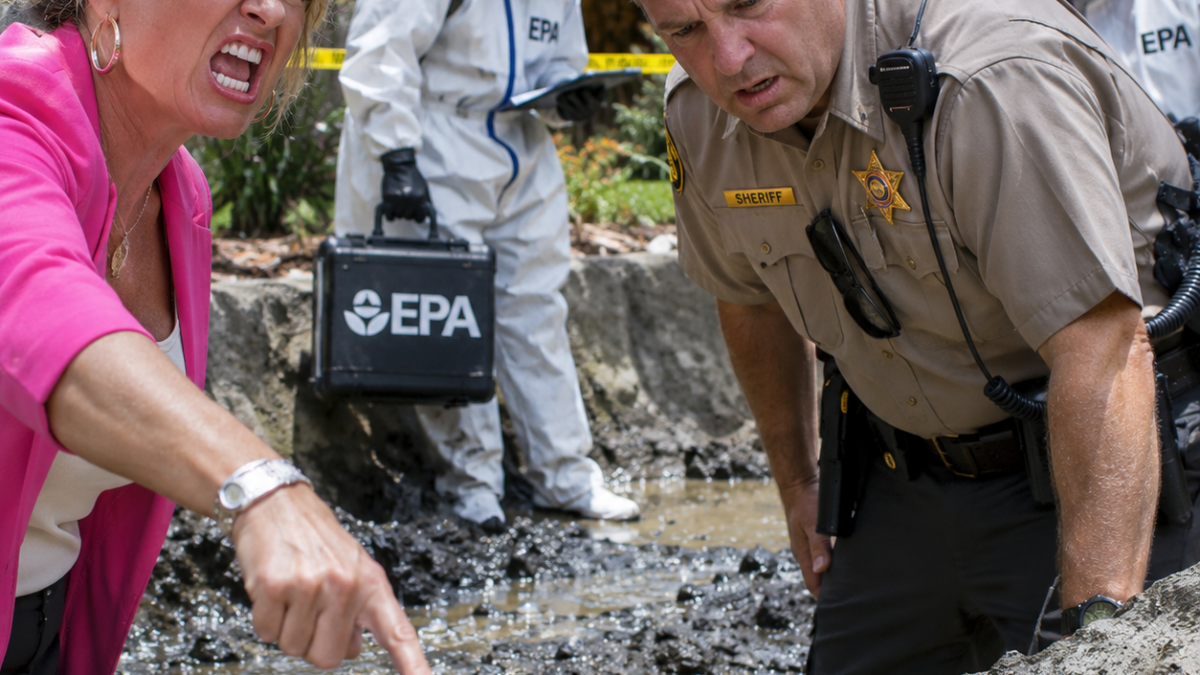
At 11:14 a.m., Constance called 911.
I didn’t know the exact time until later.
I heard the siren first.
Then saw the sheriff’s cruiser turn onto Maple Ridge Drive.
Lights flashing.
Darlene immediately adjusted her camera.
Tucker stood.
Constance was already waiting at the curb.
White blouse.
Perfect hair.
Coral lipstick.
Arms crossed.
The cruiser stopped.
Sheriff Harlan Cade stepped out.
He was in his late fifties, broad-shouldered, calm.
Constance reached him before I did.
“Officer, that man is illegally dumping hazardous chemicals into this neighborhood.”
I almost laughed.
She pointed directly at me.
“I have sent him fines. I have sent cease-and-desist orders. I have repeatedly told him to stop.”
Cade looked toward me.
Constance continued.
“He refuses to comply. There are children here. I want him arrested.”
The sheriff looked back at her.
“Ma’am, let me speak to him.”
I walked over carrying a folder.
“Sir,” he said, “you Keith Walker?”
“Yes.”
“You want to tell me what’s happening?”
“The pond is on my deed.”
I handed him the survey.
“I had the water independently tested.”
Next page.
“TCE, chromium, lead.”
His eyes moved across the numbers.
“County code enforcement inspected this yesterday.”
Next page.
“My containment setup is legal.”
Cade read the email.
Constance stepped closer.
“That doesn’t matter. The HOA—”
He raised one hand.
“Ma’am.”
She stopped.
I walked to my truck and retrieved the manila envelope.
“There’s something else.”
I handed him the photographs from the trail camera.
He looked at the first.
Then the second.
Then back at me.
“What am I looking at?”
“Someone entered the pond area after two in the morning and pumped liquid back into it.”
“Who?”
“I don’t know the individual.”
I pointed to the jacket.
“But that company is an industrial waste contractor connected financially to a company owned by Ms. Bellfield.”
Constance’s face changed.
Just slightly.
Cade saw it.
“What company?”
I told him.
He looked at Constance.
She immediately said, “This is absurd.”
Then something happened at the pond.
A sound.
Soft.
Wet.
Almost like someone popping their knuckles underwater.
We all turned.
The remaining water at the deepest part of the pond had started to move.
Not from the pump.
From below.
A bubble rose through the black mud.
Then another.
Large.
Slow.
Oily.
Each one broke on the surface and spread a rainbow ring across the water.
Cade walked toward the edge.
I followed.
The smell hit us.
He stopped.
“Jesus.”
It wasn’t just solvent.
It was rot.
Metal.
Chemical vapor.
Something old and something fresh mixed together.
More bubbles pushed through the mud.
One after another.
Cade stared for maybe ten seconds.
Then reached for his radio.
“Dispatch.”
The radio crackled.
“I need environmental emergency response contacted. Potential industrial contamination in a residential area.”
Constance stepped forward.
“Now wait a minute.”
Cade continued.
“Visible subsurface discharge. Strong chemical odor. We need Hazmat assessment.”
“You don’t understand,” Constance said.
Cade turned to her.
“Ma’am, step away from the pond.”
“But this is HOA property.”
“No one goes near that water.”
He walked to his cruiser and retrieved yellow caution tape.
For the first time in eleven years, Constance Bellfield stood on Maple Ridge Drive watching someone else take control.
Darlene’s camera recorded everything.
Cade asked me how old the pond was.
“Older than the neighborhood.”
“What was it?”
“Retention basin for Bellfield Textiles.”
His pen stopped.
“Bellfield?”
He looked at Constance.
“Any relation?”
She didn’t answer.
Not one word.
That was the moment I knew.
Not suspected.
Knew.
Six days later, the EPA arrived.
Three white vans.
Federal plates.
Technicians.
Protective suits.
Sampling equipment.
Drilling gear.
Maple Ridge had never been quieter.
Neighbors stood on driveways holding coffee.
Nobody talked much.
The same people who had complained about my pump now watched federal crews mark the ground around the pond.
The EPA tested the mud.
The soil.
The remaining water.
Then they drilled groundwater monitoring wells.
After that, they went door to door.
Every house within the target area.
Well samples.
Thirty-seven houses relied on private wells.
Four tested positive for contamination associated with the pond.
One belonged to a family with two children under ten.
When I heard that, I sat down on my porch steps.
The fight stopped feeling personal.
I had been angry about the fines.
Angry about my business.
Angry about Elaine.
But now there were kids.
Families.
People brushing their teeth.
Cooking dinner.
Filling coffee pots.
Drinking water every day while Constance’s house sat safely connected to the municipal system.
The EPA tested her property too.
Municipal water.
Clean.
She had never been drinking what everyone else drank.
That fact spread through Maple Ridge faster than any rumor I’d ever seen.
Two weeks later, the county held an emergency town hall.
Eighty-six people packed into the community center.
Standing room only.
A local television station came.
So did two newspaper reporters.
Constance sat in the fourth row beside an attorney.
She didn’t have her clipboard.
I noticed that.
For eleven years, I had almost never seen her without it.
The EPA coordinator explained the preliminary findings.
The pond had been used by Bellfield Textiles as an industrial retention basin.
Solvents.
Dye waste.
Heavy metals.
Decades of dumping.
The land had then been converted to residential development without the contamination being properly addressed.
Worse, testing and records suggested hazardous material had been added far more recently.
The room became completely silent.
Then the county attorney presented the 2003 agreement Nolan had found.
Bellfield Land Holdings.
Maintenance responsibility.
Environmental liability language.
Registered agent:
Constance R. Bellfield.
Everyone turned toward her.
Her lawyer touched her arm before she could speak.
“My client will not be making a statement.”
A low angry murmur filled the room.
Then the EPA coordinator delivered the detail that destroyed whatever trust remained.
Thirty-seven homes used private wells.
The Bellfield residence did not.
It had been connected to municipal water from the beginning.
Darlene stood.
Her hands shook.
Her voice didn’t.
“You fined my husband six hundred dollars because you said our flag was three inches too low.”
Constance kept looking down.
Darlene’s voice rose.
“And the whole time, you knew what was in that ground?”
Constance’s attorney stood.
“Please direct questions through counsel.”
Darlene ignored him.
“You knew what we were drinking?”
Nobody made a sound.
“You watched children grow up here.”
Still nothing.
“You watched people get sick.”
Constance finally looked up.
Her face was pale.
Darlene pointed at her.
“You protected yourself.”
That was all she said.
She sat down.
I was in the back row.
A reporter later asked why I didn’t confront Constance publicly.
I didn’t need to.
The truth was doing a better job than I ever could.
After the meeting, cameras surrounded me in the parking lot.
A reporter pushed a microphone toward my face.
“Mr. Walker, what first made you suspicious?”
I thought about saying the fines.
The industrial records.
Garrett.
The trail camera.
Instead I told the truth.
“My pond smelled wrong.”
“That’s all?”
I looked at the camera.
“My wife used to sit beside it every Sunday. She loved that place. After she died, I started noticing things I should’ve noticed sooner.”
The reporter waited.
“I just wanted to know why the water didn’t smell like it used to.”
The story spread.
Then investigators started digging into more than mud.
Records from Southeastern Industrial Services showed deliveries going back years.
Invoices.
Dates.
Volumes.
Locations.
Constance had not just inherited an old family problem.
The evidence suggested she had helped continue managing it.
The EPA classified Bellfield Land Holdings as a responsible party in the cleanup investigation.
Estimated remediation cost:
$1.4 million.
The county district attorney opened a separate criminal investigation.
Knowing endangerment.
Environmental violations.
Potential fraud and concealment issues.
I didn’t celebrate.
Not then.
I thought I would.
I had imagined Constance finally being cornered and expected some huge feeling of victory.
Instead I mostly felt tired.
One evening, I sat on the porch while federal crews worked behind the trees.
The pond was fenced off.
No frogs.
No water.
Just excavation lights.
I held Elaine’s old fishing reel in my hands.
Darlene came over quietly.
“You okay?”
“I don’t know.”
She sat beside me.
“I spent weeks wanting Constance destroyed.”
Darlene looked toward the worksite.
“And now?”
“Now four families have contaminated wells.”
She nodded.
“I keep thinking about Elaine.”
“Keith.”
“I know there’s no proof.”
“You don’t have to explain.”
“What if—”
She stopped me.
“Don’t.”
I looked at her.
“You loved her. You didn’t know.”
“I should’ve listened when she mentioned the smell.”
“You thought it was runoff.”
“I was wrong.”
“Yes.”
That surprised me.
Darlene didn’t soften it.
“You were wrong.”
She placed a hand on my shoulder.
“So was I. So was Harold. So was everyone who smelled something and decided there was probably a harmless explanation.”
She looked toward Constance’s house.
“The difference is that somebody knew.”
For the first time, I understood the kind of guilt I had been carrying.
It wasn’t mine to carry alone.
Garrett’s was heavier.
He testified.
He gave investigators every detail he remembered.
The barrels.
The night dumping.
The supervisors.
The chemicals.
The places records had been falsified.
After one deposition, I found him outside Nolan’s office.
He looked ten years older.
“You all right?”
“No.”
He held out his hand.
I shook it.
“I should have done this thirty years ago.”
“You’re doing it now.”
“Lorraine might still be alive.”
I had no answer.
He looked at me.
“You ever wonder if your wife…”
“Every day.”
He nodded.
“I’m sorry.”
“So am I.”
We stood in the parking lot without talking.
Some things can’t be repaired.
That was hard for a plumber to accept.
I spent my life fixing leaks, replacing broken parts, making systems work again.
But you can’t replace years.
You can’t clean poison out of a memory.
You can’t go back and warn somebody.
All you can do is decide what happens next.
Constance’s criminal case moved slowly.
Her attorney negotiated.
She cooperated with investigators and provided years of records.
The charges were reduced from what prosecutors initially considered.
I didn’t care about the exact number of years she might serve.
By then, the punishment I could see was enough.
She lost control.
The thing she valued most.
Her position.
Her reputation.
Her ability to make everyone afraid of her.
She resigned from the HOA before residents could formally remove her.
Six weeks after the town hall, a FOR SALE sign appeared outside her house.
The environmental disclosure destroyed the value.
Everyone knew why.
One Tuesday morning, I watched the white Escalade back out of her driveway.
A moving truck followed.
Constance drove past my house.
Slowly.
For a second, I thought she might stop.
She didn’t.
I was standing near the mailbox.
She looked at me through the windshield.
No clipboard.
No sunglasses.
No smile.
I didn’t wave.
I didn’t need to.
She drove away.
The HOA held its first competitive election in eleven years.
Four people ran.
Darlene won in a landslide.
At her first meeting as president, she proposed a new rule.
No fine could be issued without photographic evidence reviewed by at least two board members.
Passed unanimously.
Then Tucker raised his hand.
“I have a motion.”
Darlene sighed.
“I’m afraid to ask.”
“I move that we abolish the twelve-inch lawn ornament limit.”
The room laughed.
“Second,” someone shouted.
Darlene smiled.
“All in favor?”
Every hand went up.
The next morning, Darlene placed Harold’s garden gnome at the edge of her lawn.
Fourteen inches tall.
Tucker made a tiny sign.
PARDONED.
For the first time in a long time, Maple Ridge felt like a neighborhood instead of a monitored facility.
The cleanup took weeks.
EPA contractors removed contaminated mud.
Truck after truck.
The pond was excavated deeper than I expected.
Every layer seemed to reveal darker soil underneath.
Eventually they reached material that tested clean enough for restoration.
The basin was rebuilt.
Proper clay liner.
Controlled drainage.
Clean soil.
Native plants.
The contaminated wells received filtration systems.
The family with the two young children got theirs first.
I helped install some of the plumbing at no charge.
The father tried to pay me.
“No.”
“Keith—”
“No.”
“At least let me cover materials.”
“Already covered.”
He looked at me for a long moment.
Then shook my hand.
His little boy was standing in the doorway holding a plastic dinosaur.
That image stayed with me.
Because that was what this had become.
Not revenge.
Prevention.
Garrett understood that too.
A few months later, he came to an HOA meeting carrying an envelope.
Inside was a check for $5,000.
He donated it to create a county well-testing fund.
We called it the Maple Ridge Clean Water Fund.
The hardware store agreed to help cover testing costs.
Tucker volunteered electrical work.
Darlene organized residents.
I helped take samples when needed.
Within four months, we tested sixty-one homes.
We found another small area of solvent contamination near a different old industrial property.
Not severe yet.
Authorities intervened early.
When the county environmental officer called me with that news, I sat quietly afterward.
Maybe somebody’s daughter wouldn’t get sick.
Maybe somebody’s wife wouldn’t sit beside contaminated water for years.
Maybe that was the closest thing to repairing the past we were going to get.
A year after I first dropped my pump into the pond, I finished rebuilding the bank.
The new pond was smaller.
Cleaner.
I planted native grasses and a few flowering plants Elaine would have liked.
Then I built a bench on the south side.
Pressure-treated pine.
Nothing fancy.
Four legs.
Solid backrest.
I sanded every edge by hand.
Darlene came by while I was working.
“What’s the plaque say?”
I covered it with my hand.
“Not yet.”
“Keith.”
“You taught fourth grade, not patience?”
She laughed.
When I finished, I screwed the brass plaque into the backrest.
Five words.
ELAINE’S POND — PEACE LIVES HERE.
Darlene read it.
Then hugged me.
I’m not much of a hugger.
I let her.
The frogs came back about a month later.
At first, just one.
I was sitting on the bench at dusk when I heard it.
A low croak from the reeds.
I froze.
Then another answered from the far bank.
Within a week, there were dozens.
Loud.
Annoying.
Perfect.
I sat there with my coffee one Sunday evening.
The water smelled like mud.
Grass.
Rain.
Nothing else.
I closed my eyes.
For a second, I could see Elaine beside me.
Bare feet.
Fishing rod.
That ridiculous sun hat she loved.
“You’ll miss the frogs someday,” she had told me.
“I did,” I whispered.
The frogs kept singing.
A breeze moved across the water.
And for the first time since she died, the pond didn’t feel like a place where I had lost her.
It felt like a place where she had lived.
That difference mattered.
Constance had tried to make the fight about power.
She used fines.
Threats.
Rumors.
My business.
She tried to shame me for grieving.
She tried to make the neighborhood afraid to ask questions.
And when I finally lowered the water enough to expose what she had spent years hiding, she called the police and demanded that I be arrested.
Instead, the sheriff stood at the edge of that pond, watched black chemical bubbles rise out of the mud, and called the EPA.
Constance wanted me stopped.
She stopped herself.
The final invoice for the environmental cleanup reached approximately $1.4 million.
Her company faced the financial consequences.
Investigators took the records.
The HOA removed the rules she had abused.
The neighbors she had frightened learned to speak to one another again.
And the pond she had guarded more fiercely than any mailbox, fence, or garden gnome was finally clean.
People sometimes ask me whether draining it was revenge.
I’ve thought about that question.
At first, maybe part of me wanted revenge.
After what she said about Elaine.
After she attacked my business.
After she tried to make me look unstable.
I wanted her to feel what it was like to have somebody threaten the things you worked your whole life to build.
But revenge wasn’t what I felt when I watched her Escalade disappear down Maple Ridge Drive.
I felt relief.
Because revenge is about making someone suffer.
What happened at Maple Ridge became something better.
The truth came out.
Families got clean water.
Garrett finally told the story he had carried for decades.
Darlene turned the HOA into something that served residents instead of punishing them.
Another contaminated site was found before it became worse.
And I got my pond back.
Not the old pond.
That one was gone.
The water Elaine sat beside had been drained.
The poisoned mud had been hauled away.
The reeds were new.
The clay was new.
Even the frogs were probably different frogs.
But the peace was real.
One evening, almost two years after everything started, I walked down there carrying two cups of coffee.
Habit.
I didn’t realize what I had done until I reached the bench.
I looked down at both cups.
For a moment, my chest hurt.
Then I laughed.
“Still making yours,” I said.
I placed the second cup beside the plaque.
The sunset spread across the water.
Orange.
Gold.
No rainbow chemical sheen.
Just light.
I sat down.
For years after Elaine died, I thought keeping the house meant refusing to let go.
Maybe part of me believed that if I preserved everything exactly the way she left it, I could keep losing her from becoming permanent.
But the pond taught me something.
Sometimes you don’t honor what you loved by keeping it untouched.
Sometimes you honor it by digging out everything poisonous that got buried underneath.
Even when it’s ugly.
Even when it smells terrible.
Even when powerful people tell you to stop.
You drain the water.
You expose the mud.
You find the truth.
Then you rebuild.
The frogs started as the sun disappeared.
I leaned back against the bench.
For once, I didn’t close my eyes and pretend Elaine was still there.
I didn’t need to.
I let myself miss her.
I let myself remember her.
And I let the new pond be new.
Across the water, fireflies appeared in the grass.
Somewhere behind me, Darlene yelled at Tucker for putting another oversized garden gnome on her lawn.
He yelled back that HOA rules allowed it now.
She told him that didn’t mean she wanted twenty of them.
I laughed so hard I nearly spilled my coffee.
That was Maple Ridge now.
Messier.
Louder.
Less perfect.
More human.
Constance had spent eleven years trying to control every visible inch of the neighborhood.
In the end, the ugliest thing in Maple Ridge had been the one thing she kept insisting nobody should look at.
I looked down at Elaine’s plaque.
“Peace lives here.”
Five words.
She would have liked that.
Although knowing Elaine, she probably would have told me the bench needed another coat of stain.
The frogs got louder.
I stayed until the stars came out.
Then I stood, picked up both coffee cups, and walked back toward the house.
Halfway across the yard, I stopped and looked behind me one last time.
The pond reflected the moon.
Clear.
Still.
Clean.
And for the first time in years, I didn’t smell chemicals.
I smelled exactly what Elaine had always smelled.
Wet mud.
Cut grass.
Something green.
Something alive.
Peace.








