PART 2: HOA Karen Called 911 When I Changed My Own Locks — She Had No Idea Who the Officers Were About to Recognize
PART 2
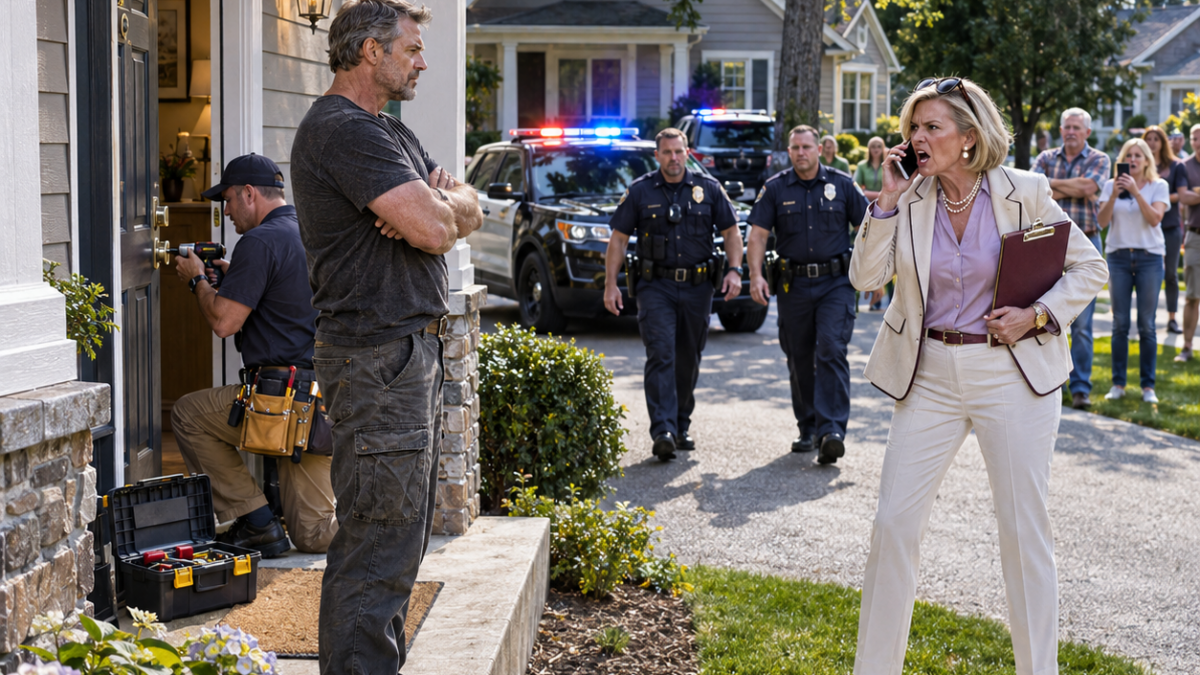
Officer Daniel Mercer stopped beside his cruiser with one hand resting near his belt.
For half a second, he simply stared at me.
Then recognition hit.
His shoulders straightened.
“Deputy Director Carter?”
Karen’s smile faltered.
I stepped off the porch.
“Former Deputy Director,” I corrected. “Retired now.”
Mercer had worked with a Marshals fugitive task force years earlier. I remembered him as a young patrol officer with good instincts and the annoying habit of volunteering for every dangerous assignment before anybody else could.
Apparently, he remembered me too.
He snapped to attention and saluted.
The second officer, a younger man named Collins, looked from Mercer to me, saw the badge case I had opened in my hand, and straightened as well.
“Sir.”
He saluted too.
The entire street went silent.
Karen froze with her phone still pressed against her palm.
Roy slowly lowered his screwdriver.
A curtain moved in the house two doors down.
Then another.
I had dealt with armed fugitives who recovered from surprises faster than Karen Whitmore did.
Her mouth opened.
Nothing came out.
Mercer lowered his hand first.
“I heard you retired.”
“Trying to.”
His eyes flicked toward Karen.
“Apparently not quietly.”
“That part has been difficult.”
Karen finally found her voice.
“Excuse me?”
Mercer turned toward her.
She pointed at me.
“That man is breaking into this residence.”
Mercer looked at the house number.
Then at me.
Then back at Karen.
“Ma’am, are you saying Mr. Carter doesn’t live here?”
“The homeowner is supposed to be—”
“I am the homeowner,” I said.
Karen spun toward me.
“You never told me—”
“Told you what?”
Her eyes dropped toward the old federal badge in my wallet.
“That.”
I closed it.
“I didn’t realize my résumé was required to change my locks.”
Collins tried not to smile.
Karen stepped toward Mercer.
“I called because his behavior was suspicious.”
“What behavior?”
“He hired someone to modify the house without authorization.”
Roy raised his hand slightly.
“I’m a locksmith.”
Karen ignored him.
“The HOA requires approval for exterior changes.”
Mercer’s forehead creased.
“Ma’am, you called 911 and reported a burglary.”
“I believed one was occurring.”
“You told dispatch the man was aggressive.”
“He was confrontational.”
Roy looked at me.
I looked at Roy.
Neither of us said anything.
Mercer glanced toward the bag of hardware beside the door.
“You replacing your locks, Chief?”
“Apparently.”
“Why?”
That was the moment I had been waiting for.
I took out my phone.
“Because somebody entered my house without permission last Thursday.”
Karen’s face tightened.
Mercer’s expression changed immediately.
“Do you have a report?”
“Not yet. I preserved the footage and sent a copy to counsel.”
Karen stepped forward.
“This has nothing to do with—”
I tapped the screen.
The video began.
At first, all anyone could see was my backyard.
Then the gate opened.
Karen walked through it.
Lavender blazer.
Pearls.
Clipboard.
Behind her came a maintenance worker carrying a small tool bag.
Roy muttered, “Well, damn.”
The camera showed Karen trying the back door.
It opened.
She entered.
Collins stepped closer.
“Is that her?”
Karen’s voice became sharp.
“That footage is being presented without context.”
I let the video continue.
She moved through my kitchen.
Opened a cabinet.
Checked my thermostat.
Opened the refrigerator.
Then walked toward my office.
Mercer looked at her.
“What was the purpose of the entry?”
“HOA inspection.”
“Did Mr. Carter authorize it?”
“The association has inspection rights.”
“That wasn’t my question.”
Karen drew herself up.
“We are permitted to enter properties when necessary to ensure compliance.”
I paused the video on the frame showing her holding my property folder in one hand and her phone in the other.
“What compliance issue required photographing my deed?”
The color drained from her cheeks.
“That’s not what I was doing.”
“Then tell them what you were doing.”
She looked toward Mercer.
“You have no idea how difficult it is managing this neighborhood. Residents constantly violate standards and then pretend they weren’t notified.”
Mercer remained calm.
“Did you have permission to enter his home?”
Karen hesitated.
“I had association authority.”
“Yes or no.”
Her lips compressed.
“No.”
The word hung there.
A neighbor across the street actually gasped.
Karen heard it.
She looked around.
By then at least eight people were outside.
Frank Patterson, the retired electrician from three houses down, stood at the end of his driveway with both hands in his pockets.
Linda Foster from Lot 17 was filming from behind a flower bed.
Walter Briggs, an HOA board member, had come onto his porch.
Karen’s eyes moved between them.
Embarrassment replaced panic.
And embarrassment, with people like Karen, was more dangerous.
She pointed at me.
“This is exactly what he wanted.”
I almost laughed.
“I wanted new locks.”
“You deliberately provoked me.”
“By securing my house?”
“You knew I would respond.”
Mercer raised a hand.
“Mrs. Whitmore.”
She ignored him.
“You moved here three months ago and immediately started challenging everything.”
“I responded to twenty-three violation notices.”
“Because you refuse to respect the community!”
“Karen.”
Mercer’s voice sharpened.
She stopped.
“This is a police response, not an HOA meeting.”
The street went quiet again.
He continued.
“You called 911 and reported a burglary. Mr. Carter has established that he owns and occupies the property. His locksmith has confirmed why he’s here. Your original complaint is not supported by what we found.”
Karen’s face was red now.
“So I made a mistake.”
“That’s what the report will say if that’s what the evidence supports.”
She folded her arms.
“Fine.”
Mercer looked toward my phone.
“But we now also have a separate allegation involving unauthorized entry into an occupied residence.”
Karen stared at him.
“You’re not seriously suggesting I committed a crime.”
“I’m suggesting we document what happened.”
“I’m the HOA president.”
Mercer nodded once.
“And?”
The word landed harder than any insult could have.
Karen’s entire identity was built around that title.
President.
The person people called.
The person whose signature appeared on every notice.
The person who decided what color mailbox was acceptable and how many hours a trash bin could remain visible.
Mercer had reduced all of it to one syllable.
And?
Karen looked at me.
There was hatred in her eyes now.
Not because I had attacked her.
Because the uniform standing beside her had failed to treat her power as important.
“I’ll be filing a complaint,” she said.
“Against whom?” Collins asked.
“All of you.”
Collins nodded.
“That’s your right.”
She turned toward me.
“And you.”
“Get in line.”
She stalked across the street.
Duchess, watching from Karen’s porch, began barking furiously as though she had been waiting for permission.
Karen grabbed the dog’s leash and disappeared inside.
Her front door slammed.
Only then did Roy exhale.
“You could have warned me.”
“About what?”
“That your normal Saturday includes police saluting you.”
“It usually doesn’t.”
Mercer laughed.
“Still drinking terrible coffee?”
I picked up my mug.
“Some traditions survive retirement.”
He took my statement.
Collins photographed the back door, the old lock, and the time stamp on the security footage.
I gave them the maintenance worker’s image and explained I had not yet identified him.
Mercer gave me an incident number.
“You want to pursue the entry?”
“Yes.”
That surprised Frank, who was still standing nearby.
Maybe he thought I would let it go after humiliating Karen.
I wouldn’t.
Not because I wanted revenge.
Because entering another person’s home and photographing private documents was not an HOA disagreement.
If I ignored it because she looked ridiculous now, I would be teaching her exactly the wrong lesson.
Mercer nodded.
“We’ll send it to the county investigator.”
“Appreciate it.”
Before leaving, he looked toward Karen’s house.
“You think she’s done?”
“No.”
He smiled without humor.
“Neither do I.”
The cruisers drove away.
For several seconds nobody moved.
Then Frank crossed the street.
He was seventy-one, broad-shouldered, silver-haired, and usually wore the expression of a man perpetually disappointed by modern appliances.
He looked at my new deadbolt.
Then at me.
“Twenty years.”
“What?”
“I’ve lived here twenty years.”
He pointed across the street.
“That woman has been president for seven of them. Nobody has ever shut her up for that long.”
“I didn’t shut her up.”
“You showed her a video.”
“Technology did most of the work.”
Frank grinned.
“I like you.”
Other neighbors came over.
That was when I learned Karen’s behavior toward me wasn’t unusual.
My experience was just more extreme.
Linda Foster had received a $300 fine because her teenage daughter drew sidewalk chalk flowers near the curb.
A widower named Paul had been threatened with a lien over an unpaid $42 landscaping assessment he claimed he had never received.
Frank had been cited for replacing his mailbox post with one that was three-quarters of an inch wider than the approved model.
Three-quarters of an inch.
He still had the measuring photograph.
“They sent a guy out with calipers,” he said.
“You’re joking.”
“I wish.”
Walter Briggs approached last.
Unlike the others, he looked uncomfortable.
“James.”
“Walter.”
He glanced toward Karen’s house.
“I’m on the board.”
“I know.”
“This situation…”
He hesitated.
“That’s not normal.”
“Which part?”
He almost smiled.
“Fair.”
Then his expression became serious.
“I didn’t know she was entering homes.”
“You believe me now?”
“I saw the footage.”
“She said HOA bylaws allow it.”
Walter frowned.
“They allow exterior compliance inspections after written notice. There are limited emergency provisions for common infrastructure.”
“Do those include opening my refrigerator?”
“No.”
“Photographing my property records?”
“No.”
He sighed.
“I’ll request an emergency board meeting.”
“Do what you think is necessary.”
“You should attend.”
“I’d rather not.”
“You’re the affected homeowner.”
“I’ll send evidence.”
Walter looked at me for a long moment.
“You really don’t want to fight her, do you?”
“I spent most of my adult life fighting people who actually needed fighting.”
I looked toward Karen’s closed blinds.
“I bought this house because I was tired.”
Walter’s face softened.
That was the first moment anyone in Maplewood understood the part of this story I rarely said out loud.
Retirement had not felt like victory.
It had felt like withdrawal from a life that had consumed nearly everything else.
For twenty years, my phone had rung at 2:00 a.m.
My wife, Sarah, had learned to sleep through the sound of me dressing in darkness.
She had learned not to ask when I would be home because I usually didn’t know.
We had planned to buy a quiet house together after retirement.
Cancer changed that plan.
Sarah died eleven months before I moved to Maplewood.
The house was supposed to be mine and hers.
Instead, I signed the closing papers alone.
That was why the break-in bothered me beyond the obvious violation.
Home was the one place I had promised myself would no longer belong to the job, the government, somebody else’s emergency, or anybody who believed they could simply walk in because they had authority.
Karen hadn’t known any of that.
She didn’t need to.
A boundary does not require a tragic explanation before people are obligated to respect it.
Walter nodded slowly.
“I’ll call the meeting.”
Then he left.
Roy finished the locks just before sunset.
He tested the deadbolt twice.
“Solid.”
I turned the key.
The bolt slid into place with a clean metallic click.
For the first time since I had watched the security footage, my shoulders loosened.
Roy packed his tools.
“Invoice will be in your email.”
“Add an inconvenience fee.”
“For what?”
“Getting accused of burglary.”
He grinned.
“I’m charging you for the story.”
“Fair.”
He drove away.
I made another cup of coffee and carried it to the porch.
Across the street, Karen’s blinds moved.
She was watching.
I raised my mug slightly.
The blinds snapped shut.
I thought the day was over.
At 6:47 p.m., somebody knocked.
Not Karen.
A courier.
He handed me a stiff white envelope embossed with the Maplewood Estates logo.
I signed.
Inside was a notice.
UNAUTHORIZED EXTERIOR SECURITY MODIFICATION.
The HOA accused me of replacing a visible exterior fixture without architectural approval.
Potential fine:
$500 per occurrence.
I read it twice.
Then I started laughing.
Karen had called 911 on me.
Police had documented her unauthorized entry.
The board was considering an emergency meeting.
And her response was to fine me for the lock I installed because she had entered my house.
I carried the notice into the kitchen.
Placed it beside the incident report number.
Then I opened a new file folder.
On the tab, I wrote:
WHITMORE.
My phone rang.
My attorney, Michael Reeves.
“I heard you had an interesting afternoon.”
“Small town.”
“Small neighborhood.”
“How did you hear?”
“Roy called me.”
“You know Roy?”
“He changes the office locks.”
“Apparently everybody knows everybody except me.”
Michael laughed.
Then his tone changed.
“I reviewed the footage.”
“And?”
“Do not delete anything.”
“Wasn’t planning to.”
“Your HOA documents also contain an inspection clause, but nothing remotely authorizing what she did.”
“That’s what Walter said.”
“She could have exposure for trespass. Potentially unlawful entry depending on how the prosecutor views the facts. Photographing documents complicates it.”
“What about the maintenance worker?”
“Identify him.”
“I have a face.”
“The board may know.”
I looked at Karen’s newest violation notice.
“She just fined me.”
“For what?”
“The replacement locks.”
Michael went silent.
Then he laughed.
Actually laughed.
“That woman is going to put my children through college.”
“I’m glad somebody benefits.”
“Do not pay it.”
“I wasn’t going to.”
“Appeal it according to the bylaws. Make them create a record.”
That was why I paid Michael.
He understood something that my old job had taught me too.
People who abuse authority depend on informal fear.
They hate records.
Records have dates.
Records have signatures.
Records survive shouting.
So I appealed.
The next morning, I emailed a one-page response.
I included the locksmith invoice.
Photographs of the old and new locks.
The police incident number.
A still image showing Karen entering my back door.
Then I wrote:
The lock replacement was necessary after unauthorized entry by the HOA president. Please preserve all correspondence, inspection records, board authorizations, key-access records, contractor communications, and electronic messages related to my property.
I copied every board member.
Karen answered eleven minutes later.
Her reply contained six paragraphs.
None addressed the preservation request.
Instead she accused me of “weaponizing a private disagreement.”
Walter replied to the entire chain.
Mrs. Whitmore, please cease direct enforcement activity concerning this property until the board reviews the matter.
Karen answered:
I AM THE ELECTED PRESIDENT AND WILL CONTINUE PERFORMING MY DUTIES.
All capitals.
Never a good sign.
By noon, the neighborhood group chat had screenshots.
I hadn’t posted them.
Somebody on the board had.
That afternoon, Frank appeared at my fence carrying two beers.
“I hear you’re dangerous.”
“Apparently.”
“Mind if I associate with a known criminal?”
“One beer is admissible bail.”
He handed it over.
We sat on my porch.
Frank looked across the street.
“You know why nobody challenged her?”
“Fines?”
“Partly.”
He took a drink.
“Mostly exhaustion.”
I understood that.
“Karen can argue longer than anybody. You tell her she’s wrong, she produces three pages. You answer the three pages, she schedules a hearing. You win the hearing, suddenly there’s another inspection.”
“So people quit.”
“Exactly.”
He rubbed the label on his bottle.
“My wife used to fight her.”
“Used to?”
Frank’s expression changed.
“Diane died two years ago.”
“I’m sorry.”
“She hated those damn mailbox rules.”
He smiled faintly.
“After she died, Karen sent me a violation because the flower bed got overgrown.”
I looked at him.
“Three days after the funeral.”
My jaw tightened.
“She knew?”
“Attended the funeral.”
That told me more about Karen than any rulebook could.
Frank looked toward my yard.
“You know what Diane used to say?”
“What?”
“Some people don’t want respect. They want witnesses.”
I remembered that.
The emergency board meeting happened Thursday night.
The clubhouse held maybe sixty people comfortably.
Nearly a hundred showed up.
Some stood along the walls.
Others crowded the hallway.
Karen sat at the front beside six board members.
Lavender blazer again.
Pearls.
Stack of documents.
If public humiliation had shaken her, she had reconstructed herself out of stationery.
Walter called the meeting to order.
“We are here to address recent concerns regarding inspection procedures, homeowner privacy, and enforcement authority.”
Karen immediately leaned toward the microphone.
“We are actually here because one resident has created unnecessary hostility toward this association.”
Murmurs moved through the room.
Walter sighed.
“Karen.”
“No. I’m not going to allow my reputation to be destroyed by a newcomer.”
I sat in the third row.
Michael Reeves sat beside me.
He leaned over.
“You sure you don’t want popcorn?”
“Professional.”
“I am professional.”
“You brought popcorn.”
“Emergency snack.”
Karen pointed toward me.
“Mr. Carter has deliberately misrepresented a routine compliance visit as a criminal intrusion.”
I raised my hand.
Walter looked at me.
“Mr. Carter?”
“May I ask one question?”
Karen rolled her eyes.
Walter nodded.
I stood.
“Did I give you permission to enter my house?”
Karen stiffened.
“We had association authorization.”
“That wasn’t my question.”
Michael whispered, “Careful.”
I nodded.
Karen looked around the room.
Then back at me.
“No.”
“Thank you.”
I sat.
The murmuring became louder.
Karen slapped one hand against the table.
“The bylaws grant inspection rights.”
Walter opened a binder.
“Exterior inspection rights after notice.”
“There are emergency provisions.”
“What emergency existed?”
Karen hesitated.
“We had received a report.”
“From whom?”
“A resident.”
“Which resident?”
“That information is confidential.”
Walter looked toward the other board members.
“Was the board notified?”
Silence.
One member shook his head.
Then another.
Karen’s face tightened.
“The president does not need a formal vote to investigate obvious violations.”
“What violation?”
She turned toward me.
“Unauthorized interior modifications.”
I almost laughed.
Walter stared at her.
“How would you know about interior modifications before entering the house?”
The room went silent.
Karen realized the trap immediately.
Her lips parted.
Closed.
Michael leaned toward me.
“That might be my favorite moment.”
Karen reached for a paper.
“We had reason to believe—”
“Based on what?” Walter asked.
She couldn’t answer without admitting either she had invented the justification or had been surveilling my interior somehow.
So she changed direction.
“This entire process is becoming a personal attack.”
A woman in the back called out.
“So was going through his mail!”
Applause broke out.
Walter hit the gavel.
“Please.”
Karen’s face flushed.
I stood again.
“Mr. Briggs, I have printed stills from the footage and a copy of the complete video available for board review.”
I carried a folder forward.
Karen stared at it.
I laid out photographs one by one.
Karen entering the gate.
Karen opening my back door.
Karen in my kitchen.
Karen in my office.
Karen holding my property documents.
Walter’s expression became darker with each image.
One board member, Alice Monroe, covered her mouth.
“Karen, what were you looking for?”
Karen’s voice became quiet.
“Compliance documentation.”
“In his deed?”
Karen looked at me.
“You were being difficult.”
That sentence changed the room.
Not because it proved a crime.
Because it revealed motive.
I hadn’t been dangerous.
I hadn’t created an emergency.
I had been difficult.
Meaning I had said no.
Walter leaned back.
“Mrs. Whitmore, pending a full review, I move that your enforcement authority be suspended.”
Karen stared at him.
“You cannot do that.”
Alice spoke.
“I second.”
Karen turned toward her.
“Alice.”
“I’m sorry.”
“You’re sorry?”
Alice swallowed.
“You entered his home.”
“I was protecting Maplewood.”
“From a deadbolt?”
A few people laughed.
Karen slammed her palm on the table.
“Enough!”
The room fell silent.
She stood.
“I built this community.”
Frank muttered behind me.
“She personally poured every sidewalk.”
Karen heard him.
Her face went crimson.
“You people have no idea what I do for you.”
Walter stayed calm.
“Sit down.”
“No.”
“Karen.”
“I kept property values up. I fought contractors. I enforced standards none of you had the courage to enforce. Half of you thank me privately and criticize me publicly.”
Nobody answered.
That silence wounded her more than booing would have.
Walter called the vote.
Five board members supported suspension.
One abstained.
Karen was the only vote against.
When Walter announced the result, she didn’t move.
For the first time, she looked genuinely lost.
Then she found me in the crowd.
“You.”
I didn’t respond.
“You came here and turned everyone against me.”
“No.”
My voice carried through the room.
“I installed a lock.”
Several people laughed despite themselves.
Karen pointed toward me.
“You think this is funny?”
“No.”
I stood.
“You entered my home. Then you called 911 when I tried to secure it. Nobody made those decisions for you.”
Her finger trembled.
“You humiliated me.”
“I showed what happened.”
“That’s the same thing.”
“No, Karen.”
I shook my head.
“It only feels the same when the truth is embarrassing.”
She grabbed her papers and stormed out.
The clubhouse door slammed hard enough to shake the framed neighborhood map.
For several seconds, nobody moved.
Then Frank started clapping.
Others joined.
I didn’t.
Michael noticed.
“You okay?”
“Yeah.”
“You won.”
“I didn’t come here to win.”
That was true.
And it would become important later.
Because Karen believed every conflict had one winner and one loser.
If she lost power, somebody else must have stolen it.
If she was embarrassed, somebody must have humiliated her.
If people rejected her, somebody must have turned them against her.
She could not yet imagine the possibility that consequences were not attacks.
The next morning, I found a formal HOA summons in my mailbox.
Unauthorized security modification.
Hostile conduct toward an HOA officer.
Misuse of law-enforcement influence.
Failure to preserve neighborhood harmony.
I read the last one twice.
Failure to preserve neighborhood harmony.
Apparently harmony meant Karen remained president.
The notice ordered me to appear at another disciplinary hearing within forty-eight hours.
At the bottom were Karen’s typed initials.
K.W.
I called Walter.
“Did the board authorize this?”
A long pause.
“No.”
“She’s suspended.”
“I know.”
“She signed it as president.”
“I know.”
“Walter.”
“I’m dealing with it.”
“You may want to deal faster.”
He sighed.
“She still has administrator access to the HOA website and document system.”
“Change the passwords.”
“We’re trying.”
I closed my eyes.
“You’re trying to change a password?”
“She registered several accounts under her personal email.”
Of course she had.
Control rarely lives in one place.
It lives in passwords.
Keys.
Bank accounts.
Mailing lists.
Vendor relationships.
The little systems nobody notices until one person owns all of them.
“Walter, secure everything.”
“We are.”
“Bank accounts?”
“Two signatures required.”
“Good.”
“Mostly.”
I didn’t like that word.
“What does mostly mean?”
He hesitated.
“We’re reviewing some discretionary accounts.”
My old instincts stirred.
“Have your accountant review them.”
“We are.”
“Independent accountant.”
Another pause.
“I’ll suggest it.”
After we hung up, I called Michael.
“Karen’s still issuing notices.”
“I saw.”
“How?”
“She copied me.”
“Good.”
“That was sarcasm.”
“I know.”
Then he became serious.
“The board needs to lock down records. If there’s a governance dispute, documents have a funny way of disappearing.”
“You think there’s more?”
“I think somebody willing to walk into a house and photograph a deed because a homeowner said no probably doesn’t have healthy boundaries elsewhere.”
I wrote that down mentally.
The county investigation into my break-in moved quietly.
The maintenance worker was identified as Leonard Price, an independent handyman who did occasional HOA work.
A deputy interviewed him.
The next day, Leonard called me.
“I want to apologize.”
“You should probably speak through your attorney.”
“I don’t have one.”
“Then you especially should consider one.”
He sounded frightened.
“Mrs. Whitmore told me you had given the HOA permission.”
I said nothing.
“She said there was an inspection authorization on file.”
“Did you see it?”
“No.”
“Did you ask?”
“No.”
Silence.
“I should have.”
“Yes.”
“She told me you were out of town and that we needed to document unauthorized work before you came back.”
“What unauthorized work?”
“She never said.”
I looked toward Karen’s house.
“Did she tell you to photograph documents?”
“No. I was in the kitchen when she went into the office.”
“Did you see her opening drawers?”
He hesitated.
“Yes.”
“Tell the deputy that.”
“I did.”
Good.
He wasn’t innocent.
But he was cooperating.
There was a difference.
That evening, somebody taped another notice to my door.
This one claimed my security cameras violated neighborhood privacy standards.
I laughed.
Then photographed the notice.
Then photographed Karen standing across the street photographing me photographing the notice.
It was becoming absurd enough to be funny.
But humor didn’t eliminate risk.
People who are losing control sometimes become unpredictable.
So I made one decision.
I invited witnesses.
Not officers.
Not backup.
Friends.
Saturday afternoon, I hosted a barbecue.
I had planned it small.
Frank.
Linda.
Walter.
Alice.
Roy.
A few other neighbors.
Then Mercer heard about it.
“You grilling?”
“Possibly.”
“I’m off Saturday.”
“That sounds like a personal problem.”
“You owe me lunch for the false burglary call.”
“I did not make that call.”
“Still your neighborhood.”
He invited Collins.
Then Dave Monroe, another old task-force friend, heard.
Then Russell McLean, a former Marshals colleague who now worked a federal supervisory position nearby, texted me.
HEARD YOU GOT ARRESTED FOR CHANGING A LOCK.
I answered:
TRAGIC. SEND BBQ SAUCE.
By Saturday morning, I had twenty-four people coming.
Some happened to work in law enforcement.
Most were off duty.
Nobody came in uniform at my request.
I did not want a show of force.
Mercer ignored me slightly and arrived wearing a department polo.
Russ drove his government-issued SUV because he had come directly from work.
That was enough.
At noon, Maplewood Drive smelled like ribs, hamburgers, charcoal, and the first genuinely relaxed Saturday the neighborhood had seen in months.
Frank wore an apron reading:
KISS THE COOK, IGNORE THE HOA.
Alice laughed so hard she had to sit down.
Kids played cornhole on my lawn.
Linda brought potato salad.
Walter brought six folding chairs and spent half the afternoon apologizing to everyone for serving on the board.
“No confession required,” Frank told him. “Community service begins at the cooler.”
I was standing at the grill when Karen’s front door opened.
Conversation didn’t stop.
But it changed.
People noticed.
Karen stepped onto her porch.
No clipboard.
Then she saw Mercer.
Collins.
Russ’s black SUV.
Several men and women she recognized from the 911 response.
Her expression moved from confusion to suspicion.
Then anger.
She crossed the street.
Heels hitting pavement.
Frank leaned toward me.
“Incoming.”
“Behave.”
“I’m seventy-one. I’ve been waiting decades to stop behaving.”
Karen reached my driveway.
“What is this?”
I flipped a burger.
“Lunch.”
“You’re hosting an unauthorized gathering.”
Alice looked over from the picnic table.
“Karen.”
Karen’s head snapped toward her.
“You’re suspended.”
“I am still the elected president until a formal removal vote is certified.”
Walter stood.
“Actually, your suspension specifically removed enforcement authority.”
Karen ignored him.
She pointed toward the vehicles.
“You’re bringing law enforcement into this neighborhood to intimidate me.”
Mercer looked down at the plate in his hand.
“Ma’am, I’m eating potato salad.”
Russ nearly choked on his drink.
Karen pointed at him.
“And who are you?”
“Russ.”
“That doesn’t answer my question.”
“It answered exactly what you asked.”
Frank made a coughing noise that sounded suspiciously like laughter.
Karen turned toward me.
“This is deliberate.”
“The barbecue?”
“This spectacle.”
I looked around.
Children were playing.
Neighbors were talking.
Roy was helping Collins move a cooler.
My old colleagues were eating ribs.
No one was watching Karen except because she had walked into the party and started yelling.
“Karen, nobody here was discussing you.”
She looked wounded by that.
It lasted only a moment.
“You’re mocking me.”
“No.”
“You think because you were some federal official you can make me look small.”
I put down the spatula.
The yard quieted.
“Karen, listen carefully.”
She folded her arms.
“I did not make you enter my house.”
Her face tightened.
“I did not make you call 911.”
“You manipulated—”
“I did not make you file a violation against the lock I installed because you entered my house.”
She looked around.
Nobody interrupted me.
“I did not make the board suspend you.”
“You turned them against me.”
“No.”
My voice remained quiet.
“You keep demanding credit for everything good that happens in Maplewood and blaming somebody else for every consequence you don’t like.”
Her mouth opened.
I continued.
“You want to know why people are here today?”
She said nothing.
“Because they wanted to come.”
That struck her.
Community had always been something Karen organized.
Approved.
Scheduled.
Regulated.
Here were her neighbors laughing together without her permission.
That was what she could not stand.
She looked at Alice.
Alice met her eyes but said nothing.
At Walter.
He looked down.
At Frank.
He took a bite of his burger.
At Linda.
She turned back toward her daughter.
Karen was surrounded by people and completely alone.
Her eyes filled.
She blinked hard.
For the first time, I felt something other than anger toward her.
Pity.
Then she looked at me again.
“You took everything from me.”
I shook my head.
“No.”
She turned.
Walked across the street.
Duchess barked from the window.
Karen entered her house.
The door closed softly this time.
No slam.
For several seconds, nobody spoke.
Then Mercer said, “This potato salad really is excellent.”
Laughter returned.
I appreciated him for that.
The barbecue continued until sunset.
No speeches.
No victory celebration.
No one toasted Karen’s downfall.
We just ate.
Talked.
Laughed.
It was the most normal afternoon I’d had since Sarah died.
That realization caught me unexpectedly.
At one point, I stood alone by the grill watching Frank argue with Russ about football.
Alice was teaching two children how to play cornhole.
Roy had discovered my garage refrigerator and appointed himself beverage coordinator.
For a moment, I could almost hear Sarah.
This is what you wanted, James.
Not silence.
Peace.
I had confused the two.
Silence was an empty house.
Peace was being able to fill it with people without fear.
That night, after everyone left, I found a folded note beneath my doormat.
One sentence.
YOU HUMILIATED ME. I WILL NEVER FORGIVE YOU.
I read it.
Folded it.
Placed it with the other evidence instead of throwing it away.
Old habits.
The next morning, the barbecue was online.
Linda’s teenage son had posted a twenty-second clip.
Karen standing at my driveway.
Mercer holding a hamburger.
Russ laughing.
Me telling Karen, “Nobody here was discussing you.”
Fifty thousand views by lunchtime.
Then seventy.
Then a hundred thousand.
Memes appeared.
FEDERAL BARBECUE ENFORCEMENT DIVISION.
WHEN YOU CALL 911 BUT THE BURGLAR USED TO RUN THE TASK FORCE.
One showed me holding a spatula like a badge.
I didn’t share any of them.
Karen saw them anyway.
At three that afternoon, her car left.
She didn’t return for six days.
Maplewood became strangely quiet.
Too quiet.
On the seventh night, somebody attempted to log into my home security account.
The system sent me an alert.
Failed password.
Then another.
Then another.
The source location wasn’t enough to identify anyone, and I refused to speculate.
I changed the password.
Enabled additional authentication.
Documented the time.
The next morning, a yellow envelope was taped to my front door.
FORMAL HOA INVESTIGATION.
The document accused me of unauthorized gatherings, harassment of an HOA official, misuse of professional influence, community intimidation, and “conduct damaging to neighborhood trust.”
At the bottom:
POTENTIAL SANCTIONS MAY INCLUDE REVOCATION OF RESIDENCY PRIVILEGES.
I stood on my porch laughing so hard Frank heard me from across the street.
“What?”
I held up the paper.
“She’s evicting me.”
“From your own house?”
“Apparently.”
Frank considered it.
“That saves on moving expenses.”
I handed him the notice.
His smile disappeared.
“She signed this?”
“Yes.”
“She’s suspended.”
“Yes.”
“She’s insane.”
“I’m trying not to use diagnostic terminology.”
He looked across the street.
Karen was behind her hedge holding a phone.
Filming us.
I waved.
She lowered it.
That afternoon I prepared a binder.
Every notice.
Every email.
Security stills.
The full video on a flash drive.
Police report.
Locksmith invoice.
Karen’s handwritten note.
Board suspension notice.
Copies of messages between Karen and Leonard Price obtained through the investigation.
I labeled the binder:
MAPLEWOOD — WHITMORE MATTER.
Frank wanted me to call it THE KAREN FILES.
Michael vetoed that.
“Judges appreciate boring labels.”
“Unfortunately.”
The disciplinary hearing was Thursday.
Karen arrived before everyone else and placed herself at the head of the table.
Walter entered and stopped.
“Karen.”
“I am chairing.”
“No.”
“I remain president until removal is certified.”
“You are suspended.”
“My suspension is under appeal.”
“To whom?”
“The board.”
“We are the board.”
“Then hear my appeal.”
Walter closed his eyes.
Alice sat beside him.
“This isn’t helping you.”
Karen pointed to the audience.
“He has turned these proceedings into theater.”
I entered carrying the binder.
The room went quiet.
Karen saw it.
Her face tightened.
“Mr. Carter.”
“Mrs. Whitmore.”
“You find this amusing?”
“No.”
I set the binder down.
The thud echoed.
Walter opened the meeting.
Karen immediately began reading accusations.
“Unauthorized mass gathering.”
I raised a hand.
“Private barbecue on my lot.”
“Attended by law enforcement.”
“Some guests are plumbers too. Is that relevant?”
Laughter.
Karen slammed the paper down.
“Intimidation.”
“By eating ribs?”
More laughter.
Walter tapped the gavel.
“Let’s keep this serious.”
“I’m trying,” I said.
Karen glared.
“You used your professional connections to humiliate an HOA officer.”
Alice interrupted.
“Karen, you went to his barbecue.”
“I was enforcing policy.”
“You had no enforcement authority.”
Karen’s voice rose.
“I am still president.”
Walter leaned forward.
“Not during suspension.”
“I built this association!”
There it was again.
I opened my binder.
“May I?”
Walter nodded.
I distributed copies of the police report.
Then still photographs from my security footage.
Then Karen’s post-suspension notices.
Then the handwritten note.
You humiliated me. I will never forgive you.
Alice read it.
Her face changed.
“Karen, did you write this?”
“No.”
I said nothing.
Alice held it beside several handwritten notes from prior HOA correspondence.
Karen saw the comparison.
“That proves nothing.”
Walter rubbed his forehead.
Then the clubhouse door opened.
Two deputies entered.
Mercer was not one of them.
That mattered.
These were county deputies who had no personal history with me.
The older deputy carried a large envelope.
“Karen Whitmore?”
Karen turned.
“Yes?”
“I’m Deputy Sanchez with the county sheriff’s office.”
Her face paled.
“This concerns the complaint involving James Carter.”
She looked at me.
I hadn’t known they were coming at that exact moment.
Michael had.
He gave me a slight nod.
Sanchez continued.
“A judge issued a temporary no-contact and stay-away order while the allegations of unauthorized entry and continuing harassment are reviewed.”
The room erupted in whispers.
Karen stood.
“No.”
“Ma’am.”
“No. He arranged this.”
Sanchez remained calm.
“You may read the order. If you have questions, contact your attorney.”
“This is my neighborhood.”
“The order doesn’t prevent you from living here.”
“You’re banning me from speaking to my own resident?”
Walter winced.
Sanchez glanced at the paper.
“It prohibits direct contact with Mr. Carter, entry onto his property, and actions intended to circumvent those restrictions.”
Karen stared at me.
Pure rage.
“You planned this.”
I stayed seated.
“Karen, I reported what happened.”
“You destroyed my life.”
“No.”
“You made everyone hate me.”
“No.”
“You took my board.”
“No.”
Her voice broke.
“Then who did?”
The room was completely silent.
I answered quietly.
“You did.”
Karen looked around.
Nobody defended her.
Not Walter.
Not Alice.
Not one homeowner.
Her shoulders dropped.
For a second, I thought she might cry.
Instead, she picked up the order.
Walked out.
The door closed behind her.
No slam.
Walter sat back.
“I think we should adjourn.”
Nobody objected.
The investigation continued.
More information came out.
Not criminal corruption on some massive scale.
Something more ordinary.
More believable.
Karen had used HOA contractors without proper board approval.
She had bypassed votes.
Changed website policies before formal adoption.
Issued fines that other board members never reviewed.
Maintained administrator accounts in her own name.
Directed the management company to send notices the board had never authorized.
Most of it came from one fundamental belief:
If Karen thought something was good for Maplewood, procedural limits were obstacles.
That was how power corrupted people in real life.
Not always with bags of cash.
Sometimes with certainty.
Alice became interim president.
Her first action was simple.
She changed the passwords.
Frank called me immediately.
“Historic day.”
“What happened?”
“Karen no longer controls the HOA website.”
“Alert the governor.”
“Already called CNN.”
Her second action was to suspend disputed fines.
Her third was to hire independent counsel to review the bylaws.
Her fourth was to invite homeowners to submit complaints without fear of retaliation.
Forty-three arrived in one week.
Forty-three.
Some were petty.
Some were legitimate.
Several described patterns that looked disturbingly familiar.
Residents who challenged Karen received inspections.
Homeowners who supported her received exceptions.
Board members who questioned her found themselves removed from committees.
People had noticed.
They simply hadn’t compared notes.
That was Karen’s greatest protection.
Isolation.
Every target believed they were the only one.
Once people talked, her system collapsed.
The board held a removal vote.
Karen did not attend.
The result was unanimous.
Seven to zero.
Maplewood Estates had a new president.
Alice Monroe.
She immediately announced that she hated the word president and preferred “board chair.”
Frank proposed “Supreme Leader.”
Alice threatened to fine him.
Everybody laughed because, for the first time, they knew she was joking.
A week later, a FOR SALE sign appeared in Karen’s yard.
I stood at my mailbox staring at it.
Frank walked over.
“Well.”
“Yeah.”
“You happy?”
I thought about it.
“No.”
He looked surprised.
“Relieved?”
“Yes.”
“Different thing.”
“Very.”
Moving trucks arrived four days later.
Karen didn’t come outside while I was there.
A crew loaded furniture.
Boxes.
Her dining set.
A white cabinet.
Several framed neighborhood awards.
Then Duchess appeared in the front window.
The little dog barked at me.
I waved.
Around noon, Karen emerged carrying a box.
No blazer.
No pearls.
Jeans and a gray sweater.
She looked exhausted.
Our eyes met.
Neither of us moved.
Because of the court order, I didn’t approach.
She didn’t either.
She loaded the box.
Got into her car.
Drove away.
I watched until the vehicle turned the corner.
Then I went home.
I closed my new front door.
Turned the lock.
Click.
For the first time, it sounded like what it was supposed to sound like.
Security.
Not defiance.
Not war.
Home.
I thought the story had ended.
I was wrong.
One month later, while repairing a hinge on my side gate, a black sedan stopped at the curb.
Karen stepped out.
The temporary order had expired the previous week after the prosecutor concluded the immediate contact restrictions were no longer necessary, though the trespass case remained unresolved.
I set down the drill.
Karen removed her sunglasses.
She looked thinner.
“James.”
“Karen.”
“I need five minutes.”
“You have four.”
Her lips tightened.
Then, surprisingly, she almost smiled.
“You still think you’re funny.”
“Sometimes.”
She looked at the house.
“My sale closes tomorrow.”
“I heard.”
“I’m moving to Georgia. My sister has a place outside Savannah.”
“Good luck.”
She flinched.
Maybe she had expected sarcasm.
“I came to tell you something.”
I waited.
Her voice became harder.
“You humiliated me.”
There it was.
Same wound.
“You destroyed my reputation.”
I leaned against the gate.
“Karen, we have been through this.”
“No. You always get to speak. This time I’m speaking.”
I nodded.
“Go ahead.”
She looked toward the homes around us.
“I gave seven years to this place.”
“I know.”
“I organized every holiday event. Negotiated landscaping contracts. Fought the developer when drainage failed on the west side. Got the insurance premiums reduced. Kept people from turning their yards into junk piles.”
Some of that was true.
That was important.
Karen had not become president because she was useless.
She had become powerful because she was effective.
At first.
“I made this neighborhood better.”
“In some ways.”
Her eyes widened slightly.
She had expected total rejection.
I continued.
“And then you decided making some things better meant every decision you made was right.”
Her jaw tightened.
“You came in knowing nothing.”
“You entered my house.”
“I know.”
The words were quiet.
I stopped.
Karen looked down.
“I know.”
That was the first time she had admitted it without a justification attached.
No inspection rights.
No emergency.
No community standards.
Just:
I know.
Her hands trembled.
“I didn’t mean for any of this to happen.”
“You walked through my back door.”
“I know.”
“You photographed my documents.”
“I know.”
“You called 911 because I replaced the lock.”
Her eyes closed.
“I know.”
The anger went out of me.
Not the memory.
Not the consequences.
Just the need to argue.
Karen sat on the edge of the curb.
I remained by the gate.
After a moment, she said, “Do you know what’s pathetic?”
I didn’t answer.
“My husband left three years ago.”
I hadn’t known she was divorced.
“He told me I cared more about Maplewood than our marriage.”
She laughed bitterly.
“I told him somebody had to care.”
Duchess wasn’t with her.
I wondered where the dog was.
“My children live out of state. We barely speak. The board was…”
She stopped.
“Everything.”
That did not excuse what she had done.
But suddenly it explained something.
“When people listened to me,” she said, “I mattered.”
I looked at her.
“And when they didn’t?”
“I made them.”
There it was.
The whole tragedy in three words.
She wiped at one eye angrily.
“I hate that I’m telling you this.”
“You don’t have to.”
“I know.”
Silence.
Then she looked at my front door.
“You really changed the locks because of me?”
“Yes.”
“I thought you did it to provoke me.”
“Karen, I barely knew you.”
That seemed to hurt most.
In her story, she had been my great enemy from the beginning.
In reality, she had been a neighbor I wanted to avoid.
“You weren’t fighting me?” she asked.
“No.”
“Then why did you keep all those records?”
“Because you kept giving me reasons.”
She looked down.
“I thought your silence meant arrogance.”
“My silence meant I was tired.”
“From me?”
“From twenty years of conflict.”
I hesitated.
Then said something I rarely told people.
“My wife died before we could move here together.”
Karen looked up.
“I didn’t know.”
“You didn’t need to.”
“I’m sorry.”
“So am I.”
I looked at the house.
“This was supposed to be the place where nobody came through the door unless I invited them.”
Karen’s face changed.
Finally, she understood why the violation had landed so deeply.
“I’m sorry,” she whispered.
It was the first real apology.
No audience.
No board.
No deputy.
No threat.
Just two people beside a gate.
I nodded once.
“Thank you.”
Her face hardened almost reflexively after showing vulnerability.
“You still shouldn’t have embarrassed me with that barbecue.”
I stared at her.
Then laughed.
A real laugh.
Karen looked offended.
“What?”
“There you are.”
She almost smiled.
“Go to hell, James.”
“Georgia first.”
That did it.
She laughed.
Only briefly.
Then she put her sunglasses back on.
“Goodbye.”
“Goodbye, Karen.”
She drove away.
I thought that was finally the epilogue.
Three days later, I was served with a lawsuit.
WHITMORE v. CARTER.
Defamation.
Intentional infliction of emotional distress.
Interference with community standing.
Loss of reputation.
I called Michael.
“She apologized.”
“That was nice.”
“Then she sued me.”
“That’s less nice.”
“Is this serious?”
“All lawsuits are serious enough to answer.”
“Does she have a case?”
“She’s claiming you orchestrated public humiliation and spread false claims about her.”
“I have video.”
“Yes.”
“Police reports.”
“Yes.”
“HOA records.”
“Yes.”
“Her handwritten threat.”
“Yes.”
“So?”
Michael sighed.
“James, the legal system requires paperwork even when reality has already answered the question.”
I hated that sentence because it was true.
For the next two months, the lawsuit became Karen’s final attempt to restore her narrative.
In filings, she described herself as a dedicated community leader targeted by a retired federal officer who used professional connections to intimidate a civilian.
She claimed the barbecue had been staged specifically to humiliate her.
She claimed I encouraged neighbors to post videos online.
I had not.
She claimed I falsely accused her of burglary.
I had said unauthorized entry.
The police report said the same.
She claimed I destroyed her reputation.
That one was harder.
Because her reputation had, in fact, been destroyed.
The question was by whom.
During discovery, Michael requested Karen’s communications concerning me.
That changed everything.
Emails.
Text messages.
Messages to the HOA management company.
Messages to Leonard.
One sent the day before she entered my home read:
CARTER IS RESISTANT AND THINKS HE IS OUTSIDE NORMAL ENFORCEMENT. WE NEED SOMETHING ON FILE SHOWING INTERIOR NONCOMPLIANCE.
Another:
IF WE DOCUMENT THE INSIDE, HE CAN’T KEEP CLAIMING PRIVACY EVERY TIME WE ENFORCE.
Michael read that one twice.
“She believed privacy was an obstacle.”
“Apparently.”
Then we found the message sent to Leonard:
HE’S IN DC. USE REAR ACCESS. I HAVE AUTHORITY.
Leonard had replied:
DO WE HAVE OWNER PERMISSION?
Karen answered:
I AM THE HOA PRESIDENT. THAT IS THE PERMISSION.
Michael looked at me.
“Well.”
“Yeah.”
“There’s your case.”
Karen’s lawyer requested settlement negotiations.
Her demand went from six figures to dismissal with each side paying its own costs.
I agreed on one condition.
The claims were dismissed with prejudice.
No re-filing.
Karen accepted.
No money changed hands.
No public apology.
No dramatic courtroom victory.
Just a signed dismissal.
Michael seemed disappointed.
“You could have pushed for fees.”
“I could have.”
“Why didn’t you?”
“Because I want her out of my life.”
He studied me.
“That may be the healthiest thing you’ve said since I met you.”
“Send me your bill and ruin the moment.”
The remaining trespass matter also ended without spectacle.
Karen accepted responsibility through a misdemeanor disposition, paid restitution for the damaged security system and related expenses, and agreed not to enter any Maplewood property without permission.
Leonard cooperated and received a lesser consequence.
Nobody went to prison.
I didn’t need prison.
I needed a boundary the law recognized.
I got one.
Maplewood changed.
Slowly at first.
Alice rewrote enforcement procedures.
No home entry without explicit owner consent except a true emergency involving immediate danger and lawful authority.
No unilateral presidential fines.
No secret inspections.
All hearings required written evidence.
Board votes were recorded.
Appeals went to a panel rather than the person who issued the violation.
Frank proposed a rule banning rulers longer than twelve inches.
Alice rejected it.
He accused her of authoritarianism.
She threatened to appoint him mailbox commissioner.
He withdrew his complaint.
People began enjoying meetings.
That surprised everyone.
The new board even reviewed old fines.
Dozens were reduced or refunded.
Frank received his mailbox money back.
He framed the check.
“Not cashing it?”
“Absolutely not. This is a war trophy.”
“You’re losing interest.”
“Worth every dollar.”
One afternoon, Alice knocked on my door.
For a second, seeing an HOA leader on my porch triggered an instinctive reaction.
Then I remembered Karen was in Georgia.
Alice held a folder.
“You look terrified.”
“Conditioned response.”
She laughed.
“We’re organizing a community picnic.”
“Do I need approval?”
“You are impossible.”
“What do you need?”
“We want you there.”
“No speeches.”
“I wasn’t going to ask.”
“Good.”
“I was going to ask you to run for the board.”
I stared at her.
Alice laughed before I could answer.
“Your face.”
“Absolutely not.”
“I know.”
“You don’t know how serious I am.”
“I do.”
The picnic happened on a Saturday in May.
Frank manned the grill wearing a new apron.
CERTIFIED HOA MENACE.
Kids ran through sprinklers.
Linda brought three pies.
Walter organized folding tables and somehow managed to place all of them crooked.
Nobody fined him.
Roy came with his wife.
Mercer stopped by after shift.
He wore normal clothes.
I checked.
No saluting.
“Disappointed?” he asked.
“Deeply.”
As the sun lowered, I stood at the edge of the park watching Maplewood become what Karen had always claimed she wanted.
A community.
The irony wasn’t lost on me.
People respected shared spaces.
Lawns were maintained.
Nobody had turned the neighborhood into chaos.
They just weren’t afraid anymore.
Rules still existed.
What disappeared was fear disguised as order.
Frank approached carrying two lemonades.
“Thinking?”
“Dangerous habit.”
He handed me one.
“You miss her?”
I almost spit out the drink.
“No.”
“You sure?”
“Frank.”
“Life was entertaining.”
“I prefer boring.”
He looked around.
“Diane would’ve liked this.”
His voice softened.
I nodded.
“So would Sarah.”
He knew her name by then.
We had talked about our wives more than once.
Frank raised his plastic cup.
“To women who would’ve told us we were both idiots.”
I touched mine to his.
“That’s accurate.”
A week later, a letter arrived.
No law firm.
No HOA logo.
Georgia postmark.
Karen.
I stood in the kitchen for several minutes before opening it.
The handwriting pressed deeply into the paper.
James,
I told myself I would never write to you.
Apparently I am still bad at following my own rules.
I smiled.
She continued.
The lawsuit was a mistake.
Not because I lost.
Because I filed it for the same reason I did everything else.
I wanted a document saying I was right.
When the board disagreed with me, I wrote a notice.
When homeowners disagreed, I wrote a violation.
When the police disagreed, I filed a complaint.
When the neighborhood rejected me, I filed a lawsuit.
I kept trying to turn paper into proof that everybody else was wrong.
That line stopped me.
Because it was the clearest understanding she had ever expressed.
She wrote about living with her sister.
Walking Duchess every morning.
No board meetings.
No complaint inbox.
No one calling her president.
At first, she said, it felt like disappearing.
Then something unexpected happened.
She started sleeping better.
She volunteered twice a week at a community food pantry.
The first month, she reorganized their entire supply room without asking.
Her sister apparently told her:
“Karen, if you become president of the canned beans, I’m sending you back to Virginia.”
I laughed out loud.
Karen wrote:
For once, I listened.
She apologized to Leonard.
To Alice.
To Walter.
To several homeowners.
Then came my paragraph.
I entered your home because you had stopped responding to me the way I expected people to respond.
That frightened me.
You were not impressed by the title.
You did not argue when I wanted an argument.
You simply told me no.
I had spent years making “no” disappear.
So I crossed a line that should never have been crossed.
When you changed the locks, I saw it as an attack because I could not admit the locks were a consequence of what I had done.
Calling 911 was cruel.
I could have put you or your locksmith in danger.
I am sorry.
I read that sentence twice.
Then the next.
I also owe you an apology regarding your wife.
I didn’t know about her.
You were right that I did not need to know.
Your home should have been safe because it was yours, not because your reason for wanting privacy was sad enough to satisfy me.
That was the sentence I kept.
Not physically.
I kept the whole letter.
But that sentence stayed with me.
Your boundary did not need my approval.
At the bottom she wrote:
I don’t expect friendship.
I hope someday you can remember me as more than the worst thing I did.
Karen.
I folded the letter.
Put it in the same drawer where I kept Sarah’s old birthday cards.
Not because Karen belonged beside Sarah.
She didn’t.
But because both reminded me of something I had forgotten after decades in law enforcement.
People were rarely only one thing.
A criminal could love his children.
A victim could make mistakes.
A good officer could become arrogant.
A controlling neighbor could once have been a lonely woman trying desperately to feel useful.
Understanding that did not erase accountability.
It made accountability more meaningful.
Because consequences were supposed to create a chance for change.
Not merely suffering.
I eventually wrote back.
Three sentences.
Karen,
I accept your apology.
Maplewood is doing well.
I hope you are too.
James.
I almost added something clever about canned beans.
I didn’t.
Growth has limits.
Six months passed.
Then a year.
Maplewood became ordinary.
Beautifully ordinary.
The biggest HOA controversy that spring involved whether residents could install solar-powered path lights.
The discussion lasted forty minutes.
Nobody called police.
Progress.
Frank’s mailbox remained defiantly three-quarters of an inch too wide.
Alice pretended not to notice.
Roy replaced half the locks on the street after neighbors heard my story and suddenly became interested in security.
He sent me a Christmas card:
THANK YOU FOR YOUR SERVICE TO THE LOCKSMITH INDUSTRY.
Mercer occasionally stopped for coffee.
Russ still referred to the barbecue as Operation Brisket Freedom.
I threatened to block him.
He sent me a T-shirt.
FEDERAL BBQ ENFORCEMENT DIVISION.
I secretly kept it.
The strangest change was inside me.
When I bought the Maplewood house, I believed peace meant withdrawal.
No late-night calls.
No emergencies.
No people depending on me.
I wanted doors closed.
Locks turned.
Silence.
Then Karen crossed one of those locked boundaries, and my first instinct was to fortify everything.
Cameras.
Records.
Lawyers.
Police reports.
Necessary things.
But somewhere between Frank’s porch visits, Alice’s picnic, Roy’s terrible jokes, and neighborhood kids cutting across my lawn to retrieve baseballs, I realized a house could be secure without becoming a bunker.
Sarah had understood that better than I did.
She used to tell me:
“A safe house is not the same thing as a home.”
I hadn’t understood.
Not really.
My career had taught me to think of safety as locked doors, controlled access, clear lines of authority.
Sarah thought safety meant knowing who you could open the door for.
One summer evening, I was sitting on the porch when a moving truck stopped at Karen’s old house.
A young couple stepped out.
Maybe early thirties.
Two small children.
A golden retriever.
The woman noticed me watching.
She waved.
I waved back.
An hour later, someone knocked on my door.
The husband stood there holding a paper.
“Sorry to bother you. I’m Mark. We just moved across the street.”
“James.”
He looked embarrassed.
“This might be a dumb question.”
“Those are my specialty.”
He handed me the HOA welcome packet.
“We heard this neighborhood used to be kind of strict.”
I looked at the booklet.
It was sixteen pages now.
Not fifty.
“Used to be.”
“My wife wants to paint the front door blue.”
“Then paint it blue.”
He blinked.
“Really?”
“Check the current guidelines.”
“I did. It says exterior colors should be harmonious with surrounding properties.”
“That sounds like Alice.”
“So blue is okay?”
I looked across the street.
His wife was holding three color samples while one child chased the dog.
“What shade?”
“Something called Harbor Blue.”
“I have no authority to approve anything.”
He laughed.
“Right.”
“Which is why I’m telling you it looks fine.”
He thanked me and went home.
Two weeks later, the door was blue.
Bright blue.
Karen would have hated it.
I loved it.
Not because blue was better.
Because nobody was afraid to choose it.
One October afternoon, another envelope arrived from Georgia.
Inside was a photograph.
Karen stood behind a table at a food pantry wearing an apron and holding a clipboard.
I laughed immediately.
On the back she had written:
DON’T PANIC. THEY ONLY LET ME INVENTORY CANNED GOODS.
Underneath:
NO AUTHORITY OVER LOCKS.
I put the picture on the refrigerator.
Frank saw it the next day.
“You’re friends now?”
“No.”
“Pen pals?”
“No.”
“Former enemies with correspondence?”
“That may be accurate.”
He studied the photo.
“She looks happier.”
“She does.”
Frank nodded.
“Diane used to say people get mean when they’re miserable.”
“Sarah used to say miserable people still have choices.”
He considered that.
“I like Sarah’s version better.”
“Me too.”
We carried coffee to the porch.
Across the street, Mark’s children were drawing chalk pictures on the sidewalk.
Huge ones.
Flowers.
Dinosaurs.
A crooked police car.
One drawing stretched halfway across the driveway.
Linda walked past.
Stopped.
Looked at it.
Then looked toward me.
“HOA violation?”
I narrowed my eyes.
“Severe.”
The kids froze.
I pointed at the dinosaur.
“Needs bigger teeth.”
They laughed and went back to drawing.
Frank shook his head.
“You’re getting soft.”
“Retirement.”
The evening light settled over Maplewood.
Porch lights came on one after another.
Some warm.
Some cool.
Nobody measured them.
Trash bins stood beside two garages even though pickup had ended almost an hour earlier.
Civilization somehow survived.
The flag outside my house moved gently in the breeze.
Still larger than Karen’s old preferred dimensions.
Still there.
My front door opened behind me as Roy came through carrying a toolbox.
“You ready?”
“For what?”
“The lock.”
I had called him that morning because the deadbolt had started sticking.
The same deadbolt.
The one that started everything.
He knelt beside the door and examined it.
“Cylinder’s fine.”
“What’s wrong?”
“Strike plate shifted.”
He loosened two screws.
Adjusted it.
Tightened them.
Then closed the door.
Click.
Perfect.
“That’s it?”
“That’s it.”
“How much?”
“You paid enough last time.”
“Roy.”
He stood.
“Buy me barbecue.”
“Deal.”
He packed his tools.
Before leaving, he rested his hand on the door.
“Funny, huh?”
“What?”
“All that trouble over this little thing.”
I looked at the lock.
“Wasn’t really about the lock.”
“No.”
He grinned.
“Never is.”
After he left, I remained on the porch.
The neighborhood was quiet without being empty.
Somewhere, someone was grilling.
Children laughed.
A lawn mower started two houses away.
Frank yelled at whoever was mowing because he was trying to watch a baseball game.
Normal life.
I took Karen’s first violation notice from the drawer where I had kept the old case papers.
TRASH BINS VISIBLE SIX MINUTES BEYOND PERMITTED COLLECTION WINDOW.
I read it once.
Then the notice about the porch light.
Then the notice about the flag.
Then the unauthorized-lock citation.
That one made me smile.
I had kept everything because evidence had been my profession.
Dates.
Signatures.
Records.
Proof.
For years those papers had meant protection.
Now they were just paper.
I carried them to the small fire pit behind the house.
Not the police report.
Not the legal documents I still had a reason to retain.
Just the old petty HOA warnings.
I fed them into the flame one at a time.
Trash bins.
Porch light.
Flag.
Deadbolt.
The paper curled black at the edges.
Frank leaned over the fence.
“You burning evidence?”
“Only nonsense.”
“That legal?”
“I’ll ask the HOA.”
“Careful. I know the chairwoman.”
I laughed.
The last page burned down.
I watched the embers lift into the darkening air.
Then I went inside.
At the front door, I stopped.
The deadbolt gleamed beneath the porch light.
A year earlier, turning that lock had felt like drawing a line against someone determined to cross it.
Now it was simply a lock.
That was the victory.
Not Karen losing her presidency.
Not the police recognizing me.
Not the board vote.
Not the viral video.
Not the lawsuit collapsing.
Not even the apology.
The victory was that none of those things controlled my life anymore.
I turned the key.
The deadbolt slid into place with one clean click.
Behind me, Maplewood glowed through the windows—not perfect, not silent, not controlled, just alive.
For years I had worn a badge that opened doors most people could not open.
Retirement taught me something different.
Sometimes the most important door is the one you are finally allowed to close.
And that night, for the first time since Karen Whitmore walked into my house without permission, I locked my own front door and felt absolutely nothing but peace.
[END OF STORY]








