PART 2: HOA KAREN Called 911 When I Bought the Private Lake They’d Used for Free—Then 11 Boats Lost Their Dock Access
PART 2
The first thing I did was read the letter again.
Not because it made more sense the second time.
Because sometimes the fastest way to lose a property dispute is to assume the other person is stupid.
Maybe there was something I had missed.
Maybe an old agreement.
A recorded recreational easement.
A covenant buried in the chain of title.
Something.
So I opened the closing folder.
The deed was exactly where I had left it.
Mill Lake.
Separate parcel.
My name.
I checked the title insurance commitment.
No Clearwater Pines recreational easement.
I pulled the county GIS map.
Same boundaries.
The HOA’s common land stopped before the shoreline.
I pulled the subdivision plat.
Same thing.
Then I opened the letter again.
**LAKE USE PERMIT APPLICATION REQUIRED.**
I laughed.
Not loudly.
Just once.
The kind of laugh you make when somebody sends you an invoice for borrowing your own truck.
My response took twenty minutes.
I thanked the board for welcoming me to the area.
I wrote that my recorded deed contained no HOA covenant, lake-use permit requirement, community recreational easement or annual fee obligation.
I explained that Mill Lake was a non-annexed private parcel.
Then I wrote:
**Accordingly, I will not be applying to the Clearwater Pines Homeowners Association for permission to access or operate property I own.**
I read that sentence twice.
Too aggressive?
No.
Accurate.
At the bottom:
**I hope we can maintain a friendly and respectful relationship going forward.**
I meant that.
I had no intention of buying a lake and becoming the villain of the neighborhood.
I wasn’t planning to drain it.
Fence off every inch.
Ban children.
Open a marina.
Turn it into some exclusive club.
I liked that people enjoyed the lake.
The problem was simple.
Permission should come from the owner.
And now I was the owner.
I mailed the letter certified.
Return receipt.
Three days later the green card came back.
Someone at the HOA office had signed hard enough that the pen nearly tore through it.
I filed it.
Four days after that, Harriet Openhouse showed up at my house.
Harriet lived one property over.
Seventy-one.
Retired fourth-grade teacher.
Gray hair cut short.
The kind of woman who could silence a room simply by raising one eyebrow.
She held a cream-colored newsletter.
“You’ve made the paper.”
“I didn’t know there was a paper.”
“Oh, there is.”
She handed it over.
**THE PINES POST – OCTOBER EDITION.**
I read.
Community cleanup.
Halloween decoration contest.
Road maintenance schedule.
Then:
**PRESERVING OUR SHARED LAKE TRADITIONS**
I stopped.
Harriet crossed her arms.
“Keep going.”
The article referred to a “new lake owner.”
No name.
Didn’t need one.
It said I had expressed hostility toward longstanding community traditions and might restrict access to shared recreational resources.
Dolores was quoted.
**The board is deeply concerned about preserving the safety, continuity and community character Clearwater Pines residents have enjoyed for generations.**
I looked at Harriet.
“I sent one letter.”
“I know.”
“I said I wasn’t paying them twelve hundred dollars.”
“I know.”
“How did I become a safety threat?”
Harriet shrugged.
“Dolores has a gift.”
“For what?”
“Making administrative disagreements sound like invasions.”
I photographed the newsletter.
Scanned it.
Put it in a folder.
A Richmond attorney who handled defamation issues told me the language was probably too general to justify immediate action but worth keeping.
“Document everything,” she said.
“People who write newsletters like this rarely stop with one.”
She was right.
Nine days later, the legal letter arrived.
Different tone.
Different paper.
Real law firm.
The HOA claimed that Clearwater Pines residents had used Mill Lake openly and continuously for years and that such historical use might have created a prescriptive right of access.
That got my attention.
Because unlike the imaginary twelve-hundred-dollar lake permit, prescriptive easements are real.
I called Braddock Fells.
Braddock practiced real estate law outside Fredericksburg.
Twenty-two years.
Calm voice.
No wasted sentences.
His office smelled like old paper and coffee.
I spread everything across his conference table.
Deed.
Title commitment.
Plat.
HOA letters.
Newsletter.
Braddock read the prescriptive easement letter twice.
Then:
“How long did the previous owner allow residents to use the lake?”
“Decades, apparently.”
“Allow?”
“Yes.”
“You’re sure?”
“As far as everyone tells me.”
“That matters.”
He took off his glasses.
“A prescriptive claim depends on adverse use.”
“Meaning without permission.”
“Exactly.”
“So if Harlan knowingly let people use it—”
“That weakens their position substantially.”
“Even if nothing was written?”
“Permission doesn’t have to arrive in a leather binder with a notary stamp to exist.”
He leaned back.
“But we don’t rely on assumptions.”
Of course.
“Witnesses?”
“Harriet knew him.”
“Who else?”
“I’ll ask.”
Within a week, Braddock had spoken to three longtime residents.
All remembered Harlan openly allowing lake use.
One had something better.
A birthday card.
Hallmark.
Bass on the front.
Inside, in shaky handwriting:
**Come fish whenever you want. You’re always welcome. – Harlan**
Braddock called me.
I could hear amusement in his voice.
“I don’t usually build easement cases around Hallmark cards.”
“But?”
“This one’s beautiful.”
“So their claim?”
“Still something we answer seriously.”
“Meaning?”
“Never underestimate the amount of money people will spend defending something they’ve been getting free.”
That turned out to be one of the most accurate things anyone said during the entire dispute.
The social pressure got worse.
Dolores held what she called an emergency community forum.
I wasn’t invited.
Harriet attended.
She came by afterward.
“How bad?”
“Depends.”
“On?”
“Whether you’re afraid of casseroles.”
“What?”
“They had refreshments.”
“Of course.”
Harriet sat on my porch.
“Dolores told everyone the lake is part of Clearwater Pines culture.”
“That’s not legally meaningful.”
“I know.”
“She say it’s HOA property?”
“Carefully.”
“What does carefully mean?”
“She said, ‘our lake.’ A lot.”
I stared toward the trees.
“What else?”
“She said we need to protect what we’ve built.”
I laughed.
“Built what?”
Harriet looked at me.
“That question may become important.”
The next morning she returned.
This time carrying a folder.
Actually, not a folder.
A banker’s box.
Brown cardboard.
Metal reinforced corners.
Dust on the lid.
“I found something.”
I stepped aside.
“Come in.”
We put the box on my kitchen table.
“Harlan gave me this a couple of years before he died.”
“Why?”
“He was slowing down.”
She opened it.
“Tax receipts. Utility papers. Insurance things. He told me to hold it for him.”
“You never looked?”
“Not really.”
She gave me the teacher look.
“People’s papers are people’s papers.”
Fair.
“After the meeting, I remembered something.”
She pulled out four pages.
Plain white paper.
Draft agreement.
Date:
March 2019.
Parties:
Harlan Beaky, owner.
Clearwater Pines Homeowners Association.
I read.
Formal lake access lease.
Residents could use docks.
Fish.
Launch boats.
Conduct recreational activities.
HOA would contribute toward maintenance and carry liability coverage.
Annual lease payment:
$3,600.
Term:
Three years.
Renewable.
Bottom of page four.
Blank signature lines.
Above them, handwritten:
**Sent copy to board. Waiting to hear back.**
Harriet slid another paper across the table.
Certified-mail receipt.
Delivered to the HOA.
March 14, 2019.
Signed.
I looked at her.
“They knew.”
“That Harlan wanted an agreement?”
“Yes.”
“They signed for this.”
“Yes.”
“And never responded?”
“Not that I know.”
I stared at the lease.
For years, residents had told themselves Harlan simply liked letting them use the lake.
Maybe he did.
But at some point he had asked the HOA to formalize it.
Not end access.
Formalize it.
Three thousand six hundred dollars a year.
Insurance.
Maintenance.
A clean legal arrangement.
The board had received the offer.
Then apparently ignored it.
Harlan died.
The lake sold.
Now that same board was threatening the new owner with prescriptive rights.
I called Braddock.
He read everything.
Then called me back.
His tone had changed.
“This is useful.”
“How useful?”
“Very.”
“Explain.”
“The HOA is arguing that their use matured into a right because it was continuous and adverse.”
“Right.”
“But here’s the prior owner offering them a formal lease for that use.”
“Which means?”
“At minimum, it supports the argument that everyone understood ownership remained with Harlan and that access depended on his permission.”
“And they ignored him.”
“Yes.”
“Does that hurt them?”
“It certainly doesn’t make their story prettier.”
He paused.
“More importantly, it establishes knowledge.”
“Knowledge of what?”
“That this wasn’t their lake.”
That sentence sat with me.
They knew.
Not abstractly.
Not because somebody could have looked at the plat.
The previous owner had literally mailed them a lease saying:
**You are using my property. Let’s formalize it.**
They signed for the letter.
Then did nothing.
I felt anger for Harlan then.
A man I had never met.
An eighty-something-year-old property owner trying to put things in order near the end of his life.
He wasn’t trying to kick anybody off.
He was offering them a cheap, reasonable agreement.
And nobody even answered.
The next move came quickly.
County code enforcement.
An officer named Randy drove out.
Clipboard.
Work boots.
He inspected the north dock.
Walked every board.
Pressed railings.
Took photographs.
Checked the launch.
Eleven minutes.
Then:
“Looks fine for what it is.”
“No violations?”
“Nothing I can cite.”
“Why were you sent?”
“Complaint.”
“From?”
He gave me the look county employees give when they want to stay alive professionally.
“Complaint.”
Fair enough.
“Can I get the report?”
“Once it closes.”
That evening the Clearwater Pines Facebook group posted:
**County authorities visited Mill Lake today following concerns regarding the new owner’s property.**
No mention that the inspection found nothing.
Just the implication.
Harriet showed me her phone.
“They’re good.”
“At what?”
“Making punctuation do crimes.”
I laughed.
She wasn’t wrong.
I obtained the final code report.
No violations.
Filed it.
Then I started checking permits.
That habit came from construction.
Never believe someone about a structure when a permitting database can tell you what actually happened.
I searched Mill Lake’s parcel history.
Past five years.
One result.
October 2021.
**DOCK CONSTRUCTION PERMIT APPLICATION**
Applicant:
Clearwater Pines Homeowners Association.
Property owner:
Harlan Beaky.
Status:
Rejected.
Reason:
Applicant did not hold ownership or recorded easement rights for the subject parcel.
I leaned toward the monitor.
Read it again.
The county had already told them.
Before I ever bought Mill Lake.
Before Dolores ever sent me a permit application.
Before their lawyer threatened prescriptive rights.
The HOA had applied to construct something permanent on Harlan’s property.
The county said:
You don’t own it.
You have no easement.
Application rejected.
And the board continued treating the lake as community property anyway.
I printed the permit record.
Placed it beside Harlan’s 2019 lease offer.
Now the timeline looked different.
Harlan:
**Let’s make this legal.**
HOA:
silence.
County:
**You don’t own this land.**
HOA:
silence.
Harlan dies.
I buy lake.
HOA:
**Pay us for permission to use it.**
Braddock almost sounded happy when I sent the permit denial.
“Garrett.”
“Yeah?”
“They’re helping us.”
“I don’t think that’s their intention.”
“Intention is overrated.”
Dolores launched a petition.
**PROTECT OUR LAKE – RESTORE COMMUNITY ACCESS.**
It appeared at the mailbox kiosk.
By Sunday, she claimed 180 signatures.
Clearwater Pines had about 340 homes.
A small majority.
Enough for social pressure.
Not enough to rewrite a deed.
I didn’t respond.
Then Dolores confronted me at the mailboxes.
White Cadillac SUV.
Visor.
Fleece vest.
She got out slowly.
“Mr. Wolfson.”
“Dolores.”
“I think you know why I’m here.”
“I assume it’s not to answer Harlan’s 2019 lease proposal.”
Her expression moved.
Tiny.
But there.
“You have been creating unnecessary conflict.”
“I bought property.”
“You bought property located inside a community.”
“Near one.”
“Inside.”
“Mill Lake is non-annexed.”
“You know exactly what I mean.”
“No.”
I folded my mail.
“I don’t.”
Her voice tightened.
“This neighborhood has traditions.”
“Fine.”
“Children learn to fish there.”
“Good.”
“Families have used those docks for years.”
“I know.”
“And you come in—”
She stopped.
“Come in what?”
“You come in and act like history doesn’t matter.”
“History matters.”
“Clearly not to you.”
“Harlan’s history matters.”
She frowned.
“Who?”
That surprised me.
“Harlan Beaky.”
“I know who he was.”
“The man whose lake everyone used.”
“He supported the community.”
“He asked you for a lease.”
She stared.
“What are you talking about?”
“March 2019.”
For the first time, Dolores looked genuinely uncertain.
“That’s irrelevant.”
“Is it?”
“This community has relied on that lake for decades.”
“Then why didn’t the community sign the agreement he offered?”
Her jaw flexed.
“People like you don’t understand what it means to build something.”
There it was.
Not the worst insult in history.
Not even close.
But it told me exactly how she saw me.
New owner.
Outsider.
Guy who hadn’t sat through thirty years of July Fourth picnics.
Never mind that my name was on the deed.
Never mind that I paid for the property.
I was the interruption.
She was the continuity.
I kept my voice even.
“What exactly did the HOA build at Mill Lake?”
She gave me an icy look.
“You’ll find out how seriously this community takes its rights.”
Then she walked back to the Cadillac.
I wrote down the conversation.
Time.
Date.
Location.
Exact phrases I remembered.
The legal letter arrived Tuesday.
Nineteen pages later, in a future round, but this first one was already aggressive.
Prescriptive rights.
Community reliance.
Equitable servitude.
Demand that I stop interfering with recreational use.
Braddock spent three days on the response.
Eight pages.
Harlan’s lease proposal.
Certified receipt.
The permit rejection.
Permissive use.
Possible unjust enrichment.
Then our demand.
Retroactive lease value:
$3,600 per year.
Three years.
$10,800.
Plus formal acknowledgement:
Mill Lake was privately owned.
No permanent community access right existed absent contract or recorded easement.
I asked:
“Why only three years?”
“Because I’m trying to settle a dispute, not manufacture one.”
“I like that answer.”
“Good.”
Then Braddock found something better.
The HOA’s own CC&Rs.
Page thirty-one.
Section 7.4.
The association could not pursue financial claims, liens or legal action against owners of non-annexed parcels without first obtaining a court order establishing jurisdiction.
I read it.
Then read it again.
“You’re telling me their rules say they can’t do what they’re doing.”
“Broadly, yes.”
“That’s beautiful.”
“Don’t get romantic.”
“They sent me a lake permit.”
“I know.”
“For my lake.”
“I know.”
“And threatened legal action.”
“I know.”
“While their own CC&Rs—”
“Garrett.”
“Fine.”
We included Section 7.4.
Underlined.
Certified mail.
Delivered.
Then Braddock called on a Thursday evening.
“Do you have the survey?”
“Of course.”
“Open it.”
I spread it across the kitchen table.
“What am I looking for?”
“Docks.”
There were three main structures.
North dock.
East bank platform.
Larger two-slip section.
I traced the property boundary.
Then stopped.
Every structure sat inside the lake parcel.
Not on HOA common land.
Not partly on HOA land.
Inside.
“All three?”
“All three,” Braddock said.
“Who built them?”
“That’s the next question.”
I searched HOA financial records.
2016 special assessment.
Twenty-two thousand dollars.
Purpose:
Dock construction and waterfront improvements.
My stomach dropped.
“Braddock.”
“I know.”
“They charged homeowners twenty-two grand.”
“Yes.”
“To build docks.”
“Yes.”
“On Harlan’s land.”
“Yes.”
“Without an easement.”
“Yes.”
“Without a lease.”
“Yes.”
“What happens to structures attached to land when the land sells?”
“You know.”
I did.
Permanent improvements generally travel with the real property unless another agreement says otherwise.
That meant the board had raised $22,000 from residents to construct improvements on a parcel they did not own.
Residents believed they were funding community assets.
What they actually funded were improvements to private property.
Then that private property sold.
To me.
I sat there looking at the survey.
For the first time, I wasn’t angry at the boat owners.
I felt sorry for them.
They paid.
The board didn’t.
A homeowner might have written a special-assessment check believing he was buying his family a better community dock.
Nobody told him the land under that dock belonged to Harlan.
Nobody told him Harlan had offered a lease.
Nobody told him the county had rejected the HOA’s own permit application because it lacked property rights.
That wasn’t Garrett versus the neighborhood anymore.
It was the board versus the truth.
I called Braddock.
“How far can we take this?”
“Far enough.”
We met twice at his office.
Survey maps everywhere.
CC&Rs.
County filings.
Legal pad.
He outlined the strategy.
First:
Formal ownership notice.
The HOA would receive survey documentation confirming that the fixed dock structures were attached to Mill Lake’s private parcel.
Second:
Quiet-title action.
Ask a court to resolve any claimed interest permanently.
Third:
Settlement.
I didn’t want decades of litigation.
I wanted a clean title and a legal arrangement.
Braddock said:
“That’s the key.”
“What?”
“You’re not trying to end lake access.”
“No.”
“Then don’t let Dolores define you as the man taking the lake away.”
“How?”
“Offer something reasonable after ownership is acknowledged.”
“I already know the number.”
“Three thousand six hundred?”
I shook my head.
“That was Harlan’s number.”
Braddock smiled.
“Good.”
I bought locks.
Heavy ones.
Keyed alike.
Private property signs.
Gate hardware.
Not because I planned to destroy anything.
Because if the court documents and recorded deed said I controlled the structures, access had to become real rather than theoretical.
Harriet signed an affidavit.
Six pages.
Braddock later said she was the best witness he’d prepared in years.
She remembered Harlan talking about the lake.
Remembered his frustration that the board never answered.
Remembered the box.
Remembered finding the draft.
She didn’t exaggerate.
Teachers rarely need to.
Then we found another angle.
HOA disclosure obligations.
If Clearwater Pines had represented the docks as community assets in budgets, resale information or association disclosures while having no ownership or easement interest in the underlying property, that raised questions beyond my dispute.
I passed the documents to the appropriate local contact.
Not my fight to prosecute.
But homeowners deserved accurate disclosures.
A journalist named Cecilia Drum began looking into the story.
She covered local government and property issues.
I didn’t ask her to write anything.
I gave her documents.
She said:
“If it’s a story, the records will make it one.”
I liked her immediately.
Then I wrote my own letter to Clearwater Pines residents.
One page.
No lawyer language.
No Dolores insults.
I explained:
Harlan owned Mill Lake.
The subdivision never acquired it.
Harlan allowed use.
In 2019 he proposed a formal lease.
The HOA received the proposal.
In 2021 it applied for a dock permit and was rejected because it did not own the land or hold an easement.
Homeowners later paid for dock improvements placed on that private parcel.
I bought the parcel.
Those are the facts.
I ended with:
**I am not interested in taking recreation away from families. I am interested in making sure access to private property is based on an honest, written agreement rather than threats against the owner.**
Harriet read it.
“Too nice.”
“Really?”
“Yes.”
“Braddock says it’s good.”
“Lawyers like bland.”
“That’s why I hired him.”
We mailed it to all 340 households.
The response was immediate.
Facebook lit up.
**Is this true?**
**We don’t own the docks?**
**I paid the 2016 assessment.**
**Why didn’t the board tell us?**
**Did Harlan really offer a lease?**
Dolores responded by calling my letter misinformation.
She did not identify one inaccurate document.
Couldn’t.
Three board members suddenly became unavailable for an emergency meeting.
One, Ferris, called me personally.
Quiet accountant.
Two years on board.
“Mr. Wolfson?”
“Garrett.”
“I read your letter.”
“Okay.”
“I pulled the county records.”
“Good.”
“I didn’t know.”
“I believe you.”
“You do?”
“Yes.”
He sounded surprised.
“Why?”
“Because there’d be no reason for you to call me if you did.”
He exhaled.
“I didn’t know about Harlan’s lease offer.”
“Okay.”
“Or the permit denial.”
“Okay.”
“Dolores told us the lake access had always been an association right.”
“I know.”
“I’ve contacted my own attorney.”
“Probably smart.”
“I won’t attend another board vote until I understand my exposure.”
“No hard feelings.”
“Really?”
“Ferris, I don’t need enemies.”
There was a pause.
“That may make you the only person involved who doesn’t.”
Then Dolores tried to file a notice of disputed ownership at the county recorder.
The clerk declined.
She had no recorded ownership interest to support the filing.
That was the first time I felt the momentum change.
Not legally.
That had been changing for weeks.
Socially.
People were starting to ask:
**What else didn’t we know?**
Then came Colby.
Seasonal marina worker.
He had maintained docks around the area for years.
We met at a diner.
He stirred coffee.
“You know slip three?”
“North dock?”
“Yeah.”
“What about it?”
“Dolores’s.”
I leaned back.
“What do you mean hers?”
“Her pontoon.”
“How long?”
“Six years at least.”
“Pays?”
He laughed.
“No.”
“Assigned?”
“Not officially.”
“Why does she get it?”
He shrugged.
“President.”
Of course.
Colby had maintenance logs.
Boat descriptions.
Slip numbers.
Year after year.
**Slip 3 – Shrink pontoon.**
Dolores wasn’t protecting an abstract community tradition.
Her own boat sat in one of the best slips.
For free.
On a dock built with resident money.
On private land.
That changed my emotional relationship with the whole fight.
I had been willing to believe she thought she was defending the community.
Maybe part of her did.
But she also had something personal to lose.
Her boat.
Her slip.
Her status.
The same woman telling me I didn’t understand community had been enjoying private waterfront access she never paid for.
I called Braddock.
“It’s time.”
“Quiet title filing is ready.”
“And the docks?”
“Your deed and survey are clear.”
“I want to secure them.”
“Then do it carefully.”
I did.
No damage.
No touching boats.
No sabotage.
No midnight tricks.
We prepared formal notices.
Property signs.
Access closures.
The existing boats would have lawful opportunities to be removed, but no new unlicensed use would continue while the dispute was pending.
The timing landed near the Fourth of July.
Clearwater Pines’ biggest lake tradition.
I didn’t choose that date because I wanted fireworks.
Legal preparation simply finished when it finished.
But I understood the symbolism.
Harlan’s lake.
July Fourth.
A board talking about freedom while demanding free access to someone else’s land.
Harriet came over six evenings before.
We sat on my porch.
The pines moved in the wind.
She handed me coffee.
“How are you feeling?”
“Like half the neighborhood hates me.”
“Not half.”
“Comforting.”
“Dolores wants you to think everybody agrees with her.”
“Hundred eighty signed the petition.”
“Some signed because she told them you were building a marina.”
“I don’t even own a marina.”
“She also told one woman there might be a hotel.”
“Where?”
Harriet looked toward the six-acre lake.
“Maybe underwater.”
I laughed.
Then she became serious.
“Harlan would’ve liked you.”
“You think?”
“He hated conflict.”
“That’s encouraging.”
“But he hated being taken advantage of more.”
I looked across the trees.
“I wish he’d signed a lease.”
“He tried.”
That was the tragedy.
He had tried to make things clear.
The board benefited from keeping things vague.
Vagueness is useful when the arrangement favors you.
Written contracts become attractive only when they protect something you might lose.
At 5:31 on July Fourth morning, Mill Lake looked peaceful enough to make the previous months feel imaginary.
Gray light.
Mist.
Birds in cattails.
Colby helped me because he understood the dock layout.
We secured access points.
North dock.
East bank.
South launch.
Private-property signs.
Swing gate at the main path.
We finished shortly after six.
Everything photographed.
Nothing damaged.
I went home.
Made eggs.
Coffee.
Tried to watch television.
Couldn’t.
At 8:45, I returned with a folding chair, thermos and folder.
First resident:
9:07.
Kayak on roof.
He stopped at the gate.
Read the sign.
Looked at me.
“Morning.”
Nothing.
Phone came out.
By 9:40, eleven people were there.
No boats launching.
Lots of phones.
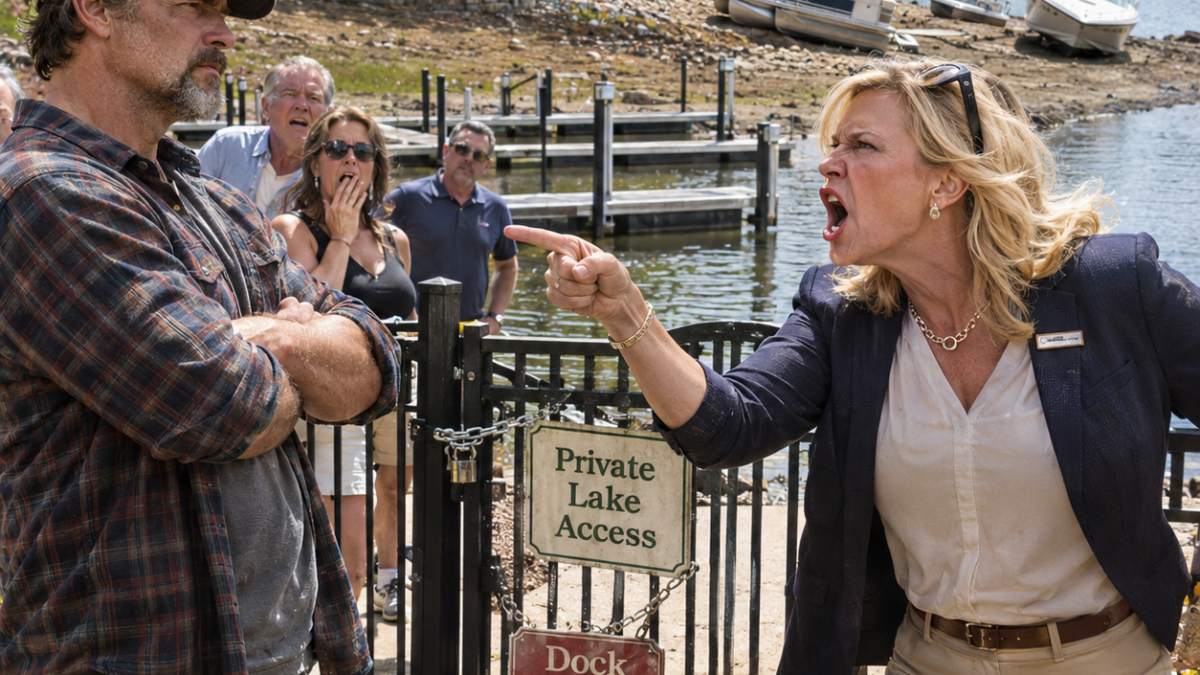
At 9:52, the white Cadillac arrived.
Dolores got out before the engine fully settled.
Two board members with her.
Phyllis filming.
Dolores walked straight toward me.
“You need to remove these immediately.”
“Good morning.”
“Do not patronize me.”
“I’m drinking coffee.”
“This is illegal.”
“No.”
“You cannot block residents from community docks.”
“They aren’t community docks.”
She pointed.
“Those were paid for by Clearwater Pines homeowners.”
“That is true.”
Her face brightened, like I had made a mistake.
“Then you admit it.”
“I’ve never disputed who paid.”
“Then open them.”
“Payment doesn’t change the land.”
Her expression hardened.
“We have decades of rights here.”
“Then show me the recorded easement.”
“You know this is going to court.”
“It already is.”
She looked around.
Residents were arriving.
Some angry.
Some confused.
Some embarrassed.
Her voice rose.
“This man is trying to take our lake.”
I stood.
“My lake.”
People murmured.
Dolores stepped closer.
“This is our community.”
“Mill Lake is a separate parcel.”
“You don’t belong here.”
There it was.
The sentence from the beginning.
The sentence that somehow made everything simple.
I looked at her.
“Dolores.”
“What?”
“My name is on the deed.”
“You think money lets you walk into a neighborhood and take away thirty years of history?”
“No.”
I held up my folder.
“The deed lets me decide access to my property.”
She reached for her phone.
“What are you doing?”
“Calling the police.”
“Okay.”
That answer bothered her.
“You are trespassing on community property.”
“No.”
She dialed.
“Officer, there’s a man refusing to leave our community lake.”
I could hear the dispatcher asking questions.
Dolores gave the address.
Then looked directly at me while she said:
“He’s blocking residents from their docks.”
I sat back down.
Harriet arrived during the call.
She looked at me.
“Again?”
“Apparently.”
“You have coffee?”
“Thermos.”
“Good.”
The officer arrived around ten-nineteen.
Young.
Professional.
He spoke to Dolores first.
Then me.
I handed him the deed.
Survey.
Attorney letter.
Quiet-title filing confirmation.
County map.
He read carefully.
Walked toward the gate.
Looked at boundary markings.
Returned.
“Mr. Wolfson, these locks are yours?”
“Yes.”
“You installed them?”
“Yes.”
“Did you damage any boats?”
“No.”
“Move any boats?”
“No.”
“Prevent anyone from leaving with a boat already lawfully positioned?”
“No.”
He nodded.
Then turned to Dolores.
“Ma’am.”
She stepped forward.
“Yes?”
“This appears to be private property.”
“It has been community property for decades.”
“The deed doesn’t show that.”
“We have established rights.”
“That may be a civil issue for a court.”
“We have residents who need access.”
The officer looked toward the signs.
“The property owner is allowed to secure his property unless there’s a court order or recorded right saying otherwise.”
Dolores stared.
“So you’re doing nothing?”
“I’m not seeing a criminal offense.”
“He’s trespassing.”
“On land titled to him.”
Silence.
People heard it.
That’s what mattered.
Not because a police officer decided the entire legal case.
He didn’t.
A court would resolve disputed property rights.
But Dolores had called 911 expecting handcuffs.
Instead the officer read the deed and confirmed what every county record already showed.
I belonged there.
She didn’t have automatic authority.
Cecilia Drum had arrived with a photographer.
I hadn’t called her that morning.
She had heard.
Small communities move information faster than broadband.
About forty residents gathered.
I stood.
Pulled out the one-page statement I had written.
“I want to explain why the docks are closed.”
Someone shouted:
“Because you’re greedy.”
I waited.
“Maybe you’ll still think that after.”
Quiet.
I told them about Harlan.
Not the lawsuit first.
Harlan.
The man who had allowed families to fish.
Allowed boats.
Allowed Fourth of July traditions.
Then 2019.
His proposed lease.
Three thousand six hundred dollars.
Insurance.
Maintenance.
A way to keep everything going.
I held up the certified receipt.
“Your board received this.”
People looked toward Dolores.
“She didn’t respond.”
Dolores said:
“That document was never approved.”
“That’s the point.”
I continued.
“In 2021 the HOA applied for a construction permit on Harlan’s parcel.”
I held up the county rejection.
“The county rejected it because the HOA had no ownership or recorded easement.”
Murmurs.
“Then homeowners were assessed twenty-two thousand dollars for docks built on that same private parcel.”
That landed hardest.
One man shouted:
“I paid three hundred forty dollars.”
Others joined.
“So did I.”
“What?”
“Why weren’t we told?”
Dolores stepped forward.
“This is a distorted presentation.”
I looked at her.
“Which document is false?”
She didn’t answer.
I continued.
“When I bought Mill Lake, the docks attached to the parcel transferred with the property.”
I looked at the crowd.
“I did not buy your boats.”
A few nervous laughs.
“I did not buy your houses.”
More.
“I bought the lake parcel and everything permanently attached to it.”
I paused.
“I am willing to negotiate continued recreational access.”
That changed the crowd.
Dolores looked at me sharply.
“But it will be written.”
I held up the deed.
“It will acknowledge who owns the property.”
“Access will be contractual.”
“Maintenance responsibility will be clear.”
“Liability will be clear.”
“And nobody will ever again tell the next owner that permission somehow became ownership because everyone got used to using something for free.”
Nobody shouted after that.
Cecilia approached Dolores.
“Ms. Shrink, county records show the HOA received Harlan Beaky’s lease proposal in March 2019.”
Dolores stiffened.
“Can you explain why the board didn’t respond?”
Seven seconds can be a very long time.
“I don’t recall the circumstances.”
“Did you receive it?”
“I don’t recall.”
“Were you board president?”
“Yes.”
“Was the HOA aware that Mill Lake remained privately titled?”
“That’s a complicated legal question.”
“No.”
Cecilia remained calm.
“Ownership is public record.”
Dolores looked toward her attorney, who wasn’t there.
Bad morning for that.
“I have no further comment.”
The story ran eight days later.
Headline careful.
Subhead brutal:
**HOA Board Spent $22,000 in Resident Funds on Docks Built on Private Land**
The article didn’t call Dolores corrupt.
Didn’t need to.
It printed documents.
Harlan’s lease.
Permit denial.
Survey.
Assessment.
Homeowners could decide how they felt.
Dolores resigned Tuesday.
Personal interests.
New leadership.
The usual graceful language institutions use after something very ungraceful happens.
Three more board members left within a week.
Phyllis shut down her Facebook account.
The county began reviewing HOA disclosures involving claimed community assets.
I wasn’t central to that investigation.
Good.
I wanted Mill Lake resolved.
Ferris became part of the interim leadership.
He called me.
“Can we talk?”
“Absolutely.”
“No lawyers first?”
“Braddock will eventually review anything.”
“Fair.”
We met at the clubhouse.
First time I’d been invited.
There were no casseroles.
Disappointing.
Ferris sat across from me with two other homeowners.
Not Dolores allies.
Not my allies.
Just people trying to clean up.
Ferris began:
“We want access restored.”
“I know.”
“What do you want?”
“A lease.”
“How much?”
I thought about Harlan.
“Three thousand a year.”
Ferris blinked.
“Less than Harlan asked.”
“Yes.”
“Why?”
“Because I don’t want to punish residents for the board’s decision.”
He looked at the others.
“What else?”
“Five-year term.”
“Renewable?”
“Yes.”
“Maintenance?”
“Shared according to use.”
“Insurance?”
“HOA carries appropriate coverage.”
“Public access?”
“Residents and authorized guests.”
“Fishing?”
“Yes.”
“Boats?”
“Yes.”
“Fourth of July parade?”
I smiled.
“Yes.”
Ferris relaxed slightly.
“And legal acknowledgement?”
“Recorded.”
He knew what I meant.
“That the lake is yours.”
“That access is contractual.”
“No prescriptive right.”
“No claim of ownership.”
He tapped his pen.
“Can you live with first-come slips?”
“Yes.”
“Dolores’s old slip?”
“Especially first come.”
One of the homeowners laughed.
Negotiations took two meetings.
Four hours total.
Compared with the previous months, it felt miraculous.
Final agreement:
Five-year renewable lease.
Three thousand dollars annually.
Resident recreational access.
Defined liability.
Maintenance contributions.
Recorded acknowledgement that Mill Lake was private property and that HOA access existed only through voluntary agreement.
The ratification vote:
291 yes.
22 no.
I didn’t care about the 22.
People were entitled to dislike me.
Ownership isn’t an election.
But access could now continue without pretending history had created a deed.
The day the locks came off, I arrived early.
Harriet stood beside me.
“You going to make a speech?”
“No.”
“Good.”
I unlocked the main gate.
Removed the sign.
Then north dock.
East access.
South launch.
A family waited nearby.
Father.
Two kids.
Fishing rods.
The younger boy looked at me.
“Can we go?”
I smiled.
“Yeah.”
He ran.
Harriet watched him.
“Harlan would’ve liked that.”
“I hope.”
“He would.”
The first annual lease payment came in.
Three thousand dollars.
I could have deposited it and forgotten about the lake for another year.
Instead, I looked at the north dock.
The Frankenstein one.
Boards from four different decades.
Railings repaired with mismatched fasteners.
A slight tilt that somehow passed inspection while still looking determined to embarrass carpentry as a profession.
I called Everett Pace.
Local contractor.
Two-man crew.
We replaced it.
Treated pine.
Level platform.
Six slips.
Proper hardware.
Nothing fancy.
Just good.
On the last day, I bought lunch.
Sandwiches.
We sat at the edge.
Everett looked over the water.
“You bought this for forty-seven?”
“Yeah.”
“Good deal.”
“Ask me after attorney fees.”
He laughed.
“Still.”
Afternoon sun turned the new planks honey-colored.
For the first time since I bought Mill Lake, the place felt like mine without feeling like a battlefield.
That mattered.
A week later, a kid’s father knocked.
“My son wants to fish.”
“Okay.”
“Off the new dock.”
“That’s why it’s there.”
He looked surprised.
“You don’t mind?”
“No.”
“I thought—”
“I know what people thought.”
He looked embarrassed.
“Sorry.”
“No need.”
The boy caught two bluegill and a little largemouth.
He ran home talking so fast I could barely understand him.
That night I sat at the end of the dock.
Great blue heron in the shallows.
Water like glass.
Wind in the pines.
For months, everybody had talked about rights.
My rights.
Their rights.
HOA authority.
Prescriptive rights.
Dock rights.
Access rights.
Nobody talked enough about why Harlan had allowed people there in the first place.
Because he liked seeing them enjoy it.
Owning something does not mean you must keep everyone out.
That was Dolores’s misunderstanding of me.
And maybe my misunderstanding of her.
She thought if the lake was acknowledged as private, community life ended.
I thought if community access remained informal, my ownership would always be under attack.
Both problems disappeared with a contract.
Permission written down.
Clear.
Honest.
Harriet had another idea.
Of course she did.
“Harlan Beaky Fishing Education Fund.”
I stared at her.
“That’s a long name.”
“You’re not naming it.”
“Apparently.”
She wanted to use part of the lease income to help local children attend an outdoor conservation and fishing program run by county parks.
Kids eight to sixteen.
Especially kids who didn’t grow up with equipment or parents who fished.
“How much?”
“Start modestly.”
“Why Harlan?”
She gave me that look.
“You really have to ask?”
No.
I didn’t.
We started the fund.
Thirty-one residents voluntarily contributed in the first couple of weeks.
The first summer, twelve kids participated.
Next year, nineteen.
I attended one afternoon.
A little girl caught her first fish.
Tiny bluegill.
She screamed.
Not fear.
Joy.
Then immediately started crying because she thought she’d hurt it.
The instructor showed her how to wet her hands.
Remove the hook.
Release it.
She watched the fish disappear.
Then asked:
“Can I do that again?”
I laughed.
That’s what Harlan had protected without ever calling it protection.
Space.
Water.
A dock.
A place where somebody could learn something they remembered forever.
The lawsuit resolved around the same time.
The quiet-title process and settlement documentation created the clarity I wanted.
Mill Lake:
private parcel.
Dock ownership:
part of the parcel.
HOA access:
contractual.
No permanent prescriptive easement arising from prior permissive use.
No more ambiguity.
Braddock handed me the final recorded paperwork.
“Congratulations.”
“What did I win?”
“Certainty.”
“Expensive prize.”
“Always.”
I looked through the documents.
“Was Dolores ever legally close?”
“Close to what?”
“Winning.”
Braddock considered.
“Her best argument was reliance.”
“But?”
“Reliance isn’t ownership.”
“Prescriptive easement?”
“Destroyed by the permission evidence.”
“Equitable servitude?”
“Not supported strongly enough.”
“Twenty-two-thousand-dollar docks?”
“Embarrassing.”
“For her?”
“For everyone.”
He wasn’t wrong.
That was the part I never enjoyed.
Residents had been misled too.
A lot of them were angry at me early because they honestly believed the lake was theirs.
Why wouldn’t they?
The HOA newsletter called it community property.
Budgets listed waterfront improvements.
Special assessments funded docks.
Board presidents organized events.
Nobody had reason to pull a survey for fun.
People trust institutions partly because normal life would be impossible otherwise.
You can’t personally recheck every deed, insurance certificate and permit every time you attend a picnic.
The failure wasn’t that residents trusted.
The failure was that the people receiving that trust stopped checking themselves.
Ferris understood that.
The new board created an asset register.
Real one.
Every property or improvement the HOA claimed to own had to have a deed, lease, easement or other recorded basis attached.
No more:
**We’ve always used it.**
No more:
**Everybody knows it’s ours.**
Documents.
The first review found two other minor issues.
Nothing dramatic.
A landscaping strip maintained by the HOA but owned by the county.
A drainage easement everyone had misdescribed for years.
Both corrected.
That’s what good governance looks like most of the time.
Boring corrections before they become stories.
Dolores disappeared from board life.
She still lived in Clearwater Pines for a while.
I saw the white Cadillac occasionally.
Never her pontoon.
That boat had been removed from slip three during the access dispute.
When lake use reopened, slip three became first come, first served like the others.
One Saturday, I saw a father and teenage daughter tie a battered aluminum fishing boat there.
I smiled more than I probably should have.
Not because Dolores lost the slip.
Because nobody owned the privilege anymore.
If you arrived first and followed the agreement, the dock was available.
Simple.
Months later, I encountered Dolores at a grocery store.
We saw each other across produce.
There is no elegant way to meet the former HOA president who once called 911 on you while both holding onions.
She looked away first.
I could’ve done the same.
Instead:
“Dolores.”
She stopped.
“Garrett.”
“How are you?”
Her expression said she suspected a trap.
“Fine.”
“Good.”
I put an onion in my cart.
Then she said:
“You ruined my reputation.”
I looked at her.
“No.”
“Don’t.”
Her voice stayed low.
“You sent letters to everyone.”
“With county documents.”
“You brought in the press.”
“I gave a reporter records.”
“You closed the docks on July Fourth.”
“Temporarily.”
“Do you have any idea what that did to me?”
I thought about it.
“Yes.”
Her eyes narrowed.
“And you don’t care.”
“I care.”
She almost laughed.
“Please.”
“I care that you were board president when Harlan offered a legal lease.”
Silence.
“I care that the HOA tried to permit construction on land it didn’t own.”
Silence.
“I care that homeowners paid twenty-two thousand dollars believing they were building a community asset.”
She looked down.
“I care that your response to my deed was to send me an application to pay you twelve hundred dollars a year for permission to use my property.”
“That was counsel’s advice.”
“Was the newsletter counsel’s advice?”
No answer.
“The Facebook campaign?”
No answer.
“The 911 call?”
Her jaw tightened.
“You humiliated me.”
I lowered my voice.
“Dolores, the police officer read the deed.”
She stared at me.
“You called him.”
I continued:
“If I had been wrong, I would’ve been the one humiliated.”
She said nothing.
I picked up another onion.
Then she asked:
“Why did you reopen access?”
That question surprised me.
“Because I never wanted to close the lake permanently.”
She blinked.
“You could have.”
“Yes.”
“Why didn’t you?”
I thought of Harlan.
“Because ownership and generosity aren’t opposites.”
For once, Dolores had no quick response.
I added:
“Harlan understood that.”
She looked away.
Then quietly:
“We should’ve answered his letter.”
“Yes.”
That was it.
No dramatic apology.
No tears.
No friendship.
Just the first honest sentence I ever heard from her about the entire mess.
We went separate directions.
I considered that enough.
Years passed.
Mill Lake changed slowly.
The new dock weathered.
The treated pine darkened.
Fishing fund grew.
The Fourth of July pontoon parade returned.
The first year after the agreement, Ferris called to ask permission.
That mattered more than he probably realized.
“Garrett, board wants to schedule the parade.”
“Okay.”
“Saturday evening.”
“Fine.”
“Any restrictions?”
“Life jackets where required. No fireworks launched from the docks.”
“Reasonable.”
“Send me the event insurance certificate.”
“Already did.”
I laughed.
“Ferris.”
“What?”
“You might be the best HOA president in Virginia.”
“Don’t curse me.”
I attended the parade.
Not on a boat.
Sat on the north dock.
Harriet beside me.
Families decorated pontoons.
Flags.
Lights.
Kids waving.
At sunset the water turned orange.
Harriet nudged me.
“See?”
“What?”
“Community.”
I smiled.
“Contractually licensed community.”
She groaned.
“Never say that again.”
Fair.
The following year, I added a bench near Harlan’s favorite fishing spot based on where Harriet remembered seeing him.
Small plaque.
**HARLAN BEAKY**
**HE SHARED THE WATER.**
That was all.
No mention of HOA.
No mention of lawsuits.
No mention of me.
One morning, I found a bouquet of cheap grocery-store flowers beside the bench.
No note.
Another time, a fishing lure.
Then somebody left an old photograph in a plastic sleeve.
Harlan standing beside the north dock.
Much younger.
Holding a largemouth bass.
Three children around him.
I didn’t know who left it.
I framed a copy inside the small storage shed and returned the original to Harriet to preserve.
She cried.
First time I saw her do that.
“He was a good man.”
“I know.”
“You never met him.”
“No.”
“You still know.”
She was right.
People leave themselves in paperwork.
But not only paperwork.
They leave themselves in what other people remember.
Harlan’s legal mistake had been keeping too much informal.
His human success had been that hundreds of people remembered his generosity.
Both things could be true.
I thought about my father then.
Zanesville.
Stamping plant.
Lunch box.
Hands permanently dark around the fingernails no matter how much he scrubbed.
He never owned a lake.
Never owned much of anything.
But he had one rule about tools.
If somebody borrowed one, he wrote their name on a piece of masking tape inside the cabinet.
I used to laugh.
“Dad, it’s a wrench.”
He’d say:
“Doesn’t matter what it is. If you don’t remember where something went, eventually everybody thinks it’s theirs.”
I had forgotten that until Mill Lake.
Dad would’ve understood this fight immediately.
Not the Virginia easement law.
Not quiet-title procedure.
The basic principle.
Know what you own.
Know what you lend.
Write down the difference.
I had learned that lesson twice.
Once from him.
Once from losing eighty thousand dollars.
The first time cost nothing.
I should’ve listened harder.
My construction career taught me something else.
Boundaries aren’t hostility.
On a job site, everyone needs to know where responsibility begins and ends.
Electrician.
Plumber.
Concrete crew.
Owner.
Architect.
When responsibilities blur, tasks get missed.
Then everybody points.
Property is similar.
Clear boundaries make generosity safer.
Before the lease, residents used Mill Lake because everybody assumed they could.
That assumption eventually became entitlement.
After the lease, they used it because the owner explicitly allowed it under defined terms.
Ironically, the lake felt more communal once everyone admitted it wasn’t community property.
Nobody had to pretend.
One fall afternoon, I was replacing a loose board when a man approached.
Maybe fifty.
I recognized him vaguely.
He’d been one of the loudest people at the July Fourth closure.
“You need help?”
I looked up.
“With?”
“Board.”
He held a drill.
“Sure.”
We worked.
After a while he said:
“I was pretty hard on you.”
“I remember.”
“I called you a parasite online.”
“I remember that too.”
He winced.
“Sorry.”
“Accepted.”
He drove a screw.
“I really thought you were buying the lake to close it.”
“I know.”
“Dolores said there were investors.”
“No investors.”
“I know now.”
Another screw.
“My wife wanted me to come apologize months ago.”
“Smart woman.”
“Don’t tell her.”
“Deal.”
We worked another ten minutes.
Then he said:
“My dad used to fish with Harlan.”
“Really?”
“Yeah.”
“He ever talk about access?”
“All the time.”
I stopped.
“What did he say?”
“That Harlan let anyone respectful come down.”
There it was again.
Let.
Not:
The HOA owned it.
Not:
We had a legal right.
Harlan let.
Permission.
Normal language had preserved the truth even when board politics tried to rewrite it.
The man looked at the water.
“I think we forgot the difference between being welcomed and being entitled.”
I set down the drill.
“That might be the whole story.”
He nodded.
“Probably.”
The lake became quieter after that.
Not less used.
Less angry.
That’s different.
There were rules now.
Boat registration for safety.
Defined dock spaces.
Guest access.
No overnight commercial storage.
Fishing hours.
Nothing oppressive.
Just enough structure to keep fifty assumptions from becoming one lawsuit.
The HOA paid the lease.
On time.
Every year.
I put a portion into maintenance.
A portion into Harlan’s fund.
The rest covered insurance and taxes.
I wasn’t making some fortune.
That wasn’t the point.
The point was reciprocity.
The community received something valuable.
The owner received something in return.
Everyone knew the arrangement.
Nobody hid.
One summer, county parks invited me to the fishing program.
I didn’t want to speak.
Harriet volunteered me.
Naturally.
Twenty kids.
Fishing rods.
Life jackets.
I stood near the dock.
“What do you want me to talk about?”
The instructor said:
“Ownership.”
I stared.
“They’re ten.”
“Keep it simple.”
So I asked the kids:
“If I let you borrow my fishing rod, whose rod is it?”
“Yours!”
“If you use it every Saturday for five years?”
“Still yours!”
“If you clean it?”
“Yours!”
“If you buy new fishing line?”
One kid hesitated.
“Still yours?”
“Yes.”
“What if I say you can use it whenever you want?”
A girl raised her hand.
“Then it’s yours, but we’re allowed.”
I smiled.
“Exactly.”
Harriet stood behind them.
She gave me an approving nod.
Apparently I had passed fourth grade.
Years after Dolores resigned, Clearwater Pines revised its homeowner disclosures.
Mill Lake no longer appeared anywhere under association-owned recreational assets.
Instead:
**Privately Owned Recreational Parcel – Access Provided Pursuant to Recorded Lease Agreement.**
Beautiful sentence.
Boring.
Precise.
No future buyer could misunderstand.
If the lease ever ended, they would know.
If ownership changed, they would know.
If the HOA negotiated different terms, they would know.
That was more important to me than any apology Dolores could have offered.
Systems outlast people.
Fix the system.
One afternoon, Ferris showed me the updated disclosure package.
“Thirty-eight pages.”
“Too long.”
“You caused six of them.”
“I’m sorry.”
“No, you’re not.”
“No.”
He pointed to the lake section.
“This satisfy you?”
I read it.
“Yes.”
“Good.”
He closed the binder.
“Can I ask something?”
“Sure.”
“If Dolores had offered the lease immediately, what would you have done?”
“Signed one.”
“Seriously?”
“Yes.”
“Even after the twelve-hundred-dollar permit demand?”
“Probably would’ve negotiated.”
He shook his head.
“All that money.”
“All those lawyers.”
“All those meetings.”
“All because nobody wanted to say the lake wasn’t ours.”
“Pretty much.”
Ferris sighed.
“Associations are weird.”
“People are weird.”
“Fair.”
Braddock eventually retired.
At our last lunch together, I paid.
He protested.
“You billed me enough.”
“That is not how gratitude works.”
“It is today.”
We sat near downtown Fredericksburg.
He asked:
“Still own the lake?”
“Yes.”
“Any more lawsuits?”
“No.”
“Disappointing.”
“Thought lawyers wanted peace.”
“Peace doesn’t pay for boats.”
I laughed.
Then he became serious.
“You handled one thing correctly.”
“One?”
“Don’t get greedy.”
“Which?”
“You didn’t confuse winning title with having to punish the neighborhood.”
I thought about that.
“It would’ve been easy.”
“Very.”
“Lock everyone out forever.”
“Yes.”
“Charge ridiculous fees.”
“Yes.”
“Sell to somebody worse.”
“Yes.”
“Why didn’t I?”
“Because you wanted ownership respected, not worshipped.”
That was a lawyer sentence.
A good one.
I remembered it.
Ownership respected.
Not worshipped.
You can own something and still share.
You can share something without surrendering ownership.
Those concepts shouldn’t be difficult.
But when traditions become expectations and expectations become entitlement, people forget the difference.
Harlan’s generosity created decades of happiness.
The board’s refusal to formalize that generosity nearly destroyed it.
That distinction matters.
The final irony?
The written lease protected residents more than the old informal arrangement ever had.
Under Harlan, he could theoretically have changed his mind tomorrow.
Under my five-year lease, residents had defined rights during the term.
Access couldn’t disappear because I woke up angry.
The HOA knew maintenance costs.
Insurance requirements.
Renewal dates.
Everybody had more certainty.
Even me.
Especially me.
The people who called contracts hostile had never understood that contracts can protect both sides.
One November morning, I walked down before sunrise.
Fog.
Cold enough to see my breath.
Frogs quiet.
Leaves on water.
I sat on Harlan’s bench.
No boats moving.
Docks empty.
The lake looked almost exactly as it had the first day I saw the auction listing.
I thought about the opening confrontation.
Dolores’s voice.
**This is our lake. You don’t belong here.**
At the time, that sentence made me furious.
Years later, it sounded almost sad.
She had confused belonging with ownership.
They aren’t the same.
Did I belong to Clearwater Pines?
Maybe not at first.
I didn’t own a house inside the HOA.
Didn’t attend their picnics.
Didn’t vote in their elections.
But Mill Lake belonged to me legally.
Meanwhile, hundreds of Clearwater Pines residents felt they belonged at Mill Lake emotionally.
Those two facts didn’t have to be enemies.
The mistake was pretending one erased the other.
The lease solved that.
My deed said:
**mine.**
Our agreement said:
**welcome.**
That’s a much better combination than:
**ours because we’ve always used it.**
The sun began coming through the trees.
A truck stopped near the access path.
Father and daughter.
Fishing gear.
They walked toward me.
“Morning, Garrett.”
“Morning.”
“Lake open?”
“Always check the sign.”
The girl read.
“Open.”
“Then yes.”
She smiled.
They walked out onto the dock.
I watched her cast badly.
Line slapped the water.
Father tried not to laugh.
She yelled at him.
Normal.
Beautiful.
I thought about the $47,000.
The attorney fees.
The certified letters.
The July Fourth chaos.
911.
Petitions.
Facebook.
The absurd lake permit.
Would I buy Mill Lake again knowing all of it?
Yes.
Immediately.
Not because I enjoyed the fight.
I didn’t.
Because the fight ended.
The lake remained.
Most conflicts feel permanent while you’re inside them.
They rarely are.
The water outlasted Dolores’s presidency.
Outlasted Facebook arguments.
Outlasted the locks.
Outlasted the newspaper cycle.
It will probably outlast me.
That changes your perspective.
If I sell one day, the next owner will receive something I never had:
clarity.
Recorded ownership.
Recorded access agreement.
Dock rights defined.
HOA rights defined.
Maintenance responsibility defined.
No guessing.
No myth.
No woman with a clipboard inventing jurisdiction because everybody forgot to ask for the deed.
That’s my real revenge.
Not Dolores losing her slip.
Not her resignation.
Not watching a police officer tell her he couldn’t remove me from my own land.
Those moments felt satisfying.
I’d be lying if I said otherwise.
But satisfaction passes.
A corrected record stays.
That is what I wanted.
Harlan had spent years sharing Mill Lake without asking much.
When he finally asked the HOA to formalize the arrangement, they ignored him.
Maybe they thought he’d always be there.
Maybe they thought he’d never enforce anything.
Maybe they assumed generosity was permanent because it had lasted so long.
Then he died.
That should have been the moment for the board to check.
Instead they doubled down on assumption.
And assumptions don’t transfer title.
Deeds do.
Recorded easements do.
Contracts do.
That lesson cost everyone more than it should have.
But at least it stuck.
The next board president after Ferris once told me:
“We have a rule now.”
“What rule?”
“If somebody says ‘we’ve always done it this way,’ we ask for the document.”
I laughed.
“Good rule.”
“Your fault.”
“I’ll take it.”
Years later, one of the first kids supported by the Harlan Beaky Fishing Education Fund came back as a college student.
He recognized me near the dock.
“Mr. Wolfson?”
“Depends.”
He laughed.
“I’m Eli.”
I didn’t remember.
He showed me an old photo on his phone.
Twelve years old.
Life jacket.
Fishing rod.
Tiny bluegill.
“I was in the first group.”
Then I remembered.
“You cried when the fish came off the hook.”
His face turned red.
“I was twelve.”
“You screamed too.”
“Please stop.”
I laughed.
“What are you studying?”
“Environmental science.”
That shut me up.
He looked across the water.
“I think this place did it.”
“Fishing?”
“Water.”
He shrugged.
“Conservation.”
“Good.”
He kicked at the dock.
“My mom told me the lake almost got closed.”
“Temporarily.”
“She said some HOA lady called the police.”
“That happened.”
“Was she crazy?”
I thought.
“No.”
He looked disappointed.
“She was wrong.”
“That’s different.”
“How?”
“Crazy means you can dismiss the person.”
I looked across the water.
“Wrong means you should understand how they got there so the mistake doesn’t repeat.”
He nodded slowly.
“That’s a very old-person answer.”
“Get off my dock.”
He laughed.
“Private property?”
“Exactly.”
He stayed another hour.
That conversation made me think about Dolores differently again.
She wasn’t stupid.
She had managed a bank branch.
Understood documents.
Understood ownership.
That may have been the problem.
She understood enough to know how serious my deed was.
So instead of conceding early, she tried to manufacture enough social and legal pressure to make ownership irrelevant.
Permit demand.
Newsletter.
Prescriptive easement.
Community petition.
Code complaint.
Recorder filing.
911.
Not because she didn’t understand paperwork.
Because she understood it and hoped I wouldn’t.
That is a different kind of failure.
Power often survives through information imbalance.
One side knows the documents.
The other trusts the tone.
When both sides read the same records, tone loses power.
That’s what happened.
I didn’t become stronger.
The documents became visible.
Homeowners saw the 2019 lease.
The rejected permit.
The survey.
Their own assessment.
Their own CC&Rs.
Then the question stopped being:
**Do you like Garrett?**
And became:
**Who owns Mill Lake?**
Much easier question.
You don’t have to like the owner for the deed to work.
That’s one of the beautiful things about property records.
They don’t conduct popularity polls.
One rainy afternoon, Harriet and I sat under the dock shelter.
She had slowed down with age.
Still sharp.
Always sharp.
She watched water hit the lake.
“I’m glad you didn’t close it.”
“Me too.”
“Harlan would’ve haunted you.”
“That seems legally complicated.”
She rolled her eyes.
“I mean it.”
“I know.”
She looked at the north bank.
“You know what he used to say?”
“What?”
“Water looks better when somebody’s using it.”
I laughed.
“That’s not very conservation-minded.”
“He meant kids.”
“Ah.”
“He liked noise.”
“I thought he liked quiet.”
“Both.”
“That seems contradictory.”
“People are.”
Fair.
Harriet passed away a few years later.
Peacefully.
Her niece gave me the old banker’s box.
The same one that had held Harlan’s draft lease.
There were a few additional documents inside.
Nothing legally important.
Christmas cards.
Receipts.
A photograph of Harriet and Harlan at the lake.
I kept the box in the small lake office.
Not because I needed evidence anymore.
The court record had settled that.
I kept it because sometimes paperwork changes meaning.
At first, the box was evidence.
Then history.
That’s a good transformation.
The legal fight became history too.
New residents arrived who knew nothing about Dolores.
Perfect.
They read the disclosure package.
Saw Mill Lake listed as private.
Saw the access lease.
Paid dues.
Used docks.
No drama.
One new homeowner asked me:
“Why doesn’t the HOA just buy the lake?”
“Maybe someday.”
“Would you sell?”
“Maybe someday.”
“For how much?”
I smiled.
“More than forty-seven.”
He laughed.
“Fair.”
If the HOA ever buys it, it will be through negotiation.
Offer.
Appraisal.
Contract.
Closing.
Nobody will color the parcel differently on a map and declare it community property.
That is enough for me.
The lake has never made me rich.
Not financially.
Taxes.
Maintenance.
Insurance.
Dock repairs.
Attorney bills in the early years.
The annual lease helps.
But if profit had been my goal, there were better investments than six acres of dark Virginia water full of frogs.
I bought it because I wanted something quiet.
Ironically, I got years of noise first.
Then quiet.
Maybe that’s how property works.
You don’t truly understand what something gives you until you’ve had to defend why it matters.
Mill Lake taught me that ownership isn’t about saying:
**Stay out.**
It’s about having the legitimate authority to say:
**Come in.**
Permission only has meaning when refusal is possible.
Harlan understood that instinctively.
Dolores didn’t.
At least not until the locks appeared.
The morning she called 911 remains the most dramatic piece of the story.
People love that part.
“Did you really sit there with coffee?”
Yes.
“Was she screaming?”
Not exactly.
Angry.
“Did the cop laugh at her?”
No.
He was professional.
“Did you lock her boat in?”
No.
I never touched anyone’s boat.
“Did you keep the docks closed forever?”
No.
That is where people get disappointed.
They want revenge to end with the other side losing everything.
I don’t.
If I had closed Mill Lake forever just to hurt Dolores, hundreds of people who had done nothing wrong would’ve paid for her mistake.
Children.
Retirees.
Families who wrote checks because their board told them the docks were community infrastructure.
That’s not justice.
That’s collateral damage.
The better ending was making Dolores’s model impossible.
No more free entitlement.
No more fake ownership.
No more undocumented tradition masquerading as property law.
Residents got access back.
I got my rights recognized.
Harlan’s generosity survived in a healthier form.
That’s a win.
There is a line from Braddock I still remember.
We were signing the final paperwork.
He looked at the recorded acknowledgement.
Said:
“Now the next fight is less likely.”
I asked:
“Why?”
“Because the truth is attached to the land.”
That’s property law at its best.
People forget.
Records don’t have to.
Dolores forgot Harlan’s permission wasn’t ownership.
The next board doesn’t get to.
Future homeowners don’t get to.
Future buyers of Mill Lake don’t get to.
The truth is attached.
Years after everything ended, I received a Christmas card.
No return address.
Front:
Snow-covered lake.
Inside:
**Hope Mill Lake is peaceful. – Dolores**
Nothing else.
I stared.
Then laughed.
Of course she’d send a lake card.
I put it in the Harlan box.
Not as evidence.
History.
The following spring, I saw Dolores one last time.
She had moved.
Her house sold.
A moving truck sat outside.
I was driving past the subdivision entrance when she pulled out behind me.
At the intersection, she turned one direction.
I turned the other.
No conversation.
No final confrontation.
No symbolic wave.
Just roads separating.
That felt right.
Some relationships don’t need closure speeches.
The documents had already said enough.
Today, on summer mornings, fog still sits over Mill Lake.
Frogs are still ridiculous.
The north dock is no longer mismatched.
Slip three still belongs to whoever gets there first.
The launch gate has a keypad now because keys are annoying.
Residents have the code through the HOA lease.
Guests follow the rules.
The fishing fund continues.
Kids still catch bluegill.
The Fourth of July parade still happens.
And if you stand on the shore early enough, before motors start and before the neighborhood wakes, you can hear absolutely nothing but water against wood.
That’s why I bought it.
Not to fight Clearwater Pines.
Not to humiliate Dolores.
Not to become the man with the famous deed.
I bought a lake because after years in construction, lawsuits, bad contractors and other people’s schedules, I wanted something that felt still.
It took a long time for Mill Lake to become still again.
But it did.
The day Dolores called 911, she thought the police would settle ownership through authority.
The officer didn’t.
He read the deed.
The board thought tradition would settle ownership.
It didn’t.
The court read the records.
The residents thought the docks were community assets because they’d paid for them.
They weren’t.
The survey showed where they stood.
Again and again, the story came back to paper.
Not glamorous.
Not emotional.
Paper.
Harlan’s 2019 lease.
Certified receipt.
County permit denial.
Survey.
Deed.
CC&Rs.
Special-assessment records.
Quiet-title filing.
Recorded lease.
Every major turn already existed somewhere in a document before anybody started shouting.
That is what stays with me.
Dolores looked powerful because she controlled meetings.
Newsletters.
Petitions.
Social pressure.
But none of those could move the property line thirty feet.
Could not create an easement that hadn’t been recorded.
Could not turn permission into ownership simply by repeating “our lake.”
Could not change whose name was on the deed.
The hardest lesson I learned years earlier, after losing eighty thousand dollars to a contractor, was that trust is not a substitute for documentation.
That lesson saved Mill Lake.
But Mill Lake taught me something the contractor never did.
Documentation doesn’t have to destroy trust.
Used properly, it rebuilds it.
The residents and I trust each other more today because the arrangement is written.
Nobody has to wonder.
Nobody has to remember what somebody promised ten years ago.
Nobody has to rely on whoever happens to be HOA president.
The agreement speaks for us when we’re not in the room.
Harlan deserved that.
He never got it.
So in a way, the final lease was partly for him.
I sometimes imagine him sitting on the old north dock, watching children fish.
Maybe he would’ve thought three thousand dollars was too little.
Maybe he’d have told me to charge more.
Maybe he’d have laughed at Dolores’s 911 call.
Harriet believed he would.
I hope he would’ve understood why I reopened the gates.
Because this story was never really about keeping people away.
It was about the right to choose generosity instead of having generosity stolen and renamed obligation.
Harlan chose to share Mill Lake.
I choose to share it now.
The difference is that today everyone knows exactly what that choice means.
The lake is private.
The welcome is real.
The paperwork is clear.
And when somebody says, “We’ve always used it,” the answer no longer needs to be an argument.
We can simply point to the recorded agreement.
Yes.
You can use it.
Because the owner said yes.
Not because the HOA said it was theirs.
Not because Dolores called 911.
Not because eleven boats were already sitting at the docks.
Because permission was given honestly.
And after everything that happened, that simple distinction became the strongest thing at Mill Lake.
Stronger than a padlock.
Stronger than a petition.
Stronger than a board president.
Stronger than a tradition people mistook for a deed.
The morning I bought Mill Lake, I thought ownership would give me quiet.
For a while, it gave me conflict.
But the conflict forced everyone—including me—to understand something Harlan had known from the beginning.
A place can belong to one person and still mean something to many people.
Those truths can live together.
They only become enemies when someone decides gratitude is no longer enough and starts calling permission a right.
Dolores crossed that line.
I drew it again.
Then, once everyone could see it, I opened the gate.
And that’s why the final image I keep from this entire story isn’t Dolores yelling beside a police cruiser.
It isn’t eleven boats stranded without dock access.
It isn’t the newspaper headline or the stack of legal papers on Braddock’s conference table.
It’s a kid on the rebuilt north dock, holding a bluegill in both hands while his father kneels beside him, showing him how to release it.
Behind them, the water is flat.
The mist is lifting.
Harlan’s bench is under the pines.
And nobody is arguing about who owns anything.
Because after all that noise, the truth finally became boring.
Exactly the way it should have been from the beginning.








