PART 2: HOA Karen Called 911 to Throw Me Out—Then Dispatch Told Her I Was the State Officer Running the Investigation
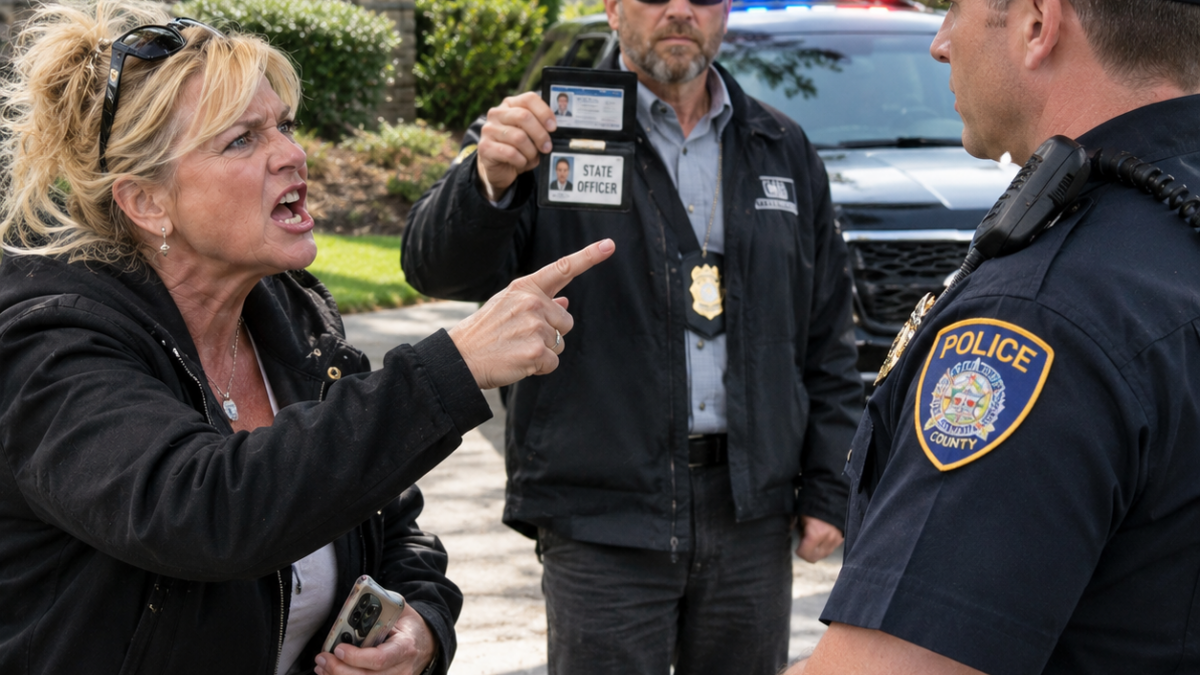
PART 2
Cynthia lowered the phone slightly.
For the first time since I arrived, she wasn’t speaking.
I could hear the dispatcher through the speaker.
Not every word.
Enough.
“Ma’am, Mr. Cole is listed as the state officer assigned to the active Pine Ridge fire-safety investigation.”
Cynthia’s eyes narrowed.
“That doesn’t mean he can trespass.”
The dispatcher answered something else.
Cynthia stiffened.
“Yes, I understand.”
Another pause.
“No, I don’t need medical assistance.”
I almost smiled at that.
She ended the call.
Then she looked at me.
“That was unnecessarily dramatic.”
I raised an eyebrow.
“You called 911.”
“Because you refused to leave.”
“I identified myself before you called.”
“I had no way to know those credentials were legitimate.”
“You could have called the number on the inspection notice.”
“I don’t appreciate strangers walking into my neighborhood and waving badges.”
“I don’t appreciate emergency gates chained shut when fire engines are supposed to use them.”
Her expression hardened again.
That was Cynthia.
Embarrassment lasted only as long as it took her to find anger.
A county patrol car arrived several minutes later anyway.
Deputy Carlos Mendoza stepped out.
He knew me from previous state inspections.
“Morning, Ethan.”
“Morning.”
Cynthia looked from him to me.
Carlos turned toward her.
“Mrs. Langley?”
“Yes.”
“You called about a trespasser?”
She crossed her arms.
“I called because someone entered private HOA property without permission.”
Carlos looked at my state vehicle.
Then my credentials.
Then the case folder.
“That’s Investigator Cole.”
“I know who he claims to be.”
Carlos’s patience shortened.
“He’s exactly who he claims to be.”
“I still want him removed.”
“On what basis?”
“This is private property.”
Carlos nodded toward the road.
“So is half the land I respond to.”
Cynthia stared.
“He’s conducting a state inspection connected to a reported fire-access violation.”
Carlos looked toward me.
“You have an active case?”
I handed him the notice.
He read the first page.
Returned it.
“That answers that.”
Cynthia’s voice rose.
“No, it doesn’t.”
Carlos remained calm.
“You’re free to call your attorney.”
“I already have.”
“Good.”
Then he looked at me.
“Need anything from us?”
“Not unless somebody interferes with the inspection.”
Cynthia’s face went red.
Carlos gave her a polite nod and returned to his patrol car.
As he drove away, she said:
“You embarrassed me.”
I looked at her.
“No.”
“You could’ve handled that differently.”
“I showed you identification.”
“You made me look like a liar.”
“You told 911 my identification was fake.”
She opened her mouth.
Then closed it.
I walked toward the emergency gate.
The chain was still there.
Up close, it looked worse.
Heavy commercial chain.
Weathered.
Not temporary.
The padlock had rust around the shackle.
I photographed it.
Measured the gate width.
Checked the posted signs.
Then inspected the lane beyond.
The road itself was wide enough for emergency vehicles.
The problem wasn’t design.
The problem was access.
Cynthia followed me.
“That gate is opened for emergencies.”
“How?”
“Security has the key.”
“Where is security?”
“At the main entrance.”
“How long does it take them to get here?”
“That’s irrelevant.”
“No.”
I wrote in my notebook.
“That’s almost the entire issue.”
“The fire department should have called ahead.”
I turned.
“Fire departments generally don’t make reservations.”
Her jaw tightened.
“The gate was chained because teenagers were using the road.”
“Then install an approved emergency access system.”
“We have one.”
I pointed at the chain.
“No.”
I walked to the hinge post.
There was an old red Knox-style emergency access box mounted beside it.
The faceplate had been painted over.
I opened the exterior cover.
Empty.
No emergency key.
No override.
Cynthia shifted behind me.
“When was that removed?”
“I don’t know.”
“Who maintains the gate?”
“Our management company.”
“Which company?”
“Pine Ridge Community Services.”
“Who owns it?”
She looked at me sharply.
“Why does that matter?”
“Because I asked.”
“It’s a contractor.”
“Name?”
“Langley Property Management.”
That name caught my attention.
“Related to you?”
“My husband’s company.”
There it was.
Not automatically improper.
But worth writing down.
I made a note.
Cynthia saw me.
“This is exactly why I didn’t want you walking around unsupervised.”
“Because I write things down?”
“Because you interpret everything negatively.”
“I haven’t interpreted anything.”
“You’re clearly trying to build a case.”
“I already have a case.”
She stared at me.
Then said:
“You state people always arrive believing the HOA is guilty.”
“Mrs. Langley, a fire engine found a chained emergency gate.”
“That doesn’t make us criminals.”
“I haven’t called you criminals.”
“Yet.”
Interesting word.
I continued the inspection.
The emergency lane connected the subdivision to Old Mill Road.
According to the approved development plan, it had to remain unobstructed or equipped with approved emergency access at all times.
No exceptions for teenagers.
No exceptions for aesthetics.
No exceptions because a board president found traffic annoying.
I asked for the gate maintenance logs.
Cynthia said they were in the clubhouse.
We walked back.
The clubhouse lobby was polished marble and dark wood.
A wall displayed photographs of past HOA presidents.
Cynthia’s portrait was largest.
Of course it was.
She led me into a conference room.
Three binders sat on the table.
“This is everything.”
I opened the first.
Board minutes.
Second.
Maintenance records.
Third.
Fire inspections.
I started reading.
The annual emergency-access certification caught my eye immediately.
PINE RIDGE ESTATES
EAST FIRE ACCESS — VERIFIED OPERATIONAL
Signed eight months earlier.
Inspector:
Harold Keene.
Certification number.
I knew the name.
Harold Keene had retired from county inspections almost two years earlier.
I looked at Cynthia.
“Who obtained this?”
“The management company.”
“Harold Keene inspected the gate?”
“Yes.”
“When?”
“The date is on the report.”
I looked at it again.
“Interesting.”
“What?”
“Nothing yet.”
I photographed the document.
Cynthia leaned forward.
“You can’t copy private HOA records.”
“The records were formally requested as part of the investigation.”
“They contain confidential information.”
“This one contains a state-required safety certification.”
Her eyes narrowed.
“You’re enjoying this.”
“No.”
“Really?”
“No.”
I had been doing enforcement work too long to enjoy finding bad records.
Bad records meant somebody had been exposed to real risk.
The farther I read, the less I liked.
According to board minutes, the emergency road had been “temporarily restricted” eighteen months earlier because residents complained about cut-through traffic.
Six months after that, the board approved “enhanced access control.”
But I found no fire-department approval.
No state approval.
No updated emergency plan.
Then I found a payment.
$38,400.
To Langley Property Management.
Description:
Emergency access security improvements.
I looked at Cynthia.
“What did this cover?”
“The gate.”
“The chain?”
“Security upgrades.”
“What upgrades?”
“Cameras. Signage. Reinforcement.”
“Who approved the contract?”
“The board.”
“Did you disclose that your husband’s company was the vendor?”
Her face tightened.
“That’s an HOA governance issue, not fire safety.”
“Maybe.”
I photographed it.
She stood.
“I think this inspection is over.”
“No.”
“I’ve provided the records.”
“Not all of them.”
“What else?”
“Original gate authorization. Fire department approval. Access-control specifications. Maintenance logs. Key-control records.”
“I told you we don’t have all of that here.”
“Where is it?”
“Management office.”
“Your husband’s company?”
“Yes.”
“Address?”
She didn’t answer.
I waited.
Eventually, she gave it.
That afternoon, I drove to the county fire department.
Chief Aaron Walsh was waiting.
He had commanded the response at Thomas Avery’s fire.
We sat in his office.
He pulled up the engine log.
“Four minutes, eighteen seconds.”
“Delay?”
“From first arrival at east gate to clearing main entrance.”
I felt my jaw tighten.
“That’s worse than the preliminary report.”
“Yeah.”
“What did the crew do at the east gate?”
“Checked the emergency box.”
“Empty.”
He looked at me.
“You saw it.”
“Yes.”
“Then they called dispatch.”
“What happened?”
“Nobody from Pine Ridge answered the emergency contact number.”
“Security?”
“Main gate guard said he couldn’t leave.”
“So Engine 6 reversed.”
“Correct.”
A fully loaded fire engine backing down a narrow residential lane at night is not quick.
Or safe.
“What was the fire condition when they finally arrived?”
“Kitchen had extended into attic.”
“If they’d had four minutes?”
Chief Walsh leaned back.
“You know I won’t speculate for the report.”
“I know.”
He paused.
“But four minutes matters.”
“Yes.”
Thomas Avery was discharged from the hospital two days after the fire.
Smoke inhalation.
No burns.
He had been trying to reenter the home for his dog.
A neighbor stopped him.
Firefighters later found the dog hiding in a downstairs bathroom.
Lucky.
Too lucky.
I asked Walsh:
“Did your department sign the eight-month certification?”
“What certification?”
I showed him the photo.
He stared.
Then leaned closer.
“Harold Keene?”
“Yes.”
“Harold hasn’t worked here in almost two years.”
“Could he have contracted privately?”
“No.”
“You sure?”
“He moved to Florida.”
That was a problem.
A serious one.
“Did Pine Ridge request an emergency access inspection eight months ago?”
Walsh checked the database.
Nothing.
“No.”
“Any inspection in the last eighteen months?”
He searched.
Then shook his head.
“Last one was three years ago.”
Before Cynthia’s board chained the gate.
I called Harold Keene.
He answered from Fort Myers.
When I explained why I was calling, he went quiet.
“I didn’t sign anything.”
“You haven’t inspected Pine Ridge recently?”
“Not since I retired.”
“Did you ever authorize anyone to use your old certification number?”
“No.”
I emailed him the document.
Ten minutes later, he called back.
“That signature isn’t mine.”
Now the investigation changed.
A chained gate was a violation.
A false safety certification was something else entirely.
I forwarded the document to our legal division.
Then I requested the original electronic file.
The next morning, Cynthia’s attorney called.
Martin Sloane.
Smooth voice.
Very controlled.
“Investigator Cole, I’m representing Pine Ridge Estates.”
“Understood.”
“My client believes your inspection has expanded far beyond the original complaint.”
“It has expanded based on records produced by your client.”
“Specifically?”
“I’ll communicate through the formal request.”
“Mrs. Langley feels targeted.”
“She called 911 to have me removed during a lawful inspection.”
“That was a misunderstanding.”
“She reported that my state credentials were fake.”
“Again, misunderstanding.”
“Then we’ll move past it.”
He paused.
“I’d appreciate clarity on the current scope.”
“Emergency access compliance. Certification records. Contractor involvement related to the safety system. Potential falsification of required records.”
Silence.
“Potential falsification?”
“Yes.”
“By whom?”
“Under review.”
Martin’s tone changed slightly.
“I strongly recommend you avoid implying criminal conduct without evidence.”
“I didn’t imply anything.”
“You said falsification.”
“I have a document signed by a man who says he didn’t sign it.”
Long pause.
“We’ll review.”
“I recommend that.”
That afternoon, I received an email from Cynthia.
Not her attorney.
Her.
SUBJECT: NOTICE OF HARASSMENT.
She accused me of abusing state authority.
Targeting a private community.
Threatening property values.
Creating unnecessary panic.
She demanded that another investigator be assigned.
I forwarded it to my supervisor.
He called five minutes later.
“You want off the case?”
“No.”
“Any conflict?”
“No.”
“Did you know her before this?”
“Never met her.”
“Keep going.”
That’s why I liked working for the state.
A good supervisor doesn’t ask whether somebody powerful is upset.
He asks whether your documentation is solid.
Mine was.
The following day, a woman named Melissa Grant called my office.
She lived in Pine Ridge.
House 47.
She sounded nervous.
“Are you the investigator?”
“Yes.”
“I don’t want my name used.”
“I can’t promise confidentiality beyond what the law allows.”
She hesitated.
Then said:
“I was on the board.”
“When?”
“Until last year.”
“What happened?”
“Cynthia removed me from the safety committee.”
“Why?”
“I objected to the gate.”
I sat straighter.
“What did you object to?”
“The chain.”
“When was it installed?”
“About eighteen months ago.”
“Why?”
“Cynthia said teenagers were entering from Old Mill Road.”
“Did anyone discuss fire access?”
“Yes.”
“Who?”
“Me.”
I took notes.
“What did Cynthia say?”
“She said emergency vehicles could use the main entrance.”
“Anything else?”
“She said the second access had become a liability.”
“Was the fire department consulted?”
“I asked.”
“And?”
“She said Langley Property Management had handled it.”
I stared at my notes.
“Do you have records?”
“Yes.”
“What kind?”
“Emails.”
We met at a coffee shop.
Melissa brought printed copies.
One email stood out.
From Cynthia to the board.
We are not spending another dollar accommodating a secondary gate nobody uses. Main access is adequate. Chain east entrance immediately and deal with any fire-department objections later.
I read it twice.
“When was this?”
“Eighteen months ago.”
“Did the board approve?”
“Five to two.”
“You voted no?”
“Yes.”
“Who else?”
“Peter Lawson.”
“What happened to him?”
“Resigned.”
“And you?”
“Removed from committee three months later.”
I asked about the safety certification.
Melissa shook her head.
“I never saw that.”
“Did the board discuss an inspection?”
“No.”
“Did Langley Property Management bill for one?”
She frowned.
“I remember a safety compliance invoice.”
“How much?”
“Maybe twelve thousand.”
That sounded high.
I requested financial records.
Cynthia’s attorney resisted.
The state issued a formal administrative demand.
Two days later, documents arrived.
There it was.
$12,750.
Langley Property Management.
Description:
Fire access certification and compliance coordination.
Another invoice.
$9,600.
Emergency lane monitoring.
Another.
$16,050.
Gate reinforcement and unauthorized-use mitigation.
Total:
$38,400.
The same number I’d seen in the board records.
I traced subcontractors.
Cameras cost $4,900.
Signs and steel reinforcement:
$6,300.
Chain and hardware:
Less than $1,000.
I couldn’t account for roughly $26,000.
Again, financial impropriety wasn’t automatically my jurisdiction.
But if money billed for safety compliance was tied to a false fire-access certification, it became relevant.
I requested the electronic metadata for the certification.
Langley Property Management sent a PDF.
Created on a computer registered to:
CLANGLEY-LPM.
Cynthia Langley.
Interesting.
Not proof she forged it.
But interesting.
The author metadata showed:
Cynthia L.
Creation date:
Two days before the HOA audit meeting.
I called Harold again.
“Did you ever give Cynthia Langley a blank inspection form?”
“No.”
“Have you ever met her?”
“Maybe years ago.”
“Did you work for Langley Property Management?”
“Never.”
The case got bigger.
Then something happened that made it personal.
Thomas Avery asked to meet me.
His temporary apartment was fifteen minutes from Pine Ridge.
He opened the door with a cane.
Seventy-two.
Thin.
Still coughing.
On the coffee table sat a framed photograph of his late wife.
“Mr. Cole?”
“Ethan.”
He shook my hand.
“Tom.”
We sat.
He didn’t want to talk about code.
Or gates.
Or boards.
He wanted to talk about the four minutes.
“I heard the sirens.”
He looked down.
“They got close.”
Then stopped.
“I thought they were here.”
His voice cracked.
“But they weren’t.”
I said nothing.
“My wife and I bought that house because the brochure said two emergency access points.”
He laughed bitterly.
“I remember that.”
“Why?”
“Ellen had a heart condition.”
He looked at her photograph.
“She died three years ago.”
Then he looked back at me.
“I almost sold after that.”
“Why didn’t you?”
“Too many memories.”
He swallowed.
“When the kitchen caught fire, I got outside. Then I remembered Charlie.”
“The dog?”
He nodded.
“I tried going back.”
His neighbor stopped him.
Tom’s hands shook.
“I know it’s stupid.”
“No.”
“Yes, it is.”
“No.”
I leaned forward.
“It’s human.”
He wiped his eyes.
“When the firefighters finally came from the other direction, flames were already in the roof.”
He looked at me.
“Would four minutes have saved my kitchen?”
“I can’t promise that.”
“Would it have mattered?”
“Yes.”
That answer I could give him.
Four minutes always matters in a structure fire.
He nodded.
“Then don’t let her call it a misunderstanding.”
I didn’t.
I left Tom’s apartment carrying something heavier than a case file.
There is a temptation in enforcement work to reduce everything to violations.
Section numbers.
Deadlines.
Fines.
Compliance.
But codes are written in blood more often than people realize.
Every emergency-access rule exists because somebody, somewhere, needed help and couldn’t get it fast enough.
Cynthia treated the east gate like a neighborhood decoration.
Tom had watched his roof burn because of it.
A week after my inspection, Pine Ridge held an emergency board meeting.
I wasn’t invited.
That didn’t stop half the neighborhood from emailing me afterward.
Cynthia stood in front of residents and announced that a “rogue state investigator” was trying to punish the community.
According to one recording, she said:
“This is what happens when bureaucrats think they know our neighborhood better than we do.”
A resident asked about Tom’s fire.
Cynthia called it unfortunate but unrelated.
Melissa Grant stood.
“It was directly related.”
The room became noisy.
Cynthia told her to sit.
Melissa didn’t.
Then another resident asked:
“Why was the emergency gate chained?”
Cynthia answered:
“Security.”
“Who approved it?”
“The board.”
“Did the fire department?”
Silence.
A man near the back asked:
“Why does the fire certification have a retired inspector’s name?”
That’s when the meeting changed.
Cynthia stopped.
“Where did you hear that?”
The man held up his phone.
Apparently the information had already begun spreading through neighborhood messages.
Cynthia called it misinformation.
Then she made the mistake that eventually shattered her support.
She said:
“The certification is valid because our management company handled it.”
Melissa asked:
“Your husband’s company?”
The room erupted.
Cynthia ended the meeting.
The next morning, Pine Ridge’s treasurer called me.
Robert Chen.
CPA.
Soft-spoken.
Very precise.
He asked whether he could provide records voluntarily.
“Yes.”
“Am I allowed to?”
“If they are records you lawfully possess and the HOA’s counsel doesn’t prohibit disclosure under applicable rules, you should consider speaking with your own attorney.”
“I did.”
“What did they say?”
“To cooperate with official requests.”
“Then yes.”
Robert brought me three years of financial summaries.
The $38,400 wasn’t the only issue.
Langley Property Management had received more than $214,000 from Pine Ridge over three years.
Landscaping coordination.
Security oversight.
Vendor management.
Compliance administration.
Some of that could be legitimate.
But several invoices were suspiciously vague.
Then Robert showed me something else.
“Cynthia approves these.”
“Board vote?”
“Not always.”
“Why?”
“She says her contract authority covers amounts under $25,000.”
I looked at the invoices.
Many were $24,500.
$23,800.
$24,900.
Structured just below the board-approval threshold.
That was governance territory.
But the pattern mattered because safety-related payments were part of it.
Robert pointed to one:
$24,750.
Emergency Infrastructure Consulting.
“What infrastructure?”
“I don’t know.”
“Who got paid?”
“Langley.”
“Supporting documents?”
“None attached.”
“What did Cynthia say?”
“That it was confidential security work.”
I asked:
“Do you think the board knew?”
“No.”
“Why are you coming forward now?”
Robert looked exhausted.
“Because I watched Tom Avery’s house burn.”
Silence.
“And I signed checks.”
There it was.
Guilt.
“I kept telling myself I wasn’t responsible for operational decisions.”
He rubbed his forehead.
“But every time I signed, I made it easier.”
“You’re helping now.”
“I should have helped before.”
Maybe.
But late truth is still better than permanent silence.
I turned the financial evidence over to the appropriate state financial-investigation unit and county authorities.
I stayed focused on fire safety.
The state issued an immediate corrective order.
Remove the chain.
Restore approved emergency access.
Install compliant fire-department override equipment.
Provide 24-hour access.
Submit an independently certified plan.
Cynthia appealed.
Of course she did.
Her attorney claimed the eastern road created security risks.
We scheduled an administrative hearing.
Two days before the hearing, someone reinstalled a chain.
Not the old one.
New.
Bright steel.
I received a photograph from a resident.
I drove out immediately.
Cynthia was waiting.
“You’re not authorized to be here without counsel.”
“I am verifying compliance with the state order.”
“We appealed.”
“The order remains in effect unless stayed.”
“It should be stayed.”
“It isn’t.”
She stood in front of the gate.
“You are obsessed with this.”
“No.”
“You want to destroy me.”
“No.”
“You’ve turned my entire neighborhood against me.”
“No.”
She laughed.
“Everything is no with you.”
“Because most of what you’re accusing me of isn’t true.”
“Then what do you want?”
I pointed at the chain.
“That gone.”
She folded her arms.
“Not happening.”
I took out my phone.
Photographed it.
She smiled.
“Take all the pictures you want.”
I called the fire chief.
Then our legal office.
Within hours, the state sought emergency enforcement.
The county also issued its own notice.
Cynthia finally ordered the chain cut.
Not removed carefully.
Cut.
Maybe she wanted everyone to see how angry she was.
A maintenance worker used bolt cutters while residents watched.
The chain fell onto the pavement.
That sound was satisfying.
Not because I had won.
Because the road was open.
But Cynthia wasn’t finished.
She filed a complaint against me with the governor’s constituent office.
Another with my agency.
She accused me of threatening residents.
Fabricating violations.
Entering restricted property.
Using the fire to advance a personal agenda.
My supervisor reviewed my body camera.
Every inspection photo.
Every email.
Every notice.
Every conversation.
Complaint dismissed.
Then Cynthia went to local television.
She stood outside the clubhouse.
Behind her, residents had placed signs:
PROTECT OUR COMMUNITY FROM STATE OVERREACH.
She said:
“We are being bullied by an agency that doesn’t understand private property rights.”
That phrase almost made me laugh.
Private property rights.
From a woman who believed a private HOA could override a state-required emergency lane.
I did not respond publicly.
My agency issued one short statement.
Pine Ridge Estates was subject to an active fire-safety enforcement matter involving emergency access.
Nothing more.
Cynthia wanted a fight.
I wanted a record.
Then the administrative hearing began.
The room wasn’t a dramatic courtroom.
No jury.
No wooden witness box.
Just a state hearing officer.
Tables.
Microphones.
Exhibits.
But Pine Ridge residents packed every available chair.
Tom Avery came.
So did Melissa.
Robert.
Chief Walsh.
Cynthia arrived with two attorneys.
She looked calm.
She always looked calm until facts stopped moving in her direction.
Her lawyer argued first.
The east lane, he said, had not been permanently closed.
It was subject to controlled access.
Security personnel could open it when needed.
I testified.
“Was security available during the Avery fire?”
“No.”
“Was an emergency override available?”
“No.”
“Was the required access box functional?”
“No.”
“Was the gate physically chained?”
“Yes.”
“Was the chain capable of being opened by responding firefighters?”
“No.”
Photograph on screen.
Rusty chain.
Empty access box.
Then Chief Walsh testified.
Engine 6.
Arrival.
Blocked lane.
Four minutes, eighteen seconds.
Reroute.
Fire extension.
Cynthia’s attorney asked:
“Can you prove the delay increased property damage?”
Walsh answered:
“I can prove we were delayed.”
“That’s not what I asked.”
“No.”
“So you cannot say the delay caused the roof damage.”
“No.”
Her attorney smiled.
Then Walsh continued.
“But the entire reason emergency access rules exist is because response time matters.”
The smile faded.
Melissa testified next.
She produced Cynthia’s email.
Chain east entrance immediately and deal with any fire-department objections later.
Cynthia stared at the table.
Her attorney objected to context.
The hearing officer admitted the email.
Then the certification.
Harold Keene appeared by video.
“Is this your signature?”
“No.”
“Did you conduct this inspection?”
“No.”
“Did you authorize anyone to use your certification number?”
“No.”
“Were you employed by the county on the date shown?”
“No.”
“Where were you living?”
“Florida.”
The room went silent.
Cynthia’s attorney tried another path.
“Could an administrative employee have reused an old template?”
“Maybe.”
“Would that mean Mrs. Langley forged your name?”
“I didn’t say that.”
“Exactly.”
Good lawyering.
Narrow.
Technically correct.
Then our records analyst testified.
PDF metadata.
Created on Cynthia’s computer.
Author:
Cynthia L.
Cynthia’s attorney objected that metadata didn’t prove authorship.
Correct again.
It didn’t.
Then Robert Chen testified.
He produced the invoice.
$12,750.
Fire access certification and compliance coordination.
Paid to Langley Property Management.
He produced the payment authorization.
Approved electronically by Cynthia.
Now the pieces touched.
Her company got paid.
Her computer created the document.
A retired inspector’s name appeared on it.
No inspection occurred.
That was no longer a simple template error.
Still, I didn’t overstate.
My job wasn’t to declare forgery.
My job was to prove the fire-safety record could not be relied on.
We had more than enough.
Then Cynthia testified.
Her lawyer asked:
“Did you intend to endanger anyone?”
“No.”
“Did you believe the east gate remained available for emergencies?”
“Yes.”
“Did you rely on your management contractor?”
“Yes.”
“Did you knowingly falsify an inspection certificate?”
“No.”
“Did you know Mr. Keene had not inspected the gate?”
She hesitated.
“I believed the compliance work had been completed.”
Then cross-examination.
Agency counsel asked:
“Who owns Langley Property Management?”
“My husband.”
“Do you work for the company?”
“Occasionally.”
“Did you use the computer identified as CLANGLEY-LPM?”
“Yes.”
“Did you create HOA documents on it?”
“Yes.”
“Did you create the fire-access certificate?”
“I don’t remember.”
“Did you approve payment to your husband’s company for fire-access certification?”
“Yes.”
“Did you verify an inspection occurred?”
“I relied on staff.”
“Which staff member?”
“I don’t recall.”
“Name one person who told you Mr. Keene inspected the gate.”
Silence.
“Mrs. Langley?”
“I don’t remember.”
“Did you tell the board the fire department had approved chaining the gate?”
“I may have said the issue was handled.”
“Was it approved?”
“No.”
“Did you know that before Thomas Avery’s fire?”
She looked angry.
“I knew we had not received written objection.”
“That’s different.”
She said nothing.
Then came the email.
Deal with any fire-department objections later.
“Your words?”
“Yes.”
“So when you ordered the gate chained, you knew fire-department concerns had not been resolved.”
“I believed the main entrance was sufficient.”
“Are you a fire protection engineer?”
“No.”
“Fire marshal?”
“No.”
“Fire chief?”
“No.”
“No further questions.”
The hearing officer issued an interim ruling that afternoon.
Pine Ridge had violated emergency-access requirements.
The east gate had to remain continuously accessible to emergency services.
Approved access controls only.
No chains.
No private override that depended on an HOA employee arriving.
Independent inspection required.
Daily penalties if the HOA failed.
The false certification was referred for separate investigation.
Cynthia walked out saying the state had overreached.
But residents weren’t listening anymore.
Not after Harold.
Not after the emails.
Not after the payments.
The HOA board called a special meeting.
Cynthia tried to cancel it.
The bylaws allowed members to force one.
They did.
Eighty-seven residents attended.
More joined by proxy.
Robert stood at the front.
For years, he had barely spoken at meetings.
That night, he displayed the payments to Langley Property Management.
$214,000 over three years.
People started shouting.
Cynthia stood.
“All of those contracts were legal.”
Robert answered:
“Then we’ll audit them.”
“No.”
The room went quiet.
She realized her mistake.
“I mean, an audit isn’t necessary.”
Melissa laughed from the back.
“Then you should love one.”
Residents applauded.
A motion passed.
Independent forensic audit.
Cynthia protested.
Lost.
Then came the recall petition.
She called it revenge.
Maybe part of it was.
People were angry.
But most residents were tired.
Tired of being told questions were disloyal.
Tired of contracts they hadn’t seen.
Tired of watching Cynthia use “security” to justify everything.
Tired of her telling them that Tom’s fire was unrelated to the gate they had all seen chained.
The recall vote was set for three weeks later.
Cynthia fought hard.
Flyers.
Emails.
Private meetings.
She claimed removing her would make Pine Ridge vulnerable to lawsuits.
She warned dues would rise.
She blamed Melissa.
Robert.
Me.
The fire department.
The county.
Everyone except herself.
Then the forensic auditors found the first major discrepancy.
The $38,400 emergency access project.
Actual documented third-party costs:
Just over $12,000.
Where was the rest?
Langley Property Management had billed “coordination” and “security consulting.”
No time records.
No detailed work product.
Then another contract.
$24,750.
Emergency infrastructure consulting.
Auditors could not identify any corresponding infrastructure project.
Another.
$23,800.
Vendor-management services.
Vague.
Another.
$24,900.
Community resilience planning.
No written plan.
The pattern was impossible to ignore.
Again, that wasn’t my investigation.
But it destroyed Cynthia politically.
Residents had paid assessments believing money was going to safety and operations.
Instead, large sums went to a company owned by her husband, often just beneath the threshold requiring broader approval.
The audit went to the HOA’s attorney.
Then to county financial investigators.
Cynthia resigned from Langley Property Management.
Too late.
The recall meeting happened anyway.
She stood at the podium.
For once, no one applauded when she entered.
She gave a fifteen-minute speech.
She said Pine Ridge had become safer and more valuable under her leadership.
That was probably true in some ways.
She had improved landscaping.
Negotiated pool renovations.
Added cameras.
Renegotiated trash contracts.
People are complicated.
Bad decisions don’t erase every good one.
Good decisions don’t excuse the dangerous ones.
Then Tom Avery walked to the microphone.
He had not planned to speak.
I was sitting in the back as a guest, not in uniform.
He looked smaller than I remembered.
His voice shook.
“I don’t know anything about contracts.”
The room became quiet.
“I don’t know whether Mrs. Langley stole a dollar.”
Cynthia’s attorney looked relieved.
Tom continued.
“But I know what it sounds like when a fire engine gets close to your house and then drives away.”
No one moved.
“I heard it.”
He swallowed.
“I was outside barefoot.”
His hands trembled against the microphone.
“I thought they had passed my street.”
He looked at Cynthia.
“Then I learned they were trying to get through the gate.”
Cynthia stared downward.
“My wife and I bought our house because they told us there were two emergency entrances.”
Tom paused.
“She died before she could see what happened.”
His voice broke.
“I spent three weeks in a hotel wondering why one person got to decide that the gate wasn’t important.”
Silence.
Then he said:
“I don’t want revenge.”
He looked around.
“I want the next ambulance or fire truck to get through.”
He returned to his seat.
That speech ended Cynthia’s presidency more effectively than any audit.
The ballots were counted.
Seventy-six percent voted to remove her.
She was out.
The board immediately suspended Langley Property Management’s contract.
Robert became interim treasurer.
Melissa returned to the safety committee.
An outside management company took over temporarily.
The new board called me.
Not Cynthia.
The new president, David Sloan, asked:
“What do we need to do?”
That was the first question I had wanted from the beginning.
Not:
How do we fight the state?
Not:
How do we keep teenagers out?
Not:
How do we protect property values?
What do we need to do?
I met them at the east gate.
The chain was gone.
A certified fire-access contractor installed an approved emergency override.
The fire department tested it.
Engine 6 approached.
The gate opened before the truck stopped.
The engine rolled through.
No delay.
Chief Walsh looked at me through the open window.
“That’s more like it.”
I smiled.
For the first time, the gate looked boring.
That is exactly how safety systems should look.
Boring.
Reliable.
Nobody applauds a gate for opening.
They only remember when it doesn’t.
The financial investigation continued.
I wasn’t involved beyond providing relevant documents.
Eventually, the HOA reached a civil settlement with Langley Property Management.
The company agreed to repay $96,000 in questioned charges.
Other disputed amounts were resolved through credits and insurance.
County authorities reviewed whether any criminal statutes applied to the certification and financial records.
I never made public claims beyond what was officially determined.
That mattered to me.
People wanted a dramatic arrest.
Some residents were disappointed when Cynthia wasn’t marched out of her house in handcuffs.
Real accountability isn’t always cinematic.
Sometimes it’s:
Losing office.
Losing contracts.
Writing repayment checks.
Paying lawyers.
Living with a public record that says you were warned.
Facing neighbors who no longer believe you automatically.
Cynthia still lived in Pine Ridge.
That surprised me.
Her house was one of the largest in the neighborhood.
Moving would have looked like surrender.
She didn’t surrender easily.
The first time I saw her after the recall, I was there for the final state compliance inspection.
She stood across the clubhouse parking lot.
No cream jacket.
No board binder.
No residents following her.
She waited until I finished.
Then approached.
“You got what you wanted.”
I closed my clipboard.
“What did I want?”
“My position.”
“No.”
“My husband’s contract.”
“No.”
“To embarrass me.”
“No.”
She laughed without humor.
“Don’t pretend.”
“I wanted the emergency gate open.”
“All of this over a gate?”
I looked at her.
“No.”
She waited.
“All of this because you kept treating the gate like it was only a gate.”
Her face hardened.
“What does that mean?”
“It was four minutes to Tom Avery.”
She looked away.
“I didn’t cause the fire.”
“No.”
“I didn’t make the firefighters turn around.”
“You chained their approved access.”
“I believed the main entrance was enough.”
“You believed wrong.”
She looked back at me.
“You’ve never made a bad judgment?”
“Of course.”
“Then why am I the villain?”
I thought about that.
“You’re not a villain because you made one bad decision.”
She seemed surprised.
“You’re responsible because people warned you.”
Silence.
“Melissa warned you.”
She looked down.
“The fire department’s design warned you.”
Nothing.
“The original approval warned you.”
Still nothing.
“And after the fire, instead of asking how to fix it, you called the investigation harassment.”
Her jaw tightened.
“You called 911 to have me removed.”
“That was a mistake.”
“Yes.”
For once, she said it.
A mistake.
Not misunderstanding.
Not overreach.
Not harassment.
Mistake.
I nodded.
“So was chaining the gate.”
She didn’t answer.
I started walking toward my state vehicle.
Then Cynthia said:
“Do you know what people say about me now?”
I stopped.
“No.”
“They say I burned Tom’s house.”
I turned.
“That’s not what happened.”
“I know.”
“Then correct anyone who says it.”
She looked surprised.
“You would defend me?”
“I’d defend the truth.”
That answer seemed to hurt more than anger would have.
Because truth was exactly what had dismantled her authority.
Not exaggeration.
Not revenge.
Truth.
She stood alone in the parking lot as I drove away.
Six months later, Pine Ridge invited me back.
Not for enforcement.
For a community safety day.
I almost declined.
Then Tom called personally.
“You should come.”
“Why?”
“Charlie likes you.”
“The dog?”
“Yes.”
“That dog barely looked at me.”
“He’s shy.”
Tom’s house had been rebuilt.
Not exactly the same.
The insurance repair changed the kitchen layout.
New roof.
Fresh siding.
Some original photographs were lost.
Most furniture downstairs survived.
Charlie had become famous in the neighborhood.
Children visited him.
Tom hated that.
Pretended to hate it.
He brought Charlie to the safety event wearing a red bandana.
The fire department demonstrated emergency access.
Kids climbed into Engine 6.
Residents learned CPR.
Smoke alarms were distributed.
The east gate remained open during the event.
Someone had removed the old bronze sign.
In its place:
EMERGENCY ACCESS
KEEP CLEAR
AUTHORIZED FIRE/EMS ENTRY
No HOA logo.
Good.
I stood beside Tom.
He watched children climbing through the fire engine.
“My wife would have liked this.”
“I bet.”
“She would’ve hated the speeches.”
I laughed.
“Smart woman.”
Tom smiled.
Then he became quiet.
“You know, I hated Cynthia.”
I looked at him.
“For months.”
“Understandable.”
“I thought about suing her personally.”
“Did you?”
“No.”
“Why?”
He scratched Charlie behind the ears.
“My lawyer said there were complicated liability issues.”
“That sounds like a lawyer.”
He smiled.
“But mostly…”
He watched the gate.
“I got tired.”
I understood.
“Anger is heavy.”
“Yeah.”
He pointed toward the road.
“That gate opening feels better.”
There it was.
The difference between punishment and repair.
One looks backward.
The other changes what happens next.
Pine Ridge adopted new rules.
Any fire-safety modification required independent review.
Emergency access could not be altered by HOA vote alone.
Related-party contracts had to be disclosed.
Expenses above $10,000 required competitive bids unless formally exempted.
No vendor owned by a board member or immediate family could receive money without written conflict disclosure and independent approval.
The new board published contracts online.
Residents complained about all the paperwork.
David Sloan told them:
“Paperwork is cheaper than fire damage.”
Hard to argue.
Robert eventually resigned as treasurer voluntarily.
Not because he’d done anything criminal.
Because he said he needed distance.
He met me for coffee before leaving.
“I keep thinking I should have seen it.”
“The invoices?”
“Everything.”
“You saw part of it.”
“Too late.”
He looked at his coffee.
“Cynthia was good at making questions feel like accusations.”
“That happens.”
“If you asked for backup, she’d say you didn’t trust her.”
“Did you?”
“For years.”
“Why?”
“She was effective.”
That word again.
Effective.
Cynthia was effective.
She got things done.
People like leaders who get things done.
Until someone asks whether the things should have been done.
Efficiency without accountability can become dangerous very quickly.
Robert shook his head.
“I signed some of those checks.”
“You told the auditors.”
“Yes.”
“You cooperated.”
“Yes.”
“Then learn from it.”
“That’s all?”
“What else do you want me to say?”
“I don’t know.”
He laughed sadly.
“Maybe that I’m forgiven.”
“I’m a fire investigator, not a priest.”
That made him laugh for real.
Good.
Melissa joined the new board.
She hated every minute of it.
Which probably made her useful.
Her first act was to require all committee removals to have written reasons.
She called me afterward.
“Too specific?”
“Sounds personal.”
“It is.”
“Then maybe make the rule broader.”
She laughed.
“Fine.”
She did.
Pine Ridge slowly became ordinary again.
That’s the part nobody writes headlines about.
The gate worked.
Board meetings became boring.
Contracts had backup.
Tom rebuilt.
Cynthia stayed home more.
Langley Property Management closed its HOA division.
The state’s case moved to closed-compliance status after one year of successful inspections.
I signed the final report.
Case summary:
Emergency access restored.
Deficiencies corrected.
Monitoring complete.
I sat at my desk looking at those words.
So simple.
They didn’t contain the sound of Cynthia calling 911.
Or Tom’s voice.
Or Harold Keene staring at a forged-looking signature.
Or Robert bringing financial records.
Or the recall meeting.
Or Engine 6 rolling through the reopened gate.
Reports reduce chaos into sentences.
Maybe that’s necessary.
But sometimes I wish there were a field labeled:
What this actually cost people.
Tom lost part of his home.
Residents lost trust.
Robert lost sleep.
Melissa lost years believing speaking up didn’t matter.
Cynthia lost her office.
Her husband’s company lost a major contract.
The HOA paid lawyers and auditors.
All because a chain seemed easier than doing the safety work correctly.
One chain.
One padlock.
That’s how these stories often start.
Small.
Manageable.
Easy to dismiss.
A rule bent for convenience.
A form copied.
A signature reused.
A question silenced.
Then the next shortcut requires another one.
Cynthia probably didn’t wake up one morning planning to create a state investigation.
She wanted teenagers off a road.
Then she didn’t want to pay for a proper emergency gate.
Then she didn’t want the board questioning the contractor.
Then she needed paperwork showing compliance.
Then Tom’s fire happened.
Then I arrived.
Then she called 911.
Every decision narrowed the next one.
By the time dispatch told her I was the state officer assigned to the case, she was already standing inside a system of choices she had built herself.
That’s the part people called revenge later.
They’d say:
“She called the cops on the wrong guy.”
Funny headline.
But not really the lesson.
I wasn’t the wrong guy because I had authority.
I was the wrong guy because I wasn’t intimidated by hers.
She was used to titles ending arguments.
HOA President.
Board authority.
Private property.
Community standards.
Security.
Those words worked inside Pine Ridge for years.
Then she met another system.
One that required documents.
Approvals.
Inspections.
Evidence.
Her title didn’t disappear.
It simply stopped being the highest title in the room.
And she didn’t know how to handle that.
A year after the case closed, I was driving through the county when dispatch called my unit.
Possible blocked fire lane at a condominium complex.
I almost laughed.
Different HOA.
Different president.
Same sentence.
When I arrived, the board manager met me at the gate.
He looked nervous.
“Are you Investigator Cole?”
“Yes.”
He handed me a folder.
“We’ve already opened the emergency access.”
That was refreshing.
“We think a contractor parked equipment incorrectly.”
“Let’s look.”
No shouting.
No 911 call.
No accusations.
We inspected.
Contractor error.
Corrected in an hour.
Done.
That’s what compliance is supposed to look like.
Mistake.
Correction.
No ego.
As I drove away, I thought about Cynthia.
If she’d responded like that the first morning, Pine Ridge would have saved itself months of pain.
I showed up.
She could have said:
The gate is chained. That’s a problem. Help us fix it.
Instead:
You don’t have permission.
Leave.
Your badge is fake.
Call 911.
That choice didn’t create the underlying violation.
But it revealed her mindset.
She believed control mattered more than correction.
Once you understand that, the rest of the story makes sense.
Several years later, Tom passed away.
Natural causes.
His daughter called me.
I hadn’t known he had given her my number.
“He talked about you.”
“I hope not too much.”
She laughed.
“He said you were the man who opened the gate.”
That hit me harder than I expected.
“I didn’t do it alone.”
“I know.”
“He did a lot himself.”
“He would hate hearing that.”
“Probably.”
She told me Charlie the dog went to live with her family.
Good.
Before hanging up, she said:
“Dad kept one thing from the fire.”
“What?”
“The old Pine Ridge brochure.”
I remembered.
Two emergency access points.
“He framed the page.”
“Why?”
“He wrote something under it.”
“What?”
She paused.
“Promises only matter if somebody keeps checking.”
I wrote that down.
I still have it in my desk.
Years in enforcement taught me that rules don’t enforce themselves.
Gates don’t stay open because plans say they should.
Fire lanes don’t stay clear because signs exist.
People have to maintain systems.
Ask questions.
Check.
Document.
Challenge shortcuts.
That can be uncomfortable.
Especially in HOAs, companies, agencies—anywhere authority gets concentrated.
People don’t like being the difficult person.
Melissa didn’t.
Robert didn’t.
Tom didn’t.
Nobody enjoys standing in a meeting saying:
Show me the approval.
Where’s the inspection?
Who signed this?
Why is that gate locked?
But those questions matter most before the emergency.
Afterward, everyone becomes interested.
That’s too late.
The last time I drove through Pine Ridge, I wasn’t there for work.
I was taking a shortcut after visiting Chief Walsh.
I stopped near the eastern road.
The gate had been replaced again.
New system.
Better.
Automatic emergency receiver.
Fire department override.
Battery backup.
Red reflective striping.
Clear signage.
No chain.
I parked briefly.
A woman walking a golden retriever stopped.
“Can I help you?”
“Just looking.”
She glanced at my state plate.
“Oh.”
Then she smiled.
“You’re him.”
“Who?”
“The investigator.”
I sighed.
“Apparently.”
She laughed.
“I moved here after all that.”
“Lucky you.”
“The realtor told us about the fire-gate case.”
“That’s unusual honesty.”
“She said the HOA learned a very expensive lesson.”
“Accurate.”
The woman looked at the gate.
“It works now.”
“That’s what matters.”
She continued walking.
I stood alone.
No Cynthia.
No board.
No reporters.
No arguments.
Just an emergency gate waiting to do one job.
Open when needed.
I thought about that first morning.
Cynthia holding her phone.
Telling 911:
There’s a man refusing to leave.
He claims he’s some kind of state officer.
I believe the identification is fake.
Then dispatch checking my name.
Her face changing.
For years, people told that part like it was a punchline.
The HOA Karen called the police on the investigator in charge.
But what happened after was more important.
Dispatch didn’t defeat Cynthia.
I didn’t defeat her.
The audit didn’t.
The residents didn’t.
Not by themselves.
What defeated her was the accumulation of every warning she chose to dismiss.
Every document.
Every email.
Every invoice.
Every delay.
Every question.
Every person who finally stopped accepting her answer simply because she delivered it confidently.
The 911 call was only the moment she lost control of the story.
Before that call, she believed she could define me.
Trespasser.
Bureaucrat.
Threat.
After dispatch spoke, she had to deal with what I actually was.
The officer assigned to investigate a gate she had no lawful right to keep chained.
Later, she had to deal with what the gate actually was.
Emergency infrastructure.
Then what the certification actually was.
Unreliable.
Then what the contracts actually were.
Conflicted.
Then what her presidency actually was.
Temporary.
Titles feel permanent when you’re holding them.
They aren’t.
Responsibilities last longer.
That’s why I never considered Cynthia’s recall the ending.
The real ending happened on a rainy evening two years after the fire.
Chief Walsh sent me a video.
Security camera footage from Pine Ridge.
Thunderstorm.
Wind.
A lightning strike triggered a garage fire near the east side.
Engine 6 approached from Old Mill Road.
The emergency receiver detected the fire department signal.
The gate opened.
The truck never stopped.
From first turn to neighborhood entry:
Seconds.
Not four minutes.
The crew contained the fire to the garage.
No injuries.
The house remained intact.
Chief Walsh’s message had three words:
Gate worked perfectly.
I watched that clip five times.
Not because of the fire.
Because of the gate.
Opening.
Exactly when it was supposed to.
That was the moment I finally felt the case was finished.
Not when Cynthia lost office.
Not when Langley Property Management repaid money.
Not when the state ruled against the HOA.
Not when dispatch told her who I was.
When an engine rolled through that gate without slowing down.
Someone’s emergency happened.
And this time, the system did its job.
That’s what enforcement is supposed to accomplish.
Not humiliation.
Not revenge.
Correction.
People often ask whether I enjoyed watching Cynthia fall.
Parts of it?
Yes.
I’m human.
When someone calls 911 and falsely suggests your credentials are fake, there’s a certain satisfaction in watching reality correct them immediately.
When someone spends months calling you a rogue investigator and then their own emails prove your case?
Satisfying.
When their neighbors vote them out?
Also satisfying.
But those feelings don’t last.
The repaired system does.
The next resident doesn’t care who won the argument.
They care whether the fire engine gets through.
So if I had to summarize everything Cynthia lost, I wouldn’t start with the presidency.
I’d start with certainty.
She had built her power on the belief that if she sounded confident enough, everyone else would doubt themselves.
Melissa doubted herself.
Robert doubted himself.
Residents doubted the fire complaints.
Even Tom wondered whether he was being unreasonable for caring about four minutes.
Then the evidence arrived.
Confidence is fragile when facts stop cooperating.
Cynthia called 911 because she thought police would restore the world she understood.
She was HOA president.
I was on “her” property.
Therefore I must leave.
Simple.
Then the dispatcher checked the system.
And said, in effect:
No.
That’s the state officer assigned to the case.
One sentence.
That didn’t make me powerful.
It made her unable to pretend I was something else.
Everything afterward followed the same pattern.
She said the gate was compliant.
Records said no.
She said the inspector approved it.
The inspector said no.
She said the board understood the contracts.
The treasurer said no.
She said residents supported her.
The recall said no.
She said the east lane wasn’t necessary.
The next fire proved otherwise.
Sometimes truth arrives as a long investigation.
Sometimes it arrives through a radio.
Either way, once it gets into the room, authority has to answer to it.
I still keep the original 911 incident report.
Not framed.
Not displayed.
Just filed.
Page one contains Cynthia’s initial allegation.
Unauthorized male refusing to leave HOA property.
Claims state credentials.
Possible impersonation.
Then the supplement.
Subject confirmed as State Fire Marshal Investigator Ethan Cole, assigned lead officer on active Pine Ridge Estates emergency-access investigation.
No law-enforcement action required.
I smile every time I read that.
Not because she was embarrassed.
Because the report captured the entire story before any of us knew it.
She believed I was pretending to be someone with authority.
In reality, she had spent years pretending her authority reached farther than it did.
I showed a badge.
She showed a title.
Only one of us understood the limits of ours.
My badge let me investigate.
It didn’t make me judge.
Didn’t make me jury.
Didn’t let me punish her personally.
I still needed evidence.
Hearings.
Orders.
Due process.
Her presidency let her manage an association.
It did not let her rewrite fire codes.
It did not let her fabricate compliance.
It did not let her block emergency access because teenagers annoyed her.
It did not let her turn her husband’s company into an unquestioned pipeline for HOA money.
The difference was limits.
Good authority understands limits.
Bad authority treats limits as disrespect.
Cynthia learned that lesson publicly.
Expensively.
Painfully.
But Pine Ridge survived.
More importantly, Pine Ridge improved.
Tom’s house stood rebuilt until the day he died.
Charlie spent his final years spoiled by Tom’s grandchildren.
Engine 6 got its access back.
Residents started asking better questions.
And that ugly chain disappeared forever.
That was enough.
Because the best revenge wasn’t making Cynthia feel powerless.
It was making sure no future HOA president at Pine Ridge could ever lock that gate and say:
Trust me.
The records were changed.
The policies were changed.
The hardware was changed.
The culture changed.
A new president could dislike the emergency road.
Could hate teenagers.
Could complain about traffic.
Could hold three-hour meetings.
Could make speeches.
But they couldn’t chain the gate without dozens of people immediately asking:
Where’s the approval?
Where’s the fire marshal?
Where’s the access plan?
That is what real accountability looks like.
Not one person winning.
A system becoming harder to abuse.
And every time I think back to Cynthia standing at that gate with her phone against her ear, I remember the expression on her face when dispatch answered.
She had expected police to remove the problem.
Instead, the voice on the other end told her the problem wasn’t the man standing in front of her.
The problem was the gate behind her.
She called 911 to have me thrown out of Pine Ridge Estates.
Dispatch told her I was the state officer in charge of the investigation.
But the part she never understood until much later was this:
I didn’t come there to take away her authority.
I came there because she had already used it in a way that could have cost someone much more than a house.
And in the end, I didn’t need to destroy her.
I only had to keep the gate open long enough for the truth to come through.








