PART 2: HOA Karen Called 911 on My Garage Party—Then the Responding Officers Recognized Everyone Inside
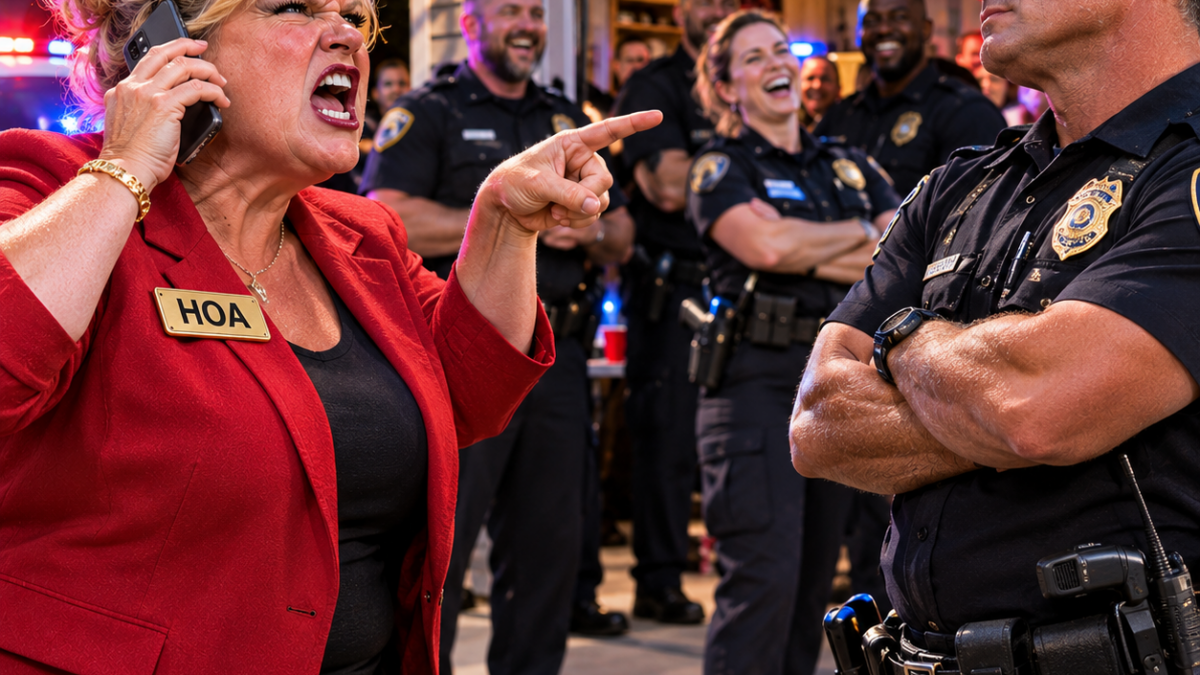
PART 2
There is something about sirens coming toward your house that changes your breathing even when you know you have done nothing wrong.
I felt it immediately.
The sound grew from a distant wail into something physical.
Closer.
Louder.
Moving fast.
Inside the garage, conversations stopped.
Someone lowered the music.
Adam looked toward the street.
“What did she tell them?”
“I don’t know.”
That was the problem.
We knew what was actually happening.
Dispatch knew only whatever Helen had decided was happening.
Those are two very different realities.
Ethan set his drink on the workbench.
“Everybody stay calm.”
The way he said it made me look at him differently.
Not because he sounded afraid.
Because he didn’t.
“What should I do?”
“You’re the homeowner?”
“Yes.”
“Stay visible. Hands out. Don’t walk toward the cars.”
I nodded.
That simple instruction made the situation feel more serious.
The first patrol car turned onto the street hard enough that its headlights swept across three front lawns.
Red and blue lights exploded against houses.
A second unit came behind it.
Then a third.
Doors opened.
Officers stepped out quickly.
Hands near holsters.
One shouted:
“Everyone in the garage, keep your hands where we can see them!”
Every man inside complied instantly.
No arguing.
No offended reactions.
No sudden movements.
Hands visible.
Bodies still.
I stood near the edge of the driveway and raised both hands slightly.
“Homeowner!”
One officer approached.
Young.
Maybe early thirties.
Focused.
“Sir, are you the homeowner?”
“Yes.”
“Anybody armed?”
That question froze me.
I looked toward Adam.
Then Ethan.
I genuinely didn’t know.
Most of these guys were off-duty officers.
Some might legally be carrying.
Ethan answered from inside.
“Some of us are law enforcement and may have secured off-duty weapons.”
The responding officer’s eyes snapped toward him.
“Do not reach for anything.”
“Wasn’t planning to.”
Then something strange happened.
The officer stared at Ethan.
Really stared.
His posture changed.
“Ethan?”
Ethan lowered his hands just slightly.
“Miller?”
The officer blinked.
“What the hell are you doing here?”
“Eating chicken.”
A second officer moved closer.
Then stopped.
“Rob?”
An older guy near the cooler sighed.
“Evening, Sanchez.”
Another recognition.
Then another.
Within maybe thirty seconds, the whole emotional temperature changed.
Not completely.
Professional procedure still mattered.
But the faceless “dangerous men” Helen had apparently described were turning into coworkers.
Detectives.
Patrol officers.
A retired deputy.
Two guys from another district.
One firefighter Adam trained with.
I looked at my brother.
“You might have mentioned this.”
He whispered:
“I thought it would be funny later.”
“This is later.”
“Not as funny as I hoped.”
Across the street, Helen was still filming.
She hadn’t understood what was happening yet.
She saw uniforms.
Saw officers.
Saw people standing with hands visible.
In her mind, this was probably proof.
Then one of the responding officers spoke into his radio.
“Dispatch, scene secure. No active threat.”
A pause.
Then:
“Possible false alarm.”
Helen lowered the phone.
Just slightly.
I watched her smile disappear.
She crossed the street.
“Wait.”
Nobody responded immediately.
She stepped closer.
“Officer?”
The young officer who had first approached me turned.
“Yes, ma’am?”
“I’m the caller.”
His expression became more careful.
“Okay.”
“These men were acting suspiciously.”
Ethan leaned against my workbench.
“By eating?”
Helen looked at him.
“You were watching the street.”
“I was standing in a garage.”
“You shut the door when I walked past.”
Adam frowned.
“We never shut the door.”
Helen ignored him.
“There was alcohol.”
The responding officer looked toward the cooler.
“So?”
“I felt threatened.”
“Did anyone threaten you?”
“No, but—”
“Did anyone approach your property?”
“No.”
“Did anyone display a firearm?”
Her hesitation lasted too long.
“I believed they might be armed.”
The officer stared.
“You believed.”
“Yes.”
“You reported weapons.”
Helen’s posture stiffened.
“They looked dangerous.”
Something about that sentence changed the atmosphere again.
Not because it was dramatic.
Because it exposed something.
Ethan looked around the garage.
Then at Helen.
“Which one of us looked dangerous?”
She didn’t answer.
The older officer by the cooler, Rob, spoke gently.
“Ma’am, we were talking about barbecue sauce when the units arrived.”
Nobody laughed.
Not yet.
Another vehicle rolled onto the street.
Unmarked SUV.
No siren.
A supervisory officer stepped out.
Late forties, maybe early fifties.
The kind of man whose authority didn’t need volume.
He took in the scene.
Patrol units.
Garage.
Off-duty officers.
Helen filming.
Then he walked toward the first responding officer.
“What’ve we got?”
“Caller reported possible armed individuals, threatening behavior, suspicious gathering.”
He glanced inside the garage.
Recognized someone.
Then another.
His eyebrows lifted.
“Seriously?”
The younger officer nodded once.
The supervisor turned toward Helen.
“You called?”
“Yes.”
“Name?”
“Helen Brooks. I’m on the HOA board.”
He didn’t react.
That irritated her.
I could see it.
People like Helen expected titles to change posture.
His didn’t.
He pulled out a small notebook.
“Tell me exactly what you observed.”
She started confidently.
“There was a large gathering of unidentified men.”
“How many?”
“Maybe twenty-five.”
Adam looked around.
We counted later.
There were fourteen guests.
The supervisor wrote something.
“Continue.”
“They were watching houses.”
Ethan actually looked offended.
“I was watching Daniel burn chicken.”
I looked at him.
“It wasn’t burned.”
“Debatable.”
The supervisor held up one hand.
Helen continued.
“They had alcohol. They were acting secretive. When I approached, I felt intimidated.”
“Did anyone verbally threaten you?”
“No.”
“Physically approach you?”
“No.”
“Display a weapon?”
“No, but I thought—”
He stopped writing.
“You told dispatch weapons were possibly being displayed.”
“I said they were possibly armed.”
“Why?”
“The way they carried themselves.”
Silence.
He looked toward the garage again.
Of course they carried themselves like police.
Most of them were.
Helen had interpreted calm awareness as danger because she had already decided what story she wanted.
The supervisor asked:
“Did you recognize anyone?”
“No.”
“Did you ask the homeowner who they were?”
“I asked whether he had authorization for the gathering.”
I almost laughed.
He looked at me.
“What did you tell her?”
“Family and friends. Brother back in town. Small get-together. Done early.”
“Music level?”
“Normal.”
A neighbor across the street called out:
“It wasn’t loud.”
Everyone turned.
Mr. Jenkins stood on his porch.
He was seventy if he was a day.
Still holding his newspaper like somehow that protected him from being involved.
Helen shot him a look.
He shrugged.
“It wasn’t.”
That opened the door.
Another neighbor stepped closer.
“Honestly, we couldn’t hear anything until the police got here.”
Somebody farther down laughed.
Helen’s face tightened.
The supervisor looked at her.
“Ms. Brooks, have you made similar calls before?”
Her expression changed instantly.
“What does that have to do with anything?”
He glanced at the younger officer.
The younger officer looked uncomfortable.
Then the supervisor said:
“Your name appears in previous reports.”
“I’m vigilant.”
“How many times have you called emergency services over neighborhood concerns?”
“I don’t keep count.”
“We do.”
That sentence landed.
The street became very quiet.
Helen folded her arms.
“I don’t appreciate your tone.”
“I’m asking questions.”
“I protect this neighborhood.”
“From what?”
She blinked.
“That’s inappropriate.”
“No, ma’am. It’s relevant.”
He flipped a page.
“Last February, suspicious vehicle?”
Her face tightened.
“It sat outside for almost an hour.”
“Home hospice nurse.”
A few neighbors murmured.
The supervisor continued.
“April. Possible drug activity?”
Helen looked around.
“That house had people coming and going constantly.”
“Gardening club.”
Someone laughed.
The supervisor did not.
“June. Late-night disturbance?”
“A group was gathered outside.”
“Three residents talking on a porch.”
Helen’s face was turning red.
“You’re trying to make me look ridiculous.”
“I’m reading reports.”
“You don’t understand this neighborhood.”
He closed the notebook.
“Ma’am, vigilance is not the same thing as manufacturing danger.”
Her mouth opened.
He continued.
“When you call 911 and report a possible armed threat, officers respond based on that information.”
She looked toward the patrol cars.
“Yes, because safety matters.”
“Exactly.”
His voice got quieter.
“That means information has to be truthful.”
“I told the truth.”
“You said you saw behavior suggesting an imminent threat.”
“It felt threatening.”
“Feelings matter. They are not evidence of a crime.”
Helen looked toward me.
“He was hostile when I asked about the gathering.”
I almost stepped forward.
The supervisor noticed.
“Sir, stay where you are.”
I stopped.
“Sorry.”
Then he asked me:
“What did you say?”
“I asked what permit she thought I needed. Told her we’d finish early. She said she’d handle it and walked away.”
Helen snapped:
“That’s not all.”
“Then what else?”
She froze.
That was the problem with cameras.
She had been filming.
The supervisor glanced at her phone.
“You recorded the interaction?”
“Yes.”
“Good.”
Helen’s face changed.
“Good?”
“May I see it?”
She held the phone tighter.
“I don’t think—”
“You’re making an allegation. Your recording could clarify.”
For once, her favorite weapon worked against her.
Helen unlocked the phone.
Opened the video.
The supervisor watched.
No shouting.
No threats.
Me holding a paper plate.
Helen asking about a permit.
Me telling her it was family and friends.
Her saying it was unsafe.
Her saying:
“I’ll handle it.”
Then walking away.
When the video ended, he handed the phone back.
His expression had become flat.
“You told dispatch the homeowner was confrontational.”
“He was dismissive.”
“That is not the same thing.”
“He refused to comply.”
“With what?”
“The gathering rules.”
“What gathering rule?”
She stopped.
The HOA did have nuisance rules.
Noise.
Parking.
Commercial activity.
None prohibited fifteen people sitting in a private garage at eight o’clock.
The supervisor looked toward the first officer.
“Any actual violation?”
“None observed.”
“Noise?”
“No.”
“Parking obstruction?”
“No.”
“Open containers in roadway?”
“No.”
“Threats?”
“No.”
“Weapons displayed?”
“No.”
The supervisor nodded.
Then turned back to Helen.
“Ms. Brooks, we’re documenting this as a false or unfounded emergency report pending review.”
The phone slipped from her hand.
It hit the pavement.
The sound was small.
But I remember it more clearly than the sirens.
“No.”
Her voice cracked.
“No, you can’t.”
He remained calm.
“I can document what occurred.”
“I was protecting people.”
“You reported danger you did not observe.”
“I was afraid.”
“Of what?”
She looked at the men inside my garage.
Nobody moved.
The supervisor continued.
“People could have gotten hurt tonight.”
That was when the humor vanished completely.
Because he was right.
The officers arriving had expected armed danger.
My guests included armed off-duty officers.
Everyone behaved calmly.
Everyone complied.
Everyone understood the stakes.
But what if one person had panicked?
What if somebody had reached for identification too quickly?
What if an arriving officer had misunderstood a lawful off-duty weapon?
What if Adam had invited completely ordinary civilians who didn’t know how to move during a high-risk police response?
Helen had created danger out of nothing.
Not because the garage party was dangerous.
Because she needed it to be.
That realization made me angrier than her calling 911 itself.
The supervisor asked:
“Has Ms. Brooks had issues with you before?”
“Not like this.”
“What does that mean?”
I explained.
The filming.
The warnings.
Her habit of hovering around other homes.
The emails.
The constant implication that ordinary behavior required her approval.
Helen interrupted.
“I have every right to monitor HOA compliance.”
The supervisor turned.
“That’s enough.”
“I am an elected board—”
“Ma’am.”
His voice never rose.
“Enough.”
She finally stopped.
The officers remained another twenty minutes.
Formal statements.
Names.
Body-camera documentation.
My off-duty guests identified themselves where appropriate.
No one was cited.
No one in the garage had done anything wrong.
Before leaving, the supervisor shook my hand.
“Sorry your night got interrupted.”
I looked toward Helen’s house.
“Could’ve been worse.”
He nodded.
“Much worse.”
That stayed with me.
Much worse.
The police cars slowly disappeared.
Red and blue light vanished from the hedges.
Doors closed up and down the street.
Neighbors stopped filming.
Helen walked home.
For the first time since I had known her, she didn’t look like she was monitoring anything.
She looked small.
Inside the garage, nobody spoke for several seconds.
Then Ethan raised a soda can.
“To the quietest police call I’ve ever attended.”
That broke it.
Laughter.
Not wild.
Relieved.
Rob shook his head.
“You know what the worst part is?”
“What?”
“I was actually enjoying your chicken.”
I pointed at Ethan.
“Tell him.”
Ethan looked offended.
“I said the edges were burned.”
“You ate three pieces.”
“Evidence disposal.”
Adam finally laughed.
I looked at him.
“This is your fault.”
“How?”
“You said training buddies.”
“They are training buddies.”
“You left out the part where they carry badges.”
“You didn’t ask.”
“I’m changing the locks.”
“On me?”
“Yes.”
The party continued.
But not really.
We stayed together another hour.
People ate.
Talked.
Tried to return to normal.
The emotional temperature never fully reset.
Once police lights flood your driveway, the night becomes divided into before and after.
Before, we were celebrating Adam coming home.
After, we were discussing how close things had come to going wrong.
Ethan sat beside me on the garage step.
“You okay?”
“Yeah.”
He waited.
“No,” I admitted.
“That’s normal.”
“I’m angry.”
“Also normal.”
“She knew there wasn’t a threat.”
“Probably.”
“Why do that?”
Ethan looked toward Helen’s dark house.
“Some people start believing discomfort is the same as danger.”
“That’s insane.”
“Sometimes.”
He took a drink.
“Sometimes it’s easier to call yourself afraid than admit you just don’t like not being in control.”
That sentence explained Helen better than anything I had heard.
Around midnight, everyone left.
Adam stayed.
We sat in the garage under the cheap string lights.
“I’m sorry,” he said.
“For what?”
“This was supposed to be fun.”
“It was.”
“For forty minutes.”
“Strong forty minutes.”
He smiled.
Then got serious.
“Those guys deal with real danger every day.”
“I know.”
“And tonight some neighbor almost made them the danger.”
I looked at him.
“Yeah.”
He rubbed his hands together.
“That’s what bothers me.”
Me too.
The next morning, Helen’s story was already spreading.
Neighborhood Facebook group.
Private HOA messages.
Group texts.
According to one version, police had “broken up an unauthorized gathering.”
According to another, there had been “concerns involving firearms.”
According to Helen’s own post, she had simply “requested a safety check.”
That last one irritated me.
Safety check.
As if three patrol cars had arrived because she politely asked someone to turn down music.
I typed a response.
Deleted it.
Typed another.
Deleted that too.
Adam watched from the kitchen.
“You’re going to post?”
“I don’t know.”
“Don’t.”
I looked at him.
“You sound like Ethan.”
“Because Ethan’s smarter than both of us.”
Fair.
By noon, the body-camera incident number had circulated among several neighbors who had witnessed the response.
People started pushing back.
Mr. Jenkins wrote:
**I live directly across from Daniel. There was no unusual noise before police arrived.**
Carol from two houses down added:
**Helen was filming them long before she called.**
Another neighbor:
**I saw her argue with Daniel. He never threatened her.**
Then somebody posted:
**Maybe we should discuss how often emergency services are being called for HOA issues.**
That changed the conversation.
Suddenly the garage party wasn’t the main subject.
Helen was.
People had stories.
Lots of them.
A hospice nurse had once been stopped because Helen thought her car looked suspicious.
A teenager was photographed for sitting in a parked car outside his own house.
A landscaping crew had been reported because Helen claimed they were “possibly casing homes.”
A Black delivery driver had been questioned by Helen because she didn’t recognize him.
A divorced father was reported for having “unregistered overnight guests.”
The guests were his children.
An elderly man had police called because his television was supposedly too loud.
When officers arrived, it wasn’t even on.
One story would have sounded petty.
Together they formed something else.
A pattern.
That afternoon, the HOA president—not Helen, the actual president—sent an email.
His name was Richard Wells.
He was normally invisible.
The message was carefully neutral.
**The board is aware of concerns arising from last night’s incident. The board will review whether any association policies or representations contributed to unnecessary emergency response. Residents are reminded that HOA board service does not grant law-enforcement authority.**
I read the last sentence twice.
So did everyone else.
Helen replied-all.
Of course.
**As the person who made the call, I strongly object to the implication that my actions were inappropriate. I acted in good faith based on behavior I reasonably considered threatening.**
Richard responded twenty minutes later.
**This matter is under review. Please refrain from further community-wide communication until that review is complete.**
That was the HOA version of:
Stop talking.
For once, Helen listened.
For two days.
Then a letter appeared taped to my mailbox.
Not an official violation.
A “community courtesy notice.”
It cited excessive gathering.
Parking congestion.
Potential nuisance.
I photographed it.
Sent it to Richard.
His response came fast.
**This notice was not authorized by the board. Please retain it.**
Interesting.
Then a second note appeared.
This one said:
**Some residents are uncomfortable with law-enforcement personnel gathering socially in residential areas.**
That one made me laugh.
Adam read it.
“They know cops live here, right?”
“Apparently off-duty cops become suspicious when they eat barbecue.”
He shook his head.
I sent that note to Richard too.
No answer.
Instead, the HOA announced a special meeting.
Normally twelve people attended.
That night, more than sixty showed up.
Folding chairs lined the back wall.
People stood in the hallway.
I sat near the middle.
Adam came with me.
Ethan didn’t.
He said it was my neighborhood problem now.
Probably wise.
Helen sat at the board table.
She wore a dark red jacket.
Clipboard.
Straight back.
Same posture.
But something had changed.
People weren’t looking away anymore.
Richard opened the meeting.
“We’re here to address concerns related to emergency reporting, board conduct, and misuse or perceived misuse of association authority.”
Helen immediately raised one hand.
“I object to the phrase misuse.”
Richard looked tired.
“Noted.”
She leaned toward the microphone.
“I believe this entire process is retaliation because I had the courage to report suspicious behavior.”
Murmurs.
Richard said:
“You will have time to speak.”
“I’m speaking now.”
“No.”
That single word surprised everyone.
Especially Helen.
Richard continued.
“Residents first.”
Mr. Jenkins stood.
“I have lived across from Daniel for nine years.”
Technically I had lived there six.
He corrected himself after someone whispered.
“Six years. Feels longer.”
Laughter.
Even I smiled.
He continued.
“That party wasn’t loud.”
Helen rolled her eyes.
Mr. Jenkins pointed at her.
“That. That right there.”
Richard said:
“Please address the board.”
Jenkins turned back.
“She looks at anyone who disagrees with her like they’re stupid.”
A few people murmured agreement.
“She called the police because she didn’t like those men.”
Helen interrupted:
“I feared for my safety.”
Jenkins turned.
“You were standing across the street filming them.”
“That doesn’t mean—”
“You walked closer after police arrived.”
More murmurs.
Richard tapped the table.
“Please.”
A woman named Maria stood next.
“Helen reported my son.”
Helen looked confused.
“Which incident?”
Maria laughed bitterly.
“That you have to ask is the problem.”
The room changed.
Maria’s son, Caleb, was nineteen.
College student.
Mixed-race.
She explained that he had been sitting in his car after midnight talking on the phone because his girlfriend had broken up with him and he didn’t want his younger siblings hearing him cry.
Helen photographed the car.
Called it suspicious.
Police arrived.
Caleb had been terrified.
“No crime,” Maria said.
“No violation.”
She looked directly at Helen.
“You saw a young man you didn’t recognize emotionally and decided he was dangerous.”
Helen’s face hardened.
“I could not know who he was.”
“You live four houses from us.”
Silence.
Another resident stood.
Then another.
Story after story.
Helen defended each one individually.
Hospice nurse?
Unmarked vehicle.
Gardening club?
Unusual traffic.
Kids playing basketball?
Noise.
Divorced father’s children?
Overnight occupancy rules.
Every explanation sounded almost reasonable by itself.
Together they became absurd.
Richard finally interrupted.
“Helen, do you understand what residents are saying?”
“I understand they’re angry because rules have consequences.”
A groan moved through the room.
She continued.
“If people had followed rules, most of these situations would not have occurred.”
That was when I finally stood.
Richard looked at me.
“Daniel.”
I walked toward the microphone.
Helen’s eyes followed me.
“I didn’t break an HOA rule Saturday.”
She opened her mouth.
I held up one hand.
“Let me finish.”
To my surprise, she did.
“My brother came home. I invited friends.”
I looked around.
“We grilled food. Played low music. Nobody blocked traffic. Nobody threatened anyone.”
Then I looked at Helen.
“You saw men you didn’t recognize.”
Her jaw tightened.
“You decided that made them dangerous.”
“I made an assessment.”
“No.”
I shook my head.
“You wrote a story.”
The room went quiet.
“And then you called 911 and forced police officers to enter the story you invented.”
Helen stared.
“You have no idea what it feels like to be a woman alone in a neighborhood watching unfamiliar men—”
“I absolutely accept that you can feel uncomfortable.”
That surprised her.
I continued.
“You could have gone inside.”
Nothing.
“You could have called the HOA president.”
Nothing.
“You could have called the non-emergency line and said you were concerned about noise.”
Nothing.
“You could have asked me again who they were.”
I leaned slightly toward the microphone.
“But you told 911 there were dangerous armed men.”
Her eyes flashed.
“I said possibly armed.”
“You had no evidence.”
“They were.”
That stopped me.
“What?”
“They were armed.”
“Some were law-enforcement officers.”
“So I was right.”
A sound moved through the room.
Not laughter.
Disbelief.
I stared at her.
“No, Helen.”
She looked satisfied for half a second.
“You accidentally guessing someone might legally carry a weapon does not make your claim of criminal danger true.”
Her smile disappeared.
I continued.
“And the fact that they turned out to be cops isn’t actually the important part.”
Several people looked surprised.
“It shouldn’t matter who they were.”
I paused.
“They could have been teachers.”
“Mechanics.”
“Accountants.”
“Construction workers.”
“My brother’s gym friends.”
“As long as nobody was threatening you, you didn’t get to turn them into criminals because they made you uncomfortable.”
That changed something in the room.
Even Helen stopped moving.
I finished:
“The irony is that they were cops.”
“The problem is that they shouldn’t have needed to be.”
I sat down.
Adam squeezed my shoulder.
“Not bad.”
“Shut up.”
Richard called for a recess.
Ten minutes.
The room exploded into conversations.
People came to me.
Some thanked me.
I hated that.
I hadn’t wanted to lead anything.
One older man said:
“You said what everybody needed.”
I shook my head.
“Everybody already knew.”
“Knowing silently doesn’t change much.”
That turned out to be true.
After recess, Richard announced a formal board review.
Helen would temporarily step back from compliance activities.
She laughed.
“Temporarily?”
“Yes.”
“I have served this community for eleven years.”
“And now we’re reviewing that service.”
She looked stunned.
For years, Helen’s greatest weapon had been inevitability.
Everyone assumed she would always be there.
Always sending emails.
Always photographing.
Always reporting.
The moment people realized she could be challenged, her authority shrank.
Over the next week, the police review moved forward too.
I gave another statement.
The senior officer explained they were examining whether Helen’s 911 call met the threshold for a false emergency report or misuse.
“I don’t want revenge,” I said.
He nodded.
“This isn’t about what you want.”
That answer bothered me at first.
Then I understood.
Emergency systems don’t belong to victims or callers.
They belong to everyone.
If someone abuses them, the harm extends beyond one neighborhood dispute.
“What happens?”
“Depends on evidence, call recording, history, prosecutor review.”
“Can I hear the call?”
“Eventually maybe.”
I didn’t.
Not then.
Several weeks later, through the process, parts of the call became known.
Helen had told dispatch there was:
“a group of possibly armed adult males behaving aggressively.”
She described them as “monitoring homes.”
Said she believed “something criminal” might be occurring.
When asked whether anyone had directly threatened her, she apparently said:
“Not yet.”
Not yet.
Those two words bothered me more than anything.
They turned the absence of a threat into evidence that a threat was coming.
How do you defend yourself against that logic?
You don’t.
That’s why it’s dangerous.
The report was eventually formally classified as unfounded, and Helen faced consequences for misuse of emergency services under the applicable local process.
It wasn’t some dramatic felony prosecution.
No SWAT team.
No courtroom screaming.
There were administrative and legal consequences.
Documentation.
Warnings.
Fines.
Potential liability if the behavior continued.
More importantly for Helen, the police department communicated directly with the HOA about using emergency services for association disputes.
That embarrassed her more than any citation could.
The HOA review continued.
The board looked through years of complaints.
Not all came from Helen.
But an uncomfortable number did.
Many had no violation attached.
Some involved emergency calls.
Some involved non-emergency police contact.
Some involved photographs she took personally.
Some had notes attached in HOA files describing residents as:
**uncooperative**
**hostile**
**problem household**
**needs monitoring**
When those phrases became public at another meeting, the neighborhood reaction changed from frustration to anger.
Maria stood with a printed copy of her family’s file.
“My son is listed as a problem household.”
Richard looked embarrassed.
“We are reviewing these labels.”
“Who wrote this?”
Nobody answered.
Maria looked at Helen.
Helen looked down.
That was answer enough.
Tom Benson, a retired teacher, stood next.
“My file says resistant to neighborhood culture.”
People laughed.
He didn’t.
“What does that mean?”
Helen finally said:
“You repeatedly objected to community standards.”
“I objected to you photographing my grandchildren.”
Silence.
One by one, old private humiliations became public facts.
That was Helen’s real downfall.
Not the garage party.
The garage party simply cracked the door.
Everything else had been waiting behind it.
I started feeling strange about my role.
Neighbors treated me like I had defeated someone.
I hadn’t.
Helen defeated herself over years.
I was simply the incident people could no longer explain away.
That mattered.
There’s a difference between causing a collapse and being present when a structure finally reveals how unstable it already was.
Three weeks after the party, the newsletter arrived.
I almost deleted it.
Then saw one sentence halfway down.
**Effective immediately, Helen Brooks has resigned from the HOA Board.**
That was it.
No explanation.
No farewell.
No eleven-year retrospective.
No thank-you for service.
Just gone.
I stood in my kitchen staring at the phone.
I expected satisfaction.
I had imagined this moment.
Not consciously maybe.
But some part of me expected a rush.
Finally.
She lost.
Instead, I felt relief.
Then something heavier.
Sadness, maybe.
Not for what she did.
For what a person had to become to live like that.
Adam called that evening.
“You saw?”
“Yeah.”
“How do you feel?”
“I don’t know.”
“Happy?”
“Not really.”
“Should I be worried?”
“No.”
I leaned against the counter.
“I thought I wanted her gone.”
“You wanted her to stop.”
That was exactly it.
Those aren’t always the same thing.
“I didn’t care whether she stayed on the board.”
“I just wanted her to stop treating everyone like suspects.”
Adam laughed softly.
“Maybe without the board she can learn to be a neighbor.”
I doubted it.
I was wrong.
A few days later, I saw Helen sitting on her front porch.
No clipboard.
No phone raised.
No dog.
Just Helen.
I almost walked past.
Then stopped at the edge of her lawn.
She noticed me.
For several seconds, neither of us spoke.
Finally:
“You got what you wanted.”
Her voice wasn’t bitter.
That surprised me.
“I didn’t want you gone.”
She looked away.
“Everyone says that after.”
“I wanted you to leave me alone.”
She gave a small laugh.
“Same difference.”
“No.”
I stepped closer but stayed on the sidewalk.
“You think this was about winning?”
“Wasn’t it?”
“No.”
“What was it about?”
I looked at her house.
Then my garage down the street.
“I wanted to grill chicken without having police arrive expecting guns.”
She flinched.
Good.
Not because I wanted to hurt her.
Because reality should hurt a little when you’ve spent years avoiding it.
Helen looked down at her hands.
“This neighborhood used to feel safe.”
I said nothing.
“When we first moved here, everyone knew everyone.”
She looked toward the street.
“Kids grew up together. People watched each other’s houses.”
“Sounds nice.”
“It was.”
“What changed?”
“People.”
She immediately corrected herself.
“No.”
Then:
“Maybe I did.”
I waited.
She took a long breath.
“My husband died seven years ago.”
I knew he had died.
I didn’t know when.
“He handled everything.”
“What does that have to do with the HOA?”
“After he died, people checked on me.”
She smiled faintly.
“Then they stopped.”
That sentence landed harder than I expected.
“I joined more committees.”
“Started helping with compliance.”
“People called me when there was a problem.”
Her fingers tightened around the porch railing.
“For a while, I felt useful.”
I understood before she finished.
“Then useful became necessary.”
She looked at me.
“Yes.”
“And necessary became control.”
Her eyes filled.
“Yes.”
We stood quietly.
She continued.
“If I knew whose car was where, who was visiting, who was outside, what people were doing…”
“You felt safe.”
She nodded.
“I could keep things from changing.”
“But things change anyway.”
“I know.”
Her voice cracked.
“I know that now.”
That didn’t excuse anything.
She had frightened people.
Humiliated residents.
Wasted emergency resources.
Created risk.
Loneliness doesn’t transform harmful behavior into harmless behavior.
But it explained something.
Fear disguised as authority.
Loneliness disguised as duty.
Control disguised as community care.
I said:
“You scared people.”
“I know.”
“You made ordinary people feel like they had to prove they belonged in their own homes.”
“I know.”
“You could have gotten someone hurt that night.”
She closed her eyes.
“I know.”
For the first time, there was nothing to fight.
No excuse.
No policy.
No title.
Just:
I know.
I didn’t forgive her dramatically.
She didn’t ask.
We didn’t hug.
That would have felt ridiculous.
I simply said:
“I hope you figure out who you are without monitoring everyone else.”
She nodded.
“So do I.”
Then I walked home.
After that, the neighborhood changed slowly.
Not overnight.
People who had lived under constant low-level scrutiny didn’t suddenly become relaxed.
But little things happened.
Kids played basketball later.
Neighbors sat on driveways talking.
People stopped pulling trash cans in with military precision.
Nobody photographed visiting cars.
The new HOA board sent fewer emails.
When they did, the tone changed.
No:
**IMMEDIATE COMPLIANCE REQUIRED.**
More:
**Reminder: please bring bins in by Tuesday evening when possible.**
Small difference.
Huge emotional effect.
One evening, Maria’s son Caleb was shooting hoops.
The ball bounced into Helen’s yard.
Everyone noticed.
Caleb froze.
Old reflex.
Helen came outside.
Picked up the basketball.
For one second, nobody knew what would happen.
Then she tossed it back.
“Nice shot.”
Caleb caught it.
“Thanks.”
She went inside.
Maria looked at me across the street.
I shrugged.
Progress.
Several months passed.
My garage became normal again.
Tools.
Cars.
Boxes.
Adam visited.
We had another gathering.
Smaller.
Not because of Helen.
Because I didn’t feel like cooking for fifteen people again.
Ethan came.
Rob came.
A few others.
Before we started, Adam looked across the street.
“No Helen.”
“She’s home.”
“You checked?”
“No.”
He smiled.
“Growth.”
We opened the garage door.
Music.
Food.
Laughter.
No one filmed.
No police arrived.
Around nine, Ethan stood in my driveway looking toward the street.
“You know what’s weird?”
“What?”
“I keep expecting lights.”
“Me too.”
He nodded.
“Stuff like that sticks.”
“Yeah.”
He took a drink.
“You ever hear what happened with the emergency call?”
“Enough.”
“She learned?”
“I think so.”
“That’s rare.”
I looked toward Helen’s dark porch.
“Maybe.”
Then Ethan said something I still think about.
“The best outcome isn’t that she got punished.”
“What is?”
“That nobody needs to be scared of her anymore.”
That was right.
Punishment ends an incident.
Changing the dynamic ends the pattern.
The neighborhood had stopped feeding Helen’s authority.
People challenged politely.
Asked for rules in writing.
Attended HOA meetings.
Requested minutes.
Asked:
“Is this actually a violation?”
The board had to answer.
Sometimes yes.
Usually no.
That was healthy.
Rules still existed.
Nobody became anarchists.
Trash cans still had deadlines.
Grass still got cut.
People still argued about fences.
But nobody confused the HOA with law enforcement anymore.
That distinction alone made the neighborhood feel lighter.
One spring, the board held a community picnic.
I almost skipped it.
Adam convinced me to go.
Helen was there.
Not working a table.
Not holding a clipboard.
Just sitting beneath a tree eating potato salad.
At one point, a kid ran across the grass with a water gun.
He sprayed another kid.
Then accidentally hit Helen.
Everyone nearby froze.
Helen looked down at her wet shirt.
The kid looked terrified.
“Sorry!”
For one second, old Helen appeared in her eyes.
Then she started laughing.
Actually laughing.
“It’s fine.”
The kid ran off.
Adam leaned toward me.
“Who is that woman?”
“Apparently the neighborhood no longer requires a sheriff’s response to water guns.”
He laughed.
Helen heard.
She looked over.
Then, surprisingly, laughed too.
That felt like an ending.
Not complete.
But real.
I still thought about the night sometimes.
Mostly when I heard sirens.
The sound changed for me.
Before, sirens meant somebody else’s emergency.
Afterward, part of my body remembered flashing lights reflected against my garage.
Remembered hands raised.
Remembered the possibility of a misunderstanding becoming permanent.
That was the part I couldn’t turn into a joke.
What if those men had not been police?
What if they had been ordinary friends?
Would the responding officers have relaxed as quickly?
Maybe.
Hopefully.
What if someone had panicked?
What if Helen’s description had sounded even more alarming?
What if one guest had lawfully carried a firearm and reached toward his waistband before understanding the command?
Nothing happened.
I’m grateful.
But “nothing happened” can hide how close an unnecessary emergency response comes to becoming something else.
That humbled me.
It changed how I think about words like:
Suspicious.
Dangerous.
Threatening.
Those words are not neutral.
When you tell authorities someone is dangerous, you place weight on every movement that person makes afterward.
A hand moving becomes a threat.
A question becomes defiance.
A confused reaction becomes suspicious.
Helen had never thought about that.
She thought she was merely making a phone call.
She was actually shaping how armed officers approached my home.
That is power.
Real power.
More power than any HOA title she ever held.
She learned that too late.
But she did learn.
A year after the incident, I saw the senior officer who had handled the scene.
His name was Captain Miller.
Different Miller from the younger responding officer.
I ran into him at a coffee shop.
He recognized me first.
“Garage party.”
I groaned.
“That’s my legal name now.”
He laughed.
“How’s the neighborhood?”
“Quiet.”
“Good.”
“Helen resigned.”
“I heard.”
“You hear everything?”
“Small department.”
I hesitated.
“Can I ask you something?”
“Sure.”
“How bad could that night have gone?”
His expression changed.
No smile.
“Bad.”
That answer was enough.
But he continued.
“Dispatch information shapes initial response. Officers were told multiple potentially armed subjects, possible intimidation, caller afraid.”
I felt my stomach tighten.
“If Ethan hadn’t been there?”
“Wouldn’t change our obligation to assess.”
“No, I mean recognizing him.”
Captain Miller thought.
“The recognition helped lower uncertainty faster.”
Exactly what I feared.
“So Helen made it more dangerous.”
“She made it more complicated than it needed to be.”
He took a sip.
“People assume calling 911 transfers responsibility.”
“What do you mean?”
“They think, ‘I called. Police decide what happens now.’”
He put the cup down.
“But callers influence what happens through what they report.”
I nodded.
“That’s why exaggeration matters.”
He looked at me.
“Yes.”
Then:
“To be clear, your guests did everything right.”
“I know.”
“So did the responding officers.”
“I know.”
“The problem was bad information.”
“I know.”
He smiled slightly.
“You really wanted me to say it.”
“Maybe.”
“Bad information creates bad conditions.”
That sentence stayed with me.
I thanked him.
Before leaving, he said:
“Invite better neighbors next time.”
“I did.”
“Good.”
The story became neighborhood folklore.
Like stories do, it mutated.
According to one version, Helen called SWAT.
She didn’t.
According to another, thirty off-duty cops were inside.
Fourteen guests total.
According to one teenager, the entire police department was eating ribs when units arrived.
Not remotely true.
Someone claimed Helen was arrested on the spot.
Also false.
The real story was less cinematic.
But the truth mattered more.
She called 911 and exaggerated danger.
Officers responded appropriately to what they were told.
They discovered the reality didn’t match.
A history emerged.
Consequences followed.
The HOA removed her authority.
Residents finally talked.
The neighborhood changed.
That is less dramatic than instant revenge.
It is also more satisfying.
Because revenge would have ended with Helen humiliated.
This ended with everyone safer.
Even Helen.
Especially, maybe.
She no longer carried the impossible job she had invented for herself.
She didn’t have to know every car.
Every visitor.
Every garbage can.
Every sound.
She slowly became someone who simply lived there.
One afternoon, maybe eighteen months later, I was fixing a shelf in the garage when she walked past with her dog.
She stopped.
“Daniel.”
“Helen.”
She looked inside.
“No permit?”
I stared at her.
For half a second, I couldn’t tell.
Then she smiled.
I laughed.
“Don’t start.”
She continued walking.
That tiny joke told me more than an apology would have.
She understood.
The garage had stopped being evidence.
I had stopped being a target.
She had stopped being an officer nobody appointed.
We were just neighbors.
Not friends.
That distinction mattered.
Healing does not always mean reconciliation.
Sometimes it means coexistence without fear.
Adam visited again that summer.
We sat on my driveway after dark.
No party.
Just us.
He asked:
“You ever wish I hadn’t invited the guys?”
“No.”
“Really?”
“If they hadn’t been there, maybe we never would’ve understood how serious Helen’s behavior had gotten.”
He looked uncomfortable.
“That’s a pretty expensive lesson.”
“Emotionally?”
“Yeah.”
I nodded.
“I wish the lesson had been cheaper.”
Then I smiled.
“But Rob’s barbecue-sauce argument was worth something.”
Adam laughed.
“He still insists Carolina-style is superior.”
“He’s wrong.”
“Objectively.”
We sat quietly.
Then Adam said:
“I’m glad you didn’t turn this into a revenge thing.”
I looked at him.
“I wanted to for a while.”
“I know.”
“How?”
“You’re my brother.”
Fair.
“I wanted her embarrassed.”
“She was.”
“I wanted everybody to see what she was.”
“They did.”
“I wanted her gone.”
“She left.”
“Then none of it felt as good as I expected.”
Adam nodded.
“Because what you actually wanted was peace.”
That word again.
Peace.
It sounds passive.
It isn’t.
Peace sometimes requires confronting the thing disturbing it.
But if confrontation becomes your identity, you never get the peace back.
That was the trap I avoided.
Eventually.
I stopped checking Helen’s porch.
Stopped wondering whether she was filming.
Stopped attending every HOA meeting.
Stopped reading every email like it contained a hidden threat.
The neighborhood survived without my vigilance.
That was important.
Otherwise I could have become her in reverse.
A man so obsessed with preventing abuse of authority that I started monitoring everyone for signs of authority.
Fear can reproduce itself that way.
I didn’t want that.
So I went back to ordinary life.
Work.
Mortgage.
Mowing.
Adam’s visits.
Chicken on the grill.
The garage slowly accumulated junk again.
The folding chairs disappeared into storage.
The string lights stayed.
I liked them.
Every once in a while, I turned them on when nobody was coming over.
The warm light against the concrete reminded me that the same place could hold two memories.
Police lights.
And laughter.
I got to choose which one I fed.
One evening, Mr. Jenkins walked over.
“Party?”
“No.”
“Lights are on.”
“I like them.”
He nodded.
Then stood there awkwardly.
“Can I ask you something?”
“Sure.”
“Why didn’t you sue her?”
I laughed.
“For what?”
“Everything.”
“I talked to an attorney.”
“What’d they say?”
“There were options.”
“And?”
“I didn’t want the next three years of my life organized around Helen.”
Jenkins considered that.
“Smart.”
“Maybe.”
“I would’ve sued.”
“I know.”
He frowned.
“How do you know?”
“You filed a complaint over a tree root.”
“That root cracked my driveway.”
“I know.”
He walked home muttering.
I laughed.
There had been legal routes.
Civil claims.
Potential defamation issues depending on statements.
Emergency-report misuse.
HOA misconduct.
But I wasn’t interested in maximizing punishment.
The police and HOA had their processes.
I wanted distance.
Sometimes winning means knowing when enough accountability is enough.
That doesn’t fit the fantasy of total revenge.
But it fit my life.
The board adopted new policies after Helen resigned.
No individual board member could issue unofficial compliance notices.
Resident complaints had to be documented.
Emergency services were explicitly excluded from normal HOA enforcement.
Board members received training.
That last one made everyone laugh.
Apparently there was now a slide titled:
**THE HOA IS NOT LAW ENFORCEMENT.**
Richard showed it at a meeting.
People applauded.
I almost felt sorry for future board members.
Almost.
The best policy, though, was simple.
Before escalating a resident issue, the HOA had to verify:
What rule?
What evidence?
What authority?
Three questions.
Helen’s entire system would have collapsed under them.
What rule prohibited my gathering?
None.
What evidence suggested criminal danger?
None.
What authority did Helen possess?
Almost none.
Simple questions.
People underestimate how powerful precise questions are.
Bullies thrive in vague language.
Unsafe.
Suspicious.
Inappropriate.
Concern.
Community standards.
Ask for specifics and suddenly the room changes.
Unsafe how?
Suspicious because of what?
Which rule?
What behavior?
Who authorized this?
Show me.
That became one of the lasting changes in the neighborhood.
People asked.
Not aggressively.
Just clearly.
And because they asked, the HOA became more boring.
Boring governance is underrated.
One year, the biggest controversy was whether holiday decorations could stay up until January 15 or January 20.
The meeting lasted two hours.
I left early.
It was beautiful.
No police.
No false reports.
No suspicious gardeners.
Just adults arguing about inflatable snowmen.
That was progress.
Helen still lived three houses down.
Her hedges remained perfect.
Some habits never die.
But she stopped inspecting other people’s lawns.
Stopped carrying the clipboard.
Her dog got older.
She walked slower.
Sometimes we waved.
Sometimes we didn’t.
That was enough.
Then something happened that changed how I saw her one final time.
A summer thunderstorm rolled through fast.
Colorado weather.
Sun at five.
Violent wind at five-thirty.
A tree limb fell across Helen’s driveway.
Big one.
She was outside staring at it when I came home.
I parked.
Walked over.
“You okay?”
“I’m fine.”
“Need help?”
She hesitated.
Old pride.
Then:
“Yes.”
I grabbed my chainsaw.
Mr. Jenkins came with a pry bar.
Another neighbor brought gloves.
Within forty minutes, the driveway was clear.
Nobody discussed the garage party.
Nobody discussed the board.
We worked.
When it was done, Helen stood near the cut branches.
“Thank you.”
“Sure.”
She looked around at all of us.
Then said:
“I forgot this is what community is supposed to feel like.”
Nobody answered.
We didn’t need to.
That sentence closed something for me.
Helen had spent years thinking community meant surveillance.
Rules.
Control.
Knowing everything.
But community was neighbors showing up with chainsaws without asking for authority.
It was Maria bringing food when someone was sick.
Jenkins checking on elderly residents during snowstorms.
Kids returning basketballs.
Adam bringing friends into my garage.
Trust.
Voluntary.
Messy.
Uncontrolled.
That was the thing Helen had been trying to protect by destroying it.
I think she finally understood.
The next HOA election came.
Helen did not run.
Nobody expected her to.
Richard stepped down too.
Newer residents joined.
Younger parents.
Retirees.
One accountant everyone joked was too boring to become corrupt.
The association became something I barely noticed.
Which is exactly how a good HOA probably should function most of the time.
The garage party story continued fading.
New residents occasionally heard it.
Sometimes they asked.
“Is it true everyone in your garage was a cop?”
“Not everyone.”
“Most?”
“Enough.”
“Did Helen get arrested?”
“No.”
“Did she get kicked out?”
“She resigned.”
“That’s less exciting.”
“Real life usually is.”
They looked disappointed.
I didn’t.
The real ending was better than the exaggerated one.
Helen didn’t vanish.
She changed.
The neighborhood didn’t destroy her.
It stopped empowering the behavior.
Police didn’t humiliate her.
They documented reality.
I didn’t become a hero.
I stayed a homeowner.
That was enough.
Several years later, Adam came back into town again after another long stretch away.
We decided to recreate the garage night.
Not intentionally at first.
He said:
“Want to have people over?”
I looked around.
Garage.
String lights still hanging.
“Sure.”
This time I knew exactly who he meant by training friends.
Ethan arrived first.
Older.
Same calm smile.
“Any emergency permits required?”
“Get out.”
Rob came next.
He brought barbecue sauce.
Wrong kind.
We argued.
Neighbors came too.
Maria.
Caleb, now finished with college.
Mr. Jenkins.
Even Richard.
The new HOA chair stopped by for thirty minutes.
Around eight, I looked across the street.
Helen was on her porch.
Alone.
For a second I considered ignoring her.
Then I walked across.
She looked up.
“What?”
“We’ve got too much food.”
She stared.
“You’re inviting me?”
“I’m offering chicken.”
“Is there a permit?”
I smiled.
“Don’t push it.”
She laughed.
Then, after a moment:
“I’ll come by.”
Ten minutes later, Helen walked into my garage.
Not filming.
Not counting.
No clipboard.
Just carrying a bowl of potato salad.
The room noticed.
Conversation softened for a second.
Then Rob, of all people, saved it.
“Is that homemade?”
Helen looked at him.
“Yes.”
He tasted it.
“Needs paprika.”
She stared.
Then said:
“Your barbecue sauce tastes like ketchup.”
The room exploded.
Perfect.
No speeches.
No apology ceremony.
Just food.
Later that evening, Helen sat near the garage door.
Ethan walked over.
She looked at him.
“I remember you.”
“I remember you too.”
“I’m sorry.”
He nodded.
“Thank you.”
That was it.
No punishment.
No lecture.
No “you could have killed someone.”
He could have said those things.
They were true.
But she already knew.
Sometimes repeating a lesson after it has finally been learned is just cruelty wearing the clothes of justice.
Ethan understood that.
So did I.
At around ten, people started leaving.
Helen carried her empty bowl home.
Adam stood beside me.
“You invited her.”
“Apparently.”
“You’ve gotten soft.”
“Shut up.”
He looked around the garage.
“No cops.”
“There are literally twelve cops standing here.”
“You know what I mean.”
I did.
No flashing lights.
No commands.
No emergency.
No story invented by someone standing outside.
Just people.
That was the difference.
A few weeks later, I finally took down the original cheap string lights.
Half had burned out.
The wires sagged.
Adam complained.
“Historic artifacts.”
“Trash.”
“You should frame them.”
“I should frame you.”
I replaced them with better lights.
Warm LEDs.
Cleaner.
Brighter.
I stood in the garage that evening looking at them.
Same space.
Different light.
That felt appropriate.
We do that with memories too.
We don’t erase the room.
We change what illuminates it.
For years, if someone mentioned that night, I pictured police cars.
Eventually, I pictured Ethan’s soda toast.
Then Rob arguing about barbecue sauce.
Later, I pictured Helen carrying potato salad into the same garage she once described as dangerous.
The memory changed because life kept adding to it.
That may be the most satisfying form of revenge available.
Not freezing somebody forever as the villain.
Living long enough that their worst act becomes only one scene in a much larger story.
Today, the garage is still messy.
Tools.
Bike.
Old refrigerator.
Half-finished shelving project.
The string lights come on whenever Adam visits.
Helen still lives down the street.
We are not close.
We don’t need to be.
Sometimes we wave.
Sometimes she asks whether Adam is home.
Once she told me my lawn was getting long.
I stared at her.
She immediately raised both hands.
“Joke.”
“Good.”
She laughed.
I mowed it the next day anyway.
Not because of her.
Probably.
The HOA newsletter still arrives every month.
I skim it.
Most of it is boring.
Road repairs.
Pool schedule.
Architectural requests.
Once, buried on page three, there was a reminder:
**Residents should contact emergency services only for genuine emergencies or situations requiring immediate police, fire, or medical response. HOA concerns should be directed through normal association channels.**
No name attached.
It didn’t need one.
I saved that newsletter.
Not as a trophy.
As proof that systems can learn too.
Slowly.
Painfully.
But they can.
When I think about that Saturday night now, I don’t feel triumphant.
Mostly grateful.
Grateful the responding officers were professional.
Grateful my guests knew how to behave.
Grateful nobody panicked.
Grateful truth surfaced quickly.
Because the irony that everyone loves—the HOA Karen calling police on a garage full of off-duty cops—is only funny because nobody got hurt.
Take away that outcome and the story stops being funny immediately.
That is what I carry from it.
Not revenge.
Responsibility.
Words matter.
Fear matters.
Authority matters.
If you claim danger, you should understand what happens when other people act on that claim.
Helen didn’t.
Then she learned.
The neighborhood learned too.
And strangely, so did I.
I learned that standing up for yourself doesn’t always mean crushing the person who came after you.
Sometimes it means telling the truth clearly enough that they lose the power to keep lying.
Then stopping.
Let consequences belong to the systems designed to handle them.
Let people decide whether to change.
And if they do change, you don’t have to become their friend.
You simply stop needing them to suffer.
That was the point where I knew the whole thing was actually over.
Not when the police wrote the report.
Not when Helen resigned.
Not when the HOA changed policy.
Not even when she apologized to Ethan.
It ended the first night I saw her walking past my open garage and realized I didn’t care whether she looked inside.
No anxiety.
No anger.
No instinct to prove anything.
Just my neighbor.
Walking her dog.
I turned back toward the garage.
Adam was inside telling another story badly.
Ethan was correcting him.
Rob was stealing food.
Somebody laughed.
The lights were warm.
The street was quiet.
Nobody was afraid.
That was all I had wanted from the beginning.
A garage.
My brother.
Some friends.
A couple hours where life didn’t feel so heavy.
It took one unnecessary 911 call, three patrol cars, a neighborhood reckoning, an HOA resignation, and several uncomfortable truths to get there.
But eventually, we got there.
And now, whenever Adam comes home, I still roll the cars into the driveway.
I still sweep the garage.
I still put out folding chairs.
I still grill too much chicken.
The only difference is that now, when laughter spills into the driveway, nobody mistakes it for danger.
They just hear neighbors enjoying the night.
Exactly the way it should have been all along.








