PART 2: HOA Karen Called 911 on My Backyard BBQ—She Had No Idea the Fire Chief Was Already Sitting There Eating My Brisket
PART 2
Deborah Hartley moved into 4127 Sycamore Lane on a Tuesday in April.
Four bedrooms.
Three-car garage.
Fresh landscaping.
One sedan parked inside a space large enough for three vehicles.
She was fifty-seven, though almost nobody guessed it correctly.
Her hair was salon-perfect auburn.
Her nails were never chipped.
Her sunglasses were Chanel.
Her blouses looked pressed even in ninety-degree Texas heat.
And she wore stilettos on her own driveway as though asphalt existed to support fashion rather than cars.
Linda watched her walking two Persian cats on leashes one afternoon and said, “That woman wakes up every morning prepared to file a complaint against oxygen.”
I laughed.
Linda didn’t.
“I mean it.”
Deborah had recently relocated from a gated community near Plano, where she had served six years as HOA vice president.
We learned later that she had not been universally adored there.
That was putting it kindly.
She arrived in Ridgerest with two cats, expensive furniture, a binder filled with old HOA rules, and the absolute conviction that every neighborhood was waiting for someone like her to improve it.
Her first encounter with me happened while I was trimming a brisket.
I heard heels before I saw her.
Click.
Click.
Click.
I looked toward the driveway.
She stood at the edge holding a clipboard.
“What the hell is that thing?”
I followed her stare.
“The smoker?”
“It smells like a landfill.”
“Post oak.”
“I didn’t ask what kind of wood.”
She looked me up and down.
Old Station 14 T-shirt.
Work shorts.
Boots.
Gloves covered in brisket fat.
“I paid nearly two million dollars for my house.”
“Congratulations.”
Her mouth tightened.
“I did not pay two million dollars to live next to a man grilling in his yard like a vagrant.”
Linda was inside.
I knew she heard that.
I could practically feel her moving toward the screen door.
I kept my voice level.
“The kitchen is fully permitted.”
“I’m not here to chat with the help.”
That one almost did it.
Linda appeared behind me.
I raised one hand slightly.
Not yet.
Deborah continued.
“I’m calling the fire department.”
“I’m happy to show you the permits first.”
“I don’t want your permits.”
“Inspection reports?”
“No.”
“Fire-safety certification?”
“I want that disgusting thing gone.”
I looked at the smoker.
Then back at her.
“No.”
She seemed genuinely surprised.
People like Deborah usually build their strategy around discomfort.
They make the conversation so unpleasant that agreement feels easier than continuing.
I had spent twenty-two years in burning buildings.
An angry woman with a clipboard was not going to raise my pulse.
She pointed toward the backyard.
“You’ll regret being difficult.”
“I’m not being difficult.”
“You are refusing a reasonable request.”
“You asked me to remove a permitted outdoor kitchen from my property because you don’t like the smell.”
“Yes.”
“That isn’t reasonable.”
Deborah’s expression hardened.
Then she turned and walked home.
When she was gone, Linda stepped outside.
“She called you the help.”
“I noticed.”
“You’re wearing a shirt that says ‘Captain Marcus Cole, Station 14.’”
“Maybe she doesn’t read.”
“Oh, she reads.”
Linda folded her arms.
“She just doesn’t read anything that contradicts what she already decided.”
I should have written that down.
It explained the next eighteen months better than anything else.
The first note arrived the next morning.
Lavender stationery.
Handwritten.
She wrote that she had noticed an “unusual amount of smoke” emanating from my property and suggested I consider indoor cooking methods more respectful of neighbors with respiratory sensitivities.
At the bottom:
Deborah Hartley.
Smiley face.
The smiley face had eyelashes.
Linda read it twice.
Then held it toward the kitchen window.
“What are you doing?”
“Checking for poison.”
“It’s stationery.”
“She dots her i’s with circles.”
“That’s not evidence of anything.”
“I taught middle school.”
“Twenty-seven years ago.”
“Patterns persist.”
She folded the note into a paper airplane and threw it toward recycling.
It hit the refrigerator.
“Poor aerodynamics,” I said.
“Shut up.”
The second note arrived the following Saturday.
Typed this time.
Cream card stock.
Watermark.
Now Deborah complained about:
Excessive vehicle congestion.
Unregulated gatherings.
Persistent odors.
Activities inconsistent with the neighborhood’s family-oriented character.
She finished by saying she hoped I would behave as a responsible neighbor who respected “the collective investment we have all made in Ridgerest Estates.”
Translation:
Your barbecue annoys me, and I believe my annoyance has legal force.
I pinned the letter to the corkboard in my garage.
Right beside my Station 14 retirement photograph and a Polaroid from the first neighborhood cookout.
Ray read it that weekend.
He held the paper in one hand and a rib in the other.
“How long has she lived here?”
“About a week.”
“She’s already drafting legislation.”
Linda handed him a glass of sweet tea.
“She walks Persian cats in heels.”
Ray looked at her.
“Cats?”
“Two.”
“On leashes?”
“Yep.”
He looked back at the letter.
“This is going to be a problem.”
Linda said, “She was a problem before she unpacked.”
By July, Deborah had become HOA president.
Nobody else wanted the position.
The previous president, Phil Coburn, was a retired dentist who had served nine years and seemed genuinely relieved to escape.
Phil’s idea of HOA leadership was approving fence colors, arranging the annual yard sale, making sure pool maintenance got paid, and sending one polite reminder when somebody left a trash can out for three days.
Deborah’s approach was different.
Within a month, the newsletter had gone from two pages to something that read like municipal code written by someone with a personal grievance against ordinary life.
She created a feature called:
COMMUNITY STANDARDS AWARENESS
Each issue included passive-aggressive warnings about lawns, planters, trash containers, porches, cars, and exterior decorations.
She began walking Ridgerest with a clipboard.
Photographing houses.
If she could see through fence slats, she photographed backyards.
If she could see over a gate, she took notes.
She even had a pen with a light built into it.
Linda saw her writing after sunset one evening.
“She has night-vision bureaucracy.”
“It’s just a pen light.”
“That sentence should never exist.”
Then the first official violation arrived.
Certified mail.
Three pages.
Single-spaced.
New HOA letterhead Deborah had designed herself.
Across the top:
RIDGEREST ESTATES — EXCELLENCE IN COMMUNITY LIVING
She cited Article 4, Section 3.
Permanent structures visible from neighboring property required architectural approval.
According to Deborah, my kitchen was an unauthorized permanent structure inconsistent with neighborhood character.
She included photographs taken through our fence.
A hand-drawn diagram.
And a phrase that nearly killed Linda.
“Structural encroachment into the community visual corridor.”
Linda looked up.
“Visual corridor?”
“That’s what it says.”
She reread it.
Then again.
“She thinks your smoker is an architectural emergency.”
“Apparently.”
Linda put the letter down.
“Get the file.”
I had built the kitchen after retirement.
Which meant I had enough time to do it properly.
The folder was already labeled:
KITCHEN — PERMITS AND APPROVALS
County building permit.
Issued fourteen months before Deborah moved in.
Architectural Review Committee approval.
Signed by Phil Coburn.
He had written in the margin:
Looks great. Can I get an invite to the first cookout?
Plumbing certificate.
Pass.
Gas inspection.
Pass.
Electrical.
Pass.
Fire safety.
Pass.
And Ray Delgado’s inspection report.
Every component met or exceeded applicable residential outdoor cooking requirements.
At the bottom, Ray had added:
This installation is built to a standard I rarely see in commercial kitchens.
Linda tapped the sentence.
“I like this one.”
“So do I.”
“Make sure she gets that page first.”
I copied everything.
Sent it certified.
My cover letter was one page.
No sarcasm.
No anger.
I listed every approval.
Then signed:
Respectfully,
Marcus Cole
Captain, Retired
San Antonio Fire Department
Deborah signed for the envelope herself.
Twelve days passed.
Nothing.
I assumed that meant the documents had done their job.
Linda did not.
We were eating dinner when she said:
“She’s reloading.”
“Who?”
She stared at me.
“Really?”
“Deborah?”
“She signed for that packet like somebody accepting a challenge.”
“You saw her?”
“Delivery camera.”
“You study too much footage.”
“I’m retired too.”
Day thirteen.
Emergency Architectural Review Committee meeting.
Deborah proposed a new HOA amendment.
No permanent outdoor cooking installation could exceed thirty-two square feet.
Mine, including the pergola, measured thirty-eight.
Six square feet beyond the limit.
Linda read the proposal.
“She picked thirty-two specifically for you.”
“Yes.”
“How subtle.”
The amendment required a two-thirds community vote.
Deborah scheduled it for October.
Then she campaigned.
Hard.
She knocked on sixty-one doors.
Printed flyers.
Header:
PROTECT YOUR PROPERTY VALUES
Underneath was a stock photograph of a two-story colonial fully engulfed in flames.
Not a smoker fire.
Not a backyard fire.
A structure fire dramatic enough for a movie poster.
She claimed large outdoor cooking installations:
Created serious fire hazards.
Produced toxic particulates.
Caused respiratory disease.
Attracted rats.
Raccoons.
Potentially coyotes.
Reduced surrounding property values by up to twelve percent.
No citations.
No studies.
No data.
Just numbers delivered with confidence.
She told the Petersons on Birch Court that smoke from my pit was statistically linked to childhood asthma.
She told the Wens on Magnolia Drive that my grease trap could attract coyotes.
She told Carol Fisk that she had personally seen flames shooting six feet above my smoker.
The smoker’s firebox was enclosed.
Six-foot flames would have required physics to resign.
Then Deborah visited Dolores Medina.
Eighty-one.
Retired chemistry teacher.
Thirty-four years in a classroom.
Deborah explained that barbecue particulates were accelerating exterior paint deterioration on homes within three hundred feet.
Dolores adjusted her reading glasses.
“Dear.”
“Yes?”
“That is not how particulate dispersion works.”
According to Dolores, Deborah tried to respond.
She smiled.
“But your highlights look wonderful.”
I didn’t campaign.
No flyers.
No door knocking.
No rebuttal website.
I cooked.
Saturday before the vote, I invited every family who had received one of Deborah’s flyers to come look at the kitchen for themselves.
Forty-three households showed up.
Biggest cookout we had ever had.
The Petersons brought a fruit salad so large it occupied its own table.
The Wens brought spring rolls.
Ray ate enough of them to insult my brisket.
Howard Fisk had three plates of pulled pork.
Two beers.
By four o’clock, he was half asleep in a lawn chair with sauce on his shirt.
His wife Carol arrived looking for him.
She took one look.
“Howard.”
He opened one eye.
“I was going for a walk.”
“You’ve been gone four hours.”
“Long walk.”
Carol stayed for dessert.
Linda sat beside Dolores.
Watched children running through the yard.
Neighbors talking.
Firefighters telling stories.
People who had lived five houses apart for ten years finally learning each other’s names.
“She knocked on sixty-one doors trying to shut this down,” Linda said.
Dolores took a sip of tea.
“And sixty-one doors sent their families here.”
The HOA vote took place on a Thursday.
Deborah had a twelve-slide PowerPoint.
Stock house-fire images.
A smoke-migration chart made in Excel.
Colored arrows that looked suspiciously like Microsoft Paint.
A petition she claimed had thirty-one signatures.
I brought the folder.
When my turn came, I stood.
“Every permit was pulled before construction.”
I held them up.
“Every inspection passed.”
Then Ray’s report.
“The Fire Chief of San Antonio personally inspected the installation.”
People looked toward Ray.
He was sitting in back.
“If anyone has a legitimate concern, I will walk through every component with you myself. Gas. Electrical. Grease control. Firebox clearances. Extinguisher placement.”
I sat.
Two minutes.
That was all.
Vote:
74 against Deborah’s amendment.
2 in favor.
Seventy-four to two.
Deborah stared at the result.
Closed the laptop.
Collected her petition.
Walked to her car.
Linda watched through the clubhouse window.
“She’s sitting there.”
“Who?”
“Deborah.”
“So?”
“Both hands on the steering wheel.”
“Processing defeat.”
“No.”
Linda turned toward me.
“That woman is planning phase two.”
Six weeks later, phase two arrived.
Deborah bypassed the HOA.
If the neighborhood would not validate her, she would find a government agency that would.
First:
Noise complaint.
San Antonio Code Compliance.
She alleged amplified music.
Shouting.
Disruptive crowd behavior.
Excessive guest traffic.
Vehicle noise.
The city sent Ruben Garza.
Saturday.
1:15 p.m.
Twenty-six people were eating in lawn chairs.
Motown played through one Bluetooth speaker.
Ruben pulled out a calibrated decibel meter.
Took three readings at the property line.
Highest:
61 decibels.
Legal limit:
He looked at the meter.
Then at us.
“Complaint says sustained disruptive noise.”
I pointed toward Dolores.
She was sitting under the pergola reading.
Ruben smiled.
He wrote:
No violation observed. Complainant’s characterization does not match on-site conditions.
I handed him pulled pork.
Linda brought another sandwich before he left.
“You people are going to make me look corrupt.”
Ruben grinned.
“You didn’t pay.”
“No.”
“Then we’re safe.”
Linda said, “Should I save you a plate for the next complaint?”
He laughed.
Strike one.
Three weeks later:
County Health Department.
Deborah alleged I was operating an unlicensed food-service establishment and distributing uninspected meat products.
Maria Santos arrived the next Saturday.
Clipboard.
Professional expression.
She watched me slice brisket.
“Do you charge?”
“No.”
“Membership dues?”
“No.”
“Donations?”
“No.”
“Commercial signage?”
I pointed toward a wooden sign Linda had given me for Christmas.
BIG SMOKE’S
NO SHIRT, NO SHOES, NO PROBLEM
Maria read it.
Started laughing.
Had to lower the clipboard.
“That’s your commercial signage?”
“Apparently.”
She closed the complaint.
No commercial activity observed.
Linda watched Maria drive away.
“Deborah made a government inspector laugh out loud at an official complaint.”
“Talent.”
“She’s a gift.”
Strike two.
Two weeks later:
County Code Enforcement.
Unpermitted construction.
Again.
Officer James Trujillo pulled my address before driving out.
Every permit was on file.
Passed.
Current.
Complete.
He still had to inspect.
I gave him the tour.
Forty-five minutes later, he was no longer interested in the complaint.
He wanted to know about the smoker.
“Two hundred fifty gallons?”
“Original tank size.”
“You weld the firebox?”
“Yes.”
“What plate?”
I told him.
“Draw evenly?”
“Eventually.”
“How long did tuning take?”
“Two weekends.”
James nodded slowly.
“I’ve been thinking about building one.”
Linda appeared carrying Tupperware.
“Oh no.”
James looked at her.
“What?”
“You came as an inspector and you’re leaving with blueprints.”
I handed him leftover pulled pork.
He left with my phone number too.
Strike three.
HOA membership.
Noise.
Health.
Code.
Every attempt failed.
Any reasonable person might have reconsidered.
Deborah did the opposite.
Failure did not make her question the complaint.
It convinced her she had not yet found an authority strong enough to agree.
And eventually she chose the one agency she believed nobody could argue with.
The fire department.
Before that happened, though, Linda said something one night that brought the whole fight back into focus.
We were sitting beneath the pergola after everyone had gone.
Smoker cooling.
String lights on.
Two glasses of iced tea.
She looked around.
“You know why this bothers me?”
“Deborah?”
“Yes.”
“Many options.”
“She keeps talking about the smoker like it’s the thing.”
“It is the thing she hates.”
“No.”
Linda shook her head.
“She hates the people.”
I looked at her.
“She hates that people come here without her permission.”
That landed harder than I expected.
Because the cookout was never about food.
Not really.
When I was a rookie, Lou Modano’s Sunday table had been the place firefighters went after spending a week being firefighters.
People romanticize the job.
Courage.
Brotherhood.
Lights and sirens.
What they don’t see is how quickly a terrible call becomes normal.
You finish CPR on a child.
Wash the equipment.
Refill oxygen.
Restock.
Then tones drop again.
You go.
The job requires that.
But human beings are not built like engines.
Lou understood.
His backyard gave us somewhere to be ordinary.
That pecan tree mattered.
The smoker mattered.
But mostly the chairs mattered.
You sat.
Nobody needed an explanation.
When Lou retired, the tradition vanished.
I talked about it for years.
One evening Linda finally said:
“Build the kitchen, Marcus.”
“I will.”
“You’ve been saying that for six years.”
“It’s a project.”
“Then do the project.”
I looked at her.
She added:
“Be the next Lou.”
That was the sentence that got the concrete poured.
When I built the outdoor kitchen, I was rebuilding a table Station 14 had lost.
Saturday instead of Sunday so active crews could come on rotating days off.
Smoker lit around five.
Food until the last person left.
I never charged anyone.
Never checked invitations.
If somebody followed the smell through the gate, I handed them a plate.
Ray understood better than anybody.
He had been at Lou’s Sundays for twelve years.
He did not come for free meat.
He was the fire chief.
He could afford brisket.
He came because the table mattered.
And that was why Ray personally inspected my kitchen before I ever lit the first fire.
He didn’t have to.
He wanted to.
Six hours.
Gas fittings.
Clearances.
Ventilation.
Firebox.
Grease management.
Extinguisher location.
Distances.
Every component.
He used a steel tape.
Checked twice.
At the end, he sat in his usual chair.
Opened a Shiner.
“Marcus.”
“Yeah?”
“This is safer than half the restaurants we inspect.”
“That’s insulting to restaurants.”
“It’s accurate.”
“Put it in writing.”
He did.
That was the office Deborah eventually chose.
A twelve-page complaint landed on Assistant Chief Tom Patterson’s desk in February.
Custom letterhead.
RIDGEREST ESTATES COMMUNITY SAFETY INITIATIVE
Seventeen photographs.
Measurements.
Fire-code citations.
Diagrams.
Two dusk photographs made the red glow from my firebox look much more dramatic than it was.
Patterson saw the address.
Walked the complaint straight to Ray.
“Your buddy’s neighbor.”
Ray read everything.
Every page.
He opened his own inspection report.
Compared numbers.
Deborah claimed the smoker was eleven feet from the nearest combustible surface.
She cited a fire-code section requiring greater separation.
The problem was twofold.
First:
Her measurement was wrong.
She had measured from an oblique angle from the sidewalk.
Parallax error.
Actual distance:
Fourteen feet.
Ray had measured it himself.
Second:
The code section she cited applied to commercial cooking and mixed-use occupancies.
Mine was residential.
Required separation:
Ten feet.
I had fourteen.
Patterson said:
“You want me to send someone?”
“No.”
“You’re going?”
“Saturday.”
“On your day off?”
“I’ll already be there.”
Patterson looked at him.
Ray said:
“I’ll bring the official response.”
Then he called me.
Tuesday evening.
Linda was reading at the kitchen table.
I answered.
“Ray.”
“I have your neighbor’s masterpiece.”
“How long?”
“Twelve pages.”
“She’s improving.”
“Seventeen photographs.”
“Of what?”
“Apparently the apocalypse behind your pergola.”
Linda looked up.
I put the call on speaker.
Ray continued.
“She claims eleven feet.”
“Fourteen.”
“I know.”
“She cited the wrong section?”
“Yep.”
Linda closed her book.
“What now?”
Ray said:
“I want to handle it personally.”
“How?”
“Saturday.”
“You’re coming anyway.”
“Exactly.”
Then his tone changed.
Not angry.
Command tone.
The voice he used when people needed to stop improvising.
“I want to be there when her complaint gets answered.”
Linda smiled slowly.
“Perfect.”
Ray heard her.
“Linda?”
“Yes?”
“Extra sweet tea.”
“Official letterhead?”
“Already packed.”
“Then you get extra tea.”
I said:
“Ribs?”
Ray answered:
“Two racks.”
The formal complaint should have been enough.
It wasn’t.
Thursday, Deborah emailed the department demanding enforcement within seventy-two hours.
She threatened escalation to:
City Council.
Local media.
State Fire Marshal.
Patterson forwarded it to Ray.
Ray replied:
Saturday. Full response protocol. Engine 23 and Engine 41 available.
He wasn’t planning a stunt.
He was planning for Deborah.
Her email sounded like someone preparing to force action.
If she called 911 and reported an active fire, the department had to respond.
Ray could not stop that.
He could make sure crews knew the background and did not charge through my yard with an axe because a neighbor had invented flames.
Deborah had another plan entirely.
According to what came out later, she rehearsed the 911 call.
She wrote talking points on a card.
Practiced urgency.
She intended to call during the Saturday cookout and force a public emergency response.
In her imagination, fire engines would arrive with lights and sirens.
Firefighters would order me to extinguish the smoker.
Neighbors would watch.
She would film everything.
Then post the proof that she had been right all along.
She even planned where to stand.
Across the street.
Phone in landscape mode.
Sun behind her.
The detail I still find incredible is not that she planned it.
It is that after eighteen months she still had not figured out who Ray Delgado was.
Saturday morning began exactly like every Saturday.
5:00 a.m.
Smoker lid open.
Post oak.
Fourteen-pound prime packer brisket.
Eight racks of St. Louis-style ribs.
Four rings of jalapeño-cheddar sausage.
Linda had pinto beans simmering by six.
Cumin.
Rendered pork fat.
Coffee.
By ten, neighbors started arriving.
Eleven o’clock:
Ray’s department SUV.
He carried his lawn chair through the gate.
Same chair.
Same location.
Three feet from the smoker.
“Morning.”
“Chief.”
He held up the folder.
“Official response.”
I pointed toward the pit.
“Official ribs.”
“Excellent.”
By noon, thirty-two people were in the yard.
Station 14 guys.
Two from Station 7.
Dolores with the same pecan-pie recipe she had been baking since 1988.
Howard Fisk arrived claiming he had gone out for a walk.
Linda looked at his plate.
“That walk involved sausage?”
“Hydration stop.”
“That’s beer.”
“Carbohydrates.”
Ray was on his second plate.
He and Dolores had moved into a heated debate about the correct ratio of corn syrup to brown sugar in pecan pie.
Then I heard a siren.
My hand stopped over the cutting board.
Twenty-two years of conditioning.
I knew distance from pitch.
Direction.
Approach.
Another siren joined it.
I looked toward Ray.
He put his fork down.
Wiped his mouth.
Calm.
“That’s probably ours.”
At 12:47 p.m., Deborah Hartley had called 911.
The recording later became part of the public record.
Her voice:
“I need to report an active fire at 4115 Sycamore Lane.”
Dispatcher:
“What are you seeing?”
“Heavy black smoke coming from the rear of the property.”
False.
Our fire was burning clean.
Dispatcher:
“Can you see flames?”
“Yes.”
False.
“Where?”
“Above the fence line.”
Impossible.
The firebox was enclosed.
“This is not a grill. This is an uncontrolled fire, and there are people in the area who may be in danger.”
The dispatcher asked whether anyone was hurt.
“Not yet.”
Not yet.
Children were present, Deborah said.
The situation looked dangerous.
What Deborah was actually seeing was heat shimmer.
Dark steel.
Texas sun.
Ninety-two degrees.
But she had committed to the performance.
Engine 23 rolled.
Engine 41 rolled.
Eight firefighters.
Lights.
Sirens.
12:54 p.m.
Outside, Deborah stood on the sidewalk.
Pressed white blouse.
Linen slacks.
Phone horizontal.
Recording.
Exactly where she had planned.
The engines stopped.
Firefighters hit the pavement.
Lieutenant Chris Morales took point.
Turnout pants.
Department polo.
Helmet in one hand.
Two crew members behind him.
Others staged with a hose line.
Chris came around the side of my house at a jog.
Then stopped dead.
Thirty-two people froze mid-bite.
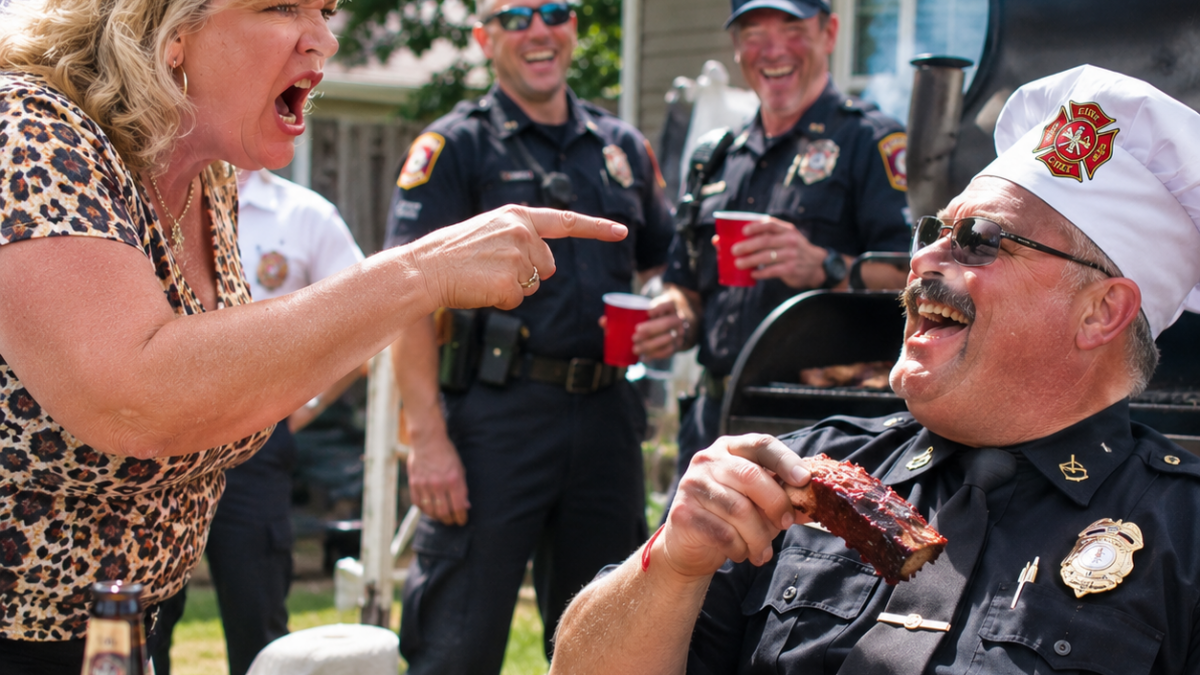
And there was Fire Chief Ray Delgado.
Sitting in a folding lawn chair.
Plate balanced on his right knee.
Barbecue sauce smeared on his chin.
Half-finished Shiner in his left hand.
Otis Redding playing from the patio speaker.
No structure fire.
No grass fire.
No uncontrolled flames.
No panic.
Ray looked up.
He did not stand.
He lifted a rib.
“Took you long enough, Morales.”
Chris stared.
Ray added:
“Grab a plate before they run out.”
Three seconds.
That was how long Morales held it together.
A probationary firefighter named Danny Reeves cracked first.
He started laughing.
Then Chris.
Then the other firefighters.
Eight men who had arrived prepared for an active emergency were standing in my backyard staring at their own fire chief eating ribs.
The yard erupted.
Laughter.
Shaking heads.
Relief.
Outside the fence, Deborah’s phone slowly dropped.
Linda saw her through the slats.
She leaned toward Dolores.
“Eighteen months.”
Dolores watched Deborah.
“And?”
“All she got was a front-row seat to lunch.”
Ray Delgado had spent thirty years learning not to hurry when other people were losing control.
He finished chewing.
Set his plate on the chair arm.
Wiped his hands.
Folded the napkin.
Then stood.
The laughter faded.
He looked at Morales.
“Chris.”
“Yes, Chief.”
“Secure the engines.”
“Yes, sir.”
“Radio dispatch. False alarm, Code 4.”
Morales reached for his radio.
Ray continued.
“No fire. No hazard. Reporting party’s description does not match conditions.”
Then:
“I’ll sign the incident report personally.”
That sentence mattered.
Ray walked through the side gate.
Deborah was still on the sidewalk.
Her face had gone pale.
The perfect auburn hair was beginning to lose the fight with the Texas heat.
Ray stopped six feet away.
Professional distance.
Hands clasped behind him.
“Ms. Hartley?”
“Yes.”
“I’m Ray Delgado.”
She swallowed.
“Fire Chief, San Antonio Fire Department.”
Deborah looked toward the backyard.
Ray said:
“I personally inspected Mr. Cole’s installation before it entered service.”
“I—”
“Every major component was checked.”
She stared.
“Your written complaint states the smoker is eleven feet from the nearest combustible surface.”
“That’s what I measured.”
“No.”
Her mouth tightened.
“The measured distance is fourteen feet.”
“I used a laser device.”
“You measured from an oblique angle.”
She said nothing.
“Parallax error.”
Ray’s voice remained calm.
“The code section you cited applies to commercial or mixed-use cooking installations. This is residential. Required clearance is ten feet.”
He paused.
“Mr. Cole has fourteen.”
Deborah shifted her weight.
Ray continued.
“At 12:47 today, you called 911.”
She looked down.
“You reported an uncontrolled fire.”
“I thought—”
“You told the dispatcher there was heavy black smoke.”
Silence.
“You said you could see flames above the fence.”
“I believed I saw—”
“I was standing in the backyard.”
That stopped her.
Ray looked at her.
“There were no uncontrolled flames.”
Nothing.
“No active fire.”
Nothing.
“No imminent hazard.”
Finally Deborah said:
“I may have been mistaken.”
Ray held her gaze.
“False reporting of an emergency can carry criminal consequences.”
Her face changed.
Fear now.
Real fear.
He continued.
“I am documenting that you may have been mistaken.”
Deborah breathed.
“That means I am not making a criminal referral based on today’s call.”
Her shoulders loosened slightly.
Ray’s voice dropped.
“But listen carefully.”
The shoulders tightened again.
“If another fabricated fire complaint regarding this property reaches my department, I will personally refer the matter to the district attorney.”
Deborah nodded.
Ray waited.
“Do we understand each other?”
She nodded again.
“Ms. Hartley.”
“Yes.”
“Do we understand each other?”
“Yes.”
Ray stepped aside.
Deborah turned.
Walked across Sycamore Lane.
For eighteen months, those designer heels had sounded like punctuation.
Sharp.
Confident.
Every step seemed to announce she was going somewhere important.
That afternoon they sounded different.
Unsteady.
She reached her house.
Opened the door.
Stepped inside.
Closed it.
Ray waited until the door shut.
Then came back through my gate.
Nobody in the backyard said anything.
He returned to his chair.
Picked up the plate.
Looked at the brisket.
Then:
“Somebody get me a fresh Shiner.”
The yard stayed silent.
“That woman just cost me forty-five seconds of prime eating time.”
The place exploded.
Applause.
Laughter.
Chris Morales shook his head.
Danny Reeves was already in line for ribs.
Three firefighters from Engine 23 followed him.
Then Engine 41.
Linda moved into full command mode.
“Plates there.”
She pointed.
“Tea here.”
Then toward Ray:
“Chief does not get thirds until everybody who came in a fire engine has eaten.”
Ray looked personally betrayed.
“I run the department.”
“Not this kitchen.”
Dolores clapped.
For a few minutes, it would have been easy to let that be the ending.
Deborah humiliated.
Firefighters eating.
Ray sitting three feet from the smoker.
Everybody laughing.
But something about the false 911 call bothered me too much.
I had spent twenty-two years riding apparatus to emergencies.
Every time a truck rolls lights and sirens, people take risks.
Firefighters.
Drivers.
Pedestrians.
And while two engines are tied up answering a fabricated call, they are not available for something real.
A heart attack.
A structure fire.
A child trapped in a car.
Deborah had used emergency resources to stage a neighborhood argument.
That was not something I could dismiss because the outcome had been funny.
Monday morning, I requested an emergency community meeting.
I submitted the timeline.
Everything.
Her original letters.
The official HOA violation.
My permits.
The Architectural Review approval.
The 74–2 vote rejecting her rule.
Noise complaint.
Result:
No violation.
Health complaint.
Result:
No commercial activity.
Code complaint.
Result:
All permits valid.
Fire complaint.
Corrected measurements.
Ray’s inspection.
911 incident report.
Then I filed a public-records request for the 911 audio.
When it arrived, I listened once.
Linda sat beside me.
Deborah’s voice filled the kitchen.
I can see flames above the fence line.
Linda’s jaw tightened.
“Play it again.”
I did.
Dispatcher:
You can confirm visible flames?
Deborah:
Yes. Absolutely.
Linda looked at me.
“She didn’t hesitate.”
“No.”
“She knew.”
“I think so.”
“Use it.”
One hundred three residents attended the emergency meeting.
That was more people than showed up to most annual elections.
Deborah sat at the front table.
Navy suit.
Clipboard.
Gail beside her.
Howard Fisk sat in the audience this time.
Carol had apparently made his position clear at home.
Deborah opened:
“This meeting has been called due to an unfortunate misunderstanding—”
Carlos Reyes stood.
Retired lieutenant.
Station 14.
Eight years of Saturday brisket.
“Deborah.”
She stopped.
“This was Marcus’s requested meeting.”
“I am still HOA president.”
Carlos looked around the room.
“For the next few minutes.”
A low murmur moved through the clubhouse.
I stood.
No PowerPoint.
No stock photography.
No charts.
I spoke for eleven minutes.
Not about whether Deborah was difficult.
Not about her wardrobe.
Not about her cats.
Not about whether anybody liked her.
I talked about records.
August:
My kitchen was labeled unapproved.
It had prior approval.
October:
She tried to change the rules after discovering the existing rules protected it.
Community voted 74–2 against her.
December:
Noise complaint.
Highest measured level:
61 decibels.
Limit:
No violation.
Health Department:
No business.
No violation.
Code Enforcement:
Construction permitted.
No violation.
Fire Department complaint:
Measurements incorrect.
Code misapplied.
Then:
I connected the audio.
The clubhouse speakers crackled.
Deborah’s recorded voice filled the room.
I need to report an active fire at 4115 Sycamore Lane.
People went still.
There is heavy black smoke.
Someone shook his head.
I can see flames above the fence line.
A woman behind me whispered:
“Oh my God.”
The dispatcher asked whether she was sure.
Deborah:
Yes. Absolutely.
I stopped the recording.
No one moved.
I looked toward the residents.
“At the moment that call was made, Fire Chief Ray Delgado was sitting three feet from my smoker.”
All eyes moved to Ray.
He sat in the second row.
Uniform polo.
Arms folded.
He did not smile.
“Two engine companies responded because emergency dispatch has to treat reports of visible fire and children in danger as real until proven otherwise.”
I looked back at the room.
“This is no longer a disagreement about barbecue.”
Silence.
“It is a question of whether Ridgerest Estates wants leadership that uses community authority and public emergency systems to pursue personal grievances.”
Then I sat.
Carlos rose.
“I move to remove Deborah Hartley as HOA president, effective immediately.”
Dolores stood.
“Second.”
Deborah’s head snapped toward her.
Dolores smiled politely.
The vote was called.
Ninety-one in favor of removal.
Eight against.
Four abstentions.
91–8.
Deborah looked at the tally.
For the first time since I had met her, she had nothing to say.
She gathered her clipboard.
Stacked papers.
Slid them into a leather folio.
Walked toward the side exit.
Linda leaned toward me.
“First time I’ve seen that woman leave a room without explaining why everybody else is wrong.”
I almost laughed.
Deborah paused briefly.
Then continued.
Door shut.
No speech.
No dramatic final threat.
Just gone.
The city imposed a $750 fine.
Her insurance carrier warned that future frivolous complaint-related claims might not be covered.
By June, the house at 4127 Sycamore Lane had a moving truck outside.
The Persian cats went first.
Then furniture.
Boxes.
Wardrobe racks.
No going-away party.
No neighbors carrying casseroles.
Nobody lined the street to wave.
Nobody missed the lavender stationery.
Deborah moved to a professionally managed senior community in Round Rock, where individual residents did not get to run neighborhood enforcement as personal policy.
The day her moving truck disappeared, Linda and I stood in our driveway.
She watched until it turned the corner.
“That’s it.”
“Looks like it.”
“You know what I expected?”
“What?”
“More drama.”
“I’m grateful there isn’t any.”
Linda nodded.
Then looked toward our backyard.
“Saturday?”
“Saturday.”
That was how life returned.
Not with a grand celebration.
With meat thawing in the refrigerator on Friday night.
Carlos Reyes became the new HOA president.
Retired Station 14 lieutenant.
He had eaten at my house for eight years and understood something Deborah never did.
An HOA is supposed to make the boring parts of shared property easier.
Not turn one person’s preferences into law.
His first proposal was simple.
Annual neighborhood block party.
Paid from the HOA social budget.
Sycamore Lane.
Firefighters welcome.
Families welcome.
Neighbors welcome.
Then he added:
“Marcus hosts.”
I raised my hand.
Carlos looked at me.
“Yes?”
“I would like the minutes to reflect that Marcus was not consulted.”
The room laughed.
“Noted.”
“Do I get a vote?”
“No.”
“Excellent governance.”
Motion passed unanimously.
The first block party drew more than two hundred people.
Ray brought a department smoker.
Engine 23 and Engine 41 parked along Sycamore Lane.
The same engines that had once raced there because Deborah reported flames.
This time they came without urgency.
Doors open.
Kids climbing inside.
Firefighters helping them try on helmets.
One child found the air horn.
The blast made Dolores jump.
She looked toward the truck.
“Again!”
The kid’s eyes widened.
Firefighter smiled.
“Pull hard like you mean it.”
The second blast echoed through Ridgerest.
Then another.
And another.
If Deborah had still lived three doors down, the noise complaint probably would have reached city offices before dessert.
Instead, everyone laughed.
Carlos stood beside me watching families fill the street.
“Better?”
“Better than what?”
“Before.”
I thought about it.
“Yes.”
Then:
“But don’t turn this into a committee.”
“What?”
“Annual barbecue committee.”
“I hadn’t thought about it.”
“Good.”
“We need shirts.”
“Carlos.”
He laughed.
That fall, Linda did something without telling me.
I found the email on our laptop.
SAN ANTONIO STOCK SHOW & RODEO BARBECUE COOKOFF — REGISTRATION CONFIRMED
I stared.
“Linda.”
She was reading.
“Yes?”
“What did you do?”
“Depends.”
“You entered me in a barbecue competition.”
“Yes.”
“Why?”
She turned one page.
“Because I can.”
“Two hundred teams.”
“More.”
“I don’t compete.”
“You do now.”
“I cook for friends.”
“And now judges.”
“I didn’t agree.”
Linda finally lowered the book.
“Marcus, you spent eighteen months defending that smoker against a woman who called it a fire hazard.”
“So?”
“Now I want you to do something fun with it.”
I looked at the screen.
Then at her.
She smiled.
“Besides, I’m tired of Ray saying every brisket is the best brisket you’ve ever cooked.”
“He’s encouraging.”
“He’s repetitive.”
“He’s fire chief.”
“That gives him authority over fire.”
She pointed toward the smoker outside.
“Not brisket.”
Competition morning felt strangely similar to fire-station mornings.
Dark.
Preparation.
Coffee.
Wood.
Everyone pretending they were not nervous.
Fourteen-pound brisket.
Same smoker.
Same firebox Deborah wanted removed.
Same welds.
Same steel.
Two hundred twelve teams.
Some had custom pits that looked like racing trailers.
Sponsors.
Matching shirts.
Trophy histories.
I had Linda.
Ray.
And a smoker made from a propane tank.
Ray came by during prep.
“Nervous?”
“No.”
“Liar.”
“I ran structure fires.”
“Different.”
“Much easier.”
“Exactly.”
I stared at him.
“That was supposed to make me feel better?”
“No.”
Linda came over.
“Stop bothering him.”
“I’m helping.”
“You’re eating burnt ends.”
“Morale support.”
Hours passed.
Fire management.
Temperature.
Wrap.
Rest.
The kind of waiting barbecue demands and impatient people hate.
I thought about Captain Lou.
His old barrel smoker.
The pecan tree.
He never cared about trophies.
He cooked because people needed food and somewhere to sit.
I almost laughed.
Here I was obsessing over bark texture because Linda wanted a trophy.
Turn-in came.
I sliced.
Bent one piece over my finger.
Juices.
Good.
Not perfect.
Nothing ever is.
I placed the slices in the box.
Closed it.
Handed it over.
Then waited.
Awards began.
Other categories.
Then brisket.
Tenth place.
Not me.
Ninth.
Not me.
Fifth.
Fourth.
Third.
I relaxed.
“Good,” I told Linda.
She looked offended.
“Good?”
“We’re not winning.”
“Why are you happy?”
“Pressure’s gone.”
Second place announced.
Not me.
I turned away.
Then heard:
“First place brisket…”
Pause.
“Marcus Cole.”
Linda screamed.
Not cheered.
Screamed.
Ray hit my shoulder hard enough to remind me why my left knee had not been the only part of my body damaged in the fire service.
“Go.”
I stared at him.
“That’s you, idiot.”
I walked toward the stage.
First place.
Out of 212 teams.
The trophy felt heavier than expected.
Flash photographs.
Applause.
Linda crying and denying it.
Ray yelling something I could not understand.
For a moment, I thought about Deborah.
Not because I wanted to.
Because the irony was impossible to miss.
The smoker she called unsafe had just won the biggest barbecue contest I had ever entered.
But the thought passed quickly.
The better memory was Lou.
Sunday morning.
Pecan tree.
Young firefighters sitting on mismatched chairs.
The place that taught me food could hold people together after hard weeks.
The trophy went on our mantel.
Next to my captain’s badge.
Beside the Station 14 photograph from 2004.
Ray and I were both younger in that picture.
The warehouse collapse had happened that year.
You could still see healing burns near his collar.
The photograph meant more than the trophy.
Always would.
The following Saturday, Ray arrived at eleven.
Same department SUV.
Same folding chair.
He went inside first.
Saw the trophy.
Picked it up.
Turned it over.
Put it back.
Then stood looking at the 2004 crew photograph.
I waited.
He said nothing.
Finally he walked outside.
Dropped into the chair beside the smoker.
I handed him a plate.
He cut a piece of brisket.
Took a bite.
Chewed slowly.
Then:
“Marcus.”
“Yeah?”
“I think this might be the best brisket you’ve ever made.”
I stared at him.
“You’ve been saying that for fifteen years.”
“And I’ve been right for fifteen years.”
“You said it last week.”
“Last week was the best then.”
“That makes no sense.”
“I’m the fire chief.”
“That does not give you authority over brisket.”
“It gives me authority generally.”
Linda passed behind him with sweet tea.
“No, it doesn’t.”
Ray pointed his fork toward her.
“Hostile household.”
“You keep coming back.”
“Food.”
She smiled.
So did I.
The afternoon filled slowly.
Dolores arrived with pecan pie.
Carlos came with folding chairs.
Two Station 14 guys showed up.
Then neighbors.
Children.
Someone brought potato salad.
Someone else brought sausage.
Nobody signed in.
Nobody checked capacity.
Nobody issued an invitation.
They just came.
Exactly the way they had at Lou’s house.
That was what Deborah had never understood.
She thought she was fighting a smoker.
She wasn’t.
A smoker is steel.
You can remove steel.
She was fighting a table.
And tables are harder to kill.
A real neighborhood is not created by newsletters saying Excellence in Community Living.
It is created when somebody notices Dolores hasn’t shown up yet.
When Linda makes extra sweet tea because Station 7 might come.
When a firefighter coming off a difficult shift knows there is a chair where nobody will ask him to explain his face.
When Howard says he’s going for a walk and somehow ends up asleep beside the smoker with barbecue sauce on his shirt.
When kids know the firefighters by first name.
When somebody brings food nobody asked for.
When people stay after dark because going home feels less urgent than the conversation they are having.
Deborah looked at all of that and saw congestion.
Noise.
Odor.
Smoke.
Risk.
Unregulated gatherings.
I looked at it and saw the reason I built the kitchen.
Captain Lou had been right without ever saying it aloud.
People who spend their lives responding when the worst thing happens to somebody else need a place where nothing important is happening.
A place where the only emergency is somebody running out of ribs.
That table had given me something too.
Retirement is strange after emergency service.
For twenty-two years, the radio could change your entire day in one tone.
People needed you immediately.
Then you retire.
One morning the city keeps moving without you.
The engines still roll.
Someone else sits in your seat.
Someone else commands the scene.
That is how it should be.
But knowing that does not make the silence easy.
The outdoor kitchen gave me somewhere to put the part of myself that still wanted to serve.
Not in a heroic way.
Just food.
Chairs.
A gate left open.
Linda had understood that long before I did.
“Be the next Lou.”
That was all she had said.
I thought she meant build his smoker again.
She meant build what the smoker created.
Ray understood too.
That was why he never missed Saturday.
It was not repayment for the warehouse.
Not anymore.
Twenty years is too long to carry a debt between friends.
He came because the table was his too.
The 911 call eventually became a story the firefighters told constantly.
Every new rookie heard it.
Usually exaggerated.
In some versions Ray was holding an entire brisket.
In others, Morales came through the gate with an axe raised above his head.
Neither happened.
The truth was funnier.
Ray.
Lawn chair.
Barbecue sauce on his chin.
Rib in one hand.
“Took you long enough.”
No embellishment needed.
For me, though, the call never became entirely funny.
I kept thinking about those two engines.
Eight firefighters.
Emergency response.
Lights.
Sirens.
Because one woman wanted to win an HOA argument.
People assume false calls are harmless if nothing happens.
That is not true.
Emergency response is a finite resource.
A crew sent to fiction cannot simultaneously answer reality.
That was why I pushed the neighborhood meeting.
Not revenge.
Accountability.
Deborah had crossed from annoying into dangerous.
Ray giving her one final warning was generous.
He could have pushed harder.
He chose not to.
Thirty years in command had taught him the difference between punishment and correction.
He gave her a way out.
She took it.
Good.
I did not need to see Deborah in court.
Did not want her arrested.
Did not need a mugshot.
I wanted her to stop.
She stopped.
Residents removed her.
Then she left.
Enough.
The satisfying part was not destroying Deborah.
It was watching Ridgerest become itself again.
Carlos’s newsletters were boring.
Beautifully boring.
Pool schedule.
Road maintenance.
Lost dog.
Annual budget.
Yard sale.
One month the largest photo was a golden retriever wearing sunglasses.
Linda held it up.
“Look.”
“What?”
“Governance.”
“What’s the dog’s name?”
“Peanut.”
“Excellent.”
No community-safety manifestos.
No photographs through fence slats.
No tactical clipboard walks after sunset.
No emergency amendments designed around one person.
Just neighborhood administration.
The kind nobody thinks about unless it fails.
The block party became annual.
My Saturday cookout stayed private.
Carlos tried once to reimburse me from the HOA social fund.
“No.”
“Brisket costs money.”
“I know.”
“You feed half the neighborhood.”
“Sometimes.”
“Let the HOA help.”
“No.”
“Why?”
“Then you’ll create a barbecue committee.”
He paused.
“That is a good idea.”
“Absolutely not.”
“Three members.”
“Carlos.”
“Subcommittee for side dishes.”
“Leave my property.”
He laughed.
People contributed anyway.
Not formally.
Someone brought beans.
Someone brought rolls.
Someone dropped a bag of post oak by the garage.
Dolores brought pie.
Ray contributed appetite.
Long-standing arrangement.
The first-place trophy stayed on the mantel.
I was proud of it.
But if the house caught fire and I had ten seconds to grab something, I would leave it.
I would take the Station 14 photograph.
Ray.
Me.
Crew.
Men younger than we remembered ourselves being.
The photograph represented something the trophy never could.
We had survived long enough to sit around a smoker and become old men arguing about brisket.
Not everybody gets that.
Some firefighters leave the job injured.
Some leave early.
Some never leave the scene that takes them.
You carry those names too.
That is why a simple Saturday matters.
Ray once looked around the backyard late in the afternoon.
Most people were talking.
Dolores was finishing pie.
Children were chasing each other through the sprinkler.
He said:
“Lou would like this.”
I looked at him.
“You think?”
“Yep.”
He took another bite.
“He’d hate your firebox design.”
“Why?”
“Too nice.”
“You’re insulting my smoker.”
“Lou cooked on an oil drum.”
“He was cheap.”
“Traditional.”
“He stole that drum.”
“Allegedly.”
I laughed.
Then went quiet.
“Miss that yard?”
Ray nodded.
“Every week.”
I understood.
He pointed around mine.
“Not as much anymore.”
That might be the best compliment anyone ever gave me.
Deborah spent eighteen months trying to convince everyone that my backyard lowered Ridgerest’s value.
But value is a strange word.
Her house had cost nearly two million dollars.
Beautiful countertops.
Three-car garage.
Landscaping.
Everything polished.
Yet for all that money, she never seemed happy there.
She stood behind windows watching other people enjoy something free.
The smell crossed the street.
Laughter crossed the street.
People crossed the street.
Maybe that was what bothered her.
You cannot buy your way into belonging.
You participate.
The gate was open.
She could have walked over.
That first week, before everything got ugly, if Deborah had arrived holding a plate instead of a clipboard, I would have fed her.
Even after the lavender note, probably.
Ray once asked:
“After she called you a vagrant?”
“Yes.”
“You’re lying.”
“No.”
“After she called you the help?”
“Maybe slightly smaller portion.”
He laughed.
“That’s petty.”
“I’m human.”
The problem was that Deborah did not want a chair.
She wanted control of the yard from three houses away.
There is a difference.
A neighborhood needs rules.
I am not anti-HOA.
Firefighters may understand rules better than most people.
Building codes exist for reasons.
Clearances matter.
Gas lines matter.
Extinguishers matter.
Exit routes matter.
Rules built from experience save lives.
The danger comes when rules become costumes for preference.
Deborah did that constantly.
She disliked smoke.
Called it a health emergency.
Disliked parked cars.
Called them congestion.
Disliked gatherings.
Called them unregulated.
Disliked my smoker.
Called it nonconforming.
When existing rules would not produce her desired answer, she tried to write a new one.
When residents rejected that, she moved to government complaints.
When three agencies rejected her claims, she escalated to emergency dispatch.
That is the pattern.
Not regulation.
Control.
And control hates the word no.
The 74–2 vote should have ended it.
Seventy-four neighbors had spoken.
Deborah heard:
Try somewhere else.
The noise finding should have ended it.
61 decibels.
Limit 75.
She heard:
Wrong agency.
Health Department.
No commercial operation.
She heard:
Wrong inspector.
Code enforcement.
Every permit valid.
She heard:
Try fire.
Eventually reality had nowhere else to bend.
So she lied.
That was the final mistake.
Ray once told me afterward:
“People think authority is the loud part.”
“What?”
“Sirens. Rank. Uniform.”
He pointed toward his chest.
“None of that is the hard part.”
“What is?”
“Knowing when not to use it.”
I thought about the sidewalk.
He could have referred Deborah immediately.
Could have pushed for charges.
Instead, he documented the mistake and gave one warning.
“Why didn’t you send it to the DA?”
He shrugged.
“She stopped.”
“You knew she would?”
“No.”
“Then?”
“The goal was to stop false emergency calls.”
“And if she had done it again?”
“She would have learned a different lesson.”
That was Ray.
The same man who could command a five-alarm scene without raising his voice spent Saturdays fighting Dolores over pie recipes.
Leadership is strange.
Deborah believed leadership meant people obeying you.
Ray believed leadership meant knowing what responsibility belonged to you and what did not.
Carlos understood the second version too.
Ridgerest improved under him because most people stopped noticing the HOA.
That is probably the ideal.
One Saturday afternoon after the cookoff, I lifted the smoker lid.
Blue smoke rolled away.
Bark dark.
Fat rendered.
I caught Linda watching me.
“What?”
“Nothing.”
“You have the face.”
“What face?”
“The one where you’re thinking too much.”
“I’m checking brisket.”
“No.”
She came closer.
“Thinking about Deborah?”
I shook my head.
“Lou.”
Linda smiled.
“Good.”
“I think you were right.”
She stared.
“I need you to say that slower.”
“About building the kitchen.”
“Oh.”
“Don’t make this unpleasant.”
“I waited years for this.”
“Linda.”
She put one hand against her chest.
“Marcus Cole says wife was right.”
“I retract.”
“Too late.”
I laughed.
Then looked around the yard.
String lights.
Cedar pergola.
Black smoker.
Ray’s chair.
Dolores’s pie carrier on the table.
Carlos arguing with Howard.
Kids laughing.
Station 14 shirts.
Normal.
That was all I had wanted.
A place where nothing urgent happened.
The smoke still drifts across Sycamore Lane every Saturday morning.
Slow.
Thin.
Clean.
Post oak and black pepper.
It goes over fences.
Past driveways.
Across lawns.
Nobody files reports anymore.
If you drive through Ridgerest Estates around noon and roll down the window, you can follow it.
You will hear the yard before you see it.
Firefighters.
Neighbors.
Friends.
Someone asking whether the ribs are ready.
Linda telling somebody to stop stealing burnt ends.
Dolores correcting a person half her age.
Maybe an engine crew on a day off.
Maybe Carlos pretending he is not president for a few hours.
And me standing over the same smoker Deborah Hartley spent eighteen months trying to remove.
The smoker is still fully permitted.
Still inspected.
Still safe.
Still ugly in exactly the way I like it.
And beside it sits one folding lawn chair.
The one closest to the fire.
There is usually a cold Shiner waiting on the armrest.
Nobody needs a nameplate.
Nobody else takes it.
That chair belongs to Fire Chief Ray Delgado.
And he never misses a Saturday.








