PART 2: HOA Karen Called 911 on Me for Parking My Truck in My Own Driveway—Then the Deputies Learned I Was the New Police Chief
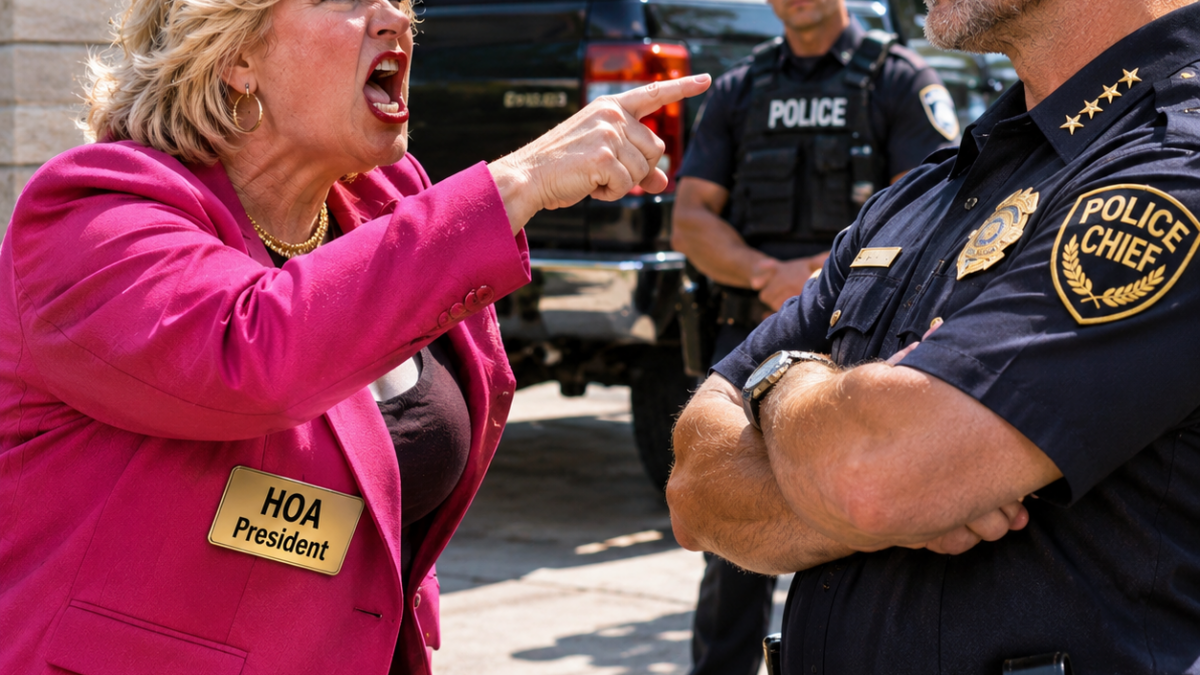
PART 2
I didn’t march to Sloan’s house.
I didn’t call her.
I didn’t tell her I was a police chief.
I didn’t even tell her I had spent twenty-three years interviewing liars for a living.
People assume investigators confront problems.
Most good investigators don’t.
We collect them.
I took the first violation notice and put it in a folder.
Then the second.
Then the photographs showing where my trash cans actually sat behind the garage, invisible from the street unless somebody walked onto my property.
Then the mailbox complaint.
Then the daily truck fines.
Every envelope got a date.
Every photograph got a timestamp.
Every interaction got written down while it was fresh.
By the week before Christmas, Sloan had created a paper trail thick enough to bend the folder.
And then she started making videos.
That was when the problem stopped being about my truck.
## **“HEY, HAWTHORNE FAM”**
Sloan filmed her HOA announcements in what looked like a staged home office designed for social media rather than work.
Ring light.
Cream wall.
Three decorative books nobody had ever opened.
One candle.
A plant that was probably fake.
She opened every video the same way.
“Hey, Hawthorne fam.”
Then came two or three minutes of whatever violation had offended her that week.
Snow shoveling.
Trash cans.
Mailbox staining.
Holiday lights.
Parking.
One December video was clearly about me.
She never used my name.
She didn’t need to.
Behind her appeared a photograph of my black F-250.
Someone had added a cartoon frowning face over the windshield.
Sloan smiled sympathetically at the camera.
“Unfortunately, we have a certain resident at the north end of the court who seems to believe our community standards are optional.”
Forty-one people reacted with hearts.
Josie found the video before I did.
Teenagers always find these things first.
I came downstairs one morning and found her sitting at the kitchen island with her phone turned face down.
“You okay?”
“Yeah.”
That meant no.
“What happened?”
“Emma’s mom said the HOA lady told people we’re a situation.”
I stood there holding the mug Nora had bought me the last Christmas she was alive.
**WORLD’S OKAYEST DAD.**
Nora thought it was hilarious.
I had never managed to throw it away.
“What does that mean?” Josie asked.
“It means some adults get bored in winter.”
“She says people should be careful around our house.”
I felt something inside me go very still.
There is a point where somebody can insult you without consequence because you understand what they are.
Then they involve your kid.
The rules change.
Not because you become reckless.
Because you become precise.
“Are we doing something wrong?” Josie asked.
“No.”
“Then why does everybody think we are?”
I looked toward the window.
Snow was beginning to fall.
“Because one person is talking louder than everybody else.”
“Can’t you stop her?”
“Yes.”
That answer came before I had decided exactly how.
Josie looked at me.
“Then why don’t you?”
“Because stopping somebody isn’t the same thing as proving them wrong.”
She frowned.
“That sounds like cop stuff.”
“It probably is.”
She slid off the stool.
As she walked away, she stopped.
“Dad?”
“Yeah?”
“Mom would hate her.”
I smiled despite myself.
“Your mother would’ve lasted four minutes before getting banned from the HOA Facebook page.”
That finally made Josie laugh.
After she left for school, I wrote my first certified records request.
## **FIVE BUSINESS DAYS**
Most people think an HOA is some mysterious authority existing between government and religion.
It isn’t.
It’s usually a corporation.
And corporations keep records.
Meeting minutes.
Contracts.
Bank statements.
Budgets.
Vendor agreements.
Invoices.
Votes.
In Wisconsin, members of many homeowner associations organized as non-stock corporations have inspection rights to corporate records under applicable law.
I wasn’t improvising.
I had spent years working financial investigations.
I knew what clean books look like.
I also knew what happens when somebody gets nervous about letting you see them.
My request was simple.
Six years of financial statements.
Every vendor contract.
Every board meeting minute since 2018.
All accounting records related to enforcement services, snow removal, roads, landscaping, and towing.
Certified mail.
Return receipt.
Sloan signed for it December 22.
Her handwriting had a little heart over the “i.”
Her response came on the twenty-eighth.
One paragraph.
My request was supposedly not made in good faith.
Records were “unavailable during the holiday season.”
Future correspondence should be directed to the association’s attorney.
No attorney’s name.
No address.
Nothing.
I stood in my driveway reading the letter.
Then I laughed.
People with clean books often get annoyed when you ask to see them.
But smart people with clean books give you the books.
People who refuse immediately?
Those are the people who make investigators curious.
At 4:15 the next morning, I learned just how curious I was about to become.
## **THE SNOWPLOW**
Orange light flashed through my bedroom window.
At first I thought it was a municipal plow.
Then I noticed the logo.
**VOGLE PROPERTY SERVICES.**
The truck stopped at the mouth of my driveway.
Instead of clearing the cul-de-sac, the driver lowered the blade.
Then pushed four feet of frozen slush directly across my driveway.
He backed up.
Did it again.
A wall of ice and dirty snow now blocked the concrete I had cleared the night before.
The orange strobe reflected off Josie’s bedroom curtains.
I stood at the window in the dark.
Watching.
No anger yet.
Just information.
Company.
Time.
Vehicle.
Action.
I photographed the truck.
Then I waited for it to leave.
I shoveled the driveway before Josie woke up.
I didn’t want her seeing another message that our home had become a target.
While I shoveled, I thought about my father.
Owen Callahan.
Badge fourteen.
Nineteen years with Bell Court Police.
In 1998, the son of an important local official crashed a Bronco into a utility pole while drunk.
Dad wrote the report exactly as it happened.
No favors.
No missing details.
No quiet adjustment of the blood-alcohol evidence.
Six weeks later, the village “reorganized.”
His position vanished.
He spent the next two years hanging drywall.
Then he died at fifty-six after a stroke.
He never got his badge back.
The day I became chief, Village President Wendell Pike had handed me a flat cardboard box.
Inside was a tarnished gold shield wrapped in an old shop rag.
Badge fourteen.
Chipped near the top.
“Nobody ever reissued it,” Wendell said.
“Why?”
He looked at me.
“Because everybody knew whose it was.”
I kept Dad’s badge in the console of my truck.
On January ninth—his birthday—I sat in that truck after work for twenty minutes holding it in my hand.
That was the night Sloan called 911.
## **THE SPOTLIGHT**
I had been home less than an hour.
It was cold enough that the cab lost heat quickly after I shut off the engine.
I stayed seated.
No music.
No phone.
Just Dad’s badge turning between my fingers.
I remember saying quietly:
“Happy birthday, old man.”
Then white light exploded through the back window.
Hard.
Flat.
A spotlight.
Before I saw red and blue reflections, I heard the loudspeaker.
“DRIVER OF THE BLACK PICKUP, PUT BOTH HANDS OUT THE DRIVER’S SIDE WINDOW.”
I knew that tone.
I had used it hundreds of times.
Weapon call.
Unknown subject.
High adrenaline.
Officer believes the person in the vehicle may be armed.
I put Dad’s badge on the passenger seat.
Then I pushed both hands outside the window.
Fingers spread.
“OPEN THE DRIVER’S DOOR FROM THE OUTSIDE WITH YOUR LEFT HAND.”
I complied.
“STEP OUT.”
I did.
“TURN AROUND.”
I did.
“WALK BACKWARD TOWARD MY VOICE.”
I walked backward down my own driveway in socks because I had taken off my boots in the truck.
Concrete burned cold through the fabric.
Hands behind my head.
Three patrol vehicles.
Deputies using doors for cover.
Porch lights came on one by one around the cul-de-sac.
Then I saw Josie.
Front window.
Flannel pajama pants.
School wrestling hoodie.
One hand pressed against the glass.
Spotlight across my back.
She didn’t scream.
That made it worse.
She was frozen.
Watching her father treated like an armed suspect because someone had told dispatch there might be a gun.
The deputies cleared my truck.
Ninety seconds, maybe less.
One young deputy returned holding Dad’s badge carefully by the edges.
“Sir?”
“Yes.”
“Is this yours?”
“It belonged to my father.”
He looked at the badge.
Then at me.
“Caller reported a man sitting in a vehicle for approximately twenty minutes. Possible firearm in his hand. Said the subject had been watching the neighborhood.”
“No firearm.”
“No, sir.”
I could have ended the whole thing in four words.
**I’m a police chief.**
Everything would have changed.
The deputies would have relaxed.
Somebody would have gone directly to Sloan’s door.
My title would have become armor.
I didn’t use it.
Because Dad had spent his life believing badges weren’t supposed to win personal arguments.
And because another part of me—the investigator part—had already started asking questions.
“Can I get the incident number?”
The deputy looked surprised.
Then nodded.
Every call for service creates a record.
Time.
Caller.
Narrative.
Disposition.
I wanted that record.
He wrote the number on his business card.
I was still standing on frozen concrete when I saw Sloan.
She was at the end of the cul-de-sac.
Long wool coat.
Ugg boots.
Phone held vertically.
Recording.
When the patrol cars started leaving, she walked up my driveway.
“Wade?”
I looked at her.
“Oh my God. I had no idea that was you.”
“You met me in November.”
“It was dark.”
“You called about a gun?”
She tucked her hands into her sleeves.
“I said I thought I saw something.”
“There was no gun.”
“I have a responsibility to this community.”
I looked through the window.
Josie still stood there.
Sloan followed my eyes.
“We have children here.”
“So do I.”
She smiled faintly.
“I’m sure everybody’s relieved it was nothing.”
Then she walked away.
That sentence stayed with me.
**It was nothing.**
To her.
The police response.
The spotlights.
The guns.
My daughter watching from the window.
Nothing.
She posted her video that night.
I stood in the driveway holding the deputy’s business card until my feet went numb.
Then I went inside.
Opened the folder.
And wrote on a fresh tab:
**EXHIBIT ONE — FALSE WEAPON REPORT.**
## **THE DISPATCH LOGS**
The next morning I sent a public-records request to the county communications center.
I asked for every call originating from Sloan’s phone number and address over the previous six years.
Narratives.
Dates.
Dispositions.
Nothing confidential beyond what the law allowed.
The request cost me eleven dollars.
Then I waited.
While I waited, Sloan stole my truck.
## **THE FIRST TOW**
It happened on a Tuesday afternoon.
I was at the kitchen table when I heard air brakes.
Wrong day for garbage.
I looked through the window.
A rollback tow truck was backing into my driveway.
**VOGLE PROPERTY SERVICES** on the door.
One man lowered the deck.
Another crouched near my F-250.
I walked outside without a coat.
Twelve degrees.
Wind cutting across the subdivision.
“That’s my truck.”
The operator barely looked at me.
“Association authorization.”
“You’re on my property.”
“You’ve got a balance over four grand.”
“Who authorized this?”
“Board president.”
“She doesn’t own the driveway.”
“Take it up with the association.”
I could have blocked the truck.
I could have stood in front of it.
I could have called my department.
I could have flashed my credentials and turned the entire scene around.
Instead, I took out my phone.
Started recording.
One continuous video.
Twenty-two minutes.
Company name.
DOT number.
Faces.
License plate.
Straps.
Truck location.
My driveway.
My voice.
“I am the homeowner. I do not consent to removal of this vehicle.”
Again later.
“I am informing you this truck is parked on private property owned by me.”
And a third time.
“I do not authorize this tow.”
They took it anyway.
Josie came home two hours later.
“Where’s the truck?”
“Towed.”
Her face fell.
“Can they do that?”
“We’ll find out.”
“Dad.”
“What?”
“You already know.”
I smiled slightly.
“Yes.”
“What are you going to do?”
“Get it back.”
“That’s it?”
“For today.”
Storage cost me $480.
The transmission repair cost another $2,700 because the truck had been damaged during loading.
I paid.
Kept every receipt.
Then Sloan filmed another announcement.
“Hey, Hawthorne fam.”
Hand on chest.
Sad expression.
“Enforcement action occurred this week, and I just want everyone to know I take absolutely no joy in these things.”
I watched exactly once.
Then saved a copy.
## **WHEN THEY CAME FOR JOSIE**
A board post appeared two days later.
It did not use our name.
That was Sloan’s specialty.
Never cross the line cleanly enough that everybody immediately recognizes defamation.
Just lean over it.
The post reminded residents about “recent police activity” at the north end of the court and suggested parents “use appropriate judgment” regarding children being dropped off in the area.
The next day Josie came home from practice.
No hello.
No snack.
Straight upstairs.
I found her sitting on the third stair.
Coat still on.
“Kiddo?”
She looked at the floor.
“Emma’s mom changed the carpool.”
“Why?”
“Said it was easier.”
“That’s not what she said.”
Josie’s eyes filled.
“She said there’s been police stuff here.”
I sat beside her.
“Look at me.”
She did.
“We have done nothing wrong.”
“Then why is everybody treating us like we did?”
I didn’t have a comforting answer.
So I gave her the true one.
“Because Sloan built something out of people being afraid of what she’ll say about them.”
“What?”
“A small kingdom.”
Josie wiped her face.
“That sounds stupid.”
“Most kingdoms are when you look closely.”
She almost smiled.
I continued.
“They seem permanent right up until everybody realizes the walls were cardboard.”
“When does that happen?”
“Soon.”
I hoped I was right.
Two days later, the dispatch records arrived.
Fourteen pages.
By page four, I knew I was.
## **THIRTY-ONE CALLS**
Thirty-one calls.
Six years.
Same originating number.
Sloan’s.
Suspicious vehicle.
Suspicious person.
Possible intoxicated driver.
Possible weapon.
Loud gathering.
Welfare check.
Man behind a house.
One narrative described somebody “moving suspiciously along the side of a residence.”
Disposition:
**HOMEOWNER REPAIRING DOWNSPOUT.**
Thirty-one calls.
Thirty-one dispositions.
**UNFOUNDED.**
Every one.
I went back through the addresses.
Three families had been the repeated targets.
All three sold their homes and moved within eighteen months of Sloan’s first complaint involving them.
That changed the case.
Until then, I could still pretend I was dealing with one obsessive HOA president who didn’t like my truck.
Now I saw a pattern.
This was how she operated.
Police calls created rumors.
Rumors created isolation.
Isolation made homeowners easier to pressure.
Fines appeared.
Tows happened.
Liens followed.
People left.
And each departure reinforced Sloan’s authority.
She wasn’t preserving community standards.
She was training people to fear becoming the next household everybody whispered about.
I closed the dispatch file.
Then went to the Register of Deeds.
## **FOUR WORDS ON A PLAT MAP**
The county records building smelled like toner, wet coats, and radiator heat.
A clerk named Gail helped me pull the recorded subdivision plat.
She unrolled a map across a large table.
Brass weights held the corners flat.
Ninety-one lots.
Cul-de-sac.
My parcel.
Hawthorne Bluff Court.
Sumac Lane.
Bluff Ridge Road.
I traced the street with my finger.
Then I saw four words.
**DEDICATED TO THE PUBLIC.**
I read them again.
Gail noticed my expression.
“Something wrong?”
“Maybe something right.”
I asked whether anything later had been recorded accepting the dedication.
She disappeared.
Returned with a two-page municipal resolution.
September 2011.
The Town of Merrick had formally accepted the subdivision streets into the public road system.
I sat back.
The streets had been public for thirteen years.
The HOA didn’t own them.
It hadn’t controlled them since 2011.
I drove directly to town hall.
Requested winter maintenance route sheets.
Hawthorne Bluff Court had been on the municipal plow rotation since 2012.
The town plowed it.
The town salted it.
The town maintained it.
Then why was my HOA assessment charging me ninety-five dollars every month for **road and snow services**?
I did the math in the parking lot.
Ninety-one homes.
$95 a month.
$8,645 monthly.
More than $103,000 a year.
And who received the contract?
Vogle Property Services.
Sloan’s husband’s company.
I sat in my truck for a long time.
The heater running.
Town resolution in my lap.
This was no longer about parking.
The HOA had been collecting six figures a year for services the municipality already provided.
That money flowed to a company connected to the president’s family.
And because the street was public, Sloan’s entire roadside-enforcement mythology was built on property the association didn’t control.
Then there was my truck.
Parked not on the public road.
But in my deeded driveway.
An HOA president who didn’t own the street had authorized her husband’s company to take a vehicle from concrete she also didn’t own under a rule that had never been properly recorded.
It was almost elegant.
In the way a collapsing building can be elegant once every structural defect lines up.
I added the map.
Resolution.
Route sheets.
Assessment statements.
Everything went into the folder.
Then I circled one date on my calendar.
February 11.
Annual HOA meeting.
## **HANK**
I needed somebody who understood the finances independently.
Not me.
That mattered.
I was now a sitting police chief with personal involvement.
If I kept digging on my own, Sloan’s eventual defense would write itself.
**Police chief uses badge to target woman in neighborhood dispute.**
I wasn’t giving her that.
So I visited Hank Ostrander.
Seventy-four.
Retired accounting instructor.
Lives at the end of Sumac Lane.
Still shoveled his own walk because his cardiologist told him movement was good.
I brought pastries.
Hank gave me coffee.
Then I asked about the HOA.
“You were treasurer once.”
“Eleven months.”
“Why’d you quit?”
His face changed.
“I asked for the snow contract.”
“What happened?”
“Nothing.”
“How many times?”
“Three.”
“And?”
“Board told me vendor management wasn’t part of my responsibility.”
“You were treasurer.”
“I noticed.”
He went downstairs.
Returned carrying a Ziploc bag.
Inside was a thumb drive.
“I exported the accounting file before I resigned.”
“Why?”
“Thirty-one years telling students to keep copies.”
We spent four evenings rebuilding the HOA finances.
Hank used pencil.
Graph paper.
Calculator.
He distrusted spreadsheets he didn’t create himself.
By the end, one number sat at the bottom.
**$684,412**
Paid to Vogle Property Services over six years.
Snow removal.
Landscaping.
Parking enforcement.
Covenant enforcement.
No competitive bids.
No clear board votes authorizing several contracts.
Meeting minutes repeatedly showed vendor selection being “tabled.”
Then contracts simply appeared.
Hank set down his pencil.
“You know what bothers me?”
“The money?”
“No.”
He looked at the total.
“They made us pay for the rope.”
## **COLLEEN**
Then I met Colleen Brandt.
Dental hygienist.
Two sons.
Her husband had been gone since 2018.
In 2019, the HOA had towed her minivan out of her own driveway over a fence-stain dispute.
The tow.
Fees.
Penalties.
Administrative charges.
She couldn’t pay.
The balance became a lien.
Twice she had been denied refinancing because of it.
Still owed $4,200.
She told me the story at her kitchen counter.
Halfway through, she started crying.
“I thought I was stupid.”
“You’re not.”
“They told everybody I was refusing to follow basic rules.”
“Were you?”
“I stained the fence the approved color.”
“Then what happened?”
“Sloan said the lighting made it look wrong.”
I stared at her.
“The lighting.”
She laughed while crying.
“I know.”
She handed me the file.
Tow authorization.
Violation notice.
Lien paperwork.
Same blue border.
Same company.
Same names.
Another folder.
Another family.
Same system.
## **THE MOMENT I STOPPED INVESTIGATING**
This part mattered more than anything else I did.
I stopped.
I had enough to file a complaint.
So I did what an ethical cop is supposed to do when he becomes personally involved.
I removed myself.
I called Roland Beck, my former partner from state criminal investigations.
I handed him the banker’s box.
“I’m a witness.”
He looked through the first few documents.
“Anything else?”
“I live there.”
“That’s not what I asked.”
“No. That’s all.”
“You’re sure?”
“Yes.”
“You understand once I take this, you don’t touch the investigation.”
“That’s why I called.”
Roland studied me.
Then nodded.
“Good.”
The county became involved.
Then an assistant district attorney experienced in financial crimes.
Subpoenas went out.
Quietly.
I went home.
Went to work.
Did my job.
And waited.
## **ITEM SEVEN**
Sloan had written the HOA bylaws herself several years earlier.
One provision allowed any member in good standing to place an item on the annual meeting agenda with ten days’ written notice.
I almost admired the irony.
On January 29, I sent certified notice.
**ITEM 7: REVIEW OF ROAD OWNERSHIP, VENDOR CONTRACTS, AND ENFORCEMENT AUTHORITY.**
Sloan signed for it the next day.
She couldn’t legally make it disappear without violating her own bylaws in front of the entire association.
Two mornings later, I woke to the sound of steel being struck.
Sledgehammer.
Again.
Again.
I opened the door.
Three men wearing Vogle Property Services jackets were driving signposts into my frozen lawn.
**NO PARKING — TOW ZONE — HAWTHORNE BLUFF ENFORCEMENT**
A fourth man had a striping machine.
He was painting a yellow line across the mouth of my driveway.
My driveway.
Sloan stood at the curb filming.
Long coat.
Gloves.
Phone vertical.
She read from a paper.
“Emergency board resolution. The north end of Hawthorne Bluff Court has been designated a shared emergency access corridor.”
I looked at the line.
Then the sign.
Then her.
“You’ll want to move anything you don’t want removed,” she said.
“Understood.”
That was all.
She waited.
The fight was supposed to happen.
She needed anger.
She needed me shouting.
She needed footage.
Instead, I closed the door.
Inside, four cameras recorded everything.
Twenty-nine minutes.
Different angles.
Audio.
No ambiguity.
I uploaded copies to Roland.
The next morning, they took the truck again.
## **THE SECOND TOW**
This time the F-250 disappeared to a tow lot behind chain-link fencing.
The HOA filed another lien.
$6,900.
Storage.
Administrative recovery.
Daily penalties.
I added the documents to my civil file.
Did nothing else.
Then Sloan went to court.
She sought a harassment injunction against me.
Her sworn petition said my cameras were pointed at her home.
They weren’t.
She said I had followed her vehicle.
I hadn’t.
She said she feared for her safety.
A temporary order was entered before I had an opportunity to respond.
The hearing was scheduled.
I brought two things.
A diagram showing every camera’s field of view.
And forty seconds of footage.
The commissioner looked at the diagram.
Her house wasn’t visible from my property.
Then we played the footage.
6:11 a.m.
My yard.
Her contractors.
Sledgehammers.
Striping machine.
Sloan standing on the curb filming them.
The commissioner watched.
Then looked at Sloan’s attorney.
“Counsel.”
“Yes, Your Honor?”
“Your client is asking me to protect her from a man who was asleep in his house while her contractor painted his driveway?”
Silence.
Petition denied.
Costs awarded to me.
Outside the courtroom, Sloan walked fast enough that her heels echoed.
That evening:
“Hey, Hawthorne fam.”
She called the ruling a “procedural setback.”
Said the court system sometimes protects the wrong people.
Used the word integrity four times.
I saved the video.
## **SHE FINALLY LEARNED WHO I WAS**
On February 7, Sloan discovered my job.
I never found out who told her.
Didn’t matter.
A reasonable person might have reconsidered everything after learning the man she had reported as an armed stranger was actually the police chief of a nearby village.
Sloan did the opposite.
She drove to Bell Court.
Filed an eleven-page citizen complaint demanding my removal.
Bound copies.
Exhibits.
Claims that I was temperamentally unfit.
That I intimidated women.
That I had weaponized my office against a “female community leader.”
I had done none of those things.
But Sloan had already reached the stage where every consequence was proof of persecution.
Two days later, she called 911 again.
That call ended everything.
## **THE CURTAIN ROD**
Josie had decided our front room needed curtains.
Real curtains.
The streetlight kept bothering her during movie nights.
So on Sunday evening I stood near the front window holding a five-foot black curtain rod horizontally while Josie stood behind me.
“It’s crooked,” she said.
“It’s not.”
“It is definitely crooked.”
“I own a level.”
“You’re ignoring the level.”
“I’m using instinct.”
“That’s why it’s crooked.”
Then I noticed movement outside.
Through the glass.
Headlights.
I knew before the sirens came.
The dispatch transcript later showed Sloan’s call.
“He has a rifle.”
“He’s standing at the front window with it.”
“He’s screaming at his daughter.”
“I think he’s going to hurt her.”
Every word false.
But dispatchers don’t gamble with rifle-and-child calls.
They send people.
This time, however, the deputies knew my address.
They knew who lived there.
I placed the curtain rod on the carpet.
Sent Josie into the kitchen.
Opened the front door slowly.
Hands visible.
Two deputies approached.
The first slowed when he recognized me.
“Evening, Chief.”
Behind him, a sergeant looked through the open doorway.
Black curtain rod on the floor.
No weapon.
No screaming child.
He keyed his radio.
“Signal four. Nothing here.”
Then I heard Sloan.
She was standing near my driveway.
Cream robe.
Shearling boots.
Phone recording.
She had come outside to film my arrest.
One deputy had called me Chief loudly enough for her to hear.
She lowered her phone.
“What did you just call him?”
Nobody answered.
Then a gray unmarked sedan pulled in.
Detective Sergeant Ellis Kaine stepped out.
Financial Crimes.
Eleven days into the HOA case.
He walked past me without acknowledgment.
That was exactly how it should be.
Then he stopped in front of Sloan.
“Ma’am?”
“Yes?”
“I have a warrant for your phone and its contents.”
She stared.
“This is my personal property.”
“Yes, ma’am.”
“I’m recording.”
“I can see that.”
“You can’t take this.”
He held out his hand.
“It’s evidence. You’ll receive a receipt.”
Every porch light on Hawthorne Bluff Court was on.
Neighbors stood outside.
Hank at the end of his driveway.
Colleen on her porch.
Sloan slowly handed the phone over.
For six years, she had used that device to film everybody else’s humiliation.
Now it disappeared into an evidence bag.
No one clapped.
No one laughed.
They just watched.
That was better.
## **MY FATHER’S TABLE**
The next evening, Bell Court Village Board considered Sloan’s complaint against me.
Public session.
The clerk read all eleven pages.
I sat in the third row.
Same village hall.
Same wood paneling.
Same radiator banging beneath the window.
And the same table where, in 1998, officials had decided my father’s job should disappear because he refused to alter a truthful police report.
Different people now.
Same table.
The clerk finished Sloan’s complaint.
Silence.
Four seconds.
Then Trustee Arlene Doss leaned toward her microphone.
“Is she aware that we can read?”
A few people laughed.
I didn’t.
The board voted seven to zero.
Complaint unfounded.
Then another motion.
Formal statement of support for the chief.
Seven to zero.
I looked at the ceiling.
Because if I looked at anybody, I was going to lose composure.
Dad never got that vote.
Never got an apology.
Never got his job back.
He got drywall jobs.
Then a stroke.
Twenty-five years later, I sat in the same room and watched a board do the thing I wished somebody had done for him.
Look at evidence.
And refuse to punish the person who told the truth.
## **THE ANNUAL MEETING**
The Hawthorne Bluff clubhouse held around ninety people comfortably.
That night, about one hundred forty came.
Every chair full.
People standing along the walls.
Wet coats.
Burned coffee.
Radiator banging.
Sloan stood at the front.
Perfect hair.
Blazer.
Three rings.
One replacement phone placed face down on the table.
For forty minutes, she acted like nothing had changed.
Reserve study.
Landscaping.
Mailbox stains.
Then slide fourteen appeared.
A photograph of my house.
My address.
A bar chart showing my alleged fines.
“Certain chronic violators,” she said, “have exposed this association to nearly nine thousand dollars in legal costs.”
I sat in the third row.
Laptop bag between my feet.
Waited.
Finally:
“Item seven.”
She looked directly at me.
“Mr. Callahan, you have ten minutes.”
I stood.
Connected my laptop.
The screen changed.
Plat map.
“Before I begin, I’m not your lawyer.”
The room quieted.
“Everything I’m about to show you is a public record. Anyone in this room can obtain these documents. I’ll leave the file numbers up so you don’t have to trust me.”
That mattered.
I didn’t want them to believe Wade Callahan.
I wanted them to believe documents they could verify themselves.
I zoomed in.
**DEDICATED TO THE PUBLIC.**
“These streets are not HOA property.”
Sloan shifted.
“The subdivision plat dedicated them to public use, and in 2011 the Town of Merrick accepted them.”
Next slide.
Municipal resolution.
Next.
Snow-plow routes.
“Hawthorne Bluff Court has been on the town’s winter route since 2012.”
People started murmuring.
Next slide.
HOA assessment.
“I pay ninety-five dollars a month for road and snow services.”
A man near the back said:
“So do I.”
Another:
“Everybody does.”
I nodded.
“Ninety-one homes. That’s more than one hundred three thousand dollars a year.”
The room changed.
There is a sound crowds make when confusion becomes arithmetic.
It isn’t loud at first.
It’s low.
Uneasy.
I clicked.
“Hank Ostrander helped reconstruct six years of association payments.”
Spreadsheet.
Invoices.
Checks.
Vendor records.
**VOGLE PROPERTY SERVICES — $684,412.**
Owned by Sloan’s husband.
No competitive bidding.
Multiple contracts without recorded votes.
Sloan stood.
“This is misleading.”
I didn’t look at her.
Next slide.
Dispatch records.
Thirty-one calls.
Six years.
Same number.
Dispositions down the page.
**UNFOUNDED.**
**UNFOUNDED.**
**UNFOUNDED.**
I let them read.
“Three families on this list moved within eighteen months.”
Colleen stood near the aisle.
I gestured toward her.
“One of those homeowners is here.”
People turned.
She looked terrified.
Then angry.
I continued.
“She still carries a lien resulting from a vehicle tow out of her own driveway.”
Someone said:
“You can’t do that.”
I looked toward the screen.
“That brings us to the last document.”
The supposed commercial-vehicle amendment.
“This rule was never properly recorded as part of the land covenants.”
Sloan’s hand hit the table.
“You are not an attorney.”
“No.”
“You’re giving legal conclusions.”
“I’m showing public documents.”
“You’re deliberately misleading these residents.”
“I’m showing them where the documents are filed.”
She stood fully.
“This meeting is adjourned.”
Hank rose.
“Point of order.”
Sloan glared.
“Meeting is adjourned.”
“Motion to continue.”
Somebody shouted:
“Second!”
Then another.
Then dozens.
Sloan reached for her gavel.
That was when the rear doors opened.
## **THE ARREST**
Detective Sergeant Kaine entered first.
Two deputies followed.
Behind them came Roland Beck from state criminal investigations.
Nobody rushed.
Nobody had to.
The room went silent.
Kaine walked down the center aisle.
Stopped at the head table.
“Sloan Vogle?”
She stared at him.
“Yes?”
“I have a warrant for your arrest.”
Her face went white.
Not pale.
White.
She looked past him.
Straight at me.
Then reached for the last weapon she believed she had.
“Do you have any idea who my husband is?”
I answered before I could stop myself.
“I do.”
She stared.
“They picked him up in the parking lot four minutes ago.”
A sound moved through the room.
Not cheering.
Shock.
Sloan looked at the doors.
Then at her board.
Nobody moved.
I opened my laptop bag.
Took out two things.
Placed them on the table.
Dad’s badge.
Number fourteen.
Tarnished.
Chipped.
Beside it, my own Bell Court chief identification.
Sloan stared.
I said:
“This belonged to my father.”
Then touched mine.
“This belongs to me.”
The room had gone completely still.
“I’ve been the chief of police in Bell Court since October.”
Someone near the back whispered:
“Holy hell.”
Sloan’s mouth opened.
I continued before she could speak.
“But that isn’t why you’re being arrested.”
I looked around at the neighbors.
“You’re not being arrested because you called 911 on a police chief.”
Then back at her.
“You’re being arrested because investigators believe you and your husband took hundreds of thousands of dollars from the people sitting in this room.”
She shook her head.
“No.”
Kaine stepped forward.
“Ma’am, turn around.”
“This is retaliation.”
“No.”
“You did this.”
I thought about January ninth.
Cold driveway.
Josie in the window.
Dad’s badge on the passenger seat.
I thought about Colleen crying over a lien.
Hank resigning rather than sign bad books.
Three families gone.
My truck on a rollback.
The yellow paint across my concrete.
Then I said:
“I filed a complaint.”
“That’s the same thing.”
“No.”
I shook my head.
“Everything after that was evidence.”
They handcuffed her.
Walked her through the clubhouse.
Every person she had spent six years managing, fining, filming, and shaming watched her leave.
Nobody pulled out a phone.
That detail stayed with me.
Sloan had turned their neighborhood into content.
When the moment actually mattered, nobody wanted content anymore.
They wanted the truth.
## **THE CHARGES**
The criminal case took months.
Sloan ultimately faced charges tied to theft in the operation of the association, false reports to public safety, and false statements made under oath.
Her husband’s role centered heavily on Vogle Property Services and the money moving through association contracts.
He cooperated.
That changed Sloan’s negotiating position quickly.
Eventually she accepted a plea.
Custody.
Extended supervision.
Restitution.
Her husband received jail time and lost professional registrations connected to his contracting business.
Vogle Property Services dissolved.
The rollback truck was sold.
I admit I looked up the auction result.
Eleven thousand dollars.
The white Range Rover disappeared too.
Returned to the leasing company.
For nine days it sat dirty at the end of Sloan’s driveway before somebody came for it.
There was a time when seeing that would have satisfied me.
By then, it mostly looked sad.
Power has a way of making temporary things look permanent.
Cars.
Titles.
Gavels.
Social media accounts.
HOA presidencies.
Then paperwork arrives and reminds everybody that permanence was part of the illusion.
## **THE MONEY COMES BACK**
The civil side moved faster.
Insurance.
Settlements.
Asset sales.
Association claims.
Eventually more than four hundred thousand dollars returned to Hawthorne Bluff households through credits and reimbursements.
My share was roughly $4,500.
I didn’t celebrate it.
It felt like receiving your own wallet back after somebody had taken money from it.
Colleen’s lien was released.
Later she received additional reimbursement.
She refinanced her house.
When I stopped by, she cried in the kitchen again.
This time she laughed while doing it.
“I’m sorry.”
“For what?”
“I cry every time you come over.”
“That’s not a great review of my personality.”
She laughed harder.
Her sons rolled their eyes from the living room.
That was better.
## **THE BOARD FALLS**
All five HOA board members resigned within a week.
Some claimed they had trusted Sloan.
Some said they hadn’t understood the finances.
Some probably told the truth.
Some probably didn’t.
I didn’t spend time deciding which was which.
At the special election in April, Colleen ran for president.
She won seventy-eight to two.
Hank became treasurer.
His first condition:
Every quarter, the complete financial package would be uploaded to a shared folder where any homeowner could access it without requesting permission.
No gatekeeping.
No mysterious records office.
No holiday excuses.
No “not in good faith” letters.
Just numbers.
His second condition:
Every vendor relationship over a certain threshold required transparent bidding and a recorded vote.
People applauded.
Hank hated applause.
“Stop that,” he said.
Which made them applaud harder.
The **road and snow services** line disappeared from our monthly assessment in May.
Ninety-five dollars a month.
Gone.
$1,140 per year returned permanently to each household because the town had already been providing the road service through taxes.
For thirteen years.
All anybody ever had to do was look at the plat.
## **MY TRUCK COMES HOME**
I got the F-250 back February twentieth.
The transfer case damage was ultimately covered through settlement.
I drove it home slowly.
Josie was waiting in the driveway.
She came outside before I shut off the engine.
“You got it.”
“Apparently.”
She opened the passenger door.
Climbed in.
Sat for a second.
Then looked at Dad’s badge in the console.
“You gonna keep that there?”
“Probably.”
“Why?”
“Because he likes the truck.”
She smiled.
“You’re weird.”
“Genetics.”
In April, I rented a concrete grinder and removed the yellow stripe Vogle Property Services had painted across my driveway.
Hot dust hung in the air.
Josie brought me water every twenty minutes whether I asked or not.
When I finished, you could still see a faint shadow where the paint had been.
I considered grinding deeper.
Then stopped.
“Why’d you leave that part?” Josie asked.
“Reminder.”
“Of Sloan?”
“No.”
“Then what?”
I looked at the faint line.
“That property doesn’t protect itself.”
She nodded like she understood.
Maybe she did.
## **EMMA’S MOM**
In March, Emma’s mother knocked on our door carrying lasagna.
There are few more Midwestern forms of surrender than appearing with baked pasta.
Josie answered.
The woman looked terrified.
“Hi.”
“Hi.”
“I was hoping your dad was home.”
I came to the door.
She held the pan like a peace offering.
“I owe you both an apology.”
Josie looked at me.
I said nothing.
The woman continued.
“I believed things I shouldn’t have.”
Still nothing.
“I changed the carpool because I was scared.”
Josie crossed her arms.
Emma’s mother swallowed.
“I hurt you.”
Josie looked toward the driveway.
Then back.
“Yeah.”
“I’m sorry.”
Long silence.
Then Josie stepped aside.
“Do you want to come in?”
I stared at my daughter.
She was better than I was.
Nora would have been proud.
Later, after Emma’s mother left, I said:
“You let her off easy.”
Josie shrugged.
“She brought lasagna.”
“Good point.”
Then:
“Also, Mom would say holding grudges gives annoying people free rent in your brain.”
I smiled.
“She said that about my brother.”
“Still counts.”
## **WHY I NEVER TOLD SLOAN I WAS CHIEF**
People asked me this constantly afterward.
Why didn’t you tell her?
Why not on the first day?
Why not when she called 911?
Why not during the tow?
Wouldn’t your title have ended everything?
Maybe.
That was exactly why I didn’t use it.
I didn’t want a neighborhood where people respected my driveway because I had a badge.
I wanted a neighborhood where everybody’s driveway was respected because it belonged to them.
If I used my rank to solve my problem, Sloan could have continued doing the same thing to Colleen.
Or Hank.
Or the next family.
The whole point wasn’t that she picked the wrong victim because I happened to outrank her expectations.
The point was that she should never have been able to do it to anyone.
Dad understood that.
His badge didn’t make his report more true.
The truth made his report worth defending.
He lost his job because the people in power forgot that.
I wasn’t going to repeat their mistake in reverse.
## **BADGE FOURTEEN**
In June, Bell Court Public Library opened its basement meeting room on the second Saturday of the month.
A folding sign went up near the entrance.
**BADGE 14 LEGAL INFORMATION CLINIC**
Free.
Nine to noon.
No appointment.
A real-estate attorney volunteered.
A retired title examiner sat at another table with forty years of experience reading plats, deeds, legal descriptions, and recorded covenants.
They didn’t represent people in court.
They did something more basic.
They showed homeowners how to find their documents.
How to pull a plat.
How to check whether an amendment was actually recorded.
How to request corporate records.
How to identify who owns the road outside their home.
How to distinguish an HOA rule from a municipal ordinance.
How to ask questions before fear turns into a payment.
Sixty-one people came the first Saturday.
Eventually people drove from several counties.
I attended when my schedule allowed.
Not as police chief.
As Owen Callahan’s son.
Badge fourteen hung in a shadow box just inside the Bell Court Police Department entrance.
I put a small plaque beneath it.
**TRUTH DOESN’T NEED A FAVOR.**
Josie read it one afternoon.
“Did Grandpa say that?”
“No.”
“You?”
“No.”
“Then who?”
“Sounded like something he should’ve said.”
She laughed.
“That’s cheating.”
“Chief’s privilege.”
## **JOSIE DRIVES THE F-250**
By senior year, Josie had changed.
Not dramatically.
She was still the same kid who wanted a room facing the trees.
But Hawthorne Bluff stopped feeling temporary to her.
She made varsity.
Rebuilt friendships.
And every Friday, she drove my F-250 to school.
The first time she asked:
“Can I take the truck?”
“No.”
“Why?”
“Because I enjoy having a transmission.”
She stared at me.
“Mom would let me.”
“Your mother thought parallel parking was a conspiracy.”
“She’d still let me.”
Eventually I did.
She parked it in our driveway sideways when she came home.
Terrible angle.
Half the truck looked like it wanted to migrate toward the lawn.
I stood in the garage doorway.
Said nothing.
Josie climbed out.
Looked at the truck.
Then at me.
“You’re not going to say anything?”
“No.”
“This is bothering you.”
“Deeply.”
She smiled.
“Growth.”
“Get inside.”
She laughed and walked past me.
The truck stayed crooked all night.
I slept anyway.
## **THE LAST HOA MEETING I ATTENDED**
About a year after Sloan’s arrest, I attended one more Hawthorne Bluff meeting.
Colleen sat at the front.
No gavel.
Hank had a laptop.
Meeting started at seven.
At 7:02 someone asked a question about landscaping.
Colleen answered.
At 7:09 Hank reviewed finances.
Every number was on a screen.
At 7:16 a homeowner challenged an expense.
Nobody punished him.
Hank opened the invoice.
They discussed it.
At 7:22 they voted.
At 7:31 the meeting ended.
I sat there stunned.
Colleen walked over.
“You okay?”
“I didn’t know HOA meetings could end before retirement.”
She laughed.
“We’re trying something new.”
“What?”
“Being boring.”
“Highly recommend it.”
I never attended another meeting.
I didn’t need to.
That was the best possible outcome.
## **WHAT HAPPENED TO SLOAN**
I rarely thought about Sloan after the case closed.
That surprised me.
During the worst months, she occupied every corner of my thinking.
Every vehicle outside.
Every envelope.
Every notification.
Every phone call.
I checked windows.
Cameras.
Records.
I hated what she did to Josie.
I hated what she did to Colleen.
And I hated the way she used emergency services as a neighborhood enforcement tool.
But once she was gone, anger became heavy.
I had carried enough heavy things.
Nora’s illness.
Dad’s badge.
Josie’s fear.
I didn’t need Sloan too.
People sometimes asked whether I was happy she went to custody.
No.
I was satisfied there were consequences.
Different thing.
I never needed Sloan destroyed.
I needed the system she built to stop working.
It did.
## **NORA’S MUG**
One winter morning, almost exactly a year after the first 911 call, I sat at the kitchen island drinking coffee from the same ridiculous mug.
**WORLD’S OKAYEST DAD.**
Josie walked in.
Hair a mess.
Half awake.
“You still use that?”
“Yes.”
“Mom bought that because you burned pancakes.”
“That story is disputed.”
“She told it to everybody.”
“No reliable witnesses.”
Josie poured cereal.
Then looked outside.
Snow had covered the driveway.
The F-250 sat there.
Lumber rack still installed.
No violation notice.
No tow truck.
No blue-bordered paper.
No Range Rover parked at the curb.
Just snow.
“Dad?”
“Yeah?”
“You know what’s weird?”
“What?”
“It feels normal here now.”
I looked outside.
That sentence hit harder than I expected.
Normal.
After Nora died, I thought normal was something we had lost forever.
You don’t get the old normal back.
You build another one.
A daughter eating cereal before school.
A truck under snow.
Coffee.
A house facing trees.
No one afraid of the phone ringing.
That was enough.
## **THE FINAL LESSON MY FATHER LEFT ME**
Dad never knew I became Bell Court police chief.
Sometimes that still hurts.
I would have liked to see his face.
He would have pretended not to care.
Then probably told everybody at the hardware store.
But the older I get, the more I realize the title wasn’t the part he would have cared about.
The part that mattered happened before anybody knew my title.
The first night Sloan called 911, I could have said:
“I’m Chief Callahan.”
I didn’t.
When they towed the truck, I could have made calls.
I didn’t.
When she painted my driveway, I could have sent officers.
I didn’t.
When she lied in court, I brought evidence.
When I found financial records suggesting crimes, I handed the investigation to someone independent.
That was Dad’s lesson.
A badge is most important when you are willing not to use it for yourself.
I understood that fully only after the whole thing was over.
## **ONE MORE CALL**
Two years later, dispatch called Bell Court about a suspicious vehicle parked outside a house.
Routine.
An officer responded.
The “suspicious man” turned out to be a homeowner sitting in his van waiting for his daughter to finish getting ready.
No crime.
No confrontation.
Nothing.
The officer documented it and cleared.
I read the call later during a routine review.
For a moment I was back in that driveway.
Cold socks.
Hands behind my head.
Josie at the window.
Then I noticed something in the narrative.
The officer had written:
**Caller advised that lawful presence in neighborhood is not itself suspicious activity.**
I smiled.
That was progress.
Small.
Boring.
Real.
## **THE GHOST LINE**
The faint yellow stripe remains across the driveway.
Years of weather have almost erased it.
You have to catch it in the right light.
Sometimes a visitor asks.
“What happened there?”
“Long story.”
Josie always interrupts.
“Dad defeated a dictatorship with paperwork.”
I hate that description.
Mostly because she tells it too loudly.
“It wasn’t a dictatorship.”
“Dad.”
“It was an HOA.”
“Same haircut.”
I laugh every time.
Then I look at that line.
It reminds me how close we came to believing we should leave.
There were nights I considered selling.
Not because Sloan was right.
Because Josie was hurting.
I thought about choosing peace.
But sometimes leaving doesn’t create peace.
Sometimes it simply hands the next family your problem.
Colleen had almost left.
Three other families did.
Sloan counted on that.
She assumed normal people would eventually decide fighting was too exhausting.
She wasn’t completely wrong.
Most people are exhausted.
They have jobs.
Children.
Mortgages.
Parents getting older.
Nobody wants to spend Thursday night reading bylaws.
That is exactly why petty power works.
It lives in the gap between what people could challenge and what they have enough energy to challenge.
Sloan lived in that gap for six years.
Then she picked a man whose professional skill was reading boring documents until hidden patterns became visible.
Bad luck for her.
Better luck for everybody else.
## **THE DAY JOSIE LEFT FOR COLLEGE**
The morning Josie left for college, she packed the F-250.
Of course.
Suitcases.
Plastic bins.
One lamp.
Three plants I predicted would die before Thanksgiving.
Nora’s old quilt.
Before climbing in, Josie stood in the driveway looking at the house.
“You okay?” I asked.
“No.”
“Good.”
She laughed.
“You?”
“Perfect.”
“Liar.”
“Professional training.”
She hugged me.
Longer than usual.
Then whispered:
“Thanks for not making us move.”
That sentence nearly ended me.
I looked over her shoulder at the faint yellow stripe.
“Thank you for staying.”
She stepped back.
“Mom would be proud of you.”
I couldn’t answer immediately.
Then:
“She’d be proud of you.”
“Obviously.”
That sounded like Nora too.
Josie climbed into the truck.
I watched my emotional-support vehicle disappear around the corner with my daughter behind the wheel.
Crooked parking suddenly seemed like a small problem.
## **WHY THE STORY ISN’T REALLY ABOUT A POLICE CHIEF**
People tell this story wrong.
They say:
“HOA Karen called the cops on the wrong guy because he was secretly the police chief.”
That’s catchy.
But it misses the point.
If I had been a plumber, Sloan would still have been wrong.
If I had been unemployed, Sloan would still have been wrong.
If I had driven an older truck, worn dirty clothes, or had no title at all, Sloan still would not have had the right to invent a firearm call, take a vehicle from private property, manufacture fines under an unenforceable rule, or hide financial transactions from the families paying the bills.
My badge didn’t create my rights.
My deed did.
The recorded documents did.
The law did.
Basic fairness did.
Being chief only made the irony sharper.
And when Sloan finally discovered who I was, it still didn’t save me.
Evidence did.
That’s the part worth remembering.
## **THE SHADOW BOX**
Badge fourteen still hangs inside Bell Court Police Department.
Most people walking through the lobby don’t know the whole story.
New officers ask sometimes.
“Whose badge?”
“My father’s.”
“What happened?”
“He wrote something true.”
“That’s it?”
“That was enough.”
Then I tell them the rest.
Not to make them angry.
To remind them.
Small institutions can hurt people just as efficiently as large ones when nobody checks power.
Village boards.
HOAs.
Police departments.
Companies.
School committees.
Any organization can become somebody’s kingdom if everyone else decides paperwork is boring and asking questions is rude.
Dad lost his career because people used power against truth.
Decades later, Sloan lost hers because truth finally caught up with power.
There’s symmetry in that.
Not justice exactly.
Life rarely balances that neatly.
But enough symmetry to let me breathe easier.
## **THE END**
Hawthorne Bluff Court looks almost exactly the same today as the afternoon we moved in.
Same houses.
Same trees.
Same curve of asphalt.
Same mailboxes.
My driveway still holds the F-250 when Josie isn’t stealing it.
The lumber rack is still there.
Nobody has complained.
Not because the neighborhood’s “aesthetic” changed.
Because the people did.
Residents started reading meeting packets.
Vendor bids get posted.
Financial statements are public.
Police calls are treated seriously instead of being used as social weapons.
And when somebody new moves in, Colleen sends them a welcome packet.
A real one.
Emergency contacts.
Trash schedule.
Snow information.
HOA financial link.
Recorded covenants.
At the bottom is one sentence Hank insisted on adding:
**If somebody tells you something is a rule, ask where it’s written.**
That might be the best thing to come out of all of it.
One October evening, years after Sloan’s arrest, I drove home from Bell Court and parked in my driveway.
Exactly where the story started.
I sat in the truck for a few minutes.
Engine off.
Cold beginning to settle into the cab.
Then I opened the console.
Dad’s original badge wasn’t there anymore.
It hangs at the station now.
But for a second I could still feel the weight of it in my hand.
Number fourteen.
Chipped enamel.
A badge belonging to a man punished for refusing to change a true report.
I looked through the windshield toward our house.
Warm light in the windows.
Nora’s tree beyond the backyard.
The faint ghost of yellow paint across the driveway.
And I thought about the first January night when Sloan saw a man sitting in a truck and decided she knew everything she needed to know about him.
She saw an old F-250.
A lumber rack.
A stranger.
Somebody she believed didn’t belong in her version of the neighborhood.
She called 911.
She told dispatch she thought I had a gun.
Three patrol cars came.
My daughter watched me walk backward through spotlights in my socks.
And for a long time, I thought that was the moment the whole story changed.
It wasn’t.
The real turning point came when I chose not to tell those deputies who I was.
When I asked for an incident number instead.
One number became a records request.
The records request became thirty-one unfounded calls.
Those calls became a pattern.
The pattern led me to other families.
The truck fines led me to the covenants.
The snow fees led me to the plat.
The plat led me to a municipal resolution.
The resolution led Hank and me into six years of financial records.
And the financial records eventually led investigators to a scheme worth hundreds of thousands of dollars.
Sloan thought power meant getting the last word.
My father taught me something better.
Power is making sure the record survives after everybody stops talking.
I finally got out of the truck.
Closed the door.
The sound echoed softly through the cold street.
No Range Rover appeared.
No phone camera.
No violation notice waited beneath my windshield wiper.
Just my house.
My driveway.
My truck.
The ordinary things Sloan had tried to make feel like privileges she could revoke.
I walked toward the porch.
Then stopped and looked back once.
The truck sat exactly where I wanted it.
On property I owned.
Under rules that finally meant what the documents actually said.
I smiled.
Not because I had been the police chief.
Not because Sloan had been arrested.
Not because I had won.
Because Josie had once asked me whether we were in trouble simply for living in our own home.
And if she asked me that question now, I knew exactly what I would tell her.
“No, kiddo.”
“We’re home.”
Then I went inside and shut the door.








