PART 2: HOA Karen Called 911 on Four “Dangerous Men” in My Backyard — She Had No Idea We Were All Cops
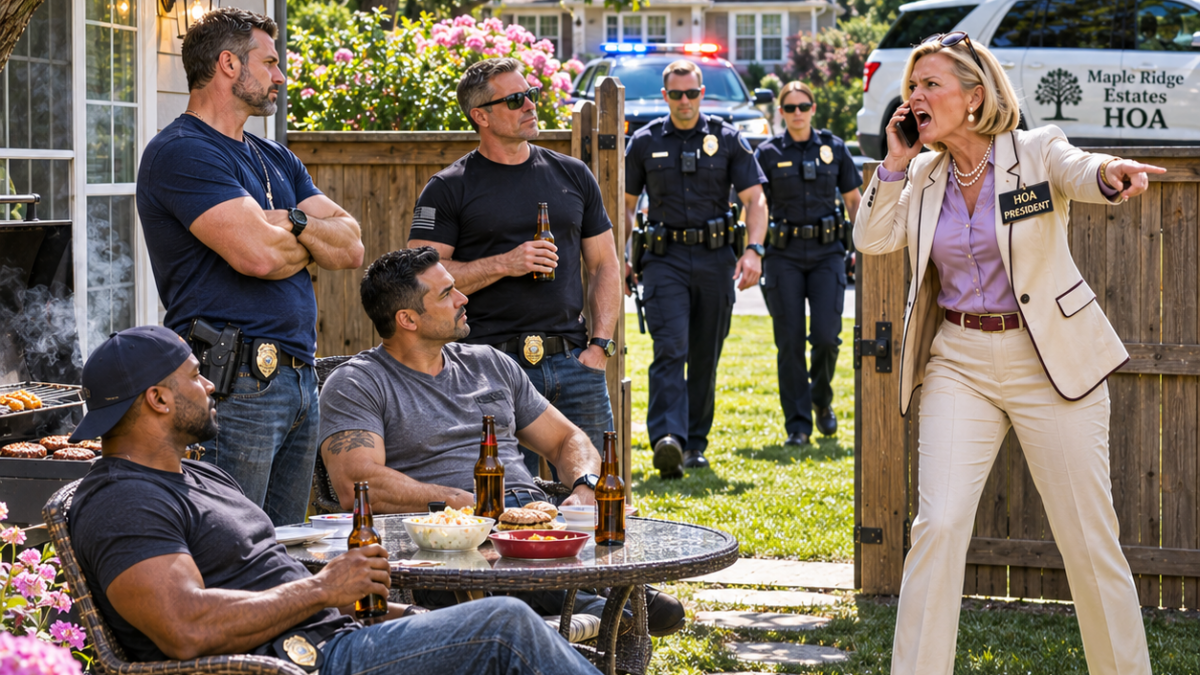
The afternoon my HOA president walked through my closed backyard gate and called 911 to report a “gang of dangerous men,” she was pointing at me and three friends who were standing around my grill drinking one beer apiece in the yard of the house I had spent fifteen years saving to buy. By the time the patrol car arrived, Linda Carver was telling the dispatcher that we had threatened her, surrounded her, and might be involved in drugs, while the four men she was describing as criminals were quietly deciding which one of us should explain to the responding officers that every person in that backyard was an off-duty cop. What I didn’t understand yet was that the false 911 call was only the first move, because within hours Linda would use her HOA title, the neighborhood Facebook group, and a story she had clearly been waiting to tell to turn my own home into the center of a fight that had started long before that Saturday barbecue.
My name is Marcus Reed, and until that day Maple Ridge Estates had been the first place in years where I felt like I could leave work at work.
I had spent most of my adult life as Officer Reed—uniform, radio, reports, night shifts, court dates, and too many calls that followed me home in my head. Buying the house at 247 Maple Ridge Lane was supposed to change that. The backyard had an old oak tree, a privacy fence, and a grill that worked only if you knew exactly how hard to kick the left wheel.
That Saturday, Tyler, Ramon, Chris, and I finally had the same day off. Getting four cops on one schedule felt like winning the lottery.
Tyler was built like a linebacker and laughed like a kid. Ramon was the calm one, the guy who could talk furious people down without humiliating them. Chris handled technical investigations and could find patterns in a phone dump faster than I could finish coffee.
For once, none of that mattered.
We were arguing about whether Die Hard counted as a Christmas movie when Ramon glanced toward the fence.
“You see that?”
A flash of blonde hair disappeared behind the slats.
“Neighbor?” Tyler asked.
“Probably.”
Then the side gate rattled.
The latch lifted.
A woman stepped into my yard without knocking.
I recognized her immediately: Linda Carver, HOA president, professional sender of emails nobody asked for.
She stood twenty feet from us with her hands on her hips.
“I knew it.”
Chris looked at me.
“Knew what?”
Linda ignored him.
“I heard shouting from my kitchen. Drinking. Profanity. This neighborhood has standards.”
“We don’t even have music on,” Tyler said.
Ramon kept his voice easy.
“Ma’am, we’re just having a barbecue.”
She looked from one face to another.
“I know what kind of people you are.”
The air changed.
I had heard that tone before. So had the guys.
Tyler stood.
I raised one hand.
“Easy.”
Then I faced Linda.
“You’re on private property. Please leave.”
“This community has rules.”
“My backyard isn’t a common area.”
“Gatherings have restrictions.”
“There are four of us.”
“You’re being disruptive.”
“You entered my yard.”
Her eyes narrowed.
Then something calculating passed across her face.
She pulled out her phone.
“Fine. I’m calling the police.”
Chris laughed.
That made her furious.
She dialed 911 and transformed instantly.
“Yes, please hurry. There are aggressive men in my neighbor’s backyard. They’ve been drinking. They’re threatening me.”
Nobody moved.
Ramon said quietly, “When they arrive, Marcus talks.”
The sirens came closer.
Linda paced my lawn with one hand pressed dramatically to her chest.
Then two officers entered through the gate.
The younger one looked tense. The older officer scanned the yard, saw the grill, the chairs, the cooler, then looked straight at me.
Sergeant Daniel Miller.
His eyebrows lifted.
“Marcus?”
I raised my hand.
“Hey, Sarge.”
He looked at Tyler, Ramon, and Chris.
Linda rushed toward him.
“Thank God. These men threatened me.”
Miller stared at her.
“Ma’am, do you know who these men are?”
She pointed at us.
“Dangerous individuals who probably don’t even live here.”
Miller’s expression went flat.
“Ma’am, all four of them are police officers.”
Linda stopped breathing.
Then Miller looked toward the open gate.
“And unless I’m missing something, you’re standing in Officer Reed’s private backyard.”
The humiliation should have ended it.
Instead, Linda’s face hardened.
And when she walked out of my yard ten minutes later, the look she gave me told me the police had corrected her facts—but they had not touched the reason she had come after me in the first place.
PART 2
Sergeant Miller waited until the gate slammed behind Linda before turning back to me.
The rookie beside him looked like he wished the patio stones would open and swallow him.
Miller rubbed one hand over his face.
“Marcus.”
“Yeah?”
“How long has she been like this?”
“I’ve lived here six months.”
“That doesn’t answer the question.”
“About six months.”
Tyler snorted.
Miller shot him a look.
“You three stay out of this.”
Tyler spread his hands.
“I’m sitting in a chair.”
“Keep succeeding.”
Chris bit down on a grin.
Miller walked toward the gate and examined the latch.
“Was this closed when she came in?”
“Yes.”
“Locked?”
“No.”
“Did you invite her?”
“No.”
“Did anybody threaten her?”
“No.”
He looked at Ramon.
Ramon shook his head.
“Not even close.”
Miller turned to the rookie.
“Get statements.”
Linda had claimed we were intoxicated, so Miller asked how much we had consumed.
One beer each.
Food on the grill.
Nobody driving.
Nobody disorderly.
The backyard was quiet enough that I could hear the neighbor’s sprinkler clicking two houses away.
The younger officer finally said:
“This is not remotely what dispatch described.”
“No,” Miller replied. “It isn’t.”
He pulled me aside.
“Do you want the trespass documented?”
“Yes.”
“Formal warning?”
I hesitated.
Part of me wanted to say no.
I had been trained to de-escalate conflict for most of my adult life, and some habits don’t switch off because you’re standing behind your own house instead of beside a cruiser.
But another part of me remembered Linda opening my gate without permission and describing my friends as criminals before she knew one thing about them.
“Yes,” I said.
“Document it.”
Miller nodded.
“Good.”
I raised an eyebrow.
“Good?”
“People regret documentation right up until they desperately need it.”
He knew.
I knew.
Still, I hoped the report would be the end.
Miller must have seen that on my face.
“Don’t count on embarrassment making her rational.”
“I wasn’t.”
“You were.”
“Little bit.”
He handed me the incident number.
“Keep this.”
“I will.”
“And Marcus?”
“Yeah?”
“If she escalates, don’t handle it yourself just because you wear a badge.”
That annoyed me.
Which meant I needed to hear it.
“I know.”
“Knowing and doing are different.”
He looked toward Tyler.
“Especially with your backup crew.”
Tyler put a hand to his chest.
“I am offended.”
Miller left.
The rookie apologized again before following.
I closed the gate.
For about thirty seconds, nobody spoke.
Then Chris raised his beer.
“Well.”
Ramon looked at him.
“Don’t.”
“I was going to say our afternoon improved.”
“It did not.”
Tyler dropped into his chair.
“She called us a gang.”
Chris looked around.
“Technically four people can be a gang.”
“Chris.”
“Fine.”
I tried to laugh.
Couldn’t.
The grill had burned two burgers black.
The others were dry.
The cooler suddenly felt stupid sitting there.
The whole backyard looked the same, but the feeling was gone.
That bothered me more than Linda herself.
I bought the house because I wanted one place where I didn’t have to scan exits.
One place where I could be Marcus instead of Officer Reed.
One afternoon had changed that.
Ramon noticed.
He always did.
“You want us to stay?”
“No.”
“You sure?”
“Yeah.”
Tyler said:
“We can stay.”
“I’m good.”
Chris closed the cooler.
“Then I’m taking the expensive beer.”
“You brought it.”
“Still.”
They stayed another half hour anyway.
Mostly cleaning.
Nobody mentioned Linda.
When they finally left, I locked the side gate.
That was new.
I sat on the couch after sunset trying to watch television when my phone started buzzing.
Once.
Then again.
Then five times in a row.
Neighborhood notifications.
I opened the Maple Ridge community page.
Linda’s post sat at the top.
URGENT SAFETY WARNING — 247 MAPLE RIDGE LANE.
My address.
The first sentence called us “a group of aggressive intoxicated men.”
The second claimed we had harassed her.
Then:
POSSIBLE GANG AFFILIATION.
SUSPECTED DRUG ACTIVITY.
POLICE REFUSED TO ACT BECAUSE THE MEN APPEARED TO KNOW THE RESPONDING OFFICERS.
I read that line three times.
She had turned Miller recognizing us into proof of corruption.
The comments multiplied while I watched.
Thank you for protecting us, Linda.
Are children safe walking past that house?
We need cameras at the entrance.
Why would four men be drinking in a backyard in the afternoon?
That last one actually made me stare at the screen.
Because it was Saturday?
One woman wrote:
Marcus has always been polite to me.
Three people replied telling her she didn’t know what she was talking about.
Another comment:
Linda, as HOA president, you need to act before this gets worse.
I put the phone down.
Picked it back up.
Screenshots.
Every post.
Every comment from Linda.
The time.
The date.
Then I texted the group.
ME: She posted about us.
TYLER: I saw.
CHRIS: Screenshots saved.
RAMON: Do not reply.
ME: Wasn’t planning to.
TYLER: I was.
RAMON: You definitely do not reply.
TYLER: Oppression.
A second notification appeared.
Linda had replied beneath her own post.
I WILL BE ADDRESSING THIS THROUGH OFFICIAL HOA CHANNELS.
That was the sentence that made my stomach tighten.
She wasn’t only lying as a neighbor.
She was converting the lie into paperwork.
The next morning proved it.
White envelope taped to my front door.
MAPLE RIDGE ESTATES HOMEOWNERS ASSOCIATION.
NOTICE OF VIOLATION.
Unapproved outdoor gathering.
Nuisance noise.
Unsightly exterior recreational equipment.
The “recreational equipment” was apparently my folding chairs, cooler, and grill tools.
Fines:
One hundred dollars per day per unresolved violation.
I read it twice.
Then went inside and found my copy of the covenants.
I’d barely opened them since closing on the house.
The gathering rule applied to events using common facilities.
The noise rule required a documented complaint tied to a measurable disturbance or quiet-hour violation.
And I could find nothing prohibiting visible folding chairs in a private fenced backyard.
Ramon came over at noon.
He read the letter at my kitchen table.
“She’s building a narrative.”
“I know.”
“No, I mean literally.”
He tapped the paper.
“First public accusation. Then official notice. If you argue emotionally, she points to that as aggression.”
“So I do nothing?”
“You appeal.”
“That sounds exciting.”
“It isn’t supposed to be.”
Tyler arrived five minutes later.
“Can we arrest her for being annoying?”
“No.”
“Checking.”
Chris came last, carrying his laptop.
I pointed at him.
“No hacking.”
He looked offended.
“I am a public-records enthusiast.”
“You’re a problem.”
“That too.”
We appealed the HOA notices.
In writing.
Cited the exact sections.
Attached security-camera timestamps showing no amplified music and Linda entering my property uninvited.
Requested the board meeting minutes authorizing the fines.
Then we waited.
The board did not answer.
Linda did.
DENIED.
No hearing date.
No explanation.
Just her signature.
Ramon stared at the email.
“Is she allowed to deny her own complaint?”
“Apparently she believes so.”
Chris looked up.
“Maybe we should figure out how much authority she actually has.”
“Public records,” I warned.
He saluted.
“Public records.”
That afternoon, he found Maple Ridge’s corporate filing.
Board roster.
Budgets.
Recorded covenants.
Meeting minutes available through the association portal.
Nothing explosive.
What bothered me was the pattern.
Linda had been president for four years.
During that time, enforcement complaints increased dramatically.
Appeals dropped.
Board attendance dropped too.
Most homeowners did not fight.
They paid.
“This is bigger than you,” Ramon said.
“Maybe.”
“It is.”
I rubbed my eyes.
“I don’t want to fix the HOA.”
“No one said you do.”
“Feels like everyone’s headed there.”
Tyler looked toward the window.
Curtain moved across the street.
Linda.
Watching again.
“She’s making it your problem.”
The next two days brought more violations.
Improper trash-can placement.
Unauthorized exterior camera angle.
Landscape inconsistency.
I had owned the camera since move-in.
The landscaping had passed the closing inspection.
The trash can was behind the fence.
It became absurd.
Then it became dangerous.
My captain called me into his office Wednesday morning.
Captain Elena Brooks closed the door.
That alone told me enough.
“Sit.”
I sat.
She placed a printed complaint on the desk.
“My neighbor?”
“Yes.”
Linda had filed a complaint with Internal Affairs.
She accused me of using my badge to intimidate residents, arranging favorable treatment from responding officers, drinking while armed, and threatening her with “police connections.”
I stared at the paper.
“I never displayed my badge.”
“I know.”
“I wasn’t armed.”
“I know.”
“Miller responded by chance.”
“I know.”
She folded her hands.
“But it’s filed.”
I felt heat rise into my face.
“Captain—”
“Stop.”
She leaned forward.
“I am not accusing you of misconduct.”
“Feels great anyway.”
“I know.”
“You believe this?”
“No.”
“Then why am I sitting here?”
“Because a formal complaint involving an officer gets reviewed.”
I looked away.
That was the system.
The same system I wanted people to trust when they complained about us.
Now that it pointed toward me, I hated it.
Brooks said:
“Body-camera footage from Miller’s call will be reviewed. Dispatch audio too.”
“Fine.”
“Your statements.”
“Fine.”
“Any social-media posts.”
“Fine.”
She watched me.
“Do not contact Linda about the complaint.”
“I wasn’t going to.”
“Do not ask your friends to investigate her.”
I thought about Chris.
“Professionally, no.”
Her eyes narrowed.
“Marcus.”
“They haven’t.”
“Keep it that way.”
I nodded.
She softened slightly.
“You know how this works.”
“That doesn’t make it fun.”
“No.”
She pushed the paper toward me.
“Take a copy.”
I didn’t want it.
Took it anyway.
For the first time since buying the house, I considered selling.
That scared me.
Linda had invaded a barbecue.
Then my reputation.
Now my career.
All because she disliked four men sitting in my backyard?
The explanation no longer fit.
Something else was there.
I just couldn’t see it.
Chris found it that night.
Not through department databases.
Not through anything restricted.
An old newspaper archive.
Public court reporting.
Public obituary.
Public sentencing stories.
He called me.
“Marcus.”
“What?”
“You alone?”
“Yeah.”
“Sit down.”
“I hate when people say that.”
“Do it.”
I sat at the kitchen table.
He sent a link.
The headline was five years old.
LOCAL NARCOTICS CASE LEADS TO MULTIPLE FELONY PLEAS.
A photograph showed two defendants outside the courthouse.
The first face came back immediately.
Ethan Carver.
Twenty-eight at the time.
I remembered the case before I remembered the surname.
Oxycodone.
Fentanyl.
Distribution network.
Several arrests.
One overdose investigation linked to the broader operation.
My name appeared three paragraphs down.
Officer Marcus J. Reed, lead investigator.
My hands went cold.
Chris sent another article.
Ethan had died while incarcerated two years later.
Then an obituary.
Mother:
Linda May Carver.
I stared at her photograph.
Older hairstyle.
Different glasses.
Same eyes.
Suddenly I was back in court five years earlier.
Ethan being sentenced.
A woman standing in the hallway screaming that we had framed her son.
“He was sick!”
“You ruined him!”
“You people needed somebody to blame!”
I remembered walking past her.
Not because I didn’t care.
Because there was nothing I could say that wouldn’t sound cruel.
Evidence had been overwhelming.
Ethan had pleaded guilty after negotiations.
Still, a mother had watched her son disappear into prison.
Now she lived across the street from me.
I called Chris.
“She knew.”
“I think so.”
“From when I moved in?”
“Maybe.”
“Why wait six months?”
“I don’t know.”
Ramon arrived twenty minutes later.
Tyler after him.
We sat around the same table where we had eaten barbecue leftovers.
I showed them everything.
Tyler’s face hardened.
“She targeted you.”
Ramon didn’t answer immediately.
Then:
“Maybe.”
Tyler turned.
“Maybe?”
“We know she’s Ethan’s mother. We know Marcus arrested him. We know she’s harassing Marcus.”
“That’s called a motive.”
“It’s evidence of a possible motive.”
Tyler rolled his eyes.
Ramon continued:
“We do not know when she recognized Marcus. We do not know whether she consciously planned this from move-in. We do not know whether the barbecue triggered something or whether she was already building toward it.”
Chris nodded.
“He’s right.”
Tyler looked betrayed.
“You two are exhausting.”
I barely heard them.
I was thinking about Ethan.
He had been twenty-eight.
Older than some rookies I trained now.
He wasn’t some movie villain.
He had joked during transport.
Asked about football.
Cried when the plea became real.
People are complicated.
He had also sold pills that destroyed lives.
Both things could be true.
I remembered Linda screaming at sentencing.
I remembered thinking grief had made her irrational.
Now I wondered whether that grief had simply been waiting for somewhere to land.
Ramon asked:
“You okay?”
“No.”
“What are you feeling?”
“Guilty.”
Tyler leaned forward.
“For what?”
“I don’t know.”
“That’s not an answer.”
“I arrested her son.”
“He committed the crimes.”
“I know.”
“You didn’t sentence him.”
“I know.”
“You didn’t kill him.”
“I know.”
“Then stop carrying her version.”
Easy to say.
Harder to do.
The next night, somebody came over my fence.
We were all at the house again, but not for fun.
Ramon was reviewing HOA rules.
Chris was comparing public board records.
Tyler was destroying a bag of chips.
I was making coffee.
The motion light snapped on.
Metal crashed outside.
We froze.
Second crash.
I reached the back door first.
A man in dark clothes stood beside my outdoor AC unit.
Crowbar raised.
He brought it down.
Metal buckled.
“Hey!”
He turned.
For one second, the security light caught part of his face.
Then he swung the crowbar again, dropped it, pulled a spray can from his jacket, and painted one word across my siding.
PIG.
Tyler moved toward the door.
I blocked him.
“No.”
“He’s right there.”
“No.”
The man ran.
Cleared the fence.
Gone.
Ramon was already calling 911.
Chris said:
“Cameras.”
“Save everything.”
I stood staring at the red paint dripping down the siding.
My hands shook.
Not fear.
Rage.
That scared me more.
I wanted to run after him.
Wanted to catch him.
Wanted one minute without a badge, procedure, reports, or restraint.
Then I heard Captain Brooks in my head.
Do not handle it yourself.
I stepped back.
Tyler saw what it cost me.
“Good call.”
“Don’t congratulate me.”
“I’m serious.”
“Don’t.”
Police arrived.
Patrolman Jacobs.
Officer Nguyen.
Neither from my immediate team.
Good.
Objectivity mattered now.
They photographed everything.
The AC unit was badly damaged.
The repair estimate later crossed into felony-level territory under the applicable charging review, but the prosecutor—not us—would decide what actually got filed.
Nguyen found a clear boot impression in soft soil.
Large.
Distinct wear along the outer heel.
Security footage caught the intruder from three angles, none perfectly showing his face.
A neighbor’s doorbell camera caught a dark sedan entering the street at 10:52.
Leaving at 11:08.
Temporary tag blurred.
Better than nothing.
Jacobs asked:
“Any suspects?”
I looked toward Linda’s house.
Curtains closed.
I told him the truth.
“I know someone with motive to harass me. I do not have evidence she ordered this.”
“Name?”
“Linda Carver.”
“HOA president?”
“Yes.”
He wrote it.
“Anyone else?”
I hesitated.
Then said:
“There may be a connection to her late son’s old case.”
I explained Ethan.
Jacobs nodded.
“We’ll send it to detectives.”
Chris started to speak.
I stopped him.
“Anything you found through public sources, give it to Detective Henderson tomorrow.”
Chris nodded.
That was important.
We were cops.
Which meant the worst possible thing we could do was turn personal anger into a private investigation using tools the public didn’t have.
If Linda wanted to accuse us of corruption, I wasn’t going to hand her even a shadow of it.
Detective Samuel Henderson took the case.
He was fifty-three and had the permanent tired eyes of a man who had spent half his career waiting for people to stop lying.
He listened.
Watched the footage.
Read the 911 report.
Reviewed Linda’s public posts.
Then he said:
“You stay out of my investigation.”
“Gladly.”
“I mean it.”
“I know.”
“Your friends too.”
Chris looked wounded.
Henderson pointed at him.
“Especially you.”
Chris nodded.
“Public records?”
“Fine.”
“Neighborhood gossip?”
“Fine.”
“Restricted databases?”
“No.”
“Phone records?”
“No.”
“Anything that requires a warrant?”
“No.”
Chris sighed.
“You take all the joy out of life.”
Henderson stared at him.
Chris shut up.
Three days later, Henderson called me.
“I can’t tell you everything.”
“Then why call?”
“Because your name is about to surface in interviews and I don’t want you hearing rumors first.”
My stomach tightened.
“We identified a person of interest in the vandalism.”
“Who?”
“You remember Donnie Hughes?”
I did.
Immediately.
Donnie had been arrested with Ethan.
He cooperated early.
Served a shorter sentence.
After release, he worked private security.
I sat down.
“Donnie?”
“Don’t contact him.”
“I wasn’t going to.”
“Good.”
“What connects him?”
“I can’t discuss probable cause details yet.”
“Sam.”
“Marcus.”
I exhaled.
“Fine.”
He added:
“We’re also looking at a financial link.”
“To Linda?”
Silence.
That was answer enough.
Two days later, Donnie was arrested on the vandalism case.
Not because Chris had hacked a phone.
Not because Tyler followed him.
Because detectives built an actual case.
Video placing a car matching his near Maple Ridge.
Security-employment records showing he finished a shift nearby shortly before the attack.
A distinctive damaged tread pattern consistent with the boot impression.
And eventually, after judicial authorization, phone records showing contact with Linda around the time of the vandalism.
Still circumstantial.
Then a search produced the break.
Paint matching the brand and batch type used on my house.
Clothing consistent with footage.
Boots matching the impression.
Donnie asked for a lawyer.
Then asked for a deal.
The case changed overnight.
Henderson came to my house with Assistant District Attorney Rachel Kim.
We sat at my table.
“You were right about motive,” Henderson said.
I hated hearing that.
Kim opened a folder.
“Mr. Hughes says Linda Carver asked him to frighten you.”
Tyler, Ramon, and Chris weren’t present.
This was official.
I said:
“Because of Ethan?”
“Yes.”
“What exactly did she ask?”
“We’re not going through every statement yet.”
“Did she order the property damage?”
Kim chose her words carefully.
“He says she paid him for ‘security help’ and told him she wanted you frightened enough to leave Maple Ridge.”
I looked at the red-painted siding outside the kitchen window.
Repainted now.
Still visible in my head.
“HOA money?”
Henderson’s expression changed.
“That’s another investigation.”
I leaned back.
“You’re kidding.”
Kim shook her head.
“We have reason to believe at least some money came through an association discretionary account labeled neighborhood security consultation.”
I laughed once.
No humor.
“She used HOA dues to target me.”
“That allegation is being reviewed.”
“Does the board know?”
“Not yet.”
“What do you need from me?”
“Nothing except cooperation.”
Henderson added:
“And restraint.”
“I’ve been restrained.”
“I know.”
Kim said:
“Hughes has agreed to cooperate further.”
“How?”
She closed the folder.
“That’s not something you need to participate in.”
Good.
I didn’t.
Donnie, with counsel present and investigators supervising, made a recorded call to Linda.
I heard the recording much later.
Not live.
Not secretly intercepted by my friends.
Lawfully documented.
Donnie told her investigators were looking at him.
Linda panicked.
At first she denied everything.
Then he said:
“You paid me.”
She replied:
“That money was for security.”
“To smash his AC?”
“You weren’t supposed to get caught.”
“What was I supposed to do?”
“Scare him.”
“Why?”
A long silence.
Then:
“Because he destroyed Ethan.”
I closed my eyes when I heard that part later.
Donnie pushed.
“You told me to make him leave.”
“I wanted him gone.”
“You told me the graffiti.”
“I said make him understand what he is.”
“What, a cop?”
“A man who ruined my son.”
Then Donnie said:
“If I go down, I’m telling them everything.”
Linda’s voice broke.
“You promised me.”
“You promised me this would be simple HOA pressure.”
“You made it worse.”
“You paid me.”
“I paid you to help.”
“To commit a felony.”
“Don’t say that.”
The call ended there.
It was enough.
The next stage moved faster.
Search warrant.
Financial records.
HOA account.
A payment categorized as “special neighborhood security consultation.”
Twenty-four hundred dollars.
Recipient:
Iron Watch Security Services.
Donnie’s employer had no contract with Maple Ridge.
The company owner told investigators Donnie arranged the invoice himself after Linda asked for “personal neighborhood assistance.”
Another payment came from Linda’s personal account.
The paper trail did what anger couldn’t.
It made motive visible.
Meanwhile, she kept attacking me publicly.
She posted that the vandalism was probably staged.
She claimed my fellow officers were intimidating her.
She filed another Internal Affairs complaint alleging I was orchestrating a criminal investigation from my home.
That one almost hurt more than the first.
Captain Brooks called me again.
“Marcus.”
“I know.”
“You haven’t accessed the case?”
“No.”
“You haven’t directed Henderson?”
“I can barely direct my grill.”
“This is serious.”
“I know.”
She studied me.
Then said:
“Henderson contacted us independently and confirmed you are being treated as a victim and witness, not an investigator.”
“Good.”
“Both complaints are being consolidated.”
“Great.”
“Stop saying great like that.”
“Sorry.”
She leaned back.
“How are you sleeping?”
I hated the question.
“Fine.”
“That bad?”
“I said fine.”
“Exactly.”
I looked away.
She lowered her voice.
“You can use EAP.”
“I know.”
“Use it.”
“I’m not falling apart.”
“You don’t have to fall apart to talk to someone.”
That was true.
I still resisted.
Cops can be stupid about help.
We spend our careers telling other people trauma matters, then act offended when someone suggests the same rules apply to us.
I eventually went.
One appointment.
Then another.
I didn’t tell the guys at first.
Ramon somehow knew anyway.
“You finally talk to somebody?”
“How do you know?”
“You stopped pretending you sleep.”
“I hate you.”
“Good.”
The HOA scheduled a quarterly meeting.
Under normal circumstances I would have skipped it.
Nothing good has ever happened beneath fluorescent lighting while someone debates mailbox paint.
This time, Michael Carter, an attorney recommended by our union legal program, told me to attend.
Not because I needed a lawyer for the criminal case.
Because Linda’s public accusations and HOA sanctions had become a civil and employment problem.
Michael was forty-five, quiet, and incapable of being impressed by drama.
He reviewed everything.
“Do not turn this into revenge.”
“I’m not.”
“You want to.”
I looked at him.
“Maybe.”
“Good.”
“Good?”
“Better to admit it.”
He tapped the HOA notices.
“Your revenge is going to be boring.”
“Fantastic.”
“Records.”
“I hate you too.”
“Get in line.”
Before the meeting, the HOA board had already received notice from investigators to preserve records.
Treasurer Howard Bell looked terrified.
Secretary Donna Fields looked sick.
Linda still acted like nothing had changed.
That told me either she didn’t know how much police had—or refused to believe consequences could reach her.
The clubhouse filled.
Neighbors who had read Linda’s posts came early.
Some looked at me cautiously.
Others avoided me.
Tyler, Ramon, and Chris sat beside me.
Michael sat at the aisle.
Linda began at six.
“Welcome to the Maple Ridge Estates quarterly membership meeting.”
Her voice was tight.
She read minutes.
Landscaping expenses.
Pool maintenance.
A discussion about mailbox posts.
Twenty minutes of normalcy while everybody waited for the bomb.
Finally:
“New business.”
Michael stood.
“Before that, the Reed matter.”
Linda’s face stiffened.
“This is not on the agenda.”
“It should be.”
“We will address homeowner discipline privately.”
Michael remained standing.
“My client was publicly accused by the HOA president on an association-operated forum, fined under association authority, and subjected to notices distributed using association resources.”
Murmurs.
Linda said:
“He violated community standards.”
Michael placed one folder on the front table.
“Then identify the provisions.”
She stared at him.
“Excuse me?”
“The gathering violation.”
He opened the covenants.
“Your notice cites Section 8.2.”
“Yes.”
“Section 8.2 regulates reservations of common recreational facilities.”
Silence.
“My client was in his private backyard.”
Linda’s jaw tightened.
“The noise provision.”
Michael turned the page.
“Requires either a quiet-hours violation or verified nuisance report.”
“I filed a complaint.”
“You were standing inside his yard after entering without permission.”
“That is irrelevant.”
“Not to the trespass report.”
People whispered.
Linda raised her voice.
“This meeting is not a courtroom.”
Michael nodded.
“Correct.”
He placed another document down.
“So we’ll keep it simple. The fines are unsupported under the text you cited. We request immediate withdrawal.”
Howard, the treasurer, spoke quietly.
“Linda.”
She turned.
“What?”
“We should table enforcement.”
“No.”
“Counsel told us yesterday—”
Her face changed.
“What counsel?”
“Our association attorney.”
“What did he tell you?”
“That we should suspend all Reed-related fines pending review.”
The room went still.
Linda looked betrayed.
“You spoke to counsel without me?”
Howard swallowed.
“The board has independent duties.”
“I am the president.”
Donna finally spoke.
“You don’t own the board, Linda.”
That sentence changed the room.
Linda stood.
“This entire meeting is becoming an attack.”
Michael said:
“No. It is becoming a record.”
Her eyes snapped toward me.
“You.”
I stayed seated.
She pointed.
“This is what you wanted.”
I said:
“I wanted a barbecue.”
People laughed.
Not loudly.
Enough.
Linda’s face reddened.
“You think this is funny?”
“No.”
“You and your friends invaded this neighborhood.”
Tyler shifted.
Ramon put a hand on his arm.
I stood.
“I bought a house.”
“You knew who I was.”
There it was.
The first public crack.
I looked at her.
“No.”
She froze.
Michael turned slightly.
“Mrs. Carver?”
Linda realized what she had said.
“I meant you knew I was HOA president.”
“No.”
My voice was quiet.
“You meant Ethan.”
A wave moved through the room.
Somebody whispered:
“Who’s Ethan?”
Linda’s mouth trembled.
“Don’t say his name.”
Now I knew.
Not suspected.
Knew.
“You recognized me when I moved in.”
“Don’t.”
“Didn’t you?”
“He was my son.”
The room disappeared for me.
For a few seconds, we weren’t HOA president and homeowner.
We were back in a courthouse corridor five years earlier.
A mother.
A cop.
A son in custody.
Linda’s eyes filled.
“You took him from me.”
I swallowed.
“Linda—”
“You arrested him.”
“Yes.”
“You put him in prison.”
“I investigated the case.”
“He died there.”
“I know.”
“You never cared.”
That hit harder than the slander.
Because grief doesn’t care about procedure.
I said:
“I remembered you after I found the old case.”
She laughed bitterly.
“Found?”
“You think I forgot?”
“I didn’t recognize you when I moved in.”
“You expect me to believe that?”
“Yes.”
“You destroyed my family and forgot my face?”
The room was silent.
I had no perfect answer.
So I told the truth.
“I remembered Ethan.”
She flinched.
“I remembered the case.”
My voice lowered.
“I remembered you crying in the courthouse.”
“Then why didn’t you know me?”
“Because five years passed, Linda.”
“That’s not an answer.”
“No.”
I nodded.
“It’s the only one I have.”
Her tears turned angry.
“My son told me you framed him.”
“He pleaded guilty with counsel.”
“You pressured him.”
“I didn’t negotiate the plea.”
“You people always have answers.”
Ramon looked down.
Tyler stopped moving.
The whole meeting had changed.
This wasn’t funny anymore.
I said:
“I’m sorry your son died.”
“Don’t.”
“I am.”
“You don’t get to be sorry.”
“You’re right.”
That surprised her.
I continued.
“You don’t owe me forgiveness for doing my job.”
Her face twisted.
“But grief doesn’t give you the right to destroy my life either.”
She stared.
Then the clubhouse doors opened.
Detective Henderson entered with two plainclothes investigators.
Linda saw him.
All color left her face.
Michael glanced toward me.
I hadn’t known Henderson was coming.
Good.
That meant this wasn’t theater.
Henderson walked to the side of the room.
“Mrs. Carver.”
She gripped the table.
“What is this?”
“I need to speak with you outside.”
“No.”
He remained calm.
“Linda.”
“You can’t interrupt my meeting.”
“I’m asking you to come with us.”
She looked toward Howard.
“Do something.”
Howard didn’t move.
Donna stared at the floor.
Linda’s voice rose.
“This is because of him.”
Henderson said:
“This has nothing to do with HOA procedure.”
“Yes, it does.”
“No.”
He stepped closer.
“We have a warrant.”
The room erupted in whispers.
Linda grabbed the edge of the table.
“For what?”
Henderson didn’t announce charges theatrically.
He simply said:
“We’ll discuss that privately.”
She looked at me.
“You did this.”
I shook my head.
“No.”
“You sent them.”
“I didn’t know they were coming.”
“Liar.”
Henderson said:
“Mrs. Carver.”
She backed away.
“No.”
Nobody moved toward her aggressively.
No dramatic tackle.
No screaming officers.
Just the slow collapse of denial.
She looked around the clubhouse.
At neighbors.
At Howard.
At Donna.
At the empty chair beside her.
Then at me.
Her voice became small.
“I only wanted him to feel what I felt.”
That sentence stayed with me longer than anything else.
Henderson guided her outside.
The door closed.
For several seconds, nobody spoke.
Then Howard sat down.
He looked twenty years older.
Donna covered her face.
A woman in the third row began crying.
Not for me.
Not necessarily for Linda.
For the ugliness of realizing how long grief had been wearing the costume of leadership.
Michael broke the silence.
“I think the board should recess.”
Howard nodded.
Then stopped.
“No.”
He looked around.
“We’ve been recessing for four years.”
People shifted.
He continued.
“We need to finish something.”
He placed Linda’s violation notices on the table.
“I move that all enforcement against Mr. Reed arising from this incident be suspended immediately pending independent counsel review.”
Donna said:
“Second.”
Vote.
Unanimous among the remaining board members.
Then Howard added:
“I move that Linda Carver be suspended from all HOA authority pending investigation.”
Second.
Passed.
Nobody applauded.
That mattered to me.
The meeting wasn’t victory.
It was cleanup.
Neighbors approached afterward.
Some apologized.
An older man named George Bennett stood in front of me holding his hat.
He had written one of the ugliest comments under Linda’s post.
“These kinds of people don’t belong here.”
I remembered it.
He knew I remembered.
“Officer Reed.”
“Marcus.”
He looked down.
“I owe you an apology.”
I waited.
“I believed her.”
“Okay.”
“Too quickly.”
“Okay.”
“I said things.”
“You did.”
His face reddened.
“I’m ashamed.”
That softened me.
Not because shame fixes damage.
Because he didn’t add a defense.
No “but.”
No “I was misled.”
Just:
I’m ashamed.
I shook his hand.
“Do better next time.”
“I will.”
Mrs. Patel from the corner approached next.
“I didn’t comment.”
“Okay.”
“But I saw the post and told my daughter not to walk past your house.”
That hurt.
She looked close to tears.
“I’m sorry.”
I nodded.
Then a younger couple.
Then another neighbor.
Not everyone apologized.
Some left quietly.
Fine.
Trust does not repair because a meeting ends.
Outside, Tyler leaned against my truck.
“That was awful.”
“Yep.”
Chris said:
“I expected more satisfaction.”
“Me too.”
Ramon looked toward the clubhouse.
“Truth is rarely as fun as revenge fantasies.”
Tyler frowned.
“You ruin everything.”
Ramon smiled.
“Gift.”
Linda spent that night in custody.
Her attorney arranged a bond hearing.
The criminal process moved slowly after that.
Much slower than neighborhood gossip.
Donnie Hughes cooperated.
His plea agreement required truthful testimony and restitution.
Investigators found that Linda had used HOA discretionary funds improperly, then covered part of the payment with her own money.
The association hired an outside auditor.
That audit discovered more problems.
Not a secret criminal empire.
Something more ordinary.
Linda had been running Maple Ridge as if board procedures were optional.
Fines issued without proper votes.
Appeals denied without hearings.
Discretionary expenses lacking documentation.
Small reimbursements to herself.
Nothing individually looked dramatic.
Together, they showed a president who had stopped distinguishing her authority from the organization’s.
The Donnie payment was the worst.
Howard came to my house with the audit.
“I’m sorry.”
“You keep saying that.”
“Going to keep saying it.”
He handed me the report.
“We should’ve checked.”
“Yes.”
“We trusted her.”
“Yes.”
“You’re not making this easy.”
“I’m trying not to lie.”
He laughed weakly.
Then pointed at a line.
The HOA had paid $2,400 for “temporary safety consultation.”
Donnie.
My dues.
My neighbors’ dues.
Money collected to repair fences and maintain common landscaping had helped fund the man who smashed my AC unit.
I sat down.
Howard looked sick.
“We’re reimbursing the account from the association’s fidelity coverage if the claim is approved. Counsel is pursuing recovery from Linda.”
I said:
“I don’t want homeowners paying for what she did.”
“Neither do we.”
That distinction mattered.
The neighborhood wasn’t Linda.
I had to remind myself often.
My Internal Affairs review concluded three weeks later.
Captain Brooks called me in.
Same office.
Same chair.
She pushed a letter across the desk.
ALLEGATIONS NOT SUSTAINED; AVAILABLE EVIDENCE CONTRADICTS MATERIAL CLAIMS.
Body camera showed Linda trespassing.
Dispatch audio contradicted her later version.
Witness statements matched mine.
No evidence I used police authority against her.
No weapon.
No threats.
No special treatment.
I read the letter twice.
Brooks said:
“You’re clear.”
I exhaled.
“I knew I was.”
“Different from seeing it on paper.”
“Yeah.”
She leaned back.
“You angry?”
“Yes.”
“At the department?”
“Little.”
“Fair.”
“I understand why you investigated.”
“Still angry?”
“Yes.”
“That’s also fair.”
I folded the letter.
She asked:
“Still seeing the counselor?”
I looked at her.
“That information classified?”
“No.”
“Then yes.”
“Good.”
She smiled.
“Go back to work.”
The neighborhood page changed overnight after Linda’s arrest.
Her safety warning disappeared.
The board posted a correction.
Previous allegations concerning the resident at 247 Maple Ridge Lane and his guests were not supported by available evidence. Residents are asked not to repeat unverified claims.
Chris sent me a screenshot.
CHRIS: Framed.
ME: Why?
CHRIS: Historic document.
TYLER: Burn it.
RAMON: Save everything.
TYLER: Of course you said that.
The HOA held a special election.
Linda was formally removed.
Eleanor Price, a retired elementary-school principal, became president.
She was sixty-seven, soft-spoken, and seemed genuinely horrified whenever someone suggested she had “power.”
Her first visit to my house came with cookies.
Actual cookies.
Not a citation hidden under them.
She stood on the porch.
“Mr. Reed.”
“Marcus.”
“Marcus.”
She held out an envelope.
“Formal apology from the association.”
I took it.
“And these.”
Cookies.
“Oatmeal raisin?”
“Chocolate chip.”
“Good start.”
She laughed.
Then became serious.
“We voided every fine Linda issued relating to your barbecue.”
“Thank you.”
“We’re reviewing every enforcement action from her presidency.”
“That sounds painful.”
“I taught third grade for thirty-two years.”
“So?”
“I’ve seen worse.”
I liked her immediately.
She looked toward my backyard.
“May I ask something?”
“Sure.”
“Were you really debating whether Die Hard is a Christmas movie?”
I stared.
“How do you know that?”
“Sergeant Miller’s report mentioned the gathering was casual conversation.”
“That did not answer my question.”
“Howard heard it from someone.”
“HOA intelligence network?”
She smiled.
“So?”
“It is.”
“Christmas movie?”
“Yes.”
“Good.”
She left.
That was the first time I laughed about the original day without forcing it.
The criminal case dragged through winter.
Linda’s attorney initially portrayed her as a grieving mother who had acted irrationally after unexpectedly confronting the officer she blamed for her son’s incarceration and death.
That explanation was partly true.
It was not a defense to paying someone to vandalize my home.
The prosecutor never mocked her grief.
I respected that.
Neither did I.
When I gave my victim-impact statement, I made that point.
“I don’t hate Linda Carver.”
The courtroom was quiet.
She sat beside her attorney.
I continued.
“I understand that when she sees me, she may see the worst day of her life.”
Her eyes lifted.
“But I did not kill Ethan.”
Her face tightened.
“I investigated a narcotics case. Evidence was collected. Prosecutors made decisions. His attorney represented him. A court accepted his plea.”
I paused.
“Linda was allowed to hate me.”
I looked at her.
“She was not allowed to terrorize me.”
The judge listened.
I continued.
“She didn’t just damage an air-conditioning unit.”
“She made me afraid to relax in my own home.”
“She made neighbors afraid of me.”
“She made my employer investigate whether I had abused the badge I spent my adult life trying to honor.”
“And she used a position of community trust to make personal revenge look official.”
My throat tightened.
I looked down at the statement.
“The worst night wasn’t the vandalism.”
“It was the night before, after the barbecue, when I locked my own backyard gate and realized I had started scanning my home the way I scan a crime scene.”
I stopped.
The judge waited.
“So I’m not asking for cruelty.”
“I’m asking for accountability strong enough that when I go home, I can believe she cannot simply start again.”
That was all.
Donnie entered a plea.
He admitted the vandalism and his role in the intimidation.
He received custody, probation afterward, restitution, and restrictions on contact with me.
Because he cooperated early and provided evidence against Linda, his sentence was reduced from what prosecutors had initially considered seeking.
Tyler hated that.
“He smashed your house.”
“Yes.”
“He should do the full time.”
“What is full time?”
“You know what I mean.”
“No, I don’t.”
Tyler frowned.
I continued.
“He helped prove the larger case.”
“So?”
“So prosecutors trade information for cooperation every day.”
“I know.”
“You’ve testified in cases like that.”
“I still hate it.”
“You’re allowed.”
Ramon said from across the table:
“Justice not feeling emotionally perfect doesn’t mean it failed.”
Tyler pointed at him.
“You need a hobby.”
“I have one.”
“What?”
“Correcting you.”
Linda eventually accepted a plea too.
Conspiracy related to the vandalism.
Misuse of association funds.
False reporting tied to parts of the original incident.
Restitution.
No-contact provisions.
Removal from the HOA.
A custodial sentence followed by supervised probation.
She would be away from Maple Ridge for a while.
Not forever.
That mattered.
People talk about prison like it erases a person.
It doesn’t.
Eventually, most people come back into the world.
The harder question is who they come back as.
Linda’s house went on the market.
For months it sat dark.
I expected relief.
Instead, every time I looked across the street, I thought about Ethan.
I found myself rereading the old case.
Not evidence.
Not because I doubted it.
People.
Interview transcripts.
Photos.
A young man whose life narrowed until drugs and bad decisions defined it.
I wondered whether I had missed something human because I had been so focused on being correct.
That thought scared me.
Ramon found me one evening with the old newspaper article open.
“You’re doing it again.”
“Doing what?”
“Taking responsibility for everyone.”
“I’m thinking.”
“You’re punishing yourself.”
“I arrested her son.”
“You investigated him.”
“Same thing to her.”
“She can believe that.”
He pulled out a chair.
“Doesn’t make it true.”
I looked toward Linda’s empty house.
“She lost him.”
“Yes.”
“And then saw me living across the street, having beers with friends.”
“Yes.”
“I understand how that could break something loose.”
“So do I.”
“Does that make her less guilty?”
“No.”
“Does it make her less human?”
“No.”
That was the answer I needed.
Linda didn’t need to become a monster for me to protect myself from her.
Ethan didn’t need to become innocent for me to feel compassion toward his mother.
I didn’t need to become guilty because somebody hated me for doing my job.
Multiple truths could exist.
That was harder than choosing sides.
Maple Ridge slowly returned to normal.
The HOA rewrote its complaint procedure.
No president could unilaterally impose disputed fines.
Appeals went to a committee that excluded the original complainant.
Major discretionary spending required two signatures.
Social-media “safety alerts” required verification if posted under the association’s official name.
Private yards remained private.
Eleanor introduced that last rule at the annual meeting.
I raised my hand.
“That wasn’t already clear?”
People laughed.
She said:
“You’d be surprised what apparently needs writing down.”
Howard looked at the floor.
Afterward, George Bennett—the older neighbor who had apologized—came over.
“Marcus.”
“George.”
“My granddaughter’s selling fundraiser cookies.”
I stared at him.
“You apologized to me so you could sell cookies?”
“Absolutely.”
“How much?”
“Seven dollars a box.”
“Robbery.”
“She’s nine.”
“Organized crime.”
He smiled.
“Two boxes?”
“Three.”
That was how trust returned.
Not through speeches.
Small normal things.
Mrs. Patel started waving again.
Kids rode bikes past my house without their parents calling them back.
A teenager knocked on my door one afternoon because his basketball had gone over my fence.
He looked terrified.
“Sorry, sir.”
“It’s a basketball.”
“I know.”
“You want it?”
“Yes.”
I retrieved it.
He said:
“My mom told me you’re a police officer.”
“Unfortunately.”
He laughed.
Then:
“She said that lady lied about you.”
I stopped.
“Your mom shouldn’t have put you in the middle of that.”
He shrugged.
“She apologized.”
Good.
I handed him the ball.
“Stay out of my flowers.”
“I will.”
“I don’t have flowers.”
He looked confused.
I closed the door laughing.
The backyard took longer.
For months, every time the side gate rattled in the wind, my shoulders tightened.
Every metallic sound near the AC unit made me look outside.
I installed better lighting.
Not excessive.
Just sensible.
Then one Saturday, Tyler showed up carrying a new latch.
“What’s that?”
“Gate lock.”
“I have one.”
“This one’s better.”
“Why?”
“Because it cost eighty dollars.”
“That’s not a reason.”
“It has a warranty.”
Chris arrived behind him.
“He spent eighty dollars on a latch?”
“He doesn’t understand money.”
Ramon came last with burgers.
“Are we actually doing this?”
I looked at all three of them.
Same group.
Same yard.
Different Saturday.
“Yeah.”
We set up the chairs.
Opened the cooler.
Started the grill.
For the first half hour, conversation felt forced.
All four of us knew why.
Tyler finally said:
“Okay.”
“What?”
“We’re not doing this.”
“Doing what?”
He pointed around.
“This funeral.”
Chris nodded.
“He’s right.”
Ramon said:
“Unfortunately.”
Tyler looked offended.
“Why unfortunately?”
“Because I enjoy when you’re wrong.”
I laughed.
Real laugh.
The tension cracked.
Chris brought up Die Hard.
Again.
“Christmas movie.”
Tyler said:
“No.”
I stared at him.
“You said yes last time.”
“I’ve evolved.”
Ramon shook his head.
“Some opinions should disqualify you from carrying a firearm.”
Within ten minutes, we were shouting.
Not angry.
Laughing.
Arguing.
Living.
Then a police cruiser slowed outside.
All four of us went silent.
Tyler looked toward the fence.
Chris lowered his bottle.
My stomach tightened.
The cruiser stopped.
Sergeant Miller walked to the gate.
He knocked.
That tiny detail nearly broke me.
Knocked.
I opened it.
“Sarge.”
He held up a bag.
“Eleanor sent cookies.”
I stared.
“You’re delivering HOA cookies?”
“I made the mistake of stopping to talk to her.”
“Come in.”
He glanced behind me.
“Am I walking into gang activity?”
Tyler shouted:
“Only if you say Die Hard isn’t a Christmas movie.”
Miller entered.
Closed the gate behind him.
He stayed an hour.
That evening the five of us sat under the oak tree while the sun disappeared.
No one checked the curtains across the street.
No one watched the gate.
For the first time, I felt the yard becoming mine again.
Not legally.
It had always been mine legally.
Emotionally.
That was different.
Nearly a year after Linda’s arrest, I received a letter.
Prison mail.
Her name in the corner.
I almost threw it away.
Instead, I left it unopened on the kitchen counter for three days.
Ramon asked about it.
“You going to read it?”
“Maybe.”
“You don’t have to.”
“I know.”
That helped.
The fourth night, I opened it.
Marcus,
I do not expect a reply.
I have spent a lot of time trying to write this without turning it into another excuse.
I blamed you for Ethan because blaming one person was easier than admitting how many things went wrong.
Him.
Me.
His choices.
His friends.
The drugs.
The system.
His own anger.
Mine.
When I saw your name on the closing paperwork after you moved into Maple Ridge, I recognized it immediately.
So that answered one question.
She had known.
She continued.
At first I told myself I could live with it.
Then I saw you laughing in your yard with your friends.
I hated you for being happy.
That sentence hurt.
Not because it was cruel.
Because it was honest.
Ethan was dead and you were alive.
You had friends.
A house.
A career.
A Saturday afternoon.
I started watching because I wanted proof you were the kind of man I had made you into in my mind.
When I couldn’t find it, I decided ordinary things were evidence.
Noise.
Beer.
Friends.
Your uniform.
Your cameras.
The fact that neighbors liked you.
I used the HOA because it was the one place where people still listened when I said something with confidence.
I told myself I was protecting the community.
I was punishing you.
Then came the part I reread three times.
Donnie was my worst decision.
I thought fear would make you leave.
When he damaged your home, part of me knew I had crossed a line.
Instead of stopping, I became more afraid of being exposed, so I kept going.
I am sorry for what I did to your home.
Your reputation.
Your career.
Your friends.
I am sorry that I made my grief your punishment.
I do not ask you to forgive me.
Linda.
I sat at the kitchen table a long time.
Then went outside.
The house across the street had sold.
A young couple lived there now.
A little girl had drawn chalk flowers on the driveway.
The windows were warm.
Normal.
I folded Linda’s letter.
I didn’t forgive her that night.
I’m not sure forgiveness works like a switch anyway.
But something loosened.
For months I had carried her hatred like it was evidence I had overlooked.
Her letter returned it to the proper owner.
The next week I wrote back.
Linda,
I received your letter.
I am sorry Ethan died.
I hope you continue doing the work you’ve started.
I am rebuilding my peace too.
Marcus.
Three sentences.
Enough.
I never heard from her again.
Maybe that was best.
Life moved.
Chris got promoted.
Tyler finally admitted Die Hard was a Christmas movie after losing a department holiday trivia bet, though he claimed coercion.
Ramon started dating an emergency-room nurse named Natalie who could out-argue him.
Watching that was deeply satisfying.
Sergeant Miller retired.
At his party, he told the backyard story.
Badly.
He made himself sound heroic.
I objected.
He ignored me.
Captain Brooks later promoted me into a training role part-time.
I nearly declined.
Then she said:
“You’re good with younger officers.”
“I’m mean to them.”
“Exactly.”
One of the things I started teaching was how quickly assumptions can control a call.
I never used Linda’s name.
Didn’t need to.
I told recruits:
“You arrive with information from dispatch. Treat it as information, not truth.”
I told them about four men in a backyard.
A frightened caller.
A gate.
A peaceful scene that didn’t match the report.
“Observe before you inherit someone else’s fear.”
The rookie who had responded with Miller was in the back at one session.
Officer Nathan Cole now.
More confident.
Afterward, he approached.
“I remember that call.”
“So do I.”
“I had my hand near my gun.”
“I noticed.”
He looked ashamed.
“You guys weren’t doing anything.”
“You didn’t know that when you entered.”
“No.”
“That’s why training exists.”
He nodded.
“I think about it.”
“Good.”
“You’re not mad?”
“I was.”
“And now?”
“Now I’m glad you learned before a worse call.”
He shook my hand.
That conversation mattered almost as much as Linda’s letter.
Not because I had been physically endangered that afternoon.
I hadn’t.
But we all carry assumptions into places.
Cops.
Neighbors.
HOA presidents.
Grieving mothers.
Homeowners.
The danger comes when we decide the assumption is more important than what is actually in front of us.
Two years after the original barbecue, Maple Ridge held its annual summer cookout.
Not my idea.
Eleanor’s.
She set it up in the common park.
Proper reservation.
Insurance certificate.
Apparently HOA presidents can organize gatherings legally without invading anyone’s yard.
I brought burgers.
Tyler brought beer.
Chris brought a portable speaker.
Ramon brought Natalie.
George brought his granddaughter, now eleven and running a cookie empire.
Mrs. Patel brought enough food for fifty people.
Kids ran between tables.
Nobody cared whose lawn chair matched whose cooler.
Eleanor walked up beside me.
“You surviving?”
“Barely.”
“Too much community?”
“Way too much.”
She looked toward my house.
“You know, when I became president, Howard gave me Linda’s old office key.”
“And?”
“I threw it away.”
“Why?”
“Door has a keypad now.”
“That’s less symbolic.”
“I’m practical.”
We smiled.
She said:
“People still talk about what happened.”
“I know.”
“Does that bother you?”
“Sometimes.”
“Want me to shut it down?”
“No.”
I watched a group of neighbors laughing.
“Just make sure they remember everybody was human.”
Eleanor understood.
“Even Linda?”
“Especially Linda.”
That answer surprised me when I heard myself say it.
Human did not mean innocent.
Human did not mean safe.
Human did not mean forgiven automatically.
It meant capable of terrible choices for reasons that made emotional sense inside a damaged mind.
And capable, maybe, of understanding them later.
When the cookout ended, the guys followed me home.
Tyler carried the leftover cooler.
Chris took the speaker.
Ramon had abandoned us for Natalie.
Traitor.
We ended up in my backyard.
Same oak.
Same grill.
Same fence.
I opened the gate.
Tyler walked through.
Then stopped.
“You remember?”
“Hard not to.”
Chris said:
“Two years.”
“Yep.”
Tyler placed the cooler down.
“You ever think about moving?”
“I did.”
“When?”
“First month.”
“Why didn’t you?”
I looked around.
Because that question had taken me a long time to answer.
“At first, pride.”
Chris nodded.
“Sounds like you.”
“Then I realized leaving because I wanted another house would be fine.”
I touched the gate latch.
“Leaving because somebody made me afraid to live here would’ve followed me.”
Tyler looked toward the empty chair under the oak.
“That’s annoyingly deep.”
“Thank you.”
“It wasn’t a compliment.”
We sat.
Ramon eventually returned.
Natalie went home.
The four of us were together again.
Exactly how the whole mess had started.
Chris handed me a beer.
I opened it.
One.
Same as before.
Tyler leaned back.
“So.”
“No.”
“I haven’t said anything.”
“You’re going to bring up Die Hard.”
“Because I have new evidence.”
Ramon groaned.
Chris smiled.
The debate started.
Loud.
Ridiculous.
Perfect.
At one point I noticed movement beyond the fence.
My body reacted automatically.
Head turned.
Shoulders tightened.
Then a child laughed on the sidewalk.
Nothing.
I relaxed.
Ramon noticed.
Didn’t say anything.
That was friendship too.
Knowing when not to point at a scar.
The sun dropped.
Porch lights came on one by one.
Our voices carried across the yard.
Nobody called 911.
Nobody opened my gate.
Nobody posted a warning.
We were simply four friends sitting where we belonged.
I looked at Tyler.
Chris.
Ramon.
The people Linda had once described as a gang.
Maybe she had accidentally been right about one thing.
We were a group bound together.
Not by crime.
By history.
Work.
Bad jokes.
Long nights.
The knowledge that if one of us called at two in the morning, the others would answer.
For years I thought strength meant being the person other people could rely on.
That whole ordeal taught me the other half.
Sometimes strength means letting people stand beside you.
I had spent fifteen years saving for a house.
Linda almost convinced me peace came from walls, deeds, fences, and locks.
It doesn’t.
Those things protect space.
People protect peace.
The grill clicked as the flame died.
Tyler yawned.
Chris checked the time.
Ramon stood.
“Same time next year?”
“Absolutely.”
Tyler pointed at me.
“Lock the gate.”
“I always do.”
They left one by one.
I walked them around to the driveway.
No tension.
No patrol cars.
No Linda watching through curtains.
Just friends heading home.
When I came back through the side gate, I stopped.
For a second, I remembered her hand lifting the latch that first afternoon.
The accusation.
The phone call.
Miller’s face when he recognized us.
The Facebook post.
The red word painted across my siding.
Courtrooms.
Complaints.
The prison letter.
Then the memory passed.
I closed the gate.
Not hard.
Not angrily.
Just enough for the latch to catch.
The yard went quiet behind me.
My house lights glowed through the windows.
I could smell charcoal fading in the grill.
A beer sat unfinished on the table.
One of Tyler’s chairs was crooked.
Chris had forgotten his phone charger again.
Normal mess.
My mess.
Home.
I walked inside without checking the fence twice.
And that, more than Linda’s arrest, the HOA vote, the cleared investigation, or any courtroom result, was how I finally knew the fight was over.
[END OF STORY]








