PART 2: HOA Karen Burned My Grandfather’s Sugarcane Field — By Morning, Her Own Neighborhood Was Dark
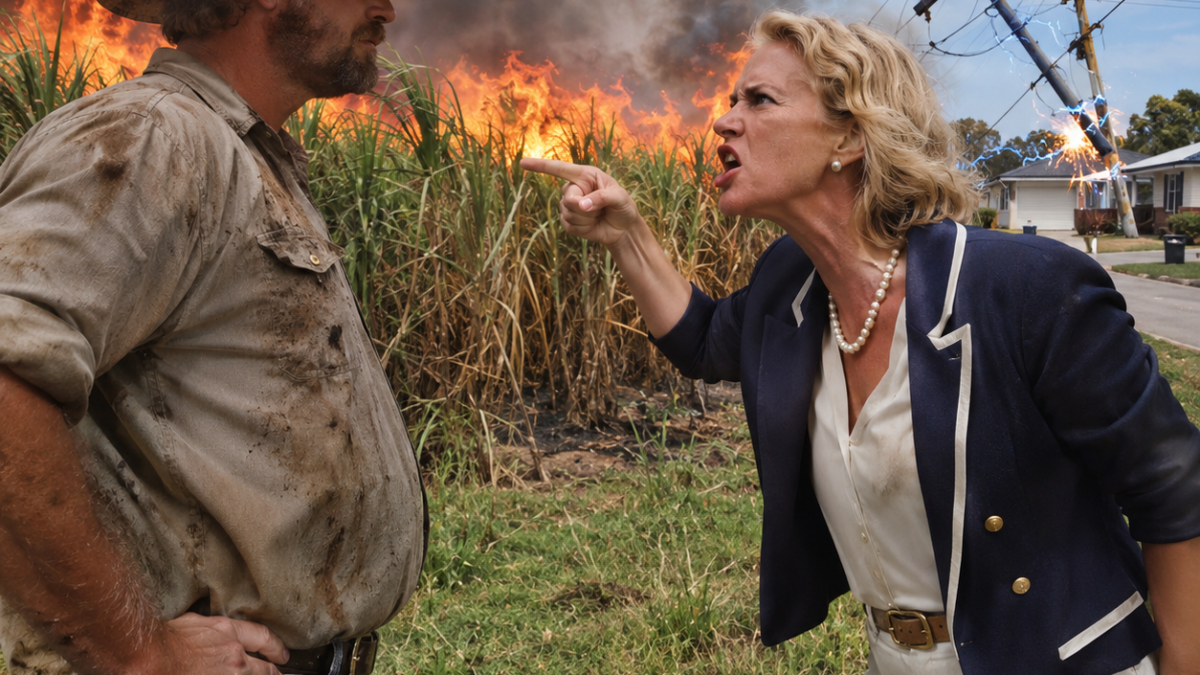
At 4:17 in the morning, I stood barefoot in wet Louisiana grass and watched orange fire race through the sugarcane my grandfather had first planted more than sixty years earlier, each crackling stalk throwing sparks into a black sky while the smell of caramelized sugar, diesel, and something sharp and chemical burned the back of my throat.
Then, beyond the flames, I saw the woman who had spent nearly two years trying to erase my farm from the landscape—HOA president Darlene Whitlock—standing beside the cut fence in her expensive vest and running shoes, an empty container hanging from one hand as casually as if she had just finished watering flowers instead of setting fire to three generations of my family’s work.
What happened over the next few hours would turn the quietest morning Crestfield had seen all year into the day an entire neighborhood finally learned exactly how far one person had been willing to go to win a fight that was never hers to begin with.
My name is Garrett Tulloch.
My grandfather, Elwood Tulloch, bought eight acres outside Crestfield, Louisiana, in 1961.
He came from sharecropping roots in Mississippi with almost no money and an almost unreasonable amount of patience. He cut timber, repaired equipment, hauled freight, and saved every dollar he could until he found a piece of bottomland most people considered too wet, too stubborn, and too inconvenient to be worth much.
Grandpa looked at it and saw sugarcane.
He used to tell me that poor land was only poor if you asked it to become something it was never meant to be.
The soil was dark. The water table was high. Summers were brutal. Cane loved it.
He planted his first rows by hand.
My father, Garrett Senior, expanded them.
Then the land came to me.
For thirty-seven years, I worked those same acres.
Not because I was trapped there.
Because I wanted to.
My mornings smelled like earth, cut grass, diesel fuel, and cane. My hands knew which valves stuck when the humidity rose, which tractor needed two turns of the key on cold mornings, and which low corner collected water after a hard rain.
The farm wasn’t picturesque in the way people from subdivisions imagine farms.
It was work.
Mud.
Mosquitoes.
Broken belts.
Sunburn.
Numbers that barely made sense some years.
But every time I walked through those rows, I knew exactly where I came from.
Then Crestfield started changing.
A developer called Holloway Group bought land along our eastern boundary and built a gated subdivision marketed as a “lifestyle community.”
Big houses.
Three-car garages.
Decorative ponds.
A clubhouse.
An HOA.
And eventually, Darlene Whitlock.
She arrived in a pearl-white Lexus and became HOA president almost immediately.
The first letter she sent me informed me that my sugarcane field was “aesthetically inconsistent with neighborhood standards.”
I read it twice.
Then I drove to the property line and looked from my field toward her subdivision.
The subdivision was four years old.
My farm was nearly sixty.
More importantly, my land was not part of the HOA.
Not one square foot.
Darlene either didn’t understand that or didn’t care.
She demanded an eight-foot privacy fence at my expense.
I refused.
She filed a nuisance complaint.
The parish dismissed it.
Then came noise complaints.
Environmental complaints.
Irrigation complaints.
Petitions to rezone my agricultural land.
Every allegation was investigated.
Every one failed.
But Darlene kept coming.
My wife, Ronda, once asked me why I thought she was so obsessed with eight acres that weren’t hers.
I gave her the answer I believed then.
“Control.”
Ronda shook her head.
“No.”
“What then?”
“Money.”
I should have listened more carefully.
Because Darlene Whitlock was never really trying to make my farm prettier.
She was trying to make it disappear.
PART 2
## THE WOMAN AT THE FENCE
Darlene’s first demand had arrived by certified mail.
That should have told me something.
Normal neighbors knock.
People looking for leverage create paper trails.
The letter said the smell of agricultural activity created an unreasonable nuisance for residents of Crestfield Meadows.
I took it to Ronda.
She read the first page, then the second.
“What smell?”
“Apparently Louisiana.”
She looked at me.
“I’m serious.”
“So am I.”
The only strong smells from the property came during harvest and controlled burn periods.
Cut cane.
Smoke.
Diesel.
Mud.
Nothing unusual.
Nothing illegal.
Nothing that had not existed long before Darlene bought a house next door.
She wanted me to install four hundred feet of privacy fencing.
Eight feet tall.
At my expense.
I wrote back with one paragraph.
My property was not part of the association.
Agricultural activity on the property predated the subdivision.
No covenant governing her HOA applied to me.
That should have ended it.
Instead, three weeks later, I received notice that she had filed a nuisance complaint with the parish.
An inspector came out.
Walked the farm.
Checked records.
Asked routine questions.
Then he shook my hand.
“You’re fine.”
“That’s it?”
“That’s it.”
Darlene was waiting near her Lexus when he left.
I walked toward the fence.
She was wearing sunglasses large enough to hide half her face.
“Well?” she asked.
“Dismissed.”
Her lips tightened.
“That’s disappointing.”
“For you.”
She looked over the cane.
“You understand this isn’t appropriate beside a modern residential community.”
“It was here before the community.”
“Things change.”
“Property lines haven’t.”
Her smile returned.
That was the first time she said something I would hear in different forms for the next two years.
“Eventually, Garrett, you’ll understand you can’t stand in the way of progress forever.”
I leaned against the fence post.
“And eventually you’ll understand that progress doesn’t mean you get to own whatever you can see from your backyard.”
She got into her Lexus.
The tires crunched down the gravel.
For months, that sound became my warning.
If Darlene’s Lexus appeared, paperwork usually followed.
## THE PETITION
By June, she had collected seventy-three signatures demanding that the parish consider rezoning my land from agricultural to residential.
Most of the names belonged to people in the new subdivision.
A few had never spoken to me.
One had moved in three weeks earlier.
Apparently that was enough experience to decide what should happen to property my family had worked since Kennedy was president.
Ronda read the petition at our kitchen table.
“Do they actually think this works?”
“They want a hearing.”
“That wasn’t my question.”
I sat across from her.
Ronda had a master’s degree in business administration and an almost irritating ability to see two steps beyond me when I was angry.
“What do you see?”
She tapped the paper.
“They don’t need the rezoning to succeed immediately.”
“Then why bother?”
“To create uncertainty.”
I stared at her.
“Uncertainty lowers value.”
There it was.
That was the first time she said it.
She continued.
“If a buyer thinks the property is headed toward a zoning fight, they offer less.”
“I’m not selling.”
“They don’t know that.”
“I’ve told them.”
“People like Darlene assume everyone has a price.”
I folded the petition.
“She’s going to find out some people don’t.”
Ronda’s expression didn’t change.
“Don’t make this personal.”
“It already is.”
“No.”
She reached across the table.
“It is personal to you. That doesn’t mean you should fight personally.”
I hated when she was right.
That happened often.
## THE BUFFER ORDINANCE
Darlene’s smartest move came later that summer.
She stopped attacking my farm directly.
She attacked the rules around it.
She began appearing at Crestfield town council meetings.
Front row.
Notebook.
Perfect posture.
Calm voice.
She proposed something called an agricultural buffer-zone ordinance.
Any operating farm within half a mile of a residential development would be required to keep one hundred feet of cleared land between active agriculture and residential boundaries.
To someone who had never worked a small farm, one hundred feet sounded reasonable.
To me, it meant losing roughly forty percent of usable acreage along the eastern side.
Forty percent was not a landscaping inconvenience.
It was the difference between staying profitable and slowly dying.
Darlene framed it as fire safety.
That part was clever.
It had been a dry year.
A grass fire in another parish had made television news.
She stood at the town council podium holding a laminated news article.
“Families have a right to protection from preventable wildfire risk.”
A photograph of burned grass appeared on the projector.
Then a photograph of my sugarcane.
No context.
Just tall cane beside a neighborhood.
She let people imagine the rest.
I didn’t know the ordinance existed until Beau Oaks called me.
Beau operated a crawfish farm about a mile away.
He texted me a photograph of the council agenda.
**AGRICULTURAL BUFFER SAFETY ORDINANCE — DISCUSSION AND POSSIBLE ACTION.**
Meeting Thursday.
It was Tuesday night.
Forty hours.
I called the LSU AgCenter the next morning.
That decision changed everything.
Fielding Arseneau, the extension agent assigned to our parish, arrived with data instead of emotion.
Licensed burn history.
Safety requirements.
Setback research.
Agricultural best practices.
He had copies of my burn records.
Twenty years.
No major incident.
No citations.
No uncontrolled events.
He looked at the proposed ordinance.
“This isn’t written by somebody who understands agriculture.”
“Darlene thinks she does.”
“She doesn’t.”
“Will you say that Thursday?”
He smiled.
“More professionally.”
Thursday night, I arrived with Fielding, Beau, and three other farmers.
Darlene looked surprised.
Not scared.
Not yet.
Just irritated that her target had brought witnesses.
Fielding spoke first.
He explained controlled cane burns.
Permitting.
Wind requirements.
Notification procedures.
Fire breaks.
Setbacks.
Then Beau spoke.
Then another farmer.
Then me.
The ordinance did not pass.
But it didn’t die either.
Commissioner Dale Pruitt kept suggesting more study.
More committee review.
More expert consultation.
Afterward, Beau caught me in the parking lot.
“Pruitt’s brother-in-law.”
“What?”
“Holloway Group.”
I looked at him.
“What about it?”
“Board member.”
The next morning, I searched public corporate records.
He was right.
Dale Pruitt’s brother-in-law sat on the board of the same development company behind Darlene’s subdivision.
I printed the record.
Put it in a folder.
Then I labeled the folder:
**WHITLOCK / HOLLOWAY**
Ronda walked past.
“You’ve named the folder.”
“Yes.”
“That’s never good.”
“It helps organization.”
“It means you’re obsessed.”
“Also helps organization.”
She sighed.
## THE INSURANCE ATTACK
Darlene’s next move scared me more than rezoning.
She contacted my crop-insurance provider.
That wasn’t a political nuisance.
That was financial warfare.
My cane was insured under a federally backed crop program.
Without that coverage, one fire, storm, disease event, or serious harvest failure could destroy the farm financially.
Darlene wrote a formal letter claiming my field created an elevated community fire risk.
Attached was a report from a private “fire consultant” named Trent Blaylock.
He had apparently evaluated my property from the road.
Never entered.
Never spoke to me.
Never reviewed my burn history.
His report concluded my field lacked sufficient firebreak protection.
The insurer opened a review.
Coverage status was temporarily restricted pending investigation.
Harvest was eight weeks away.
I read the notice standing beside the mailbox.
My hands went cold.
Ronda found me in the kitchen twenty minutes later.
“You’re pale.”
“They’re reviewing the policy.”
She took the letter.
Read.
Then sat down.
For forty-eight hours, I barely slept.
Anger is easy.
Fear is harder to admit.
If I lost that crop uninsured, I could lose the farm.
Not metaphorically.
Financially.
Ronda watched me pace the kitchen.
Finally she said:
“Garrett.”
“What?”
“Sit.”
“I’m fine.”
“Sit.”
I sat.
She put both hands flat on the table.
“Stop reacting.”
“I’m not reacting.”
“You haven’t slept in two days.”
“Different issue.”
“Start building a case.”
I looked at her.
She leaned forward.
“Darlene wants you exhausted.”
Silence.
“She wants you so scared of the next complaint that selling becomes relief.”
That sentence stayed with me.
I called Winston Guidry.
## WINSTON
Winston was an agricultural attorney in Baton Rouge.
Twenty-two years in farm and land disputes.
He spoke slowly enough to make everybody else in the room feel frantic.
I explained everything.
His first response:
“Don’t contact Darlene directly again.”
“Why?”
“Because she wants material.”
“What kind?”
“Anything she can call a threat.”
He asked for every letter.
Every complaint.
Every dismissal.
Insurance documents.
County records.
Then he asked for the original HOA covenants.
“Why?”
“My land isn’t in the HOA.”
“Exactly.”
“So?”
“People who enjoy enforcing rules on other people often forget to read their own.”
His paralegal called four hours later.
Covenant 14, Section 3.
The developer was required to maintain a fifty-foot transitional landscape buffer anywhere the subdivision bordered agricultural land.
Mature trees.
Hedgerow.
Equivalent screening.
What had Holloway installed?
Eight feet of ornamental grass and a rail fence.
They had been violating their own founding covenant from day one.
I called Winston.
“You smiling?”
“I don’t smile professionally.”
“You sound like you are.”
“We have leverage.”
“Use it.”
“Not yet.”
I hated that phrase.
Every lawyer I met seemed to love it.
Not yet.
Wait.
Document.
Let them move.
But Winston was right.
## THE FACEBOOK WAR I REFUSED TO JOIN
Three days after I retained him, my farm appeared in the neighborhood Facebook group.
A woman named Sherry posted:
**Has anyone else noticed a chemical odor coming from the farm west of Crestfield Meadows? I’m concerned about respiratory health, especially for children.**
Forty-seven comments.
People reporting headaches.
Burning eyes.
“Strange smells.”
Nobody had made these reports before.
Now suddenly half the subdivision had become environmental toxicologists.
Ronda showed me the thread.
“Don’t.”
“I didn’t say anything.”
“Your face did.”
Darlene announced a community safety forum.
Residents were encouraged to document any farm-related odors and submit complaints to environmental agencies.
Beau drove past the clubhouse the morning of the meeting.
Thirty cars.
He called me from a gas station.
“She’s got a crowd.”
“I know.”
“You coming?”
“No.”
That surprised him.
“You sick?”
“No.”
“What are you doing?”
“Calling a reporter.”
## MARISOL VEGA
Marisol worked for the Acadiana Courier.
She had written a long piece about crawfish farming that Beau respected.
That gave her more credibility with me than any journalism award would have.
I called.
“I’m not asking you to write about an HOA fight.”
“Okay.”
“I’m asking if you want to see what a sugarcane farm actually looks like before people decide it’s poisoning children.”
She paused.
“When?”
“Wednesday.”
She arrived at seven in the morning.
I gave her the tour.
Cane twelve feet high.
Equipment shed.
Irrigation.
Storage.
Permit binder.
Burn records.
Pesticide logs.
Environmental compliance.
Everything.
Ronda gave her coffee and pecan praline.
Marisol spent three hours.
She asked good questions.
Not friendly questions.
Good ones.
That mattered.
When she left, she said:
“I don’t see the conditions being described online.”
“That’s because they aren’t here.”
“I’ll write what I can verify.”
Perfect.
That was all I wanted.
Meanwhile, Winston formally notified Holloway Group that its development violated the fifty-foot buffer covenant.
They denied our interpretation.
Winston called me.
“They refused.”
“That bad?”
“Excellent.”
“You lawyers are strange.”
“Now we can compel records.”
That word mattered.
Records.
## CONRAD SCHETLER
Conrad called three weeks before harvest.
He lived inside Crestfield Meadows.
Retired commercial insurance executive.
Sixty-one.
Quiet voice.
Careful words.
“Mr. Tulloch, I believe you need to see something.”
We met at my kitchen table.
He brought a folder.
HOA special assessments.
Fourteen over three years.
Approximately $340,000 collected.
I whistled.
“That’s a lot of clubhouse repairs.”
“That’s the problem.”
He showed me disclosed spending.
Roads.
Landscaping.
Insurance.
Repairs.
Normal expenses.
There was still roughly $180,000 that wasn’t easily explained.
Conrad had requested records.
The HOA stalled.
His attorney pushed.
Eventually they produced partial financials.
One vendor appeared repeatedly.
**Crestfield Property Consulting LLC**
Roughly twelve thousand dollars per quarter.
“Who owns it?”
Conrad looked at me.
“Dale Pruitt’s brother-in-law.”
The same man tied to Holloway.
I leaned back.
Now everything looked different.
Darlene’s push for a buffer ordinance.
Pruitt’s reluctance to kill it.
Holloway’s development interests.
HOA money flowing toward a connected company.
Winston called it a “beautifully ugly set of facts.”
Conrad didn’t care about drama.
“I spent thirty-five years reading financial statements,” he said. “Numbers don’t get offended when you ask questions.”
I liked him immediately.
“What do you want?”
“A full accounting.”
“That’s it?”
“That’s everything.”
He paused.
“And I don’t like being lied to.”
Also fair.
## THE KITCHEN TABLE
The Sunday before harvest week, our kitchen became a war room.
Ronda made red beans.
Beau brought sweet tea.
Conrad brought financial statements.
Winston brought a yellow legal pad.
Marisol came for background but agreed not to publish anything unsupported.
We built four tracks.
Legal.
Financial.
Insurance.
Public record.
Winston already had the covenant case against Holloway.
Conrad’s lawyer would pursue HOA financial disclosure and potential fiduciary claims.
My insurer had provided copies of Darlene’s complaint and Blaylock’s report.
That gave Winston grounds to evaluate tortious interference.
Then Beau asked:
“What about your burn?”
My harvest burn.
Mid-October.
Same timing every year.
Licensed.
Permitted.
Routine.
I looked at the calendar.
Crestfield Meadows’ Fall Festival was scheduled for the same Saturday.
Ronda saw my expression.
“No.”
“I haven’t said anything.”
“You’re thinking something petty.”
“Legal.”
“Legal can still be petty.”
Winston looked over his glasses.
“What?”
“My burn permit.”
“What about it?”
“Saturday.”
He understood.
Sugarcane burns produce visible smoke.
Safe when done correctly.
Legal.
Routine.
But visually dramatic.
Darlene had spent a year calling my farm a fire hazard.
The HOA was throwing an outdoor festival beside it.
I filed the permit.
Properly.
No shortcuts.
No games.
If weather conditions were wrong, I would cancel.
If the fire marshal objected, I would cancel.
I was not risking anyone’s safety to embarrass Darlene.
But if everything was legal?
I would farm.
On my land.
On my schedule.
## SHE TRIED TO BLOCK THE BURN
Darlene learned about the permit.
Within twenty-four hours she objected to the state fire marshal.
Proximity to residents.
Festival crowd.
Fire risk.
The inspector came Wednesday.
I met him with records.
Twenty years of safe burns.
Field maps.
Distances.
Wind projections.
The nearest residential structure was far beyond minimum clearance requirements.
He walked everything.
An hour later, he handed me the report.
“Permit stands.”
“That simple?”
“Pretty much.”
I called Winston.
“Document the call,” he said.
Of course.
Then something darker happened.
Beau called Thursday evening.
Someone from Holloway Group had approached him.
They asked whether he would provide a statement supporting the HOA’s fire-safety concerns.
In return, they suggested future “consideration” regarding land-acquisition discussions.
Beau told them to get off his property.
Another farmer, Calvin Theriot, received a similar approach.
Both made written statements.
Notarized.
Winston read them.
“Do nothing.”
“I’m getting tired of that advice.”
“They’re making our case for us.”
“But—”
“Garrett.”
I stopped.
“Let arrogant people continue talking.”
That might have been Winston’s favorite legal principle.
## THE EMERGENCY COUNCIL SESSION
Friday morning, Commissioner Pruitt called an emergency parish council session.
Six hours’ notice.
Purpose:
temporary public-safety declaration affecting open burns near residential gatherings.
My burn.
Obviously.
Winston had anticipated it.
He filed for emergency judicial relief based on lack of due process and the targeted nature of the proposed action.
By one o’clock, the session was canceled.
But several residents had already arrived.
Among them were three women from Darlene’s subdivision.
Peggy Lambert, a retired principal, was one.
Darlene arrived at 1:55.
Saw them.
Saw Marisol.
Saw the canceled notice.
According to Marisol, something in Darlene’s face cracked.
“Who told you about this?”
Peggy stared at her.
“We’re homeowners.”
“This was a public-safety matter.”
“So we can attend.”
“You should go home.”
Peggy crossed her arms.
“We’re standing in a public parking lot.”
Marisol wrote everything down.
Darlene sat in her Lexus for eleven minutes.
Then left.
None of us knew what she would do next.
That was the mistake.
We still thought she would use paper.
## SATURDAY, 5:57 A.M.
I reached the north field before sunrise.
Burn equipment ready.
Weather acceptable.
Crew on standby.
Then I saw the fence.
Cut.
Three wires.
Clean.
A four-foot opening.
I stopped.
The morning was still.
Too still.
I called Winston.
“Don’t touch it.”
“I know.”
“Photograph.”
“I know.”
“Sheriff.”
“Already dialing.”
I took six angles.
Timestamped.
Then walked south.
That was when I smelled it.
Petroleum.
Sharp.
Not diesel.
Not machine grease.
Accelerant.
I crouched.
The bases of the cane along approximately sixty feet of fence line were wet.
I touched nothing.
Took photographs.
Called the fire marshal.
Then Marisol.
Then I sat on the truck tailgate.
For the first time in months, I felt no anger.
Just dread.
Someone wanted a fire.
A bad one.
And they wanted it associated with my legal burn.
The fire department arrived.
Then the state investigator.
He suspended my planned burn.
Fine.
Safety first.
They found a half-empty container of charcoal lighter fluid inside the fence.
Boot impressions.
Cut wire.
Everything changed.
This was no longer civil harassment.
It was a crime scene.
## THE FIRE
Investigators were still working when somebody shouted.
“Smoke!”
Not from my burn zone.
Farther north.
Near the cut fence.
The cane caught fast.
Too fast.
Flame climbed with a violent hiss.
Anyone who has worked controlled burns knows the difference immediately.
A normal cane burn moves predictably when conditions are managed.
This didn’t.
The accelerant-fed edge surged.
Wind shifted.
Heat rolled upward.
I heard the cane crackling like thousands of dry bones.
“Move!”
Firefighters pushed us back.
I watched orange flame race parallel to the fence.
For one horrible second I thought it would jump directly into the subdivision.
It didn’t.
But the heat column rose toward the utility corridor.
Power lines ran along the easement.
A distribution line sagged.
Then came a sound like a rifle shot.
Blue-white arc.
Transformer explosion.
The neighborhood went dark.
All at once.
Streetlights.
Clubhouse.
Festival tents.
Sound system.
Inflatables.
Everything.
From across the field, you could hear people shouting.
The time later recorded by the utility:
8:47 a.m.
Darlene’s Fall Festival had just lost power.
I stood beside a fire truck looking at smoke rolling into the sky.
My stomach turned.
This was not funny.
Not justice.
Not yet.
A fire near homes is never funny.
The firefighters contained the cane edge before structures ignited.
The power lines were damaged.
One transformer failed.
The eastern section of the subdivision was shut down.
Then an investigator asked me:
“Mr. Tulloch, where is Mrs. Whitlock?”
“I don’t know.”
Marisol did.
“She’s at the festival.”
## THE BOOTS
By the time sheriff’s deputies crossed the common area, about sixty people were standing around the powerless Fall Festival.
Food vendors.
Families.
Children.
Volunteers.
Darlene wore a name tag.
**FESTIVAL CHAIR**
The investigator approached her.
I wasn’t there for the first conversation.
Marisol was.
Later, she told me Darlene went pale the moment he asked about the morning.
Then somebody noticed her boots.
The impression at my fence had a distinctive tread.
So did Darlene’s boots.
Not proof by itself.
Enough to ask more questions.
A deputy walked past her Lexus.
Through the cargo-area window, he saw wire cutters.
That led to the vehicle being secured.
Investigators obtained what they needed legally.
The cutters matched the type of damage.
Other evidence followed.
Witness timelines.
Camera footage.
Phone-location information.
The container.
The fence.
The accelerant pattern.
Darlene had apparently intended to manipulate the conditions around my licensed burn.
Make the fire look uncontrolled.
Make me look reckless.
Destroy my insurance.
Destroy my public credibility.
Maybe force the government to shut down future agricultural operations.
Instead, the fire happened outside my controlled ignition process.
Authorities were already present.
My burn had been suspended.
And her attempt to manufacture evidence created the evidence against her.
She was arrested at her own Fall Festival.
In front of the people whose approval she had spent years chasing.
Marisol took the photograph.
Darlene in handcuffs.
Dark clubhouse behind her.
Festival lights hanging uselessly overhead.
Pearl-white Lexus in the background.
I saw the image later.
People expected me to smile.
I didn’t.
## I WENT BACK TO THE FIELD
While everyone watched Darlene leave in a sheriff’s vehicle, I went back to my farm.
Ronda found me near the burned edge.
Three acres had been badly affected.
Some cane completely gone.
Other areas scorched.
Fence damaged.
Soil black.
The smell was terrible and beautiful at once.
Burned sugar smells sweet.
That somehow made it worse.
I knelt and picked up a blackened stalk.
It collapsed between my fingers.
Ronda stood behind me.
“You okay?”
“No.”
She sat beside me.
For months, I had imagined Darlene losing.
I thought it would feel good.
Instead, I was looking at ashes.
“My grandfather planted cane here.”
“I know.”
“My dad worked this section.”
“I know.”
“All because she wanted to win.”
Ronda took my hand.
“No.”
I looked at her.
“Because she couldn’t accept a boundary.”
That was more accurate.
A property boundary.
A legal boundary.
A moral boundary.
Darlene believed every limit was negotiable if she pushed hard enough.
Eventually she pushed into criminal territory.
The field paid part of the price.
## THE CRIMINAL CASE
The case took months.
Real justice usually does.
Not television justice.
Not one dramatic hearing where everyone claps.
Evidence.
Forensics.
Statements.
Negotiations.
Darlene ultimately entered a guilty plea to criminal property damage and a reduced arson-related offense tied to the incident.
She received probation.
Restitution.
Restrictions.
Part of her agreement prohibited future service in HOA board leadership.
The restitution amount reached roughly $47,000 for property damage and related losses.
People asked whether that was enough.
No.
Money never equals history.
Forty-seven thousand dollars does not replace fear.
It does not undo the morning.
It does not give back sleep.
But restitution is not supposed to erase memory.
It is supposed to make responsibility real.
Darlene had to pay.
Personally.
That mattered.
## THE HOA FINANCIALS
Her arrest did something else.
People stopped being afraid of the HOA board.
Conrad’s financial challenge accelerated.
Records became public through litigation.
The connection between special-assessment funds, Crestfield Property Consulting, Holloway Group, and related insiders was investigated and exposed.
Approximately $210,000 was eventually returned or credited to homeowners through settlement of the fiduciary claims.
The shell company disappeared.
Commissioner Dale Pruitt did not seek reelection.
His relationship with the development interests became public.
Marisol wrote three long investigative pieces.
The first explained my farm dispute.
The second followed the HOA money.
The third focused on local political connections.
She won an investigative reporting award.
When she called to tell me, I said:
“Good.”
“That’s it?”
“What do you want, a parade?”
“You could sound happy.”
“I am.”
“Garrett, you sound like somebody told you the tractor started.”
“That makes me very happy.”
She laughed.
## THE FIFTY-FOOT BUFFER
The covenant lawsuit settled separately.
Holloway Group agreed to install the buffer required by its own governing documents.
Fifty feet.
Not eight.
Mature cypress.
Hedgerow.
Proper screening.
They also covered my legal costs under the settlement terms.
I stood beside Winston the day the first cypress went into the ground.
“You enjoying this?”
“I don’t enjoy litigation.”
“You looked pretty happy when they unloaded the trees.”
“Trees are peaceful.”
“You’re lying.”
“Professionally.”
The cypress changed the property line.
Not because I wanted to hide the subdivision.
Because for the first time, the development complied with the boundary it had expected me to respect alone.
That felt right.
## THE INSURANCE LETTER
My crop insurer completed its review.
The fire marshal’s investigation established that the accelerant had been placed by a third party and that the fire did not result from negligent execution of my licensed burn.
The adverse notation was removed.
My policy status was restored.
I sat at the kitchen table reading the letter.
Ronda watched me.
“Well?”
“We’re covered.”
She closed her eyes.
For months, we had lived with the possibility that Darlene’s false campaign could destroy our financial safety net.
That one letter lifted a weight I hadn’t realized I was still carrying.
Ronda stood.
Walked around the table.
Put her arms around me.
I held her.
Neither of us said anything.
There are victories too quiet for cheering.
## SPRING
Winter passed.
The burned field looked dead.
Black.
Flat.
Empty.
Then spring came.
One morning I walked the damaged rows.
Something green pushed through the soil.
A cane shoot.
Then another.
Then hundreds.
Sugarcane is resilient.
Some varieties ratoon from established root systems.
The roots survive when the top growth is gone.
Grandpa knew that.
Dad knew that.
I knew it intellectually.
Seeing it was different.
Ronda came out behind me.
“You’re smiling.”
“No.”
“You are.”
“Sun.”
“Cloudy.”
I pointed.
She saw the green shoots.
Her expression softened.
“Your grandfather’s roots?”
“Some of them.”
She crouched.
Touched one.
I thought about the fire.
The blackened field.
Darlene in handcuffs.
Everything that had happened.
Maybe the obvious metaphor was too easy.
I didn’t care.
Sometimes obvious things are true.
The field had burned.
The roots had not surrendered.
## CONRAD BECOMES PRESIDENT
Darlene resigned from the HOA.
Conrad became interim president.
The irony pleased almost everyone.
His first board meeting was open.
Full financial packet.
Vendor list.
Reserve balances.
Contracts.
Questions allowed.
No shouting.
No laminated speeches.
Conrad introduced a rule:
Any vendor contract over five hundred dollars had to be disclosed at an open meeting.
A homeowner raised her hand.
“Why five hundred?”
Conrad answered:
“Because I’m tired of surprises.”
Fair.
An audit committee formed.
Residents who had once ignored HOA meetings began attending.
Not because they suddenly loved governance.
Because they had learned the price of not watching.
That lesson spread quickly.
## PEGGY
A few months later, Peggy Lambert knocked on my door.
The retired principal.
She carried a pie.
“Peace offering.”
“For what?”
“Living over there.”
I laughed.
“Not your fault.”
“We should have paid attention earlier.”
“You didn’t know.”
“We knew enough.”
That honesty impressed me.
She sat on the porch.
“For years, Darlene handled everything.”
“People liked that?”
“At first.”
Peggy looked toward the subdivision.
“She made meetings short. Problems disappeared. Landscaping stayed perfect.”
“And?”
“We confused efficiency with good leadership.”
That sentence stuck with me.
Control often looks efficient.
Until the bill arrives.
Financially.
Morally.
Legally.
## THE FIRST HARVEST AFTER THE FIRE
Beau came over.
We sat on the truck tailgate.
Sweet tea.
Warm afternoon.
Cane moving in the wind.
The replanted section was still shorter than the mature rows.
But it was alive.
Beau looked across the field.
“Remember when she wanted a hundred-foot buffer on your side?”
“Yep.”
“Now Holloway has fifty feet of cypress on theirs.”
“Yep.”
He grinned.
“Funny.”
“Not that funny.”
“It’s a little funny.”
I gave him that.
We watched the harvester move slowly through the rows.
The smell was everything I remembered.
Earth.
Sweet cane.
A little diesel.
Home.
## ELWOOD’S NAME
I wanted to do something with the settlement money.
Not because there was a fortune.
There wasn’t.
But enough.
Ronda suggested investing it.
I said I wanted Grandpa’s name attached to something.
We created the Elwood Tulloch Agricultural Scholarship.
$2,500 a year.
For a graduating student in the parish planning to study agriculture, environmental science, agronomy, or a related field.
The first recipient was Jasper Fontenot.
Seventeen.
Farm kid.
Wanted to study agronomy at LSU.
At the ceremony, he shook my hand so hard it hurt.
“Mr. Tulloch, my family can’t thank you enough.”
“Don’t thank me.”
“Who?”
I looked toward Grandpa’s old photograph on the display table.
“Him.”
Jasper smiled.
“I never met him.”
“Doesn’t matter.”
Legacy is strange that way.
A man can die before someone is born and still change that person’s future.
## DARLENE YEARS LATER
I heard pieces.
Nothing dramatic.
She moved.
She stayed out of HOA politics.
At least as far as I knew.
People occasionally sent me updates.
I stopped reading them.
At first, that surprised people.
“Don’t you want to know what happened to her?”
Not really.
There was a time I checked every filing connected to Darlene Whitlock.
Every complaint.
Every meeting.
Every social media post.
Every rumor.
Then one morning I realized that continuing to watch her life meant continuing to give her space in mine.
I had cane to harvest.
A wife.
Neighbors.
A scholarship.
A farm.
Enough.
## THE FALL FESTIVAL RETURNS
Two years later, Crestfield Meadows held another Fall Festival.
Conrad invited us.
I almost declined.
Ronda made me go.
“Why?”
“Because avoiding them means Darlene still owns the memory.”
Again.
Annoyingly correct.
We went.
The cypress buffer had grown.
Kids ran between tables.
Someone sold jambalaya.
Someone else sold pralines.
No one talked about the old fire until Peggy found us.
She pointed toward the field.
“Burning this year?”
“Already did.”
She stared.
“You did?”
“Last week.”
“I didn’t even notice.”
“Wind was good.”
She laughed.
For years, Darlene had convinced residents that my controlled burns were existential threats.
Now a properly managed burn happened with almost no drama.
That was one of the most satisfying things I experienced.
Not confrontation.
Normalcy.
## WHAT DARLENE NEVER UNDERSTOOD
She thought I resisted because I hated change.
That was wrong.
Farmers live with change constantly.
Weather.
Markets.
Equipment.
Disease.
Labor.
Floods.
Drought.
New technology.
We adapt or disappear.
What I resisted was theft disguised as improvement.
There is a difference between progress and displacement.
Between regulation and harassment.
Between a neighborhood having standards and one person using those standards to reach outside its legal boundary.
My farm did not belong to Darlene.
That should have been the end of the story.
She couldn’t tolerate that.
Every escalation came from the same belief:
If she wanted something badly enough, the boundary should move.
Eventually she physically cut the boundary.
That was almost too perfect.
For two years I told her the fence line mattered.
She finally answered by cutting it.
And that act became part of the evidence that ended her control.
## THE POWER LINES
People still tell the story wrong.
They say Darlene burned my cane and karma instantly knocked out her neighborhood.
That makes a better bar story.
Reality is messier.
The fire created dangerous heat conditions near aging distribution infrastructure.
The lines faulted.
A transformer failed.
Utility crews had to isolate the affected service.
Families lost electricity.
Nobody deserved that.
Children didn’t.
Older residents didn’t.
People who disliked Darlene didn’t.
That outage was not justice.
It was collateral damage from one person’s recklessness.
The justice came later.
When responsibility was established.
When she paid restitution.
When the HOA finances were opened.
When homeowners recovered money.
When Holloway installed the buffer.
When my insurance record was cleared.
When public officials faced scrutiny.
That distinction matters to me.
Revenge feels simple.
Justice usually isn’t.
## THE NIGHT RONDA ASKED ME
We were sitting on the porch.
Cicadas loud.
Humidity thick.
Cane moving beyond the yard.
Ronda asked:
“If you could go back, would you sell?”
“What?”
“The farm.”
“No.”
“Even knowing everything?”
I thought about it.
Legal bills.
Fear.
Threats.
Fire.
The insurance mess.
Sleepless nights.
“Still no.”
“Why?”
I looked toward the field.
“Because selling under pressure isn’t the same as choosing to sell.”
She nodded.
“That’s what I thought.”
“If Jasper offered me ten million tomorrow, though—”
She laughed.
“There he is.”
I smiled.
Dad never told me the farm had to remain forever.
Grandpa never did either.
What mattered was choice.
The right to decide what happened to something you had built.
Darlene wanted to take that choice.
That was the fight.
## JASPER COMES HOME
Four years after receiving the scholarship, Jasper came back from LSU.
Degree in agronomy.
He stopped by the farm.
Bigger.
More confident.
Still shook my hand too hard.
“I got a job.”
“Where?”
“Extension service.”
I smiled.
“That so?”
“Want to help farmers.”
“Bad career choice.”
He laughed.
“I blame you.”
“Fair.”
He walked the cane.
Asked questions.
Soil.
Ratoon performance.
Burn practices.
Yield.
At one point he stopped near the area that had burned.
“This is where it happened?”
“About here.”
He looked down.
“You can’t tell.”
That sentence hit me.
You can’t tell.
The field had healed so completely that someone who didn’t know the history couldn’t see the scar.
I could.
Of course.
I knew exactly where.
But the land had moved forward.
Maybe I could too.
## MARISOL’S ARTICLE
On the anniversary, Marisol published a retrospective.
She interviewed Conrad.
Peggy.
Beau.
Winston.
Ronda.
Me.
Her final question:
“What do you think this story is actually about?”
I expected myself to say property rights.
Or corruption.
Or HOA overreach.
Instead I said:
“Attention.”
She waited.
“People stop paying attention.”
“To what?”
“Boundaries. Money. Authority. Documents. Each other.”
I looked at her recorder.
“Darlene only got as far as she did because everybody assumed somebody else was watching.”
Marisol nodded.
“That’s the quote.”
“Use a better one.”
“No.”
Journalists are stubborn.
## GRANDPA’S FIELD
When I was nine, Grandpa took me to the cane before sunrise.
He cut one stalk.
Split it.
Handed me a piece.
“Chew.”
I did.
Sweet juice filled my mouth.
Not refined sugar.
Grassier.
Earthier.
He smiled.
“Everything worth having takes work before it gets sweet.”
At nine, I thought he was talking about sugar.
Maybe he was.
Grandparents often become philosophers only after they die.
I remembered that morning often during the fight with Darlene.
There was nothing sweet about those years.
Then came the parts worth keeping.
The scholarship.
The cypress.
The open HOA books.
Jasper.
My insurance restored.
Farmers talking to each other.
Neighbors inside Crestfield Meadows realizing farmers outside their gate weren’t enemies.
That was the sweetness after the work.
## THE FIRE MARSHAL RETURNS
Years later, the same fire marshal investigator visited during harvest.
Not officially.
He was nearby.
Stopped in.
We stood near the field.
“You still burn?”
“When conditions allow.”
“Good.”
I laughed.
“You’re the first government official to tell me to keep setting things on fire.”
“Properly.”
“Important distinction.”
He looked toward the subdivision.
“You know what I remember?”
“What?”
“The lighter fluid bottle.”
“Me too.”
“She left it inside your property.”
“Yep.”
He shook his head.
“People get careless when they think they’re smarter than everyone else.”
That might be the simplest explanation for Darlene.
Not insanity.
Not some grand evil.
Arrogance.
She believed nobody else was watching closely.
That her title made her smarter.
That farmers were unsophisticated.
That HOA residents would follow her.
That local officials could be pressured.
That paperwork could create truth.
That fire would behave the way she wanted.
Fire doesn’t care about ego.
Neither does evidence.
## THE LAST LETTER
One December, I received a Christmas card from Conrad.
His grandchildren on the front.
Inside:
**Garrett—HOA audit completed. Reserves healthy. No mystery vendors. People are still complaining, but now they complain in public meetings where everyone can hear them. Progress. Merry Christmas. —Conrad**
I showed Ronda.
She smiled.
“Frame it.”
“Why?”
“Because ‘people still complaining’ might be the healthiest sentence ever written about an HOA.”
She had a point.
Healthy communities are not silent.
They disagree.
Openly.
With records.
With rules.
With limits.
Darlene’s version of order required everyone else to stop asking questions.
Conrad’s version survived them.
## THE FIELD TODAY
I’m older now.
My knees hurt.
The tractor seat feels less comfortable every year.
Ronda says that is not the tractor.
The original eight acres remain.
The cypress trees along the eastern boundary are tall now.
Beautiful.
They soften the view between farm and subdivision without pretending one side owns the other.
Sometimes residents walk along the back path.
A few wave.
Some of their children have toured the farm with school groups.
That is probably the part Darlene would have hated most.
Not that the cane survived.
That the people she told to fear it learned what it was.
Kids ask why we burn fields.
We explain.
They ask about safety.
We explain.
They ask why cane smells sweet.
We cut a stalk.
Let them taste it.
Fear does poorly when exposed to information.
That lesson applies beyond farming.
## A BOY ASKED ME ABOUT THE FIRE
A school group came one October.
Maybe twenty kids.
One boy had clearly heard the story from his parents.
“Mr. Tulloch?”
“Yes?”
“Is this the farm that lady burned?”
The teacher looked embarrassed.
I wasn’t.
“Part of it.”
“Did you hate her?”
Children go straight for the complicated part.
“For a while.”
“Do you now?”
“No.”
“Why?”
I thought.
“Because I have better things to do.”
He nodded like that made perfect sense.
Then he asked:
“Did the cane grow back?”
I pointed.
“You’re standing in it.”
He looked around.
His eyes widened.
“This is the same one?”
“Same roots in some places.”
“That’s cool.”
“Very.”
He ran to catch his class.
I stood there.
Same roots.
That was the real ending.
## THE STORY PEOPLE TELL
People tell this as the story of the HOA president who burned a field and knocked out her own neighborhood’s power.
That’s the dramatic version.
It’s true enough.
But it isn’t the whole truth.
The story started long before the match.
It started when a woman decided rules should apply to land she didn’t own.
When a developer ignored its own covenant.
When residents paid assessments without asking where the money went.
When a commissioner failed to disclose relationships clearly enough.
When an insurer had to take a polished complaint seriously.
When neighbors inside one community started believing stories about neighbors outside it without ever walking across the fence.
The fire was just the moment everything became visible.
Flames do that.
So do lawsuits.
So do financial records.
## MY REVENGE
If you want to call what happened revenge, fine.
But it wasn’t Darlene being arrested.
That was accountability.
It wasn’t her restitution.
That was compensation.
It wasn’t losing her HOA position.
That was consequence.
My revenge was standing in a green field the following spring.
Watching new cane push through soil she had tried to blacken.
My revenge was Holloway paying for fifty feet of mature cypress.
My revenge was Conrad opening the financial books.
My revenge was the HOA refunding money to homeowners.
My revenge was my insurance company putting in writing that I had done nothing wrong.
My revenge was Beau sitting beside me at harvest.
My revenge was Jasper going to LSU on a scholarship carrying my grandfather’s name.
My revenge was hearing children laugh in a field Darlene once described as a threat to their health.
My revenge was ordinary life continuing.
That is the kind of revenge bullies hate most.
Because it denies them permanence.
## RONDA AND I
One evening, many years later, we sat on the tailgate.
Same spot Beau and I used.
Sun going down.
Sweet tea.
Cane rustling.
Ronda said:
“You know what I remember?”
“What?”
“The night you almost posted on Facebook.”
I groaned.
“That was one time.”
“You wrote six paragraphs.”
“Draft.”
“You used the phrase ‘suburban dictator.’”
“Accurate.”
“And I deleted it.”
“You saved my life.”
“I saved your lawsuit.”
We laughed.
Then she rested her head against my shoulder.
“You listened eventually.”
“To what?”
“Stop reacting. Start building a case.”
I took her hand.
“That should go on your tombstone.”
“Excuse me?”
“Too soon?”
“Very.”
We sat quietly.
That woman had lived through every letter.
Every fear.
Every angry night.
Every insurance problem.
Every phone call.
People called the story mine.
It wasn’t.
Ronda carried half of it.
Maybe more.
She simply didn’t need everyone to know.
## ELWOOD
Grandpa died before Holloway Group existed.
Before Darlene.
Before gated subdivisions.
Before Facebook complaints.
I sometimes wonder what he would have done.
Probably nothing dramatic.
He didn’t like lawyers.
Didn’t trust politicians.
Would have hated social media.
He would have walked the boundary.
Checked the fence.
Filed what paperwork was necessary.
Then gone back to work.
That was his way.
Dad was more emotional.
Dad would have yelled.
Probably at the council.
Definitely at Darlene.
I ended up somewhere between them.
Maybe that is inheritance too.
Not just land.
Temperament.
Lessons.
Mistakes.
## THE LAST BURN OF THE SEASON
Last October, we conducted the final permitted burn before harvest.
Conditions perfect.
Notifications complete.
Firebreaks checked.
Crews ready.
I stood at the edge of the field.
For a moment, before ignition, I remembered that other morning.
Cut fence.
Lighter fluid.
Smoke.
Police.
Power outage.
Handcuffs.
Then I gave the signal.
The controlled line moved exactly as it should.
Predictable.
Managed.
Beautiful in the strange way agricultural fire can be.
Smoke rose away from the subdivision.
The cypress buffer stood dark against the sky.
No panic.
No complaints.
No emergency council session.
No Darlene.
Just farming.
When it was done, I walked the perimeter.
Everything contained.
Exactly where it belonged.
Boundaries respected.
That felt like the final sentence.
## WHAT I LEARNED
The smallest authority can become dangerous when nobody questions it.
Not because HOA presidents are uniquely evil.
They aren’t.
Most are probably people trying to get the pool cleaned and stop someone from parking an RV across three spaces.
But titles change some people.
Especially people who already believe control is the same thing as leadership.
Darlene’s mistake wasn’t caring about Crestfield Meadows.
It was deciding caring gave her ownership over everything around it.
My land.
My livelihood.
My insurance.
My reputation.
Eventually my fence.
She crossed every boundary because each previous crossing had seemed survivable.
Complaint.
Petition.
Ordinance.
Insurance letter.
Political pressure.
Financial interference.
Then physical sabotage.
The line moved gradually.
Until suddenly there were handcuffs.
That is why boundaries matter before things become dramatic.
## THE ENDING I WANTED
For a long time, I thought a satisfying ending required Darlene to understand what she had done.
Apologize.
Admit it.
See the farm.
Recognize Grandpa’s legacy.
That never happened.
I stopped needing it.
People overvalue apologies from people who do not mean them.
The farm did not need her apology.
Neither did I.
The land needed water.
Time.
Roots.
Sun.
Work.
It got those things.
And it came back.
One morning, I walked the field after rain.
Drops sat on the cane leaves.
Sun broke through clouds.
The whole field turned bright green.
I took a photograph.
Not for evidence.
That was new.
For years, I photographed things because something might need proving.
Fence.
Letters.
Damage.
License plates.
Receipts.
Documents.
That morning I photographed the field because it was beautiful.
I sent it to Jasper.
Then Beau.
Then Conrad.
Then Marisol.
Ronda looked over my shoulder.
“No caption?”
“No.”
She smiled.
“Growth.”
“What?”
“That’s your caption.”
Too sentimental.
I sent it anyway.
## THE ROOTS
Sugarcane does something I think about often.
Cut it down and the root remains.
Burn the top and, if the root survives, growth can return.
Not forever.
Not magically.
Not without care.
But enough.
My grandfather’s exact original plants are not somehow immortal beneath the soil.
That isn’t how agriculture works.
But the continuity is real.
Soil improved by his labor.
Rows shaped by my father.
Drainage they designed.
Knowledge passed down.
A farm is not one crop.
It is accumulated decisions.
So is a family.
So is a community.
Darlene burned cane.
She did not burn continuity.
She could not.
## ONE FINAL AFTERNOON
Beau and I sat by the field.
Older now.
He had finally retired from crawfish.
Mostly.
Farmers have strange definitions of retirement.
He looked toward the subdivision.
“Remember the festival?”
“Unfortunately.”
“Power went out right when they started serving food.”
“I know.”
“Peggy says half the potato salad spoiled.”
“That part still hurts.”
He laughed.
Then became quiet.
“You think any of this would’ve happened if Holloway had just planted the damn buffer?”
I thought about it.
Maybe.
Maybe not.
Small violations have a way of revealing big attitudes.
“They thought nobody would make them.”
Beau nodded.
“That was the whole problem, wasn’t it?”
Yes.
Not just Holloway.
Darlene too.
They assumed nobody would make them follow boundaries.
Until people did.
## HOME
At sunset, I walked back toward the house.
The cane moved behind me.
Cicadas started.
Somebody in the subdivision was grilling.
The smell drifted through the cypress.
A dog barked.
Farther away, a tractor started.
Normal sounds.
There was a time when every unfamiliar vehicle made me tense.
Every certified letter made my stomach hurt.
Every phone call after dark felt like another attack.
That faded.
Not all at once.
Home became home again gradually.
That may be the greatest ending I can offer.
Not a courtroom.
Not an arrest.
Not a headline.
A man walking across his own property without expecting somebody to take it away.
## IF GRANDPA COULD SEE IT
I think Elwood would recognize the farm.
Different equipment.
Different methods.
But same cane.
Same humidity.
Same dark soil.
Same stubbornness.
He would probably dislike the subdivision.
Then he would meet Conrad and Peggy and decide some of those people were all right.
He would like Jasper.
Definitely.
He would pretend not to care about the scholarship and then tell everyone at church.
And if I explained the whole Darlene story?
He would probably listen.
Chew on a piece of cane.
Then say something short that made everything simpler.
Maybe:
“Fence was there for a reason.”
That sounds like him.
## THE REAL LEGACY
For years, I thought the farm was Grandpa’s legacy.
Then I realized land alone is not a legacy.
What people learn from it is.
He taught Dad to work.
Dad taught me to stay.
Ronda taught me to think before reacting.
Winston taught me to document.
Conrad taught his neighbors to follow the money.
Marisol taught people to verify before believing.
Darlene, unintentionally, taught an entire community what happens when authority stops hearing the word no.
And the field taught us all the same lesson it had been teaching since 1961.
Damage is real.
But damage is not always the final state.
## THE LAST WORD
Darlene once told me I couldn’t stand in the way of progress forever.
She was right about one thing.
Nothing stays exactly the same forever.
Crestfield changed.
The subdivision stayed.
The farm stayed.
The HOA changed.
The board changed.
The cypress grew.
Young people left.
Some came back.
The cane burned.
Then grew again.
Progress happened.
Just not the kind Darlene imagined.
Her version required one thing to disappear so another could profit.
The version we ended up with required boundaries, transparency, accountability, and a little humility.
There is room in Louisiana for subdivisions.
There is room for farms.
There is room for people who want clean sidewalks and people who come home covered in mud.
The problem begins when one decides the other has no right to exist.
That was Darlene’s mistake.
She looked across a fence and saw land that should belong to her vision.
I looked across the same fence and saw a boundary.
When she finally cut that fence before sunrise, she believed she had removed the last thing standing between her and victory.
Instead, she crossed the one line that made everything undeniable.
The lighter fluid.
The fire.
The power lines.
The arrest.
Those were dramatic.
But they were not the reason she lost.
She lost because the rest of us finally stopped treating her confidence as proof that she was right.
We checked the law.
We checked the covenants.
We checked the insurance letters.
We checked the money.
We checked the political relationships.
We checked the fence.
And once people started checking, her entire system fell apart.
That is what I remember most.
Not the flames.
Not the handcuffs.
Not even the blackout.
I remember the first new cane pushing through the black soil the following spring.
Small.
Bright green.
Almost fragile.
I crouched beside it.
Touched the leaf.
Then looked across the field toward the cypress trees Holloway had finally been forced to plant.
For months, Darlene had insisted my farm was ugly.
Dangerous.
Outdated.
An obstacle.
That morning, with fresh growth coming through soil she had tried to destroy, I finally understood why her opinion had bothered me so much.
I had been arguing with someone who never possessed the authority to define the value of what my family built.
Neither did the HOA.
Neither did the developer.
Neither did the loudest person at a town council meeting.
Some things are valuable because people have spent lifetimes caring for them.
Grandpa’s cane was one.
Our independence was another.
So I stood up.
Brushed the soil from my knees.
And went back to work.
Because that was what the Tullochs had always done.
The fire had burned hot.
The neighborhood had gone dark.
Darlene’s little empire had collapsed in public.
But by spring, the field was green again.
And in the end, that was the only revenge I ever really needed.








