PART 2: HOA Karen Buried the Storm Drain I Built—One Flash Flood Put Her Entire Block Underwater
PART 2
Shelby Kincaid moved into Stonebridge in 2021 with her husband, Derek.
Their house sat on Creek View Court.
Three-car garage.
Stone façade.
Outdoor kitchen.
Pool.
Perfect landscaping.
The kind of home developers photograph before the owners have time to leave a bicycle in the driveway.
Derek owned Kincaid Landscape Design.
Hardscape.
Irrigation.
Pergolas.
Outdoor kitchens.
Retaining walls.
Decorative water features.
His truck had green script on the doors that said:
**DESIGN YOUR OUTSIDE**
It was the kind of slogan people pay consultants to invent.
Derek was pleasant enough when Shelby wasn’t around.
But when she was, he behaved like somebody who had agreed years earlier that life ran smoother if she believed every idea was hers.
Shelby was thirty-eight.
Beautiful.
Polished.
Always camera-ready.
Hair done every few weeks.
Expensive workout clothes.
Designer sunglasses.
White sneakers intentionally manufactured to look worn.
A gold bracelet she touched whenever somebody disagreed with her.
Her phone was almost always attached to a gimbal.
She filmed everything.
Front entrance.
Pool.
Walking trails.
Sunset.
Community events.
Board meetings.
Flowers.
Mailboxes.
She treated Stonebridge less like a neighborhood and more like a lifestyle account.
Her social-media bio called her:
**President, Stonebridge HOA
Visionary
Curator of Community
Making Beautiful Things Happen**
She ran for HOA president in January 2023.
Won forty-seven to twelve because almost nobody else wanted the job.
Her campaign slogan was:
**STANDARDS ARE NOT OPTIONAL**
Gold foil.
Linen card stock.
QR code to her Instagram page.
Within six weeks, Shelby repainted the entry monument.
Replaced mailbox structures.
Added decorative lighting.
Then the fines started.
Visible trash cans.
Basketball hoops.
Pickup beds without tonneau covers.
A wind chime she described as:
“Acoustically inconsistent with the desired ambient character of the community.”
That one circulated around the neighborhood for days because people kept checking the letter to see if it was satire.
It wasn’t.
She fined a veteran because a small American flag decal on his mailbox was not, according to the notice, “the approved shade of patriotic red.”
Then she started her weekly neighborhood videos.
**Tuesday Walks.**
Shelby would stroll Stonebridge in coordinated athletic clothes, talking into the camera.
If she liked a house, she paused.
Smiled.
“Perfect.”
If she didn’t, she let the camera linger.
No direct criticism.
She didn’t need it.
A three-second shot became a warning.
Two families repainted shutters after appearing in her videos.
Then she filmed Rosa Garza’s backyard.
Rosa was a single mother on Creek View Court.
Her nine-year-old son had a used trampoline.
Shelby paused the camera.
Tilted her head.
Said:
“Every community has opportunities for growth.”
Fine arrived next morning.
$150.
Unapproved recreational equipment.
I had watched people abuse authority before.
Government.
Private boards.
Neighborhood committees.
It usually starts small.
Nobody fights the first ridiculous decision because fighting is exhausting.
Then the person making the decision learns that ridiculous decisions work.
Shelby first noticed my inlet while I was planting roses.
Margaret had ordered fifty David Austin bare-root roses the October before she died.
They arrived after the funeral.
I couldn’t plant them all.
Not emotionally.
So I planted a few every spring.
Finishing the job felt too final.
That afternoon I was on my knees beside the fence when I saw Shelby and Derek.
A third man followed with a laser measure.
Shelby stopped beside the grate.
“What the hell is that?”
She wasn’t asking me.
She said it toward the air.
Derek crouched.
“Storm drain.”
Shelby made a face.
“It’s disgusting.”
I stood.
“It’s the main junction inlet.”
She turned.
“Mr. Callister.”
“Mrs. Kincaid.”
She removed her sunglasses.
“Have you ever considered landscaping around this?”
“No.”
She blinked.
“Why?”
“Because it needs to stay clear.”
“Of?”
“Everything.”
I pointed.
“Leaves. Soil. Roots. Mulch. Anything that interferes with flow.”
Derek looked through the grate.
“How much water comes through?”
“Depends on the storm.”
Shelby sighed.
“It’s just a drain.”
“No.”
She frowned.
“It’s the entrance to a fifty-four-inch trunk line.”
I looked toward Ridgemont Lane.
“This subdivision drains roughly nine hundred acres through the system.”
Her expression said she had already lost interest.
“In a significant storm, you can see around seventeen hundred gallons per minute at this point.”
Derek stood.
“That much?”
“Yes.”
Shelby looked between us.
“I just want it to look better.”
“It looks exactly the way it needs to.”
She stared at the cast iron.
“It looks like a prison drain.”
“It drains water.”
“We can make infrastructure beautiful.”
“Sometimes.”
“And this?”
“Needs to stay open.”
She put her sunglasses back on.
“We’ll figure something out.”
“Shelby.”
She turned.
“If you block that inlet, the water stays on the street.”
“Mr. Callister.”
“Yes?”
“I understand you used to work for the county.”
“Thirty-four years.”
“Then you should appreciate progress.”
She smiled.
Walked away.
I watched Derek follow.
He looked back once at the grate.
His face told me he understood at least half of what I had said.
That should have mattered.
It didn’t.
Two weeks later, Trish Delgado texted me.
**YOU NEED TO COME TO THE BOARD MEETING.**
Photo attached.
Agenda.
Item Six:
**COMMUNITY POCKET PARK — PHASE ONE APPROVAL**
I attended.
About forty residents.
Shelby had a projector.
Slide deck.
Ring light.
Phone on tripod.
Of course the meeting was being livestreamed.
The first rendering appeared.
I stared.
Raised garden.
Native plants.
Flagstone paths.
Cedar bench.
Pergola.
Bronze plaque.
Decorative lighting.
All centered directly over the junction inlet.
Shelby smiled toward the camera.
“This neglected corner has long been one of Stonebridge’s least attractive areas.”
Next slide.
Before photograph.
My drain.
After rendering.
Flowers.
Pergola.
Garden.
“By transforming unused utility space into a community gathering area—”
I raised my hand.
“Mr. Callister, questions at the end.”
“This isn’t a question.”
She stopped.
“It’s a warning.”
The room went quiet.
“That location is a functioning municipal drainage inlet.”
Shelby smiled.
“We are aware.”
“Your rendering covers it.”
“We’re landscaping around it.”
“You’ve placed flagstone over the grate.”
“The design is permeable.”
“No.”
Derek stood near the side wall.
I pointed at the screen.
“Four inches of soil.”
“Yes.”
“Pavers.”
“Yes.”
“Raised planters.”
“Yes.”
“Pergola footings.”
“Yes.”
“That is burial.”
Shelby turned toward the audience.
“Mr. Callister is a retired engineer.”
The word retired landed with unnecessary emphasis.
“We appreciate his historical knowledge.”
Historical.
“But modern landscape systems incorporate permeability strategies that older infrastructure designs did not.”
I stared at her.
“Water hasn’t changed.”
A few people laughed.
Shelby didn’t.
I looked at Derek.
“What’s the infiltration capacity?”
He paused.
“Of?”
“Your assembly.”
“The paver base.”
“Yes.”
“I’ll get you the specification.”
“Before the vote?”
He looked toward Shelby.
She answered.
“Our professional contractor has already reviewed it.”
“Derek is your husband.”
A few heads turned.
Shelby’s face stiffened.
“He is also an experienced landscape professional.”
“Did anybody else bid?”
“That’s not relevant.”
“It is if HOA money is paying him.”
Shelby tapped the microphone.
“We’re discussing aesthetics and community function.”
“No.”
I stood.
“We’re discussing putting a garden over the mouth of a pipe designed to carry floodwater.”
She turned toward the crowd.
“There will still be drainage.”
“How?”
“Water passes through soil.”
I closed my eyes.
One second.
Just one.
Then opened them.
“In a two-inch rain, this inlet can take over a thousand gallons per minute.”
She shifted.
“Soil does not absorb a thousand gallons a minute.”
Derek said:
“Permeable aggregate can—”
“Through saturated topsoil and root systems?”
“I said I’ll get the spec.”
“You don’t have one.”
Silence.
Shelby smiled toward the camera.
“Some people see limitations.”
Then looked directly at me.
“Other people see possibilities.”
The board voted.
Five to one.
Dennis Wang voted no.
He was removed from the architectural committee the next week.
He called me.
“She told me she needs builders, not blockers.”
“She threaten you?”
“Nicest threat I’ve ever received.”
I sent a certified letter the next morning.
Three pages.
Drainage master plan.
Original easement.
Flow calculations.
County ordinance.
Texas Water Code language described in the source.
One-page flood scenario.
No emotion.
No insults.
Just physics.
Green return card came back.
No response.
Second letter two weeks later.
Photograph of the inlet from 1997.
Drainage standards.
No response.
Third went to Hays County Flood Control.
Assistant Director Daryl Muñoz called.
“Wade.”
“Daryl.”
“I read your packet.”
“And?”
“You know the problem.”
“Explain it anyway.”
“The inlet is on current HOA common area.”
“Correct.”
“County has maintenance access.”
“Yes.”
“But the easement doesn’t explicitly prohibit surface landscaping.”
“They’re pouring concrete over a junction box.”
“I know.”
“You can stop them.”
“My attorneys disagree.”
I leaned back.
“You need it to flood.”
Daryl went quiet.
Then:
“I need a documented impact.”
I hated the answer because I had written versions of it myself for decades.
Government often reacts more easily to damage than probability.
“You’re sending a warning?”
“Yes.”
“Put it in writing.”
“I will.”
“They’ll ignore it.”
“Then you’ll have the record.”
I already understood.
I just didn’t like it.
Groundbreaking:
May 6.
Derek’s crew arrived at seven.
Skid steer.
Concrete mixer.
Trailer.
Four workers.
I watched from the kitchen.
Coffee in hand.
They removed the grate bolts first.
Five-eighths stainless.
Expansion anchors.
A cordless impact had them out in two minutes.
Then four men lifted the two-hundred-forty-pound cast-iron grate.
Set it on grass.
For five minutes, the junction box sat open.
Twenty-seven years of drainage.
Clear.
Ready.
Then they poured concrete over it.
Four inches.
Rebar.
Smooth finish.
Aggregate layer.
Pavers.
Soil.
Plants.
I documented every stage.
Photos.
Time stamps.
Video.
By Friday, the drain had disappeared.
In its place:
Mountain laurel.
Lantana.
Sage.
Mexican feather grass.
Drip irrigation.
Flagstone.
Cedar bench.
Pergola.
Solar lights.
A hummingbird feeder.
People loved it.
Someone added a ceramic planter.
Another resident left a painted stone with a heart.
Shelby filmed the project from start to finish.
Time lapse.
Drone footage.
Walkthrough.
Final reel at sunset.
White linen dress.
Glass of rosé.
Sitting on the cedar bench.
Caption:
**Proof that vision and leadership can turn an eyesore into a gathering place.**
Then:
**When people tell you it can’t be done, remember they said that about every beautiful thing that ever existed.**
Hashtags.
Leadership.
Community.
Beauty.
Four hundred likes.
Dozens of comments.
I stood behind my fence that evening.
The garden really was beautiful.
That almost made it worse.
Lantana orange and gold.
Margaret loved those colors.
Feather grass moving.
Jasmine beginning to climb.
Underneath:
Four inches of concrete sealing the only direct entrance to a fifty-four-inch pipe.
I called Daryl.
“They capped it.”
“How much concrete?”
“Four inches.”
“Documented?”
“Every minute.”
“I’m sending the warning letter tomorrow.”
“Good.”
“Wade?”
“Yes?”
“Put out a rain gauge.”
“I already have two.”
He laughed once.
“Of course you do.”
I installed a tipping-bucket gauge.
Cellular data logger.
Time-lapse camera aimed from my hackberry tree toward the garden.
Every fifteen seconds.
Then I requested HOA financial records.
When the documents arrived, I found the contract.
Pocket park:
$94,000.
Kincaid Landscape Design.
Sole bidder.
I had worked around construction long enough to estimate cost.
Stone and pavers:
Maybe twelve thousand.
Plants and soil:
Four.
Concrete and aggregate:
Three.
Pergola:
Under three.
Labor and equipment:
Maybe nine.
Even generously:
Thirty-one thousand.
Invoice:
Ninety-four thousand.
Difference:
About sixty-three thousand dollars.
Shelby approved the contract.
Derek owned the contractor.
No competitive bid.
I printed the pages.
Put them in plastic sleeves.
Margaret used to say:
“Some paper you handle like glass.”
This qualified.
The county warning arrived May 22.
Shelby filmed herself opening it.
Read the first paragraph in a childish voice.
Rolled her eyes.
Then folded the notice into a paper airplane.
She threw it from the clubhouse porch.
Video caption:
**When bureaucrats try to cancel beauty.**
Then:
**Some people build. Some people write letters.**
Sixteen hundred views.
I saved the video.
Then Shelby started targeting me.
Fine:
$200.
Unapproved surveillance device.
My rain gauge.
Second fine:
$350.
Failure to maintain landscaping.
Margaret’s roses.
Third:
Cease-and-desist demanding removal of the time-lapse camera.
I answered each.
Certified mail.
Green cards.
File.
June 14:
Special board meeting.
Shelby introduced a resolution describing my property as a nuisance because of:
“Persistent antagonism toward community improvement initiatives and refusal to participate in the shared aesthetic vision of Stonebridge Estates.”
Dennis Wang objected.
“You can’t declare someone’s property a nuisance because he disagrees with you.”
Shelby turned.
“Dennis.”
“Yes?”
“The adults are talking.”
Dennis stared.
Then sat.
Later he sent me the minutes.
**I’m sorry. She’s lost it.**
That was when I hired Carmen Estrada.
Water-rights and municipal-liability attorney.
San Marcos.
Sharp.
Expensive.
Worth it.
I gave her everything.
Carmen read the $94,000 contract twice.
Then looked up.
“Your HOA president approved a ninety-four-thousand-dollar no-bid contract to her husband’s company.”
“Yes.”
“For a project worth around thirty thousand.”
“Approximately.”
“That project obstructed stormwater infrastructure.”
“Yes.”
“After written warnings.”
“Yes.”
“And she filmed herself turning the county warning into a paper airplane.”
“Yes.”
Carmen leaned back.
“This woman’s Instagram account may become the most expensive autobiography in Hays County.”
I almost smiled.
She studied the drainage plan.
“How many homes feed this system?”
“Two hundred twelve.”
“What happens in four inches of rain?”
“Water backs through Ridgemont.”
I pointed.
“Six to eight inches here.”
Then Creek View.
“Twelve to fourteen here.”
“Shelby lives where?”
“Creek View.”
Carmen looked at me.
Then back at the map.
“Secondary low point.”
“Yes.”
She was quiet.
Then:
“Do nothing.”
“What?”
“No lawsuit.”
“Yet?”
“Correct.”
“She’s already violated—”
“I know.”
Carmen folded her hands.
“You’ve warned them repeatedly.”
“Yes.”
“County warned them.”
“Yes.”
“Everything is documented.”
“Yes.”
“Then let the weather prove the engineering.”
I didn’t like the sentence.
Maybe because I knew exactly what proof would cost.
But she was right about one thing.
Until there was damage, the board would keep calling it theory.
I spent the summer documenting.
Rain gauge upgraded to dual sensors.
Cloud upload.
Second camera at Cypress Creek headwall.
Third camera from my roof showing Ridgemont.
Fourth near Bellflower and Creek View.
Dennis signed access permission for the HOA utility pole.
Then I obtained the HOA insurance declarations.
Two-million-dollar liability policy.
Intentional-acts exclusion.
Family-member contracting exclusion where work lacked competitive bidding.
I read those sections repeatedly.
Not with pleasure.
With dread.
If the garden caused a flood, homeowners might discover their association’s insurance wouldn’t protect them.
I walked the entire six-hundred-forty-foot trunk line.
Photographed joints.
Outfall.
Headwall.
Existing cracks.
Coordinates.
Baseline.
July.
August.
No significant rain.
The garden flourished.
Shelby won the Hays County Community Excellence Award for beautification.
She wore a white blazer.
Accepted the plaque.
Cried one perfectly timed tear.
Posted the video.
Caption:
**Sometimes the hardest part of leadership is caring more than everyone else.**
Seven hundred likes.
I watched once.
Saved it.
Closed the app.
September 3.
National Weather Service issued a flash-flood watch.
Upper-level low over the Edwards Plateau.
Gulf moisture.
Training storms.
Phrase in the forecast discussion:
**Life-threatening flash flooding possible.**
I checked the ground.
Dry for a week.
Hard summer soil.
Limestone.
Bad combination.
People think dry ground absorbs rain.
Sometimes extremely dry Hill Country ground does the opposite.
Water hits hard surface.
Runs.
I sent one final certified warning.
Seventh.
Copied HOA board.
Daryl.
Carmen.
I wrote:
**The primary junction inlet remains capped and obstructed. In a significant rainfall, the Stonebridge trunk system cannot operate as designed. I strongly recommend immediate removal of the concrete cap and restoration of the inlet before the forecast storm arrives.**
I hand-delivered another copy to Shelby’s mailbox at four.
At 8:16 p.m., Shelby posted a screenshot.
Laughing emoji.
Caption:
**The drain man is predicting the apocalypse again. Somebody get this man a hobby. Maybe a garden. Oh wait… we already built one where his precious grate used to be.**
Three laughing emojis.
Paper-airplane emoji.
Nine hundred forty-two views.
Her biggest engagement yet.
I looked at the timestamp.
Then at the radar.
Margaret’s voice lived in my head.
Water doesn’t negotiate.
I stayed awake.
11:00 p.m.
Radar.
Midnight.
Radar.
1:00.
Rain beginning north.
1:14:12 a.m.
First hundredth tipped into my gauge.
By 1:30, the bucket was tipping every few seconds.
At 2:00:
Rain rate 4.3 inches per hour.
I put on my boots.
Stormwater engineers know when numbers stop being numbers.
I stepped onto the porch.
Ridgemont Lane gleamed under streetlights.
Not gutters.
Entire pavement.
Water moving east exactly as designed.
Toward the inlet.
Toward a garden.
2:11.
The first sheet reached the flagstone.
Camera captured everything.
For several minutes, Derek’s permeable design appeared to work.
Water entered paver joints.
Darkened soil.
Lantana moved gently.
Then saturation.
At 2:15, infiltration ended.
The garden became a bathtub with no drain.
Water crossed the flagstone.
Around the bench.
Through pergola posts.
Solar path lights blinked out one by one.
The painted heart rock floated away.
Ceramic planter tipped.
Broke.
2:20.
Eight inches of brown water covered the garden.
Mulch spinning.
Grass flattened.
Jasmine disappearing.
Mountain laurel root ball lifted.
Rolled across the bed.
Then water kept coming.
Nine hundred acres of rooftops.
Streets.
Driveways.
Patios.
Lawns.
All sending runoff toward a pipe whose entrance was beneath reinforced concrete.
2:27.
Water split.
The main sheet continued east.
Reached Bellflower.
Turned downhill toward Creek View Court.
Exactly as my model predicted.
Creek View was a bowl.
Eight homes around a cul-de-sac.
Secondary low point.
With the trunk inlet blocked, runoff backed through the street grade.
2:40.
Every driveway underwater.
Eight inches.
Ten.
Twelve.
Garage doors disappearing at the bottom.
2:53.
First garage flooded.
Then second.
Then four almost together.
2:58.
911 calls.
Fire engine arrived soon after.
By then, eighteen inches sat at the curb.
Water entered houses through garages, service doors, low thresholds, sliding doors.
I stood in rain watching red and blue lights pulse across moving water.
The garden was gone.
Flagstone lifted.
Pergola leaned.
Cedar bench floated sideways.
The bronze plaque sat under several inches of mud-brown water.
**STONEBRIDGE COMMUNITY GARDEN
EST. 2024**
Five months.
That was how long it lasted.
Then I saw the concrete cap.
Cracked diagonally.
Not from water above.
Pressure below.
The trunk line had pressurized.
Water forced upward through the crack.
A plume of soil and gravel boiled through the garden.
The system was trying to breathe.
Shelby had put a hand over its mouth.
My phone buzzed.
Trish.
**CREEK VIEW IS FLOODING.**
Then:
**IT’S BAD, WADE.**
I grabbed my raincoat.
Moisture meter out of habit.
Drove carefully.
3:20.
Creek View looked like a shallow river.
At 4912, Jake and Dena Peyton’s garage had fourteen inches.
Jake wore boxer shorts and boots.
Carrying plastic storage bins through knee-deep water.
Their golden retriever barked from the stairs.
At 4918, Mrs. Nguyen stood in her doorway holding a framed family photograph above her head.
At 4910, Rosa Garza was on a stepladder.
Photo albums on top of the refrigerator.
Her nine-year-old son held a shoebox of baseball cards against his chest.
Then 4906.
Shelby’s house.
The jewel of Stonebridge.
Featured in seventeen social-media posts.
Water stood nineteen inches against the entry.
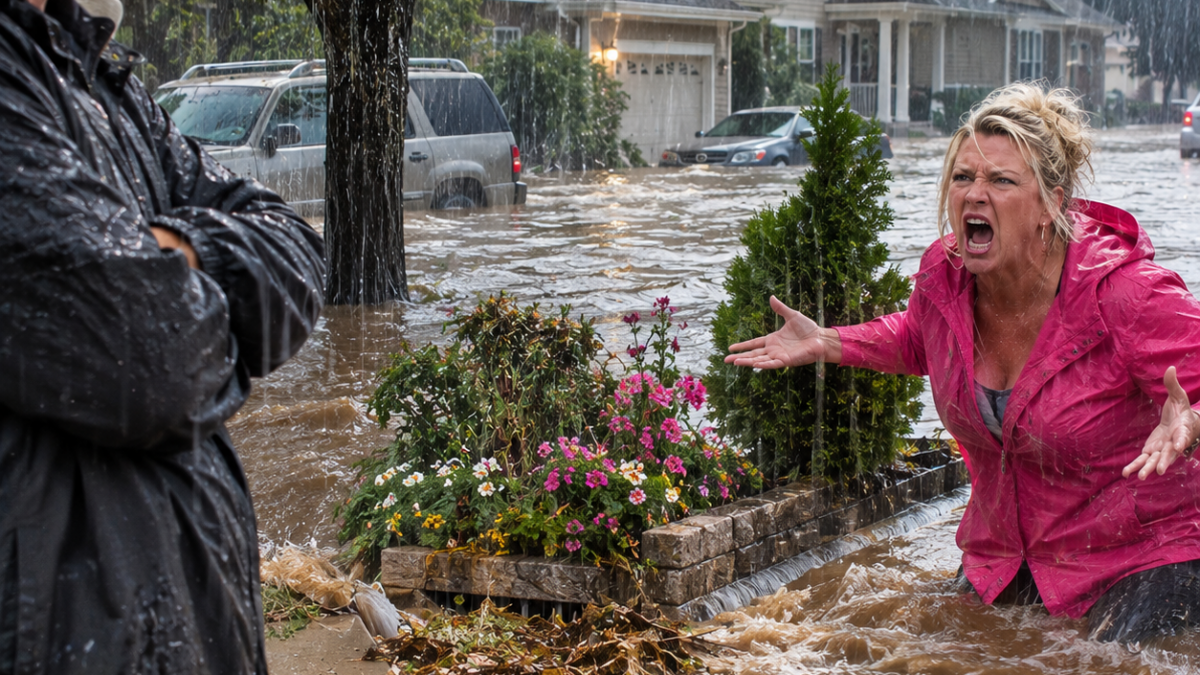
Shelby came through the side door barefoot.
White silk robe.
No longer white.
Hair flat.
No makeup.
No sunglasses.
No gimbal.
No ring light.
For the first time, she looked like a person.
Not a production.
Derek followed.
Gym shorts.
Carrying a leaf blower.
I stopped.
He stepped into eighteen inches of floodwater.
Pointed the blower.
Pulled the trigger.
The motor screamed.
Nothing happened.
The water did not care.
Derek lowered it.
It floated away.
Then Shelby saw me.
“You.”
She pointed.
“You did this!”
“No, ma’am.”
Rain ran from my hood.
“Four point eight inches of rain did this.”
“You sabotaged the drainage.”
“I didn’t touch the drainage.”
“You—”
“You did.”
Silence.
“I warned you seven times.”
Her mouth opened.
“The county warned you.”
Derek looked toward the intersection.
Then at me.
“Shelby.”
“Shut up.”
“He’s right about the drain.”
“I said shut up.”
Firefighters moved house to house behind us.
A man stood holding a cat above the water.
I pulled out my phone.
Showed Shelby an old photograph.
Original inlet.
Cast-iron grate.
Clear.
Functional.
“This inlet was designed for a hundred-year storm.”
She stared.
“Tonight is closer to a twenty-five-year event.”
I looked around.
“This should not have flooded.”
Her eyes moved toward her house.
Then back.
“Take your cameras down.”
I almost laughed.
“No.”
“They’re spying on us.”
“Those cameras may be the only reason your neighbors can prove exactly what happened.”
“What does that mean?”
I looked at her.
“It means you should read your insurance declarations.”
She stared.
“Why?”
“Intentional-acts exclusion.”
Her face changed slightly.
“And there’s an exclusion involving contracts awarded to immediate family without competitive bidding.”
Derek stopped moving.
Shelby whispered:
“What?”
“Read the policy.”
For once, Shelby had nothing to say.
Morning came gray.
Water slowly receded.
County crews arrived around nine.
Concrete saw.
Vacuum truck.
Chain hoist.
They cut Shelby’s cap into four sections.
Lifted them away.
Underneath:
My junction box.
Still intact.
Twenty-seven years old.
Built correctly.
The grate had been sitting in my garage since May.
So were the bolts.
The foreman looked at the coffee can.
“You saved these?”
“I save everything.”
He laughed.
“Engineers.”
“Exactly.”
We reinstalled the grate.
Cleaned the box.
Opened the system.
The moment the obstruction disappeared, water began moving the way it was supposed to.
Twenty-two homes had taken water.
Total estimated loss:
$1.7 million.
Then insurance companies began reading.
HOA general liability:
Denied.
Intentional-acts exclusion.
County warning.
Certified letters.
Board minutes.
Shelby’s paper-airplane video.
Denied.
Directors-and-officers carrier:
Denied under willful violation provisions.
Individual homeowner policies:
Many excluded surface-water flooding.
Stonebridge wasn’t in a designated FEMA floodplain because the drainage system was engineered to keep it from becoming one.
That irony was brutal.
The system had worked for twenty-seven years.
Then the HOA intentionally covered its primary inlet.
Carmen filed suit in October.
Negligence.
Breach of fiduciary duty.
Violation of state water law under the source’s framing.
Fraud connected to the no-bid landscaping contract.
Conflict of interest.
Shelby was recalled October 12.
Vote:
168 to 9.
Nine people still supported her.
Trish said:
“I want names.”
“No.”
“I just want to understand them.”
“You can’t.”
The county rescinded Shelby’s beautification award quietly the next month.
The webpage disappeared.
No announcement.
No ceremony.
Just gone.
Shelby’s deposition happened in January.
She arrived in a cream blazer.
Hair perfect again.
Confidence repaired.
At least externally.
Carmen began with the county warning video.
Paper airplane.
Shelby’s baby voice.
Then construction time lapse.
Workers removing the grate.
Concrete.
Pavers.
Soil.
Then rainfall data.
Time stamps.
Flow.
Flood footage.
Then the social-media post from eleven hours and forty-eight minutes before water entered Shelby’s home.
**THE DRAIN MAN IS PREDICTING THE APOCALYPSE AGAIN.**
Carmen left it on the screen.
Silence.
Then she asked:
“Mrs. Kincaid, when you posted this, had you received Mr. Callister’s final written warning?”
“Yes.”
“The seventh warning?”
“My attorney disputes the characterization—”
“Had you received it?”
“Yes.”
“Had the county previously warned the board?”
“Yes.”
“Did you understand Mr. Callister designed the original drainage system?”
“He said he did.”
“Did you verify?”
“No.”
“Did you obtain an engineering review before permanently covering the inlet?”
“Derek reviewed the project.”
“Your husband?”
“Yes.”
“Is he a licensed civil engineer?”
“No.”
“Hydrologist?”
“No.”
“Stormwater engineer?”
“No.”
“Licensed landscape architect?”
Pause.
“No.”
“Did any licensed engineer calculate the drainage capacity of the garden assembly?”
“Our design was permeable.”
“That wasn’t my question.”
Shelby stared.
“No.”
“Did you receive competitive bids?”
“No.”
“Did you approve payment of ninety-four thousand dollars to your husband’s company?”
“Yes.”
“Did you post a video mocking the county warning?”
“My page is personal.”
“Answer the question.”
“Yes.”
“Did your home receive nineteen inches of floodwater?”
Shelby’s attorney interrupted.
“Counsel—”
Carmen waited.
Then:
“Did it?”
Shelby’s voice dropped.
“Yes.”
Carmen clicked another slide.
My rain gauge.
4.8 inches.
Then engineering design storm.
The system had handled worse historically.
Carmen leaned forward.
“Mrs. Kincaid, do you still believe the inlet was an eyesore?”
Shelby’s attorney requested a recess.
They left the room.
They did not return that day.
Settlement:
$862,000.
Personal exposure.
Insurance did not rescue them.
Derek sold two work trucks.
Then equipment.
Shelby sold her white Denali.
The custom plate went with it.
Their Creek View home went on the market.
Texas disclosure laws required them to report the flooding history.
The listing disclosed nineteen inches of interior water due to obstruction of the subdivision stormwater inlet.
It sold for $114,000 less than they had paid.
The final social-media post from that house showed the porch at sunset.
No caption.
Fourteen likes.
Deleted within an hour.
Trish had already screenshotted it.
Of course she had.
But the part that mattered most happened after Shelby was gone.
I went door to door.
Creek View.
Moisture meter.
Clipboard.
Damage assessments.
Some of those residents had supported the garden.
Some had applauded when Shelby unveiled it.
Some liked her videos mocking me.
I helped every one.
Jake Peyton apologized twice.
“I thought you were just mad because they changed something you designed.”
I looked at his garage.
His daughter’s pink bicycle sat drying on the lawn.
“Jake.”
“Yeah?”
“She lied to you.”
He looked down.
“You don’t owe me an apology.”
“I voted for her.”
“So did a lot of people.”
“I signed the petition supporting the park.”
“Water didn’t check signatures before entering your garage.”
He looked at me.
I continued.
“That’s the lesson.”
At Mrs. Nguyen’s house, six inches had entered the front room.
The photograph she carried above her head survived.
Frame warped.
Photo dry.
She pressed my hand between both of hers.
No speech.
None needed.
Rosa Garza’s kitchen had nine inches.
Her boy’s baseball cards survived because he held the box over his head the entire time.
I wrote her damage scope for free.
Helped document everything.
Walked through her insurance appeal.
Eventually, her carrier paid.
Trish accompanied me.
Took notes.
No gimbal.
No performance.
Just work.
The settlement allocated $160,000 toward a permanent Stonebridge drainage-maintenance endowment.
For twenty-seven years, I had done much of the inlet maintenance myself because I knew nobody else would.
Now it had a budget.
Inspection schedule.
Responsible contractor.
Records.
Another $50,000 funded a flash-flood awareness program at three elementary schools.
That part mattered more than the lawsuit.
Margaret had written the original version of a flood-safety curriculum in 2014.
I still had the document on my computer.
Never deleted it.
Her name went on the updated guide.
**THE MARGARET CALLISTER FLASH FLOOD SAFETY PROGRAM**
The first time I saw it printed, I had to sit down.
Trish noticed.
“You okay?”
“Yeah.”
“You’re lying.”
“I know.”
I ran my thumb across Margaret’s name.
For years, I thought the only thing I had left of her was memory.
Then suddenly something she wrote for children almost a decade earlier was being taught again because a storm drain she warned me to protect had been buried.
Life makes strange circles.
November came.
The neighborhood was quieter.
I replaced the grate properly.
New stainless anchor bolts.
Torqued to specification.
Cleared the junction box.
Flushed the first thirty feet of trunk line.
Walked the full corridor.
Headwall.
Joints.
Outfall.
Everything working.
Exactly the way it had since 1996.
That evening, I sat beside the inlet.
Back against the fence post.
Same place Margaret used to stand while watching me clean it.
The roses were mostly finished for the season.
Three had produced orange hips.
Bird food.
I counted the plantings.
Forty-seven.
Margaret had ordered fifty.
Three bare roots remained stored.
I had been saving them.
At first because I couldn’t finish.
Then because I realized I didn’t want to.
As long as there were three roses left to plant, some part of Margaret’s plan was still waiting for spring.
That comforted me.
Trish arrived around six carrying two beers.
Sat beside me without asking.
“Permission?”
“You’re already sitting.”
“Good point.”
She opened one.
Handed it over.
Mockingbird in the hackberry ran through its entire catalog.
Cardinal.
Blue jay.
Then a perfect car-alarm imitation.
Margaret had loved mockingbirds.
Said they were nature’s editorial writers.
Trish listened.
“You miss her.”
“Every day.”
“She would’ve liked this.”
“The flood?”
“The drain working again.”
I looked through the grate.
Dark junction box.
Open trunk line.
Ready.
“She’d say I took too long.”
Trish laughed.
It was the first laugh I had heard near that inlet in more than a year that didn’t come from Shelby’s phone.
I stayed there after Trish left.
Streetlights came on.
Somebody walked a dog.
Water from a sprinkler ran along the curb.
Reached the grate.
Disappeared.
That sound.
A tiny trickle.
Water going where it was supposed to.
After everything, that was the ending I wanted.
Not Shelby losing her house.
Not the recall.
Not the $862,000 settlement.
Not the award being rescinded.
Those were consequences.
Necessary ones.
But consequences are not repair.
Repair is Jake’s daughter getting her bicycle back.
Mrs. Nguyen saving her photograph.
Rosa’s son saving his cards.
A maintenance fund.
A school program.
A storm drain open again.
The next major storm came the following spring.
Three point nine inches.
Hard.
Fast.
People were nervous.
I was awake all night.
Couldn’t help it.
At 1:30 a.m., I stood under an umbrella beside the inlet.
Ridgemont carried water east.
Exactly as designed.
It reached the grate.
Dropped.
No pond.
No backup.
No Creek View flood.
My phone buzzed.
Daryl.
**HOW’S IT LOOKING?**
I sent:
**BORING.**
He replied:
**BEST KIND.**
By dawn, rain stopped.
Creek View was wet.
Not flooded.
No fire trucks.
No people carrying photographs over their heads.
Nobody on stepladders.
No silk robes standing in brown water.
Just puddles.
I walked home.
Made coffee.
Sat beside Margaret’s roses.
And for the first time since the flood, I felt the anger loosen.
Systems are funny.
People only notice them after failure.
Before Shelby, most of Stonebridge probably believed stormwater disappeared because streets were sloped.
They saw grates.
Ignored them.
That’s normal.
People don’t think about drainage any more than they think about sewer mains or electrical transformers.
Good infrastructure is invisible.
Then Shelby decided invisible meant unnecessary.
That mistake cost everyone.
Not only her.
That is why I never tell this story as if I enjoyed watching Creek View flood.
I didn’t.
I watched children lose bedrooms.
Families drag wet furniture onto lawns.
People cry over photographs.
I watched water rise in houses belonging to neighbors who had never covered a drain.
That is not entertainment.
Could I have done more?
I asked myself that for months.
Could I have broken the garden apart myself?
Legally, no.
Could I have removed the cap during the storm?
Not safely.
Could I have forced the county sooner?
They had already explained their authority.
Could I have sued before the rain?
Carmen believed the strongest case required actual damage.
But knowing all of that does not make the question disappear.
Engineers live with consequences differently.
We calculate failure.
Then sometimes we watch calculations become reality.
Numbers become wet drywall.
Flow rates become a child standing on a chair.
Eighteen inches becomes a woman holding a photograph above her head.
Those numbers stay with you.
Carmen told me once:
“You warned them.”
“I know.”
“You did everything reasonable.”
“I know.”
“They made the choice.”
“I know.”
“Then stop carrying Shelby’s decision.”
I looked at her.
“That advice included in the bill?”
“No.”
“Good, because it’s not very helpful.”
She laughed.
But she was right.
Eventually, the neighborhood learned to separate responsibility from regret.
I could regret what happened without accepting responsibility for Shelby’s choice.
That took time.
The new HOA board invited me to speak.
I almost refused.
Dennis Wang had become president.
He called.
“Wade.”
“No.”
“I haven’t asked.”
“It’s an HOA meeting.”
“Fair.”
“What do you want?”
“Ten minutes.”
“For?”
“Drainage.”
“You want residents to listen to a retired engineer explain drainage?”
“They will now.”
That was unfortunately true.
I attended.
No ring light.
No livestream.
No gold-foil slogans.
Dennis sat at the table.
Trish beside him.
Financial reports available.
Contracts posted publicly.
Conflict-of-interest policy adopted.
Competitive bids mandatory above a set threshold.
I stood at the front.
No slides.
Just the original 1996 drainage map.
“Water does not care who is president.”
A few people smiled.
“It doesn’t care who voted for the garden.”
Silence.
“It doesn’t care what a home cost.”
I pointed at the map.
“Gravity is the closest thing engineering has to democracy.”
That got a laugh.
Then I explained the system.
Ridgeline.
Street slope.
Inlet.
Trunk.
Headwall.
Cypress Creek.
People asked real questions.
“What happens if leaves clog it?”
“We clean it.”
“Who inspects?”
“Now the HOA pays a contractor and county retains easement access.”
“How often?”
“Quarterly and after significant rainfall.”
“What if somebody wants landscaping nearby?”
“Engineering review first.”
A woman asked:
“Can it be made prettier?”
Everybody turned toward her.
She immediately raised both hands.
“I’m kidding.”
The room laughed.
So did I.
That mattered.
Humor means the wound is closing.
Derek’s landscaping company survived.
Barely.
He lost equipment.
Clients.
Reputation.
I saw him once at a building-supply store months later.
He was loading irrigation pipe.
Our eyes met.
He looked away.
Then stopped.
“Wade.”
“Derek.”
He hesitated.
“I should’ve listened.”
“Yes.”
“I knew the flow number sounded wrong for what Shelby wanted.”
I waited.
“I just…”
He stopped.
“You just what?”
He looked toward the truck.
“Got tired of fighting at home.”
I understood more than I wanted to.
“That doesn’t excuse it.”
“I know.”
“You poured concrete over a storm drain.”
“I know.”
“People lost houses’ worth of property.”
“I know.”
He looked at me.
“I know.”
There was nothing else to say.
I left.
People often imagine bad decisions are made by villains rubbing their hands together.
Sometimes they are made by tired people saying yes because no is inconvenient.
That does not make the consequences smaller.
One evening the following spring, I finally planted rose number forty-eight.
Not forty-nine.
Not fifty.
Just one.
Margaret had ordered fifty.
I dug the hole beside the fence.
Mixed compost.
Set the bare root.
Watered.
Then sat back.
Why that day?
I don’t know.
Maybe because Stonebridge had survived another heavy storm.
Maybe because the school curriculum had launched.
Maybe because grief had shifted.
I still kept two roses unplanted.
Something waiting.
Always.
Rosa’s son came over while I was watering.
“Mr. Wade?”
“Yeah?”
“Mom says you built the drain.”
“I helped.”
“Did you build the flood too?”
I smiled.
“No.”
“Mrs. Kincaid said you made it happen.”
“Before she moved?”
He nodded.
I turned off the hose.
“Water goes downhill.”
“I know.”
“That’s basically the whole answer.”
He stared.
“That’s not an answer.”
“Smart kid.”
I pointed toward the grate.
“Imagine somebody puts their hand over the bathtub drain.”
“Okay.”
“Then turns the faucet on full.”
“It overflows.”
“Who caused the overflow?”
“The person who covered the drain.”
“Exactly.”
He nodded.
Then:
“But the rain turned on the faucet.”
“Very good.”
“So Mrs. Kincaid covered the drain and God turned on the faucet.”
I looked toward the sky.
“Let’s leave God out of the lawsuit.”
He laughed.
Then ran home.
Margaret would have loved him.
The flood-awareness program became bigger than expected.
Teachers used rainfall demonstrations.
Clear plastic trays.
Miniature streets.
Drain openings.
Students poured cups of water over different surfaces.
Grass.
Concrete.
Mulch.
Then covered the drain and watched the model flood.
One teacher sent me a video.
Twenty third-graders shouting:
“OPEN THE DRAIN!”
I watched it three times.
Margaret’s name was printed on the lesson guide.
I cried the third time.
Not dramatically.
Just sat at the desk and let it happen.
Grief has no schedule.
Sometimes you survive the funeral.
Then cry because twenty children understand runoff.
The new board installed a small sign beside the inlet.
Dennis asked me to approve wording.
I expected something ridiculous.
Instead:
**STORMWATER INFRASTRUCTURE
KEEP CLEAR AT ALL TIMES
THIS INLET SERVES STONEBRIDGE ESTATES**
Simple.
No bronze plaque.
No pergola.
No decorative lights.
I approved.
Trish added one line in smaller lettering:
**ENGINEERED 1996**
I complained.
She ignored me.
A year after the flood, residents held a community workday.
Not Shelby’s version.
No gimbal.
No influencers.
People cleaned the greenbelt.
Picked up trash.
Cleared debris.
Trimmed vegetation away from drainage corridors.
Jake Peyton brought his kids.
Rosa brought her son.
Mrs. Nguyen brought food.
Dennis brought gloves and immediately lost them.
Somebody asked if we should plant flowers near the inlet.
Thirty people shouted:
“No!”
That became the funniest moment of the morning.
We planted flowers fifty feet away.
Safely uphill.
The garden there looked nice.
Turns out beauty and drainage can coexist when beauty doesn’t pretend physics is optional.
The old bronze garden plaque had been recovered after the flood.
Bent.
Scratched.
Dennis found it in HOA storage.
“What do we do with it?”
“Recycle it.”
Trish objected.
“Keep it.”
“Why?”
“History.”
I looked at her.
“You keep screenshots.”
“And you keep bolts.”
Fair.
The plaque ended up in the clubhouse storage room.
Not displayed.
Just retained.
A reminder.
The flood lawsuits eventually ended.
Settlement money distributed.
Repairs completed.
Some families replaced flooring.
Others remodeled.
A few sold.
Most stayed.
Creek View looked normal again.
You could drive through and never know nineteen inches of water had once stood inside Shelby’s living room.
That is the strange thing about disasters.
They can disappear visually long before people stop feeling them.
Jake still checked the weather every time thunderstorms formed.
Mrs. Nguyen moved family photographs upstairs.
Rosa bought plastic storage bins for everything important.
I added redundant monitoring to the inlet.
Not because the system needed it.
Because residents did.
Data dashboard.
Rainfall.
Water depth.
Flow estimate.
Dennis asked whether homeowners could access it.
“Why?”
“Peace of mind.”
I built a simple webpage.
During storms, residents watched.
Some became too enthusiastic.
Trish texted me during one rain:
**IS 312 GPM BAD?**
I replied:
**NO. GO TO BED.**
Five minutes later:
**WHAT ABOUT 418?**
**TRISH.**
**FINE.**
Margaret would have found that hilarious.
One evening, almost two years after she died, I dreamed about her.
Nothing dramatic.
We were standing beside the inlet.
She leaned on the fence.
I cleaned leaves.
Same as hundreds of real afternoons.
She said:
“You missed one.”
I looked.
One hackberry leaf against the grate.
I picked it up.
She smiled.
Then I woke.
Boiler? No, wrong story. No dog here.
Just an empty bedroom.
Morning light.
For a second, grief came back as sharp as the hospital.
Then it passed.
I got up.
Walked outside.
There actually was one leaf on the grate.
I laughed so loudly Trish heard from across the street later and asked whether I had lost my mind.
Possibly.
I cleared it.
The maintenance endowment meant I no longer had to do everything myself.
A contractor inspected.
County crews handled bigger cleaning.
But I still walked the inlet after storms.
Habit.
Responsibility.
Memory.
Sometimes I stood there and remembered Margaret saying:
“Don’t let anybody mess with your drain.”
Maybe she was confused.
Maybe she wasn’t.
Doesn’t matter.
I kept the promise eventually.
Not perfectly.
But enough.
Shelby disappeared from Stonebridge’s daily life.
No more reels.
No more Tuesday Walks.
No community-curator captions.
I heard she and Derek moved to another part of Texas.
I never searched.
Didn’t care.
People occasionally sent me screenshots.
I stopped opening them.
That was progress.
Revenge keeps someone important.
Peace makes them irrelevant.
The hardest part of the whole story was realizing that I did not want Shelby ruined forever.
I wanted her stopped.
Those are different things.
She lost money.
Position.
House value.
Reputation.
She deserved accountability.
But eventually accountability had done its work.
The neighborhood didn’t need her suffering.
It needed functioning drainage.
That was the difference between Shelby and Margaret.
Shelby believed leadership meant being seen.
Margaret believed useful work should disappear into the background when done correctly.
She spent twenty-six years studying rivers and never once called herself a visionary.
She called herself:
“Someone who reads gauges.”
But because she read them, people downstream got warnings.
Because engineers calculate drainage, children sleep through storms instead of waking to firefighters.
Because somebody cleans a grate, twenty-two families don’t spend months replacing drywall.
There is dignity in things nobody photographs.
That lesson became the center of the elementary-school program.
One teacher asked me to speak to fifth-graders.
I said no.
She asked again.
I said I hate public speaking.
She said:
“You argued with an HOA president in front of forty adults.”
“That was anger.”
“Use anger.”
I went.
One kid asked:
“Why do we need storm drains?”
I drew a hill.
Street.
House.
Arrow downhill.
“Because water always moves.”
Another:
“Can’t we just build houses where floods don’t happen?”
“Good question.”
I explained elevation.
Drainage.
Development.
Risk.
Then a boy in the front asked:
“Did a lady really build a garden on your drain?”
The teacher closed her eyes.
“Yes.”
“Why?”
I considered.
“She cared more about how something looked than what it did.”
The boy nodded.
“My dad does that with cars.”
Class exploded laughing.
I did too.
Then I told them:
“If you remember one thing, remember this: before you cover something, move something, or block something, find out why it’s there.”
Simple.
Maybe that lesson was worth fifty thousand dollars.
I wish it had cost less to learn.
On the second anniversary of Margaret’s death, I planted rose forty-nine.
One left.
Trish watched from her driveway.
“You know eventually you have to plant the last one.”
“No.”
“You can’t keep a bare root forever.”
“I can try.”
“Margaret would call that irrational.”
“She married an engineer.”
“Exactly.”
Rose forty-nine took.
Deep pink.
Strong.
I kept number fifty stored one more winter.
Maybe I’ll plant it.
Maybe I won’t.
Some unfinished things are not failures.
Sometimes they are a way of keeping tomorrow connected to yesterday.
The storm drain remains ugly.
Cast iron.
Concrete collar.
Functional.
Every now and then a new resident asks whether it can be screened with plants.
Dennis sends them to me.
I say:
“No.”
Then explain.
Nobody argues.
Amazing what one flood can do for public education.
The final time I thought seriously about Shelby was during a summer storm.
Not severe.
Two inches in an hour.
I stood under my porch.
Water moved along the gutter.
Turned.
Reached the grate.
Dropped into the box.
No standing water.
No dramatic sound.
Just steady flow.
Seventeen hundred gallons per minute was possible during larger events.
That night maybe six hundred.
Seven hundred.
The exact number didn’t matter.
The street stayed dry.
I could hear Margaret:
“That storm drain has never disappointed you.”
I answered out loud.
“No, ma’am.”
A neighbor walking his dog looked over.
“You talking to me?”
“No.”
He kept walking faster.
I smiled.
By then, Stonebridge had become boring again.
I mean that as praise.
Board meetings discussed budgets.
Pool repairs.
Insurance.
Mailbox painting.
No one declared themselves curator of anything.
Contracts required bids.
Conflicts had to be disclosed.
Drainage maintenance happened on schedule.
People still argued.
Humans will always argue.
But no one stood above a storm drain with a gimbal and decided beauty had repealed gravity.
That was enough.
If I had to summarize what happened, I would not say:
Shelby covered my drain and I let her block floodwater until her house flooded.
That makes the story too simple and makes me sound crueler than I was.
The truth is harder.
I warned her.
Repeatedly.
County warned her.
Her board approved the project.
Her husband built it.
Regulators lacked enough immediate authority to stop a landscaping improvement on private common land before measurable harm occurred.
The weather arrived.
Physics did the rest.
That is why evidence mattered.
Without the letters, Shelby could have said nobody warned her.
Without camera footage, she could have claimed the inlet remained partially open.
Without rain data, she could have blamed an unprecedented storm.
Without the original drainage plans, she could have claimed the system was inadequate.
Without insurance records, residents might have believed their policy would cover deliberate choices.
Documentation turned argument into chronology.
Chronology became accountability.
Margaret believed in measurements.
She used to say:
“Nature doesn’t care whether your explanation sounds good.”
That might have been the perfect description of Shelby’s failure.
Her explanation always sounded good.
Beauty.
Community.
Progress.
Leadership.
Permeability.
Vision.
But rainfall is not a board meeting.
It doesn’t applaud.
At 2:15 in the morning, every slogan disappeared.
There was only flow.
Elevation.
Capacity.
Obstruction.
Consequence.
Water found the truth.
It always does.
Years later, I still sit beside the inlet sometimes.
Especially evenings.
The grate gets warm from the Texas sun.
Hackberry casts shade across it.
Margaret’s roses line the fence.
Forty-nine now.
One still waiting.
Children ride bicycles down Ridgemont.
Rosa’s boy is older.
No trampoline anymore.
Not because the HOA banned it.
He outgrew it.
Mrs. Nguyen’s grandchildren visit.
Jake repainted the garage.
Dennis complains about board paperwork.
Trish still screenshots everything.
The drainage sign stands beside the grate.
Most people ignore it.
Good.
Ignoring infrastructure is a privilege earned when infrastructure works.
Sometimes a little water runs through after somebody washes a driveway.
I can hear it.
Down through the grate.
Into the fifty-four-inch pipe.
Six hundred forty feet.
Headwall.
Cypress Creek.
Exactly where it belongs.
That sound reminds me of Margaret more than the roses.
Not because she loved storm drains.
Though she kind of did.
Because she understood systems.
She understood that the best protection is often ugly.
That the thing people want to remove may be the thing quietly keeping them safe.
And she understood that water has no respect for ego.
Shelby learned that lesson at 2:53 on a September morning, barefoot in a silk robe, while nineteen inches of brown water pushed against the walls of the house she had once called the jewel of Stonebridge.
I learned something too.
Being right does not make disaster satisfying.
Evidence may win the lawsuit.
Warnings may prove fault.
But if your neighbors are carrying photographs above floodwater, you do not celebrate.
You help them dry their homes.
You measure the damage.
You show them how to appeal.
You rebuild.
Then you make sure the mistake cannot happen again.
That is what Margaret would have done.
So that is what I did.
And every time another storm rolls across the Hill Country, I walk outside, watch water move toward that ugly iron grate, and wait.
It drops.
The street stays dry.
The lights remain on in Creek View.
Nobody calls 911.
Nobody notices.
Perfect.
That is exactly how it is supposed to work.








