PART 2: HOA Karen Buried My Flood Culvert Under 12 Luxury Tennis Courts—Then County Excavators Ripped Up Her $2.4M Dream
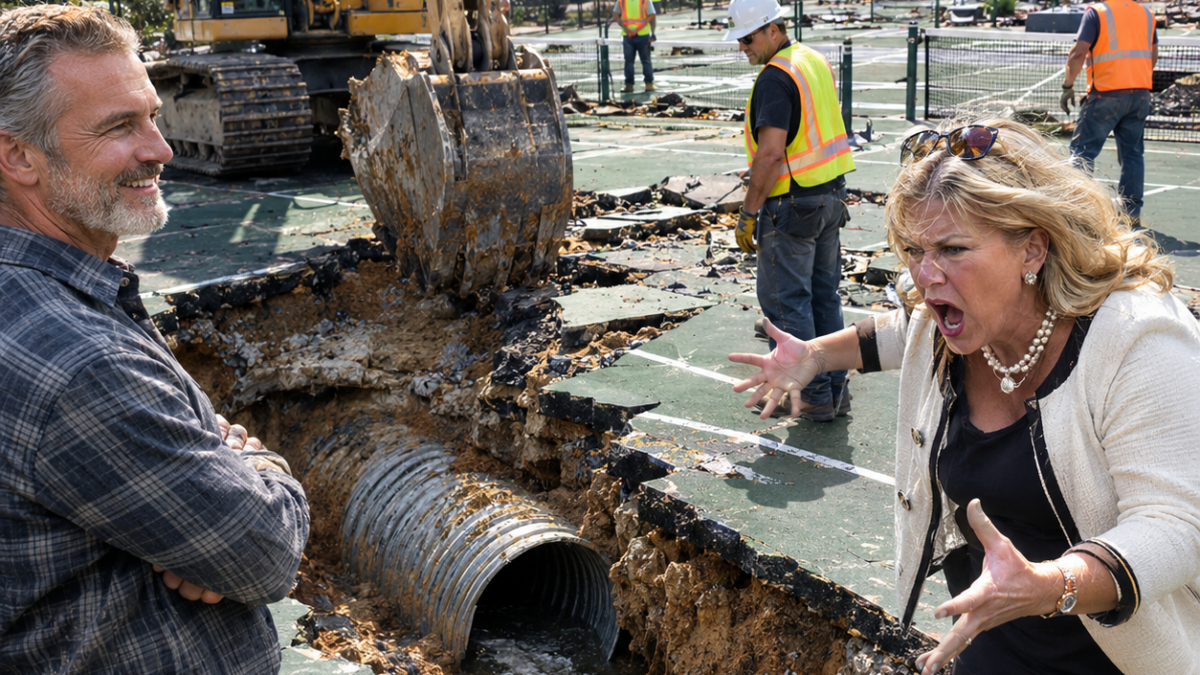
PART 2
No insults.
No threats.
No dramatic language.
I attached photographs showing the culvert before construction.
The 1998 recorded easement.
An old subdivision plat.
Maintenance records.
And a simple request:
Stop construction.
Inspect the drainage system.
Confirm where the water would go if the original culvert had actually been abandoned.
Vivian called an emergency board meeting.
For about ten minutes, I believed she might finally listen.
I should have known better.
She stood at the front of the clubhouse meeting room beneath a large rendering of the tennis complex.
Twelve perfect blue courts.
White fences.
Decorative landscaping.
Lighting.
Spectator areas.
Her dream.
She introduced me like a defendant.
“Mr. Barlow has been interfering with the association’s approved recreational project.”
I sat in the back.
“I asked you to inspect a drainage culvert.”
She ignored me.
“Our records do not recognize this so-called active culvert.”
“So-called?”
She clicked a remote.
A map appeared on the screen.
The tennis complex sat neatly on open land.
No culvert.
No flood corridor.
No drainage easement.
Nothing.
What bothered me was how accurate everything else looked.
Property corners.
Roads.
Parking.
Utilities.
Precise.
Only the drainage layer had vanished.
I raised my hand.
Vivian sighed.
“Yes, Clayton?”
“Who prepared the map?”
“An independent engineering consultant.”
“Name?”
“That’s not relevant.”
“File number?”
“Internal.”
“Licensed engineer?”
She tightened her mouth.
“The project has been approved.”
“That wasn’t what I asked.”
A couple board members shifted.
Vivian clicked to the next slide.
“Any delay resulting from Mr. Barlow’s interference may expose him to liability for project losses.”
I almost laughed.
“You buried my drainage.”
“You are spreading misinformation.”
“The contractor uncovered the pipe.”
“That was obsolete infrastructure.”
“Owen said it was carrying water.”
Her voice sharpened.
“You do not have the floor.”
I leaned back.
That was the meeting.
Not engineering.
Not flood risk.
Power.
A week later, I received a letter from the HOA’s attorney.
Stop making accusations.
Stay away from the project.
Retract statements.
Possible liability if regulators investigated because of my complaints.
That afternoon, Vivian drove to my ranch fence.
She held a copy of the letter.
“You wanted a fight?”
“I wanted my culvert inspected.”
“You’re challenging twelve tennis courts.”
“No.”
She smiled.
“Then you’d better have twelve lawyers.”
I looked at her.
“I only need the original records.”
Her smile widened.
“Old paperwork has never stopped a multimillion-dollar development.”
She drove away.
That night I read the homeowner project budget.
Grading.
Lighting.
Surfacing.
Fencing.
Landscaping.
Then:
STORMWATER RELOCATION — $190,000
I stared.
Vivian had told everyone the culvert didn’t exist.
But the HOA had spent almost two hundred thousand dollars to relocate stormwater.
I searched every page.
No replacement pipe.
No new outlet.
No drainage profile.
No hydrology calculation.
No as-built drawing.
Nothing showing where water went now.
Thunder rolled outside.
I walked to the porch.
Lightning flashed west.
Storm.
Heavy.
Faster than forecast.
Within an hour, rain hammered the roof.
By midnight, the ditch was full.
At four in the morning, I woke to a sound I had never heard on that ranch.
Water spilling over the south bank.
I pulled on boots.
Grabbed a flashlight.
Ran outside.
The hay fields looked like a dark lake.
Water spread toward the equipment barn.
Weeks from harvest.
Machinery inside.
Bales.
Feed.
Tools.
Everything.
I walked upstream.
The buried culvert mouth had become a wall.
Water stacked against compacted fill.
Vivian’s tennis pad sat above it like a dam.
I rented two portable pumps before sunrise.
Called my ranch hands.
We dug a temporary relief trench entirely on my property.
No crossing the fence.
No touching HOA construction.
The pumps saved the barn.
Barely.
The hay?
Different story.
By noon, the first damage estimate was already tens of thousands.
Wet hay.
Flooded low ground.
Equipment repairs.
Erosion.
I stood in mud up to my ankles looking across the fence.
Workers were still laying base material for tennis courts.
Vivian responded to the flooding that afternoon.
Not with an engineer.
With a newsletter.
She told Silverbrook Heights residents I had illegally altered drainage on my ranch.
She said my pumps were redirecting runoff toward the neighborhood.
People believed her.
One resident yelled from a golf cart:
“Stop flooding us!”
I looked at the water standing in my field.
“I’d love to.”
Another shouted:
“You’re doing this because you hate the tennis courts!”
I didn’t answer.
Vivian installed a locked barrier across the old maintenance-access lane.
The only practical way to reach the culvert outlet.
I drove to the gate.
She was already there.
“Open it.”
“No.”
“I need to inspect the outlet.”
“You have no right to enter HOA property.”
“My easement says otherwise.”
“We dispute that.”
“My field is underwater.”
“If your farm floods, that’s your problem.”
I looked past her.
Twelve courts taking shape.
Blue surface starting to appear.
“Your courts are standing on the reason my farm floods.”
“My courts are staying.”
She turned away.
That night, I opened my old field notebook.
Twenty-two years of drainage projects had taught me something else.
When people stop listening, measure.
Measurements turn shouting into numbers.
Numbers go into reports.
Reports survive meetings.
I called the county stormwater office.
Darla Kessler arrived the next morning.
Forty-three.
Mud-resistant boots.
Clipboard.
No interest in gossip.
“I hear there’s a disagreement.”
“There’s water.”
“That’s more useful.”
She measured upstream elevation.
Located the recorded culvert alignment.
Checked the subdivision grade.
Walked the HOA side as far as permitted.
Then she came back.
“This is worse than a buried inlet.”
“How?”
“The whole court pad is raised.”
“I know.”
“The original flood corridor ran across here during major overflow.”
I looked toward the courts.
“So even if we reopen the pipe—”
“The pad still blocks flood conveyance.”
“What happens in a bigger storm?”
She looked west.
“Potentially water on the county road.”
That changed everything.
Private ranch flooding was bad.
Public-road flood risk brought county authority.
Darla issued a formal notice.
Produce all drainage permits.
Engineering plans.
As-built drawings.
Design revisions.
Vivian appeared less than an hour later.
She approached Darla.
“You’ve been misled.”
Darla didn’t look up from her clipboard.
“Where is the replacement culvert?”
Vivian paused.
“We have approved stormwater modifications.”
“Where?”
“In the project files.”
“Show me.”
“The HOA attorney—”
“Where is the pipe?”
Vivian said nothing.
Darla looked at me after Vivian left.
“Preliminary records show the tennis footprint may be inside a protected drainage corridor.”
“All of it?”
“Possibly.”
“What does that mean?”
“If confirmed, this stops being your drainage dispute.”
She looked at the courts.
“It becomes an unlawful obstruction of a regulated flood path.”
The next morning, I went to the county records office.
1998 files.
Original subdivision plat.
Culvert drawings.
Permanent drainage easement.
The documents established everything.
Culvert lawful.
Maintenance right permanent.
Flood corridor protected.
No grade raising.
No obstruction.
No construction blocking conveyance.
I brought the copies to Darla.
She lined up old coordinates with the current site survey.
Then became quiet.
“All twelve.”
“What?”
“All twelve courts.”
She pointed.
“Entire complex is inside the protected corridor.”
I stared.
“Can the county remove one court over the pipe?”
“No.”
“Why?”
“The remaining eleven still form the raised obstruction.”
She pointed to the culvert alignment.
“And maintenance access requires clearing the length.”
“The fill is continuous.”
“Yes.”
“So?”
“If engineering confirms what these maps show, the realistic correction is total removal.”
I sat back.
Twelve courts.
$2.4 million.
Gone?
Then Darla pulled out another archived plan.
Master plan.
Across the exact future tennis footprint:
PERMANENT DRAINAGE AND FLOOD CONVEYANCE AREA
I remembered Vivian’s boardroom map.
Same property.
Same roads.
Same corners.
But that label had disappeared.
Replaced with:
PROPOSED RECREATIONAL FACILITIES
I asked:
“Accident?”
Darla answered carefully.
“We need the revision history.”
“You think it’s an accident?”
“I think evidence should answer.”
Good answer.
Slow.
Formal.
I told her I was fine with that.
Paperwork outlives people who ignore it.
At the next HOA meeting, I carried the county-stamped master plan.
Vivian glanced down.
For maybe half a second, color left her face.
Then she recovered.
“Obsolete.”
“County record.”
“Obsolete.”
“Flood corridor.”
“These courts open Friday.”
She pointed toward the tournament schedule.
That was her strategy.
Outrun enforcement.
Open first.
Create members.
Create expectations.
Make removal politically painful.
I had seen developers do it.
Build enough reality and hope paperwork becomes irrelevant.
The courts looked beautiful.
Blue surfaces.
Perfect white lines.
New lights.
Fencing.
Banner:
12 COURTS. ONE COMMUNITY. A NEW ERA.
Founding membership:
$1,800.
Dozens paid.
Vivian gave speeches about vision.
She mocked people who would stop progress over “some muddy ditch.”
I arrived with Darla and a county inspector.
No equipment.
No confrontation.
Vivian came down from the stage.
“Why are you still doing this?”
I handed her the stamped records.
She waved them aside.
“Look around, Clayton.”
Residents watched.
“Twelve beautiful courts.”
I looked toward my flooded hay field.
“Nobody cares about your muddy little ditch,” she said.
I pointed toward the low ground.
“You buried the waterway.”
Then:
“You didn’t bury the water.”
Darla stepped forward.
“Who is the licensed engineer responsible for drainage relocation?”
Vivian produced a binder.
Prepared.
Organized.
Confident.
Darla opened it.
Looked at the approval number.
Then another page.
Her expression changed.
“This permit number doesn’t match the county index.”
Vivian stiffened.
“That is the number provided by our consultant.”
“I’ll verify it.”
Vivian turned to residents.
“This is harassment.”
Then a woman approached me quietly.
Felicia Drummond.
HOA treasurer.
Forty-one.
Nervous.
“I need to show you something.”
“What?”
“The $190,000.”
We stepped away.
She handed me board minutes.
Vivian had described the spending as:
PERMANENT ELIMINATION OF OBSOLETE DRAINAGE INFRASTRUCTURE
I read it twice.
Publicly:
Culvert never existed.
Internally:
Money approved to eliminate it.
Felicia whispered:
“I asked for detailed invoices.”
“And?”
“Never got them.”
“Did the board vote?”
“On the amount.”
“For relocation?”
“That’s what we were told.”
I looked at her.
“I’ll give this to the county.”
“Please don’t use my name publicly.”
“I won’t.”
“I mean it.”
“I said I won’t.”
She nodded.
Minutes later, Darla’s phone buzzed.
Permit verification.
Vivian’s drainage approval number belonged to a parking-lot resurfacing project.
Nothing to do with tennis.
Nothing to do with stormwater.
Darla walked straight to center court.
“Mrs. Norwood.”
Vivian smiled for the cameras.
“Yes?”
“All new activity at this complex must stop pending formal review.”
Her face went blank.
Then she looked at the crowd.
Lifted her chin.
“Nothing is stopping our grand opening.”
That sentence would come back later.
County issued document preservation demands.
Contractor Owen Carver got nervous.
His company built the pad.
The surfaces.
The subgrade.
And the HOA still owed him money.
Through his attorney, Owen produced site records.
Emails.
Change orders.
Field logs.
Then:
CHANGE ORDER #17 — DRAINAGE OBSTRUCTION REMOVAL
His crew had exposed the culvert.
Confirmed active flow.
Recommended stopping work until approved drainage design existed.
Below that recommendation:
Handwritten instruction.
PROCEED WITH FILL.
NO ADDITIONAL DRAINAGE WORK AUTHORIZED.
Signature:
Vivian Norwood
The $190,000?
Not relocation.
It paid for fill.
Compaction.
Subgrade restructuring.
Sealing the inlet.
Not one foot of replacement culvert.
Owen admitted his company should have stopped anyway.
I respected that.
He didn’t pretend Vivian’s order erased contractor responsibility.
Then Darla found another document.
Preliminary design from a licensed civil engineer.
Flood corridor shaded red.
Tennis site labeled unsuitable.
The version presented to the HOA?
Same drawing.
Same engineer signature block.
Red shading gone.
Warning gone.
The engineer confirmed:
He never approved the altered version.
Now it wasn’t just bad engineering.
Possible falsified technical documents.
County legal got involved.
Vivian threatened Owen.
Threatened lawsuit.
Confidentiality.
Damages.
Then requested HOA money for attorneys.
Felicia voted no.
Other board members started asking questions.
“Why are we defending something we never saw?”
Vivian called them disloyal.
Meeting ended early.
The county issued a formal order.
Stop using courts.
Secure site.
Produce corrective engineering plan.
Reopen culvert.
Restore flood corridor.
Final sentence:
REMOVAL OF ALL 12 COURTS MAY BE REQUIRED.
The compliance meeting was packed.
Darla presented flood photos.
1998 records.
Elevations.
Altered drawing.
Perry Kavanaugh, county enforcement attorney, explained the law.
No use.
No tournament.
No construction.
Corrective plan required.
Engineers agreed the complex couldn’t stay as built.
Vivian stood.
“You do not have authority to destroy $2.4 million of private association property.”
Perry looked at her.
“Ownership does not give anyone the right to obstruct a protected public drainage system.”
“These courts belong to Silverbrook.”
“The flood corridor does not.”
“Our lawyers will challenge this.”
“You may.”
“Then nothing comes down.”
Perry remained calm.
“You have fourteen days.”
Stamped engineering plan.
Funding.
Timeline.
Restore culvert.
Vivian wrote nothing.
Felicia wrote everything.
Fourteen days.
Vivian used them to organize a tennis exhibition.
Not a corrective plan.
Tournament.
Crowd.
Proof the courts were “safe.”
She ordered county warning signs removed.
Maintenance workers stacked them behind a building.
Planters were placed near standing water so residents wouldn’t see it.
One worker photographed everything.
Sent it to the county.
Then the second storm arrived.
Harder.
Water filled my ditch.
Pumps running.
Fields turning brown beneath standing runoff.
This time water crept toward the county-road shoulder.
Darla called public works.
Violation confirmed.
Notices served.
Deadline ignored.
Public infrastructure threatened.
Emergency authority activated.
The final work order:
DEMOLISH ALL 12 COURTS.
EXCAVATE BURIED CULVERT.
RESTORE FLOOD CORRIDOR.
Darla called me after dark.
“Crew arrives first light.”
I stood near the ditch.
Water high.
“Do not touch anything yourself.”
“I won’t.”
“Seriously.”
“I’ve waited this long.”
“Stay outside their safety zone.”
“I will.”
I looked across the fence.
Court lights reflected on standing water.
“I won’t touch one court.”
The next morning Vivian arrived expecting a protest opportunity.
She had residents coming.
Phones ready.
Probably planned to make the county look like villains.
She expected inspectors.
Instead:
Excavators.
Wheel loaders.
Dump trucks.
Concrete saws.
Pump truck.
Public-works convoy.
Lead vehicle:
COUNTY PUBLIC WORKS — EMERGENCY DRAINAGE RESTORATION
Vivian ran toward the crew chief.
Brody Nellis climbed out.
Forty-seven.
Hard hat.
Rolled plans.
“What is this?”
“Work order.”
“You cannot enter.”
“We can.”
“My lawyers—”
Brody unfolded the scope.
“Ma’am, we’re here for all twelve courts.”
By seven, power to the light towers was shut down.
Barricades up.
Safety perimeter.
Machines staged.
Eighty residents gathered outside.
Some angry at the county.
Some angry at me.
Many had paid $1,800 and never played a match.
Vivian stood at the gate holding her construction contract.
“This is vandalism!”
Brody gave her the enforcement order.
She shoved it back.
“You have no right.”
He calmly walked her through each line.
Verified obstruction.
Uncorrected flood hazard.
Public-road risk.
Expired compliance deadline.
Emergency restoration authority.
Vivian spun toward me.
“You did this!”
Everyone looked.
“You destroyed everything I built!”
I met her eyes.
“No, Vivian.”
She waited.
“You built it where the water was supposed to go.”
Darla walked forward.
One sheet of paper.
Change Order #17.
Vivian’s signature.
Darla held it where residents could see.
A murmur.
Not friendly.
7:14 a.m.
Concrete saw started.
The sound cut through the crowd.
Blade bit into Court One.
Straight line through blue acrylic.
Into slab.
Vivian screamed:
“Stop!”
Nobody stopped.
Excavator moved in after engineers confirmed the section safe.
Bucket hooked under slab.
Lifted.
The first section cracked.
Blue surface folded upward.
Underneath:
Concrete.
Crushed stone.
Compacted fill.
Then moisture.
At first a dark stain.
Then seepage.
Then muddy water moving through gaps.
For six weeks, the culvert had been trapped beneath Vivian’s perfect courts.
Now its path began appearing.
Vivian turned toward residents.
“They’re destroying your property!”
Felicia stepped forward.
“Did you know the easement existed?”
Vivian ignored her.
Felicia raised her voice.
“Before we approved the courts—did you know?”
Silence.
“What was the $190,000 for?”
Nothing.
“Where is the replacement culvert?”
Homeowner:
“Why does the permit number belong to a parking lot?”
Another:
“Are our memberships being refunded?”
Another:
“Did you sign the fill order?”
The crowd changed.
For six years, Vivian stood in front of them.
Now they stood in front of her.
Owen Carver stood near the back.
He didn’t defend the courts.
Over two days, demolition moved section by section.
Court Two.
Court Three.
Court Four.
Slabs sawed.
Lifted.
Loaded onto trucks.
Fences removed.
Lights disconnected.
Center-court foundation broken.
The $2.4 million complex disappeared one load at a time.
Vivian spent hours calling lawyers.
Emergency injunction.
Temporary restraint.
Anything.
No judge stopped the work.
Then crews reached Court Twelve.
Ground scanner detected a strange concrete mass.
Not shown on supplied plans.
Brody shut down machinery.
Darla compared coordinates.
Old inspection manhole.
Exactly.
Hand excavation began.
Slow.
Careful.
Then they found it.
Broken remains of the manhole.
And beneath the court base:
A massive solid concrete plug.
Poured directly into the culvert mouth.
Not fill settling accidentally.
Not forgotten construction debris.
Purpose-built sealing block.
Darla pulled contractor records.
Instruction:
Construct sealing block at culvert.
Completion confirmed.
Final approval:
Vivian Norwood.
I stood behind the safety barrier.
Stared.
For weeks, I believed she had simply been reckless.
Obsessed with tennis.
Obsessed with status.
Maybe she convinced herself the culvert was unnecessary.
The concrete plug changed that.
Then technicians uncovered something beside it.
Small new pipe.
Too small to replace a seventy-two-inch culvert.
Angled toward my low ground.
Darla studied it.
Then the revised plans.
Her face became hard.
“What?”
She didn’t answer immediately.
“Darla.”
“This line was designed to drain HOA-side water toward your ranch.”
I stared.
“Toward?”
“Yes.”
“Not toward the creek.”
“No.”
“What does that mean?”
“When water accumulated around the courts, this would push overflow toward your low fields.”
My hands went cold.
“She didn’t just block my drainage.”
Darla looked at me.
“No.”
I stared at the pipe.
“She tried to make my land carry hers.”
Owen stepped forward.
Printed emails.
Vivian’s account.
Instructions approving redirection.
Cost approvals.
Felicia verified signatures matched HOA records.
Vivian immediately said Owen did it.
Owen didn’t raise his voice.
He held up the emails.
“You directed the change.”
“You’re lying.”
“My lawyer has the server copies.”
“You’re trying to save your company.”
“I’m cooperating because I should have stopped the job when my engineer warned me.”
That answer mattered.
Vivian had expected everybody to protect themselves by blaming someone else.
Owen accepted part of his responsibility.
That made his evidence stronger.
Darla walked board members to the trench.
She explained:
Original culvert.
Concrete plug.
Improper redirection pipe.
Flood elevation.
My ranch.
Public road.
Vivian could no longer say the culvert didn’t exist.
She paid to bury it.
Paid to plug it.
Approved a line directing overflow toward me.
That realization changed something inside me.
Until then, I had wanted the courts gone.
Now I wanted the full truth documented.
Not revenge.
Record.
Because one day Vivian would tell this story differently.
People like her always do.
County crews removed the concrete plug in stages.
Pumps lowered upstream water slowly.
No dramatic surge.
No irresponsible release.
When the opening became safe, water started moving.
Steady.
Brown.
Through the culvert.
I watched.
For weeks, every conversation had been about authority.
Votes.
Budgets.
Lawyers.
Maps.
Tennis.
Now the water spoke.
Quietly.
Exactly where it belonged.
Darla came beside me.
“Feels good?”
I listened.
“I don’t know.”
“You’ve been fighting six weeks.”
“My hay is still gone.”
“Yes.”
“Residents lost money.”
“Yes.”
“The county is tearing up brand-new courts.”
“Yes.”
“Owen’s company made a mess.”
“Yes.”
“So no.”
I looked at the water.
“But that sounds right.”
By the end, every court was gone.
All twelve.
Flood corridor excavated.
Culvert accessible.
Natural grade restored.
New fencing stacked for removal.
Grand-opening banner folded into a dumpster.
The phrase:
12 COURTS. ONE COMMUNITY. A NEW ERA.
Gone.
Darla handed HOA representatives the site report.
Complex unusable.
Corrective work ongoing.
Then Felicia got the emergency cost estimate.
Demolition and restoration:
Approximately $860,000.
On top of the lost $2.4 million construction.
More than $3.2 million before crop claims, legal costs, refunds, investigations, and contractor disputes.
Vivian said:
“Insurance will cover it.”
Perry Kavanaugh arrived with another notice.
County reviewing cost recovery against responsible parties.
Engineering documents referred for investigation.
Her face changed.
For the first time, she seemed to understand the courts were only the visible loss.
The paperwork underneath was worse.
Silverbrook called a special meeting.
Packed clubhouse.
Felicia presented numbers.
$2.4 million lost.
$860,000 emergency restoration estimate.
$190,000 drainage expenditure under audit.
Membership refunds.
Potential ranch damages.
Legal costs.
Residents shouted.
Vivian stood.
“I was trying to improve this community.”
One man in the third row raised his hand.
“How does flooding another man’s ranch improve our community?”
Silence.
Vivian tried:
“The contractor—”
Another homeowner:
“You signed the order.”
“The county is interpreting—”
Another:
“Why was the engineering warning erased?”
“I relied on professionals.”
Owen’s documentation was already public within the board process.
Nobody accepted it.
Recall vote.
Bylaws followed.
Eligible residents voted.
Clear majority removed Vivian as president.
For six years, she controlled committees.
Budgets.
Meetings.
Project priorities.
Now she walked past the framed tennis rendering near the clubhouse door.
No one followed.
New board stopped funding her personal defense for actions outside authorized duties.
Every founding membership refunded.
Felicia stayed to help sort finances.
Not because she wanted power.
Because she felt responsible for not asking harder questions sooner.
She came to my ranch.
“I’m sorry.”
“For what?”
“I signed financial reports.”
“You didn’t sign the fill order.”
“I should’ve demanded invoices.”
“Probably.”
She looked surprised.
“You aren’t going to tell me it wasn’t my fault?”
“No.”
She almost smiled.
“Thanks.”
“You want honesty.”
“I do.”
“You trusted someone too much.”
“Yes.”
“That matters.”
She nodded.
“But you came forward.”
“Late.”
“Still matters.”
We settled my ranch claim eventually.
Flooded hay.
Pumping.
Temporary trenching.
Equipment impacts.
Professional costs.
New board negotiated instead of threatening.
That felt important.
I didn’t want to punish every homeowner for Vivian.
The association was responsible where the law said it was responsible.
Vivian’s personal liability went through separate proceedings.
That distinction kept justice from becoming revenge.
County finished restoring the corridor before first frost.
Native grass seeded.
Erosion protection.
New inspection manholes.
Open access.
No light towers.
No tennis fencing.
No elevated pad.
Just ground.
Useful because it looked useless.
That is one of the strange things about drainage.
People want land to be doing something visible.
House.
Court.
Parking.
Garden.
Sometimes land’s most important job is being empty.
Empty space gives water somewhere to go.
Vivian looked at the flood corridor and saw wasted property.
I looked at it and saw safety.
That difference cost millions.
Investigators continued reviewing the altered plans.
Change Order #17.
Permit misuse.
Engineering signature.
Emails.
Payment records.
Eventually Vivian was charged in connection with the use of falsified documents.
Her civil financial responsibility remained separate.
No simple fantasy where one person personally pays every dollar of the HOA’s loss.
Real accountability is more complicated.
Contractor liability.
Association liability.
Insurance.
Personal liability.
Government cost recovery.
Civil claims.
Criminal charges.
Different systems.
Different burdens of proof.
Different outcomes.
I was fine with that.
I didn’t need a fairy-tale sentence.
I needed the drainage working.
One afternoon, Darla came for final inspection.
We walked the ditch.
Water moved smoothly.
She checked the new manhole.
Grade.
Vegetation.
Outlet.
“Looks good.”
“First time you’ve said something nice.”
“I say nice things when measurements deserve them.”
I smiled.
She looked toward the open corridor.
“You satisfied?”
“With what?”
“All twelve courts gone.”
I shook my head.
“I don’t hate tennis.”
She laughed.
“I know.”
“I never cared if they built twenty courts.”
“Just not there.”
“Exactly.”
I looked at the grass.
“I didn’t want their money wasted.”
“But?”
“I couldn’t accept somebody deciding their project mattered more than everybody downstream.”
Darla nodded.
“That’s drainage law in one sentence.”
“You can use it.”
“I’m county. We prefer seventy-page reports.”
I laughed.
Before leaving, she said:
“We’ll inspect every spring.”
“I’ll have coffee.”
“Good coffee?”
“No promises.”
She drove away.
One of my ranch hands approached carrying a cracked piece of blue sign.
White letters:
COURT 12
“Want it?”
I looked.
For a second, I imagined hanging it in the barn.
Trophy.
Reminder.
Then I shook my head.
“Scrap trailer.”
“You sure?”
“Yes.”
“Could be funny.”
“The water’s funnier.”
He tossed it away.
That should have been the end.
But real endings come slower.
For months, residents from Silverbrook drove past my fence.
Some stared.
Some waved.
Some didn’t.
One man stopped his pickup.
“Clayton.”
“Yeah?”
“I was one of the people yelling at you.”
“I remember a lot of yelling.”
“I said you were flooding us on purpose.”
“Okay.”
“I was wrong.”
“Yes.”
He laughed awkwardly.
“You don’t make apologies easy.”
“I’m not trying to punish you.”
“What do you want me to say?”
“Nothing.”
“Nothing?”
“Next time somebody tells you a story that makes one person look crazy and themselves look perfect, ask to see the documents.”
He nodded.
“That’s fair.”
Another resident brought beer.
I didn’t drink much beer.
Took it anyway.
Another brought hay-field seed to replace erosion damage.
I appreciated that more.
Silverbrook changed leadership.
Projects required independent review.
Engineering plans had to be verified directly with the licensed professional.
Permit numbers checked.
Reserve spending required documentation.
Conflict rules strengthened.
No president could make technical decisions alone.
Boring.
Excellent.
Vivian had made everything urgent.
Urgency is useful when a culvert fails during a storm.
It is dangerous when a leader uses it to stop people from reading.
Her favorite phrases were:
We can’t delay.
Property values are at stake.
The community expects action.
The deadline is Friday.
Contractors are already booked.
We’ll lose money.
Every sentence shortened the time between question and obedience.
Eventually people stopped questioning.
That was her real power.
Not the HOA presidency.
Speed.
One winter morning, Felicia visited again.
She brought a box of records.
“What’s this?”
“Copies the new board thought you should have.”
Drainage maintenance schedule.
Annual inspection requirements.
Emergency contacts.
Recorded easement acknowledgment.
I opened the folder.
“Who approved this?”
“Board.”
“County review?”
“Attached.”
“Engineer?”
“Stamped.”
“Look at you.”
She laughed.
“We’re trying.”
I flipped pages.
“Vivian would’ve hated this.”
“Why?”
“Too many signatures.”
Felicia smiled.
“That was intentional.”
The next spring, Darla returned.
Water moving.
No blockage.
We drank terrible coffee beside the ditch.
“You weren’t lying.”
“What?”
“About the coffee.”
“I warned you.”
She inspected everything.
Then looked toward Silverbrook.
“They’re considering new courts.”
I raised an eyebrow.
“Where?”
“North side.”
“Flood corridor?”
“No.”
“Then good.”
“You don’t care?”
“Why would I?”
She smiled.
“I wondered.”
“Darla, I have nothing against tennis.”
“You’ve said that a lot.”
“Because nobody believes me.”
Silverbrook eventually built four courts on properly engineered ground.
Smaller project.
Real drainage.
Actual permits.
The new board sent me the site map before construction.
Not because I had approval authority.
Courtesy.
I replied:
Looks like your water has somewhere to go. Good luck.
Opening day?
I didn’t attend.
I had hay to cut.
But I heard it went fine.
No excavators came later.
That’s success.
Years passed.
The destroyed twelve-court complex became a local story.
People exaggerated.
Some said county crews showed up without warning.
Not true.
Fourteen-day deadline.
Multiple notices.
Some said I sued and personally ordered demolition.
Not true.
County enforced drainage regulations.
Some said a giant wave exploded from beneath Court Twelve.
Definitely not true.
Water was released slowly under pump control.
Reality was dramatic enough.
It didn’t need lies.
I became oddly protective of accuracy.
Maybe because the whole disaster started with altered records.
If you win using truth, you shouldn’t improve the story by lying afterward.
One reporter asked:
“Did you enjoy watching the first court break?”
I considered.
“The first crack?”
“Yes.”
“No.”
“Really?”
“I enjoyed seeing the culvert restored.”
“That’s less dramatic.”
“It’s more important.”
She asked:
“Did it feel like revenge?”
“No.”
“Why not?”
“County crews weren’t there because I hated Vivian.”
“Then what?”
“They were there because water had to move.”
Simple.
That was always the story.
Water had to move.
Vivian turned it into status.
Money.
Leadership.
Prestige.
Tennis.
Property values.
I kept bringing it back to hydraulics.
Gravity won.
It usually does.
My hay fields recovered.
The flood year hurt.
Financial settlement helped.
But hay doesn’t care about settlement.
Soil needed time.
Ruts repaired.
Erosion reseeded.
One low section produced poorly the following season.
Then better.
Within two years, most damage was hard to see.
That felt good.
One morning, my ranch hand asked:
“Where exactly were the courts?”
I pointed.
He stared.
“You can barely tell.”
“That’s the idea.”
Native grass covered most of it.
Inspection structures visible.
Flood corridor open.
After heavy rain, water spread safely across designated ground then entered the restored culvert.
No drama.
The most successful flood-control system is often one nobody notices.
Vivian wanted a project people could photograph.
Drainage works best when nobody talks about it.
Maybe that’s why she hated the culvert.
It didn’t make her look important.
No ribbon cutting for a pipe installed in 1998.
No founding membership.
No luxury brochure.
Just infrastructure doing its job.
Invisible competence gets less applause than visible ambition.
Until visible ambition floods your neighbor.
I thought about that often.
The criminal case involving falsified documents moved through its own process.
I didn’t follow every hearing.
I cooperated when asked.
Provided recordings.
Maps.
Flood records.
Damage documentation.
Then went home.
I had spent enough life on Vivian.
Anger is a lease you pay to someone who no longer deserves space in your head.
I stopped paying.
Felicia once asked:
“Do you forgive her?”
I thought about it.
“I don’t know.”
“You don’t?”
“No.”
“Still angry?”
“Not much.”
“Then what’s forgiveness?”
“Maybe not needing an answer anymore.”
She considered that.
“I like that.”
I wasn’t sure I did.
But it felt true.
Vivian’s face no longer appeared every time I saw the ditch.
That was progress.
The ranch became the ranch again.
Not the place next to the tennis-court scandal.
I went back to worrying about hay prices.
Diesel.
Fence repairs.
Cattle.
Weather.
Ordinary problems.
Beautiful problems.
One summer, Silverbrook invited county engineers to give a stormwater presentation.
I heard about it from Darla.
“You should come.”
“No.”
“They’re using your case.”
“Definitely no.”
“You’ll be famous.”
“Still no.”
She laughed.
The presentation apparently showed the original flood corridor.
Altered map.
Court pad.
Restoration.
Residents learned why open conveyance areas matter.
Children probably slept.
Adults hopefully listened.
That was enough.
The new four-court facility remained dry.
My ranch remained dry.
Public road remained open.
Amazing what happens when engineers design before construction instead of after disaster.
One afternoon, Owen Carver came to see me.
First time since the demolition.
He stood beside his pickup.
“I owe you an apology.”
“Yes.”
He looked surprised.
“I thought you’d tell me it was all Vivian.”
“No.”
“She ordered it.”
“Your engineer warned you.”
“I know.”
“You kept building.”
“Yes.”
“Why?”
He looked toward the field.
“Final payment.”
“That simple?”
“No.”
“What else?”
“Schedule. Penalties. Crew costs. We told ourselves the owner had accepted the risk.”
“Even after you found active water?”
He closed his eyes briefly.
“We should’ve walked.”
“Yes.”
He nodded.
“I nearly lost my company.”
“I know.”
“I changed our policy.”
“How?”
“No work after unresolved utility conflict without stamped redesign.”
“Good.”
“No owner override if our engineer flags public-safety risk.”
“Better.”
He looked at me.
“You hate me?”
“No.”
“Why?”
“Would that reopen the culvert?”
He laughed once.
“No.”
“Then it’s useless.”
We shook hands.
Not forgiveness exactly.
Accountability.
Different.
He accepted his part.
That made moving forward possible.
Vivian never did.
At least not with me.
Years later, I saw her at a grocery store.
She saw me.
Stopped.
I expected something.
Anger.
Blame.
Maybe apology.
She turned down another aisle.
I let her.
That was the whole encounter.
Five seconds.
I realized afterward my heart hadn’t even sped up.
Freedom.
The easement remained recorded.
But after the disaster, the county added clearer maintenance procedures.
Annual inspection.
Access lane kept open.
No permanent fences obstructing entry.
Manholes mapped.
Vegetation controlled.
Storm inspection after major events.
I kept copies.
Of course.
My field notebook grew thicker.
On the first page, I wrote:
1998 PIPE STILL WINS ARGUMENTS.
Darla saw it.
“That’s not engineering language.”
“It should be.”
“I’m putting it in the county manual.”
“Please do.”
She didn’t.
Probably.
Another heavy storm came years later.
Forecast called for five inches overnight.
I stood at the ditch with a flashlight.
Old instinct.
Water rising.
But this time it moved.
Strong.
Steady.
Into the inlet.
Through the seventy-two-inch pipe.
Under Silverbrook.
Out toward the creek.
No pumps.
No emergency trench.
No barn flooding.
No hay underwater.
I stayed longer than necessary.
My wife—who had watched me become obsessed with drainage for months during the case—called from the porch.
“You planning to stand in the rain all night?”
“Maybe.”
“It’s working.”
“I know.”
“Then come inside.”
“In a minute.”
I listened.
Water inside concrete makes a low rushing sound.
Ordinary.
I loved it.
If someone had driven past, they would have seen a middle-aged rancher standing in rain smiling at a ditch.
Fine.
Let them.
That sound had cost millions to silence temporarily.
It came back anyway.
Water is stubborn.
So was I.
The next morning, Darla texted.
Road clear. Corridor performing as designed.
I replied:
Coffee?
She answered:
Not yours.
Rude.
Accurate.
Over time, even the joke became normal.
Silverbrook’s new board sometimes called me before drainage work.
Not because they needed permission for everything.
Because communication is cheap.
“Clayton, maintenance crew will access the easement Tuesday.”
“Fine.”
“We’ll have two trucks.”
“Okay.”
“Gate open?”
“I’ll unlock it.”
Ten seconds.
No lawyers.
No meeting.
No threats.
Consent and notice are incredibly efficient when people respect them.
Vivian had spent $3.2 million-plus discovering that.
One fall, Felicia invited me to the clubhouse.
Financial-review meeting.
I almost refused.
Then she said:
“We’re unveiling something.”
“What?”
“Come.”
In the lobby, the old framed rendering of the twelve-court complex was gone.
In its place:
Large aerial photo of the restored flood corridor.
No dramatic caption.
Just:
SILVERBROOK DRAINAGE CONSERVATION AREA
I laughed.
Felicia looked worried.
“You hate it?”
“No.”
“What?”
“You turned the tennis disaster into a drainage poster.”
“We needed something.”
“Vivian would die.”
Felicia smiled.
“Maybe that’s why we chose it.”
I pointed.
“Take my ranch out of the caption.”
“It isn’t named.”
“Good.”
“Want your name?”
“No.”
She nodded.
“You really don’t like plaques.”
“I like water moving.”
At the meeting, residents reviewed reserves.
Open books.
Detailed invoices.
Engineering contracts.
Some complained the process was too slow.
Felicia said:
“Slow is cheaper than twelve courts.”
Nobody argued.
That sentence became a local joke.
Need a second bid?
Slow is cheaper than twelve courts.
Verify a permit?
Slow is cheaper than twelve courts.
Read the easement?
Slow is cheaper than twelve courts.
I approved.
Humor can keep lessons alive after anger fades.
My family ranch continued.
Seventy-four acres.
Hay.
Pasture.
Equipment barn that survived because two pumps and a relief trench bought us one night.
Every time I walked through that barn, I remembered.
If the second storm had been worse before the county acted?
Could have lost machinery.
Maybe barn.
County road could have flooded.
Somebody could have been hurt.
That is the part people forget because the story ended well.
Infrastructure failures are not just expensive.
They can kill people.
Vivian treated drainage like aesthetics.
Ugly pipe versus beautiful courts.
Wrong comparison.
The real comparison was:
Open flood path versus uncontrolled water.
Beauty never entered the equation.
I told a young county engineer that once.
He laughed.
“We try telling developers.”
“Do they listen?”
“Sometimes.”
“And when they don’t?”
He pointed toward the restored corridor.
“We show them pictures.”
Fair.
Years later, a developer considering property nearby called me.
“How wide is your drainage easement?”
I gave him the record reference.
He said:
“I heard what happened at Silverbrook.”
“So did everyone.”
“We’re planning around it.”
“Good.”
“We might even make the corridor part of a greenway.”
“As long as conveyance and maintenance remain clear.”
“That’s what the county said.”
I smiled.
Growth isn’t the enemy.
Ignoring systems is.
People always need houses.
Courts.
Roads.
Businesses.
Just build them where they belong.
There was a time during the fight when Vivian tried to paint me as the old rancher opposing progress.
Funny.
I spent twenty-two years building infrastructure.
I like development.
Good development.
I like systems that work.
What I hate is arrogance disguised as progress.
There’s a difference.
The county’s final restoration report eventually went into my fireproof cabinet.
Beside the 1998 easement.
Full circle.
Old paper proving the pipe existed.
New paper proving it was restored.
I added photographs.
Not because I expected another fight.
Because memory fades.
Records don’t have to.
My father used to keep every land document.
I thought it was excessive.
Now I do the same.
My son laughs.
“Why do you need twenty copies of a culvert map?”
“Because somebody once spent $2.4 million pretending it wasn’t there.”
He stopped laughing.
Good lesson.
When he eventually takes over more of the ranch, he’ll know.
Water line.
Flood corridor.
Access lane.
Manholes.
Easement.
Ownership is responsibility too.
Not just rights.
I fought for the ability to maintain that culvert.
Then I had to maintain it.
That felt fair.
One spring, county crew found sediment accumulation.
We scheduled cleaning.
Silverbrook gave access.
No problem.
Vac truck.
Inspection camera.
Minor repair.
The whole job cost a fraction of what Vivian spent burying it.
Darla sent me video from inside.
Concrete still good.
I watched water running.
“Almost four hundred feet.”
She nodded.
“Still doing its job.”
“Since 1998.”
“Imagine that.”
No marble.
No membership fees.
No ribbon.
Still working.
I thought of Vivian’s grand-opening banner.
Never used.
The irony was almost too easy.
Twelve courts lasted less than one season.
The culvert outlived them.
Maybe permanence should be measured by usefulness.
Not cost.
Another reporter returned years later for a “where are they now” story.
She asked:
“What do you think when people call Vivian’s project a $2.4 million mistake?”
I said:
“That’s too simple.”
“Why?”
“The loss was bigger.”
“Because demolition?”
“Yes.”
“Legal costs?”
“Yes.”
“Flood damages?”
“Yes.”
“Then what would you call it?”
“A failure to respect a system people couldn’t see.”
She liked that.
Then:
“Do you think Vivian wanted to flood you?”
I chose words carefully.
“Records showed she approved a redirection that sent overflow toward my low ground.”
“Intent?”
“Investigators and courts decide legal intent.”
“You won’t say?”
“I’ll say what documents show.”
She smiled.
“You’ve learned to sound like a lawyer.”
“Worst thing anyone’s said to me.”
Eliza—sorry, wrong attorney from another life. In my case, no personal litigator dominated the story. County process did.
That mattered too.
Sometimes people assume every conflict requires one heroic attorney.
Here, much of the power came from public records and technical enforcement.
Darla measured.
Perry enforced.
Public Works corrected.
Felicia exposed finance.
Owen turned over site records.
Different institutions doing their jobs.
That is what stopped Vivian.
No single savior.
A chain of people deciding evidence mattered more than her confidence.
I liked that.
It made the ending less personal.
Good systems should not require heroes.
Just people willing to follow rules.
Vivian’s mistake was believing she could control every person individually.
Board members.
Contractors.
Residents.
Security.
Maybe she could.
She couldn’t control the records.
The 1998 plat did not care if she was HOA president.
Change Order #17 did not care.
The engineer’s original red-shaded drawing did not care.
Emails did not care.
Water certainly did not care.
That became the heart of the story for me.
Truth stored in boring places.
Archives.
Site logs.
Minutes.
Invoices.
Old easements.
People ignore boring records because they lack drama.
Then one day those records tear up twelve tennis courts.
The county never literally “punished” the courts.
It restored a drainage corridor.
That distinction may sound technical.
It matters.
The goal wasn’t destruction.
The goal was function.
If engineers could have safely preserved some courts while restoring full conveyance and culvert access, maybe they would have.
They couldn’t.
Common raised base.
Full flood-path obstruction.
Maintenance-access needs.
So all twelve came out.
Vivian wanted it framed as revenge.
It wasn’t.
Hydrology.
Engineering.
Law.
The outcome was dramatic because the violation was large.
I sometimes wondered what she thought afterward.
Did she still believe she was right?
Maybe.
Some people confuse intention with justification.
“I wanted to improve the neighborhood.”
Fine.
That doesn’t make the means legal.
Good intentions don’t resize pipes.
They don’t erase easements.
They don’t absorb floodwater.
They don’t turn altered drawings into valid engineering.
At the recall meeting, she said she wanted to raise neighborhood quality.
The homeowner’s question remained perfect:
“How does flooding another man’s land improve our neighborhood?”
No answer existed.
Years later, I saw that man at a feed store.
I thanked him.
“For what?”
“That question.”
He laughed.
“I was mad.”
“Still good question.”
“My wife says I should’ve asked it six months earlier.”
“Your wife sounds smart.”
“She reminds me.”
“Also smart.”
We talked hay.
Normal.
That is another kind of ending.
Enemies become neighbors again.
Or at least people sharing a feed-store aisle without lawyers.
Silverbrook and my ranch stopped treating each other like opposing countries.
That benefited everyone.
Their stormwater crossed under their land.
My water relied on their maintenance cooperation.
County road depended on both.
Infrastructure connects people whether they like each other or not.
Vivian built politics around separation.
HOA versus rancher.
Members versus outsider.
Progress versus old drain.
Water exposed the lie.
We were connected physically.
Always had been.
Their decisions affected me.
My drainage affected them.
You can’t HOA your way out of a watershed.
That line made Darla laugh.
She actually did put it in one presentation.
Without credit.
I still complain.
The first year after restoration, native grass came in uneven.
Bare patches.
Mud.
Ugly.
Some Silverbrook residents complained.
“Looks unfinished.”
I told Felicia:
“Give it time.”
Second year?
Better.
Third?
Healthy corridor.
Wildflowers at edges.
Birds.
Some residents walked nearby where permitted.
Not technically a recreational facility.
But more pleasant than raw excavation.
One woman said:
“It’s actually beautiful.”
I smiled.
“Don’t tell Vivian.”
Bad joke.
But harmless.
Maybe that was what Silverbrook needed to learn.
Useful doesn’t have to be ugly.
But useful comes first.
If they had planned green space around the drainage corridor from the beginning, they could have had beauty and safety.
Instead they tried to bury function beneath recreation.
The expensive lesson eventually produced better planning.
That is the closest thing to redemption institutions get.
Learn.
Change rules.
Do better.
One August afternoon, a thunderstorm rolled over the hills.
I was baling.
Had to stop.
Rain came hard.
I drove to the ditch out of habit.
Water rose.
Entered culvert.
Strong.
No backup.
Silverbrook’s new four courts sat far north on higher ground.
Players ran for shelter.
Their courts drained normally.
My fields stayed mostly dry.
County road clear.
I stood in the rain and laughed.
My ranch hand thought I was crazy.
“You good?”
“Perfect.”
“It’s raining.”
“I noticed.”
“Why are you smiling?”
“Because nothing is happening.”
That confused him.
But that was victory.
Nothing.
No emergency pumps.
No board meeting.
No lawyers.
No excavators.
No blue concrete cracking.
Just stormwater going where engineers designed it to go in 1998.
Nothing happening is the highest compliment infrastructure can receive.
I went home.
Changed clothes.
Drank coffee.
That was the life I wanted.
Vivian once told me I needed twelve lawyers to fight twelve tennis courts.
She was wrong.
I needed the records.
The easement.
The measurements.
The contractor logs.
The engineer’s original drawing.
The minutes.
And patience.
Mostly patience.
I never cut her fences.
Never drove equipment onto HOA property.
Never damaged a court.
Never threatened a worker.
Never diverted water toward Silverbrook.
I kept my hands on my side.
That protected me.
Every escalation stayed hers.
Fill the culvert.
Compact the inlet.
Alter the map.
Use wrong permit.
Remove warning signs.
Schedule tournament despite order.
Redirect overflow.
Each choice became evidence.
People sometimes believe restraint means weakness.
It can feel like weakness.
Standing in a flooded field while somebody calls you a liar?
Weak.
Watching beautiful courts built over your easement?
Weak.
Waiting for county review while hay rots underwater?
Weak.
But restraint gave the truth room to arrive without contamination from my anger.
When county machines finally entered, nobody could say I had sabotaged the courts.
I hadn’t touched them.
That mattered.
If there is revenge in this story, it wasn’t mine.
It was gravity’s.
Vivian buried a pipe.
Water backed up.
She buried records.
Archives produced copies.
She hid warnings.
Contractors preserved logs.
She redirected runoff.
Engineers found the pipe.
She thought money could make the mistake too expensive to reverse.
County tore it out anyway.
She tried to make the courts permanent.
The old culvert survived.
That symmetry is satisfying.
I admit it.
But satisfaction is different from cruelty.
I never wanted Silverbrook homeowners to lose $3.2 million.
Most had no idea.
They paid dues.
Trusted leadership.
Some paid memberships.
They were victims too.
That is why I never sued everyone emotionally.
I filed real claims.
Real damages.
Real evidence.
Then stopped.
The new board negotiated fairly.
That was enough.
The last major paperwork related to my crop claim arrived one winter afternoon.
Settlement complete.
I signed.
Put it in the cabinet.
Closed the drawer.
My wife asked:
“Done?”
“For now.”
“What does that mean?”
“Darla says nothing involving water is ever done.”
“Sounds like Darla.”
We laughed.
Then ate dinner.
No ceremony.
Closure rarely arrives with music.
It looks like filing a document and going back to life.
The culvert still needs inspection.
The ranch still floods in extreme weather sometimes.
No system makes water disappear.
It manages risk.
That’s another lesson Vivian missed.
Engineering isn’t magic.
You respect capacity.
Path.
Elevation.
Overflow.
You leave space.
Arrogance says:
We can build wherever we want.
Engineering asks:
Where will the water go?
Always ask the second question.
One afternoon, my son walked the easement with me.
I showed him the manholes.
He asked:
“Is this the famous culvert?”
“Unfortunately.”
“Doesn’t look famous.”
“It’s a pipe.”
“People spent millions fighting over this?”
“Basically.”
He stared.
“That’s stupid.”
“Good summary.”
“Why didn’t they just build courts somewhere else?”
I laughed.
“Also good summary.”
Children are brutal efficiency experts.
He asked:
“What happened to Vivian?”
I told him the basics.
Removed as president.
Investigation.
Charges tied to falsified documents.
Civil financial proceedings.
No embellished prison fantasy.
Truth.
Then he asked:
“Do you hate her?”
I thought.
“No.”
“Really?”
“I hated what she did.”
“Different?”
“Yes.”
“How?”
I looked toward the water.
“If you keep hating a person forever, you let them keep taking time from you.”
He nodded like he understood.
Maybe he did.
Maybe I was still learning.
We kept walking.
At the outlet, water flowed toward the creek.
He skipped a stone.
Normal.
I realized then that Vivian’s story would eventually become family history.
Something before his time.
Like Dad’s stories about droughts.
Fires.
Bad winters.
That’s good.
Pain becoming history is progress.
Silverbrook’s fourth board after Vivian sent me a holiday card once.
Inside:
Photo of the new properly sited tennis courts.
Message:
No culverts were harmed in the making of this project.
I laughed harder than I should have.
My wife framed that.
Against my wishes.
It hangs in the mudroom.
Maybe revenge isn’t demolition.
Maybe it’s reaching a point where the story becomes a joke instead of a wound.
The original twelve courts never hosted a match.
That fact sounds wasteful.
Because it was.
But their removal prevented worse flooding.
Restored public drainage.
Forced better governance.
Exposed altered documents.
Protected the road.
And taught an entire neighborhood to respect invisible infrastructure.
Expensive lesson.
Permanent one, I hope.
Darla retired eventually.
Her final spring inspection, she came without county truck.
Personal car.
Clipboard anyway.
“You’re retired.”
“Habit.”
“You’re trespassing.”
She smiled.
“Recorded easement.”
“That belongs to me.”
“County people never really leave.”
We walked the corridor.
She checked the inlet out of instinct.
“Still good.”
“Thanks to you.”
“Thanks to records.”
“Take a compliment.”
“No.”
We reached the ditch.
I had coffee.
She tasted it.
Made a face.
“Still terrible.”
“Consistency matters.”
Before leaving:
“You know what bothered me most?”
“What?”
“That preliminary drawing.”
“Red flood corridor?”
“Yes.”
“Why?”
“Engineer did exactly what we ask. Marked the hazard. Somebody erased it.”
She looked toward Silverbrook.
“Engineering can’t protect people if decision-makers edit the warning away.”
That was her lesson.
Mine was simpler.
Water remembers the original plan.
Darla drove off.
I stood beside the ditch.
Strong flow.
Native grass moving in the breeze.
No Court 12 sign.
No lights.
No security barrier.
Somewhere under the ground, four hundred feet of old concrete carried water east.
Still.
After everything.
I thought about Vivian’s confidence the morning construction started.
“I want that ugly drain gone before the cameras arrive.”
She got her cameras.
Just not the pictures she wanted.
Instead of ribbon cutting:
Excavators.
Instead of tennis players:
County crews.
Instead of founding members cheering:
Residents demanding answers.
Instead of Court One opening:
Court One splitting at 7:14 a.m.
Instead of Court Twelve becoming the centerpiece:
Court Twelve revealing a concrete plug and redirection pipe.
She had wanted the twelve courts to prove her power.
They proved her decisions.
I never needed a trophy.
The flowing ditch was enough.
Every storm after that became its own quiet verdict.
Water comes from my fields.
Enters the culvert.
Passes beneath Silverbrook.
Reaches the creek.
Exactly as the 1998 plans intended.
No HOA vote required.
No membership fee.
No ribbon.
No speech.
That is what I think about when people ask if the ending satisfied me.
Yes.
Not because twelve courts were destroyed.
Because the thing Vivian tried hardest to silence started working again.
The culvert.
The records.
And eventually the truth.
She spent $2.4 million trying to bury all three beneath blue concrete.
The county tore up every court.
And when the last slab was gone, the water kept moving exactly where it had always belonged.








