PART 2: HOA KAREN Buried My Family’s Drainage Ditch for Her Dream Guest House — She Never Expected Me to Pull the County Records
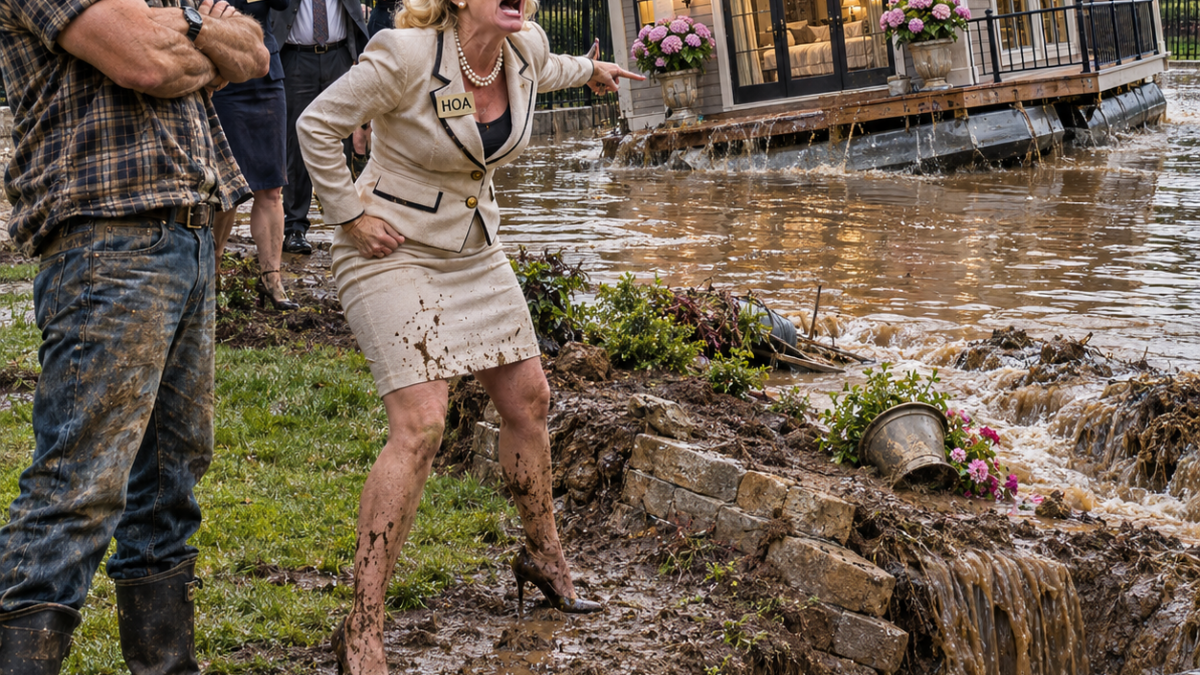
PART 2
“Don’t call her,” Terence said.
I hadn’t even moved.
“I wasn’t.”
“You were thinking about it.”
“I was thinking about several things.”
“Most of them expensive?”
“Possibly.”
Bonita sat across from us and folded her arms.
“What does ‘accessory dwelling approval pending’ mean?”
Terence looked at me.
“Guest house.”
I felt something shift into place.
Constance’s property sat immediately west of mine. Her house was large, but the side yard facing my property narrowed toward the rear because of an old utility corridor and several mature oaks.
The drainage swale ran between us—on my property, but close enough to the boundary that any new structure on her side would have to account for it.
I stood up.
“I’m going to the county.”
Terence shook his head.
“Tomorrow.”
“The permits office is closed.”
“Then the sheriff.”
“That,” he said, “is open.”
Deputy Hendrix arrived the next morning.
He looked young enough that I briefly wondered whether he had been old enough to drive when I started working industrial pipe.
But he was methodical.
He didn’t show up looking for a dramatic confrontation.
He asked questions.
He photographed the filled channel.
He photographed the notice.
He photographed the excavator tracks.
Then he asked for my survey.
I showed him the boundary.
He walked it himself.
“You didn’t authorize any work?”
“No.”
“Did your wife?”
Bonita answered from the porch.
“Absolutely not.”
“Any written permission?”
“None.”
He looked toward Constance’s property.
Her house sat partially hidden behind hedges.
“Who hired the contractor?”
“HOA president says the board.”
“You have that in writing?”
I handed him the email packet.
He read the first page.
Then looked at the survey again.
“Yeah.”
“What?”
“This doesn’t look like common property.”
“It isn’t.”
He nodded.
“I’m going to document this as suspected criminal trespass and property damage. Whether the district attorney moves on anything is their call.”
“That’s all I need.”
He glanced toward the buried swale.
“You’re going to want an engineer too.”
“I know.”
“And don’t dig it back out yet.”
That surprised me.
“Why?”
“Because right now, this is evidence.”
He pointed toward the disturbed ground.
“If you restore it yourself before someone inspects it, people start arguing about what was there.”
That sentence probably saved me thousands later.
I thanked him.
By afternoon, I had sent certified letters to Constance and every HOA board member.
I kept them simple.
Unauthorized entry.
Unauthorized alteration.
Police report filed.
Full restoration demanded within thirty days.
I gave the parcel number.
Survey references.
Photos.
No insults.
No threats.
No dramatic language.
Terence helped me proofread it.
“You sound almost reasonable,” he said.
“Painful, isn’t it?”
“Deeply.”
Constance responded three days later.
Certified mail.
She assessed me a $2,200 HOA fine for “obstructing an approved community drainage improvement.”
Then she threatened a lien against my property if I failed to pay within fifteen days.
I read the letter twice.
Then a third time.
Bonita watched me from the kitchen.
“Don’t.”
“I haven’t done anything.”
“You’re holding the coffee mug like it owes you money.”
I looked down.
My fingers were white around the handle.
“I’m being fined because she destroyed my property.”
“I know.”
“She’s threatening a lien on Grandpa’s land.”
“I know.”
I set the cup down.
Too hard.
The handle cracked.
Bonita looked at it.
“One mug.”
“That’s all.”
“You get one.”
I called an attorney.
Her name was Nadine Presley.
Terence recommended her because she handled property disputes involving environmental and drainage regulations.
She practiced out of Macon.
Our first meeting happened over video call while I sat at the workbench in my shop.
Nadine had silver-streaked hair, narrow glasses and the precise tone of somebody who had spent years explaining unpleasant facts to confident people.
She listened without interrupting.
Then she said:
“Mr. Rutherford, I have three immediate concerns.”
“Only three?”
“For the first ten minutes.”
I liked her.
“First, the swale appears to be engineered drainage infrastructure.”
“It is.”
“If it serves multiple upstream properties and discharges toward a creek, alteration may require county and possibly state approval.”
“Meaning?”
“Meaning this may be more than trespass.”
I leaned back.
“What’s second?”
“The lien threat.”
She held up the letter.
“This is sloppy.”
“Good sloppy?”
“For you.”
She explained that even if the HOA had jurisdiction to fine me—which we disputed—it had procedural requirements before filing a lien.
Notice periods.
Opportunity to contest.
Board documentation.
Constance had skipped steps.
“So she can’t lien the land?”
“Not properly based on this letter.”
“Third?”
Nadine looked directly into the camera.
“Guest house.”
I sat straighter.
“You noticed that.”
“I noticed everything.”
She asked me to search the Laurel County Planning Department’s online permit portal.
I typed in Constance’s address.
Several permits appeared.
Landscaping.
Electrical.
Fence.
Then:
**Accessory Dwelling Unit — 600 sq. ft.**
Status:
**DENIED.**
My hand stopped on the mouse.
“Nadine.”
“I see it.”
I opened the file.
The site plan loaded.
There was Constance’s house.
Property line.
Proposed guest house.
And beside it, labeled in small print:
**Existing drainage swale to be removed/filled.**
I stared at the date.
Six weeks before my ditch disappeared.
Then I opened the denial letter.
County engineering had rejected the plan because the swale was part of the approved subdivision stormwater system.
The letter instructed the applicant that the drainage feature had to remain unless an engineered alternative was approved.
Constance had been told no.
In writing.
Six weeks later, she sent contractors onto my land and filled it anyway.
Nadine was quiet for several seconds.
Then:
“Well.”
“That good?”
“For you?”
“Yes.”
“For her?”
“No.”
I printed everything.
The denied permit.
The site plan.
The county comments.
I placed them beside Constance’s HOA packet.
The reason was suddenly obvious.
This had never been about beautification.
Never about mosquitoes.
Never about safety.
My ditch was in the way of her guest house.
And when the county refused to let her remove it, she put on her HOA-president hat and pretended she had authority the county had already denied her.
Nadine filed a complaint with Georgia environmental regulators.
Then she sent preservation letters to the HOA and Constance personally.
No records destroyed.
No emails deleted.
No contractor invoices discarded.
That was when Constance called a special HOA board meeting.
At her house.
Agenda:
**Rutherford Property Compliance Review.**
Bonita read the notice.
“She’s putting you on trial in her dining room.”
“Apparently.”
“You going?”
“Absolutely.”
“Then I am too.”
Terence joined us.
The meeting was held on a Wednesday evening.
Constance’s dining room looked exactly the way I expected.
Polished table.
White chairs nobody comfortable would ever choose.
Chandelier large enough to require its own zoning permit.
Seven board members sat around the room.
Several looked nervous before I said a word.
Constance stood at the head.
“Thank you for attending.”
I looked around.
“Was attendance optional?”
Her mouth tightened.
“We are attempting to resolve this professionally.”
“That would be new.”
Bonita touched my arm under the table.
One mug, her look reminded me.
I shut up.
Constance presented photographs of my property.
Some were clearly taken from above.
Drone images.
Red circles around the former swale.
The koi pond.
My workshop.
“She had a drone over our property?” Bonita whispered.
“I noticed.”
Constance continued.
“The Rutherford parcel has presented recurring drainage and aesthetic concerns. The board acted to correct a hazardous feature.”
I waited.
Then she displayed a slide titled:
**COMMUNITY RISK MITIGATION**
That one almost made me admire her nerve.
When she finished, she looked at me.
“Dwayne, we’re willing to waive a portion of the fine if you agree not to interfere with the improvement.”
I opened my folder.
“Can I show the board something?”
She glanced around.
“This isn’t a courtroom.”
“Good.”
I placed the county drainage plan on the table.
“This is the original approved stormwater plan.”
Cordell Hayes, a retired teacher on the board, leaned forward.
I placed the police report beside it.
“This is the sheriff’s report documenting unauthorized entry and alteration.”
Nobody spoke.
Then Nadine’s letter.
“This explains potential liability for anybody who authorized work on private property.”
One board member immediately looked at Constance.
Then I placed the permit denial on the table.
The room changed.
Constance’s posture stiffened.
Cordell picked it up.
He read.
Then read again.
“Constance.”
“Yes?”
“You told us the county approved the drainage work.”
“They were aware of the broader project.”
“This says denied.”
“There were ongoing conversations.”
Cordell turned the page.
“This is not ‘ongoing conversation.’”
He tapped the paper.
“It says the swale must remain.”
Constance’s voice sharpened.
“That was an initial determination.”
“Did you appeal it?”
“We were considering options.”
“Did you appeal it?”
She didn’t answer.
Another board member, Rita Chandler, looked at me.
“When was this denied?”
“Six weeks before the ditch was filled.”
Rita turned to Constance.
“You knew?”
“I knew the permit needed revision.”
“And you had the ditch removed anyway?”
“The HOA has maintenance authority.”
“No,” I said.
Constance’s eyes snapped toward me.
I slid the survey forward.
“The ditch is entirely on my parcel.”
Cordell looked at it.
Then at Constance.
“Did you know that?”
“We have road-adjacent easement rights.”
“Not over the swale.”
She stood.
“I think we need a recess.”
Nobody objected.
When we returned ten minutes later, three board members had moved their chairs farther from Constance.
The symbolism was subtle.
But obvious.
The board voted five to two not to pursue the $2,200 fine while legal review was pending.
Constance voted to continue.
So did one loyal ally named Warren.
The others refused.
Outside, Bonita squeezed my arm.
“That went well.”
“Too well.”
Terence looked at me.
“You know what comes next.”
I did.
Constance stopped sending official letters.
That should have relieved me.
Instead, it made me more nervous.
A person who likes paperwork doesn’t stop using paperwork because they calm down.
They stop because they are changing tactics.
Three weeks later, my neighbor Foster Elgin waved me over his back fence.
He had an envelope in his hand.
“Dwayne.”
“What’s up?”
“You got Facebook?”
“No.”
“You sure?”
“Very.”
He handed me the envelope.
Inside were printed screenshots of a Facebook account using my name.
My town.
A photograph of a man close enough to my age to fool someone who didn’t know me well.
The account had posted complaints about Magnolia Pines.
Specific homeowners.
The HOA.
Some of the comments were crude.
Others were offensive.
One named Foster.
I read them twice.
“This isn’t me.”
“I know.”
“Who else got these?”
“My wife heard Miriam did.”
I felt cold despite the Georgia heat.
That was different.
A property argument was one thing.
Trying to poison my reputation with neighbors was another.
Foster said:
“I know how you talk, Dwayne.”
I looked at him.
“That’s either comforting or insulting.”
“Both.”
I photographed every page.
Nadine called me before eight the next morning.
“This changes our approach.”
“How?”
“We document everything. Do not accuse Constance publicly without evidence.”
“I wasn’t planning to.”
“You were thinking it.”
“You and Terence should start a club.”
She told us to collect every envelope.
Terence and I walked the neighborhood.
Six households had received them.
Miriam Holst, a retired teacher, had kept hers.
So had the Mendez family.
Each envelope contained nearly identical screenshots.
Nadine issued legal preservation requests tied to the social-media account.
Then Constance opened another front.
The county assessor contacted me.
Complaint:
Commercial activity on residential property.
Reason:
I sold koi.
That was technically true.
My fish reproduced faster than I could keep them.
Every few months, I sold extras to members of a local hobby club.
Twenty dollars.
Thirty dollars.
Occasionally more for a particularly nice fish.
It paid for food and filter media.
Apparently, Constance had described it as a commercial aquaculture operation.
The assessor sent someone.
He looked at my pond.
Asked for sales records.
I showed him a notebook.
He laughed.
“This is your commercial business?”
“Apparently.”
“How much did you make last year?”
“Seven hundred and eighty dollars.”
“Gross?”
“Yes.”
He shook his head.
Two weeks later:
Complaint dismissed.
Then my homeowner’s insurance called.
They had received notice suggesting my drainage system had caused flooding on Constance’s property.
I almost dropped the phone.
“My drainage system?”
“That is the allegation.”
“The ditch she filled?”
The representative paused.
“I’m not aware of that detail.”
“You will be.”
Nadine handled the response.
County engineer documentation showed the obstruction had been caused by Constance’s fill.
That complaint went nowhere too.
But the pattern was obvious.
Reputation.
Taxes.
Insurance.
Three different pressure points.
All within thirty days.
I sat at my kitchen table late one night staring at folders.
Bonita came in wearing her robe.
“You sleeping?”
“Eventually.”
She poured water.
“You know what worries me?”
“What?”
“You’re starting to enjoy this.”
I looked at her.
“Enjoy what?”
“Being right.”
That stung because it was partly true.
I had stopped being frightened.
Now I was angry.
Anger felt better.
But anger can make a man stupid.
Bonita sat across from me.
“I want her stopped too.”
“I know.”
“I want the ditch back.”
“I know.”
“But don’t build your whole life around making Constance miserable.”
“I’m not.”
She raised one eyebrow.
I looked at the folders.
“Maybe a little.”
“Win.”
She touched my hand.
“Then come home.”
That sentence mattered later.
The document that changed everything came from a title search Nadine ordered.
Six pages.
Recorded in 1994.
A drainage covenant attached to every lot in Magnolia Pines.
The language was surprisingly direct.
Each property owner shared responsibility for preserving the stormwater system.
No owner could alter any component without:
Written approval from the county engineer.
And signatures from every adjacent affected property owner.
Constance had neither.
The county had denied her.
I had never signed.
Foster had never signed.
The Mendez family had never signed.
Then Nadine pointed to the enforcement clause.
“What does that mean?” I asked.
“If someone knowingly alters the system in violation of the covenant, they can be responsible for full restoration costs plus documented downstream damages.”
“Knowingly?”
“We have her denied permit.”
“So she can’t say she didn’t know.”
“She can say anything.”
Nadine smiled faintly.
“That does not make it persuasive.”
County engineers estimated basic restoration at about fourteen thousand dollars.
The covenant allowed additional recovery for willful violations.
Nadine explained that total exposure could climb substantially before even considering environmental penalties or legal fees.
I sat quietly.
Then said:
“I don’t want twenty thousand dollars.”
She looked surprised.
“Most clients do.”
“I want the ditch fixed.”
“Understandable.”
“And I want her never able to fill it again.”
“That can be arranged through recorded protections.”
I hesitated.
“There’s more.”
“What?”
I told her about Bart Colahan.
Bart was a retired civil engineer who had spent thirty years designing stormwater systems.
Two years earlier, he had looked at my swale during a neighborhood cookout and complained about its geometry for almost forty minutes.
Engineers have hobbies too.
His conclusion had been simple.
The ditch worked.
But it could work better.
A wider planted bioswale could carry more runoff, slow sediment, improve downstream water quality and reduce erosion.
At the southern end, there was enough elevation drop for a small retention basin.
Back then, it was just conversation.
Now I called him.
Bart arrived in rubber boots carrying survey flags and the excitement of a teenager who had been told he could redesign a racetrack.
He walked the filled ditch.
“This is awful.”
“I know.”
“No, I mean technically.”
“That too.”
He crouched.
“Who put this aggregate in?”
“Constance’s contractor.”
“Wrong material.”
“Good.”
“No. Bad.”
“I meant good for my case.”
He looked at me.
“You people have ruined engineering.”
Three hours later, he had a concept.
Excavate the fill.
Regrade the swale.
Plant native vegetation.
Create a small county-approved retention pond.
Then he pointed toward the lower end.
“You could put a floating maintenance platform there.”
I stared.
“A what?”
“Sixteen feet, maybe. Anchored. Gives access for inspection and vegetation maintenance.”
“Could people sit on it?”
“Technically.”
“Fish?”
“Technically.”
I smiled.
Bart saw it.
“No.”
“What?”
“I know that face.”
“What face?”
“This is infrastructure, Dwayne.”
“Of course.”
“Not revenge.”
“Absolutely.”
He narrowed his eyes.
“I don’t believe you.”
The idea grew.
Not because I wanted to annoy Constance.
At least not entirely.
The restored drainage system could become something useful.
A bioswale with native plants.
A short walking path.
Educational signage.
Retention habitat.
A small floating platform that neighbors could use for fishing or sitting.
And the best part?
It would exist because Constance had forced the county and regulators to take a closer look at the system.
Her attempt to erase water from my property would create something more permanent than the ditch she destroyed.
Nadine listened to the proposal.
Then she was silent.
Finally:
“That is either brilliant or deeply petty.”
“Can it be both?”
“Probably.”
She helped us do it legally.
That mattered.
Permits.
Engineering.
Environmental review.
County approval.
Recorded plans.
We weren’t going to become the thing we were fighting.
I met with Foster.
The Mendez family.
Miriam.
Cordell.
I showed them Bart’s drawings.
Foster pointed toward the pond.
“What’s that rectangle?”
“Floating maintenance platform.”
He looked at me.
“Houseboat?”
“No.”
“Looks like a houseboat.”
“It has no house.”
“Boat?”
“It floats.”
He grinned.
“Houseboat.”
The name stuck.
The Mendez family offered help with native plantings.
Their son Rafael was studying environmental science.
Miriam suggested an educational sign.
Cordell proposed that the HOA, if the board agreed, support the project as a community stormwater feature.
Foster had an excavator.
He volunteered it.
For the first time since I had found the ditch buried, I felt like we were building instead of defending.
Then Nadine filed suit.
Constance individually.
The HOA as a co-defendant because the work had been presented as HOA-approved activity.
That filing shattered what remained of her board support.
Three members contacted Nadine seeking separate counsel.
Then the board met.
Five to two.
Constance was removed as HOA president pending litigation.
She remained a homeowner.
She still had her house.
Her guest house dream.
Her opinions.
But she no longer had the title she had used as a weapon.
Cordell called me afterward.
“It’s done.”
“She’s out?”
“As president.”
“How’d she take it?”
“Exactly as you would expect.”
“What does that mean?”
“She said the vote was retaliatory, illegal, biased and possibly discriminatory.”
“Against what?”
“Her.”
I laughed.
“I’m serious.”
“So am I.”
Two days later, environmental regulators issued a formal violation notice.
Illegal alteration of a regulated stormwater feature.
Restoration plan required.
Potential civil penalties.
The notice named Constance.
Not the HOA.
Not me.
Her.
That was the moment her lawyer finally entered the story.
His name was Hartwell.
He wrote Nadine a long letter arguing that the ditch work had been authorized under general HOA maintenance powers and that my proposed bioswale conversion would violate neighborhood aesthetics.
Nadine read it.
Then called me.
“He has a problem.”
“What?”
“He is relying on documents that do not say what he claims.”
“Will you tell him?”
“Very politely.”
She sent him the 1994 drainage covenant.
The county denial.
The environmental order.
The survey.
The civil complaint.
Then she suggested he review all four before sending another letter.
We heard nothing for eleven days.
Construction started the following week.
Foster’s excavator arrived at seven in the morning.
I stood beside the swale as the bucket took the first bite out of the dirt Constance had dumped there.
The sound was heavy.
Wet earth.
Stone.
Machine hydraulics.
Then the old grade began reappearing.
Red Georgia clay.
The channel my grandfather had maintained.
I didn’t realize how much seeing it buried had bothered me until I watched it return.
Bonita stood beside me.
“You okay?”
“Yeah.”
“You look like you’re going to cry.”
“Dust.”
“There is no dust.”
“Machine fumes.”
She smiled and slipped her hand into mine.
By Saturday, the swale was open.
By Sunday, the retention area had shape.
Bart walked the grade with a laser level.
Rafael helped lay erosion-control fabric.
Miriam organized planting volunteers.
Children carried river oats in buckets.
Something strange was happening.
What had begun as my private fight was becoming a community project.
Constance watched from next door.
I saw her at the kitchen window.
Sometimes with binoculars.
Sometimes with her phone.
Then inspectors started arriving.
First building department.
Complaint about unpermitted excavation.
Bart showed the stamped plans.
Inspector left.
Second inspection.
Complaint about an unauthorized pond.
Stamped plans.
Environmental approval.
Inspector left.
Third call.
Mosquito hazard.
County engineer explained the retention design had circulation and habitat controls.
Nothing.
Then Constance went door-to-door with a petition.
She claimed our bioswale would attract traffic.
Wildlife.
Mosquitoes.
Children.
That last one confused me.
Apparently children had become an environmental hazard.
Miriam let Constance give her the full presentation.
Then signed the petition.
Later she called me.
“I think I did something bad.”
“What?”
“She gave me a sheet and told me to sign.”
“You signed?”
“Yes.”
“For her petition?”
“I signed your name.”
I almost choked on coffee.
“Miriam.”
“I panicked.”
“You wrote Dwayne Rutherford?”
“No, I wrote ‘Dwayne’s Project Is Great.’”
I laughed until my knee hurt.
The county received fourteen signatures.
They reviewed the petition.
The project was already permitted.
No action.
Constance’s lawyer sent another nuisance letter.
Mosquitoes.
Wildlife.
Property values.
Nadine responded with engineering documentation.
Hartwell went quiet again.
Then the newspaper called.
Laurel County Courier.
Reporter named Priya Nair.
Someone at the county had mentioned the environmental violation.
She had pulled public records.
Permit denial.
Police report.
Court filing.
Environmental order.
Drainage covenant.
She knew most of the story before she ever called me.
“I’d like your side,” she said.
“My side is in the records.”
“I know.”
That answer impressed me.
She interviewed me.
Then Foster.
Cordell.
County staff.
Constance declined at first.
Then submitted a written statement saying she had acted in good faith to improve community safety.
Priya asked me whether the floating platform was designed to provoke Constance.
I said:
“No.”
Then after a pause:
“It does happen to face her kitchen.”
Priya laughed.
“Can I print that?”
“No.”
She didn’t.
Two days before publication, Constance’s husband called me.
Philip.
First conversation we had ever had.
He was an attorney.
His voice was professional.
Controlled.
Tired.
“Mr. Rutherford.”
“Dwayne is fine.”
“I want to discuss settlement.”
“Talk to Nadine.”
“I have.”
“Then why are you calling me?”
He paused.
“Because some parts of this are no longer purely legal.”
I knew immediately.
“The newspaper.”
“Yes.”
“What about it?”
“My wife has made mistakes.”
I said nothing.
“She believed she was acting in the community’s interest.”
“She wanted a guest house.”
“I’m aware.”
“The permit was denied.”
“I’m aware.”
“She filled my ditch.”
Another pause.
“I’m aware.”
I almost felt sorry for him.
Almost.
Philip said:
“I’m prepared to offer thirty-five thousand dollars to resolve your civil claims.”
“That’s more than we asked for.”
“I know.”
“What’s the condition?”
“You cooperate in stopping publication.”
“No.”
He exhaled.
“Dwayne.”
“I don’t control the newspaper.”
“You could decline comment.”
“Already commented.”
“You could tell them the matter has been resolved.”
“It hasn’t.”
“It could be.”
I looked out my workshop window.
Foster and Bart were installing the frame for the floating platform.
“She tried to use fake Facebook posts to turn neighbors against me.”
No response.
“She filed complaints against my taxes.”
Silence.
“She contacted my insurer and tried to blame me for flooding caused by the ditch she buried.”
“Those matters are disputed.”
“No.”
My voice stayed calm.
“Those matters are documented.”
Philip went quiet.
Then:
“What would it take?”
“For what?”
“For this to end.”
I thought about Bonita telling me to win and come home.
“I’m not asking for your family to be destroyed.”
“Then help me.”
“I am helping you.”
“How?”
“I’m not asking for more money.”
“That isn’t what I mean.”
“I know.”
I looked toward Constance’s house.
“Your wife needs to stop.”
He didn’t answer.
“The ditch gets restored. Damages get paid. The records stay public. The article runs if the newspaper wants it. Then I go back to my life.”
He sounded exhausted when he said:
“She won’t see it that way.”
“That’s not something I can fix.”
Thirty minutes later, Hartwell sent the newspaper a threat of legal action if they published.
Priya forwarded the letter to me with one word.
**Interesting.**
The newspaper’s attorney reviewed the story.
Every major claim came from public records.
The threat disappeared within hours.
Thursday evening, we launched the platform.
Pressure-treated framing.
Marine flotation.
Dark-green stain.
Sixteen feet long.
Eight wide.
A small bench at one end.
Nothing luxurious.
Foster stood on the bank.
“You need a mailbox.”
“No.”
“Tiny front porch.”
“No.”
“Curtains.”
“It is not a houseboat.”
Terence opened a beer.
“It’s floating.”
“Yes.”
“It’s structurally house-adjacent.”
“What does that even mean?”
“It means houseboat.”
Bart looked offended.
“It is a stormwater-access platform.”
Everyone laughed.
We eased it into the retention pond.
It settled gently.
Water moved beneath it.
The restored swale murmured through river oats and newly planted buttonbush.
I stood listening.
For three months, that sound had been gone.
I hadn’t realized how much silence Constance had created until the water came back.
Foster handed me a beer.
“She can see it from her kitchen.”
I looked toward the house.
Constance stood behind the glass.
Phone in hand.
“I know.”
Friday morning, Priya’s article ran.
Front page.
Large photograph.
The headline was ruthless without being unfair.
**HOA PRESIDENT FILLED NEIGHBOR’S DRAINAGE SWALE AFTER GUEST-HOUSE PERMIT DENIAL**
The aerial photo showed everything.
My property.
The restored bioswale.
Native plantings.
Retention pond.
Floating platform.
Constance’s lot beside it.
By noon, the story was everywhere locally.
Not because I promoted it.
Because people understood it instantly.
A person had been told no.
She had used a position of authority to try to make the obstacle disappear.
Then the obstacle became permanent.
The county commission scheduled a public meeting.
Official agenda:
**Stormwater Governance and HOA Coordination Following Magnolia Pines Incident.**
That phrase made Terence laugh for five straight minutes.
“You’re an incident now.”
“Apparently.”
The county meeting drew more people than the room could hold.
Bonita came.
Terence.
Foster.
Bart.
Miriam.
Rafael.
Nadine.
Constance sat in the first row wearing a dark blazer and the posture of somebody determined not to look defeated.
Philip was absent.
The county stormwater director presented first.
Maps.
Runoff calculations.
Drainage capacity.
He explained why the 1994 covenant existed.
He explained what happened when one piece of a shared drainage network was removed.
Water didn’t care about HOA titles.
It followed grade.
Block one channel and the pressure went somewhere else.
Foster spoke during public comment.
He brought receipts.
“Twenty-four hundred dollars.”
He held up the folder.
“That’s what I spent waterproofing my foundation after water started backing toward my property.”
Constance shifted in her seat.
Miriam spoke next.
She showed a picture of her granddaughter standing beside our educational sign.
Rafael talked about bioswales.
Native plants.
Runoff filtration.
Pollinators.
The commissioners asked him questions for almost ten minutes.
Then Constance’s name was called.
She walked to the microphone.
I had seen her speak at HOA meetings before.
She was good.
Calm.
Polished.
She framed everything as community leadership.
She said a contractor had misunderstood county requirements.
She said she had believed approvals were moving forward.
She said her actions had been motivated by safety.
Then Commissioner Patricia Delacroix leaned toward her microphone.
“Ms. Whitmore Bell.”
“Yes?”
“Your permit application identifies the swale as a feature to be removed.”
“Yes.”
“That application was denied.”
“We were discussing revisions.”
“Six weeks before the fill occurred.”
“There were ongoing—”
“Did you appeal the denial?”
Constance paused.
“We intended to.”
“That is not my question.”
The room became very still.
“Did you file an appeal?”
“I would need to review the paperwork.”
The county planner spoke from his table.
“There is no appeal in the record.”
Constance’s shoulders tightened.
Commissioner Delacroix looked at her.
“So the county said the swale could not be removed, no appeal was filed, and six weeks later the swale was removed.”
Constance tried to pivot.
“The HOA believed the drainage feature had become an aesthetic and safety—”
“We are not discussing aesthetics.”
Delacroix’s voice remained quiet.
“That swale was engineered stormwater infrastructure.”
Constance stopped.
Delacroix continued.
“We are trying to determine how a private association officer came to believe HOA authority overrode a county drainage plan and private property boundaries.”
That was the moment the balance shifted.
Not because anyone shouted.
No one did.
Not because I gave a speech.
I didn’t.
A public official simply placed the facts in the correct order.
Nadine spoke after Constance.
Three minutes.
No theatrics.
She requested a formal county policy requiring HOA boards to notify county engineering before altering any drainage feature they intended to classify as common-area maintenance.
The commission voted four to one.
Policy adopted.
Countywide.
One person’s attempt to bury a ditch had changed procedure for every HOA in Laurel County.
Outside afterward, Constance walked past us.
Then stopped.
She looked at me.
I expected anger.
Instead, she looked tired.
“Happy?”
I considered the question.
“No.”
She seemed surprised.
“You got what you wanted.”
“I wanted my ditch left alone.”
Her mouth tightened.
“You turned this into a spectacle.”
“You filled it with an excavator.”
“I made a mistake.”
“That’s the first time I’ve heard you say that.”
She looked toward Nadine.
“You ruined my name.”
I shook my head.
“I didn’t file your permit application.”
She said nothing.
“I didn’t sign the denial.”
Nothing.
“I didn’t order the fill.”
Her face hardened again.
“You think you’re better than me?”
“No.”
I looked toward the courthouse.
“I think ‘no’ has to mean something.”
For once, she had no answer.
She walked away.
The civil case settled six weeks later.
Constance agreed to pay $18,500 toward restoration costs, engineering expenses, materials and part of my attorney fees.
Foster’s foundation expenses were handled separately.
Environmental regulators assessed their own civil penalty against her.
$14,750.
That wasn’t mine.
I never saw a dollar of it.
It went where regulatory penalties go.
What mattered to me was that the violation remained public.
The guest house permit died permanently.
Not as revenge.
Geometry killed it.
The structure could not fit while preserving required setbacks and the drainage feature.
And now the swale was no longer just an old ditch.
The county had registered Bart’s bioswale design.
The retention pond had an approved maintenance plan.
We recorded an educational access easement.
Constance couldn’t remove it.
Neither could the next owner.
Four months later, the For Sale sign appeared in her yard.
Bonita noticed first.
She was carrying groceries.
“Dwayne.”
“What?”
She pointed.
I walked outside.
White sign.
Red letters.
Constance and Philip were moving.
Foster came over that evening.
“You going to buy it?”
“No.”
“Think about it.”
“No.”
“We could turn the house into a visitor center.”
“No.”
“Name it the Constance Whitmore Bell Institute of Hydrology.”
I laughed.
“Go home, Foster.”
They moved to Cobb County.
Somebody told me the neighborhood had no HOA.
I didn’t verify it.
Cordell became the new Magnolia Pines HOA president.
At his first full membership meeting, he did something so simple that it almost made me angry nobody had done it before.
He mailed every homeowner a copy of the 1994 drainage covenant.
With a plain-English summary.
“This is what we actually agreed to,” he said.
Then he posted enforcement policies online.
Complaints had to be documented.
Board actions required recorded votes.
Conflicts of interest had to be disclosed.
No president could unilaterally authorize work on private property.
The rules didn’t disappear.
They became understandable.
That was better.
The bioswale settled in.
First year was messy.
Native plants don’t look impressive immediately.
Some died.
Rafael replanted them.
Bart complained constantly.
“This grade is two tenths off.”
“Does it work?”
“That is not the point.”
“What is the point?”
“It could work more correctly.”
He was happy.
He just didn’t know how to express it.
By the following spring, buttonbush bloomed.
Black-eyed Susans spread.
River oats bent along the water.
Dragonflies appeared.
Then turtles.
Songbirds.
The retention pond held clean water after storms and released it slowly downstream.
The floating platform became unexpectedly popular.
Kids fished from it.
Miriam’s granddaughter used it for school observations.
Foster installed a ladder.
I built a second bench.
Terence brought coffee.
He refused to stop calling it the houseboat.
One evening, I found a handmade sign someone had hung from the side.
**RUTHERFORD MARINA**
I knew Foster had done it because the letters were crooked.
I left it.
Bonita and I started sitting there after dinner.
Sometimes we didn’t talk.
That was the part of the story people rarely understood.
The public fight was dramatic.
Lawyers.
Inspectors.
Meetings.
Headlines.
But the damage had been quieter.
For months, every envelope felt dangerous.
Every county vehicle made me wonder whether Constance had filed another complaint.
Every neighbor’s strange glance made me wonder if another fake screenshot had appeared.
I had started seeing my home as territory instead of home.
Then one evening, Bonita sat beside me on the platform.
The sun was dropping behind the pines.
Water moved through the bioswale.
She slipped off her shoes and put her feet near the edge.
“You’re home again.”
I looked at her.
“What?”
“You finally stopped watching her house.”
I realized she was right.
For almost a year, I had unconsciously checked Constance’s windows.
Was she watching?
Photographing?
Calling somebody?
Now the house was occupied by a new family.
Young couple.
Two kids.
A Labrador that escaped constantly.
I hadn’t noticed.
Bonita smiled.
“Told you.”
“What?”
“Win and come home.”
I leaned back.
“Still enjoying being right?”
“A little.”
We stayed until the mosquitoes came out.
The HOA used part of recovered funds to create a small environmental education fund.
I put some settlement money into it too.
Rafael’s professor contributed after reading the newspaper article.
The first scholarship went to a Laurel County student planning to study civil engineering.
The second went to an environmental-science student.
We named it the Magnolia Pines Environmental Education Fund.
Not after me.
Not after Constance.
The whole point was bigger than either of us.
At the dedication, Miriam’s granddaughter stood beside the bioswale sign explaining runoff to two younger kids.
She pointed toward the plants.
“These clean the water.”
One kid looked skeptical.
“Plants?”
“Yes.”
“How?”
She launched into an explanation involving roots, sediment and nutrients.
Bart stood nearby pretending not to be proud.
Foster nudged me.
“Look at that.”
“I see.”
“All because your neighbor wanted a guest house.”
“Don’t say that around Bart.”
“Why?”
“He’ll say it happened because of hydrology.”
Bart turned from twenty feet away.
“It did happen because of hydrology.”
Foster yelled back:
“Nobody asked you.”
That became our normal.
Not court dates.
Not cease-and-desist letters.
People teasing each other beside a pond.
A year after the settlement, Deputy Hendrix stopped by.
He was older-looking already.
Law enforcement will do that.
He stood near the bioswale.
“This the ditch?”
“Used to be.”
He looked at the pond.
“And that?”
“Maintenance platform.”
He stared.
“Houseboat?”
I sighed.
“Get off my property.”
He laughed.
Then became serious.
“You did the right thing filing the report early.”
“I almost dug the whole thing back out that morning.”
“Would’ve made it harder.”
“I know.”
He looked down the channel.
“Most property disputes start with everybody fixing things before anybody documents them.”
“That something you learn in training?”
“No.”
He smiled.
“Learned it from watching people.”
The fake Facebook account was eventually linked closely enough to people in Constance’s circle for Nadine to use it in settlement discussions, but we never got the clean dramatic confession people imagine stories should have.
No courtroom witness stood up and admitted everything.
No computer screen flashed her name.
Life is messier than that.
The account disappeared.
The smear stopped.
That was enough for me.
The county assessor never contacted me about koi again.
My insurance remained intact.
The lien never happened.
The $2,200 HOA fine was formally rescinded.
Cordell mailed me the notice personally.
At the bottom, he had handwritten:
**Sorry this ever got this far.**
I kept that one.
Not because I needed proof.
Because apologies are rare enough to save.
The original laminated notice Constance had attached to my fence stayed in a drawer for a long time.
One rainy afternoon, I found it while looking for a filter receipt.
**REMOVED FREE OF CHARGE.**
I laughed.
Then carried it to the workshop.
I considered throwing it away.
Instead, I hung it above Grandpa’s old vise.
Terence saw it later.
“You keeping trophies now?”
“Reminder.”
“Of what?”
I looked at the notice.
“That official-looking nonsense is still nonsense.”
He nodded.
“Fair.”
Then he noticed something on my bench.
“What’s that?”
A small brass plaque.
I had ordered it for the floating platform.
He read it.
**ELI RUTHERFORD
1961
WATER KNOWS WHERE IT BELONGS**
Terence looked at me.
“That’s sentimental.”
“Don’t tell anybody.”
“Too late.”
Grandpa never saw the subdivision.
Never met Constance.
Never saw the pond.
But he understood land.
He used to say you could fight water for a while, but if you wanted peace, you learned where it wanted to go.
As a child, I thought he meant farming.
Maybe he did.
But standing there years later, looking at the channel he had first cut with hand tools, I understood the sentence differently.
Constance’s biggest mistake wasn’t arrogance.
It wasn’t even filling the ditch.
Her biggest mistake was believing that authority could replace reality.
The county map was real.
The property line was real.
The stormwater system was real.
The denied permit was real.
Gravity was real.
Water was real.
Her title as HOA president could not change any of those things.
She could print letters.
Issue fines.
Call inspectors.
Pressure neighbors.
Threaten liens.
But eventually, somebody was going to lay the documents next to each other.
And the facts were going to remain after the title disappeared.
I saw Constance one final time almost two years later.
I was in Atlanta for a medical appointment.
Bonita and I stopped at a garden store on the way home.
I was comparing irrigation fittings when I heard:
“Dwayne?”
I turned.
Constance.
No blazer.
No clipboard.
Jeans.
Sweater.
She looked more ordinary than I remembered.
We stood there awkwardly.
“Hello, Constance.”
She glanced at the fittings.
“Still fixing water?”
“Apparently.”
She smiled slightly.
Then it disappeared.
“How’s Magnolia Pines?”
“Fine.”
“The pond?”
“Fine.”
“The platform?”
“Still floating.”
That almost made her laugh.
Almost.
She looked down.
“I hated that thing.”
“I know.”
“I could see it every morning.”
“I know.”
“Did you put it there because of me?”
There it was.
The question everyone else had asked jokingly.
Coming from her, it felt different.
I considered lying.
Then decided we were both too old for that.
“Partly.”
She nodded.
“I figured.”
“But that’s not why it stayed.”
She looked at me.
“Why did it?”
“People use it.”
She said nothing.
“Kids fish there. Students study the plants. My wife and I sit out there.”
Her face changed.
Not much.
“You got a lot out of all this.”
I thought about the legal bills.
Months of stress.
Fake posts.
County complaints.
Foster’s wet foundation.
Bonita watching me pace around the kitchen.
“No.”
I shook my head.
“We made something out of it.”
She absorbed that.
Then asked quietly:
“Do you hate me?”
That surprised me.
I answered honestly.
“No.”
“You did.”
“For a while.”
“What changed?”
“You moved.”
She laughed once.
That helped.
Then I said:
“And I got tired.”
She nodded.
“I was angry too.”
“At me?”
“At everybody.”
She hesitated.
“My mother-in-law was supposed to live in that guest house.”
I hadn’t known that.
“Philip’s mother?”
“Yes.”
“She was sick?”
“Getting older. Couldn’t manage alone.”
That didn’t excuse anything.
But for the first time, it gave shape to something underneath her obsession.
“Why didn’t you tell anyone?”
She shrugged.
“Because I thought I could solve it.”
“By filling my ditch?”
She winced.
“When you say it like that…”
“How else would I say it?”
“I know.”
We stood between racks of irrigation fittings.
Then she said:
“I thought if the guest house got built, everything would settle down.”
“And when the county said no?”
“I was angry.”
She looked ashamed.
“I had already promised her.”
There it was.
Not innocence.
Not justification.
Human motive.
Pride.
Fear.
A promise she couldn’t keep.
And the belief that her title gave her a shortcut.
“What happened to her?” I asked.
“She moved into assisted living.”
“How is she?”
“Fine, actually. Better than she would’ve been with us.”
That made both of us laugh softly.
Life has a mean sense of humor.
Constance looked at me.
“I am sorry about the ditch.”
It wasn’t dramatic.
No tears.
No speech.
Just the sentence I had wanted in the beginning and no longer needed.
“Thank you.”
“I should have asked.”
“Yes.”
“And listened when the county said no.”
“Yes.”
She smiled faintly.
“You could give me one easy answer.”
“I waited a long time for those two yeses.”
She deserved that.
Then she offered her hand.
I shook it.
We walked away in opposite directions.
Bonita was waiting near the register.
“Was that who I think it was?”
“Yes.”
“You fight?”
“No.”
“She apologize?”
“Yes.”
Bonita stared.
“Are we in the right universe?”
“Apparently.”
She took my arm.
“You forgive her?”
“I don’t know.”
“That sounds healthy.”
The drive home was quiet.
When we reached Magnolia Pines, sunset was catching the tops of the river oats.
I parked.
Bonita went inside.
I walked toward the pond.
Two kids from the new family next door were sitting on the platform with fishing rods.
Their Labrador was lying beside them, tail hanging over the edge.
One boy saw me.
“Mr. Rutherford!”
“Yeah?”
“We caught one!”
He held up a tiny bluegill.
“Congratulations.”
“Can we keep it?”
“No.”
“Why?”
“Too small.”
He frowned.
The other boy said:
“Told you.”
They released it.
The platform rocked gently.
Water moved beneath it.
I sat on the bank instead of joining them.
The bioswale was thick with native plants now.
You could barely see the engineered grade beneath all that green.
That was how good infrastructure should work.
Quietly.
Most people shouldn’t have to think about it.
Rain falls.
Water moves.
Roots hold soil.
The creek stays cleaner.
Homes stay drier.
Nothing dramatic happens.
That is success.
For years, people heard the story and focused on the floating platform.
The “houseboat.”
They liked the irony.
An HOA president filled a ditch for her dream guest house.
Her guest house never got built.
The ditch came back bigger.
A floating platform appeared where she could see it.
It made a good headline.
But standing there that evening, watching two children argue over whose turn it was to bait a hook, I realized the platform wasn’t the ending.
It was just the most visible part.
The real ending was that Foster’s foundation stayed dry.
The Mendez family had cleaner runoff crossing their lower yard.
Miriam’s granddaughter chose an environmental-science program after working on the project.
Cordell ran an HOA where people received documents before threats.
The county changed its rules.
The scholarship existed.
Bonita had her husband back instead of a man pacing the kitchen waiting for the next certified letter.
And I could hear water again.
That mattered most.
The same sound I had heard my whole life.
Rain moving through red Georgia clay.
A soft trickle through grasses.
Water finding grade.
Grandpa Eli had understood it.
Maybe he would have laughed at the platform.
Actually, I know exactly what he would have said.
He would have looked at the sixteen-foot deck floating in the pond.
Then at me.
Then back at the deck.
And said:
“You built a porch where a porch has no business being.”
He would have been right.
That didn’t mean he wouldn’t have sat on it.
A few weeks later, I mounted his brass plaque near the platform bench.
Bonita stood beside me.
“You sure about the wording?”
I read it again.
**ELI RUTHERFORD — 1961
WATER KNOWS WHERE IT BELONGS**
“Yeah.”
She looked down the swale.
“So do people?”
“Eventually.”
She smiled.
We sat.
The evening was warm.
Somewhere upstream, a sprinkler clicked on.
Water entered the roadside system.
Ran beneath a culvert.
Reached my property.
Slowed through river oats.
Curved around buttonbush.
Collected briefly in the pond.
Then continued toward the creek.
Exactly as it was supposed to.
The platform rose less than an inch as the level changed.
Bonita nudged me.
“Houseboat’s moving.”
“It is not a houseboat.”
“It floats.”
“Yes.”
“It has a bench.”
“So?”
“A porch bench.”
“Bonita.”
She laughed.
I gave up.
Across the pond, the old laminated HOA notice still existed only in my workshop.
The one that said Constance had removed the ditch “free of charge.”
Technically, she had been right about one thing.
The final version didn’t cost me what she expected.
She paid restoration.
She paid penalties.
The HOA helped fund improvements.
Neighbors donated labor.
The settlement seeded an education fund.
And the ditch she wanted erased became one of the most protected, documented and useful pieces of stormwater infrastructure in the county.
Her dream guest house never touched the ground.
But something else did get built.
A bioswale.
A pond.
A community trail.
A scholarship.
And, depending on who you ask, one extremely stubborn little houseboat.
I still call it a maintenance platform.
Nobody believes me.
That’s fine.
Some arguments aren’t worth winning.
The important ones already were.
[END OF STORY]








