PART 2: HOA Karen Buried My Dad’s Drainage Ditch for “Aesthetics”—Then the Storm Sent All the Water Straight Into Her $42K Backyard
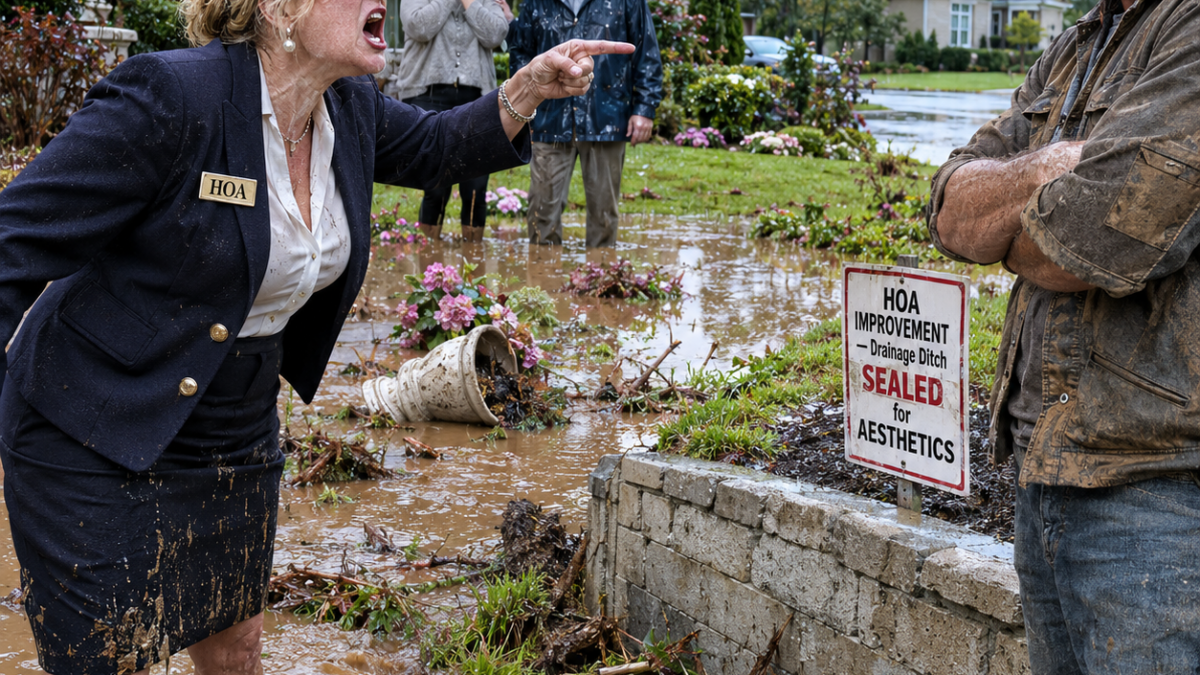
PART 2
Hawthorne Ridge began as the Abernathy Dairy.
One hundred twenty acres along my north property line.
When I was younger, you could hear cows there before sunrise.
By 2017, the dairy was gone.
Crestline Partners bought the land.
The signs appeared first.
COMING SOON — HAWTHORNE RIDGE ESTATES.
Then came survey stakes.
Orange ribbons.
Bulldozers.
Excavators.
Dump trucks.
The ridge changed almost overnight.
Crestline moved roughly ninety thousand cubic yards of Georgia red clay.
Trees disappeared.
Slopes changed.
Roads appeared.
Forty-three lots were cut into what had once been rolling pasture.
Homes started in the mid-five-hundreds.
Four thousand square feet.
Gray Hardie board.
Stone veneer.
Three-car garages.
Identical mailboxes.
Small landscaped yards.
The kind of subdivision where everything looked new enough that even the trees seemed temporary.
Development changes water.
That is not criticism.
It is physics.
Pasture absorbs rainfall differently from rooftops.
Trees slow runoff.
Roots hold soil.
Impervious surfaces do not negotiate.
A roof catches water.
A driveway moves it.
A road moves more.
Put forty-three houses, streets, sidewalks, patios, and compacted lawns on a ridge, and suddenly rain that used to soak slowly into pasture arrives downhill faster and in larger volume.
Crestline’s engineers knew that.
Their approved stormwater plan knew it.
And the plan showed exactly where that water was supposed to go.
South.
Toward my property.
Toward Dad’s swale.
The detention basin at Hawthorne Ridge was designed to slow the peak flow.
Its outfall then discharged toward the existing drainage channel on the Whitfield parcel.
My channel.
The swale my father dug with a rented backhoe in 1982.
Crestline obtained an easement.
Not ownership.
Not control of my land.
A drainage easement.
It gave them a permanent right to discharge stormwater into the existing channel at a rate not exceeding five cubic feet per second during the design event.
In return, I received four thousand dollars once.
Crestline agreed to clean the outfall pipe every year.
They did it once.
After that, I maintained what needed maintaining because I was not interested in letting a blocked pipe prove a point by flooding forty-three families.
Rain kept falling.
The basin kept discharging.
Dad’s swale kept working.
It was almost funny.
A forty-two-year-old channel built by a hay farmer with no engineering degree had become an essential component in a modern subdivision’s engineered drainage system.
Dad would have enjoyed that.
He would also have complained that Crestline never cleaned the pipe.
Then Denise Barlo moved into Lot 17.
March 2020.
Bottom of the cul-de-sac on Ridstone Drive.
Closest house to my property.
About forty feet from her back yard to the swale through the buffer trees.
She and her husband, Craig, bought one of the nicer homes in the development.
Then Denise spent another forty-two thousand dollars on the backyard.
Not all at once.
She curated it.
That was her favorite word.
Japanese boxwoods in symmetrical rows.
Zoysia sod instead of Bermuda.
A pergola strung with Edison bulbs.
A custom gas fire pit.
Stamped concrete.
Outdoor furniture selected less for weather resistance than how it looked in photographs.
Everything had a purpose.
Unfortunately, most of those purposes involved Instagram.
Denise was thirty-nine.
She had platinum highlights touched up every six weeks.
Microbladed eyebrows permanently arched as though somebody nearby had just disappointed her.
Perfect teeth.
Perfect nails.
Coordinated athleisure.
Lululemon.
Alo Yoga.
Muted colors.
White Range Rover.
Vanity plate:
HAWK QN.
Hawthorne Queen.
Apparently she had given herself the title before the neighborhood did.
Eight months after moving in, Denise ran for HOA president.
Unopposed.
Nobody else wanted the job.
She wanted it badly enough for everybody.
Within weeks she created a neighborhood Instagram account:
HAWTHORNE RIDGE LIVING.
Golden-hour photographs of the entrance monument.
Walking-trail videos.
Pool pictures.
Reels of Denise strolling through the subdivision in matching workout sets while captions talked about:
Intentional community standards.
Protecting what matters.
Knowing your neighborhood’s worth.
She formed an Aesthetic Review Committee.
She chaired it.
She was also the only voting member.
That made the word committee optimistic.
In nine months:
Six families fined.
Basketball hoop.
Garden hose left uncoiled.
Shade sail over a kiddie pool.
Recycling bin visible from the road.
Trampoline.
The Wins family on Lot 31 paid eight hundred dollars over the trampoline their children had used for two years.
They took it apart in the rain.
Their youngest daughter watched from inside.
Denise posted that evening:
Sometimes leadership means making the choice that isn’t popular.
Then three crying-face emojis.
Ruth showed me the post.
“She fined children for a trampoline and then posted crying emojis?”
“Apparently leadership hurts.”
“Her?”
“Apparently.”
Ruth shook her head.
“Some people should not be given fonts.”
I laughed.
At the time, Denise was still somebody else’s problem.
Then she came to the fence.
October 2022.
I had finished mowing.
Coffee in hand.
Denise stood on the other side in black leggings, ankle boots that had never met mud, and a cream cashmere wrap that looked inappropriate within fifty feet of a drainage channel.
Her phone was already out.
Recording.
She pointed at the swale.
“Is it always like this?”
“Like what?”
“Muddy.”
“It rained.”
“Overgrown.”
“That’s switchgrass.”
“Weeds.”
“No.”
She pushed her sunglasses up into her hair.
“It looks abandoned.”
“I maintain it every three weeks.”
She gave me a look.
“Maintain it?”
“Yes.”
“Like that?”
“Like what?”
She gestured broadly.
“Open.”
I understood then.
She did not see drainage.
She saw a line on a landscape that had not been designed around her preferences.
“There are weeds.”
“Switchgrass.”
“Whatever.”
“My father planted it. Holds the banks.”
“You could replace it.”
“With what?”
“Boxwoods.”
I almost laughed.
She was serious.
“Or ornamental grass.”
“This is ornamental grass.”
“You know what I mean.”
“I really don’t.”
She sighed.
“The channel is visible from fourteen backyards.”
“So?”
“Three residents have already mentioned property values.”
“Three residents need to read their drainage plan.”
Her eyes narrowed.
“Can you at least cover it?”
“With?”
“Decorative culvert.”
“It isn’t a culvert.”
“A pipe, then.”
“No.”
“Why?”
“Capacity.”
She folded her arms.
“It’s a ditch.”
“It handles runoff from forty-three houses.”
“That seems exaggerated.”
“It’s in your approved stormwater plan.”
She glanced at her phone.
“I don’t understand why everything has to be so ugly when there are attractive solutions.”
“Because attractive solutions have to work too.”
“Boxwoods work everywhere else.”
“Not as stormwater conveyance.”
That finally irritated her.
“Don’t talk to me like I’m stupid.”
“I’m explaining drainage.”
“I know what drainage is.”
“Then you understand why we don’t plant shrubs in the flow path.”
She looked past me.
The channel was dry except for a thin trickle near the center.
Creek rock.
Switchgrass.
Red clay on the banks.
Nothing glamorous.
Nothing wrong.
She said:
“It smells.”
“No, it doesn’t.”
“Muddy water smells.”
“There isn’t standing water.”
“It still looks like an open sewer.”
I put my coffee on the fence post.
“Denise.”
She seemed surprised I knew her name.
“That channel keeps Hawthorne Ridge from flooding.”
She laughed once.
Not because something was funny.
Because she did not believe me.
“My house has professional drainage.”
“Yes.”
“That’s what storm drains are for.”
“Where do you think those storm drains send the water?”
“The county system.”
I pointed.
“This is part of the system.”
Her expression told me she thought I was being difficult on purpose.
“My property is not part of your HOA.”
“I understand that.”
“No, you understand the sentence. I’m not sure you understand what it means.”
That got a flash of anger.
She put the sunglasses back down.
“We’ll see what the board thinks.”
“The board can think whatever it wants.”
She turned.
Walked toward Ridstone Drive.
Then over her shoulder:
“That trench is gone by summer.”
I watched her leave.
I should have opened a file that afternoon.
Instead, I went inside.
Ruth had dinner warming.
I told her about Denise.
She stopped cutting cornbread.
“Boxwoods?”
“Boxwoods.”
“In a drainage swale?”
“Yes.”
“She’s president?”
“Yes.”
Ruth stared at me.
“You’re going to need a folder.”
“I’m not.”
“You are.”
Three weeks later, the first letter arrived.
Ruth was right.
November 9.
Embossed HOA letterhead.
Denise’s signature in teal ink.
Subject:
RE: MAINTENANCE OF ADJACENT DRAINAGE FEATURE — WHITFIELD PARCEL
According to the letter, the board had received complaints that my channel was:
A visual detriment.
A property-value concern.
A mosquito vector.
I had thirty days to:
Screen it.
Pipe it.
Or allow the HOA to “remediate” it.
I read the letter beside the mailbox.
Behind me, the swale carried a thin stream after a morning rain.
Doing exactly what it had done for decades.
I walked inside.
Ruth saw the envelope.
“Folder?”
I opened a drawer.
“Folder.”
She smiled.
The second attack was public.
Trish Gilmore showed me.
Trish lived on Ridstone Drive with her husband, Dennis, and their two boys.
She worked from home doing medical billing.
Unlike most people in Hawthorne Ridge, she had once actually asked me where the stormwater went.
She came to my fence holding her phone.
“You need to see this.”
On the Hawthorne Ridge app:
THE WHITFIELD DITCH: AN OPEN HAZARD FORTY FEET FROM OUR CHILDREN
Photos.
Every one selected carefully.
Late November.
Switchgrass dormant and brown.
Standing water after rainfall photographed at an angle making it appear stagnant.
Stock photo of a mosquito.
Stock photograph of a child standing beside water.
One picture showed my swale behind bare trees.
No scale.
No explanation.
No mention that it was the approved primary outfall.
I scrolled.
“How many people were at the meeting?”
“Eleven.”
“Out of forty-three?”
“Yep.”
“She said it got a standing ovation.”
“It did.”
“Eleven people?”
“Cal.”
“What?”
“She only needs the board.”
That was the first time I felt something beyond annoyance.
Not fear.
Concern.
Because Trish was right.
The truth does not protect infrastructure if the people with equipment believe the wrong thing.
December 1.
Certified letter.
Law firm.
Barlo & Associates.
Denise’s brother-in-law.
Real-estate closings.
Not stormwater.
Not land-use litigation.
Not civil engineering.
But his letter threatened injunctive relief unless I piped the swale underground within sixty days.
I called Walt Pinkney.
Walt had worked stormwater with me for years.
He was still with the county.
“Can an HOA force me to pipe my own swale?”
“You asking as a retired engineer or because somebody actually tried?”
“Actual.”
“Your land?”
“Yes.”
“Approved drainage plan relies on it?”
“Yes.”
“Working?”
“Perfectly.”
“Then no.”
“What if they modify it?”
Walt went quiet.
“The Hawthorne plan uses that channel as its primary outfall.”
“I know.”
“Filling it without hydraulic review violates ordinance.”
“I know.”
“So why are we having this conversation?”
“Because their president doesn’t.”
Walt sighed.
“Cal.”
“Yeah?”
“If they block the outlet, every drop that can’t leave becomes their problem.”
I looked out the window toward the swale.
“That is exactly what worries me.”
I sent one-page certified response.
The channel predates Hawthorne Ridge by thirty-five years.
The approved subdivision drainage plan relies on it.
It is on private property.
The HOA covenants do not apply.
No modifications authorized.
I reserved all rights.
Then I signed:
Cal Whitfield, P.E., Retired
And stamped it.
I rarely used my engineering stamp after retirement.
That morning, I wanted the person reading to understand this was not an argument about taste.
Denise responded on the neighborhood app.
Not through counsel.
She posted:
He calls himself an engineer. I call it a man with an ugly ditch and an ego. Stay tuned.
Fourteen clapping emojis.
Three of them from Denise herself.
Ruth held the phone.
“Did she applaud herself?”
“Apparently.”
“Can you do that?”
“Technically.”
“Should you?”
“Technically no.”
January went quiet.
Ruth called that worse than letters.
“Thunderhead quiet,” she said.
Then February.
Code complaint.
Standing water.
Mosquito habitat.
Unpermitted earthwork.
Inspector Todd Buchanan called.
We had worked together eighteen years.
“Cal.”
“Todd.”
“I have a complaint.”
“I have a guess.”
“Drainage swale.”
“There it is.”
He came Thursday.
Walked all 210 feet.
Looked at outlet.
Bank stabilization.
Vegetation.
Grade.
He stood.
“This is probably the best-maintained private drainage feature in the county.”
“Tell Denise.”
“I’ll put no violation.”
Three weeks later:
Second complaint.
Dangerous wildlife.
Copperhead reported.
Todd returned.
We walked the bank.
Found a box turtle sunning itself.
Todd pointed.
“Copperhead.”
“Deadly.”
“Should I evacuate?”
“Immediately.”
No violation.
Third complaint in April.
Unlawful diversion of stormwater.
Which was almost beautiful in its wrongness.
The swale conveyed stormwater exactly as approved.
Complaint dismissed.
Three failures.
Denise changed strategy.
She hired a landscape architect.
Dylan Puit.
Twenty-six.
Recently licensed.
Portfolio heavy on patios, landscape beds, retaining-wall aesthetics.
Nothing wrong with landscape architecture.
Good landscape architects understand their scope.
The problem was Denise was hiring aesthetics to solve hydraulics.
I watched them walk the swale one Saturday.
Denise carried her phone and a cold-pressed juice.
Dylan carried a notebook.
She spoke.
He nodded.
She pointed.
He nodded.
Every engineer has seen that meeting.
Client pays for an answer.
Consultant learns which answer the client wants.
Tuesday, Trish sent me the presentation.
DRAINAGE AESTHETICS REMEDIATION PLAN
I opened slide one.
Rendering.
Beautiful.
Absolutely beautiful.
And hydraulically ridiculous.
Fill existing swale with compacted gravel.
Install four-inch perforated pipe underground.
Flatten grade.
Decorative flagstone.
Ornamental grasses.
Crepe myrtles.
The rendering looked like Southern Living had acquired a stormwater department.
No capacity analysis.
No Manning calculations.
No basin routing.
No twenty-five-year event.
No five-cubic-feet-per-second design flow.
No easement discussion.
Nothing.
A four-inch pipe.
I stared at it.
Ruth came behind me.
“Bad?”
“Do you want the engineering answer?”
“No.”
“It’s a garden hose trying to replace a highway.”
She looked at the drawing.
“It’s prettier.”
“It’ll look fantastic underwater.”
The design flow reaching my swale could approach five cubic feet per second.
To force anything close to that through a four-inch line, you would need absurd hydraulic head.
Tens of feet.
The swale did the job with gravity and a two-percent grade.
No pump.
No mechanical failure.
No decorative brochure.
Water entered.
Water left.
Simple.
The board voted 4–1 to approve Denise’s concept.
Dennis Gilmore cast the only no.
At the meeting he asked:
“What happens during a major storm?”
Denise replied:
“Storms drain to the county system. That’s what storm drains are for.”
Trish called that night.
“The county system is your swale.”
“I know.”
“Dennis told her.”
“What did she say?”
“You’re holding the community hostage with an outdated trench.”
I walked outside.
Rain earlier that day had left a slow flow over Dad’s rocks.
In the dark, water whispered.
Spring peepers sounded in the grass.
Ruth brought two mugs.
Sat beside me.
“She’s going to fill it.”
“Yes.”
“You going to stop her?”
“I’m going to tell her she can’t.”
“You already did.”
“I know.”
Ruth looked at the channel.
“She’ll do it anyway.”
I took a drink.
“If she does, I want it recorded.”
Late March, I drove to Home Depot.
Gone two hours.
Returned to a Bobcat parked beside my swale.
Two workers.
Three loads of crush-and-run dumped into the eastern sixty feet.
Switchgrass scraped away.
Dad’s creek rock disappearing beneath gray aggregate.
Denise stood at the property line.
Custom navy Hawthorne Ridge polo.
HOA crest embroidered over her chest.
Full makeup.
Phone raised.
Recording.
“Morning, Cal.”
She sounded cheerful.
Like we were neighbors discussing mulch.
“What are you doing?”
“Phase one.”
“Of what?”
“The remediation.”
“On my land.”
“Shared drainage feature.”
“Stop.”
She lowered the phone slightly.
“The board approved this.”
“The board does not own my property.”
“We have an easement.”
“You have a discharge easement.”
“Exactly.”
“No.”
I walked closer.
“Page two. Paragraph four. Crestline can discharge stormwater. There is no right to fill, grade, plant, excavate, or alter.”
“The board attorney reviewed it.”
“Your brother-in-law does real-estate closings.”
Her jaw moved.
Barely.
But I saw it.
“We are improving the area.”
“You’re burying a functioning outfall.”
“You should be thanking us.”
I looked at the workers.
“Did she tell you this land belongs to the HOA?”
One looked at Denise.
She waved.
“Keep going.”
I looked back at them.
“Gentlemen.”
My voice stayed calm.
“This is private property.”
The Bobcat operator stopped.
“What you’re doing is unpermitted grading of a county-approved drainage facility.”
Denise raised her phone.
“Your hostility is being recorded.”
“Good.”
“What?”
“I want a record.”
The man holding a shovel placed it down.
Smart.
Denise told them again to continue.
They looked at the survey pin.
Then at me.
Then at each other.
They began loading equipment.
Denise’s face changed.
“You cannot intimidate contractors.”
“I told them where the property line is.”
“This is a shared community issue.”
“Still my land.”
She pointed her camera directly at my face.
“The board will hear about this.”
“Make sure the video includes the survey marker.”
I photographed everything.
Gravel.
Tire tracks.
Switchgrass.
Cracked rock.
Bobcat.
Work order.
Then called the sheriff’s non-emergency line.
Deputy arrived forty minutes later.
Workers gone.
Denise remained.
Arms crossed.
Fresh lipstick.
He approached.
“Ma’am, the property owner says you authorized work here without permission.”
“I authorized remediation of shared drainage infrastructure.”
He looked at me.
Then her.
“Is this his property?”
“It is adjacent to Hawthorne Ridge.”
“That wasn’t my question.”
She hesitated.
“Is this his property?”
Her eyes met mine.
“It won’t always be.”
The deputy wrote that down.
I watched him.
So did Denise.
Maybe she realized too late that some lines sound better in your head than in a police report.
He issued a verbal trespass warning.
No arrest.
No citation.
That was fine.
I wanted documentation.
After everyone left, I spent the afternoon removing gravel.
Wheelbarrow.
Shovel.
Hand rake.
Some of Dad’s creek rock was cracked.
Switchgrass roots exposed.
Ruth brought sandwiches near dusk.
We sat on my tailgate.
The channel was open again.
Thin water moving clear through stone.
Ruth watched it.
“She’ll come back.”
“Yes.”
“You know that.”
“Yes.”
“What will you do?”
“Make sure every camera works.”
April, Denise posted a twelve-minute video.
Ring light.
Kitchen island.
Carefully controlled voice.
Title:
WHY OUR DRAINAGE FIGHT MATTERS
She talked about mosquitoes.
Children.
Property values.
Safety.
At one point, her eyes shined with what looked like rehearsed emotion while she described a six-year-old child who had “wandered dangerously close” to the ditch.
Trish told me what really happened.
The boy had walked within about thirty feet of my fence.
His mother called him back.
End of incident.
In Denise’s version, you would have thought Coast Guard rescue swimmers had been notified.
Six hundred views.
I watched because Wade would eventually ask.
Then came the final slide.
HAWTHORNE RIDGE — PHASE 2 — COMING 2025
Seventeen premium lots.
Starting high six hundreds.
I paused.
Something inside me shifted.
Why put Phase 2 in a drainage video?
Monday morning, I drove to county planning.
Pulled the preliminary plat.
Crestline had filed in January.
Seventeen lots east of the existing subdivision.
I opened the drainage report.
Read once.
Then again.
The proposed outfall for the new phase:
My swale.
Not only that.
Meridian Civil’s preliminary report stated that the existing drainage channel on the adjacent Whitfield parcel required capacity improvements for Phase 2.
Widen from eight feet to twelve.
Extend east forty feet.
I sat completely still.
They did not want my swale gone.
They needed more of it.
That meant Denise’s entire campaign made less sense.
Until I read the development contacts.
Craig Barlo.
Real-estate broker.
Crestline was his largest client.
He had sold a large portion of Phase 1.
Potential commission for seventeen Phase 2 homes beginning above six hundred thousand:
North of two hundred thousand dollars.
There it was.
Not aesthetics.
Not mosquitoes.
Not children.
Not property values.
Money.
If Phase 2 required widening my channel, Crestline needed cooperation.
Or control.
A politically framed campaign labeling the swale dangerous and obsolete could create pressure for “remediation.”
Then redesign.
Then Phase 2.
Craig stood to make a quarter-million-dollar commission.
I sat in the planning-office parking lot with the certified report on my lap.
Engine running.
Air conditioner blowing.
I expected to feel triumphant.
I didn’t.
I felt cold.
Focused.
The way you feel when a confusing problem finally resolves into a clear diagram.
Denise had not spent months obsessing over a ditch merely because it was ugly.
There was a financial interest sitting behind the beautification language.
I drove home.
Opened a clean yellow legal pad.
Wrote two words.
LET HER FINISH.
Then I called Wade Jeff.
Land-use attorney in Gainesville.
He had handled stormwater and property disputes for years.
I summarized everything.
He listened.
Then:
“Cal.”
“Yeah?”
“You have three problems wearing one costume.”
“Go.”
“Trespass.”
“Yes.”
“Interference with drainage.”
“Yes.”
“And the Phase 2 conflict.”
“Yes.”
“If Craig is positioned to earn commissions on a development that depends on modifying the drainage feature his wife is campaigning to control, the planning commission will care.”
“What do I do?”
“Nothing stupid.”
“Helpful.”
“Document.”
“Already.”
“Warn them formally.”
“I have.”
“Again.”
“And then?”
“If they alter it anyway, don’t help them erase the evidence.”
“You’re telling me to let them fill it?”
“I’m telling you not to physically fight a grading crew.”
“Wade, if they fill it, houses flood.”
“If a design storm hits.”
“When.”
He was quiet.
“Yes.”
“I spent thirty-one years preventing this.”
“I know.”
“And now you’re telling me to watch.”
“I’m telling you that you have already told the HOA what the channel does.”
“Yes.”
“You’ve told their lawyer.”
“Yes.”
“County?”
“Next.”
“Then give everybody written notice.”
He paused.
“And Cal?”
“Yeah?”
“If they do it anyway, every cubic yard becomes evidence.”
For six weeks, I built the file.
Three cellular trail cameras.
Motion activation.
Timestamped.
Full swale coverage.
Rain gauge.
Pressure transducer logging water level every five minutes.
Certified letters.
Green return receipts.
HOA board.
Denise.
Crestline.
Warnings:
Modification without engineering review violates county stormwater ordinance.
The swale is the approved primary outfall.
Unauthorized grading creates foreseeable flood risk.
Officers may face liability.
I disclosed that I knew about Phase 2.
Then I wrote the county.
Asked one narrow question.
Is the existing Whitfield drainage channel still the approved primary outfall, and has any modification been authorized?
Nine days later:
One paragraph.
The existing drainage channel on the Whitfield parcel is the approved primary stormwater outfall for the Hawthorne Ridge Estates detention basin. No application to modify this feature has been submitted to or approved by this office.
Perfect.
Four copies.
Wade.
File.
Barn safe.
Desk drawer.
Ruth saw me tape one inside the drawer.
“You know we have a safe.”
“Yes.”
“And cloud storage.”
“Yes.”
“And Wade has one.”
“Yes.”
“So why the desk?”
“Redundancy.”
“You’ve been retired five years.”
“Habits.”
She kissed the side of my head.
“I know.”
Trish kept feeding me board information.
May.
“Denise is getting bids.”
“How much?”
“Fourteen thousand.”
“For?”
“Fill the whole swale.”
“Engineer?”
“No.”
“Contractor?”
“Grading company from Dawsonville.”
I leaned against the barn.
“She still thinks this is landscaping.”
“Cal.”
“Yeah?”
“What happens if she fills everything?”
I did not simplify.
“The detention basin outlet loses its downstream conveyance.”
“English.”
“Water backs up.”
“How far?”
“Depends on storm.”
“Into Hawthorne?”
“Yes.”
“Which houses?”
“The south side of Ridstone first.”
She went quiet.
“Mine?”
“Yes.”
“And Denise?”
“She’s lower than you.”
Long pause.
“So hers gets it worst.”
“Yes.”
“Does she know?”
“She has three certified warnings.”
“That wasn’t what I asked.”
I looked across the swale.
“No.”
“Why not?”
“Because knowing requires believing she can be wrong.”
Mid-June.
Saturday.
Ruth and I were three hours north at her sister’s birthday.
At 2:47, phone buzzed.
Trish:
CAL CALL ME NOW.
I stepped outside.
Called.
She answered immediately.
“They’re here.”
“Who?”
“Dump truck.”
My chest tightened.
“And skid steer.”
“Where?”
“Your swale.”
“Denise?”
“Directing everything.”
I closed my eyes.
“How long?”
“Since noon.”
“Cameras?”
“Green lights.”
“Full length?”
“Yes.”
“What has she done?”
“They’re almost finished.”
“Outlet?”
“I can’t see.”
“She filming?”
“She has a gimbal.”
Of course.
“She’s calling it a community workday.”
I looked through the kitchen window.
Ruth was cutting birthday cake.
My first instinct was to get in the truck immediately.
Three hours away.
Nothing I did would arrive before the grading was over.
I asked:
“Anybody on my property besides contractors?”
“Several neighbors.”
“Do not confront.”
“I wasn’t.”
“Record from your property if you can.”
“I am.”
I hung up.
Walked inside.
Ruth handed me cake.
“What?”
“Nothing.”
She looked at my face.
“Cal.”
“She filled it.”
Ruth’s hand stopped.
“All?”
“Trish says almost.”
She placed cake down.
“Your dad’s rock?”
“Under it.”
We stayed long enough not to turn Ruth’s sister’s birthday into a family emergency.
Then drove south.
Ruth was silent for nearly ten miles.
Finally:
“You okay?”
“No.”
“I know it’s a ditch.”
“No.”
“I mean, I know it isn’t.”
I kept both hands on the wheel.
“He hauled those rocks.”
“I know.”
“Eight loads.”
“I know.”
“I remember sitting in the truck.”
She touched my arm.
“You warned them.”
“That doesn’t bring the rock back.”
“No.”
We arrived at 7:15.
Sun low.
Amber through pines.
I walked straight to the north boundary.
The swale was gone.
Not damaged.
Gone.
Two hundred ten feet.
Flat.
Compacted crush-and-run.
Decorative polished river pebble.
Fresh sod along edges.
Two ornamental cherry trees still in burlap root balls.
In the center:
Wooden sign on cedar stakes.
HAWTHORNE RIDGE COMMUNITY BEAUTIFICATION PROJECT
BOARD APPROVED
COMMUNITY FUNDED
BUILT WITH PRIDE
HOA crest burned into the wood.
I stared.
Forty-two years of stormwater infrastructure converted into an Etsy sign.
Then I walked the length.
Worst part was the outlet.
The twelve-inch pipe under Spot Road.
They had installed a decorative cast-iron grate over it.
Leaf pattern.
Bolted into a new concrete collar.
Landscape adhesive around the edges.
I crouched.
Touched it.
Sealed.
They had not merely reduced capacity.
They had closed the drain.
A bathtub with no outlet.
I knelt on the new gravel.
Pressed my palm against it.
Hard.
Plate-compacted.
Below:
Dad’s creek rock.
The stones he loaded into the Ford.
The stones I helped throw from the tailgate when I was thirteen.
Now buried under gray aggregate.
Trail-camera footage told the rest.
Four hours twenty-three minutes.
Dump truck.
Skid steer.
Plate compactor.
Workers.
Denise.
Custom HOA polo.
Phone.
Gimbal.
She pointed.
Directed.
At one moment she kicked a clump of uprooted switchgrass off the decorative surface with the toe of her sneaker.
Twenty neighbors watched.
Three helped rake pebble.
Nobody asked where the water would go.
That night, Denise posted the reel.
Before:
November footage.
Brown dormant vegetation.
After:
Fresh green sod.
Polished stone.
Cherry trees.
Country music.
Caption:
When leadership means doing what others won’t.
Eight hundred forty-seven likes.
Denise liked it first.
Sunday morning, I documented.
Every inch.
Photos.
Measurements.
Outlet.
Compaction.
Changes.
Camera files uploaded.
I sent Wade the link.
Twenty minutes later he called.
“Cal.”
“You watched?”
“She glued the outlet shut.”
“Yes.”
“Actually glued.”
“Yes.”
“Decorative grate.”
“Yes.”
He was silent.
Then:
“She turned the drainage system into a bathtub.”
“Exactly.”
“When’s the next storm?”
“This is Georgia.”
“Right.”
“Could be tomorrow.”
“Could be October.”
He sighed.
“When it comes…”
“I know.”
“This is going to be expensive.”
Summer turned hot.
Dry.
Denise interpreted lack of rain as proof.
Every week:
New photographs.
Cherry trees leafed.
Lantana.
Two Adirondack chairs placed halfway along the buried channel.
July:
BUFFER GARDEN SOCIAL.
Lemonade.
Charcuterie.
About forty residents.
People stood on top of the buried outfall drinking rosé.
The chairs faced the sunset.
Denise wore a sundress and wide-brimmed hat.
She lifted a glass toward the camera.
Caption:
This is what happens when a community invests in beauty.
Ruth showed me.
I handed the phone back.
“She’s not wrong.”
Ruth stared.
“Cal.”
“They invested.”
“In a flood.”
“Still an investment.”
“You’re getting mean.”
“No.”
“You smiled.”
“Did not.”
“You absolutely did.”
August.
County finally issued cease-and-desist.
Unauthorized modification of approved stormwater infrastructure.
Denise posted it.
Caption:
Bureaucracy trying to undo community progress.
I submitted my report.
Twelve pages.
Trail-camera evidence.
Rain-gauge baseline.
Hydraulic analysis.
Easement.
County confirmation.
At the end I wrote:
THIS WATER HAS NO OUTLET.
Denise hired an actual attorney.
Not her brother-in-law.
Motion to stay enforcement.
County granted sixty days.
That pushed resolution into late October.
Wade hated it.
“So they leave an obstructed primary outfall through hurricane season?”
“Sixty days.”
“Unbelievable.”
“They’re preserving due process.”
“Physics isn’t.”
I knew.
For two months, we watched forecasts.
September mostly passed.
Small storms.
Nothing major.
Water pooled briefly above the sealed section.
Then infiltrated slowly.
Denise called that proof the redesign worked.
It wasn’t.
A dry summer makes bad drainage look competent.
Real systems are judged during design events.
October 20.
Forecast changed.
Slow-moving front.
Gulf moisture.
Stalling against northern Georgia.
I looked at model totals.
Then county forecast.
Then National Weather Service graphics.
Ruth came into my office.
“That face.”
“What face?”
“The hurricane-season face.”
“Not hurricane.”
“Storm?”
“Yes.”
“Bad?”
“Potentially.”
“How much?”
“Maybe six.”
“Inches?”
“Yes.”
She looked north.
“Enough?”
“Yes.”
I checked cameras.
Batteries.
Connections.
Rain gauge.
Transducer.
My property was safe.
In 2020, I had regraded our south side.
Any overflow from the blocked channel would move away from my house toward pasture.
I did not engineer that because of Denise.
I engineered it because water does not care about optimism.
October 22.
Flash flood watch.
October 23.
Rain began around four.
No thunder spectacle.
No trees bending sideways.
Nothing cinematic.
Steady rain.
Warm.
Relentless.
The kind homeowners underestimate.
An inch an hour.
Hour after hour.
At seven, three inches.
At nine, five.
At ten, I walked onto the back porch.
Floodlight reached toward where Dad’s channel used to run.
Water was collecting.
Brown.
Still.
Spread across polished pebble.
The Adirondack chairs stood in it.
At first:
Two inches.
Then four.
Cherry-tree stakes reflected in the surface.
Ruth came beside me.
“Is that it?”
“Yes.”
“Already?”
“Yes.”
She watched.
“Can anything be done?”
“Not safely tonight.”
“Could you open the grate?”
“Water pressure against it now.”
“You could try?”
“I would be standing in moving floodwater next to a blocked pipe at night.”
She understood.
“No.”
“No.”
At ten-thirty, water reached the Adirondack seats.
The custom beautification sign stood in the middle.
BUILT WITH PRIDE.
Its lower edge disappeared.
I watched surface movement.
Not much.
That was the problem.
Drainage water should move.
This water was stacking.
I knew the elevations.
I knew basin storage.
I knew how long before water looked for a new route.
For forty-two years, Dad had given it a road.
Denise removed the road.
Now it would pick its own.
Around eleven, the outfall system began reversing.
Water meant to leave the detention basin through the discharge structure had nowhere downstream to go.
Basin rose.
Then overflowed.
Sheet flow from the ridge hit the compacted channel surface.
Instead of dropping into a vegetated swale, it moved laterally.
Toward Ridstone.
Trish called.
“Cal.”
“I know.”
“There’s water in our driveway.”
“How much?”
“Maybe two inches.”
“Get your boys upstairs.”
“What?”
“Move anything valuable out of basement.”
“Dennis is outside.”
“Bring him in.”
She went quiet.
“You think the basement floods?”
“Yes.”
“How bad?”
“I don’t know.”
“Cal.”
“Trish, I cannot tell you what Denise wants to hear. Get papers and electronics up.”
She called Dennis.
At eleven:
Seven driveways holding water.
Midnight:
Nine basements taking water.
Trish called again.
Crying.
“Six inches.”
“Basement?”
“Yes.”
“Power off?”
“Dennis shut the breaker.”
“Good.”
“He has the shop vac.”
“Stop.”
“What?”
“Six inches and rising?”
“Yes.”
“A shop vac is not going to win.”
“He wants to do something.”
“I know.”
“Cal, it keeps coming.”
“It has nowhere to go.”
She made a sound.
Half sob.
Half anger.
“Dennis told her.”
“I know.”
“You told her.”
“I know.”
“Everybody told her.”
Behind her I could hear water.
Then Denise’s yard disappeared.
Lot 17 sat at the lowest point of the cul-de-sac.
She chose it partly for the open view.
Her back patio faced my property.
Forty-two thousand dollars of landscaping sat exactly where redirected water wanted to go.
First the Zoysia.
Nine dollars a square foot.
Water lifted it from the red clay in sheets.
Rolled like wet carpet.
Then the boxwoods.
Symmetrical rows.
Twelve hundred dollars installed.
Submerged.
Pergola lights reflected on water for a while.
Then the electrical circuit failed.
The Edison bulbs went dark.
The gas fire pit filled.
Water covered the stamped-concrete surround.
The patio went under.
Decorative pebble from my buried swale washed downhill.
Straight into Denise’s yard.
The same material she had chosen because Dad’s creek rock looked ugly became part of a red-clay slurry moving across her landscaping.
The Adirondack chairs lifted.
Floated.
One struck the fence.
Another rotated slowly in the flood.
The beautification sign remained standing longer.
Eighteen inches of water.
Half-submerged HOA crest.
BUILT WITH PRIDE.
From my porch it looked less like a sign and more like a marker.
Ruth stood beside me.
“This is awful.”
“Yes.”
“Do you feel bad for her?”
“For the houses? Yes.”
“For Denise.”
I watched brown water entering Lot 17.
“Yes.”
She looked surprised.
“She did this.”
“I know.”
“She was warned.”
“I know.”
“And you still—”
“Her neighbors didn’t.”
Ruth looked toward Hawthorne.
That was the part that hurt.
Denise’s house was not alone.
Twelve homes eventually flooded.
Some people had voted for her.
Some against.
Some never attended meetings.
Water did not ask.
At Denise’s house, the basement door finally lost.
Fourteen inches inside.
Finished basement.
Home theater.
Leather recliners.
Children’s playroom.
Built-in shelves.
Craig’s office.
Files.
Laptop on a low shelf.
Brown water.
Red clay.
Sump pump ran until it couldn’t.
Denise and Craig carried bags and framed photographs upstairs in darkness.
The same woman who had filmed herself directing the destruction in full makeup now stood barefoot in muddy basement water at two in the morning.
No camera angle fixed it.
No caption softened it.
No filter.
Just cause and effect.
The rain stopped around 1:30.
Total at my gauge:
7.2 inches.
Roughly a fifty-year event.
Ruth looked toward the sky.
“It stopped.”
“Rain stopped.”
“Water?”
“No.”
Water takes time.
Catchment keeps draining after clouds leave.
Basins continue rising.
Soils release runoff.
Flooding does not obey the psychological relief of silence.
For three days, backed-up water remained.
Three days.
Because the outlet was still sealed.
On day two, the fire department came.
They looked at the decorative cast-iron grate.
Bolts.
Adhesive.
Water behind it.
One firefighter shook his head.
“Who did this?”
Nobody answered.
Angle grinder.
Sparks.
Metal screamed.
They cut the grate away.
The instant the obstruction released, water shot through the pipe.
Not a trickle.
A surge.
Like something exhaling after being held underwater.
Then came the most painful part for me.
As water began cutting through the fill, it found the old shape.
Under decorative pebble.
Under landscape fabric.
Under compacted crush-and-run.
Beneath all of it:
Dad’s channel.
The flow line he carved.
Some switchgrass roots had survived.
Water moved along the old grade.
It always remembers gravity.
Ruth stood beside me when exposed portions appeared.
“There.”
I nodded.
“His channel.”
“Shape of it.”
“Still there.”
Some of Dad’s original stones were too damaged to salvage.
Most had been crushed or mixed with imported aggregate.
But the geometry survived.
Two-percent fall.
Toward the county pipe.
Forty-two years of water had taught the ground where to go.
It took Denise months to bury it.
Water began exposing it in hours.
Damage assessment took two weeks.
Twelve homes.
Approximately $1.4 million insured loss.
Drywall.
Flooring.
HVAC.
Furniture.
Electronics.
Personal property.
Three families displaced for remediation.
The Wins family.
Lot 31.
The same family Denise had fined eight hundred dollars for a trampoline.
They moved in with relatives.
Their youngest asked every morning when they could go home.
Six weeks.
That is the part nobody laughs about.
Trampoline fines are petty.
Flood damage is not.
Denise’s choices had passed beyond ridiculous.
Families were living out of bags.
Children sleeping away from their rooms.
Contractors tearing out walls.
Dehumidifiers running day and night.
Then the insurance companies investigated.
They always do when twelve houses flood in one subdivision.
Adjusters walked elevations.
Read county plans.
Photographed the filled swale.
Measured the sealed outlet.
Reviewed emails.
Board records.
County notices.
My certified warnings.
State Farm sent an adjuster who spent two hours at the site.
Her report ran seven pages.
The conclusion was direct.
The flood losses resulted from unauthorized alteration of the primary stormwater outfall.
Not simply rain.
The rain was the load.
The failed drainage modification created the damage path.
Claims were denied under the circumstances described in the source because the proximate cause was the unauthorized alteration rather than an unavoidable weather event.
Twelve families.
Twelve denial letters.
Then carriers turned toward the HOA.
Community standards may not enforce themselves.
Neither do liability policies.
Every carrier began pursuing Hawthorne Ridge.
Roughly $1.4 million.
Investigation expenses.
Legal fees.
Wade filed our case in December.
Trespass.
Property damage.
Interference with drainage.
Negligence.
Punitive damages.
The county enforcement action resumed in January.
Fines:
$22,000.
Full restoration required within ninety days.
Denise’s beautification project had cost about fourteen thousand dollars to install.
Restoration cost:
Sixty-eight thousand.
Not because digging gravel out is inherently that expensive.
Because once people destroy an approved drainage facility and create a documented flood, nobody casually fixes it with a skid steer.
Licensed engineer.
Excavation plan.
County oversight.
Grade verification.
Outlet restoration.
Erosion-control measures.
Inspection.
Replacement vegetation.
As Wade put it:
“Fourteen thousand dollars to create the problem. Sixty-eight thousand to prove you fixed it.”
Dad’s creek rock was mostly gone.
That hurt more than the money.
Those stones came from Settingdown Creek.
Eight loads.
Dad driving the old Ford.
Me riding beside him.
He let me shift once on the way back.
I ground the gear so badly he pulled over.
“Get out.”
I thought I was in trouble.
Instead he moved over.
“You’re going to learn it right.”
That was Dad.
He could be impatient with mistakes.
But he had no patience at all for leaving them uncorrected.
We practiced the clutch on a dirt turnout for fifteen minutes.
Then drove the rest of the load home.
One of those stones may have been the one I threw from the tailgate while he spread grade.
Gone now.
Crushed.
Mixed.
Hauled away.
You cannot sue a memory back into place.
The new channel used new stone.
Not the same.
But it held the grade.
New switchgrass came from the same supplier lineage in Canton.
We planted it carefully.
No boxwoods.
No decorative covers.
No fake flagstone.
No Instagram aesthetic.
Just a functional swale.
Two hundred ten feet.
Open.
Stable.
Able to move water.
Denise resigned in February.
No final speech.
No twelve-minute video.
No leadership quote.
The Hawthorne Ridge Living Instagram went private.
Then inactive.
Then dark.
Craig’s Phase 2 deal collapsed.
County planning reviewed the preliminary drainage design more closely.
The detention basin was already operating near ninety-six percent of available design capacity under Phase 1.
Seventeen additional lots were not feasible under the proposed arrangement.
Phase 2 died.
The land east of Hawthorne remains red clay and volunteer pine.
The glossy rendering remains a rendering.
Craig’s projected commission north of two hundred thousand dollars remains money he never earned.
That was the quiet part of the whole story.
The thing Denise had been moving toward all along disappeared.
No premium lots.
No expanded development.
No financial payoff.
Just lawsuits.
Insurance disputes.
Repair bills.
And twelve damaged homes.
Our case settled in May.
I’m not giving the number.
The source doesn’t either.
It covered restoration.
Wade’s fees.
Enough beyond that that Ruth and I stopped discussing the amount.
Not because it was life-changing money.
Because neither of us wanted to feel fortunate about a disaster that hurt twelve families.
One evening after settlement, Ruth sat across from me.
“You won.”
“No.”
She understood.
“The case.”
“Yes.”
“That’s what I meant.”
“I know.”
“Still doesn’t feel good?”
“No.”
She looked toward the window.
“What would?”
“Dad’s rocks back.”
Neither of us said anything after that.
The families on Ridstone settled separately.
Some recovered more.
Some less.
None came out untouched.
Drywall can be replaced.
Furniture replaced.
You can remediate mold.
Refinish.
Repaint.
But a child who wakes for weeks asking when the family can go home remembers.
That is why I never call what happened revenge.
People online might.
Denise sealed my ditch.
Storm destroyed her yard.
Perfect karma.
That is the simple version.
Real life was uglier.
Her yard did get destroyed.
Yes.
The forty-two-thousand-dollar backyard dissolved under exactly the water she had been warned about.
Her Zoysia peeled away.
Boxwoods drowned.
Fire pit filled.
Basement took fourteen inches.
Craig’s office flooded.
Their house sold later at a discount.
There is undeniable irony in that.
But eleven other homes flooded too.
The Wins family did not deserve that because Denise wanted prettier landscaping.
Trish did not deserve six inches in her basement.
Her boys did not deserve to hear their mother crying while water rose.
Physics does not isolate consequences to the guilty.
That is why engineers worry before disasters.
We know failure spreads.
Denise and Craig listed Lot 17 in June.
It sold nine days later.
Discounted.
The basement still smelled faintly of mildew seven months after the storm.
Backyard looked like construction.
Zoysia never recovered.
The fire-pit concrete carried a ring of Georgia red clay that pressure washing could not completely remove.
Red mud is like water.
It goes where it wants.
And it leaves evidence.
The white Range Rover disappeared on a Tuesday.
Trish texted me.
Two words.
HAWK’S GONE.
I read it.
Put the phone down.
No celebration.
No champagne.
No post.
Nothing.
Ruth came home from school.
“How was your day?”
“Fine.”
“Anything happen?”
“Denise moved.”
She stopped.
“Today?”
“Yes.”
“How do you feel?”
I thought.
“Quiet.”
She nodded.
“That’s probably good.”
It was.
Months later, the rebuilt swale settled in.
Switchgrass rooted.
Banks stabilized.
Storms came.
Small ones first.
I watched every one.
Old habit.
Rain hits ridge.
Roofs.
Driveways.
Street.
Detention basin.
Outfall.
My channel.
Water moves east.
County pipe.
Gone.
No basements.
No alarms.
No social-media reels.
That is what successful drainage looks like.
Nothing happens.
People rarely understand how much engineering exists to make nothing happen.
No flood.
No erosion.
No washed-out road.
No emergency.
The best infrastructure often produces an absence.
You notice it only after someone removes it.
Last Tuesday, I mowed the swale.
Three months after the new switchgrass went in, it had thickened beautifully.
Green.
Not manicured.
Healthy.
A brown thrasher worked the east bank.
Flipped pebbles hunting beetles.
Water moved slowly.
Clear.
The way it had for decades.
I stopped the mower.
Walked to the outlet.
Checked for debris.
Nothing.
Stood there.
Forty-two years under two owners.
Hundreds of storms.
One catastrophic act of human arrogance.
Still working.
I thought about Dad.
September 2020.
Oxygen line behind him.
Slow steps.
He stood almost where I was standing.
Watched the water.
“Still works.”
At fifty-two, after three decades of engineering, I understand more equations than Dad ever cared to know.
Hydraulic radius.
Manning coefficients.
Time of concentration.
Storage routing.
Return intervals.
Peak discharge.
He had no degree.
He had a farmer’s eyes.
He watched water.
He learned.
When the barn flooded in 1982, he did not blame the storm.
He asked:
Where did the water come from?
Where should it go?
Then he gave it a road.
That is civil engineering in its oldest form.
You do not conquer water.
You accommodate it.
People use phrases like:
Control stormwater.
Manage runoff.
Contain flow.
Useful terms.
But they can make you arrogant if you forget the truth underneath.
Water is heavier than your plans.
Older than your subdivision.
Uninterested in your property values.
It follows gravity.
Finds weakness.
Tests shortcuts.
Denise believed the swale was ugly because it openly acknowledged what the neighborhood wanted to ignore.
Rain has consequences.
New developments create runoff.
Somewhere, that runoff has to go.
A ditch is honest.
It says:
This is the road for water.
Denise preferred the illusion.
Flat gravel.
Cherry trees.
Adirondack chairs.
A sign.
No visible drainage.
But removing visible infrastructure does not remove the thing it manages.
She eliminated the road.
Not the traffic.
That is why her four-inch pipe idea bothered me so much.
It was not merely undersized.
It represented the whole problem.
Trying to solve engineering with appearance.
The rendering looked good.
Therefore it must work.
But water never sees the rendering.
It sees elevation.
Cross-section.
Roughness.
Capacity.
Outlet condition.
Gravity.
The same mistake happened in my first week as a young field tech.
Developer filled a swale with topsoil.
Why?
Curb appeal.
Model home nearby.
Then rain.
Princess wallpaper.
Stuffed animals.
Brown water.
I was twenty-one then.
Standing in a little girl’s flooded room.
Thirty-one years later, I watched the same logic repeat.
Different subdivision.
Different woman.
More expensive clothes.
Same mistake.
Beauty over function.
Then water.
Maybe that is why Denise’s fight felt personal long before she touched Dad’s rock.
I had seen this movie.
I knew the ending.
That is also why I kept warning her.
Not because I wanted to win an argument.
Because I knew what wet drywall smells like.
I knew what families sound like after flooding.
I knew insurance adjusters.
Restoration fans.
Mold testing.
Children living with grandparents.
People think engineers get rigid because we love rules.
Some do.
Most of us get rigid because we have seen what happens when somebody skips one.
My first boss used to say:
“A drainage plan is an apology written before the rain.”
I didn’t understand at twenty-one.
I do now.
You assume water will expose your mistakes.
So you design humility into the ground.
Extra capacity.
Proper grade.
Overflow route.
Maintenance access.
Open outlet.
Denise had no humility.
She believed a board vote could change the hydraulic model.
That is the line I still remember from Trish.
Dennis asked what happens in a storm.
Denise said:
“Storms drain to the county system.”
She was correct.
She simply did not know the county system she was referring to ended at Dad’s swale.
She thought infrastructure was somewhere else.
Invisible.
Somebody else’s job.
Most people do.
Turn faucet.
Water.
Flush toilet.
Gone.
Rain falls.
Road dries.
We build civilizations on systems most residents never see.
Then we call visible parts ugly.
Power lines.
Utility boxes.
Drainage ditches.
Pump stations.
Retention basins.
They’re not decorative.
They are the reason decorative things survive.
Denise learned after fourteen inches of water entered her basement.
Her forty-two-thousand-dollar yard was never the important loss.
The important loss was trust.
The neighborhood learned their HOA president had ignored:
A retired county engineer.
The county stormwater office.
A sheriff’s warning.
Certified letters.
County enforcement.
Her own board member.
The subdivision’s approved plans.
All because she believed authority meant being correct.
It doesn’t.
Authority multiplies the cost of being wrong.
That is something boards should remember.
After Denise left, Hawthorne did not suddenly become anti-HOA.
It still had rules.
Still had dues.
Still had board meetings.
Good.
Shared property needs management.
The lesson was simpler.
Stay inside your authority.
Ask qualified people.
Read easements.
Disclose conflicts.
Do not treat private property as community inventory.
And when three separate professionals tell you water needs an outlet, maybe don’t glue the outlet shut.
I never needed Denise to admit she was wrong.
She never gave me a speech.
No apology appears in the source.
That’s fine.
Her yard was enough evidence.
The insurance reports were enough.
The restoration order was enough.
The dead Phase 2 plat was enough.
I do wonder sometimes what she thought at two in the morning.
Barefoot.
Basement water around her ankles.
Lights out.
Sump pump dead.
Craig lifting files.
Water carrying Georgia clay across their finished floor.
Could she hear my words?
Could she remember standing at my fence?
“It moves water.”
Could she remember:
“If water backs up, your neighbors’ basements flood.”
Maybe.
Maybe not.
People are capable of extraordinary mental gymnastics when responsibility arrives.
It no longer matters.
The swale is open.
That matters.
The outlet is clear.
That matters.
Forty-three families have somewhere for their rain to go.
That matters.
Ruth still packs my lunch sometimes.
Even though I’m retired.
Brown paper bag.
Note inside.
Usually something sarcastic.
One morning after I finished restoring the east bank, I opened lunch.
Her note said:
PLEASE DO NOT INSPECT ANY STORM DRAINS WHILE EATING THIS SANDWICH.
I brought it home.
Pinned it above my desk.
She asked why.
“Evidence.”
“Of what?”
“Harassment.”
She laughed.
Our life returned to normal.
I mow.
Ruth teaches fourth grade.
I occasionally consult when somebody wants an old stormwater inspector to tell them why their expensive plan is about to flood.
I try not to enjoy those calls too much.
The Phase 2 land sits untouched.
Volunteer pines.
Red clay.
Weeds.
No seventeen premium lots.
No renderings installed.
Sometimes I drive past and remember the slide.
COMING 2025.
It never came.
That is not because I blocked development.
I didn’t.
The drainage capacity was not there.
The detention basin could not safely carry the additional flow under the proposed design.
That fact existed before I discovered Craig’s commission.
Money did not change hydrology.
It only explained why Denise was so eager to pretend hydrology did not matter.
Craig’s two-hundred-thousand-dollar commission would have required houses.
Houses required drainage.
Drainage required my swale.
Their strategy tried to turn a private functioning channel into a community problem first.
Once everybody accepted the swale as defective, modification would seem reasonable.
That was the pattern.
Create narrative.
Build pressure.
Take control.
Then Phase 2.
It almost worked.
Until it rained.
Nature is an inconvenient auditor.
The county had paperwork.
I had cameras.
Wade had law.
But the storm produced the demonstration.
Seven-point-two inches.
No presentation.
No debate.
No board vote.
Water showed exactly what the blocked system did.
The result was terrible.
It was also undeniable.
That is the line I return to from my first week:
The plans showed a swale.
The ground showed sod.
The water showed who was lying.
At Hawthorne:
The Instagram showed a buffer garden.
The sign showed beautification.
The HOA minutes showed a community project.
The county plan showed an open channel.
And the water showed which document mattered.
Sometimes people ask whether I could have opened the swale before the storm.
Legally?
Maybe I could have sought faster emergency relief.
Physically?
I owned the land beneath much of it.
But by August the county had issued enforcement and Denise’s attorney had obtained a stay.
Any unilateral excavation in the middle of an active dispute could complicate liability and evidence.
More importantly, restoration required doing it correctly.
This was not a garden bed I could shovel open in an afternoon once they had compacted the full length and sealed the outlet.
And when the storm was underway, attempting to remove a grate against backed-up floodwater in darkness would have been dangerous.
I spent thirty-one years telling people not to become the second victim.
I wasn’t going to ignore that because I was angry.
Still, I wish the storm had missed us.
Every time I think about Trish crying, I wish it had.
Wade once told me:
“If the storm hadn’t come, she might still be president.”
“Probably.”
“And the channel?”
“County would eventually force restoration.”
“Eventually.”
“Yep.”
He looked at me.
“Nature accelerated discovery.”
“That’s one way to say it.”
He knew I didn’t like calling it karma.
The internet likes karma.
Engineers prefer causation.
Blocked outlet.
Reduced conveyance.
Design rainfall.
Backwater.
Overflow.
Flood path.
Damages.
No magic required.
That is actually more satisfying to me.
Denise was not punished by the universe.
She was confronted by the system she altered.
She created conditions.
Rain supplied load.
Gravity did the rest.
There is a kind of justice in mechanics.
Not moral justice.
Predictable justice.
Put water behind a barrier.
Pressure rises.
Remove capacity.
Elevation rises.
Block a path.
Flow finds another.
The same equations apply to everybody.
Presidents.
Engineers.
Farmers.
Children.
That equality is why I trust physical systems more than personalities.
They don’t care how confidently you’re wrong.
The restored channel is slightly different now.
New stone.
New grass.
A little wider in one segment because the licensed restoration engineer used the opportunity to improve stability.
I approved.
Dad would have too.
He was sentimental about land, not stubborn about better work.
That distinction matters.
I did not demand exact historical reconstruction.
The old channel had been designed for a 1982 hillside.
Hawthorne changed the drainage.
If we were rebuilding, we could respect Dad’s alignment while making sure the cross-section met current reality.
That is how you honor old work.
Not by freezing it.
By preserving its purpose.
I kept one cracked piece of his creek rock.
Found it during excavation.
About the size of my fist.
Rounded on one side.
Fresh fracture on the other.
It sits on the shelf in the barn.
Ruth saw it.
“You’re becoming your father.”
“He kept rocks?”
“No.”
“What?”
“He kept everything else.”
Fair.
The brass plaque people might expect does not exist.
No memorial sign.
No inscription.
Dad would have hated that.
The swale itself is enough.
Every storm writes his name in moving water.
Last Tuesday, after mowing, I stood at the outlet.
Brown thrasher on the east bank.
Switchgrass brushing my jeans.
Water shallow.
Clear.
I could see stone through it.
I thought about Denise’s beautification reel.
Country song.
Cherry trees.
Rosé.
Adirondack chairs.
When leadership means doing what others won’t.
She was right in a way.
She did what nobody qualified was willing to do.
Because qualified people understood why it was a terrible idea.
Leadership is not bravery in ignoring warnings.
Sometimes leadership is accepting boring expertise.
Sometimes it is saying:
I don’t know.
Show me.
Explain the five cubic feet per second.
Walk me through the easement.
Tell me why this grass is here.
Denise never asked.
She announced.
That was her failure.
Not beauty.
Not Instagram.
Not expensive clothes.
Certainty.
The inability to imagine another person might know something she didn’t.
Dad was the opposite.
Farmer.
No degree.
When he needed a backhoe, he rented one.
When he needed grade, he used a level.
When water taught him something, he listened.
He never confused experience with omniscience.
That is why his channel lasted forty-two years.
He understood enough to respect what he didn’t control.
“Water’s going to come off that hill whether you want it to or not.”
I hear that sentence every time rain starts.
“Your only choice is whether you give it a road or let it pick its own.”
Denise let it pick.
It picked Ridstone Drive.
It picked twelve basements.
It picked her forty-two-thousand-dollar yard.
It picked her home theater.
It picked Craig’s office.
And it left red clay on everything.
The image everybody remembers is Denise barefoot in fourteen inches of water.
People laugh when they tell it.
Cashmere woman.
HOA president.
Perfect yard.
Mud.
But I remember the larger image.
Twelve houses.
Three families displaced.
Children asking when they could go home.
That is the cost of ignoring infrastructure.
That is why the ending is not me standing over Denise’s ruined yard smiling.
The ending is quieter.
A mower.
A restored channel.
New switchgrass.
A bird turning stones.
Water moving.
No flooded homes.
No meetings.
No lawyers.
No cameras.
No Instagram.
Just gravity doing what gravity has always done.
The channel does not work because it is beautiful.
It does not work because the grass looks good at golden hour.
It does not work because a board approves it.
It does not work because I am an engineer.
It works because the grade is right.
The outlet is open.
The capacity exists.
And forty-three homes on a ridge need somewhere for rain to go.
My father understood that before Hawthorne Ridge had a name.
He understood it with a rented Case backhoe.
Eight truckloads of creek rock.
Switchgrass.
Red clay drying on his arms.
No computer model.
No rendering.
No followers.
No clapping emojis.
Just common sense and respect for water.
The last time he checked it, he was dying.
Oxygen tube behind him.
Still worried about hurricane season.
Still checking the outlet.
He stood there.
Watched.
Then said:
“Still works.”
After everything Denise did, after the Bobcat, the gravel, the decorative grate, the flood, the lawsuits, the restoration—
I can stand in the same place today and say the same thing.
Still works.
Denise Barlo learned that lesson standing barefoot in fourteen inches of muddy water in her own basement at two in the morning while the forty-two-thousand-dollar backyard she built for photographs disappeared under the runoff she spent nine months pretending did not need a place to go.
And forty feet away, under a custom HOA sign that said BUILT WITH PRIDE, the drainage channel she sealed for aesthetics sat buried beneath decorative stone while twelve families paid the price of her education.
Water had been warned.
It simply took the road she left it.








