PART 2: HOA Karen Bulldozed My Only Road… Then Found Out Who Owns Hers
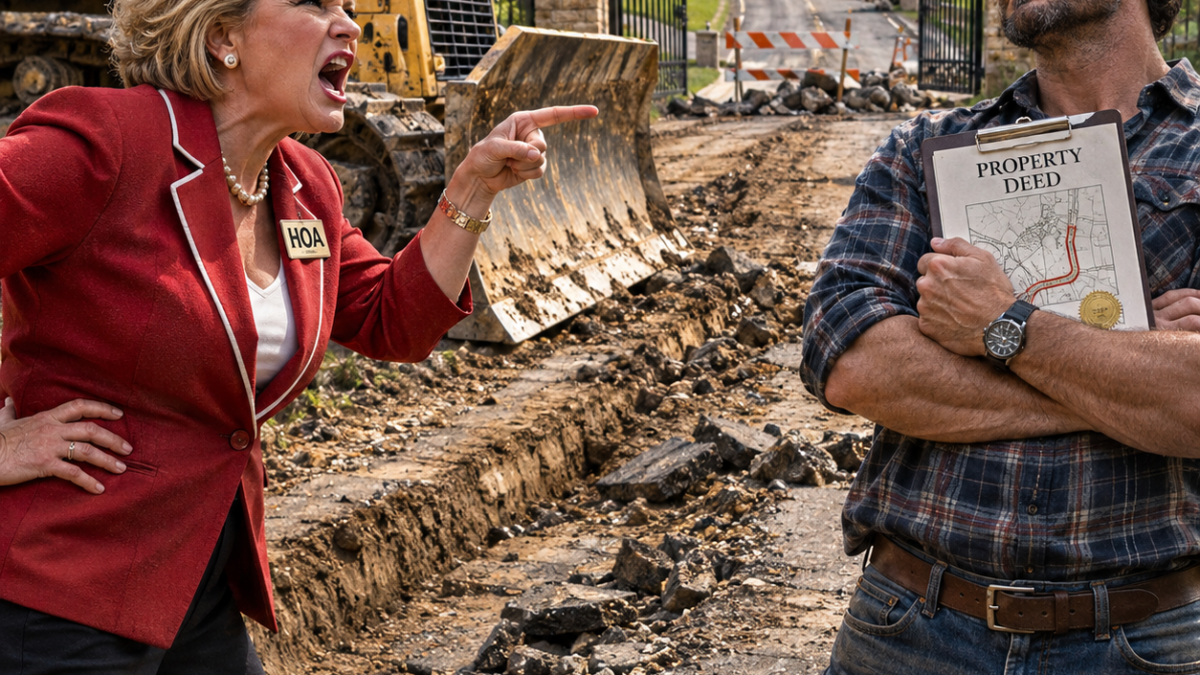
PART 2
I should have asked Ruth about that creek strip right then.
Instead, I looked down at the pie.
“Peach?”
She nodded.
“My brother-in-law’s favorite.”
“Much obliged.”
That night, I ate two slices at the kitchen counter and stared through the window toward the little vegetable garden.
My late wife, Emily, would have laughed at me.
Not because of the HOA.
Because I had planted too many tomatoes.
“You always overengineer everything, Dan,” she used to tell me.
I could hear her voice so clearly that for a moment the empty kitchen didn’t feel empty.
Then headlights swept across the front window.
A black SUV slowed on the road outside.
Vivian’s.
It stopped for several seconds.
Then moved on.
I set my fork down.
Whatever game Vivian Whitlock was playing, I had no intention of joining it.
That was my first mistake.
Because Vivian didn’t need me to join.
She had already decided I was playing.
—
The next notice arrived on Thursday.
This one was different.
**FINAL NOTICE OF NONCOMPLIANCE.**
I stood at the mailbox reading it twice.
The HOA demanded that I remove my vegetable garden, replace my mailbox, repaint my detached workshop, reduce the fence height, and submit my property for “architectural review.”
At the bottom, someone had typed:
**Failure to comply may result in escalating enforcement action.**
I laughed.
Not because it was funny.
Because sometimes absurdity reaches a point where your brain doesn’t know what else to do.
I walked inside, opened the drawer, and placed the letter on top of the others.
Then I called the number printed at the bottom.
Vivian answered herself.
“Willow Creek Homeowners Association.”
“Mrs. Whitlock, Daniel Mercer.”
Silence.
Then:
“Have you reconsidered?”
“I’m calling because I want this harassment to stop.”
“Enforcement is not harassment.”
“You have no authority over my property.”
“We have authority over the community.”
“I’m not part of your community.”
“You live in Willow Creek Valley.”
“My deed says private parcel.”
“Your deed is an inconvenience.”
That sentence told me more than any of her letters had.
I leaned against the kitchen counter.
“Mrs. Whitlock, are you saying you intend to ignore a recorded deed because you find it inconvenient?”
“I’m saying people who want to live peacefully with their neighbors eventually learn to cooperate.”
“And people who want to avoid lawsuits eventually learn where their property line ends.”
Her voice went cold.
“Is that a threat?”
“No, ma’am.”
I looked at the drawer full of notices.
“That was free advice.”
She hung up.
Two days later, the real trouble started.
—
Saturday morning began with diesel engines.
I woke before sunrise to the low mechanical rumble of heavy equipment.
For one disorienting second, I thought I was back on a job site.
Then I looked out my bedroom window.
A yellow bulldozer was sitting on the gravel access road.
I pulled on jeans and boots and stepped outside.
There were three workers.
A dump truck.
A compact excavator.
And Vivian Whitlock.
She stood beside her SUV holding a paper coffee cup.
I walked toward them.
“What’s going on?”
She took a slow sip.
“Drainage improvements.”
“On my access road?”
“Association contractors are correcting runoff problems.”
I looked past her.
The bulldozer had already pushed a berm of dirt across the narrow gravel lane.
My road.
My only vehicle access to the county highway.
“Stop the machine.”
Vivian didn’t move.
“Mr. Mercer—”
I raised my voice.
“Stop the machine.”
The operator looked toward us.
Vivian waved for him to continue.
He hesitated.
I walked directly toward the bulldozer.
That stopped him.
He shut down the engine and climbed out.
He was maybe thirty.
Work boots, sunburned neck, tired eyes.
“Sir, I’m just doing the job they gave me.”
“Did they tell you this is a recorded access road?”
His face changed.
Vivian snapped, “Kyle, get back in the machine.”
I pointed toward the gravel beneath our feet.
“This is the only road to my house.”
Vivian crossed her arms.
“You can use the service path behind the north field.”
“That isn’t a road.”
“It’s passable.”
“Not by a truck.”
“Then walk.”
I stared at her.
She smiled.
That smile was the moment everything changed for me.
Before that morning, I thought Vivian was just another petty HOA president drunk on a little authority.
But this wasn’t about mailbox colors.
This wasn’t about grass height.
She had brought machinery.
She had paid men to physically isolate me on my own property.
“Mrs. Whitlock,” I said quietly, “you understand that if you block this road, emergency vehicles cannot reach my house.”
“You’re being dramatic.”
“Fire truck?”
“No fire.”
“Ambulance?”
“You appear healthy.”
I took one step closer.
“What if I’m not tomorrow?”
For the first time, the workers stopped looking at me and started looking at her.
Vivian noticed.
Her tone sharpened.
“This project is approved. Continue.”
Kyle glanced at me.
“Sir?”
I looked at him.
“You know what a recorded easement is?”
He nodded slowly.
“My dad does excavation.”
“Then you know what happens when somebody knowingly destroys one.”
His eyes dropped toward the ground.
Vivian said, “You’re paid by the hour, Kyle.”
He swallowed.
“I’m sorry, sir.”
Then he climbed back into the bulldozer.
I stepped away.
And watched them bury my road.
It took less than four hours.
Four hours to build a wall of compacted dirt and broken stone high enough that my pickup couldn’t cross it.
They even dug a drainage trench along the eastern side, making it impossible to go around.
When they finished, Vivian walked back toward her SUV.
I stood beside my truck.
“You’re really doing this?”
She opened the driver’s door.
“I gave you opportunities to cooperate.”
“With rules that don’t apply to me.”
“You could have avoided all of this.”
“So this is punishment?”
She looked at me over the door.
“This is community planning.”
Then she drove away.
—
I called the county.
They sent someone Monday afternoon.
He stood beside the dirt berm, took photographs, looked at my deed, scratched his chin, and finally said the words I had already expected to hate.
“This may be a civil matter.”
“Civil?”
“The HOA says drainage work.”
“They blocked a recorded access.”
“I understand.”
“This is my only road.”
“I understand.”
“Then do something.”
He sighed.
“I can document it. You may need an attorney.”
I looked at the mountain of dirt.
In the Army, we called something like that a choke point.
You didn’t block a choke point unless you understood exactly what force you were containing.
Vivian Whitlock had never bothered to find out.
For three days, my truck sat trapped.
I climbed over the berm every morning.
Crossed the north field.
Walked nearly two miles to the closest store.
People from Willow Creek drove past me.
Some recognized me.
A few waved awkwardly.
Most looked away.
Word was spreading.
The outsider had fought the HOA.
The HOA had won.
At least, that was the story Vivian was telling.
On the third afternoon, a dusty blue Ford pulled onto the shoulder beside me.
Ruth leaned across and opened the passenger door.
“Get in, soldier.”
I raised an eyebrow.
“Soldier?”
“You walk like one.”
“Old habits.”
“Bring your deed next time.”
“Why?”
She looked at me.
“Because I found Walter’s papers.”
I got in.
—
Ruth’s house sat along the creek in the older section of the valley.
It was smaller than most of the homes in Willow Creek.
No decorative fountain.
No stone entrance.
No matching mailboxes.
Just a porch, wind chimes, flower beds, and a kitchen that smelled like cinnamon.
She placed a cardboard document box on the table.
“Walter gave these to me before he died.”
“You said he sold half his property.”
“He did.”
She opened the box.
“Not all of it.”
Inside were deeds, surveys, correspondence, plats, and legal agreements going back decades.
My instincts kicked in.
I stopped seeing paper.
I started seeing terrain.
Property lines.
Access routes.
Drainage rights.
Easements.
Control points.
Ruth handed me a yellowed agreement dated 1987.
“Read paragraph six.”
I did.
Then I read it again.
Then a third time.
The agreement involved Walter Pritchard and the original Willow Creek development corporation.
Walter had granted the subdivision permission to cross a narrow strip of land along Pritchard Creek.
Permission.
Not ownership.
The association could use the strip for its main entrance road under one specific condition:
**The gravel access road serving the Pritchard residence must remain unobstructed and continuously accessible.**
My pulse slowed.
Not accelerated.
That was something Emily always used to notice.
When I got truly angry, I became calm.
Ruth watched my face.
“What?”
I pointed at the paragraph.
“The association’s main entrance crosses Walter’s creek strip.”
“Yes.”
“You said Walter kept that strip.”
“Yes.”
“When I bought his remaining parcel, was the creek strip included?”
Ruth slid another survey toward me.
I unfolded it.
There it was.
A narrow strip following the creek.
Running directly beneath the paved entrance road used by Willow Creek.
The legal description matched my deed.
I looked up.
“Ruth.”
She nodded.
“You own it.”
I sat back.
The entire main entrance to Willow Creek crossed my land.
And the agreement giving them permission to use it depended on them keeping my gravel road open.
Vivian had not merely blocked my road.
She had violated the condition protecting hers.
“Why didn’t Walter ever enforce this?”
Ruth stared at the table.
“He wanted to.”
“What stopped him?”
“Cancer.”
That took some of the triumph out of the discovery.
She folded her hands.
“By the time he understood what she had done, he was sick. The lawyers exhausted him. Vivian knew it. She fined him. Delayed things. Sent letters. Threatened liens. Made him attend hearing after hearing.”
Ruth’s voice cracked.
“He sold her land for a dollar because he didn’t have the strength left to fight.”
I looked down at the agreement.
“But he kept the creek strip.”
“He said someday she would push the wrong person too far.”
I swallowed.
“Did he know me?”
“No.”
Ruth gave a sad little smile.
“But I think he was hoping someone like you would eventually show up.”
For the first time since Emily died, I felt something I hadn’t expected to feel again.
Not happiness.
Purpose.
—
Ruth made coffee while I photographed every document.
I called my attorney from her kitchen.
His name was Michael Grant.
Former military lawyer.
The kind of man who sounded bored until someone handed him a legal problem interesting enough to wake him up.
I emailed the agreement.
Ten minutes later, he called back.
“Daniel.”
“Yeah?”
“Where did you get this?”
“Previous owner’s family.”
Silence.
Then I heard paper moving.
“Send me your current deed.”
I did.
Another ten minutes.
Then he started laughing.
Not chuckling.
Laughing.
“What?”
“Daniel, I apologize.”
“You finished?”
“No.”
He laughed again.
“What am I missing?”
“You’re not missing anything. That’s why this is funny.”
“Explain.”
“The HOA’s access agreement is conditional. Very clearly conditional.”
“I saw that.”
“They had permission to cross the creek strip only as long as access to the Pritchard residence remained open.”
“They buried my road.”
“I know.”
“And I own the creek strip.”
“You do.”
“So?”
“So unless there’s a superseding agreement somewhere, Mrs. Whitlock just terminated her own association’s right to use its main entrance.”
I looked toward Ruth.
She was smiling for the first time.
“How many houses are in Willow Creek?”
Michael asked.
“About four hundred.”
He whistled.
“Daniel, do not touch anything.”
“Meaning?”
“Do not block the road. Do not put up a cone. Do not put up a gate. Do not even stand there looking threatening until I confirm the title chain.”
“You think it’s real?”
“I think it’s beautiful.”
—
The next morning, someone knocked on my door.
That was difficult considering my road was blocked.
I opened it to find Kyle, the bulldozer operator.
He had walked in.
He held an envelope.
“Mr. Mercer?”
“Yeah.”
“I need to talk to you.”
I stepped outside.
He looked nervous.
“I’m the guy who built your wall.”
“I remember.”
“I didn’t know what it was when we started.”
“You knew after I told you.”
His eyes dropped.
“Yeah.”
I waited.
“I’m sorry.”
That mattered more than he probably realized.
“Why are you here?”
He handed me the envelope.
Inside was a photocopy of an invoice.
**Whitlock Site Services.**
Forty-eight thousand dollars.
Description:
**Emergency drainage stabilization and roadway protection.**
I stared at the amount.
“You got paid forty-eight thousand?”
Kyle laughed bitterly.
“I got four hundred.”
“Who owns Whitlock Site Services?”
“Mrs. Whitlock’s nephew.”
Of course.
Kyle rubbed the back of his neck.
“They used association road funds.”
“For four hours of bulldozer work?”
“Yes.”
“Why are you giving me this?”
“Because she told my boss the real reason.”
I looked at him.
“What reason?”
Kyle hesitated.
Then said it.
“She wanted to make you leave.”
The air felt suddenly very still.
“She said once you couldn’t access the property, you’d sell. Her nephew wants the land.”
I remembered the real estate agent.
The association president had tried to buy my parcel.
I had outbid her.
My property had been intended for phase two.
Thirty luxury lots.
For her nephew.
This had never been about a mailbox.
Or tomatoes.
Or paint.
It had been about land.
Kyle continued.
“I heard them arguing. My boss said blocking a private road was illegal. She said the county would call it civil and you’d get tired before anything happened.”
I folded the invoice.
“What made you change your mind?”
He looked toward the garden.
“My dad lost his shop when I was a kid. Bigger company squeezed him until he couldn’t afford the lawsuit.”
He met my eyes.
“I watched people do to him what she’s doing to you.”
I nodded.
“You want to make it right?”
“Yes.”
“Then I’m going to need your help.”
“With what?”
I looked toward the distant creek entrance.
“Building a gate.”
—
Michael confirmed everything forty-eight hours later.
The title was clean.
The creek strip belonged to me.
No later agreement superseded Walter’s 1987 condition.
Vivian’s decision to obstruct my access had triggered the termination clause.
Her association no longer had a legal right to use the section of road crossing my property.
I asked the obvious question.
“Can I close it?”
Michael paused.
“Legally?”
“Yes.”
“Yes.”
“Safely?”
“Different question.”
I liked Michael.
“Go on.”
“You need notice. Documentation. Survey markers. Sheriff informed. County informed. Everything photographed. No traps. No barriers people can accidentally hit. Emergency services need a temporary protocol.”
“I already thought of all that.”
“I assumed you had.”
“Anything else?”
“Yes.”
“What?”
“Daniel?”
“Yeah?”
“Try not to enjoy this too much.”
I looked at the mountain of dirt trapping my truck.
“No promises.”
—
I don’t get angry the way some men do.
I don’t throw things.
I don’t scream.
I spent too many years around heavy equipment and explosives to believe anger improves decision-making.
I get organized.
By Thursday, I had a survey crew confirming the boundaries.
By Friday, my attorney had delivered formal notice to the HOA.
By Friday afternoon, the county had copies.
The sheriff’s department had copies.
The fire department had copies.
The road department had copies.
Emergency access procedures were arranged.
Kyle helped me install two steel posts well inside my property line.
Between them, we mounted a heavy ranch gate.
Nothing fancy.
Nothing threatening.
Just steel.
Strong hinges.
A legal sign.
**PRIVATE PROPERTY. ACCESS BY PERMISSION ONLY.**
Saturday morning, I closed it.
At 7:12 a.m., the first Willow Creek resident arrived.
A man in a golf shirt stopped his SUV.
He stared at the gate.
He got out.
Read the sign.
Looked at me.
“What is this?”
“Private road.”
“This is the subdivision entrance.”
“Yes, sir.”
“You can’t close it.”
I held out a copy of the notice.
“Actually, I can.”
He read two paragraphs.
Then looked over his shoulder toward the line of cars forming behind him.
“Oh, hell.”
By 7:30, there were twelve cars.
By 8:00, thirty.
By 9:15, the line wrapped past the fountain.
People honked.
Someone shouted.
Someone else called the sheriff.
And at 9:42, a black SUV came flying toward the gate.
Vivian Whitlock stepped out before the vehicle had completely stopped.
Her face was red.
“What do you think you are doing?”
I stood on my side of the gate.
“Morning, Mrs. Whitlock.”
“Open this immediately.”
“No.”
“Four hundred families live behind this entrance!”
“Yes, ma’am.”
“You cannot imprison an entire neighborhood!”
“They’re not imprisoned.”
“There is no other vehicle entrance!”
“That sounds like a planning problem.”
Her mouth opened.
Then closed.
She recognized her own phrase.
“Open the gate.”
I pointed toward the dirt wall visible across the field in the distance.
“My road is still closed.”
“That has nothing to do with this.”
“Legally, it has everything to do with this.”
She grabbed the gate.
“Arrest him!”
A sheriff’s deputy standing nearby sighed.
“Mrs. Whitlock, we’ve already discussed this.”
“He is obstructing a public road!”
“It isn’t public.”
“He’s holding residents hostage!”
“He isn’t preventing anyone from leaving their homes. He’s denying use of private property after the association’s access permission terminated.”
Vivian stared at him.
“What?”
The deputy handed her a copy of Michael’s letter.
She didn’t read it.
She slapped it away.
“I pay taxes in this county.”
“So does Mr. Mercer.”
“Then push the gate open.”
The deputy’s expression hardened.
“Ma’am, if you damage that gate or cross that boundary after being told not to, you may be arrested for trespassing or property damage.”
She pointed at me.
“He is doing this out of revenge.”
I shook my head.
“No, ma’am.”
“What would you call it?”
“Consequences.”
That silenced her.
Only for a second.
Then she turned toward Kyle.
He was standing near his truck.
“You.”
Kyle blinked.
“Ma’am?”
“Take the gate down.”
“No.”
“I hired you.”
“Not for this.”
“I’ll pay you.”
“No.”
“I’ll pay you double.”
Kyle looked at the dirt berm blocking my road.
“Last time you paid forty-eight thousand dollars for four hours of work.”
A few residents close enough to hear us stopped talking.
Vivian’s face changed.
Kyle continued.
“I got four hundred.”
“What are you doing?”
“I’m telling the truth.”
Several phones came out.
Vivian noticed.
“Put those cameras away!”
Nobody did.
The deputy looked at Kyle.
“Forty-eight thousand?”
Kyle nodded.
“Association road fund.”
I saw the moment Vivian realized she had more than one problem.
—
By noon, there were more than sixty vehicles sitting near the entrance.
Some residents were furious with me.
Others were furious with Vivian.
Most had no idea what was happening.
I understood their anger.
They hadn’t bulldozed my road.
They hadn’t sent me notices.
They hadn’t tried to force me off my land.
They were people trying to get home from grocery stores, kids’ games, work, and Saturday errands.
So I walked along the line handing out copies of the 1987 agreement.
One man refused to take it.
“You’re a selfish bastard.”
“Maybe.”
“You’re punishing us for something Vivian did.”
“I’m asking your board to fix what Vivian did.”
“My wife has medication in the car.”
I immediately opened the gate and waved him through.
That surprised him.
“I thought—”
“I’m not here to hurt anyone.”
Another resident approached.
An elderly woman.
“What about caregivers?”
“Through.”
“Deliveries?”
“Essential deliveries can pass.”
“Emergency vehicles?”
“They already have access.”
She looked toward Vivian.
Then back at me.
“So what are you doing?”
“Making your board come to the table.”
For the first time, she smiled.
“Good.”
By afternoon, residents were organizing rides through the secondary pedestrian path.
A few parked outside and walked.
Some cursed me.
Some brought me coffee.
One brought a folding chair.
Another brought a cooler.
It became less like a standoff and more like the strangest neighborhood meeting I had ever attended.
At 3:00 p.m., one of the HOA board members approached.
His name was Thomas Reed.
He looked exhausted.
“Mr. Mercer.”
“Mr. Reed.”
“We’re calling an emergency board meeting tonight.”
“What time?”
“Seven.”
“I’ll be there.”
Vivian appeared behind him.
“No, you won’t.”
Thomas turned.
“He owns the road, Vivian.”
“He is not an association member.”
“He has relevant evidence.”
“He has no right to speak.”
I folded my arms.
Thomas looked at me.
“Seven o’clock. Clubhouse.”
“I’ll bring paperwork.”
Vivian stepped closer.
“You think you’ve won?”
I looked at her.
“No, ma’am.”
Then I glanced toward the line of cars.
“I think you lost.”
—
The Willow Creek clubhouse could hold maybe two hundred people.
That night, almost four hundred tried to get inside.
Residents stood along the walls.
Packed the hallway.
Crowded around open windows.
Some watched from outside through the glass.
When I entered with Ruth, the room went quiet.
Vivian sat at the front table.
Her nephew sat beside her.
I recognized him from county property records.
Caleb Whitlock.
Developer.
Owner of Whitlock Site Services.
The man who wanted my land.
Vivian picked up the microphone.
“This meeting will come to order.”
Someone shouted, “Open the road!”
Another person yelled, “Why did you close his?”
Then the room erupted.
Vivian hammered a wooden gavel.
“Order!”
Nobody listened.
She hammered again.
Finally, Thomas Reed stood.
“Everyone, please.”
The room settled.
Vivian immediately began.
“We are facing an unprecedented attack on our community by an individual who has chosen to hold four hundred families hostage over a minor drainage dispute.”
I almost admired the audacity.
Minor drainage dispute.
She continued.
“Mr. Mercer has illegally blocked the main entrance and endangered residents.”
The sheriff’s deputy standing at the back raised his eyebrows.
I waited.
Vivian kept talking.
She used words like extortion.
Retaliation.
Hostile outsider.
Threat.
Then she pointed toward me.
“I propose the association immediately file suit and seek damages sufficient to force Mr. Mercer to remove his obstruction.”
A few people applauded.
Not many.
Thomas looked at me.
“Mr. Mercer, you asked to speak.”
Vivian slammed the gavel.
“He is not a member.”
A voice came from the back.
“Tonight he owns our front door.”
Laughter broke through the room.
Vivian’s nephew stood.
“This isn’t funny.”
“No,” I said.
I walked toward the front.
“It isn’t.”
I placed a folder on the table.
“My name is Daniel Mercer. I bought the Pritchard property legally. I am not a member of this HOA. I never agreed to your covenants, and your board has no authority over my home.”
I held up the stack of violation notices.
“Despite that, your president sent me these.”
The room murmured.
“Mailbox.”
I dropped one on the table.
“Fence.”
Another.
“Grass.”
Another.
“My truck.”
Another.
“My late wife’s vegetable garden.”
That quieted the room.
I looked toward Vivian.
“She knew I wasn’t a member.”
“That is your interpretation,” she said.
“No.”
I held up my deed.
“That is the county recorder’s interpretation.”
A few people laughed.
I continued.
“Then Mrs. Whitlock hired contractors to block the only vehicle access to my home.”
Vivian interrupted.
“Drainage maintenance.”
Kyle stood from the second row.
“No, it wasn’t.”
Every head turned.
Vivian froze.
Kyle walked forward.
“She told us to close his road.”
“That is a lie.”
Kyle pulled out his phone.
“I have messages.”
You could feel the room change.
People leaned forward.
He read aloud.
“Make sure Mercer cannot get a vehicle through. Once he understands how inconvenient that parcel is, he’ll reconsider selling.”
Nobody spoke.
Caleb Whitlock stood.
“You can’t prove who sent that.”
Kyle held up the screen.
“Your company phone number.”
Caleb sat back down.
I almost felt sorry for him.
Almost.
Then Kyle handed Thomas the forty-eight-thousand-dollar invoice.
“This was billed to the HOA road fund.”
Thomas stared at it.
“What?”
Vivian stood.
“That invoice is confidential.”
Someone in the crowd shouted:
“Forty-eight thousand?”
Another:
“For that pile of dirt?”
Another:
“My dues paid for that?”
The room exploded.
Vivian hammered the gavel so hard the head broke loose.
That didn’t help.
Thomas raised his voice.
“Everyone!”
Eventually, the room settled again.
He looked at Kyle.
“How much were you paid?”
“Four hundred dollars.”
Silence.
Thomas turned toward Vivian.
“Where did the rest go?”
“Administrative and equipment expenses.”
Kyle shook his head.
“No.”
Caleb said, “This is ridiculous.”
I opened the second folder.
“This is the 1987 access agreement between Walter Pritchard and the original Willow Creek development company.”
Ruth stood beside me.
For the first time all evening, Vivian looked afraid.
Not angry.
Afraid.
I read the key paragraph aloud.
The association could cross the Pritchard Creek strip only while the gravel road serving the Pritchard residence remained unobstructed.
Then I unfolded the current survey.
“That creek strip was never transferred to the association.”
I pointed toward the map.
“It belongs to me.”
A man near the front whispered, “Oh my God.”
I continued.
“When Mrs. Whitlock closed my road, your association violated the condition granting access across my property.”
Vivian said, “That document is nearly forty years old.”
“So is your right to use the entrance.”
Her face drained of color.
Michael Grant, my attorney, stood from the back.
“The title company, county records office, and independent surveyor have all confirmed Mr. Mercer’s ownership.”
Vivian stared at him.
“Who are you?”
“His attorney.”
She laughed once.
A desperate sound.
“Lawyers. How adorable.”
Michael smiled.
“I’ve been called worse.”
Thomas rubbed both hands over his face.
“What does Mr. Mercer want?”
That was the moment everyone expected me to name a number.
A big one.
I could see it in their faces.
Vivian probably expected millions.
Her nephew looked like he was already calculating what a lawsuit might cost.
I looked at Ruth.
Then at the people packed into the room.
“I’ll reopen the main entrance for one dollar a year.”
Nobody reacted at first.
They thought they had misheard.
Thomas blinked.
“One dollar?”
“One dollar.”
Vivian narrowed her eyes.
“What’s the trick?”
“No trick.”
“Then why close it?”
“Because you wouldn’t listen while my road was buried.”
I turned toward the residents.
“I don’t want your houses. I don’t want your association dues. I don’t want to punish four hundred families.”
Then I looked at Vivian.
“I want two things.”
Thomas nodded.
“Name them.”
“First, rebuild my road.”
Someone called out, “Done.”
Several people applauded.
“Second,” I said, “independent audit of the HOA road fund.”
The applause stopped.
Vivian stood.
“Absolutely not.”
And with those two words, she destroyed whatever support she still had.
Thomas stared at her.
“Why not?”
“Because it is unnecessary.”
“Forty-eight thousand dollars was spent.”
“For authorized work.”
“On the private road of a man who isn’t even a member?”
Vivian pointed at me.
“This is exactly what he wants. Division.”
“No,” Ruth said.
Her voice wasn’t loud.
But the room went quiet anyway.
She walked slowly toward the front.
“I knew Walter Pritchard.”
Vivian’s expression changed.
Ruth continued.
“He was my brother-in-law.”
Nobody interrupted.
“For years, he came home from HOA hearings exhausted. He had cancer. Some days, he could barely stand.”
Ruth looked directly at Vivian.
“And she knew.”
Vivian sat very still.
“She fined him for his fence. His shed. His driveway. His garden hose. His truck. She threatened foreclosure over fees he did not owe.”
A woman in the crowd covered her mouth.
Ruth’s voice shook.
“He sold half his land for one dollar because he wanted peace before he died.”
She placed her hand on the 1987 agreement.
“But he kept the creek strip.”
Ruth looked at me.
“I never understood why until now.”
I swallowed hard.
Neither had I.
She turned back to the room.
“Walter knew he couldn’t fight forever.”
Her eyes filled.
“So he left one door unlocked for the next person.”
The clubhouse was silent.
I looked down at the table because suddenly I couldn’t look at Ruth.
For two years after Emily died, I had believed the garden was the only promise I still had left to keep.
But standing in that room, I realized I had inherited another promise from a man I never met.
Don’t let them do it again.
Thomas stood.
“I move for an immediate independent audit of the road fund.”
Another board member said, “Second.”
Vivian slammed her hand onto the table.
“No.”
Thomas looked at her.
“That’s a motion.”
“I am president.”
“Then call the vote.”
“I refuse.”
Someone shouted from the audience:
“Then vote her out!”
The room erupted.
Caleb grabbed Vivian’s arm.
“Let’s leave.”
She pulled away.
“No.”
Thomas opened the bylaws.
I watched his eyes move down the page.
Then he looked up.
“Special removal vote.”
Vivian laughed.
“You need cause.”
Thomas held up the invoice.
“I think we have cause.”
—
The vote wasn’t even close.
Forty-one authorized votes to remove Vivian Whitlock from the board.
Two against.
One of the two was Caleb.
When Thomas announced the result, nobody cheered at first.
They simply exhaled.
Like an entire room had been holding its breath for years.
Vivian stood.
Her chair scraped sharply across the floor.
“You’re making a mistake.”
Thomas looked tired.
“Maybe.”
“You have no idea what I’ve done for this community.”
A man in the crowd said, “We’re starting to.”
A few people laughed.
Vivian pointed at Kyle.
“You’re fired.”
Kyle folded his arms.
“Ma’am, I don’t work for you.”
Then she pointed at the HOA manager.
“You’re fired.”
The manager shook his head.
“You’re not president anymore.”
That got the loudest reaction of the night.
Vivian turned to me.
Her face was pale, but her eyes burned.
“This isn’t over.”
I thought about giving her some dramatic answer.
Something clever.
Something that would sound good repeated later.
Instead, I said the truth.
“It could have been over the day I told you I wasn’t in your association.”
For once, Vivian had nothing to say.
She walked out.
Caleb followed.
The clubhouse doors closed behind them.
Nobody moved for several seconds.
Then Ruth touched my arm.
“Walter would have liked you.”
I looked at the old agreement on the table.
“I think I’d have liked him too.”
—
The gate reopened the next morning.
I didn’t make the residents wait for the audit.
That had never been the point.
At 6:30 a.m., I unlocked it.
By 6:45, traffic was moving normally.
At 7:15, someone left a paper bag hanging from the gate.
Inside were two breakfast sandwiches and a note.
**Sorry we blamed you before we knew the truth.**
At 8:00, someone left coffee.
By noon, there were six handwritten notes.
One resident brought tomatoes.
I looked at them and laughed.
Emily would have appreciated the irony.
The new board moved fast.
Thomas served as acting president while the audit began.
The association hired an accounting firm from outside the county.
They also hired a contractor to rebuild my gravel road.
Not Caleb’s company.
A real road company.
The superintendent walked the damage with me.
“We’ll have this fixed properly.”
“How long?”
“Three days.”
Kyle stood nearby.
Thomas pointed toward him.
“I’d like him on the crew.”
Kyle blinked.
“Why?”
Thomas smiled.
“You know the road.”
Kyle looked at me.
I shrugged.
“Paid by the hour.”
He laughed.
“Worth every penny.”
—
The audit took six weeks.
It found far more than the forty-eight-thousand-dollar invoice.
For years, contracts had repeatedly gone to companies connected to Vivian’s relatives.
Landscaping.
Snow removal.
Drainage.
Security.
Clubhouse repairs.
Consulting.
Some were overpriced.
Some had almost no documentation.
A few appeared to bill for work residents said had never happened.
The independent auditor didn’t call it theft.
Auditors are careful with words.
He called it:
**Significant financial irregularities requiring legal review.**
Michael laughed when he read that phrase.
“That means the accountant is screaming without using an exclamation point.”
The board turned everything over to counsel.
Then to the appropriate authorities.
I stayed out of that part.
That surprised some people.
One neighbor stopped me near the gate.
“You don’t want to see her charged?”
“If she committed crimes, that’s for investigators.”
“After everything she did to you?”
I looked toward my rebuilt road.
“I wanted my access back.”
“And revenge?”
I thought about it.
“Revenge is letting someone else control your life after they’re gone.”
He nodded slowly.
“So what was the gate?”
“Leverage.”
That made him laugh.
—
Vivian didn’t disappear immediately.
People like her rarely do.
Losing authority didn’t convince her she had been wrong.
It convinced her everyone else had betrayed her.
She filed complaints.
She threatened litigation.
She claimed the board vote had been improper.
She sent letters accusing Thomas of conspiracy.
She tried to challenge my creek-strip ownership.
Michael answered each one.
Calmly.
Professionally.
Brutally.
Every time she sent ten pages, he replied with three.
Facts.
Dates.
Parcel numbers.
Recorded documents.
No insults.
No anger.
She hated that more than anything.
One afternoon, Michael called.
“She filed for an injunction against your gate.”
“On what grounds?”
“That you may close it again.”
“Can I?”
“Yes.”
“Am I?”
“No.”
“Then what’s the problem?”
“There isn’t one.”
I heard papers moving.
“The judge denied emergency relief.”
“That fast?”
“She attached the 1987 agreement herself.”
I laughed.
“She submitted the document that proves my case?”
“Yes.”
“Why?”
“Because she highlighted the part allowing the HOA to cross your land.”
“And ignored the condition?”
“She highlighted around it.”
I sat down at the kitchen table.
For the first time in weeks, I laughed until my stomach hurt.
Emily would have loved Michael.
—
By early fall, the garden was producing more vegetables than one man could possibly eat.
Ruth came over every Wednesday.
Sometimes with pie.
Sometimes with bread.
Sometimes empty-handed, which I preferred because it meant she finally believed she didn’t need an excuse to visit.
She showed me how Walter used to stake tomatoes.
I showed her the bench I had built beside the garden for Emily.
One evening, we sat there as the sun dropped behind the valley.
Ruth looked at the rows of vegetables.
“Your wife would have liked this.”
“I hope so.”
“You still talk to her?”
I stared at the garden.
“Sometimes.”
“Good.”
I looked at Ruth.
“You think that’s strange?”
“At my age?”
She laughed softly.
“I talk to more dead people than living ones.”
That made me smile.
We sat in silence for a while.
Then Ruth said, “Walter changed after Vivian started going after him.”
“How?”
“He became embarrassed.”
I looked at her.
“For being harassed?”
“That’s what people like her do.”
Ruth picked at a loose thread on her sleeve.
“They make you feel foolish for objecting. Difficult for defending yourself. Selfish for wanting what was already yours.”
I knew exactly what she meant.
That first week, standing beside my buried road, part of me had wondered whether I was overreacting.
Maybe I should compromise.
Maybe I should replace the mailbox.
Maybe the garden wasn’t worth the trouble.
That was how coercion worked.
Not always by overpowering you.
Sometimes by making resistance feel unreasonable.
Ruth continued.
“Near the end, Walter told me something.”
“What?”
“He said, ‘The worst thing I did was keep trying to prove to her that I was a good neighbor.’”
I looked toward the creek.
“Why was that the worst thing?”
“Because she never cared whether he was good.”
Ruth stood.
“She only cared whether he obeyed.”
That sentence stayed with me.
—
The board eventually elected a new permanent president.
They asked me to attend the meeting.
I declined.
I wasn’t an HOA member.
I had fought hard enough to establish that fact.
But Thomas called the next evening.
“You should know who won.”
“Who?”
“Ruth.”
I nearly dropped the phone.
“Ruth?”
“Forty-six votes.”
“She doesn’t even like meetings.”
“She said the same thing.”
I drove to her house.
She answered the door wearing a look of complete irritation.
“You.”
“Madam President.”
“Don’t start.”
I laughed.
“You ran?”
“No.”
“How did you win?”
“Apparently people wrote my name down.”
“Forty-six of them?”
She crossed her arms.
“I blame you.”
“That seems unfair.”
“They said I stood up to Vivian.”
“You did.”
“I baked a pie.”
“A powerful pie.”
She tried not to smile.
Failed.
Then she reached into her pocket.
“You still owe me something.”
“What?”
“The lease.”
I understood.
The new HOA had approved my proposal.
One dollar per year for access across the creek strip.
I pulled a dollar bill from my wallet.
Ruth looked at it.
“You’re paying yourself?”
“No.”
I placed it in her hand.
“You’re the president.”
Her expression softened.
“This was Walter’s.”
“The land?”
“The fight.”
I shook my head.
“He did the hard part.”
I folded her fingers around the dollar.
“He kept the strip.”
Ruth’s eyes filled.
“He always wondered if that mattered.”
“It mattered.”
She looked down at the bill.
Then whispered:
“I wish I could tell him.”
“You can.”
Ruth looked at me.
I nodded toward the creek.
“Apparently we’re allowed to talk to dead people.”
She laughed through her tears.
A week later, she framed the dollar.
It hung in the HOA office beside a copy of the 1987 agreement.
Under it, she put a small brass plaque:
**ACCESS IS A PRIVILEGE. RESPECT IS A CONDITION.**
I told her that sounded too dramatic.
She told me to shut up.
—
Winter came early that year.
The first snow covered the repaired gravel road in six inches of white.
At sunrise, I heard a plow.
I stepped outside.
Kyle was driving.
He lowered the window.
“Morning!”
“You work snow now?”
“New board hired us.”
“Us?”
He pointed toward the logo on the truck.
Kyle had started his own excavation company.
Nothing big.
One truck.
One skid steer.
A used excavator.
Thomas had helped him get insurance paperwork together.
A few residents recommended him for private jobs.
“Congratulations,” I said.
“Thanks.”
He looked toward my mailbox.
“You know that thing is still the wrong model.”
I stared at him.
He grinned.
I threw a snowball at the truck.
He drove away laughing.
—
For the first time since buying the house, winter felt peaceful.
No notices.
No black SUV slowing outside.
No blue HOA folders.
The drawer in my kitchen remained closed.
Sometimes I opened it anyway.
Not because I needed the letters.
Because they reminded me how small the whole thing had started.
A mailbox.
A garden.
A fence.
That’s the danger with people like Vivian.
They rarely begin by demanding everything.
They begin by demanding something small enough that resistance makes you look unreasonable.
Change the mailbox.
Move the garden.
Sign the form.
Accept the fine.
Let us measure the fence.
Let us decide what belongs to you.
Then one morning you wake up and someone has bulldozed your only road.
—
In February, I received a certified letter.
Not from Vivian.
From her attorney.
She was withdrawing all claims against me.
No apology.
No admission.
Just withdrawal.
Michael called.
“You disappointed?”
“About what?”
“No dramatic courtroom finale.”
I looked through the window at the snow-covered garden.
“No.”
“You sure?”
“Yeah.”
“Most clients want the other side humiliated.”
“I saw her face at the clubhouse.”
“Fair point.”
“What happens with the financial investigation?”
“Still ongoing.”
“Do I need to do anything?”
“No.”
“Good.”
I started to hang up.
Michael said, “Daniel.”
“Yeah?”
“You handled this well.”
I almost laughed.
“I closed the entrance to four hundred homes.”
“Temporarily.”
“I made an HOA president lose her job.”
“She managed most of that herself.”
“I used a forty-year-old easement agreement as leverage.”
Michael paused.
“That part was beautiful.”
I smiled.
“Take care, counselor.”
“You too.”
—
Spring brought rain.
The creek rose.
The vegetable garden returned.
This time, I planted fewer tomatoes.
Emily would have been proud.
Ruth disagreed.
“You need more.”
“I had tomatoes until Christmas last year.”
“That sounds like success.”
“That sounds like poor planning.”
She handed me another seedling.
“Plant it.”
“Yes, Madam President.”
She glared at me.
I planted it.
The neighborhood changed after Vivian left.
Not dramatically.
People still argued over dues.
Someone still complained about lawn ornaments.
There were still meetings nobody wanted to attend.
But the board published expenses online.
Contracts over a certain amount required multiple bids.
Residents could review invoices.
Meeting minutes were public.
No violation notice could be issued to a nonmember property without legal review.
That last rule was unofficially called the Mercer Rule.
I hated the name.
Ruth loved it.
“What if there’s another private parcel someday?” she asked.
“There isn’t.”
“Then the rule will last forever without being tested.”
“That’s not how rules should work.”
“You really were an engineer.”
—
One Saturday afternoon, a couple stopped beside my garden.
They were new residents.
Young.
Two kids in the back seat.
The husband pointed toward the creek entrance.
“Are you the gate guy?”
I closed my eyes.
“Please tell me people don’t call me that.”
His wife laughed.
“They absolutely do.”
“Wonderful.”
Their daughter leaned out the window.
“Did you really trap everybody?”
“No.”
Her father said, “He kind of did.”
I pointed toward him.
“Don’t encourage her.”
The girl looked serious.
“Why?”
I thought about how to explain the whole thing to a nine-year-old.
“Someone blocked my road.”
“So you blocked theirs?”
“Basically.”
She nodded.
“That’s fair.”
Her mother said, “We are trying to teach nuance.”
I smiled.
“Good luck.”
Before they left, the husband became more serious.
“My dad used to live here.”
“In Willow Creek?”
“Yeah.”
“He knew Walter.”
I looked at him.
“What did he say about him?”
“He said Walter was stubborn.”
I laughed.
“That sounds promising.”
“He also said everybody knew what Vivian was doing, but nobody wanted to get involved.”
The smile faded.
“Why?”
“Because it wasn’t happening to them.”
There it was.
The sentence that explained almost everything.
Not just Willow Creek.
A lot of life.
People tolerate unfairness surprisingly well when someone else is paying for it.
Until the road leads to their own front door.
—
In May, I received another envelope.
Handwritten.
No return address.
Inside was a single sheet of paper.
Daniel,
You believe you won because people turned against me.
You did not win.
You destroyed the value of this community.
You embarrassed people who spent years building it.
Eventually, they will understand what you cost them.
—V.W.
I read it twice.
Then I put it in the drawer.
Not because it frightened me.
Because it belonged with the others.
The last piece of a story I hoped was finished.
It wasn’t.
—
Three weeks later, a white sign appeared on the vacant parcel beside mine.
**NOTICE OF SALE.**
I slowed my truck.
The property had been unused for years.
Eight acres.
Mostly meadow.
A small stand of pine near the back.
I stopped when I saw the purchaser listed at the bottom.
**Buyer: K. Whitlock.**
I stared at the name.
Then laughed.
Not Vivian.
K. Whitlock.
Caleb.
Her nephew.
“Here we go again,” I muttered.
That evening, Ruth arrived before I could call her.
“You saw it?”
“Yep.”
“What are you going to do?”
“Nothing.”
She stared.
“Nothing?”
“He bought land.”
“You don’t trust him.”
“No.”
“You think Vivian is behind it?”
“Probably.”
“And you’re doing nothing?”
I looked toward the neighboring field.
“Ruth, you ever fish?”
“No.”
“Fishing teaches patience.”
“You don’t fish.”
“No.”
“Then that metaphor is useless.”
I laughed.
“Come inside. I have coffee.”
“I brought pie.”
“Peach?”
“Apple.”
“Things really are changing.”
—
Caleb began construction in June.
Survey stakes appeared.
Then equipment.
Then a sign.
**WHITLOCK RIDGE — SIX EXCLUSIVE ESTATE HOMES.**
Six.
Not thirty.
Apparently the audit and board changes had damaged the original development plan.
I didn’t object.
His land.
His project.
As long as he stayed on his side of the line, I had no problem.
For two weeks, he did.
Then one morning I found orange paint across my creek strip.
Utility markings.
I called the number on the stake.
A contractor answered.
“We’re installing water lines for Whitlock Ridge.”
“Across parcel 18-C?”
“Let me check.”
Paper rustled.
“Yes.”
“That parcel is mine.”
Silence.
“We were told there’s an association utility easement.”
“There isn’t.”
Another silence.
“I’ll call you back.”
Twenty minutes later, Caleb’s truck arrived.
He got out.
No greeting.
“You called the utility contractor?”
“They marked my property.”
“There’s an easement.”
“Show me.”
“It’s part of the subdivision plan.”
“Show me.”
He stared.
I waited.
Caleb finally said, “You enjoy this, don’t you?”
“Paperwork?”
“Power.”
I nearly laughed.
“You think this is power?”
“You closed four hundred families out of their neighborhood.”
“I closed my property after your aunt blocked my home.”
“You humiliated her.”
“She did that herself.”
“You destroyed her reputation.”
“She billed your company forty-eight thousand dollars to bury my road.”
His jaw tightened.
“That was legal work.”
“Then the audit shouldn’t bother you.”
He took one step closer.
“You cost my family hundreds of thousands of dollars.”
“And there it is.”
“What?”
“The real conversation.”
Caleb looked away.
I continued.
“You don’t care about the HOA.”
“You don’t know what I care about.”
“You care about my parcel.”
He said nothing.
“Your aunt wanted it for phase two.”
Still nothing.
“You bought the neighboring lot because you think eventually I’ll sell.”
Caleb finally looked at me.
“Everyone sells.”
“My wife is buried forty minutes from here.”
His expression shifted.
“I planted that garden because she never got the yard she wanted.”
I pointed toward my house.
“I’m not going anywhere.”
For a moment, Caleb seemed almost human.
Then he said, “We’ll see.”
And there was Vivian’s voice.
Not literally.
But close enough.
—
I called Michael.
He checked the utility documents.
No easement.
The contractor pulled the markings.
Caleb moved the planned water line.
That should have ended it.
Instead, small things started happening.
A survey marker disappeared.
Then another.
Someone dumped tree branches near my fence.
A drone hovered over my garden three afternoons in a row.
One night, headlights sat on the neighboring lot for almost an hour.
I documented everything.
No accusations.
No confrontation.
Photographs.
Dates.
Times.
Coordinates.
That was another lesson from engineering.
If you think something matters, measure it.
—
Then someone cut my fence.
I found the opening at 6:10 one morning.
Two sections of wire clipped cleanly.
Not storm damage.
Not animals.
Cut.
I called the sheriff.
Deputy Harris arrived.
Same man who had been at the gate months earlier.
He crouched beside the wire.
“Clean cut.”
“Yep.”
“Cameras?”
“Front and house perimeter. Not this corner.”
He looked toward Caleb’s construction site.
“You suspect someone?”
“I suspect whoever cut it.”
Harris smiled slightly.
“Good answer.”
He photographed the damage.
“Anything taken?”
“No.”
“Animals get out?”
“I don’t have livestock.”
“Then why cut it?”
“That’s what I’d like to know.”
He stood.
“Upgrade the cameras.”
“Already ordered.”
As he walked away, he stopped.
“Daniel.”
“Yeah?”
“Don’t let this turn into the last situation.”
I understood.
“Meaning?”
“Don’t wait until somebody builds a wall.”
I nodded.
“I won’t.”
—
The next camera caught the answer.
Not Caleb.
Not Vivian.
One of Caleb’s subcontractors.
A man in a reflective vest crossed my property at 2:13 a.m., walked to the fence, and removed a temporary marker I had installed beside the creek.
He then photographed the ground.
The sheriff identified him.
When questioned, he said Caleb had asked him to verify an old boundary.
Caleb denied telling him to trespass.
Nothing major happened legally.
A warning.
Documentation.
The subcontractor was told to stay off my property.
But something about the incident bothered me.
Why that spot?
I pulled out Walter’s old survey.
Then the new survey.
Then Caleb’s development plan from county records.
His planned private access road came within thirty feet of the creek strip.
Too close.
I drove to Ruth’s.
She looked at the maps.
“What am I looking at?”
“I think Caleb has a problem.”
“Good.”
“No.”
I pointed.
“He bought eight acres for six estate houses.”
“Yes.”
“The county road frontage is narrow.”
“So?”
“So emergency-access requirements.”
She waited.
“He needs a second approved route.”
Ruth’s eyes widened.
“Across your land?”
“Probably.”
“Can he do that?”
“No.”
She smiled.
“You look disappointed.”
“I am.”
“Why?”
“Because people do stupid things when they’ve already spent money based on something they don’t actually own.”
Ruth folded the map.
“What are you going to do?”
“Wait.”
She shook her head.
“You and your imaginary fishing.”
—
Two weeks later, Caleb came to my door.
No lawyer.
No contractor.
Just Caleb.
He held a folder.
“Can we talk?”
“Sure.”
We sat on the porch.
He opened the folder.
Development drawings.
“I need a secondary emergency route.”
“I know.”
He stared at me.
“How?”
“Your subcontractor was interested in a very specific part of my fence.”
He sighed.
“Right.”
“How much land do you need?”
“Twenty-foot emergency easement along the creek strip.”
“No.”
“Daniel.”
“No.”
“You haven’t heard the offer.”
“Because the answer isn’t about money.”
He leaned back.
“You enjoy saying that.”
“You enjoy asking for things you don’t own.”
His expression hardened.
Then softened.
“I’ll pay two hundred thousand.”
“No.”
“Two-fifty.”
“No.”
“Three hundred.”
I shook my head.
Caleb closed the folder.
“What do you want?”
There it was.
The same question Thomas had asked at the clubhouse.
What do you want?
Money?
Revenge?
Power?
I looked toward Emily’s garden.
“I want your family to stop treating property boundaries like suggestions.”
“I’m not Vivian.”
“Then prove it.”
“How?”
“Don’t trespass. Don’t cut fences. Don’t send contractors onto my land. Don’t mark utilities across property you don’t own.”
“I didn’t cut your fence.”
“I didn’t say you did.”
“You think I did.”
“I think you created an environment where people working for you believed my property rights were an inconvenience.”
That hit him harder than I expected.
Because it was the same language Vivian had used.
Your deed is an inconvenience.
Caleb stared at the porch floor.
“What would it take for you to grant the easement?”
I thought about Walter.
About one dollar.
About leverage.
“Reconfigure the project.”
His head snapped up.
“That’s not an answer.”
“Build fewer houses. Create compliant access from your own frontage.”
“That costs me millions.”
“That sounds like a planning problem.”
His eyes narrowed.
Again, his aunt’s words returned to him.
He stood.
“You really have been waiting to say that.”
“A little.”
He left without shaking my hand.
—
Construction slowed.
Then stopped.
Rumors moved through Willow Creek.
Caleb was fighting with investors.
The county had rejected his current access plan.
One of his lenders wanted additional guarantees.
Vivian had apparently put money into the project.
For two months, nothing happened next door.
Then one October morning, Caleb returned.
He looked different.
Tired.
No expensive jacket.
No folder.
“Can we talk?”
I poured coffee.
We sat on the porch again.
He didn’t negotiate this time.
“My aunt told me the creek strip belonged to the association.”
I said nothing.
“She said Walter’s agreement guaranteed access.”
“It did.”
“She never mentioned the condition.”
I waited.
“She told me your parcel would eventually become part of phase two.”
“Did you believe her?”
“Yes.”
“Why?”
“She built most of this place.”
“No.”
I looked at him.
“Developers built this place. Contractors built it. Families bought houses. Residents paid dues.”
Caleb’s face tightened.
“She ran it.”
“That’s different.”
He nodded slowly.
“My entire project was based on access she promised me.”
“There’s your problem.”
“I know.”
He stared into his coffee.
“She told me if we made living here uncomfortable enough, you’d sell.”
There it was.
The last piece.
Not new information.
Confirmation.
I felt anger.
Real anger.
For the first time in months.
But underneath it was something else.
Sadness.
Because Caleb sounded less like a villain and more like a man finally realizing that someone he trusted had taught him the wrong rules.
“She used you too,” I said.
He looked up sharply.
“Don’t.”
“Doesn’t excuse what you did.”
“Good.”
“But it’s true.”
He stood.
“I didn’t come for sympathy.”
“Why did you come?”
“To ask one last time.”
“For the easement?”
“Yes.”
“No.”
He nodded.
“I figured.”
He turned toward the steps.
“Caleb.”
He stopped.
“If you redesign the project to four houses instead of six, the county frontage may support compliant access.”
He looked back.
“I know.”
“So why haven’t you?”
“Because four houses make the numbers ugly.”
“Ugly isn’t the same as impossible.”
“No.”
He looked toward the meadow.
“My aunt always said if the numbers are ugly, make someone else pay.”
I didn’t say anything.
Caleb laughed without humor.
“I guess I’m learning new math.”
—
Whitlock Ridge became four homes.
No easement across my property.
No secondary road through the creek strip.
Caleb took a financial loss.
Not ruin.
Not bankruptcy.
A loss.
He sold the first house the following summer.
The buyers came by to introduce themselves.
Nice couple.
Quiet.
They asked about the fence.
I told them the property line.
They respected it.
That was all I ever wanted.
—
Vivian’s story ended more quietly.
The financial investigation eventually led to a civil settlement involving repayment of disputed HOA funds and permanent restrictions on her serving as an association officer.
Caleb’s company repaid part of the forty-eight-thousand-dollar road invoice.
The association recovered additional money connected to several questionable contracts.
No dramatic handcuffs.
No courthouse staircase.
No screaming arrest.
For some residents, that was disappointing.
For me, it was enough.
Because the most important consequence had already happened.
Nobody was afraid of her anymore.
She still lived in Willow Creek for a while.
Sometimes I saw her SUV.
She never stopped at my gate.
Never measured my fence.
Never commented on the garden.
Then one winter, a real estate sign appeared outside her house.
**FOR SALE.**
Ruth called me.
“You hear?”
“Yes.”
“Going to celebrate?”
“No.”
“Liar.”
“I might have pie.”
“That’s celebrating.”
“Then bring peach.”
Two months later, Vivian moved.
No farewell.
No final confrontation.
Just a moving truck.
I watched it pass over the creek strip and felt almost nothing.
That surprised me.
I had imagined that moment many times.
I thought I would feel triumph.
Instead, I felt relief.
The kind you feel when a storm finally moves far enough away that you stop listening for thunder.
—
Years later, the gate is still there.
Most days it stays open.
There is a recorded one-dollar-per-year access lease between my property and the Willow Creek HOA.
Every January, the association president delivers one dollar.
Ruth insists on doing it personally.
Every year, I hand the dollar back.
Every year, she refuses.
“It belongs to the association.”
“You framed the first one.”
“Historical artifact.”
“You’re impossible.”
“I’m president.”
“Temporary condition.”
She narrows her eyes.
“You want me to measure your fence?”
That usually ends the argument.
The garden is bigger now.
There’s a wooden sign at the entrance.
**EMILY’S GARDEN.**
I didn’t put it there.
One spring, Kyle and several neighbors installed it while I was away visiting my daughter.
I stood staring at it for a long time.
Kyle shifted awkwardly.
“If you hate it, we can take it down.”
“No.”
I touched the carved letters.
“Leave it.”
That night, I sat on the bench beside the tomatoes until the sun disappeared.
For years, grief had made the future feel like an insult.
Every new season arrived without Emily.
Every project I finished was something she would never see.
Every peaceful evening felt incomplete because the chair beside me was empty.
But somewhere between Ruth’s pies, Walter’s papers, Kyle’s apology, and four hundred neighbors learning how close they had come to losing control of their own community, the house stopped feeling like the place I had moved after my wife died.
It became home.
Not because nothing bad happened there.
Because something worth protecting did.
—
One afternoon, a little boy from the neighborhood stopped beside the garden.
He pointed toward the main entrance.
“Mr. Mercer?”
“Yeah?”
“My dad says you own the road.”
“A piece of it.”
“Why don’t you close it?”
I looked toward the open gate.
“Why would I?”
“Because you can.”
I smiled.
There was the whole lesson in one question.
Because you can.
That had been Vivian’s philosophy.
She had authority, so she used it.
She had influence, so she pushed.
She had money, so she pressured.
She had lawyers, so she frightened people.
She thought power meant being able to make someone else smaller.
I crouched so the boy didn’t have to look up at me.
“Being able to do something isn’t the same as having a good reason to do it.”
He thought about that.
“Then why have the gate?”
“So everyone remembers where the line is.”
He nodded like that made perfect sense.
Maybe children understand boundaries better than adults.
—
A few weeks later, I found the old drawer open.
Ruth had been helping me clean the kitchen.
“What’s all this?”
“The original violation letters.”
She pulled out the first one.
“Mailbox not approved.”
“Serious offense.”
She found another.
“Truck color?”
“Apparently blue was dangerous.”
“Fence height.”
“National emergency.”
Then she found the vegetable-garden notice.
Her expression changed.
I took it from her.
For years, I had kept every letter because I believed documentation mattered.
It did.
But I didn’t need them anymore.
I carried the stack outside.
Ruth followed.
“What are you doing?”
I walked to the workshop shredder.
“Making room.”
“For what?”
I looked toward the garden.
“Seed catalogs.”
She smiled.
One by one, the notices disappeared into the machine.
Mailbox.
Fence.
Truck.
Grass.
Garden.
All of Vivian’s little attempts to tell me what belonged to her.
Gone.
I kept only three things.
Walter’s agreement.
The one-dollar lease.
And the first handwritten note someone left on my gate:
**Sorry we blamed you before we knew the truth.**
Those weren’t reminders of the fight.
They were reminders of what came after.
—
The mailbox is still the same one.
Black metal.
Slight dent on the left side.
Not an approved Willow Creek model.
Nobody has complained in years.
The fence is still “too tall.”
The truck is still blue.
The garden is visible from the clubhouse road.
And every summer, I plant one row too many tomatoes.
Some habits are worth keeping.
People sometimes ask me whether I regret closing the gate.
I always give them the same answer.
I regret that it became necessary.
I regret that Walter didn’t have someone beside him when Vivian was pushing him out.
I regret that hundreds of neighbors stayed quiet because the fight wasn’t theirs yet.
I regret that a young contractor had to choose between a paycheck and doing what he knew was right.
I regret that Vivian had so many chances to stop and never took one.
But closing the gate?
No.
I don’t regret that.
Because the truth is, I never wanted revenge.
I wanted a boundary.
And some people don’t recognize boundaries until they meet one made of steel.
Vivian thought she had trapped me when she buried my only road.
She believed inconvenience would turn into fear.
Fear would turn into surrender.
And surrender would give her the land she had wanted from the beginning.
Instead, she gave me the one thing I hadn’t known I possessed.
Leverage.
Walter had left it buried in old paperwork for nearly forty years.
A narrow creek strip.
A forgotten condition.
One sentence in an old agreement.
She had spent years forcing people to obey rules she controlled.
Then, for once, she ran into a rule she couldn’t rewrite.
She closed my road.
So the agreement closed hers.
That was never the part that stayed with me, though.
The part I remember most happened long after the lawyers left, after the audit was finished, after Vivian moved away.
It was a warm evening in late summer.
Ruth sat beside me in Emily’s garden.
Kyle had dropped off fresh gravel earlier that afternoon.
Children were riding bicycles along the clubhouse road.
Cars passed through the open entrance beyond the creek.
Nobody honked.
Nobody shouted.
Nobody was afraid.
Ruth looked toward the road.
“You know what Walter would say?”
“What?”
She smiled.
“He’d say you should’ve charged them two dollars.”
I laughed so hard I nearly spilled my coffee.
“Greedy man.”
“Terrible.”
We sat there until the light faded.
Before leaving, Ruth stopped beside the garden sign.
“She would’ve liked it here.”
I knew she meant Emily.
My throat tightened.
“Yeah.”
Ruth touched my shoulder.
“I think she would’ve liked what you did with the place.”
After she left, I stayed outside alone.
The garden moved gently in the evening breeze.
Tomato vines climbed their stakes.
The creek reflected the last orange light.
Beyond it, the gate stood open.
And for the first time since Emily died, I didn’t look at the empty space beside me and think only about what I had lost.
I thought about what remained.
A home.
A garden.
Good neighbors.
A promise kept for my wife.
A promise completed for a man I never met.
And one old road leading through the valley.
Vivian Whitlock once stood beside the wall blocking my driveway and told me I would have to learn to cooperate.
In a strange way, she was right.
I did learn.
I learned that cooperation without choice is just obedience.
I learned that kindness does not require surrender.
I learned that peace bought by letting someone take a little more from you every week is not peace.
And I learned that sometimes the quietest person in the argument isn’t afraid.
Sometimes he’s just reading the deed.
As for the HOA?
They still cross my land every single day.
For one dollar a year.
Ruth still keeps the first dollar framed in the clubhouse.
Kyle still plows my road every winter.
Caleb built his four houses and, to his credit, never crossed my property line again.
Walter’s name remains on the original agreement.
Emily’s name is carved above the garden.
And my mailbox?
Still not approved.
I think I’m going to keep it that way.








