PART 2: HOA Karen Bulldozed My Only Access Road—Then Her Own Propane Truck and Fire Department Couldn’t Get Through
PART 2
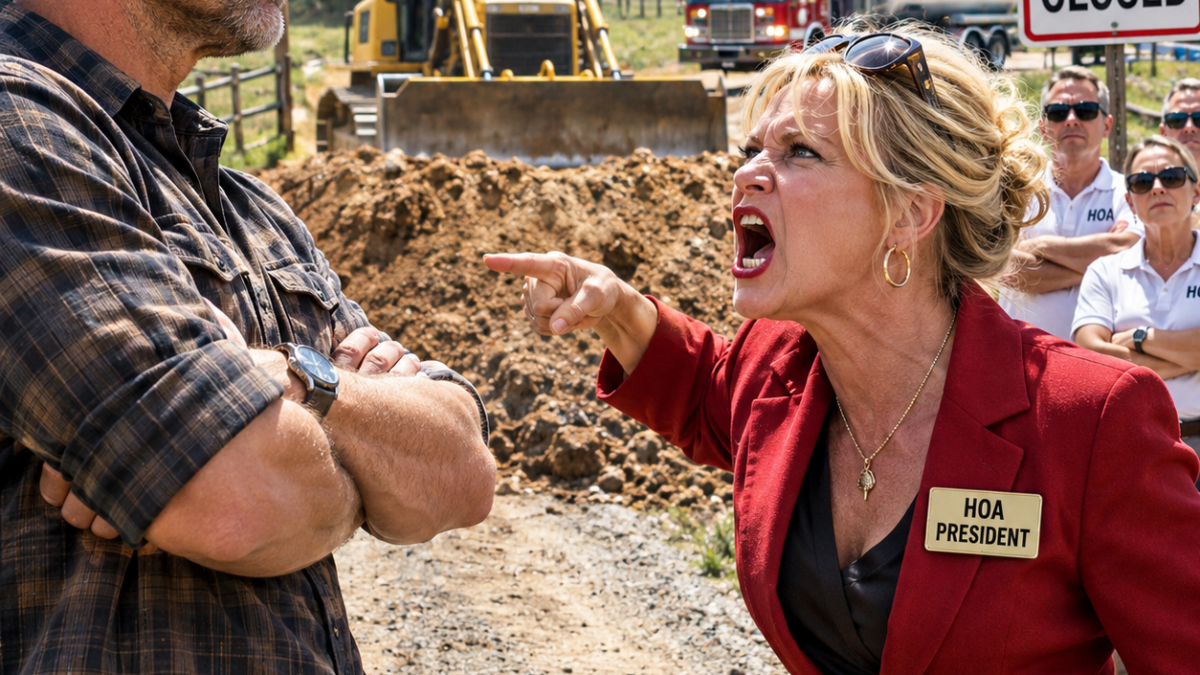
The bulldozer stopped twenty yards from my driveway.
I walked toward the road slowly.
There were two laborers standing beside a dump truck and a younger man inside the bulldozer cab.
Karen had one hand on her hip.
The other held a travel mug.
She looked perfectly comfortable.
“What’s happening?” I asked.
“Road work.”
“What kind?”
“Corrective work.”
“That doesn’t answer the question.”
“It answers enough of it.”
I looked past her.
The bulldozer blade was already biting into the shoulder.
Mud rolled forward in a thick brown wave.
“You have a permit?”
Karen smiled.
“I’m president of the HOA.”
“That wasn’t my question.”
Her expression tightened.
“You have been warned repeatedly about your conduct regarding this access road.”
“My conduct?”
“The commercial propane vehicle you allowed onto the road caused excessive rutting.”
I almost laughed.
That was what this was about.
Two days earlier, the propane company had delivered fuel to my house.
The same truck then continued directly to Karen’s mansion and filled her tank.
One vehicle.
One road.
Two customers.
Karen had called me an hour later and demanded five hundred dollars for road repairs.
I refused.
She threatened to “review” my access privileges.
Apparently, this was the review.
“The truck serviced your house too,” I said.
“That is irrelevant.”
“It is literally the same truck.”
“My delivery had already been scheduled.”
“That doesn’t change what the tires did.”
“You are responsible for the damage near your section.”
“There is no damage.”
“There are ruts.”
“It’s a gravel road.”
“You are becoming argumentative.”
“And you’re bringing a bulldozer onto a recorded easement.”
Karen turned toward the operator.
“Continue.”
The young man looked at me.
Then at her.
“Ma’am…”
“I said continue.”
He lowered the blade.
I didn’t step in front of it.
I didn’t shout.
I didn’t touch anyone.
I stood well back, pulled out my phone, and started recording.
Karen noticed.
“Put that away.”
“No.”
“You don’t have permission to record me.”
“We’re outside.”
“This is HOA property.”
“No. This is a recorded shared easement.”
Her face flushed.
“You always have an answer, don’t you?”
“Usually when I’ve read the documents.”
That irritated her more than yelling would have.
The bulldozer pushed another mound of dirt across the road.
Then another.
Dump trucks unloaded soil.
Rock.
Broken sod.
By eight-thirty that morning, a six-foot berm crossed the entire road.
By nine, it was nearly eight feet high.
My truck sat on my side.
Karen’s Lexus was outside toward the county road.
Her mansion sat beyond the barrier on the same side as my house.
She had physically cut both homes off from vehicular access.
Apparently, she hadn’t noticed that detail.
Or she didn’t think it mattered.
When the equipment finally stopped, she walked toward me.
“This should give you time to reconsider your attitude.”
I lowered my phone.
“My attitude?”
“Your unwillingness to cooperate.”
“You blocked the only road to my home.”
“Temporarily.”
“With eight feet of dirt.”
“If you had simply paid the assessment, none of this would have been necessary.”
I stared at her.
There are moments when anger arrives hot.
Fast.
Loud.
This wasn’t one of them.
My anger went cold.
That was usually more dangerous.
Twenty years in uniform had taught me something useful: when someone makes a catastrophic mistake because they’re emotional, arrogant, or overconfident, interrupting them can be an act of mercy.
Sometimes the smartest thing you can do is let them finish.
So I nodded.
“All done?”
Karen looked almost disappointed that I wasn’t yelling.
“Yes.”
“Good.”
I turned toward my house.
Behind me, she called out, “I suggest you use this opportunity to review the HOA standards.”
I kept walking.
“I intend to review a lot of things.”
Inside, I made coffee.
Then I cleared my dining room table.
I brought out the HOA binder.
My deed.
The recorded easement.
The survey from closing.
The county plat.
Satellite maps.
I laid everything out.
For two hours, I read.
Not skimmed.
Read.
The access road was not Karen’s private road.
It was not even solely HOA property.
It was a legally recorded shared access easement benefiting both parcels.
The language was clear.
Neither party could materially obstruct ingress or egress.
Karen had just done exactly that.
Not by mistake.
Not because of a fallen tree.
Not because of emergency construction.
Deliberately.
I checked the grading regulations next.
Major earthwork required permits.
Drainage review.
Erosion-control measures.
Depending on volume and slope, sometimes engineering approval.
Karen had done none of it.
I looked through the window at the wall.
She thought she had built a prison.
What she had actually built was evidence.
I retrieved my DSLR camera from the office.
Then I began documenting.
Wide photographs first.
The entire road.
My truck.
The berm.
Karen’s house.
Then close-ups.
Bulldozer tracks.
Freshly cut soil.
Broken vegetation.
Drainage channels.
The edge of the easement.
Survey markers.
I recorded video while narrating the date and approximate time.
Then I launched my drone.
From two hundred feet up, the insanity became impossible to deny.
The gravel road came off the county highway in one clean line.
The berm cut directly across it.
My property was beyond it.
Karen’s property was beyond it.
Her pool was visible.
Her large white propane tank was visible.
And that was when I noticed something that made me lower the controller and stare at the screen.
Her propane tank wasn’t a little residential bottle.
It was enormous.
The kind serviced by heavy trucks.
The same trucks that now had no way to reach it.
I zoomed in.
Then I looked toward the mansion.
October nights were getting colder.
Karen heated the house with propane.
The pool too, from what neighbors had told me.
I remembered something else.
The road was also the only realistic route for emergency vehicles.
A fire engine wasn’t crossing an eight-foot dirt wall.
Neither was an ambulance.
Karen had blocked my road to punish me.
But roads don’t care who you’re punishing.
They either work or they don’t.
I landed the drone.
Backed up every file twice.
Uploaded another copy to secure cloud storage.
Then I made my first call.
County planning and zoning.
A woman named Brenda answered.
She sounded tired until I said:
“I need to report unpermitted grading that has completely obstructed a recorded access easement.”
There was a pause.
Then her tone changed.
“Completely obstructed?”
“Yes.”
“What kind of obstruction?”
“Approximately eight feet of compacted dirt and rock across the road.”
Another pause.
“Was this storm damage?”
“No, ma’am.”
“Construction?”
“Deliberate construction.”
“Permit number?”
“I don’t believe one exists.”
Keyboard keys started clicking.
“Give me the parcel.”
I did.
More clicking.
“I’m not showing any grading permit.”
“I didn’t think you would.”
“Do you have photographs?”
“About two hundred.”
“Video?”
“Yes.”
“Can you send representative files?”
“Immediately.”
She gave me an email address.
Before hanging up, she said, “Mr. Donaldson, do not alter the site yourself before inspection.”
“I wasn’t planning to.”
That was true.
Karen had created the evidence.
I wanted it preserved exactly as she left it.
My second call was to Frank Delaney.
Frank had been an Army JAG officer when I knew him.
Now he practiced real estate and contract law.
He loved two things professionally:
Clean documents.
And bullies who put stupid things in writing.
I explained everything.
There was a long silence.
Then:
“She did what?”
“Built an eight-foot berm across the road.”
“With equipment?”
“Yes.”
“You filmed it?”
“Yes.”
“Please tell me you filmed her directing it.”
“I did.”
Frank began laughing.
“Arthur, you have no idea how happy you just made my morning.”
“She trapped me on my property.”
“I know. That isn’t the funny part.”
“What is?”
“She documented intent.”
“Meaning?”
“She threatened your access after you disputed an assessment, then shortly afterward physically obstructed the easement. You have the prior letters?”
“Every one.”
“The five-hundred-dollar assessment?”
“Yes.”
“Her threat about reviewing access privileges?”
“I wrote down the call immediately afterward.”
“Excellent.”
“Excellent?”
“For us.”
He became serious.
“Do not talk to her.”
“I wasn’t planning to.”
“Do not threaten her. Do not touch the berm. Do not move one shovel of dirt.”
“Understood.”
“Let the county inspect. I’m preparing a demand letter and civil complaint.”
“What claims?”
“Interference with easement rights. Private nuisance. Possibly intentional interference with quiet enjoyment. Damages for lost access. We’ll look at the HOA structure and determine whether she acted personally, as an officer, or both.”
He paused.
“Arthur?”
“Yeah?”
“You said both houses use propane?”
“Yes.”
“How much does hers hold?”
“Looks like roughly a thousand gallons.”
“And delivery requires this road?”
“Absolutely.”
He made a thoughtful sound.
“Call the propane company.”
“I already thought about that.”
“Good. Don’t complain. Don’t demand they punish her. Just inform their safety department that their customer’s tank is now inaccessible because of unpermitted earthwork.”
“What are you thinking?”
“Propane companies hate uncontrolled site hazards. Their lawyers hate them even more.”
I smiled.
“So I let everyone react to what she actually did.”
“Exactly.”
“Frank?”
“Yes?”
“I think I’m going to enjoy working with you.”
“I was about to say the same thing.”
The propane company transferred me three times before I reached a regional safety manager named Bill.
I kept the conversation factual.
No insults.
No Karen stories.
Just access.
Tank location.
Berm dimensions.
Unpermitted grading.
Photographs.
Bill asked one question.
“Can emergency personnel physically reach the tank shutoff?”
“Not by vehicle.”
“Can our delivery truck reach the tank?”
“No.”
“Can you email the drone video?”
“Already preparing it.”
His voice became very flat.
Professional.
“That site is going to be placed on temporary service hold pending safety review.”
“What does that mean?”
“No deliveries.”
I said nothing.
Bill continued.
“An inaccessible bulk propane tank is not something we play with. If there were a leak, impact, fire, regulator problem, or line failure, we need access.”
“Understood.”
“We’ll notify the account holder.”
“Thank you.”
I hung up.
I didn’t celebrate.
Not yet.
This wasn’t a game.
A propane tank truly could be dangerous if emergency crews couldn’t reach it.
That was the part Karen had never considered.
She had focused so intensely on punishing me that she had created a hazard beside her own home.
The county inspector arrived the next morning.
His name was Mark.
He parked on the county side of the berm and stood staring at it for several seconds before saying anything.
“Who built this?”
“The HOA president directed it.”
“You have proof?”
“Yes.”
“Why?”
“She says road maintenance.”
Mark looked at the eight-foot wall.
“This isn’t maintenance.”
He spent nearly an hour taking measurements.
He photographed the road.
Checked the slope.
Looked at disturbed drainage.
Compared the site with the plat.
He asked whether there was another road to either house.
“No.”
“Emergency access?”
“Not with that berm.”
He looked toward Karen’s mansion.
“Fire apparatus?”
“No.”
“Propane?”
“Both houses.”
Mark shook his head.
“This was a terrible idea.”
Finally.
Someone had said it out loud.
Karen appeared near her lawn.
“What are you doing?”
Mark introduced himself.
Her posture changed immediately.
“You’re trespassing.”
“I’m inspecting reported grading work affecting a recorded access corridor.”
“This is HOA maintenance.”
“Permit?”
“I don’t need one.”
Mark looked at the berm.
“Yes, you do.”
“I am president of the association.”
“That doesn’t exempt you from county grading rules.”
“I know the county supervisor personally.”
“Then he can explain the ordinance to you too.”
I almost smiled.
Karen pointed at me.
“He called you because he’s angry about an assessment.”
Mark didn’t even look at me.
“I’m here because someone moved enough soil to block a road and alter drainage without authorization.”
“It will be corrected when he becomes cooperative.”
Mark stopped writing.
“Ma’am.”
His voice changed.
“Are you saying you are intentionally maintaining the obstruction until that property owner agrees to your demands?”
Karen realized too late what she had said.
“I’m saying this is an internal HOA matter.”
Mark wrote something on his clipboard.
Then he walked to his truck.
Ten minutes later, a bright red notice was attached to a wooden stake hammered beside the berm.
STOP WORK ORDER
Below it:
NOTICE OF VIOLATION
Karen stared at it.
I stood on my porch holding coffee.
She looked at me.
I lifted the cup.
Not in a toast.
Just enough for her to know I had seen everything.
Her face turned crimson.
The first official letter reached her that afternoon.
The propane company followed.
Then Frank’s demand letter.
By the end of the week, Karen was facing county penalties that increased while the obstruction remained, a suspended propane account, a lawyer demanding restoration of my easement and damages, and growing questions from residents.
She had wanted to make my life inconvenient.
Instead, she had created three separate problems for herself in forty-eight hours.
But the berm still stood.
And I left it there.
That surprised Karen.
She probably expected me to become desperate.
I wasn’t.
I had food.
Electricity.
Running water.
My property backed onto trails I could use on foot if I absolutely needed to leave.
It was inconvenient.
I was angry.
But I wasn’t helpless.
What bothered me more than being trapped was a question that kept returning.
How comfortable Karen had been doing it.
There had been no hesitation.
No fear that neighbors might object.
No concern that the county might intervene.
No pause before she used HOA authority as a weapon.
People don’t become that comfortable with abuse on their first attempt.
So I started looking.
County property records are boring.
That’s useful.
People hide lies inside emotion.
Paperwork doesn’t care.
I searched sales in Willow Creek during Karen’s years as president.
Properties that turned over unusually quickly.
Owners who sold below the neighborhood trend.
Cases involving liens or disputes.
One name caught my attention.
Arthur and Eleanor Henderson.
They had owned a house in Willow Creek for fifteen years.
Two years earlier, they had sold and moved into a small downtown condominium.
I found a public address.
Then I drove as far as I could, walked around the berm, arranged a ride, and visited Arthur Henderson.
He answered the door wearing gardening gloves.
Late seventies.
Thin.
Careful movements.
Kind eyes.
There were rose plants all over the balcony behind him.
“Mr. Henderson?”
“Yes?”
“My name is Arthur Donaldson. I live in Willow Creek Estates.”
His expression changed.
“You bought the property at the end of the access road?”
“Yes.”
“And Karen is still president?”
“Yes.”
He gave a tired laugh.
“Of course she is.”
He invited me in.
I told him about the berm.
For several seconds, he simply stared.
Then he shook his head.
“She finally went that far.”
“Finally?”
Arthur sat down.
His hands trembled slightly as he removed his gloves.
“My wife loved roses.”
He looked toward the balcony.
“Eleanor could grow roses anywhere. Bad soil. Too much shade. Too much rain. Didn’t matter. She knew exactly what they needed.”
His voice softened.
“She won prizes.”
“What happened?”
“Karen.”
One word.
That was all he needed.
The story came slowly.
First, Karen claimed Eleanor’s trellises were unauthorized structures.
Then she objected to a rose variety that wasn’t on an approved landscaping list.
Then fertilizer.
Then edging.
Then a gardening bench.
Then a birdbath.
Letters became fines.
Fines became hearings.
Hearings became threats.
Eleanor was already dealing with heart problems.
The HOA fight consumed her.
“She started checking the mailbox three times a day,” Arthur said. “Every time a certified letter came, her hands would shake.”
I felt my jaw tighten.
“She stopped working in the garden.”
He looked away.
“The roses died before she did.”
The room became very quiet.
Arthur stared at his hands.
“We finally sold.”
“Because of the HOA?”
“Because I thought moving would give her peace.”
“Did it?”
His eyes filled.
“She died six months later.”
I didn’t know what to say.
There are moments when anger feels inappropriate because someone else’s grief is bigger than it.
Finally, Arthur said, “The doctor said her heart was weak.”
He looked directly at me.
“But I know what those last years did to her.”
I thought about my mailbox.
My tomatoes.
My five-hundred-dollar assessment.
My eight-foot berm.
Karen had not suddenly become cruel when I arrived.
She had simply found someone new.
“Mr. Henderson,” I said, “I’m taking legal action.”
“Good.”
“I think other residents may have similar stories.”
“They do.”
“Would you be willing to put yours in writing?”
He looked toward the rose bushes.
“For court?”
“Possibly.”
“For the HOA?”
“Definitely.”
His eyes sharpened.
For the first time since I entered, he looked less tired.
“What do you need?”
“A sworn statement.”
He nodded.
“I’ll give you one.”
Then he leaned forward.
“But don’t call it a disagreement.”
“I won’t.”
“Don’t call it strict enforcement.”
“I won’t.”
“Call it what it was.”
“What was it?”
Arthur Henderson’s voice became steady.
“Abuse.”
The Garcias came to me three days later.
Miguel and Sarah.
Young couple.
Eight-year-old son.
They parked beyond the berm and walked half a mile to my house.
Sarah carried a thick folder.
“We heard you’re fighting Karen,” Miguel said.
“I’m protecting my property.”
“That counts.”
Sarah opened the folder.
Inside were violation notices.
Photographs.
Emails.
Fines.
The dispute was over a wooden swing set behind their house.
It couldn’t be seen from the street.
Karen claimed it was an unapproved recreational structure.
Two hundred dollars per week.
“For a child’s swing set?” I asked.
Sarah nodded.
“We appealed.”
“And?”
“Karen chaired the appeal.”
“Convenient.”
“She denied it.”
Miguel laughed bitterly.
“She told us that if we respected the community, we wouldn’t force everyone else to spend time dealing with us.”
I knew that language.
Make the victim feel selfish for resisting.
I showed Sarah Frank’s demand letter.
She read it twice.
She was a paralegal.
By the second page, she was smiling.
“This is serious.”
“So is an eight-foot berm.”
“No, I mean legally serious.”
She tapped one paragraph.
“She exposed the HOA itself to liability.”
“I know.”
“Do the residents know?”
“Probably not.”
Sarah looked at Miguel.
Miguel looked at me.
Then Sarah asked:
“What do you want?”
That question mattered.
I could have said money.
I could have said revenge.
I could have said I wanted Karen to suffer.
At that moment, part of me did.
But Arthur Henderson’s face was still in my mind.
The dead roses.
Eleanor checking the mailbox with shaking hands.
“I want the berm removed,” I said.
“And after that?”
“I want her out.”
Sarah leaned back.
“As president?”
“As anything that gives her this kind of power.”
Miguel nodded.
“How?”
Sarah answered before I did.
“The bylaws.”
She already knew them.
“There’s a recall provision.”
“What does it require?” I asked.
“Twenty-five percent of the homeowners to demand a special vote.”
“How many houses?”
“Sixty.”
“So fifteen signatures.”
“Yes.”
I looked at the folder in her lap.
“We have three stories already.”
“Yours, ours, Henderson’s.”
“There are more.”
Miguel’s expression hardened.
“Then we find them.”
We formed what Miguel jokingly called the Willow Creek Concerned Homeowners Committee.
The name sounded almost painfully boring.
Perfect.
I didn’t want slogans.
I didn’t want personal insults.
I wanted facts.
We met in my garage because I had plenty of space, although everyone had to walk in thanks to Karen’s berm.
Sarah reviewed the HOA documents.
Miguel designed a one-page notice.
Arthur Henderson prepared his affidavit.
I organized evidence.
The flyer said simply:
A homeowner’s recorded access easement had been deliberately obstructed.
County officials had issued violations.
The HOA could face legal exposure.
Residents had reported a pattern of selective and aggressive enforcement.
Homeowners who had relevant experiences could contact us confidentially.
No “Karen.”
No insults.
No gossip.
We delivered one to every house.
Then we waited.
The first call came the next morning.
A woman named Denise.
She had been fined for a satellite dish.
Federal law sharply limited HOA restrictions on certain reception devices, but Karen had threatened her until she relocated the dish at significant expense.
Then a father named Greg called.
Basketball hoop.
Then another family.
Wrong grass.
Not dead grass.
Not neglected grass.
Wrong species.
The shade was supposedly inconsistent with community landscaping.
Then a retired teacher who had been cited for a decorative bench.
Then a nurse whose work schedule meant her trash cans sometimes remained visible until the evening instead of being pulled in by noon.
Karen had issued repeated fines.
More stories came.
The details were different.
The pattern was identical.
Karen identified something.
Karen sent a notice.
If the homeowner complied immediately, she moved on.
If they questioned her, the scrutiny increased.
Additional inspections.
Additional violations.
Hearings.
Threats.
She didn’t enforce rules.
She trained people not to challenge her.
By the end of the week, we had twelve additional statements.
Some residents refused to sign anything.
They were afraid.
I understood.
One man stood outside my garage and whispered:
“She’ll come after my house.”
“She may not be president much longer.”
“You don’t understand.”
“I think I do.”
“No.”
He looked toward Karen’s hill.
“She remembers everything.”
So did I.
That was why I documented everything.
Meanwhile, the weather turned cold.
The propane company did not restore Karen’s service.
Bill called me once.
“We conducted our site review.”
“And?”
“Vehicle access remains unacceptable.”
“Understood.”
“We’ve informed the account holder.”
“What about emergency service?”
“That’s part of the concern.”
The county fire marshal became involved after the grading inspector referred the blocked access.
I didn’t call him.
I didn’t need to.
The berm spoke for itself.
A fire department SUV arrived one afternoon.
The marshal took photographs and measured the road width.
He looked over the wall toward the houses.
“This is the only apparatus route?”
“Yes.”
He stared at the berm.
“A structure fire up there would be a nightmare.”
“I agree.”
“Ambulance?”
“Same problem.”
“Why was this built?”
“Ask the HOA president.”
He did.
The conversation was loud enough that I could hear pieces from my property.
Karen insisted it was temporary.
Then claimed necessary maintenance.
Then said I had forced her to take action.
The fire marshal eventually said something that carried clearly across the road:
“Ma’am, fire doesn’t care about your HOA dispute.”
I wish I had recorded that.
By then, Karen’s problem was no longer just that she couldn’t receive propane.
She had created a documented emergency-access hazard to her own mansion.
And cold weather was coming.
One Friday, rain fell all afternoon.
The temperature dropped steadily.
I was reviewing another homeowner statement when I noticed a bright umbrella outside.
Karen.
She stood beyond the tree line, staring toward my house.
She didn’t call out.
She didn’t wave.
She just stood there.
Watching.
I closed the blinds.
An hour later, she was gone.
Monday morning, my phone rang.
“This Arthur Donaldson?”
“Yes.”
“This is Dave with A1 Excavation. We’ve been contracted to remove an earth berm.”
“Okay.”
“Ms. Miller said we can bring equipment through your property to reach it.”
I leaned back in my chair.
“She said that?”
“Yeah. Excavator and dump truck. She said you’d authorized it.”
“No.”
Silence.
“No?”
“No.”
“Sir, she said it was arranged.”
“She was mistaken.”
“Well… how are we supposed to remove it?”
“That’s something you should discuss with the person who hired you.”
Dave sounded increasingly uncomfortable.
“She says there’s no access from her side.”
“That is correct.”
“So we need to cross your yard.”
“You will need written authorization.”
“What kind?”
“Proof of insurance. Hold-harmless agreement. Restoration plan. Route plan. Security deposit for damage. Attorney review.”
Another silence.
“Are you serious?”
“Completely.”
“Ms. Miller said you two are neighbors.”
“We are.”
“She said it wouldn’t be a problem.”
“She also said the road had to remain clear.”
I let that hang there.
Dave sighed.
“Can she call you?”
“I prefer counsel-to-counsel communication.”
I gave him Frank’s number.
He sounded defeated.
“She said this had to happen today.”
“That sounds urgent.”
“Yes.”
“I’m sure she’ll figure something out.”
I hung up.
For months, Karen had hidden behind rules.
Written authorization.
Approved vendors.
Preapproval.
Compliance.
Documentation.
Now, for the first time, every bureaucratic obstacle stood on her side of the table.
I did not invent them to hurt her.
I simply stopped granting the informal cooperation she had assumed she was entitled to.
The irony was not lost on me.
Three days before the annual HOA meeting, Karen came to see me.
Not in the golf cart.
Not in the Lexus.
On foot.
She climbed halfway up the muddy berm.
Her expensive shoes were ruined.
Her hair was damp.
Her face looked tired.
“We need to talk.”
I was cutting fallen branches beside my garage.
I set the saw down.
“Go ahead.”
“This has gotten out of control.”
“I agree.”
“I’m prepared to resolve it.”
“That’s good.”
“I’ll remove the berm.”
“That’s already required.”
“I’ll pay to restore the gravel.”
“Also required.”
Her mouth tightened.
“I will waive all outstanding HOA violations against your property.”
I stared at her.
“The mailbox?”
“Yes.”
“The garden?”
“Yes.”
“The five-hundred-dollar road assessment?”
“Yes.”
I almost smiled.
“You’re offering to forgive penalties I never owed in exchange for permission to fix the illegal obstruction you created.”
“That is not what I said.”
“It’s exactly what you said.”
“I’m trying to be reasonable.”
“No. You’re trying to get a bulldozer through my property because the county fines are increasing.”
She looked away.
“And your propane company won’t deliver.”
Her eyes snapped back to mine.
“You contacted them.”
“I informed them their truck could no longer reach your tank.”
“You had no right.”
“They have a right to know whether their equipment can access their customer.”
“You knew what would happen.”
“I told them the truth.”
Her voice cracked slightly.
“My house is cold.”
I didn’t answer.
“The pool equipment has been shut down. My generator is propane. The forecast is thirty degrees.”
“That sounds unpleasant.”
Her anger returned.
“You’re enjoying this.”
“No.”
“Liar.”
I stepped closer to the berm.
“Karen, I wanted a quiet house at the end of a gravel road.”
She stared down at me.
“You sent the mailbox notice.”
Silence.
“You fined my garden.”
Silence.
“You charged me five hundred dollars for a propane truck that also serviced your house.”
“That was—”
“You threatened my access.”
She stopped.
“Then you brought a bulldozer.”
Rainwater dripped from the edge of the berm.
“You did all of that.”
I pointed toward the wall.
“And now you’re standing on the result.”
Her face trembled between anger and panic.
“What do you want?”
“For the first time?”
“Yes.”
“I want accountability.”
“What does that mean?”
“You’ll find out at the HOA meeting.”
Her eyes widened.
“You’re behind that petition.”
“I signed it.”
“You turned the community against me.”
“No.”
I looked toward her mansion.
“You did that.”
She climbed down the berm without another word.
For the first time since I met her, Karen Miller walked away from me without having the last word.
The annual meeting was held Thursday night.
Normally, according to Miguel, twelve or fifteen residents attended.
That night, the clubhouse parking lot overflowed.
People parked along the road.
More than a hundred residents and former residents crowded inside.
Arthur Henderson came.
He wore a dark jacket and a tie covered in tiny roses.
When I saw it, I had to look away for a second.
“For Eleanor?” I asked.
He touched the tie.
“For Eleanor.”
Sarah Garcia carried the petition.
Nineteen signatures.
Four more than required.
Karen arrived ten minutes late.
She looked nothing like the woman who had inspected me from a golf cart six months earlier.
Dark circles under her eyes.
Heavy sweater.
Tense mouth.
She sat behind the board table and struck the gavel.
“The annual meeting of the Willow Creek Homeowners Association is now in session.”
She rushed through everything.
Treasurer report.
Grounds maintenance.
Landscape committee.
Old business.
Nobody cared.
Everyone was waiting.
Finally, Karen reached the final agenda item.
Her voice slowed.
“Motion for a vote of no confidence in the president.”
Silence.
“Is there a second?”
Miguel stood.
“I second it.”
Karen’s face hardened.
“And I request time to address the membership.”
“I have not recognized—”
A resident shouted from the back.
“Let him speak!”
Then another.
“Let them speak!”
Karen struck the gavel.
“This is not a mob.”
Sarah stood.
“No. It’s a membership meeting.”
Karen glared at her.
Sarah didn’t sit.
The secretary quietly leaned toward Karen.
“They followed the bylaws.”
Karen whispered something I couldn’t hear.
The secretary shook her head.
Miguel walked to the podium.
He told the story of his son’s swing set.
No theatrics.
Just dates.
Notices.
Fines.
Appeals.
Emails.
Then Sarah spoke.
She explained the berm.
The county violations.
Potential legal liability.
Insurance exposure.
Emergency-access concerns.
“My concern,” she said, “is not whether you personally like Mr. Donaldson.”
She looked around the room.
“My concern is that an officer of this association used association authority to deliberately interfere with a homeowner’s recorded property rights, resulting in government enforcement, legal claims, and risk to every member.”
A resident asked, “Could we have to pay?”
Sarah answered carefully.
“If the HOA is found responsible, the association’s insurance and finances could be affected.”
That changed the room.
People who had ignored Karen’s behavior when it affected someone else suddenly understood the cost could reach them.
But money wasn’t what broke Karen’s support.
Arthur Henderson did that.
He walked slowly to the podium.
The room quieted.
“My wife’s name was Eleanor.”
Karen stared at the table.
Arthur continued.
“She loved roses.”
He spoke about the garden.
The letters.
The fines.
The anxiety.
The day Eleanor stopped tending the roses.
The decision to sell.
The move.
Her death six months later.
He never shouted.
He never called Karen names.
That made it worse.
“I cannot prove a letter killed my wife,” Arthur said.
His voice trembled.
“And I won’t pretend I can.”
Several people lowered their eyes.
“But I can tell you what fear did to her.”
He looked toward Karen.
“She was afraid to open her own mailbox.”
The room went completely still.
“She had lived in that home fifteen years.”
Arthur swallowed.
“And by the end, a certified envelope could make her cry.”
Someone behind me sniffed.
Arthur touched his rose tie.
“My wife did not deserve to spend her final healthy years believing that every flower she planted might become another reason for someone to punish her.”
A woman began crying openly.
Arthur stepped away from the podium.
As he passed Karen, he stopped.
He didn’t speak to her.
He simply looked at her.
Then continued to his seat.
Someone in the back whispered:
“Shame on you.”
Another voice repeated it.
Karen struck the gavel.
“Enough.”
That was my turn.
I stood.
“My name is Arthur Donaldson.”
Every face turned toward me.
“I own the property at the end of the shared access road.”
I unfolded a large printout.
Drone photograph.
The entire scene.
County road.
Easement.
My house.
Karen’s mansion.
Eight-foot brown wall.
I held it up.
“This is what happened after I disputed a five-hundred-dollar assessment.”
Karen interrupted.
“That is a deliberate mischaracterization.”
I ignored her.
“This berm was built without the required permits.”
I placed the county notice on the table.
“It blocked my only vehicle access.”
Another document.
“It blocked propane delivery.”
Another.
“It triggered emergency-access concerns.”
Another.
“It resulted in a civil action.”
I placed Frank’s complaint down.
“This is not about landscaping standards.”
I looked at the residents.
“It’s about what happens when one person stops believing there are limits to her authority.”
Karen stood.
“You have repeatedly violated association rules.”
“Mailbox?”
I asked.
She hesitated.
“Among other things.”
“The grandfathered mailbox?”
A few people laughed.
She flushed.
“My garden?”
More murmuring.
“Your garden is irrelevant.”
“It mattered enough to fine.”
“This is disorderly.”
“No.”
I looked directly at her.
“This is documentation.”
Sarah smiled.
I continued.
“People told me to keep my head down when I moved here.”
A few residents looked uncomfortable.
“I understand why.”
I gestured toward Arthur Henderson.
“Because keeping your head down worked.”
Karen stared at me.
“For a while.”
I looked around the room.
“Until the next letter.”
“The next fine.”
“The next inspection.”
“The next family.”
I held up the drone photo again.
“She thought she could isolate me.”
Then I looked toward Miguel.
Sarah.
Arthur.
Denise.
Greg.
All the homeowners who had given statements.
“But I’m not isolated.”
More people stood.
Not dramatically.
One at a time.
Residents who had spoken to us.
A woman near the aisle.
Then a man in the second row.
Then another couple.
Karen watched them.
Her expression changed.
This was the moment she lost.
Not when the vote happened.
Not when the gavel changed hands.
Right then.
Because authority like hers depends on one thing more than rules.
Isolation.
Everyone has to believe they are alone.
Once they realize the same thing happened to the person beside them, fear changes shape.
It becomes anger.
And anger shared by enough ordinary people becomes accountability.
Karen knew it.
“Sit down,” she ordered.
Nobody did.
“Sit down!”
More residents stood.
The secretary looked at the petition.
Then at Karen.
“We need to vote.”
Karen turned on her.
“I am chairing this meeting.”
“The bylaws require the vote.”
“I determine procedure.”
Sarah opened the binder.
“Section eight, paragraph four.”
Karen stared at her.
“You think because you’re a paralegal—”
“I think because I can read.”
The room erupted in laughter.
Karen’s face went scarlet.
The secretary called the roll.
Ballots were distributed.
I didn’t vote.
I wasn’t an HOA member entitled to that vote under the circumstances.
I didn’t need to.
The residents did.
The count took ten minutes.
It felt longer.
Finally, the secretary stood.
“For removal of Karen Miller as president: fifty-eight.”
Silence.
“Against: two.”
Then the clubhouse exploded.
Applause.
Relief.
Some cheering.
Arthur Henderson closed his eyes.
Miguel put an arm around Sarah.
Karen remained seated.
Her face had gone pale.
She looked around the room as if she couldn’t recognize the people.
“I have given years to this community.”
No one responded.
She stood.
“You ungrateful people have no idea what it takes to maintain standards.”
A man near the back said:
“We’re learning.”
Karen pointed at Sarah.
“You manipulated them.”
Sarah shook her head.
“They voted.”
“You’ve destroyed this association.”
“No,” Arthur Henderson said quietly.
Everyone heard him.
“You confused yourself with the association.”
Karen looked at him.
Arthur’s voice remained calm.
“We’re removing you.”
“Not the community.”
That ended it.
A temporary board was appointed that night.
Sarah Garcia became president.
Her first motion was simple.
“Authorize immediate restoration of the Donaldson access easement using association funds, subject to Mr. Donaldson’s approval of site access.”
Unanimous.
Second motion.
“Formal independent review of recent enforcement actions.”
Unanimous.
Third.
“Retain new outside legal counsel.”
Unanimous.
Fourth.
“Suspend all contested discretionary fines until review.”
The room applauded again.
Karen gathered her papers.
For a moment, I thought she would walk past me.
Instead, she stopped.
“This makes you happy?”
“No.”
“You humiliated me.”
“You ordered a bulldozer to bury my road.”
“You could have cooperated.”
There it was again.
That word.
Cooperate.
I looked at her.
“I offered you cooperation from the day I moved in.”
“No.”
“You offered me obedience.”
She flinched.
“There’s a difference.”
Karen left.
Nobody followed her.
The new excavation company arrived the next morning.
This time, they had permission.
Insurance.
Protective ground mats.
A restoration plan.
All the boring paperwork Karen had spent years demanding from everyone else.
The foreman shook my hand.
“We’ll have you open today.”
He was right.
The excavator cut through the berm.
Load after load disappeared into trucks.
By lunchtime, I could see the county road again.
By four, the gravel had been regraded.
Compacted.
Smoothed.
Drainage repaired.
The fire marshal inspected the route.
The propane company reviewed access.
At 5:17 p.m., I drove my Ford down the road for the first time in weeks.
I stopped near the county highway.
Looked in the mirror.
No wall.
I expected to feel triumphant.
Instead, I felt tired.
That surprised me.
Winning doesn’t always feel like fireworks.
Sometimes it feels like being able to go buy groceries without climbing over a dirt mountain.
I drove into town.
Bought coffee.
Bread.
Milk.
And a small rose bush.
The lawsuit didn’t disappear because Karen lost the election.
Frank wouldn’t allow that.
“She acted intentionally,” he reminded me.
“I have my road back.”
“That’s restoration.”
“I know.”
“Restoration is not damages.”
“I’m not trying to ruin her.”
“Good.”
He looked across his desk.
“Neither am I.”
I raised an eyebrow.
Frank smiled.
“I’m trying to make sure she pays what the law says her decision cost you.”
The evidence was brutal.
The video showed Karen directing the bulldozer.
Her earlier communication supported the access threat.
County records showed no permit.
The easement language was clear.
The propane safety notice supported the consequences of the obstruction.
Resident affidavits created context.
Her insurer took one look at the file and pushed for settlement.
Karen resisted.
Frank didn’t.
He simply prepared for trial.
The closer the date came, the more expensive her position became.
Eventually, she settled.
The agreement covered my legal expenses.
Property damage.
Loss-of-access damages.
Restoration issues.
And an additional negotiated amount.
More important to me, Karen signed written apologies addressed to me, the Garcias, and Arthur Henderson.
When mine arrived, I read it once.
It was stiff.
Lawyered.
Probably painful for her to sign.
I put it in the file.
Arthur’s apology was different.
He called me after receiving it.
“You okay?” I asked.
A long silence.
“It says she regrets distress caused to my family.”
“How do you feel?”
“I don’t know.”
I understood.
Some injuries don’t disappear because the person who caused them finally uses the word regret.
“Eleanor deserved to hear it,” he said.
“Yes.”
“She didn’t.”
“No.”
Another silence.
“Still,” Arthur said, “I’m glad she had to write her name underneath it.”
“So am I.”
The HOA review exposed more questionable decisions.
Not every Karen-issued violation was invalid.
Some homeowners had genuinely broken rules.
That mattered.
If we were going to demand fairness, we couldn’t pretend all enforcement was automatically wrong.
But many actions had been inconsistent.
Selective.
Poorly documented.
Or based on vague language Karen interpreted however she wanted.
The new legal firm recommended major revisions.
No more arbitrary “aesthetic displeasure” notices.
Clear deadlines.
Neutral appeals.
Multiple board members required for significant fines.
Conflict-of-interest disclosure.
Written standards.
No single officer could act as complainant, investigator, judge, and appeal authority.
Sarah held open meetings.
Residents argued.
Sometimes loudly.
That was healthy.
Democracy is noisier than dictatorship.
Someone hated the proposed fence rules.
Someone else wanted stricter parking enforcement.
A man spent fifteen minutes arguing about garbage cans.
Nobody was terrified.
That was the difference.
Then Karen listed her house.
I heard about it from Miguel.
“You see the sign?”
“No.”
“Go look.”
I didn’t.
For three days.
Finally, curiosity won.
I drove past.
There it was.
FOR SALE
The mansion on the hill.
The pool.
The landscaping.
The giant propane tank.
The house she had ruled from like a palace.
Frank told me the settlement wasn’t solely responsible for the sale.
But it didn’t help.
Legal costs.
County fines.
Association humiliation.
Lost influence.
Whatever the exact financial picture, Karen was leaving.
Two weeks later, a moving truck came down the access road.
A huge one.
I nearly laughed at the irony.
Months earlier, Karen had tried to fine me because a propane truck left ruts.
Now one of the largest moving trucks I had ever seen was rolling toward her mansion.
I could have complained.
I didn’t.
The road was built to be used.
That was the difference between us.
I stood on my porch with coffee while movers loaded furniture.
Tables.
Boxes.
Decorations.
Massive framed artwork.
Eventually, Karen came outside.
She wore sunglasses even though the day was cloudy.
A man I assumed was her husband loaded the last suitcase into a car.
For a moment, I wondered if she would look toward my house.
She didn’t.
The car rolled down the driveway.
Reached the gravel access.
Passed the place where the berm had stood.
Then disappeared toward the county highway.
No shouting.
No final speech.
No dramatic confrontation.
Just departure.
I thought I would feel satisfaction.
I did.
But something else came with it.
Sadness.
Not for Karen exactly.
For the waste.
How much easier could everything have been if she had simply accepted one word?
No.
No, I won’t replace a grandfathered mailbox.
No, you cannot fine a garden you have no specific rule against.
No, I will not pay five hundred dollars because a truck used a shared road.
No, you cannot physically block another person’s legal access because you’re angry.
Healthy people hear boundaries and adjust.
Controlling people hear boundaries and escalate.
Karen escalated until she bulldozed herself out of the community she wanted to control.
The quiet afterward was different from the quiet I had first moved there to find.
Before, quiet had meant absence.
No city.
No close neighbors.
No noise.
Now quiet meant safety.
No certified letters designed to frighten people.
No golf cart patrol.
No neighbors whispering because they were afraid to be seen talking.
Children played outside more.
The Garcia swing set stayed exactly where it was.
Somebody installed a basketball hoop.
Nobody’s property value collapsed.
Vegetable gardens appeared.
Mine grew embarrassingly well.
And one Saturday morning, Arthur Henderson visited.
He carried a small pot.
Inside was a rose cutting.
Deep red.
Healthy.
“This was Eleanor’s variety,” he said.
I stared at it.
“You still have them?”
“A few.”
“I thought you said the old garden died.”
“It did.”
He smiled.
“But she had given cuttings to friends.”
He placed the pot in my hands.
“One came back to me.”
I didn’t know what to say.
Arthur looked toward my front door.
“Plant it somewhere you’ll see it.”
We dug a hole together beside the porch.
The soil was rocky.
Arthur laughed at my technique.
“You’re strangling the roots.”
“I’m planting it.”
“You’re burying it.”
“You want to do this?”
“Yes.”
“Then why did you bring me outside?”
“To carry the shovel.”
I laughed.
He adjusted the plant.
Spread the roots.
Packed the soil gently.
When we finished, the little rose looked almost too fragile for the place.
Arthur stood slowly.
“A new beginning.”
I nodded.
“For Eleanor.”
He looked at me.
“For everybody.”
The first flowers appeared the following spring.
Three red roses.
I sent Arthur a photo.
He called five minutes later.
“You see?”
“What?”
“She knew what she was doing.”
“Eleanor?”
“Of course.”
I looked at the roses.
“I never doubted it.”
Arthur visited more often after that.
Sometimes Miguel and Sarah came too.
What had begun as a committee formed because of a crisis became something closer to friendship.
We talked about normal things.
Cars.
Gardens.
Work.
Schools.
Weather.
Not Karen.
That may have been the final victory.
A bully can occupy so much mental space that even after they’re gone, every conversation remains about them.
Eventually, Karen became something that had happened.
Not something still happening.
There was one last piece.
About six months after she moved, I attended an HOA meeting.
Not because anyone summoned me.
Because Sarah asked.
The association had finished revising the rules.
She wanted residents to review them.
I sat in the back.
The meeting was boring.
Beautifully boring.
Budget discussion.
Road maintenance.
Tree trimming.
Reserve funds.
Someone argued over whether basketball hoops should be allowed permanently at the curb.
A fifteen-minute debate followed.
Then Sarah said:
“Okay. Let’s vote.”
That simple sentence struck me.
No threat.
No declaration.
No “I’m president.”
Vote.
The membership approved the revised rules.
Then Sarah looked toward the back.
“Arthur?”
I looked up.
“Yes?”
“Anything?”
“About what?”
“The access road.”
I smiled.
“It’s still there.”
People laughed.
Sarah nodded.
“Good.”
The meeting moved on.
Afterward, I stood outside with Miguel.
“You know,” he said, “this whole thing started over a propane truck.”
“Technically, my mailbox.”
“Right.”
“The mailbox was first.”
“Still the same mailbox?”
“Of course.”
“Karen would hate that.”
“I try not to make decisions based on what Karen would hate.”
Miguel smiled.
“Very mature.”
“Usually.”
We walked toward the parking lot.
A delivery truck passed.
Heavy tires.
Gravel popping underneath.
Nobody ran outside with a camera.
Nobody issued a five-hundred-dollar assessment.
The road survived.
Imagine that.
Years in the service taught me to respect chain of command.
But they also taught me something people misunderstand about authority.
Good authority has limits.
Good leaders know them.
Rules matter because they protect people from arbitrary power.
Procedure matters because one angry person should not be able to destroy another person’s rights on impulse.
Karen loved rules only when they flowed in one direction.
From her.
Toward everyone else.
The moment the county rules applied to her grading…
The moment the propane company’s safety rules applied to her tank…
The moment the HOA recall rules applied to her presidency…
Suddenly rules became unfair.
That was the irony I never forgot.
She didn’t hate rules.
She hated limits.
One afternoon, a new family moved into Karen’s old mansion.
The house had been sold to a developer first, then transferred again after some renovation work.
The new owners were a couple with two teenage daughters.
Their names were Ben and Laura.
They came down the road carrying a plate of cookies.
That made me suspicious immediately.
“Are those homemade?” I asked.
Laura laughed.
“No.”
“Good.”
“Why good?”
“I trust honesty.”
Ben looked toward the road.
“We heard there was some history here.”
“There’s history everywhere.”
“No, I mean with the HOA.”
Laura nudged him.
“I told him not to ask.”
“It’s fine.”
Ben hesitated.
“Somebody said the former owner built a dirt wall across the road.”
“That happened.”
“And blocked herself in?”
“That also happened.”
He looked at the road.
“Why?”
“Long story.”
Their younger daughter had followed them down.
She looked up at me.
“Did you beat her?”
I laughed.
“No.”
“Dad said you beat the HOA lady.”
“I didn’t.”
“What happened?”
I thought for a second.
“She made a bad decision.”
“And?”
“Then she kept making more bad decisions because admitting the first one was wrong felt harder than stopping.”
The girl considered this.
“That sounds dumb.”
Children are excellent at summarizing adult behavior.
“Yes,” I said.
“It was.”
Ben became a good neighbor.
His propane deliveries used the road.
So did mine.
One winter morning, I happened to be outside when the propane truck arrived.
The driver was new.
He filled my tank.
Then continued toward Ben’s former-Karen mansion.
As he passed, he rolled down the window.
“Road okay up there?”
I looked at the smooth gravel.
“Wide open.”
He gave me a thumbs-up.
For some reason, I stood there smiling long after the truck disappeared.
Months of conflict.
Lawyers.
Meetings.
Fines.
Evidence.
And there it was.
The simplest possible ending.
A truck using a road for what a road was designed to do.
The rose beside my porch grew taller.
Arthur Henderson grew weaker.
Age was doing what Karen never managed to do.
Slow him down.
One summer afternoon, I visited his condo.
He was sitting beside the balcony roses.
“I’m tired, son,” he said.
“You need anything?”
“Less advice.”
“That I can’t provide.”
He laughed.
Then coughed.
We sat quietly.
After a while, he said:
“Eleanor would’ve liked what happened.”
“With Karen?”
“With the neighborhood.”
I nodded.
“She would’ve liked the gardens.”
“She’d complain about yours.”
“What’s wrong with mine?”
“Your tomato spacing.”
“You haven’t even seen this year’s.”
“I know you.”
I smiled.
Arthur’s expression became serious.
“Promise me something.”
“What?”
“Don’t let this become a story about revenge.”
I looked at him.
“It was revenge sometimes.”
“In your head.”
“Definitely.”
“Mine too.”
He stared at the rose bushes.
“But revenge isn’t why it mattered.”
“No.”
“It mattered because people stopped being afraid.”
I thought about that.
“You’re right.”
“Of course I’m right.”
“I’m not putting that in writing.”
“You should.”
He smiled.
Then he looked at me.
“People will remember the dirt wall because it’s funny.”
“It wasn’t funny at the time.”
“It’s funny now.”
“Fair.”
“But remember Eleanor too.”
I swallowed.
“I will.”
“Good.”
Arthur Henderson passed away the following winter.
Peacefully.
His daughter called me.
The funeral was small.
Miguel and Sarah attended.
Several Willow Creek residents came.
People who hadn’t known Arthur well but knew his story.
On the table near his photograph was a vase filled with red roses.
His daughter hugged me afterward.
“He talked about you.”
“I hope not too much.”
“He said you gave him a fight worth staying awake for.”
That hit me harder than expected.
She handed me an envelope.
Inside was a handwritten note.
Arthur’s writing.
Shaky.
Short.
Keep the rose alive.
I still have it.
That spring, I stood beside the plant near my porch.
It had survived winter.
New green shoots.
Small leaves.
I thought about Karen’s wall.
About Eleanor.
Arthur.
The Garcias.
Sarah standing up with the bylaws.
Miguel seconding the recall.
The county inspector hammering a red notice into fresh dirt.
The propane safety manager saying no truck would approach an unsafe site.
The fire marshal staring at the blocked road.
Frank laughing when he realized how much evidence Karen had created against herself.
All those pieces mattered.
But Arthur had been right.
The story wasn’t really about revenge.
Revenge was satisfying.
I won’t pretend otherwise.
Watching Karen’s own tactic rebound on her?
Satisfying.
Watching her discover the propane company wouldn’t cross the berm?
Satisfying.
Watching her ask permission to run equipment over my yard after she tried to control every truck I brought down the road?
Very satisfying.
Watching fifty-eight homeowners vote her out?
I’d be lying if I said I felt nothing.
But revenge burns quickly.
The part that lasted was different.
Kids playing on the Garcia swing set.
Gardens returning.
Neighbors speaking openly at meetings.
A widower seeing his wife’s story finally believed.
A rose blooming beside my porch.
That lasted.
Every now and then, someone asks whether I would do anything differently.
Yes.
I would have talked to the neighbors sooner.
That’s the one answer people don’t expect.
They think I’ll say I should have hired Frank sooner.
Called the county faster.
Bought a bigger drone.
No.
I should have listened sooner.
Karen’s greatest weapon wasn’t the HOA binder.
It wasn’t fines.
It wasn’t the title “president.”
It was the belief among residents that everybody else was fine.
The Hendersons thought they were alone.
The Garcias thought they were alone.
Denise thought she was alone.
Greg thought he was alone.
I thought I was dealing with one difficult woman and one ridiculous mailbox dispute.
Isolation protected Karen.
Conversation destroyed that protection.
Once we compared letters, dates, fines, and tactics, everything changed.
A pattern emerged.
And patterns are hard to dismiss.
The new HOA eventually created a simple homeowner grievance process.
Three residents, none of them board officers, reviewed contested enforcement decisions.
Meetings were recorded.
Significant fines required a board vote.
Owners received actual written reasons.
Nothing revolutionary.
Just fairness.
One evening, Sarah showed me the annual violation report.
“You know how many disputes went to appeal this year?”
“How many?”
“Three.”
“And?”
“One was overturned. Two were upheld.”
“Anyone build an eight-foot wall?”
“Not yet.”
“Disappointing.”
She laughed.
“We also have a new road maintenance policy.”
I pretended to look alarmed.
“Should I hide?”
“It says ordinary wear caused by authorized residential service vehicles is covered by normal maintenance.”
“Including propane trucks?”
“Especially propane trucks.”
“That sounds suspiciously targeted.”
“It is.”
She grinned.
“We call it the Donaldson Clause.”
“No.”
“Yes.”
“Take my name off it.”
“Too late.”
“I’ll sue.”
“You know a lawyer?”
“A very enthusiastic one.”
We both laughed.
Years later, the original mailbox finally rusted through.
I came outside one morning and found the door hanging sideways.
I stared at it.
The grandfather clause had protected it only until replacement became necessary.
Miguel happened to drive past.
He stopped.
“Oh, no.”
“What?”
He pointed.
“The famous mailbox.”
“I know.”
“What are you going to do?”
“Buy another mailbox.”
“Approved model?”
I looked at him.
He started laughing before I answered.
The new HOA no longer required the absurd four-hundred-dollar faux-bronze model.
I bought a normal black metal mailbox for forty-three dollars.
Installed it that afternoon.
Sarah came by.
She inspected it dramatically.
“Hmm.”
“What?”
“I’m not sure.”
“About what?”
“Standards.”
I pointed toward the road.
“Careful.”
She raised both hands.
“I withdraw the complaint.”
Sometimes healing looks like people finally being able to laugh at what once made them afraid.
The garden stayed too.
Tomatoes.
Cucumbers.
Peppers.
Then beans.
Then herbs.
I built raised beds.
Ben’s wife planted vegetables at the old Miller mansion.
One day she came down holding a basket.
“I grew too many zucchini.”
“That’s not possible.”
“It is absolutely possible.”
She handed me six.
I stared at them.
“What am I supposed to do with these?”
“Your problem now.”
She walked away laughing.
I looked toward the hill.
Karen once claimed vegetables threatened community standards.
Now produce traveled up and down the road between neighbors.
Property values survived.
Civilization continued.
The last time I heard anything about Karen was years later.
Nothing dramatic.
A former resident had run into someone who knew her.
She was living in another town.
Not on an HOA board.
I hoped that part was true.
I didn’t ask for more.
There was a time when I would have wanted to know whether she was miserable.
Whether she regretted everything.
Whether she told people we had treated her unfairly.
Whether she still blamed me.
Eventually, I realized none of that mattered.
Her punishment wasn’t something I needed to monitor.
I had my road.
My home.
My neighbors.
The community had changed.
Arthur’s rose was alive.
That was enough.
On the tenth anniversary of Eleanor Henderson’s death, Arthur’s daughter visited Willow Creek.
We walked to my porch.
The rose bush had become enormous.
Red blooms covered it.
She touched one gently.
“Dad would be happy.”
“So would your mother?”
She smiled.
“Mom would tell you three things you’re doing wrong.”
“Your father already warned me.”
We stood there looking at the plant.
“I used to hate this place,” she said.
“Willow Creek?”
“Yes.”
“Because of what happened?”
She nodded.
“For years, when Dad said the name, I thought about Mom crying at the kitchen table.”
I didn’t speak.
“Now I see pictures online sometimes. The community garden. Kids playing. Holiday events.”
She smiled sadly.
“It’s strange.”
“What?”
“A place can change.”
I looked toward the road.
“People can too.”
“Did Karen?”
“I don’t know.”
She considered that.
“Do you care?”
I thought about it.
“No.”
She nodded.
“That might be the best ending.”
That evening, after she left, I sat outside.
The gravel road caught the last light.
Cars moved through occasionally.
A delivery van.
A pickup.
Then the familiar propane truck.
It stopped at Ben’s house.
No wall.
No confrontation.
No inspection by a woman in a golf cart.
Just normal life.
I remembered the morning Karen stood beside the bulldozer.
“This is my property now,” she had practically told me with her actions.
“You can find another way out.”
She believed power was the ability to close a road.
She never understood that real power was knowing when you had no right to close it in the first place.
The berm lasted a few weeks.
The consequences lasted much longer.
It cost her money.
Her presidency.
Her standing in the neighborhood.
Eventually, her home.
But the most important thing she lost was something she had already been spending recklessly for years.
Trust.
And unlike gravel, trust cannot be restored with one pass of a box blade.
When people hear the story, they usually focus on the part where Karen’s own propane delivery became impossible.
I understand why.
There’s poetic justice in it.
She blocked my road over a dispute involving a propane truck.
Then discovered her own propane truck couldn’t reach her.
Add the county fines, the emergency-access problem, the lawsuit, and the recall vote, and it sounds almost too perfect.
But that wasn’t the moment I remember most clearly.
I remember Arthur Henderson standing at the clubhouse podium in his rose-covered tie.
I remember his voice when he said Eleanor had become afraid of the mailbox.
I remember dozens of people who had spent years believing they were alone suddenly looking around and realizing they weren’t.
That was the night Karen truly lost.
Not because fifty-eight people voted against her.
Because fifty-eight people stopped being afraid of disappointing her.
There is a difference.
My road is still gravel.
It still develops ruts after heavy rain.
Propane trucks still leave tire impressions when the ground is soft.
Once or twice a year, somebody runs a box blade over it.
Takes maybe ten minutes.
No five-hundred-dollar special assessment.
No certified letter.
No bulldozer.
Funny how easy maintenance becomes when nobody is using it as an excuse to control someone else.
The first time Sarah watched a maintenance crew grade the road, she called me.
“You seeing this?”
“I’m watching.”
“They fixed the ruts.”
“Remarkable technology.”
“Took eleven minutes.”
“Karen said it was a five-hundred-dollar emergency.”
“Inflation?”
“Must be.”
We laughed.
Then Sarah became quiet.
“Do you ever think about what would’ve happened if you just paid?”
I looked down the road.
“Yes.”
“What?”
“She would’ve found something else.”
Sarah sighed.
“Exactly.”
That was the lesson.
The first unreasonable demand is rarely the last.
Compliance doesn’t always buy peace.
Sometimes it buys the next demand.
I don’t tell people to fight every rule.
That would be foolish.
Communities need standards.
Neighbors need agreements.
Shared roads require maintenance.
HOAs can serve useful purposes when they are transparent, limited, and accountable.
The problem was never that Karen believed in rules.
The problem was that she believed rules belonged to her.
When a rule protected me, she ignored it.
When a county ordinance limited her, she dismissed it.
When an easement prevented obstruction, she violated it.
When recall bylaws threatened her position, she tried to control the meeting.
That is not respect for rules.
That is respect for power.
Specifically, your own.
One afternoon, a young veteran bought a house two streets over.
He came to see me because someone had told him I knew the neighborhood.
“Anything I should watch out for?” he asked.
I nearly laughed.
“Read your documents.”
“That bad?”
“No.”
“That good?”
“Also no.”
He looked confused.
I handed him a beer.
“Just read before you sign things. Keep copies. Know your property lines. Talk to your neighbors.”
He nodded.
“And if the HOA sends a violation?”
“Read it.”
“And if it’s wrong?”
“Ask them to show you the rule.”
“And if they don’t?”
“Stay calm.”
He smiled.
“That’s it?”
“That’s most of it.”
“What about lawyers?”
“When necessary.”
“County?”
“When necessary.”
“Bulldozers?”
“Hopefully never.”
He laughed.
I didn’t.
Not immediately.
Then I did.
The red rose by my porch blooms every year.
Some years better than others.
A late frost damaged it once.
A storm broke two branches.
I thought I had lost part of it.
But roses are stubborn.
Arthur had told me that.
I pruned the damage.
Fed the soil.
Waited.
New growth came back.
Maybe that is why Eleanor loved them.
Not because they were delicate.
Because they survived pruning, winter, bad soil, neglect, and still found a way to bloom again.
Willow Creek did the same.
The Hendersons lost their home there.
The Garcias nearly lost their peace.
I nearly lost legal access to mine.
But communities are not one president.
They are not one binder.
They are not one person’s ego.
They are people.
People can decide to change.
If Karen taught me anything, it was this:
You can intimidate one person.
Maybe ten.
Maybe an entire neighborhood for a while.
You can send letters until people dread their mailboxes.
You can hide behind official titles.
You can turn ordinary rules into weapons.
You can convince good people that resisting you would cost more than surrendering.
But every abuse creates a record.
Every unfair fine creates a memory.
Every frightened homeowner knows something the others may not.
And eventually, if people start comparing stories, the walls around a bully’s authority begin to crack.
Karen’s wall happened to be made of dirt.
That just made the metaphor easier to see.
The morning the berm came down, I saved one photograph.
Not the dramatic drone shot.
Not Karen standing beside the bulldozer.
Not the red county notice.
A simple picture taken after the excavator finished.
The road was empty.
Fresh gravel.
Trees on both sides.
A clear path to the county highway.
Nothing special.
I framed it in my garage.
People ask why.
I tell them:
“That’s what winning looked like.”
Not Karen leaving.
Not the settlement check.
Not the 58–2 vote.
An open road.
Because that was what I wanted from the beginning.
The right to come and go from my own home.
The right to grow tomatoes behind my garage.
The right to keep a legal mailbox until it wore out.
The right to say no without someone deciding I needed to be punished.
Simple things.
People sometimes don’t realize how valuable simple rights are until somebody tries to take them.
Years after the fight, I found one of Karen’s original violation letters while cleaning my garage.
I had missed it when organizing the files.
UNAPPROVED AGRICULTURAL ACTIVITY.
Fifty dollars per day.
I walked outside.
My garden was full.
Tomatoes hanging heavy.
Cucumbers climbing trellises.
Peppers turning red.
Bees moving among small flowers.
Ben’s daughter was helping me water.
She saw the paper.
“What’s that?”
“Old fine.”
“For what?”
I pointed toward the garden.
“This.”
She stared at me.
“You got fined for tomatoes?”
“Apparently they were dangerous.”
She laughed.
“That’s stupid.”
Another child summarizing adult behavior perfectly.
I tore the letter in half.
Then again.
Dropped it in the recycling bin.
The girl looked disappointed.
“You should’ve framed it.”
“I’ve framed enough things.”
She pointed toward the garage.
“The road picture?”
“Exactly.”
“What about the rose?”
“That stays outside.”
“Why?”
“Because some things are supposed to keep growing.”
She seemed satisfied with that answer.
So was I.
That night, a storm rolled through.
Heavy rain.
Wind.
Thunder.
I woke around two and listened.
For a brief second, years disappeared.
I remembered the berm.
Emergency access blocked.
Propane tank unreachable.
What would have happened if a lightning strike had started a fire during those weeks?
What if someone had suffered a heart attack?
What if an ambulance had needed those minutes?
Karen had called the berm a temporary measure.
People underestimate what “temporary” can cost.
Five minutes is temporary.
So is a blocked artery.
So is a house fire.
So is the time between calling 911 and hearing sirens.
That was the part of her decision I never found funny.
Her arrogance had created real risk.
She didn’t understand that because she had reduced the situation to a contest between herself and me.
When everything becomes personal, consequences disappear from view.
Until they arrive.
The next morning, I checked the road.
Rain had carved shallow grooves through the gravel.
Nothing serious.
I brought out my tractor.
Attached the box blade.
Ten minutes later, the road was smooth again.
I shut off the engine.
Sat there.
And started laughing.
Five hundred dollars.
Threatened access.
An eight-foot berm.
County violations.
Propane shutdown.
Fire-access concerns.
A lawsuit.
A recall election.
A moving truck.
All because Karen refused to accept that a gravel road sometimes gets ruts.
I wished Arthur Henderson were still alive.
He would have enjoyed that.
Then I looked at the rose by the porch.
Maybe he did.
There is no dramatic monument to what happened in Willow Creek.
No plaque.
No courthouse ruling carved in stone.
The berm is gone.
Karen is gone.
Most new residents know the story only as neighborhood folklore.
Sometimes they exaggerate it.
I’ve heard versions where the berm was twenty feet tall.
Versions where I was a retired general.
Versions where Karen had to be rescued by helicopter.
None of that happened.
The truth is simpler.
She abused authority.
I documented it.
Other people realized they had been abused too.
We used the law.
We used the bylaws.
We used public records.
We used votes.
And eventually, a system Karen had treated as her personal weapon began functioning the way systems are supposed to function.
With limits.
I still have the old HOA binder.
It sits on a shelf in my garage.
The spine is cracked.
Several pages are marked.
Sarah once asked why I kept it.
“Evidence?”
“Not anymore.”
“Sentimental value?”
“Absolutely not.”
“Then why?”
I opened it.
Found the grandfather clause that saved my old mailbox.
Then the vague landscaping section Karen had tried to use against my vegetables.
Then the recall provision Sarah used to remove her.
I closed it.
“Because this thing never changed.”
Sarah looked confused.
“What do you mean?”
“The words were here the whole time.”
Karen hadn’t needed new rules to become powerful.
She needed people who believed her interpretation was the only one that mattered.
Once we started reading for ourselves, her magic disappeared.
Sarah smiled.
“That’s surprisingly philosophical for you.”
“I’ve been practicing.”
“Needs work.”
The community now holds a summer picnic near the clubhouse.
The first year, Sarah asked me to bring vegetables.
I brought tomatoes.
Too many.
Naturally.
The Garcia boy, older now, ran past with two friends.
Behind them was the same wooden swing set Karen had once declared unacceptable.
Nobody noticed it.
That seemed important.
Eleanor Henderson’s daughter brought roses for the tables one year.
Red.
She didn’t make a speech.
Neither did I.
We put one vase beside the food.
People asked where the flowers came from.
“Old Willow Creek roses,” she said.
That was enough.
At sunset, I sometimes stand where the berm once crossed the road.
If you didn’t know, you’d never see any sign of it.
Grass grew back.
Drainage settled.
Gravel was replaced.
The earth forgot.
People don’t forget as easily.
But we can decide what we carry forward.
I don’t carry Karen’s voice.
Not anymore.
I carry Arthur’s.
“Don’t let it become only a story about revenge.”
So I won’t.
Yes, revenge was part of it.
There was a moment when Karen stood on that berm, cold house behind her, and begged me to let an excavator cross my property.
I said no.
I knew exactly how much that word hurt her.
I won’t pretend I didn’t feel satisfaction.
But if that had been the ending, it would have been shallow.
A bully suffers.
Audience cheers.
Credits roll.
Real life is messier.
People who had been frightened needed confidence again.
Rules needed fixing.
Trust needed rebuilding.
A grieving husband needed someone to believe what had happened to his wife.
A young family needed to know their son could play in his own backyard without fear of another arbitrary fine.
And I needed to learn that privacy and isolation were not the same thing.
I had moved to Willow Creek because I wanted to be left alone.
I ended up finding neighbors.
That may have been Karen’s greatest accidental gift.
She forced us to meet.
Without her berm, I might never have knocked on Arthur Henderson’s door.
The Garcias might never have walked down my driveway.
Sarah might never have become president.
People might have continued paying petty fines individually, each believing resistance was hopeless.
Karen built the wall to separate me from everybody else.
Instead, it connected us.
There’s a certain justice in that.
Years later, a county worker stopped near my property while inspecting drainage.
He was young.
Different department than Mark.
He looked toward the road.
“Wasn’t there some kind of big enforcement case here years ago?”
“That depends.”
“HOA lady built a berm?”
“Sounds familiar.”
He laughed.
“My supervisor tells that story in training.”
“Seriously?”
“Unpermitted grading, easement obstruction, emergency access, drainage alteration.”
He shook his head.
“Basically a checklist of what not to do.”
I stared at him.
“You’re telling me Karen became a training example?”
“Apparently.”
That may have been the most satisfying consequence of all.
I didn’t tell him that.
When the worker left, I walked back toward the house.
The rose was blooming.
My new black mailbox stood by the road.
The garden needed weeding.
A propane truck was scheduled for Thursday.
Normal problems.
Good problems.
I thought about the woman who once believed that blocking my road would teach me a lesson.
She was right about one thing.
I learned plenty.
Just not the lesson she intended.
I learned that a deed matters only if you’re willing to defend what it says.
I learned that documentation beats shouting.
I learned that bullies are often strongest when everyone faces them one at a time.
I learned that rules are not the same as justice—but fair rules, applied openly, can protect people from those who confuse authority with ownership.
And I learned that revenge feels good for a moment.
Restoring something feels good much longer.
So if you ask me what finally defeated Karen Miller, I won’t say it was the county.
It wasn’t the propane company.
It wasn’t the fire marshal.
It wasn’t Frank.
It wasn’t the lawsuit.
It wasn’t even the fifty-eight votes.
Those were tools.
Karen defeated Karen.
She could have accepted my first polite response about the mailbox.
She could have left the garden alone.
She could have accepted that gravel roads develop ruts.
She could have withdrawn the five-hundred-dollar charge.
She could have apologized.
She could have stopped.
At every stage, there was an exit.
She refused every one.
Because stopping would have required admitting that someone else had the right to tell her no.
So she escalated until she created an eight-foot monument to her own arrogance.
Then the county put a red notice on it.
The propane company refused to cross it.
Emergency officials called it unsafe.
Her neighbors organized around it.
Her lawyer had to explain it.
Her insurer had to pay because of it.
And eventually, another excavation crew hauled it away while she watched the community move on without her.
She built the wall.
We merely showed everyone who had ordered it.
The road is open tonight.
I can see the entrance from my porch.
One set of headlights passes.
Then another.
Somebody’s coming home late.
A pickup turns toward Ben’s old mansion.
Farther down, I hear kids laughing.
The Garcia swing set creaks somewhere in the dark.
Wind moves through the trees.
The rose by the door taps lightly against the railing.
This is what I wanted when I bought the place.
Quiet.
Not silence.
There’s a difference.
Silence is what Karen created when people were afraid to speak.
Quiet is what came after they finally did.
And whenever a heavy propane truck comes rumbling down that gravel road, I still remember the morning Karen stood beside her bulldozer, smiling at the wall she thought would trap me.
She never understood the simplest truth about blocking the only road.
Once you close it, you don’t get to choose who gets stranded on the other side.
In the end, I got my road back.
The Garcias kept their swing set.
Arthur Henderson got to see his wife’s story finally believed.
Willow Creek got its community back.
Karen lost the presidency she had mistaken for ownership.
And Eleanor’s roses?
One of them still blooms beside my front door.
Every spring.
Right where I can see it.
That is the part of the story I value most.
Not the wall coming down.
What grew after it was gone.








