PART 2: HOA Karen Bulldozed My Family’s Fire Lookout for Her Luxury Resort—Then a County Lease Turned It Into a $2.4 Million Mistake
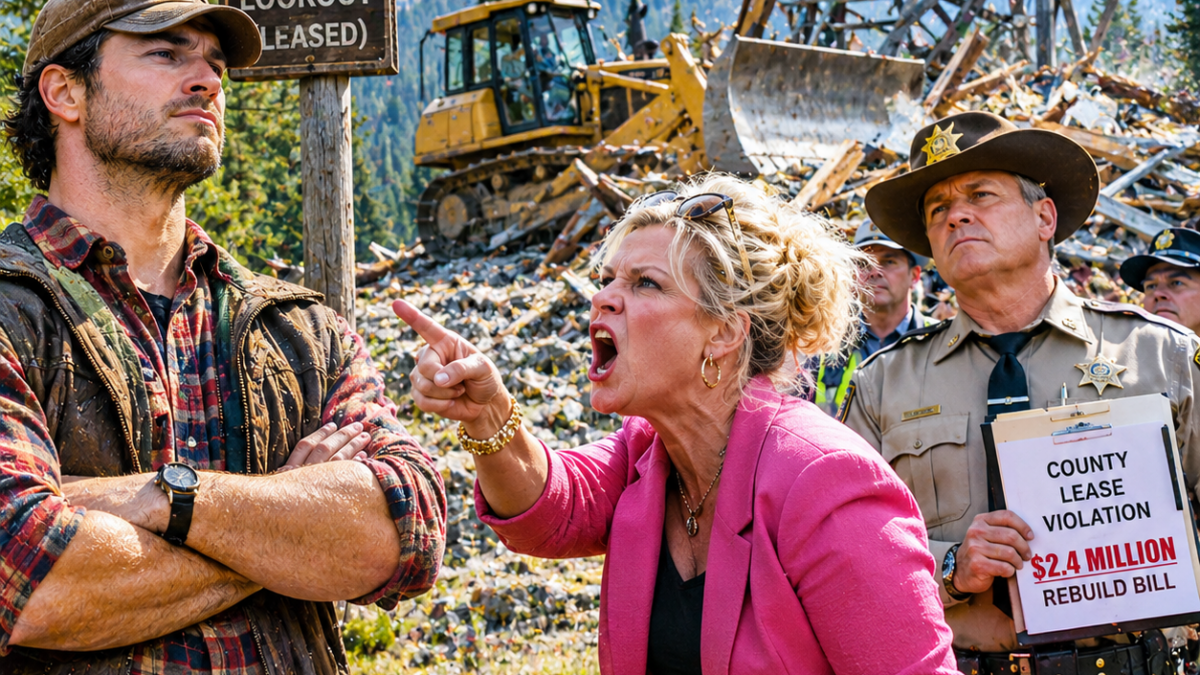
PART 2
I had been kneeling beside the power conduit at the base of Pine Sentinel, checking the line feeding the communications equipment.
Routine work.
I had done versions of it a thousand times.
Then I heard diesel.
Heavy.
Tracked.
Not one of my machines.
The sound rolled uphill through the trees before the convoy appeared.
Tracked bulldozer.
Two flatbeds.
White pickup with the Evergreen Summit logo.
Corinne stepped out before the engine had fully settled.
That red folder was pressed against her chest.
She never looked at me.
“Fence it off.”
Workers began unloading temporary barriers.
“Get the machine positioned.”
I stood.
“Stop.”
Nobody did.
“Corinne.”
She turned.
“You’re on private property.”
She smiled.
“That tower is coming down today.”
“Your HOA doesn’t own this ridge.”
“We have authorization.”
“From who?”
“The necessary authorities.”
“Show me.”
She ignored that.
I pointed toward the warning notice fixed near my gate.
ACTIVE COUNTY EMERGENCY COMMUNICATIONS EQUIPMENT — AUTHORIZED PERSONNEL ONLY
“You see that?”
“I see an old sign.”
“It’s not old.”
“Elias, that tower is an eyesore.”
“It’s an active site.”
“It’s an obsolete metal structure ruining the highest-value view in the entire community.”
“Still not yours.”
She turned toward the crew.
“Keep moving.”
That was when I noticed the second warning sign.
The one at the tower base.
Normally it warned about radio-frequency equipment and restricted access near the antenna system.
Gray paint covered it.
Fresh.
Thick.
Still glossy near one edge.
Someone had come onto my ridge before sunrise and painted over a safety notice.
I walked closer.
“Who did that?”
Corinne looked bored.
“Did what?”
“The warning sign.”
“Maybe someone got tired of looking at junk.”
I stared at her.
“Who authorized removal of an active communications relay?”
She finally looked directly at me.
“The HOA owns this ridge now.”
“No.”
“Your refusal to recognize reality does not change reality.”
“That’s an interesting sentence.”
She frowned.
“Especially from someone standing on my deed.”
I pulled out my phone.
Started recording.
The bulldozer entered through my open gate.
The operator was young.
Orange vest.
Maybe late twenties.
He looked from me to Corinne.
His right hand stayed near the controls.
I raised my voice.
“You are on privately owned property. I do not consent to demolition.”
The operator looked uncomfortable.
Corinne marched to the cab.
“If this job is not finished today, I will terminate this contract.”
The man said something I could not hear.
She leaned closer.
“And I will make sure your company never works for Evergreen Summit or any project connected to us again.”
That I heard.
On my belt, the status monitor linked to Pine Sentinel’s relay shifted.
Green.
Amber.
Vibration warning.
The bulldozer blade rose.
I stepped farther outside the swing radius.
Not because I was surrendering.
Because steel and anger are a bad combination.
I had spent years around heavy equipment.
You do not prove ownership by standing where a machine can kill you.
I held my phone steady.
“If you touch that tower, Corinne, you’re not just fighting me anymore.”
She lifted one hand.
The operator started forward.
Then another voice came from behind me.
“Hold up.”
A broad-shouldered man in a tan work jacket walked over from one of the flatbeds.
“Miles Grady.”
He offered his hand.
“Demolition contractor.”
I shook it.
“Elias Roark. Landowner.”
Miles looked surprised.
“Landowner?”
“Yes.”
He turned toward Corinne.
She said:
“Don’t start.”
Miles held up a paper.
“We have a demolition permit.”
“May I see it?”
Corinne answered before he could.
“No.”
Miles looked at her.
I said:
“Then call the county.”
Corinne scoffed.
“We are not wasting a morning on another delay.”
I opened my phone.
Pulled up Royce’s certified survey.
Then the county lease.
Miles read.
His jaw tightened.
“What’s this?”
“Recorded lease.”
“County?”
“Yes.”
“For the tower?”
“Yes.”
“Still active?”
“Yes.”
Corinne stepped between us and grabbed the folder from his hand.
“You’re being paid to remove a tower, Miles.”
He looked at her.
“You told me this thing was abandoned.”
“It effectively is.”
I pointed toward the status monitor.
“Relay is live.”
Miles looked up at the antenna mast.
Then at the conduit.
Then back at Corinne.
“You told us utilities were dead.”
“They are irrelevant.”
“Emergency communications aren’t irrelevant.”
“Stop pretending to be a lawyer.”
“I don’t need to be a lawyer to know I don’t want my excavator tearing down county radio equipment.”
“Bulldozer.”
“What?”
“You brought a bulldozer.”
Miles stared at her.
That was the kind of detail she cared about.
I said:
“Call the permitting office.”
Miles nodded.
“That’s what I’m doing.”
Corinne’s face changed.
“No.”
He looked at her.
“No?”
“We have a deadline.”
“I have insurance.”
“I will cancel your contract.”
“Then cancel it.”
For the first time, I thought the morning might end without destruction.
Miles stepped back.
“My crew does nothing until this permit is verified.”
Corinne stared at him.
Then slowly turned.
There was a smaller truck behind the flatbeds.
A subcontractor.
Different company.
Different operator.
I had barely noticed him.
Corinne had not.
She walked straight to him.
“Get in the machine.”
Miles said:
“Corinne.”
She ignored him.
The subcontractor looked confused.
“You are authorized.”
He looked toward Miles.
Miles shook his head.
“Don’t.”
Corinne stepped closer.
“I am the client.”
Then pointed at the tower.
“Take it down.”
The man climbed into the cab.
My stomach dropped.
I backed farther away.
Held my phone.
“Do not touch that structure.”
The engine revved.
Blade rose.
Corinne stood near her pickup.
Phone out.
Recording too.
The blade hit the lower cross-brace.
Steel cracked.
Sharp.
Loud.
The sound echoed through the ridge like a rifle shot.
I yelled:
“STOP!”
The operator backed away.
I thought maybe he would.
Corinne waved him forward.
Second impact.
One load-bearing brace folded.
The tower moved.
Not much.
Enough.
Every instinct from twenty years of emergency communications screamed at me.
Once a steel leg goes out of geometry, you do not know where the next failure travels.
“Everybody clear!”
Miles yelled too.
“Back up!”
The machine reversed.
The tower groaned.
Long.
Deep.
A sound I had never heard from Pine Sentinel.
One leg buckled.
The upper deck shifted.
The stairs twisted.
Then forty-eight feet of history leaned.
For a split second, it seemed almost slow.
Then gravity took over.
The observation deck fell first.
Steel hit rock.
The staircase folded.
The antenna mast snapped.
Radio cabinet tore loose.
Cables whipped through dust.
Wood splintered.
Metal screamed.
Then silence.
No one was inside the fall zone.
That was the only good thing about that minute.
Dust drifted through the clearing.
Corinne lowered her phone.
Smiled.
Actually smiled.
I walked toward the wreckage.
Slowly.
Not because I was calm.
Because my legs did not feel completely connected to the rest of me.
Near the edge of the collapsed deck, half buried beneath bent steel, lay a bronze plaque.
PINE SENTINEL LOOKOUT — 1983
Dented.
Scratched.
But readable.
My grandfather had commissioned it.
I remembered being a child, holding it while he drilled the mounting holes.
He had laughed because the plaque felt too heavy in my hands.
“Strong things should feel heavy,” he told me.
I picked it up.
Corinne came behind me.
Brushed dust from her white coat.
“There.”
I turned.
“Now your property finally looks respectable.”
I did not answer.
The status monitor on my belt had stopped blinking.
Screen:
OFFLINE
Then my radio crackled.
“Pine Sentinel relay offline. Confirm equipment status.”
Every worker went quiet.
Dispatch again:
“Pine Sentinel, confirm.”
Miles closed his eyes.
I keyed the radio.
“This is Elias Roark at Pine Sentinel.”
“Go ahead.”
“Tower has been demolished. Relay destroyed.”
Pause.
Longer than I expected.
“Repeat.”
“Pine Sentinel tower is down. Communications equipment destroyed.”
Corinne’s smile disappeared.
I looked at her.
“You didn’t demolish an abandoned tower.”
She said nothing.
“You destroyed an active county communications site.”
That was the exact moment her project stopped being a private property dispute.
Within hours, county vehicles were climbing my road.
Ada Winslow arrived first.
Director of emergency management.
Forty-nine.
No wasted words.
She stepped out.
Saw the wreckage.
“Tape it.”
Technicians moved.
Nobody touched debris unless authorized.
They inspected power.
Antenna remains.
Feed line.
Relay equipment.
Foundation.
Their conclusion came quickly.
Nothing usable.
The relay was gone.
Backup channels were activated, but coverage weakened in several valleys.
More dropped transmissions.
Less redundancy.
Ada called for a mobile relay unit.
Temporary replacement.
Not ideal.
Necessary.
I knew what that meant.
If there was a wildfire that night, responders would still have communications.
But not what they had before.
If search crews went into the deep valleys, coverage would be worse.
Corinne started talking before Ada asked her anything.
“That tower was unsafe.”
Ada looked at her.
“It was rotting.”
No response.
“It was a danger.”
Ada finally asked:
“Engineering report?”
Corinne blinked.
“What?”
“The report showing the tower was structurally unsafe.”
“Our HOA had concerns.”
“That is not an engineering report.”
“The structure was clearly obsolete.”
Ada pointed toward the wrecked equipment.
“Who authorized removal of county communications assets?”
Corinne lifted her chin.
“The HOA has jurisdiction over structures affecting our community boundary.”
Ada’s voice stayed calm.
“Your HOA has jurisdiction over HOA property.”
Pause.
“This is not HOA property.”
Corinne looked toward me.
“That is disputed.”
Royce’s certified survey was in my truck.
I handed it to Ada.
She read the cover.
Then the lease.
Then called her office.
The county began building a record that afternoon.
My video.
Miles’s statement.
The subcontractor’s work order.
The supposed permit.
Boundary survey.
Recorded lease.
Inspection records.
Radio logs showing the exact moment the relay went dark.
Photographs.
Emails.
Every piece.
One inspection report showed Pine Sentinel had passed county review only months earlier.
Not condemned.
Not abandoned.
Not unsafe.
Corinne’s “hazard” story lasted about three hours.
Then county chief engineer Von Whitaker arrived.
Fifty-seven.
Gray truck.
Hard hat.
Quiet face.
He walked the site without speaking.
Snapped brace.
Footings.
Broken mast.
Conduit.
Rock shelf.
Access road damage.
After nearly an hour, he came to me.
“This isn’t repairable.”
“I figured.”
“No.”
He shook his head.
“I mean none of the primary load system can be trusted.”
“What does that mean?”
“Full reconstruction.”
Corinne overheard.
She walked over.
“It’s an old tower.”
Von looked at her.
“It was.”
“You’re not rebuilding some monument.”
He looked toward the relay wreckage.
“No.”
Then:
“We’re restoring a functioning site.”
That distinction became the heart of everything.
The following week, I met Livia Pritchard.
Property attorney.
Forty-four.
Sharp enough to make you feel underprepared even when you had brought every document.
Fortunately, I had.
We went to county records.
Certified lease.
Recorded in 2010.
Term through 2045.
My family retained ownership of land and structure.
County received rights to use the lookout for fire observation, emergency communications, inspections, repairs, and emergencies.
No major change without proper approvals.
And one section I had never paid much attention to before.
Restoration.
Livia read it twice.
Then tapped the page.
“This is important.”
“How important?”
“The tower cannot simply be replaced with scrap value.”
“I know what it did.”
“Exactly.”
She leaned back.
“If the site is restored, it must perform the function it legally served.”
“Current standards?”
“Yes.”
“So no rebuilding the 1983 version.”
“No.”
She smiled without humor.
“Corinne destroyed a forty-year-old structure.”
Pause.
“She may have created an obligation to replace it with a modern one.”
That was the first time I understood why the number could become enormous.
Corinne later claimed the lease expired in 2025.
It did not.
No termination.
No amendment.
No early cancellation.
Recorded.
Public.
Easy to verify.
So where did 2025 come from?
Selma Cross answered that.
Evergreen Summit treasurer.
Fifty-five.
She contacted me quietly.
Much like other people who had started becoming afraid of Corinne.
Selma brought the Skyline Terrace project file.
Inside:
Outside legal due-diligence report.
One page highlighted yellow.
RECORDED COUNTY LEASE ACTIVE THROUGH 2045. NO AUTHORITY TO REMOVE EXISTING FIRE LOOKOUT.
In the margin:
Corinne’s handwriting.
Four words.
Remove before site inspection.
Livia read it.
Then again.
She placed the page flat.
“Well.”
I asked:
“Well what?”
“This is no longer looking like misunderstanding.”
Selma nodded.
“She got this weeks before demolition.”
Livia looked at her.
“Can you establish receipt?”
“Yes.”
“Email?”
“Yes.”
“Board file?”
“Yes.”
“Good.”
Miles added the next layer.
He turned over emails from Corinne.
One instructed his company to remove Pine Sentinel before a scheduled county site inspection.
Another assured him the permit was fully verified.
The county responded formally:
No such demolition permit existed.
Never issued.
Permit number invalid.
Now the timeline became simple.
Corinne knew:
My land was private.
County lease active.
HOA lacked authority.
Tower hosted public equipment.
County inspection coming.
Her development deadline approaching.
She ordered demolition anyway.
Livia still refused to overstate the case.
“The lease doesn’t make Corinne automatically liable.”
“I understand.”
“She didn’t sign it.”
“Yes.”
“But it establishes what existed.”
“Value?”
“Use.”
“Function.”
“Exactly.”
She looked at me.
“Your claim is not: she breached the lease.”
“Then what?”
“She directed destruction of property she did not own, on land she did not control.”
“And county?”
“County had lawful operational rights and equipment there.”
She tapped the lease.
“And this helps establish what restoring the site means.”
Then Von called.
“Come to engineering.”
I drove down.
Thick report.
Plans.
Cost breakdown.
He turned to the last page.
$2,400,000.
I stared.
“Two point four million?”
“Yes.”
“For one tower?”
“No.”
That answer again.
Not one tower.
A functioning fire lookout and communications facility.
Von walked me through everything.
Modern tower structure, foundation, mountain construction:
$1,250,000.
Antennas, relay hardware, emergency connections:
$450,000.
Site restoration and erosion control:
$300,000.
Access road and infrastructure repairs:
$250,000.
Design, permitting, inspections:
$150,000.
Total:
$2.4 million.
I sat back.
Corinne had mocked Pine Sentinel as scrap.
Her mistake was measuring steel by weight instead of function.
County and my attorneys sent formal demands.
Evergreen Summit HOA.
Corinne personally.
Other responsible parties.
The demand separated interests carefully.
No duplicate recovery.
My property damage.
County equipment and operational interests.
Restoration standard.
Evidence.
Corinne’s response was predictable.
“Extortion.”
She demanded a meeting with Von.
Showed up furious.
“That pile of metal wasn’t worth fifty thousand dollars!”
Von did not react.
“You’re looking at what remains.”
“Yes.”
“We’re calculating what it costs to restore what it did.”
Silence.
She stared.
“Two point four million is insane.”
“Current engineering is expensive.”
“The county cannot upgrade at our expense.”
“It isn’t an upgrade.”
He slid the report toward her.
“It is replacement to required current standards.”
That difference followed her into court.
Corinne assumed insurance would save her.
Then the carrier received the file.
Due-diligence warning.
Email trail.
Possible intentional demolition.
Reservation-of-rights letter.
Coverage uncertain.
Intentional conduct exclusions under review.
Suddenly:
No guaranteed insurer writing a $2.4 million check.
Then Skyline Terrace investors began calling.
They had placed $3.6 million in conditional deposits.
They had been told Evergreen Summit controlled the ridge.
Now county attorneys were saying otherwise.
One investor emailed:
Did Evergreen Summit ever own the property represented in the project package?
Corinne never answered.
She could not.
Selma called an emergency board meeting.
Financial review showed $48,000 demolition advance.
No proper board approval.
Booked as:
Landscape Improvement
Board members stared.
One said:
“Landscape?”
Selma nodded toward photographs of the collapsed tower.
“That is what the payment was labeled.”
Corinne blamed Miles.
“The contractor acted recklessly.”
Miles had every email.
Every instruction.
Every work order.
Every promise that permits were valid.
He had also refused to continue once I showed him the lease.
Then watched Corinne put another operator in the machine.
His statement was devastating.
Gordon Hale, retired banker and longtime supporter of Corinne, asked one question.
“Did you know about the county lease before demolition?”
Corinne did not answer.
Selma opened the due-diligence report.
Yellow highlight.
Corinne’s handwritten note.
Remove before site inspection.
The meeting ended badly for her.
The membership meeting a week later ended worse.
Corinne arrived prepared.
Slides.
Speech.
Talking points.
She told homeowners:
I was manipulating the county.
The tower was dangerous.
The $2.4 million was a shakedown.
She had acted bravely to protect property values.
Some residents nodded.
Then Selma stood.
“Show the report.”
The projector changed.
Private ownership.
Recorded lease.
No HOA authority.
No demolition approval.
Then the email proving Corinne received it before demolition.
Corinne interrupted.
“This is confidential.”
Selma said:
“The board authorized disclosure.”
“You are betraying this community.”
“No.”
Selma’s voice remained level.
“Protecting this HOA means protecting it from decisions like yours.”
I sat in the back.
I did not speak.
Did not need to.
Von explained restoration.
Why the old tower’s scrap value was irrelevant.
Why a replacement had to meet modern codes.
Why the ridge location made everything expensive.
Then came the revelation that destroyed Corinne’s remaining support.
The independent board attorney had traced business records.
Corinne held a financial stake, through a separate LLC, in the development entity behind Skyline Terrace.
She had never disclosed it.
The development agreement tied site clearance to release of another major payment.
Money that would partially benefit her.
The room erupted.
Now residents understood why she had been racing.
Not only community pride.
Not only property value.
Personal money.
Within an hour, the board suspended her spending authority.
Independent counsel retained.
Records preserved.
Contracts frozen.
Recall vote scheduled.
Investors suspended activity.
At the same time, Livia and county counsel sought court protection.
Temporary order.
No construction.
No intrusion.
No alteration of the ridge.
The bulldozers were gone.
For the first time since Corinne had appeared on my property, nothing moved without lawful permission.
The recall meeting was packed.
Corinne lost.
Clear majority.
President no longer.
Gavel gone.
Authority gone.
She walked out of the hall.
A process server waited under a parking-lot light.
He handed her an envelope.
Civil summons.
She opened it.
First page:
CLAIMED RESTORATION DAMAGES: $2,400,000
That photograph never became public from me.
I did not need it.
The number was enough.
The case took months.
People expecting instant revenge do not understand civil litigation.
There are reports.
Experts.
Discovery.
Depositions.
Motions.
Insurance fights.
Allocation disputes.
Every number gets challenged.
Good.
That is how it should work.
At trial, Corinne’s defense focused on three arguments.
One:
The tower was old.
Two:
She never signed the county lease.
Three:
The demolition operator physically knocked it down.
Livia handled the first two.
Miles handled the third.
Corinne’s attorney said:
“Ms. Bexley was not a party to this lease.”
Livia stood.
“We agree.”
That startled him.
She continued.
“We are not alleging she breached a contract she never signed.”
Then she looked toward the judge.
“The lease establishes lawful use, operational value, access rights, and restoration requirements associated with the facility that Ms. Bexley directed others to destroy.”
That was clean.
No exaggeration.
Then Von testified.
Drawings.
Foundation plans.
Contractor bids.
High-altitude logistics.
Modern safety code.
Communications equipment.
No luxury additions.
No observation restaurant.
No decorative deck.
Nothing beyond restoration.
Corinne’s lawyer asked:
“Isn’t it true the original tower may have been worth only a fraction of this amount?”
Von answered:
“If sold as scrap after legal removal, yes.”
Then:
“But this case is not about buying scrap.”
He pointed toward the reconstruction plans.
“It is about replacing an operating facility.”
Miles testified.
He looked uncomfortable in a borrowed suit.
But he told the truth.
Elias showed me ownership documentation.
Elias showed me the county lease.
Elias asked me to verify.
I refused to continue.
Corinne ordered another operator into the machine.
Corinne demanded demolition proceed.
Corinne had represented the permit as valid.
Then Selma testified.
Due diligence.
Email receipt.
Board records.
Hidden payment.
Corinne’s note.
Remove before site inspection.
The note appeared on the screen.
Her handwriting enlarged.
It looked almost absurdly casual.
Four words.
Millions in consequences.
Then Corinne took the stand.
Livia asked:
“Why did you continue after Mr. Roark disputed ownership?”
“I believed the project was lawfully approved.”
“You had a report stating otherwise.”
“Our lawyers prepare many reports.”
“Did you read this one?”
Pause.
“Yes.”
“Did you write this?”
She showed the note.
Longer pause.
“Yes.”
“Why remove the lookout before inspection?”
“The project had deadlines.”
“Why did the deadline matter more than verifying authority?”
Corinne looked toward her lawyer.
He could not answer for her.
Livia waited.
The courtroom stayed silent.
Corinne finally said:
“I could not allow another delay.”
Livia nodded.
“So the development deadline mattered more to you than confirming whether you had the legal right to demolish the structure.”
Corinne opened her mouth.
Closed it.
That was the question she never answered.
The court found the restoration claim supported.
Total:
$2.4 million.
Responsibility allocated among Corinne and related responsible parties according to findings.
Insurance applied where legally available.
Whatever was not covered remained with those held liable.
Importantly:
Corinne had personal exposure for the intentional demolition decision.
No hiding completely behind the HOA title.
Outside court, she stopped me.
She looked smaller.
Not physically.
The confidence was gone.
“All this…”
Her voice was thin.
“Over one tower.”
I looked at her.
“No.”
She waited.
“This happened because you thought being HOA president meant owning everything around it.”
She looked away.
I walked past.
That was the closest thing we ever had to a final confrontation.
I did not need a better line.
After judgment, reconstruction planning began.
Funds came through insurance where applicable.
Financial guarantees.
Judgment enforcement.
Other responsible sources.
Everything allocated carefully.
The county kept the mobile relay active in the meantime.
I hated seeing it.
Not because it was ugly.
Because every time I saw the temporary mast, I remembered why it was there.
Corinne’s personal consequences deepened.
Removed from Skyline Terrace.
Development collapsed because the ridge was never theirs.
Investment contracts unwound.
Deposits refunded according to their terms.
Her personal financial interest in the project disappeared.
Reachable assets were applied toward her portion of the judgment.
Eventually, she sold her second mountain home.
The one with the view she had always bragged about.
People told me this as if I would celebrate.
I didn’t.
I understood the irony.
That was enough.
Evergreen Summit had to rebuild leadership too.
The new board published financial reports.
Required independent ownership verification before projects reached outside association boundaries.
Required conflict-of-interest disclosures.
No more president deciding alone that a neighboring ridge was “effectively” HOA property.
Selma became one of the most trusted people on the board.
She hated that.
“I just wanted the books to balance.”
I laughed.
“They balance better when nobody is secretly bulldozing county infrastructure.”
“That is technically true.”
Spring came.
Snow melted from Pine Hollow Ridge.
Construction trucks returned.
This time:
With my permission.
With county authorization.
With permits.
Real permits.
Nobody crossed my gate until everything was signed.
Steel arrived.
Concrete.
Reinforcement.
Foundation crews.
The old footings were damaged beyond reuse.
They were removed.
New ones drilled into the rock shelf.
I watched.
Some days I helped.
Not because county required me.
Because Pine Sentinel was still mine.
The new structure rose slowly.
Modern steel.
Stronger bracing.
Improved stair system.
Safer observation deck.
Updated lightning protection.
Better equipment housing.
New radio hardware.
When the frame reached full height, I stood below it.
Forty-eight feet had once seemed enormous when I was a child.
The new tower felt taller even though it filled almost the same sky.
Maybe because of everything it carried.
History.
Loss.
Law.
Responsibility.
Technicians installed antennas.
Ran coax.
Power.
Backup.
Grounding.
Tested coverage.
Deep valley.
Northern ridge.
Western canyon.
Search-and-rescue zone.
Everything.
Von inspected every level.
Clipboard.
No sentimentality.
That was why I trusted him.
Finally, he climbed down.
Signed.
“Accepted.”
Ada stood at the base with a handheld radio.
She keyed it.
“Pine Sentinel, this is county dispatch. Radio check.”
Static.
Half second.
Then a clear voice.
“County dispatch, Pine Sentinel. Loud and clear.”
Technicians cheered.
I did not.
I could not.
My throat tightened.
I looked away.
The sound brought back my grandfather.
Not logically.
Emotionally.
A radio signal where silence had been.
I reached into my truck.
The bronze plaque.
Restored.
The dents smoothed.
Not erased completely.
I asked the metalworker to leave a faint trace.
He thought that was strange.
I wanted history visible.
We mounted it on a small memorial wall near the entrance.
PINE SENTINEL LOOKOUT — 1983
Not because the new tower had been built in 1983.
Because the promise began then.
Selma arrived that afternoon.
She handed me a formal Evergreen Summit letter.
Every plan involving Pine Hollow Ridge terminated.
No ownership claim.
No development claim.
No proposed access.
No Skyline Terrace.
I read it.
Folded it.
Put it in my jacket.
Then looked up.
At the top of Pine Sentinel, the beacon Corinne had once ordered me to remove blinked against the blue Colorado sky.
Steady.
Legal.
Useful.
Still there.
People called the case revenge.
I never did.
Revenge would have meant trying to destroy Evergreen Summit because Corinne destroyed my tower.
I did not.
I did not sue innocent homeowners for things they did not do.
I did not block their roads.
I did not sabotage their utilities.
I did not try to bankrupt every family living below my ridge.
I wanted:
My property rights recognized.
The tower restored.
The county equipment restored.
The responsible people to pay what the law said they owed.
That is accountability.
Revenge is messier.
And usually less satisfying.
The first time I climbed the new tower, I went alone.
Early morning.
Cold.
My boots rang against steel steps.
Higher.
Higher.
At the top, three valleys opened beneath me.
Exactly as they had when I was eight.
The mountains had not changed much.
Human beings had.
I put my hands on the railing.
Wind moved through the antenna mast.
For a moment, I could almost hear my grandfather.
“Looking is a responsibility.”
I smiled.
“Yeah.”
I said it out loud.
No one heard me.
That was fine.
I looked toward Evergreen Summit.
Tiny roofs.
Roads.
Clubhouse.
Seventy-six homes.
From up there, Corinne’s empire looked very small.
That perspective helped.
The ridge had existed before her.
Would exist after me.
Property disputes feel enormous when you are standing inside them.
Mountains do not care.
They wait.
That is something I wish Corinne had understood.
She believed money created permanence.
Investor deposits.
Luxury villas.
Glass terrace.
Marketing.
A promise to wealthy buyers.
But the oldest thing on that mountain was not her project.
It was ownership.
Recorded rights.
And the physical land beneath all her presentations.
You can render over a tower in a brochure.
You cannot render over a deed.
You can label a ridge “HOA owned.”
You cannot make it true with gold lettering.
You can call a structure abandoned.
You cannot erase county maintenance logs.
You can invent a permit number.
You cannot make the county database agree.
And you can destroy steel in under a minute.
Rebuilding the function you destroyed can cost $2.4 million.
That was the lesson.
People often asked me:
“Why didn’t you physically stop the bulldozer?”
Because I wanted to live.
That answer surprised them.
There is a strange fantasy around property rights.
People imagine a landowner standing heroically in front of equipment.
That is how people die.
I warned.
Recorded.
Called authorities.
Stayed clear.
The machine destroyed my tower.
Yes.
But nobody was crushed.
Nobody was shot.
Nobody was arrested because a confrontation spiraled.
And every unlawful decision was captured.
That mattered.
I would rather rebuild steel than bury a person.
Miles understood.
Months later, he came back.
Not as demolition contractor.
As one of the bidders helping with site logistics.
He asked first.
“Okay if I come through?”
I smiled.
“Now you ask.”
He winced.
“Fair.”
I opened the gate.
We walked toward the new tower site.
He said:
“I think about that morning.”
“So do I.”
“I should have shut the entire site down sooner.”
“You did stop your crew.”
“Not before we arrived.”
“You were lied to.”
“I should’ve verified.”
“Yes.”
He appreciated the honesty.
“I changed company policy.”
“How?”
“No demolition based solely on client permit copies.”
“County verification?”
“Direct.”
“Ownership?”
“Direct.”
“Active utilities?”
“Direct.”
“Good.”
He looked toward the new steel.
“Expensive lesson.”
“For everybody.”
Miles’s company was not assigned all the blame.
That mattered.
He stopped when evidence reached him.
The second operator did not.
Courts and insurers sorted those responsibilities.
Precision is important.
When something terrible happens, people want one villain and everyone around them treated the same.
Reality is more complicated.
Corinne directed.
Miles hesitated and stopped.
Subcontractor proceeded.
Treasurer exposed records.
Board members varied in what they knew.
Homeowners were not one mind.
That is why evidence mattered.
It separated conduct.
I became almost obsessive about saying:
“Corinne did this.”
Not:
“The HOA people did this.”
Because most residents never voted to bulldoze Pine Sentinel.
They woke up one morning to discover their president had created a multimillion-dollar problem.
I had no interest in punishing them for her decisions.
One resident named Arthur drove up months after the judgment.
He stood at my gate.
“I owe you an apology.”
“For?”
“I believed her.”
“That happened a lot.”
“She told us you were trying to hold the association hostage for money.”
“I never made an offer.”
“I know that now.”
He looked toward the tower.
“Two point four million.”
“Yes.”
“I thought that was ridiculous.”
“Most people did.”
“Until the engineer explained it.”
I nodded.
He said:
“I repair elevators.”
“That sounds expensive.”
“It is.”
“If someone destroys an old elevator, do they replace it with 1983 parts?”
He laughed.
“No.”
“Exactly.”
That became the easiest explanation.
Replacement cost is not nostalgia.
Modern systems must meet modern standards.
Pine Sentinel had become part of emergency infrastructure.
You do not rebuild emergency infrastructure with scrap.
Corinne’s attorney knew that.
He simply had to challenge the amount.
That was his job.
Von’s job was to prove it.
He did.
Invoices.
Bids.
Engineering.
Logistics.
No fantasy numbers.
No luxury upgrade.
That made the judgment durable.
Livia once told me:
“The best damages case is boring.”
“What?”
“Spreadsheets.”
“That sounds terrible.”
“Boring numbers survive cross-examination.”
She was right.
The title sounds dramatic:
$2.4 million.
The proof was painfully ordinary.
Concrete.
Steel.
Freight.
Road work.
Erosion control.
Antennas.
Design hours.
Inspection.
Permits.
Line items.
That is how big consequences are usually built.
Not one giant charge.
Hundreds of smaller realities.
The $3.6 million investor deposits also sounded dramatic.
But they had conditions.
Land control.
Site clearance.
Development rights.
Once investors learned Evergreen Summit did not own the ridge, the entire arrangement became unstable.
I never met most of those investors.
Did not care to.
Their fight was with the development entity.
Mine was with the people who crossed my boundary and destroyed property.
Keeping issues separate made everything cleaner.
The new HOA board did the same.
They did not pretend Skyline Terrace could be saved.
They ended it.
That saved residents from spending even more trying to rescue a project built on a false premise.
Selma told me:
“The hardest vote wasn’t removing Corinne.”
“What was?”
“Admitting the project itself was dead.”
“Why?”
“People had imagined it for years.”
“Sunset terrace?”
“Yes.”
“Restaurant?”
“Yes.”
“Villas?”
“Yes.”
“Property values?”
“Especially.”
I looked toward the ridge.
“Dreams are expensive when they’re built on somebody else’s dirt.”
She laughed.
Then sighed.
“That should’ve been on the first slide.”
Maybe.
One autumn, Evergreen Summit held its first board meeting under new leadership.
They invited neighboring landowners.
I went.
Not to make peace.
Not to gloat.
To listen.
New president opened with:
“Association jurisdiction ends at recorded association boundaries.”
I looked at Selma.
She smiled.
Someone had learned.
They adopted:
Ownership verification before off-site projects.
Written conflict disclosures.
Independent counsel review for property acquisition.
No project marketing before land rights were confirmed.
No contractor authorization outside HOA property without recorded permission.
Basic.
Obvious.
Necessary.
Corinne’s legacy became rules preventing another Corinne.
That was satisfying.
More satisfying than hearing about her second home sale.
People expected me to enjoy that part.
I didn’t.
I had liked my tower.
She liked her mountain home.
Loss is loss.
What mattered was not that she suffered the same emotional pain.
What mattered was that assets lawfully available under the judgment were used to satisfy responsibility.
Lawful consequence.
Not revenge theater.
The distinction protected me from becoming bitter.
I still had anger.
Of course.
The plaque did not fix the moment I watched Pine Sentinel fall.
Some memories stay physical.
Whenever I heard heavy diesel climb the road, my chest tightened for a while.
Even authorized construction.
Even rebuilding.
I would look toward the bend expecting Corinne’s white pickup.
It took time.
One morning, during reconstruction, a crane came up.
I knew it was scheduled.
Still, when the engine growled through the trees, my hands went cold.
The operator waved.
“Mr. Roark?”
“Yes.”
“We’re here for the tower lift.”
I nodded.
He looked at the permit packet.
“Want to review?”
I almost laughed.
“Yes.”
We reviewed everything.
He waited.
That patience mattered.
Normal legal construction felt strangely healing.
The new tower went up piece by piece.
Not in one dramatic lift.
Base sections.
Cross bracing.
Upper frame.
Deck.
Mast.
Cable trays.
Every bolt torqued.
Every inspection logged.
The old tower fell in less than a minute.
The new one took months.
Destruction is fast.
Restoration is patient.
That might be the deepest truth in the entire story.
Corinne believed speed gave her power.
Demolish before inspection.
Clear site before deadline.
Get investors committed.
Make reality irreversible.
But restoration belongs to people willing to take time.
Survey.
Records.
Engineering.
Court.
Rebuild.
Slow things defeated her.
I thought often about the handwritten note.
Remove before site inspection.
Four words.
They captured everything wrong with her approach.
Not:
Resolve ownership before construction.
Not:
Negotiate with Elias.
Not:
Verify county rights.
Remove before someone looks.
That is how bad decisions grow.
Avoid scrutiny.
Move fast.
Create facts on the ground.
Then force everyone else to adapt.
I had seen that mentality in infrastructure projects before.
Usually less dramatic.
A contractor pours before inspection.
A developer clears before wetland approval.
Someone relocates markers.
Then says:
Well, it’s already done.
Corinne tried the ultimate version.
Tower already gone.
Surely county would compromise.
Instead, the restoration clause made “already done” the beginning of the bill.
Irony has a sense of timing.
One reporter asked me:
“Was the lease your secret weapon?”
“No.”
“Why not?”
“It was recorded.”
She laughed.
“Then why didn’t Corinne know?”
“She did.”
That changed the interview.
The public liked the idea that Corinne missed some hidden clause.
Reality was worse.
Due diligence warned her.
She wrote beside it.
She knew.
The “secret” was only secret because she assumed nobody would enforce it.
That distinction made the story more disturbing.
Ignorance is dangerous.
Knowing and proceeding anyway is something else.
Selma struggled with that.
For months, she blamed herself for not stopping Corinne earlier.
One afternoon we sat near the base of the rebuilt tower.
She said:
“I saw signs.”
“What signs?”
“Contracts moving too fast.”
“Okay.”
“Payments split strangely.”
“Okay.”
“Corinne refusing questions.”
“Okay.”
“I should have known.”
“No.”
She looked at me.
“You’re letting me off easy.”
“No.”
“You said ‘no’ four times.”
“Because knowing something feels wrong is not the same as knowing somebody plans to bulldoze a tower.”
She stared at the ground.
“What should I have done?”
“Asked sooner.”
“That’s it?”
“And you eventually did.”
She nodded.
Accountability should not become self-destruction either.
Selma helped expose the truth.
That mattered.
The community slowly stopped treating Pine Hollow Ridge like disputed territory.
Hikers occasionally asked permission to cross.
I sometimes allowed it.
Evergreen Summit’s new board asked whether residents could join a county fire-safety day at Pine Sentinel.
I said yes.
That event became one of my favorite days.
Children climbed partway under supervision.
Fire crews explained smoke detection.
Communications technicians demonstrated radios.
Ada told the crowd:
“This tower is not decoration.”
I laughed.
She saw me.
“You disagree?”
“No.”
“Good.”
She explained how repeaters work.
Line-of-sight.
Terrain.
Redundancy.
Coverage.
People listened.
A resident said:
“I had no idea.”
That sentence mattered.
Corinne had exploited ignorance.
She called Pine Sentinel ugly because most people did not know what it did.
Once people understood function, appearance mattered less.
That applies to many things.
Fence.
Drainage ditch.
Utility box.
Fire road.
Snow guard.
Old tower.
Infrastructure is often ugly until the day you need it.
Then it becomes beautiful.
My grandfather understood.
He would not have cared about Corinne’s brochure.
He would have asked:
“What happens when there’s smoke?”
That was his test.
Function before prestige.
The reconstructed Pine Sentinel looked better than the old tower.
I can admit that.
Clean steel.
Modern rails.
Safer stairs.
Weather-resistant equipment enclosure.
Corinne would probably have liked the aesthetics.
That irony made me laugh.
Had she approached the county and me honestly, maybe the site could have been improved without destroying anything unlawfully.
Maybe Skyline Terrace could have been redesigned somewhere else.
Maybe a small public viewing area could coexist.
She never asked.
Control was more important than cooperation.
That cost everyone.
The final judgment number became public.
People reduced the story to:
HOA Karen destroys $50,000 tower, owes $2.4 million.
Funny.
Not quite accurate.
The tower was not a $50,000 tower.
That was Corinne’s framing.
Scrap value is not operational value.
If someone smashes a fire engine, you do not value the damage by weighing the metal.
If someone cuts a fiber line, you do not price it by copper content.
Function matters.
Service matters.
Replacement standards matter.
That is what the court recognized.
Livia enjoyed explaining that.
“You keep saying function.”
“Because juries understand function.”
“It was a bench trial.”
“Judges also understand function.”
Fair.
I asked:
“What if the lease had no restoration language?”
“We still would have damages arguments.”
“Would $2.4 million be harder?”
“Possibly.”
“So my grandfather’s agreement mattered.”
“Very much.”
He had signed it fifteen years before Corinne arrived.
Another reminder:
Good documents outlive the people who create them.
I added copies to my estate file.
My nephew laughed.
“You have more paperwork than land.”
“Paper protects land.”
“You sound like a lawyer.”
“Get out.”
He may inherit Pine Hollow someday.
If he does, he will know exactly what county rights exist.
Exactly where.
Exactly until when.
No ambiguity.
I will not leave him a fight created by poor records.
That is how family land survives.
The new tower’s lease relationship eventually got updated to reflect the rebuilt facility.
Not because Corinne invalidated the old agreement.
Because technology changed.
New equipment.
New maintenance responsibilities.
Clearer insurance.
I negotiated carefully.
Livia reviewed everything.
County reviewed.
No rush.
Ada joked:
“You’re making us earn every paragraph.”
“Yes.”
“Trauma?”
“Experience.”
She laughed.
The revised arrangement remained cooperative.
That mattered.
Government lease did not mean government owned my ridge.
My ownership remained.
County rights remained specific.
Boundaries.
Even good relationships need boundaries.
Maybe especially good ones.
One winter, a wildfire started far south.
Not close enough to threaten Pine Hollow.
But smoke became visible from the tower.
The lookout operator reported it early.
Dispatch traffic passed through Pine Sentinel.
Crews mobilized.
I listened from the cabin.
Radio:
“Pine Sentinel, copy.”
“Loud and clear.”
That phrase hit differently now.
The fire was contained.
Nothing dramatic happened on my ridge.
No reporter came.
Nobody wrote about the rebuilt tower that day.
Good.
Infrastructure’s best day is usually one nobody remembers.
That night I climbed halfway up.
Looked south.
Faint orange glow beyond a ridge.
I touched the rail.
My grandfather’s promise was alive again.
Someone was watching.
The $2.4 million number disappeared from my mind.
Money was never the most important part.
Restored function was.
That was when I finally stopped thinking of the judgment as revenge.
It had rebuilt something real.
Without restoration, a damages award would have felt hollow.
Steel in the sky mattered more than numbers on paper.
The insurance disputes took longer.
They always do.
Some amounts covered.
Others challenged.
Judgment enforcement continued.
Corinne’s personal stake and assets were handled through lawful process.
I did not follow every filing.
People found that strange.
“Don’t you want to know?”
“Not really.”
“Why?”
“Tower’s back.”
That was enough.
Livia gave me updates when necessary.
I did not need to watch Corinne lose things one by one.
Obsession keeps people connected.
I wanted distance.
The best revenge, if you insist on using that word, was not caring what Corinne was doing anymore.
Her influence over my daily life ended.
No letters.
No white pickup.
No threats.
No red folder.
Just weather.
One spring morning, I found deer bedding near the access road.
I laughed.
For months that spot had been:
Evidence zone.
Construction route.
Survey point.
Legal exhibit.
Now deer did not care.
Nature had reclaimed the drama.
Good.
I repaired an old section of fence.
Repainted the gate.
The Evergreen Summit logo that once appeared on a temporary panel was long gone.
My sign said:
PINE HOLLOW RIDGE — PRIVATE PROPERTY
Nothing about HOA.
I considered adding:
NO HOA AUTHORITY
Then decided against it.
My property did not need to define itself by Corinne forever.
Private property was enough.
The county communications notice remained.
Clear.
Legal.
Verified.
A contractor once stopped and asked:
“Is that the famous tower?”
“I hope not.”
He laughed.
“It is.”
“I prefer Pine Sentinel.”
“Fair.”
The story had become local folklore.
People embellished.
They said Corinne personally drove the bulldozer.
False.
They said I chained myself to the tower.
False.
They said the county arrested her on the ridge.
False.
They said investors lost all $3.6 million.
Not necessarily; contracts were unwound according to terms.
I corrected people.
“Why?”
“Because truth is already good enough.”
That became a personal rule.
Do not improve a true story until it becomes a lie.
Corinne did enough manipulating.
I would not answer manipulation with more manipulation.
The facts were dramatic without help.
Private ridge.
Active county lease.
Fake permit.
Warning ignored.
Tower demolished.
Relay lost.
Due diligence.
Hidden financial stake.
$2.4 million restoration.
Judgment.
Rebuild.
Enough.
One homeowner, Nora, visited years later.
She had been one of Corinne’s strongest supporters.
“I hated you.”
I laughed.
“Good opening.”
“I did.”
“Why?”
“She said you were trying to force us to buy your land for millions.”
“I never offered to sell.”
“I know.”
“She said you sabotaged Skyline Terrace.”
“I declined to give up my ridge.”
“I know.”
She looked at the tower.
“I voted against removing her.”
I said nothing.
“I was one of the minority.”
“Okay.”
“You’re not angry?”
“What would that do now?”
She breathed out.
“I wanted to apologize.”
“Accepted.”
“That easy?”
“Yes.”
She looked surprised.
I shrugged.
“People can be wrong.”
“Corinne was more than wrong.”
“Yes.”
“You really don’t hate us?”
“No.”
That helped her.
Maybe helped me too.
Communities recover when individuals stop inheriting other people’s grudges.
Evergreen Summit was not Corinne.
Pine Hollow was not anti-HOA territory.
We became neighbors again.
Cautiously.
Properly.
One board member eventually asked whether the HOA could contribute to maintaining the public fire-safety education program at Pine Sentinel.
I said yes.
With paperwork.
He laughed.
“Of course.”
Everything with paperwork.
That became a running joke.
But everyone understood why.
The county paid what it was responsible for.
HOA contributed voluntarily to educational events.
No ownership claims.
No hidden strings.
That is cooperation.
Clear roles.
The first time Evergreen Summit residents gathered at Pine Sentinel after reconstruction, Ada spoke.
Then Selma.
Then someone asked me to say something.
I resisted.
Eventually climbed one step.
Looked at the crowd.
“I’m not giving a speech.”
People laughed.
I held up the restored bronze plaque.
“My grandfather built the first tower because he thought seeing trouble early created a duty to act.”
Quiet.
“I wish more people had looked carefully at the paperwork before trouble reached this ridge.”
A few uncomfortable laughs.
Then:
“But we’re here now.”
I pointed upward.
“Tower works.”
Then toward Evergreen Summit.
“Neighborhood still exists.”
Then the forest.
“Mountain still belongs where the records say it belongs.”
I stepped down.
That was enough.
A child asked me later:
“Did the bad lady really knock the whole thing down?”
I crouched.
“She ordered it demolished.”
“Why?”
“She wanted to build something else here.”
“Why didn’t she build somewhere else?”
I smiled.
Kids ask the best questions.
“Exactly.”
He ran away before I answered further.
Why didn’t she build somewhere else?
Because this view was more profitable.
Because redesign cost money.
Because deposits had deadlines.
Because she believed power could substitute for permission.
Most disasters become simpler when a child asks why.
One summer, I found the original Skyline Terrace brochure inside an old case box.
Gold script.
Glass deck.
Perfect sunset.
I almost threw it away.
Then kept one copy.
Not as anger.
As comparison.
Brochure on one side.
Recorded plat on the other.
Dream versus right.
Planning versus ownership.
You need both to build.
Corinne had only one.
That was never enough.
The new HOA board eventually bought a smaller overlook parcel elsewhere.
Legally.
Negotiated purchase.
No dispute.
They built a modest scenic platform.
I visited.
Beautiful view.
Not as wide as Pine Sentinel.
Still good.
Selma stood beside me.
“See?”
“What?”
“We found another ridge.”
I laughed.
“Impossible.”
“Apparently not.”
That was maybe the funniest ending.
The “irreplaceable” Skyline Terrace site had a legal alternative.
Less dramatic.
Less lucrative.
But real.
Corinne destroyed millions because she refused to accept second-best.
Perfection is expensive when it requires stealing.
I thought about that often.
The strongest people I knew in mountain work were good at compromise.
Weather forces it.
Terrain forces it.
Roads curve.
Foundations move.
You adapt.
Corinne did not adapt.
She demanded the mountain adapt to her rendering.
Mountains are poor listeners.
Property records are worse.
One night, long after the case, I dreamed about the collapse.
Steel bending.
Grandfather’s plaque.
Dust.
I woke before dawn.
Walked outside.
New Pine Sentinel stood against the stars.
Beacon blinking.
I stayed there until sunrise.
Not because I was afraid.
Because I needed to see it.
Trauma can survive legal victory.
People rarely mention that.
A court ruling does not erase the sound of steel breaking.
Restoration helps.
Time helps.
Ordinary mornings help.
I told Livia once.
She said:
“You should talk to someone.”
“A therapist?”
“Yes.”
“You’re a lawyer recommending therapy?”
“We’re not all monsters.”
I laughed.
Then I actually did.
A few sessions.
Helpful.
The grief was not only about property.
It was about violation.
Family memory.
Helplessness.
Watching something beloved destroyed while doing the smart thing—standing back—feels wrong even when it is right.
I had to accept that restraint can look like helplessness in the moment.
It was not.
My recording helped prove the case.
My staying alive mattered more.
That emotional lesson changed me.
I became less interested in dramatic confrontation.
More interested in outcomes.
That is why, when people asked:
“Would you punch Corinne if you could go back?”
No.
“Would you block the bulldozer with your truck?”
No.
“Would you chain yourself to the tower?”
No.
I would call sooner.
Record more angles.
Maybe install a gate they could not legally cross without more obvious damage.
But I would not turn a property crime into a funeral.
No.
Years later, Miles told me the subcontractor who operated the machine left demolition work.
I did not ask why.
Maybe guilt.
Maybe insurance.
Not my business.
I hoped he learned.
That was enough.
The county eventually installed additional redundancy elsewhere too.
Ada said:
“We relied too heavily on one relay.”
“So Corinne improved the network?”
“Do not give her credit.”
I laughed.
But the county did strengthen backup coverage.
That was good.
Systems should learn from failure.
A stronger tower.
More redundancy.
Better HOA controls.
Better contractor verification.
Better public awareness.
A terrible act can produce improvements if people refuse to waste the lesson.
That does not make the act good.
It makes recovery meaningful.
One autumn, I brought my nephew to the top.
He had been too young to remember the old tower clearly.
We looked over three valleys.
He asked:
“Do you ever wish Grandpa’s original tower was still here?”
“Yes.”
“Even though this one is better?”
“Yes.”
He thought.
“That doesn’t make sense.”
“It will.”
He laughed.
Maybe someday.
New can be technically better and still not replace history emotionally.
The bronze plaque bridged that.
Old year.
New structure.
Continuity.
That mattered more than pretending nothing had been lost.
The county offered to put a new plaque with the reconstruction year.
I agreed.
Beside the old one.
Not instead of.
One read:
PINE SENTINEL LOOKOUT — 1983
The other:
REBUILT IN SERVICE TO PINE COUNTY — AFTER 2026 RESTORATION
Two chapters.
One place.
Corinne’s name nowhere.
That felt right.
She did not deserve permanent billing on the mountain.
Her case lived in records.
Not on my tower.
The $2.4 million figure followed me longer.
People introduced me at events:
“This is the guy with the $2.4 million tower.”
I corrected them.
“Fire lookout and communications site.”
Less catchy.
More accurate.
One man said:
“That’s not as viral.”
“Good.”
I had no interest in becoming a character forever.
I was Elias.
Landowner.
Former communications technician.
Guy who fixed conduit.
That identity mattered more than the lawsuit.
The morning before all this began, my coffee had gone cold while I worked at the tower base.
Years later, same thing happened.
I was checking a junction box.
Set mug down.
Forgot it.
An hour later, cold.
I laughed.
Normal life had completed the circle.
No white pickup.
No bulldozer.
No Corinne.
Just bad coffee.
Perfect.
I climbed down the ridge that afternoon carrying tools.
Paused at the gate.
The county lease notice was clean.
No gray paint.
I touched one corner.
The sign looked ordinary.
Once, Corinne barely glanced at it.
That was her mistake in miniature.
Warnings only matter if you respect what they represent.
The sign was not authority because it had bold letters.
It pointed to authority recorded elsewhere.
Lease.
County rights.
Operational use.
Corinne dismissed the sign because she dismissed every limit outside her own control.
I learned the opposite.
Never trust a sign alone.
Verify the record behind it.
That is why her fake permit did not survive.
A seal is not truth.
A document number is not truth.
Verification creates trust.
The county clerk verified.
Surveyor verified.
Attorney verified.
Engineer verified.
Court verified.
Slowly.
Layer after layer.
Corinne’s entire story collapsed because it could not survive verification.
That may be the simplest summary.
Her claims:
HOA owns ridge.
False.
Tower abandoned.
False.
Lease expired.
False.
Permit valid.
False.
Tower unsafe.
Unsupported.
Removal authorized.
False.
Skyline Terrace land secured.
False.
Insurance will cover it.
Uncertain at best.
Tower worth scrap.
Wrong measure.
Every assumption met a record.
Facts won.
Not quickly.
Eventually.
That is why the ending felt satisfying.
Not because Corinne lost a house.
Not because investors abandoned her.
Not because residents stopped speaking to her.
Because Pine Sentinel came back.
That was restoration.
Everything else was consequence.
The day the new tower officially entered service, I stayed after everyone left.
Sunset.
Orange light across the valleys.
Beacon beginning to blink.
Radio humming softly inside the equipment enclosure.
I stood beside my grandfather’s plaque.
Ran my fingers over the letters.
“Still watching,” I said.
Wind moved through the pines.
No answer.
Didn’t need one.
I looked down toward Evergreen Summit.
The luxury community had survived.
Good.
People still had homes.
Good.
New leadership.
Good.
Skyline Terrace gone.
Also good.
Somewhere else, Corinne was dealing with the life her choices had built.
I did not need to see it.
My life was here.
That was enough.
People will always remember the $2.4 million.
Big numbers stick.
I remember something smaller.
The instant after the tower fell.
The status monitor going dark.
That little word:
OFFLINE
That hurt more than the money ever mattered.
Then years later:
“Pine Sentinel, this is county dispatch. Radio check.”
“Loud and clear.”
Those three words meant more than the judgment.
They meant the thing Corinne tried to erase had returned to doing what it was built to do.
That is a better ending than revenge.
But if someone insists on calling it revenge, then this was mine:
I did not bulldoze her property.
I did not ruin her road.
I did not trespass.
I did not invent a fine.
I did not threaten her.
I kept the survey.
Kept the lease.
Kept the video.
Let the county calculate.
Let the court decide.
And then I rebuilt.
Corinne had believed destruction would make her plan irreversible.
Instead, destruction triggered the clause that made restoration unavoidable.
She wanted a luxury terrace.
She got a court judgment.
She wanted my tower erased.
She helped finance its replacement.
She wanted the highest-value view in the county.
The rebuilt Pine Sentinel now stands there instead.
Stronger.
Safer.
Still blinking at night.
Still carrying emergency traffic.
Still on my land.
Still outside Evergreen Summit.
And every time that radio answers dispatch, it proves something Corinne Bexley never understood until the bill arrived.
You can flatten steel.
You can tear cables out of the ground.
You can even destroy forty years of history in less than sixty seconds.
But if the land was never yours, the lease was still active, and the truth was already sitting in the county record before your bulldozer ever climbed the ridge, you have not erased the problem.
You have only made it more expensive.
Corinne called Pine Sentinel an eyesore.
The county called it a lifeline.
And after everything was measured, documented, argued, and proven, the court called what she did a $2.4 million mistake.








