PART 2: HOA Karen Bulldozed My Family’s Apple Orchard for a Luxury Resort — She Forgot I Was the One Who Had to Approve Her Permits
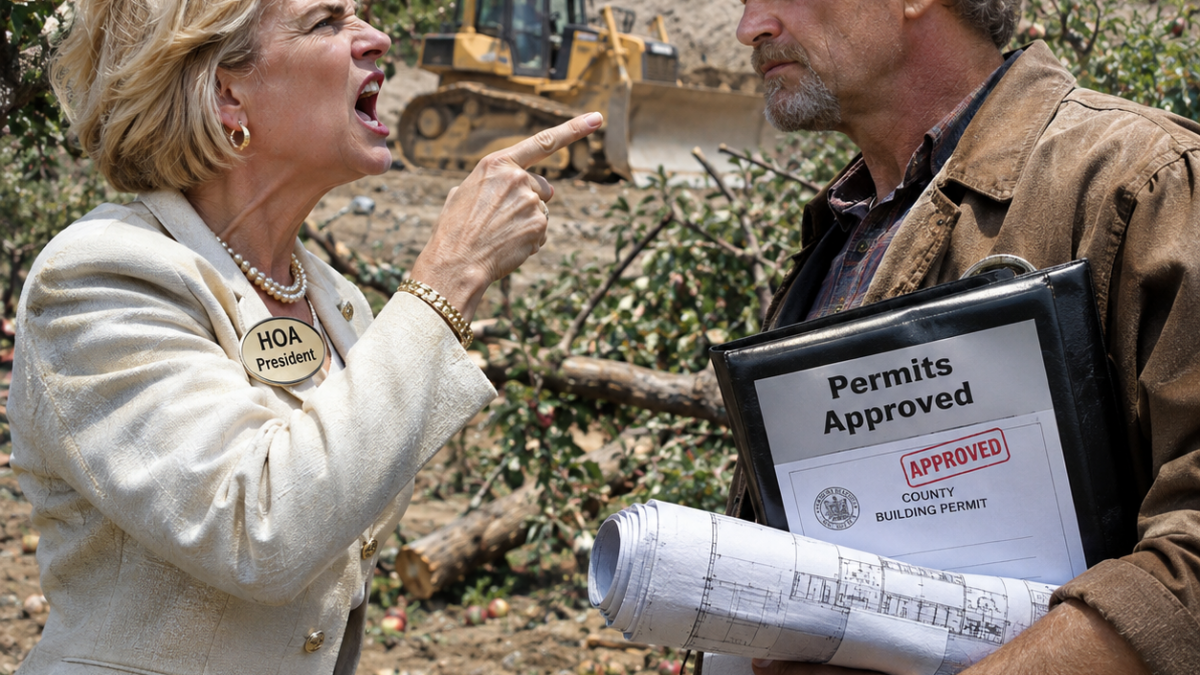
At five in the morning, I woke to the sound of thirty years of my father’s life being crushed beneath a bulldozer.
By the time I reached the orchard, Honeycrisp trees were lying in the mud, diesel smoke hung over the rows, and the woman responsible was standing beside the machinery with a clipboard and a smile.
She thought the land was already hers, but she had no idea what she had just set in motion.
My name is Jake Morrison, and my family had been growing apples on those forty acres since 1994.
My grandfather bought the property when it was little more than scrub grass, uneven ground, and a shallow wetland that everyone else considered useless. He didn’t have much money, but he had the kind of stubborn optimism that makes a man look at bad soil and see an orchard.
My father inherited that optimism.
For almost thirty years, he grafted trees, improved irrigation, learned the frost patterns, studied the soil, and turned those acres into one of the most productive small apple farms in the county.
Honeycrisp.
Gala.
A few rows of Fuji.
In good years, our fruit showed up at farmers markets all over the region.
In bad years, Dad still walked the rows before sunrise with coffee in one hand and pruning shears in the other.
He used to tell me, “Land remembers how you treat it.”
I thought that was just something farmers said to make children feel guilty about driving tractors too fast.
I understood it later.
In 2018, Dad had a heart attack.
That changed everything.
Hospital bills arrived faster than apples could grow. The farm was profitable enough to survive, but not enough to cover medical expenses, repairs, taxes, payroll, and everything else that comes with trying to keep forty acres alive.
So I took a county job.
I had worked around planning and construction for years, and eventually I ended up in the permits department. Fifteen years in county government, seven of them as permits director.
There was some irony in it.
By day, I reviewed development applications.
By evening, I went home and tried to protect agricultural land from being swallowed by the same kind of development I approved when it was done legally.
I never saw that as a contradiction.
Development wasn’t the enemy.
Corruption was.
Then Delia Prescott moved into Willowbrook Estates.
She was fifty-two, from Phoenix, drove a black luxury SUV, carried a designer leather portfolio everywhere, and had the remarkable ability to make a complaint sound like a declaration of war.
Willowbrook sat directly beside our farm.
The development had been built long after the orchard, but Delia behaved as if the apples had appeared specifically to inconvenience her.
Her first complaint was about the smell of spring blossoms.
Her second was about tractor noise.
Her third involved irrigation.
Within a month of becoming HOA president, she had filed dozens of violations against people who had lived there for years.
The Kowalskis had chickens.
Problem.
Mrs. Martinez grew vegetables.
Problem.
Big Mike parked a work trailer beside his garage.
Problem.
My tractor crossed the access road twice a week.
Apparently also a problem.
Then she came after me directly.
A certified notice arrived demanding a $15,000 “remediation assessment” because my irrigation system supposedly violated county health requirements.
That was strange.
I was the permits director.
If my irrigation violated county requirements, I would probably know.
So I asked Delia for the supporting documentation.
She came to my office personally.
Her heels clicked across the courthouse floor before I even saw her.
She placed a folder on my desk.
“There.”
I opened it.
A compliance agreement.
County formatting.
My property address.
My name.
And at the bottom—
my signature.
Except I had never signed it.
I stared at the page.
Delia smiled.
“You agreed to corrective action months ago.”
“No, I didn’t.”
“That’s your signature.”
“It looks like my signature.”
Her eyes sharpened.
“Are you accusing me of something, Mr. Morrison?”
I looked up.
“I’m saying I never signed this.”
For the first time, her smile disappeared.
Then it returned.
Colder.
“You should be careful making accusations you can’t prove.”
She picked up her handbag.
“You have thirty days.”
That evening, I sat at Dad’s old kitchen table with the forged document beside one of his farming journals.
On the left was thirty years of handwritten rainfall totals, harvest dates, grafting notes, and reminders like **CHECK NORTH PUMP BEFORE FROST**.
On the right was a lie wearing an official-looking seal.
I touched the signature.
Something inside me tightened.
I still didn’t know what Delia wanted.
I didn’t know how many people she had already targeted.
And I definitely didn’t know how far she was willing to go.
But I knew one thing.
Nobody forged my name and took my family’s land without finding out exactly what kind of man my father had raised.
PART 2
## THE WOMAN WHO WANTED EVERYTHING
The next morning, I took the document to Carmen Alvarez.
Carmen was my deputy clerk and had worked county government for twenty years.
She could detect a bad permit application from across the room.
She held Delia’s supposed compliance agreement under the fluorescent light.
“Paper stock is wrong.”
“That fast?”
“We changed vendors two years ago.”
She pointed at the upper corner.
“And that header hasn’t been used since 2021.”
I leaned closer.
“What about the document number?”
She typed it into our system.
Nothing.
Tried again.
Still nothing.
Then she looked at me.
“This never existed.”
I sat back.
“So somebody created a county document.”
“Somebody created something designed to look like one.”
She studied my forged signature.
“Jake, this is more serious than an HOA dispute.”
I knew.
But knowing something intellectually and feeling it in your stomach are different things.
I had spent my career inside government systems.
Permits.
Inspections.
Public records.
Hearings.
Codes.
Most people find bureaucracy confusing.
I found it comforting.
Paper trails don’t have moods.
Dates don’t get intimidated.
Official records don’t care who has the nicer lawyer.
If someone lied, the paperwork usually remembered.
That was where I intended to start.
Then Big Mike came by.
His real name was Michael Donnelly, but nobody had called him Michael since high school.
He was six-foot-four, built like a barn door, and had helped Dad build our equipment shed twenty years earlier.
He walked into the permits office carrying two coffees.
“One’s yours.”
“What’s the other?”
“Also yours. You look terrible.”
“Thank you.”
He sat.
“I need to tell you something about your new friend.”
“Delia?”
“She offered me work.”
“That doesn’t sound illegal.”
“Wait.”
He leaned forward.
“She wants me to start bidding on ‘required corrective improvements’ for homeowners.”
I frowned.
“She’s making you her contractor?”
“She wants me to inflate the estimates.”
That got my attention.
“How much?”
“Twenty, thirty percent.”
“And then?”
“She says we split the difference.”
I stared at him.
“You said no.”
“Obviously.”
Mike looked offended.
“I charge too much honestly. I don’t need to cheat.”
Despite everything, I laughed.
Then he stopped smiling.
“She also asked whether your farm had debt.”
My laughter died.
“What exactly did she ask?”
“How much you owed. Whether you were behind on taxes. Whether your dad’s medical bills put liens on the property.”
A cold feeling moved through my chest.
“Why?”
“She said she was evaluating neighborhood redevelopment opportunities.”
That night, I called my cousin Tony.
Tony Morrison was a lawyer in Denver and the kind of cousin who had spent most family reunions arguing hypothetical cases with people who wanted to eat potato salad in peace.
He listened.
Then asked for Delia’s full name.
Two days later he called back.
“Jake.”
“What?”
“I found her.”
“That sounds ominous.”
“It should.”
Delia had been involved in property disputes in Phoenix.
Then Tucson.
Then Flagstaff.
Different companies.
Different developments.
Same pattern.
Target small landowners.
Challenge zoning.
Pile on fines.
Create legal expenses.
Then send a buyer with a low offer.
Three elderly property owners had eventually sold.
Two properties were demolished.
One became a shopping complex.
Tony emailed me the cases.
I read them until after midnight.
One farmer had been seventy-three.
Another couple had owned their land for forty-two years.
Delia hadn’t invented a strategy in Willowbrook.
She had brought one with her.
## THE KOWALSKIS
The Kowalskis lived east of us.
Walter was seventy-eight.
Martha was seventy-six.
They had been married longer than I had been alive.
Their little farm wasn’t impressive to anyone looking at investment potential.
Eleven acres.
Old farmhouse.
Chicken coop.
A red barn leaning just enough to look tired but not enough to fall.
To me, it was part of the landscape.
Walter had taught me to drive a manual transmission when I was fourteen.
Martha brought casseroles after Dad’s heart attack.
They were neighbors in the oldest sense of the word.
I drove over one evening.
Walter met me at the porch.
“You heard.”
“What happened?”
He handed me a letter.
Foreclosure-related collection notice.
HOA fines.
Legal fees.
Administrative penalties.
Almost $19,000.
“For chickens?”
He laughed bitterly.
“For everything.”
Martha came outside.
“She says our fence is wrong.”
Walter added, “Then the barn paint.”
“Then the coop.”
“Then drainage.”
Martha’s hands trembled slightly.
“We paid some of it because we were scared.”
That sentence made me angrier than the numbers.
“How much?”
“Too much.”
Walter looked out at the property.
“I’m tired, Jake.”
I had never heard him say that.
Not after surgeries.
Not during drought years.
Not when their oldest son died.
Never.
“She knows we can’t fight forever,” he said.
Suddenly Tony’s research wasn’t abstract.
This was happening here.
To people I loved.
I went home that night and walked through the orchard.
The evening air smelled like damp soil and blossoms.
Dad used to say the trees changed sound depending on weather.
In wind, leaves whispered.
Before rain, they seemed to hold still.
That night everything felt too quiet.
I realized Delia wasn’t trying to enforce rules.
She was softening the ground.
Making people financially weak.
Emotionally exhausted.
Ready to sell.
The only question was who was waiting to buy.
## THE FIRST LAWSUIT
The answer began arriving at six o’clock on a Tuesday morning.
A process server stood on my porch.
“Jake Morrison?”
“Yes.”
“You’ve been served.”
Forty-three pages.
Delia and the HOA were suing me.
According to the filing, Morrison Apple Farm had been illegally operating on residential-zoned property since 1987.
They wanted immediate cessation of agricultural activities.
Damages for diminished property values.
$250,000.
And an emergency injunction.
I read the zoning map they attached.
At first glance, it looked convincing.
Official seal.
Survey lines.
Parcel numbers.
Historical notation.
Then I saw something wrong.
The section code.
I had stared at county maps for years.
That numbering system didn’t exist in 1987.
I called Carmen.
“Basement.”
“Coffee?”
“Bring enough to kill us.”
For three days, we lived among old county records.
Paper maps.
Microfilm.
Commission minutes.
Survey books.
The courthouse basement smelled like dust, cold concrete, and forgotten bureaucracy.
Big Mike delivered food.
Tony joined by video.
We reconstructed the history of my property.
In 1994, when Grandpa bought it, the land had explicit agricultural grandfathering.
When surrounding parcels were later rezoned, existing agricultural use remained protected.
The chain was perfect.
Then we examined Delia’s map.
Wrong section codes.
Wrong seal.
Wrong formatting.
Then Carmen found the best detail.
The surveyor signature.
Edward Lansing.
I recognized the name.
“Wasn’t he dead before this?”
Carmen checked.
Edward Lansing died in 1986.
The map Delia submitted was dated 1987.
Tony was silent for several seconds.
Then:
“Oh, she is spectacularly stupid.”
“She forged a county zoning map.”
“She submitted a forged county zoning map to a court.”
I felt something unfamiliar.
Not happiness.
Relief.
Because finally the fight had moved onto terrain I understood.
Evidence.
We filed our response.
Every original record.
Every discrepancy.
Every forged element.
Then Tony filed a counterclaim.
Fraud.
Harassment.
Frivolous litigation.
I thought Delia might retreat.
Instead, she escalated.
## THE FAKE INSPECTORS
Three men arrived at my farm in uniforms.
They claimed to be state agricultural inspectors.
One told me several trees were infected with a dangerous disease.
“Removal required within fourteen days.”
I looked at the nearest Honeycrisp.
Healthy bark.
Healthy buds.
Healthy leaves.
“What disease?”
He gave me a name vague enough to sound scientific.
I asked for credentials.
They flashed badges.
Something bothered me.
The lamination looked cheap.
So I called the state agriculture department.
No inspection scheduled.
No employees by those names.
I returned outside.
The men were already leaving.
Their van had a magnetic agency logo.
Underneath the dirt on the rear bumper, I could read the rental company.
Phoenix.
I photographed everything.
Delia had upgraded from forged paperwork to fake government employees.
Then the real county health inspector showed up.
Phillips.
I knew him.
He was nervous before he even spoke.
“Jake, I have to issue a condemnation notice on the irrigation system.”
“Based on?”
“Groundwater contamination concerns.”
“What test?”
He looked away.
“Administrative directive.”
“From who?”
“I can’t discuss that.”
I let him finish.
Then I went inside and pulled the camera footage.
Dad had started hiding security cameras years earlier after tools disappeared from the barn.
I upgraded them.
One unit sat inside a decorative birdhouse with a view of the farm entrance.
Phillips completed his inspection.
Walked to his truck.
Then Delia appeared.
She opened the passenger door.
Got in.
A few minutes later, the camera captured her holding an envelope.
Phillips looked inside.
He counted something.
Even at distance, the movement was obvious.
Cash.
My stomach tightened.
I called Tony.
Then the sheriff.
Then, because Phillips was a county employee, I called the appropriate internal investigator.
The fight was no longer theoretical.
A county inspector appeared to have taken money from a woman trying to condemn my property.
And that was only the beginning.
## THE BLUEPRINT
Big Mike came to my house after dark carrying a cardboard tube.
He looked scared.
I had seen Mike angry.
I had seen him injured.
I had seen him fall ten feet from scaffolding, get up, and complain about scratching his tape measure.
I had rarely seen him scared.
“What?”
He unrolled the plans across my kitchen table.
Architectural drawings.
Site maps.
A luxury resort.
Two hundred rooms.
Spa.
Conference center.
Restaurants.
Golf course.
Private villas.
I leaned closer.
The footprint covered my orchard.
The Kowalski property.
Two additional farms.
“When did you get this?”
“Delia asked me to price early site work.”
“Why would she ask you?”
“She thinks I can be bought.”
He pointed to the title block.
I read the date.
Six months before Delia moved into Willowbrook.
I looked up.
“This was planned before she became HOA president.”
Mike nodded.
My mouth went dry.
The harassment.
Fines.
Lawsuits.
Lowball purchase offers.
Everything had a purpose.
This wasn’t a power-hungry woman improvising.
She had moved here to clear land.
The HOA was just her tool.
Then Mike showed me another page.
Proposed acquisition strategy.
One phrase was circled.
**Eminent domain support if voluntary assembly fails.**
I stared at it.
“She’s trying to make the county condemn us.”
Mike nodded.
“For economic development.”
My father’s photograph hung on the wall above the table.
He was standing beside a newly planted row in 1996.
Young.
Sunburned.
Smiling.
Suddenly the resort plans underneath him felt obscene.
A golf course where his irrigation ponds sat.
Luxury cabins where Grandpa’s original trees grew.
A spa where Martha Kowalski raised chickens.
I put both hands on the table.
“This doesn’t happen.”
Mike looked at me.
“Good.”
“Not one acre.”
“Good.”
“No deal.”
Mike smiled slightly.
“Now you sound like your dad.”
## THE FEDERAL CASE
Tony insisted we stop treating Delia like a normal civil opponent.
He contacted authorities.
I provided the forged documents.
Bribery footage.
Phoenix property cases.
Fake inspection records.
Shell-company names.
Eventually I met Special Agent Sarah Morrison.
No relation.
She worked financial crimes.
She didn’t smile much.
That reassured me.
She sat across from me in a plain conference room and reviewed the evidence.
When she finally looked up, she said:
“This is not an HOA dispute.”
“I figured.”
“You may be documenting a broader land-fraud operation.”
“How broad?”
“We don’t know yet.”
Then she pointed at me.
“And from this moment forward, you do exactly what we tell you regarding evidence.”
That part was difficult.
I was used to fixing problems.
Federal investigations require patience.
Sarah wanted documentation.
Not heroics.
No confronting suspects.
No unauthorized searches.
No using my county position to punish Delia.
That last part mattered.
I had access to permit systems.
Inspection scheduling.
Code enforcement.
I could not turn my office into a private weapon.
Delia expected me to.
She filed an ethics complaint accusing me of exactly that.
Abuse of office.
Conflict of interest.
Retaliatory enforcement.
Within days, my professional reputation was being dragged through local media.
A newspaper editorial asked whether county officials should own property affected by their own departments.
Radio callers accused me of corruption.
Anonymous accounts claimed I accepted contractor kickbacks.
My mother called crying.
“Jake, what are people saying?”
“Lies.”
“Are you in trouble?”
“No.”
That answer came too quickly.
She heard it.
“You sound like your father when he was scared.”
Dad had died the previous year after his health declined.
There are moments when grief returns without warning.
That sentence was one.
I sat in silence.
Mom said softly:
“He’d tell you not to let them make you reckless.”
“I know.”
“Then listen to him.”
## THE IRS
Delia went after my finances next.
An anonymous complaint alleged I had taken bribes from contractors in exchange for permit approvals.
Fake invoices appeared.
Doctored bank records.
Even photographs supposedly showing me receiving envelopes in parking lots.
My accounts were temporarily restricted while questions were sorted out.
Payroll for the farm became uncertain.
I had harvest workers depending on me.
My personal savings were tied up.
For the first time, I understood exactly how Delia had broken people in Arizona.
You didn’t need to win in court.
You only needed to make someone too broke to reach court.
I sat in Dad’s old chair late one night.
The leather was cracked.
His hand had worn one arm smooth over decades.
I had a stack of bills on my lap.
For several minutes, I thought about selling.
Not everything.
Maybe ten acres.
Then twenty.
Enough to stop bleeding money.
Enough to make Delia go away.
That thought scared me more than any threat.
Because it meant her strategy was working.
Carmen arrived the next morning with breakfast.
She found me asleep at the table.
“You look dead.”
“I’m considering it as a financial strategy.”
She set down a bag.
“Contractors are talking to investigators.”
“Good.”
“Every single one says you never took a dime.”
I looked up.
“Every one?”
She smiled.
“Big Mike told them you once rejected his permit because he used blue ink.”
“I did.”
“I know.”
“Black means original.”
“Normal people don’t care.”
“Normal people don’t work permits.”
She laughed.
Then became serious.
“Jake, your records are clean.”
It took weeks, but the false financial accusations collapsed.
Not before they did damage.
But they collapsed.
And Delia had made another mistake.
Fake financial evidence leaves evidence of its own.
## THE TWO ACRES
Her next permit application landed on my desk.
Pool house renovation.
Routine.
Except the parcel boundaries were wrong.
Her property appeared two acres larger than county records showed.
I opened GIS mapping.
Then the deed.
Then the original subdivision survey.
Those two acres were not hers.
They were part of a protected county wetland preserve.
The same wetland connected hydrologically to our farm ponds.
I called Carmen.
“Come here.”
She stared at the overlay.
“Oh.”
“Yeah.”
“That’s bad.”
“For her.”
The proposed resort golf course crossed the same wetland.
So did drainage infrastructure.
The environmental survey Delia submitted barely mentioned it.
I pulled old habitat studies.
Then requested updated testing through proper channels.
That was when endangered salamander habitat was confirmed around the irrigation ponds.
Dad had protected those ponds because they improved the orchard.
He never knew they might one day protect the orchard in return.
I stood beside the water one misty morning while a biologist showed me a tiny salamander.
Smaller than my thumb.
“That little thing can stop a resort?”
The biologist smiled.
“That little thing doesn’t care about resorts.”
Neither did federal habitat law.
## THE PERMITS CROSSED MY DESK
Delia’s resort application arrived in full.
Hundreds of pages.
And because of my conflict, I did not personally issue the final decision.
We established independent review.
Everything transparent.
Everything documented.
But I still knew how to read the file.
Page seventy-three contained language tying development rights to the cessation of agricultural use within the impact zone.
There it was.
The strategy.
If Delia could kill the farms, force sales, or create enough legal pressure to stop agricultural operations, the development pathway became easier.
My farm was the keystone.
The largest continuous agricultural parcel.
Remove it, and the rest of the rural character protections weakened.
Tony helped trace the companies.
Willowbrook Resort LLC.
Phoenix Development Partners.
Desert Sun Holdings.
Southwestern Investment Group.
Layers.
Shells.
Money flowing through companies whose names sounded generic enough to disappear into paperwork.
Federal investigators traced deeper.
Casino-linked funds.
Questionable investors.
Prior land acquisitions.
Delia owed millions.
The resort wasn’t merely an opportunity.
It was apparently her attempt to escape a collapsing financial structure.
That made her more dangerous.
People with options negotiate.
People with no options gamble.
## SHE ATTACKED THE WATER
At five one Tuesday morning, machinery woke me.
Excavator.
Trucks.
Floodlights.
A crew was digging across the irrigation line.
I ran outside.
“What are you doing?”
“Emergency contamination remediation.”
“Who authorized it?”
The foreman handed me an order.
My signature appeared at the bottom.
Again.
I looked at the date.
The document was dated the following week.
I almost laughed.
“Stop work.”
“We have authorization.”
“No, you have a forgery.”
He climbed back into the excavator.
“Call whoever you want.”
So I did.
Sheriff.
County counsel.
Emergency utilities.
Federal contact.
And I filmed everything.
By sunrise, several irrigation lines had been severed.
Water pressure was dropping.
Harvest season was approaching.
Mature apple trees can survive a lot.
But not deliberate water disruption during critical periods.
Big Mike arrived with his crew before breakfast.
“No charge.”
“Mike—”
“No.”
He pointed toward the damaged line.
“My town too.”
Emergency repair authority was properly invoked.
Crews worked through the day.
PVC.
Valves.
Pumps.
Mud.
By evening, water was moving again.
I stood beside Mike watching irrigation spray across the orchard.
He wiped sweat from his face.
“Your dad would’ve killed somebody.”
“No.”
Mike looked at me.
“He would’ve thought about it.”
That made me laugh for the first time in days.
## THE COMMUNITY BREAKS
Delia intensified pressure everywhere.
The Kowalskis received more foreclosure threats.
Mrs. Martinez was cited over her garden.
Older residents began receiving notices for fences, sheds, paint colors, driveways, drainage, animals.
Anything that cost money.
Anything that made people consider selling.
One evening, we held a meeting in the school gym.
I expected thirty people.
More than a hundred came.
Farmers.
Retirees.
Young families.
People from Willowbrook.
People outside it.
Some brought violation notices.
Others brought purchase offers.
Everyone had a story.
Walter Kowalski stood.
He held a folder in both hands.
“My wife and I were ready to leave.”
The room quieted.
“I’m seventy-eight.”
He swallowed.
“I kept telling myself it wasn’t worth dying over a chicken coop.”
Martha took his arm.
“But then I realized we weren’t fighting about chickens.”
He looked toward me.
“We were fighting over whether forty-seven years of our lives mattered.”
That sentence broke something open in the room.
People began standing.
One after another.
A widow.
A mechanic.
A teacher.
A young couple.
A farmer.
For months, Delia had isolated them.
That night they saw each other.
Fear changes when it becomes shared.
Sometimes it gets bigger.
Sometimes it becomes courage.
## BIG MIKE WEARS A WIRE
Federal investigators asked Mike whether he would record a meeting.
Delia wanted to discuss construction pricing.
He agreed.
I hated it.
Mike was brave.
That doesn’t make danger comfortable.
Before he left, I said:
“If anything feels wrong, walk.”
“I know.”
“Don’t improvise.”
“I know.”
“You always improvise.”
He grinned.
“Occupational hazard.”
The recording captured Delia discussing inflated invoices.
Payments.
Preferred companies.
And one sentence that became important later.
“Jake’s job won’t be a problem much longer.”
Mike asked:
“What does that mean?”
She replied:
“People who obstruct progress eventually get replaced.”
Not a threat by itself.
But inside everything else, it mattered.
Carmen uncovered travel paid for by a development consulting company.
Three county commissioners.
Las Vegas.
Hotels.
Meals.
Entertainment.
Those commissioners had voted consistently on development issues tied to Delia’s interests.
The investigation widened again.
I began to feel like I was watching rot spread through walls after removing one piece of drywall.
Every time we thought we had found the problem, something worse sat behind it.
## RACHEL CHEN
Rachel Chen was an investigative reporter.
She contacted Tony first.
Then me.
I didn’t trust her.
Delia had already used media against me.
Rachel understood.
“Don’t trust me.”
That surprised me.
“Excuse me?”
“Trust documents.”
She placed a recorder on the table.
“Anything I publish, you should be able to verify.”
That was the first thing she said that made me comfortable.
She had researched Delia’s previous developments.
Arizona.
Multiple farmers.
Similar lawsuits.
Similar entities.
Similar acquisitions.
Photographs showed fields gone.
Concrete where orchards used to be.
One image hit me hard.
An elderly man standing beside a demolished barn.
Caption:
**Property acquired after prolonged zoning dispute.**
I stared at it.
Rachel said quietly:
“You’re seeing your future.”
“No.”
She waited.
“That’s what she thinks my future is.”
Rachel watched me.
“What do you think?”
I looked at the photo.
“Different ending.”
## THREE DAYS BEFORE GROUNDBREAKING
Delia announced a groundbreaking ceremony.
Ten o’clock.
October 14.
Invited investors.
Politicians.
Media.
She didn’t have final permits.
She didn’t have environmental clearance.
She didn’t legally own all the land represented in her plans.
But she was moving forward.
That told us she was panicking.
At three in the morning on October 12, floodlights appeared near the development site.
Chainsaws started.
Heavy equipment moved in.
They claimed emergency environmental remediation.
There was no qualifying emergency.
Trees came down.
Old oaks.
Brush.
Boundary vegetation.
I stood in the dark listening to wood crack.
Then I smelled diesel.
And fresh-cut timber.
I called the EPA contact.
The sheriff.
County counsel.
Stop-work authority followed.
By six, deputies were on site.
Federal environmental enforcement was notified.
Crews were ordered to stop.
But the damage already done looked brutal.
That morning I walked into my orchard.
Several trees along the edge were down.
Not the whole farm.
But enough.
One was a Honeycrisp Dad planted himself.
I recognized it because the trunk forked unusually low.
He used to complain that he should have corrected it when the tree was young.
I knelt beside it.
The roots were torn from the soil.
Apples lay crushed beneath tracks.
I put my hand against the trunk.
And suddenly I wasn’t a permits director.
I wasn’t a witness.
I wasn’t part of a federal investigation.
I was a son.
My father was dead.
And one of the living things he had raised with his own hands was lying in mud because somebody wanted a resort.
I cried.
Not dramatically.
Not loudly.
I just sat there with my hand on the bark while tears hit my work pants.
Mike found me.
He didn’t speak for a while.
Then he sat beside me.
“She can’t put it back,” I said.
“No.”
“Court won’t put it back.”
“No.”
“Money won’t put it back.”
“No.”
I looked at him.
“So what the hell does winning even mean?”
Mike stared toward the damaged rows.
“Maybe winning means she doesn’t get to do it to anyone else.”
I closed my eyes.
That wasn’t enough.
But it was something.
## DAD’S JOURNAL
That night, I opened Dad’s journals.
I wasn’t looking for evidence.
I was looking for him.
1998.
**Late frost. Lost west row. Replant.**
2003.
**Irrigation pump failed. Jake helped repair. Complained entire time.**
I smiled.
2011.
**Honeycrisp finally producing well. Soil improving.**
Then a page from 2018.
A few weeks after his heart attack.
His handwriting was shaky.
**If Jake keeps this place, good. If he sells someday, also good. Land should serve life, not trap it. Just don’t let anybody take it from him because they think he’s too tired to fight.**
I read that sentence again.
And again.
Then closed the book.
Dad had never expected the farm to be worshiped.
He expected it to be respected.
There was a difference.
I slept four hours.
Woke before sunrise.
And went back to work.
## OCTOBER 14
The morning was cold and clear.
Groundbreaking at ten.
Rachel’s story went live at 9:30.
The headline spread quickly.
Multi-state land acquisition scheme.
Forged records.
Questionable HOA practices.
Financial links.
Environmental violations.
By nine forty-five, reporters were arriving in numbers Delia had not planned for.
She still held the ceremony.
That tells you everything about her.
Most people, faced with federal scrutiny and a collapsing public narrative, would cancel.
Delia doubled down.
A stage had been erected near the planned resort entrance.
Gold shovel.
Banner.
Renderings of luxury buildings.
Politicians.
Investors.
Cameras.
I arrived wearing a wire at federal request.
Agent Sarah was somewhere in the crowd.
Other agents too.
Delia took the podium.
“Today,” she announced, “we move beyond obstruction and fear.”
I almost admired the nerve.
“This project will create hundreds of jobs and secure Willowbrook’s future.”
Polite applause.
She continued.
“Certain individuals have tried to stop progress through misinformation, personal vendettas, and abuse of government authority.”
Her eyes found me.
There it was.
I waited.
Eventually came questions.
I stepped forward.
“Ms. Prescott.”
The crowd turned.
Her jaw tightened.
“Mr. Morrison.”
“I have a permit question.”
A few reporters moved microphones closer.
She smiled.
“I’m sure you do.”
I held up a folder.
“Your development applications contain false property descriptions.”
Her smile flickered.
“That’s your opinion.”
“No.”
I removed the overlay map.
Rachel’s team had arranged a portable display.
Actual deed boundaries appeared in blue.
Delia’s claimed boundaries in red.
The overlap with protected wetland was obvious.
“You claim approximately two acres you do not own.”
Murmurs.
Delia raised her hand dismissively.
“Boundary adjustments are routine during large development projects.”
“Not when the additional land belongs to a protected public preserve.”
Her attorney moved toward her.
She ignored him.
“We have legal entitlement.”
“Show it.”
“Appropriate documents have been filed.”
“Several are forged.”
The crowd changed.
Not loud.
Just attentive.
I continued.
“Your zoning map uses a section numbering system that did not exist on the date printed.”
Her face tightened.
“The surveyor signature belongs to a man who died before the document was supposedly created.”
Cameras clicked.
“You submitted permit applications under multiple companies that trace back to the same ownership network.”
She stepped toward me.
“This is exactly the abuse I’ve warned everyone about.”
I kept my voice level.
“Then answer one question.”
She glared.
“Do you own the land we’re standing on?”
“Yes.”
Wrong answer.
I looked toward Sarah.
Then back at Delia.
“No.”
I pointed toward the map.
“County records place your legal boundary fifty feet behind this stage.”
The crowd erupted.
Delia grabbed another folder.
“We have environmental approval.”
She held up an inspection report.
I recognized the signature.
Phillips.
The inspector captured receiving cash.
Before I could speak, another voice came from beside the stage.
“Ms. Prescott.”
Agent Sarah Morrison stepped forward.
Badge visible.
The sound around us seemed to disappear.
Delia stared at the badge.
Then at me.
Then back at Sarah.
“Delia Prescott, you are under arrest.”
Cameras surged forward.
Sarah continued.
The charges she listed seemed endless.
Mail fraud.
Wire fraud.
Money laundering-related offenses.
Conspiracy.
Environmental crimes.
Racketeering allegations.
Delia’s lawyer moved away from her.
That detail stayed with me.
For months he had walked half a step behind her.
The moment the cuffs appeared, he created distance.
Delia looked around wildly.
“This is political!”
Nobody answered.
“This man is corrupt!”
She pointed at me.
“He used his office!”
Sarah calmly guided her hands behind her back.
Delia twisted.
“You think you won?”
I didn’t respond.
She shouted louder.
“Jake! You think this saves your farm?”
The handcuffs clicked.
I looked toward the damaged orchard.
“No.”
She froze.
“It doesn’t bring back what you destroyed.”
For the first time, I think she understood something.
This wasn’t triumph for me.
Not completely.
Justice and restoration are not the same thing.
Then Walter Kowalski began clapping.
Slowly.
Martha joined him.
Big Mike.
Carmen.
Others.
The applause spread.
Not because a woman was being humiliated.
Because people who had spent months being afraid finally believed she could no longer reach them.
Delia was led away.
Several associates were arrested.
Investigators moved across the site.
Equipment was secured.
Files seized.
The golden shovel remained leaning against the stage.
I stared at it.
Mike walked over.
“You want it?”
“No.”
“Would look good in the barn.”
“No.”
He smiled.
“You’re no fun.”
I looked at the resort rendering behind us.
“Burn that.”
“Now we’re talking.”
I laughed.
He didn’t actually burn it.
Carmen took it as evidence.
She always ruined the good ideas.
## AFTER THE ARRESTS
Federal investigations expanded.
Delia eventually entered a guilty plea covering major portions of the scheme.
Other defendants followed.
Several officials faced criminal or civil consequences related to bribery and corruption.
The resort permits were void.
The wetland received stronger protection.
The fraudulent acquisitions were unwound where legally possible.
The Kowalskis kept their land.
The day Walter received confirmation that the foreclosure pressure had been stopped, he walked to my farm carrying a cardboard box.
Inside was a chicken.
“A chicken?”
“Victory chicken.”
“What am I supposed to do with it?”
“Raise it.”
“I grow apples.”
“Diversify.”
Martha stood behind him laughing.
The chicken lived in our equipment shed for eight years.
We named her Delia.
That was Mike’s idea.
I deny responsibility.
## CLEANING COUNTY GOVERNMENT
The corruption inside the county hurt almost as much as the farm damage.
Phillips cooperated.
Commissioners were investigated.
Records were audited.
Policies changed.
I testified.
Repeatedly.
Some people apologized.
Others insisted they had merely attended conferences or trusted bad information.
I learned something unpleasant.
Corruption rarely begins with a briefcase of cash.
Sometimes it begins with a free dinner.
A trip.
A favor.
A small exception.
Then another.
By the time real money appears, people have already trained themselves not to ask questions.
My office changed procedures.
Independent review for conflicts involving county employees.
Stronger authentication on historical documents.
Digital verification for signatures.
Automatic cross-checking against GIS boundaries.
Public transparency tools.
Nothing glamorous.
That is the point.
Good government should usually be boring.
When it becomes dramatic, somebody has probably failed.
## THE ORCHARD
The hardest part was the trees.
You cannot restore a mature orchard with a court order.
We lost rows.
Old root systems.
Years of growth.
For several months, I avoided the damaged section.
Then one Saturday, Mom came over.
She was seventy-four.
Still moved through the farm like it belonged to her—which, emotionally, it did.
She stood beside the stump of Dad’s Honeycrisp tree.
“You going to leave this like this forever?”
“I haven’t decided.”
“Yes, you have.”
I looked at her.
She held out a shovel.
“I’m too old to dig.”
“That is manipulation.”
“I raised you.”
“Advanced manipulation.”
We planted a new tree.
Then another.
Then neighbors arrived.
I hadn’t invited them.
Carmen came with gloves.
Mike brought equipment.
The Kowalskis brought lunch.
Mrs. Martinez brought tomato plants for reasons nobody understood.
Within two weekends, we replanted most of the destroyed rows.
Not replacements.
New trees.
There is a difference.
I stopped trying to recreate exactly what had been lost.
Dad’s orchard belonged to his life.
What we were planting belonged to ours.
## THE WETLAND
Federal environmental designation eventually protected a much larger area around the farm.
The same wetland Delia viewed as wasted land became the foundation of permanent conservation.
A grant helped restore habitat.
We built a small education center.
School groups started visiting.
Children learned about irrigation.
Pollinators.
Soil.
Salamanders.
Apples.
One boy looked at a tree and asked me:
“Where do apples come from before the store?”
I thought he was joking.
He wasn’t.
I took him straight to the orchard.
That became one of my favorite parts of the work.
Dad spent his life producing food.
I began to understand that teaching people where food comes from was another way of preserving his legacy.
## THE KOWALSKIS’ FIRST FREE SPRING
The first spring without Delia’s HOA pressure felt strange.
Walter expanded the chicken coop.
Possibly too much.
Martha painted the barn doors bright red.
Nobody issued a violation.
Mrs. Martinez planted so many tomatoes that she started giving bags away.
Mike parked his trailer wherever it fit.
Someone joked that without strict HOA enforcement, civilization would collapse.
Instead, people began having neighborhood dinners.
Actual neighbors.
Not mandatory association mixers.
Nobody wore name tags.
Nobody gave speeches about property values.
Children ran through yards.
Dogs barked.
Farm equipment moved on roads.
Life was messy.
It was wonderful.
## RACHEL
Rachel kept reporting.
Her investigation expanded into a larger series on rural land pressure.
She interviewed families Delia had targeted in other states.
Some had lost everything.
That was difficult to hear.
Our ending had been better.
Theirs hadn’t.
Rachel won major recognition for the series.
I didn’t care much about awards.
She did excellent work.
That was enough.
We spent more time together.
Interviews became coffee.
Coffee became dinner.
Dinner became arguments about whether journalists or permit officials were more annoying.
She said permit officials.
She was wrong.
Our first official date happened after we testified at a state hearing.
Not romantic.
Bad coffee.
Fluorescent lights.
Four hours of waiting.
But afterward we drove to a diner and talked until midnight.
Dad would have liked her.
That mattered more than I expected.
## THE FARM EXPANDS
Several parcels tied to the failed development were eventually sold or reassigned through lawful proceedings.
We acquired additional agricultural acreage.
Morrison Apple Farm grew.
Not because I wanted an empire.
Because I wanted a buffer.
Agricultural land protecting agricultural land.
We partnered with a university.
Organic farming trials.
Water conservation.
Habitat studies.
New apple varieties.
One professor told me Dad had accidentally created an unusual microclimate around the ponds.
“He knew.”
“Scientifically?”
“No.”
I smiled.
“He just knew.”
Some knowledge arrives through data.
Some through thirty years of walking the same field.
Both matter.
## THE APPLE FESTIVAL
The first Willowbrook Apple Festival began as a joke.
Mike said we needed to celebrate one year without being sued.
Carmen said that was not a normal festival theme.
So we changed it.
Community resilience.
Agriculture.
Wetland conservation.
Local vendors.
Music.
Food.
By noon, the farm was packed.
Children rode hay wagons.
Musicians played bluegrass near the barn.
Martha Kowalski sold eggs.
Mrs. Martinez sold tomatoes despite it being an apple festival.
Nobody could stop her.
Rachel ran a journalism workshop for teenagers.
Carmen organized a booth explaining how public records worked.
Mike stationed himself near the cider press and contributed almost nothing useful.
At sunset, I walked away from the crowd.
The new Honeycrisp trees stood where Delia’s machinery had destroyed the old ones.
Still young.
Still thin.
But healthy.
A little girl was picking an apple nearby.
Her father lifted her so she could reach.
I suddenly remembered Dad doing the same thing with me.
For a second, the years folded together.
That was when I finally understood what he meant.
Land remembers how you treat it.
Not magically.
Through consequences.
Care for soil and roots grow deeper.
Neglect water and trees weaken.
Protect wetlands and entire ecosystems survive.
Destroy something and the scar remains.
Replant, and the land remembers that too.
## DELIA’S SENTENCE
People asked whether I attended Delia’s sentencing.
I did.
I sat in the back.
She looked different.
No designer portfolio.
No heels clicking across marble.
No group of lawyers.
She looked smaller.
Older.
Human.
That complicated my feelings.
I had spent months seeing her as an enemy.
In court, she was just a woman who had made a long series of destructive choices.
The judge spoke about fraud.
Financial damage.
Victims.
Environmental harm.
Abuse of public systems.
Delia accepted a substantial federal prison sentence under her plea agreement and significant restitution obligations.
When she was allowed to speak, she said she had been trying to save investors and create economic opportunity.
Maybe she believed some version of that.
People are good at turning greed into a story where they are the hero.
Then she looked toward the gallery.
Her eyes found me.
I expected hatred.
Instead, she looked tired.
After court, Rachel asked:
“How do you feel?”
I thought about it.
“Finished.”
“Happy?”
“No.”
“Sad?”
“No.”
“Then what?”
I looked back at the courthouse doors.
“Finished.”
That was enough.
## THE SCHOLARSHIP
Part of the money I received through lawful whistleblower and settlement channels went into a scholarship.
Agriculture.
Environmental law.
Rural planning.
The first recipient was Carmen’s daughter.
She wanted to become an environmental attorney.
At the award ceremony, Carmen cried before her daughter did.
Mike cried too, but claimed dust entered both eyes simultaneously.
The scholarship became annual.
Dad never went to college.
Grandpa barely finished high school.
I liked the idea that the land they built could help educate people who would protect other land.
Legacy does not have to be a monument.
Sometimes it is tuition.
## MY MOTHER’S LAST HARVEST
Mom’s health declined a few years later.
One September, she asked me to drive her through the orchard.
Not in the truck.
“Tractor.”
“You’re going to complain about the bumps.”
“Probably.”
I helped her onto the old tractor.
We moved slowly.
She pointed at trees.
“Your father planted that row.”
“I know.”
“That one was your grandfather’s.”
“I know.”
She pointed at the replanted section.
“And those are yours.”
I didn’t answer.
She looked at me.
“You kept thinking you were preserving your father’s farm.”
“I was.”
“No.”
She smiled.
“You were building your own.”
That hit me harder than I expected.
Mom died the following winter.
At her memorial, we served apple pie.
Walter Kowalski gave a toast.
Mike tried to give one and cried too hard.
Rachel held my hand.
After everyone left, I walked to the new trees.
For years, I had thought protecting the farm meant freezing it in time.
But nothing living survives that way.
Trees grow.
People age.
Families change.
Land changes.
Protection doesn’t mean preventing all change.
It means making sure change is not stolen from you.
## ANOTHER CALL
Years after Delia’s arrest, I received a phone call from a permits director in a neighboring county.
She sounded exhausted.
“Jake Morrison?”
“Yes.”
“I was told you might understand something.”
“What?”
“Developers are targeting several dairy farms.”
I sat straighter.
“What kind of pressure?”
“Code complaints. Zoning challenges. Strange purchase offers.”
“Any shell companies?”
A pause.
“Yes.”
“Send me only what you’re legally allowed to share.”
“You think it’s connected?”
“I think patterns matter.”
I looked through my office window.
The orchard was covered in morning mist.
Young trees had become mature.
Children from a school group were arriving near the education center.
Rachel was interviewing a conservation volunteer.
Mike, older and slower, was arguing with somebody about a fence.
Normal life.
Hard-won normal life.
The permits director said:
“I’m afraid I’m overreacting.”
I remembered the forged signature.
The fake inspectors.
The bulldozers.
Walter saying he was tired.
Dad’s tree in the mud.
“No,” I said.
“Document first. Decide later.”
She exhaled.
“Can you help?”
I looked at Dad’s photograph.
“I’ll be there.”
## WHAT REVENGE FINALLY MEANT
When Delia first came after us, I imagined revenge in simple terms.
I wanted her to lose.
I wanted her embarrassed.
I wanted every person she had bullied to watch her fail.
And yes, when the handcuffs closed around her wrists, part of me felt satisfaction.
Anyone who says otherwise has probably never watched someone deliberately destroy a piece of their family history.
But that feeling faded.
The better feeling remained.
Walter still had his house.
Martha still had her chickens.
Mrs. Martinez still had tomatoes.
The wetland was protected.
Children visited the farm.
County government became harder to corrupt.
Young lawyers received scholarships.
New apple trees grew where old ones had died.
That was revenge Delia could never undo.
She wanted a resort.
We built a preserve.
She wanted luxury villas.
We built classrooms.
She wanted a golf course.
We protected ponds.
She tried to force old farmers from their property.
They stayed long enough to see her removed.
She wanted to erase agriculture from the map.
The farm grew.
That was the ending I could live with.
## THE TREE
There is one tree I visit every October.
The first Honeycrisp Mom and I planted after the bulldozers left.
For years it produced nothing.
Then a few apples.
Then more.
Now it is strong.
One branch grows slightly crooked.
Mike once suggested pruning it.
I told him no.
Dad’s old tree had a low fork too.
Maybe that is sentimental.
I’m allowed.
Last harvest, I picked an apple from that branch.
Rachel stood beside me.
“Good?”
I took a bite.
Sweet.
Crisp.
A little tart.
“Perfect.”
“You say that every year.”
“It improves.”
“You say that every year too.”
I handed her the apple.
Around us, people were preparing for the festival.
Music testing.
Tables unfolding.
Children laughing.
The air smelled like cider and leaves.
No diesel.
No burning paperwork.
No crushed blossoms beneath bulldozer tracks.
I closed my eyes.
For just a second, I could hear Dad’s voice.
Land remembers how you treat it.
He had been right.
The orchard remembered the damage.
So did I.
But scars were not the only thing it remembered.
It remembered replanting.
Water returning to broken irrigation lines.
Neighbors showing up with shovels.
Children learning the names of trees.
A community deciding it would no longer be bought one exhausted family at a time.
That was the part Delia never understood.
She believed ownership came from contracts, leverage, money, and control.
My father understood something simpler.
You can own a deed and still have no relationship with the land beneath your feet.
And you can spend thirty years caring for forty acres until every row carries part of your family inside it.
Delia thought she could bulldoze that relationship before sunrise.
She thought if she destroyed enough trees, manufactured enough paperwork, bribed enough people, and frightened enough neighbors, the land would become just another parcel on a development map.
She was wrong.
The bulldozers did destroy trees.
They destroyed memories I can never physically recover.
They left scars that court orders could not erase.
But they did not destroy the farm.
They did not destroy my father’s legacy.
And they did not destroy the community.
In the end, the woman who wanted to build a private resort gave us something she never intended.
A reason to stand together.
I spent years thinking my most important weapon in that fight was my position as permits director.
It wasn’t.
It helped.
Knowing the records mattered.
Understanding the system mattered.
Knowing exactly which documents were false and which laws applied mattered enormously.
But paperwork alone did not save us.
Carmen saved us by refusing to ignore inconsistencies.
Tony saved us by taking the first forged map seriously.
Mike saved us by refusing dirty money and helping repair what Delia’s crews destroyed.
Rachel saved us by putting verified facts in front of the public.
Federal investigators saved us by following the evidence instead of the politics.
The Kowalskis saved themselves by refusing to leave when they finally realized they weren’t alone.
And Dad—
Dad saved me years before the fight ever started.
He taught me that land was not valuable because someone wanted to build on it.
It was valuable because of what people were willing to build with it.
Food.
Family.
Memory.
Community.
A future.
One October morning, a schoolboy stood beside me under that Honeycrisp tree.
He was maybe nine.
He looked toward the wetland.
Then at the orchard.
“Mr. Morrison?”
“Yeah?”
“Is this the place where the bad lady tried to build the hotel?”
I laughed.
“Resort.”
“What’s the difference?”
“Mostly price.”
He thought about that.
“Did you beat her?”
Children ask complicated questions as if they have simple answers.
I looked across the farm.
Sixty acres now.
New trees.
Old trees.
Wetland reeds moving in the wind.
The education center.
The Kowalski property beyond the fence.
The barn Dad helped repair a dozen times.
Then I looked down at him.
“No.”
He frowned.
“She got arrested.”
“She did.”
“So you beat her.”
I shook my head.
“We stopped her.”
“What’s the difference?”
I smiled.
“A big one.”
He waited.
“Beating somebody means the story is about them losing.”
I pointed toward the orchard.
“Stopping them means the story is about everything they didn’t get to destroy.”
He looked around again.
At that age, I wasn’t sure he understood.
Then he nodded.
“So this is the stuff she didn’t destroy?”
My throat tightened.
“Yeah.”
He picked up an apple.
“All of it?”
“All of it.”
That afternoon, after the buses left, I stood alone at the edge of the orchard.
The sun dropped behind the hills.
Long shadows stretched between the rows.
For years, I had carried the image of bulldozers in my head.
Metal tracks.
Broken branches.
Apples in mud.
Delia’s clipboard.
Sometimes I still dreamed about it.
But memory changes when you give it competition.
Now there were other images.
Mom holding a shovel.
Mike repairing irrigation.
Carmen laughing over paperwork.
Walter carrying his ridiculous victory chicken.
Rachel standing beside me at the festival.
Children running between trees Dad never lived long enough to see.
The new memories did not erase the old ones.
They surrounded them.
That was healing.
Not forgetting.
Building enough life around the wound that the wound was no longer the biggest thing there.
I touched the bark of the Honeycrisp tree.
Rough.
Alive.
Rooted.
Delia once believed my farm was an obstacle.
Something standing between her and millions of dollars.
She never understood that some obstacles should not be removed.
Sometimes an orchard is not empty land waiting for a better use.
Sometimes an old farmhouse is not an acquisition opportunity.
Sometimes chickens, tomatoes, ponds, barns, tractors, and families are not signs that a place has failed to modernize.
Sometimes they are the reason the place is worth protecting.
And sometimes the person standing between a bulldozer and a family farm happens to be the county permits director who knows exactly what legal development looks like—
and exactly what fraud looks like too.
Delia learned that difference too late.
The resort was never built.
The golf course never drained the wetland.
The villas never covered Dad’s trees.
The families she tried to force out remained.
And every October, when the orchard fills with apples and the air turns sweet, people come from miles away to walk the same ground she tried to erase.
They buy cider.
They listen to music.
They learn about farming.
They watch salamanders in the wetland.
Children climb onto hay wagons.
Neighbors argue about tomatoes.
And when the sun goes down, lights come on in the barn while music carries across the fields.
Sometimes I stand at the edge of the crowd and think about Delia’s original resort drawings.
Two hundred rooms.
Spa.
Golf course.
Luxury villas.
She wanted to create a destination.
In a strange way, she did.
Just not hers.
She tried to turn our community into something wealthy strangers would visit for a weekend.
Instead, we protected the place where actual families could keep living.
Dad would have liked that ending.
Not because I won.
He never cared much about winning.
He cared about what remained after the fight was over.
The trees remained.
The water remained.
The people remained.
And so did I.
That was enough.








