PART 2: HOA Karen Bulldozed a Highway Through My Protected Wetlands — She Laughed at My Flood Warning Until the Sky Turned Black
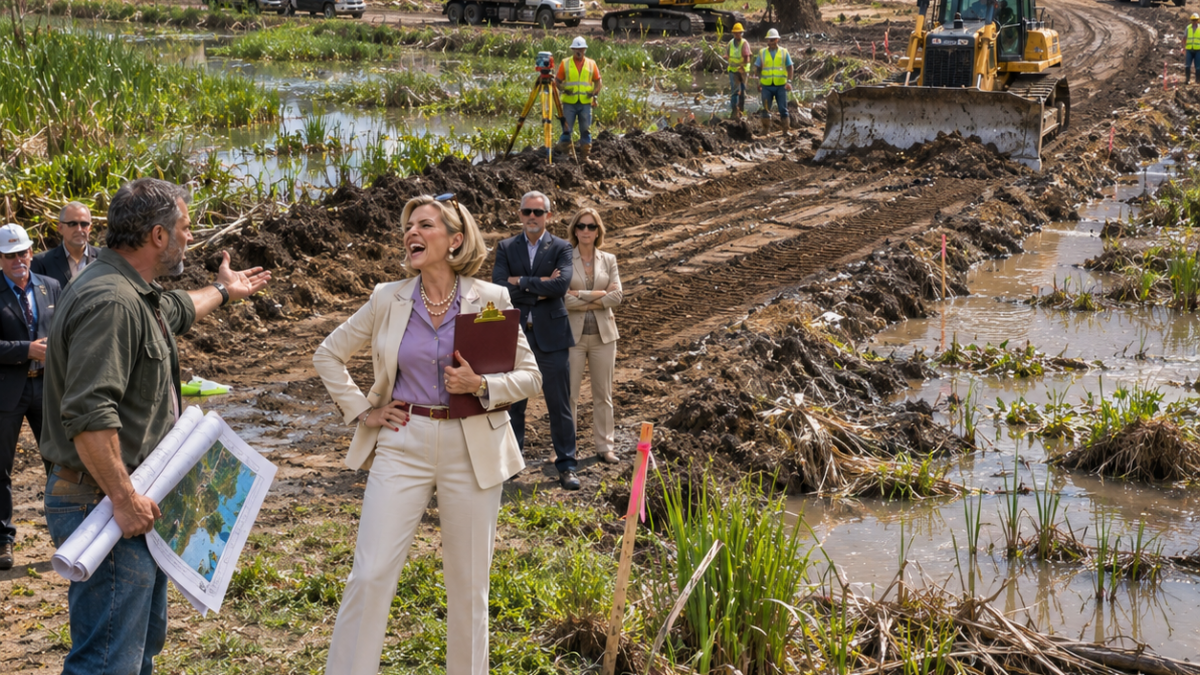
PART 2
For several seconds, neither Bill nor I spoke.
The marsh had always looked chaotic to strangers.
Reeds growing wherever water carried seed.
Cypress knees rising from black mud.
Patches of open water appearing and disappearing with the seasons.
But underneath that mess was structure.
I knew exactly where my property monuments were.
My father had taught me.
He bought the original acreage in the early 1980s and spent years fighting people who wanted to drain pieces of it for pasture.
When I was twelve, he walked me through the marsh carrying a survey map in a plastic sleeve.
He stopped beside an iron marker and tapped it with his boot.
“Lines matter, Tommy.”
At twelve, I thought he meant property.
When I got older, I understood he meant everything.
Property lines.
Flood lines.
Tree lines.
The thin lines people cross because they assume nothing will happen when they do.
I looked at the missing marker.
“That post was right here.”
Bill nodded.
“Saw one of their guys pull something up.”
“You saw him?”
“Sure did.”
“What did it look like?”
“Rusty steel rod with a yellow cap.”
My boundary monument.
I took out my phone.
“Tell me that again.”
Bill frowned.
“You recording?”
“With your permission.”
“Record all you want.”
He looked directly into the camera.
“I saw two employees from Adams Development remove an old survey marker from this location around seven-fifteen this morning. One of them said the HOA had a newer boundary.”
I stopped the recording.
“Thank you.”
“You think they forged something?”
“I think I don’t accuse people until I can prove it.”
Bill grinned.
“That lawyer talk?”
“Environmental-consultant survival instinct.”
We spent the next hour photographing every stake.
I recorded GPS coordinates.
Wide shots.
Close shots.
The disturbed soil where my boundary monument had been.
Tire tracks.
Paint marks.
Vehicle impressions.
The whole thing.
Then I called Evelyn Mercer.
Evelyn was an environmental attorney I’d worked with on three consulting cases over the years.
She had the unnerving habit of becoming calmer as everyone around her became more alarmed.
When she answered, I said, “I need a favor.”
“Professional favor or Thomas-created-disaster favor?”
“Other people created the disaster.”
“So professional.”
I explained.
She stopped me twice to clarify dates.
When I finished, she asked one question.
“Have they broken ground?”
“Survey stakes only.”
“Good.”
“Why good?”
“Because stopping a road before the first excavator arrives is cheaper than stopping one after.”
“They’re talking like they already have authority.”
“Authority from whom?”
“The HOA.”
“That wasn’t my question.”
“I know.”
“Email me the deed, title report, wetland delineation, county map, HOA document, photographs, and Bill’s statement.”
“I’ve already sent half.”
A pause.
“You were expecting me to say that?”
“I’ve known you twelve years.”
Then her voice hardened.
“Thomas, do not pull their stakes.”
“They’re on my land.”
“I understand.”
“Don’t I have the right?”
“You probably have several rights. I care more about evidence. Leave everything exactly where it is.”
“I hate when you’re sensible.”
“That’s why you pay me.”
“I haven’t paid you yet.”
“You will.”
She told me to contact the county recorder, zoning department, state environmental agency, and the Army Corps district office responsible for wetland permitting.
I had already drafted two of those emails.
By noon, I had sent all four.
By one, I’d installed two trail cameras overlooking the proposed corridor.
At three, the first HOA flyer appeared.
CLEARING THE SWAMP FOR A SAFER WILLOW BEND.
There was a glossy rendering of a two-lane road lined with ornamental trees.
Underneath:
FASTER EMERGENCY ACCESS.
REDUCED TRAFFIC.
HIGHER PROPERTY VALUES.
COMMUNITY PROGRESS.
No mention of private ownership.
No mention of wetlands.
No mention of permits.
No mention of me, except indirectly.
A paragraph near the bottom read:
“Certain adjacent landowners have raised concerns based on outdated environmental assumptions.”
I actually laughed.
Outdated environmental assumptions.
Like gravity.
Bill called that evening.
“You see the flyer?”
“Yes.”
“You famous?”
“Apparently.”
“There’s a cartoon online too.”
“I don’t want to know.”
“You wearing fishing boots standing in a puddle.”
“I said I don’t want to know.”
He laughed.
Natalie was good at one thing.
Marketing.
She understood that nobody wanted to hear about hydrology when they could hear “faster emergency access.”
She knew “federally regulated wetland” sounded technical.
“Old swamp” sounded disposable.
Most importantly, she understood that once people emotionally invested in a project, they would defend it long before they understood it.
The next HOA meeting proved it.
The room was full.
Natalie stood beneath a projected aerial map.
Paul Adams, her husband, sat near the front beside two men from his construction company.
Paul was a broad man in his early sixties with permanently tanned forearms and the confidence of someone who had spent thirty years telling subcontractors where to put things.
I didn’t dislike him personally.
Not yet.
Natalie began.
“We’ve heard concerns.”
Her eyes found me.
“Some valid. Some exaggerated.”
I raised my hand.
She ignored it.
“The proposed connector will reduce travel from the southern homes to Highway 18 by nearly nine minutes.”
Applause.
“It will improve fire and ambulance access.”
More applause.
“And independent market projections suggest improved connectivity could increase resale values.”
Sarah Langley, a retired teacher sitting behind me, whispered, “That would be nice.”
I turned.
“Not if your living room is underwater.”
She looked uncomfortable.
Natalie continued.
“Our engineers have reviewed drainage.”
I stood.
“What engineers?”
She stopped.
“Thomas, please wait until public comment.”
“You said engineers. Who?”
Paul turned in his chair.
“My company works with professionals.”
“Names?”
Natalie smiled.
“We’ll provide relevant documentation through proper channels.”
“Then why haven’t you provided it to the property owner?”
Murmurs.
She sighed theatrically.
“Because we’re not here to litigate.”
“No. You’re here to vote on construction across my land.”
Someone near the front said, “He has a point.”
Natalie clicked to another slide.
A yellow strip crossed my parcel.
“Willow Bend has access rights.”
I walked toward the screen.
“No, it doesn’t.”
“Thomas—”
“Show the recorded easement number.”
Her smile disappeared.
“The board’s legal records establish—”
“Recorded easement number.”
Silence.
Paul stood.
“You don’t get to interrogate my wife.”
“I get to ask why your company marked forty feet inside my deeded boundary.”
Paul’s face hardened.
“Our surveyor used the updated plan.”
“What updated plan?”
Natalie answered.
“The one approved by the board.”
I almost couldn’t believe it.
“Your board can’t move a property line.”
“We didn’t move a property line.”
“You removed my monument.”
“That is an allegation.”
“I have a witness.”
Bill stood from the side wall.
“Two, if you count my glasses.”
A few people laughed.
Natalie hit the gavel.
“This meeting will remain orderly.”
I took my folder from the chair.
“Good. Here’s something orderly.”
I held up the certified parcel map.
“My deed.”
Another page.
“County survey.”
Another.
“Wetland delineation.”
Another.
“Floodplain map.”
I looked around.
“This isn’t a philosophical disagreement. My southern acreage is private land containing regulated wetland and flood-storage area. If you fill it without permits, you risk enforcement from multiple agencies.”
Natalie folded her arms.
“You’re trying to frighten everyone.”
“Yes.”
That startled her.
“Because they should be frightened.”
The room went quiet.
I pointed to the projection.
“This wetland is lower than most of Willow Bend. During heavy rainfall, stormwater spreads here. Slowly. It loses energy. It infiltrates. It drains through two natural channels.”
I traced one.
“Your proposed road crosses both.”
Paul said, “That’s what culverts are for.”
“What invert elevation?”
He frowned.
“What?”
“What elevation are you setting the culvert inlets?”
“We know how to install pipe.”
“That wasn’t my question.”
Natalie cut in.
“Thomas, you’re deliberately drowning this conversation in jargon.”
“No. Water doesn’t care whether you understand the jargon.”
She looked at the board.
“I move we approve phase one.”
I actually laughed.
“You haven’t answered a single question.”
“We have professional advice.”
“From your husband’s company.”
“That’s insulting.”
“It’s a conflict of interest.”
Paul stood again.
“Watch yourself.”
I looked at him.
“Or what?”
Evelyn’s voice flashed in my head.
Do not give them anything.
I took a breath.
“I’m done arguing.”
Natalie looked triumphant.
Then I added:
“My attorney will handle the rest.”
That changed a few expressions.
Not hers.
“Wonderful,” she said. “Let the lawyers talk.”
The vote passed.
Not unanimously.
But comfortably.
As people stood, Sarah touched my sleeve.
“You really think it could flood?”
“I don’t think it.”
“How certain are you?”
“Enough that I wouldn’t buy a basement in the lower cul-de-sac.”
She stared at me.
Her house was in the lower cul-de-sac.
I hated that.
I didn’t want people afraid.
I wanted them informed.
Those are different things.
The following morning, engines woke me at six-forty.
I stepped onto my porch.
Four dump trucks.
Two bulldozers.
One excavator.
All lined along the dirt access path.
My coffee cup stopped halfway to my mouth.
“No.”
I was running before I realized it.
By the time I reached the marsh, one bulldozer had already pushed through the cattails.
Natalie stood beside Paul wearing a white hard hat.
The front had a sticker.
WILLOW BEND INFRASTRUCTURE.
I almost admired the commitment to theater.
“Stop!”
The bulldozer operator looked at Paul.
Paul made a circular motion.
The machine idled down.
I stepped into the muddy track.
“This is private property.”
Natalie walked toward me.
“Good morning, Thomas.”
“You’re done.”
“We’re beginning preliminary grading.”
“You don’t have permission.”
She held out papers.
“You’ve been notified.”
I took them.
HOA ACCESS IMPROVEMENT AUTHORIZATION.
Three pages of association letterhead.
Board signatures.
A diagram.
No county permit.
No wetland authorization.
No recorded easement.
No landowner consent.
“This isn’t a construction permit.”
“It establishes our right to proceed.”
“No.”
Paul said, “Our counsel reviewed it.”
“Give me their name.”
Natalie smiled.
“You don’t dictate our process.”
I called the sheriff.
Then Evelyn.
Then the county zoning office.
Evelyn answered first.
“Tell me they haven’t started.”
“They started.”
A rare silence.
“Photos.”
“Already taking them.”
“Video.”
“Running.”
“Do not physically interfere with equipment.”
“They’re on my land.”
“I know.”
“Evelyn—”
“Thomas, listen to me. You being correct will not protect you from a forty-thousand-pound machine. Document. Call authorities. Let me file.”
I hated it.
But she was right.
A deputy arrived twenty-five minutes later.
His name was Harris.
No relation.
I’d met him at county meetings.
He looked from the machines to me to Natalie.
“What’s the complaint?”
“They’re trespassing and filling regulated wetlands.”
Natalie stepped forward.
“We’re performing authorized HOA infrastructure work.”
Deputy Harris frowned.
“Paperwork?”
She handed him the HOA packet.
Then another map I hadn’t seen.
He studied it.
I looked over his shoulder.
The yellow strip was labeled EXISTING COMMUNITY ACCESS EASEMENT.
My pulse spiked.
“That’s false.”
The deputy looked at me.
“I have the county deed.”
I handed it over.
He compared.
“I’m not a surveyor.”
“The county recorder has no easement.”
Natalie said, “Records are being updated.”
“Stop saying that like property law is software.”
The deputy rubbed his temple.
“Mr. Harris, this looks like a civil boundary dispute.”
“No. They’re actively altering regulated wetland.”
“I understand your claim.”
“Claim?”
“I don’t have authority to determine wetland jurisdiction standing here.”
“So you’re letting them continue?”
He glanced at the machines.
“I can document the dispute.”
Natalie smiled.
I wanted to scream.
Instead, I said quietly:
“The law isn’t on her side. It’s just late.”
Deputy Harris looked uncomfortable.
That afternoon Evelyn filed for emergency injunctive relief.
The state environmental office opened a complaint.
The Army Corps acknowledged receipt.
County zoning said an inspector would review.
Every answer included some version of:
Soon.
Within days.
Pending.
Under review.
Machines do not understand pending.
By sunset, the first drainage swale had been filled.
I stood on the hill filming as gravel disappeared into water that had taken centuries to shape.
Cypress roots cracked.
Mud boiled around excavator tracks.
A great blue heron that had nested near the eastern pond circled twice and left.
It did not return that week.
I kept filming.
At eight that night, I walked the new embankment.
Not on top of the active work area.
Along my remaining ground.
The natural outflow channel had stopped moving.
That scared me more than anything.
It was normally subtle.
A slow ribbon sliding south.
Now the surface sat almost still.
I pushed a measuring staff into the water.
Logged the elevation.
Then walked to the upstream basin.
Water there had risen.
Only a few inches.
But the direction was clear.
The road fill was acting like a barrier.
I wrote in my field notebook:
DAY ONE.
OUTFLOW REDUCED.
UPSTREAM STORAGE RISING.
FILL CROSSING PRIMARY DRAINAGE PATH.
I stopped.
My father’s field journal sat in the kitchen at home.
He used to write almost exactly like that.
Short sentences.
Measurements.
No drama.
The earth remembers, he’d tell me.
At fourteen, I thought it was one of those things fathers say because they like hearing themselves sound wise.
At fifty-eight, I knew what he meant.
Land keeps records.
Erosion.
Sediment.
Tree rings.
Watermarks.
People lie.
Land usually doesn’t.
The work accelerated.
That’s what frightened Evelyn.
“They’re trying to get ahead of the order,” she said.
“Can they?”
“They can build faster than paperwork travels. That doesn’t make it legal.”
“County inspector came.”
“And?”
“Saw him talking to Natalie.”
“Did he issue anything?”
“Not that I saw.”
“Name?”
I gave it to her.
She checked.
“He isn’t environmental enforcement. He’s general zoning.”
“That’s what I thought.”
“Don’t assume corruption because they spoke.”
“I didn’t.”
“You were thinking it.”
“Yes.”
“Don’t.”
By day three, the road base stretched nearly halfway across the wetland.
By day five, they had installed two large culverts.
I walked the site after crews left and immediately saw the problem.
The pipes didn’t line up with the natural low flow.
They sat higher.
Not by inches.
By enough to matter.
Water was already ponding against the upstream fill.
I photographed the elevations with survey equipment.
Sent the data to Evelyn.
Then sent it to the state.
My email subject line:
URGENT — CONSTRUCTION CREATING HYDROLOGIC BARRIER.
The reply arrived the next morning.
Complaint received. Field review pending.
Pending.
I hated that word.
Natalie loved the new road.
She turned construction into campaign theater.
Photos every day.
Updates.
“Progress continues.”
“Connectivity is coming.”
“The future of Willow Bend.”
One post showed her and Paul standing beside the excavator.
Another showed the board holding golden shovels.
Then came the local newspaper.
WILLOW BEND HOA EXPANDS COMMUNITY ACCESS.
The article quoted Natalie.
“This project is about safety, resilience, and bringing our community together.”
I cut it out.
Put it in my evidence folder.
Bill watched me.
“You keeping her scrapbook?”
“Admissions file.”
“Same difference.”
One Saturday, the HOA held a ribbon-cutting barbecue before the road was even officially open.
I went.
Evelyn told me not to.
Then changed her mind.
“Don’t argue.”
“I won’t.”
“Don’t threaten.”
“I won’t.”
“Don’t say anything you wouldn’t want read to a judge.”
“That’s most of what I say.”
“Thomas.”
“I’ll behave.”
A banner stretched across the asphalt.
THE FUTURE OF WILLOW BEND.
People ate burgers.
Kids drew with chalk on brand-new pavement.
Natalie walked around with a plastic cup, accepting congratulations.
Sarah Langley stood near the edge.
When she saw me, she came over.
“I’ve been watching my backyard after rain.”
“And?”
“Water sits longer.”
“How much?”
“I don’t know.”
“Photograph it next time. Same angle. Put something fixed in frame.”
She looked at me.
“You really think this road changes everything that much?”
“It changes where the water can go.”
“But it has culverts.”
“Too high.”
“You’re sure?”
“I measured them.”
Her face fell.
“My basement flooded once before we moved in.”
I hadn’t known that.
“How bad?”
“Previous owner said six inches.”
“During what storm?”
“Twenty years ago.”
I looked toward Natalie.
“Do you have flood insurance?”
“Yes.”
“Good.”
“That isn’t reassuring.”
“It isn’t meant to be.”
Natalie spotted me.
She raised her cup.
“Thomas!”
I didn’t move.
She came over.
“Well, look who finally decided to enjoy progress.”
“I came for the free potato salad.”
“You always were charming.”
She gestured broadly.
“Not bad, is it?”
I looked down the road.
Fresh asphalt.
Decorative guardrails.
Young trees planted in gravel shoulders.
A clean scar across land that had once absorbed water in every direction.
“It looks expensive.”
“Worth every penny.”
“Whose penny?”
She smiled.
“Community investment.”
Paul joined us.
“You have to admit it drives nice.”
“I haven’t driven it.”
“You should.”
“No.”
He laughed.
“Still protesting?”
“Still measuring.”
Natalie rolled her eyes.
“You environmental people always predict catastrophe.”
“No. Most of my job is preventing boring outcomes.”
“What does that mean?”
“If people listen, nothing happens. Then everybody says the warning was exaggerated.”
She took a drink.
“You want this to fail.”
That angered me.
“I want thirty-seven families not to lose their homes because you built a road where water is supposed to spread.”
Her smile faded.
“You’re rooting for us to be wrong.”
“No, Natalie. I’m praying I’m wrong.”
For a moment, neither of us spoke.
Then she raised her cup again.
“To the future.”
I touched my water bottle to it.
“To the future.”
She smiled.
I added quietly:
“Just remember it has weather.”
That night, thunderstorms rolled through.
Nothing historic.
Just summer rain.
Two and a half inches overnight.
At midnight, I checked my gauges.
At two, again.
At four-thirty, I walked out with a headlamp.
The upstream basin had risen almost ten inches above its usual response for comparable rainfall.
The road shoulder was wet.
Not overtopped.
But saturated.
The culverts were flowing.
Poorly.
I filmed.
Measured.
Photographed.
Then I emailed everything.
Evelyn called at six.
“You’ve been awake all night?”
“Yes.”
“You’re fifty-eight.”
“Thank you for the update.”
“Go sleep.”
“Did you see the numbers?”
“Yes.”
A pause.
“You were right.”
“I’d rather be rested and wrong.”
“So would I.”
The first temporary stop-work communication arrived that afternoon.
Not a final enforcement order.
A county request for suspension pending review.
Adams Development disputed its applicability.
Their attorney argued that the project was already substantially complete and involved an established access easement.
Evelyn nearly shouted when she told me.
“They’re using the fake easement again.”
“So what now?”
“We challenge it.”
“How long?”
“Don’t ask.”
I looked toward the sky.
Storm season didn’t care about court schedules.
Over the next two weeks, construction activity slowed but did not completely stop.
Crews installed signage.
Painted lines.
Finished shoulders.
Added drainage grates.
The physical barrier remained.
Then the weather service started talking about a tropical system in the Gulf.
At first, nobody cared.
Systems form all the time.
Half die over warm water.
Others turn.
This one didn’t.
Three days later:
TROPICAL DEPRESSION EXPECTED TO PRODUCE HEAVY INLAND RAIN.
The next update:
SIGNIFICANT FLOOD POTENTIAL.
Then:
EXTREME RAINFALL POSSIBLE ACROSS CENTRAL COUNTIES.
I printed the forecast.
Not because I needed paper.
Because I wanted the chronology.
Bill came over Thursday afternoon.
He stood beside me on the porch looking south.
Clouds were piling in layers.
“You look worried.”
“I am.”
“How bad?”
“Depends where the bands stall.”
“That road?”
“Worst-case scenario, it stores water upstream until it overtops or breaches.”
“And then?”
I didn’t answer immediately.
Bill’s face changed.
“Tom.”
“The lower part of Willow Bend is downhill from the midpoint.”
“How fast?”
“I don’t know.”
“That’s not like you.”
“I don’t guess about flood velocity.”
“Can we do anything?”
That was the question I had been asking for weeks.
I called county emergency management.
I sent them my maps.
I sent the altered drainage model.
I included photographs from the last rainfall.
I marked the homes at highest risk.
Sarah’s was one.
Natalie’s was another.
Not because I wanted it that way.
Because topography doesn’t know who deserves what.
The emergency manager called me back.
“We’re reviewing.”
“Review faster.”
“Sir—”
“I’m not calling about property damage anymore. I’m calling about people.”
That changed the conversation.
Within hours, an advisory went out to residents in the lower streets.
Not an evacuation order.
Preparedness.
Move vehicles to high ground.
Monitor alerts.
Avoid low crossings.
Natalie posted on the HOA forum thirty minutes later.
DON’T PANIC.
THE NEW CONNECTOR INCLUDES MODERN DRAINAGE DESIGNED FOR HEAVY WEATHER.
I replied:
PLEASE FOLLOW COUNTY EMERGENCY GUIDANCE. THE ROAD IS NOT A FLOOD-CONTROL STRUCTURE.
My comment disappeared.
Then I was removed from the HOA forum.
Bill stared at my phone.
“She banned the environmental consultant during a flood warning.”
“Apparently.”
“That’s impressive.”
“Not the word I’d use.”
Friday morning, rain began.
Gentle.
By noon, steady.
By sunset, hard.
I checked gauges every hour.
Up two inches.
Four.
Seven.
Nine.
Water spread through the remaining wetland.
Exactly as it had for decades.
Then it reached the road.
And stopped.
Not completely.
Some passed through the culverts.
But not enough.
On one side, storage rose.
On the other, neighborhoods remained deceptively dry.
That was the danger.
People saw dry streets and assumed the system was working.
At midnight, Natalie posted:
NEW ROAD PERFORMING BEAUTIFULLY.
I stared at the screen.
The road was not performing beautifully.
It was holding water.
Bill called.
“You see her post?”
“Yes.”
“You going to answer?”
“No.”
“Why?”
“Because she doesn’t need an argument. She needs an evacuation map.”
I resent mine to emergency management.
Then I called Sarah.
She answered half asleep.
“Thomas?”
“Move your car.”
“What?”
“To higher ground.”
Silence.
“Now?”
“Yes.”
She was awake instantly.
“Is it that bad?”
“Not yet.”
“That wasn’t reassuring.”
“Take documents, medication, pets. Put valuables upstairs if you can. If the county tells you to leave, leave.”
“My husband says Natalie posted—”
“I don’t care what Natalie posted.”
My voice came out sharper than I intended.
“Sarah, please.”
She was quiet.
Then:
“Okay.”
I called three other households I knew in low areas.
Bill called others.
At two in the morning, the rain intensified.
The world became noise.
Water on roof.
Water in gutters.
Water running across the yard.
Thunder.
Wind.
My power flickered.
I launched my drone briefly during a lighter interval, staying within safe limits.
From above, the situation was worse than ground level showed.
The wetland had become one broad brown reservoir on the upstream side of the road.
Willow Bend sat beyond the asphalt.
Lower.
Too close.
I recorded.
Landed.
Called emergency management again.
“Water is within inches of overtopping near the center section.”
The person on duty asked:
“Are you certain?”
“I am looking at it.”
“Any structural failure?”
“Surface cracking near the shoulder.”
That triggered a different response.
By six in the morning, flash-flood warnings covered the county.
Estimated rainfall totals had climbed into historic territory.
Ten inches.
Possibly fourteen in localized bands.
The county issued evacuation instructions for the lowest homes in Willow Bend.
Some residents left.
Some refused.
Natalie posted nothing.
At nine, Deputy Harris arrived at my house soaked through his uniform.
He stood beneath my porch roof.
“We’ve got water backing into the north end.”
“I know.”
“HOA says you have drainage channels on your property you can open.”
I stared at him.
“Open?”
“They think you can redirect the water.”
“No.”
“Can’t or won’t?”
“Can’t safely.”
I took him to the map.
“The road is impounding water across the wetland. Any improvised release now could concentrate flow unpredictably. You need people out of the low zone.”
He studied the map.
“Could the road fail?”
“Yes.”
“How bad?”
“I can’t tell you exactly.”
“Worst case?”
I pointed.
“It breaches near here. Water seeks this grade. These three streets are exposed.”
His face tightened.
“Natalie’s house?”
“Inside the zone.”
He looked at me.
I knew what he was thinking.
“Deputy, I don’t care whose house it is. Get them out.”
That seemed to settle something.
He reached for his radio.
The next few hours became a blur.
Sirens.
Text alerts.
Neighbors moving vehicles.
Fire crews knocking on doors.
Rain so heavy I could barely see the tree line.
Bill showed up in a yellow raincoat.
“You evacuating?”
“My house is on higher ground.”
“That wasn’t the question.”
“I’m staying unless emergency management orders otherwise.”
He shook his head.
“Of course.”
“What about you?”
“Going to my daughter’s.”
“Good.”
He grabbed my shoulder.
“Don’t be stupid.”
“I’m never stupid.”
He looked at me.
We both started laughing.
It was either that or scream.
“Tom.”
“Yeah?”
“If it goes, let it go.”
I knew what he meant.
Don’t try to save the marsh by risking yourself.
“I will.”
He left.
By late afternoon, the sky turned a color I still remember.
Green-gray.
Not cinematic.
Sickly.
The kind of sky that drains color from everything beneath it.
Water had reached the asphalt surface.
Thin sheets ran across.
Then thicker.
I filmed from high ground.
No celebration.
No whispered revenge.
Just evidence.
The road shoulder began sloughing away.
One planted tree tilted.
A guardrail post shifted.
I called the county again.
“It’s overtopping.”
The dispatcher said crews were already pulling back.
That was good.
No responders should be near the road when it failed.
At seven, power went out.
My generator started.
At eight-thirty, Sarah called.
“We left.”
“Where are you?”
“My sister’s.”
“Good.”
“Thomas, Natalie is still there.”
“How do you know?”
“She told people she wasn’t abandoning her house over your scare tactics.”
I closed my eyes.
“Call the deputy.”
“I did.”
“What did he say?”
“They’re trying.”
At nine-fifteen, someone pounded on my door.
Deputy Harris again.
This time two firefighters were behind him.
“Mr. Harris, we’re clearing the sector.”
“Is Natalie out?”
“No.”
“Then I’m coming.”
“No.”
One firefighter shook his head.
“Absolutely not.”
“I know the terrain.”
“We’re not taking civilians into moving floodwater.”
“Then use my map.”
I handed it over.
“Her safest access is from the western rise. Do not approach across the new road.”
The firefighter studied it.
“You’re sure?”
“Yes.”
He folded it.
“Stay here.”
They left.
I stood under the porch, helpless.
That was the hardest part.
Not being right.
Not waiting for the road to fail.
Knowing people were in danger because of something I had predicted and having nothing left to do but stay out of rescuers’ way.
At 9:47, lightning flashed.
For a fraction of a second, the whole wetland turned white.
Then came a sound deeper than thunder.
A groan.
Low.
Structural.
I knew immediately.
The asphalt surface near the center sagged.
A dark line opened.
Water punched through.
The first break was narrow.
Then the roadbed beneath it disappeared.
What happened next looked less like an explosion than the earth suddenly remembering an old path.
Brown water tore through the breach.
As the opening widened, larger sections collapsed.
Asphalt folded.
Gravel vanished.
Guardrail twisted.
The reservoir upstream dropped into the gap.
I backed toward the house even though I was already well above it.
The roar swallowed every other sound.
Water surged downhill.
Through open lots.
Across roads.
Into Willow Bend.
Streetlights went dark one by one.
Car alarms screamed.
A shed broke loose and rotated through the current.
Trash cans.
Branches.
Patio furniture.
Everything moved.
The storm didn’t “punish” anybody.
It didn’t know Natalie.
It didn’t know me.
It followed elevation.
That made it more frightening.
No judgment.
No mercy.
Just physics.
My phone rang.
Deputy Harris.
“We couldn’t reach Adams before the breach.”
“Where are you?”
“High ground west side.”
“Any visual?”
“No.”
I opened the drone case.
Then stopped.
Wind was too strong.
Flying would have been irresponsible.
I grabbed binoculars instead.
From my upstairs window I could see part of the neighborhood between trees.
Natalie’s street was flooding rapidly.
Her white SUV moved.
Not driving.
Floating sideways.
It struck a mailbox.
Turned.
Disappeared behind a house.
“Damn it.”
I called the deputy.
“Her SUV is in the water.”
“Occupied?”
“Couldn’t tell.”
“Stay where you are.”
The rain continued.
Near midnight, the main surge slowed enough that the roar became distinguishable from thunder.
My house remained dry.
Water surrounded the lower edge of the property but had not reached the foundation.
The irony was painful.
The wetland Natalie called wasted space was still taking water.
What remained of it.
Around one in the morning, I heard shouting.
Not from the road.
From the east.
I grabbed a waterproof light.
Stepped onto the porch.
“Hello?”
A flashlight flashed from a roof two houses away.
“Help!”
The current between us was still dangerous.
I called 911.
Already overloaded.
Fire-rescue boats were working from the north.
The dispatcher told me to remain in a safe position.
I shouted toward the house.
“Stay high! Rescue is coming!”
A man’s voice answered.
“My wife can’t get upstairs!”
That changed things.
I knew the property.
There was a raised service lane behind my land that reached near their rear lot without crossing the deepest current.
I told the dispatcher.
She relayed it.
Ten minutes later, a rescue crew arrived on an inflatable boat from the west.
I met them at the highest accessible point and showed them the route.
One firefighter looked at me.
“You Thomas?”
“Yes.”
“Guy with the map?”
“Yes.”
“Come point, don’t get in water.”
Fair deal.
We worked toward the house.
The woman was brought out first.
Then her husband.
She clutched a wet photo album against her chest.
When they reached high ground, the husband kept saying:
“They said the road would protect us.”
I didn’t correct him.
Not then.
The next emergency came before dawn.
A firefighter spotted someone on the porch roof of a partially flooded house.
White clothing.
Blonde hair.
Natalie.
Of course.
For one terrible second, a part of me felt nothing.
Not satisfaction.
Nothing.
Like my emotions had finally burned out.
Then she screamed.
“Help!”
That snapped me back.
The crew moved toward her.
A section of fencing blocked their route.
One firefighter asked if there was another approach.
“Yes.”
I knew the old drainage berm.
We guided them west.
Natalie’s house shifted with the current.
Not dramatically.
A groan.
A porch column tilted.
She clung tighter.
“Thomas!”
She had recognized me.
“Thomas, please!”
I hated that my name sounded different in her mouth now.
Not dismissive.
Not mocking.
Afraid.
The boat crew reached within throwing distance.
A rescuer tossed a line.
Natalie missed.
Again.
Missed.
Third time, she grabbed it.
They pulled her into the boat.
I did not personally drag her through the current like some action hero.
Professionals rescued her.
The only thing I did was tell them the safest route through land I knew better than anyone.
That was enough.
When the boat reached high ground, Natalie stumbled out wrapped in a rescue blanket.
She saw me.
For a moment, neither of us spoke.
Then she whispered:
“I didn’t think…”
I almost laughed.
Not because it was funny.
Because those three words explained months of disaster.
“I know.”
She looked toward the darkness where Willow Bend had been.
“I thought the culverts…”
“Were too high.”
Her face crumpled.
“Paul said—”
“Paul is a contractor.”
“He said it would work.”
“I told you it wouldn’t.”
She covered her mouth.
I had imagined this moment.
Not exactly.
But some version.
Natalie finally forced to admit I was right.
I thought it would feel good.
It didn’t.
Behind her, families were being evacuated from flooded homes.
Some had lost everything.
There was no victory in being right about that.
“You need to get checked by the medics.”
She shook her head.
“Thomas—”
“Not now.”
She stopped.
A firefighter guided her away.
By sunrise, the rain weakened.
Clouds moved east.
The world that emerged beneath them barely resembled Willow Bend.
The new road was gone through the center.
Two long sections remained on either side like broken bridges leading nowhere.
The HOA clubhouse had suffered major structural damage.
Several lower homes were flooded to windowsills.
Others had foundation damage.
Cars rested at angles where water had left them.
Fences tangled in trees.
A refrigerator sat in the middle of what had been a lawn.
My wetlands looked wounded.
Deep gouges.
Buried sections.
Debris everywhere.
But water was moving again.
That mattered.
Once the barrier failed, the old channels began reasserting themselves.
Not perfectly.
Not safely.
But recognizably.
I stood there exhausted, soaked, covered in mud.
A frog croaked somewhere near the eastern pond.
One sound.
Then silence.
I almost cried.
Emergency crews arrived in greater numbers after daylight.
Boats.
High-water vehicles.
Utility teams.
County engineers.
The first engineer who approached me was a woman named Marianne Cho.
She wore orange waterproof gear and carried a field tablet.
“You’re Thomas Harris?”
“Yes.”
“The environmental consultant?”
“Yes.”
“You filed the pre-construction complaints?”
“Yes.”
She looked toward the road breach.
“I’ve read two.”
“Then you know I wasn’t subtle.”
“No.”
For the first time that morning, someone smiled.
“Can you show me the original drainage?”
I took her along the highest remaining trail.
We stopped at the upstream side.
She studied debris lines.
Elevation.
Culvert remains.
Channel locations.
Then she said quietly:
“This road acted like an embankment.”
“Yes.”
“How much storage was trapped?”
“I need final rainfall and post-event survey before I give you a number.”
She looked at me.
“You really are a consultant.”
“Occupational disease.”
She nodded.
“Good answer.”
Over the next two days, engineering teams reconstructed what happened.
The storm itself was extraordinary.
That mattered.
A historic rain event would have caused flooding regardless.
I said that every time someone tried to turn the story into something simpler.
The road did not summon the storm.
Natalie did not control the weather.
But preliminary analysis indicated the embankment reduced natural storage and conveyance, caused upstream impoundment, and then released water rapidly when a central section breached.
In other words:
The storm loaded the gun.
The road changed where it pointed.
That was close enough to Marianne’s phrasing that I wrote it down.
Federal and state inspectors arrived next.
Army Corps representatives.
State environmental enforcement.
FEMA teams assessing damage.
County surveyors.
Insurance engineers.
For once, nobody told me the issue was civil and complicated.
They wanted my files.
I had plenty.
Dates.
Water levels.
GPS points.
Photos before construction.
Photos during.
Drone imagery.
HOA meeting recordings where legally permitted.
Emails.
Certified letters.
The newspaper article.
The flyer.
Natalie’s social-media statements.
Bill’s witness statement.
The altered easement map.
One federal investigator flipped through the binder.
“You documented every day?”
“Almost.”
“Why?”
“Because nobody was stopping them.”
He looked at me.
“That answer’s going in my notes.”
The easement issue became uglier.
The county recorder found no valid recorded access easement crossing my wetland.
The map Natalie had used came from a survey exhibit prepared for the HOA.
It was not a recorded property instrument.
Yet somewhere between draft and construction, the legend had been changed to label the proposed corridor as an “existing community access easement.”
Evelyn called me.
“You sitting down?”
“Yes.”
“They found the source file.”
“And?”
“The original surveyor’s version says PROPOSED ACCESS CORRIDOR.”
I gripped the phone.
“And Natalie’s?”
“EXISTING ACCESS EASEMENT.”
“Who changed it?”
“Metadata suggests the altered PDF passed through Adams Development’s office system.”
Paul.
I closed my eyes.
“That’s bad.”
“Very.”
“Criminal?”
“Stop asking me to predict charges.”
“You never let me have fun.”
“Thomas, thirty homes are filing claims. Nobody is having fun.”
She was right.
The media arrived soon after.
At first, local.
Then regional.
Then national outlets used aerial images because flooded suburbs and a broken road made good television.
Reporters wanted a villain.
Natalie was easy.
Bright-blazer HOA president.
Road through wetlands.
Historic flood.
Destroyed neighborhood.
I refused the most dramatic interviews.
One reporter caught me while I was loading drone equipment.
“Mr. Harris, did the HOA cause this flood?”
“No.”
She looked disappointed.
“The storm caused the flood.”
“But the road—”
“Made consequences worse according to preliminary engineering analysis.”
“Didn’t you warn them?”
“Yes.”
“How many times?”
“Enough.”
“Do you feel vindicated?”
I looked behind her at a family carrying soaked boxes out of a house.
“No.”
She lowered the microphone slightly.
“Why not?”
“Because vindication doesn’t dry photographs.”
That was the clip they aired.
Not the technical explanation.
I suppose I couldn’t blame them.
Natalie tried speaking to reporters once.
She stood near what remained of her driveway.
No blazer.
No perfect curls.
Just jeans, boots, and exhaustion.
“We were trying to improve the community,” she said.
A reporter asked:
“Did you know the road crossed Mr. Harris’s private property?”
“Our understanding was that an easement existed.”
“County records show none.”
“We relied on professional documents.”
“Prepared by your husband’s company?”
Natalie stopped.
Another reporter asked:
“Were you warned the road could increase flood risk?”
She looked toward me across the street.
I wasn’t close enough to hear her answer.
I saw her lips move.
Then she walked inside.
Or what remained inside.
Paul didn’t speak publicly.
Adams Development shut down operations within days while licensing authorities and insurers investigated.
The HOA held an emergency meeting in the damaged community hall.
Nobody asked Natalie to preside.
She didn’t attend.
Neither did Paul.
I went because Evelyn told me I should hear what they planned to do next.
The meeting started without microphones because the electrical system was ruined.
Residents sat on folding chairs.
Some wore borrowed clothes.
Sarah was in the front row.
Her basement had filled nearly to the ceiling.
She had lost furniture, family papers, and most of her husband’s workshop.
She looked at me when I entered.
Then looked away.
That hurt more than anger would have.
Tom Keller, the HOA treasurer, stood.
“We need to discuss insurance, emergency funds, and legal representation.”
A man shouted:
“We need to discuss why we voted for a road on somebody else’s property.”
Another voice:
“Natalie said there was an easement.”
Someone yelled:
“Did anyone check?”
Silence.
That was the question.
Did anyone check?
Not Natalie.
Not enough.
Not the board.
Not the homeowners who voted yes because nine minutes off a drive sounded nice.
People had trusted confidence.
Then confused confidence with competence.
Sarah stood.
Her voice shook.
“I voted yes.”
Nobody responded.
She looked at me.
“I voted for it even after Thomas warned us.”
I wished she wouldn’t.
“I thought he was protecting his view or his privacy or… I don’t know.”
She swallowed.
“My husband asked me that night if I believed Thomas. I said he was being dramatic.”
Her eyes filled.
“I owe you an apology.”
I stood.
“Sarah, don’t.”
“No.”
She shook her head.
“You called me before the flood. You got us out.”
“You got yourself out.”
“Because you called.”
Several people murmured agreement.
I wanted the floor to open.
Being thanked by people who had lost homes because I successfully predicted their disaster felt unbearable.
“I don’t need apologies tonight.”
The room quieted.
“I need everybody to stop simplifying this.”
I pointed toward the broken windows.
“That storm was historic. Some flooding was going to happen. The road made the drainage failure worse, but nobody in this room made rain fall.”
Someone said:
“Natalie built the road.”
“Yes.”
“And we voted for it.”
“Yes.”
“But she lied.”
“Yes.”
All true.
All at once.
That’s the part people dislike.
Complex responsibility doesn’t fit on signs.
The board voted to suspend all HOA activity except emergency administration.
Outside counsel took over.
An independent engineering firm was retained.
Forensic accountants reviewed the road contract.
That’s where the money problems appeared.
Adams Development had been awarded the project without competitive bidding.
Natalie had disclosed that Paul owned the company, but meeting records showed the conflict discussion was shallow.
The advertised “community discount” was misleading.
Several line items exceeded comparable regional rates.
Drainage design work had been invoiced through a subcontractor whose listed engineer denied approving the final configuration.
That one mattered.
A lot.
The engineer produced his original drawings.
They called for a different culvert alignment and substantially more flood conveyance.
Adams Development’s built version did not match.
Paul said field conditions required changes.
No signed engineering change order existed.
Marianne called me after reviewing it.
“They didn’t just build in the wrong place.”
“I know.”
“They changed the drainage design.”
“I suspected.”
“And the constructed elevations align with your measurements.”
“Unfortunately.”
She sighed.
“Your notes are annoyingly good.”
“I’ll take that as praise.”
“You should.”
Regulators issued formal violations.
Unauthorized discharge of fill into regulated wetlands.
Unpermitted alteration.
Failure to comply with required environmental review.
False or misleading submissions became a separate matter.
State prosecutors reviewed the altered easement and permit-related documents.
The number everyone repeated was $1.2 million.
It wasn’t one simple fine handed to Natalie.
It represented a combination of environmental penalties, restoration obligations, civil liabilities, and restitution exposure associated with the project.
Headlines simplified it.
They always do.
Evelyn didn’t.
“Do not tell people Natalie personally owes $1.2 million until the orders are final.”
“You take the fun out of numbers.”
“I’m serious.”
“So am I.”
“Thomas.”
“Fine.”
Insurance became its own war.
Homeowners’ policies covered some flood losses.
Others disputed exclusions.
The HOA’s liability carrier investigated whether it would defend or indemnify the association for conduct involving unauthorized construction.
Adams Development’s insurer reserved rights.
Lawyers multiplied like mosquitoes.
Ironically, the wetland had fewer mosquitoes than the courthouse.
The HOA eventually entered insolvency proceedings.
Special assessments would have been crushing.
Multiple homeowners sued.
The board negotiated with insurers and contractors.
Natalie’s supporters disappeared quickly.
People who once applauded her road now said they had always had concerns.
Bill found that hilarious.
“Memory drains faster than a culvert.”
“Don’t start.”
He leaned on his cane overlooking the damaged marsh.
“You know what’s funny?”
“Nothing about this.”
“Frogs are back.”
That shut me up.
We listened.
One croak.
Then another.
Then a chorus from the eastern pool.
Not loud.
But there.
Bill smiled.
“Told you.”
“You never told me anything about frogs.”
“Feels like something I’d say.”
Restoration started that fall.
Removing the remaining asphalt was delicate.
You don’t repair a wetland by sending more heavy equipment everywhere.
Crews worked from designated access zones.
Materials came out in stages.
Hydrologists reopened blocked channels.
Native vegetation was replanted.
Erosion controls went in.
I was hired as a technical consultant.
At first, I refused.
“I don’t want HOA money.”
Evelyn said:
“It’s not HOA money.”
“Whose?”
“Restoration funds from the responsible parties and public recovery programs.”
“I don’t want Natalie’s money either.”
“That’s literally what restitution is for.”
“I know.”
“Then stop being dramatic and make sure they rebuild correctly.”
So I took the job.
The first morning, I stood where the road had crossed the marsh.
An excavator lifted a slab of asphalt.
Mud dripped from underneath.
For months, I’d imagined wanting to see that.
Instead, I felt tired.
A young restoration technician named Maya stood beside me.
“You okay?”
“Yes.”
“You look like you’re at a funeral.”
“Feels like one.”
“For the road?”
“For the time we lost.”
She nodded toward fresh shoots of sedge already emerging nearby.
“Wetlands are stubborn.”
“That’s why I like them.”
“Good thing.”
She walked away.
I stayed.
The day the last major section of asphalt came out, Bill brought two folding chairs.
“What are these?”
“Front-row seats.”
“To construction debris?”
“Deconstruction.”
We sat with coffee.
No champagne.
No cheering.
The final truck left.
Underneath the roadbed was compacted fill that would take months to remediate.
But the black stripe was gone.
Bill raised his cup.
“To useless swamp.”
I touched mine to his.
“To useless swamp.”
Natalie’s case moved slower.
Investigations took months.
Paul’s contractor license was suspended during proceedings and later revoked after findings related to the unauthorized work, documentation failures, and code violations.
Natalie faced allegations involving falsified records, reckless approval of construction, and environmental violations.
Not every dramatic charge rumored online survived legal review.
That’s normal.
The eventual resolution involved negotiated pleas and civil settlements rather than some television-style trial where every wrong became a felony.
I attended the final hearing.
Evelyn asked why.
“Closure.”
“You think courts provide that?”
“No.”
“Good.”
Natalie looked different.
Gray showing in her hair.
No bright blazer.
She wore a simple dark suit and kept both hands folded in front of her.
Paul sat beside his attorney several seats away.
They barely looked at each other.
The judge reviewed the record.
Unauthorized land alteration.
False representations in project documents.
Environmental damage.
Reckless disregard of repeated technical warnings.
Financial conflicts.
Then he addressed Natalie.
“You described yourself throughout these proceedings as someone trying to improve a community.”
Natalie looked up.
“Yes, Your Honor.”
“Good intentions do not authorize you to take another person’s land.”
“No, Your Honor.”
“They do not substitute for permits.”
“No.”
“They do not turn a vote into an easement.”
Her voice dropped.
“No.”
“And when qualified people repeatedly told you that a project created flood danger, leadership required you to stop and verify—not silence the warnings.”
Natalie’s face tightened.
For a moment, I remembered her at that first meeting.
Well, maybe you and your frogs can keep a corner of it.
She seemed like a different person.
Or perhaps the same person without power around her.
The final sentence included eighteen months of supervised probation, eight hundred hours of community service, personal financial penalties, restitution obligations allocated through the civil settlements, and a ten-year prohibition on holding leadership positions in registered community associations or related development entities.
Paul faced separate licensing penalties, financial liability, and probationary conditions tied to his role in the contracting and documentation.
When the judge said Natalie could not serve on an HOA board for ten years, Bill—sitting two rows behind me—made a tiny choking noise.
I turned.
He whispered:
“Cruel and unusual.”
I almost laughed in court.
Natalie heard.
She looked back.
Our eyes met.
She mouthed something.
I couldn’t tell whether it was:
I’m sorry.
Or:
Why?
Maybe neither.
I nodded once.
Then looked forward.
Afterward, Evelyn and I walked down the courthouse steps.
“You satisfied?”
“No.”
“Good.”
“You keep saying good when I give depressing answers.”
“Because satisfaction is the wrong goal.”
“What is the goal?”
She pointed toward the parking lot.
“Go home.”
So I did.
Willow Bend changed after the flood.
Some houses were repaired.
Some demolished.
Several lower lots were purchased through mitigation programs rather than rebuilt the same way.
The clubhouse was replaced on higher ground.
The HOA itself did not survive in its old form.
Between lawsuits, insolvency, and loss of trust, residents voted to dissolve it after obligations were settled as far as legally possible.
A smaller neighborhood association formed later.
Voluntary social functions.
Environmental stewardship.
No lawn rulers.
No fake road authority.
The first president was Dr. Alice Monroe, a biology professor from the local college.
At the first meeting she said:
“I’d like to begin with a radical proposal.”
Everyone stiffened.
She smiled.
“We don’t build anything.”
People laughed.
Even me.
The association created a wetland advisory committee.
They asked me to chair it.
“No.”
Alice blinked.
“That was fast.”
“I spent a year fighting an HOA president. I’m not becoming any kind of president.”
“Chair isn’t president.”
“Sounds contagious.”
Bill shouted from the back:
“Put him down as reluctant dictator.”
I threw a napkin at him.
I agreed to advise.
Nothing more.
The restored wetland became part of a county conservation agreement.
Not public recreational property.
Still mine.
That distinction mattered.
But I granted a narrow educational access license for supervised university field studies and restoration volunteers.
My choice.
Written terms.
My signature.
That mattered too.
Sarah volunteered during planting season.
The first time, she arrived carrying trays of marsh grass.
“I don’t know what I’m doing.”
“Perfect. Neither did the people who built the road.”
She laughed nervously.
Then got muddy.
We worked side by side.
After an hour, she said:
“My husband and I talked about moving.”
“You going to?”
“No.”
“Why?”
“I don’t want the flood to be the last chapter.”
I understood that.
She pressed another seedling into the mud.
“Thomas?”
“Yeah?”
“I am sorry.”
I looked at her.
She had apologized before.
This time I let it land.
“I know.”
“I voted for it.”
“I know.”
“I saw your documents.”
“I know.”
“I still voted yes.”
I set down my trowel.
“Sarah, I can’t make that decision unhappen.”
She nodded.
“But you left when I called.”
“Yes.”
“You helped other people leave.”
“Yes.”
“You came back and planted this.”
She looked at the wetland.
“Yes.”
“Then keep doing the next right thing.”
Her eyes filled.
“That sounds like forgiveness.”
“It isn’t that organized.”
She laughed.
Good.
I didn’t want speeches.
I wanted people getting mud under their nails.
Six months after the flood, wildlife returned in earnest.
Frogs first.
Then dragonflies.
Red-winged blackbirds.
Egrets.
The old great blue heron—or one that looked exactly like it—returned to the eastern basin.
I stood still for ten minutes watching it.
Bill came up behind me.
“That your bird?”
“Not mine.”
“Everything around here seems to be yours when somebody wants to build on it.”
“Very funny.”
The heron opened its wings.
Lifted.
Crossed the restored channel.
For the first time since construction started, its shadow passed over water instead of asphalt.
I felt something loosen in my chest.
News coverage faded.
Thank God.
For months, reporters had called.
Podcasts.
Environmental magazines.
Law schools.
Engineering groups.
At first, I refused nearly all of it.
Evelyn finally said:
“Thomas, you understand people are going to tell this story whether you participate or not.”
“That’s their problem.”
“No. They’ll turn it into ‘man predicts karma flood destroys evil HOA.’”
I stared at her.
“They already did.”
“Exactly.”
“So?”
“Tell the accurate version.”
I hated when she was right.
I started giving occasional talks.
Not about revenge.
About failure.
How systems break.
A board ignores a deed.
A contractor skips independent review.
A survey label changes.
A sheriff sees conflicting paperwork and calls it civil.
An agency takes a week.
Residents trust a confident presentation.
Everybody assumes somebody else verified the important part.
Then rain arrives.
People always wanted the dramatic part.
“So the wetland caused the road to fail?”
“No.”
“Nature got revenge?”
“No.”
“Did you know it would wash away?”
“I knew the hydrology was compromised. I did not know the exact failure time or magnitude.”
“Were you happy when it broke?”
“No.”
That answer disappointed audiences.
Good.
Reality should occasionally disappoint people who want entertainment from other people’s disasters.
One year after the flood, the county held a memorial and restoration dedication.
I nearly didn’t go.
Bill threatened to drag me.
“With what strength?”
“Emotional manipulation.”
“That’s HOA behavior.”
“I’m learning.”
So I went.
The gathering was small.
Survivors.
Emergency crews.
Restoration workers.
County officials.
Families who had moved away returned for the day.
A simple plaque stood beside the new low-impact boardwalk.
Not a monument to me.
I insisted.
It read:
WILLOW BEND WETLAND RESTORATION AREA
RESTORED AFTER THE HISTORIC FLOOD
PROTECTING WATER, WILDLIFE, AND COMMUNITY
That was enough.
Marianne spoke about floodplain function.
Alice spoke about stewardship.
Deputy Harris spoke briefly.
Then surprised me.
“There’s someone else who needs to say something.”
He looked at me.
I shook my head.
People laughed.
He kept looking.
I gave up.
There was no podium.
Just a small microphone.
I took it.
For a few seconds, I stared over the wetland.
One year earlier, a road had cut across it.
Now water moved quietly through sedges.
“Sixteen months ago,” I said, “some people in this neighborhood called this wasted space.”
Nobody moved.
“I was angry about that. Probably more angry than I admitted.”
Bill nodded dramatically.
I ignored him.
“But after the flood, I realized something.”
I looked at the rebuilt homes.
The empty lots.
The people.
“This land was never here to prove me right.”
Silence.
“It doesn’t care whether we call it valuable. It doesn’t care whether we understand it. It stores water because that’s what the landscape allows it to do.”
I pointed toward the old road corridor.
“When we ignored that, we paid for it.”
A little boy near the front held his mother’s hand.
“We lost homes. Money. Years of work. Some people lost things they can never replace.”
I swallowed.
“And some of that happened because a historic storm was bigger than what this county had seen in generations. Some happened because we made the landscape less able to handle it.”
I looked at Sarah.
Then Deputy Harris.
Then Alice.
“The important part isn’t who was right before the storm.”
I handed the microphone back.
“It’s whether we’re smarter before the next one.”
That was all.
No applause at first.
Then a few people clapped.
I wished they wouldn’t.
Bill clapped loudest.
Of course.
A few weeks later, a letter arrived.
Handwritten.
No return address.
I recognized the name before opening it.
Natalie Adams.
I almost threw it away.
Instead, I made coffee.
Sat on the porch.
Opened it.
Thomas,
I have written this several times and thrown it away because everything sounds like an excuse.
So I will not make one.
You warned me.
I thought leadership meant refusing to let opposition slow progress. I convinced myself that because I believed the road would help people, resistance was selfish.
I was wrong.
I have spent the past months doing community-service work at an urban garden and drainage-restoration project.
I know that probably sounds ironic.
It is.
I used to think people who talked about soil and drainage were making simple things complicated.
Now I understand I was the one making complicated things dangerously simple.
I am sorry for what I did to your land.
I am sorry for what happened to Willow Bend.
I am sorry I made your warnings into an attack on me.
You do not owe me forgiveness or a reply.
Natalie
I read it twice.
Bill arrived while I was still holding it.
“Tax bill?”
“No.”
“Bad news?”
“Not exactly.”
I handed it over.
He read.
His eyebrows rose.
“Huh.”
“That’s all?”
“What do you want? Tears?”
“No.”
He returned it.
“You writing back?”
“I don’t know.”
“Want my advice?”
“Never.”
“Good. I don’t have any.”
He sat.
We watched a pair of egrets move through the shallow water.
I never replied.
Not because I hated her.
Because she had finally written something that didn’t ask anything from me.
Answering would have turned it into a conversation.
I wanted it to remain what it was.
An apology.
Nothing more.
I placed the letter inside my father’s old field journal.
Months later, I opened that journal while preparing for a university field class.
A yellowed page fell loose.
My father’s handwriting.
1984.
SPRING RAIN.
MARSH HIGH.
SOUTH CHANNEL CLEAR.
WATER WORKING AS IT SHOULD.
Below that, one sentence:
Leave room for the land to do its job.
I sat there for a long time.
All the legal fights.
Millions in damage.
Investigations.
News stories.
Court orders.
Restoration crews.
My father had reduced the whole thing to nine words forty years earlier.
Leave room for the land to do its job.
The students arrived around nine.
Twenty-two of them.
Clean boots.
New notebooks.
The kind of confidence only people who haven’t stepped into marsh mud yet possess.
I led them down the boardwalk.
One asked:
“Is this where the HOA road was?”
“Yes.”
“Right here?”
“Pretty much.”
She stared across the reeds.
“Hard to imagine.”
“Good.”
Another student said:
“Did the flood wash all of it away?”
“Most of the central section failed. The rest was removed during restoration.”
“Did you know that would happen?”
“I knew the system was being made more dangerous. That’s different from knowing exactly how a historic storm will behave.”
He wrote that down.
“Don’t write everything I say.”
“Why?”
“Half of it isn’t useful.”
Bill, sitting on a bench nearby, shouted:
“Other half isn’t either.”
The students laughed.
I raised one finger at him.
Then continued the tour.
We measured water levels.
Identified sedges.
Found amphibian egg masses.
Discussed storage volume.
Nothing dramatic.
Exactly what I wanted.
When the group left, evening was beginning.
I walked farther along the boardwalk alone.
At the midpoint, I stopped.
This was roughly where Natalie had stood during the ribbon cutting.
I could still picture it.
White hard hat.
Plastic cup.
Banner.
The future of Willow Bend.
Now there was no road.
No asphalt.
No guardrail.
No golden shovel.
Only water.
Cattails.
Small ripples.
A dragonfly settled on the wooden railing beside my hand.
Somewhere behind me, a frog started calling.
Another answered.
Then another.
The sound spread across the marsh.
Loud.
Messy.
Alive.
I thought about the night of the flood.
Natalie on the roof.
Sarah’s phone call.
Deputy Harris soaked beneath my porch.
The road splitting open.
For a long time, I’d believed the most important moment was when the asphalt failed.
It wasn’t.
The most important moment had happened months earlier in a room full of folding chairs, when Natalie showed a red line across land that wasn’t hers and enough people decided convenience mattered more than asking whether that line belonged there.
Disasters rarely begin when something breaks.
They begin when someone ignores the first boundary.
I rested both hands on the boardwalk rail.
The water below moved slowly through the restored channel.
No drama.
No revenge.
Just flow.
My father had been right.
The earth remembers.
But given enough time—and enough humility—it can heal too.
I stayed until the sun dropped behind the cypress trees.
Then I turned toward home.
Behind me, the frogs kept singing where the highway used to be.
[END OF STORY]








