PART 2: HOA Karen Bulldozed 63 of My Family’s Apple Trees for Her $6M Glass Palace—Then the Judge Ordered Every Pane Torn Down
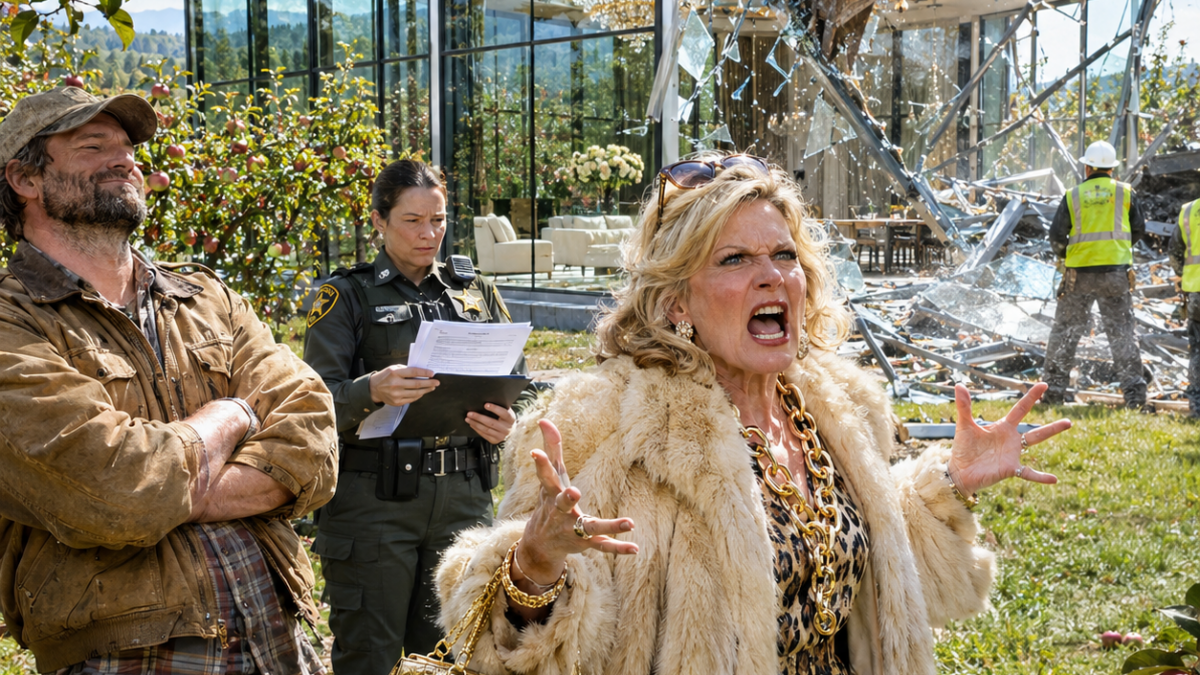
PART 2
I drove around the property instead of forcing the gate.
That mattered.
Every instinct in me wanted to cut their lock, tear down the sign, and walk straight onto the ground my father had given me.
But anger makes terrible evidence.
So I went north.
Drew was waiting beside the equipment barn.
He looked sick.
Not nervous.
Sick.
“Jud.”
“What happened?”
He removed his cap.
“I tried to stop them.”
“When?”
“First day they came.”
“How long?”
“Almost eleven weeks.”
I stared at him.
“You’ve had construction crews on my land for eleven weeks?”
“I thought you approved it.”
My anger shifted.
“What?”
“The project manager showed me papers with your name.”
“What papers?”
“He said you signed off before your trip.”
“Drew, I would have told you.”
“I know that now.”
He rubbed one hand over his forehead.
“They said you didn’t want calls while you were negotiating.”
“You called anyway?”
“Once.”
“And?”
“They gave me an email.”
“What email?”
“Supposedly yours for the trip.”
I stared.
“It wasn’t?”
“No answer ever came.”
“Show me.”
He gave me his phone.
The address looked plausible.
It wasn’t mine.
Someone had built an entire communication wall around me.
Drew reached inside his jacket.
“I kept this.”
Folded permit authorization.
Construction access.
Landowner approval.
My name at the bottom.
My signature.
I knew that signature.
I also knew I had never placed it there.
The exact shape of the J.
The long final stroke.
It looked almost perfect.
That was what made it worse.
“They showed you this?”
“First week.”
“And the contractors?”
“Same thing.”
I looked east.
“You watched them cut the trees?”
His face tightened.
“They fenced me out.”
“Sixty-three?”
“Yes.”
“Who ordered it?”
“Marlene—”
“Beverly?”
“Beverly.”
He corrected himself.
“She came twice. Maybe three times.”
I looked down at the document.
“Did she speak to you?”
“Once.”
“What did she say?”
“I told her you wouldn’t approve cutting those rows.”
“And?”
“She told me ownership had been legally clarified and I was interfering with HOA property.”
I closed my eyes.
Drew continued.
“She had guards walk me back to the barn.”
That night I walked Cedar Run with a flashlight.
The surviving rows still smelled right.
Leaves.
Soil.
Old bark.
But when I reached the eastern side, the smell changed.
Wet concrete.
Cut sod.
Fresh landscaping mulch.
Artificial things.
I stopped at the place where Granddad’s oldest tree used to lean over the drainage ditch.
When I was little, that tree grew crooked enough that Dad threatened to remove it every spring.
Granddad always said no.
“It’s ugly,” Dad would say.
“It still gives apples,” Granddad would answer.
The tree survived another forty years.
Beverly’s contractor took it down in an afternoon.
Now a marble step covered the spot.
I stood there with the forged permit in my hand.
No yelling.
No breaking things.
No dramatic promise.
Just one sentence.
“I’m getting this ground back.”
The following morning, I went to the HOA office.
Beverly had a framed rendering of the pavilion on the wall.
She was proud of it.
You could tell.
She talked before I did.
Weddings.
Corporate conferences.
Charity galas.
Art exhibitions.
Luxury events.
Tourism.
Prestige.
“Four hundred VIP guests have already been invited to the grand opening,” she said.
I waited.
She continued.
“This will become one of the finest venues in Hollister County.”
“Show me the deed.”
She stopped.
“The property rights are more complicated than a deed.”
“They aren’t.”
She slid an old document toward me.
I recognized it.
Dad had signed it decades ago.
Silverest Ridge’s original developer needed access to maintain a drainage culvert near our property line.
Twelve-foot maintenance strip.
Crews could enter when necessary to clear or repair drainage infrastructure.
That was it.
Beverly tapped the paper.
“This establishes community-use rights.”
“No.”
“It establishes access.”
“For drainage.”
“It gives the association authority to improve the corridor.”
“Clear a culvert.”
“Community improvement can evolve.”
I laughed once.
“A ditch became a six-million-dollar ballroom?”
Her expression hardened.
“Courts interpret old agreements all the time.”
“So let one.”
That was when she offered money.
$180,000.
Sign a confirmation.
Release claims.
Accept HOA rights.
I stared at the paper.
“You’re offering me money to say what you already claim is true.”
“It avoids unnecessary litigation.”
“No.”
“Think carefully.”
“I did.”
“You could lose everything.”
“No.”
She leaned forward.
“You can take one hundred eighty thousand dollars.”
Pause.
“Or you can fight a six-million-dollar building in court.”
I looked at her.
“You think the building makes the land yours.”
“It makes the situation practical.”
“No.”
“It makes your position difficult.”
I stood.
“No, Beverly.”
I pointed at her rendering.
“It makes your mistake expensive.”
Her eyes narrowed.
When I returned to Cedar Run, HOA security stopped my truck at the eastern gate.
My own gate.
“Credentialed access only.”
I called the sheriff.
Deputy came.
Polite.
Professional.
And told me the truth.
He could document the dispute.
He could prevent violence.
He could not decide title beside a gravel road.
I understood.
I photographed everything.
Gate.
Fence.
Guards.
Sign.
Cameras.
Filed the report.
That evening, Beverly sent a notice to every Silverest Ridge household.
She said a neighboring landowner was attempting to sabotage a six-million-dollar community investment.
She said I wanted money.
She said the HOA would protect residents from intimidation.
She never wrote:
We built most of it on his orchard.
Within three days, my phone filled with messages.
“You’re greedy.”
“Take the money.”
“Why ruin this for everyone?”
One envelope in my mailbox said:
**THE COMMUNITY MATTERS MORE THAN YOUR TREES.**
That one stayed with me.
Not because it hurt.
Because it showed how well Beverly understood crowds.
She had made my property rights sound selfish.
Her trespass sounded generous.
My orchard became an obstacle.
Her pavilion became progress.
I didn’t reply.
Instead, I hired Eliza Bannon.
Fifteen years in real-estate litigation.
Calm enough to make angry people feel foolish.
At our first meeting, she put two maps on her desk.
County plat.
HOA map.
She traced both.
Then looked up.
“Why does their new boundary run directly through sixty-three apple trees?”
“Because they wanted the land.”
“Let’s prove it.”
She hired Clifford Sers.
Seventy if he was a day, though he claimed sixty-eight.
Forty years surveying land.
Clifford trusted old iron pins more than new computer graphics.
He pulled deeds.
Recorded surveys.
Subdivision plats.
County coordinates.
Then walked Cedar Run.
Two days.
Three days.
Every marker.
Every corner.
Every calculation.
At the end, he sat at my kitchen table with Eliza.
“The HOA owns two-point-seven acres near the western parking area.”
“I know.”
“The pavilion doesn’t stay on it.”
“How much of mine?”
He looked at me.
“Approximately four-point-six acres affected by the principal structure, terraces, grading, and related improvements.”
My throat tightened.
“Four-point-six.”
“Yes.”
“Their map?”
“Shifted east.”
“Accident?”
Clifford shook his head.
“Not a fuzzy line.”
He tapped the report.
“This is a building standing on the wrong man’s land.”
Then he showed me a photograph.
Old rusted iron survey pin.
Grass scraped away.
I recognized it.
Dad showed me that marker when I was a boy.
He had said:
“Land remembers where it begins.”
I almost laughed when that memory surfaced.
Eliza didn’t.
She said:
“This is strong.”
“So I can tear it down?”
“No.”
I looked at her.
“It’s my land.”
“Yes.”
“My trees are gone.”
“Yes.”
“They built without permission.”
“Yes.”
“So why can’t I remove it?”
“Because if you touch a six-million-dollar structure while ownership is in litigation, Beverly gets to stop talking about her trespass and start talking about your destruction.”
I hated the answer.
Which usually meant it was right.
So we filed.
Quiet title.
Trespass.
Damages.
Temporary injunction.
And we demanded the original paperwork.
Before the first hearing, Beverly held a press conference beneath her glass canopy.
Board members behind her.
Reporters in front.
She waved a document.
**CEDAR RUN COMMUNITY ACCESS AGREEMENT**
My name supposedly authorized community-use development.
When Eliza obtained a copy, parts of it were familiar.
The drainage language.
Dad’s old agreement.
Then new clauses appeared.
Permanent structures.
Expanded community use.
Commercial event operations.
Clauses Dad had never signed.
Clauses I had never seen.
Eliza demanded the original.
HOA counsel said it was under review.
She looked at me.
“Whenever someone claims a document proves everything but refuses to show the original, I become interested.”
Clifford found something else.
Early pavilion site plan.
Entire structure on HOA land.
Smaller.
Crowded beside parking.
Not glamorous.
Then a later revised plan.
Building shifted east.
Onto my orchard.
Better views.
Wider terraces.
More space.
The revision was dated before I left for my trip.
I stared at it.
“They waited until I left.”
Eliza said:
“Maybe.”
“They planned this.”
“Maybe.”
“You always say maybe.”
“Until I can prove definitely.”
The first injunction hearing came fast.
Beverly’s law firm argued stopping construction would harm hundreds of innocent homeowners.
Millions invested.
Contracts signed.
Grand opening planned.
Eliza presented:
My deed.
Recorded plat.
Clifford’s survey.
The surviving boundary pin.
The drainage agreement.
Judge Loretta Drummond listened.
No expression.
No speeches.
Then she ruled.
No additional construction in the disputed area.
No commercial events there.
Grand opening postponed.
That was the first time Beverly lost something she had already announced as inevitable.
Four hundred invitations became worthless overnight.
Her response?
Tell residents it was a “minor permitting delay.”
Then she told them I caused it.
Again.
At the next HOA meeting, Harold Brisco, a retired teacher, asked:
“Why did we build before the title was settled?”
Beverly avoided the answer.
Instead, she warned residents that if the pavilion came down, they might face a special assessment.
Fear.
Always fear.
Then the first serious settlement offer arrived.
$500,000.
Keep the pavilion.
Confirm permanent HOA rights.
Drop removal demand.
I stared at the number.
Eliza didn’t.
“Interesting.”
“Half a million is interesting.”
“No. The increase is interesting.”
“They started at one-eighty.”
“Now five hundred.”
“Meaning?”
“They’re afraid of something.”
I declined.
That night, Drew called.
“Someone talked to me.”
“Who?”
“Construction worker.”
“What did he say?”
“He said we need to look at what they buried beneath the east foundation.”
I met the worker at a diner thirty miles away.
Young guy.
Nervous.
Wouldn’t testify.
Not yet.
He told me site crews uncovered old iron boundary monuments during excavation.
Three.
Markers that should have triggered survey verification.
Instead?
Site supervisor told them to keep moving.
Two markers disappeared into scrap.
One was buried near the eastern footing.
I wanted to dig it up myself.
Eliza almost shouted through the phone.
“No.”
“It’s evidence.”
“Exactly.”
“It’s on my land.”
“Still no.”
“Why?”
“Because evidence you excavate yourself becomes evidence they attack.”
“So?”
“We ask the court.”
Judge Drummond approved supervised inspection.
That inspection exposed another problem.
My main underground irrigation line had been severed by the foundation.
That line fed the sixty-three lost trees.
But it also fed eastern rows still standing.
Worse, grading around the pavilion redirected runoff.
After rain, water pooled near remaining roots.
Too much water can kill a tree as surely as drought.
Eliza brought in Dr. Wendel Puit from the state university.
He walked the rows.
Checked roots.
Leaves.
Drainage.
Soil.
He marked trees showing stress.
Fungal risk.
Decline.
Some were heritage varieties my family had grafted for decades.
His report said damage might take years to fully measure.
I read it in the packing barn.
Then Beverly’s new brochure arrived.
Glossy.
Beautiful.
The pavilion photographed at sunset.
Caption:
**EXPERIENCE EVENTS WITH BREATHTAKING VIEWS OF A HERITAGE APPLE ORCHARD.**
I laughed.
Not because it was funny.
She had cut down part of my orchard to sell people the experience of looking at what remained.
Drew and I worked every evening.
Temporary hoses.
Shallow relief trenches.
Drain standing water.
Keep stressed roots alive.
White cloth strips marked weakening trees.
By the end of the month, too many strips moved in the wind.
Then Beverly counter-sued.
She claimed I damaged the pavilion’s reputation.
Eliza barely reacted.
“Let her.”
Discovery kept moving.
Then one construction invoice appeared.
Tree removal change order.
Sixty-three mature apple trees.
Approval:
**Beverly Gant.**
Not me.
Not a mistaken contractor.
Her.
That same night, Eliza received an anonymous email.
Two sentences.
**The $6 million isn’t the whole story.
Follow the event company.**
That led to Marjory Ellison.
Forensic accountant.
And then Twilight Kerr.
Silverest Ridge bookkeeper for eleven years.
Twilight met me at a public library.
Back corner.
Folder held against her chest.
She explained the pavilion was originally presented to the board as a $3.8 million project.
Then:
Consulting.
Design upgrades.
Luxury materials.
Event management.
Landscaping.
Schedule acceleration.
$6 million.
One company appeared repeatedly.
**EVERGLASS EVENTS LLC**
Planning fees.
Branding fees.
Venue-management fees.
Consulting.
Contracts.
Total completed and pending business:
About $1.4 million.
Ownership connections?
Beverly.
I stared at Twilight.
“The board knew?”
“Not fully.”
“Did you?”
“Not at first.”
“Are the payments illegal?”
“I’m not qualified to say.”
That answer made me trust her.
She continued.
“But it is a conflict the board should have known about.”
Marjory reviewed the records.
Some invoices described similar work under different codes.
Some fees approved after payment.
Some documentation incomplete.
None of that alone proved fraud.
But the pattern needed investigation.
Eliza submitted what was appropriate under seal.
No Facebook accusations.
No public rumor campaign.
Court.
Discovery.
Evidence.
That mattered.
Beverly reacted by blaming bookkeeping.
Then outside consultants.
Then three board members put statements in writing.
They had never received the full Everglass disclosures.
Silverest Ridge homeowners started turning.
Beverly called an emergency meeting.
Suggested residents might need special assessments to cover pavilion loans and litigation.
The room erupted.
Russ Whitaker, a contractor who lived in the HOA, stood.
“You said the orchard was ours.”
Beverly raised her voice.
“The legal situation is complex.”
“Then why did you build?”
“We relied on professional guidance.”
“Why are we paying lawyers now?”
She adjourned the meeting.
Walked out while residents shouted.
Her power cracked.
Then another settlement offer.
$1.2 million.
Same condition.
Pavilion stays.
I spent that night on my porch.
The offer could change my life.
One-point-two million.
And I thought about families in Silverest Ridge.
People who had nothing to do with Beverly’s decisions.
People who might pay assessments.
People who believed her.
Then I looked east.
Glass roof glowing beyond my apple trees.
Sixty-three empty places.
I called Eliza the next morning.
“My terms.”
“Go ahead.”
“Ownership acknowledged.”
“Yes.”
“Full repair.”
“Yes.”
“Drainage and irrigation restored.”
“Yes.”
“And every piece of that building on my land comes off.”
Pause.
“You’re sure?”
“Yes.”
She delivered the terms.
Beverly rejected them within an hour.
Then Clifford called.
He found a consultant survey in county archives.
Early feasibility phase.
Private orchard boundary clearly marked.
Bold line.
Technical note:
**Any pavilion expansion toward Cedar Run Orchard requires direct agreement with property owner.**
Delivered to project leadership nine months before construction finished.
Beverly had possessed the truth before construction.
Still, Eliza said:
“This proves knowledge in the project team.”
“Beverly was project lead.”
“Likely.”
“Likely?”
“I want her fingerprints.”
Discovery produced hundreds of emails.
But something was strange.
The exact messages explaining why the project moved east were missing.
Eliza moved to compel.
Then Beverly made another mistake.
She asked construction director Forest Dayne to sign a statement.
The statement claimed every site-plan change followed legal advice and landowner consent.
Forest refused.
Beverly threatened his company.
Litigation.
Blacklisting.
Lost work.
He still refused.
Said he would testify only to records.
A few days later, forensic document examiner Harriet Voss finished analyzing my supposed consent.
Copied signature.
Transferred.
Not hand-signed.
I remembered where it came from.
Years earlier, I had signed an electronic service-road agreement for maintenance trucks.
Same signature form.
Same shape.
Then Eliza found the real poison hidden in the fake document.
A new clause.
Permanent structures allowed.
That clause appeared nowhere in the recorded drainage agreement.
They hadn’t merely copied my signature.
They rewrote the rights above it.
Then Forest called.
“I kept the original site-change instructions.”
Eliza went silent.
“He doesn’t know I still have them.”
Forest arrived with his attorney.
Certified archive copies.
Revision logs.
Technical correspondence.
Cost estimates.
Consultant notices.
The whole story.
Original design:
HOA parcel.
Cramped.
Bad view.
Limited terrace space.
Design team suggested orchard expansion as an option.
But they warned:
Purchase or secure legal agreement.
Beverly instructed them to contact me.
Records showed I refused.
Politely.
Explicitly.
I would not sell.
I would not cut down family trees.
After that refusal, Beverly sent an email.
Three sentences.
**Move the pavilion east.
The orchard owner won’t cooperate.
Use the community access file.**
I read it.
Once.
Twice.
Nobody spoke.
There it was.
Not mistake.
Not confusion.
Not old map.
Not ambiguous easement.
Refusal.
Followed by deliberate circumvention.
Forest explained that after the site moved, project management produced a consent form bearing my name.
He questioned survey differences.
Was told legal had handled it.
He saved everything to protect his company.
Then we saw the scheduling note.
Accelerated installation.
Prefab glass modules.
Night shifts.
Weekend work.
Huge overtime.
One line initialed by Beverly:
**Complete eastern structure before owner returns.**
She wasn’t racing the grand opening.
She was racing me home.
And at the bottom of the archive stack?
Risk assessment.
Prepared at Beverly’s request.
What happens if orchard owner sues?
Legal exposure.
Cost of litigation.
Potential damages.
Projected pavilion revenue.
Wedding bookings.
Corporate events.
Galas.
The conclusion chilled me.
Once the $6 million building was completed, demolition was considered economically unlikely.
Expected outcome?
Owner forced to accept compensation or sell.
I stared at the page.
“She planned the lawsuit.”
Eliza answered quietly.
“Yes.”
“She expected me to sue.”
“Yes.”
“And she thought the cost would protect the building.”
“Yes.”
That was the whole strategy.
Build fast.
Build expensive.
Create innocent third parties.
Create contracts.
Create debt.
Then stand in court and say:
Too late.
Too much money.
Too many people affected.
Force the farmer to sell.
I finally understood Beverly.
She didn’t believe the land was hers.
She believed money could make ownership irrelevant.
Residents started a recall petition.
Harold Brisco came to my house three days before trial.
Casserole dish in his hands.
I nearly laughed.
“What’s this?”
“My wife said you shouldn’t apologize empty-handed.”
“Apologize?”
He looked embarrassed.
“I believed Beverly.”
I let him inside.
Coffee.
Kitchen table.
Harold stared into his cup.
“I said things at the feed store.”
“I heard.”
“You did?”
“Small town.”
“I said you were holding us hostage.”
“I heard that one too.”
“I’m sorry.”
I looked at him.
“I never blamed everybody.”
“You should.”
“No.”
He looked up.
“I blame the people who lied.”
He nodded.
“People like me repeated it.”
“Yes.”
“That matters too.”
“Yes.”
He absorbed that.
I continued.
“Then remember it.”
“What?”
“Next time somebody tells you one person is the enemy of an entire community, ask what they’re trying to make you stop looking at.”
Harold nodded slowly.
Trial began beneath the high windows of the old county courthouse.
Judge Drummond presiding.
Beverly arrived with a legal team.
Still polished.
Still controlled.
But when Eliza placed the risk assessment on the evidence table, Beverly saw the title.
Her face changed.
Small movement.
But I saw it.
Her attorney opened with economics.
Six-million-dollar building.
Homeowner losses.
Innocent residents.
Loans.
Contracts.
Demolition waste.
Economic destruction.
Eliza did not pretend those consequences weren’t real.
She said:
“No one disputes demolition will be costly.”
Pause.
“But if cost alone allows intentional trespass to become permanent ownership, then anyone wealthy enough can seize anyone’s land.”
She looked at the judge.
“All they need is enough concrete and the nerve to pour it.”
Clifford testified first.
Recorded deeds.
Plat.
Coordinates.
Iron monuments.
His survey.
Four-point-six acres.
No ambiguity.
Harriet testified.
Copied signature.
Transferred image.
Altered document.
Permanent-structure clause absent from original.
Forest testified.
Site moved after my refusal.
He identified Beverly’s email.
**MOVE THE PAVILION EAST.**
He identified the schedule acceleration.
**COMPLETE EASTERN STRUCTURE BEFORE OWNER RETURNS.**
Twilight testified about the project finances.
Everglass.
Disclosures.
Board records.
Drew testified about being escorted away.
The permit shown to him.
The false email.
Then the trees.
Eliza asked:
“What did you hear the day they removed them?”
Drew’s voice changed.
“Chainsaws.”
“How long?”
“Most of the afternoon.”
“How many?”
“Sixty-three.”
He looked toward me.
“I stood outside the fence and listened.”
The courtroom went quiet.
Beverly’s lawyer tried to suggest Drew should have resisted harder.
He asked:
“If you truly believed Mr. Fenner had not approved the work, why did you allow contractors to continue?”
Drew looked at him.
“Because they showed me a signed document.”
“Which you accepted.”
“Yes.”
“Without calling your employer.”
“I tried.”
“Only once.”
Drew paused.
Then:
“I trusted a signed piece of paper because that’s what honest people are supposed to be able to do.”
Nobody had much to say after that.
Then Beverly took the stand.
Eliza asked:
“Did Jud Fenner refuse to sell orchard land?”
Beverly answered carefully.
“There were preliminary discussions.”
“That wasn’t my question.”
Pause.
“Did he refuse?”
“He expressed concerns.”
Eliza displayed my written response.
**I will not sell the eastern orchard or permit removal of the heritage trees.**
“Is that a refusal?”
Beverly looked down.
“Yes.”
Eliza placed Beverly’s email beside it.
**MOVE THE PAVILION EAST.
THE ORCHARD OWNER WON’T COOPERATE.
USE THE COMMUNITY ACCESS FILE.**
“Your email?”
“Yes.”
“Sent after his refusal?”
“Yes.”
“You knew he owned the land?”
“We believed the access file created rights.”
“Rights to maintain a drainage ditch?”
“Broader community rights.”
Eliza displayed the recorded agreement.
“Point to the clause allowing a permanent event structure.”
Beverly couldn’t.
“Point to the clause allowing tree removal.”
Nothing.
“Commercial events?”
Nothing.
“Concrete foundation?”
Nothing.
“Four-point-six acres of occupation?”
Nothing.
Eliza switched documents.
The fabricated consent.
“Did Mr. Fenner sign this?”
“We relied on it.”
“That wasn’t my question.”
Beverly looked toward her attorney.
“Did he sign this document?”
“I believed he had.”
Harriet’s forensic conclusion appeared on screen.
Copied signature.
Eliza moved to the schedule.
“Why did you instruct contractors to complete the eastern structure before Mr. Fenner returned?”
“Construction efficiency.”
“Why mention his return?”
Silence.
“Why?”
Beverly’s mouth opened.
Closed.
Eliza brought out the risk assessment.
“Did you request this?”
“I requested general project-risk analysis.”
“Does it analyze what would happen if Mr. Fenner sued?”
“Yes.”
“Does it conclude demolition was unlikely once the building reached six million dollars?”
“I’d have to read the exact wording.”
Eliza read it.
Then:
“Was that part of your decision to accelerate construction?”
“No.”
“Was it part of your decision to proceed after Mr. Fenner refused?”
“No.”
“Then why did you continue?”
Beverly finally lost some of her polished tone.
“Because one person cannot freeze the development of an entire community.”
Eliza became very still.
“Even when the land belongs to that one person?”
Beverly realized what she had said.
Too late.
Closing arguments came.
HOA counsel begged the court not to punish innocent homeowners.
He proposed compensation.
Forced sale.
Permanent easement.
Some monetary remedy that allowed the pavilion to remain.
Eliza stood.
Less than ten minutes.
She reminded the court that I had refused.
In writing.
Beverly knew.
They built anyway.
The fake consent came later.
The risk assessment predicted litigation.
The building’s cost was not an unfortunate consequence.
It was leverage.
“The six-million-dollar price tag is not a reason to reward the trespass,” she said.
“It was the strategy used to make the trespass seem irreversible.”
Then she sat down.
Judge Drummond reviewed her notes.
The courtroom was so quiet I heard the ceiling fan.
When she finally spoke, she began with title.
Cedar Run Orchard.
Mine.
The evidence established that the HOA’s pavilion encroached substantially on my property.
The association continued construction despite clear evidence of the true boundary.
The court rejected the argument that financial investment created a right to remain.
Then Judge Drummond looked directly at Beverly.
“You cannot manufacture ownership by pouring concrete on someone else’s land.”
I will remember that sentence for the rest of my life.
The order:
No operation of the pavilion on the disputed ground.
Forty-five days to dismantle every encroaching structure under an approved safety plan.
Remove glass.
Steel.
Marble.
Foundation.
Landscaping.
Regrade.
Repair drainage.
Restore irrigation.
Implement soil-restoration plan.
Damages and costs handled under the judgment and continuing proceedings.
Financial records produced.
Suspected forged documents and irregular transactions referred to proper authorities for independent review.
The judge was careful.
Referral wasn’t conviction.
Investigation would determine criminal issues.
Beverly stood frozen.
Her attorney whispered.
Appeal.
Stay.
Options.
I didn’t celebrate.
People expected me to smile.
I didn’t.
Sixty-three trees were still gone.
Winning a case doesn’t regrow fifty years.
But the land would come back.
That mattered.
Then Beverly asked for an emergency stay.
She acted as if it were guaranteed.
Called VIP guests.
Told staff grand opening was only delayed.
Ordered marble polished.
Glass cleaned.
Landscaping maintained.
Still pretending the palace would survive.
The morning the stay decision arrived, I stood outside the pavilion fence.
Sunrise.
Old survey map in my hand.
Beverly stepped onto the marble terrace.
Security beside her.
She saw me.
“What are you doing here?”
“Waiting.”
“For what?”
“The court.”
She laughed.
“You really believe they’re tearing this down?”
I didn’t answer.
“Six million dollars, Jud.”
Still nothing.
“Four hundred guests.”
Nothing.
“Investors.”
Nothing.
“This community owns this property.”
I pressed Clifford’s worn survey map against the fence.
“No.”
She pointed toward security.
“Remove him.”
The guards started forward.
Then a county vehicle turned onto the gravel road.
Beverly smiled.
Maybe she thought it was someone coming to save her.
Carla Whitlock stepped out.
Court officer.
Sealed order.
Beverly walked down the terrace.
“What is that?”
Carla handed the document to her attorney.
The stay had been denied.
Demolition would proceed.
Beverly read the first page.
Then the second.
Her face drained.
“No.”
Her attorney said something quietly.
She shook her head.
“No.”
Carla continued explaining deadlines.
Safety procedures.
Compliance.
Beverly looked at the glass pavilion behind her.
Morning light reflected across hundreds of panes.
For months, that building had been her proof.
Proof of power.
Proof of money.
Proof she was too far ahead to stop.
Now every pane had a deadline.
Demolition crews arrived days later.
Court-supervised.
Engineered plan.
No chaos.
No revenge with a bulldozer.
Careful removal.
Glass panel by glass panel.
Cranes lifted them.
Flatbed trucks carried them away.
The marble terrace came apart.
Designer lighting disconnected.
Steel members removed.
Landscaping stripped.
Then the foundation.
That was harder to watch.
Jackhammers.
Concrete saws.
Excavators.
Dust.
But underneath?
Soil.
My soil.
Every morning I stood at the edge of Cedar Run.
Not cheering.
Watching.
The pavilion shrank.
One week, the roof disappeared.
Next, much of the glass.
Then steel.
Then marble.
Eventually, you could see across the land again.
No luxury hall.
No velvet rope.
No gala entrance.
Just disturbed earth where trees once stood.
It looked wounded.
But it looked honest.
Drew came beside me one morning.
“Feels empty.”
“Yeah.”
“You miss the trees.”
“Every day.”
“We’ll plant.”
“They won’t be the same.”
“No.”
That hurt.
Because justice has limits.
Court orders can remove concrete.
Money can replace irrigation.
Experts can repair soil.
No judge can make a sixty-year-old apple tree sixty years old again.
The financial investigation continued.
Everglass payments.
Contracts.
Conflicts.
Bookkeeping.
Board disclosures.
Liability.
The new independent audit traced money and identified amounts subject to recovery proceedings.
Homeowners held a recall vote.
Beverly lost.
Overwhelmingly.
Same people she claimed to represent.
New board.
Independent financial management.
Review of loan obligations.
Claims against responsible parties.
Possible personal liability.
The lawyers Beverly hired eventually sent bills directly to her after the new board refused to treat her personal defense as unlimited HOA expense.
Former allies stopped answering calls.
Event contracts were canceled.
Deposits and refunds sorted.
There was no grand opening.
No four hundred VIP guests.
No glass palace.
The HOA clubhouse later hung a photograph of Cedar Run Orchard in the lobby.
I didn’t ask them to.
Maybe it was guilt.
Maybe reminder.
Maybe both.
Then restoration started.
That was the part I cared about.
Topsoil.
Drainage.
Irrigation.
Soil amendment.
Grading.
Drew and I rebuilt sections ourselves.
We saved grafting wood from surviving heritage varieties.
A horticultural specialist helped us propagate them.
Young rootstock.
Old genetics.
Granddad’s apples, in a way.
Not the same trees.
But descendants.
That mattered.
The first planting weekend surprised me.
I reached the eastern field early.
Saw cars parked along the north road.
My first thought was:
What now?
Then Harold Brisco climbed out carrying a shovel.
Behind him:
Residents.
Maybe two dozen.
Russ Whitaker had a small tractor.
Twilight brought sandwiches.
One woman carried buckets.
Another had work gloves.
I walked toward Harold.
“What is this?”
He shrugged.
“Planting day.”
“I didn’t invite anybody.”
“No.”
“So?”
“We thought we’d come anyway.”
I looked at the group.
“Why?”
Harold shifted.
“Because we can’t put the old trees back.”
No one made a speech.
Thank God.
No giant apology.
No cameras.
No HOA banner.
They worked.
Some badly.
One man planted a tree too deep and Drew made him redo it.
Kids carried water.
Twilight handed out sandwiches.
Russ moved soil.
By sunset, the first new row stood where Beverly’s marble terrace had been.
Small trees.
Thin trunks.
Fragile.
Nothing impressive.
I loved them.
After everyone left, I walked the row alone.
Each tree had a little support stake.
Each one looked vulnerable.
But alive.
That was enough.
Weeks later, Beverly’s white SUV slowed on the county road.
I was kneeling beside a young tree.
Tamping soil.
I recognized the vehicle.
It stopped.
Beverly sat behind the wheel.
No cream suit I could see.
No entourage.
No guards.
No board members.
Behind me, the pavilion was gone.
She looked toward the new trees.
I looked at her.
For a moment, I wondered if she would get out.
She didn’t.
I went back to work.
That was the best answer I could give.
She wanted conflict.
Attention.
Control.
Even defeat can become power if everyone keeps looking at you.
I was done looking.
Months passed.
Some trees took.
Some failed.
That’s orchards.
You plant ten.
Maybe one surprises you.
Maybe one dies for no obvious reason.
Maybe frost comes.
Maybe deer.
Maybe fungus.
You keep going.
Dr. Puit monitored the stressed eastern rows.
Some older trees recovered.
Some declined enough that we eventually replaced them.
Every loss hurt.
But the water was moving properly again.
Drainage corrected.
Irrigation restored.
Soil improving.
Cedar Run was becoming an orchard again rather than a construction site.
The court process on damages continued.
So did investigations around the forged documents and financial dealings.
I learned not to measure justice by speed.
Real cases take time.
Banks review.
Experts calculate.
Courts schedule.
People appeal.
Records matter.
It is boring.
That boredom protects everyone.
Beverly had hated boring process.
That was part of how she created disaster.
She moved fast.
Build first.
Explain later.
Spend first.
Approve later.
Tell residents first.
Verify later.
When people asked questions, she called them disloyal.
I came to appreciate slow systems.
Not because they’re pleasant.
Because slow makes room for proof.
Eventually, the HOA’s finances stabilized under new management.
Not quickly.
Residents paid for mistakes they didn’t personally choose.
That bothered me.
I never wanted families losing money.
But that reality also taught Silverest Ridge something uncomfortable.
If you give one leader unchecked power because she makes decisions quickly, you also inherit the cost of those decisions.
Harold said it best one afternoon.
“We kept saying Beverly gets things done.”
I looked at him.
“She did.”
He laughed sadly.
“Yeah.”
“What?”
“We never asked whether they were things that should be done.”
That stayed with me.
Beverly’s greatest skill wasn’t deception.
It was certainty.
She always sounded certain.
Certain the boundary was HOA land.
Certain Dad’s drainage agreement meant development rights.
Certain my refusal didn’t matter.
Certain no judge would demolish something worth six million dollars.
Certain residents would stay behind her.
Certainty is comforting.
Especially when the truth is complicated.
People follow confident voices because questions feel like work.
I understood why residents believed her.
I also understood why they should never do it again without checking.
One afternoon, Twilight came to Cedar Run.
She brought a folder.
“What’s that?”
“New HOA financial policies.”
“I’m not joining.”
She laughed.
“I know.”
She showed me.
Conflict disclosures.
Independent approval.
Outside review for major contracts.
No payments to affiliated entities without full board notice.
Property verification before capital projects.
“That should help.”
“That’s the idea.”
“You staying?”
“For now.”
“Why?”
“Because I spent eleven years keeping books and still missed what mattered.”
“You didn’t miss everything.”
“I missed enough.”
She looked toward the new trees.
“I want to do better.”
I nodded.
That is all you can ask sometimes.
Not perfection.
Better.
Drew carried guilt longer.
One night we were repairing a pump.
He said:
“I should have called you more.”
“You tried.”
“Once.”
“They gave you a fake address.”
“I should’ve known.”
“How?”
He didn’t answer.
“You were shown my signature.”
“Yes.”
“A construction permit.”
“Yes.”
“Security.”
“Yes.”
“HOA officers.”
“Yes.”
“Contractors.”
“Yes.”
“Everyone told you it was legal.”
He tightened a fitting.
“I still should’ve known.”
I looked at him.
“Drew.”
He stopped.
“They lied to you too.”
He stared at the ground.
“Doesn’t make listening to those saws easier.”
“No.”
We worked in silence.
Some wounds don’t need arguments.
They need time.
The following spring, blossoms appeared on the new trees.
Not many.
Young trees.
A few.
I walked the row early.
Small white-pink flowers.
Drew joined me.
“Look at that.”
“I see.”
“Granddad variety?”
“Two of them.”
“Already flowering?”
“Don’t get excited. We may remove the fruit this year.”
“You farmers ruin everything.”
I laughed.
“Tree needs roots more than apples.”
Maybe people do too.
That thought came to me later.
For months, I wanted the end of the case to be dramatic.
Judge orders demolition.
Beverly loses title.
Glass comes down.
Victory.
But the real ending was roots.
Slow.
Invisible.
Rebuilding before producing.
Cedar Run needed that.
So did I.
The lawsuit had turned me into somebody who woke up angry.
Checked emails angry.
Read letters angry.
Walked fields angry.
I hated that.
Beverly had taken land.
Then time.
Then peace.
I refused to let her keep the last one.
So I stopped following every rumor about her.
Eliza handled legal updates.
If I needed to sign something, she called.
If investigators needed me, I cooperated.
Otherwise?
I farmed.
Harvest came.
We picked.
Cold-storage contract worked.
The deal I had traveled twelve weeks to negotiate turned out to be one of the best business decisions Cedar Run ever made.
Irony.
Beverly chose those twelve weeks because she thought absence made me weak.
The trip she used against me ultimately helped preserve the orchard financially.
Dad would’ve enjoyed that.
He liked irony almost as much as he liked saying “I told you so.”
The new distribution contract stabilized revenue.
We reinvested.
Updated packing equipment.
Improved irrigation monitoring.
Expanded cold handling.
The eastern restoration continued.
Eventually, some residents from Silverest Ridge began buying apples directly from us.
First year, awkward.
A woman approached the farm stand.
“You probably hate seeing people from the HOA.”
“No.”
She looked surprised.
“I hate bad paperwork.”
She laughed.
“Fair.”
She bought two bags.
Then returned the following week.
That was how normal returned.
One transaction at a time.
One conversation.
No speeches.
No forgiveness ceremony.
I never became friends with everyone.
I didn’t need to.
Peace doesn’t require intimacy.
Just respect.
Years later, I found one of Beverly’s old pavilion brochures in a file box.
Glass palace at sunset.
Caption:
**A LEGACY FOR GENERATIONS.**
I stared at that line.
The pavilion lasted months.
Some trees at Cedar Run had lived sixty years.
Human beings are terrible at judging what lasts.
We call concrete permanent.
Trees temporary.
Yet trees outlive buildings all the time.
The pavilion came down because its foundation was legally wrong.
The orchard came back because its roots—literal and figurative—were right.
I almost threw the brochure away.
Then kept one copy.
Not a trophy.
Evidence of arrogance.
There’s value in remembering what confidence looks like when it outruns reality.
Harold visited one fall afternoon.
He had become something like a neighbor.
Not close friend.
But good man.
We sat on the porch.
He looked toward the eastern rows.
“You know what people still say?”
“What?”
“That you cost the HOA six million dollars.”
I smiled.
“What do you say?”
“That Beverly cost the HOA six million dollars.”
“Smart.”
“Took me a while.”
He took a drink of cider.
“Can I ask something?”
“Sure.”
“If they had offered you two million, would you have sold?”
“No.”
“Three?”
“No.”
“Six?”
I looked toward the trees.
“No.”
He whistled.
“That’s a lot of money.”
“Not everything is for sale.”
He nodded.
“I think that was the part Beverly couldn’t understand.”
Exactly.
To her, price solved ownership.
If someone refused a price, increase pressure.
Increase money.
Increase consequences.
Eventually, everyone sells.
But some things don’t have a market value.
Granddad’s tree wasn’t worth six million dollars.
Obviously.
But the right to decide whether it stayed?
Priceless.
That’s ownership.
Not the object.
The choice.
Beverly wanted my choice removed.
That was the real fight.
One winter, Eliza invited me to speak to a property-law seminar.
I refused.
She asked again.
I refused.
Third time:
“There’s free lunch.”
I went.
Students expected drama.
I gave them paperwork.
Recorded deed.
Easement.
Altered addendum.
Survey pin.
Email.
Risk assessment.
One student asked:
“What was the single most important piece of evidence?”
I thought.
“The email.”
“Move the pavilion east?”
“Yes.”
“Why?”
“Because everything before that could be framed as mistake.”
I explained.
Maps can be wrong.
People misunderstand easements.
Surveyors disagree.
Contractors make assumptions.
Documents get copied badly.
But:
**THE ORCHARD OWNER WON’T COOPERATE.**
That sentence admitted two things.
She knew who owned it.
And she knew I refused.
Everything after became choice.
The student nodded.
Then another asked:
“What was the most emotionally important evidence?”
Different question.
“Survey pin.”
“Why?”
“My dad showed it to me when I was a kid.”
That old rusted pin never appeared dramatic.
No gold lettering.
No glass.
No marble.
No six-million-dollar budget.
Just metal in dirt.
Yet it outlasted Beverly’s entire palace.
Land remembers where it begins.
Dad was right.
A few years after restoration, the eastern trees produced their first serious crop.
Small compared to mature rows.
But enough to pick.
Drew held one apple from a graft descended from Granddad’s old tree.
He polished it on his shirt.
“Think it tastes the same?”
“There’s one way to find out.”
We cut it.
Shared it.
Tart.
Crisp.
Almost exactly how I remembered.
Drew chewed.
“Well?”
I said:
“Could use another year.”
He laughed.
“You cannot enjoy anything.”
I looked at the new row.
“I’m enjoying this.”
And I was.
The best revenge wasn’t watching glass come down.
It was tasting an apple grown where marble once stood.
Beverly wanted the pavilion to become a permanent monument to her presidency.
Instead, the land produced fruit again.
No plaque.
No chandelier.
No VIP terrace.
Just apples.
Somebody once asked whether I would name a new variety after the case.
Absolutely not.
No Beverly Apple.
No Glass Pavilion Red.
No Judge Drummond Gold.
Though Drew liked that last one.
The orchard had survived enough branding.
The trees could just be trees.
The legal story eventually became less central.
Investigations reached their own conclusions through proper channels.
Claims settled in stages.
Recoveries happened where assets and law allowed.
Some disputes lasted longer than I expected.
That is real life.
Cases rarely end with one gavel and perfect accounting.
But what mattered to me had already happened.
My land was mine.
Recorded.
Recognized.
Uncovered.
Restored.
Nobody could again stand at my gate and tell me I was trespassing.
The new HOA board formalized its boundary records.
No more colorful internal maps treated like deeds.
Every external-property agreement required independent verification.
Future capital projects required title review.
Good.
Boring.
Beautifully boring.
Years after the pavilion, Daniel Mercer—one of the newer board members—asked if the HOA could pay Cedar Run to provide apples for their fall festival.
I stared at him.
“Festival?”
He laughed.
“Small one.”
“On your land?”
“Yes.”
“Verified?”
He held up paperwork.
I laughed.
“Then sure.”
We supplied apples.
No gala.
No glass palace.
Kids.
Cider.
Food.
Music.
I attended for half an hour.
Harold saw me.
“Never thought I’d see you at an HOA event.”
“Neither did I.”
“Want a pavilion?”
I looked at him.
“Say that again and I leave.”
He laughed until he choked.
That was healing too.
Being able to joke.
The story no longer owned every conversation.
Cedar Run became an orchard first.
Legal case second.
Exactly how I wanted it.
Sometimes people drove past looking for where the famous pavilion had been.
There was nothing to see.
That pleased me.
A line of apple trees.
Fence.
Grass.
Maybe someone expecting ruins felt disappointed.
But absence was the point.
Beverly had tried to make her decision permanent.
The land refused.
One early morning, years later, I stood by that first new row.
Fog low.
Sun just coming up.
The trees were tall enough now to cast shadows.
I remembered the morning Carla Whitlock arrived with the denied stay.
Beverly on the marble terrace.
Security.
Glass sparkling.
She looked unbeatable.
If you had photographed that moment without context, you would assume she owned everything in sight.
That is the danger of appearances.
Authority can look like architecture.
Ownership can look like security gates.
Truth can look like one tired farmer holding an old survey.
But courts don’t decide property by who built the more expensive entrance.
They decide evidence.
I wish more people understood that before they became impressed by confident people.
Beverly’s entire strategy depended on awe.
Six million dollars.
Four hundred VIP guests.
Glass cathedral.
Marble terrace.
Security guards.
Luxury brochures.
Major law firm.
She wanted everyone—including me—to feel small.
It worked briefly.
The first time I saw that pavilion, I felt small.
I’ll admit it.
I looked at six million dollars of construction and thought:
How do I fight this?
Then I looked at the deed.
My name.
One line.
Sometimes truth is physically smaller than a lie.
Still stronger.
I walked to the oldest surviving tree near the restored eastern boundary.
It had barely survived the drainage damage.
Dr. Puit once thought we might lose it.
Years later, trunk scarred but alive.
I put my hand on the bark.
Dad used to say:
“Don’t judge an orchard by one season.”
Good advice for people too.
The year Beverly arrived was one terrible season.
Not the whole life.
Cedar Run existed before her.
It existed after.
That perspective saved me from bitterness.
People who hurt you often feel enormous while the conflict is happening.
Time shrinks them.
Beverly became a name in a legal file.
A story residents told new board members.
A warning.
The orchard became daily life.
That is how it should be.
Drew eventually retired.
On his last day, we walked the eastern row.
He stopped near the place Granddad’s original tree had stood.
One of its graft descendants now grew there.
“Still feel guilty?” I asked.
He looked at me.
“Less.”
“Good.”
“Not none.”
“That’s probably human.”
He touched the young tree.
“I should’ve been stronger.”
“Maybe.”
He laughed.
“Thanks.”
“You want me to lie?”
“No.”
Then I added:
“You stayed.”
He looked at me.
“When it got bad, you stayed.”
He nodded.
“That counts.”
We shook hands.
He cried.
I pretended not to see.
He pretended I wasn’t crying either.
Orchards make sentimental fools out of grown men.
His replacement was younger.
First week, I showed him property files.
He looked bored.
Good.
I told him:
“You think this is boring?”
“Yes.”
“Remember that.”
“Why?”
“Because boring paperwork once saved this orchard.”
He thought I was joking.
I showed him the photo.
Glass pavilion.
He stopped smiling.
“That was here?”
“Yep.”
“On this field?”
“Yep.”
“What happened?”
“Read the file.”
“You’re serious?”
“Very.”
He read it.
Afterward:
“I’ll keep the files straight.”
“Good.”
Dad would’ve approved.
I updated the fireproof cabinet too.
Deed.
Survey.
Court order.
Restoration plan.
Photographs.
New boundary verification.
And one brochure.
Not because I feared another Beverly.
Because history gets clearer when records survive.
On the cabinet door, I taped Dad’s old note:
**Keep your paperwork straight and take care of the soil.**
That became Cedar Run’s unofficial rule.
The year the restored eastern rows finally produced enough for commercial picking, we held no ceremony.
No ribbon.
No VIP invitations.
No speeches.
Workers came early.
Bins lined up.
Ladders.
Picking bags.
Tractors.
Normal harvest.
Harold and a few Silverest Ridge residents volunteered for a charity picking day later that month.
He looked around.
“Hard to imagine glass here.”
“Good.”
“Do you miss any of it?”
“The chandelier was pretty.”
He stared.
I laughed.
“No.”
At lunch, people sat under trees where the marble terrace had once been.
Sandwiches.
Cider.
Mud on shoes.
No velvet rope.
I looked around.
This was more beautiful.
Not because simplicity is always morally superior.
Because it was honest.
Everything there had permission to be there.
That became important to me.
Permission.
Such a small word.
Beverly considered it an obstacle.
But civilization depends on it.
You ask before taking.
You ask before entering.
You ask before building.
You ask before spending someone else’s money.
You ask before signing someone else’s name.
When the answer is no, you stop.
If Beverly had followed that one principle, none of this happens.
No lawsuits.
No demolition.
No financial investigation.
No recall.
No damaged orchard.
No six-million-dollar loss.
Just one smaller pavilion on HOA land.
Maybe successful.
Maybe profitable.
Maybe still standing today.
She could have had that.
What destroyed her project wasn’t my stubbornness.
It was her belief that no applied only to other people.
Toward the end of one harvest, a reporter asked to interview me.
Anniversary story.
I almost declined.
Then accepted.
She stood beside the eastern rows.
“People call this the orchard that beat a six-million-dollar HOA pavilion.”
“I hate that.”
“Why?”
“The orchard didn’t beat anything.”
“What would you call it?”
“A property dispute somebody made unnecessarily expensive.”
She laughed.
“Less catchy.”
“More accurate.”
She asked:
“Did you want revenge?”
“At first?”
“Yes.”
“Of course.”
“What did you imagine?”
I thought.
“Bulldozer.”
She laughed.
“I’m serious.”
“Would you have demolished it yourself?”
“No.”
“Why?”
“Eliza threatened to kill me.”
“Your lawyer?”
“Figuratively.”
Then I became serious.
“The difference between anger and justice is process.”
She wrote that down.
I continued.
“If I had torn the building apart myself, Beverly could have turned me into the villain. Instead, a judge reviewed the evidence and ordered removal.”
“What was more satisfying?”
I looked at the trees.
“This.”
She expected something dramatic.
“Apples?”
“Yes.”
“More satisfying than demolition?”
“Not even close.”
Because destruction is fast.
Growing is slow.
Slow satisfaction lasts longer.
Judge Drummond’s sentence still circulated locally.
**You cannot manufacture ownership by pouring concrete on someone else’s land.**
People printed it.
Shared it.
Used it in HOA discussions.
I understood why.
It sounded like justice.
But Dad’s sentence meant more to me.
Land remembers where it begins.
The court proved ownership.
The orchard proved endurance.
Years passed.
Some of the young trees grew taller than me.
The first generation planted after the pavilion became established.
Their roots went through soil once compacted beneath concrete.
That fact amazed me.
We had to restore it carefully.
Aeration.
Organic matter.
Drainage.
Patience.
Roots eventually found their way.
One morning I dug near a tree and found a small shard of polished stone.
Piece of pavilion terrace.
I held it.
White-gray.
Smooth.
I could have kept it.
Instead, I tossed it in the debris bucket.
Some people would call that a missed souvenir.
I had enough souvenirs.
I wanted soil.
Beverly’s name gradually disappeared from conversation.
New residents didn’t know it.
New board members knew only from policy manuals.
That was fitting.
Power she once thought permanent became footnote.
The orchard became landscape again.
One afternoon a little girl from Silverest Ridge stood at the farm stand.
She pointed east.
“My mom says there used to be a giant glass building there.”
“There did.”
“Why?”
“Long story.”
“Was it pretty?”
I considered.
“Yes.”
“Why did they take it down?”
“It was built where it didn’t belong.”
She thought about that.
Then:
“Like when I build Legos on my brother’s desk?”
I smiled.
“Pretty much.”
“What happens?”
“He knocks them down.”
“Court did ours.”
She nodded like this made perfect sense.
Children sometimes understand property better than adults.
She picked an apple.
“Is this from there?”
“Yes.”
She took a bite.
“Good.”
That was enough.
No legal argument could improve it.
I thought about Beverly less and less.
Then one day I saw her again.
Not close.
Gas station.
Different car.
She saw me.
I saw her.
Neither approached.
For a second, old anger surfaced automatically.
Then disappeared.
She was just a woman getting gasoline.
I was just a man buying diesel.
Life had shrunk the conflict.
That felt like freedom.
I paid.
Left.
Never looked back.
The last major restoration payment cleared years after the case began.
Eliza called.
“Done.”
“What?”
“Final structured payment under the civil resolution.”
I sat in my office.
“That’s it?”
“For that portion.”
“Any more paperwork?”
“There is always more paperwork.”
I laughed.
“Of course.”
She paused.
“You okay?”
“Yeah.”
“You sound disappointed.”
“No.”
“What?”
“I thought closure would feel different.”
“It usually feels boring.”
“Boring again.”
“Boring is underrated.”
She was right.
I closed the file.
Put it in Dad’s cabinet.
Then went outside.
Eastern rows needed pruning.
That is closure.
Work waiting.
The orchard doesn’t care that you won a lawsuit.
Trees still need pruning.
I liked that.
It kept me from turning into someone who lived entirely inside his grievance.
Beverly had built a monument to herself.
I almost built one too, emotionally.
A monument of anger.
The orchard knocked it down.
Every season demanded attention somewhere else.
Frost.
Disease.
Prices.
Labor.
Weather.
Fruit.
Life.
Eventually, the story became something that happened rather than something still happening.
That distinction is huge.
One fall evening, after everyone left, I walked to the exact center of where the pavilion main hall had stood.
No marker.
No plaque.
Just grass between young orchard rows.
I tried to reconstruct the architecture.
Stage there.
Terrace there.
Glass wall there.
VIP entrance there.
Couldn’t quite do it anymore.
Trees had erased the shape.
I smiled.
Beverly believed architecture would erase the orchard.
The orchard erased the architecture.
Not instantly.
Slowly.
Quietly.
That was better.
Sunset lit the apples.
I thought of Granddad.
Dad.
Drew.
Eliza.
Harold.
Twilight.
Forest.
People who told the truth when it mattered.
Some early.
Some late.
All important.
People like stories with one hero.
Real life rarely works that way.
I could not have won alone.
Surveyor found boundary.
Attorney built case.
Accountant followed money.
Bookkeeper preserved records.
Construction director saved emails.
Document examiner proved signature transfer.
Agricultural expert proved damage.
Residents eventually asked questions.
Judge applied law.
Restoration crews repaired land.
Neighbors planted trees.
Justice was not one dramatic act.
It was dozens of people deciding evidence mattered.
Maybe that was the deepest lesson.
Beverly’s scheme worked because people initially surrendered judgment to one confident person.
It collapsed when individuals started doing their own jobs honestly.
Clifford measured.
Harriet examined.
Forest remembered.
Twilight checked books.
Eliza asked.
Judge Drummond read.
Truth is often less dramatic than lies.
But it has more people working for it once they stop being afraid.
The last time Harold came by before moving closer to his daughter, he brought cider doughnuts.
We sat on the porch.
He looked east.
“Those trees are getting big.”
“Slowly.”
“Think they’ll outlive us?”
“Some.”
He smiled.
“Good.”
Then:
“Do you ever wish you took the one-point-two million?”
I laughed.
“No.”
“Not even a little?”
“Ask me after a bad harvest.”
He laughed too.
Then I became serious.
“If I took it, every time I looked east I would know I sold because somebody forced the price high enough.”
“Isn’t that still a choice?”
“Technically.”
“But?”
“There are choices you make freely and choices someone tries to manufacture for you.”
He nodded.
“That’s what she did.”
Exactly.
Beverly’s risk memo said once the building was complete, I would be forced to accept compensation.
That word—forced—was the entire case.
She believed she could build my choice away.
The judge gave it back.
And once I had the choice?
I chose trees.
Not because trees are always more valuable than buildings.
Because these were my trees.
My land.
My decision.
The next spring, we added another heritage variety.
Grafting wood from one of the remaining old trees.
Drew came back for planting day despite being retired.
He stood with hands on hips.
“You’re spacing them wrong.”
“You’re retired.”
“Trees don’t care.”
“Go home.”
“Your dad would agree with me.”
That was unfair.
He knew it.
We argued.
Then moved one tree six inches.
Old habits.
That afternoon, we drank cider in the packing barn.
He looked east.
“Remember the glass roof?”
“Yes.”
“Hard to believe.”
“Good.”
He nodded.
“Good.”
The orchard entered another season.
Then another.
Some years later, I updated my will.
That was emotional.
Cedar Run would go to family.
Clear title.
Surveys attached.
Boundary history.
The whole legal record.
My attorney asked why I wanted so much detail.
I said:
“I want whoever gets this land after me to know exactly where it begins.”
Dad again.
Always Dad.
Maybe that is what inheritance really is.
Not property.
Instructions.
Stories.
Mistakes already paid for.
The next owner shouldn’t have to rediscover the same truth.
On the anniversary of Judge Drummond’s ruling, Eliza texted me a photograph someone had posted online.
The old pavilion.
Beautiful at sunrise.
Caption:
**THE PALACE THAT COULDN’T MOVE A PROPERTY LINE.**
I replied:
**Corny.**
She answered:
**Accurate.**
Maybe.
I put the phone away.
There were apples to sort.
My final memory of Beverly isn’t the courtroom.
Or the terrace.
Or the white SUV.
It’s that morning after her stay was denied.
She stood in front of six million dollars’ worth of glass.
I stood outside with a worn survey map.
If you judged the scene by appearance, she had everything.
Building.
Security.
Money.
Title.
Influence.
I had paper.
Then Carla opened the court order.
And everything changed.
Not because the truth changed.
Because the truth was finally enforced.
That matters.
People say:
“The judge gave you the land back.”
Not exactly.
The land never stopped being mine.
The judge stopped everyone else from pretending otherwise.
There is a difference.
Today, when I walk the eastern rows, I sometimes stop where Granddad’s oldest tree stood.
A younger tree grows there now.
Grafted from the old line.
Not identical.
But connected.
Its trunk is strong.
Branches heavy enough to need thinning some years.
The first time it produced a full crop, I picked one apple myself.
I carried it to the porch.
Cut it open.
Crisp white flesh.
Seeds dark.
The taste took me backward fifty years.
Granddad.
Dad.
Wooden crates.
Summer heat.
Old tractor.
Everything Beverly’s six-million-dollar pavilion tried to erase.
Still there.
Memory is stubborn.
So is land.
So are roots.
People ask whether I feel like I won.
I do.
But not because Beverly lost.
Her title.
Her pavilion.
Her influence.
Her money problems.
Her legal troubles.
Those were consequences.
My victory was different.
The orchard lived.
The cold-storage contract succeeded.
The eastern rows came back.
Neighbors who once believed lies learned to ask questions.
The HOA changed its rules.
Drew stopped blaming himself so much.
And I learned that defending your property does not require becoming cruel.
That mattered.
There were moments I wanted cruelty.
When I saw the stumps gone.
When I held the forged document.
When I read the risk memo.
When Beverly called me greedy.
When residents sent letters.
I wanted her to hurt.
I’m not proud of that.
I’m human.
But when the glass started coming down, I felt something unexpected.
Sadness.
Six million dollars of labor wasted.
Workers had built it.
Craftsmen installed it.
People quarried stone.
Fabricated steel.
Transported glass.
Residents paid money.
All because one person decided consent was optional.
That waste is part of Beverly’s legacy too.
Not just malice.
Waste.
Good work built in the wrong place becomes waste.
That is why boundaries matter before construction.
That is why permission matters before spending.
That is why law matters before ambition.
The most expensive mistakes often begin when someone says:
“We can fix the paperwork later.”
No.
Fix the paperwork first.
The orchard taught me that.
A tree grows where you plant it.
If you plant it wrong, you may move it young.
Wait decades?
Different problem.
Buildings are the same.
Beverly tried to use that permanence as leverage.
Judge Drummond refused.
I will always respect her for that.
Because the easy solution would have been money.
Force me to sell.
Keep structure.
Make everybody financially whole enough.
Practical.
Efficient.
Wrong.
Some rights become meaningless if somebody else can intentionally violate them and then buy forgiveness afterward.
The court understood that.
If Beverly had made a genuine surveying mistake, maybe the outcome could have looked different.
But she knew.
That changed everything.
Her own email:
**THE ORCHARD OWNER WON’T COOPERATE.**
That sentence followed her all the way to judgment.
If you know someone says no and continue anyway, you are not confused.
You are choosing.
And choices have consequences.
One late summer evening, I stood by the new eastern fence.
Nothing fancy.
Steel posts.
Wire.
Gate.
A small sign:
**CEDAR RUN ORCHARD
PRIVATE PROPERTY**
No mention of Beverly.
No mention of court.
No victory slogan.
I considered something sarcastic once.
Drew wanted:
**NO $6 MILLION PAVILIONS BEYOND THIS POINT.**
I refused.
Funny.
But I didn’t want Beverly’s name or memory guarding my land forever.
The deed was enough.
The fence was enough.
The trees were enough.
A pickup drove slowly past.
Silverest Ridge family.
They waved.
I waved.
Normal.
That is the ending people underestimate.
Not dramatic justice.
Normality.
You don’t wake thinking about the person who hurt you.
You think about weather.
Work.
Coffee.
Harvest.
That is when you know you truly got your life back.
Beverly once built a palace where my grandfather’s trees stood.
Now children pick apples there.
She once hung floodlights above marble.
Now sunlight comes through branches.
She once put velvet ropes around a terrace.
Now grass grows where people would have stood drinking champagne.
She once told me one farmer could not fight a six-million-dollar building.
She was right about one thing.
I couldn’t.
Not alone.
But I never had to.
I had deeds.
Survey pins.
Records.
Witnesses.
Experts.
Law.
And eventually the truth.
The final autumn harvest after the new eastern rows matured was one of our best.
I walked through trees heavy with fruit.
Workers laughing.
Bins filling.
Tractors moving.
Drew had come back just to bother everybody.
Harold visited one last time before winter.
He picked an apple.
Polished it on his sleeve.
Bit into it.
“Good.”
“Obviously.”
He pointed toward the ground.
“Right here?”
“Almost.”
“Where the terrace was?”
“Yes.”
He shook his head.
“Six million dollars.”
I smiled.
“Expensive mulch.”
He laughed.
Then:
“You know what I like?”
“What?”
“Nobody who drives by would ever know.”
I looked around.
He was right.
No scar big enough to tell the whole story.
That pleased me.
Pain does not need to remain visible to remain meaningful.
The orchard didn’t owe anybody ruins.
I didn’t owe anybody eternal anger.
Sunset moved across the rows.
For a moment the apples glowed red-gold.
I thought of the glass pavilion catching sunrise the day Carla brought the order.
Beautiful things can be wrong.
Broken things can recover.
Expensive things can be temporary.
Simple things can endure.
A deed.
A tree.
A boundary pin.
A promise.
A man’s right to say:
This is mine.
No.
You may not take it.
Beverly spent six million dollars trying to make that word irrelevant.
The court made her remove every pane.
But the most satisfying part came years later.
Not the demolition.
Not the recall.
Not the financial investigation.
Not even seeing the soil return.
It came one morning when I walked through the eastern rows carrying pruning shears.
I stopped beneath a tree grown from grafting wood saved from the orchard Beverly destroyed.
An apple hung just above my head.
I picked it.
Took one bite.
Sweet.
Tart.
Crisp.
Alive.
Behind me, Cedar Run stretched toward the hills.
No glass palace.
No guards.
No HOA sign.
Just trees.
I looked down at the apple and thought about Dad’s old words.
Land remembers where it begins.
He was right.
It remembered the boundary.
It remembered the water.
It remembered the roots.
And eventually, after all the glass and marble were gone, it remembered how to grow again.
Beverly thought finishing a six-million-dollar building would force me to surrender.
Instead, every dollar she spent only made the truth more expensive for her to ignore.
She believed four hundred gala invitations could turn trespass into ownership.
They couldn’t.
She believed a copied signature could turn drainage access into development rights.
It couldn’t.
She believed if the building became beautiful enough, profitable enough, and expensive enough, no judge would dare order it removed.
She was wrong.
The pavilion disappeared.
The orchard returned.
And the land she tried to steal never belonged to her for a single day.
Not when the first tree fell.
Not when the concrete was poured.
Not when the glass went up.
Not when the invitations went out.
Not even when she stood on the marble terrace calling it community property.
It was always Cedar Run.
It was always my family’s ground.
And in the end, the most powerful thing I did was refuse to let someone else’s money decide what my “no” was worth.
I finished the apple.
Dropped the core into the compost bucket.
Then I went back to pruning.
Because the lawsuit was over.
The pavilion was gone.
The trees were growing.
And Cedar Run Orchard had a future again.
That was enough.
More than enough.








