PART 2: HOA Karen Bulldozed 22 Acres of My Ranch Into a Golf Course—So I Turned Their Memberships Into Trespassing Charges
PART 2
The first person I blamed was myself.
That might sound strange considering somebody else had bulldozed my land, but if you spend enough years in surveying, you develop a habit of assuming you should have caught things earlier.
I had been away for several weeks on a consulting job in Webb County.
The ranch was big.
The southern pasture wasn’t visible from the house.
The new development had construction equipment moving constantly.
I had trusted a fence line that had stood almost sixty years.
That was my mistake.
Not legally.
Not morally.
But personally.
I should have walked the line sooner.
I parked my truck where the south fence should have been.
Then started walking.
The first thing I noticed was the absence of cedar posts.
My grandfather had cut them himself.
Not treated lumber.
Actual Hill Country cedar.
Stripped.
Seasoned.
Set into limestone.
Every one slightly different.
I could identify some of them the way other people recognize faces.
Gone.
Wire gone.
Posts gone.
Fence line gone.
In its place:
Bermuda grass.
I walked farther.
The fifteenth fairway crossed the old pasture.
The sixteenth green sat where the largest stock tank had been.
That tank covered nearly two acres.
Fourteen feet deep at the center.
Spring fed.
It had never gone dry.
My grandfather dug it in the 1960s with equipment that would probably be considered agricultural archaeology now.
I had watched my father break ice at its edge during a winter freeze.
I learned to swim there.
My son had caught his first bass there.
Now it was filled.
Compacted.
Graded.
Covered with putting grass.
A white bunker curled along one side.
There was a red flag waving in the wind.
I stood at the edge of the green.
A golfer in a blue polo lined up a putt.
He glanced at me.
Probably thought I was maintenance.
He putted.
Missed.
I didn’t say anything.
I walked on.
The second stock tank had been expanded and reshaped into a decorative water hazard.
The third had been partially filled and turned into a bunker complex.
The limestone hay barn my grandfather built in 1965 was gone.
No rubble.
No standing walls.
Gone.
The steel cattle chute was gone too.
A paved cart path crossed the exact place where cattle trucks used to load.
Four golf holes.
Fifteen through eighteen.
Approximately twenty-two acres.
I took photographs.
Every angle.
Every feature.
Old fence corners.
Visible monuments.
Cart paths.
Greens.
Bunkers.
Then I drove to the clubhouse.
Ridge View Heights didn’t believe in subtlety.
Limestone façade.
Glass.
Leather furniture.
A pro shop where shirts cost more than my first survey transit.
The receptionist smiled.
“Can I help you?”
“I need to see the HOA president.”
“Do you have an appointment?”
“No.”
“Ms. Whan is inspecting the course.”
“I’ll wait.”
She told me forty-five minutes.
It took fifty-two.
Denise Whan arrived in a golf cart.
The vice president, Glenn Harbor, followed behind.
Denise was in her late forties.
Always immaculate.
Always composed.
The kind of person who treated presentation as evidence of competence.
I would learn quickly that she had spent years getting her way because most people mistook certainty for authority.
She looked me over.
Boots.
Wranglers.
Work shirt.
Dust.
“Mr. Dunlap?”
“Yes.”
“The rancher.”
“The owner of the ranch next door.”
She smiled faintly.
“What can I do for you?”
“Your golf course is on my land.”
That smile stayed exactly where it was.
“The course was constructed according to the developer’s approved survey.”
“The survey is wrong.”
She tilted her head.
“Our survey was professionally prepared.”
“By who?”
“Ronnie Phelps.”
That name meant nothing to me.
Yet.
“I’ve been a boundary surveyor twenty-six years.”
She looked at my boots again.
“I’m sure you have experience with ranch fencing.”
I almost laughed.
“With the Texas General Land Office.”
That gave Glenn pause.
Denise didn’t seem impressed.
“Our developer has a map.”
“I have recorded deeds and original monuments.”
“Then submit your concern in writing.”
“It’s not a concern.”
I leaned slightly closer.
“Twenty-two acres of my property have been cleared.”
Her expression cooled.
“You’re making an assumption.”
“No.”
“I know exactly where my boundary is.”
“Our golf course has been operating for years.”
“That doesn’t move a deed.”
Denise’s eyes narrowed.
“Mr. Dunlap, Ridge View Heights is a premier residential golf community.”
“I can see that.”
“Our members have significant investments here.”
“So do I.”
She looked toward the windows overlooking the course.
“The idea that four finished holes somehow belong to a cattle pasture is absurd.”
There it was.
Not evidence.
Class.
The assumption that manicured grass had somehow acquired more legal dignity than ranch land.
I said:
“Land doesn’t change ownership because you improve it.”
“You’re welcome to submit whatever documentation you have.”
“I will.”
“Good.”
She smiled again.
“Then our legal team can respond.”
“You might want to close those holes while they do.”
The smile disappeared.
“That won’t be necessary.”
“It will.”
She turned away.
Conversation over.
At least in her mind.
I drove home.
Maggie was on the porch reading a mystery novel.
She looked up.
“Well?”
“They think their survey controls.”
“Does it?”
“No.”
“Then why are you making that face?”
“What face?”
“The face you make when somebody says something stupid in a courthouse.”
I sat down.
“She told me their golf course is too valuable for my ranch claim to make sense.”
Maggie closed the book.
“Garrett.”
“Yeah?”
“Your grandmother’s stock tank is a putting green.”
“I know.”
“A putting green.”
“I saw it.”
She took off her reading glasses.
“Get the survey done.”
“Already calling Jimmy.”
“Good.”
Then she opened her book again.
“Let the monuments embarrass her.”
Jimmy Canales had worked with me at the General Land Office.
He ran his own surveying firm now.
If I said a line was close enough, Jimmy would measure it twice out of principle.
He brought a two-man crew.
Survey-grade GNSS equipment.
Total station.
Historical plats.
Original deed calls.
They spent nine days in the field.
I stayed out of the way.
That was important.
This was my land.
My dispute.
So I wanted an independent professional opinion.
Jimmy found the original monuments.
Iron rods.
Set into limestone.
Still there.
Still matching the historical description.
Then he found the markers used for Ridge View Heights.
Orange-capped stakes.
Poorly set.
Wrong.
At the southeast corner, their claimed line shifted roughly forty feet.
At the southwest, more than fifty.
The error created a long wedge of land.
Approximately twenty-two acres.
Exactly where holes fifteen through eighteen sat.
Jimmy called me over.
He pointed through the trees.
“See that rod?”
“Yes.”
“Original.”
Then toward a plastic stake.
“See that?”
“Yes.”
“That’s fantasy.”
“How bad?”
“Bad enough that whoever signed their work should surrender his equipment.”
“Ronnie Phelps.”
Jimmy frowned.
“I don’t know the name.”
“That’s probably not good.”
“No.”
Jimmy’s final report was forty-seven pages.
Maps.
Coordinate tables.
Monument references.
Historical comparisons.
Photographs.
Legal descriptions.
Conclusion:
Ridge View Golf Club encroached on the Dunlap Ranch tract by approximately 22.4 acres.
I filed the survey with Kendall County.
Jimmy sealed it.
The county surveyor reviewed it and noted that it was consistent with historical monumentation.
Then I sent certified notices.
Denise Whan.
Kyle Prescott.
HOA registered agent.
The letters were simple.
The recorded survey established that improvements associated with holes fifteen through eighteen occupied Dunlap Ranch property.
Use was unauthorized.
They had sixty days to cease use and address removal or another lawful resolution.
I wasn’t expecting an apology.
But I expected a lawyer to understand the risk.
Kyle’s lawyer responded first.
Three pages.
“Disputed survey.”
“Good faith reliance.”
“Operative development plat.”
A lot of words saying:
We don’t want this to be true.
Denise’s letter was shorter.
The HOA does not recognize unauthorized survey claims.
Mr. Dunlap is advised to cease harassment of Ridge View Heights members and staff.
I read it to Maggie.
She lowered her coffee.
“Harassment?”
“Apparently.”
“Did you move the monuments?”
“No.”
“Did you build their golf course?”
“No.”
“Then I’m struggling to understand who is harassing whom.”
“So am I.”
That was when I called Wade Turnbo.
Seventy-one.
Land attorney.
Represented my father years earlier.
He had spent most of his career dealing with people who believed a developer’s budget could outrank a deed.
His office was in a converted limestone ranch house outside Boerne.
I brought the survey.
Wade read.
Then looked over his glasses.
“They’re still playing?”
“Yes.”
“They received certified notice?”
“Yes.”
“And Denise told members to keep playing?”
“Yes.”
Wade smiled.
Not happily.
Legally.
“Good.”
“That doesn’t sound good.”
“For them, no.”
He leaned back.
“Garrett, you’ve already done the hardest part.”
“Boundary?”
“Boundary and notice.”
He tapped Jimmy’s survey.
“Now we make ignoring it expensive.”
Wade explained that properly posted land changes the situation.
Signs.
Purple paint.
Formal notice.
Once people know they are entering another person’s property without consent, continuing to cross that line can become criminal trespass.
I said:
“Two hundred twelve golf members.”
He looked up.
“How much are memberships?”
“Eight hundred a month.”
Wade leaned back farther.
“That’s impressive.”
“Why?”
“They may be paying eight hundred dollars a month for access to land the club can’t legally give them.”
I understood.
Membership records.
Tee times.
Pro-shop check-ins.
Emails.
All of them could prove notice and presence.
Wade continued.
“And we have destruction.”
“Fence.”
“Stock tanks.”
“Barn.”
“Cattle chute.”
“Grade work.”
“Trees.”
He nodded.
“Document every dollar.”
Maggie loved the plan.
Not because she wanted golfers arrested.
Because she believed strongly in consequences that were organized alphabetically.
I told her:
“We’re posting the southern line.”
She looked up from a stack of library donation forms.
“How many members?”
“Two hundred twelve.”
“Then I hope they read signs better than Denise reads surveys.”
Saturday morning, Maggie rode shotgun in my F-250.
Truck bed:
T-posts.
Reflective NO TRESPASSING signs.
Purple boundary paint.
Post driver.
GPS unit.
Camera.
We posted the line properly.
Signs every few hundred feet.
Visible.
Clear.
Purple paint on appropriate trees and posts.
Photographs.
Coordinates.
Maggie logged each location.
By noon, the course looked different.
Hole fifteen now crossed a clearly posted private-property boundary.
Hole sixteen had purple marks around the approach.
A sign stood along the cart path on seventeen.
Hole eighteen had multiple signs across the line.
Maggie looked down the fairway.
“That’s ugly.”
“It is.”
She smiled.
“Perfect.”
I sent the documentation to Wade.
His reply:
Perfect.
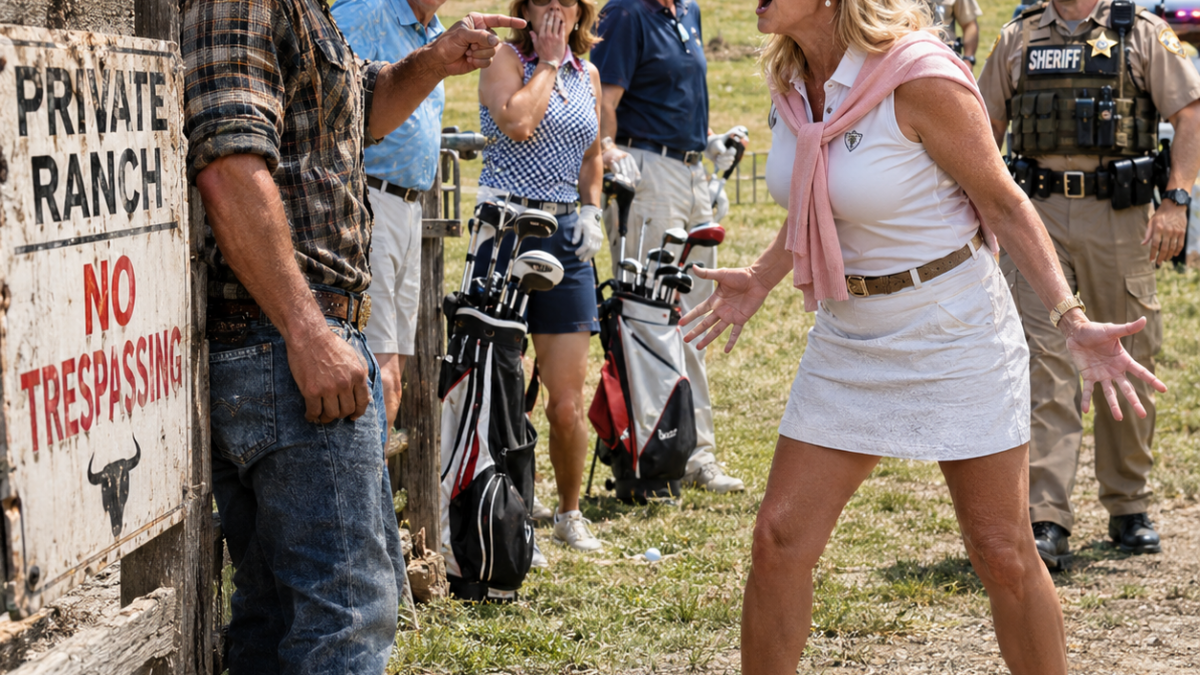
The first golfers arrived the next morning.
Trail cameras sent images to my phone.
At 7:14, three men stopped at one sign.
Read it.
Pointed.
Looked toward the clubhouse.
Then played through.
Another group did the same.
By eight, I had photographs of multiple golfers crossing after reading visible notice.
I called Kendall County.
Deputy Ruiz arrived.
Young.
Raised on a ranch near Comfort.
He looked at the purple paint.
Then Jimmy’s survey.
Then the recorded notice.
“You already told the club?”
“Certified.”
“They still sent players out?”
“Yes.”
Ruiz shook his head.
Then drove his cruiser onto the course.
Four men were putting on sixteen.
My former stock tank.
Ruiz stepped out.
“Gentlemen.”
They looked confused.
“Are you aware you’re on posted private property?”
One man laughed nervously.
“This is Ridge View.”
Ruiz pointed toward the sign.
“That sign says otherwise.”
“Denise told us to ignore those.”
That was useful.
“What exactly did she say?”
“She emailed everybody.”
One golfer pulled out his phone.
There it was.
From Denise:
Disregard unauthorized signage on the south course. This is a frivolous claim by a neighboring property owner. Play is not affected.
Timestamp.
Distribution list.
Two hundred twelve members.
I almost admired the efficiency.
She had taken formal notice and turned it into written proof that she intentionally encouraged continued entry.
Ruiz issued warnings and citations.
Fourteen golfers that morning.
Denise arrived in a golf cart twenty minutes later.
White golf outfit.
Sunglasses.
Controlled anger.
“Deputy.”
Ruiz turned.
“This is HOA property.”
“No, ma’am.”
Her expression changed.
“Excuse me?”
“I reviewed the recorded survey.”
“That survey is disputed.”
“Your dispute doesn’t erase the current ownership record.”
“These signs are unauthorized.”
“They were placed by the landowner.”
“You have no idea how much money has been invested in this course.”
Ruiz stared at her.
“Ma’am, I don’t enforce investment amounts.”
She pointed toward me.
“He’s harassing residents.”
“He’s posting his property.”
Denise’s jaw tightened.
Ruiz continued:
“And if you keep telling members to cross after notice, you may want to speak with your attorney.”
She called her attorney.
Then Kyle.
Then Glenn.
By that afternoon, Ridge View hired another surveyor.
This time:
A real one.
Meridian Land Services.
Licensed.
San Antonio.
They spent three days in the field.
I didn’t interfere.
On the fourth day, Glenn called me.
Not Denise.
“Garrett.”
“Yeah?”
“Meridian finished.”
“I figured.”
“They confirmed your line.”
I waited.
“Twenty-two acres?”
“Yes.”
“Four holes?”
“Yes.”
“Original monuments?”
“Yes.”
I heard him exhale.
Then:
“Ronnie Phelps wasn’t licensed.”
That part made even me blink.
“What was he?”
“Land consultant.”
“What does that mean?”
“I don’t know.”
Later we learned he had never held a professional surveying license.
He had a handheld GPS.
A business card.
And the confidence to charge developers three thousand dollars for something that should have been done by a licensed surveyor.
Kyle had saved perhaps ten thousand dollars on legitimate surveying.
That decision would cost him hundreds of thousands.
Denise didn’t surrender.
She called an emergency board meeting.
Her idea:
Adverse possession.
Glenn finally pushed back.
“Denise.”
“What?”
“We’ve only occupied the land four years.”
“So?”
“That’s not enough.”
“We improved it.”
“That doesn’t matter.”
“It increases value.”
“That doesn’t change ownership.”
She stared at him.
“We need a judge who understands how destructive it would be to the community to lose four holes.”
Glenn said:
“Judges understand deeds.”
“I need one who understands property values.”
“That is not the same thing.”
Denise leaned back.
“Then find me one who sees it my way.”
Glenn stared.
“That’s not how law works.”
“Then the law is stupid.”
That comment made its way into Wade’s notes.
Not evidence of ownership.
But a very good summary of the problem.
The following Saturday, forty-one golfers crossed the boundary again.
By then:
Signs were posted.
Purple paint visible.
The sheriff had warned the club.
Meridian had confirmed the boundary.
Some golfers had probably not been told about Meridian.
Others knew.
Several later said Denise explicitly encouraged everyone to continue playing “as a show of unity.”
The trail cameras caught them.
Timestamps.
Faces.
Carts.
Groups.
Tee times.
This time, I didn’t request warnings.
I filed complaints.
Deputy Ruiz returned with two other deputies.
Forty-one trespass citations were issued.
On a golf course.
In one morning.
That was when Ridge View finally panicked.
The membership email chain exploded.
One message:
My husband got cited for playing a course we pay $800 a month to use.
Another:
Why did the board tell us the land claim was fake?
Another:
Did Meridian confirm Dunlap owns the land?
Another:
I want my membership refunded.
Then:
Are criminal charges going to affect my professional license?
The problem Denise had created was no longer abstract.
She had converted a luxury amenity into personal legal exposure for her own members.
The emergency community meeting drew 104 homeowners.
The clubhouse was packed.
Standing room.
Anger.
Fear.
Denise sat at the front.
Navy blazer.
White blouse.
Prepared statement.
She opened with:
“Ongoing boundary clarification.”
People groaned.
She continued:
“Temporary disruption.”
Someone laughed.
“Proactive stakeholder engagement.”
A man shouted:
“Forty-one people got citations!”
Denise ignored him.
Then Paul Meechum stood.
Retired CPA.
Quiet man.
The kind who notices when a number doesn’t belong.
“Denise.”
She stopped.
“Yes, Paul?”
“I want to understand the financial exposure.”
“We have counsel handling—”
“Please answer.”
His voice wasn’t loud.
That made it more effective.
“Forty-one criminal trespass citations.”
Silence.
“Potential penalties.”
Silence.
“Civil suit.”
Silence.
“Destroyed ranch improvements.”
Silence.
“Twenty-two acres.”
Silence.
“Golf improvements built on land we don’t own.”
Denise said:
“The boundary remains under legal review.”
Paul held up Meridian’s report.
“Your surveyor says Garrett owns it.”
“That is one interpretation.”
“No.”
Paul opened the report.
“It is literally the conclusion.”
Applause.
Denise’s face tightened.
Paul continued.
“Ronnie Phelps wasn’t licensed.”
Murmurs.
“You told this community the original survey was professionally prepared.”
Denise said:
“That was the developer’s representation.”
“Then why did you keep sending golfers out after your own replacement survey confirmed the problem?”
Silence.
A woman stood.
“My husband has a criminal citation.”
Another:
“So does mine.”
Another:
“You told us to ignore the signs.”
Another:
“You sent the email.”
Denise tried to regain control.
“I was protecting the community’s investment.”
Paul’s expression hardened.
“By turning membership dues into evidence of trespass?”
That sentence silenced the room.
He continued.
“Every tee time on those holes is logged.”
People looked around.
“Every membership swipe proves access.”
More silence.
“Every email telling people to play after notice shows the board knew.”
Now even Glenn looked pale.
Paul said:
“You did not protect us.”
He pointed toward the windows overlooking the course.
“You put us on someone else’s land and told us ownership was somebody else’s problem.”
A young couple near the door stood.
The father held a toddler.
“Will this affect our home title?”
That question changed the room.
Because until then, some residents were angry about golf.
Now they were afraid about property.
Denise had built her authority around one promise:
She protected values.
Now homeowners realized she had threatened them.
Someone called for a no-confidence vote.
The result:
89 to 11.
Denise was removed.
The same community that had once trusted her confidence now watched her gather her papers in silence.
She walked toward the exit.
Outside, Wade was waiting with a process server.
Denise stopped.
The process server asked:
“Denise Whan?”
Her face changed.
“Yes.”
“You’ve been served.”
Civil complaint.
Property destruction.
Encroachment.
Interference with agricultural operations.
Damages.
She looked at Wade.
Then at me.
Homeowners filed out behind her.
No one was looking at her outfit.
No one was impressed by the posture.
They were looking at the lawsuit.
That was the first moment I saw Denise understand something I had known since the beginning.
A property line does not care who you are.
The financial consequences arrived fast.
First:
Fence.
Eight hundred twenty yards.
Replacement cost.
Then:
Stock tanks.
Restoration and loss.
Hay barn.
Native limestone construction.
Cattle chute.
Agricultural interruption.
Trees.
Earthwork.
Appraisers came.
Contractors.
Engineers.
Agricultural consultants.
Total physical damage:
Hundreds of thousands.
Wade pursued enhanced damages based on continued use after clear notice.
The golf club faced two basic options on the twenty-two acres.
Remove four holes.
Restore the ranch.
Rebuild ponds.
Rebuild fencing.
Regrade.
Repair agricultural access.
Or buy the land.
Demolition and restoration would cost a fortune.
The HOA chose purchase.
That hurt.
I won’t pretend otherwise.
My grandfather’s land was never supposed to become a golf course.
Money could not recreate the original stock tank.
It could not rebuild sixty years of family use exactly as it was.
Maggie and I sat at the kitchen table when Wade presented the offer.
She read it.
Then looked at me.
“You don’t want to sell.”
“No.”
“Would you rather make them tear it all out?”
“I don’t know.”
She reached across the table.
“Earl cared about the ranch.”
“I know.”
“He also cared about not being foolish.”
I smiled faintly.
“That sounds like something he would say.”
“He would ask what keeps the rest of the ranch strongest.”
That was the real question.
Forcing removal might restore twenty-two acres.
But litigation could continue for years.
Buying the land would permanently settle the boundary.
Fund major ranch improvements.
Protect the remaining acreage.
And make Ridge View pay fair value for what they had taken.
I agreed.
The twenty-two acres were sold at an appraised Hill Country value reflecting the golf-course improvements.
Kyle Prescott settled separately for relying on an unlicensed “survey.”
His shortcut cost him nearly half a million dollars.
Ronnie Phelps was referred for practicing surveying without proper licensure.
He stopped doing “property solutions.”
Wade called me after learning that.
“What’s he doing now?”
“Apparently pest control.”
I laughed.
“That seems safer.”
“Probably for property boundaries.”
The forty-one golfer cases remained.
I could have pushed them.
Technically, they had crossed after notice.
Some more than once.
But most of them were not Denise.
They had been told by the HOA that the course was safe to play.
They paid dues.
They trusted management.
They made stupid decisions.
That didn’t make all of them malicious.
So I met with the DA.
“I want the citations resolved.”
He looked surprised.
“You sure?”
“Yes.”
“They entered posted land.”
“I know.”
“You have video.”
“I know.”
“Why dismiss?”
“Because the people who deserve the biggest consequences are the ones who told them to cross.”
The eventual resolution required acknowledgment.
They signed documents confirming the land boundary and agreeing not to trespass again.
Forty-one signatures.
Forty-one members.
Forty-one people who had briefly learned that an expensive membership card cannot grant access to property the club does not own.
The civil numbers were larger.
Enhanced damages tied to destruction and willful continuation.
Land purchase.
Legal fees.
Developer settlement.
Total financial exposure went north of $1.6 million.
When Wade showed me the final figure, I sat quietly.
Maggie looked over my shoulder.
“One point six?”
“Approximately.”
She closed her book.
“They bulldozed your grandfather’s fence.”
“Yes.”
“Filled his pond.”
“Yes.”
“Called you confused.”
“Yes.”
She nodded.
“Expensive confusion.”
I laughed.
For the first time in months.
Then came the part I cared about most.
Rebuilding the boundary.
I didn’t use cedar posts.
Not this time.
Steel pipe.
Set in concrete.
Welded rails.
High-tensile wire.
And survey monuments.
Real ones.
At regular control locations.
Brass caps.
Coordinates stamped.
Recorded.
Designed so a surveyor two hundred years from now could find them.
Jimmy supervised.
When we set the final monument, he sighted down the line.
“Straight.”
“How straight?”
“Straight enough that Earl would complain just to keep you humble.”
I smiled.
“He set his with a compass and chain.”
“And got it right.”
Jimmy kicked lightly at the limestone.
“People forget the old surveyors knew what they were doing.”
Maggie ordered a sign for the gate.
Powder-coated steel.
DUNLAP RANCH
EST. 1963
SURVEYED. RECORDED. POSTED.
I looked at it.
“Too much?”
She stared at me.
“They turned your grandmother’s stock tank into a putting green.”
“Fair.”
“Nothing is too much.”
Ridge View elected a new board.
Paul Meechum became president.
His first visit to my house was different.
No clipboard.
No attorney.
He carried a bottle of bourbon.
“Peace offering.”
I took it.
“You don’t owe me personally.”
“Our board does.”
He handed me a written apology.
Not vague.
Not “mistakes were made.”
Specific.
It acknowledged the unauthorized encroachment.
Destruction.
Failure to heed the recorded survey.
Continued member access after notice.
I read it.
Then looked up.
“This is good.”
“We hired counsel to write it.”
“I could tell.”
Paul smiled.
“Second thing.”
“What?”
“We’re resurveying every lot in Ridge View.”
I nodded.
“Licensed firm?”
“Yes.”
“Good.”
They found two minor discrepancies.
Both corrected early.
No lawsuits.
No bulldozers.
No golf holes.
Imagine that.
Denise sold her house six months later.
The listing said:
Premium corner lot with golf-course views.
Maggie read it on her phone.
“Technically true.”
“Which holes?”
“Doesn’t say.”
“Smart.”
“Probably the smartest sentence associated with that property in years.”
Denise moved away.
I heard different stories afterward.
Plano.
Dallas.
Property management.
Luxury leasing.
I stopped asking.
That surprised me.
For months, she had occupied part of my mind.
Every morning:
Denise.
Every survey:
Denise.
Every sign:
Denise.
Every golfer:
Denise.
Then the case ended.
And one day I realized I had gone an entire week without thinking about her.
That felt better than the settlement.
The south fence became part of my morning routine.
Drive.
Stop.
Check monuments.
Look across.
Ridge View still had its golf course.
Four of those holes now sat legally on land the club had purchased from me.
The rest remained where they belonged.
The golfers changed too.
They checked signs.
Stayed on cart paths.
Respected the fence.
One morning, I saw a man walk toward the boundary looking for a ball.
He stopped.
Saw the purple paint.
Looked at me.
I was on the other side fixing wire.
He raised his hand.
“Ball’s over there.”
“I see it.”
“Can I get it?”
That question mattered.
Permission.
Four words that would have prevented almost everything.
“Go ahead.”
He crossed.
Picked up the ball.
“Thank you.”
“You’re welcome.”
He stepped back across.
Easy.
No sheriff.
No lawsuit.
No million dollars.
Just respect.
Maggie later said:
“You look disappointed.”
“I’m not.”
“No confrontation?”
“No.”
She smiled.
“Good. You’re learning.”
The money changed the ranch.
Not into something flashy.
I paid off equipment.
Improved water systems.
Restored portions of pasture.
Rebuilt agricultural infrastructure.
Created a conservation easement on acreage Maggie and I never wanted developed.
That was important.
If Ridge View taught me anything, it was that land can disappear one “temporary” decision at a time.
So we protected what remained.
I also established a small scholarship through the local high school for students pursuing surveying, land management, agriculture, or civil engineering.
Maggie suggested it.
“What should we call it?”
“Earl Dunlap Boundary Scholarship.”
She frowned.
“Sounds like the winner gets a fence.”
“What’s wrong with fences?”
“Garrett.”
We settled on:
Earl Dunlap Land Stewardship Scholarship.
First recipient:
A seventeen-year-old girl named Marisol Vega.
Her father worked ranch maintenance.
She wanted to study geomatics.
At the scholarship ceremony, she told me:
“My dad says surveyors just walk around holding sticks.”
I laughed.
“Your dad’s not entirely wrong.”
She smiled.
“Why did you become one?”
I thought about it.
“Because lines matter.”
She waited.
I continued.
“Not because lines separate people.”
“But because?”
“They prevent people from taking what isn’t theirs.”
Her smile faded into something more serious.
“That happened to you?”
“A little.”
Maggie laughed from the table behind us.
“Twenty-two acres is apparently ‘a little.’”
Marisol looked confused.
I handed her the scholarship certificate.
“Study hard.”
She did.
Years later, she interned with Jimmy.
He complained she was too precise.
Which meant she was excellent.
The old hay barn was harder.
You cannot replace age.
You can rebuild walls.
Use similar limestone.
Find old oak timber.
But a barn built by your grandfather carries things material receipts cannot list.
His hammer marks.
His repairs.
The place where he wrote measurements in pencil.
Those were gone.
I kept one limestone block recovered from the grading area.
It sits beside the ranch house.
Maggie planted rosemary around it.
One evening, I found her sitting there.
“You okay?”
“Yes.”
“You don’t look okay.”
She touched the stone.
“I never understood how angry I was about that barn.”
“I did.”
“You always talk about the boundary.”
“That’s my profession.”
“The barn was family.”
I sat beside her.
“Yes.”
She leaned against me.
“They paid.”
“I know.”
“Doesn’t fix it.”
“No.”
That was another lesson.
Winning and repairing are not the same thing.
A judgment can compensate.
A survey can prove.
A deed can settle.
But some things remain lost.
You carry them differently.
A few years after the case, Paul invited me to speak at Ridge View.
I laughed.
“No.”
“Please.”
“No.”
“It’s about property boundaries.”
“Hire a surveyor.”
“We did.”
“Then listen to him.”
Paul sighed.
“It’s for the board.”
“Definitely no.”
Maggie overheard.
“You should go.”
I covered the phone.
“Why?”
“Because apparently men need PowerPoint before they respect fences.”
I looked at her.
She smiled.
I went.
The clubhouse felt strange.
Same limestone.
Same leather.
Same cold air conditioning.
Different board.
No Denise.
Paul introduced me.
I stood at the front.
About fifty residents.
“First thing.”
I pointed toward the windows.
“Your golf course is legal now.”
Laughter.
Good.
“Second.”
I held up a survey plat.
“This is more important than your brochure.”
Quiet.
“Your marketing material tells you what somebody wants you to believe.”
I tapped the plat.
“This tells you what you own.”
I explained monuments.
Licensed surveys.
Recorded documents.
Easements.
Why developers should never substitute cheap location sketches for professional boundary work.
Then a man asked:
“Why didn’t the old fence prove ownership?”
“Fence evidence can matter.”
I said.
“But a fence by itself isn’t always the boundary.”
He nodded.
“So how do you know?”
“You investigate.”
I pointed at him.
“That question is exactly why licensed surveyors exist.”
Someone else asked:
“What was the biggest mistake Denise made?”
I thought.
There were many.
Ignoring me.
Ignoring Jimmy.
Ignoring the county.
Ignoring Meridian.
Sending golfers after notice.
But the real mistake started earlier.
“She treated an inconvenient fact like a negotiation.”
The room went quiet.
“A boundary is not a customer-service complaint.”
I looked around.
“You can dispute it.”
“You can litigate it.”
“You can resurvey it.”
“But you cannot simply decide it should move because your development works better if it does.”
Paul nodded.
That sentence became part of Ridge View’s board training packet.
I wish I were kidding.
Years passed.
The story faded.
New homeowners moved in.
Some didn’t know.
Others heard exaggerated versions.
One rumor said I had arrested two hundred golfers personally.
Not true.
Another said I dug up the eighteenth green with a bulldozer.
Also not true.
My favorite claimed I released cattle onto the course during a tournament.
Maggie loved that one.
“You should have.”
“No.”
“Picture Denise.”
“I don’t want to.”
“A Brangus herd on the putting green.”
“You’re dangerous.”
“Retired librarian.”
“Same thing.”
The reality was less cinematic.
And more effective.
Survey.
Notice.
Posting.
Documentation.
Law.
That’s usually how real consequences work.
Less dramatic than revenge fantasies.
More permanent.
One morning, about eight years after the dispute began, I was driving the fence.
I stopped near the brass monument at the old southwest corner.
Sunlight hit the cap.
Coordinates still legible.
Across the fence, a maintenance crew was working on the course.
One young man walked over.
“Mr. Dunlap?”
“Yes.”
“My boss says never touch these markers.”
“Your boss is smart.”
“He says this one cost the golf club a million dollars.”
I laughed.
“The marker didn’t.”
“What did?”
“Ignoring it.”
The kid nodded slowly.
Then:
“You really surveyed for the state?”
“Twenty-six years.”
“That cool?”
“Depends how much you like mosquitoes.”
He laughed.
I looked down at the brass cap.
“You thinking about surveying?”
“Maybe.”
“Good career.”
“Why?”
I looked across the line.
“Because somebody always needs to know where things stop.”
He went back to work.
I stayed there a while.
My grandfather had understood that without ever holding a GPS receiver.
He put cedar posts in the ground.
Walked the line.
Maintained it.
Not because he hated neighbors.
Because good neighbors need known boundaries.
People like Denise misunderstood that.
They treated boundaries as hostility.
Rules as obstacles.
Consent as inconvenience.
But boundaries are what make cooperation possible.
You know where yours ends.
You respect where mine begins.
Then nobody needs a deputy on the sixteenth green.
Maggie eventually made me retire from consulting completely.
“You said you retired eight years ago.”
“I did.”
“You took six jobs last year.”
“Consulting isn’t working.”
“It involves invoices.”
“That’s administrative.”
“It involves driving.”
“Recreational.”
“It involves survey equipment.”
“Sentimental.”
She stared at me.
“Garrett.”
I surrendered.
Mostly.
Instead, I helped teach occasional continuing-education classes.
Young surveyors.
Boundary law.
Historical evidence.
Field notes.
One class asked me to present the Ridge View case.
I opened with a photograph.
Not of Denise.
Not the golf course.
The original iron monument.
Rusty.
Half buried.
Unimpressive.
“This.”
I pointed.
“This beat a multimillion-dollar development.”
Students looked confused.
I explained.
“Not because iron is magic.”
“Because it was evidence.”
Then I showed the fake plastic stake.
“This cost them millions.”
Someone asked:
“How?”
“Because somebody trusted convenience instead of competence.”
That became the theme.
Professional responsibility.
Kyle wanted cheap.
Ronnie wanted to be treated like a surveyor.
Denise wanted the golf course to be right.
Members wanted to keep playing.
Each person accepted the fact easiest for them.
Reality did not care.
Reality waited.
Sometimes for years.
Then collected interest.
When Maggie and I celebrated our fortieth anniversary, our kids threw a party at the ranch.
Grandchildren.
Neighbors.
Jimmy.
Paul.
Even Deputy Ruiz came.
Someone put a little golf flag near the barbecue pit as a joke.
Maggie saw it.
“Who did that?”
Our son raised his hand.
“Take it out.”
Everyone laughed.
He pulled it.
Maggie looked at me.
“I’m serious.”
“I know.”
Later, one granddaughter asked why Grandma hated golf flags.
I said:
“Long story.”
Maggie said:
“Property dispute.”
Our granddaughter nodded like that explained everything.
Maybe it did.
The south fence still runs straight.
Steel.
Concrete.
Brass.
The original cedar posts are mostly gone.
But I saved three that workers found buried near the old fence trench.
One sits by the ranch gate.
One near the house.
One in the barn we rebuilt.
The new barn doesn’t pretend to be Earl’s.
That matters.
We used stone.
Oak.
Similar footprint.
But on the entrance beam, I mounted a small brass plaque.
ORIGINAL BARN BUILT BY EARL DUNLAP, 1965
DESTROYED DURING RIDGE VIEW ENCROACHMENT
REBUILT BY THE DUNLAP FAMILY
Maggie read it.
“No amount?”
“No.”
“No names?”
“No.”
“Good.”
“Why?”
“Because this is about Earl.”
She was right.
That helped too.
For years, Denise had been attached to the loss.
Eventually, I took her name out of the memory.
The barn belonged to Earl.
Not to the person who destroyed it.
The ranch belonged to our family.
Not to the HOA that crossed it.
There’s power in deciding who gets remembered.
Ridge View’s golf club survived.
That surprised some people.
I never wanted it destroyed.
I wanted it legal.
The board reconfigured operations.
Purchased the disputed acreage.
Raised insurance.
Adjusted membership.
Hired professionals.
The course remained eighteen holes.
But every year, their maintenance crews receive the recorded boundary map.
Every new board member gets it too.
Paul once told me:
“We probably overdo it now.”
“No.”
“You don’t think?”
“I’m a surveyor.”
“Right.”
“There is no such thing as overdoing a boundary map.”
He laughed.
I wasn’t joking.
One afternoon, years after Denise left, a tournament was held at Ridge View.
Paul invited me.
I said no.
Maggie said yes for me.
So I went.
I don’t golf.
Never cared about golf.
They put me in a cart with Paul.
At sixteen, I stopped.
The green looked beautiful.
Perfect.
I remembered water.
Cattle.
Mud.
Earl.
For a moment, grief caught me unexpectedly.
Paul noticed.
“You okay?”
“Yeah.”
He looked toward the green.
“I’m sorry.”
“You already apologized.”
“Doesn’t mean I stop being sorry.”
That was fair.
I stepped out.
Walked to the edge.
The land was legally theirs now.
I had signed the deed.
That was different.
Consent changes everything.
Paul said:
“Want to hit one?”
“No.”
“Come on.”
“No.”
Maggie shouted from another cart:
“Do it.”
I took the club.
Terrible stance.
Paul tried to correct me.
“Garrett, feet—”
“I know where my feet are.”
“I’m sure you do.”
I swung.
Ball flew low.
Bounced.
Rolled onto the green.
Not close to the hole.
But playable.
Paul laughed.
“Not bad.”
I handed back the club.
“That’s enough.”
Maggie clapped sarcastically.
For the first time, I stood on that green without feeling like something had been stolen.
Because nothing was being stolen anymore.
That surprised me.
Closure is a strange word.
Too clean.
Too final.
But maybe that was as close as I ever got.
The land changed.
Legally.
The family changed.
The ranch changed.
But the line was respected.
That was enough.
People sometimes ask if I hated Denise.
I did.
For a while.
Not because she insulted me.
I’ve been insulted by oilmen, lawyers, ranchers, bureaucrats, and one judge who thought surveyors were “men who walk around with expensive tripods.”
You develop thick skin.
What I hated was how casually she dismissed history.
My grandfather’s fence.
The stock tanks.
The barn.
The work.
She saw ranch land and imagined unused space.
That mentality is dangerous.
Land isn’t empty because it isn’t manicured.
A pasture is working.
A pond is working.
Fence is working.
A barn is working.
Not every valuable thing looks expensive.
Denise understood price.
She didn’t understand value.
The legal system eventually taught her the difference.
Ironically, the twenty-two acres became worth far more because of the golf improvements.
The course spent a fortune making my land more valuable before being forced to buy it.
Maggie loved that.
“Karma with landscaping.”
“That’s not a legal term.”
“It should be.”
The final accounting still makes people stare.
Property damages.
Enhanced damages.
Land sale.
Developer settlement.
Costs.
More than $1.6 million tied to a mistake that began with a three-thousand-dollar shortcut on a survey.
Three thousand.
That’s the part I repeat to young developers.
Kyle Prescott tried to save maybe eight or ten thousand dollars by skipping a licensed survey.
He got a cheap map.
Then spent hundreds of thousands defending it.
The HOA spent more.
Members got citations.
Denise lost her position.
Everybody paid because somebody decided professional accuracy was too expensive.
Jimmy once said:
“The cheapest survey is always the one that hasn’t caused a lawsuit yet.”
That belongs on a sign.
Maybe Maggie will make one.
Now, every morning, I still look south.
Ranch on one side.
Course on the other.
Steel fence between.
Golfers stay where they belong.
Cattle stay where they belong.
Sometimes balls don’t.
People ask permission.
I throw them back.
Simple.
The world works surprisingly well when people respect lines.
My grandfather understood that.
My father understood it.
I spent twenty-six years proving it for other people.
Then one HOA president gave me the most personal boundary case of my life.
She believed expensive homes could erase old deeds.
She believed manicured grass could make ranch land hers.
She believed if enough members used the course, use would become ownership.
She believed confidence could defeat monuments.
She believed I would get tired.
She was wrong.
The fence came back.
The monuments were recorded.
The damage was paid.
The residents learned the truth.
And Denise learned a lesson every surveyor already knows:
A boundary doesn’t move because somebody wants more room.
It doesn’t move because the clubhouse cost millions.
It doesn’t move because two hundred members pay eight hundred dollars a month.
It doesn’t move because a developer hired the wrong man.
It doesn’t move because the HOA president sends an email.
It stays where the evidence puts it.
That is what saved the ranch.
Not anger.
Not revenge.
Evidence.
When Ridge View turned my pasture into a golf course, they thought they had changed reality.
All I did was mark reality clearly enough that nobody could pretend not to see it anymore.
And once those signs went up, every membership card stopped being proof that golfers belonged on those four holes.
It became proof that someone had sold them access to land the club did not own.
That was Denise’s undoing.
She didn’t just ignore my boundary.
She ordered an entire community to ignore it with her.
Then she put the order in writing.
The last time I drove the south line before sunset, Maggie was beside me.
We stopped at the brass monument.
The light was low.
Hill Country gold.
Golf course green on one side.
Native grass on ours.
Maggie looked across.
“You ever miss the old pond?”
“Yes.”
“Me too.”
She touched my arm.
“You did right.”
I nodded.
“I know.”
We sat quietly.
Then a golf ball bounced over the fence.
Rolled to my truck.
A man on the other side raised his hand.
“Mr. Dunlap?”
“Yeah?”
“Can I retrieve that?”
Maggie smiled.
I picked up the ball.
Walked toward the fence.
Then tossed it back.
“Next time keep it on your property.”
He laughed.
“Yes, sir.”
Maggie looked at me.
“You enjoyed that.”
“A little.”
We drove home.
Past the rebuilt barn.
Past the cattle.
Past the gate sign.
DUNLAP RANCH — EST. 1963.
Surveyed.
Recorded.
Posted.
Every inch.
My grandfather had built the first boundary with cedar, wire, a compass, and a chain.
I rebuilt it with steel, GPS coordinates, brass monuments, lawsuits, and one very expensive lesson.
Different tools.
Same line.
And that, in the end, was all I ever asked them to respect.








