PART 2: HOA Karen Built a Wall Six Feet Inside My Property—Then the Survey Put Part of Her Prize-Winning Yard on Mine
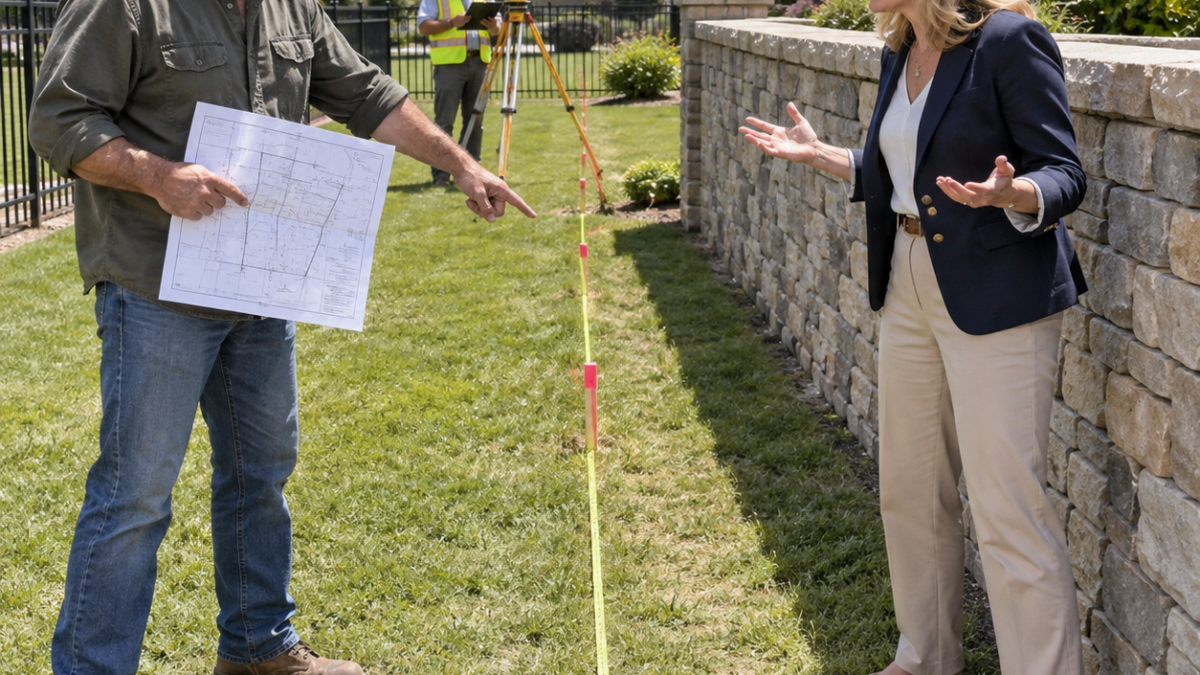
The morning I came home and found a three-foot cinder-block wall running straight through my wife’s garden, Karen Peterson was standing beside the crushed tomato plants with a clipboard, calmly explaining that the HOA had “corrected” my property line without bothering to ask me. She handed me a $200 vegetation fine and a $2,000 bill for half the wall, then smiled while the rosemary Sarah had planted after her second round of chemotherapy lay snapped beneath fresh mortar and construction mud. What Karen did not know was that I had spent twenty-two years with the Army Corps of Engineers—and the first survey pin I uncovered told me her wall was only the beginning of what she had built on land that was never hers.
“This is a community beautification project, Mark.”
Karen said it as though that settled everything.
I stared past her.
Yesterday, there had been a garden.
Not decorative landscaping.
Sarah’s garden.
Raised beds of heirloom tomatoes.
Rosemary.
Lavender.
Sunflowers against the back fence.
A narrow stone path Sarah had laid herself because after chemo she hated sitting inside waiting for the next appointment.
That garden had been the one place where she stopped talking about blood counts.
Now half of it was gone.
Raw gray blocks stretched across the yard like somebody had drawn a line through our life with concrete.
“This is six feet inside my property.”
Karen gave a short laugh.
“You’re using an outdated survey.”
“No.”
“The board revised the plat.”
I looked at her.
“You revised my deed?”
“Don’t be dramatic.”
She pushed two sheets of paper toward me.
One was a violation notice for “unapproved overgrown vegetation.”
The other was an invoice.
COMMUNITY BOUNDARY IMPROVEMENT
HOMEOWNER SHARE: $2,000
I almost respected the audacity.
“You destroyed my garden, built a wall on my land, and now you’re billing me?”
“The new boundary reflects the community standard.”
“Property lines aren’t community standards.”
She rolled her eyes.
“You really should attend meetings.”
“What meeting approved this?”
“Tuesday.”
“What time?”
Her expression shifted.
“Regular board session.”
“There was no meeting Tuesday.”
“You don’t know everything the board does.”
I took out my phone.
Karen immediately straightened.
“Are you recording me?”
“Yes.”
“I don’t consent.”
“We’re standing in my backyard.”
Her eyes narrowed.
“Behind the approved community boundary.”
That sentence was so absurd I almost smiled.
Instead, I walked to the garage.
Sarah appeared in the kitchen doorway.
She was pale.
Not sick pale anymore.
Angry pale.
“What are you doing?”
“Checking something.”
“Mark.”
I stopped.
She looked through the window at the destroyed beds.
Her voice dropped.
“My sunflowers.”
I walked back and kissed her forehead.
“I know.”
Then I opened the old steel cabinet in the garage.
Five years earlier, when we bought the house, I had stored our closing documents inside a weatherproof accordion file.
Insurance.
Deed.
Title policy.
Survey.
I unrolled the original survey across my workbench.
Two iron pins defined the rear boundary.
I grabbed a hundred-foot tape, fluorescent string, a small hammer, and my phone.
Karen was still waiting when I returned.
“You planning to play surveyor now?”
“No.”
I found the front pin first.
Exactly where the plat showed it.
The rear pin took longer.
Ten minutes beneath the roots of an old oak.
But there it was.
Iron.
Old.
Undisturbed.
I tied the string and pulled it tight between the monuments.
Then I stepped back.
The fluorescent line ran parallel to Karen’s new wall.
Six feet away.
On my side.
Sarah came outside.
She saw it.
Then put one hand over her mouth.
Karen stared.
“That proves nothing.”
I measured again.
Six feet, three inches at one end.
Five feet, eleven at the other.
I photographed everything.
Survey pin.
Tape.
String.
Wall.
Destroyed garden.
Then I turned toward Karen’s property.
That was when I noticed something I had never questioned before.
Her rose garden.
The one featured every year in the Harmony Creek newsletter.
Part of it sat on my side of the string.
So did the far corner of her expensive flagstone patio.
Karen followed my eyes.
For the first time that morning, she stopped talking.
I lowered the measuring tape.
“This line goes both ways.”
Her face tightened.
“You touch my roses and I’ll sue you.”
“I’m not touching anything.”
I looked at the wall again.
“At least not until a licensed surveyor tells us exactly whose yard you’ve been using.”
And as Karen’s confidence finally cracked, Sarah slipped her hand into mine and whispered something I would remember through everything that came next.
“Don’t just get the garden back.”
She looked toward the broken plants.
“Make them tell the truth.”
PART 2
I called Gus Petrovic before Karen had even finished marching back toward her house.
Apex Land Surveying had a reputation in our county for two things.
Precision.
And being expensive.
I wanted both.
Gus answered on the second ring.
“Petrovic.”
“Gus, Mark Jensen.”
There was a pause.
“Army Corps Mark Jensen?”
“Retired Army Corps Mark Jensen.”
“That means you’re either bored or angry.”
“Property dispute.”
“Angry.”
I looked through the window at Karen.
She was pacing across her patio with her phone pressed to her ear.
“I need a boundary survey.”
“How disputed?”
“There’s a cinder-block wall six feet inside what my closing survey says is my lot.”
Gus whistled.
“Neighbor build it?”
“HOA president.”
“Of course.”
“And her patio may cross the actual line in the opposite direction.”
A long silence.
Then:
“Thursday. Eight a.m.”
“Can you make it defensible?”
“Mark, I make grocery lists defensible.”
“That’s why I called.”
I spent the rest of that afternoon doing what years in engineering had trained me to do.
Document before disturbing.
I photographed every destroyed plant.
Individual stems.
Crushed irrigation tubing.
Broken cedar edging.
Footprints.
Mortar residue.
Construction tire marks.
The cut rosemary.
Sarah’s sunflowers.
Then I found our garden photographs from the previous month.
Healthy beds.
Exact locations.
Dates embedded in the image metadata.
I emailed copies to myself and placed originals in cloud storage.
By six, my anger had become useful.
Sarah sat at the kitchen table with tea she had not touched.
I laid the HOA papers beside her.
“Don’t pay either.”
She gave me a tired smile.
“I wasn’t planning to.”
I sat across from her.
“How are you?”
“I’m not going to fall apart over flowers.”
“I didn’t ask about flowers.”
She looked out the window.
Two years earlier, Sarah had been diagnosed with stage II breast cancer.
Surgery.
Chemotherapy.
Radiation.
Then the waiting.
Always waiting.
The garden had started after her second infusion.
One morning she came home from the hospital, changed clothes, and asked me to drive her to a nursery.
She bought twelve tomato seedlings she was too weak to plant.
I planted them.
She supervised from a chair.
By summer she was stronger.
The garden grew with her.
I knew better than to call it therapy.
She hated that word.
But I watched what happened when her hands were in the dirt.
She stopped being a patient.
She became Sarah.
“What hurts,” she finally said, “is how casually she did it.”
I nodded.
“She didn’t even see it.”
“She saw weeds.”
“That’s what bothers me.”
Sarah touched the violation notice.
“She looked at something that mattered to me and decided her taste mattered more.”
My hands tightened.
She noticed.
“Mark.”
“I’m fine.”
“No war metaphors.”
“I haven’t used one.”
“You have the face.”
“What face?”
“The one you had when contractors lied about bridge tolerances.”
“That was different.”
“You made a colonel apologize to a lieutenant.”
“He was wrong.”
“Exactly.”
She reached across the table.
“Get our land back.”
“I will.”
“But don’t become her.”
That irritated me.
Mostly because I understood why she said it.
“I’m not going to bulldoze her patio.”
“Good.”
“I might enjoy making her move it.”
“Mark.”
“Legally.”
She shook her head.
But she smiled.
That helped.
The next morning, I sent the first formal notice.
Not just to Karen.
Every board member.
Certified.
Email copy.
Regular mail.
I attached our recorded deed, the closing survey, photographs, and a demand that no further construction occur until an independent survey established the boundary.
I disputed the fine.
Rejected the invoice.
Reserved our rights regarding property damage.
And requested:
Board minutes.
Plans.
Contractor information.
Insurance information.
Any “revised plat” Karen claimed authorized the wall.
Seven days later, the HOA answered.
Actually, Karen answered.
One page.
No minutes.
No revised recorded plat.
No contractor certificate.
Just a photocopy of a covenant paragraph authorizing the board to maintain landscaping and appearance standards.
At the bottom she wrote:
The HOA-maintained plat supersedes outdated homeowner documents.
That sentence was almost beautiful.
Almost.
I read it twice.
Then showed Sarah.
“What does that even mean?”
“It means she believes the HOA can move dirt boundaries with a printer.”
“Can they?”
“No.”
“You sound happy.”
“I’m not happy.”
“You look happy.”
“I’m professionally interested.”
“That’s engineer happy.”
Fair.
Then I noticed the final paragraph.
My objection itself had been deemed “harassing communication toward volunteer board leadership.”
New fine:
$500.
I laughed.
Sarah did not.
“She can fine you for disagreeing?”
“She can type anything she wants onto paper.”
“Is that the same thing?”
“No.”
“That’s what scares people.”
And that became important later.
Karen’s power did not come from always being legally correct.
It came from paper arriving in mailboxes.
Bold headings.
Deadlines.
Threats.
Late fees.
Words like lien.
Most people read an official-looking HOA notice and assume somebody checked whether it was valid.
Often nobody had.
Thursday morning, Gus arrived with two survey technicians.
Karen appeared before their tripod was fully extended.
Pink polo.
Clipboard.
Sunglasses.
She marched across her lawn.
“What is going on?”
Gus kept setting up.
“I’m going to need you people to leave.”
He continued working.
“I’m speaking to you.”
Gus finally looked up.
“Good morning.”
“Who authorized this?”
“Property owner.”
“I’m HOA president.”
“Congratulations.”
I turned away because I knew my face would betray me.
Karen held out her hand.
“Permits.”
Gus calmly opened his truck.
Pulled out licenses.
Insurance.
Work order.
County parcel records.
He handed the folder over.
Karen flipped through pages.
“There’s a revised HOA boundary.”
“Recorded where?” Gus asked.
“The board maintains it.”
“That wasn’t my question.”
She stared.
“Recorded where?”
“It’s an association document.”
Gus took the folder back.
“Then it doesn’t alter a recorded property boundary.”
“You don’t understand our covenants.”
“I understand monuments, bearings, distances, deeds, plats, and county records.”
He turned away.
“That’s what I’m here for.”
Karen retreated to her porch.
She watched for two hours.
The survey team located original monuments.
Confirmed the deed calls.
Compared subdivision plats.
Checked adjoining deeds.
Used GNSS equipment tied to control points.
Then Gus called me over.
“Mark.”
His tone changed.
I walked toward him.
Sarah followed.
Karen remained on her patio pretending not to watch.
Gus pointed at the line of pink flags.
“Your rough measurement was good.”
“How good?”
“Wall varies between approximately five-foot-ten and six-foot-four inside your boundary.”
Sarah closed her eyes.
I looked at the destroyed garden.
“Entire wall?”
“The portion behind your parcel.”
Then Gus smiled.
“That’s not the fun part.”
I didn’t like that smile.
“What?”
He led us toward the rear corner.
Pink flags crossed Karen’s landscaping.
Rose bushes.
Decorative stone border.
Then the line reached her patio.
A triangular section of flagstone fell across our side.
“How much?”
“We’ll calculate exact area in the report.”
“Ballpark.”
“About two hundred square feet total encroachment when you include landscape area.”
Karen had heard enough.
She marched over.
“That is impossible.”
Gus turned.
“Which part?”
“My property line has always been the old fence.”
“Apparently not.”
“That fence was there when I bought.”
“Physical occupation doesn’t necessarily establish legal boundary.”
“My attorney will disagree.”
“Maybe.”
Gus pointed toward a pink flag.
“But these are where the deed and monuments put the line.”
Karen looked at me.
“You planned this.”
I actually laughed.
“Planned what?”
“To steal my garden.”
“Karen, you built a wall six feet into mine.”
“That wall corrected an irregular boundary.”
“No.”
I pointed at the flags.
“That boundary was irregular only in your imagination.”
Her face flushed.
“If you touch one rose—”
“I already told you I’m not touching anything.”
Sarah stepped beside me.
Her voice was softer.
That made it more effective.
“You touched mine.”
Karen looked at her.
For the first time since this started, I saw discomfort.
Sarah continued.
“You sent workers into my garden without asking. They crushed plants I grew while I was sick.”
Karen’s eyes flicked toward the ruined beds.
“They were overgrown.”
Sarah’s expression changed.
Not anger.
Disbelief.
“They were alive.”
Karen opened her mouth.
Nothing came out.
Then she turned and walked away.
The official survey arrived Friday afternoon.
Twenty-two pages.
Stamped.
Signed.
Legal description.
Surveyor’s certification.
Encroachment exhibits.
Photographs.
Calculations.
It confirmed everything.
I emailed it to Ben Carter.
Ben and I had served together briefly early in my Corps career.
He went to law school after leaving active duty and built a practice around property and construction disputes.
His reply came twenty minutes later.
Call me.
I did.
“This is spectacular.”
“Sarah says lawyers who call disputes spectacular should be monitored.”
“She’s right.”
“What’s our position?”
“Strong on encroachment and property damage.”
“Her patio?”
“Slow down.”
“I said two words.”
“I know your voice.”
He continued.
“Her occupation of that strip may raise boundary, adverse possession, acquiescence, or limitation issues depending on state law and facts.”
I disliked every one of those words.
“She’s on my deeded land.”
“That matters. It isn’t always the only thing.”
“How long?”
“She says old fence was thirty years?”
“Yes.”
“You’ve owned five?”
“Yes.”
“We need title history, predecessor use, permission, tax records, and whether the fence was ever treated as boundary.”
“Fine.”
“Do not remove anything.”
“I know.”
“Do not threaten to remove anything.”
“I know.”
“Do not sit on the survey stake drinking whiskey while she moves roses.”
I paused.
“That was specific.”
“You were thinking about it.”
I had been.
Ben prepared a formal demand.
Unlike Karen’s letters, every sentence had purpose.
Remove the wall.
Restore our property.
Withdraw fines and invoice.
Reimburse survey and reasonable landscape losses.
Preserve records.
Then a separate neighbor-to-neighbor notice regarding the newly documented encroachment from Karen’s landscaping and patio.
Not:
Your yard is mine now.
Instead:
The survey reveals occupation beyond the deeded boundary.
Please provide any survey, agreement, easement, boundary-line instrument, or other document supporting your use.
No threats.
No immediate demolition.
Give counsel time.
Ben knew something I was still learning.
The strongest legal letters often sound boring.
We sent copies to all board directors.
That was when the board began cracking.
Three days later, a man named Stan Mercer knocked on our door.
Stan was an HOA director.
I had met him once.
Quiet.
Accountant at a manufacturing company.
He looked miserable.
“I probably shouldn’t be here.”
“Then why are you?”
He glanced toward Karen’s house.
“Was the wall really six feet over?”
I handed him Gus’s survey.
He read.
His shoulders dropped.
“Damn.”
“Did you vote for it?”
Stan hesitated.
“There wasn’t exactly a vote.”
There it was.
“What happened?”
“Karen said the rear boundary needed correction because several properties had inconsistent setbacks.”
“Did she show you a survey?”
“She had a map.”
“What map?”
“Something printed from the HOA software.”
“County map?”
“I don’t know.”
“Recorded plat?”
“No.”
“Did you authorize construction?”
“She emailed asking if anybody objected.”
“That is not a vote.”
“I know.”
“Did you reply?”
“No.”
“So how did she call it unanimous?”
Stan rubbed his face.
“That’s what I’m worried about.”
Sarah brought him coffee.
He declined.
Then changed his mind.
Stan told us Karen had become increasingly aggressive over the previous two years.
Board meetings were often informal.
Minutes sparse.
Email decisions treated as votes.
Contractors sometimes hired before board ratification.
“Why didn’t you stop it?”
He looked at me.
“Because every time someone challenged her, she made their life miserable.”
I thought about the $500 fine.
“What about the contractor?”
“K&G Solutions.”
“Who selected them?”
“Karen.”
“Bids?”
“I never saw any.”
“Amount?”
“Four thousand.”
That matched my invoice math.
She was billing us half.
“Who owns K&G?”
“No idea.”
I did not know yet either.
Stan stood to leave.
Before walking out, he said:
“You didn’t hear this from me.”
I looked at him.
“If this becomes formal, you may need to say it yourself.”
His face tightened.
“I know.”
That afternoon, Sarah baked chocolate-chip cookies.
I stared at her.
“What?”
“You’re the one starting an insurgency with cookies?”
“I’m meeting neighbors.”
“Operation Chocolate Chip?”
“Don’t call it that.”
I called it that privately.
We visited Arthur Henderson first.
Seventy-eight.
Widower.
His wife Mary had died three years earlier.
The empty hook where her bird feeder once hung told most of his story before he did.
“She made me remove it.”
“Why?”
“Squirrels.”
I looked at the oak trees surrounding his house.
“Squirrels live here.”
“That was my argument.”
He showed me the notice.
Attractive nuisance / vermin source.
Fine:
$100.
“It was Mary’s?”
He nodded.
“She watched cardinals from the breakfast table every morning.”
“Why’d you remove it?”
Arthur shrugged.
“I got tired.”
Those words bothered me more than if he had said he was afraid.
Tired.
That was how Karen won.
Next came the Rodriguez family.
Their children’s swing set had once been blue.
Now beige.
Maria Rodriguez showed us photographs.
Bright blue slide.
Red ladder.
Yellow canopy.
Then the approved version.
Beige everything.
“My son asked why his playground had to look like Dad’s office.”
Sarah laughed.
I didn’t.
“How much did repainting cost?”
“Materials plus two weekends.”
“Fine if you refused?”
“Twenty-five dollars daily.”
We collected copies.
Basketball hoop.
Wind chimes.
Holiday lights.
Window-box flowers.
Trash cans.
A porch bench.
Some violations had support in written covenants.
Others were discretionary interpretations.
Still others seemed invented.
The pattern mattered more than any one notice.
I created a spreadsheet.
Not because I wanted to overthrow Karen.
Not yet.
Because patterns become visible when you stop relying on memory.
Date.
Household.
Rule cited.
Actual covenant language.
Fine.
Appeal.
Outcome.
Then I found something else.
Residents who appealed Karen successfully often received unrelated inspections within thirty days.
Could be coincidence.
Maybe.
But enough coincidences deserve a column.
Our meeting happened two weeks later.
Twenty-one households attended.
Arthur spoke first.
Then Maria.
Then Mr. Chen talked about wind chimes his wife had brought from Taiwan years before.
Then a young father described being cited because his basketball hoop remained visible after dusk.
Nobody shouted.
That mattered.
People compared paperwork.
That mattered more.
Karen had been able to tell each household:
Your situation is unique.
Now they discovered it wasn’t.
Maria Rodriguez’s sister-in-law, Elena, was a CPA.
She looked through several notices.
“Has anyone requested HOA financials?”
Silence.
Arthur said, “Why?”
“Because Mark got billed two thousand dollars for half a four-thousand-dollar wall.”
“Yes.”
“Which was built without a formal vote.”
“Yes.”
“I want the invoice.”
That started the financial side.
The HOA’s first response was delay.
Then incomplete PDFs.
Then a box.
Elena worked through it.
Three days later, she called me.
“Come over.”
Her dining table looked like a crime board built by accountants.
Invoices.
Bank statements.
Vendor registrations.
She slid one paper toward me.
K&G SOLUTIONS — $4,000.
“Wall.”
“Yes.”
“Problem?”
“Several.”
She showed me comparable estimates.
Roughly half that amount.
Not proof of wrongdoing.
But suspicious.
Then:
State business registry.
K&G owner:
Gary Peterson.
Karen’s brother-in-law.
I stared.
“Disclosed?”
“I haven’t found it.”
“Board approval?”
“Vague.”
“Bids?”
“None produced.”
Sarah stood beside me.
“So she hired family.”
“Maybe.”
Elena corrected me.
“She definitely hired a related vendor. Whether the relationship itself violates anything depends on disclosure, policy, price, and approval.”
I smiled.
“You sound like Ben.”
“I charge less.”
Then she showed me legal expenses.
Several invoices from a private law firm.
Dates after our demand.
Descriptions:
Executive consultation.
Board officer defense review.
Encroachment response.
Paid from HOA operating funds.
Again, that did not automatically mean theft.
Boards often receive legal advice.
But if Karen was using association funds solely to defend personal property encroachment, that was another issue.
We needed facts.
The homeowners’ petition came next.
The bylaws required twenty-five percent to call a special membership meeting.
We collected sixty-two percent.
Not because of me.
Because people were exhausted.
The petition requested:
Independent financial review.
Discussion of selective enforcement.
Review of wall authorization.
Vote regarding board leadership.
Karen had to schedule the meeting.
She sent the notice herself.
Then spent the next week canvassing residents, according to three different neighbors.
She told people I wanted to abolish the HOA.
False.
That I planned to sue every homeowner.
False.
That I intended to seize part of her house.
False.
And that Sarah’s garden was “mostly weeds anyway.”
That last one nearly cost me my composure.
Sarah heard it from Maria.
She walked into my office.
“Don’t.”
“I haven’t done anything.”
“You’re making the face.”
“What face?”
“The colonel face.”
“I’m not a colonel.”
“That’s why it’s concerning.”
She closed the door.
“Let her talk.”
“She’s talking about you.”
“I know.”
“You were sick when—”
“I know what the garden means.”
Her voice sharpened.
“Do not fight Karen because you think I need avenging.”
That stopped me.
Sarah sat.
“I need the garden restored.”
“Yes.”
“I need our property protected.”
“Yes.”
“I need her lies exposed.”
“Yes.”
“But I don’t need you turning this into something that keeps you angry for five years.”
Silence.
“I already lost enough time being sick.”
That hit harder than anything Karen had done.
Sarah reached across the desk.
“Win clean.”
I nodded.
“Okay.”
The night of the special meeting, the clubhouse could barely hold everyone.
Karen sat at the center table.
Stan on one side.
Carol Bennett on the other.
Carol had voted with Karen on almost everything for years.
Stan looked as though he wanted to be anywhere else.
Karen opened with twenty minutes about community harmony.
Then she called my name.
“Mr. Jensen has apparently prepared a presentation.”
Her tone made presentation sound contagious.
I walked to the podium.
First slide.
The wall.
Second.
Original garden.
Third.
Destroyed garden.
Then Gus’s survey.
I explained what I knew.
Not what I assumed.
“The wall lies approximately six feet inside the boundary established by a licensed surveyor using recorded instruments and original monuments.”
Karen interrupted.
“Our attorney disputes that interpretation.”
Ben stood in the rear.
“Then please produce a competing survey.”
Silence.
Karen glared.
I continued.
“The same survey also identified an apparent encroachment from landscaping and part of a patio on the opposite side.”
Murmurs.
I raised one hand.
“That issue is being handled through counsel. I have not removed anything and will not until the legal rights are determined.”
That mattered.
It showed the contrast.
Karen moved first.
I documented first.
Then Sarah walked to the microphone.
I had not known she planned to speak.
“My name is Sarah Jensen.”
The room quieted.
“I’m the one whose garden was destroyed.”
She put up a photograph.
Sarah after chemo.
Head scarf.
Too thin.
Sitting beside tiny tomato seedlings.
I had taken it without knowing how important it would become.
“This was the first garden Mark and I planted here.”
Her voice shook.
“I was in treatment for cancer.”
Nobody moved.
“I don’t believe plants are more important than community standards. I don’t believe being sick gives me special property rights.”
Karen looked uncomfortable.
“But I do believe people should ask before destroying something that belongs to someone else.”
Sarah changed the slide.
Karen’s notice.
OVERGROWN VEGETATION.
“I’m not asking anybody to vote against Karen because of my illness.”
Sarah looked directly at her.
“I’m asking you to look at what happens when somebody stops seeing neighbors and starts seeing violations.”
Then she sat.
Karen’s face had lost color.
Arthur spoke next.
Bird feeder.
Maria.
Swing set.
Mr. Chen.
Wind chimes.
Then Elena presented the financial records.
No dramatic accusations.
She was too disciplined for that.
“K&G Solutions received a four-thousand-dollar no-bid contract for the wall.”
Business registry appeared.
Gary Peterson.
She continued.
“Mr. Peterson is related by marriage to President Karen Peterson.”
Noise erupted.
Karen grabbed the microphone.
“This is outrageous. Gary is a qualified contractor.”
Elena nodded.
“That may be true.”
Karen hesitated.
“The issue is disclosure and procurement.”
“He gave us a fair price.”
“Where are the comparative bids?”
“We were under a deadline.”
“What deadline?”
“Beautification schedule.”
Laughter.
Karen’s face reddened.
Elena continued.
“We also found association-funded legal invoices that appear, based on their descriptions, to include consultation related to President Peterson’s personal boundary dispute.”
Karen stood.
“The HOA is required to defend board members.”
Frank Delaney, a retired paralegal, spoke from his seat.
“For good-faith actions within authority, depending on the governing documents and insurance terms.”
Karen pointed.
“Exactly.”
Frank stood.
“That sentence was not agreement.”
More laughter.
Karen snapped.
“This has become a witch hunt.”
Stan suddenly spoke.
“No.”
Everyone turned.
Karen stared at him.
“What?”
Stan swallowed.
His hands shook.
But he continued.
“There was no formal board vote approving the wall.”
Karen’s face froze.
“Stan.”
“You emailed us.”
“We discussed it.”
“You told us it was routine.”
“Because it was.”
“You said there was a corrected survey.”
“There was.”
“Show it.”
Karen looked at him as though he had betrayed her personally.
Stan’s voice strengthened.
“I should’ve asked before.”
He looked toward us.
“I didn’t. That was wrong.”
Karen slammed the gavel.
“This meeting is out of order.”
Frank walked to the microphone.
“Article Seven, Section Three permits removal of a director by membership vote after proper notice. Notice was provided.”
“You are not counsel.”
“No.”
He looked around the packed room.
“I’m a homeowner who read the bylaws.”
He made the motion.
Removal of Karen Peterson from the board.
Someone seconded immediately.
Karen exploded.
“You cannot do this!”
She stood.
“You people have no idea what it takes to keep this neighborhood from becoming trash.”
Nobody answered.
She pointed toward Arthur.
“You want feeders attracting rats?”
Then Maria.
“Primary-color toys everywhere?”
Then me.
“And this man wants to turn the neighborhood into a farm because his wife grew a few tomatoes!”
I felt Sarah’s hand close around my wrist.
Not restraining me physically.
Reminding me.
Win clean.
Karen kept going.
“I am the only person who has maintained standards around here for years!”
Frank waited.
When she stopped, he said:
“All in favor of removal, follow the voting procedure in the notice.”
Not a theatrical standing vote.
Paper ballots.
Verified household eligibility.
Independent count by three residents not running for board positions.
Thirty minutes later:
Seventy-eight percent for removal.
Karen sat perfectly still.
The room did not erupt immediately.
There was relief first.
Then applause.
Karen grabbed her clipboard.
She looked at me.
“You’re happy now?”
“No.”
“Liar.”
“I’ll be happy when my wife has her garden back.”
She left.
Stan resigned later that evening.
Carol followed the next morning.
An interim board was appointed under the bylaws until a proper election.
Frank agreed to serve temporarily.
Elena became treasurer.
A schoolteacher named Lisa Monroe became secretary.
Their first decision was not to punish Karen.
It was to freeze disputed enforcement actions and authorize an independent review.
That made me respect them immediately.
My civil dispute continued.
Ben filed suit because Karen would not resolve the encroachment voluntarily.
Wall.
Garden damages.
Boundary declaration.
Survey costs.
Her patio and roses.
The HOA, under new leadership, admitted the wall had been authorized improperly and agreed to pay for removing it through association insurance and reserve funds, subject to pursuing recovery from responsible parties.
I objected.
“Why should homeowners pay for Karen?”
Ben replied, “Because the association’s contractor built the wall. Your claim is against the entity too.”
“I don’t want Arthur paying.”
“Insurance may cover part.”
“And the rest?”
“New board can pursue reimbursement if warranted.”
That was the adult answer.
Unsatisfying.
Correct.
The wall came down three weeks later.
Not with me sipping whiskey beside a jackhammer.
Sarah would not allow that.
We stood on the porch.
A licensed demolition crew carefully removed block sections.
Dust rose.
The first gap reopened a view of the back garden.
Sarah squeezed my hand.
Arthur came over carrying iced tea.
“Mary would have enjoyed this.”
“Why?”
“She hated walls.”
I smiled.
“Good woman.”
“Best.”
He watched another block fall.
Then said quietly:
“You know what I’m putting back up tomorrow?”
“What?”
“My bird feeder.”
“Need help?”
“No.”
He grinned.
“I want Karen to see me do it myself.”
Fair.
When the final wall section disappeared, I walked into the reclaimed strip.
Bare soil.
Mortar chips.
Tire grooves.
It looked terrible.
Still felt good.
Six feet is not much.
Two long steps.
But land changes emotionally when somebody has taken it from you.
I stood there.
Sarah walked beside me.
“What are you thinking?”
“That it looks bigger.”
“Because we fought over it.”
“Probably.”
She crouched.
Picked up a broken rosemary branch that had somehow dried instead of rotting.
“I don’t want the old garden recreated.”
I looked at her.
“You sure?”
“Yes.”
“I thought—”
“That was the garden I needed when I was sick.”
She stood.
“I’m not sick now.”
I understood.
“What do you want?”
“A new one.”
So we designed one.
But first came Karen’s encroachment.
That fight turned out to be legally messier than I wanted.
Her attorney argued that the old fence line had been treated as the boundary for decades.
Potential boundary-by-acquiescence issues.
Potential adverse possession arguments.
We obtained prior deeds.
Old aerial photographs.
Statements from former owners.
A previous owner of our house, Mr. Wallace, was still alive in Florida.
He remembered the fence.
“It wasn’t a boundary fence.”
“What was it?”
“Dog fence.”
“Whose?”
“Petersons before Karen.”
“Did you believe it marked the property line?”
“No.”
“Did you ever give permission for landscaping beyond it?”
“I told them I didn’t care if they planted roses there as long as they understood it was my side.”
Ben nearly hugged the phone.
“Anything written?”
Mr. Wallace laughed.
“This was 1989. We talked over beer.”
Not ideal.
But useful.
Then we found an old survey from a refinancing transaction.
Same boundary as Gus’s.
Recorded long before Karen bought.
That substantially weakened her claim.
Settlement followed.
Karen agreed to recognize the surveyed boundary.
She would relocate landscaping within a defined time.
The patio corner would be cut back professionally.
We agreed not to seek removal beyond what the survey required.
No needless destruction.
No punitive stripping of her yard.
Just the line.
The day the roses moved was complicated.
I expected triumph.
Karen stood near her back door watching workers dig mature bushes.
Some were beautiful.
Deep red.
Pink.
Yellow.
Prize winners, according to newspaper clippings.
Sarah stood beside me.
“She loves those.”
“Yes.”
“Like I loved mine.”
That was not a sentence I wanted.
“She built hers on our land.”
“I know.”
“What are you saying?”
“Nothing.”
She watched a worker lift a root ball.
Then:
“Let them transplant them carefully.”
“They are.”
“No revenge.”
“I didn’t order revenge.”
“I know.”
She squeezed my hand.
“That’s why I married you.”
“Because I don’t murder roses?”
“Low bar.”
One rose had roots too tangled near the patio to move cleanly.
The landscaper asked if we wanted it removed entirely.
Sarah walked over.
“Can it stay?”
Karen, watching from the porch, looked startled.
The landscaper checked the line.
“About eighteen inches over.”
Ben had negotiated full clearance.
Legally, we could insist.
I looked at Sarah.
She said, “Move the border around it.”
“That gives up land use.”
“Eighteen inches around a rose.”
I smiled.
“Engineer says inefficient.”
“Cancer survivor says keep the flower.”
She won.
We signed a narrow revocable planting license acknowledging the rose remained on our land with permission and created no boundary rights.
Ben called us ridiculous.
I called it precise kindness.
Karen said nothing.
But two days later, an envelope appeared in our mailbox.
Inside was a card.
No apology.
Just:
Thank you for the rose.
Signed:
Karen.
I did not answer.
The financial review was worse for her.
K&G’s contract had not been competitively bid despite policy requiring multiple quotes above a threshold.
The family relationship had not been disclosed in board minutes.
Several invoices contained unusually vague descriptions.
Independent auditors found no proof of a secret cash kickback.
That mattered.
Rumors had already convicted her of things evidence could not establish.
We refused to do that.
But the undisclosed related-party contract and improper procurement were enough for the HOA to seek reimbursement of excessive costs.
Some legal bills also included work tied primarily to Karen’s individual property exposure.
The insurer contested coverage.
Settlement required her to reimburse a portion.
K&G repaid part of the wall contract.
No criminal charges.
No dramatic handcuffs.
The county attorney reviewed referrals and found the evidence better suited to civil governance and fiduciary claims than prosecution.
Some neighbors were disappointed.
I wasn’t.
Accountability is not measured by whether somebody goes to jail.
Karen lost the board.
Paid substantial legal expenses.
Paid toward our damages.
Lost use of the six-foot strip she had treated as her own.
Had part of her patio cut away.
Watched the association formally document her undisclosed family-vendor relationship.
That was real.
Then came the garden.
Sarah designed it herself.
A winding stone path.
Vegetable beds.
Jasmine.
Lavender.
A small fountain.
And roses.
Arthur donated cuttings from plants his wife Mary had grown.
The Rodriguez children helped paint the raised beds.
Blue.
Red.
Yellow.
Deliberately bright.
When Elena saw them, she laughed.
“Architectural application?”
Sarah looked horrified.
“Do we need one?”
Elena waited just long enough to be cruel.
“No.”
The children cheered.
Arthur reinstalled his bird feeder.
Bigger than before.
Cardinals returned within a week.
The Chens rehung their wind chimes.
Dave Miller put his basketball hoop back where it had always belonged.
Harmony Creek did not collapse.
Property values did not crater.
Rats did not invade.
Civilization survived colorful toys.
Karen stopped attending community events.
Then a FOR SALE sign appeared.
I expected satisfaction.
Instead, I felt something close to sadness.
Not for losing her as a neighbor.
For what it all had become.
Karen had not started as a movie villain.
I learned that later.
She had served on the board for almost ten years.
Organized storm cleanup.
Negotiated a major roof replacement at the clubhouse.
Helped secure grants for drainage improvements.
People once trusted her for reasons.
Power had not created every bad instinct.
But years without meaningful resistance had sharpened them.
She started believing efficiency justified skipping procedure.
Then that disagreement was obstruction.
Then that standards were whatever she considered attractive.
Then that because she cared deeply, she must be right.
That path scared me more than if she had simply been evil.
Ordinary people can walk it.
The morning Karen moved, I was repairing the garden fountain.
She walked toward our yard.
Stopped exactly at the survey line.
That was almost funny.
“Mark.”
“Karen.”
She looked at the garden.
Sarah was inside.
The late-summer flowers were full.
Tomatoes climbed trellises.
Arthur’s roses bloomed along one edge.
“It looks good.”
“Sarah designed it.”
“I know.”
A pause.
“I’m leaving today.”
“I saw the truck.”
“I suppose you’re relieved.”
“Yes.”
She flinched.
I wasn’t going to lie to make her comfortable.
Then I added:
“But I don’t hate you.”
She laughed once.
“You sued me.”
“You built a wall through my wife’s garden.”
“I thought the boundary was different.”
“No.”
Her eyes hardened.
“You don’t know what I thought.”
Fair.
I set down the wrench.
“What did you think?”
Karen looked toward the pink survey cap we had left permanent at the rear corner.
“I thought the old fence was the line.”
“At first?”
She did not answer.
That told me enough.
“And when you knew it might not be?”
She crossed her arms.
“I had already committed the HOA to the project.”
“So you doubled down.”
“I was president.”
“That’s not an explanation.”
“Yes, it is.”
“No.”
I looked at her.
“It explains the title. Not the decision.”
Silence.
She turned toward the garden.
“I hated being challenged in front of people.”
There it was.
Not property values.
Not aesthetics.
Control.
“Why?”
Karen’s mouth tightened.
“My whole life, if I didn’t take charge, nobody did.”
I waited.
“My husband never handled bills. My parents were disasters. At work, every committee I joined became my responsibility because everyone else wanted to complain but nobody wanted to decide.”
She looked at me.
“So I learned to decide.”
“That can be useful.”
“It was.”
“Until nobody could tell you no.”
Her eyes narrowed.
“You make it sound simple.”
“It isn’t.”
I thought about commanding engineering teams.
Times I had been certain.
Times junior soldiers had corrected me.
The best leaders I ever knew created space for that.
The worst punished it.
“I’ve made bad calls.”
Karen looked surprised.
“Big ones?”
“Yes.”
“What happened?”
“I had people around me who could tell me.”
She looked toward her emptying house.
“I guess I didn’t.”
“You did.”
I thought of Stan.
Arthur.
Residents who appealed.
“You stopped hearing them.”
That hurt.
I could see it.
After a moment, she nodded toward the one rose Sarah had allowed to remain.
“Thank her for that.”
“Tell her yourself.”
Karen looked toward our kitchen window.
Sarah was standing there.
She came outside.
Karen stiffened.
Sarah walked to the survey line.
Karen said:
“Thank you for letting me keep the rose.”
Sarah nodded.
“It was already growing.”
“That doesn’t mean you had to.”
“No.”
Karen looked toward the garden.
“I’m sorry about your plants.”
Sarah’s face changed.
Karen continued.
“I didn’t understand what they meant.”
“You didn’t ask.”
“No.”
Sarah’s answer was not warm.
But neither was it cruel.
“They grow back.”
Karen looked relieved.
Sarah added:
“Trust takes longer.”
Karen nodded.
Then she walked away.
That was the last time I saw her.
Harmony Creek changed slowly.
Better than overnight miracles.
The new board rewrote procedures.
Not every covenant.
Not every standard.
They defined ambiguous ones.
Established notice requirements.
Documented votes.
Created appeal panels containing homeowners who were not board officers.
Required competitive bids above set amounts.
Required conflicts to be disclosed publicly.
Published monthly financials.
And adopted one sentence proposed by Arthur Henderson:
A disagreement with the board shall not itself constitute a violation.
That might have been the most important reform.
Frank served one year as interim president.
Then refused nomination.
“Why?”
He pointed at me.
“I’ve seen what happens.”
Elena became president.
She was excellent because she considered the office boring.
“Main job is budget, maintenance, contracts, compliance.”
“What about aesthetics?”
“People own houses.”
I liked her immediately.
Sarah’s health stayed good.
Every scan made me nervous anyway.
Cancer teaches you that relief can coexist with fear for years.
The garden became where we waited for results.
We planted before appointments.
Pruned afterward.
On good-news days, we bought something new.
On one five-year-clear anniversary, Sarah came home with a magnolia tree.
“Where does that go?”
“Back corner.”
“That’s near the survey line.”
“I know.”
“Setback?”
“Mark.”
“I’m asking.”
“You own six more feet.”
I laughed.
She planted it three feet inside.
Just to irritate me.
The magnolia grew.
So did the story.
Neighbors told new residents about the wall.
Usually inaccurately.
One version claimed Karen accidentally gave me half her backyard.
Another said I discovered her swimming pool was on my lot.
There was no pool.
Another said I bulldozed her patio while she screamed.
Absolutely not.
The real story was less ridiculous.
And better.
A person abused authority.
Evidence corrected her.
Neighbors stopped being afraid.
The system improved.
No bulldozers needed.
Years later, Gus Petrovic retired.
At his retirement dinner, he introduced me to his son.
“This is Six-Foot Mark.”
I stared.
“You named me?”
“Surveyors need stories.”
His son laughed.
“Dad says your HOA case paid for his fishing boat.”
“Your father overcharged me.”
“Precision costs.”
Gus raised a glass.
“To monuments that stay where people put them.”
That was a surveyor joke.
Apparently they have those.
Arthur Henderson died at eighty-six.
Peacefully.
His daughter asked whether I wanted the bird feeder.
“No.”
“Dad thought you might.”
“It belongs at his house.”
The new owners kept it.
They also kept a small brass plate his daughter added:
FOR MARY — THE CARDINALS KNOW THE WAY.
That destroyed me.
Sarah stood beside me at Arthur’s memorial.
She whispered:
“He got the last word.”
“Better than any HOA amendment.”
The Rodriguez children grew up.
The blue-red-yellow raised bed they painted eventually rotted.
We replaced it.
Sarah refused to repaint the new one beige.
Principle.
Then, nine years after the wall came down, Sarah’s cancer returned.
There are sentences life teaches you to fear even after years of pretending they belong to the past.
We found something.
The doctor said it gently.
I hated him for gentleness.
Metastatic.
Treatable.
Not curable.
The garden changed again.
We spent more time there.
Less planting.
More sitting.
The magnolia had become tall enough to cast afternoon shade.
Sarah liked a bench beneath it.
One evening, she looked toward the old survey line.
“You know the stupidest thing?”
“What?”
“I’m glad Karen built the wall.”
I stared at her.
“Cancer has affected your judgment.”
“I’m serious.”
“Explain.”
“If she hadn’t, we never would’ve met half these neighbors.”
“We knew some.”
“Not really.”
Fair.
“Arthur became family.”
“Yes.”
“Maria and Elena became friends.”
“Yes.”
“The kids helped build this.”
She swept her hand toward the garden.
“All because that woman put six feet of ugly concrete in the wrong place.”
I laughed.
Then cried.
Sarah put her head on my shoulder.
“You always want things to make engineering sense.”
“They should.”
“They don’t.”
“No.”
“Sometimes terrible things grow strange good things.”
I looked toward the rosemary.
New plants.
Descendants, in a way, of the garden Karen destroyed.
“That doesn’t make the terrible thing good.”
“No.”
Sarah squeezed my hand.
“It makes it survivable.”
She died fourteen months later.
At home.
Our bedroom overlooked the garden.
On her last afternoon, I opened the window.
She could smell jasmine.
Her hand found mine.
“Don’t turn the yard into a memorial.”
“I won’t.”
“You absolutely will.”
“I won’t.”
“Mark.”
“Fine.”
She smiled.
“Keep growing food.”
“Okay.”
“Let kids paint things stupid colors.”
I laughed through tears.
“Okay.”
“And don’t measure every plant.”
“That’s unreasonable.”
Her smile remained.
Then faded.
Sarah was gone before sunset.
For months, I barely entered the garden.
The place that once gave her peace became unbearable without her.
Tomatoes spoiled.
Weeds grew.
Magnolia leaves covered the path.
Elena never sent a violation.
That mattered more than she knew.
One Saturday morning, someone knocked.
Maria Rodriguez.
Her children were adults now.
Behind her stood six neighbors.
Tools.
Mulch.
Seedlings.
I looked at them.
“No.”
Maria nodded.
“Yes.”
“I don’t need help.”
“Correct.”
“Then why—”
“Sarah asked us.”
I stopped.
“When?”
“Before hospice.”
Maria held out an envelope.
Sarah’s handwriting.
Mark—let them help. You are unbearable when grieving.
I laughed so hard it turned into sobbing.
They entered.
Nobody asked me what needed doing.
They knew.
Pruned.
Weeded.
Repaired.
Replanted.
The Rodriguez kids—now in their twenties—painted one new raised bed red, blue, and yellow.
Again.
I objected.
Nobody listened.
By evening, the garden was alive.
Not restored to Sarah’s exact version.
She had asked for that.
Growing forward.
The six-foot strip Karen once took became the center of it.
We installed a long communal herb bed there.
Rosemary.
Basil.
Mint.
Parsley.
A small wooden sign:
TAKE WHAT YOU NEED. LEAVE SOME FOR THE NEXT PERSON.
No mention of Sarah.
She would have hated a sentimental plaque.
But everyone knew.
Years later, children from the neighborhood still came with parents to clip herbs.
They asked permission.
Mostly.
One little boy did not.
I caught him yanking basil.
“Hey.”
He froze.
“I’m sorry.”
“What’s the sign say?”
He sounded it out.
“Take what you need.”
“And?”
“Leave some.”
“You leaving some?”
He looked at the plant.
“Yes.”
“Then you’re fine.”
He smiled.
I sat beneath the magnolia after he left.
The old property line remained marked by two discreet survey monuments.
The patio on Karen’s former lot had long since been rebuilt by new owners.
The prize roses?
A few survived.
Including the one Sarah let Karen leave.
When Karen sold, the next owners asked whether it could stay under the old planting license.
I said yes.
It bloomed every spring.
Deep red.
Right near the boundary.
A flower technically rooted on my land but belonging to somebody else by agreement.
That amused the engineer in me.
It also taught me something.
A property line tells you where legal rights begin and end.
It does not require you to become petty about every inch.
Karen’s mistake was believing boundaries were whatever power allowed her to declare.
My temptation was to respond by enforcing every inch against her as ruthlessly as she had against us.
Sarah stopped me.
Precision without cruelty.
That became the real lesson.
On the fifteenth anniversary of the survey, Gus’s son came to verify several neighborhood boundaries for a drainage project.
He found me in the garden.
“Still got the monument?”
“Of course.”
He located it.
Undisturbed.
Then looked toward the herb bed.
“This all used to be disputed?”
“Six feet.”
He grinned.
“Dad loved that job.”
“Your father charged me enough.”
“He said you wanted courtroom precision.”
“I did.”
“Worth it?”
I looked around.
Magnolia.
Herbs.
Tomatoes.
Children’s bright paint.
Deep-red rose.
Sarah’s fountain still bubbling.
“Yes.”
He nodded.
“Good answer.”
Harmony Creek’s annual summer picnic eventually moved to the common green near our street.
Every year, someone asked if I would bring tomatoes.
I did.
The first time, I carried one basket.
They disappeared in minutes.
Next year, three.
Eventually the Jensen tomatoes became a ridiculous neighborhood tradition.
A teenager once asked:
“Are these the tomatoes Karen destroyed?”
“These are their descendants.”
“Seriously?”
“No. Tomatoes don’t have dynasties.”
He stared.
I sighed.
“Some seeds came from the same varieties.”
“That’s cooler.”
Maybe.
At eighty, I stopped doing most heavy garden work.
Knees.
Back.
Time.
The Rodriguez kids handled the raised beds when they visited.
Elena’s grandchildren watered herbs.
New residents who knew little about Karen knew the garden.
That felt right.
Bad people should not remain the center of good places.
One autumn evening, I sat beneath the magnolia.
The air smelled like rosemary.
A cardinal landed near the fence.
I thought of Arthur.
Then Sarah.
Then even Karen.
I wondered where she was.
Whether she had another garden.
Whether she still hated roses because of what happened.
Whether she remembered us.
I hoped she had changed.
Not because she deserved a happy ending more than anyone else.
Because the world is better when people learn.
A few weeks later, unexpectedly, I found out.
A letter arrived.
Different state.
Karen Peterson.
My first instinct was to put it unopened into a drawer.
Then I sat at the kitchen table.
Opened it.
Mark,
I learned from someone who still lives in Harmony Creek that Sarah passed away.
I am sorry.
I have thought about her many times over the years, especially the afternoon before I moved when she told me that trust takes longer to regrow than plants.
She was right.
I want you to know I remember the garden.
At the time I convinced myself I was enforcing standards. Looking back, I understand that I was angry you challenged me and I used the board’s authority to win an argument I should never have started.
I am sorry I destroyed something that mattered to her.
I do not expect an answer.
Karen.
I read it twice.
Then carried it outside.
Sat beneath Sarah’s magnolia.
For years, I had imagined that the most satisfying ending would be Karen understanding exactly how wrong she had been.
When the moment finally arrived, satisfaction was not the feeling.
Sadness.
Relief.
Maybe gratitude that people can sometimes become wiser after the damage is done.
I wrote back.
Karen,
Thank you.
Sarah rebuilt the garden before she died.
The rose we allowed to remain near the old boundary still blooms.
I thought you might want to know.
Mark.
I mailed it the next morning.
No more letters came.
That was fine.
Some relationships do not need reconciliation.
Acknowledgment can be enough.
The garden continued.
One spring, I noticed the deep-red rose had produced a cane extending across the legal line.
Technically into my neighbor’s side.
I stared at it.
Then started laughing.
My neighbor, David Wu, came outside.
“What?”
I pointed.
“Boundary violation.”
He looked horrified for a second.
Then realized.
“You want me to cut it?”
I considered it dramatically.
“No.”
“You sure?”
“Documented permission.”
He laughed.
“I’ll notify the HOA.”
“Don’t you dare.”
Sarah would have loved it.
That evening, I measured nothing.
Not the rose.
Not the herb bed.
Not even the tomatoes.
I simply sat.
The sun fell behind houses Karen once tried to make visually identical.
They weren’t identical anymore.
Blue doors.
Red doors.
Different flowers.
Basketball hoops.
Wind chimes.
Arthur’s bird feeder.
Order without sterility.
Rules without humiliation.
A community rather than a display case.
The six feet of land at the center of our fight had become almost impossible to distinguish from the rest of the yard.
Grass did not care.
Roots crossed lines.
Birds crossed lines.
Sunlight ignored them entirely.
The legal boundary still mattered.
It protected us when somebody tried to take what was ours.
But once respected, it did not need to dominate every human interaction.
That was the part I had not understood at the beginning.
I thought the survey would give me the weapon to defeat Karen.
It gave me something better.
Certainty.
Once I knew exactly where my rights ended, I no longer needed to exaggerate them.
Karen had built a wall because she wanted control.
I removed it because I wanted our land back.
Sarah built a garden because she wanted life.
In the end, hers was the strongest structure any of us created.
Concrete cracked.
Boards rotted.
Board presidents disappeared.
The garden changed every season and somehow lasted longer than all of them.
One evening, decades after the fight, a young couple looking at the house next door asked me about the pink-capped survey pin.
“Is that the property corner?”
“Yes.”
“How accurate?”
I smiled.
“Very.”
The husband laughed.
“Bad experience?”
“You could say that.”
His wife pointed toward the red rose near the line.
“Whose is that?”
I looked at it.
“That is a complicated legal arrangement.”
They stared.
I let the silence hang.
Then laughed.
“Technically rooted on mine. Maintained by theirs. Everybody agreed.”
“Why?”
“Because not every six inches needs a lawsuit.”
The husband nodded slowly.
“That sounds like a story.”
“It is.”
I looked toward the herb bed.
“But the important part isn’t the wall.”
“What is?”
I thought about Sarah holding my hand.
Arthur’s bird feeder.
Children painting beds.
Neighbors standing at the meeting.
Karen’s apology.
“The important part is what people build after the wall comes down.”
They bought the house.
Good neighbors.
Never moved the survey pin.
I appreciated that.
Years later, when I finally decided to sell our home and move closer to my sister, the garden was the hardest part.
Not the house.
The garden.
I walked through it with the buyers.
Young family.
Two daughters.
The mother loved vegetables.
The father knew nothing about plants but pretended otherwise.
Perfect.
I showed them the irrigation.
Magnolia.
Fountain.
Herb bed.
Then the red rose.
“Do not move this without talking to David next door.”
“Why?”
“Trust me.”
At closing, I included a folder.
Survey.
Boundary agreement.
Planting license.
No surprises.
The opposite of everything Karen had done.
The young mother looked at the documents.
“You’re very organized.”
“My wife would call that an understatement.”
“Was she the gardener?”
“Yes.”
I looked through the window.
“Best one I knew.”
Before leaving for the last time, I walked to the rear survey monument.
The same line that had changed everything.
I touched the cap.
Then stepped into the garden.
Six feet.
That was all.
Six feet of dirt.
Karen had believed taking it would make her neighborhood prettier.
I had once believed reclaiming it would make me feel victorious.
Sarah understood better.
Land mattered.
Rights mattered.
Truth mattered.
But after those things were protected, the question became what you did with them.
She grew tomatoes.
Rosemary.
Sunflowers.
Friendships.
Second chances.
A place people remembered.
I stood beneath the magnolia and closed my eyes.
For a second, I could hear her.
Don’t just get the garden back. Make them tell the truth.
We had.
Karen told it eventually.
The board told it.
The survey told it first.
Then the neighborhood learned something larger.
Authority does not move a property line.
Confidence does not make a lie true.
A clipboard does not turn preference into law.
And standing your ground does not require becoming cruel to the person standing on the other side.
I opened my eyes.
The red rose moved gently in the evening breeze.
One branch crossed the line again.
I left it.
Then I walked through Sarah’s garden, closed the gate behind me, and went home knowing the six feet Karen tried to steal had become the most generous piece of land I ever owned.
[END OF STORY]








