PART 2: HOA KAREN Built a Berm to Block My Valley View—Then My Engineer Proved It Was Flooding 9 Neighbors Too
PART 2
## **The Line Karen Couldn’t See**
Once the trucks left, I went inside and spread every document I had across my office desk.
Sarah followed me.
She was quiet.
That worried me more than if she’d been angry.
Finally, she asked:
“Is the view gone?”
“Part of it.”
“Can they really do that?”
“The HOA can approve some landscaping.”
“That isn’t what I asked.”
I looked toward the window.
The berm was visible from inside the house now.
Dark clay.
Three feet high in places.
Ugly as a fresh wound.
“No,” I said. “Not like that.”
Sarah leaned against the desk.
“You told her about the drainage.”
“Yes.”
“And she ignored you.”
“Yes.”
“What happens if it rains?”
I didn’t answer immediately.
That made her face change.
“Davis.”
She only called me by my last name when she wanted the military version of the truth.
“What happens?”
I pulled the original subdivision grading plan closer.
Our neighborhood sat on a long, gentle slope.
Karen’s Lot 71 and our Lot 72 were near the upper section.
Below us:
Lot 73.
74.
75.
Then several more properties stepping down toward the greenbelt.
The original development plan used shallow swales and French drains to distribute runoff.
Not glamorous.
Good drainage rarely is.
Water moved between properties in controlled patterns, feeding into a larger system lower on the hill.
Karen’s berm ran directly across one of those patterns.
I traced it.
“When rain comes down between our houses, it used to move here.”
Sarah followed my finger.
“Along the line.”
“Right.”
“Now?”
“It hits the berm.”
“And stops?”
“For a while.”
She understood the word.
“For a while.”
“Then where does it go?”
“Wherever elevation allows.”
“Our garden?”
“Yes.”
Her eyes went immediately toward the roses.
Those roses mattered.
Several had been propagated from plants that belonged to Sarah’s grandmother.
Sarah had carried cuttings from base housing to base housing for years.
Some survived heat.
Some survived moves.
Some survived me backing over one with a rental truck in Georgia.
The garden wasn’t landscaping.
It was family history.
I continued tracing the map.
“Once our yard saturates, water will move laterally.”
“Toward Mr. Henderson?”
“Most likely.”
“And after him?”
“Downhill.”
Sarah stared at the map.
“So this isn’t just our view.”
“No.”
It never had been.
## **I Warned Her Again**
My first letter had been polite.
The second wasn’t rude.
But it was formal.
I titled it:
**NOTICE OF DRAINAGE HAZARD AND DEMAND TO CEASE FURTHER ALTERATION**
I cited the covenant.
Then county stormwater regulations.
Then the legal principle that an upstream property owner generally cannot artificially redirect surface water in a way that foreseeably damages neighboring property.
I was careful not to pretend to be a lawyer.
I wrote only what I knew professionally.
**Based on the subdivision’s original grading plan and the current topography, the newly constructed berm creates a significant risk of stormwater impoundment, lateral diversion, concentrated runoff, erosion, and downstream property damage.**
I described the berm.
Its estimated height.
Length.
Clay composition.
Position relative to the existing swale.
Then:
**I strongly recommend immediate suspension of the project pending review by a licensed civil engineer or hydrologist.**
Sarah read the final version.
“You sound terrifying.”
“Good.”
“You didn’t threaten her.”
“No need.”
“How are you sending it?”
“Process server.”
She smiled.
“Okay. Slightly terrifying.”
It cost seventy-five dollars.
Worth every cent.
The process server walked to Karen’s door.
Handed her the envelope.
I watched from my office.
She read the first page.
Her shoulders stiffened.
Then she slammed the door.
## **The $200 Fine**
Three days later, her response was shoved beneath our doormat.
Not mailed.
Not certified.
Just tucked under the mat like a takeout menu.
She called my notice:
**frivolous, inflammatory, and harassing.**
She said the Architectural Review Committee’s “landscape consultant” had approved the berm.
Then came the part that made Sarah laugh out loud.
A $200 HOA fine.
**Conduct unbecoming of a resident.**
“What does that mean?” Sarah asked.
“I have no idea.”
“Is that even in the bylaws?”
“No.”
“Can they fine you for being annoying?”
“If they could, we’d both owe money.”
She stopped laughing.
“Very funny.”
I filed Karen’s letter in a new binder.
On the spine, I wrote:
**EVIDENCE**
Then I waited.
Karen mistook waiting for surrender.
That was useful.
## **The Storm**
Seven days later, the sky turned dark before dinner.
Not ordinary gray.
Purple-black.
Heavy.
A line of summer thunderstorms moved toward us from the west.
I checked rainfall projections.
Sarah saw me.
“You’ve been watching the radar all day.”
“Yes.”
“You want this storm.”
“No.”
She studied me.
“You need it.”
That was closer.
“I need to know whether I’m right.”
“What if you are?”
I looked outside.
“Then we have a much bigger problem.”
Rain started at 6:17 p.m.
Hard.
Within minutes, gutters overflowed.
The old drainage swale between our properties filled.
I stood at the back window recording.
Water moved downhill exactly as it had for years.
Until it hit Karen’s berm.
Then stopped.
A brown pool formed.
Small at first.
Then larger.
Sarah joined me.
“Oh, God.”
Water rose against the berm.
It spread toward our side.
The clay wall acted exactly like a low dam.
Within twenty minutes, the grass near Sarah’s garden disappeared beneath muddy water.
She put one hand on the glass.
“My roses.”
I kept recording.
Not because I didn’t care.
Because documentation mattered now more than anger.
Water reached the stone walkway Sarah had laid herself.
Covered it.
Rose stems bent.
Mulch floated.
Then the soil near the patio darkened as saturation advanced.
“Mark the time,” I said.
Sarah looked at me.
“What?”
“Seven fourteen. Water reached the path.”
She took out her phone.
Started notes.
Now we were both documenting.
## **The Spill**
At 7:26, something changed.
The ponded water reached enough depth that it began escaping sideways.
Not toward Karen’s gazebo.
Her side remained protected by the berm geometry and the grade behind it.
Our side had become the relief path.
A concentrated muddy stream moved across our lawn toward Lot 73.
Mr. Henderson’s property.
The widower was seventy-seven.
Quiet.
His lawn was his pride.
Perfect fescue.
Edges trimmed by hand.
I’d seen him kneeling outside with scissors once and assumed it was none of my business.
Now I watched a brown current enter his yard.
It cut straight through green grass.
Sarah whispered:
“No.”
I followed with the phone.
The stream carved a shallow channel.
It carried silt.
Pieces of mulch.
Clay.
Then continued toward Lot 74.
Not enough to flood the house yet.
Enough to prove the pattern.
My calculations were right.
And I hated it.
## **The Garden**
When rain stopped, our backyard looked like a marsh.
Mud reached near the foundation.
Not inside.
Not yet.
Sarah walked toward the roses.
I followed.
Her boots sank.
One rose leaned nearly flat.
She touched the stem.
“This was Nana’s.”
“I know.”
“You warned her.”
“I know.”
Her voice cracked.
“I don’t care about the stupid view anymore.”
That hurt.
Because I did.
But not as much as watching Sarah kneel in brown water trying to prop up a plant she’d carried through half our marriage.
I put my hand on her shoulder.
“We’re fixing this.”
She didn’t look up.
“You said that before.”
“This time I won’t be asking Karen.”
## **Mr. Henderson**
I walked next door.
He stood on his patio staring at the scar through his lawn.
“Evening.”
He looked toward me.
“She did this.”
“I know.”
“You saw it?”
“I recorded it.”
His shoulders shifted.
“I told her.”
“When?”
“While they were building the berm.”
“What did she say?”
“That the HOA’s landscape consultant had approved everything.”
“Did she show you anything?”
“No.”
“Report?”
“No.”
“Drainage study?”
“No.”
He laughed bitterly.
“Said confidential.”
That word made my suspicion stronger.
“Would you be willing to let an engineer inspect your property?”
He looked at me.
“Engineer?”
“Yes.”
“Thought you were one.”
“I know enough to recognize the problem.”
I looked at the muddy channel.
“But if we’re going to fight this, I want someone independent.”
Mr. Henderson nodded slowly.
“Do it.”
## **Dr. Eleanor Albright**
An old Army friend recommended Dr. Eleanor Albright.
Licensed civil engineer.
Doctorate focused on hydrology.
Forensic water-damage work.
When her Subaru arrived, it looked like it had already been through three flood zones.
She stepped out wearing field boots and cargo pants.
Early forties.
Practical.
Focused.
She shook my hand.
“Major Davis?”
“Retired.”
“So I’ve heard.”
She looked past me at the berm.
Then at the mud.
“Is that the structure?”
“Yes.”
She stared for maybe five seconds.
Then:
“Well.”
“Good well or bad well?”
“Expensive well.”
I liked her immediately.
## **Four Hours of Science**
Dr. Albright didn’t begin by agreeing with me.
That mattered.
She began by measuring.
Laser scanner.
Elevation survey.
Soil cores.
Permeability tests.
Photographic documentation.
Original grading plan.
Current condition.
Rainfall records.
She took measurements on my side.
Mr. Henderson’s side.
Never crossed onto Karen’s property without permission.
At one point she knelt beside the drainage swale.
“Clay content is high.”
“Yes.”
“Berm compacted?”
“Looks like it.”
“That reduces infiltration.”
“Exactly.”
She glanced at me.
“You’re going to be difficult to impress.”
“Twenty years.”
“Army Corps?”
“Yes.”
She smiled.
“Then stop answering questions before I ask them.”
Fair.
## **Karen Arrives**
About an hour later, Karen marched outside.
“What is going on?”
Dr. Albright continued taking readings.
Karen raised her voice.
“Who authorized this?”
I answered.
“I did.”
“This is HOA common property.”
“No.”
She pointed.
“That boundary is a shared area.”
“It isn’t.”
“It is treated as common space.”
“A property line isn’t a strip of common space.”
Karen looked at Dr. Albright.
“You need to stop immediately.”
Dr. Albright finally stood.
“I’m Dr. Eleanor Albright.”
“I don’t care who you are.”
“Licensed civil engineer.”
Karen hesitated.
“I’m conducting measurements entirely on my client’s property.”
“You are interfering with HOA-approved work.”
“No.”
Dr. Albright’s voice remained flat.
“I am measuring existing conditions.”
Karen pointed at me.
“This is harassment.”
I pulled the survey from my folder.
“Everything Dr. Albright is doing is on my side.”
Karen barely looked.
“You can’t bring outside contractors into a dispute without board approval.”
Dr. Albright’s eyebrows rose.
“I’m not his contractor in the sense you’re using the word.”
“You are working.”
“Yes.”
“Therefore—”
“Ma’am.”
Dr. Albright’s patience disappeared.
“You don’t license engineers.”
Silence.
“And you don’t regulate professional investigation on private property.”
Karen’s mouth opened.
Closed.
Dr. Albright returned to her equipment.
“Now, unless you’d like to provide your drainage calculations, I’d like to finish mine.”
Karen’s face flushed.
She retreated.
## **The Report**
Two weeks later, a courier delivered an eight-page report.
Blue cover.
Title:
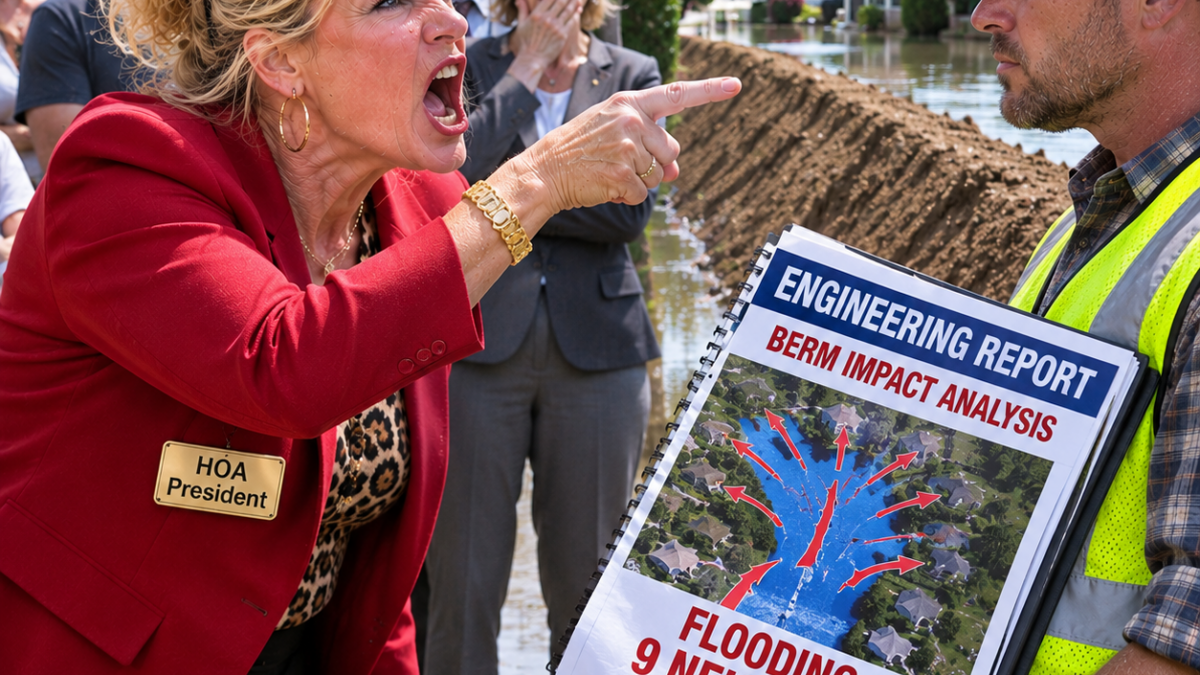
**HYDROLOGICAL AND TOPOGRAPHICAL ANALYSIS — LOTS 71, 72, AND 73, OAK RIDGE MEADOWS**
I sat at the kitchen table.
Sarah beside me.
We read.
Existing condition.
Pre-berm drainage.
Post-berm drainage.
Rainfall modeling.
Soil response.
Flow paths.
Then numbers.
The berm redirected approximately eighty-five percent of storm runoff from a drainage basin toward my property.
Peak flow across portions of Lot 72 had increased by nearly four hundred percent.
Sarah stared.
“Four hundred?”
“Almost.”
“That sounds bad.”
“It is.”
Then I reached the map.
Red properties.
One.
Two.
Three.
Four.
I kept counting.
Ten total.
Ours.
Mr. Henderson’s.
Eight more downhill.
Nine other properties besides mine.
The report described potential consequences:
Erosion.
Landscape loss.
Foundation saturation.
Basement intrusion.
Hydrostatic pressure.
Mold risk.
Long-term soil instability.
Estimated potential remediation exposure:
Hundreds of thousands of dollars.
Sarah leaned back.
“She built that thing to hide us from her gazebo.”
“Yes.”
“And it could damage ten houses.”
“Yes.”
She shook her head.
“Over a view.”
“No.”
I looked at the report.
“Over control.”
## **The Mission Changes**
Until that moment, I wanted my view back.
I wanted Sarah’s garden repaired.
I wanted Karen humbled.
Then I saw ten red lots.
That changed everything.
If I treated the report like personal ammunition, I wasn’t much better than Karen.
Nine other families now had risk they didn’t understand.
I made three copies.
Then walked to Mr. Henderson’s house.
## **The Word “We”**
He read slowly.
Glasses at the end of his nose.
When he reached the map, he removed them.
“My God.”
I nodded.
“The Millers?”
“Lot 74.”
“Garcias?”
“75.”
He looked farther down.
“Those kids play outside every afternoon.”
“I know.”
He closed the report.
“What do we do?”
We.
That word mattered.
“We tell them.”
## **Lot 74**
David Miller was thirty-eight.
Two children.
Initially skeptical.
“No offense, Major, but we’ve had one storm.”
“Fair.”
“We haven’t flooded.”
“Also fair.”
I showed him Dr. Albright’s report.
He skimmed.
Still skeptical.
So we walked into his backyard.
Near the swing set, I pointed to a small channel beginning in the soil.
He hadn’t noticed it.
“That’s new.”
I showed him the flow map.
“This is where concentrated runoff is predicted to travel.”
He looked at the swing set.
Then toward his house.
“What happens in a bigger storm?”
“That is exactly the question we don’t want answered experimentally.”
His expression changed.
“I’m in.”
## **The Garcias**
Their basement had recently been remodeled.
Family room.
Television.
Children’s play area.
Mrs. Garcia said:
“We noticed dampness.”
“When?”
“After the last rain.”
I didn’t tell them the berm caused it as a fact.
The report didn’t prove every moisture condition in every house.
I explained risk.
Potential increased saturation.
Need for inspection.
Mr. Garcia read the report twice.
Then said:
“What do you need from us?”
“Your voice.”
## **Down the Hill**
House by house.
We went.
Elderly couple with azaleas.
Young professional worried about resale.
Family with a puppy.
Retired teacher with a finished basement.
Every conversation began the same way:
“We’re not asking you to believe us.”
Then we handed them the report.
Independent engineer.
Data.
Maps.
Numbers.
The berm told its own story.
By the end of the second evening, every affected household had joined.
Ten properties.
Ten families.
One problem.
## **The Coalition**
We named ourselves the Oak Ridge Meadows Concerned Homeowners Coalition.
Not catchy.
That was intentional.
We weren’t trying to sound revolutionary.
We were trying to sound reasonable enough that a judge would never roll their eyes.
David Miller turned out to be a paralegal.
Useful.
We drafted a demand.
Every board member received it.
Not just Karen.
That was critical.
If the board had been able to say later:
“Karen never told us,”
we would have a problem.
So we told them ourselves.
## **Fifty Certified Letters**
Ten families.
Five board members.
Fifty certified envelopes.
Each contained:
Demand letter.
Executive summary of Dr. Albright’s findings.
Map of affected lots.
Photographs.
Notice of existing damage.
Our demands were straightforward.
Remove the berm.
Restore original grade under professional supervision.
Establish a neutral remediation fund for present and future damages.
Foundation inspections where necessary.
Reimbursement of professional engineering costs.
We gave ten business days.
The post office clerk looked at our pile.
“Business dispute?”
“Neighborhood landscaping.”
She stared.
“That’s a lot of mail for landscaping.”
“You have no idea.”
## **Karen Smiles**
The day the letters arrived, Mrs. Garcia called.
“You need to see this.”
“What?”
“Karen.”
“What about her?”
“She is walking down the street waving at everyone.”
I looked through my front window.
There she was.
Smiling.
Karen wasn’t calm because she had a plan.
She was calm because she couldn’t imagine a world in which ten families mattered more than her title.
That misconception would not survive much longer.
## **The Flyer**
Five days later:
**SPECIAL COMMUNITY MEETING**
Topic:
**Addressing Baseless Rumors and Preserving Community Harmony**
Sarah handed me the flyer.
“She called the engineering report a rumor.”
“She hasn’t read it.”
“How do you know?”
“Because if she had, she’d call a lawyer instead of a meeting.”
Sarah looked concerned.
“What are you going to do?”
“Let her speak.”
“That sounds dangerous.”
“For her.”
## **David Finds the Liability Issue**
We met at David Miller’s house before the meeting.
Ten households.
Arthur Jennings joined us.
Arthur was a semi-retired real estate attorney I found through a veterans legal-aid network.
Sharp eyes.
Gray hair.
No interest in theatrics.
He reviewed Dr. Albright’s report.
Then the board correspondence.
Then Karen’s fine against me.
“Conduct unbecoming?”
“Yes.”
He stared.
“That’s not a covenant.”
“I know.”
“Landscape consultant?”
“Apparently.”
“Qualifications?”
“Unknown.”
Arthur looked around.
“You have a serious claim.”
David added:
“There may be individual board exposure if they knowingly ignore a documented risk.”
Arthur nodded.
“Potentially.”
I appreciated the qualification.
Nobody responsible says “definitely” before reading everything.
He continued.
“The board’s insurer may also reserve rights if the HOA knowingly continues an unsafe condition after notice.”
Mr. Henderson asked:
“Meaning?”
“Meaning once every board member receives this report, doing nothing becomes harder to excuse.”
That was exactly why we’d sent fifty letters.
## **The Plan**
Karen would control the microphone.
Fine.
She’d control the agenda.
Fine.
She’d insult us.
Probably.
We wouldn’t interrupt.
We wouldn’t shout.
We wouldn’t call her corrupt.
We would hand the neighborhood the report.
Then ask one question:
**Show us your engineering.**
If Karen had professional evidence supporting the berm, she could produce it.
If she didn’t—
the room would understand.
## **The Clubhouse**
Packed.
Karen’s supporters.
Our coalition.
Curious homeowners.
Board members.
Arthur in the front row with a leather briefcase.
Karen saw him.
Her eyes lingered.
Good.
She started.
“Thank you for attending.”
Then ten minutes about community standards.
Harmony.
Misinformation.
Disgruntled homeowners.
Private agendas.
The berm itself was barely mentioned.
Finally:
“Major Davis apparently wishes to address us.”
She pointed toward the microphone.
I stayed in my seat.
“Thank you.”
She frowned.
I stood.
“We’re not here to discuss rumors.”
David and Mr. Henderson began distributing report summaries.
“We’re here to discuss measurements.”
Pages moved through the room.
Conversations stopped.
I continued.
“A state-licensed civil engineer and hydrologist evaluated the berm.”
Karen interrupted.
“Your hired expert.”
“Yes.”
I nodded.
“That’s why her methodology and data are included.”
A few people smiled.
I continued.
“She concluded the berm redirects approximately eighty-five percent of runoff from a drainage basin toward Lot 72.”
People looked at Karen.
“Peak flow increased almost four hundred percent.”
More murmurs.
“And the modeled downstream effect involves ten properties.”
Then:
“Nine of them belong to people other than me.”
That landed.
## **Karen Calls It Fearmongering**
“This is fearmongering!”
Karen shouted from the lectern.
I looked toward her.
“Then show us your report.”
She froze.
“The report from your landscape consultant.”
“This isn’t the forum.”
“It is exactly the forum.”
“The board is not required to disclose proprietary consultant materials.”
Arthur Jennings shifted in his chair.
I continued.
“Then provide the engineer’s name.”
Silence.
“License number.”
Silence.
“Drainage calculations.”
Nothing.
“Stormwater analysis.”
Karen’s face reddened.
“This project was approved.”
“By whom?”
“The Architectural Review Committee.”
“You chair it.”
“Yes.”
“Who is the consultant?”
“That is confidential.”
Someone in the audience said:
“Why?”
Another:
“Who is it?”
Karen banged the gavel.
## **The Nephew**
We didn’t discover the full truth until later, but Karen had described her nephew—who operated a lawn-mowing business out of a pickup truck—as the project’s landscape consultant.
No hydrology license.
No civil-engineering credential.
No drainage analysis.
Just a relative who agreed dirt looked attractive where Karen wanted it.
At the meeting, however, we only knew she refused to identify him.
That was enough.
## **The Insurance Question**
I looked at the board.
Not Karen.
The other four.
“This report puts every one of you on notice.”
They shifted.
“One major storm has already caused damage.”
I held up photographs of Sarah’s flooded roses.
Mr. Henderson’s lawn.
“The next storm could do more.”
Then I said:
“If the association knowingly leaves the berm in place after receiving this report, we will pursue every lawful remedy available.”
Karen scoffed.
“Threats.”
“No.”
Arthur stood.
For the first time.
Said nothing.
Opened his briefcase.
Placed papers on the table.
Then sat down.
That was somehow more effective than any speech.
I continued.
“Any lawsuit will examine the association’s insurance coverage.”
The treasurer, Frank, looked sharply toward Karen.
“And whether board members fulfilled their fiduciary obligations after receiving documented evidence of risk.”
Karen’s four allies suddenly looked much less loyal.
## **The Room Turns**
Questions came fast.
“Did we pay for the berm?”
“How much?”
“Why wasn’t an engineer hired?”
“Why didn’t homeowners vote?”
“Who is the consultant?”
“Does insurance cover this?”
“Can our foundations be damaged?”
“Will dues increase?”
Karen kept hitting the gavel.
Nobody stopped.
Her entire strategy had depended on making the dispute:
**Karen versus the angry Major next door.**
That story was gone.
Now it was:
**Karen versus hydrology.**
She couldn’t fine water.
## **Frank Breaks First**
The treasurer rose.
“Everyone, please.”
People quieted slightly.
He looked shaken.
“Clearly, we have information the board needs to review.”
Karen spun toward him.
“We already reviewed this!”
Frank ignored her.
“The board will convene an emergency executive session.”
“You cannot adjourn my meeting.”
His face changed.
“Karen.”
First name.
Not “Madam President.”
“The board is adjourning.”
Three other board members stood.
Karen remained at the lectern.
Alone.
That image said everything.
## **Forty-Eight Hours**
Frank called me the next morning.
“Major Davis.”
“Frank.”
“We reviewed the report.”
“And?”
He exhaled.
“We weren’t told any of this.”
“You received my first objection.”
“Karen described it as a view dispute.”
“I cited drainage.”
“I know.”
“Did you read it?”
Silence.
“No.”
At least he was honest.
He continued.
“She told us the consultant handled the technical issues.”
“Did anyone verify that?”
“No.”
Another honest answer.
“What does the board intend to do?”
“What will it take to resolve this?”
“My letter already says.”
“I know.”
“Then nothing has changed.”
Pause.
Then:
“The board voted last night.”
“How?”
“Four to zero.”
“And Karen?”
“Abstained.”
“For what?”
“To accept your demands.”
I sat quietly.
Frank continued.
“And we removed Karen Vance as president.”
## **The Berm Comes Down**
Professional crew.
Real engineers.
Permits where required.
Excavator.
Survey marks.
Dr. Albright supervising.
The same type of dump trucks that had brought clay returned empty.
Neighbors gathered.
Lawn chairs appeared.
Coffee.
Someone brought doughnuts.
I found it a little too celebratory.
Sarah didn’t.
“They watched that thing go up.”
“So?”
“They deserve to watch it leave.”
The excavator removed the clay layer by layer.
No reckless digging.
Grade checks.
Elevation readings.
Original swale restored.
As the berm shrank, the valley slowly reappeared.
First the tops of trees.
Then the ridge.
Then Blue Creek.
Then the full horizon.
Sarah stood beside me.
Her eyes filled.
“I forgot how wide it looked.”
I took her hand.
“So did I.”
The final bucket lifted.
The berm was gone.
People cheered.
I didn’t.
I just breathed.
## **The Roses**
Sarah’s garden needed rehabilitation.
Several plants survived.
Two didn’t.
The rose propagated from her grandmother looked terrible for weeks.
Sarah refused to remove it.
“I’ve moved that thing across five states.”
“I know.”
“It survived Texas.”
“That alone proves toughness.”
She smiled weakly.
Dr. Albright recommended drainage improvement and soil restoration.
The HOA paid.
New topsoil.
Aeration.
Mulch.
Professional horticultural consultation.
By the following spring, the old rose produced three new blooms.
Sarah took a photograph.
Sent it to me while I was at the hardware store.
No message.
Didn’t need one.
## **The Remediation Fund**
The board placed $50,000 into third-party escrow.
Affected properties received inspections.
The Garcias’ basement required moisture mitigation but had avoided major structural damage.
David Miller’s yard needed erosion repair.
Mr. Henderson’s lawn was regraded and reseeded.
Several downstream swales were restored.
Some homeowners needed almost nothing.
That was good.
The point wasn’t to spend the fund.
The point was to ensure people wouldn’t pay privately for Karen’s decision.
## **Dr. Albright’s Final Inspection**
Months later she returned after another significant storm.
We walked the original drainage path.
No major pooling.
No concentrated lateral flow.
No new erosion channel toward Lot 73.
She looked at me.
“Happy?”
“Professionally.”
“That sounds miserable.”
“I mean yes.”
She laughed.
Then pointed toward Sarah’s garden.
“Your wife is going to need to stop overwatering those roses.”
“I’ll tell her you said that.”
“No.”
“Why?”
“I’ve met your wife.”
Smart woman.
## **Karen’s House Goes Up for Sale**
One week after the berm disappeared, a sign appeared on Karen’s front lawn.
Cash-offer company.
Quick sale.
Rumors spread.
I ignored them.
Sarah didn’t.
“She really is leaving.”
“Looks like it.”
“Do you feel bad?”
I considered.
“For the house?”
“For her.”
I looked across the property line.
Karen had made herself hated.
That doesn’t happen in one afternoon.
The berm exposed her.
It didn’t create her.
“A little.”
Sarah seemed surprised.
“She flooded our yard.”
“I know.”
“Destroyed my roses.”
“I know.”
“Blocked our view on purpose.”
“I know.”
“Fined you for warning her.”
“I know.”
“So why feel bad?”
“Because nobody wakes up as a child planning to become the person every neighbor is relieved to see leave.”
Sarah looked toward Karen’s house.
“That doesn’t excuse her.”
“No.”
“Good.”
## **Our Last Look**
I saw Karen once during the move.
Gray sweatsuit.
No floral dress.
No clipboard.
Movers carrying boxes.
She looked toward our window.
Our eyes met.
Months earlier, I had imagined that moment.
I thought I would smile.
Maybe wave.
Maybe say something clever.
I did nothing.
Neither did she.
Then she looked away.
That was enough.
## **Frank’s New Board**
Frank became interim president.
He was embarrassed by that.
“I don’t want Karen’s chair.”
“Then don’t behave like Karen.”
“Helpful.”
He changed meeting procedure.
Engineering or drainage projects now required professional review.
Board packets went to members before votes.
Major common-area projects required disclosure.
Conflict-of-interest forms became mandatory.
Homeowners could appeal decisions to a panel separate from the Architectural Review Committee.
The landscape consultant disappeared.
So did the conduct-unbecoming fine.
## **What Happened to the Gazebo**
Karen’s gazebo never got built.
The new homeowners who bought her house considered one.
They came over first.
That almost made me laugh.
“Mr. Davis?”
“Just Davis.”
“We’re thinking about putting in a pergola.”
“Okay.”
“We wanted to make sure it wouldn’t bother you.”
I looked toward the restored view.
“How tall?”
They showed me plans.
Reasonable.
Inside setbacks.
No drainage impact.
“Build it.”
They looked surprised.
“You don’t mind?”
“I never cared whether I could see part of your yard.”
That was true.
The whole war had started because Karen couldn’t tolerate the possibility that I could see hers.
## **Mr. Henderson**
The old man became one of my closest friends.
Before the berm, we waved.
Afterward, we had coffee.
He admitted his wife had died four years earlier.
The lawn was something they had maintained together.
“That muddy channel bothered me more than it should have.”
“No.”
“It was grass.”
“No.”
He looked at me.
“You get it.”
“Sarah’s roses.”
He nodded.
We didn’t need to explain further.
Property isn’t always valuable because of square footage.
Sometimes it’s valuable because memory lives there.
## **The Garcias**
Their basement stayed dry after restoration.
Mrs. Garcia invited us over.
Sarah admired the family room.
I inspected nothing.
Mr. Garcia noticed.
“You aren’t checking the walls?”
“I am retired.”
“Seriously?”
“No.”
We laughed.
Then he said:
“You know, before all this, I never attended an HOA meeting.”
“Most people don’t.”
“Now I go every month.”
“I’m sorry.”
He laughed.
“That bad?”
“Democracy is exhausting.”
## **David Miller**
The paralegal ended up joining the board.
Not because he wanted power.
Because he understood procedures.
He was careful.
At his first meeting, he said:
“If somebody hears me say ‘because I’m on the board,’ remove me immediately.”
Good rule.
## **The Nine Other Houses**
That was the part Karen never anticipated.
She thought the berm was between two homes.
Hers and mine.
A private fight.
But water connected ten.
One upstream decision reached nine neighbors.
That’s why Dr. Albright’s report mattered so much.
It turned an argument over scenery into a network of shared risk.
Karen could dismiss one homeowner.
Ten was harder.
Physics built the coalition before I did.
## **The View**
People asked whether the view was legally protected.
Not exactly.
That wasn’t what ultimately won the fight.
The view mattered emotionally.
Property value mattered.
But the decisive issue was drainage.
Had Karen installed a lawful privacy screen entirely on her property without affecting drainage or violating covenants, our options might have been limited.
That truth actually made the ending more satisfying.
I didn’t win because I was entitled to see forever.
I won because Karen ignored a real safety problem while pretending the dispute was merely aesthetic.
## **Why I Hired an Engineer**
I already had experience.
I could read plans.
I could model basic runoff.
But I was personally involved.
That matters.
People trust evidence more when the person presenting it isn’t also the person emotionally injured.
Dr. Albright didn’t care about my view.
She didn’t care about Karen’s gazebo.
She measured.
Calculated.
Modeled.
Reported.
That made her devastating.
Professional neutrality is underrated.
## **Karen’s $200 Fine**
I kept it.
Conduct unbecoming of a resident.
Years later, Frank found me at a barbecue.
“You still have that?”
“Yes.”
“Why?”
“Historical artifact.”
“You know we rescinded it.”
“I know.”
“You going to frame it?”
“I considered it.”
“Petty.”
“Extremely.”
I never framed it.
Sarah threatened to.
## **The Coalition Dissolves**
After repairs, the Oak Ridge Meadows Concerned Homeowners Coalition had no reason to continue.
Good.
Movements shouldn’t always become institutions.
We held one final meeting.
Mr. Henderson brought pie.
David brought beer.
Dr. Albright came for twenty minutes and stayed two hours.
We voted unanimously to disband.
Then someone asked:
“What if another Karen appears?”
I said:
“Then talk to your neighbors sooner.”
That was the real safeguard.
Not an organization.
Connection.
## **The First Storm After Removal**
We all watched the forecast.
Nobody admitted it.
Then a summer thunderstorm came.
Heavy.
Maybe an inch and a half in forty minutes.
I stood under the porch roof.
Sarah beside me.
Water entered the restored swale.
Moved downhill.
No wall.
No lake.
No lateral surge.
Mr. Henderson came outside in a raincoat.
Gave me a thumbs-up.
Lot 74 remained normal.
Lot 75.
Normal.
I laughed.
Sarah looked at me.
“What?”
“Nothing.”
“You’re standing in a thunderstorm smiling at drainage.”
“Occupational damage.”
## **The View Becomes Ours Again**
After the rain, fog settled in Blue Creek Valley.
The sky cleared.
Sunlight hit the wet trees.
Sarah and I sat with coffee.
No berm.
No Karen.
No engineer.
No certified letters.
She said:
“This is what I wanted.”
“The view?”
“The quiet.”
I looked at her.
She continued.
“I thought the view was the thing I loved.”
“What was it?”
“Being able to sit here without fighting anybody.”
I understood.
A view can calm you.
But only if you don’t have to defend it every morning.
## **My Medical Retirement**
I rarely talked about why I left the Army.
The details weren’t dramatic enough for television.
Wear.
Injuries.
Years.
A body keeping score.
But retirement had been harder than I expected.
In uniform, problems came with structure.
Objectives.
Teams.
Rules of engagement.
Civilian conflict felt messier.
Karen pushed an old button in me.
Threat.
Mission.
Response.
For a while, I enjoyed the clarity too much.
Sarah saw that.
## **Sarah Calls Me Out**
Months after Karen left, Sarah said:
“You know you scared me.”
“When?”
“During the berm fight.”
“Because of flooding?”
“No.”
I waited.
“Because you liked having an enemy.”
That hurt.
“That’s not fair.”
She looked at me.
I knew immediately it was partly fair.
“You had maps everywhere.”
“I was working.”
“You called it a mission.”
“Habit.”
“You stopped sleeping.”
I said nothing.
She softened.
“I know you were protecting us.”
“I was.”
“But I don’t want you to need battles to feel useful.”
That sentence stayed.
I took her hand.
“I don’t.”
“Good.”
She looked toward the valley.
“Because I have enough projects for you.”
That was Sarah.
Mercy followed immediately by a honey-do list.
## **The New Garden Wall**
The replacement homeowners next door wanted a small raised bed.
They hired a real landscape designer.
Then had drainage checked.
They came over with the plans.
“Will this cause any issue?”
I reviewed casually.
“No.”
“We were told you’re the water guy.”
I groaned.
Sarah laughed.
The neighborhood had renamed me.
Major Drainage.
I preferred Davis.
## **Dr. Albright’s Joke**
At the community barbecue, someone asked Dr. Albright:
“What was the technical cause of the flooding?”
She answered:
“Three feet of compacted arrogance.”
Everyone laughed.
Even I did.
Then she gave the real explanation.
That’s why engineers should be invited to parties more often.
Rarely.
But sometimes.
## **The Financial Cost**
The HOA spent heavily.
Berm removal.
Professional engineering.
Legal review.
Landscape restoration.
Inspections.
Escrow.
Insurance deductibles.
Administrative expenses.
It hurt the reserve fund.
But did not destroy the association.
That mattered.
We could have demanded more.
Arthur Jennings advised against turning accountability into punishment for uninvolved homeowners.
I agreed.
Karen had made the decision.
The residents shouldn’t lose their savings because we wanted maximum revenge.
## **Arthur’s Advice**
He told me:
“People confuse leverage with entitlement.”
“What does that mean?”
“Just because you can demand something doesn’t mean you should.”
I remembered that.
Especially when several neighbors urged us to sue Karen personally for enormous damages.
Could we have explored more?
Yes.
Would it have repaired the creek faster?
No.
Our priority remained restoration.
## **The Word Revenge**
If you’re expecting me to say I didn’t enjoy any of it, I’d be lying.
Watching the berm come down felt good.
Watching Karen lose her presidency felt good.
Seeing the $200 fine rescinded felt very good.
I’m human.
But revenge wasn’t what made the ending satisfying.
Revenge would’ve been building a taller wall on Karen’s side.
Redirecting runoff toward her gazebo.
Dragging litigation out until she couldn’t afford her house.
Humiliating her publicly for sport.
We didn’t do that.
We forced correction.
Then stopped.
That’s harder than revenge.
## **What Karen Did to Herself**
She had exits.
Many.
When I objected the first time:
Pause construction.
She didn’t.
When I cited the drainage covenant:
Hire an engineer.
She didn’t.
When I sent the cease-and-desist:
Review the grade.
She didn’t.
When the first storm flooded us:
Remove the berm.
She didn’t.
When Dr. Albright arrived:
Ask for the report.
She didn’t.
When ten families sent certified letters:
Negotiate.
She didn’t.
Instead she called a public meeting to shame us.
That was the last mistake.
She put everyone in one room.
All we had to do was show them the same facts.
## **Frank’s Regret**
A year later, Frank apologized again.
“You know what bothers me?”
“What?”
“I trusted her because she sounded certain.”
“That happens.”
“She said your complaint was personal.”
“It was partly personal.”
He looked confused.
“I wanted my view.”
“So?”
“But drainage wasn’t.”
He nodded.
“I should’ve read the letter.”
“Yes.”
He smiled.
“You don’t let people off easy.”
“Easy doesn’t teach much.”
He extended his hand.
I shook it.
People can fail without being permanently defined by failure.
Frank changed.
That mattered.
## **The Next Big HOA Project**
Two years later, Oak Ridge Meadows wanted to improve the playground.
Drainage involved.
The board hired an engineer before buying anything.
They held an open meeting.
Presented plans.
Residents asked questions.
One person complained about cost.
Another about tree removal.
Another wanted different equipment.
Messy.
Slow.
Healthy.
At the end, the project worked.
Nobody flooded.
Karen would’ve hated how long democracy took.
## **Mr. Henderson’s Lawn**
His fescue recovered.
He reseeded.
Worked obsessively.
Within a year, the scar was nearly invisible.
One afternoon I saw him trimming edges.
“Looks perfect.”
He shook his head.
“Not perfect.”
“Where?”
He pointed at a section nobody else could distinguish.
“Different cultivar.”
I laughed.
“You’re insane.”
“Retirement.”
Fair.
## **The Garcias Sell**
Three years later, the Garcias moved for work.
Their house sold quickly.
No drainage disclosure nightmare.
No wet basement.
No buyer backing out because of unresolved runoff.
Mrs. Garcia hugged Sarah.
Then me.
“Thank you.”
“For what?”
“Our house stayed a home.”
That was better than any courtroom victory.
## **The Nine Families Stay Connected**
Even after the coalition dissolved, the nine families affected by runoff stayed closer.
Barbecues.
Group texts.
Storm warnings.
Someone’s dog got loose.
Someone needed help moving furniture.
Mr. Henderson needed a ride to an appointment.
The berm had been built to divide.
It accidentally connected us.
That’s irony worth appreciating.
## **Sarah Replants**
She added two new roses where the dead ones had been.
Not replacements.
She was explicit.
“You don’t replace a plant from Nana.”
“What are these?”
“New chapter.”
One was deep red.
One white.
The old surviving rose sat between them.
Every spring they bloomed.
## **The Protected Greenbelt**
The valley remained protected.
No development.
No walls.
At sunset, the view looked almost exactly as it had when we bought the lot.
Except I saw it differently.
Before Karen, I thought the view was something we had purchased.
After Karen, I understood it was something we were temporarily responsible for enjoying without assuming ownership of everything we could see.
That distinction mattered.
## **The Thing I Would Do Differently**
I would’ve talked to the downhill neighbors before the storm.
That’s my biggest regret.
I knew the berm posed risk.
I warned Karen.
But I didn’t warn everyone else immediately.
Why?
Because I still thought of it as my dispute.
My view.
My lot.
My letter.
Then the water moved.
Water doesn’t respect the emotional boundaries we draw around problems.
If something upstream can hurt someone downstream, they deserve to know before the rain comes.
## **Dr. Albright Agrees**
I told her that once.
She nodded.
“Engineering lesson.”
“Meaning?”
“Failures rarely remain local.”
She pointed toward the valley.
“Same with leadership.”
Fair.
## **The Old Flyer**
Sarah found Karen’s special-meeting flyer years later.
**ADDRESSING BASELESS RUMORS AND ENSURING COMMUNITY HARMONY**
She brought it outside.
“Keep?”
“No.”
“Evidence?”
“No case.”
“Historical artifact?”
“Trash.”
She smiled.
“Growth.”
We recycled it.
## **Karen’s Nephew**
Her landscape consultant disappeared from HOA work after the board change.
I never pursued him.
He wasn’t qualified for the role Karen gave him.
That was the issue.
Not whether he could mow lawns.
People should do work they’re competent to do.
Karen blurred family trust with professional qualification.
The berm was the cost of that confusion.
## **No One Calls It a Beautification Berm Anymore**
After the incident, “beautification berm” became neighborhood sarcasm.
When somebody planted too many shrubs:
“Careful. Beautification project.”
When Frank bought a new grill:
“Does hydrology approve?”
When Sarah built a small compost pile:
“Have you modeled the downstream impact?”
I deserved some of it.
## **The $50,000 Fund**
Not all of the remediation escrow was spent.
After final inspections and repairs, unused funds returned to the HOA.
That felt right.
We hadn’t demanded a payout.
We demanded protection.
Arthur Jennings called that the strongest part of our position.
“You were asking them to fix risk, not buy your silence.”
Exactly.
## **The View and Property Value**
An appraiser later confirmed the restored open sightline helped preserve our home’s market appeal.
Nice.
But by then I cared less.
We weren’t planning to sell.
Sarah said:
“I don’t care if the house is worth five dollars.”
“That’s financially irresponsible.”
“I care about the porch.”
“Better.”
## **A Different Kind of Victory**
When I was younger, victory had clearer shapes.
Objective achieved.
Bridge open.
Road secured.
Mission completed.
This was different.
The final victory was not a dramatic event.
It was cumulative.
One dry basement.
One repaired lawn.
One surviving rose.
One storm that passed without flooding.
One board meeting where residents argued without fear.
One neighbor asking before changing drainage.
One quiet evening.
That’s civilian victory.
Subtle.
Better, maybe.
## **The Last Board Meeting I Attended Regularly**
Frank thanked me publicly.
I told him:
“Stop.”
“Why?”
“You keep making me sound like I saved the neighborhood.”
“You did.”
“No.”
I pointed around.
“Ten families stood together.”
Then toward the board.
“Four members decided to correct the problem.”
Then:
“Dr. Albright gave us the science.”
“Arthur gave us legal guidance.”
“Sarah kept me from becoming unbearable.”
Sarah shouted from the back:
“Failed at that last one.”
The room laughed.
I stopped attending every meeting after that.
Healthy systems shouldn’t depend on the same angry retired Major forever.
## **The New President**
A teacher named Rachel became president after Frank.
First thing she told residents:
“If I ever say ‘because I’m president,’ someone please throw a copy of the bylaws at me.”
I liked her.
## **Karen’s Legacy**
People sometimes say Karen destroyed herself over a gazebo.
That’s too simple.
The gazebo was the excuse.
Her actual downfall came from believing expertise was optional when authority was available.
That attitude appears everywhere.
HOAs.
Companies.
Government.
Families.
Someone with power decides knowledge is inconvenient.
Then reality arrives.
In our case, reality arrived as two inches of rain in an hour.
## **Water Doesn’t Negotiate**
That’s the engineering lesson I carried through my career.
Water does not respect a meeting vote.
It doesn’t care about committee approval.
It doesn’t care whether Karen’s nephew thinks the berm looks nice.
Give water a blocked path and it finds another.
The same is true of truth.
Block one path.
Dismiss one letter.
Fine one homeowner.
Eventually it finds another route.
Mr. Henderson.
The Millers.
Garcias.
Dr. Albright.
Arthur.
The board.
Nine neighbors.
Then the whole community.
## **The Real Revenge**
If you want the satisfying revenge version, here it is.
Karen built the berm to block my view.
The berm was removed.
My view returned.
She wanted her gazebo hidden.
The gazebo was never built.
She fined me $200 for warning her.
The fine was rescinded.
She claimed her consultant proved the project safe.
A real engineer proved the opposite.
She tried to isolate me.
Her project united ten families.
She called us rumor spreaders.
Her own public meeting gave us an audience.
She expected four board members to protect her.
They voted her out.
She wanted to dictate what I could see from my porch.
She ended up putting her own house on the market and leaving the neighborhood entirely.
Yes.
There’s satisfaction in that.
But here’s the better part.
No one downstream lost a foundation.
No child had a flooded playroom.
The Garcias kept their basement.
Mr. Henderson kept his lawn.
Sarah saved most of her roses.
The HOA survived.
The board improved.
And the land returned to the drainage pattern it was designed to follow.
That’s a better revenge than destruction.
## **The Morning After a Storm**
Several years later, a storm passed overnight.
I woke late.
That alone told me something.
I hadn’t listened for water.
Hadn’t checked radar every hour.
Hadn’t gone outside with a flashlight.
I made coffee.
Sarah was already on the porch.
“Rain.”
“I noticed.”
She pointed.
The valley was covered in mist.
Water moved through the swale below.
No pooling.
No muddy lake.
No lateral river.
I sat beside her.
For a long time, neither of us spoke.
Then Sarah said:
“Worth fighting for?”
I looked at the valley.
Her roses.
Mr. Henderson’s green lawn.
The houses below.
Then her.
“Yes.”
She smiled.
“But?”
I knew she expected one.
“But I wish we’d never had to.”
## **What I Eventually Understood**
Karen thought the view was a privilege.
Maybe legally, in the narrowest sense, she had a point that nobody is always guaranteed an eternal view unless specific protections exist.
But that wasn’t the issue she lost on.
She lost because she treated land like a stage set.
Move dirt here.
Raise ground there.
Hide one neighbor.
Protect one gazebo.
No thought for what connects everything.
Water connects land.
Contracts connect homeowners.
Decisions connect consequences.
People connect communities.
Karen understood control.
She never understood systems.
I did.
Dr. Albright did.
Eventually, the neighborhood did too.
## **The Last Rose**
Years after the berm came down, the rose Sarah thought we’d lost suddenly produced one perfect bloom.
The old plant from her grandmother.
We had nearly removed it twice.
She refused.
That morning she called me outside.
“Look.”
Deep pink flower.
A little crooked.
Alive.
Sarah touched one petal.
“I told you.”
“You tell me many things.”
“I told you she’d come back.”
I looked toward the valley.
Then toward the restored drainage line.
Maybe that flower meant more to me than it should have.
Or exactly as much as it should have.
## **The Ending Karen Never Expected**
Karen Vance thought she was building three feet of dirt.
That’s all.
A small wall.
A little privacy.
A landscaping decision.
Something she could approve with a committee vote and defend with a letter.
She believed the berm would separate her property from mine.
Instead, it connected ten households in a way none of us expected.
The first truckload blocked part of my view.
The first storm exposed the drainage problem.
The water crossed my yard.
Then Mr. Henderson’s.
Then began moving toward the homes below.
That path became a map.
The map became an engineering investigation.
The investigation became an eight-page report.
The report became fifty certified letters.
The letters became a coalition.
The coalition became a public meeting.
And the meeting became the end of Karen’s presidency.
She thought her power came from being able to say yes or no to landscaping.
She discovered that real power belongs to reality.
Gravity.
Topography.
Water.
Documents.
Professional evidence.
And people who finally decide to stop being intimidated.
I never bulldozed Karen’s yard.
Never sent water back toward her house.
Never sabotaged her gazebo.
Never screamed at her in the clubhouse.
Never tried to destroy the HOA.
I did something much worse for a bully.
I made her explain herself in front of people who now had enough information to recognize the lies.
That was all it took.
Today, from my porch, Blue Creek Valley is wide open again.
The fog still rises in the morning.
Hawks still circle above the ridge.
Sarah’s roses bloom beside the stone path.
Mr. Henderson still obsesses over his lawn.
The Millers’ children are older.
The Garcias moved on without losing their home to a drainage dispute.
Oak Ridge Meadows still has an HOA.
It just has an HOA that understands one important fact:
A board can vote on landscaping.
It cannot vote away physics.
Karen wanted a berm because she didn’t want to look at my backyard.
Instead, that berm forced nine other families to look directly at what she had been doing.
And once they did, the wall she built to strengthen her control became the very thing that washed it away.
The berm is gone.
The view is back.
The water flows where it should.
And sometimes, when a hard summer rain starts tapping against the roof, I sit on that porch with Sarah instead of checking maps.
Because I already know where the water is going.
Downhill.
Through the restored swale.
Past the homes it once threatened.
Toward Blue Creek.
Exactly where it belonged before Karen decided she knew better.
She built a wall to take something peaceful away from me.
In the end, all she really managed to do was remind ten families how powerful they became when they stopped standing on opposite sides of it.
**Karen thought she could block my view with three feet of dirt.**
**She never imagined that the first hard rain would give the entire neighborhood a clearer view of her than they’d ever had before.**








