PART 2: HOA Karen Built 12 Luxury Garages on My Land—Then County Excavators Flattened Them Before Her Buyers Arrived
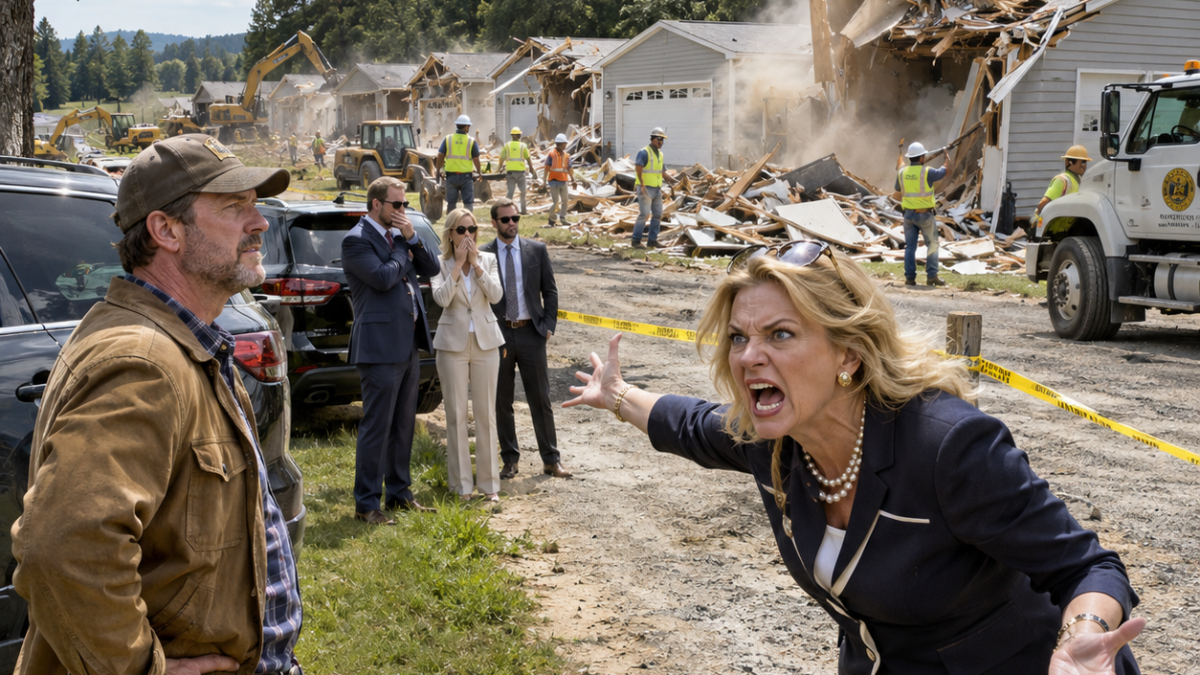
PART 2
Six weeks earlier, I had turned onto the gravel road beside Silver Bluff Estates and known something was wrong before I understood why.
I’m forty-seven years old.
I own a metal fabrication shop on the edge of town.
For more than half my life, I have read blueprints, estimated jobs, inspected steelwork, argued with suppliers, supervised crews, and listened to machinery.
Heavy equipment has a rhythm.
Excavators.
Loaders.
Flatbeds.
You learn what each one sounds like when you work around them long enough.
That Monday morning, the sounds coming from my property did not belong there.
I slowed my pickup.
Three flatbed trucks sat near the tree line carrying stacks of steel framing.
An excavator was grading the field.
Workers were pounding stakes into the ground.
At first, I thought somebody had made a wrong turn.
Then I saw the stakes.
Fresh wooden stakes formed a line running almost ninety feet inside my boundary.
The old survey markers were still there.
Some of them, anyway.
The new line simply ignored them.
It was as if someone had looked at the edge of my property, decided they wanted more room, and moved the world to match their drawing.
I parked.
Then I saw the sign.
Glossy black background.
Silver lettering.
Professional rendering.
**SILVER BLUFF PRIVATE GARAGE COLLECTION**
**12 EXCLUSIVE UNITS**
I stared at it.
“Twelve what?”
I walked toward the excavator.
Raised my hand.
The operator looked at me.
I signaled for him to shut down.
He hesitated.
Then the engine dropped into silence.
A broad-shouldered man came over carrying rolled construction plans.
“Can I help you?”
“I hope so.”
He offered his hand.
“Gus Hennegan. Site foreman.”
“Alden Beckwith.”
Something changed in his expression.
He knew the name.
I noticed.
“This my property you’re standing on, Gus?”
He glanced toward the plans.
“We’re working for Silver Bluff.”
“That wasn’t my question.”
He studied me for a second.
Then unrolled the plans across the hood of a work truck.
I leaned over them.
The drawing was clean.
Professional.
Survey-style lines.
Building footprints.
Utilities.
Parking.
Access.
And my 3.4 acres?
Gone.
Not literally.
Worse.
They were still there geographically, but the entire parcel had been shaded the same pale green used for Silver Bluff’s common areas.
A label read:
**COMMUNITY STORAGE EXPANSION**
I pointed.
“Where did you get this?”
“HOA.”
“Did you verify ownership?”
“They provided documentation.”
“What documentation?”
Gus hesitated.
“Development maps.”
“That’s not a deed.”
He looked uncomfortable.
“I’m the contractor, Mr. Beckwith.”
“I understand.”
I pointed toward the field.
“Every machine out there is on my land.”
He rubbed his jaw.
“The contract was signed by Roxanne Belridge.”
As if someone had called her name over a loudspeaker, a white SUV came rolling through the dust.
I knew Roxanne.
Everybody around Silver Bluff knew Roxanne.
Fifty-four.
Tailored clothes.
Careful hair.
Always walking with the expression of a person late to a meeting everyone else should have started without her.
She had been HOA president for years.
I had dealt with her twice.
Neither interaction had been pleasant.
My acreage bordered Silver Bluff, but it was not part of Silver Bluff.
Never had been.
No HOA dues.
No covenants.
No board authority.
I had bought the parcel years earlier because it gave me access to the back side of my shop property and because I liked having a strip of open ground between my business and the subdivision.
Roxanne stepped out.
Two private security guards followed.
She looked at me.
Not surprised.
That bothered me immediately.
“Alden.”
“Roxanne.”
“You’re interfering with an active construction site.”
I almost laughed.
“An active construction site on my land.”
“This acreage has always been designated for future community amenities.”
“Designated by who?”
“The development plan.”
I walked to my pickup.
Pulled out a copy of my deed I kept with other property paperwork.
Handed it to her.
She glanced at the first page for maybe one second.
Then handed it back.
“Your paperwork doesn’t override our community development plan.”
For a moment, I honestly wondered whether I had heard correctly.
“My paperwork?”
“Yes.”
“This is a recorded deed.”
“And our plan predates your obstruction.”
I looked at her.
“Your plan doesn’t make you the owner.”
She turned away.
“Gus, continue.”
He looked from her to me.
“Roxanne—”
“Continue pouring the pads.”
The excavator started again.
That sound made something in me go cold.
I could have shouted.
Could have stepped in front of the equipment.
Could have tried physically stopping the crew.
I didn’t.
People make mistakes when anger convinces them action matters more than evidence.
I went back to my truck.
Took out my phone.
Started photographing.
Machines.
Stakes.
Sign.
Plans.
Workers.
Old survey markers.
New line.
Every angle.
Every position.
Roxanne watched me.
“You’re wasting your time.”
I kept taking pictures.
“Maybe.”
“You’re going to be responsible for delays.”
Click.
“Good to know.”
“We will pursue damages.”
Click.
“For building on my land?”
“You are obstructing a lawful project.”
Click.
She finally walked away.
Before leaving, I stopped at the sales sign again.
That was when I noticed the small print.
**ALL 12 UNITS RESERVED**
I looked at the empty field.
There were no garages yet.
Not one wall.
Not one roof.
Concrete forms had barely started.
And Roxanne had already sold all twelve.
That changed the situation.
This was no longer only about a boundary dispute.
Somebody had taken money.
That night, I sat at my kitchen table enlarging the photographs.
The contractor’s plan had an approval stamp.
It looked like a county seal.
Maybe genuine.
Maybe not.
Below it was a signature.
**Roxanne Belridge**
I printed the image.
Next morning, I went to the county land records office.
“I need the complete history on my parcel.”
The clerk recognized the address.
“How far back?”
“All the way.”
She raised an eyebrow.
“That kind of morning?”
“You could say that.”
Transfers.
Easements.
Recorded plats.
Dedications.
Boundary adjustments.
I wanted everything.
The stack grew.
I read every page.
There was no transfer to Silver Bluff.
No lease.
No easement giving them garage rights.
No dedication.
No document signed by me.
Nothing.
Then the clerk pulled an older file.
Inside was a conceptual developer drawing from years before I purchased the acreage.
My future parcel appeared in dotted lines.
Beside it:
**FUTURE COMMUNITY EXPANSION**
There it was.
The seed of Roxanne’s fantasy.
But a conceptual plan is not a deed.
Developers sketch possibilities every day.
Roads that never get built.
Phases that never happen.
Amenities nobody finances.
Land somebody hopes to buy later.
The dotted lines meant someone once imagined expansion.
They did not mean anyone acquired title.
Roxanne had taken a developer’s old wish and presented it like ownership.
I sent her a formal demand.
Stop construction.
Remove everything installed.
Restore the property.
Two days later, her response arrived.
HOA letterhead.
Three pages.
She refused.
Then threatened me.
If I continued “obstructing community development,” Silver Bluff would seek damages against me for construction delays.
I sat at my desk reading that paragraph twice.
Then I laughed.
Not because it was funny.
Because the alternative was breaking something.
She was threatening to make me pay for slowing down construction on land she was taking from me.
That week, she called a special HOA meeting.
I heard about it from a Silver Bluff resident who bought steel shelving from my shop.
“She’s telling everyone you’re trying to kill the garage project.”
“I’m trying to stop garages on my property.”
“That’s not how she’s describing it.”
“How is she describing it?”
He looked uncomfortable.
“She says you’re holding the community hostage.”
So I went.
Carried a folder.
My deed.
Land records.
Photographs.
The clubhouse was packed.
Renderings of the garage project were displayed on easels.
Residents talked excitedly.
Roxanne stood near the front.
She saw me enter.
Her smile disappeared.
I waited until public discussion.
Then raised my hand.
“I’d like five minutes.”
Roxanne leaned toward the microphone.
“You are not a member.”
“I own the land your garage project is being built on.”
People turned.
“That is disputed.”
“No.”
I held up the deed.
“It’s recorded.”
“You have no speaking rights in this meeting.”
“I’m not asking to vote.”
She signaled to security.
Two guards approached.
I did not resist.
Before they reached me, I walked to the board table.
Placed a copy of my deed in front of the directors.
Then I looked around the room.
“You can remove me from this meeting.”
People were silent.
“But you cannot remove my name from the deed.”
The guards escorted me out.
Behind the closed doors, voices rose.
I heard arguing all the way to the parking lot.
That night, at 11:47, my phone vibrated.
Security camera alert.
I had installed a small camera on a fence post after construction began.
I opened the feed.
Three workers were moving boundary stakes.
Not accidentally.
One pulled a stake.
Walked deeper into my property.
Drove it back into the ground.
Another worker dragged temporary fencing to match the new line.
I recorded everything.
Next morning, a new sign stood outside.
**HOA PROPERTY**
**NO TRESPASSING**
I parked my truck.
Stared at it.
Then looked past the sign at the land I owned.
Apparently, I was now trespassing on my own property.
That was when I stopped believing letters alone would solve anything.
I called Shelby Quimby.
Shelby was a licensed land surveyor.
Forty-two.
Sharp.
Precise.
Not particularly interested in anyone’s feelings when coordinates disagreed.
I had hired her once before for a commercial project.
She arrived with a crew.
Spent two days pulling records, checking monuments, comparing control points, and overlaying the HOA construction plan against the recorded legal description.
She called me.
“Come to my office.”
That tone meant something.
I arrived thirty minutes later.
Two drawings lay over a light table.
Recorded boundary.
HOA project boundary.
The difference was visible instantly.
“Ninety feet?” I asked.
“Close.”
“That much?”
“Yes.”
“And every garage?”
“Every pad is inside your parcel.”
“Could somebody have misread the coordinates?”
Shelby shook her head.
“Look here.”
She pointed.
A brass survey monument.
Recorded.
Set in concrete years earlier.
Exactly where the HOA drawing pretended no marker existed.
“Nobody misses that accidentally?”
“A competent crew?”
“No.”
She tapped the drawing.
“Someone decided this monument didn’t matter.”
We resurveyed.
At sunrise, Shelby’s crew set instruments.
Located corners.
Restored points.
By midday, orange flagging made the true boundary impossible to miss.
All twelve garage pads sat on my land.
I posted notices.
**PRIVATE PROPERTY — ALDEN BECKWITH**
I chained my access gate.
Heavy padlock.
I went home thinking maybe reality had finally become inconvenient enough for Roxanne to stop.
The next morning, six trucks loaded with steel panels arrived.
I stood at the gate.
The first driver lowered his window.
“Need access.”
“No.”
“We’re scheduled.”
“You’re scheduled onto private land.”
Gus arrived.
I gave him Shelby’s certified survey.
He read it.
Walked to the nearest stake.
Compared coordinates.
Then came back.
“I’m holding the trucks.”
“Thank you.”
“I’m not sending guys onto disputed property.”
For the first time, I felt relief.
Then Roxanne arrived.
She saw the trucks waiting.
“What’s happening?”
Gus held up the survey.
“We have a serious boundary issue.”
“We have an approved project.”
“These coordinates don’t match.”
“They match our plan.”
“Your plan isn’t the recorded survey.”
Roxanne turned to me.
“Open the gate.”
“No.”
“This is your last warning.”
“No.”
She called someone.
Twenty minutes later, a pickup arrived carrying private security guards.
One stepped out holding bolt cutters.
I looked at Roxanne.
“You really want to do this?”
“Open the gate.”
“No.”
She nodded.
The guard put the cutters around my padlock.
One squeeze.
Snap.
The lock fell.
I stepped backward.
Pulled out my phone.
Started recording.
“Silver Bluff security is cutting a lock on private property at Roxanne Belridge’s direction.”
Roxanne’s face hardened.
“Stop narrating.”
I read the first truck’s plate.
Then the second.
The gate opened.
Trucks entered.
Tires flattened Shelby’s orange survey flags.
I kept filming.
County deputies arrived later.
Roxanne gave them a binder.
“This is a civil boundary disagreement.”
I gave them my deed.
Certified survey.
Video of the lock being cut.
The deputies documented everything.
They could not decide the entire property case on the roadside.
That was fair.
But the footage mattered.
Before they left, I asked Gus one thing.
“Check your coordinates.”
He did.
His face changed.
“They’re wrong.”
Roxanne pulled him aside.
I could not hear every word.
But I heard enough.
“You finish by Friday.”
“I’m not putting my company in the middle of—”
“I will terminate you.”
“Then pay me for completed work.”
“You finish first.”
“We need legal clarification.”
“The buyers arrive next week.”
That was the first time I heard it.
Buyers.
Not prospects.
Buyers.
All twelve units had to be finished by the following Friday.
Tour.
Contract signing.
Grand opening.
Roxanne was not slowing down.
She was racing.
That night, crews worked under floodlights.
Welders sent sparks across the dark field.
Steel frames rose twenty-five feet into the night.
I watched from my property camera.
What would normally take weeks, Roxanne was forcing through in days.
The strategy became obvious.
Finish before I could get a court order.
Make demolition feel unreasonable.
Create twelve buyers.
A million-dollar project.
Then argue everyone would lose too much if officials enforced the law.
Two nights later, my phone buzzed.
Unknown number.
**This is Gus.**
Then an attachment.
Forwarded email.
From Roxanne.
Sent the day after Shelby’s survey crew first appeared.
One sentence made my skin go cold.
**Move the construction line before Beckwith gets another survey.**
I read it three times.
Then another instruction below:
**Pour over the old marker by Garage 7. We don’t need confusion on site.**
I called Shelby.
She came out the next morning.
Pulled historical records.
The brass monument should have been near Garage Seven.
We walked there.
Fresh concrete.
Smooth slab.
Shelby measured from three recorded control points.
She knelt.
Looked at me.
“It’s under this.”
“You’re certain?”
“Yes.”
They had poured concrete over a county-recognized survey monument.
Not missed it.
Buried it.
I stared at the slab.
“She’s trying to erase the boundary.”
Shelby stood.
“No.”
“What?”
“She’s trying to erase evidence of the boundary.”
That distinction mattered.
We documented everything.
Photos.
Measurements.
Email.
Historical record.
Then Shelby found something else.
A notation on an old county map.
Seventy-foot corridor.
Running almost directly beneath the garage row.
“What is that?”
She leaned closer.
“Emergency drainage access.”
My land.
County access rights.
The corridor existed so county crews could reach flood-control structures during major storms.
It had to remain clear.
The garages sat on it.
Every one.
I called the county water resources office.
That is how Vera Densore entered the story.
Vera was forty-nine.
Drainage engineer.
Quiet voice.
Precise questions.
She came with county maps and a measuring wheel.
Within an hour, she had located several access points blocked by the new garage pads.
She stood in the grass looking toward Silver Bluff.
“If crews can’t access these during a major storm, that lower road could flood.”
“The neighborhood road?”
“The main approach.”
“So Roxanne is blocking emergency flood access to her own subdivision?”
Vera looked at me.
“Apparently.”
She started documenting.
Photos.
Coordinates.
Measurements.
Then Roxanne arrived.
Of course she did.
She walked straight toward Vera.
“This is private community development.”
Vera unfolded the county map.
“These structures are inside a recorded flood-control access corridor.”
“We were never informed.”
Vera looked up.
“Then I have a question.”
Roxanne folded her arms.
“What?”
“Why is your name on the county acknowledgment?”
Silence.
Roxanne’s expression changed.
“What acknowledgment?”
Vera pulled a document from her folder.
A year earlier, Silver Bluff had applied for internal road improvements.
As part of that process, the HOA acknowledged the flood-control corridor.
Signed.
Roxanne Belridge.
The agreement promised no obstruction would be built within it.
The HOA accepted responsibility for correcting violations.
Roxanne stared at her own signature.
“That document was part of road work.”
“The corridor didn’t move.”
“I don’t remember this clause.”
“You signed below it.”
“That doesn’t mean I understood—”
Vera interrupted gently.
“I’m not arguing with you. I’m documenting the site.”
That calmness enraged Roxanne more than shouting would have.
She walked away.
Vera looked at me.
“This changes things.”
“How?”
“It doesn’t make the county owner of your land.”
“I know.”
“But these structures obstruct public infrastructure.”
Meaning now Roxanne had two separate problems.
She was trespassing on my land.
And she was blocking a county-maintained flood-control corridor.
The next morning, Vera called.
“Alden, I compared the contractor plans.”
“And?”
“The corridor is gone.”
“Gone?”
“On the HOA version.”
Someone had removed it from the drawing.
Not mislabeled.
Not shifted.
Erased.
Orson Whitley from county code enforcement reviewed the file next.
Gray hair.
Decades in building enforcement.
He spent maybe fifteen minutes reading before looking up.
“Where is the permit for the actual location?”
“There isn’t one.”
“That’s what I thought.”
By the end of the day, county code enforcement posted a bright stop-work order on Garage One.
**ALL CONSTRUCTION SHALL CEASE**
I stood in front of it.
For the first time in weeks, I felt something like relief.
Next morning, I woke to welding.
I could hear it from my house.
I opened the camera.
Crews were back.
Roxanne had rerouted them through Silver Bluff’s internal road so they would not pass my gate.
I called Orson.
At nine, we stood on the site.
Sparks falling.
Workers looking nervous.
Orson raised his voice.
“Shut everything down.”
Machines stopped.
He issued a second violation.
Willful disregard.
Roxanne climbed onto a concrete pad.
“These buildings are worth more than a million dollars!”
Orson looked up.
“Then you should stop spending money on them.”
“Nobody is tearing these down.”
I answered before I could stop myself.
“They won’t be worth a dollar when the court orders them removed.”
She laughed.
Actually laughed.
“You think a judge is going to destroy twelve completed garages?”
“Yes.”
“Do you have any idea what that would cost?”
“You should.”
“I have buyers.”
“You have buildings on my land.”
“You really think the county wants this spectacle?”
That was the first time I understood her full strategy.
Roxanne believed cost was protection.
If she built enough, sold enough, and created enough collateral damage, officials would choose compromise.
That happens sometimes.
People violate first.
Then argue restoration would be too disruptive.
She was creating a fact on the ground.
But there was one problem.
Every hour of continued work after notice made her case worse.
Gus understood.
He gave investigators the construction contract.
Then the change orders.
Signed by Roxanne.
Some dated after she had received my certified survey.
After my demand letter.
After the stop-work order.
Ignorance was becoming impossible to claim.
My attorney filed formal trespass demands.
County enforcement prepared its infrastructure case.
Then I received the written notice.
If Silver Bluff failed to remove the structures voluntarily, the county would seek court authority to demolish the obstructions and recover lawful costs.
That afternoon, I drove past Silver Bluff’s entrance.
Huge banner.
Gold letters.
**12 LUXURY GARAGES — GRAND OPENING FRIDAY**
Roxanne was still advertising.
Still taking the position that reality would blink first.
Then Nell Veric came to my house.
Silver Bluff treasurer.
Fifty-one.
She looked exhausted.
“I need to understand what is happening.”
“Come in.”
I covered the kitchen table with documents.
Deed.
Survey.
County corridor.
Stop-work orders.
Roxanne’s acknowledgment.
Nell read silently.
After ten minutes, she looked up.
“She told us the ownership issue was fabricated.”
“It isn’t.”
“She said your parcel was always part of Silver Bluff.”
“It wasn’t.”
“I believe you.”
She looked sick.
Then she pulled documents from her bag.
“There’s something else.”
“What?”
“Money.”
Each garage had been offered for $134,000.
Twelve units.
More than $1.6 million if everything closed.
Every buyer had already paid a $25,000 deposit.
$300,000 total.
“Where is it?” I asked.
“That’s the problem.”
Deposits had gone into:
**SILVER BLUFF STORAGE PARTNERS LLC**
I assumed it belonged to the HOA.
Nell shook her head.
“It doesn’t.”
“Who controls it?”
“Roxanne.”
I sat back.
“Board approved?”
“I can’t find approval.”
“How much remains?”
Nell swallowed.
“I can’t reconcile about $240,000 in transfers.”
I held up a hand.
“Don’t give me anything you aren’t authorized to give me.”
“I’m treasurer.”
“Still.”
She nodded.
“Then what?”
“Get an independent lawyer.”
She looked surprised.
“Not the HOA lawyer?”
“Independent.”
“And investigators?”
“Yes.”
“Should I confront Roxanne?”
“No.”
“Why?”
“Because if something is wrong, warning her helps nobody.”
Nell sat quietly.
Finally:
“I think I’ve known something was wrong for weeks.”
“Then do the right thing now.”
Across town, one of Roxanne’s buyers had started asking questions too.
Brena Sykes.
Forty-six.
Paid $25,000.
She had been promised separate title to her luxury garage after the grand opening.
When she asked for a parcel description, Roxanne’s office delayed.
Attorney has it.
County paperwork pending.
Closing package not ready.
Every excuse bought another day.
Meanwhile, investigators followed the money.
I found another problem.
Roxanne used photos of the garage project in loan materials.
The garages were represented as assets.
But neither Roxanne nor the HOA owned the land under them.
Now the question became sharper.
Was Roxanne merely reckless?
Or had she knowingly sold property rights that did not exist?
Then Nell found meeting minutes.
Supposedly showing board approval for the garage project.
Names.
Votes.
Signatures.
One listed board member looked at the document.
“I wasn’t there.”
“Are you sure?”
“I was in Arizona visiting my sister.”
Investigators compared her signature to older documents.
It appeared copied.
That brought forgery into the picture.
The hearing came Monday morning.
Judge Beatrice Tally presiding.
I sat beside my attorney.
Shelby, Vera, and Orson behind us.
County counsel started simple.
Ownership.
Shelby testified.
“Who owns the parcel?”
“Alden Beckwith.”
“Does Silver Bluff Estates own any part of the garage footprint?”
“No.”
“How many garage pads are inside Mr. Beckwith’s boundary?”
“All twelve.”
Roxanne’s attorney tried suggesting survey uncertainty.
Shelby calmly explained the monuments.
Coordinates.
Recorded description.
The buried brass marker.
“Could a competent survey crew accidentally miss it?”
“Not reasonably.”
Vera testified next.
Flood-control corridor.
Emergency access.
Blocked inspection points.
Flood risk.
Then Orson.
Stop-work order.
Second violation.
Continued construction.
Roxanne’s turn.
She produced the old conceptual drawing.
Dotted expansion lines.
She talked about community reliance.
Property values.
Buyers.
Jobs.
Investment.
Judge Tally listened.
Then asked one question.
“Counsel, show me the legal document transferring this land to the HOA.”
Roxanne’s attorney opened his binder.
Flipped pages.
Nothing.
The judge waited.
“Deed?”
Nothing.
“Lease?”
Nothing.
“Easement authorizing garage construction?”
Nothing.
“Purchase agreement?”
Nothing.
Silence.
My attorney played video.
Security cutting my padlock.
Trucks entering.
Survey flags crushed.
Then read Roxanne’s email.
**Move the construction line before Beckwith gets another survey.**
Roxanne stared forward.
Then the drainage corridor.
Under oath, she said:
“I did not know the exact location.”
County counsel stood.
“Your Honor, may I approach?”
He handed the clerk one document.
The acknowledgment.
Roxanne’s signature.
The judge studied it.
Then looked over her glasses.
“Mrs. Belridge.”
“Yes?”
“Is this your signature?”
Long silence.
“I don’t remember signing that specific page.”
“That was not my question.”
Roxanne shifted.
“It appears to be.”
“And this clause acknowledges the corridor?”
Her attorney stood.
“Your Honor—”
Judge Tally raised one hand.
“I can read.”
The courtroom became very quiet.
The ruling was not dramatic.
Real court rulings usually aren’t.
The judge found repeated violations.
Construction on land the HOA did not own.
Obstruction of a recorded flood-control corridor.
Ignored stop-work orders.
Ongoing public infrastructure hazard.
Silver Bluff was ordered to remove all twelve garages.
Clear the corridor.
Restore access.
They received a fixed deadline.
If the HOA failed?
The county could execute demolition within the court-approved scope.
Roxanne stood.
“We will appeal.”
Judge Tally looked at her.
“You are entitled to seek appellate relief.”
Roxanne smiled.
Then the judge continued.
“Announcing an appeal does not stay my order.”
The smile disappeared.
“The deadline remains.”
Outside court, Roxanne walked past me.
“This is not over.”
I said nothing.
She kept sending grand-opening invitations.
That amazed me most.
She genuinely believed someone would intervene.
Commissioner.
Judge.
Political contact.
Anyone.
She expected officials to look at twelve finished buildings and decide enforcement was too embarrassing.
Thursday came.
Deadline.
No garage removed.
Not one panel.
Not one bolt.
Not one roof section.
At 5:00 p.m., Orson called.
“We’re executing tomorrow.”
“What time?”
“First light.”
That night, Roxanne hired decorators.
Gold ribbon.
Welcome banner.
Buyer names.
The project looked ready for a celebration.
She had no idea three county excavators were parked in a staging yard miles away.
Friday.
5:40 a.m.
I drove to my property.
Dark-blue sky.
Cold air.
County convoy waiting.
Excavators.
Dump trucks.
Engineering support.
Deputies.
Orson walked the work limits with a flashlight.
Crews verified no one was inside the garages.
Temporary electrical service isolated.
Safety zone established.
I remained outside.
I was the landowner.
Not demolition supervisor.
At 6:05, Gus arrived.
He got out.
Looked at what his crew had built.
“Hell of a thing.”
“Yes.”
“She never believed they’d do it.”
“I know.”
“I told her.”
“I know.”
At 6:12, the first bucket struck Garage One.
You already know that part.
By eight, half the row was gone.
Then Roxanne arrived screaming.
By nine, no garage remained intact.
She called everyone.
Lawyers.
Board members.
Anyone she thought could produce a last-minute order.
None came.
At 10:40, Garage Twelve fell.
The final frame twisted.
Leaned.
Collapsed.
Dust moved across empty pads.
The sales brochure version of the project no longer existed.
Then something happened that almost felt scripted.
11:15.
Luxury cars started arriving.
Buyers.
Roxanne had never canceled the ceremony.
The first man stepped out.
Looked at the demolition site.
Looked at his invitation.
Then asked:
“Where is Garage Three?”
Nobody answered.
More cars.
More buyers.
Brena arrived.
She walked directly toward Roxanne.
“I paid you twenty-five thousand dollars.”
Roxanne immediately changed voices.
Soft.
Controlled.
“Brena, there is a temporary legal dispute.”
“Temporary?”
“The county has acted prematurely.”
Brena pointed at the steel piles.
“My garage is scrap.”
“We are pursuing remedies.”
“You told me the title was being prepared.”
“It is.”
I could not listen anymore.
I stepped forward.
“This property has never belonged to Silver Bluff.”
The buyers turned.
Roxanne snapped.
“Stay out of this.”
“It’s my land.”
Orson stood beside me.
He addressed the group.
“The county is executing a court-authorized removal of structures built without lawful authority at this location and obstructing a recorded flood-control corridor.”
Brena looked at Roxanne.
“You knew this?”
“No.”
I pulled out a copy of the deed.
Then the corridor acknowledgment.
Roxanne’s signature.
Brena stared.
“What is this?”
“A document she signed more than a year ago.”
Roxanne stepped forward.
“That agreement had nothing to do with ownership.”
“No.”
I looked at her.
“It proves you knew exactly where the corridor was.”
Buyers started shouting.
“Refund us!”
“Where is our money?”
“What did we buy?”
Brena held up her contract.
“This doesn’t even identify a parcel!”
Roxanne snapped:
“This is an internal HOA matter.”
Brena almost laughed.
“I’m not even buying into your excuses anymore.”
Roxanne turned to security.
“Remove them.”
Nobody moved.
The buyers stood together.
That mattered.
One frightened buyer could be managed.
Twelve angry ones?
Harder.
Then Nell arrived.
HOA counsel beside her.
Roxanne’s eyes narrowed.
“What are you doing here?”
Nell looked at the buyers.
“I need to clarify the financial status of the garage project.”
Roxanne stepped toward her.
“No.”
Nell continued.
“The HOA account does not contain the full three hundred thousand dollars collected in buyer deposits.”
Silence.
Brena whispered:
“What?”
Nell swallowed.
“There are transfers under review.”
Roxanne shouted.
“You had no authority to disclose that!”
Nell looked at her.
“I didn’t sell twelve garages on land we never owned.”
Roxanne froze.
Nell finished:
“You did.”
Then two sheriff’s cruisers turned onto the road.
An unmarked sedan followed.
My stomach tightened.
I knew investigators had been working.
I did not know they would arrive that morning.
Sheriff Hugh Carile stepped out.
Fifty-eight.
Calm.
Two investigators with him.
Roxanne saw them.
Her face changed.
Not much.
Enough.
The sheriff walked past the buyers.
Past the demolition debris.
Stopped in front of her.
Held out an envelope.
Roxanne stared at it.
“What is this?”
“Mrs. Belridge, a warrant has been issued.”
“For what?”
“Charges involving property fraud and forged records.”
Her voice cracked.
“This is a civil land dispute.”
Sheriff Carile shook his head.
“The land dispute brought us here.”
Then he glanced toward the buyers.
“The money trail brought this warrant.”
Roxanne stepped backward.
“This is absurd.”
One deputy moved closer.
“I have attorneys.”
“You’ll have access to counsel.”
“You cannot arrest me over a boundary!”
The sheriff’s voice remained even.
“This isn’t simply about the boundary.”
The deputy placed her in handcuffs.
Roxanne looked toward me.
“You planned this.”
I did not answer.
Because I had not.
I planned to protect my land.
Everything else came from what investigators found.
They walked her toward the cruiser.
Past the gold grand-opening ribbon.
Past the welcome banner.
Past twelve buyer names printed beneath silver stars.
Brena watched the cruiser door close.
Then looked at me.
“Did she know?”
“What?”
“That she didn’t own the land when she took our deposits?”
I handed her the county acknowledgment.
Roxanne’s signature at the bottom.
“She knew the corridor.”
Brena read.
“And your deed?”
“Public record.”
“So she knew enough.”
“Yes.”
Behind us, investigators started speaking with buyers.
Contracts collected.
Statements scheduled.
Financial records preserved.
Silver Bluff Storage Partners came under scrutiny.
Inside the HOA, the remaining board was about to learn how expensive Roxanne’s ambition had become.
Demolition continued.
County crews removed steel.
Broke illegal pads where required to restore access.
Cleared blocked drainage structures.
Repaired damaged ground.
The cost was enormous.
By the time everything was calculated, demolition and associated work ran into the hundreds of thousands.
Restoration added more.
The combined bill reached roughly $617,000 under the source records and court-related accounting.
And that did not include every private legal dispute.
My civil claim continued separately.
Trespass.
Destroyed topsoil.
Cut lock.
Survey damage.
Buried monument.
Loss of use.
Restoration.
The final survey came later.
Shelby’s crew returned.
They removed broken concrete where Garage Seven had stood.
Slowly, carefully, they found the brass monument.
Still there.
Buried.
I stood beside Shelby.
She brushed dirt away.
“Well.”
I stared at the brass.
“She really poured over it.”
“Yes.”
“Think she believed concrete would make it disappear?”
Shelby smiled faintly.
“Concrete covers evidence.”
She tapped the marker.
“It doesn’t change coordinates.”
That became one of my favorite sentences.
The monument was exposed.
Corner markers reset.
New signage installed.
**PRIVATE PROPERTY — ALDEN BECKWITH**
Another sign marked the county drainage corridor.
Nobody would ever again be able to claim ignorance.
Silver Bluff held an emergency meeting.
Different atmosphere this time.
No glossy renderings.
No champagne.
No sales brochures.
Residents demanded answers.
Where was the money?
Why had Roxanne signed construction contracts?
Why did the HOA build on land it did not own?
Why had board minutes been falsified?
Who approved the private LLC?
Who was paying the $617,000?
Roxanne was removed as president according to the association’s procedures.
The new board hired an independent auditor.
Cooperated with investigators.
Filed claims to recover project money.
Assets tied to disputed funds were preserved under court orders.
Refunding the twelve buyers became a priority.
Months passed.
The criminal case eventually reached resolution.
Roxanne pleaded guilty to charges involving fraud and forgery.
Restitution followed under the court’s judgment.
I received compensation for direct losses proven in my civil case.
People assumed I would build something on the cleared land.
Maybe commercial storage.
Maybe my own garages.
I didn’t.
I repaired the access road.
Reseeded the ground.
Left the drainage corridor open.
Exactly as it had been.
By spring, grass returned.
The scars faded.
If you had not known what happened, you might have driven past and never guessed twelve steel garages once stood there.
One afternoon, Brena came back.
She parked outside my gate.
I walked over.
“How are you?”
“Better.”
“Deposit?”
“Most of it recovered.”
“Good.”
“They say the rest should come through the recovery process.”
“I hope it does.”
She looked over the field.
“You ever think this is insane?”
“Frequently.”
“Twelve garages.”
“Yep.”
“More than a million dollars.”
“Yep.”
“Gone.”
“Also yes.”
She laughed.
Then became serious.
“I was so excited when I bought mine.”
“I know.”
“I’d been saving for years.”
“I’m sorry.”
She shook her head.
“You didn’t take my money.”
“No.”
“I know.”
She looked across the field again.
“Did you ever feel guilty watching them come down?”
That surprised me.
I thought.
“Not guilty.”
“Happy?”
“No.”
“Really?”
“Relieved.”
“Why not happy?”
“Because a lot of innocent people lost money.”
She nodded.
“I kept thinking maybe somebody could have saved them.”
“The garages?”
“Yes.”
“No.”
“Why?”
“Because saving them meant accepting that somebody can build on land she doesn’t own, ignore emergency infrastructure, ignore court orders, then keep the benefit because correcting the violation became expensive.”
Brena stared at the grass.
“When you put it like that…”
“That was Roxanne’s strategy.”
“What?”
“Make the lie too expensive to undo.”
She nodded slowly.
“And it failed.”
I looked at the open field.
“Yes.”
She smiled.
“She thought twelve buildings would make her the owner.”
I smiled too.
“All they did was give the county twelve reasons to bring excavators.”
Brena laughed.
The first honest laugh I had heard from her since the grand-opening disaster.
She shook my hand.
Then left.
I stood beside the gate.
Thought about the first Monday.
Three flatbeds.
Excavator.
Workers.
That glossy sign.
All twelve units reserved.
At the time, I had felt almost powerless.
There is something deeply disorienting about watching strangers act confidently on land you know is yours.
Machines make trespass look official.
Blueprints make lies look planned.
Security guards make false authority look enforceable.
Roxanne understood appearances.
That was probably her greatest skill.
She knew most people believe confidence before they verify paperwork.
The contractor saw professional drawings.
Buyers saw brochures.
Residents saw renderings.
Board members saw meeting minutes.
Lenders saw project photos.
Everybody received a different piece.
Nobody received the entire truth.
Except the county records.
Those had stayed boring.
Quiet.
Unchanged.
My name.
My parcel.
Recorded corridor.
Recorded monument.
Roxanne could control meetings.
She could control brochures.
She could control HOA emails.
She could control security.
She could move stakes in the dark.
She could pour concrete over brass.
She could erase a corridor from a contractor drawing.
She could not rewrite the original records without leaving a trail.
That trail destroyed her.
People later called what happened “revenge.”
I never liked that word.
Revenge would have been me driving a bulldozer onto Silver Bluff property.
Revenge would have been destroying something of hers because she destroyed something of mine.
That never happened.
I did not touch her house.
Her car.
Her property.
I did not threaten buyers.
I did not sabotage the garage structures.
I documented.
Surveyed.
Filed.
Waited.
Let county engineers inspect.
Let code enforcement issue orders.
Let a judge decide.
Then when Roxanne refused the judge’s order, the county did exactly what the order permitted.
That is not revenge.
It is consequence.
But if someone insists on calling it revenge, then yes.
Watching Garage Twelve come down while Roxanne’s ribbon-cutting banner fluttered nearby was probably as satisfying as legal revenge gets.
The irony was perfect.
She wanted the buildings finished before buyers arrived because she believed twelve completed garages would make everyone afraid to undo the deal.
Instead, her refusal to remove them made sure buyers arrived in time to see exactly what she had sold.
Not garages.
A lie.
Months later, I ran into Gus at a supply yard.
He saw me loading steel.
“Alden.”
“Gus.”
We stood awkwardly.
Then he said:
“I owe you an apology.”
“You warned me eventually.”
“Eventually.”
He looked down.
“I should have stopped earlier.”
“You were working off documents.”
“Yeah.”
“But after Shelby’s survey?”
He nodded.
“That’s what bothers me.”
“Roxanne threatened your contract.”
“Still.”
He rubbed his jaw.
“I let money keep my crew there longer than I should have.”
I appreciated the honesty.
“Did investigators give you trouble?”
“We cooperated.”
“Good.”
He looked toward my truck.
“You know what I keep remembering?”
“What?”
“Garage Seven.”
“The monument?”
“Yeah.”
He shook his head.
“When she told us to pour that slab, I knew something was wrong.”
“Why?”
“Because nobody gives an instruction that specific unless they know exactly what they’re covering.”
We stood silent.
Then Gus said:
“I’ve changed my contracts.”
“How?”
“Ownership verification now.”
I laughed.
“You didn’t verify ownership before?”
“Not usually. Developer provides site control.”
“And now?”
“I verify.”
“Expensive lesson.”
“You’re telling me.”
He held out his hand.
I shook it.
Then we went our separate ways.
That conversation mattered.
Because Roxanne had not done everything alone.
People followed instructions.
Contractors trusted documents.
Security cut my lock.
Board members signed checks.
Some knew more than others.
Some should have asked questions sooner.
The difference between them and Roxanne was what happened after the truth became undeniable.
Gus cooperated.
Nell cooperated.
Board members corrected course.
Buyers gave statements.
Roxanne doubled down.
Again.
And again.
And again.
That became the pattern of the entire story.
Every time reality gave her an exit, she chose escalation.
When I showed the deed, she ordered concrete.
When I sent a formal demand, she threatened damages.
When I came to the HOA meeting, she had security remove me.
When I resurveyed, she moved stakes.
When I locked the gate, she cut the lock.
When the contractor questioned coordinates, she threatened his payment.
When the brass monument stood in her way, she buried it.
When the county identified the drainage corridor, she claimed ignorance.
When her signature proved otherwise, she kept building.
When the stop-work order appeared, she rerouted crews.
When the judge ordered removal, she planned a grand opening.
When the deadline passed, she decorated.
There is a point where bad judgment becomes something else.
A refusal to accept that reality exists independently of your authority.
Roxanne crossed that line early.
She just kept walking.
One year after demolition, I drove out to the property early one morning.
No reason.
Just wanted to look.
Dew on the grass.
Young growth where concrete once covered the soil.
The drainage path clear.
Survey flags long gone because permanent markers had been reset.
I walked to where Garage One had stood.
Nothing.
Garage Two.
Grass.
Garage Seven.
Brass monument exposed nearby.
I crouched.
Touched it.
Cold metal.
Small.
Unimpressive.
That little marker had survived tons of concrete.
Excavators.
Fraud.
Lawyers.
Sales contracts.
A courtroom.
It had sat under everything Roxanne built.
Still representing the same boundary.
I laughed quietly.
There is something poetic about survey monuments.
They do not argue.
They do not shout.
They do not care who is president.
They simply sit where the law says the line is.
People can ignore them.
Bury them.
Build over them.
But ignoring a line does not move it.
I stood.
A truck came along the county road.
Slowed.
Driver waved.
I waved back.
Normal morning.
That became the best part of the ending.
Normal.
For six weeks, my property felt like a battlefield.
Construction noise.
Security.
Lawyers.
County vehicles.
Cameras.
Crews working at night.
Then demolition.
Reporters.
Buyers.
Sheriff’s cruisers.
Afterward?
Grass.
Wind.
Occasional drainage crews.
Peace.
People think satisfying endings need fireworks.
Sometimes they need silence.
The silence after twelve illegal garages are gone is surprisingly beautiful.
Later that year, Silver Bluff invited me to attend a public meeting.
I almost declined.
Nell called.
“Please come.”
“Why?”
“We’re adopting new development controls.”
“That sounds like your problem.”
“It was your problem first.”
Fair point.
I went.
Different president.
Different board arrangement.
Residents filled the clubhouse.
Nobody stopped me at the door.
No security guards.
I sat near the back.
The new board introduced rules.
Independent title verification before HOA construction.
Recorded board votes.
Full financial disclosure for projects above a threshold.
No private project company controlled by a single officer.
Survey verification.
Conflict-of-interest disclosures.
Nell stood.
“We failed because too much authority was concentrated in one person and too many people assumed someone else had checked.”
People nodded.
Then she looked toward me.
“Alden, would you like to say anything?”
Every eye turned.
I stood.
“I’ll keep it short.”
Some people laughed.
“I don’t need your HOA to like me.”
More laughter.
“I don’t need to join.”
A few smiles.
“But if a project touches someone else’s property, verify before you build.”
I looked around.
“And if anyone tells you paperwork doesn’t matter because a plan is good for the community, that’s probably when paperwork matters most.”
I sat.
That was it.
Afterward, an older man approached.
“I voted for Roxanne.”
“Okay.”
“I defended the garages.”
“Also okay.”
“I called you selfish.”
“I remember.”
He looked embarrassed.
“I’m sorry.”
I believed him.
“Thank you.”
He seemed surprised I did not make him suffer.
Then he said:
“We thought you were trying to stop progress.”
“I was trying to stop trespass.”
“I know that now.”
“Good.”
He nodded.
“Do you hate Silver Bluff?”
“No.”
“Really?”
“Most of you didn’t build on my land.”
He smiled slightly.
“That’s fair.”
I had spent months refusing to turn an HOA president’s misconduct into hatred for eighty households.
Some residents had been arrogant.
Some gullible.
Some cowardly.
Some enabled Roxanne.
But they also paid consequences.
Financial assessments.
Legal costs.
Embarrassment.
Lost trust.
They did not need me standing outside celebrating their pain.
The people who deserved accountability got it through the process.
That was enough.
The twelve buyers were another story.
They had been sold something impossible.
Most eventually recovered substantial portions of deposits through the claims and restitution process.
Some lost time.
Legal expenses.
Plans.
Brena told me she had bought the garage because she restored vintage cars and wanted secure storage.
“Roxanne knew exactly what to say.”
“What did she say?”
“That only twelve people would ever get this opportunity.”
Scarcity.
Exclusivity.
Pressure.
Classic sales tactics.
“I should have asked more questions.”
“You asked for title.”
“Eventually.”
“That was more than some.”
She smiled sadly.
“I believed the brochures.”
“They looked good.”
“Very good.”
She looked at me.
“That sign said private garage collection.”
“I remember.”
“You know what I think about every time I see one now?”
“What?”
“Ask who owns the dirt.”
I laughed.
“That’s excellent advice.”
The financial investigation took longer than demolition.
Concrete can be broken quickly.
Money takes time.
Bank records.
LLCs.
Transfers.
Authorizations.
Signatures.
Investigators traced Silver Bluff Storage Partners.
Compared deposits.
Tracked unexplained transfers.
Forensic review of meeting minutes supported forgery findings.
Roxanne’s guilty plea ended the biggest uncertainty.
People asked me whether I attended sentencing.
I did.
Not because I wanted to watch her suffer.
Because after everything, I wanted to hear the case end in a room where nobody could move the boundary with a marker.
The judge spoke about fraud.
Forgery.
Restitution.
Abuse of authority.
Roxanne stood with counsel.
She looked smaller than I remembered.
Not physically.
Without the white SUV, security guards, microphone, HOA letterhead, and constant entourage, she looked like one person.
That was what she had always been.
One person.
The title had made everyone forget.
Including her.
At one point, she turned slightly.
Saw me.
We made eye contact.
No words.
I did not smile.
Neither did she.
I wondered whether she finally understood.
Not that she lost.
That she had never possessed the power she thought she had.
The HOA presidency gave her duties.
Not ownership.
Contracts gave her responsibilities.
Not permission to forge.
A development plan gave her goals.
Not land.
A buyer’s deposit gave her obligations.
Not title.
She had confused authority with possession until nothing around her had meaning except what she wanted.
The law eventually corrected that misunderstanding.
After sentencing, I walked outside.
Brena happened to be there.
She stood near the courthouse steps.
“Well?”
“It’s over.”
“Feels weird.”
“Yes.”
“I thought I’d feel happier.”
“Me too.”
She looked at me.
“You didn’t?”
“Relieved.”
“You always say that.”
“Because it’s true.”
She smiled.
“Maybe relief is what justice feels like when you’re tired.”
That sounded right.
We went separate directions.
I drove to my shop.
There was work waiting.
Real work.
A customer needed custom railing.
Another needed a steel platform repaired.
Normal problems with measurable dimensions and honest invoices.
I enjoyed them more than usual.
One afternoon, Shelby called.
“You busy?”
“Always.”
“Come out to the parcel.”
“Why?”
“You’ll like this.”
I drove over.
She had placed new permanent boundary markers.
More visible.
Clear.
She handed me updated survey copies.
“All recorded.”
I looked at the map.
My 3.4 acres.
Exactly where they had always been.
Silver Bluff beside it.
Drainage corridor.
No garages.
No green shading pretending my land belonged to anyone else.
“You framed one for me?”
“No.”
“Rude.”
“You own a fabrication shop. Make your own frame.”
I laughed.
Then she pointed toward the marker at Garage Seven’s old location.
“County added additional reference documentation.”
“So nobody can bury it again?”
“They can bury anything.”
She looked at me.
“But now more people know where to dig.”
That was the whole story in one sentence.
Roxanne’s power depended on people not looking.
The county looked.
Shelby looked.
Nell looked.
Buyers looked.
Investigators looked.
Once enough people looked at the same records, the illusion collapsed.
That is why fraud hates daylight.
Not because fraud is always sophisticated.
Often it is surprisingly simple.
It works because each person sees only one piece.
Gus saw a contract.
Residents saw a rendering.
Brena saw a sales agreement.
Nell saw money moving.
The county saw a corridor.
I saw machines on my land.
Separately, Roxanne could explain each problem.
Together?
No explanation survived.
That is what I learned.
Truth often looks weak when fragmented.
Put the pieces together and it becomes heavy.
Heavy enough to bring twelve garages down.
Years later, people still joke about the demolition.
Someone at a hardware store once recognized me.
“You’re the garage guy.”
“Depends what you mean.”
“The twelve garages.”
“Unfortunately.”
He laughed.
“I saw the video.”
There had been footage.
County demolition from public areas.
News clips.
Buyer confrontation.
Roxanne behind the barricade screaming.
People loved the visual.
Excavator crushing a building.
Simple.
Satisfying.
But the viral clips missed the hardest part.
Waiting.
Weeks of waiting.
Watching crews build.
Knowing they were on my land.
Knowing every day made the damage worse.
Trying not to do something stupid.
Letting lawyers write letters when I wanted to personally remove every panel.
Respecting process while Roxanne openly mocked it.
That is the part nobody puts in the headline.
Legal victories are often won during the boring stretch when the other person is trying to make you angry enough to ruin your own case.
Roxanne tried.
Cut my lock.
Called me trespasser.
Had me removed from a meeting.
Threatened damages.
Moved stakes.
Built at night.
I could have exploded.
She probably wanted me to.
Imagine if I had confronted her security physically.
Imagine if I damaged equipment.
Imagine if I threatened buyers.
Suddenly the story changes.
Angry landowner.
Safety issue.
Mutual misconduct.
Instead, I took pictures.
Called surveyors.
Saved emails.
Read records.
That restraint was not weakness.
It was strategy.
Roxanne never understood that.
She thought quiet people were passive.
She thought process meant hesitation.
She thought patience meant fear.
Until the excavators arrived.
Then suddenly all those boring documents became machinery.
That is what lawful authority looks like when it finally moves.
Slow for weeks.
Fast for hours.
At 6:12, Garage One.
By 10:40, Garage Twelve.
Four and a half hours erased six weeks of Roxanne’s arrogance.
Not because destruction is easier than construction.
Because the legal argument had already happened.
The machines were only the last paragraph.
One Friday morning several years later, I drove past the parcel at almost exactly the same time.
6:12.
I noticed because the dashboard clock changed.
I stopped.
Got out.
Sunrise.
No county convoy.
No Gus.
No Roxanne.
No buyers.
Just field.
I walked to the drainage corridor.
County had recently mowed the access strip.
Everything clear.
I thought about the morning of demolition.
Garage One folding.
Roxanne arriving.
Her scream.
**You destroyed over a million dollars!**
She never understood my answer.
**You chose this.**
People dislike that idea.
Choice.
We prefer believing disaster happens to us.
Sometimes it does.
Sometimes people are victims of bad luck.
Roxanne was not.
She had a chain of choices.
Stop after deed.
Stop after survey.
Stop after county notice.
Stop after order.
Stop before taking deposits.
Stop before falsifying records.
Stop after court ruling.
Remove structures by deadline.
Twelve exits.
Maybe more.
She chose the locked door every time.
Then blamed the building when she could not leave.
I went home.
Later that day, a storm came through.
Heavy rain.
Water rushed along the drainage system.
County crews checked the corridor.
Their trucks drove across the exact ground where Roxanne’s garage row once stood.
Unobstructed.
That night, Silver Bluff’s lower road remained open.
No flood.
No emergency.
Nobody noticed.
That is how infrastructure is supposed to work.
The victory nobody sees.
I stood on my porch listening to rain.
Thought about Vera.
The corridor agreement.
Roxanne’s signature.
If those garages had remained, maybe nothing would have happened for years.
Then one storm.
One blocked access point.
One clog.
One road underwater.
Roxanne sold the garages as an investment in property values.
She had been willing to create a flood hazard for the same residents she claimed to protect.
That contradiction defined her.
Everything was “for the community” until the community’s interests interfered with her plan.
Then documents disappeared.
Lines moved.
People became enemies.
Real leadership works opposite.
The rules matter most when they are inconvenient.
Several months after that storm, Silver Bluff’s new president called.
“County wants to inspect the corridor from your side.”
“That’s fine.”
“Do we need anything from the HOA?”
“No.”
Long pause.
Then he laughed.
“Good.”
“What?”
“I enjoy calling you and hearing ‘no problem.’”
“Low standards.”
“You have no idea.”
I did.
We eventually developed something resembling a normal neighbor relationship.
Silver Bluff did not need my land.
I did not need control over their neighborhood.
Boundaries made cooperation easier.
Not harder.
That was another lesson Roxanne missed.
She thought boundaries were obstacles.
Usually, clear boundaries are what allow neighbors to trust one another.
You know what is yours.
What is mine.
What requires permission.
What does not.
Roxanne blurred every line until everyone became suspicious of everyone.
The new board did the opposite.
We never became friends.
That wasn’t necessary.
Respect was enough.
At my fabrication shop, I hung one photograph in the office.
Not demolition.
People expect demolition.
Instead, it was a photograph Shelby took after final restoration.
Green field.
Boundary marker.
Clear drainage corridor.
Small sign.
Nothing dramatic.
Customers ask:
“What’s that?”
“My land.”
“That’s it?”
“That’s it.”
They look disappointed.
Sometimes I tell the story.
Sometimes I don’t.
Because the field is the ending.
Empty.
That is the point.
Roxanne believed empty land meant unused land.
Unused meant available.
Available meant she could invent a better purpose.
Twelve luxury garages.
Higher property values.
Revenue.
Deposits.
Expansion.
She could not imagine that keeping land open might itself be the purpose.
But the county corridor needed open ground.
I wanted open ground.
My deed allowed open ground.
Not every acre needs a building to justify existing.
That idea drove Roxanne insane.
She measured value in what she could add.
I learned value sometimes comes from what you refuse to put there.
One evening, Brena sent me a photo.
She had finally bought a legitimate garage.
Different development.
Recorded title.
Parcel identification.
Everything reviewed.
Caption:
**ASKED WHO OWNED THE DIRT FIRST.**
I replied:
**PROGRESS.**
She sent laughing emojis.
That felt like closure.
The buyers moved on.
Residents moved on.
Gus moved on.
Nell stayed involved in HOA reform for a while, then stepped down voluntarily.
She told me:
“I’ve had enough community governance for one lifetime.”
“Reasonable.”
“I want hobbies.”
“What kind?”
“Anything without minutes.”
We laughed.
She had done something important.
When she discovered irregularities, she stopped protecting the institution’s image and started protecting the people whose money she handled.
That took courage.
Late courage.
Still courage.
I respected her for it.
That is why I resist simple villain stories.
Roxanne was clearly responsible for her choices.
But systems fail around people like her because others become quiet.
Some are fooled.
Some intimidated.
Some benefit.
Some assume checking is someone else’s job.
Then the lie grows.
The answer is not finding perfect people.
It is making sure one person cannot move a boundary, spend money, approve contracts, silence meetings, and rewrite records without independent eyes.
Silver Bluff learned that.
Painfully.
I learned something too.
Owning property is simple until someone with enough confidence tells everyone you don’t.
Then ownership becomes paperwork.
Survey monuments.
Coordinates.
Witnesses.
Patience.
I used to keep my deed in a drawer.
After Roxanne, I scanned it.
Backed it up.
Same with surveys.
Not because I expect another twelve garages.
Because documents are boring until you need them.
Then they are priceless.
Every once in a while, someone asks:
“What would you have done differently?”
Easy.
Install cameras sooner.
I laugh when I say it.
But mostly?
Nothing.
I would still avoid physical confrontation.
Still hire Shelby.
Still involve county officials.
Still let the court decide.
Still stand outside the barricade while crews worked.
Still refuse to celebrate Roxanne’s arrest.
Still leave the land open after everything.
Because the ending worked.
Not perfectly.
Not painlessly.
But truth survived.
One day, while cleaning my truck, I found the original photograph of Roxanne’s sales sign on my phone backup.
**SILVER BLUFF PRIVATE GARAGE COLLECTION**
**12 EXCLUSIVE UNITS**
**ALL RESERVED**
Behind the sign, bare grass.
Nothing built.
I stared at it.
That was the moment she could have stopped with the least damage.
She had deposits already.
Could have refunded them.
Admitted the parcel issue.
Moved the project.
Embarrassing.
Expensive.
Survivable.
Instead she treated embarrassment as worse than wrongdoing.
That destroyed her.
People will do incredible damage to avoid saying:
“I was wrong.”
One sentence could have saved millions.
She never said it.
I deleted nothing.
Kept the photo.
Not out of obsession.
As a reminder.
My shop has a rule now.
If plans and field conditions disagree, stop.
No work until verified.
My guys tease me.
“Alden Rule.”
I tell them:
“You laugh until somebody puts twelve garages on the wrong parcel.”
That usually ends the joke.
It is a good rule.
Stop before steel becomes evidence.
Stop before concrete becomes demolition debris.
Stop before pride becomes fraud.
Roxanne never learned how to stop.
The last time I ever saw her was not dramatic.
Years after the case.
A grocery store.
I was in produce.
She was at the other end of the aisle.
Older.
No entourage.
We saw each other.
For a second, I wondered whether she would say something.
She didn’t.
Neither did I.
She turned her cart down another aisle.
That was fine.
I had nothing left to say.
Everything important had already been said through the process.
Deed.
Survey.
Court order.
Demolition.
Judgment.
Restitution.
Silence was appropriate.
I went home.
Drove past the field.
Grass.
No garages.
At the gate, my sign remained.
**PRIVATE PROPERTY**
**ALDEN BECKWITH**
No HOA fence.
No Silver Bluff logo.
No security guards.
No grand-opening banner.
No steel frames.
No buyers waiting for keys to buildings sitting on someone else’s land.
Just the property exactly where the deed always said it was.
Roxanne had sold the same lie twelve times.
To twelve buyers.
Through twelve contracts.
Backed by twelve buildings.
She thought repetition would turn it into truth.
She was wrong.
Truth only needed proving once.
And by noon on the Friday she planned to celebrate her victory, every garage she had built on my land was gone.
The county trucks rolled out.
The buyers went home.
The sheriff drove away with Roxanne in the back seat.
And for the first time in six weeks, I could stand at the edge of my property and see nothing blocking the line.
That was enough.
Not because I had won something new.
Because I had finally gotten back what had been mine the entire time.








