PART 2: HOA Karen Brought 3 Lawyers to Take My Family Farm—Then They Saw Me in a Judge’s Robe and Went Dead Silent
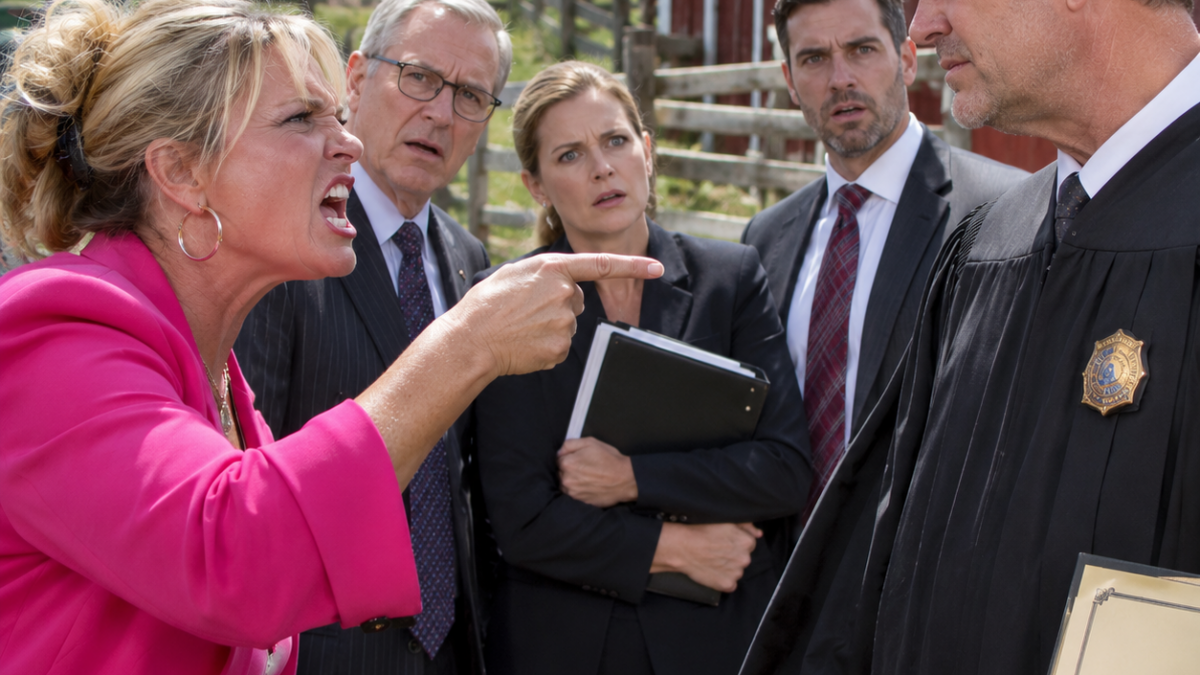
PART 2
The first letter arrived on a Tuesday in March.
Certified mail.
Return receipt requested.
The envelope was thick cream-colored paper with Ridgefield Crossing Homeowners Association printed across the top.
I opened it at the kitchen table.
Ann’s chair was still across from mine.
I had never moved it.
The letter began:
Dear Property Owner.
Not Mr. Callaway.
Not Wade.
Property Owner.
That told me almost everything I needed to know about Victoria before I reached the second paragraph.
According to the letter, my eastern boundary fence violated Ridgefield Crossing aesthetic standards and had to be removed within thirty days.
I read the paragraph twice.
Then I looked through the window toward the east pasture.
My fence.
On my land.
Installed decades before Ridgefield Crossing existed.
The letter cited Section 14.3 of their covenants.
I actually laughed.
Not because it was funny.
Because I had spent twenty-five years watching people make legal arguments, and every once in a while somebody delivered one so breathtakingly wrong that laughter was the only reasonable first reaction.
Their covenants applied to homeowners inside their subdivision.
I wasn’t a member.
I had never signed them.
My land had never been incorporated into the development.
Their HOA had exactly as much authority over my fence as I had over Victoria’s kitchen curtains.
I folded the letter.
Put it back in the envelope.
And did nothing.
Two weeks later, another arrived.
Same expensive paper.
Same dark signature.
This one threatened fines of five hundred dollars per day beginning April 15 if I refused to remove the fence.
I set it beside the first one.
Didn’t answer.
The third letter came in early April.
This time, Victoria had filed a nuisance complaint with the county zoning office.
She accused my cattle operation of producing excessive odor, noise, mud, and runoff that lowered Ridgefield property values.
That got my attention.
Not because I feared the complaint.
My farm had existed for generations before her development.
Established agricultural operations had protections against exactly the kind of nuisance complaint newer subdivisions liked to bring when residents suddenly discovered cows smelled like cows.
What interested me was the property description attached to her filing.
I read it once.
Then again.
The eastern boundary was wrong.
Not by inches.
By forty-seven feet.
According to Victoria’s documents, a strip of land nearly fifty feet wide along my entire eastern side belonged to Ridgefield Crossing.
I knew that was false.
My grandfather had commissioned a licensed survey in 1958.
My father had confirmed the line later.
I had the farm professionally resurveyed in 2011.
I knew where every major boundary pin sat.
That afternoon, I drove my truck down the access path.
The April wind was cool, carrying the smell of turned earth from Ridgefield’s landscaping crews.
I started at the creek and walked north.
The first pin should have been near an old sycamore.
Gone.
I kept walking.
Second.
Gone.
Third.
Gone.
At the fourth location, I found metal.
But it wasn’t where it belonged.
The pin had been moved about twelve feet west.
I knelt.
Mud darkened my jeans.
Fresh scratches scarred the cap.
The soil around it had been disturbed.
Someone had pulled it out and driven it back into the ground.
I sat there for several seconds with one hand resting on my knee.
That was the moment the situation changed.
A stupid HOA letter is annoying.
A nuisance complaint can be challenged.
But physically moving a property marker to support a false land claim?
That was something else entirely.
I photographed the pin.
Wide shots.
Close-ups.
The surrounding soil.
Reference points.
GPS coordinates.
Then I walked the entire line.
Boot prints were still visible in several places.
Someone had been working out there.
I didn’t call Victoria.
I didn’t call the sheriff.
I didn’t confront anybody.
One lesson the bench had taught me was that when people are doing something dishonest, interrupting them too early sometimes helps them.
They stop.
They clean up.
They coordinate stories.
They destroy records.
Patience is not weakness.
Sometimes patience is how you give a liar enough rope to document the lie themselves.
That evening, I poured a small bourbon and sat on the porch.
Sunset turned the pasture copper.
A red-tailed hawk circled above the south field.
Ann used to sit beside me in the other chair and complain that I always poured two fingers when one would have been enough.
Her chair was empty now.
I looked toward the east fence.
“What do you think?” I asked the empty chair.
I could almost hear her.
Don’t get mad yet, Wade.
Find out what they’re doing.
Ann always knew me better than I knew myself.
So that was what I did.
I waited.
Victoria escalated.
Three weeks later, a black Lincoln pulled into my gravel driveway at 8:15 in the morning.
Claire had just left after spending the weekend helping me vaccinate calves.
I was standing on the porch in mud-stained boots, jeans, and an old flannel shirt.
The coffee mug in my hand said:
WORLD’S OKAYEST RANCHER.
Ann had bought it for me as a joke.
A man stepped out of the Lincoln.
Mid-forties.
Expensive suit.
Slim tie.
Leather briefcase.
Todd Brennan.
I recognized him immediately.
He had appeared before my appellate panel fourteen months earlier in a commercial lease dispute.
Competent lawyer.
Weak case.
He had lost.
He didn’t recognize me.
Why would he?
The last time he saw me, I was sitting high behind a bench in a dark suit and judicial robe.
Now I looked like exactly what Victoria had probably described.
An aging rancher covered in cattle dust.
“Mr. Callaway?”
“That’s me.”
He climbed the porch steps.
“Todd Brennan. I represent the Ridgefield Crossing Homeowners Association.”
“I know who you are.”
He paused.
Probably assumed Victoria had told me.
“We’d like to discuss an amicable resolution to the property-line dispute.”
“There is no property-line dispute.”
His professional smile remained.
“Our licensed survey indicates your eastern fence encroaches approximately forty-seven feet into Ridgefield common property.”
“Your survey is wrong.”
“That’s precisely why I’m here.”
He placed his briefcase on the porch railing.
Right beside the clay pot containing Ann’s geranium.
That flower mattered to me more than it should have.
Ann planted it the spring before she died.
I kept it alive through winter by moving it inside.
Brennan opened the case and removed a thick stack of papers.
“We’ve filed a quiet-title action.”
That made me stop.
Victoria wasn’t asking me to move the fence anymore.
She was asking a court to declare that the land belonged to her HOA.
For most ordinary landowners, that filing alone would be terrifying.
Lawyers cost money.
Survey experts cost money.
Litigation consumes years.
A well-funded development can bury a working farmer in expenses until surrender becomes cheaper than justice.
I read the complaint.
Their survey description relied heavily on Ridgefield’s plat.
Not my older deed.
Not the established historical boundary.
Not the prior surveys.
I reached the signature page.
Then closed the packet.
Brennan watched me closely.
I knew the expression he was waiting for.
Fear.
Instead I said, “Mr. Brennan, my family has owned this property since 1941.”
He nodded politely.
“The boundary was professionally established in 1958 and confirmed multiple times.”
“I understand your position.”
“No. I don’t think you do.”
His smile weakened.
“The plat your complaint relies upon was created decades after my recorded deed.”
“That is something the court can resolve.”
“It certainly can.”
I took a drink of coffee.
“Three of my original boundary markers have been removed recently.”
His eyes changed.
“The fourth was physically moved.”
Now the smile disappeared.
“I’ve photographed the disturbed soil and documented the original coordinates.”
He said nothing.
I continued.
“If somebody connected to your client knowingly moved those pins to create support for this lawsuit, then you may have a problem considerably larger than a fence.”
Brennan stared at me.
For the first time, he wasn’t speaking to the version of me Victoria had sold him.
He closed his briefcase.
“I’ll communicate that concern to my client.”
“You should.”
He turned.
Walked down the porch.
Got into the Lincoln.
And drove out hard enough to spray gravel near Ann’s flower bed.
I watched until the dust settled.
Then I moved her geranium farther from the railing.
Brennan should have been Victoria’s warning.
Instead, she treated his discomfort like failure.
Two weeks later, I came home from Nashville and saw Victoria’s Porsche parked on the shoulder near my east fence.
Beside it sat a white Mercedes.
Two women stood near the property line.
Victoria wore oversized sunglasses and carried a handbag that probably cost more than several cows.
The other woman made me stop walking.
Katherine Mercer.
Senior partner at one of Nashville’s most respected firms.
Extremely capable.
Extremely ambitious.
And at that exact moment, being considered for a federal judicial nomination.
What Victoria did not know was that I sat on a state review panel that evaluated candidates like Mercer.
Her name had crossed my desk two months earlier.
I parked behind the barn where they couldn’t see my truck.
Then I approached through the tree line.
I got close enough to hear.
“The key is adverse possession,” Mercer said.
Victoria nodded.
“If the HOA can establish maintenance and use of the disputed strip for the required statutory period, we strengthen the title claim.”
“And then his fence comes down?”
“We would seek removal as part of the remedy.”
I leaned against a hickory.
Ridgefield Crossing had existed for less than three years.
The legal timeline Victoria needed simply wasn’t there.
Mercer knew that.
A first-year law student would know that.
Yet here she was standing beside my fence discussing how to use the theory as leverage.
That bothered me more than Victoria’s ignorance.
Victoria was entitled.
Mercer knew better.
Money was making her pretend she didn’t.
I walked quietly back toward the barn.
The hay smelled dry and sweet inside.
I sat on a bale.
Then made two calls.
First, Sam Prescott.
Sam had surveyed my property twice.
“Wade?”
“Need another survey.”
“What happened?”
“Someone moved my eastern pins.”
Silence.
“You sure?”
“I’m looking at the scratches.”
“I’ll be there tomorrow.”
My second call went to Gil Whitaker.
Gil owned 140 acres north of me.
Former Army Corps of Engineers.
Seventy years old.
A man who believed small talk should be kept under thirty seconds.
“She bothering you too?” he asked when I mentioned Ridgefield.
“A surveyor has been on my property.”
“Mine too.”
I stood.
“When?”
“Last week.”
“What happened?”
“He said the HOA authorized a boundary assessment.”
“And?”
“I told him the HOA could authorize a moon landing if it wanted. Still didn’t give him permission to trespass on my farm.”
Despite everything, I smiled.
“Get a name?”
“No. Got the truck plate.”
I wrote it down.
That changed the scale again.
My land wasn’t the only target.
Two farms.
Same developer.
Same HOA.
Unauthorized survey work.
Gil lowered his voice.
“Victoria came here six months ago.”
“What for?”
“She offered to buy my place.”
“How much?”
“Four hundred thousand.”
Gil’s farm was worth roughly twice that.
“What did you say?”
“I laughed.”
“And she?”
“She told me she’d find another way.”
I stopped writing.
“Exact words?”
“Exact.”
“Gil, write that down.”
“Already did.”
I spent that night in my study.
Ann’s green-shaded desk lamp cast a circle across the papers.
HOA letters.
Nuisance complaint.
Quiet-title filing.
Photographs.
Survey records.
Gil’s notes.
I leaned back in the old leather chair.
Outside, cattle settled in the darkness.
Victoria believed she was dealing with a farmer who happened to own land she wanted.
She wasn’t entirely wrong.
I was a farmer.
That part of me mattered deeply.
But she had made one dangerous assumption.
She thought farmer meant legally helpless.
She thought muddy boots meant ignorance.
She thought the man fixing water troughs had no idea what a false instrument looked like.
She thought wrong.
Sam arrived Friday morning.
We walked the entire eastern line.
He worked silently for hours.
Measurements.
Coordinates.
Historical references.
Metal detection.
Soil disturbance.
Finally, he spread a map across his truck hood.
“Wade.”
“What?”
“This isn’t a mistake.”
I already knew.
But hearing him say it mattered.
“Show me.”
He pointed.
“Three original pins removed. Fourth reset west of the recorded line.”
“How recent?”
“Based on the soil and corrosion exposure? Recent. Weeks, not years.”
He traced Ridgefield’s submitted survey.
“Now look at their boundary.”
It matched the Phase Two expansion concept.
Not my deed.
Not the historical survey.
The developer had drawn the line where they wanted the property to be.
Then somebody had moved physical markers to make the ground appear consistent with that fiction.
Sam looked at me.
“I’ll put everything in a certified report.”
“Would you testify?”
“Under oath.”
Then he handed me another document.
“Found something else.”
The developer behind Ridgefield Crossing was Holt Partners Development.
CEO: Vance Holt.
Victoria’s brother-in-law.
That connection I knew.
What I didn’t know was how the development approval had passed.
Rutherford County Planning Commission.
Three-to-two vote.
Two commissioners supporting the project had received large campaign contributions from a political action committee.
Tennessee Growth Alliance.
Sam looked at me.
“Guess who funded that PAC?”
“Holt.”
“Through intermediaries.”
I felt the muscles in my jaw tighten.
The land grab was no longer just Victoria dreaming about a larger subdivision.
There were signs of a coordinated system built around getting Ridgefield expanded.
Political contributions.
Survey manipulation.
Land pressure.
It was starting to look less like entitlement and more like organized theft.
That evening, I called Claire.
“Hey, Daddy.”
“I need you home this weekend.”
Her voice changed immediately.
“Are you sick?”
“No.”
“Cattle?”
“No.”
“Then what?”
“I’m going to need some help.”
She paused.
“What kind?”
“The kind your mother would tell me not to try alone.”
“I’ll leave Friday.”
Claire arrived with two bags, veterinary boots, and enough sweet tea to keep the entire county awake.
I told her everything.
She listened without interrupting.
When I finished, she stared out the kitchen window toward the pasture.
“They’re trying to take Grandpa’s land?”
“Yes.”
“And they moved the markers?”
“Looks that way.”
“What are you going to do?”
“Build the case.”
Claire looked at me.
“No.”
“No?”
“You’re going to build the legal case.”
“What’s the difference?”
“I’m going to find out what Victoria has been doing to the people inside that neighborhood.”
I almost told her to stay out of it.
Then I saw Ann in her expression.
Same stubborn jaw.
Same refusal to be treated like a child.
“Be careful.”
“Always.”
She smiled.
“Mom would say that’s a lie.”
That hurt and comforted me at the same time.
Over the next three weeks, I lived two lives.
Monday through Friday, I was Judge Wade Callaway.
I drove to Nashville.
Read briefs.
Heard arguments.
Wrote opinions.
Sat behind the bench and treated every litigant exactly as the law required.
I told no colleague what was happening.
I used no judicial authority to influence my private dispute.
That line mattered.
But evenings and weekends, I returned to the ranch.
And there I built my case as a landowner.
Sam completed a forty-three-page certified resurvey.
Every missing pin.
Every coordinate.
Every discrepancy.
Every disturbed patch of soil.
I hired Lydia Shaw, a forensic accountant from Chattanooga.
She followed the money behind Tennessee Growth Alliance.
Holt Partners.
Shell companies.
Political contributions.
The paper trail began looking ugly.
Then Claire returned with statements.
Eleven Ridgefield homeowners.
Tammy Hollis was the first.
The retired teacher with the tiny garden gnome.
Victoria had fined her for wind chimes.
A birdbath.
Her grandson’s bicycle.
Holiday decorations.
Tammy’s handwritten statement was three pages long.
When I finished reading it, I rubbed my eyes.
“This is ridiculous.”
Claire shook her head.
“It’s worse when you hear them talk about her.”
“What do they say?”
“That everybody is scared to challenge her.”
“An HOA president.”
“Not just her. Her money. Her husband’s family. Vance Holt. The lawyers.”
Claire sat opposite me in Ann’s chair.
I almost asked her not to.
I still sometimes felt that chair belonged to a dead woman.
Then I realized Ann would have hated that.
Furniture was meant to be used.
Lives were meant to continue.
Claire slid another statement across the table.
“Tammy cried.”
I looked down.
“She thinks she’s stupid for paying the fines.”
“She isn’t.”
“I told her.”
I read every statement.
Retaliation.
Selective enforcement.
Threats.
Residents pressured into silence.
Then Gil gave us photographs of the unauthorized survey vehicle and his written account of Victoria’s purchase offer.
At the bottom, in Gil’s block handwriting, were her words:
I’LL FIND ANOTHER WAY.
I stared at that sentence for a long time.
Ann once told me that threats reveal more about people than promises.
She was right again.
By the time my file was assembled, the binder was four inches thick.
I tabbed everything.
Timeline.
Survey.
Financial trail.
HOA conduct.
Developer links.
Witnesses.
Photographs.
Legal filings.
Then I called Pete Langford.
Pete worked for the Tennessee Bureau of Investigation.
We had crossed paths years earlier in a public-corruption case.
“I need you to listen to something,” I said.
He did.
Forty-five minutes.
No interruption.
When I finished, Pete exhaled slowly.
“You have copies?”
“Everything.”
“This may support opening an investigation.”
“I thought it might.”
“Wade.”
“Yes?”
“You understand I have to treat you like any other complainant.”
“That’s exactly what I want.”
“Good.”
I sent the file.
Then hired outside counsel from Memphis.
No connection to my court.
No connection to Ridgefield.
They filed a counterclaim.
Motion to dismiss.
Request for a temporary restraining order prohibiting further encroachment and interference with my property.
The hearing was scheduled for June 12.
Rutherford County.
That same week, by coincidence, I was scheduled to serve as a visiting judge in another courtroom in the same courthouse.
I almost laughed when I saw the calendar.
Not because I planned to use it.
I had no role in my own case beyond being a party and potential witness.
My lawyers would handle everything.
But sometimes timing has a sense of humor.
Victoria learned about the counterclaim on Wednesday.
Twenty minutes after the filing became public, her Porsche came up my driveway.
I was in the barn replacing a gasket on a leaking trough.
She stepped into the mud wearing white linen pants and designer heels.
Behind her came a silver Audi.
Douglas Ashford got out.
Third lawyer.
Senior partner at one of the largest firms in Middle Tennessee.
Silver hair.
Expensive suit.
The kind of calm confidence that came from spending forty years walking into rooms where everybody knew his name.
Victoria didn’t bother saying hello.
“This has gone far enough.”
I wiped my hands on a rag.
“What has?”
“This ridiculous counterclaim.”
“Mine?”
“You’re wasting the HOA’s time.”
I looked around my barn.
“Interesting place to come tell me I’m wasting your time.”
Ashford stepped forward.
“Mr. Callaway, perhaps we can reach a business solution.”
“What kind?”
Victoria answered.
“We’ll buy the disputed strip.”
“It isn’t disputed.”
“Two hundred thousand dollars.”
I actually stopped wiping my hands.
“For what?”
“The forty-seven feet.”
“My forty-seven feet.”
She smiled.
“Land is worth whatever someone is willing to pay for it.”
“No. Land is worth what it means to the person who owns it.”
Her smile thinned.
“This isn’t sentimental, Mr. Callaway.”
“To you.”
She glanced toward the pasture.
“It’s grass and cattle.”
That sentence almost did what the lawsuits hadn’t.
It almost made me angry.
My grandfather had worked railroad shifts for that grass.
My father had nearly died repairing that barn after a storm.
Ann and I had raised Claire here.
We had buried dogs here.
Celebrated birthdays here.
Fought here.
Forgiven each other here.
I had scattered part of Ann’s ashes beneath a maple on the south ridge.
And Victoria Ashworth stood in my barn calling it grass and cattle.
I looked at her.
“No.”
Her expression hardened.
“If you refuse, we proceed with the title action, the nuisance complaint, and we petition for zoning review of the entire farm.”
“You do that.”
“You could lose the cattle operation.”
“Could I?”
Ashford interrupted.
“Mr. Callaway, I strongly recommend you consult experienced counsel.”
I looked at him.
“Ashford, Klein and Whitmore.”
He nodded.
“Yes.”
“You have three matters on the Court of Appeals docket this term.”
His shoulders shifted.
Very slightly.
“Grayson Properties. Hendrix Estate. Franklin Community Bank contract matter.”
Victoria looked between us.
Ashford’s eyes narrowed.
“How do you know that?”
“I read a lot of dockets.”
Silence.
He studied me.
For just a second, I wondered whether he had figured it out.
Then Victoria turned.
“You have until Friday.”
She stepped directly into a patch of mud.
Her expensive red-soled shoes sank almost to the heel.
Claire would later tell me I should be ashamed of how much enjoyment I took from that.
I wasn’t.
Victoria jerked her foot free and marched to the Porsche.
Ashford stayed.
He looked around the barn.
Then at me.
“Have we met?”
“Probably.”
“Where?”
“I’m sure it’ll come to you.”
His expression tightened.
Then he left.
I went back to the trough.
The gasket still needed replacing.
That’s the thing about ordinary work.
It doesn’t care that someone just threatened your family legacy.
A leak remains a leak.
June 12 arrived hot.
By 8:00 a.m., the courthouse marble already felt warmer than usual.
I had been hearing cases in Courtroom Three all week as a visiting judge.
My private TRO hearing was scheduled for 10:00 in Courtroom One before Judge Martha Kingsley.
I had absolutely no role in deciding it.
At 9:15, my docket cleared early.
I stepped from the bench into the side corridor.
Still wearing my black robe.
My plan was simple.
Walk to chambers.
Change into a suit.
Go downstairs.
Enter Courtroom One as Wade Callaway, private landowner.
That plan lasted about four seconds.
I rounded the corner near the water fountain.
There they were.
All three.
Todd Brennan.
Katherine Mercer.
Douglas Ashford.
Victoria stood behind them carrying a white designer bag.
They were reviewing documents.
Brennan was talking quietly.
Then Donna, the clerk from my courtroom, came through the door behind me.
“Judge Callaway?”
Every head turned.
“Courtroom Three is cleared for the day. Do you need anything before we break?”
Brennan saw me first.
His mouth opened.
Nothing came out.
For a moment, I watched him trying to force two separate pictures together.
The man standing before him in a black judicial robe.
The rancher on the porch holding a novelty coffee mug.
Recognition hit.
His fingers tightened around the folder until the edge bent.
Mercer looked next.
The color drained from her face.
Completely.
She knew exactly who I was.
She knew the panel.
She knew her federal judicial prospects.
And she knew she had stood on my property discussing a legally impossible adverse-possession theory in support of a client trying to take part of my land.
She stepped backward.
Her shoulder touched the wall.
Then Ashford looked at me.
He didn’t visibly panic.
Men like Douglas Ashford had trained themselves for decades not to show panic.
But his eyes changed.
I could almost see him remembering our conversation in the barn.
Three appellate cases.
I read a lot of dockets.
Have we met?
Probably.
His left hand moved to the wall behind him.
I said nothing.
Twenty-five years on the bench had taught me something valuable.
Most people are terrified of silence.
They rush to fill it.
They explain.
They excuse.
They confess things nobody asked.
So I let silence do its work.
Victoria looked from one lawyer to the next.
“What?”
Nobody answered.
“Todd?”
Brennan swallowed.
“Mrs. Ashworth, we need to speak privately.”
“About what?”
“Now.”
Her voice sharpened.
“Why is everyone acting like this?”
She looked at me.
Then the robe.
Then the state seal.
“What is this?”
Mercer finally spoke.
Barely above a whisper.
“He’s a judge.”
Victoria stared.
“What?”
“Judge Callaway.”
Mercer’s lips looked almost colorless.
“Tennessee Court of Appeals.”
Victoria gave a short laugh.
Not amusement.
Disbelief.
“No.”
Nobody spoke.
“He’s a farmer.”
I finally answered.
“I am.”
She looked at me.
“And a judge.”
Her grip tightened on the handbag.
“That’s not possible.”
“It has been for about twenty-five years.”
Brennan looked as if he wished the floor would open.
Victoria stared at the three lawyers.
“You knew?”
Brennan looked away.
Mercer didn’t answer.
Ashford said nothing.
I nodded politely.
“Counselors.”
Then looked at Victoria.
“Mrs. Ashworth.”
I started walking.
She called after me.
“Did you plan this?”
I stopped.
Turned.
“Plan what?”
“This.”
She pointed at the robe.
I almost smiled.
“My employment?”
“You hid who you were.”
“No.”
Her expression twisted.
“You never told me.”
“You never asked.”
That was the truth.
She had decided who I was before she ever spoke to me.
Old farmer.
Muddy boots.
Cattle.
Barn.
No power.
No sophistication.
No connections.
The irony was that none of those assumptions should have mattered anyway.
My rights did not become more valuable because I happened to be a judge.
Her conduct wasn’t wrong because she picked a powerful victim.
It was wrong because she thought she could take land from anyone.
I continued toward chambers.
Behind me, Brennan’s voice dropped into the urgent tone of a lawyer whose client had suddenly become radioactive.
I didn’t need to hear the conversation.
The robe had said enough.
At 10:00, I entered Courtroom One wearing a charcoal suit.
No robe.
I sat in the gallery.
My attorney, Karen Goss, stood at counsel table.
Victoria sat across the room with Brennan, Mercer, and Ashford.
She looked furious.
More than furious.
Humiliated.
That was dangerous for people like Victoria.
They can forgive losing money before they forgive embarrassment.
Judge Martha Kingsley took the bench.
“All rise.”
We stood.
Then the hearing began.
Karen started with the boundary.
Sam’s certified survey appeared on the screen.
Historic deed.
1958 markers.
2011 confirmation.
Current GPS coordinates.
Photographs.
Three missing pins.
One relocated pin.
Fresh soil disturbance.
Judge Kingsley leaned forward.
“Mr. Prescott, in your professional opinion, was this marker naturally displaced?”
“No, Your Honor.”
“Could livestock have moved it?”
“No.”
“Flooding?”
“No.”
“Farm equipment?”
“Not in this manner.”
“How was it moved?”
“Pulled and reset.”
The courtroom murmured.
Karen continued.
She displayed Ridgefield’s survey.
Then overlaid the Phase Two development proposal.
The false line matched the future development plan almost perfectly.
Judge Kingsley looked toward Brennan.
“Counsel?”
Brennan stood slowly.
“Your Honor, we dispute any characterization of intentional manipulation.”
Karen nodded.
“We anticipated that.”
Next came Gil’s photographs.
Survey vehicle.
Date.
Time.
License plate.
Then his statement about the trespasser.
Then Victoria’s purchase offer.
Then her words.
I’ll find another way.
Victoria whispered to Brennan.
He shook his head.
She whispered again.
He held one hand low, telling her to stop.
Karen moved to the financial evidence.
Lydia Shaw’s report.
Holt Partners Development.
Two intermediary LLCs.
Tennessee Growth Alliance.
Campaign contributions.
Two planning commissioners.
Eighty thousand dollars combined.
Judge Kingsley’s expression changed.
This was no longer a fence hearing.
Karen was careful.
She didn’t accuse anyone of crimes the evidence had not yet established.
She simply showed the trail.
Then she introduced confirmation that TBI had opened an investigation into potential boundary fraud, false filings, and related public-corruption issues.
The room became absolutely still.
Brennan closed his eyes for half a second.
Victoria looked at Mercer.
Mercer stared straight ahead.
Karen then introduced the homeowner declarations.
Tammy Hollis.
She sat in the second row.
Her garden gnome fine seemed almost funny compared with the rest.
Until Karen explained the pattern.
Selective enforcement.
Threats.
Retaliation.
The bicycle.
Wind chimes.
Holiday lights.
Residents who questioned Victoria receiving increasingly aggressive violations.
It wasn’t proof of the land fraud.
But it showed how power operated inside Ridgefield.
Victoria’s face turned red.
Judge Kingsley looked at Brennan.
“Counsel, response?”
Brennan stood.
Buttoned his jacket.
Paused.
Then said the sentence Victoria least expected.
“Your Honor, the Ridgefield Crossing Homeowners Association respectfully withdraws its quiet-title claim and consents to the requested temporary restraining order pending resolution of the remaining matters.”
Victoria shot out of her chair.
“We are not withdrawing anything.”
Brennan turned.
“Victoria—”
“Sit down, Mrs. Ashworth,” Judge Kingsley said.
Victoria ignored her.
“This is my development.”
Judge Kingsley’s eyebrows lifted.
The words hung there.
My development.
Not community.
Not homeowners.
My development.
Victoria pointed toward me.
“He’s manipulating this because he’s a judge.”
That made me tense.
Karen immediately stood.
“Your Honor, my client has had no judicial involvement in these proceedings. Outside counsel was retained specifically to avoid any appearance of impropriety.”
Judge Kingsley nodded.
“The court is aware.”
Victoria continued.
“This entire county knows who he is now!”
“Mrs. Ashworth.”
“You think that doesn’t matter?”
“Sit down.”
“My family has invested millions—”
“Mrs. Ashworth.”
“Do you know who my father-in-law is?”
The courtroom became so quiet I could hear the ventilation system.
Judge Kingsley removed her glasses.
Placed them on the bench.
“Mrs. Ashworth, I am going to say this one final time.”
Victoria stood rigid.
“Sit down.”
Victoria did not.
Instead she said:
“I will not be silenced by a court that has clearly already decided—”
“Bailiff.”
Two bailiffs moved.
Victoria looked shocked.
Judge Kingsley’s voice became cold.
“You are held in contempt.”
“What?”
“You will be removed from my courtroom.”
“You can’t—”
“I just did.”
The bailiffs approached.
Victoria jerked one arm away.
Her white handbag slipped from her shoulder.
Hit the floor.
The clasp opened.
A lipstick rolled across the marble.
Nobody moved to pick it up.
There was something strangely perfect about that image.
All the brands.
All the money.
All the performance.
Scattered on a courtroom floor where none of it meant anything.
The bailiffs guided Victoria toward the side door.
As it opened, she stopped.
Two TBI agents stood in the hallway.
Between them was Vance Holt.
Her brother-in-law.
Handcuffed.
For the first time since I had known Victoria Ashworth, she looked genuinely afraid.
Vance looked at her.
She looked at him.
Nobody spoke.
Then the bailiffs moved her forward.
The door closed.
Judge Kingsley looked toward Brennan.
“Counsel, shall we continue?”
Brennan looked older than he had an hour earlier.
“Yes, Your Honor.”
The temporary restraining order was granted.
Any further entry onto my property without permission was prohibited.
The fraudulent boundary line was frozen pending final determination.
The HOA’s quiet-title action was withdrawn.
But that was only the beginning.
The TBI investigation moved quickly once the records were collected.
Vance Holt faced charges connected to false filings, boundary manipulation, conspiracy surrounding the attempted land acquisition, and public-corruption allegations.
The two planning commissioners tied to the questionable financial trail resigned.
Their attorneys released statements full of words like misunderstanding, routine contribution, and no admission of wrongdoing.
Victoria faced separate consequences.
Her nuisance filing.
The false survey submitted in support of her claim.
Her role in the attempted property action.
Then there was the contempt finding.
For somebody who had spent years issuing fines to everyone else, Victoria reacted poorly to receiving one from an actual court.
She spent a night in custody.
The story reached local news.
Then social media.
The same Ridgefield homeowners who had once been scared to challenge her began attending HOA meetings in numbers so large the clubhouse couldn’t hold everybody.
An emergency election was scheduled.
Victoria tried to fight removal.
Her support collapsed.
The final vote was seventy-eight to three.
Tammy Hollis called me afterward.
“They removed her.”
“I heard.”
“Seventy-eight to three.”
“Pretty convincing.”
“You want to know my favorite part?”
“What?”
“My garden gnome voted against her.”
I laughed.
Actually laughed.
The kind that comes from the chest.
I hadn’t done much of that since Ann died.
Tammy joined the new board.
At their first meeting, the board reviewed every outstanding violation issued under Victoria’s leadership.
Forty-seven were dismissed.
Garden gnome.
Gone.
Wind chime.
Gone.
Bicycle.
Gone.
Holiday lights.
Gone.
A man fined because his trash container had been visible for twelve minutes after collection?
Gone.
They rewrote the enforcement policy.
No unilateral fines.
Photographic evidence required.
Review process.
Appeals.
Residents would get a voice.
Ridgefield Crossing was still an HOA.
But it stopped operating like Victoria’s private kingdom.
The lawyers had their own problems.
Todd Brennan withdrew almost immediately.
I believed he had understood the seriousness earlier than the others.
Maybe even on my porch.
I never learned exactly what Victoria had told him before he filed.
And I didn’t need to.
Katherine Mercer’s federal judicial prospects disappeared.
There was no dramatic announcement.
No press conference.
Her name simply stopped appearing on the shortlist.
I took no part in making that happen.
I recused myself from anything involving her candidacy the moment the land dispute became connected to her.
That mattered to me.
I would not become the kind of person Victoria accused me of being.
Power cannot be used for personal revenge and remain honorable.
Mercer’s own choices were enough.
Douglas Ashford’s firm sent settlement feelers through my counsel.
I refused every attempt to handle the matter with a quiet handshake.
“Put it in writing,” I told Karen.
“They want confidentiality.”
“No.”
“They may increase the number.”
“No.”
“You sure?”
“I have spent my whole career believing public courts matter because public accountability matters.”
Karen smiled.
“I thought you’d say that.”
The final boundary determination was almost anticlimactic.
Sam reset the markers under official supervision.
The eastern line returned exactly where it belonged.
Where my grandfather’s survey had placed it.
Where my father had known it.
Where I had known it.
I walked the boundary alone afterward.
Coffee in one hand.
Copy of the old deed folded in my coat pocket.
The wind moved across the tall grass.
At the old hickory, I stopped.
Placed one hand on the fence post.
The wood was weathered.
My father had replaced that section when I was seventeen.
I remembered standing beside him.
He had handed me a post driver.
“Straight,” he said.
“It is straight.”
“It leans.”
“Everything looks like it leans to you.”
“Because everything you build leans.”
Ann used to laugh when I told that story.
I stood there remembering both of them.
Grandfather.
Dad.
Ann.
Three people gone.
All of them somehow present in that dirt.
A few days later, Claire came down.
She found me repairing a gate.
“You won.”
I kept working.
“Boundary’s restored.”
“That means you won.”
“Depends what you mean.”
Claire leaned against the post.
“You still do that.”
“What?”
“Turn every emotion into a technical answer.”
“Occupational hazard.”
“You’re allowed to be happy.”
“I am.”
“You don’t look happy.”
I put down the wrench.
“I keep thinking about how close they came.”
“But they didn’t.”
“They would have done this to somebody who couldn’t fight.”
Claire’s expression changed.
That was the thought I couldn’t shake.
The robe had frightened those lawyers.
My legal knowledge had protected me.
My connections helped me understand where to look.
I had money to hire experts.
What happened if Victoria tried this against a seventy-year-old farmer living on Social Security?
What happened if the landowner couldn’t pay a surveyor?
What if he believed the first lawyer who showed up?
That bothered me more than anything.
Claire touched my arm.
“Then maybe the point isn’t that you saved only this farm.”
“What do you mean?”
She smiled slightly.
“I’ve been talking to Tammy.”
That sentence rarely led to anything small.
“About?”
“The new HOA wants to repair its relationship with the farming community.”
“They can start by leaving us alone.”
“They want to do more.”
“What?”
Claire hesitated.
“Mom.”
My chest tightened.
“What about her?”
“They want to create a rural veterinary assistance fund.”
I stared at her.
“For local farmers who can’t afford emergency large-animal care.”
“Claire…”
“The HOA is funding the first year. Some Ridgefield residents are donating privately too.”
I knew where this was going before she said it.
“They want to name it the Ann Callaway Rural Veterinary Fund.”
I turned away.
Looked across the pasture.
The sky was pale blue.
Cattle grazed near the ridge.
For a few seconds, I couldn’t speak.
Ann loved Claire’s veterinary work.
She used to tell everyone our daughter had chosen medicine for patients who couldn’t complain.
“Did you ask them to do that?”
“No.”
“You sure?”
“Daddy.”
I wiped one hand across my face.
Dust.
Maybe something else.
“She would’ve hated the attention.”
Claire laughed softly.
“She would’ve pretended to hate it.”
“That sounds more accurate.”
The sign went up the following week.
ANN CALLAWAY RURAL VETERINARY FUND
Below it:
HELPING KEEP FARM FAMILIES AND THEIR ANIMALS TOGETHER.
I stood beside Claire when they uncovered it.
Tammy spoke.
Gil attended.
About forty Ridgefield homeowners came.
Some I recognized from the courtroom.
Some had probably once complained about cattle odor.
That was okay.
People can change.
Communities can too.
Claire said a few words about her mother.
I couldn’t.
Not because I didn’t have anything to say.
Because I had too much.
Later that evening, Claire and I sat on the porch.
Same porch where Todd Brennan had placed his briefcase.
Same railing.
Same geranium.
The plant had somehow survived everything.
Claire pointed at it.
“Mom would be amazed you haven’t killed that.”
“I have skills.”
“You forgot to water every plant she ever owned.”
“Selective memory.”
“She made me promise I’d remind you.”
“Of watering plants?”
“Of living.”
I looked at her.
She stared toward the sunset.
“She told me once that if anything happened to her, you’d turn this place into a bunker.”
“That sounds dramatic.”
“She knew you.”
I didn’t answer.
Claire continued.
“She said the farm would save you at first.”
I looked down.
“And then?”
“She said eventually I’d have to save you from the farm.”
That one landed hard.
For two years, I had used work to avoid grief.
Fence after fence.
Gate after gate.
Cattle.
Court.
Briefs.
More cattle.
Anything to keep moving.
Victoria’s attack had given me a new mission.
A clean enemy.
A problem that could be solved.
Evidence.
Law.
Outcome.
Grief wasn’t like that.
There was no motion to dismiss.
No final judgment.
No restored boundary.
Ann was still gone.
I leaned back.
“You think she was right?”
Claire smiled sadly.
“She usually was.”
A month later, Gil stopped by.
He leaned over the fence.
“Got news.”
“What?”
“Victoria’s Porsche is for sale.”
I stared at him.
“Why are you monitoring Victoria’s car?”
“I’m retired.”
“That doesn’t answer the question.”
“Luxury SUV. Selling due to personal circumstances.”
I laughed.
“You buying it?”
“I have a truck.”
“Could pull a cattle trailer with a Porsche.”
“I’d rather pull it with Tammy’s garden gnome.”
Gil laughed.
It was the first time I had heard him laugh in months.
We stood there leaning against the fence.
The same fence Victoria said had to go.
The same line someone tried to erase.
Morning sun lay across the pasture.
A barred owl called from the tree line.
Gil glanced at me.
“You ever think about selling?”
“No.”
“Me neither.”
We watched the cattle.
After a while, he said, “You know what scared them?”
“What?”
“Finding out you were a judge.”
I nodded.
“That’s what made them scared.”
“Yeah.”
“But that isn’t why they lost.”
Gil looked at me.
“No?”
“They lost before that.”
“When?”
“When they decided the law only mattered if the person they were hurting understood it.”
Gil thought about that.
Then nodded.
That was the part of the story people tended to miss.
Yes, the courthouse hallway was satisfying.
I won’t pretend otherwise.
Seeing three lawyers who had underestimated me suddenly recognize the robe?
I’m human.
I enjoyed it.
But I never wanted the lesson to be:
Be careful who you bully because he might secretly be powerful.
That lesson is too small.
The real lesson was:
Don’t steal from people.
Don’t falsify boundaries.
Don’t use money to manufacture rights you do not have.
Don’t assume a farmer is stupid.
Don’t assume a widow is weak.
Don’t assume an elderly neighbor won’t keep records.
Don’t assume somebody without connections deserves less protection than somebody with them.
And never mistake someone’s patience for surrender.
Victoria did.
She saw me ignore her first letter and thought I was afraid.
She saw me ignore the second and thought I was confused.
She saw Brennan leave my porch and assumed she simply needed a stronger lawyer.
She brought Mercer.
Then Ashford.
Each escalation convinced her she was getting closer to winning.
She never understood that every new threat was another document.
Every visit was another witness.
Every survey was another comparison.
Every false statement was another thread.
I didn’t beat Victoria by becoming louder than she was.
I beat her by letting evidence become heavier than her money.
Three months after the hearing, I walked up to the south ridge just before sunset.
That was where I had scattered some of Ann’s ashes.
I hadn’t gone there much.
Too painful.
That evening, I carried two coffee mugs.
One was mine.
The other was hers.
I set her mug near the maple.
Sat in the grass.
The farm rolled out below me.
Barn.
Pastures.
Cattle.
Fence.
Beyond the eastern edge, Ridgefield Crossing’s roofs reflected the last light.
For the first time, I didn’t see the subdivision as an enemy.
Victoria was gone.
The people who lived there weren’t her.
Some had stood beside us.
Some helped create Ann’s fund.
Children played in yards.
A dog barked.
Somebody grilled dinner.
Life.
That was all any of us were trying to build.
I looked at Ann’s mug.
“You would’ve liked Claire’s idea.”
Wind moved through the maple leaves.
“You would’ve liked Tammy too.”
I smiled.
“She has an illegal garden gnome now.”
The sun dropped lower.
“I kept the farm.”
Those words nearly broke me.
Not because I had doubted the legal outcome.
Because I suddenly remembered the morning after Ann died.
I had stood in the kitchen wondering how anything could continue.
Yet here I was.
Two years later.
The farm still here.
Claire still here.
Me still here.
Different.
But here.
“I thought keeping it exactly the same would keep you close,” I said.
The cattle moved slowly through the south pasture.
“I think I was wrong.”
My voice cracked.
“I think you wanted me to keep living on it.”
I sat until the sky turned purple.
Then gathered both mugs.
Before leaving, I touched the trunk of the maple.
“Goodnight, Annie.”
I walked back down the hill.
The next morning started at 4:30.
Some things don’t change.
I pulled on boots.
Made coffee.
Went outside.
The air smelled like damp grass and cattle.
The eastern fence was exactly where it had always belonged.
The restored boundary pins caught the first light.
Claire’s truck was parked near the barn because she had stayed overnight to help with a difficult calving.
I found her asleep in the passenger seat with a veterinary textbook open on her lap.
I tapped the window.
She jumped.
“What?”
“World-class veterinarian.”
She glared at me.
“What time is it?”
“Time to work.”
“I hate this farm.”
“No, you don’t.”
“No. I really don’t.”
We walked toward the barn together.
At the gate, I stopped.
Claire looked back.
“What?”
I looked toward the eastern line.
For months, that fence had been where every bad thought in my head went.
Victoria.
Vance.
Lawyers.
Fraud.
Threats.
Now it was just a fence again.
Cedar posts.
Wire.
Morning dew.
Exactly what it should have been all along.
“Nothing,” I said.
Claire followed my gaze.
She understood anyway.
She slipped her arm through mine.
“Come on, Judge.”
“Don’t call me that out here.”
“Why?”
“Cows aren’t impressed.”
She smiled.
“Apparently neither was Victoria.”
I laughed.
Then we walked into the barn.
Behind us, the sun rose over 380 acres my grandfather had purchased eighty-five years earlier.
Land Victoria Ashworth had called temporary.
Land her developer wanted for sixty more houses.
Land three attorneys had tried to convince me I could not afford to defend.
Land that had carried my family through births, storms, arguments, funerals, droughts, and more mornings than I could count.
It was still there.
Not because I was a judge.
Not because three lawyers went pale when they saw my robe.
And not because I had more power than Victoria expected.
The farm survived because the deed was real.
The boundary was real.
The evidence was real.
And eventually, arrogance ran into something it could not intimidate.
Truth.
People like Victoria think power means always being the person who gets the last word.
Twenty-five years in court taught me differently.
Sometimes power is knowing when not to speak.
Sometimes justice is a forty-three-page survey.
Sometimes revenge is not screaming at the woman trying to steal your land.
It is letting her file the lie.
Letting her hire the lawyers.
Letting her walk into court completely certain that the farmer she has spent months humiliating will finally break.
And then standing twenty feet away in a black judicial robe while every lawyer beside her suddenly understands exactly what kind of case they attached their names to.
I never needed to threaten Victoria.
I never needed to ruin her.
She did that herself.
All I had to do was keep the records.
Protect the land.
And wait for the truth to catch up.
That morning, Claire opened the barn door.
Warm light spilled across the floor.
A newborn calf struggled onto unsteady legs beside its mother.
Claire knelt in the straw.
“Come on, little guy.”
The calf tried.
Collapsed.
Tried again.
This time it stood.
Claire looked back at me.
There were tears in my eyes before I realized it.
She didn’t say anything.
Neither did I.
We simply watched the calf find its balance.
Ann would have loved it.
Outside, the wind moved across the pasture.
Beyond the barn, the old fence followed the ridge exactly where my grandfather had placed it.
And for the first time since Victoria Ashworth sent that first letter, I didn’t look at that fence and think about what someone had tried to take from me.
I thought about everything that was still mine.
My daughter.
My memories.
My name.
My home.
And 380 acres of Tennessee ground that would still be here long after the lawyers, the lawsuits, the luxury cars, and the arrogance were forgotten.
I reached into my jacket pocket.
My fingers touched the old brass key Ann used to carry for the barn.
I had kept it since she died.
Claire noticed.
“You okay?”
I nodded.
This time, I meant it.
“Yeah.”
Then I looked across the morning pasture.
“I think I finally am.”








