PART 2: HOA Karen Called the Cops to Seize My $100,000 Charger — Then the Officer Took One Look at My Registration
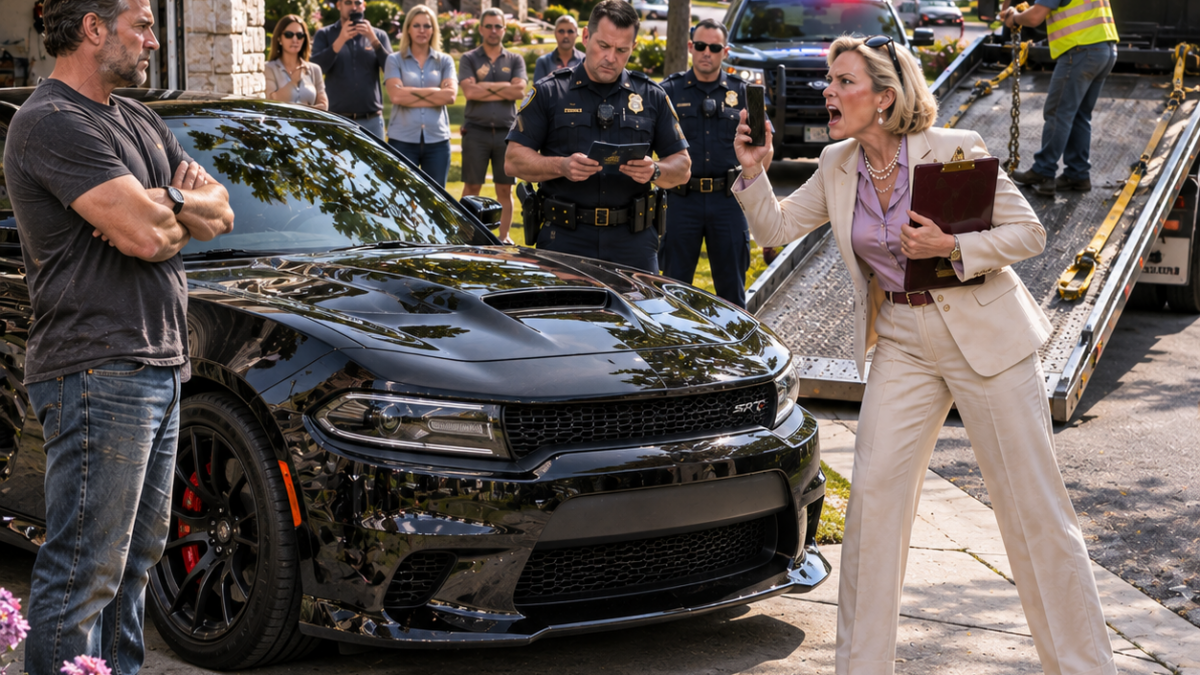
The morning Caroline Mathers stepped into my driveway, aimed her phone at my black Dodge Charger, and announced that she was calling the police to have my hundred-thousand-dollar car seized for “impersonating law enforcement,” I was standing barefoot on my front porch with a cup of coffee wondering how a quiet Saturday in Willow Bend Meadows had somehow turned into an impound operation.
She had already photographed the tinted windows, circled the antenna in three violation notices, presented my car on a giant projector screen at an HOA meeting, and even convinced a tow company to send a truck to my house, yet every time I calmly told her she had no legal reason to touch my vehicle, she seemed to interpret my refusal as proof that I was hiding something.
What finally made me stop laughing wasn’t the tow truck or the threats—it was the look on Caroline’s face when she promised that this time she would bring “real authority” to my driveway, because I could tell she had decided humiliating me in front of the neighborhood mattered more than finding out whether a crime had actually occurred.
My name is Mark Delaney, and when I moved into Willow Bend Meadows, I wanted exactly one thing from the place.
Normal life.
My workdays were already filled with traffic collisions, angry drivers, road closures, citation disputes, and people insisting that the speed limit somehow did not apply to them because they were late for work.
Home was supposed to be different.
I bought a clean two-story house on a quiet street where kids rode bikes after dinner and the biggest controversy seemed to be whether somebody’s hydrangeas were leaning too far over the sidewalk.
Then Caroline noticed my Charger.
It was black, spotless, expensive, and admittedly more aggressive-looking than the average family crossover.
But it was legal.
Completely legal.
Caroline didn’t ask.
Three mornings after I moved in, I found her standing beside it taking pictures.
“This vehicle violates community standards,” she said.
I looked behind me as if another vehicle might have appeared.
“My car?”
“It resembles a police cruiser.”
“And?”
“That creates confusion.”
“For whom?”
“Our residents.”
She tapped the roof with one manicured finger.
“Vehicles with an authoritative appearance are inappropriate in visible residential areas.”
I stared at her hand.
“Please don’t touch my car.”
Her expression hardened.
“Then park it in your garage.”
“My garage is being repaired.”
“That’s not the HOA’s problem.”
“It also isn’t illegal to park my car in my driveway.”
“We’ll determine that.”
Three days later, I received my first notice.
**COMMERCIAL OR SPECIALIZED VEHICLE DISPLAY.**
Then another.
**POTENTIAL LAW-ENFORCEMENT IMPERSONATION CONCERN.**
Then a third with photographs she had taken from the sidewalk.
Yellow circles around my windows.
Red arrows pointing toward the antenna.
I filed every letter.
My neighbor, Mr. Henley, caught me doing it one afternoon.
“You fighting her?”
“No.”
He looked disappointed.
“You should.”
“I’m documenting.”
He smiled.
“That’s probably worse.”
The next HOA meeting proved how far Caroline was willing to take it.
She dimmed the clubhouse lights and projected a photograph of my Charger across the wall.
Then another.
And another.
Seven photographs.
One slide read:
**THREAT TO COMMUNITY AESTHETIC INTEGRITY.**
Another:
**POSSIBLE IMPERSONATION VEHICLE.**
I nearly laughed.
Then Caroline displayed a graph claiming neighborhood property values had dropped twelve percent since my vehicle arrived.
A man near the front raised his hand.
“Where did those numbers come from?”
Caroline ignored him.
Her solution was a proposed rule requiring every resident to submit their vehicle for HOA approval before parking outside.
That was when people stopped looking at me and started looking at her.
Two mornings later, a tow truck appeared in my driveway.
The driver walked toward my Charger with a hook.
I stepped outside.
Caroline stood behind him with her arms crossed.
“Proceed,” she ordered.
The driver asked for my registration.
I handed it over.
He read it.
Then looked at me.
Then at the car.
His entire expression changed.
“Nope.”
Caroline blinked.
“What?”
He started packing his equipment.
“I’m not towing this.”
“I hired you!”
“Then don’t pay me.”
He climbed into his truck.
Caroline chased him halfway down the driveway.
“You get back here!”
The truck disappeared around the corner.
She turned toward me, face burning.
“This isn’t over.”
“I know.”
“I’ll call the police myself.”
For the first time that morning, I smiled.
“Caroline,” I said, “I really think you should.”
Her eyes narrowed.
She pulled out her phone.
And across the street, one by one, my neighbors began stepping onto their porches.
PART 2
Caroline stared at me for several seconds after I told her to make the call.
I think she expected me to panic.
Maybe argue.
Maybe suddenly surrender the keys and apologize for having offended the sacred visual harmony of Willow Bend Meadows.
Instead, I picked up my coffee.
That unsettled her more than anger would have.
“You think this is funny?”
“Some parts.”
“You’re about to have your vehicle impounded.”
“I heard you the first four times.”
“This is your last chance.”
“To do what?”
“Move that thing.”
I glanced at the Charger.
Black paint reflected the morning sun.
It sat completely inside my driveway, registration current, insurance current, no emergency lights activated, no police markings displayed.
Exactly where I’d left it the night before.
“What law am I breaking?”
Caroline’s mouth tightened.
“This isn’t about law.”
That was probably the most truthful thing she had said since I met her.
“This is about community standards.”
“Then why are you calling police?”
“Because you refuse to cooperate.”
I nodded slowly.
“Go ahead.”
She dialed.
Mr. Henley stood beside his mailbox across the street.
A younger couple two houses down had stopped pretending to load groceries.
Someone farther up the block raised a phone.
Caroline turned slightly so everyone could see her profile.
Even her emergency call had staging.
“Yes,” she said when the dispatcher answered. “I need an officer at Willow Bend Meadows immediately.”
Pause.
“We have a resident displaying what appears to be a law-enforcement vehicle without authorization.”
I took a sip.
Pause.
“Yes, I believe there may be impersonation involved.”
That bothered me.
Not enough to interrupt.
But enough that I set the coffee down.
Calling my car ugly was ridiculous.
Calling it noncompliant was an HOA dispute.
Accusing somebody of impersonating law enforcement was different.
That allegation could follow a person.
Caroline continued.
“He has refused every order to remove it.”
Pause.
“Yes. I’m the HOA president.”
Of course she included that.
“Please send someone.”
She ended the call.
“There.”
“There what?”
“It’s done.”
“What is?”
“The police are coming.”
“I assumed that’s what happened when you called the police.”
Her nostrils flared.
“You’re very arrogant for someone about to be exposed.”
I looked at her.
“Caroline, what exactly do you think you’re exposing?”
“You.”
“For what?”
She hesitated.
Just a fraction.
That was the problem.
She had spent weeks building a case without ever defining the crime.
The car looked official.
Therefore suspicious.
I refused her orders.
Therefore defiant.
The tow driver refused.
Therefore I must have intimidated him.
Every unanswered question became proof of the thing she already believed.
That wasn’t investigation.
That was obsession.
Mr. Henley called from across the road.
“You want another coffee, Mark?”
“I’m good.”
Caroline spun toward him.
“This is an active enforcement situation.”
Henley looked down at his bathrobe.
“Should I put on tactical pajamas?”
Someone laughed.
Caroline ignored it.
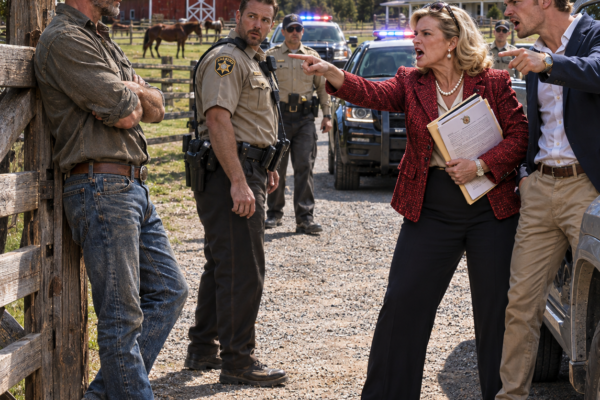
Ten minutes later, a patrol cruiser turned onto our street.
I recognized it immediately.
Unit 214.
Then the driver.
Ryan Keller.
Of course.
I almost felt sorry for Caroline.
Almost.
Keller pulled to the curb.
Before he’d fully opened his door, Caroline hurried toward him.
“Officer!”
He stepped out.
She practically intercepted him at the hood.
“Thank goodness. I’ve documented everything.”
Keller looked past her.
Saw me.
His expression changed for half a second.
Not enough for Caroline to notice.
I gave him a tiny shake of my head.
Let her talk.
He understood.
Police officers become excellent at reading tiny signals.
Mostly because large signals happen too late.
“What seems to be the problem, ma’am?”
Caroline pointed dramatically.
“That vehicle.”
Keller looked at the Charger.
“Okay.”
“It is unauthorized.”
“Unauthorized by whom?”
“The Willow Bend Meadows Homeowners Association.”
Keller paused.
“Is it parked on HOA property?”
“No, but—”
“Public roadway?”
“No.”
“Fire lane?”
“No.”
“Blocking anything?”
“No.”
She looked irritated that he kept asking relevant questions.
“It is parked in his driveway.”
Keller nodded.
“Then what exactly would you like police to do?”
“Impound it.”
Mr. Henley coughed.
Keller remained professional.
“Why?”
“It resembles a police vehicle.”
“Does it display police insignia?”
“No.”
“Emergency lights?”
“I don’t know.”
“Does it say POLICE?”
“No.”
“Has the owner represented himself as a police officer?”
Caroline’s eyes flashed toward me.
“He hasn’t represented himself as anything.”
Keller glanced at me again.
I looked away before I smiled.
Caroline pulled out her phone.
“I have photographs.”
She started swiping.
“This antenna.”
Swipe.
“These tinted windows.”
Swipe.
“The aggressive body style.”
Keller looked up.
“Aggressive body style?”
“Yes.”
He studied the Charger.
Then me.
Then back to Caroline.
“It’s a Dodge Charger.”
“Exactly.”
I heard someone behind me snort.
Caroline continued as if she had scored a point.
“This community has standards against commercial vehicles and anything that creates the appearance of official governmental use.”
Keller said, “HOA rules are civil matters.”
“Impersonating law enforcement is criminal.”
“Yes.”
“Exactly.”
“But you haven’t described impersonation.”
“He refuses to explain the vehicle.”
Keller’s tone stayed even.
“He doesn’t have to explain a privately owned car to you.”
Caroline took a breath through her nose.
Then pointed at me.
“Ask him.”
Keller looked toward me.
“Sir, can I see your registration?”
“Sure.”
I went inside.
When I returned, Caroline stood beside Keller looking triumphant.
I handed him the paperwork.
He read it.
Then he looked at me.
I could see the moment he decided how much fun professionalism allowed.
Apparently, some.
He handed it back.
“Everything’s current.”
Caroline stepped closer.
“Then seize it.”
Keller looked at her.
“No.”
She blinked.
“No?”
“No.”
“Why not?”
“Because there is no legal basis to impound it.”
“But the impersonation—”
“There isn’t one.”
“How can you possibly know?”
Keller glanced toward me.
Then straightened.
“Because I’m familiar with the vehicle.”
Caroline’s face brightened.
“Excellent.”
She smiled.
“Then you know what I’m talking about.”
Keller’s mouth twitched.
“No, ma’am.”
The neighborhood went quiet.
He turned slightly toward me.
“Morning, Lieutenant Delaney.”
There it was.
Nothing dramatic.
Two words.
Lieutenant Delaney.
Caroline stared at him.
Then me.
Then back at him.
“Lieutenant?”
Nobody answered immediately.
Her lips parted.
“You’re—”
I folded the registration.
Keller finished it for her.
“Lieutenant Mark Delaney. Traffic Enforcement Division.”
Silence.
Complete silence.
Even the birds seemed respectful enough to pause.
Caroline looked at my Charger again as if it had transformed in front of her.
“A real police officer?”
Keller’s eyebrows lifted.
“Yes, ma’am.”
“A traffic officer?”
“Traffic enforcement lieutenant.”
Mr. Henley turned away because he was already laughing.
The younger couple didn’t bother hiding it.
Someone farther up the street said:
“Oh my God.”
Caroline’s face changed color in stages.
Confusion.
White.
Pink.
Then a deep red.
“But…”
She looked at me.
“You never told me.”
“You never asked.”
“I sent you notices.”
“Yes.”
“You let me?”
“You’re allowed to mail letters.”
“You let me hire a tow truck.”
“I showed him the registration.”
“You could have stopped this weeks ago!”
That sentence interested me.
“How?”
“By telling me who you are.”
I shook my head.
“My occupation isn’t required for you to respect my property.”
She opened her mouth.
Nothing came out.
Keller stepped in.
“Mrs. Mathers, I’m going to recommend that you stop making law-enforcement impersonation allegations about this vehicle.”
“I didn’t know.”
“You could have verified before reporting.”
“I was protecting the neighborhood.”
“From a parked car?”
She looked offended.
Keller continued.
“And attempting to have a legally parked vehicle towed from private property without clear authority can create serious civil problems.”
Caroline looked toward the neighbors.
They were all watching.
That made it worse.
If this had happened privately, maybe embarrassment could have taught her something.
But Caroline cared too much about image.
Public humiliation didn’t make her reflective.
It made her desperate.
Her chin lifted.
“His profession does not exempt him from HOA standards.”
I said:
“I never claimed it did.”
She turned toward me.
“Then the vehicle still violates aesthetic rules.”
Keller rubbed the bridge of his nose.
“Ma’am, that’s an issue for your association and its legal counsel, not police.”
“But—”
“No crime.”
He pointed toward the Charger.
“No impersonation.”
Then toward my driveway.
“No basis for seizure.”
Caroline looked as if he had personally betrayed her.
“Fine.”
She shoved her phone into her purse.
“This will go through the board.”
I nodded.
“That’s where it should have started.”
She marched home.
Nobody applauded immediately.
Then Henley did.
Three slow claps.
The younger couple joined.
I turned.
“Please don’t.”
That made everyone laugh harder.
Keller walked toward his cruiser.
I followed.
“Sorry.”
“For what?”
“That.”
He smiled.
“Best call I’ve had all week.”
“You need better hobbies.”
“So do HOA presidents.”
He opened his door.
Then became serious.
“Document everything.”
“I have.”
“I figured.”
“She’s escalating.”
“Yeah.”
He nodded toward the houses.
“Plenty of witnesses now.”
“That’s helpful.”
He got in.
Before shutting the door, he said:
“Lieutenant?”
“Yeah?”
“Nice car.”
I smiled.
“Drive safely, Keller.”
He laughed and left.
The block remained energized long after the cruiser disappeared.
People came over.
Some wanted to laugh.
Some apologized.
A woman named Denise, who lived near the entrance, said:
“She did this to us last Christmas.”
“Over a car?”
“Lights.”
She rolled her eyes.
“We had white lights and blue lights. She decided blue looked commercial.”
“Commercial?”
“I asked what business we were advertising.”
“What’d she say?”
“That’s not the point.”
I smiled.
“Sounds familiar.”
Mr. Henley became quieter.
“She’ll come after you harder now.”
I looked at him.
“You think?”
“I know.”
His smile disappeared.
“Caroline doesn’t handle embarrassment.”
“How long has she been president?”
“Four years.”
“Any challengers?”
“Three.”
“What happened?”
“One moved.”
“Because of her?”
He shrugged.
“Maybe.”
“The other two?”
“Dropped out.”
“Why?”
“She found violations.”
That stayed with me.
Not because it was illegal.
Not yet.
Because it suggested a pattern.
I spent years in traffic enforcement learning that patterns matter.
One bad decision is one bad decision.
Three similar decisions tell you what somebody believes they can get away with.
The next two days were quiet.
Caroline’s curtains stayed closed.
Her morning patrol disappeared.
Her little surveillance chair was gone.
The neighborhood relaxed.
I should have known better.
On Monday at 7:03 a.m., her front door opened.
She emerged in a peach blazer.
Clipboard.
Sunglasses.
Back straight.
If humiliation had wounded her, she’d covered it with accessories.
She walked directly toward me.
I was collecting the newspaper.
“We need to speak.”
“Morning.”
“I met with board members.”
“Congratulations.”
“Your employment status does not change your obligation to comply with Willow Bend rules.”
“I know.”
That answer disrupted her speech.
She stared.
“You know?”
“Yes.”
“I expected you to claim immunity.”
“Why would I do that?”
“You used your position to humiliate me.”
“No.”
“You had an officer address you by rank in front of everyone.”
“I didn’t control his vocabulary.”
“You could have corrected me earlier.”
I folded the newspaper.
“Caroline, you made an accusation.”
“You refused to cooperate.”
“You accused me of committing a crime without asking who owned the car.”
“It looks suspicious.”
“To you.”
She pulled out a sheet of paper.
“Fourteen residents signed this petition.”
I took it.
**MANDATORY ENCLOSED STORAGE OF SPECIALIZED, COMMERCIAL, OR GOVERNMENT-APPEARING VEHICLES.**
I looked at the signatures.
Then again.
“Caroline.”
“What?”
“This handwriting is identical.”
“It isn’t.”
“Half these signatures look like yours.”
“That’s insulting.”
I studied the page.
Somebody had made a heroic effort to vary the slant.
One signature read C. Mathers.
Another Caroline M.
Another C.M.
I looked up.
“Three are literally your name.”
“Those represent different capacities.”
I almost admired the confidence.
“My garage renovation finishes next month.”
“Not my problem.”
“My car is legal.”
“This is private community governance.”
“You need a valid rule passed properly.”
“It will be.”
“Then let the board vote.”
Her eyes narrowed.
“You think because you wear a badge, nobody can touch you.”
There it was.
The story she needed.
Not Mark the neighbor.
Not Mark whose garage ceiling had been torn out because the previous owner apparently believed fertilizer and old electrical wiring belonged beside each other.
Officer.
Authority.
Threat.
She could not defeat me as a neighbor because that required treating me as equal.
So she needed me to be abusing power.
“I haven’t worn my badge once during this dispute.”
“You don’t have to.”
“What does that mean?”
“People know.”
“Because you called police to my house.”
She opened her mouth.
Closed it.
I handed back the petition.
“Take it to the board.”
“I will.”
She walked away.
The HOA meeting that Thursday was packed.
Usually fifteen residents attended.
Maybe twenty.
That night there were more than sixty.
Word had spread.
People wanted to see what Caroline did next.
Marla Chesney, the vice president, sat beside her at the front.
Marla was the opposite of Caroline in almost every visible way.
Quiet.
Gray hair.
No theatrics.
Worked as an accountant, according to Henley.
Caroline opened with a twenty-minute presentation titled:
**COMMUNITY SAFETY AND VISUAL CONSISTENCY.**
The Charger appeared again.
Seven photographs.
Maybe nine.
One taken from low enough near my driveway that I wondered whether she’d crouched behind my mailbox.
She displayed another graph.
**RESIDENT COMFORT INDEX.**
A man behind me whispered:
“That’s not a real thing.”
His wife whispered:
“Shh.”
Caroline said:
“Since this vehicle entered Willow Bend, multiple homeowners have expressed unease.”
Marla asked:
“How many?”
Caroline clicked.
A pie chart appeared.
I closed my eyes.
“Fourteen signatures.”
Someone called:
“How many actual people?”
Laughter.
Caroline’s shoulders stiffened.
She clicked again.
“This is not amusing.”
Mr. Henley raised his hand.
“I’m amused.”
“Mr. Henley.”
“Just documenting.”
More laughter.
Then Marla spoke.
“Caroline, before we discuss a new rule, we need to address whether the towing company was authorized.”
The room changed.
Caroline looked toward her.
“I acted under presidential discretion.”
“The bylaws require board approval for towing from private lots unless a vehicle creates an immediate safety hazard.”
“It created a safety concern.”
“What hazard?”
“Potential impersonation.”
“Which police determined was not occurring.”
Caroline’s jaw tightened.
“The information available at the time—”
Marla held up a document.
“I called the towing company.”
Caroline stopped.
“They said you represented that the board had approved removal.”
A murmur spread.
Marla continued.
“We did not.”
Caroline’s fingers tightened around the remote.
“I had verbal support.”
“From whom?”
Silence.
One board member looked down.
Another stared at Caroline.
Nobody volunteered.
Marla asked again.
“Who?”
Caroline’s voice became quieter.
“This meeting is becoming unnecessarily hostile.”
The irony was almost impressive.
I remained silent.
That mattered.
Caroline kept trying to pull me into the center.
I refused.
This wasn’t me versus Caroline anymore.
It was Caroline versus her own process.
That was exactly where it belonged.
The proposed vehicle rule failed.
Forty-three votes against.
Nine in favor.
Caroline was one of the nine.
Possibly more than once in spirit.
Afterward, Marla stopped me outside.
“Lieutenant Delaney?”
“Mark.”
She smiled.
“Mark.”
“What can I do for you?”
“I owe you an apology.”
“You didn’t call the tow truck.”
“I’m on the board.”
“That doesn’t make you responsible for every dumb decision.”
Her expression stayed serious.
“Maybe not. But we let her operate without enough oversight.”
I looked toward the clubhouse window.
Caroline stood inside gathering papers.
“Why?”
Marla sighed.
“Because fighting with her is exhausting.”
That answer was more revealing than she realized.
“Then she’s learned that exhaustion works.”
Marla nodded.
“I think a lot of us are starting to understand that.”
She walked away.
For the next week, neighbors became friendlier.
Not because they suddenly loved my car.
Most didn’t care.
They were simply realizing Caroline could be challenged.
Denise put blue Christmas lights around her porch in June.
Purely decorative rebellion.
Henley placed his basketball hoop at the edge of his driveway.
Caroline photographed it.
He waved.
A teenager drew a chalk traffic cone beside my Charger.
Under it:
**DANGEROUS VEHICLE ZONE.**
I laughed.
Caroline did not.
Her surveillance got worse.
Every morning, she sat outside with a folding table.
Laptop.
Phone.
Notebook.
Sometimes binoculars.
I wish that were exaggeration.
It wasn’t.
She recorded when I left.
When I returned.
Visitors.
Deliveries.
One afternoon I walked over.
She immediately raised her phone.
“Stay on your property.”
“I’m on the sidewalk.”
“You’re approaching me aggressively.”
“I’m walking.”
“What do you want?”
“To ask why you’re recording my house.”
“Community documentation.”
“Under what authority?”
“HOA safety.”
“Safety from what?”
She looked toward the Charger.
I laughed.
“You’re still doing this?”
“That vehicle creates legitimate questions.”
“It has answered every question.”
“Not for me.”
“That sounds personal.”
Her eyes flashed.
“Don’t flatter yourself.”
I walked away.
Behind me, she said:
“You’re going to make a mistake eventually.”
I stopped.
Turned.
She had lowered the phone.
For the first time, the statement didn’t sound ridiculous.
It sounded revealing.
“You’re waiting for me to?”
She didn’t answer.
Then raised the phone again.
“Good afternoon, Lieutenant.”
I went home.
That night, I wrote down exactly what she said.
Date.
Time.
Location.
Not because I was building a criminal case.
Because documentation is memory with fewer opinions.
A few days later, Officer Martinez stopped by.
He had paperwork I had left at the traffic unit.
He pulled his marked cruiser onto the curb.
Caroline came out of her house so fast she nearly dropped her laptop.
“Officer!”
Martinez looked surprised.
Then saw me.
“Lieutenant.”
I shook my head slightly.
Too late.
Caroline had heard.
She rushed toward him anyway.
“There’s an ongoing vehicle violation here.”
Martinez looked at the Charger.
Then me.
Then her.
“What violation?”
She began the speech.
Aesthetics.
Impersonation.
Community fear.
Government appearance.
Unauthorized display.
Martinez listened patiently.
He was younger than Keller but had the same professional gift for letting people talk themselves into corners.
When she finished, he asked:
“Ma’am, are you aware Lieutenant Delaney supervises traffic enforcement?”
Her face tightened.
“I am now.”
“Then I’m not sure what impersonation concern remains.”
“HOA standards remain.”
“That’s civil.”
“Yes, but—”
Martinez held up a hand.
“You’ve called police about this before?”
“The first officer didn’t understand.”
I almost choked.
Martinez’s eyebrows went up.
“Officer Keller?”
“Yes.”
“He understood.”
“He was biased.”
“Because he knew the lieutenant?”
“Yes.”
Martinez glanced at me.
I could see him making a decision.
Then he said:
“Ma’am, the registration is valid. The vehicle is legally parked. There is no police action to take.”
She folded her arms.
“So law enforcement protects its own.”
I stepped forward.
“Caroline.”
She looked at me.
“Stop.”
“Don’t order me around.”
“I’m not speaking as your lieutenant.”
“You always are.”
“No.”
My voice became quieter.
“That’s what you don’t understand.”
The street had gone silent.
“You keep trying to turn my job into the reason you can’t control me.”
Her face hardened.
“I can’t control you because you refuse lawful HOA authority.”
“I follow valid rules.”
“You mock them.”
“I challenge nonsense.”
“You humiliated me.”
There it was.
Martinez looked away.
I said:
“This stopped being about the car after Keller left, didn’t it?”
She stared.
“You’re angry people laughed.”
Her cheeks reddened.
“You have no idea what I’m angry about.”
“Then tell me.”
Her hand tightened around the phone.
For one second, I thought she might.
Instead she turned.
“This conversation is over.”
She walked away.
Martinez waited.
Then looked at me.
“That woman hates your Charger.”
“I think the Charger is innocent.”
“Definitely.”
He handed me the paperwork.
“Sir.”
“Thanks.”
As he walked back to his cruiser, Henley called from across the street.
“You charging admission next time?”
“Go inside.”
He grinned.
Caroline’s next move crossed from irritating into concerning.
Saturday morning, I woke at six thirty.
Motion alert.
Front driveway.
I opened the camera feed.
Caroline stood near the Charger.
Not on the sidewalk.
My driveway.
She leaned toward the windshield with her phone.
Photographing the VIN.
I was outside in seconds.
“Caroline.”
She jumped.
Turned.
Then recovered.
“Morning.”
“What are you doing?”
“Documenting.”
“On my property.”
“I only stepped over for a clearer photograph.”
“Leave.”
She lifted her chin.
“The vehicle identification number is publicly visible.”
“From public space?”
No answer.
“Leave.”
“You can’t intimidate me.”
“I haven’t moved toward you.”
She looked down.
She was standing almost ten feet inside my driveway.
Then back at me.
“I have a responsibility.”
“No.”
I kept my voice level.
“You used to have an HOA title.”
“I still do.”
“You have no responsibility to inspect my VIN.”
Her jaw trembled.
Not fear.
Anger.
“Do you know what people are saying about me?”
I didn’t answer.
“They think I’m crazy.”
I softened slightly.
“Then stop giving them evidence.”
That hurt her.
I saw it.
For the first time since this began, she didn’t snap back immediately.
She looked older.
Tired.
Then the armor returned.
“This isn’t finished.”
“It can be.”
She walked away.
I saved the camera footage.
Later that afternoon, Marla knocked.
“I need to talk to you.”
We sat at my kitchen table.
She placed a folder between us.
“We’re auditing Caroline’s enforcement history.”
“Why?”
“Too many complaints.”
“How many?”
“Thirty-two residents have contacted us since the towing incident.”
I leaned back.
“Thirty-two?”
“She targeted more people than I knew.”
Marla opened the folder.
There were violation notices.
Hundreds.
Some legitimate.
Cars blocking sidewalks.
Unmaintained common-area fencing.
Trash left for weeks.
But many were strange.
A wheelchair ramp cited as an architectural alteration.
A child’s basketball hoop labeled an attractive nuisance.
Holiday lights.
A flower bed.
A welcome mat.
A flag.
A toddler’s playhouse visible above a privacy fence.
“What is this?”
I asked.
Marla sighed.
“Her risk list.”
She slid over a spreadsheet.
Resident names.
Addresses.
Notes.
**ARGUMENTATIVE.**
**LIKELY NONCOMPLIANT.**
**BOARD RESISTANCE.**
**WATCH.**
My name was highlighted.
**LAW ENFORCEMENT. AUTHORITY COMPLEX. VEHICLE ISSUE. HIGH RESISTANCE.**
I laughed once.
Not because it was funny.
Because the alternative was anger.
“She made a blacklist.”
“Essentially.”
“Did the board know?”
“No.”
“Where did you find it?”
“HOA cloud storage.”
“Who had access?”
“Caroline.”
I turned pages.
Henley was there.
**SOCIAL INSTIGATOR.**
Denise.
**AESTHETIC DEFIANCE.**
Priya, who lived on the next block and had occasionally challenged board language.
**LEGALISTIC. CAUTION.**
I closed the folder.
“This is why people stopped challenging her.”
Marla nodded.
“We think so.”
“What are you going to do?”
“Emergency meeting.”
“When?”
“Sunday.”
“You don’t need me.”
“Yes, we do.”
“Why?”
“Because your situation made people start talking.”
I thought about that.
Then shook my head.
“No.”
Marla looked surprised.
“I don’t want this meeting to be about me.”
“But—”
“Make it about the residents.”
She studied me.
“You really don’t want revenge?”
I thought about Caroline photographing my car every morning.
The tow truck.
The false police reports.
The VIN.
“I want her stopped.”
“That’s not what I asked.”
“No.”
I smiled slightly.
“Some revenge would feel good.”
Marla smiled too.
“Thank you for being human.”
“But if she gets removed because the traffic lieutenant embarrassed her, she’ll tell herself she was persecuted.”
Marla nodded slowly.
“If residents show what she did to them…”
“She has to face the pattern.”
“That sounds like justice.”
“Hopefully.”
The emergency meeting overflowed.
People stood against the walls.
Some outside the door.
Caroline sat beside Marla.
No pastel blazer.
Dark blue jacket.
No clipboard.
That worried me more than the clipboard would have.
She knew.
Marla called the meeting to order.
“We’ve received a significant number of complaints regarding enforcement practices.”
Caroline immediately spoke.
“This is a coordinated retaliation campaign.”
Marla looked at her.
“You’ll have time.”
“I have a right to respond.”
“You will.”
Caroline’s eyes moved through the room.
Then landed on me in the back.
There it was.
Blame.
Marla projected the risk list.
A gasp moved through the room.
Caroline stood.
“That is an internal administrative tool.”
A woman near the front said:
“You called my autistic son a neighborhood disruption.”
Caroline blinked.
“I never—”
The woman held up a printed notice.
“You wrote it.”
Another resident stood.
“You fined me because my mother stayed with us after surgery.”
“That was a parking issue.”
“She had a disabled permit.”
Another.
“You reported my daughter’s lemonade stand as unauthorized commerce.”
“That rule exists.”
“She was eight.”
Laughter.
Angry laughter.
Caroline’s face tightened.
She looked toward me again.
“You orchestrated this.”
I remained seated.
Marla said:
“He didn’t.”
“You expect me to believe that?”
“Yes.”
“His arrival started all of this.”
Henley stood.
“No.”
Caroline turned.
“You started it.”
Applause.
She raised her voice.
“I maintained property values!”
Denise called:
“Mine went up while my Christmas lights were blue.”
More laughter.
Caroline lost patience.
“You people begged me to fix this community.”
The room quieted.
Her voice cracked.
“You complained about cars. Noise. Lawns. Rentals. Kids leaving bicycles everywhere.”
Nobody answered immediately.
Because she wasn’t entirely wrong.
That mattered.
Caroline had not invented every complaint.
People had given her power because enforcement was easier when somebody else became the villain.
Marla said gently:
“Yes.”
Caroline looked at her.
“We did.”
That silenced the room.
Marla continued.
“Residents complained. The board allowed you too much unilateral authority. That’s on us.”
Caroline looked almost relieved.
Then Marla added:
“But you used that authority selectively.”
Relief vanished.
“You fabricated complaints.”
A resident held up a notice.
Marla continued.
“You filed violations under names of people who never submitted them.”
Another paper.
“You authorized towing without board approval.”
Another.
“You maintained a risk list targeting residents who challenged you.”
Caroline looked around.
Her allies avoided her eyes.
Then she pointed toward me.
“And him?”
The room turned.
“What about his violations?”
I finally stood.
“What violation, Caroline?”
“Your vehicle.”
“What about it?”
“It still violates the appearance standards.”
“No rule says that.”
“It resembles law enforcement.”
“I am law enforcement.”
“That doesn’t matter!”
Her voice echoed.
Then silence.
She heard herself.
So did everyone else.
Marla folded her hands.
“Caroline, this was never about the car.”
Her eyes filled.
Not with tears yet.
With fury.
“You have no idea what this neighborhood was like before I took over.”
Henley said:
“We lived here.”
She ignored him.
“People did whatever they wanted. Trash cans stayed out. Cars parked everywhere. Property standards were collapsing.”
Denise said:
“We survived.”
“I made this place respectable.”
Marla’s voice became soft.
“And somewhere along the way, you decided respectable meant obedient.”
Caroline sat down.
For the first time, nobody laughed.
The board voted.
Five to one.
Her enforcement authority suspended immediately.
Independent audit.
Temporary leadership transferred to Marla.
The room erupted.
Applause.
Relief.
Someone cried.
I watched Caroline.
She didn’t move.
Not while everyone celebrated around her.
She stared at the table.
Hands folded.
Small.
I expected satisfaction.
Instead, I felt tired.
When the meeting ended, I waited until most people left.
Caroline remained seated.
Marla spoke quietly with two board members.
I walked toward the door.
“Mark.”
Caroline’s voice.
I stopped.
She stood.
“Was this what you wanted?”
“No.”
“Don’t lie.”
“I wanted you to stop harassing me.”
“You wanted me humiliated.”
I thought about it.
“At one point?”
Her eyes sharpened.
“Yes.”
That honesty surprised her.
“After the tow truck, yes.”
I continued.
“When Keller called me Lieutenant and everybody laughed, part of me enjoyed watching you realize you’d been wrong.”
Her eyes glistened.
“But this?”
I gestured toward the empty room.
“This is bigger than my car.”
“You started it.”
“No.”
I looked at her.
“You made people afraid long before I moved here.”
Her mouth tightened.
“They needed rules.”
“Rules aren’t the problem.”
“What is?”
“You needed them to fear you.”
She looked away.
For once, she didn’t argue.
I left.
The neighborhood changed almost immediately.
No surveillance chair.
No warning slips.
No Caroline walking at 7:12 taking photographs.
People stood in driveways longer.
Talked.
Kids left bicycles on lawns.
Henley moved his hoop back to the curb.
The world did not end.
My Charger remained in the driveway.
My garage renovation finished nine days later.
The contractor called.
“You can park inside now.”
“Good.”
Then I stared at the empty garage.
For weeks, Caroline had demanded I hide the Charger inside.
Now that I could, part of me wanted to leave it outside forever.
That would’ve been pride.
So I parked wherever was convenient.
Sometimes inside.
Sometimes outside.
The choice mattered more than the location.
A week after Caroline’s suspension, she drove past my house doing nearly forty in a twenty-mile-per-hour residential zone.
I was off duty.
No uniform.
I watched her white SUV disappear around the bend.
I shook my head.
Karma doesn’t need assistance.
Apparently, neither did Caroline.
Two hours later, a marked traffic unit stopped her on the main road.
Not me.
Officer Martinez.
I found out Monday morning when a familiar voice echoed across the traffic division lobby.
“I demand to speak to whoever is in charge.”
I closed my eyes.
Keller looked into my office.
“You have a visitor.”
“No.”
“Definitely.”
“I’m not here.”
“You’re terrible at hiding.”
Caroline appeared in the doorway.
She held a traffic citation.
Her face froze.
I stood.
“Good morning.”
She looked at the sign beside my office.
**LT. MARK DELANEY — TRAFFIC ENFORCEMENT.**
Then at me.
Then the ticket.
“Of course.”
I almost smiled.
“What can I help you with?”
“This citation is ridiculous.”
I took it.
Forty-one in a twenty-five.
“Where?”
“Willow Bend Parkway.”
“Posted twenty-five.”
“I know.”
“Officer Martinez clocked forty-one.”
“The road was empty.”
“That doesn’t change the limit.”
She stared.
“You’re enjoying this.”
“No.”
“Really?”
“Caroline, I didn’t issue the ticket.”
“You supervise him.”
“I do.”
“So dismiss it.”
“No.”
Her eyes widened.
“Why?”
“Because the citation appears valid.”
“After everything you’ve done to me?”
“That makes it even more important I don’t interfere.”
She gripped the counter.
“You could make one call.”
“Yes.”
“You won’t?”
“No.”
“Why?”
“Because that would be an abuse of authority.”
Silence.
The sentence landed harder than I intended.
Caroline stared at me.
Then down at the citation.
When she spoke, her voice was quieter.
“So that’s what you think I did.”
I didn’t answer.
Didn’t need to.
She folded the ticket.
“Fine.”
“If you want to contest it, the court date is printed there.”
“I know how tickets work.”
“I assumed.”
She started toward the door.
Then stopped.
“Lieutenant?”
“Yes?”
“I really did think your car was fake.”
I looked at her.
“I believe you.”
That surprised her.
“I thought someone was trying to intimidate the neighborhood.”
“I believe that too.”
She turned fully toward me.
“Then why did everyone act like I was insane?”
“Because you stopped checking whether what you believed was true.”
That silenced her.
She left.
No yelling.
No accusation.
No dramatic exit.
Just a woman holding a speeding ticket.
The internal HOA audit took three weeks.
Marla invited me to the final meeting.
I went.
Not for revenge.
For closure.
Every seat was taken.
Caroline sat in the second row.
No leadership table.
That visual alone said enough.
Marla stood at the front with a thick stack of documents.
“We reviewed four years of enforcement records.”
She paused.
“Two hundred seventeen violation notices.”
Murmurs.
“Of those, eighty-three lacked adequate board authorization or supporting documentation.”
People reacted.
“Twenty-six were selectively enforced against residents with recorded disagreements with former leadership.”
Caroline closed her eyes.
“Nine complaints were submitted under resident names without evidence those residents had actually made the complaints.”
Gasps.
Henley whispered:
“I knew Mrs. Peterson didn’t care about my hoop.”
Marla continued.
“The board has voted unanimously to void all unsupported citations.”
Applause.
“Refund improperly collected fines.”
Louder.
“Require full board review for escalated enforcement.”
Louder still.
“No individual officer may authorize towing from private residential property except in circumstances specifically allowed by law and the governing documents.”
Someone near me said:
“Imagine that.”
Then Marla looked toward me.
“We also owe Lieutenant Delaney an apology.”
I shifted.
Didn’t like being singled out.
She continued.
“The association issued unsupported impersonation allegations, attempted unauthorized towing, and repeatedly contacted law enforcement over a private vehicle that was legally parked.”
Dozens of people turned.
I nodded once.
“That apology is formally entered into the minutes.”
Then Marla looked toward Caroline.
“And Ms. Mathers has agreed to permanently resign from HOA leadership.”
The applause started immediately.
Not mocking.
Cathartic.
Four years of pressure leaving a room at once.
I looked at Caroline.
She stared down.
Didn’t fight.
Didn’t argue.
Didn’t shout that the vote was illegal.
When it ended, people gathered outside.
Laughter.
Relief.
A few hugged Marla.
Henley slapped me on the shoulder.
“You broke the HOA.”
“No.”
“Fine. You broke Caroline.”
“No.”
He smiled.
“You really hate satisfying sentences.”
“I like accurate ones.”
He walked away.
I saw Caroline standing by the walkway.
Alone.
A folder against her chest.
I could have walked past.
I almost did.
“Lieutenant Delaney?”
I stopped.
“Yes?”
She kept her eyes down.
“I owe you an apology.”
I waited.
“For the notices.”
Pause.
“The tow trucks.”
Another.
“The police reports.”
Her voice became rough.
“I wasn’t handling things well.”
I could have said something sharp.
I had several options.
Instead:
“I appreciate the apology.”
She looked up.
No sunglasses.
No clipboard.
No practiced president smile.
Just Caroline.
“For what exactly?”
I asked.
She swallowed.
“All of it.”
Her fingers tightened around the folder.
“I convinced myself that if somebody challenged me, it meant the rules were under attack.”
I said nothing.
“That sounds ridiculous now.”
“Not ridiculous.”
She looked surprised.
“Dangerous.”
She nodded slowly.
“I suppose that’s worse.”
“It can be.”
She looked toward my house.
The Charger was visible.
“I hated that car.”
“I noticed.”
A tiny smile appeared.
Then disappeared.
“I thought it represented something.”
“What?”
“Authority.”
That wasn’t what I expected.
She continued.
“My father was a police officer.”
I stayed quiet.
“He wasn’t a good man.”
That changed the conversation.
“He brought the uniform home with him.”
Her eyes remained fixed on the Charger.
“He used authority as an excuse for everything.”
I understood more than I wanted to.
“So when you moved in…”
“I saw that car.”
She nodded.
“You wouldn’t explain yourself.”
“And you filled in the blanks.”
“Yes.”
“That explains it.”
She looked at me hopefully.
“It doesn’t excuse it.”
Hope disappeared.
“I know.”
We stood there.
Then I said:
“You could have asked.”
She laughed once.
Weakly.
“Officer Keller said the same thing.”
“He’s annoyingly sensible.”
She smiled.
Real smile this time.
Then her eyes filled.
“I hope someday people remember something about me besides this.”
I looked toward the clubhouse.
“That’s up to what you do next.”
She nodded.
“I know.”
Then she walked home.
Weeks passed.
Caroline became almost invisible.
Not hiding.
Just living.
She stopped photographing residents.
Stopped commenting on lawns.
Stopped attending every meeting.
One Saturday, I saw her helping Denise carry groceries.
No clipboard.
No authority.
Just two neighbors.
Denise noticed me watching.
Raised an eyebrow.
I shrugged.
Maybe people change.
Maybe they get tired.
Maybe sometimes losing power gives them enough silence to hear themselves.
I didn’t need to decide which.
My garage was finished.
New drywall.
Rewired outlets.
Epoxy floor.
For the first time since moving in, both cars could fit comfortably.
One evening, Henley walked over.
“Finally hiding the Charger?”
“No.”
“What then?”
“Protecting the paint.”
He grinned.
“Caroline would hate that distinction.”
“Probably.”
He leaned against the garage frame.
“You know something?”
“Dangerous start.”
“The neighborhood likes you.”
“Why?”
“You survived Caroline.”
“Low bar.”
“And you didn’t use your badge against her.”
That mattered more.
I looked at him.
“Why would I?”
“Plenty of people would’ve.”
“Then they shouldn’t wear one.”
Henley nodded.
“Fair.”
The traffic ticket Caroline received went to court.
I didn’t attend.
Martinez did.
She paid the fine.
No special treatment.
A month later, she sent a short email to the traffic office.
**Officer Martinez was professional and correct. I was speeding.**
He printed it.
Framed it.
Hung it in the break room.
I told him he was cruel.
He said:
“Historical document.”
I couldn’t argue.
The HOA changed.
Marla became president.
But only after insisting new bylaws reduce the president’s unilateral power.
Her first proposal required three things before major enforcement:
Written rule.
Documented evidence.
Board review.
Her second prohibited anonymous complaints from being used alone as the basis for fines.
Her third created mediation.
Someone asked me to join the board.
I laughed.
“No.”
“Why?”
“I already supervise traffic officers.”
“So?”
“One bureaucracy is enough.”
They accepted that.
My Charger became an inside joke.
At the annual summer picnic, someone placed a tiny plastic traffic cone beside it.
A handwritten sign read:
**APPROVED BY ZERO HOA PRESIDENTS.**
Even Caroline laughed when she saw it.
That moment stayed with me.
Not because it erased what happened.
It didn’t.
But because six months earlier she would have demanded the sign removed.
Now she took a picture.
Not as evidence.
Because it was funny.
One afternoon, I found her near my driveway.
I expected nothing.
She pointed to the Charger.
“Can I ask something?”
“Sure.”
“How much did that thing really cost?”
I told her.
Her eyes widened.
“Oh my God.”
“Yeah.”
“And you left it outside?”
“My garage was under renovation.”
She shook her head.
“I would’ve been terrified someone would scratch it.”
“I was more worried about a tow truck.”
She closed her eyes.
“I deserved that.”
“A little.”
She laughed.
Then she surprised me.
“Can I see it?”
“What?”
“The car.”
“You spent months trying to remove it.”
“I know.”
“And now you want a tour?”
“I’m trying personal growth.”
I stared.
She smiled awkwardly.
I opened the driver’s door.
She looked inside.
Dashboard.
Console.
Nothing magical.
“Where are the police lights?”
“There aren’t any.”
She turned.
“None?”
“No.”
“But—”
“The antenna is for communication equipment I sometimes carry.”
“The windows?”
“Legal tint.”
“The aggressive look?”
“Dodge.”
She stared at the car.
Then started laughing.
“What?”
“I built an entire crisis around a black Dodge.”
“Correct.”
She covered her face.
“Oh God.”
I laughed too.
That was probably the moment the story truly ended.
Not the police reveal.
Not her removal.
Not the audit.
That laugh.
Two people standing beside the same car that had turned a quiet neighborhood into a battleground, finally seeing how ridiculous part of it had been.
The consequences remained.
Caroline never held HOA office again.
Refunds were issued.
Several residents received formal apologies.
Rules changed.
The board published enforcement records.
Marla instituted annual review so no one person could quietly build another private kingdom.
And me?
I finally got what I had wanted when I moved in.
Silence.
Not total silence.
Willow Bend had kids.
Dogs.
Lawn equipment.
Henley yelling at basketball games through his open windows.
But peaceful silence.
The kind where nobody watches your driveway because they believe they own it.
One year after the first tow truck, I woke before dawn.
Made coffee.
Walked outside.
The Charger sat in the driveway.
I’d washed it the night before.
Streetlights reflected along the hood.
For a moment, I remembered Caroline standing there with her phone.
**This car violates HOA standards.**
I smiled.
Then heard footsteps.
She was walking down the sidewalk.
No clipboard.
Running shoes.
Coffee cup.
She saw me.
Saw the car.
Slowed.
“Morning, Lieutenant.”
“Morning, Caroline.”
She nodded toward the Charger.
“Still threatening property values?”
“Devastating them.”
She smiled.
“Try to keep the intimidation under control.”
“I’ll do my best.”
She kept walking.
No hostility.
No fear.
Just neighbors.
I finished my coffee.
Then got ready for work.
At the traffic unit, Officer Keller was filling out reports.
He looked up.
“Lieutenant.”
“Morning.”
“You know today is the anniversary?”
“Of what?”
“Caroline Mathers versus Dodge Charger.”
“Please find actual work.”
Martinez looked over.
“We should put it on the department calendar.”
“I can transfer both of you.”
“Abuse of authority,” Keller said immediately.
The room laughed.
I pointed at him.
“That’s actually funny.”
Then I went into my office.
On the wall hung citations.
Commendations.
A photograph of our traffic unit.
Nothing about Caroline.
Nothing about Willow Bend.
Because that wasn’t a police victory.
It wasn’t mine either.
The neighborhood had fixed itself.
The responding officers simply refused to turn one woman’s certainty into law.
That’s how it should work.
Years in enforcement had taught me something Caroline eventually learned too.
Authority has limits.
Mine does.
The HOA’s does.
Police authority does.
A title doesn’t transform preference into law.
A badge doesn’t transform anger into guilt.
And a person refusing your demand isn’t automatically doing something wrong.
Sometimes they’re simply saying no.
That’s allowed.
A few years later, I retired.
Not dramatically.
I turned in paperwork.
Cleared my desk.
Keller gave me a toy tow truck as a retirement gift.
Across the side, someone had printed:
**WILLOW BEND HOA ENFORCEMENT UNIT.**
I laughed harder than I wanted to.
Martinez handed me another box.
Inside was a miniature black Charger.
“You people are terrible.”
“Respectfully, Lieutenant.”
“Former lieutenant.”
“Still terrifying.”
I took both home.
The tow truck went on a shelf in my garage.
The miniature Charger beside it.
Caroline saw them one day during a neighborhood cleanup event.
She stared.
Then looked at me.
“You kept that?”
“Retirement gift.”
“That’s cruel.”
“You called two tow trucks.”
“One successful lesson.”
“Neither tow was successful.”
“Fair.”
She smiled.
By then, Caroline had changed more than anyone expected.
She volunteered at the community garden.
Not president.
Not chair.
Not coordinator.
Just volunteer.
The first year someone asked her to lead the committee.
She declined.
I heard about it from Marla.
“She said she works better when she isn’t in charge.”
I thought that might be the healthiest sentence Caroline ever spoke.
Our relationship never became friendship.
It didn’t need to.
We reached something better than forced friendliness.
Respect.
Occasionally she’d wave.
Sometimes we’d talk.
Once she asked for help after her battery died.
I jump-started her SUV.
She looked embarrassed.
“You’re enjoying this.”
“A little.”
“I knew it.”
Then we both laughed.
One Sunday, Mr. Henley passed away.
Heart attack.
Seventy-eight.
His daughter called me because he had left something in his garage with my name on it.
A cardboard box.
Inside was an old basketball.
And a note.
**Mark — Tell whoever runs the HOA next that the hoop stays. — Henley**
I sat on his garage floor for a long time.
The whole Caroline battle had been funny when reduced to tow trucks and police reveals.
But Henley reminded me there had been something else underneath it.
People had spent years becoming smaller to avoid conflict.
He removed his hoop.
Denise changed lights.
Parents shortened parties.
Residents stopped arguing.
Not because every rule was unreasonable.
Because enforcement had become personal.
Henley had been one of the first people to tell me:
Don’t let her scare you off.
We placed his basketball beside the hoop at the neighborhood memorial.
Caroline came.
She stood quietly near the back.
Afterward, she approached me.
“He hated me.”
“No.”
She looked doubtful.
“He hated what I did.”
“That sounds more accurate.”
She looked toward the basketball.
“I made him remove that hoop twice.”
“I know.”
“I thought I was protecting property values.”
“I know.”
She wiped at one eye.
“I wasted so much time.”
I didn’t know what to say.
Sometimes there isn’t a clean line that fixes regret.
So I simply stood beside her.
The following HOA meeting, Marla proposed permanently grandfathering Henley’s basketball hoop.
Unanimous.
Caroline attended.
Voted yes as a resident.
His daughter cried.
That felt more meaningful than any courtroom victory could have.
Years after the Charger incident, people still told new families the story.
Usually badly.
According to one version, Caroline tried to tow an undercover FBI car.
False.
Another claimed I arrested her personally.
Definitely false.
Another claimed twenty police cars surrounded my house.
We had one cruiser.
Stories grow when they become folklore.
Whenever somebody asked me directly, I corrected the details.
“She called police.”
“Yes.”
“She thought you were impersonating an officer?”
“Yes.”
“And you were traffic enforcement?”
“Yes.”
“Did you know the officer who responded?”
“Yes.”
“What happened?”
“He explained that my car was legal.”
They always looked disappointed.
“That’s it?”
“Pretty much.”
“But what about Caroline?”
“The HOA investigated her conduct.”
“No dramatic arrest?”
“No.”
“No handcuffs?”
“No.”
“No judge?”
“No.”
Usually they’d sigh.
Real life disappoints people who want cinematic revenge.
But I preferred the truth.
Caroline did not need to go to jail for the story to have consequences.
She lost authority.
Her policies were reviewed.
Fines were refunded.
People stopped being afraid of her.
She had to sit in a room while residents described how her decisions affected them.
Then she had to decide who she wanted to become afterward.
That was enough.
More than enough.
One spring morning, long after I retired, I opened the garage and found Caroline standing on the sidewalk.
She was older.
So was I.
She held two coffees.
“Peace offering.”
“For what?”
“I need a favor.”
“No.”
She laughed.
“You don’t even know.”
“You brought coffee. It’s serious.”
“My nephew bought a used Charger.”
I stared.
She laughed harder.
“You’re joking.”
“I wish.”
“What does he need?”
“He wants someone to inspect it.”
“You’re asking me?”
“I know one person who’s extremely familiar with suspicious Chargers.”
I took the coffee.
“That joke cost you the inspection fee.”
“I brought the expensive coffee.”
“Fine.”
Her nephew arrived thirty minutes later.
Twenty-two.
Nervous.
Car enthusiast.
The Charger was red.
Used.
Not remotely police-looking.
I checked the tires.
Brakes.
Suspension.
Opened the hood.
Caroline watched.
Her nephew asked:
“Aunt Caroline says you used to be a cop.”
“She finally admits it.”
Caroline rolled her eyes.
“She says there was some story about your car.”
I looked at her.
She shook her head slightly.
Please don’t.
I smiled.
“Nothing important.”
She looked grateful.
We finished the inspection.
The car was decent.
Needed tires soon.
Her nephew thanked me.
Drove away.
Caroline remained.
“You didn’t tell him.”
“Your story to tell.”
She looked toward my garage.
“I would have told everyone once.”
“I remember.”
She smiled sadly.
“Thank you.”
“For the inspection?”
“For letting old things stay old.”
That stayed with me.
After she left, I walked into the garage.
On the shelf sat Keller’s toy tow truck.
Beside it, the miniature black Charger.
I picked up the little car.
Turned it over in my hand.
Something that had once represented an entire battle now fit in my palm.
Time does that.
It shrinks things.
Not because they didn’t matter.
Because you grew around them.
The real Charger was in the garage behind me.
Older now.
Still immaculate.
Still loud enough when started cold to make neighbors look up.
I kept it.
Not because of Caroline.
Because I loved the car.
That distinction mattered.
I opened the garage door.
Sunlight stretched across the floor.
Kids—different kids now—rode bicycles down the street.
A basketball bounced near Henley’s old house.
Blue holiday lights hung from Denise’s porch even though it wasn’t December.
Nobody cared.
I backed the Charger into the driveway.
Let the engine idle.
Caroline happened to be walking near the mailboxes.
She looked over.
For half a second, I saw the old expression.
Then she smiled.
Raised one hand.
I waved.
That was all.
No camera.
No clipboard.
No tow truck.
No police cruiser turning the corner.
I pulled onto the street.
At the neighborhood entrance stood the Willow Bend Meadows sign.
Years earlier, Caroline had tried to make this place beautiful by controlling everything visible from it.
Cars.
Lights.
Hoops.
People.
Now the neighborhood looked less perfect.
Much better.
One lawn needed mowing.
Somebody’s trash can was still outside.
Children’s chalk covered a sidewalk.
A bicycle rested against a mailbox.
Life.
I stopped at the main road.
Checked traffic.
Then smiled at the irony.
For most of my career, I had been the one telling other people when they could stop and when they could go.
Caroline had spent years trying to do the same thing without a badge.
In the end, both of us had to learn the same lesson in different ways.
Authority isn’t proven by how quickly people obey you.
It’s proven by whether you know when you don’t have the right to give the order.
I turned onto the highway.
The Charger accelerated smoothly.
In the rearview mirror, Willow Bend disappeared behind trees.
No anger.
No victory speech.
Just home.
And somewhere back there, probably walking toward the community garden with dirt on her shoes instead of a clipboard in her hands, was the woman who once called the police to seize my car because she thought it looked too much like authority.
The funny part was that the car had never been the thing she needed to fear.
It was the word **no**.
For years, nobody in Willow Bend had said it loudly enough.
When someone finally did, she called a tow truck.
Then the police.
Then she discovered something no HOA rule could rewrite:
My driveway was mine.
My legal car was mine.
Her title had limits.
So did my badge.
And the moment both sides understood those boundaries, the neighborhood finally became what it had always claimed to be.
A community.
Not a kingdom.
I pressed the accelerator.
The Charger moved into the morning traffic.
For once, nobody tried to tow it away.
[END OF STORY]