PART 2: HOA Karen Tried to Kick Me Off My Own 40 Acres—So I Built the Ranch She Swore I’d Never Have
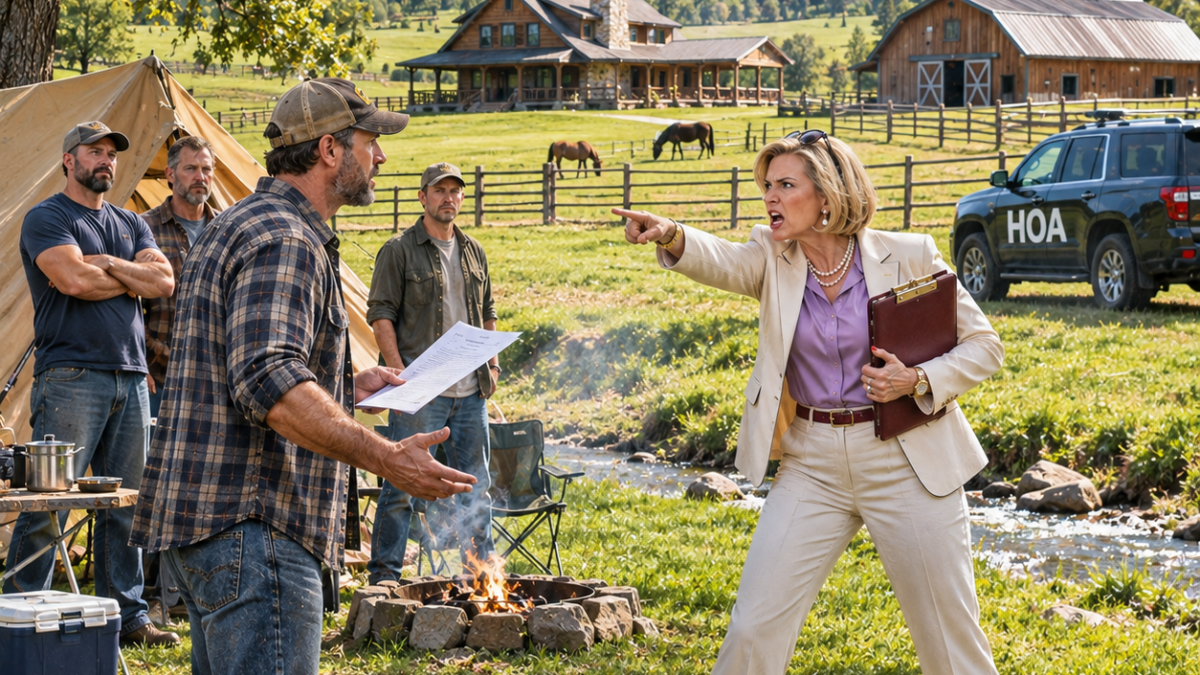
The first morning I camped on the forty acres my friends and I had just bought, a woman I had never met marched across the pasture, planted herself beside our fire pit, and ordered us to pack everything because, according to her, my own deed mattered less than the fact that her family had been walking across the land for twenty years.
When I calmly told her we were the legal owners and offered to show her the recorded county paperwork, she refused to look at it, threatened to call the sheriff, and shouted that we were destroying “community hiking land” even though there was no HOA, no public trail, no easement, and nothing on the property except grass, a creek, trees, and four stunned men wondering how our first peaceful camping trip had somehow become a territorial war.
What worried me most wasn’t how loudly she yelled—it was the absolute certainty in her face when she promised that ownership wouldn’t matter once “the community” got involved, because she spoke like someone who had spent years turning everybody else’s silence into proof that she was in charge.
We had spent six months looking for that land.
Not a subdivision lot. Not a vacation rental. Not a polished resort property with neighbors twenty feet away.
We wanted space.
Forty acres finally appeared in an online listing: rolling pasture, a narrow creek cutting through the middle, scattered woods, and one enormous oak standing near the center like it had been waiting for somebody to build a life around it.
Three friends and I pooled our money.
We made an offer the next day.
Two weeks later, the deed was recorded.
That first drive in felt unreal.
Jeff sat beside me staring through the windshield while Sam leaned forward from the back seat.
“Guys,” Jeff said, “we’re either going to build something incredible here or die trying.”
“Comforting,” Sam replied.
We laughed.
For the first hour, nothing existed except the land.
We unloaded tents, coolers, fishing rods, folding chairs, and enough food to survive twice as long as we planned to stay. We built our camp beneath the oak, cracked open cold drinks, and listened to the creek.
Then a voice ripped across the field.
“HEY!”
We all turned.
A woman in sunglasses was marching toward us from a house near the far boundary.
Hands on hips.
Fast steps.
Zero hesitation.
“What do you think you’re doing?”
I stood.
“Camping.”
“Not here you’re not.”
I glanced around.
“Why?”
“This is private property.”
I nodded.
“Yes.”
She blinked.
Then pointed at us.
“So leave.”
Jeff covered his mouth.
I said, “Ma’am, we own it.”
Her expression became strangely offended.
“No, you don’t.”
“We bought it last week.”
“That’s impossible.”
“I’ve got the deed in the truck.”
“I don’t want to see fake paperwork.”
That was the first moment I understood logic wasn’t going to help quickly.
She told us she knew the previous owner personally. Her family had hiked the property for two decades. They had picnicked along the creek, crossed the pasture, and used the hill behind the oak.
Therefore, in her mind, the land somehow still belonged to them emotionally.
I tried once more.
“The seller accepted our offer. The transfer was recorded with the county.”
“You tricked him.”
“We paid his asking price.”
“You’re strangers.”
“We’re the owners.”
She stepped closer.
“If you don’t leave, I’m calling the sheriff.”
Jeff muttered behind me, “That might actually save us time.”
I nearly smiled.
“Call him.”
Her mouth dropped open.
“You’ll regret this.”
She spun around and stormed toward her house, shouting something about criminals and “her trails.”
We watched her go.
Sam stared after her.
“Did we accidentally buy land inside an invisible HOA?”
We laughed then.
We shouldn’t have.
That evening, Karen stood at the boundary watching us around the fire.
She didn’t speak.
She just stared.
The next morning, I woke to hard knocking against the side of the camper.
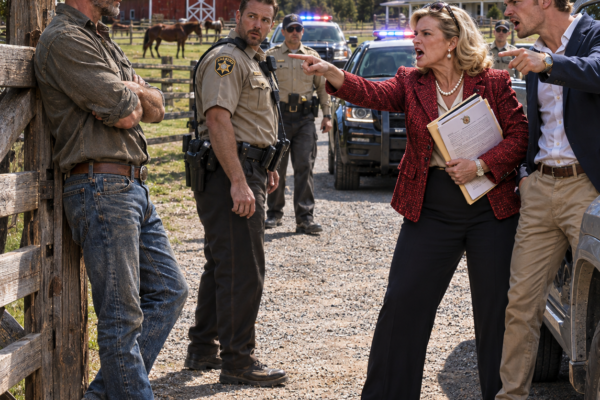
When I opened the door, a sheriff’s deputy stood outside with one hand resting on his belt.
“Morning,” he said.
Behind him, across the field, Karen stood with her arms folded and a smile on her face.
“We received a trespassing complaint.”
I looked at Karen.
Then at the deputy.
Then I reached for the folder containing our deed.
And before I handed it to him, Karen shouted from across the pasture:
“Don’t believe anything they show you.”
PART 2
The deputy looked over his shoulder at Karen.
Then back at me.
His expression told me this wasn’t the first time he had heard her voice before breakfast.
“Go ahead,” he said.
I handed him the folder.
Purchase contract.
Recorded deed.
County parcel map.
Closing paperwork.
Everything.
He flipped through the pages carefully.
Jeff stepped out behind me carrying coffee.
Sam followed.
Nobody joked.
The deputy reached the final page, looked toward the property lines, and nodded.
“All right.”
Karen started walking toward us.
“What?”
The deputy turned.
“Ma’am, they own the property.”
She stopped.
“No.”
“They do.”
“That paperwork is fake.”
“It matches county records.”
“They manipulated the seller.”
“Do you have evidence of that?”
“He would never sell.”
“That isn’t evidence.”
Karen’s face tightened.
“My family has used this property for twenty years.”
The deputy looked toward me.
“Was there an easement disclosed?”
“No.”
He looked back at her.
“Do you have a recorded access easement?”
Her mouth opened.
Closed.
“That’s not the point.”
“It actually is.”
She pointed toward the creek.
“We have trails.”
I looked over.
There was no marked trail.
Just grass flattened in places where people had apparently been walking for years.
The deputy sighed.
“Ma’am, recreational use doesn’t automatically give you ownership.”
“We’ve always come here.”
“And now someone else owns it.”
Karen’s cheeks reddened.
“You can’t let outsiders take over.”
Jeff looked at me.
I shook my head slightly.
Don’t.
The deputy handed me the papers.
“You gentlemen are fine.”
“Thank you.”
He turned toward Karen.
“And I’m warning you. Stop making false trespass reports against the legal owners.”
Her eyes widened.
“I was protecting the community.”
“From what?”
She looked at our campsite.
“Trespassers.”
The deputy stared at her.
“They’re not trespassing.”
She said nothing.
He wished us a good day.
Then drove away.
Karen remained standing in the field.
Her fists were clenched.
“You think that proves something?”
I stared.
“It proves exactly what we’ve been telling you.”
“The sheriff doesn’t understand the history here.”
“Apparently the county recorder doesn’t either.”
“This is not funny.”
“No.”
I became more serious.
“It isn’t.”
I pointed toward her property.
“Go home.”
Her eyes sharpened.
“You don’t tell me what to do.”
“On my property, I absolutely tell you when to leave.”
That landed.
She looked around as though somebody might appear and overrule me.
Nobody did.
Finally she turned.
But before she left, she looked back.
“This isn’t over.”
Jeff waited until she was fifty yards away.
Then he said:
“She is definitely going to make this worse.”
He was right.
By breakfast the following morning, Karen returned.
This time she brought two women with her.
They followed several feet behind like backup singers in an extremely angry band.
Karen stopped beside our fire pit.
“Sheriff or not, the community has rights.”
I put my coffee down.
“What community?”
“All the families around here.”
“What rights?”
“Generational recreational access.”
“Show me where that’s recorded.”
One of the women said:
“We don’t need paperwork for tradition.”
“Yes, you do if you’re claiming a legal right to my land.”
Karen folded her arms.
“We held a discussion this morning.”
Jeff asked:
“Where?”
“Online.”
Sam whispered:
“Oh, good. Facebook law.”
Karen ignored him.
“The community agrees unanimously that your camping is disruptive.”
“How many people voted?”
“That isn’t important.”
“How many?”
Her jaw tightened.
“People are concerned.”
Jeff said:
“That’s not a number.”
Karen pointed at him.
“You need to watch your attitude.”
“I’m camping.”
“You’re destroying preserved walking paths.”
I looked at the grass.
“Which path?”
She pointed vaguely.
“That one.”
“Where?”
“Right there.”
I saw nothing.
Sam said:
“Is it invisible?”
One of the women gasped.
Karen’s face turned bright red.
“This is exactly the disrespect I’m talking about.”
I stood.
“Karen, listen carefully. You’re on privately owned land. You have no easement. There is no HOA. There is no board. There is no public hiking designation. You need to leave.”
Her voice dropped.
“You boys pack up today, or I’m going to make things very difficult.”
I stared at her.
“Is that a threat?”
Her smile was thin.
“It’s a promise.”
Then she walked away.
Twenty minutes later, Animal Control arrived.
The officer stepped out holding a clipboard.
“We received a report of illegal trapping.”
I looked at Jeff.
Jeff looked at Sam.
Sam looked at the empty field.
I said:
“We haven’t trapped anything.”
“Mind if I look?”
“Go ahead.”
He walked around the campsite.
Checked the creek.
Looked through the nearby grass.
Nothing.
When he returned, he sighed.
“You’re clear.”
Jeff said:
“Was the caller Karen?”
The officer hesitated.
Then gave us the expression of a man who had already lost whatever argument he was supposed to protect confidentially.
“She has contacted our office before.”
“How many times?”
“Enough.”
He left.
An hour later, a game warden showed up.
Illegal hunting complaint.
We had no guns.
No traps.
No animal carcasses.
Only fishing poles.
He looked around.
“You guys have licenses?”
We showed him.
He nodded.
“Have a good trip.”
Before lunch, another deputy came up.
Same trespassing issue.
This one barely reached our camp before saying:
“Karen again?”
I raised my hands.
“You tell me.”
He rubbed his forehead.
“I’ll speak with her.”
Jeff grabbed a Sharpie after he left.
On the cooler lid, he wrote:
**ANIMAL CONTROL: 1
GAME WARDEN: 1
SHERIFF: 2
KAREN MELTDOWNS: ∞**
That part was funny.
For a while.
But by the fourth day, the constant interruptions started wearing on us.
We had bought the land because each of us needed somewhere to disconnect.
Jeff worked in IT and had spent two years answering emergency calls at ridiculous hours.
Sam managed construction crews and seemed permanently one phone vibration away from a migraine.
I had been living the same routine for nearly a decade—work, traffic, bills, sleep, repeat.
The land was supposed to become the opposite of all that.
Quiet.
Something permanent.
A place built with our own hands.
Karen seemed determined to turn it into another workplace.
Every morning she appeared.
Every afternoon some agency received a complaint.
Every evening she stood at the boundary.
But the land kept pulling us back toward why we’d bought it.
We fished.
We cooked.
We jumped into the creek once and immediately regretted it.
We hung hammocks beneath the oak.
We sat around the fire after dark and talked about things men who have known each other for years still somehow avoid talking about when life is moving too quickly.
Work.
Parents getting older.
Money.
What we wanted the next ten years to look like.
On the fifth morning, Karen arrived carrying papers.
Jeff looked up.
“She brought paperwork.”
“That could be dangerous,” Sam said.
Karen stopped in front of me.
“I have spoken to the community board.”
I stared.
“The what?”
“The community board.”
“There is no community board.”
“We have a Facebook group.”
Jeff coughed.
I think he was covering laughter.
Karen shoved the papers toward me.
“They voted unanimously that you must vacate within twenty-four hours.”
I took the packet.
There were typed statements.
Names.
A list of supposed violations.
“Unapproved camping.”
“Damage to heritage trails.”
“Environmental disruption.”
“Declining rural character.”
I looked up.
“Karen, none of this has legal authority.”
“It has community authority.”
“That’s not a thing.”
“You don’t understand how long we’ve protected this valley.”
“From whom?”
“People like you.”
That irritated me more than I expected.
“People who buy property?”
“Outsiders.”
“We didn’t steal it.”
“You’re changing it.”
“We’ve been here five days.”
“And look what you’ve done.”
She pointed toward our tents.
I looked at them.
“Camped?”
“You’ve displaced wildlife.”
“There are deer eating fifty yards behind you.”
She spun.
Two deer stared at us.
One kept chewing.
Jeff said:
“They seem devastated.”
Karen turned back.
“You have twenty-four hours.”
I handed her papers back.
“No.”
Her eyes widened.
“No?”
“No.”
“You’re refusing a community order?”
“I’m refusing something you printed.”
She snatched the pages from me.
“You’ll regret this.”
Then she walked away.
We watched.
Sam flipped a burger on the grill.
“Guys.”
“What?”
He looked around.
“Why are we just camping?”
I frowned.
“What do you mean?”
“We own forty acres.”
“Correct.”
“We keep talking about how much we like it.”
“Yes.”
“So why not build something?”
Jeff looked up.
“What?”
“Cabins.”
Sam pointed toward the creek.
“One over there. Maybe another near the oak. A real fire pit. Porch. Storage shed.”
He smiled.
“Turn this into a ranch.”
Nobody said anything for several seconds.
Then Jeff leaned forward.
“That would be incredible.”
The idea hit me differently.
We had bought land because it was affordable and beautiful.
We hadn’t agreed on a permanent plan yet.
Maybe this was it.
A retreat.
A ranch.
Somewhere our families could use someday.
Somewhere our kids could come.
Maybe horses eventually.
A workshop.
Fishing.
A place that became more valuable emotionally every year.
I looked across the pasture.
The oak.
The creek.
The hill.
Then I imagined a porch.
Sam saw my expression.
“You see it.”
“I do.”
Jeff grinned.
“We’re doing it.”
We spent the next hour talking.
Not serious architectural plans yet.
Just possibilities.
Cabins.
Road improvement.
Water.
Septic.
Power.
Permits.
Then Karen appeared.
She had apparently been watching.
“Front porch?”
Jeff looked at me.
I looked at her.
“Excuse me?”
“I heard you.”
She walked closer.
“You’re building?”
“Thinking about it.”
“No.”
The word came out almost frightened.
Sam raised an eyebrow.
“No?”
“You can’t.”
“Why?”
“This land is protected.”
“By what?”
“It’s a natural reserve.”
“No, it isn’t.”
“A hiking sanctuary.”
“No.”
“My family has been coming here for twenty years.”
“That still doesn’t make it yours.”
Her breathing changed.
She paced.
“You cannot build here.”
“We can if county rules allow it.”
“I forbid it.”
Jeff laughed.
“You forbid it?”
She spun toward him.
“Yes.”
He looked around.
“Did we accidentally buy a medieval kingdom?”
“Shut up.”
I stepped between the conversation.
“Karen, if the county says we can build, we’re building.”
Her eyes met mine.
“I swear I will stop you.”
Then she walked away.
Sam flipped another burger.
“Well.”
Jeff smiled.
“Now we definitely have to build.”
I laughed.
But the idea had stopped being a joke.
The following morning, we drove into town.
County planning office.
Survey copies.
Building requirements.
Setbacks.
Septic information.
Water access.
Fire rules.
Environmental restrictions.
We asked questions.
A lot of them.
The property wasn’t some unrestricted fantasyland.
There were codes.
Permits.
Responsibilities.
Exactly as there should be.
But nothing prevented residential or ranch development within the applicable rules.
The county planner looked at the parcel map.
“Forty acres?”
“Yes.”
“Plenty of room.”
“Any public trails?”
“No.”
“Protected habitat?”
“Not according to our mapping, though you’ll still need standard reviews depending on what you build.”
“Creek restrictions?”
“Yes. Maintain setbacks and don’t alter the watercourse without authorization.”
We wrote everything down.
By lunch, we understood something important.
Karen was wrong about nearly everything.
But her obsession had accidentally forced us to do our homework early.
That would matter later.
We bought stakes.
Survey flags.
Measuring equipment.
When we returned, Karen stood at the boundary wearing pajama pants and a robe.
“What are those?”
“Markers.”
“No.”
I kept walking.
“Absolutely not.”
She crossed onto the property.
Then grabbed one.
“Karen.”
She pulled.
The marker snapped.
She froze.
I stared at the broken piece in her hand.
“Put it down.”
“You are not building.”
“You just damaged property.”
“It shouldn’t be here.”
“You shouldn’t be here.”
She threw the broken stake.
“You city rats think you can buy everything.”
Sam stopped measuring.
“Actually, in this particular case, yes. We literally bought it.”
“Shut up!”
Her voice echoed over the pasture.
“You’re infecting this place.”
That word changed the mood.
Infecting.
I looked at her.
“Go home.”
She shook her head wildly.
“This is mine.”
“No.”
“It always has been.”
“No.”
“It always will be.”
Something in her expression caught my attention.
Not simple anger.
Pain.
Real pain.
Then it vanished beneath rage.
She turned.
Walked back to her house.
Sam looked at me.
“She actually believes that.”
“Yeah.”
Jeff picked up another marker.
“Doesn’t make it true.”
“No.”
But it explained something.
Not enough.
Just something.
Two days later, Karen arrived with seven people.
Clipboards.
Binoculars.
One man in a reflective vest.
Jeff looked at the group.
“Did she create a government overnight?”
Karen stopped beside the campsite.
“We are here to conduct an inspection.”
“Of what?”
“The property.”
“No.”
The woman beside Karen adjusted her clipboard.
“We’re the Community Preservation Committee.”
Sam whispered:
“That definitely didn’t exist yesterday.”
Karen ignored him.
“We’re investigating ecological damage.”
“You have no inspection authority.”
“We filed a petition.”
“For what?”
“To designate this property as community recreational land.”
I stared.
“You petitioned the county to take private land because you like walking on it?”
“We’re protecting tradition.”
“Did the county approve anything?”
“They’re reviewing it.”
“So no.”
Karen walked toward our fire ring.
“This is too large.”
“Leave.”
She ignored me and moved toward the creek.
“What is that?”
Jeff looked genuinely confused.
“Water?”
“The fishing equipment.”
“We fish.”
“You’re disrupting the ecosystem.”
“With legal fishing licenses.”
One of her group members scribbled something.
I laughed.
Not because it was funny anymore.
Because it had become absurd enough that anger had nowhere to land.
“Everybody off the property.”
Karen turned.
“You can’t order a community committee away.”
“Yes.”
I pointed.
“Watch.”
She refused.
So I called the sheriff.
I didn’t threaten.
I simply dialed.
That worked.
Her committee began retreating before I finished giving dispatch the address.
Karen stayed until the last possible second.
“You’re escalating this.”
I looked at her.
“Karen, you brought seven people onto land you don’t own to perform a fake inspection.”
She opened her mouth.
I continued.
“I am calling the real authority.”
She left.
Later that afternoon, county environmental health arrived because Karen had accused us of dumping chemicals into the creek.
The inspector looked around.
No chemicals.
No dumping.
No contamination.
He asked:
“Who’s making these complaints?”
All of us answered:
“Karen.”
He sighed.
“Document everything.”
An hour later, code enforcement arrived.
Unauthorized construction.
There wasn’t any construction yet.
The officer stared at our tents.
“That’s it?”
“That’s it.”
He shook his head.
“Have a good evening.”
Jeff updated the cooler.
**ENVIRONMENTAL HEALTH: 1
CODE ENFORCEMENT: 1**
Then he wrote:
**PATIENCE: DECLINING**
That night, we caught Karen hiding behind bushes with two men carrying cameras.
“Karen,” I called.
She stepped out.
“I am conducting community surveillance.”
“You’re trespassing.”
“We’re documenting offenses.”
“What offenses?”
She pointed at the grill.
“Open flame.”
“In an approved fire ring.”
“Outside recreational hours.”
“According to whom?”
“Me.”
The answer came without hesitation.
I stared at her.
“You don’t run anything here.”
That finally cracked her.
“You’re ruining everything!”
“We’re eating hamburgers.”
“You don’t belong here.”
“We own it.”
“Stop saying that!”
Her voice broke.
Not figuratively.
It actually broke.
She pointed at me with a shaking hand.
“I will stop you.”
Then she walked away.
That was the night I stopped thinking of Karen as merely ridiculous.
Something deeper was happening.
And deep emotions mixed with entitlement can become dangerous.
The next morning we met with a local builder.
Daniel Reyes.
He brought Emilio Cruz, his foreman.
We walked the site.
Discussed two modest cabins.
One first.
The second later.
Septic.
Water.
Foundation.
Setbacks.
Access road.
Daniel pointed toward the oak.
“Don’t build too close. Roots are probably wider than the canopy.”
I liked him immediately.
He cared about the land without pretending caring meant leaving everything untouched forever.
We submitted applications.
The county reviewed them.
We adjusted plans.
Nothing magical.
Nothing instant.
The source of Karen’s frustration became even stranger because construction wasn’t something we could simply begin on a whim.
There were approvals.
Inspections.
Timelines.
The first phase eventually cleared.
When the lumber delivery arrived, Karen nearly ran out of one slipper.
She charged toward us.
“What is that?”
Jeff looked at the truck.
“Wood.”
“I know it’s wood!”
“You asked.”
“Why is it here?”
“We’re building.”
Her face drained.
“No.”
“Yes.”
She turned toward the delivery driver.
“You cannot unload.”
He checked his paperwork.
“This is the address.”
“It’s illegal.”
Daniel walked over.
“We have authorization for the work we’re starting.”
Karen pointed at him.
“If you touch this land, I’ll sue you.”
Daniel looked at me.
I shrugged.
He looked back at her.
“Ma’am, are you the owner?”
“Yes.”
I said:
“No.”
She glared.
“This land belongs to the community.”
Daniel rubbed his beard.
“County records say these guys own it.”
“County records don’t understand.”
“That’s usually what records are for.”
Emilio almost smiled.
Karen looked at the lumber.
Then at the stakes.
Then the creek.
“You’re destroying it.”
“We haven’t even started.”
“You’re going to.”
I stepped closer.
“Karen, we’re building legally. We plan to protect the creek and oak. We’re not leveling forty acres. We’re putting up a cabin.”
“You’ll ruin the view.”
“From your house?”
“Yes!”
Finally.
The truth slipped out.
She looked toward her property.
Her home sat near the boundary with a clear view across our pasture.
For years, she had looked across land she didn’t own and treated the view as though it belonged to her.
I said:
“You don’t own our view.”
Her mouth tightened.
“You’ll regret this.”
She left.
By afternoon, she returned with five cars.
Her supporters climbed out.
Greg, a man in cargo shorts, introduced himself.
“President of the Community Preservation Network.”
Jeff whispered:
“Facebook group.”
Greg puffed his chest.
“We intend to seek an injunction.”
“Have you filed one?”
“We’re preparing.”
“On what grounds?”
“Environmental harm.”
Daniel looked around.
“We haven’t disturbed anything outside approved work.”
Greg ignored him.
“We demand you cease.”
“No.”
Karen smiled.
“Then you’ll suffer consequences.”
They staged a protest.
Folding chairs.
Homemade signs.
**SAVE OUR TRAILS**
**NO CABINS ON SACRED LAND**
**STOP THE BUILDERS**
One sign said:
**PROTECT KAREN’S TRAIL**
Jeff took a photograph.
“For historical purposes.”
Karen shouted through a megaphone.
The contractors kept working.
When the first structural post went up, Karen screamed.
Not figuratively.
Actually screamed.
“You’re violating the valley!”
Daniel checked the post for level.
Emilio tightened a brace.
The protest lasted three hours.
Then people got hot.
Hungry.
Bored.
One woman left.
Then another.
Greg made a phone call and disappeared.
Karen remained until nearly sunset.
She stood staring at the post.
That one piece of wood seemed to mean something enormous to her.
Permanence.
She had spent days acting as though she could wait us out.
The post said otherwise.
That evening, we sat beneath the oak.
Sam said:
“You think this is really a ranch?”
“Eventually.”
“With horses?”
“Maybe.”
Jeff grinned.
“I’m buying a cowboy hat.”
“You’re banned.”
“You can’t ban an owner.”
“I’ll create a Facebook board.”
He laughed.
For the first time in days, the future felt exciting again.
Then Karen returned.
No megaphone.
No followers.
She walked slowly.
Her eyes were red.
She stopped near the construction line.
“You’re really doing it.”
I nodded.
“Yes.”
She looked at the creek.
Then the oak.
Then our half-started structure.
“This was my place.”
Her voice was so quiet I barely recognized her.
“What do you mean?”
“My family came here every weekend.”
I said nothing.
“My kids learned to walk in that creek.”
She pointed.
“My husband put a rope swing on that oak.”
I looked up.
There was an old scar on one branch.
I had noticed it.
Never wondered why.
She continued.
“We had picnics on that hill.”
Her voice cracked.
“My husband died four years ago.”
That was new.
None of us spoke.
Karen wiped her eyes angrily.
“The old owner never cared if we came here.”
“Did he give you permanent permission?”
“He said we were welcome.”
“When?”
“Years ago.”
“That isn’t ownership.”
Her face tightened.
“I know what ownership is.”
“Then why are we fighting?”
She looked at me.
“Because you showed up and took it.”
“We bought it.”
“You took it.”
“Karen.”
“You don’t understand.”
I stepped closer, but kept distance.
“No. I probably don’t.”
That surprised her.
I continued.
“I didn’t know about your husband. I didn’t know your family had memories here.”
Her breathing steadied slightly.
“But that doesn’t mean we can give you authority over the land.”
Her jaw tightened.
“So that’s it?”
“What do you want me to do?”
“Stop building.”
“No.”
The softness vanished.
“You see?”
She pointed at me.
“You don’t care.”
“That isn’t fair.”
“You care more about your cabins than everything my family had.”
I felt my sympathy shrinking.
“Your memories don’t require us to leave forty acres empty forever.”
She looked at me like I’d insulted the dead.
“This land should stay exactly the way it was.”
“Then you should have bought it.”
The words came out gently.
They still hit hard.
She inhaled.
Her face crumpled for one second.
Then rage covered it.
She walked away.
Jeff exhaled.
“I almost felt sorry for her.”
“So did I.”
Sam looked toward the old swing scar.
“Still do, a little.”
I did too.
That made everything harder.
People are easier to hate when they make no emotional sense.
Karen made sense now.
She had mistaken repeated access for belonging.
Belonging for ownership.
Grief for entitlement.
The next morning, a man in a suit arrived.
Richard Hall.
Attorney.
He presented a formal-looking packet.
Karen was seeking an injunction.
I read it.
No filed case number.
No judicial signature.
No order.
Just notice that his client intended to seek relief.
“These aren’t court orders.”
“They are legal notices.”
“Meaning?”
“My client requests voluntary cessation of construction pending review.”
“No.”
He blinked.
“Excuse me?”
“No.”
“She has documented historic recreational use.”
“That doesn’t automatically create ownership.”
“She may have claims.”
“Then file them.”
Richard studied me.
“You’re confident.”
“We’ve spoken with the county.”
“My client believes your project threatens community interests.”
“There is no community ownership interest.”
He glanced toward the cabin frame.
“You understand litigation can become expensive.”
“That sounds like a threat.”
“It’s advice.”
I nodded.
“Here’s mine. Don’t bring documents onto my land and imply they’re court orders if they’re not.”
He stiffened.
“I did no such thing.”
“Good.”
I handed the packet back.
“If she files something real, send it to our attorney.”
That last sentence was partially bluff.
We didn’t have one yet.
By the end of the day, we did.
Her name was Rachel Bennett.
Property lawyer.
She reviewed our deed, county records, permits, Karen’s petition, Richard’s notice, and the alleged historic access.
Rachel’s conclusion was simple.
“Do not antagonize her.”
Jeff looked disappointed.
“Define antagonize.”
“Don’t destroy trails just because she calls them trails. Don’t block lawful roads. Don’t threaten her. Don’t touch anything on her property. Don’t post humiliating videos online.”
Jeff put his phone away.
Rachel looked at me.
“And document every trespass.”
“We already are.”
“Good.”
“What about her historical-use claim?”
“She may attempt to argue prescriptive rights, but the facts matter. Permission usually undermines hostile-use requirements, and you haven’t shown me a recorded public easement. Don’t debate it with her. Let me handle it if she files.”
That advice changed how we behaved.
No more jokes to her face.
No more verbal sparring.
No more letting Jeff improvise legal commentary.
We worked.
She yelled.
We recorded.
That drove her crazier than anything.
County land-use officer Dale Mercer came after another complaint.
He was nearly sixty.
Weathered.
Patient.
Karen had accused us of redirecting the creek and destroying protected vegetation.
Dale inspected.
Nothing.
He reviewed our permit packet.
Fine.
He looked at the creek.
Untouched.
He looked at our construction area.
Within approved limits.
“You’re good.”
I thanked him.
Before leaving, he paused.
“Karen has called our office for years.”
“About this property?”
“About everything.”
“Everything?”
“Fence heights. Smoke. Dogs. People fishing. Tree branches.”
Jeff asked:
“Tree branches?”
Dale smiled.
“Leaf patterns once.”
Jeff looked at me.
“I’m retiring.”
Dale laughed.
“Document everything. Don’t get pulled into arguments.”
Then he drove away.
By afternoon, the first cabin frame was rising.
Posts.
Joists.
Floor structure.
The beginnings of walls.
I stood where the porch would be.
The creek glittered below.
Sam joined me.
“This is better than I pictured.”
“Same.”
“Think we’ll actually finish?”
I looked toward Karen’s house.
“Yes.”
He smiled.
Then we heard her scream.
She ran across the pasture.
Full sprint.
“You can’t!”
She arrived breathing hard.
“You can’t do this.”
I said nothing.
She pointed at the frame.
“Those are illegal.”
Daniel answered.
“They’re permitted.”
“No.”
“Yes.”
She pulled out her phone.
“I’m calling the state.”
Sam whispered:
“Which state? Emotionally?”
I kicked his boot.
He shut up.
Karen called somebody.
The person on the other end apparently asked whether the construction was occurring on her property.
Her response told us everything.
“No, it’s on theirs.”
Pause.
Then:
“But that’s not the point!”
She hung up.
“I won’t let you win.”
I spoke quietly.
“Karen, there isn’t supposed to be a winner.”
“Yes, there is.”
“No.”
I gestured around.
“We bought land. We’re building according to law. You don’t have to like it.”
“You’re destroying everything.”
“Look around.”
She did.
I pointed toward the creek.
“Still there.”
The oak.
“Still there.”
The pasture.
“Still here.”
The woods.
“We’re not clear-cutting them.”
I looked at her.
“The only thing being destroyed right now is everyone’s peace.”
Her eyes filled.
“This was mine.”
I answered gently.
“No.”
She flinched.
Then:
“Then it should have been.”
That sentence told me the truth.
She wasn’t fighting over environmental protection.
Not really.
She was fighting a decision she wished she’d made years earlier.
Maybe she had assumed the old owner would never sell.
Maybe she thought informal access would last forever.
Maybe she couldn’t afford the land.
Maybe after her husband died, she couldn’t imagine someone else changing the place attached to her memories.
I understood all of that.
I still couldn’t surrender our property because she wished reality had turned out differently.
She left.
For the rest of the day, the frame rose.
That evening, a group wearing matching polo shirts appeared.
**VALLEY UNITED NEIGHBORHOOD WATCH**
Jeff looked at the logo.
“Community powered since 2021.”
He whispered:
“I bet Karen designed that.”
Their leader announced they had received complaints.
“From who?”
He looked at Karen.
I nodded.
“Okay.”
They tried to conduct “oversight.”
I declined.
They threatened reports.
I gave them Rachel’s contact information.
They left.
Karen stayed.
“You think a lawyer makes you powerful?”
“No.”
“What then?”
“The deed.”
She hated that answer.
The next morning Karen returned with an army.
Cars.
SUVs.
Signs.
Clipboards.
A megaphone.
At least a dozen people.
Some looked committed.
Others looked confused.
One older man asked:
“Karen, didn’t the owner sell it?”
“He was coerced.”
I said:
“We paid asking price.”
Another woman asked:
“Didn’t the county approve the building?”
“They made a mistake.”
Dale had worked there thirty years.
Somebody pointed that out.
Karen called him incompetent.
Her own supporters began looking uncomfortable.
Then Daniel arrived with the updated permit packet.
Karen blocked him.
“You cannot work.”
He held up the papers.
“Ma’am, these are county approvals.”
Her face fell.
“You what?”
“Work authorization. Inspections scheduled. Everything.”
“No.”
Daniel stepped around her.
She stepped back in front.
“No.”
“Please move.”
“This land is protected.”
“By who?”
“Me.”
Daniel looked at me.
I called the sheriff.
I didn’t wait.
Karen heard.
She moved into the cabin footprint.
Spread her arms.
“If you build, you build over my dead body!”
Emilio sighed.
“Ma’am, please don’t do that.”
Karen dropped to her knees.
Several supporters gasped.
Two joined her.
One man immediately walked away.
Another got into his car.
The sheriff arrived ten minutes later.
Same deputy from our first morning.
He stepped out.
Karen jumped up.
“Arrest them.”
“Ma’am.”
“They’re building illegally.”
“We checked.”
“No.”
“Yes.”
“They are destroying a public area.”
“No, ma’am.”
Her supporters listened.
The deputy continued.
“They own the property. Their permits are valid. You have been repeatedly advised not to trespass.”
Karen looked around.
Her audience was shrinking.
She pointed at me.
“You see what he’s doing?”
The deputy said:
“What he’s doing is building on his own land.”
“You don’t understand.”
“I understand enough.”
She lowered her voice.
“This is our valley.”
“It’s everybody’s valley.”
He pointed toward the ground.
“But this parcel is theirs.”
Something in her expression broke.
“You can’t do this.”
I stepped forward.
“We’re not trying to hurt you.”
She laughed bitterly.
“You’re erasing my family.”
“No.”
Her eyes filled.
“You are.”
I hesitated.
Then said:
“Karen, if you want, when the project is finished, we can talk about preserving the old swing tree.”
Everyone went quiet.
Even Jeff looked at me.
Karen stared.
“Why?”
“Because your husband put it there.”
She swallowed.
For one second, I thought that might matter.
Then pride returned.
“I don’t want permission to visit my own memories.”
“It isn’t permission to have memories.”
“You don’t get it.”
“Maybe not.”
She backed away.
Then got into her SUV and left.
Her supporters scattered.
No cheering.
No celebration.
The scene felt sad.
That evening we worked quietly.
I looked at the oak.
The scar from the rope.
I decided then that whatever we built, the tree stayed.
Not for Karen.
For the land.
Maybe also a little for the people who had loved it before us.
Construction continued.
Then Karen disappeared for a full day.
That worried me more than her yelling.
No binoculars.
No SUV.
No complaints.
Jeff said:
“She finally quit.”
Sam shook his head.
“No.”
I agreed.
“She’s planning something.”
The next morning confirmed it.
I was walking toward the creek when Jeff shouted.
Not joking.
Not laughing.
“COME HERE!”
I ran uphill.
He pointed toward Karen’s side.
A large orange bulldozer sat near the ridge.
Facing us.
Facing the cabin.
My stomach tightened.
Daniel stopped working.
Emilio lowered his saw.
Sam whispered:
“No.”
Karen stood beside the machine.
Then climbed into the cab.
“Where did she get that?” Jeff asked.
I didn’t know.
It didn’t matter.
She started the engine.
The roar rolled across the valley.
“Karen!”
She looked toward us.
I started running.
“TURN IT OFF!”
She grabbed the controls.
The bulldozer moved.
Slowly at first.
Then faster.
Straight toward the cabin.
Daniel shouted:
“Everybody move!”
Emilio ran.
Sam sprinted toward the work area.
Jeff moved to the side, waving both arms.
I kept running toward Karen.
“STOP!”
Her face was visible through the cab.
She was crying.
Actually crying.
But the machine kept moving.
She screamed over the engine:
“If you won’t stop, I will!”
The bulldozer crossed the boundary.
Forty thousand pounds of steel entered our property.
That changed everything.
This was no longer harassment.
No petition.
No megaphone.
No stupid flyer.
People could die.
The blade hit a stack of lumber.
Boards exploded outward.
Daniel dove away.
Sam grabbed Emilio and pulled him clear.
The machine kept coming.
Fifty feet.
Forty.
Thirty.
I ran along the side, staying away from the tracks.
“Karen!”
She looked toward me.
For one second, our eyes met.
There was fear in hers.
I saw it.
She knew.
Some part of her knew she had gone too far.
“Stop!”
Her hand moved.
I thought she was braking.
Instead, the bulldozer accelerated.
“NO!”
Then sirens sounded.
Close.
Two cruisers came around the bend.
Later we learned one of Karen’s own former supporters had seen the bulldozer and called 911 before she crossed the property line.
Karen looked toward the lights.
Panicked.
Her hands jerked across the controls.
The bulldozer turned violently.
The blade dug into the ground.
A trench opened.
The machine tilted sideways.
Karen screamed.
The engine roared.
Then the bulldozer dropped into soft earth and stopped at an angle.
Six feet from the cabin structure.
Six.
Daniel told me later.
He measured.
Six feet.
The deputies jumped out.
“TURN IT OFF!”
Karen fumbled.
Wrong control.
The machine lurched.
“TURN IT OFF NOW!”
Finally the engine died.
Silence.
Dust drifted through the air.
Lumber lay scattered behind us.
A trench scarred the pasture.
Nobody moved for a second.
Then everyone started talking at once.
“You okay?”
“Daniel?”
“Emilio?”
“Sam?”
“I’M GOOD.”
“Jeff?”
“Good.”
I looked toward the cabin.
Standing.
Karen climbed down badly and nearly fell.
A deputy caught her arm.
She began sobbing.
“You can’t let them build.”
“Ma’am.”
“They’re ruining everything.”
“You almost hit people with heavy equipment.”
“It was mine.”
“The bulldozer?”
“No!”
She pointed at the land.
“This!”
The deputy’s voice softened but stayed firm.
“No. It isn’t.”
She shook her head violently.
“It was my family.”
“I understand you’re upset.”
“My husband—”
Her voice collapsed.
“My kids—”
She covered her face.
Nobody laughed.
Nobody made a joke.
Even Jeff was silent.
She looked toward the oak.
“My husband built that swing.”
I felt something tighten in my chest.
Then I looked at the scattered lumber.
At Daniel.
At Sam.
At six feet.
Sympathy has limits.
Almost killing people is one.
The deputy placed her under arrest.
She didn’t fight.
As she walked toward the cruiser, she looked back at me.
“I just wanted it to stay the same.”
I didn’t answer immediately.
Then:
“Nothing stays the same forever.”
She cried harder.
The cruiser door closed.
The bulldozer was later identified as borrowed without proper authorization from a landscaping business connected to one of Karen’s acquaintances.
That created additional problems for her.
For us, there were photographs.
Statements.
Damage estimates.
Legal calls.
Insurance.
Police reports.
The bulldozer incident turned what had been a ridiculous neighbor conflict into a serious criminal case.
Rachel called that afternoon.
“Stop construction until the site is cleared by investigators.”
“We will.”
“Do not touch the bulldozer.”
“We won’t.”
“Do not talk to Karen.”
“She’s in custody.”
“Good.”
There was a pause.
“You okay?”
I looked at the cabin.
“Ask me tomorrow.”
That evening, after investigators left, the four of us sat beneath the oak.
No fire.
No jokes.
Jeff spoke first.
“That was close.”
“Yeah.”
Sam stared at his hands.
“I thought Daniel was going under the blade.”
Daniel had already gone home.
So had Emilio.
I looked toward the structure.
For the first time, I wondered whether building the ranch had become foolish.
Not because Karen was right.
Because people I cared about had almost been hurt.
“We can stop.”
Jeff looked at me.
“What?”
“We don’t have to prove anything.”
Nobody responded.
I continued.
“If this turned from building something we love into winning a war with Karen, then we screwed up somewhere.”
Sam nodded slowly.
Jeff stared at the cabin.
“So what are you saying?”
“I don’t know.”
We sat in silence.
Then Jeff said:
“I didn’t buy the land because of Karen.”
“Neither did I.”
Sam said:
“I wanted the ranch before she went insane.”
“Yes.”
Jeff looked at me.
“If she disappeared tomorrow, would you still want to build?”
I looked across the pasture.
Creek.
Oak.
Half-built cabin.
“Yes.”
He nodded.
“So do I.”
Sam nodded too.
“Then finish it.”
That was the answer.
Not revenge.
Not defeating Karen.
Finish what we wanted before she made herself part of the story.
The next morning, I called Daniel.
“I understand if you’re done.”
He was quiet.
Then:
“Are the police finished with the site?”
“Later today.”
“Insurance cleared?”
“Pending.”
“Then when we’re legally cleared, we come back.”
“You sure?”
“That woman does not get to decide whether I finish safe permitted work.”
I smiled.
“Thank you.”
“But.”
“What?”
“You buy lunch.”
“Deal.”
Construction paused three days.
When it resumed, the sound of hammers felt different.
Not defiant.
Steady.
The trench left by the bulldozer had to be repaired.
Damaged lumber replaced.
A corner of the staging area rebuilt.
Karen’s insurer and the equipment company became involved.
Rachel handled the civil side.
The criminal case proceeded separately.
Karen faced serious charges related to reckless operation of heavy machinery, trespass, property damage, harassment, and the threat created to workers on the site.
Her attorney emphasized her grief.
Her lack of prior violent criminal history.
Her emotional breakdown.
Her husband’s death.
Years of attachment to the land.
All of that was true.
The prosecutor emphasized something else.
She had been repeatedly told the property wasn’t hers.
By us.
By the sheriff.
By the county.
By contractors.
By her lawyer.
By her own supporters.
Then she crossed the boundary with a bulldozer.
Also true.
Rachel prepared us for the hearing.
“You may hear things about her that make you feel sorry for her.”
“I already do.”
“That doesn’t mean you change facts.”
“I know.”
“You can have compassion and still demand accountability.”
That sentence stayed with me.
Karen eventually entered a plea.
She avoided the maximum possible outcome but faced real consequences.
Probation with strict conditions.
Restitution for property damage.
A substantial civil payment tied to the destroyed materials and site damage.
Mandatory counseling.
A protective order keeping her away from our property and workers.
Community service.
Her access to the borrowed equipment became a separate issue for the owner.
Most importantly, she could no longer pretend the land was hers.
That part became legally explicit.
Her attorney also abandoned the historic-access argument after our deed, surveys, witness statements, and the previous owner’s records established that her family’s use had been permissive recreational access rather than ownership.
The “community trail” claim collapsed.
The “protected reserve” claim collapsed.
The “injunction” never materialized.
The Facebook committee dissolved almost immediately.
Greg deleted the group.
The matching polo shirts vanished.
Jeff was disappointed.
“I wanted one.”
“You are never buying that shirt.”
“Collector’s item.”
“No.”
The ranch took months, not days.
That mattered.
The source of the whole conflict had been Karen reacting as if every change occurred instantly.
Real construction doesn’t.
Permits.
Weather.
Inspections.
Money.
Deliveries.
Mistakes.
Rework.
The first cabin became weather-tight before winter.
We installed a simple porch facing the creek.
The second cabin waited until spring.
We improved the access road.
Added drainage carefully so runoff wouldn’t reach the creek.
Fenced a small portion.
Built a barn later.
Then came horses.
That part was Sam’s idea.
Of course.
“You said ranch.”
“I was speaking loosely.”
“Nope.”
He found two older rescue horses through a local organization.
One chestnut.
One gray.
Jeff named the gray horse Router because of his IT job.
Everyone hated the name.
It stuck.
The ranch grew slowly.
We weren’t trying to turn forty acres into a resort.
We wanted exactly what we’d imagined.
Cabins.
Creek.
Fire pit.
Horseshoe area.
Barn.
Pasture.
Trails we maintained ourselves.
And the oak.
We left the oak untouched.
One afternoon I climbed a ladder and examined the old branch scar.
A rusted eye bolt remained embedded high in the wood.
Probably from Karen’s husband’s swing.
I could have removed it.
I didn’t.
Instead, we had an arborist check the tree.
Healthy.
The hardware wasn’t harming it significantly.
We left it.
Later, I built a simple wooden bench beneath the oak.
Jeff asked:
“For Karen?”
“No.”
“For her husband?”
“No.”
“Then who?”
“Everybody who sat here before us.”
He nodded.
That was enough.
Karen’s house remained nearby.
For months, we barely saw her.
Protective-order conditions kept her away.
When she drove past, she looked straight ahead.
Her supporters stopped coming.
The valley returned to quiet.
Then one morning, almost a year after our first camping trip, I saw Karen standing at the edge of her property.
She was looking toward the oak.
Not at the cabins.
Not the barn.
The tree.
I watched from our porch.
She didn’t cross.
She didn’t wave.
She just stood.
Then went inside.
That happened several times.
I told Rachel.
“Is she violating anything?”
“No.”
“Then ignore it.”
I did.
A week later, a letter arrived through her attorney.
I expected another complaint.
Instead:
Karen requested permission to visit the oak once.
Supervised.
No contact with workers.
No claim of access rights.
No future precedent.
She wanted to see the old swing branch on what would have been her thirty-second wedding anniversary.
I read it twice.
Jeff read it.
Sam read it.
Neither spoke.
Finally Jeff asked:
“What do you want?”
I looked toward the oak.
A year earlier, I might have said no immediately.
After the bulldozer, nobody could have blamed me.
But something had changed.
The ranch was built.
Our ownership was secure.
Karen’s legal claims were finished.
Letting her visit wouldn’t make the land less ours.
I called Rachel.
“Bad idea?”
“Legally?”
“Yes.”
“If drafted properly, a one-time revocable license does not establish permanent access.”
“Emotionally?”
“I’m your lawyer, not your therapist.”
“Helpful.”
“But.”
“Yes?”
“If you want to do it, do it because you want to. Not because you’re afraid of appearing cruel.”
That was good advice.
I agreed.
One Saturday morning, Karen arrived on foot.
No sunglasses.
No megaphone.
No clipboard.
Jeans.
Plain jacket.
She stopped at the boundary.
I walked over.
For a second, neither of us spoke.
“You can come in.”
She nodded.
“Thank you.”
We walked toward the oak.
The ranch looked completely different now.
Cabin roofs.
Fences.
Barn.
Horses grazing.
Gravel path.
But the creek still ran the same route.
The oak still stood.
Karen slowed as we approached.
She looked up.
“There.”
She pointed toward the branch.
“My husband hung the swing there.”
“I figured.”
“He was terrible with knots.”
I smiled slightly.
“So am I.”
“He used too much rope.”
“That sounds safer.”
She almost smiled.
Then tears appeared.
She sat on the bench.
For several minutes, neither of us said anything.
Finally she asked:
“Why did you leave the tree?”
“Because it was healthy.”
“That’s it?”
“No.”
I looked around.
“Because we didn’t have to destroy everything old to build something new.”
She stared at the grass.
“I thought you would.”
“I know.”
“I thought if you built here, it meant everything we had would disappear.”
“It didn’t.”
She wiped her cheek.
“Most of it did.”
I considered that.
“Some things change whether we want them to or not.”
She nodded.
“My husband wanted to buy this land once.”
That surprised me.
“When?”
“Years ago.”
“Why didn’t you?”
“We couldn’t afford it.”
She laughed bitterly.
“Then later we could. He wanted to call the owner.”
“What happened?”
“I told him there was no hurry.”
She looked at the cabin.
“I said nobody would ever sell it.”
There it was.
The real wound.
Not that we stole something.
She had had a chance.
Maybe years earlier.
And assumed the future would wait.
After her husband died, the land became a monument to everything she thought would remain unchanged.
Then it sold.
To strangers.
She had turned regret into ownership.
I said:
“I’m sorry.”
She looked at me.
“For what?”
“That you lost him.”
Her face tightened.
“I’m not sorry we bought the land.”
“I know.”
“I’m not sorry we built.”
“I know.”
“And I’m not forgetting the bulldozer.”
She closed her eyes.
“I know.”
We sat there.
Eventually she said:
“I could have killed somebody.”
“Yes.”
“I didn’t think.”
“I know.”
“I just saw the walls going up and…”
She shook her head.
“I wanted time to go backward.”
“That machine only goes forward.”
She looked at me.
Then, unexpectedly, laughed.
A small broken laugh.
“You’ve been saving that?”
“No.”
“Sounds like you were.”
“Maybe a little.”
She stood.
“Thank you for letting me come.”
“You’re welcome.”
She touched the tree trunk.
Not dramatically.
Just once.
Then walked back toward the boundary.
At the edge, she stopped.
“Your ranch is beautiful.”
I didn’t know what to say.
So I said:
“Thank you.”
She left.
That was the last time she ever asked to enter.
Months later, Karen sold her house.
I heard she moved closer to her daughter.
No dramatic departure.
No final confrontation.
A moving truck came.
Then a SOLD sign.
Then strangers arrived.
Ironically, the new owners asked us whether the trail across our pasture was public.
I laughed.
“No.”
They immediately said:
“Okay.”
That simple response felt miraculous.
“But,” I added, “if you ever want to hike over with us, ask.”
They smiled.
“Deal.”
That was how the old unofficial trail became something healthier.
Invitation.
Not entitlement.
Sometimes neighbors joined us.
Sometimes we kept the land private.
Both were fine.
The difference was consent.
The ranch became exactly what we’d hoped.
Maybe better.
Our families came.
Jeff’s kids learned to fish in the creek.
Sam taught his niece how to ride Router, despite everyone agreeing Router remained a terrible horse name.
We added another cabin.
A workshop.
A proper fire ring.
The giant oak became the center of everything.
Birthdays.
Cookouts.
Quiet mornings.
One autumn, we hung a new swing.
Not from the same branch.
The arborist recommended another.
Jeff held the rope.
Sam read instructions.
I checked the knots.
Jeff said:
“Karen’s husband apparently used too much rope.”
“So will we.”
When it was finished, Sam sat on it.
The rope held.
“Legacy preserved.”
I laughed.
“Don’t get sentimental.”
“You built a ranch around a memory tree.”
“We built a ranch around an oak.”
“Sure.”
Years later, people who heard pieces of the story would ask:
“Did you build the ranch just to spite her?”
No.
That version sounded better on the internet.
But it wasn’t true.
We had the idea before the fight reached its worst point.
Karen certainly strengthened our determination.
But revenge wasn’t what kept us working through rain, permits, budgets, inspections, broken equipment, and long weekends.
You cannot build something lasting out of spite alone.
Spite burns hot.
Then disappears.
What lasted was the reason we bought the land in the first place.
Friendship.
Space.
Freedom.
Something real.
One evening, years after the bulldozer incident, the four of us sat on the porch.
The first cabin porch.
The one Karen swore would never exist.
Horses grazed beyond the fence.
The creek caught the last orange light.
The oak stood in silhouette.
Jeff held a beer.
“You remember the first day?”
“Unfortunately.”
“She called us criminals.”
“She called us invaders too,” Sam said.
“Urban energy.”
Jeff laughed.
“That was still my favorite.”
I looked across the pasture.
The area where our tents once stood was now open grass again.
No sign of the camp.
No protest signs.
No bulldozer trench.
We had repaired everything.
Jeff said:
“You think she’d hate this?”
“Karen?”
“Yeah.”
I thought about her sitting beneath the oak.
“No.”
Sam looked surprised.
“You think she’d like it?”
“I think she’d hate that we own it.”
They laughed.
I continued:
“But I think she’d like what it became.”
Nobody spoke for a moment.
Then Jeff raised his bottle.
“To the invisible hiking trail.”
Sam raised his.
“To Community Board Facebook Law.”
I raised mine.
“To buying property before emotionally annexing it.”
We laughed.
The sun disappeared.
Lights came on inside the cabins.
Somewhere near the barn, Router snorted.
Then Jeff said:
“You realize this all started because we wanted to camp for one week.”
“Yeah.”
“And now we own a ranch.”
“That was your fault.”
“Sam’s.”
Sam pointed at me.
“You said yes.”
“Terrible judgment.”
We sat there until the stars appeared.
The valley wasn’t unchanged.
That had been Karen’s impossible demand.
Nothing changes.
Nobody builds.
Nobody sells.
Memories remain exactly where they were left.
Life doesn’t work that way.
The valley had changed.
But it hadn’t been destroyed.
The creek still moved between the rocks.
The oak still threw shade across the hill.
Deer still crossed the pasture.
Kids laughed beneath branches where another family had laughed decades before.
New memories didn’t erase old ones.
They simply joined them.
The ranch wasn’t proof that Karen lost.
It was proof that the land could become something new without becoming something worse.
That mattered more.
Late that night, after everyone went inside, I stayed on the porch.
Wind moved through the grass.
The same kind of wind we’d felt on our first afternoon.
I remembered Karen walking toward us in sunglasses.
**What do you think you’re doing on my property?**
Back then, none of us understood the weight behind the word **my**.
To her, the land was hers because she loved it.
Because she remembered it.
Because her family had used it.
Because grief had convinced her permanence was a kind of ownership.
To us, it was ours because we had signed papers.
Paid for it.
Recorded the deed.
Later I learned both ways of thinking could miss something.
Owning land is legal.
Belonging somewhere is emotional.
Confusing the two can destroy people.
We had nearly learned that the hard way.
I stepped off the porch and walked toward the oak.
The new swing moved slightly in the wind.
I touched the trunk.
The old scar from Karen’s husband’s rope was still visible.
Higher up.
Faded.
Permanent.
Below it, our newer rope circled another branch.
Two histories on one tree.
Neither erased.
I smiled.
Then walked back toward the cabin.
Behind me, the ranch settled into darkness.
No megaphones.
No government trucks.
No angry committees.
No bulldozers.
Only the creek.
The horses.
The wind.
And something we had wanted from the beginning.
Peace.
Not the kind that comes from keeping everything unchanged.
The kind that comes after everyone finally understands where the boundaries are—and chooses to respect them.
[END OF STORY]