PART 2: HOA Karen Broke Into My Hellcat 23 Times—Then I Showed Her My U.S. Marshal Badge and the Federal Warrant
PART 2
Forty-eight hours after we moved in, a woman named June Whitaker knocked on our door carrying a casserole.
June lived in Unit 151.
Retired schoolteacher.
Silver hair.
Reading glasses hanging from a chain around her neck.
She had the warm smile of somebody’s favorite second-grade teacher and eyes sharp enough to catch a lie before it reached the end of a sentence.
“Welcome to Summit Pines.”
She handed Nora the casserole.
Then she looked at me.
“You’re the gentleman with the black car.”
“That obvious?”
June smiled.
“Shelly asked me if you had face tattoos.”
Nora stopped halfway to the kitchen.
I blinked.
“What?”
“I told her no.”
June lowered her voice.
“I told her you look like a youth pastor.”
I laughed.
“She didn’t appreciate that.”
“Apparently not.”
June glanced toward the hallway.
“Just be careful.”
“With what?”
“Shelly likes knowing things.”
“About cars?”
“About everyone.”
Then she smiled again as if she hadn’t just delivered a warning.
“Enjoy the casserole.”
After she left, Nora looked at me.
“Youth pastor?”
“Could be worse.”
“You own a black Hellcat.”
“Contemporary youth pastor.”
She laughed.
I forgot about the warning.
Two weeks later, I came down to the garage at 6:15 in the morning.
Colorado air had already turned cold enough that my breath fogged under the fluorescent lights.
I hit the key fob.
The Challenger chirped.
Then I saw something through the windshield.
Yellow paper.
Inside the car.
Folded once.
Tucked beneath the rearview mirror.
I unlocked the door.
Sat down.
Picked it up.
**NOTICE OF VIOLATION**
Window tint exceeded community aesthetic standards.
Fourteen days to correct.
Two-hundred-dollar fine if I failed.
Signed:
**Shelly Prescott
President, Summit Pines Estates HOA**
I stared at it.
Then at the locked doors.
The problem wasn’t the ridiculous tint violation.
The problem was that the notice had been placed inside my locked vehicle.
I looked around.
Glove box.
Slightly open.
I never left it open.
Center console.
Not closed correctly.
I lifted the lid.
Nothing missing.
Then I smelled perfume.
Heavy.
Floral.
Aggressive.
Shelly wore enough of it that you could tell which elevator she had used ten minutes after she left.
Now it was in my car.
I sat motionless.
That feeling you get as a law-enforcement officer when something moves from annoying to wrong is difficult to explain.
It isn’t exactly anger.
It is recognition.
A line has been crossed.
I went to the HOA office that afternoon.
Shelly sat behind a desk surrounded by binders and violation forms.
A framed photograph showed her cutting a ribbon at the community pool.
“Mr. Mercer.”
She smiled.
“What can I do for you?”
“Someone entered my vehicle.”
Her expression didn’t change.
“When?”
“Last night.”
“That’s concerning.”
“They left your violation notice inside.”
Pause.
Then she folded her hands.
“The association has emergency inspection authority.”
“Inside private vehicles?”
“The CC&Rs authorize access to the parking structure.”
“That isn’t what I asked.”
She tilted her head.
“Vehicles stored on association property must remain compliant.”
“You entered my car?”
“I conducted an inspection.”
“For window tint.”
“Aesthetic compliance affects property values.”
I stared at her.
“Aesthetic compliance is an emergency?”
Her smile tightened.
“Mr. Mercer, you’re new. I understand there may be an adjustment period.”
There was something familiar about her tone.
I had heard it from fugitives.
Not the nervous ones.
The confident ones.
The people who believed they were explaining reality to someone too stupid to understand it.
I went home.
Pulled the CC&Rs.
Sixty-seven pages.
Read everything.
The HOA had authority to enter common areas.
Garage.
Mechanical spaces.
Utility areas.
Nothing authorized entrance into a privately owned automobile.
Nothing.
I checked the dash cam.
At 5:52 that morning, Shelly entered the frame.
White blazer.
Clipboard.
Something in her hand.
She tried the driver’s door.
Locked.
Tried again.
Then she reached into her blazer pocket.
Slim jim.
I actually leaned closer to the screen.
“Are you kidding me?”
Nora looked over my shoulder.
“What is that?”
“A burglary tool.”
“HOA presidents carry burglary tools?”
“Apparently.”
Shelly worked the door.
Ninety seconds.
Lock popped.
She opened it.
Leaned inside.
Opened the glove compartment.
Rifled through papers.
Opened the console.
Photographed the interior four times.
Placed the violation notice on the dashboard.
Then left.
Nora stared at the screen.
“She broke into your car.”
“Yes.”
“What are you going to do?”
The obvious answer?
Report it.
I could have called Arapahoe County Sheriff.
Could have identified myself.
Could have asked them to investigate.
Could have walked back to Shelly’s office with my badge.
But I had spent eleven years learning that the first violation isn’t always the real case.
Sometimes it’s only the door.
“What if this isn’t the first time?”
Nora looked at me.
“You think she’s been doing this before?”
“I think she did it like someone who’s done it before.”
So I reviewed older footage.
The camera stored enough clips to reconstruct several mornings.
Shelly.
Again.
And again.
Checking the door.
Trying keys.
Looking through windows.
Different days.
Same routine.
That morning wasn’t the first attempt.
It was simply the first time she got inside successfully.
I started a log.
Date.
Time.
Action.
Then I waited.
By the end of the next week, she had entered again.
Then again.
I upgraded storage.
Saved copies.
No confrontation.
Shelly mistook silence for fear.
People like her often do.
Soon she became more aggressive.
She searched the trunk.
Found my gym bag.
Photographed a handheld radio.
Then, on another morning, she found my work bag.
Black duffel.
Inside:
Body armor.
Handheld radio.
Flex cuffs.
Flashlight.
Binoculars.
Standard fugitive-task-force gear.
On the back of the vest:
**U.S. MARSHAL**
Large letters.
Clear enough for a child to understand.
Shelly didn’t interpret it correctly.
At eight that evening, someone knocked.
Nora was bathing Lily.
I opened the door wearing sweatpants and a Broncos hoodie.
Two Arapahoe County deputies stood outside.
“Mr. Mercer?”
“Yes.”
“We received a report regarding weapons and tactical equipment stored in your vehicle.”
I nodded.
“One second.”
I walked to the kitchen drawer.
Retrieved my credential case.
Returned.
Opened it.
Gold star.
Department of Justice.
United States Marshals Service.
The older officer looked at me.
“Deputy Mercer?”
“Yes.”
The younger officer shifted slightly.
“Sorry to bother you.”
“No problem.”
I lowered my voice.
“I’d appreciate it if the complainant wasn’t informed of my position.”
“Operational concern?”
“Yes.”
“Understood.”
They left.
I watched from the window.
Shelly intercepted them.
Even from upstairs, I could see her gestures.
Pointing toward our unit.
Toward the garage.
Toward the officers.
They shook their heads.
Got into the cruiser.
Left.
Shelly stood alone under the lights.
Her mouth open.
Clipboard against her chest.
I thought that would slow her down.
Instead, it made things worse.
The next morning, every resident received an HOA email.
Subject:
**SECURITY ALERT**
The message warned about “suspicious tactical equipment” in Vehicle Spot 147.
Mentioned surveillance devices.
Military-grade gear.
A “vehicle designed to evade detection.”
She didn’t name me.
She didn’t need to.
The resident directory matched units with parking spaces.
People knew.
At first, it was awkward.
Then it became personal.
Two parents stopped letting their children sit with Lily at lunch.
Nora noticed women in the carpool line avoiding her.
One mother pulled her aside at school.
“Is everything okay at home?”
Nora frowned.
“Yes.”
The woman lowered her voice.
“If you ever need somewhere safe…”
Nora came home furious.
Then somebody keyed the Challenger.
Driver door to rear quarter panel.
One long scratch.
Deep enough to expose primer.
Under the garage lights, the line looked like a silver scar across black paint.
I stood beside it for several minutes.
No camera covered the exact angle.
No witness.
No proof.
I leaned close.
Perfume.
Maybe imagination.
Maybe not.
I photographed it anyway.
That night, Lily became quiet during dinner.
She climbed into Nora’s lap.
“Mommy?”
“Yes, baby?”
“Why did Mrs. Prescott say Daddy is dangerous?”
Nora looked at me.
I put down my fork.
“She didn’t mean it.”
Nora said it gently.
But Shelly meant it.
Every word.
I watched Lily’s face.
Six years old.
Big brown eyes.
Trying to fit adult cruelty into a world where she still believed grown-ups mostly told the truth.
That night I updated the log.
Vehicle entry.
HOA email.
Damage.
Impact on family.
The case was changing.
Three mornings later, I came into the garage and stopped.
A Denver boot was attached to the Hellcat’s front wheel.
Bright yellow.
Heavy commercial steel.
A laminated notice hung from it.
**VEHICLE IMPOUND**
Failure to comply with community aesthetic standards.
$500 fine.
$50 additional each day.
Contact HOA for removal.
I crouched.
Examined the boot.
Serious unit.
Serial number stamped in the metal.
Not something an HOA president orders from an online marketplace.
I photographed it.
Every angle.
Serial.
Lock.
Wheel contact point.
Notice.
Zip tie.
I did not remove it.
Evidence is only useful if you resist the urge to satisfy yourself.
Nora saw the photographs.
“Can they legally do that?”
“We’re going to find out.”
Then Shelly called Child Protective Services.
Her complaint claimed military weapons and dangerous tactical equipment were stored near a children’s playground.
She claimed Lily had unrestricted access to dangerous equipment.
None of it was true.
My gear was secured.
The vehicle was locked.
The garage was separate.
The playground wasn’t even close.
But CPS had to investigate.
A woman came to our home.
Professional.
Polite.
She walked through.
Lily’s bedroom.
Pink walls.
Stuffed animals.
Books.
Kitchen.
Safe.
Clean.
Nora answered everything.
I answered everything.
Lily proudly showed the investigator a crayon drawing of a horse with six legs.
The investigator smiled.
Closed the file.
“Unfounded.”
She left.
Nora waited until Lily was asleep.
Then she sat on the edge of our bed wearing the scrubs she had worn through a twelve-hour ER shift.
And she broke.
Quietly at first.
Tears.
Then shoulders shaking.
I sat beside her.
“We moved here for a fresh start.”
“I know.”
“Mountains.”
“I know.”
“Good school.”
“I know.”
“She called CPS on us, Colton.”
I put my arm around her.
“On Lily.”
“I know.”
Nora turned toward me.
“How much longer are you going to let this happen?”
There was no accusation in her voice.
That made it worse.
I had been treating Shelly like an investigation.
My wife was living inside the consequences.
“Not much longer.”
That night, after Nora slept, I researched the Denver boot.
The serial number traced to a commercial distributor.
Product sold to municipalities and licensed towing operations.
I called the distributor the next morning.
Identified myself only as conducting an investigation.
Purchase record:
Four months earlier.
Buyer:
**Summit Property Services LLC**
Paid by company check.
Delivered to a private mailbox in Centennial.
I had never heard of Summit Property Services.
Neither had June.
Neither had another board member I casually asked.
So I requested HOA financial records.
Nine days later, a thick envelope arrived.
I opened it after Lily went to bed.
That was the moment everything changed.
Summit Property Services LLC had been created eighteen months after Shelly became HOA president.
Owner:
Vernon Prescott.
Shelly’s husband.
HOA treasurer.
Registered address:
Private mailbox.
Employees:
One.
Vernon.
Clients:
One.
Summit Pines HOA.
Invoices covered:
Parking enforcement.
Compliance monitoring.
Landscape assessments.
Structural reviews.
Equipment purchases.
Professional-looking invoices.
Detailed numbers.
Dates.
Approval codes.
Then I started checking them.
Fire inspection invoiced.
No inspection record.
Parking equipment invoice.
Boot purchased far below the invoiced amount.
Structural review.
No engineer.
Landscape consultation.
No outside vendor.
The numbers spread across the kitchen table.
Five years.
Sixty-three thousand dollars in fabricated fines and charges.
Twenty-eight thousand dollars in sham purchases.
Money from residents.
Moved through the HOA.
Into Vernon’s company.
Back toward the Prescotts.
I kept going.
Then I found the property records.
Four families.
All had received escalating violations.
Fines.
Threats.
Lien pressure.
Each family eventually sold.
One was Harlan Pruitt.
Seventy-one.
Vietnam veteran.
Fixed income.
He had been fined thousands over a flagpole.
An American flag.
Another was Danielle Corwin.
Single mother.
Three children.
She sold her unit forty thousand dollars below market because she couldn’t keep fighting.
Weeks after those properties became distressed, companies connected to the Prescotts purchased them below market value.
Three units had become Prescott-controlled rentals.
I leaned back.
For a long time, I stared at the papers.
This wasn’t an aggressive HOA president.
This wasn’t a woman obsessed with my car.
This looked like a system.
Target resident.
Create pressure.
Escalate fines.
Threaten liens.
Make staying expensive.
Buy low.
Rent the property.
And Shelly had chosen to do the same thing to a deputy U.S. Marshal trained to build federal cases.
I smiled.
For maybe four seconds.
Then I got to work.
The next morning, I drove to a specialized automotive electronics shop in Lakewood.
Clint installed systems for law-enforcement agencies.
I told him what I needed.
“Camera inside vehicle?”
“Yes.”
“Visible?”
“No.”
“Cloud backup?”
“Immediate.”
“Audio?”
“Yes.”
“Night?”
“Yes.”
He installed a dual-lens 4K camera into the rearview mirror housing.
Infrared.
Motion activation.
Cellular uplink.
Every thirty seconds, footage went to encrypted cloud storage.
Destroy the camera?
Footage survived.
Rip out the wiring?
Already uploaded.
Perfect.
Then I started calling the former residents.
Harlan Pruitt lived in a one-bedroom apartment in Aurora.
When I introduced myself and explained what I had found, his voice changed.
“She said I owed nine thousand dollars.”
“For the flagpole?”
“Among other things.”
“What happened?”
“I couldn’t afford an attorney.”
He paused.
“So I sold.”
I heard shame in the silence.
That bothered me.
“Mr. Pruitt, you didn’t do anything wrong.”
Another pause.
“No one said that at the time.”
Danielle Corwin lived in Pueblo.
She had sold forty thousand under market value.
She still cried when she talked about the week she packed her children.
“I felt like I failed them.”
“No.”
“I couldn’t fight anymore.”
“That isn’t failure.”
I collected sworn affidavits.
Four families.
Notarized.
Dates.
Notices.
Fines.
Property sales.
Purchasers.
Then I made the call.
FBI.
Denver financial-crimes unit.
I had worked joint operations with agents there on fugitive cases.
I laid out the facts.
Shell company.
Electronic transactions.
Mail notices.
Fabricated services.
Coercive property acquisitions.
Possible wire fraud.
Possible mail fraud.
Pattern.
Documentation.
One agent asked:
“You have bank records?”
“Yes.”
“Former homeowners?”
“Four sworn statements.”
“Property chain?”
“Yes.”
“Original invoices?”
“Yes.”
There was a pause.
Then:
“We’d like to open a case.”
Those are beautiful words when you’ve built the referral correctly.
I coordinated separately with Arapahoe County authorities on the vehicle entries and harassment conduct.
Twenty-three attempts and entries were now in the timeline.
Denver boot.
Car damage.
False allegations.
CPS complaint.
Mass HOA email.
My legal pad filled six pages.
Front and back.
One night around two, I was still working when Nora appeared in the doorway.
Scrubs.
Exhausted.
She set coffee beside me.
Looked at the paperwork.
“Almost?”
I nodded.
“Almost.”
She kissed the top of my head.
Then went to bed.
I picked up the phone.
Called an assistant U.S. attorney I knew.
We discussed the federal side.
The next steps moved quietly.
The important thing was that Shelly knew none of it.
That was about to become useful.
The new dash cam caught her at 6:12 on a Thursday morning.
White blazer.
Clipboard.
Master key.
Same routine.
She tried the key.
It didn’t work.
Then slim jim.
Ninety seconds.
Pop.
Door open.
She climbed inside.
Glove box.
Console.
Then she noticed the camera.
Tiny red recording indicator.
Her face filled the image.
She leaned closer.
“He’s recording me.”
She looked around the empty garage.
Then louder:
“He’s been recording me.”
Her breathing changed.
“That’s illegal.”
She grabbed the camera housing.
Pulled.
The mount held.
She pulled harder.
Plastic cracked.
Wires tore.
She ripped it free.
The lens was still recording.
Still uploading.
She held it inches from her face.
Then she said:
“I will bury that man’s family.”
Six words.
Clear.
Then she threw the camera into the passenger footwell.
Continued searching.
Trunk.
Floor mats.
Under seats.
Ten more minutes.
Finally she carried the damaged camera to the garage trash compactor.
Dropped it.
Dusted off her hands.
Adjusted her white blazer.
Walked away.
At the same moment, an encrypted copy sat safely on a server.
I watched the footage at my kitchen table.
Nora stood behind me.
When Shelly said the words about our family, Nora’s hand tightened on the chair.
“You have enough now?”
“Yes.”
“Then finish it.”
“I will.”
Within forty-eight hours, Vernon hired an attorney.
Cease-and-desist letter.
They accused me of illegal surveillance.
Claimed I had recorded Shelly in a shared residential facility without authority.
Demanded removal of cameras.
Then Shelly sought a restraining order.
She claimed I was stalking her.
Intimidating her.
Creating a climate of fear.
My attorney, Colleen Stark, had worked as an assistant U.S. attorney.
At the hearing, she presented the pattern.
Unauthorized vehicle entries.
Dash-cam clips.
CPS complaint.
HOA emails.
Denver boot.
Financial connections.
The judge reviewed the binder.
Then looked toward Shelly’s attorney.
Request denied.
He advised counsel that Shelly appeared to face serious legal concerns of her own.
Two days later, Vernon’s lawyer withdrew.
Conflict.
Then another attorney declined.
Then another.
The Prescotts didn’t understand why lawyers suddenly became cautious.
They still didn’t understand who I was.
Shelly responded to defeat the only way she knew.
Escalation.
She created a petition.
**PETITION TO REMOVE THE MERCER FAMILY FOR COMMUNITY SAFETY**
Thirty signature lines.
She went door to door.
At one house, she said I was under ATF investigation.
At another, she said I had cartel connections.
At another, she suggested I might be in witness protection and therefore my enemies could endanger Summit Pines.
It would have been funny if Lily weren’t involved.
Then Shelly called her school.
Arapahoe Ridge Elementary.
She told Principal Sandoval that dangerous military weapons were being stored in our home.
Called me potentially violent.
Recommended “protective action.”
The principal called Nora.
Nora was at the ER.
Multi-car collision.
Blood on her scrubs.
Surgical cap still on.
She had to leave work.
Drive to school.
Sit across from a principal and explain that her husband was a federal officer and the woman making the accusation was the actual subject of an investigation.
Dr. Sandoval was horrified.
She documented the call.
Assured us Lily was safe.
No action would be taken.
But when Nora came home, she didn’t return to her shift.
She sat at the kitchen table.
Hands flat.
Staring.
I stood behind her.
“I’m sorry.”
She shook her head.
“Don’t apologize.”
“I brought this job into—”
“No.”
She turned.
“This isn’t your job.”
She looked toward Lily’s room.
“This is her.”
Shelly.
“She decided our daughter was fair game.”
That evening, a note appeared on our door.
**LEAVE**
Next morning:
**NOT WELCOME**
Then:
**WE KNOW WHAT YOU ARE**
I collected them.
Gloves.
Evidence bags.
Photographs.
Then Lily found the fourth.
It had been placed low on the mailbox.
At child height.
She peeled it off.
“Daddy?”
I turned.
“What does D-A-N-G-E-R spell?”
Nora moved faster than I did.
She took the note.
Folded it.
“Nothing important, baby.”
Lily looked between us.
“Okay.”
Then went inside.
Something inside me changed.
I had been angry before.
This wasn’t anger.
This was clarity.
The warrants were moving.
The operation date was set.
Annual HOA meeting.
Six days.
One hundred twenty or more residents expected.
I could have let agents arrest Shelly and Vernon quietly at home.
That would have been cleaner.
But there was another issue.
Summit Pines had spent seven years believing Shelly’s version of reality.
If she disappeared in handcuffs with no explanation, rumors would replace facts.
The residents needed to see what had happened.
The displaced families deserved to be seen too.
Then, six nights before the meeting, our doorbell rang.
Nine p.m.
June Whitaker.
She stood outside holding an old black-and-white composition notebook.
She looked nervous.
“I should have brought this sooner.”
I invited her in.
She sat at the kitchen table.
Placed the notebook down.
Opened it.
Forty-seven entries.
Three years.
Dates.
Times.
Specific incidents.
Shelly ordering maintenance workers to damage a resident’s garden boxes after a dues complaint.
Vernon billing for a fire inspection June could verify never happened.
Shelly threatening to tow a resident from his own assigned space because she wanted it for a guest.
Threats against board members.
Selective enforcement.
Statements.
Names.
Witnesses.
June had documented everything with the precision of a teacher recording disciplinary incidents.
“I was afraid.”
Her voice was quiet.
“For three years.”
She folded her hands.
“I watched what she did to people.”
“Why write it down?”
“Because I knew someday somebody would say none of it happened.”
I looked at her.
“What changed?”
June looked toward the hallway.
“Lily.”
I didn’t answer.
“She’s six.”
June’s mouth tightened.
“I saw the way people started treating that child.”
She pushed the notebook toward me.
“I’m not afraid anymore.”
I placed my hand on it.
“This matters.”
“Good.”
She stood.
“It was supposed to.”
The annual meeting came.
Summit Pines Community Center.
Beige walls.
Beige carpet.
Rows of beige folding chairs.
Stale coffee.
One hundred twenty residents.
Shelly sat at the center table.
White blazer.
HOA pin.
Clipboard.
Vernon beside her.
Quiet.
Phone in hand.
Outside, two FBI agents waited.
Inside, everyone talked about ordinary things.
Parking.
Sprinklers.
Pool maintenance.
Speed bumps.
Shelly tapped the microphone.
“Good evening, Summit Pines.”
Silence.
She smiled.
Then gave her re-election speech.
“Seven years of service.”
Click.
Property values.
Graph.
“Seven years of protecting this community.”
Click.
Landscaping budget.
“Seven years of making difficult decisions.”
Click.
Photographs.
“I have kept Summit Pines safe.”
I almost laughed.
“And I’m asking you for seven more.”
She opened the floor.
Questions about parking.
Landscaping.
Pool renovation.
Then I raised my hand.
Shelly saw me.
Her smile moved slightly.
Not enough for most people.
Enough for me.
“Mr. Mercer?”
“Yes.”
“You have a question?”
“More of a presentation.”
Whispers.
“That is not on tonight’s agenda.”
“It won’t take long.”
She looked at Vernon.
Vernon looked at his phone.
I stood.
Walked toward the projector.
Connected my laptop.
First video.
5:52 a.m.
Shelly approaching my Challenger.
White blazer.
Clipboard.
Master key.
She tried it.
Then produced the slim jim.
Gasps started before the door opened.
Pop.
She climbed inside.
I let the clip play.
Glove box.
Console.
Photographs.
Exit.
Next clip.
Another morning.
Next.
Another.
Next.
Another.
Twenty-three clips.
Not every second.
Enough.
Residents began whispering.
A woman said:
“Oh my God.”
Another:
“She told us she had legal authority.”
Then the final clip.
4K.
Shelly inside the car.
Camera discovered.
Her face.
Her voice.
“He’s recording me.”
She ripped it out.
Then:
“I will bury that man’s family.”
The speakers carried those words across the room.
Nobody moved.
A child coughed somewhere in back.
Shelly stood.
“That was community oversight.”
I looked at her.
“No.”
“You were storing dangerous materials in shared space.”
“In my locked private vehicle.”
“You created a safety concern.”
“You entered my car twenty-three times.”
“I had authority.”
“No.”
Her face flushed.
I clicked.
Next slide.
**SUMMIT PROPERTY SERVICES LLC**
Registration.
Owner:
Vernon Prescott.
Address.
Invoices.
Five years.
$63,000 in fabricated fines and charges.
$28,000 in sham purchases.
Denver boot purchase linked to the company.
The room came alive.
People talking.
Questions.
Anger.
I continued.
Property records.
Four families forced out after escalating violations and lien pressure.
Then acquisitions.
Prescott-connected entities.
Below-market purchases.
Harlan Pruitt stood from the second row.
Several people recognized him.
He had driven from Aurora.
Shelly stared.
Harlan spoke without a microphone.
“You fined me nine thousand dollars for my flagpole.”
Shelly looked away.
“My American flag.”
His voice cracked.
“I served two tours in Vietnam and you made me sell my home over an American flag.”
The room fell quiet again.
I displayed Danielle Corwin’s affidavit.
She joined by video call.
Her voice came through the speakers.
“I sold forty thousand dollars below market because I couldn’t afford to keep fighting them.”
Vernon stood.
No announcement.
No argument.
He picked up his phone.
Turned toward the side door.
Took four steps.
Stopped.
Two FBI agents stood in the doorway.
Dark suits.
Credentials visible.
Vernon’s face drained.
He turned back.
Shelly looked at him.
Then at the agents.
Then at me.
I reached into my back pocket.
Credential case.
Opened it.
Gold star.
Department of Justice.
United States Marshals Service.
I held it where the front rows could see.
Then turned enough for the room.
Shelly stared at it.
For the first time since I met her, she had no expression prepared.
“Mrs. Prescott.”
Her eyes met mine.
“My name is Deputy United States Marshal Colton Mercer.”
Her mouth opened.
Nothing.
“You spent three weeks trying to find out what I was hiding in that car.”
I closed the credential case.
“I wasn’t hiding anything.”
The FBI agents moved.
One toward Vernon.
One toward Shelly.
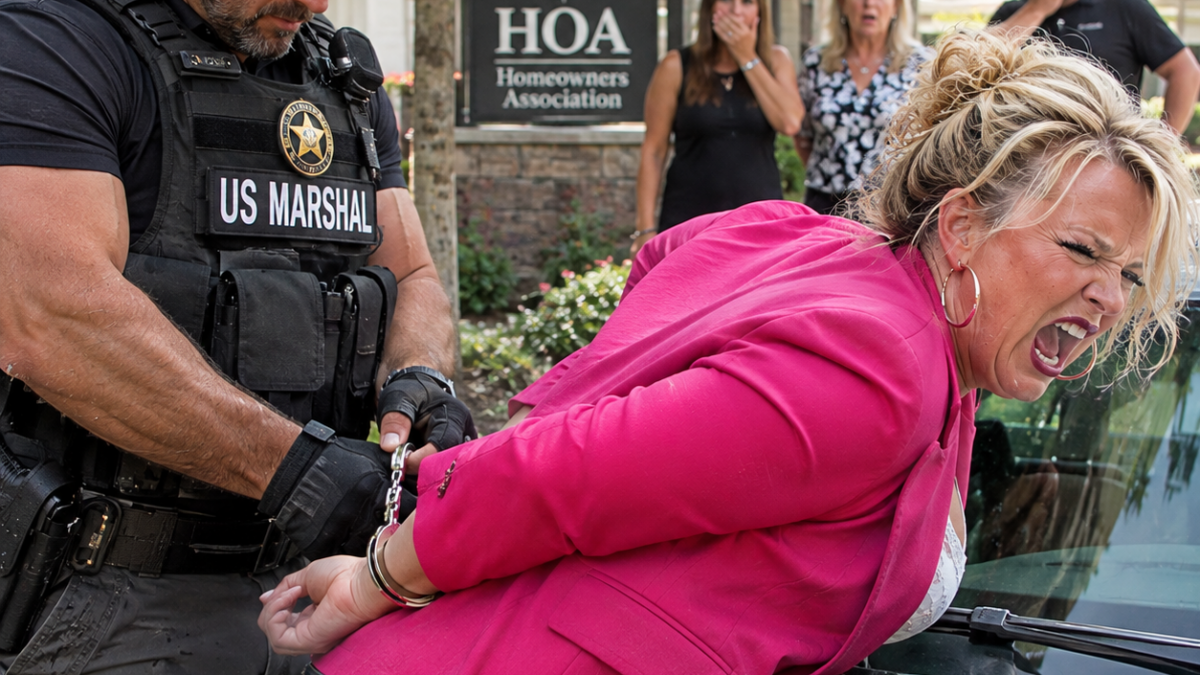
The sound of handcuffs opening is familiar to me.
I had heard it thousands of times.
That night it sounded different.
Shelly backed away.
“This is ridiculous.”
Agent:
“Mrs. Prescott, place your hands behind your back.”
“This is an HOA matter.”
“No, ma’am.”
“You can’t arrest me for enforcing covenants.”
“Hands behind your back.”
She looked at me.
“You did this.”
I didn’t move.
“No.”
“You did.”
“You did.”
The cuffs closed.
Metal clicked.
Shelly’s face twisted.
The projector behind her still showed the 4K frame of her sitting inside my Challenger.
Her own face watched her being arrested.
Vernon said nothing.
That fit him.
For five years, he had hidden behind numbers while Shelly performed the intimidation.
Now neither strategy helped.
As the agents led them toward the door, someone began clapping.
One person.
Then another.
Then nearly the entire room stood.
I did not.
Neither did Harlan.
He just watched.
Tears on his face.
There was nothing celebratory about what had happened to him.
The arrests were only the beginning of fixing it.
The federal grand jury returned indictments six weeks later.
Wire-fraud counts.
Mail-fraud allegations.
Conspiracy.
Financial charges against Vernon.
State-level vehicle trespass and harassment conduct surrounding Shelly’s campaign.
The prosecution became more complicated than any dramatic headline could summarize.
That was fine.
Real cases usually are.
The money was frozen.
Records seized.
Properties reviewed.
Restitution litigation began.
Harlan received the nine thousand dollars that had been taken from him.
Danielle received compensation for the loss attached to her pressured sale.
Other affected homeowners had claims reviewed.
Two displaced families eventually returned to Summit Pines.
Harlan was one.
Move-in day was cold and bright.
I drove over.
His old flagpole lay in the bed of a pickup.
Same pole.
Same flag.
Several neighbors helped him install it in the front garden.
Harlan tightened the final bolt.
Then stood back.
Wind came off the foothills.
The American flag opened.
For a second, nobody spoke.
Then Harlan looked at me.
“She hated this thing.”
“It’s a nice flag.”
He laughed.
“I think I’ll buy a bigger one.”
“You should check the new CC&Rs.”
He stared.
I smiled.
“Kidding.”
“Not funny.”
“It was a little funny.”
Harlan looked at the flag again.
“Thank you.”
“You don’t owe me that.”
“Yes.”
He turned.
“I do.”
I shook my head.
“You should never have been forced out.”
“But I was.”
His voice softened.
“And somebody finally checked the math.”
That line stayed with me.
Because that was what Shelly and Vernon had counted on.
Nobody checking.
HOAs are strange institutions.
Most are boring.
Necessary even.
Grass.
Roofs.
Insurance.
Roads.
Budgets.
But give the wrong people access to fines, property records, resident data, and fear, and boring authority can become something else.
Shelly understood fear.
Vernon understood spreadsheets.
Together, they had built a machine.
The new board dismantled it.
Five members.
Resident election.
Transparent monthly finances.
Independent quarterly audits.
Conflict-of-interest rules.
Vendor contracts opened for review.
And one amendment received the most enthusiastic vote.
No HOA employee, officer, contractor, or representative could possess or use a master key, entry tool, or other device to access a privately owned vehicle except where law enforcement or emergency conditions legally authorized it.
Vote:
173 to zero.
June called me afterward.
“Seven people didn’t vote.”
“Probably vacation.”
“They’re suspicious.”
“June.”
“I taught middle school for thirty years. Suspicion kept me alive.”
She became secretary of the new board.
Not president.
She refused.
“Too much power.”
Smart woman.
Nora slowly began trusting the neighborhood again.
That took longer than replacing a board.
For weeks after Shelly’s arrest, Nora checked the front door before bed twice.
Then once.
Eventually not at all.
Lily’s classmates came back.
Kids forget adult rumors faster than adults do.
One afternoon she walked home from school holding hands with the same girl who had stopped sitting with her at lunch.
I watched through the window.
Nora stood beside me.
“Should we be mad?”
“At a six-year-old?”
“I’m practicing.”
“Probably not.”
She leaned against me.
“I hated this place.”
“I know.”
“I really hated this place.”
“I know.”
Then Lily laughed outside.
Nora watched her.
“I don’t anymore.”
That mattered.
The Hellcat went to the body shop.
The long scratch disappeared under fresh black paint.
The boot damage was repaired.
Interior cleaned.
No floral perfume.
No fingerprints that didn’t belong.
But I kept the original broken dash-cam housing.
Not as a trophy.
Evidence had been returned after the case stage where it was needed.
I put the cracked piece in a drawer beside old credentials and challenge coins.
A reminder.
The most dangerous person in a situation isn’t always the one with the gun.
Sometimes it is the person convinced rules apply only in one direction.
I started something that fall.
The Summit Fund.
Small at first.
A few attorneys.
One forensic accountant.
A website.
Hotline.
Basic document templates for people fighting abusive HOA practices.
Records requests.
Lien review resources.
Referrals.
No dramatic vigilante nonsense.
Just people who knew how to read contracts helping people who were overwhelmed.
Because the former residents of Summit Pines taught me something.
Harlan didn’t lose because Shelly was right.
Danielle didn’t sell because Vernon’s numbers were legitimate.
They lost because fighting someone with documents and money costs time and expertise.
Shelly knew that.
She weaponized exhaustion.
I wanted people to have somewhere to call before exhaustion became surrender.
June volunteered.
Of course she did.
Her job?
Intake notes.
I once looked at one of her files.
Nine pages.
Single spaced.
“June.”
“Yes?”
“This homeowner complained about a mailbox.”
“It may become relevant.”
“You documented the manufacturer.”
“I’m thorough.”
“You documented the paint lot.”
“Evidence.”
I surrendered.
Six months after the arrest, a Saturday morning arrived clear and warm.
September.
Colorado at its best.
Aspens starting to turn.
Sky impossibly blue.
Rockies bright in the distance.
I washed the Challenger in the driveway.
Lily wore rain boots and a swimsuit for reasons only a six-year-old could explain.
She held a sponge almost as large as her chest.
Soap covered half the front bumper.
Very little seemed to reach the actual dirt.
Nora came outside carrying two glasses of lemonade.
She handed me one.
Then leaned against the garage.
“The scratch is gone.”
I looked at the driver’s side.
She was right.
Perfect paint.
No silver scar.
No evidence Shelly had ever dragged something down the side.
“Looks good.”
“You miss it?”
“The scratch?”
“It was evidence.”
I looked at her.
“You’re spending too much time with me.”
Nora smiled.
Across the cul-de-sac, Harlan’s flag snapped in the breeze.
The Hendersons walked past with a golden retriever.
Months earlier, Shelly had told them I was connected to the ATF.
Now Doug Henderson waved.
“Morning, Colton.”
“Morning.”
Lily waved with the sponge.
Water flew off it.
Hit the dog.
The dog immediately tried to chase the stream.
Everyone laughed.
I looked toward the garage.
For the first time since moving in, it was just a garage.
Concrete.
Assigned parking.
Storage.
No slim jim.
No boot.
No Shelly before sunrise.
No notes.
No hidden threats.
That kind of normalcy is easy to underestimate until someone takes it away.
Lily approached me.
“Daddy?”
“Yeah?”
“Can I do the hood?”
I looked at my seven-hundred-horsepower black car.
Then at the enormous dirty sponge in her hands.
Every protective instinct I had screamed no.
Nora raised an eyebrow.
I surrendered the hose.
“Gentle.”
“I know.”
She immediately blasted the windshield.
I closed my eyes.
Nora laughed.
Maybe fresh starts aren’t quiet.
Maybe they’re loud.
Wet.
Messy.
A little ridiculous.
And maybe the mistake Nora and I made was believing safety meant nothing bad would happen.
That isn’t safety.
I knew better professionally.
Safety means when something does happen, you aren’t facing it alone.
When Shelly first approached my Challenger, she saw a stranger.
Black car.
Tinted windows.
Odd schedule.
She built a story.
Then every fact became proof of the story she had already decided was true.
Work radio?
Criminal surveillance.
Body armor?
Cartel equipment.
Night shifts?
Drug activity.
Silence?
Suspicious.
When police didn’t arrest me?
Proof I was connected.
When CPS found nothing?
Proof the system was failing.
Once someone starts from certainty, evidence becomes decoration.
That was Shelly’s first failure.
Her second was believing authority belonged to whoever acted most confident.
Clipboard.
Master key.
HOA title.
White blazer.
She performed power so successfully that people around her stopped testing whether the power existed.
But a master key doesn’t make somebody law enforcement.
A violation letter doesn’t create jurisdiction.
A fine isn’t legitimate because it came on expensive paper.
And fear doesn’t become law because one hundred eighty homeowners are tired of fighting.
Shelly learned all of that.
Vernon learned something else.
Numbers remember.
Every invoice.
Every transfer.
Every shell company.
Every deed.
Every fine.
He had kept the fraud tidy because he believed tidy fraud looked legitimate.
Instead, it made the case easier.
Accountants love patterns.
So do prosecutors.
Sometimes I thought back to my first week in Summit Pines.
If I had walked into Shelly’s office after that first break-in, placed my U.S. Marshal credentials on her desk, and said:
“You entered the wrong car.”
What would have happened?
She probably would have stopped touching the Challenger.
Vernon would have cleaned the books.
Files might have disappeared.
Shell companies might have dissolved.
Former residents might never have been identified.
The system could have survived.
I would have won my personal dispute.
And lost the real case.
That distinction mattered to me.
It also mattered to Nora.
One night after Lily fell asleep, we sat on the balcony.
Mountain air cold.
Lights of the development below.
Nora held a blanket around her shoulders.
“You knew early, didn’t you?”
“Knew what?”
“That Shelly was breaking the law.”
“Yes.”
“How early?”
“First video.”
She looked at me.
“And you let her keep doing it.”
“I documented it.”
“That is a marshal answer.”
“Yes.”
She was quiet.
Then:
“I was angry at you.”
“I know.”
“When CPS came.”
“I know.”
“I thought you cared more about the case than stopping her.”
That hurt because there had been moments when I wondered the same thing.
“I’m sorry.”
She shook her head.
“I understand now.”
I didn’t answer.
“But if anything like this ever happens again…”
“Yes?”
“You arrest the crazy woman before she calls the school.”
I laughed.
“Fair.”
“Not joking.”
“I know.”
She leaned against me.
“I still hate that car.”
“No, you don’t.”
“I hate seventy percent of that car.”
“That’s progress.”
The federal proceedings continued.
Trials and pleas take time.
The dramatic moment of handcuffs is only the beginning of an actual criminal case.
Evidence motions.
Financial analysis.
Witness preparation.
Asset tracing.
Restitution.
Attorneys.
Schedules.
For the residents, the important part was simpler.
Their neighborhood belonged to them again.
At the next annual meeting, June presented the budget.
Every line visible.
A resident raised his hand.
“What’s this eight-hundred-dollar parking-equipment credit?”
June looked toward me.
I smiled.
She answered:
“Refund for one Denver boot.”
The room laughed.
I did too.
No white blazer at the front.
No Vernon.
No fear.
Just boring accounting.
Beautiful.
Harlan attended.
His flagpin on his jacket.
Danielle joined remotely.
The new board announced a fund to assist residents harmed by the Prescott regime.
There was applause.
Not the furious applause from arrest night.
Different.
Calmer.
Healing is quieter than revenge.
I learned that from Lily.
One afternoon, she asked me something while coloring at the kitchen table.
“Daddy?”
“Yeah?”
“Was Mrs. Prescott a bad person?”
I stopped.
Kids ask questions adults spend years avoiding.
“She did bad things.”
“That’s not what I asked.”
Nora looked at me over her coffee.
No help there.
“I know.”
“Was she bad?”
I sat beside Lily.
“I think people can make enough bad choices that everybody around them gets hurt.”
She thought.
“Did she hate us?”
“I don’t know.”
“She said you were dangerous.”
“She was wrong.”
“Why?”
“She decided what she wanted to believe before she knew me.”
Lily nodded slowly.
“Like when I thought broccoli tasted bad before I tried it?”
Nora laughed so hard coffee nearly came out her nose.
“Something like that.”
Lily returned to coloring.
Apparently moral philosophy was complete.
That conversation stayed with me.
Shelly had built her power partly from stories.
The dangerous stranger.
The irresponsible mother.
The unpatriotic veteran with an illegal flagpole.
The troublesome resident.
The delinquent homeowner.
Labels.
Once a label stuck, the fines became easier to justify.
Other residents stopped asking questions.
That is how small abuses grow.
Not because everyone agrees.
Because enough people decide it’s easier not to become the next target.
June once told me:
“Bullies don’t need supporters, Colton.”
“What do they need?”
“Spectators.”
She was right.
The Summit Fund’s first major case outside our neighborhood involved an elderly couple facing thousands in penalties over accessibility modifications.
We connected them with counsel.
The HOA backed down after document review showed procedural problems.
Nothing cinematic.
No arrests.
No handcuffs.
Just paperwork.
That made me happier than I expected.
I called June.
“We helped them.”
“I know.”
“How?”
“The wife sent me cookies.”
“Of course she did.”
June paused.
“Better than arrests, isn’t it?”
I looked toward the Challenger.
“Sometimes.”
She laughed.
The Hellcat remained loud.
That part never changed.
I kept the exhaust reasonable in the garage, especially at night.
Shelly had been correct that concrete amplified it.
Being wrong about almost everything doesn’t make a person wrong about everything.
That was another lesson.
I eventually replaced the tint too.
Not because Shelly demanded it.
Because Clint measured it and told me it was probably one shade beyond what I wanted to explain during a traffic stop.
Nora stared at me when I came home.
“You changed the tint?”
“Yes.”
“After all that?”
“It was borderline.”
She laughed for a full minute.
I endured it.
One year after the arrests, Summit Pines held a neighborhood barbecue.
I almost didn’t go.
Nora insisted.
“Normal family event.”
“I don’t trust events organized by HOAs.”
“June organized it.”
“That is different.”
Community lawn.
Grills.
Kids.
Music.
Harlan manned the hamburgers.
Danielle drove up from Pueblo with her children.
It was the first time I met her face-to-face.
She hugged me before I could offer a handshake.
“Sorry.”
She stepped back.
“I’m a hugger.”
“So is Nora.”
Nora immediately hugged her too.
Danielle’s oldest daughter played with Lily.
For a while, I watched them run across the grass.
Three years earlier, Danielle’s children had lost their home because their mother had been financially exhausted into selling.
Now they were back in Summit Pines for a barbecue.
Not residents again.
Not yet.
But welcome.
Danielle stood beside me.
“I still dream about the letters.”
“What letters?”
“Violation notices.”
She shook her head.
“Stupid, right?”
“No.”
“I’d hear the mailbox close and my stomach would drop.”
“That isn’t stupid.”
She looked toward the community buildings.
“Do you think she knew?”
“Knew what?”
“What she was doing to people.”
I considered it.
“Yes.”
Danielle nodded.
“I think so too.”
Harlan approached carrying two plates.
“She knew.”
He handed one to Danielle.
“One hundred percent.”
Then he looked at me.
“Marshal, burger?”
“Please stop calling me Marshal.”
“Never.”
They laughed.
That was healing too.
Turning something frightening into something small enough to joke about.
Not forgetting.
Reducing its power.
Later that evening, Lily fell asleep in the back seat on the two-minute drive from the community lawn to our garage.
Nora looked at me.
“We could’ve walked.”
“I know.”
“You wanted to drive the car.”
“Yes.”
“Ridiculous.”
“Yes.”
I pulled into Spot 147.
Same concrete walls.
Same fluorescent lights.
The Hellcat’s exhaust rolled through the structure.
Then silence.
I looked toward the place Shelly used to stand.
Empty.
Nora followed my eyes.
“You thinking about her?”
“No.”
“You are.”
“Only for a second.”
She reached across.
Took my hand.
“Then stop.”
So I did.
I carried Lily upstairs.
That became my final lesson from the whole mess.
Winning means eventually being able to stop fighting.
At first, I didn’t know how.
Federal work teaches vigilance.
Threat assessment.
Patterns.
Doors.
Vehicles.
Hands.
Exits.
Then Shelly turned my home into an operational environment.
I started checking cameras before breakfast.
Checking the garage feed before bed.
Looking at notes with gloves.
Reading every HOA email like intelligence reporting.
After the arrests, I kept doing it.
For weeks.
Nothing happened.
Still checked.
Then one night Nora caught me watching the garage camera.
“Colton.”
“What?”
“She’s gone.”
“I know.”
“You know intellectually.”
I looked at her.
“What does that mean?”
“Your body doesn’t know yet.”
ER nurse.
Always diagnosing something.
She sat beside me.
“You don’t have to watch the car sleep.”
“That sounds stupid when you say it.”
“It is stupid.”
I closed the app.
The next night, I didn’t check.
Nothing happened.
The night after that, same.
Eventually, Summit Pines became a home again instead of a perimeter.
Lily grew.
The anonymous notes disappeared into an evidence archive.
The floral perfume faded from the Challenger.
June’s casserole dish finally made it back to her after Nora realized we’d kept it almost a year.
Harlan’s flag remained.
The new HOA board became so boring that attendance dropped.
June considered that success.
“If nobody comes, we’re doing our jobs.”
“Or everyone is apathetic.”
“Don’t ruin this for me.”
The Summit Fund expanded.
One volunteer attorney became four.
Then six.
A forensic accountant joined.
Then a retired property manager.
We developed simple checklists:
Keep every notice.
Request governing documents.
Document dates.
Photograph property.
Get receipts.
Do not sign agreements you don’t understand.
Get legal advice early.
Boring things.
Powerful things.
People expect justice to look dramatic.
Sometimes it does.
Handcuffs.
Badges.
Federal agents.
But most justice looks like organized folders.
Dates.
Receipts.
People willing to say, “That happened to me too.”
Shelly had underestimated that.
She believed I was dangerous because of the car.
Later, she probably believed I was dangerous because of the badge.
She was wrong both times.
The dangerous thing was the file.
Twenty-three videos.
Bank records.
Invoices.
Affidavits.
Property transfers.
June’s notebook.
Evidence.
A badge can arrest someone.
Evidence makes the arrest mean something.
One September morning, almost exactly a year after everything began, I was washing the Challenger again.
Lily was older, though not necessarily more competent with a sponge.
Nora came outside with lemonade.
Same scene as months earlier.
Different feeling.
The Rockies were blue-gold.
Aspens changing.
Harlan’s flag moving.
Dog barking somewhere.
Normal.
Lily sprayed the driveway.
Then me.
“Hey!”
She laughed.
Nora leaned against the garage frame.
“You’re losing control of the operation, Deputy.”
“I’m aware.”
Lily sprayed me again.
“This is mutiny.”
“What’s mutiny?”
“I’ll explain when you’re older.”
She aimed for the car.
I stepped between her and the Hellcat.
“Absolutely not.”
“But it needs water.”
“It has water.”
“Not there.”
Nora laughed.
I looked at my family.
For a second, everything that had happened compressed into one thought.
This was what Shelly almost took.
Not the car.
Not the parking spot.
Not reputation.
Normal life.
A child with a hose.
My wife laughing.
A house where nobody was afraid of the mailbox.
That was the real thing worth protecting.
I used to think my job was about finding people.
Fugitives.
Defendants.
Witnesses.
You learn to watch exits and understand lies.
But the best part of law enforcement isn’t catching somebody.
It’s restoring space to the people they hurt.
A home.
A neighborhood.
A sense that rules mean something again.
Summit Pines belonged to its residents now.
Not Shelly.
Not Vernon.
Not me.
Them.
One afternoon, Harlan stopped by while I was polishing the Challenger.
He leaned on his cane.
“Still babying that thing?”
“Still jealous?”
“I drove tanks.”
“You did not.”
“Close enough.”
He looked at the car.
Then toward the garage entrance.
“Funny.”
“What?”
“All this started with window tint.”
I smiled.
“No.”
“What do you mean?”
“It started before me.”
Harlan understood.
Shelly and Vernon had been doing this for years.
The Hellcat didn’t start anything.
It simply became the object they couldn’t quietly control.
Harlan nodded.
“You’re right.”
He touched the flagpin on his shirt.
“I used to think I lost because I wasn’t tough enough.”
“You didn’t.”
“I know that now.”
He looked toward his unit.
“That matters.”
Then he left.
I stayed beside the car.
Thought about his words.
People who abuse systems depend on victims turning humiliation inward.
I should have known better.
I should have fought harder.
I should have read the rules.
I should have hired a lawyer.
I should have seen it.
But manipulation works because the person doing it controls information.
The shame belongs to the manipulator.
Not the people exhausted by the manipulation.
That became something we repeated at the Summit Fund.
You are not stupid because paperwork frightened you.
You are not weak because legal threats worked.
You are not guilty because somebody with a title wrote your name beside the word “violation.”
Check the facts.
Then decide.
I wish Harlan had heard that five years earlier.
I wish Danielle had.
We couldn’t change that.
We could change what happened next.
Years from now, Lily probably won’t remember every detail.
I hope she doesn’t.
I don’t want her childhood memories dominated by an HOA president.
Maybe she’ll remember the Challenger.
The bubbles.
Harlan’s flag.
June’s casseroles.
Mountains.
Maybe someday she’ll ask why there’s an old broken camera in my desk.
And I’ll tell her.
Not the whole criminal case.
Not every allegation.
Just the useful part.
A woman believed she had the right to enter something that wasn’t hers.
Then she believed she had the right to frighten a family that challenged her.
Then she discovered that authority has limits.
Simple.
That’s the whole story underneath the fraud and badges.
Limits.
A master key has limits.
An HOA has limits.
A government badge has limits too.
That last one matters.
The reason I didn’t arrest Shelly myself the first morning wasn’t only strategy.
It was role.
I was her neighbor.
Victim.
Witness.
You don’t get to turn official authority into personal retaliation just because you happen to carry credentials.
Other agencies investigated.
Prosecutors reviewed.
Judges signed.
Agents executed.
That is what made the outcome legitimate.
Shelly’s great failure was believing power was personal.
I could not answer that by making the same mistake.
Maybe that’s why the annual-meeting arrest felt satisfying without feeling dirty.
I didn’t invent the charges.
I didn’t manufacture evidence.
I didn’t cut corners.
I waited for the process.
And the process finally caught up with her.
One evening, long after the worst was over, Nora and I stood in the garage before going upstairs.
The Challenger sat in Spot 147.
She ran a finger over the repaired door.
“No scratch.”
“No.”
“No boot.”
“No.”
“No crazy HOA lady.”
“No.”
She smiled.
“What are you going to complain about now?”
“Gas prices.”
“Good.”
We walked toward the elevator.
Then I stopped.
Looked back once.
The garage lights reflected across the black paint.
For almost a year, that car had been treated like evidence of everything Shelly feared.
Criminality.
Violence.
Danger.
Now it was simply a car again.
A loud, unnecessary, irresponsible car.
Mine.
That was enough.
Nora called from the elevator.
“You coming?”
“Yeah.”
I turned away.
The doors closed.
Upstairs, Lily was waiting with a picture book.
Nora changed out of her scrubs.
I sat on the couch.
Lily climbed beside me.
“Read.”
“Please?”
“Please read.”
“Better.”
I opened the book.
Outside, Colorado night settled over Summit Pines.
No cameras buzzing on my phone.
No emails.
No notes.
No perfume in the car.
No woman with a clipboard deciding whether my family belonged.
Just home.
And after everything Shelly Prescott had done trying to make us leave, staying turned out to be the most satisfying ending of all.








