PART 2: HOA Karen Broke Into My Dead Wife’s Cabin—Then Screamed “Get Out!” Before She Saw the Attorney General Behind Me
PART 2
The morning the contractors came, I was about two hundred yards offshore in a kayak.
The water was nearly flat.
Fog hung low over the lake in strips.
A pair of ospreys called somewhere beyond the north shore.
The sun was just beginning to burn through the gray.
I had stopped paddling when I heard a chainsaw.
At first, I assumed someone farther down the shoreline was trimming trees.
Then the pitch changed.
It became sharper.
Closer.
The sound of metal teeth biting into structural wood.
Coming from my property.
I turned the kayak hard.
Water sprayed over the bow as I paddled toward shore.
By the time I dragged the kayak onto the gravel and rounded the side of the cabin, two men were standing on my dock.
One operated a reciprocating saw.
The blade was halfway through a support post.
The second man was stacking cut cedar sections on my lawn.
For several seconds, I just stood there.
Sawdust drifted across the lake.
Golden flecks floating on dark water.
That cedar was the wood Claire had chosen.
I remembered her standing in the lumber yard, pale from chemotherapy, running her fingers across sample boards.
“This one,” she said.
“You sure?”
“It smells alive.”
Now pieces of it were lying in the grass.
I walked toward the men.
“Morning.”
The taller man shut off the saw.
He wore a faded Carhartt vest.
JESSUP CONTRACTING.
“Morning.”
“Who hired you?”
He glanced toward the road.
“Mrs. Stanhope.”
Of course.
“She said this dock is in violation.”
“Did she show you a permit cancellation?”
He frowned.
“No.”
“A county order?”
“No.”
“Court order?”
“No.”
The second man stopped stacking wood.
The first shifted his weight.
“She said HOA authority supersedes county permits.”
I nearly laughed.
Instead, I walked inside.
Claire had insisted we buy a fireproof safe.
She said if we were building a wooden cabin in wildfire country, important papers shouldn’t live in a kitchen drawer.
I had teased her about it.
Now I opened that safe and pulled out a manila folder.
Bonner County building permit.
Approved.
Signed.
Stamped.
Recorded.
I carried it outside.
“Read this.”
The contractor took the paper.
His name, according to the patch on his vest, was Tom Jessup.
He read it once.
Then again.
He looked at the saw.
Then the three damaged posts.
“She told us there was no permit.”
“She lied.”
His partner took a step backward.
Tom gave the permit back.
Then turned.
“Pack it up.”
His partner didn’t argue.
The tools began going back into the truck.
I photographed everything.
The cut posts.
The equipment.
The work order.
Tom noticed.
“I’m going to keep my paperwork too.”
“Good.”
Before getting into the truck, he looked back at the dock.
“For what it’s worth, I’m sorry.”
“You believed what she told you.”
“I still cut the wood.”
“You stopped when you found out.”
He nodded.
That mattered later.
Then Brenda appeared.
She had been watching from uphill near the road.
The moment Tom started packing, she marched down toward us.
“What are you doing?”
Tom opened his truck door.
“You didn’t tell us he had a county permit.”
“I told you to finish.”
“We’re done.”
“Tom.”
He ignored her.
His partner climbed in.
Brenda stepped closer.
“You are under contract.”
Tom looked at her for the first time.
“Not to destroy permitted property.”
Then he got inside.
The truck drove away.
Brenda spun toward me.
Her face had turned bright red.
“You interfered with an authorized enforcement action.”
“Brenda, you sent contractors onto private property to destroy a permitted dock.”
“The dock violates Pine Crest standards.”
“County authority says it’s legal.”
“Our standards are stricter.”
“Your standards do not cancel county permits.”
Her fingers tightened around the clipboard.
“This is Pine Crest Shores.”
“I’m aware.”
“I decide what stays and what goes.”
There it was.
Not the board.
Not the bylaws.
Not the homeowners.
I.
I held up the permit.
“No, you don’t.”
Brenda stared at me.
For the first time, I saw something behind the arrogance.
Calculation.
Then she said, “We’ll see.”
She walked back toward the Escalade.
That night, I sat on the dock.
One support post was cut deep enough that I would have to replace it.
I ran my fingers along the raw cedar.
Sawdust stuck to my palm.
The lake was calm again.
But all I could smell was chainsaw oil.
It felt wrong.
A smell that had no business on Claire’s dock.
I went inside.
Saved Tom’s card.
Saved the photographs.
Saved the work order.
Saved Brenda’s notice.
Then something caught my eye.
The date.
The HOA notice authorizing removal of the dock had been issued two days after the contractors arrived.
I checked twice.
Same date.
She had ordered the destruction first.
Then created paperwork afterward.
I sat back in my chair.
For fourteen years, I had prosecuted white-collar crime.
Title fraud.
Mortgage fraud.
Financial manipulation.
Wire schemes.
People lie with their mouths easily.
Paperwork is harder.
Paper establishes timelines.
The cover-up almost always begins after the act.
Brenda had just made her first timing mistake.
I suspected it wouldn’t be her last.
A few weeks later, she called an emergency community meeting.
I attended because I wanted to see how Pine Crest actually functioned.
The meeting was held in Brenda’s garage.
Not a clubhouse.
Not an office.
A two-car garage.
One folding table.
Three plastic chairs.
A laptop balanced on a laundry basket.
And a cat sleeping on a storage bin.
Pine Crest Shores had twenty-three homes.
Three “members” voted that night.
Brenda.
A man named Vance.
And, according to the minutes Brenda later circulated, Mr. Whiskers.
The cat.
The issue was exterior paint colors.
Resolution 2024-07.
All cabins were required to be painted within thirty days using one of three approved shades:
Coastal Fog.
Morning Linen.
Birch Whisper.
All gray.
Different names.
Same depressing color.
My cabin was natural red cedar.
No paint.
Claire had chosen it specifically because she wanted it to weather naturally.
“A cabin should look like it grew out of the forest,” she told me once.
Painting it gray would have felt like putting a business suit on a pine tree.
Three days later, Brenda delivered the repainting order herself.
Certified mail.
Hand-carried.
She stood on my porch while I opened it.
“You have thirty days.”
“I’m not painting the cabin.”
She blinked.
“What?”
“I said no.”
Her mouth tightened.
“Fines begin at five hundred dollars per day.”
“No.”
“You don’t get to say no.”
“I just did.”
“This was adopted by the board.”
“How many homeowners voted?”
“That’s not relevant.”
“It’s very relevant.”
“Board action represents community action.”
“Your bylaws say otherwise.”
She froze.
Only slightly.
But I saw it.
“You’ve read the bylaws?”
“Yes.”
“All of them?”
“Yes.”
That bothered her.
Good.
“Then you know the board has discretion.”
“No. I know Article Four requires fifty-one percent approval for property-standard changes.”
Her face stiffened.
“We had quorum.”
“You had three votes.”
“We had board representation.”
“One of the votes was listed as Mr. Whiskers.”
Brenda didn’t even blush.
“He is a recognized member-at-large.”
“The cat?”
“He belongs to Vance.”
“That doesn’t make him a homeowner.”
“Garrett, you are being deliberately difficult.”
“No. I’m being literate.”
Her eyes narrowed.
“You’ll regret this.”
I closed the door.
Three days later, the lien notice arrived.
OFFICIAL NOTICE OF PROPERTY LIEN.
Big letters.
No court number.
No attorney signature.
No notary.
No filing stamp.
Just Brenda’s purple signature and an HOA rubber stamp.
Most homeowners would have panicked.
The word lien sounds final.
I knew better.
I pulled the original bylaws from the county recorder.
Confirmed the voting requirement.
Twenty-three homes.
Twelve votes minimum.
Brenda had two people and a cat.
I drafted a dispute.
Cited the exact bylaw.
Attached a certified copy.
Sent it to her.
Two days later, her response arrived.
Handwritten on the back of a potluck flyer.
Four words.
I AM THE BYLAW.
I read it twice.
Then I laughed.
Not because it was funny.
Because people reveal themselves when they believe there are no consequences.
I put the note into my file.
EXHIBIT D.
The file was getting thicker.
Then came the sewage complaint.
Brenda called county environmental enforcement and reported that I was pumping raw sewage directly into Lake Pend Oreille through an illegal discharge pipe attached to my dock.
There was no pipe.
There was a garden hose.
I used it to wash mud from the kayak.
Craig Novak from the county environmental office arrived on a Tuesday afternoon.
He carried sample bottles and looked tired before he even introduced himself.
“Garrett Hollister?”
“Yes.”
“We got a water contamination complaint.”
“I know.”
He looked toward the dock.
“Raw sewage?”
“According to Brenda.”
Craig sighed.
“Show me the discharge.”
I walked him down.
Pointed at the hose.
He stared.
“That?”
“That.”
He looked at me.
Then at the hose again.
“Okay.”
He took samples anyway.
Three locations.
Coliform.
Nitrates.
Phosphorus.
pH.
Dissolved oxygen.
Four days later, he called.
“Everything’s normal.”
“Thank you.”
“Actually, two samples tested cleaner than the county average.”
“I appreciate the confirmation.”
He hesitated.
“This isn’t the first complaint from Pine Crest.”
“From Brenda?”
“I didn’t say that.”
“You didn’t have to.”
He filed the report.
No violation.
Case closed.
Except Brenda did not accept evidence that contradicted her.
She escalated.
Within seventy-two hours, laminated warning signs appeared along the shoreline.
WATER CONTAMINATED.
NOT SAFE FOR CHILDREN OR PETS.
DO NOT SWIM.
PINE CREST SHORES HOA.
She had printed them at home.
One had the same toner streak that appeared on every notice she sent me.
The signs worked.
Not because people believed them.
Because they feared getting involved.
Three families stopped using the beach.
Two parents pulled kids from swim lessons.
Then Helen Denman listed her house.
I saw her at the mailbox cluster.
“You’re selling?”
She looked embarrassed.
“Yes.”
“Because of the water thing?”
“Not just that.”
“Brenda?”
Helen looked toward the road before answering.
“We’ve only been here two years.”
“So?”
“She’s been here nine.”
“That doesn’t make her right.”
“I know.”
“Then why leave?”
Her eyes looked tired.
“Because I don’t want every year of my life to be a battle.”
I didn’t know what to say.
That was Brenda’s real power.
Not rules.
Not fines.
Exhaustion.
She didn’t need to prove anything.
She only needed resistance to feel more expensive than surrender.
Then Earl Grady called.
I recognized the name from old property records.
He had owned Lot Seven.
Sold in 2019.
His voice was rough.
Careful.
“Mr. Hollister?”
“Yes.”
“My name is Earl Grady.”
“I know who you are.”
“I used to live at Pine Crest.”
“I know.”
“I heard Brenda’s after you.”
I sat down.
“Yes.”
“She did it to me too.”
I picked up a pen.
“What happened?”
Earl was a retired Marine.
Twenty-two years.
Two deployments.
He built his cabin himself.
Within six months, Brenda cited him for unauthorized livestock.
“What livestock?”
“A bird feeder.”
I stopped writing.
“Excuse me?”
“Bird feeder shaped like a barn.”
I rubbed my forehead.
He continued.
Wind chime complaints.
Fire marshal complaints.
Noise complaints.
Claims he was unstable.
Claims he was threatening neighbors.
Claims his Marine Corps flag violated visual standards.
After eighteen months, Earl sold.
Forty-two thousand dollars below market value.
“Who bought it?”
“A company.”
“What company?”
“Lakeview Holdings LLC.”
I wrote it down.
“I looked them up later,” Earl said.
“Who owns it?”
“Vance Stanhope.”
I stopped.
“Brenda’s husband?”
“Yes.”
I leaned back.
“How many?”
“How many what?”
“How many families?”
Earl was quiet.
“That I know about?”
“Yes.”
“Seven.”
Every muscle in my body tightened.
“All bought by Lakeview?”
“Yes.”
“Below market?”
“Every one.”
“After HOA enforcement?”
“Yes.”
The pattern snapped into place.
The dock.
The paint.
The fines.
The liens.
The false reports.
The intimidation.
The isolation.
This wasn’t random.
This wasn’t just an authoritarian HOA president enjoying control.
It was a business model.
Create pressure.
Lower morale.
Make ownership unbearable.
Wait for the homeowner to sell.
Then have the husband’s company buy below market.
I thanked Earl.
Hung up.
Walked to the window.
The contamination signs still stood along the water.
Red letters in the afternoon sun.
Something at Pine Crest was toxic.
Not the lake.
The next morning, I started pulling records.
Property transfers.
Lien filings.
Annual HOA disclosures.
Budgets.
Assessment rolls.
Operating statements.
Anything filed with the county.
Brenda tried to stop me.
She sent a note claiming public-records law did not apply to a private community organization.
Technically, she was partly correct.
What she did not understand was that documents filed with the county were public.
And she had filed a lot of documents.
I spent three days at the Bonner County Recorder’s Office.
The clerk, Janet, helped me.
Strong coffee.
Avon perfume.
Infinite patience.
By the end of the first day, we had a timeline.
By the second, we had a pattern.
Seven homes.
2015 through 2023.
Each sold thirty-one to forty percent below assessed market value.
Every seller had escalating HOA violations during the twelve to eighteen months before the sale.
Every buyer:
LAKEVIEW HOLDINGS LLC.
Registered agent:
VANCE T. STANHOPE.
Registered address:
Brenda’s house.
Then came the resales.
Minor repairs.
Fresh paint.
Landscaping.
New fixtures.
Relisted at full value or higher.
Estimated profit across seven flips:
About $2.1 million.
I stared at the number.
Then Janet handed me another set of papers.
HOA financial disclosures.
One line appeared every month.
HOA PRESIDENT COMPENSATION — ADMINISTRATIVE SERVICES.
$1,800.
Paid to Brenda.
No recorded authorization.
No board resolution.
No homeowner vote.
Over nine years:
Nearly $200,000.
For a volunteer position.
She signed many of the checks herself.
Deposited them herself.
One year, she even included a photocopy of her own handwritten ledger in the county filing.
I sat at my kitchen table that night with documents spread across every available surface.
Seven families.
Millions in profit.
Nearly two hundred thousand dollars in unauthorized compensation.
False liens.
False reports.
Property destruction.
Threats.
And a woman who thought an Amazon rubber stamp made her untouchable.
For the first time since Claire died, I felt something sharper than grief.
Purpose.
I picked up my phone.
Scrolled to a number I hadn’t called in two years.
Wallace Kemp answered on the second ring.
“Garrett Hollister.”
“Wallace.”
“I was starting to think you’d gone full mountain hermit.”
“Close.”
“How close?”
“I’m in a war with an HOA.”
He laughed.
Then stopped because I didn’t.
“What happened?”
I told him.
Dock.
Color rules.
Lien.
Sewage complaint.
Former owners.
Lakeview Holdings.
Property flips.
HOA money.
Brenda’s compensation.
Wallace listened the way he always had when we worked together.
No interruptions.
No reaction.
Just silence until the last fact landed.
Then one question.
“How clean is the paper trail?”
“County-level clean.”
“Transfers?”
“Recorded.”
“HOA filings?”
“Recorded.”
“Ownership?”
“Recorded.”
“Former owners willing to talk?”
“At least one.”
“Get more.”
“I will.”
He exhaled.
“Garrett, I’ve been looking at something like this.”
I sat straighter.
“What?”
“Three rural counties. Similar patterns.”
“HOA?”
“HOA or private community enforcement.”
“Property pressure?”
“Yes.”
“Acquisition afterward?”
“Sometimes.”
“You have cases?”
“Data.”
“But no direct intent.”
“Exactly.”
I looked at the documents.
Then toward the lake.
“Come fishing.”
Wallace laughed.
“You hate fishing.”
“I know.”
“Then you have a plan.”
“I do.”
He arrived Friday.
Before then, I needed cameras.
Six of them.
Wireless.
Night vision.
Motion activation.
Cloud backup.
One over the driveway.
One rear.
One kitchen.
One living room.
One office.
One hallway.
No blind spots.
I tested every feed.
Walked through each room.
Checked angles.
Checked timestamps.
Checked backups.
Then I contacted former homeowners.
Earl signed an affidavit.
So did the Carsons.
Bill Whitmore.
The Perrys.
Four families.
Four stories.
All similar.
Violation campaigns.
Isolation.
Pressure.
Lowball offers.
Lakeview Holdings.
I also called Sheriff Dan Lundgren.
We had met through a civic group.
Thirty years in law enforcement.
Gray mustache.
Quiet voice.
I explained enough.
“If I call Friday night, I need a unit nearby.”
“You expecting violence?”
“No.”
“Break-in?”
“Maybe.”
“You baiting somebody?”
“I’m giving somebody an opportunity to make her own decision.”
He was quiet.
“That sounds like prosecutor language.”
“I used to be one.”
“I remember.”
“If she crosses the line?”
“Call me.”
Then I needed Brenda to believe the cabin would be empty.
That part was easy.
Dottie Mercer lived nearby.
Seventy-two years old.
Friendly.
Generous.
Loved flowers.
And possessed the confidentiality standards of a local radio station.
If you told Dottie something at breakfast, half the community knew by lunch.
I found her watering geraniums.
“Morning, Dottie.”
“Garrett.”
“I’m heading to Boise tomorrow.”
Her eyes brightened.
“Oh?”
“Old friend.”
“For the weekend?”
“Yes.”
“You want me to keep an eye on the cabin?”
“I’d appreciate it.”
“Completely empty?”
“Completely.”
I walked back home.
Started a timer.
Thirty-eight minutes later, my camera recorded Dottie’s powder-blue Honda leaving.
She turned toward Brenda’s side of the neighborhood.
Twelve minutes later, she returned.
I smiled.
Operational efficiency.
By afternoon, Brenda drove past my cabin three times.
Each pass slower.
On the third, she stopped.
Got out.
Stood at the edge of my driveway.
Looked at the house for nearly two minutes.
Then typed something on her phone.
She was preparing.
Then, before Wallace even arrived, Brenda made things worse for herself.
Thursday morning, I carried coffee onto the porch.
And saw red paint.
SELL OR ELSE.
Two-foot letters.
Dripping.
Ugly.
Sprayed directly across the western red cedar.
Below the bedroom window.
Claire’s window.
The one she marked with a pencil heart.
I stood there.
My hand started shaking.
Not fear.
Anger.
Cold enough that I felt calm.
I set the coffee down.
Photographed every letter.
Every paint drip.
Every footprint.
Two different boot sizes.
I photographed tire marks.
Then I pulled the camera footage.
2:14 a.m.
Two young men emerged from the trees carrying spray cans.
One wore a backward baseball cap.
The other kept looking behind him.
At the end of the road sat a white Escalade.
Headlights pointed directly at my cabin.
Behind the wheel:
Brenda.
Watching.
Supervising.
Her nephews, I later learned.
Kyle.
Nineteen.
Trent.
Seventeen.
I saved the footage.
Laptop.
Cloud.
USB.
Then called Wallace.
“She did something else.”
“What?”
“Threat.”
“Verbal?”
“Spray paint.”
“What does it say?”
“Sell or else.”
Silence.
“Camera?”
“Every second.”
“Who?”
“Her nephews did the painting. Brenda’s in the Escalade.”
“Good.”
I looked at the wall.
“Doesn’t feel good.”
“No.”
“She painted over Claire’s pencil marks.”
Wallace knew Claire.
He was quiet longer.
Then said, “Don’t clean it yet.”
“I know.”
“We make sure she answers for every inch.”
I left the paint there.
Every neighbor saw it.
Some slowed.
Nobody stopped.
That hurt almost as much as the paint.
Fear had trained them well.
That night, I turned Claire’s wedding photograph around on the mantel.
Not because I believed she could see the vandalism.
Because I couldn’t look at her smiling face while those words were outside.
Friday morning, I picked Wallace up at Spokane International Airport.
He looked almost exactly the same.
Tall.
Silver hair.
Fishing shirt.
Fishing vest.
Leather briefcase.
“Nice disguise,” I said.
He looked down.
“I actually fish now.”
“Traitor.”
We drove to the cabin.
At six, he sat on the couch.
I showed him the camera feeds.
Then the documents.
Property transfers.
Financial filings.
Affidavits.
Brenda’s handwritten notes.
Dock work order.
Spray-paint footage.
He read for two hours.
I made coffee.
When he finally looked up, his expression had changed.
“This is textbook.”
“I thought so.”
“Predatory distress.”
“Yes.”
“Manufacture enforcement pressure.”
“Yes.”
“Depress willingness to hold.”
“Yes.”
“Related-party acquisition.”
“Yes.”
“Resale.”
“Yes.”
He tapped the affidavits.
“Potential conspiracy.”
“Yes.”
“Potential fraud.”
“Yes.”
“Embezzlement.”
“Yes.”
He looked at the laptop.
“You think she’ll come?”
“She knows I pulled records.”
“She believes you’re gone.”
“Yes.”
“And she has escalated every time you resisted.”
“Yes.”
Wallace leaned back.
“Then we wait.”
At 8:47 p.m., the rear motion sensor triggered.
The laptop screen pulsed.
Headlights appeared at the end of the road.
Then went dark.
White Escalade.
Door opened.
Brenda stepped out.
Platinum hair visible even in low light.
Gucci handbag over her shoulder.
Something metallic in her right hand.
Wallace leaned forward.
“Screwdriver?”
“Phillips.”
He looked at me.
“She actually brought a screwdriver.”
“To a felony.”
I called Sheriff Lundgren.
“She’s here.”
“Inside?”
“Not yet.”
“Call when she crosses the threshold.”
Then we watched.
Brenda reached the back door.
Tried the knob.
Locked.
She looked around.
Pulled out the screwdriver.
The motion light came on.
She didn’t leave.
She worked at the lock.
Twisting.
Prying.
Four minutes.
The whole thing recorded.
Her face.
Her hands.
The screwdriver.
The door.
Then—
Crack.
The lock gave.
Brenda entered.
Wallace put down his coffee.
She opened kitchen drawers.
Cabinets.
Looked under the sink.
She wasn’t careful.
She wasn’t even particularly quiet.
She moved like she believed the cabin belonged to her.
Then she entered the office.
The folder sat on the desk.
Exactly where I had left it.
LAKEVIEW HOLDINGS.
She grabbed it.
Opened it.
Saw the property records.
Saw Vance’s name.
Saw the sale histories.
Her expression changed.
That was important.
Recognition.
She understood what the documents were.
Then she stuffed the file into her Gucci handbag.
Wallace looked at me.
“There.”
I texted Lundgren.
Inside. Documents taken.
Then Wallace stood.
I walked toward the office.
Brenda’s back faced me.
I reached for the switch.
Click.
The fluorescent light buzzed on.
She froze.
Half the folder was still visible.
Her head turned slowly.
For one second, I saw uncertainty.
Then it vanished.
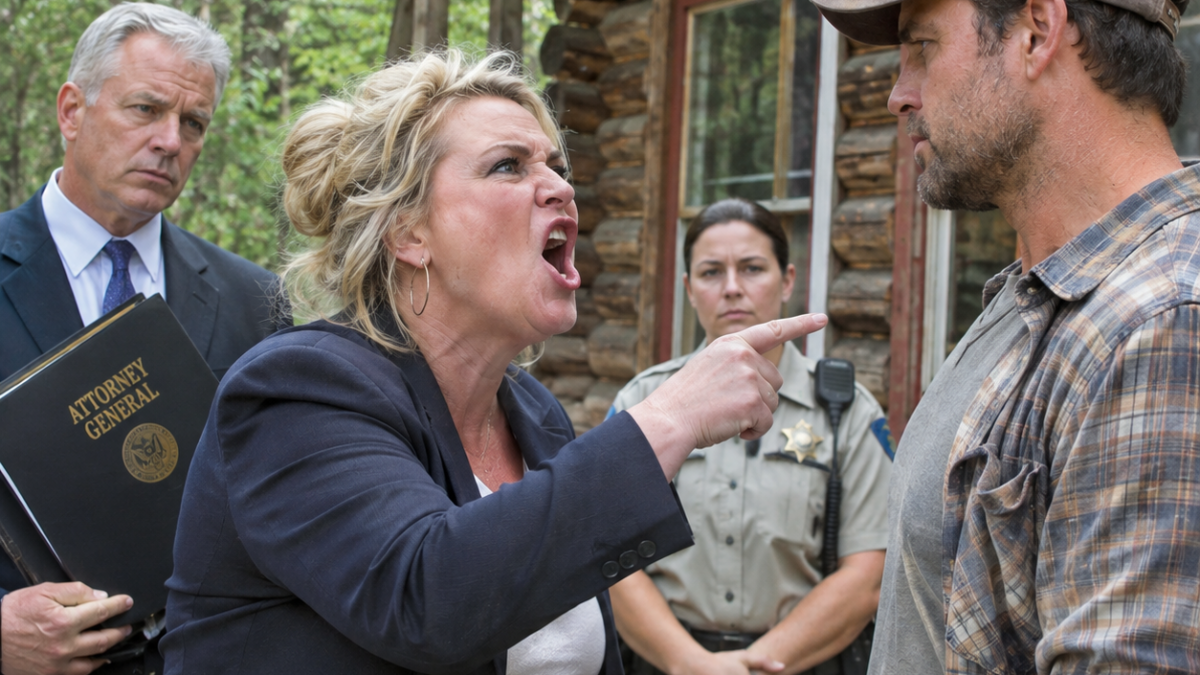
“GET OUT OF HERE!”
She screamed at me.
Inside my cabin.
Inside my office.
Holding my file.
I stared.
“Brenda.”
“You have no right to sneak up on me!”
“This is my house.”
“I am conducting an HOA inspection.”
“You broke the door.”
“I have authority.”
“No, you don’t.”
She grabbed the handbag tighter.
“You’ve been stealing confidential association documents.”
“They’re public records.”
“You are harassing board members.”
“You mean investigating your husband’s LLC?”
Her face changed.
Small.
But enough.
“You need to leave.”
I almost smiled.
“My house.”
“My office.”
“My documents.”
“GET OUT.”
Then Wallace spoke behind me.
Quietly.
“I don’t think Mr. Hollister is the person who needs to leave.”
Brenda looked past my shoulder.
Wallace stepped into the doorway.
Coffee in hand.
Fishing vest.
Calm.
Brenda frowned.
“Who are you?”
“Wallace Kemp.”
Nothing.
Then:
“Attorney General of the State of Idaho.”
The color left her face.
Wallace took a sip of coffee.
“I’ve been sitting in that living room for three hours.”
Silence.
“I watched your vehicle arrive.”
Brenda’s eyes flicked toward me.
“I watched you turn your headlights off.”
Her mouth opened.
“I watched you force the rear door with that screwdriver.”
No response.
“I watched you search Mr. Hollister’s kitchen.”
Wallace took another step.
“I watched you enter this office.”
He pointed toward the bag.
“And I watched you remove documents from his desk.”
Brenda looked toward the ceiling.
Saw the camera.
Wallace continued.
“Every second is recorded.”
Something slipped.
The clipboard.
It fell from her arm.
Hit the hardwood.
Clack.
That sound is still one of my favorite memories.
For nine years, Brenda had carried that clipboard like a royal scepter.
Fine.
Threat.
Measure.
Demand.
Order.
Now it lay face down on a floor she had no right to stand on.
“This is a setup,” she said.
Wallace nodded.
“You were told the house was empty.”
“Yes.”
She stopped.
Too late.
Wallace raised one eyebrow.
“But you entered anyway.”
“I have rights.”
“As a homeowner?”
“As president.”
“You have responsibilities as president.”
“I can inspect properties.”
“Show me the bylaw.”
She looked toward me.
“You planned this.”
“Yes.”
That answer surprised her.
I stepped forward.
“I wanted to know what you would do if you believed nobody was watching.”
Her eyes hardened.
“And now we know.”
Then the front door opened.
Sheriff Lundgren entered with a deputy.
Brenda turned.
“Dan.”
He looked at the broken rear-door frame.
The screwdriver.
The bag.
The file.
Then Wallace.
Then me.
“Mrs. Stanhope.”
“You know who I am.”
“I do.”
“Tell them I have authority to be here.”
“No.”
Her face tightened.
“What?”
Dan reached for his cuffs.
“You’re under arrest.”
Brenda stared.
“For what?”
“Burglary. Theft. Criminal mischief. We’ll sort the rest after.”
“You cannot arrest me.”
“Hands behind your back.”
“I am the president.”
“Hands behind your back.”
“I have legal authority.”
“Not to break into homes.”
The deputy stepped closer.
Brenda backed away.
“This is political harassment.”
Dan took her wrist.
Click.
First cuff.
“You forced entry.”
Click.
Second cuff.
“You removed property.”
Brenda looked at Wallace.
“I want an attorney.”
“Good decision,” Wallace said.
“I’ll sue.”
“That’s your right.”
“You don’t know who you’re dealing with.”
Wallace looked tired.
“I know exactly who I’m dealing with.”
Then he pointed toward the handbag.
“And Monday morning, my investigators will know a great deal more about your husband.”
That shut her up.
The deputy walked Brenda outside.
Red and blue lights flashed across the cedar.
Across the dock.
Across the words SELL OR ELSE.
I stood at the window.
Watched the cruiser drive away.
Then the cabin became quiet.
I turned toward the mantel.
Claire’s photograph still faced the wall.
I walked over.
Turned it back.
Her smile.
Same dress.
Same eyes.
Wallace stood behind me.
“You okay?”
“No.”
He waited.
“But maybe I’m getting there.”
The investigation moved faster than I expected.
Wallace’s office issued subpoenas within seventy-two hours.
Lakeview Holdings bank records.
Email records.
Mortgage documents.
Internal HOA accounts.
Property transfers.
Lender files.
What they found was worse.
Vance had used profits from earlier flips to secure financing for later acquisitions.
Some loans involved a Spokane lender.
Interstate transactions.
That brought federal jurisdiction.
The U.S. Attorney’s Office opened a parallel investigation.
Wire fraud.
Mail fraud.
Conspiracy.
The local newspaper ran Brenda’s arrest on the front page.
HOA PRESIDENT ARRESTED AFTER BREAKING INTO RESIDENT’S CABIN — ATTORNEY GENERAL PRESENT.
The comments filled up.
Many began with one word.
Finally.
That word told me more than the article.
People had been waiting.
Quietly.
For years.
Once the story broke, calls started.
Former homeowners.
Current homeowners.
Contractors.
People with letters.
People with invoices.
People with photographs.
People who had assumed their experience was isolated.
It wasn’t.
Helen Denman came to my door one afternoon.
“We took the house off the market.”
“Good.”
She looked down.
“I should have listened to you.”
“No.”
“I was scared.”
“So was everyone.”
“I feel stupid.”
“Don’t.”
She looked at me.
“You knew how to fight her.”
“I knew how to read a file.”
“That’s more than most of us.”
Exactly.
That realization stayed with me.
Courage is easy to admire after the danger is over.
During the danger, courage often looks like a tired person deciding not to sell their house today.
Eight weeks later, Vance was indicted.
Multiple fraud counts.
Conspiracy.
Mail.
Wire.
Brenda faced state charges.
Burglary.
Theft.
Criminal mischief.
Embezzlement.
False reports.
Other charges tied to the HOA pattern.
Then came one of the most incredible moments.
Her bail was set at seventy-five thousand dollars.
She paid it.
Using HOA operating funds.
Wallace called me.
“You sitting down?”
“Yes.”
“She posted bail.”
“Good for her.”
“With HOA money.”
I closed my eyes.
“You’re kidding.”
“No.”
“She stole association money to get out of jail for allegedly stealing association money.”
“That is an accurate summary.”
I leaned back.
“How does someone do that?”
“Habit.”
That answer made sense.
For nine years, she had treated community money as her money.
Why would jail change that?
It became another charge.
Another document.
Another entry in the timeline.
Eventually, five displaced families reached civil settlements.
More than a million dollars in compensation.
Lakeview Holdings was forced to divest its remaining Pine Crest properties.
Then Earl got a phone call.
His old cabin was available.
He came to my place.
Stood on the porch.
“I’m not going back.”
“You sure?”
“I’m seventy-one years old.”
“That wasn’t the question.”
He looked toward the lake.
“No.”
“You miss it?”
Silence.
“Every day.”
“Then go home.”
He shook his head.
“She ran me out.”
“Exactly.”
He looked at me.
Then something changed.
“I suppose going back would irritate her.”
“Deeply.”
That made him smile.
Earl moved in on a Tuesday.
I helped.
So did Tom Jessup.
Tom had become a cooperating witness.
He carried boxes all afternoon.
At one point, Earl looked at him.
“You the guy who cut Garrett’s dock?”
Tom winced.
“Yes.”
Earl laughed.
“You stop when you found out?”
“Yes.”
“Then carry the heavy stuff.”
Tom did.
By evening, Earl hung his Marine Corps flag from the same bracket Brenda once cited as a visual obstruction.
We all stood outside.
Waited.
Nothing happened.
No clipboard.
No notice.
No Escalade.
Earl looked at the flag.
Then at me.
“Looks illegal.”
“Extremely.”
He smiled.
The new HOA election happened at an actual community center.
Twenty-one of twenty-three homeowners attended.
No garage.
No laundry basket.
No cat.
Their first act:
Void all 847 violations Brenda had issued during her presidency.
Second:
Eliminate the president compensation line.
Third:
Remove Mr. Whiskers from the membership roll.
Someone proposed it as a joke.
The motion passed unanimously.
Every vote came from a human.
Dottie stood up afterward.
“I always thought that cat had too much influence.”
Nobody corrected her.
By then, part of the civil recovery was coming through.
I could have used the money for myself.
The cabin needed repairs.
The dock needed finishing.
I had legal expenses.
But I kept thinking about Earl.
Helen.
The Carsons.
People who had surrendered because they didn’t know where authority ended.
I had been a prosecutor.
I knew how to read statutes.
I knew how to preserve evidence.
I knew what a valid filing looked like.
Most people didn’t.
And they shouldn’t have to.
You shouldn’t need fourteen years in federal prosecution to protect your own front door.
So I started the Claire Hollister Cabin Fund.
A nonprofit.
Free or low-cost legal help for homeowners facing abusive HOA enforcement, coerced sales, improper liens, or fraudulent property claims.
I filed the papers at the same recorder’s office where I found Brenda’s trail.
Janet read the name.
“Claire?”
“My wife.”
She nodded.
Then opened her purse.
Pulled out twenty-five dollars.
“What’s this?”
“First donation.”
“You don’t have to.”
“I know.”
She handed me a note.
I opened it later.
My sister lost her home in an HOA dispute three years ago. Thank you.
I put the note in a file.
Not Exhibit D.
A different kind.
One that reminded me why the work mattered.
Months later, the community asked if they could rename my dock.
I didn’t like the idea at first.
It already belonged to Claire in my head.
Then Tom showed me the sign.
He had carved it from a salvageable section of the original cedar post he damaged.
CLAIRE’S LANDING.
Simple letters.
No decoration.
The wood already beginning to silver.
I ran my hand over it.
Tom looked uncomfortable.
“I wanted to fix something.”
“You repaired the post.”
“I mean the other part.”
“You were lied to.”
“I still ran the saw.”
I looked at him.
“You stopped when you knew.”
He nodded.
“That matters.”
We mounted the sign together.
The dedication happened in late summer.
Almost everybody came.
Earl stood at the end of the dock with a fishing rod and a can of Rainier.
Helen Denman brought cookies.
The Carsons brought folding chairs.
Dottie made potato salad and informed anyone who would listen that she had played “a critical intelligence role.”
Technically true.
She approached me later.
“Garrett?”
“Yeah?”
“I still feel terrible.”
“About what?”
“Telling Brenda you were gone.”
I put my hand on her shoulder.
“Dottie.”
“Yes?”
“You told her exactly when I needed you to.”
She blinked.
Then smiled.
“I knew that.”
“No, you didn’t.”
Her smile widened.
“Well, I know it now.”
Then she walked away and told someone else.
Mr. Whiskers came too.
He now lived with Earl.
The cat sat on the dock railing.
Watched everyone.
Completely indifferent.
A creature who had never asked to enter politics and was clearly relieved to be retired.
As evening fell, the lake changed color.
Gold.
Copper.
Amber.
The same colors Claire talked about from her hospital bed.
I stood beneath the cedar sign.
CLAIRE’S LANDING.
I thought about the mason jar.
The pine needles.
The pencil heart.
WINDOW HERE.
For years, I believed protecting the cabin meant protecting property.
Boards.
Permits.
Deeds.
Dock posts.
Land.
But Brenda taught me something accidentally.
A home is valuable precisely because it is not just real estate.
That was the weakness she exploited.
People will tolerate a lot to protect a place they love.
But if you make that love painful enough, some will leave.
She turned exhaustion into leverage.
Vance turned leverage into profit.
Their system depended on people feeling alone.
Earl felt alone.
Helen felt alone.
The Carsons felt alone.
I almost did too.
Then we started comparing files.
That was the beginning of the end.
Not the arrest.
Not the break-in.
The conversation.
“She did this to me too.”
That sentence destroyed nine years of isolation.
Wallace returned several months later.
This time, he really brought fishing gear.
We sat on Claire’s Landing at dawn.
Fog over the lake.
Coffee beside us.
No bites.
“You know why she broke in?” he asked.
“The file.”
He shook his head.
“Fear.”
“Same thing.”
“No.”
He cast again.
“For nine years, she made everyone else afraid first.”
I thought about it.
“She saw you collecting records.”
“Yes.”
“She understood the record was outside her control.”
I smiled.
“People who build power on intimidation hate documentation.”
“Exactly.”
“You sound like Claire.”
“I’ll take that as a compliment.”
“It is.”
We sat quietly.
After a while, Wallace looked toward the cabin.
“You staying?”
I looked too.
The red paint was gone.
Mostly.
I hired a restoration crew.
They removed nearly all of it.
But below Claire’s bedroom window, if you knew where to look, there was a faint shadow.
Part of one letter.
The crew offered to sand deeper.
I told them to stop.
Wallace had asked why.
“Because I want to remember.”
He thought that was unhealthy.
Maybe it was.
But I didn’t want history erased so cleanly that it could become unbelievable.
“Yes,” I said.
“I’m staying.”
“Good.”
A year after the arrest, the Claire Hollister Cabin Fund had helped twenty-six homeowners.
Some cases were small.
Improper fines.
Bad votes.
Unauthorized fees.
Others were serious.
One family nearly lost a house because of assessments they didn’t owe.
An elderly woman came into the office holding a notice with both hands.
They were shaking.
“I know this sounds silly.”
“It doesn’t.”
“It’s landscaping.”
“Tell me.”
“They say my flowers violate sightline standards.”
“Okay.”
“And if I don’t remove them, they’ll file a lien.”
“Show me the bylaws.”
She pushed documents across the desk.
“I don’t understand any of this.”
“That’s okay.”
“I feel stupid.”
“Don’t.”
Her eyes filled.
“It’s just flowers.”
“No.”
I looked at her.
“It’s your home.”
She nodded.
“Yes.”
That was enough.
Years earlier, I believed justice happened in courtrooms.
Indictments.
Trials.
Judges.
Sentences.
Now I knew justice often begins at a kitchen table.
With someone deciding not to throw away a letter.
With a neighbor saying, “That happened to me too.”
With a homeowner learning that a document printed in bold letters is not automatically law.
With someone taking a photograph before repairing damage.
With one person refusing to be embarrassed by fear.
Brenda’s case took time.
So did Vance’s.
Court moves slowly.
Eventually, assets were sold.
Victims compensated.
Records corrected.
Titles cleared.
The old HOA structure was replaced.
And Pine Crest became boring.
Beautifully boring.
No emergency paint-color votes.
No fake contamination warnings.
No midnight threats.
No unauthorized compensation.
No measuring tape on docks.
No one inspected Earl’s flag.
No one measured Dottie’s flower beds.
No one asked Mr. Whiskers to vote.
People lived.
That was all.
And that was enough.
One fall evening, years after I moved into Pine Crest, I was cleaning a storage box.
At the bottom, wrapped in one of Claire’s scarves, was the mason jar.
Pine needles inside.
I sat down.
Turned it in my hands.
The label was faded.
The metal lid scratched.
I carried it to the dock.
The air was cold.
My breath showed.
I sat beneath the CLAIRE’S LANDING sign.
Unscrewed the lid.
The smell was weak.
Dry.
Faint.
But still there.
Pine.
For a second, I was back in the hospital.
Claire under a thin blanket.
Chemo pump beside the bed.
The jar in her hands.
“That’s what our cabin smells like.”
I opened my eyes.
Pine trees surrounded the lake.
Water moved quietly against the posts.
The cedar had gone silver.
Exactly like she predicted.
“You were right,” I said.
No answer.
I didn’t need one.
The cabin lights glowed behind me.
Earl’s flag moved through the trees.
Somewhere down the road, Dottie was probably telling someone something she had promised never to repeat.
I smiled.
There had been a time when seeing Brenda’s white Escalade turn onto my road made my stomach tighten.
Now she was gone.
Vance was gone.
Lakeview Holdings was gone.
The fear was gone.
Claire’s cabin remained.
Western red cedar.
Wedding photograph.
Bedroom window.
Dock.
Pencil heart.
For nine years, Brenda had believed power meant being the loudest person in the room.
She shouted.
Threatened.
Fined.
Measured.
Ordered.
She told people what colors they could use.
Where they could stack wood.
What they could hang.
When they should sell.
She believed the clipboard made her powerful.
But the moment I remember most isn’t the arrest.
It isn’t the indictment.
It isn’t Wallace saying he was attorney general.
It isn’t even the handcuffs.
It’s the second before all of that.
Brenda standing inside my office.
My documents in her bag.
My broken door behind her.
Me standing quietly in front of her.
“Get out of here!” she screamed.
For nine years, that tone had worked.
People apologized.
People backed down.
People paid.
People sold.
People left.
That night, I didn’t move.
Neither did Wallace.
Neither did the cameras.
Neither did the truth.
And that was the moment Brenda stopped being powerful.
Not when the sheriff entered.
Not when Vance was indicted.
Not when Lakeview Holdings was forced to surrender property.
Her power ended when someone finally heard her order and answered:
“No.”
I picked up the mason jar.
Walked back toward the cabin.
At the rear door, I stopped.
The lock had been repaired.
The frame reinforced.
But I never replaced the door.
Claire and I had bought it together at a salvage yard outside Sandpoint.
Old wood.
Brass handle.
Tiny scratches around the keyhole.
“Someone lived behind this door before us,” Claire said when we bought it.
She liked that.
After Brenda broke in, there was another scar beside the lock.
A screwdriver mark.
I kept it.
Not because I wanted Brenda in the house forever.
Because houses remember.
Not magically.
Physically.
Scratches.
Repairs.
Color changes.
Wear.
Nail holes.
A replaced dock post.
A fading shadow of red paint.
A mark beside a lock.
History leaves evidence too.
Claire’s history lived there.
Mine did.
Brenda’s mistake became part of it.
But her mistake never defined the cabin.
That difference mattered.
She damaged the cabin.
She never owned it.
She frightened people.
She never became legitimate.
She controlled Pine Crest for nine years.
She never earned loyalty.
And when she finally crossed my threshold carrying a screwdriver, she discovered what she should have learned long before.
A title is not authority.
A clipboard is not law.
Fear is not consent.
And somebody else’s home does not become yours just because nobody has stopped you yet.
I stepped inside.
Locked the door.
Turned off the porch light.
Claire’s wedding photo sat on the mantel.
Same place I put it the first night.
Years earlier, I stood in that room thinking I was alone.
Now her name was on the dock.
On a legal fund.
On letters sent to frightened homeowners.
On checks paying for attorneys who helped people stay in their homes.
Her cabin had survived.
So had I.
I opened the bedroom window.
Cold air came in.
Pine.
Water.
Cedar.
For one brief second, the cabin smelled exactly like the mason jar beside her hospital bed.
I smiled.
Then whispered:
“They didn’t take it, Claire.”
Outside, water moved against the dock.
The wind passed through the trees.
The cedar creaked softly.
And for the first time since I had driven through the gates of Pine Crest Shores, the silence did not feel empty.
It felt like home.
But the story didn’t completely end there.
Because consequences have echoes.
A few months after Brenda’s sentencing phase began, I received a letter.
No return address.
Handwritten.
I almost threw it away.
Then I recognized the name inside.
Kyle.
One of Brenda’s nephews.
The nineteen-year-old from the spray-paint footage.
He wrote that Brenda had told him I was trying to steal community property.
She told him I was dangerous.
That the house was going to be seized anyway.
She paid him two hundred dollars to help “send a message.”
He wrote:
I know that doesn’t excuse it.
He apologized.
Not in legal language.
Not carefully.
Just awkwardly.
Like a kid realizing too late that an adult he trusted had turned him into a weapon.
I showed the letter to Wallace.
“What do you want to do?” he asked.
“What do you mean?”
“He’s involved in the criminal-mischief case.”
“I know.”
“You can make sentencing recommendations.”
“I know.”
He waited.
I looked at the letter again.
The red paint had hurt.
Badly.
It had covered Claire’s marks.
I hated him for that when I first saw the footage.
But Kyle was nineteen.
And Brenda had been using people for years.
Neighbors.
Contractors.
Family.
Even a cat, technically.
“What did he do after the arrest?” I asked.
Wallace opened a file.
“Cooperated.”
“Fully?”
“From day one.”
“Testified?”
“Yes.”
“Returned the money?”
“Yes.”
“What about Trent?”
“Juvenile process. Similar cooperation.”
I stared at Claire’s photograph.
“Then I don’t want the maximum.”
Wallace studied me.
“You sure?”
“No.”
I laughed softly.
“But I don’t think Claire would want me destroying a nineteen-year-old kid just because I can.”
Wallace nodded.
“That sounds like her.”
Kyle received community service, restitution obligations, and probation rather than incarceration.
Months later, he came to Pine Crest.
He asked if he could help repair something.
The cabin was already repaired.
So I took him to Claire’s Landing.
The sign needed resealing.
We worked quietly.
After an hour, he said, “She told us you were some rich lawyer trying to take over.”
“I’m not rich.”
“I figured that out.”
“I was a lawyer.”
“I figured that out too.”
He looked ashamed.
“I’m sorry.”
I kept brushing sealant onto the cedar.
“You already wrote that.”
“I wanted to say it here.”
I put down the brush.
“Then say it.”
He looked at the dock.
“I’m sorry.”
I nodded.
“Okay.”
“That’s it?”
“What do you want me to do?”
“I don’t know.”
“Neither do I.”
He laughed nervously.
Then I said, “Do something better with what comes next.”
He looked at me.
“That’s the only part you can still control.”
He nodded.
That was the last time I saw him.
A year later, Earl told me Kyle had enrolled in a construction-management program.
I hoped he finished.
Vance’s case was different.
He never apologized.
Not to Earl.
Not to the other families.
Not to the association.
Not to me.
His defense tried to argue the property purchases had been ordinary business transactions.
That sellers had willingly accepted offers.
Technically true.
The problem was everything that happened before the offers.
The liens.
The fines.
The reports.
The isolation.
The timing.
The emails between Vance and Brenda.
That was the piece they didn’t know investigators had recovered.
In one message, sent before Earl sold, Brenda wrote:
He’s almost ready. Keep the offer low.
Another:
Denmans are soft. Another month.
Another:
If Hollister won’t bend, hit the permit angle again.
When Wallace showed me the printouts, I stared at the words.
There it was.
Intent.
Not inference.
Not pattern.
Their own language.
“He knew,” I said.
Wallace nodded.
“The entire time.”
That hurt more than I expected.
Brenda was loud.
Vance had always been quieter.
For years, people described him as harmless.
He rarely argued.
Rarely attended meetings.
Rarely appeared in public disputes.
But he was the money side.
Brenda created pressure.
Vance waited for opportunity.
One wore the clipboard.
The other signed purchase documents.
Different roles.
Same machine.
During one civil hearing, I sat behind Earl.
Vance entered with his attorney.
Earl looked at him.
Vance looked away.
Earl leaned toward me.
“You know what bothers me?”
“What?”
“He drank beer on my porch.”
“When?”
“Before I sold.”
I looked at him.
“He came over. Told me he understood how hard Brenda could be. Said maybe selling would give me peace.”
Earl laughed once.
No humor.
“He already knew his company would buy it.”
I said nothing.
Earl looked toward the front of the courtroom.
“I spent years thinking I was weak.”
“You weren’t.”
“I left.”
“You were exhausted.”
“Same difference.”
“No.”
I leaned closer.
“They designed the exhaustion.”
Earl’s eyes stayed forward.
After a moment, he nodded.
That idea became important to the Cabin Fund.
We began teaching homeowners about coercive patterns.
Not because every HOA dispute is fraud.
Most aren’t.
Most boards are ordinary people trying to manage ordinary problems.
But when enforcement becomes selective, escalating, financially connected to insiders, and paired with acquisition pressure, you document.
You ask questions.
You compare experiences.
You never assume you are the only one.
We started community workshops.
Nothing fancy.
Coffee.
Printed guides.
Examples of valid filings versus fake ones.
How to request records.
How to preserve photographs.
How to keep communication in writing.
How to distinguish a threat from an actual court order.
The first workshop had twelve people.
The second had forty-three.
By the end of the second year, we were getting calls from outside Bonner County.
One came from a retired schoolteacher named Margaret.
Her HOA claimed she owed seventeen thousand dollars in fines.
“For what?”
“Christmas lights.”
I waited.
“It’s June.”
“I know.”
The issue went back four years.
Improper notices.
Stacked late fees.
No hearing.
No quorum.
A board member’s cousin had offered to buy the house.
That detail got my attention.
We helped Margaret challenge the lien.
She kept the house.
At the end, she mailed me a photograph.
Christmas lights covering the entire front porch.
A note on the back:
Put up twice as many this year.
I pinned it on the office wall.
Claire would have loved it.
The Cabin Fund office slowly filled with those photographs.
A family beside a repaired fence.
An elderly man under a flagpole his HOA tried to ban.
A mother standing in front of the home she almost lost.
Not trophies.
Reminders.
People stayed.
That mattered.
One morning, while sorting old records, I found Brenda’s note.
I AM THE BYLAW.
I had almost forgotten it.
Purple ink.
Potluck flyer on the back.
I framed it.
Not because I admired it.
Because it summarized everything.
For years, Brenda believed authority flowed from confidence.
If she acted certain enough, most people assumed there must be a rule somewhere supporting her.
That’s how fake authority survives.
Not through strength.
Through hesitation.
The other person hesitates.
You advance.
They doubt themselves.
You speak louder.
They ask for proof.
You change the subject.
They get tired.
You win.
Until somebody stops hesitating.
I hung the note in the Cabin Fund office beneath a small brass plaque.
ASK FOR THE BYLAW.
People laughed.
But they remembered.
Meanwhile, Pine Crest became almost unrecognizable.
The contaminated-water signs were gone.
Families returned to the beach.
The swim program came back.
Helen Denman planted flowers near the mailbox cluster.
Earl bought wind chimes.
Very loud wind chimes.
He hung six.
I accused him of overcompensating.
He said he was healing.
Dottie joined the new community newsletter committee.
This was possibly the most dangerous appointment anyone made after Brenda.
But the newsletter was excellent.
Mostly because Dottie knew everything before everyone else.
The difference now was that people volunteered the information.
Mr. Whiskers remained retired.
No voting duties.
No committees.
No quorum responsibilities.
Earl bought him a collar tag:
FORMER BOARD MEMBER.
I hated how funny I found it.
One summer evening, the new HOA president came to my cabin.
Her name was Michelle.
School librarian.
Quiet.
She carried a folder.
When I saw it, I stared at her.
She immediately raised both hands.
“Not a violation.”
“Good start.”
She laughed.
“We want to repair the community sign.”
“Okay.”
“And add a line underneath.”
“What line?”
She opened the folder.
A design.
PINE CREST SHORES.
Then beneath:
NEIGHBORS, NOT SUBJECTS.
I looked at her.
“Earl?”
“Obviously.”
I smiled.
“Do it.”
They did.
Brenda would have hated it.
Claire would have laughed.
Years passed.
The legal cases ended.
The headlines faded.
People stopped asking about Brenda everywhere I went.
That was good.
I didn’t want my life defined by the worst neighbor I ever had.
The cabin aged.
The cedar silvered.
The pine trees grew.
Claire’s Landing weathered beautifully.
Some mornings, I made coffee and walked down before sunrise.
I would sit where Claire sat during our only summer together.
She had been weak by then.
She tired easily.
But every evening, she insisted on walking to the dock.
One night, I asked why.
“Because you built me a sunset,” she said.
I laughed.
“I built a dock.”
“No.”
She pointed across the lake.
“You put it exactly where I told you.”
“Yes.”
“So you built me a sunset.”
I had forgotten that conversation until years after the Brenda case.
Memory is strange.
The big moments don’t always return first.
Sometimes it’s the way someone held a coffee cup.
The sound of their slippers on wood.
A sentence you didn’t know mattered.
Now, whenever sunset turned the water copper, I heard her.
You built me a sunset.
Maybe that was why I fought so hard.
Not for property value.
Not for victory.
For the right to keep standing in the places where love had happened.
Brenda saw acreage.
Claire saw sunsets.
There was never going to be a compromise between those two visions.
One afternoon, a young couple visited the Cabin Fund.
They were considering buying a house in an HOA.
“Should we avoid HOAs?” the husband asked.
“No.”
He looked surprised.
“Really?”
“HOAs aren’t automatically bad.”
The wife leaned forward.
“After everything that happened to you?”
“Brenda was bad.”
I pointed toward the Pine Crest sign visible through the office window.
“An organization is only as decent as the people running it and the rules limiting them.”
“So what should we do?”
“Read everything before you sign.”
“All of it?”
“All of it.”
The husband groaned.
I smiled.
“And understand where authority begins and ends.”
The wife nodded.
“What’s the biggest warning sign?”
I thought about Brenda.
The clipboard.
I AM THE BYLAW.
The break-in.
Then answered:
“Anyone who treats a request for proof like disrespect.”
They wrote that down.
That pleased me.
Eventually, I stopped feeling angry when I looked at the faint red shadow under Claire’s bedroom window.
For a long time, I saw only the vandalism.
Then it became something else.
A line between before and after.
Before, I was trying to preserve the cabin exactly as Claire left it.
After, I learned preservation does not mean preventing every scar.
You can’t.
Wood gets marked.
People get hurt.
Life changes things.
What matters is whether the thing survives with its meaning intact.
The cabin did.
I did.
One winter night, a storm came through.
Heavy snow.
Wind.
Power flickered.
I lit the fireplace.
Sat on the couch.
Claire’s photograph above me.
The cameras were still installed, though I barely checked them anymore.
One feed caught movement near the dock.
I felt an old tension.
Opened the screen.
Earl.
Carrying a shovel.
I called him.
“What are you doing?”
“Clearing Claire’s Landing.”
“In a storm?”
“Snow’s heavy.”
“You’re seventy-five.”
“And?”
“Go home.”
“No.”
I laughed.
“You’re impossible.”
“That’s why Brenda hated me.”
“Brenda hated everybody.”
“Fair.”
I put on boots.
Went outside.
Helped him shovel.
The wind came off the lake hard.
We worked in silence.
When we finished, Earl leaned on the shovel.
“You ever miss being angry?”
That question surprised me.
“No.”
He nodded.
“I do.”
“Why?”
“Anger gave me something to wake up for.”
I understood.
After injustice ends, there can be emptiness.
You spend so long fighting that peace feels like losing a job.
“What do you do with it?” he asked.
“The anger?”
“Yeah.”
I looked toward the Cabin Fund office light through the trees.
“You give it a different assignment.”
Earl smiled.
“That sound like prosecutor advice?”
“No.”
“Claire?”
“Probably.”
He nodded.
We walked back.
That became my answer.
I gave the anger a different assignment.
Help people.
Teach.
Remember.
Build.
Years earlier, Brenda used Claire’s cabin as a pressure point.
Now Claire’s name became a shield for others.
That was the revenge I cared about.
Not Brenda’s arrest.
Not Vance’s conviction.
Not the humiliation of the headline.
Not even the money returned.
Those things mattered.
Consequences matter.
But revenge ends with the other person.
Legacy keeps going.
Claire’s name kept going.
Every homeowner helped by the fund.
Every family that stayed.
Every person who learned to ask, “Show me the rule.”
Every document preserved.
Every false lien challenged.
That was the part Brenda could never undo.
One evening, Wallace visited again.
No fishing this time.
He brought bourbon.
We sat on the porch.
“You know,” he said, “your case changed state policy.”
I looked at him.
“What policy?”
“Training guidance.”
“For what?”
“Rural property-fraud indicators.”
I laughed.
“You’re kidding.”
“No.”
“Brenda created training materials.”
“In a way.”
“She’d love that.”
“Probably not.”
“What do they call the pattern?”
Wallace hesitated.
“That’s why I’m here.”
“Oh, no.”
“Internally?”
“Yes.”
“The Stanhope Pattern.”
I covered my face.
“You named a fraud pattern after her?”
“I didn’t.”
“Who did?”
“Analyst.”
I laughed for nearly a minute.
Somewhere, Brenda would have been furious.
Maybe that was petty.
I allowed myself that one.
Wallace poured another drink.
“Claire would have enjoyed this.”
“Yes.”
“You think about her every day?”
“Yes.”
“Still?”
I looked at him.
“Why wouldn’t I?”
He nodded.
“Fair.”
We sat quietly.
Then he said, “You know she’d also tell you to stop living like the case is still happening.”
I stared at the lake.
“That sounds less like Claire.”
“It sounds exactly like Claire.”
He was right.
So I started traveling.
Not much.
A week in Montana.
A few days in Oregon.
I visited Boise again without feeling like every street contained a ghost.
The cabin remained home.
But it stopped becoming a shrine.
That mattered.
I moved Claire’s hospital papers out of the bedroom.
Kept the sketches.
Kept the heart.
But donated some things.
Changed furniture.
Bought a new couch.
For months, I felt guilty.
Then I realized Claire never asked me to freeze time.
She designed a cabin to age.
She chose cedar because it would change.
Maybe that had been the lesson from the beginning.
Things can change and still remain themselves.
The cabin silvered.
The dock weathered.
I grew older.
Claire stayed thirty-nine in every photograph.
That hurt.
But not always in the same way.
Some pain becomes gratitude if you carry it long enough.
Not all.
But some.
On the tenth anniversary of Claire’s death, Pine Crest held no ceremony.
I asked them not to.
I wanted the day quiet.
I went to the dock alone.
Took the mason jar.
Took two cups of coffee out of habit.
I realized halfway down and laughed.
I left the second cup beside me anyway.
Sunrise spread across the lake.
I told Claire about the fund.
The workshops.
Earl’s wind chimes.
Dottie’s newsletter.
Mr. Whiskers.
Kyle’s apology.
Wallace’s ridiculous fraud-pattern name.
Then I said:
“You would have hated Brenda.”
The water moved.
I smiled.
“Actually, no. You would’ve scared her.”
That felt true.
Claire had been gentle.
But not soft.
There is a difference.
She never needed a clipboard.
Never needed a title.
Never needed to raise her voice.
When a nurse once tried to dismiss a medication error, Claire looked at her and calmly said:
“I’m sure you’d like to check that again.”
The nurse checked.
Claire was right.
She had that kind of authority.
The kind Brenda tried to imitate.
Authority without cruelty.
Confidence without domination.
Strength without theater.
I wished Brenda had met her.
Then again, maybe I didn’t.
One afternoon, a package arrived at the Cabin Fund.
Inside was a small wooden plaque.
No sender name.
The words carved into it:
THE RECORD OUTLASTS THE BULLY.
I turned it over.
Initials.
K.J.
Kyle.
I hung it below Brenda’s framed note.
I AM THE BYLAW.
Above.
THE RECORD OUTLASTS THE BULLY.
Below.
People asked about both.
I told the story.
Not every detail.
Just enough.
Years after the break-in, someone from a podcast contacted me.
They wanted to dramatize the moment Brenda yelled, “Get out of here.”
“Was that really what she said?” the producer asked.
“Exactly.”
“In your house?”
“Yes.”
“While stealing your file?”
“Yes.”
“And the attorney general was in the next room?”
“Yes.”
There was a long pause.
“That sounds made up.”
“I know.”
That was the strangest thing about the whole story.
The most ridiculous details were true.
The cat vote.
I AM THE BYLAW.
The fake lien.
The Escalade sticker.
The screwdriver.
Dottie accidentally functioning as tactical intelligence.
If I had written it as fiction, somebody would have told me to make it more believable.
Life doesn’t care about believable.
It just happens.
The producer asked me what moment felt most satisfying.
They expected:
The arrest.
I said:
“Earl moving home.”
They were disappointed.
But it was true.
Brenda in handcuffs felt like consequence.
Earl hanging his Marine flag again felt like justice.
There’s a difference.
Justice restores something.
Punishment alone doesn’t.
That distinction guided the fund.
Whenever possible, we didn’t just want bad behavior stopped.
We wanted people restored.
Fees refunded.
Titles cleared.
Homes kept.
Records corrected.
Confidence returned.
Fear undone.
You can’t always do all of that.
But you try.
One spring, Earl got sick.
Cancer.
Not the same kind Claire had.
But close enough that hospitals brought back too many memories.
I visited him in Coeur d’Alene.
He was thinner.
Still sarcastic.
“Doctors say I’m difficult.”
“You are.”
“Good.”
On the table beside him sat a photograph.
His cabin.
Marine flag.
Mr. Whiskers in the window.
“You scared?” I asked.
“Yes.”
He didn’t pretend.
That was one thing I loved about Earl.
No performance.
“What about the cabin?”
“My niece gets it.”
“Good.”
“I put something in the deed.”
“What?”
“No HOA forced-sale transfer.”
I laughed.
“Can you do that?”
“Lawyer says mostly.”
“Mostly?”
“Good enough to annoy someone.”
He smiled.
Then his expression softened.
“You got me home.”
“No.”
“Yes.”
“You got yourself home.”
“You opened the door.”
I looked away.
Earl died six months later.
His Marine flag stayed.
His niece moved in.
Mr. Whiskers, somehow still alive and apparently immortal, stayed too.
At Earl’s memorial, his niece gave me a small metal box.
“He wanted you to have this.”
Inside:
The original violation notice for his flag.
Brenda’s signature.
Purple ink.
I added it to the Cabin Fund display.
Not as a trophy.
As evidence of how stupid cruelty can look after it loses power.
Earl’s niece later became our first full-time staff attorney.
Her name was Rebecca.
She had spent years watching her uncle talk about what happened.
She went to law school partly because of him.
The fund grew.
Claire’s name spread.
Not because of tragedy.
Because of help.
That mattered more.
Sometimes people asked whether I forgave Brenda.
I never liked the question.
Forgiveness gets treated like a finish line.
A moral requirement.
I don’t know if I forgave her.
I stopped needing anything from her.
Maybe that’s enough.
I didn’t need an apology.
Never got one.
I didn’t need her to understand.
I didn’t need her to admit what the cabin meant.
I didn’t need her regret.
My life moved forward without her cooperation.
That was freedom.
The last time I saw Brenda was years later.
Not in court.
Not at Pine Crest.
A grocery store in Spokane.
I was buying coffee.
She was near produce.
Older.
Hair less rigid.
No designer sunglasses.
No clipboard.
We saw each other.
She froze.
I stopped.
For one strange second, the entire story existed between us.
The dock.
Paint.
Documents.
Wallace.
Handcuffs.
Neither of us spoke.
Then Brenda looked away.
I kept walking.
That was it.
No confrontation.
No speech.
No revenge.
I paid for coffee and left.
Outside, I realized my hands weren’t shaking.
That mattered.
Years earlier, her Escalade could ruin an entire morning.
Now she was just a person near the avocados.
Power gone.
Fear gone.
Story over.
I drove home.
Through the iron gate.
Past the community sign.
NEIGHBORS, NOT SUBJECTS.
Past Dottie’s house.
Past Earl’s old cabin, now Rebecca’s.
To my gravel driveway.
The cedar cabin waited among the pines.
Silver now.
Exactly like Claire promised.
I parked.
Carried groceries inside.
Set coffee on the counter.
Then opened the western window.
The lake reflected late afternoon.
Claire’s Landing glowed warm in the sun.
I walked down.
Sat beneath the sign.
No drama.
No cameras.
No waiting.
No trap.
Just water.
Pine.
Wind.
Home.
I thought about the night Brenda broke in.
People always focus on her words.
“Get out of here.”
The absurdity.
The entitlement.
But what I remember now is the silence afterward.
The moment Wallace stepped into the doorway.
The moment Brenda’s certainty disappeared.
Because fake authority depends on a shared illusion.
The bully acts like they have power.
The target acts like maybe they do.
Everyone around them avoids conflict.
The illusion grows.
Until someone asks for proof.
Until someone documents.
Until someone stays.
That was what destroyed Brenda.
Not me.
Not Wallace.
Not Sheriff Lundgren.
The record.
She spent nine years building a system based on people doubting themselves.
Then she met someone who wrote things down.
That’s all.
I sometimes wonder what would have happened if Earl had called someone sooner.
If the Carsons compared notes.
If Helen had known.
If Brenda had been challenged after the first fake fine.
Maybe seven families would still have their original homes.
Maybe not.
You can torture yourself with alternate timelines.
I stopped.
The past is evidence.
Not a place to live.
That lesson took me longer than anything else.
Claire taught me the cabin could age.
Brenda taught me the cabin could be attacked.
Earl taught me a home could be returned.
Wallace taught me records matter.
And eventually, I learned that survival is not keeping everything unchanged.
It’s knowing what must remain.
The cedar can silver.
The door can scar.
The dock can be repaired.
The neighborhood can change.
The people can leave.
New people can arrive.
What remains is meaning.
Claire’s pencil heart remained.
Not because it was untouched.
Because I remembered why it was there.
The last light was fading.
I stood.
The lake had turned copper.
Claire’s favorite.
I ran one hand over the sign.
CLAIRE’S LANDING.
Then walked back toward the cabin.
At the porch, I looked at the repaired door.
Screwdriver scar.
Still there.
I touched it once.
Then went inside.
The wedding photograph caught the light from the window.
I stopped in front of it.
“Long day,” I said.
Old habit.
I smiled at myself.
Then I heard the wind through the pines.
The same smell drifted in.
The same one from the mason jar.
The same one that made me pull over the first day I arrived.
But it didn’t hurt the same anymore.
Grief had changed.
The cabin had changed.
I had changed.
And none of that meant Claire mattered less.
It meant what she built with me had lived long enough to become something larger.
A landing.
A fund.
A community.
A lesson.
A home.
Brenda Stanhope once stood inside that home and screamed at me to leave.
She believed volume created ownership.
She believed intimidation created law.
She believed everyone eventually surrendered.
She was wrong.
I stayed.
And in the end, staying was enough.








