PART 2: HOA Karen Blocked the Mail Road Across My Land—Then Two Federal Inspectors Knocked on Her Door
PART 2
I went inside my trailer, set my phone on the folding table, and pulled the county plat from the accordion file I had started keeping beside the coffeemaker.
The old dirt road was clearly marked.
It crossed the southeast corner of my property, then continued behind Oakmont Meadows toward four older rural homes and two small farms.
The easement had existed long before the subdivision.
I had known about it when I bought the land.
It had never bothered me.
I didn’t own the right to shut it down simply because the soil beneath it was mine.
Neither did Karen.
More importantly, that road wasn’t used only by farmers.
Three days a week, the rural carrier turned off the county road, traveled across that easement, delivered to the homes beyond my property, and looped back out.
Karen hadn’t merely blocked my neighbors.
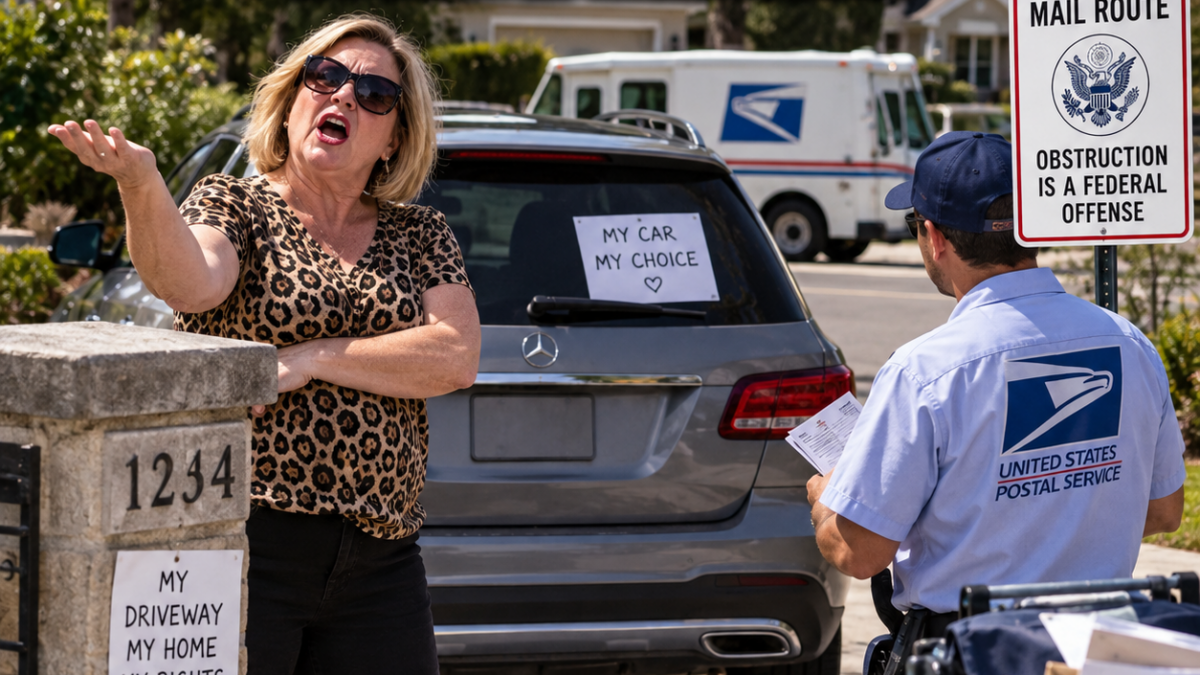
She had interfered with the delivery of United States mail.
I sat very still for a few seconds.
Then I opened my laptop.
Years in the military had taught me something that had become almost instinctive.
Before you act, understand the ground.
Before you accuse, understand the rule.
And before you challenge someone with institutional authority, make sure you are standing on solid facts.
I found the contact information for the United States Postal Inspection Service.
I read carefully.
Then I called.
A woman answered in a calm, practiced voice.
“Postal Inspection Service. How may I help you?”
“My name is Daniel Mercer,” I said. “I need to report the intentional obstruction of an active rural mail delivery route.”
There was a small pause.
Not dramatic.
Just enough for me to hear the shift in attention.
“Tell me what happened, sir.”
So I did.
I explained the easement.
The concrete planters.
The banner.
The families beyond the barricade.
The rural carrier who had been unable to proceed that morning.
Then she asked the question I knew was coming.
“Do you know who placed the obstruction?”
“I believe the president of the neighboring homeowners association did.”
“Why?”
I looked down at the thickening file beside me.
“Because she has spent several months trying to pressure me over property that isn’t part of her association, and I have documentation.”
“What kind of documentation?”
“Certified county plats. Letters she sent me. My responses. Code enforcement complaints. Sheriff calls. An HOA newsletter discussing my property. Photographs of the barricade. Video from this morning. And witnesses.”
The woman became even more methodical.
She took names.
Dates.
Addresses.
The route information.
The names of residents whose access had been affected.
When I finished, she said, “Someone from the regional office will contact you.”
“How soon?”
“Likely within twenty-four hours.”
I thanked her.
Before hanging up, she added, “Do not move the obstruction yourself unless necessary for an emergency. Preserve the scene as you found it.”
“I understand.”
I ended the call and sat back.
For months, Karen had tried to drag me into emotional fights.
She wanted yelling.
She wanted threats.
She wanted something she could photograph, quote, or twist into evidence that the angry outsider on ten acres was terrorizing her peaceful community.
I had refused to give it to her.
Now she had finally done something physical.
Something documented.
Something that reached beyond HOA politics.
And for the first time since this began, I didn’t feel angry.
I felt tired.
Not weak.
Just tired in a way I hadn’t expected.
When I retired from the Army, I had imagined this land as a place where the hardest decisions I would make involved lumber dimensions or whether to restore the Land Cruiser in its original green.
I hadn’t come here looking for another campaign.
I had spent enough years studying terrain, building defensive positions, moving equipment under pressure, and watching minor mistakes become major problems.
I wanted mornings where coffee went cold because I was distracted by birds instead of radio traffic.
I wanted to work until sunset and sleep without wondering what emergency waited at dawn.
Yet somehow, a four-foot cedar fence had turned my retirement into a bureaucratic siege.
I stared through the trailer window toward the half-finished workshop.
Then there was a knock.
Three hard taps.
I opened the door.
Jeb stood outside in dusty boots and a faded cap.
He was in his late sixties, sunburned, wiry, and looked as if he had been personally arguing with weather for most of his life.
“You serious when you said that wasn’t you?”
“I’m serious.”
He glanced toward the blocked lane.
“Then who?”
“You already know.”
His jaw shifted.
“That HOA woman?”
I nodded.
Jeb removed his cap and rubbed the top of his head.
“She’s lost her mind.”
“She thinks the road is mine to control.”
“It ain’t.”
“I know.”
“My daddy used that road.”
“I know.”
“Granddaddy too.”
“I know.”
He stared at me.
“What are you going to do?”
“I’ve already done it.”
“What?”
“I reported it.”
“To the county?”
“No.”
I hesitated.
“To the Postal Inspection Service.”
Jeb blinked.
“The what?”
“The federal law-enforcement side of the Postal Service.”
He stared toward the concrete planters.
Then he slowly put his cap back on.
“Well.”
That one word carried more satisfaction than a speech.
After a moment, he said, “You want coffee?”
“I’ve got some.”
“Yours any good?”
“No.”
“Then come to my place.”
“We can’t get through the road.”
A grin spread across his weathered face.
“Got another way.”
For the first time that morning, I laughed.
We took his pickup around the long route.
It added almost fifteen minutes.
That was inconvenient for us.
For his hay trailer, it was worse.
For emergency vehicles, potentially far worse.
That thought stayed with me.
At Jeb’s kitchen table, his wife, Martha, poured coffee strong enough to remove paint.
When she heard what had happened, she shook her head.
“That woman came down here once.”
“When?” I asked.
“Two years ago.”
Jeb groaned.
“Don’t get her started.”
Martha ignored him.
“She wanted us to replace our roadside mailbox because it didn’t match the ones in Oakmont Meadows.”
I almost choked on my coffee.
“You’re not in the HOA either.”
“Didn’t matter to her.”
“What did you say?”
Martha smiled sweetly.
“I told her when she started paying my property taxes, she could pick my mailbox.”
Jeb slapped the table.
“That’s why I married her.”
Martha continued.
“Karen looked at me like I had thrown mud on her shoes. Then she said our place affected the appearance of the neighborhood entrance.”
“What happened?”
“I planted sunflowers.”
“Why?”
“Because she said yellow was distracting.”
I stared at her.
Martha took another sip.
“You Army boys aren’t the only stubborn people around here.”
I laughed harder than I had in weeks.
But the humor faded when Jeb leaned forward.
“Daniel, I’m glad you reported this.”
His tone changed.
“This ain’t just about mail. Ambulance uses that cut-through sometimes.”
That got my attention.
“How often?”
“Depends where they’re coming from. Fire department too. Saves time getting to the houses behind you.”
I felt something cold settle in my stomach.
Karen probably hadn’t considered that.
That didn’t make it better.
It made it worse.
She had moved heavy concrete barriers onto a recorded access route because she wanted to punish someone.
The consequences apparently hadn’t entered her mind.
When I returned home, I added Jeb’s information to my notes.
Then I called my attorney, Mr. Davies.
He answered on the fourth ring.
“Daniel.”
“Morning.”
“That tone usually means our mutual friend has done something stupid.”
“She blocked an easement.”
Silence.
“With what?”
“Concrete planters.”
More silence.
“Whose easement?”
“Recorded access across the southeast corner. Serves the rural homes behind me.”
He sighed.
“All right.”
“There’s more.”
“Of course there is.”
“The mail carrier uses it.”
Another silence.
Longer this time.
“Daniel.”
“Yes?”
“Please tell me you have photographs.”
“Photographs, video, time stamps, witnesses.”
“You beautiful, paranoid bastard.”
“I’ll take that as approval.”
“What have you done?”
“Called Postal Inspection.”
He laughed once.
Not because it was funny.
It was the sound a man makes when he realizes someone has stepped on a rake and the handle is already coming upward.
“Well,” he said, “I suppose Mrs. Miller is about to learn the difference between an HOA violation letter and a federal investigation.”
“I’m not interested in seeing her arrested.”
“I know.”
“I just want this stopped.”
“Then don’t get sentimental now.”
That surprised me.
“What do you mean?”
“People like her count on everyone else becoming reasonable before they do. You have spent months being reasonable. She interpreted restraint as weakness.”
I looked through the window toward the cedar fence.
“What should I do?”
“Exactly what you’ve been doing. Preserve everything. Don’t exaggerate. Don’t threaten. Don’t celebrate publicly. Let facts do the work.”
“That’s the plan.”
“And Daniel?”
“Yeah?”
“Ask the residents behind that road to document every disruption. Mileage. Delayed deliveries. Access problems. Everything.”
I wrote it down.
“Got it.”
I spent the rest of that day working on the Land Cruiser because I needed my hands occupied.
The vehicle had belonged to a man in Tennessee who had parked it in a barn after the transmission failed sometime around 1998.
Rust had eaten the lower body panels.
The interior smelled like mice and old vinyl.
To me, it was perfect.
Machines were honest.
If something failed, there was usually a reason.
Fuel.
Air.
Compression.
Electricity.
Wear.
You diagnosed it.
You fixed it.
People were harder.
Power distorted them.
Fear distorted them.
Pride especially.
At 6:40 that evening, George walked into my workshop without knocking.
He had earned that privilege.
He was seventy-four, thin, soft-spoken, and usually carried himself with the cautious politeness of a man who had spent too many years avoiding conflict.
Not tonight.
His eyes were bright.
“I heard.”
“News travels fast.”
“It’s Oakmont Meadows. Someone sneezes and Karen issues a pollen citation.”
I smiled.
George walked around the Land Cruiser.
“You really think federal people will come?”
“I think they’ll investigate.”
He ran a hand over the unfinished fender.
“I wish I had fought her over my shed.”
I looked at him.
“You shouldn’t have had to.”
“I know.”
His voice dropped.
“That shed was Evelyn’s idea.”
I had heard him mention his late wife before, but only briefly.
He stared at the concrete floor.
“She bought me the first set of good garden tools I ever owned. Had the shed built for my fiftieth birthday. We painted it together.”
I said nothing.
“After she died, sometimes I’d go sit in there.”
His mouth trembled almost imperceptibly.
“Karen kept sending those letters. Every envelope made my stomach hurt. Fine after fine. Threats about a lien. I knew it was ridiculous, but Evelyn was gone and I didn’t have the fight in me.”
He swallowed.
“So I tore it down.”
I leaned against the workbench.
“George.”
“I watched a crew put pieces of it in a dumpster.”
He looked toward me.
“And Karen came by that afternoon in her golf cart and said, ‘See? That wasn’t so difficult.’”
For a moment I couldn’t speak.
That sentence bothered me more than almost anything Karen had done to me.
Not because of the shed.
Because she had seen surrender as proof that she had been right.
George rubbed his palms together.
“So whatever happens tomorrow, don’t feel bad for her.”
“I don’t want revenge.”
“I do.”
That made me look at him.
He gave me a sad little smile.
“Maybe not revenge exactly.”
“What, then?”
“I want her to know how it feels when somebody tells you that your wishes don’t matter.”
I understood.
The phone rang the following morning at 8:03.
“Mr. Mercer?”
“Yes.”
“This is Inspector Davis with the United States Postal Inspection Service.”
His voice was clipped and professional.
“I’m following up regarding your report of an obstructed delivery route.”
“Yes, sir.”
“My partner and I are approximately thirty minutes from your location. Can you meet us at the obstruction?”
“I can.”
“Bring whatever documentation you have.”
“I will.”
He hung up.
No small talk.
No dramatic promise.
No warning about what might happen.
Thirty minutes.
That was all.
I packed everything into my accordion folder.
The certified plat.
My deed.
Karen’s original violation letter.
My certified response.
The return receipt with her signature.
Copies of the code complaints.
Notes from the sheriff visits.
The HOA newsletter.
Photos.
Video.
Statements from Jeb and two of the residents behind the easement.
Then I walked toward the road.
People were already noticing.
An Oakmont resident walking a Labrador stopped near the barricade.
“Did you do this?”
“No.”
He frowned.
“The sign says Oakmont.”
“I noticed.”
“Why would the HOA block your road?”
“It isn’t my road to block.”
He looked confused.
I didn’t explain further.
Let Karen explain it.
At exactly 8:34, a dark blue sedan with government plates pulled over.
Two men stepped out.
Inspector Davis was tall and lean, probably early fifties, with a face that seemed built for listening without revealing what he thought.
His partner, Inspector Rodriguez, was shorter and broad through the shoulders.
They didn’t look theatrical.
No flashing lights.
No tactical gear.
No dramatic badges held in the air.
That somehow made them more intimidating.
Davis shook my hand.
“Mr. Mercer?”
“Yes.”
“Show us.”
We walked to the barricade.
Rodriguez circled it slowly.
He photographed the planters.
The banner.
The road surface.
The tire tracks.
The junction with the county road.
Then he looked toward the lane.
“These were placed yesterday?”
“Before seven in the morning.”
“You see it happen?”
“No.”
“Then how do you know who placed them?”
“I don’t know as a fact.”
He glanced at me.
Good.
He had been testing whether I would overstate.
“I believe Karen Miller and members of the HOA board are responsible based on the surrounding circumstances.”
“Show me.”
I opened the file on the hood of their car.
For almost twenty minutes, I walked them through everything.
No speeches.
No insults.
Dates.
Documents.
Records.
When I showed them Karen’s newsletter reference to “unsightly industrial construction,” Rodriguez read the paragraph twice.
“She published this?”
“Distributed to the community.”
“And your property isn’t in the association?”
“No.”
Davis studied the plat.
“You had this certified?”
“At the county clerk.”
He nodded.
“And the mail carrier regularly uses this route?”
“Tuesday, Thursday, Saturday. The residents can confirm it.”
“Carrier attempted delivery yesterday?”
“I heard the vehicle stop at the barricade. The households beyond it didn’t receive normal delivery.”
Rodriguez looked at Davis.
Davis closed the folder.
“Who is Karen Miller?”
“HOA president.”
“Address?”
I pointed.
“Fourth house after the turn. Two-story. Gray shutters. Boxwoods cut like cubes.”
Rodriguez almost smiled.
“Of course.”
Davis handed my papers back.
“Stay here.”
“Am I needed?”
“Not yet.”
They got into the sedan.
Instead of leaving, they drove directly into Oakmont Meadows.
I knew where they were going.
So did everyone else within sight.
George happened to be collecting his newspaper.
Mrs. Santoro was loading one of her children’s backpacks into an SUV.
Dave, the Marine veteran Karen had harassed over his flag, was washing his truck.
Each of them watched that dark sedan move slowly down the street.
It stopped outside Karen Miller’s house.
Karen’s home looked exactly the way you would expect.
Perfect grass.
Perfect hedges.
Seasonal wreath.
Two identical planters framing the porch.
A decorative sign saying WELCOME.
That word would become very funny later.
Her door opened.
Even from where I stood, I recognized the confident posture.
She smiled.
Davis showed identification.
The smile disappeared.
I couldn’t hear the first exchange.
Then Karen stepped onto the porch.
Hands on hips.
There it was.
Her command posture.
The same posture she had used beside my fence.
She talked for several minutes.
Pointed toward my property.
Pointed toward the street.
Once, she pointed at the inspectors themselves as though assigning them a task.
Rodriguez didn’t move.
Davis listened.
Then he said something.
Karen stopped.
Even from a distance, I saw the change.
Her shoulders jerked backward.
Her hands dropped.
She looked toward the barricade.
Then toward me.
Her face changed color.
She started talking again, much faster.
Davis raised one hand.
Not aggressively.
Just enough.
Karen stopped.
By then, people had begun stepping outside.
Nobody stood close.
Nobody wanted to interfere.
But years of fear had taught Oakmont residents to recognize the unusual sight of Karen being questioned instead of doing the questioning.
Dave crossed his arms.
George stood at the edge of his lawn.
Mrs. Santoro stayed beside her SUV.
Karen’s voice rose.
“I was protecting our neighborhood!”
That carried clearly.
Davis answered something I couldn’t hear.
“You don’t understand!” she shouted.
Rodriguez said something.
Karen pointed toward me.
“He owns it!”
That carried too.
Davis turned his head toward my property for a second.
Then back to Karen.
Whatever he said next made her visibly shrink.
Because that was Karen’s fundamental mistake.
She believed ownership meant unlimited control.
My soil lay beneath that road.
Therefore, in her mind, I could block it.
And if I could block it, she apparently believed she could block it on my behalf.
But property law doesn’t work that way.
Recorded easements survive personal preference.
And postal routes are not suggestions that disappear because an HOA president decides a dirt lane is aesthetically inconvenient.
The conversation lasted another ten minutes.
At one point, one of Karen’s board members hurried over.
A woman named Linda Carr, Karen’s closest ally.
She arrived carrying a binder.
I had seen that binder at HOA meetings.
Karen gestured toward it with sudden confidence.
Linda opened it.
Davis took several sheets.
Read them.
Handed them back.
Whatever protection Karen imagined that binder contained clearly wasn’t there.
Linda’s expression went from self-righteous to frightened.
Then Inspector Rodriguez walked toward the barricade while Davis remained with Karen.
Rodriguez stopped beside me.
“Do you have equipment capable of moving these?”
“Yes.”
“Don’t.”
“I wasn’t planning to.”
“Good.”
“Are they removing them?”
“Yes.”
“Who?”
He looked toward Karen’s house.
“The people responsible will arrange it immediately.”
Then he added, “If they don’t, it will be arranged for them.”
He returned to the sedan.
The inspectors left shortly after.
Karen remained on her porch.
For almost a full minute she didn’t move.
Then she looked across the street.
Neighbors were watching.
I expected her to yell.
Instead she went inside and slammed the door.
An hour later, a flatbed tow truck arrived with a small work crew.
They attached straps to the concrete planters and winched them one by one onto the truck.
The banner came down.
I stood beside Jeb as the final planter lifted.
He spit into the grass.
“That didn’t last long.”
“No.”
“You think she learned anything?”
“No.”
He laughed.
“Me neither.”
When the road was clear, a postal vehicle appeared at the county road.
The carrier slowed.
Looked at us.
Then turned onto the easement and continued through.
Jeb took off his cap.
He didn’t salute.
He simply held it against his chest for a second.
It was such an unexpectedly sincere gesture that I couldn’t tease him.
That afternoon, mail reached the houses beyond my land.
The road was open.
The matter could have ended there.
Karen could have apologized.
She could have told the board she had made an error.
She could have stepped back.
Instead, she called an emergency HOA meeting.
That was the message George received from another resident.
Tuesday, 7:00 p.m.
Clubhouse.
“Special security concerns involving adjacent properties.”
I read the announcement twice.
Dave called me.
“You going?”
“I’m not an HOA member.”
“You’re the adjacent property.”
“I’m still not a member.”
“So stand outside.”
“What are you planning?”
“Listening.”
The way he said it told me he planned considerably more than listening.
“Dave.”
“What?”
“Don’t turn this into a circus.”
He exhaled.
“I spent twenty-three years in the Marines. You think I don’t know discipline?”
“I think you enjoy confrontation.”
“That too.”
I went.
Not because I wanted to invade their meeting.
Because I was tired of conversations about me happening behind closed doors.
The clubhouse parking lot was almost full when I arrived.
That was unusual.
Karen’s meetings normally attracted fewer people than a root canal seminar.
Tonight, maybe sixty residents had shown up.
I stayed near the rear doors.
George waved me inside.
“You sure?”
“You’re evidence.”
“That’s a charming description.”
“Get in here.”
I stood along the back wall.
Karen sat at the front table.
Linda beside her.
Another ally named Patricia.
And the fourth board member, a quiet accountant named Robert Hale, who looked like he had spent years wishing himself invisible.
Karen struck the gavel.
“We are calling this emergency meeting to order due to serious threats to community safety.”
Murmurs moved through the room.
Karen looked directly toward me.
“Recently, an adjacent landowner has undertaken actions that have caused conflict, unwanted government involvement, and reputational harm to Oakmont Meadows.”
Dave stood immediately.
“What actions?”
Karen stiffened.
“You’ll have an opportunity during member comments.”
“You just accused him.”
“Sit down.”
Dave remained standing.
Mr. Santoro touched his arm.
Dave sat.
Karen continued.
She presented herself as the victim.
She said the easement had been temporarily restricted because of “unauthorized commercial traffic.”
She said she believed she had authority to protect Oakmont residents.
She described the arrival of federal inspectors as an “overreaction resulting from misinformation.”
That got my attention.
Misinformation.
She was already rewriting events.
Then she said something that changed the room.
“The association may be required to retain specialized legal counsel because of this malicious complaint.”
Someone near the front called out, “How much?”
Karen hesitated.
“We don’t know.”
“How much did moving those planters cost?”
Another pause.
“That is being reviewed.”
“Did HOA money pay for the planters?”
Silence.
Mrs. Santoro stood.
“I asked you a question.”
Karen struck the gavel.
“Member comments will occur—”
“Did our dues pay for you to block a road that isn’t ours?”
Applause broke out.
Karen’s face tightened.
“This is exactly the kind of disorder I am trying to protect this community from.”
George stood.
He didn’t shout.
He never did.
That was why people listened.
“Karen, I think we’ve had enough protecting.”
The room went quiet.
Her eyes narrowed.
“Excuse me?”
“I said I think we’ve had enough.”
“You’ve been violating landscaping requirements for years.”
George smiled sadly.
“There it is.”
“What?”
“That’s what you always do.”
He looked around.
“If somebody disagrees with you, suddenly their mailbox is wrong. Their shed is wrong. Their flowers are wrong. Their flag is wrong.”
Karen’s expression hardened.
“Rules exist for a reason.”
“My wife built that shed with me.”
The room changed.
Some people knew the story.
Many didn’t.
George’s voice trembled.
“You fined me until I tore down one of the last things she and I made together.”
Karen rolled her eyes.
It lasted less than a second.
But people saw it.
George saw it too.
He stopped trembling.
“She was dead, Karen.”
Silence.
“My wife was dead.”
Karen opened her mouth.
George continued.
“And you knew it.”
That hit harder than shouting.
He sat.
For the first time that evening, Karen looked unsure.
Then Mr. Santoro rose.
“I would like to request the association’s financial records relating to the purchase, transport, installation, and removal of those concrete planters.”
Karen snapped, “That request must be submitted properly.”
“It will be.”
“And you’ll receive whatever you are legally entitled to.”
“I’m counting on it.”
That meeting ended with nothing resolved.
But power had moved.
You could feel it.
Karen still had the gavel.
Still had the title.
Still had two loyal board members.
But people were no longer afraid to speak while she was in the room.
That was new.
Over the next week, our private group chat exploded.
Residents who had never spoken publicly began sending old notices.
A retired teacher had been fined because her front door was painted a blue that Karen considered too saturated.
A widower received three warnings because his grass exceeded the limit while he was hospitalized.
A single mother was threatened with a lien after leaving a child’s bicycle beside the garage overnight.
A nurse working twelve-hour shifts had accumulated hundreds of dollars in penalties because her trash container remained visible until the morning after pickup.
The stories weren’t identical.
That was important.
Some fines were probably legitimate.
Some homeowners had genuinely ignored rules they had agreed to.
We didn’t want to become the opposite kind of mob—the kind that assumed every HOA action was malicious simply because Karen was involved.
So Mr. Santoro insisted on standards.
“We separate bad rules from bad enforcement,” he said during a gathering in my workshop. “And both from illegal conduct.”
We had twenty-two people there that night.
My workbench became a conference table.
Folders were stacked beside sockets and wrenches.
“What are we looking for?” Mrs. Santoro asked.
“Patterns,” her husband said. “Selective enforcement. Procedures not followed. Fines imposed without required hearings. Expenditures lacking authorization. Retaliation.”
Dave held up one of his notices.
“She cited me three times for my flag.”
Mr. Santoro read it.
“This one is useful.”
“Because it’s ridiculous?”
“No. Ridiculous isn’t enough. Because the covenant she cites doesn’t actually prohibit what you did.”
Dave grinned.
“Even better.”
We worked until nearly midnight.
George sat near the back, sorting documents by date.
At one point I saw him holding the photograph of his shed.
He rubbed the edge with his thumb.
I sat beside him.
“You okay?”
“I should’ve done this years ago.”
“You weren’t ready years ago.”
“I was scared of losing my house.”
“That was the leverage.”
He nodded.
“You know what the strangest part is?”
“What?”
“Once you’ve been frightened long enough, you start being embarrassed that you’re frightened.”
I understood more than he knew.
Fear itself is rarely the most damaging thing.
Shame about fear isolates people.
Makes them hide.
Karen had depended on that isolation.
She sent letters privately.
Issued fines individually.
Threatened one household at a time.
Each person believed everyone else was complying happily.
Once they started comparing notes, the illusion collapsed.
Three days later, Inspector Davis called.
“I need a sworn written statement.”
“I expected that.”
“Include the history you described.”
“All of it?”
“All facts relevant to intent and the obstruction.”
“What happens next?”
“I can’t discuss an active matter in detail.”
“I understand.”
“Mr. Mercer?”
“Yes?”
“Be precise.”
“I will.”
I spent four hours writing.
No adjectives.
No speculation.
No “Karen is a tyrant.”
No “everyone hates her.”
Just facts.
Date of first contact.
Fence demand.
Certified map.
Fine notice.
Response.
Code complaint.
Sheriff visits.
Newsletter.
Barricade.
Mail route.
Photographs.
Witnesses.
I attached digital copies.
Before sending it, I read the statement twice.
Then I called Mr. Davies.
“You want me to review?”
“If you have time.”
“I always have time to read a statement that may ruin an HOA president’s week.”
He reviewed it and changed almost nothing.
Then he told me something important.
“Daniel, understand that federal involvement may not look like television.”
“I know.”
“There may not be handcuffs on the lawn.”
“I don’t care.”
“Good. Because the real consequence here may be administrative, financial, or negotiated.”
“As long as the obstruction stops.”
“That’s already happened.”
“Then as long as she stops doing this to people.”
He paused.
“The federal government can address the mail issue. The community has to address Karen.”
That sentence clarified everything.
For months, I had been waiting for some larger authority to save us.
But inspectors could not repair Oakmont Meadows.
A court could not teach neighbors to speak to one another.
A federal statute could punish conduct.
It could not create a healthy community.
That work belonged to the people who lived there.
And strangely, although I did not live inside Oakmont Meadows, I had become part of that work.
The turning point came when Mr. Santoro found Article 12.
We were in my workshop again.
He had spent the weekend reviewing governing documents.
He arrived carrying a binder filled with sticky tabs.
“Found it.”
Dave looked up.
“What?”
“How to remove a board member.”
Everyone stopped talking.
Mr. Santoro read aloud.
A director could be removed before expiration of the term by a two-thirds vote of members present at a properly noticed meeting for conduct detrimental to the association or conduct exposing the association to substantial legal or financial liability.
Dave slapped both hands on the table.
“There it is.”
“Calm down.”
“That’s the kill shot.”
“It’s a governance provision, not a kill shot.”
“Lawyers take all the fun out of language.”
Mrs. Santoro leaned forward.
“Can we use it at the next monthly meeting?”
“Yes, if we follow notice and agenda procedures.”
“What about Karen controlling the meeting?”
“She controls the gavel. She does not control the bylaws.”
I almost smiled.
That distinction would become important.
Mr. Santoro developed a plan.
Not a dramatic ambush.
A procedural one.
We would notify residents.
Verify voting eligibility.
Request inclusion of the removal motion.
If Karen refused, we would use the member provisions allowing amendment of the agenda.
We would present evidence.
Not insults.
Not rumors.
Evidence.
The barricade would be central because it had exposed the association to potential liability.
But the larger case would show years of abusive governance.
“This has to be clean,” Mr. Santoro warned us. “If we behave like a mob, Karen becomes the victim.”
Dave groaned.
“So no torches?”
“No.”
“Pitchforks?”
“No.”
“Strongly worded facial expressions?”
“Permitted.”
Even George laughed.
The next board meeting was scheduled for the following Thursday.
For eight days, Karen tried desperately to regain control.
Violation notices suddenly stopped.
An email went out announcing a new “community listening initiative.”
Another email offered amnesty on certain minor landscaping fines.
The newsletter described “recent misunderstandings” and emphasized “unity.”
Nobody missed what she was doing.
Karen had governed through fear when she felt secure.
Now that her position was threatened, she discovered kindness.
Too late.
Then something happened that almost derailed us.
Two nights before the meeting, someone threw a bag of garbage onto Karen’s lawn.
She immediately posted a message accusing “certain dissident residents” of intimidation.
I was furious.
Not at Karen.
At whoever had done it.
I called Dave.
“Was that you?”
“No.”
“Know who?”
“No.”
“Find out.”
“Why?”
“Because this stops now.”
Within half an hour, our group chat had a message from me.
No vandalism.
No harassment.
No threats.
No driving past her house to intimidate her.
No anonymous calls.
No garbage.
Nothing.
If anyone associated with our effort engaged in that behavior, I wanted no part of it.
One resident replied that Karen “deserved worse.”
I answered privately.
Maybe.
But justice and humiliation were not the same thing.
I knew why people wanted revenge.
I wanted it too, sometimes.
There had been nights when another ridiculous complaint arrived and I imagined parking my rustiest equipment where Karen could see it.
I had fantasized about painting the workshop fluorescent orange.
I had pictured dismantling her precious entrance fountain with a backhoe.
But those fantasies were exactly that.
Fantasies.
The moment we became cruel simply because cruelty felt satisfying, we became another version of Karen.
The garbage incident was never repeated.
Thursday arrived.
By six thirty, cars were lining both sides of the clubhouse road.
Karen had expected the usual fifteen residents.
More than one hundred came.
Some carried folders.
Some carried violation notices.
George carried a framed photograph of his shed.
Dave wore a small Marine Corps pin on his collar.
Mrs. Santoro came with her husband.
Jeb attended even though he had no vote.
“So why are you here?” I asked.
“Free entertainment.”
Martha elbowed him.
“We’re supporting you.”
“Same thing.”
I stood near the back again.
The atmosphere was tense but controlled.
At exactly seven, Karen entered with Linda and Patricia.
The room became silent.
Karen froze.
She had not expected this.
For a second, she looked very small.
Then the old expression returned.
Shoulders back.
Chin raised.
Authority restored by posture.
She took the center chair.
Banged the gavel.
“This meeting will come to order.”
Nobody spoke.
“First item, approval of prior minutes.”
Minutes were approved.
“Second item, seasonal landscaping proposal.”
Dave stood.
“Point of order.”
Karen closed her eyes for half a second.
“Mr. Reynolds, sit down.”
“I have a motion.”
“We have an agenda.”
“The bylaws allow members to move to amend it.”
Mr. Santoro stood beside him.
“That is correct.”
Karen stared at him.
“This meeting will not be hijacked.”
“No one is hijacking it.”
“I know what you people are doing.”
Mr. Santoro’s voice remained calm.
“Then you know the procedure.”
The quiet board member, Robert Hale, finally looked up.
“Karen.”
She turned.
“What?”
“He’s right.”
The room went completely still.
It may have been the first time Robert had contradicted her publicly.
Karen stared at him as though a chair had begun speaking.
He swallowed.
“The members can move to amend.”
Dave continued.
“I move that the agenda be amended to include consideration of the immediate removal of Karen Miller from the board under Article 12.”
A woman near the front stood.
“I second.”
Karen’s cheeks turned red.
“This is absurd.”
Mr. Santoro said, “The motion has been made and seconded.”
Karen gripped the gavel.
“I will not permit—”
Robert interrupted.
“We have to vote.”
Her eyes locked on him.
“You need to remember why you’re on this board.”
Robert’s face changed.
That sentence was a mistake.
He leaned back.
“No, Karen.”
His voice strengthened.
“I think I finally remember exactly why I’m on this board.”
He turned toward the members.
“All in favor of amending the agenda?”
Hands rose across the room.
Almost everyone.
Karen looked around as if betrayal were happening in real time.
Maybe to her, it was.
The agenda was amended.
The removal motion came forward.
Mr. Santoro asked for orderly testimony.
I spoke first.
I did not want to.
But my conflict with Karen had triggered the crisis.
So I stood at the front and placed my documents on the table.
“My name is Daniel Mercer. I own the ten acres bordering the eastern side of Oakmont Meadows. I am not and have never been a member of this HOA.”
Karen muttered something.
I ignored it.
“Several months ago, Ms. Miller ordered me to remove a fence built entirely on my own property because it did not comply with Oakmont Meadows standards.”
I showed the plat.
The certified survey.
The first letter.
My response.
The room was silent.
“She then issued fines that had no legal basis.”
I held up the notice.
“After I disputed those fines, multiple complaints were filed against my property with public agencies. Those complaints were investigated. None resulted in a finding against me.”
I looked toward Karen.
“I cannot prove she personally filed every complaint, so I will not claim that.”
That mattered.
People noticed.
I wasn’t there to exaggerate.
“However, the HOA newsletter later publicly identified my lawful workshop as a threat to neighborhood aesthetics and property values.”
I held up the newsletter.
“Then concrete planters were placed across a recorded easement on my property.”
Murmurs started.
“That easement serves families and farms behind my parcel. It is also used by a rural mail carrier.”
Karen leaned toward her microphone.
“That was never established before we—”
Mr. Santoro raised his hand.
“You’ll have time to respond.”
I continued.
“The Postal Inspection Service became involved because the obstruction interfered with mail delivery. Federal inspectors came here. The barricade was removed.”
A man in the second row called out, “Who paid for removal?”
Karen struck the gavel.
“Order.”
Mr. Santoro answered.
“We will address financial records.”
I looked around the room.
“I am not here because I hate your HOA.”
Karen laughed sharply.
Several people turned toward her.
I continued.
“I am not here because I believe communities shouldn’t have rules.”
That surprised some of them.
“You bought homes subject to covenants. You have responsibilities to each other. But rules only work when they apply consistently and when the people enforcing them understand the limits of their authority.”
George watched me.
“This began because Ms. Miller would not accept one boundary line.”
I placed my hand on the plat.
“A literal boundary.”
Then I looked at Karen.
“And eventually a legal one.”
I sat.
George was next.
He carried the photograph.
His hands shook.
“My wife’s name was Evelyn.”
Karen looked away.
“She loved roses.”
He smiled.
“She was terrible at growing vegetables. Absolutely terrible. Tomatoes hated that woman.”
Soft laughter moved through the room.
George smiled too.
“She built this shed for my fiftieth birthday.”
He turned the photograph toward everyone.
It was small.
Blue-gray siding.
White trim.
A little brass handle.
“After she died, I kept her gardening gloves on the second shelf.”
He paused.
“You fined me because I didn’t file the right architectural paperwork.”
Karen shifted.
“I offered you an opportunity to submit retroactive—”
George held up one hand.
Surprisingly, she stopped.
“You fined me for six months.”
His voice cracked.
“I was scared you’d put a lien on my home.”
Several people lowered their eyes.
“So I tore it down.”
George looked at Karen.
“The day they hauled it away, you drove over in your golf cart.”
Karen’s mouth tightened.
“You said, ‘See? That wasn’t so difficult.’”
The room became absolutely silent.
George placed the photograph on the table.
“It was difficult.”
He sat.
Mrs. Santoro spoke next.
Then Dave.
Then the nurse.
Then the widower who had been hospitalized.
Then the teacher with the blue door.
Then a young father whose children had been warned not to leave chalk drawings on the sidewalk.
One by one.
Not every complaint was catastrophic.
That was the point.
Karen’s power had not been built through one enormous act.
It had been built from hundreds of tiny intrusions.
Letters.
Threats.
Fines.
Embarrassment.
The constant message that she was watching.
Each one was small enough to seem foolish to fight.
Together, they formed a system.
After more than an hour, Karen demanded her turn.
She stood.
I expected anger.
Instead, she began softly.
“I have served this community for nine years.”
The room remained quiet.
“I have spent thousands of unpaid hours protecting your homes.”
No one interrupted.
“I have answered calls in the middle of the night. I have managed contractors. I have negotiated landscaping costs. I have enforced rules that many of you signed willingly and later decided were inconvenient.”
Some of that was probably true.
That mattered too.
Karen wasn’t a cartoon villain.
People rarely are.
She had worked.
She had solved problems.
She had probably begun believing strict enforcement was service.
But somewhere along the way, the distinction between serving a community and controlling it had disappeared.
Her voice rose.
“Property values in Oakmont Meadows increased under my leadership.”
A resident said, “So did fines.”
Karen ignored him.
“I made difficult decisions because somebody had to.”
Then she pointed toward me.
“And this man does not even live here.”
I nodded.
“That’s correct.”
“He has manipulated you.”
Murmurs rose.
“He has turned neighbors against one another.”
“No,” George said quietly.
Karen turned.
“You were unhappy before he arrived,” George continued. “We just didn’t know everyone else was unhappy too.”
That wounded her.
You could see it.
Karen looked around the room.
“You think you can do better?”
Nobody answered immediately.
Her eyes shone.
Not with tears exactly.
Something close.
“You have no idea what it takes.”
Robert, the quiet board member, finally spoke.
“Maybe that’s why more than one person should be allowed to take part.”
Karen stared at him.
He continued.
“We stopped questioning you.”
Linda shifted beside Karen.
Patricia looked down.
Robert rubbed his hands together.
“That was our fault too.”
It would have been easy to place everything on Karen.
But Robert was right.
Power like hers needs cooperation.
Sometimes enthusiastic.
Sometimes fearful.
Sometimes simply passive.
The vote was called.
Eligible members received ballots.
Mr. Santoro and two neutral volunteers counted them.
Nobody spoke.
Even Dave stayed quiet.
George sat beside me.
“What do you think?”
“I don’t know.”
“You know.”
“I don’t assume outcomes.”
He smiled.
“Army thing?”
“Life thing.”
The count finished.
Robert stood.
“Votes in favor of removal: one hundred fourteen.”
A sound moved through the room.
Not quite cheering yet.
“Votes against: three.”
Then the applause came.
It wasn’t vicious.
That surprised me.
No booing.
No chanting.
No one shouted at Karen.
People clapped because something had ended.
Karen remained seated.
Her hands rested beside the gavel.
Linda and Patricia looked stunned.
The newly selected acting president, a woman named Helen Brooks, approached the table.
Helen was sixty, a retired school principal Karen had once criticized for putting a ceramic frog beside her porch.
She stopped in front of Karen.
For several seconds, neither woman spoke.
Then Helen said gently, “Karen, the gavel belongs to the association.”
Karen looked down.
Her fingers touched it.
Then pulled away.
Helen picked it up.
That was all.
Nine years of authority transferred in one quiet movement.
Karen stood.
The room opened a path for her.
She walked toward the exit.
When she reached the back, she stopped beside me.
Everyone nearby went silent.
She looked at my face.
For months, I had imagined this moment.
I thought she might threaten me.
Insult me.
Blame me.
Instead, she said, “Are you happy now?”
It was the first truly human thing she had ever said to me.
I could have answered yes.
Part of me wanted to.
I thought about my ruined mornings.
The sheriff visits.
The false complaints.
George’s shed.
The barricade.
All the people she had frightened.
But standing three feet from her, watching humiliation settle over someone who had built her entire identity around control, revenge suddenly felt smaller than I had imagined.
“No,” I said.
She seemed surprised.
“I wanted you to stop.”
Her jaw tightened.
“Well, congratulations.”
“This wasn’t me.”
She laughed bitterly.
“You started it.”
“No.”
I looked toward the room behind her.
“They finished it.”
For a moment, I thought she might say something else.
Then she left.
The doors closed.
No one followed.
That should have been the ending.
It wasn’t.
Removing Karen exposed problems she had spent years hiding.
Helen’s first action as acting president was to authorize an independent review of association finances.
Mr. Santoro recused himself from handling the audit because he wanted it clean.
A regional accounting firm came in.
What they found wasn’t a dramatic suitcase of stolen cash.
It was worse in a different way.
Years of casual, opaque spending.
Contracts awarded without competitive bids.
Landscaping upgrades approved through questionable procedures.
Attorney expenses tied to enforcement campaigns that had never been properly authorized.
Thousands of dollars in fines collected under inconsistent procedures.
A decorative fountain repair that had somehow cost nearly twice the original estimate.
Seasonal flower replacements charged repeatedly.
And the concrete planters.
Those were there too.
Purchase.
Transport.
Installation.
Emergency removal.
Almost five thousand dollars once labor and equipment were included.
All to block a road the HOA did not own.
Residents were furious.
But Helen refused to let the investigation become a purge.
“We fix the system,” she told them. “We don’t build another dictatorship with different people.”
That became the new philosophy.
Violation procedures were rewritten.
Homeowners received clearer notices.
They were given opportunities to cure genuine problems before fines.
Appeals went to a committee instead of one president.
Financial reports were published.
Major contracts required multiple bids.
Board meeting minutes became detailed.
Residents could attend without being treated like intruders.
The most emotional change involved old fines.
The association reviewed disputed penalties from previous years.
Some stood.
A resident who ignored legitimate dues still owed them.
A homeowner who repeatedly violated a clearly written rule wasn’t magically excused because Karen had been unpopular.
But hundreds of questionable charges were reduced or voided.
George received a refund.
Not everything.
Legal limitations and records made full reimbursement complicated.
But enough that one morning he appeared at my workshop holding an envelope.
“What’s that?”
“Justice.”
“How much justice?”
“Seventeen hundred forty dollars.”
I whistled.
“What are you doing with it?”
He looked toward the cedar trees.
“Building a shed.”
I stared.
“You’re serious?”
“Smaller than the old one.”
“Want help?”
“No.”
“George.”
“I said no.”
“Why?”
He smiled.
“Because this one I need to build myself.”
I understood.
Three weeks later, I walked over.
The shed stood behind his roses.
Eight by ten.
Blue-gray.
White trim.
Brass handle.
Nearly identical to the old one.
George had reused two pieces of lumber from Evelyn’s original shed that he had secretly saved.
Inside, on the second shelf, sat a pair of faded gardening gloves.
I didn’t say anything.
Neither did he.
We just stood there.
Some victories are loud.
Federal inspectors.
Packed meetings.
Votes.
Others are a man opening the door of a little garden shed and getting something back from the dead.
The Postal Inspection Service matter continued in the background.
Karen hired an attorney.
I was interviewed once more.
Jeb gave a statement.
The rural carrier provided route information.
The board turned over records concerning the barricade.
Months passed.
I rarely asked for updates.
Then Inspector Davis called.
“Mr. Mercer.”
“Inspector.”
“I wanted to advise you that the matter has been resolved.”
I stood beside the Land Cruiser, holding the phone against my shoulder.
“What does resolved mean?”
“I can tell you that Ms. Miller entered into an agreement addressing the obstruction. There are penalties and conditions. The details will be reflected in the appropriate record.”
“So no trial?”
“No.”
I thought about it.
“Is the mail route protected?”
“Yes.”
“Then I’m satisfied.”
There was a pause.
“You were unusually well documented.”
“I’ve been accused of that.”
“Continue being accused.”
Then, surprisingly, his voice softened.
“Most complaints we get arrive after people have spent months yelling at each other and destroying evidence.”
“I considered the yelling.”
“I’m sure.”
“Thank you for taking it seriously.”
“That’s the job.”
He hung up.
Later we learned more through public proceedings and Karen’s required disclosures.
She received a substantial financial penalty and probationary conditions related to the obstruction.
There was also a written public acknowledgment.
The local newspaper ran a short item.
Nothing sensational.
No giant headline.
No photograph of Karen in handcuffs.
Just facts.
Former HOA president.
Mail obstruction.
Agreement.
Penalty.
The truth didn’t need fireworks.
Karen disappeared from community life.
Her golf cart stopped making patrols.
The curtains at her front windows stayed closed.
For a while, I saw her occasionally at the grocery store.
We never spoke.
Then one afternoon, about five months after the vote, a FOR SALE sign appeared in her yard.
George called me immediately.
“You seen it?”
“Yeah.”
“Think we should complain about the sign?”
“George.”
“What? Wrong color.”
“You’ve become dangerous.”
Martha heard us over speakerphone.
“Leave that woman alone.”
“Yes, ma’am.”
The house sold to a young couple with three children.
I met them while they were unloading bicycles.
The father introduced himself as Ryan.
“We heard the previous owner was involved with the HOA.”
“That’s one way to describe it.”
He looked nervous.
“We’ve never lived in an HOA before.”
“Read the rules.”
“We did.”
“Go to meetings.”
“We plan to.”
“Ask questions.”
He nodded.
Then his daughter, maybe nine, rolled a bright purple basketball hoop toward the driveway.
Ryan looked at me.
“Is that going to be a problem?”
I laughed.
“Not anymore.”
My own land slowly became what I had wanted from the beginning.
The workshop was finished.
I insulated the walls.
Installed proper lighting.
Built storage racks.
Mounted a heavy vise on the workbench.
The Land Cruiser came apart one piece at a time.
Transmission rebuilt.
Axles serviced.
Rust cut out.
New sheet metal welded in.
Some evenings, Dave stopped by with beer.
George came with coffee.
Jeb brought opinions nobody requested.
Mr. Santoro brought legal jokes that weren’t funny.
At first I found the interruptions strange.
I had bought ten acres because I wanted solitude.
Instead, I had somehow acquired a community.
One Saturday, while we were installing the Land Cruiser’s rebuilt transfer case, Dave crawled out from under the truck.
“You know what’s funny?”
“What?”
“You moved here to get away from people.”
“Who told you that?”
“Everybody knows.”
“That’s concerning.”
“You ended up starting a revolution.”
“I didn’t start anything.”
“You built a fence.”
“Exactly.”
“Same thing around here.”
I tossed him a rag.
“Get back to work.”
He grinned.
The new HOA board eventually asked me to attend a meeting.
That request made me laugh.
“I’m still not a member.”
Helen smiled.
“We know.”
“Then why invite me?”
“We’re discussing the border landscaping.”
I narrowed my eyes.
“Careful.”
She laughed.
“Relax. We want to plant native trees on our side.”
“Your side?”
“Our side.”
I liked the sound of that.
I attended.
The meeting lasted forty-five minutes.
People disagreed.
Nobody was threatened.
Nobody pounded the table.
Nobody received a violation notice afterward.
It was almost boring.
Which meant it worked.
At the end, Helen handed me a folder.
“What’s this?”
“Copies of revised policies.”
“Why do I need them?”
“You don’t.”
“Then why?”
“So you know we’re not coming for your fence.”
I smiled.
“My fence was beginning to worry.”
She smiled back.
“Tell it to sleep peacefully.”
Spring came.
Then summer.
The cedar fence weathered from gold to soft gray.
Wildflowers grew along the edges.
Oakmont’s new native plantings began filling the border.
The ugly distinction between my rural land and their manicured development softened.
Not disappeared.
Boundaries still mattered.
But boundaries did not have to be battle lines.
One evening, nearly a year after Karen first walked onto my land, I was sitting outside the workshop.
The Land Cruiser finally ran.
Not well.
But it ran.
The engine idled with that uneven old mechanical rhythm I had been chasing for months.
George sat beside me.
We watched the sun drop behind the trees.
“You happy?” he asked.
The question reminded me of Karen outside the clubhouse.
Are you happy now?
I thought before answering.
“Getting there.”
George nodded.
“Me too.”
From his yard, barely visible through the trees, I could see the roof of the new shed.
A mail truck rattled past.
It turned onto the old easement.
No concrete barriers.
No banner.
No argument.
It continued down the road, stopped at the boxes beyond my property, then came back.
Such an ordinary thing.
That was what struck me.
The whole battle had ultimately been about ordinary things.
A fence.
A shed.
A swing set.
A flag.
A mail route.
People imagine freedom as something dramatic.
Flags on battlefields.
Court decisions.
Speeches.
Sometimes it is.
But most of the freedom we actually feel in our daily lives is almost embarrassingly small.
Planting the flowers you like.
Building a modest shed.
Letting your children draw with chalk.
Receiving your mail.
Standing on your own land without someone inventing authority over you.
Karen had never understood that.
Maybe none of us fully understood it until she threatened those small things.
I used to think her greatest mistake was blocking the mail route.
Legally, maybe it was.
Strategically, definitely.
But over time I realized her first real mistake had happened much earlier.
She assumed everyone was alone.
She believed George was just an old man with a shed.
The Santoros were just one family with a swing set.
Dave was just one veteran with a flag.
I was just one stubborn outsider with a fence.
Individually, we were irritating.
Together, we were dangerous to a system built on silence.
That was why the barricade destroyed her.
Not merely because federal inspectors became involved.
The barricade gave everyone something unmistakable to see.
It converted whispers into evidence.
Fear into anger.
Anger into conversation.
Conversation into organization.
And organization into change.
A month after the anniversary of the vote, Oakmont held its summer picnic.
Helen invited me.
I declined.
Then Martha appeared at my workshop.
“You’re going.”
“I don’t live there.”
“You ate six burgers at our barbecue last month.”
“That’s unrelated.”
“You’re going.”
“Are you threatening me?”
“Yes.”
“What happens if I refuse?”
“No pie.”
I went.
Children ran across the clubhouse lawn.
Someone had set up folding tables.
George brought roses from his garden.
Dave grilled hamburgers while loudly criticizing everyone else’s grilling technique.
The Santoro children climbed on their wooden swing set before coming over.
Robert Hale, the once-silent board member, was manning a table where residents could suggest community projects.
Someone had placed a brightly painted ceramic frog beside the clubhouse entrance in honor of Helen.
It was ridiculous.
I loved it.
Near sunset, George came over carrying two paper cups of lemonade.
He handed me one.
“Look.”
He pointed toward the entrance road.
The decorative fountain Karen had spent so much money maintaining had been turned off.
In its place, the board had installed a simple native garden.
Wild grasses.
Black-eyed Susans.
Purple coneflowers.
A small stone bench.
No Versailles imitation.
No marble cherubs.
No monument to anybody’s ego.
Just a place to sit.
“What happened to the fountain?”
“Repair estimate was ridiculous.”
“So you removed it?”
“Vote was seventy-nine to eight.”
“Democracy.”
“Messy thing.”
“Usually is.”
He took a drink.
“You know what they named the garden?”
I groaned.
“Please tell me they didn’t name it after me.”
“No.”
“Good.”
“Freedom Garden.”
“That might be worse.”
George laughed.
“It was Dave’s idea.”
“Of course.”
Across the lawn, Dave raised a spatula at us.
“He knows we’re talking about him,” George said.
“He always assumes we are.”
We stood there watching neighbors talk to one another.
That may sound sentimental.
Maybe it was.
But I had seen communities in places where people depended on one another for survival.
The strongest weren’t the ones without conflict.
They were the ones where conflict didn’t destroy the ability to cooperate.
Oakmont had spent years confusing uniformity with community.
Uniform mailboxes.
Uniform fences.
Uniform paint.
Uniform behavior.
But real community wasn’t everyone becoming the same.
It was people being able to disagree without trying to dominate one another.
The sun dropped lower.
I headed home before dark.
Walking along the border, I passed my split-rail fence.
The same fence Karen had promised to tear down.
I stopped at the original tenth post.
The one I had been setting when her shadow first fell over me.
There were scratches in the cedar from weather and tools.
At the bottom, almost hidden by grass, was one of the old orange survey stakes.
The plastic flag had faded.
I pulled it from the ground.
I didn’t need it anymore.
Everyone knew where the line was.
I carried it back to the workshop and hung it above my workbench.
Not as a trophy.
As a reminder.
A line matters only if people agree to respect it.
Property lines.
Legal lines.
Personal lines.
Ethical lines.
Karen had crossed all of them because she believed authority erased boundaries.
The rest of us had nearly let her.
That was the part I never forgot.
The next morning, I heard tires on gravel.
The mail truck passed.
A moment later, another vehicle followed.
George’s old pickup.
He pulled into my workshop.
“Coffee?”
“You buying?”
“I brought it.”
“That’s suspicious.”
He came inside carrying two cups and an envelope.
“What’s that?”
“HOA notice.”
I stared at him.
He kept a perfectly straight face.
“What did you do?”
“Apparently my new shed violates community standards.”
My stomach tightened.
“You’re kidding.”
He handed me the envelope.
I opened it.
Inside was a single sheet of paper.
At the top:
OAKMONT MEADOWS HOMEOWNERS ASSOCIATION.
I read the first line.
Dear Mr. Whitaker,
We are pleased to confirm that your garden shed application has been approved.
Below that, handwritten in blue ink:
Looks great. Evelyn would have loved it.
—Helen
I looked up.
George was smiling.
For a second, neither of us said anything.
Then he blinked rapidly and turned toward the Land Cruiser.
“Still leaking oil?”
“Little.”
“Thought you fixed it.”
“I did.”
“Apparently not very well.”
“Drink your coffee, George.”
He laughed.
I folded the letter carefully and handed it back.
Outside, the morning was quiet.
Not empty.
Quiet.
There’s a difference.
For twenty years, silence had meant waiting.
Waiting for orders.
Waiting for engines.
Waiting for the next problem.
When I retired, I thought peace would mean nobody bothering me.
I was wrong.
Peace wasn’t isolation.
It was knowing the people around you respected where you ended and they began.
It was being able to say no without fear.
Being able to disagree without retaliation.
Being able to open your mailbox without wondering what threat waited inside.
Karen had tried to take that from me before I had even finished building my home.
In doing so, she accidentally exposed how many other people had already lost it.
She thought blocking that old dirt road would prove she controlled the border.
Instead, the mail truck that couldn’t pass became the one thing strong enough to make everyone stop pretending her behavior was normal.
Federal inspectors opened the door.
The residents walked through it.
And when it was over, I didn’t feel like I had defeated Karen.
That would give me too much credit.
Karen defeated herself every time she chose domination over conversation.
Every time she used fear when fairness would have worked.
Every time she assumed nobody would compare notes.
Every time she mistook silence for agreement.
The rest of us simply stopped helping her believe it.
Years later, I still own those ten acres.
The workshop is full of projects I will probably never finish.
The Land Cruiser eventually became reliable enough that Jeb stopped making jokes about towing it with his tractor.
George’s roses are better every summer.
His shed is still standing.
Dave still flies his flag from the porch exactly where he wants it.
The Santoro kids got older and eventually outgrew the wooden swing set Karen once hated.
When they removed it, they did so because the children no longer used it.
Not because somebody threatened them.
And the dirt easement remains open.
Three days a week, the mail carrier still crosses the corner of my property.
Sometimes I’m outside when the truck passes.
The carrier usually waves.
I wave back.
Nothing dramatic.
No federal sedan.
No crowd.
No confrontation.
Just mail being delivered.
Exactly the way it should be.
People sometimes ask whether I regret buying property beside an HOA.
I tell them no.
Then they ask whether I would do anything differently.
That answer is yes.
I would have talked to the neighbors sooner.
Because paperwork protected my land.
The law protected the mail route.
Federal inspectors stopped the obstruction.
But none of those things alone would have fixed Oakmont Meadows.
People did that.
George telling the truth about Evelyn’s shed.
Mrs. Santoro refusing to be intimidated.
Dave learning to turn anger into organization.
Robert finally raising his hand against Karen.
Helen taking the gavel without becoming another Karen.
More than a hundred homeowners deciding that rules belonged to the community, not to whoever shouted the loudest.
That was the real victory.
Not punishment.
Not humiliation.
Not watching Karen’s house get sold.
The victory was seeing ordinary people recover the belief that their voices mattered.
One evening, long after all of it, I walked to the southeast corner of my land.
The sun was dropping through the trees.
Grass had grown over the impressions where the concrete planters once sat.
You couldn’t tell anything had happened there.
No plaque.
No scar.
No marker.
Only the road.
I stood in the middle of it for a moment.
Then I heard an engine.
The mail truck.
I stepped aside.
The carrier slowed beside me.
“Evening, Daniel.”
“Evening.”
“Road’s holding up.”
“So far.”
She smiled.
“Better keep an eye on it.”
“I do.”
She drove on.
Dust rose behind the truck and drifted gold through the sunset.
I watched until the vehicle disappeared around the bend.
Then I headed home.
Past the fence.
Past the trees.
Toward the workshop lights.
For years, I thought freedom sounded like silence.
Now I knew better.
Sometimes freedom sounded like children laughing behind a fence someone else didn’t choose.
Sometimes it sounded like a hammer inside a garden shed that once wasn’t allowed to exist.
Sometimes it sounded like neighbors arguing during a meeting and still shaking hands afterward.
And sometimes it sounded like an old white mail truck rattling peacefully down a dirt road that one arrogant woman once believed she had the right to close.
That was the sound I had been looking for when I bought those ten acres.
Not silence.
Freedom.
And this time, nobody was going to barricade it again.








