PART 2: HOA Karen Blocked My Farm Road for Months — Then Her BMW Took a One-Way Flight Into the Mud
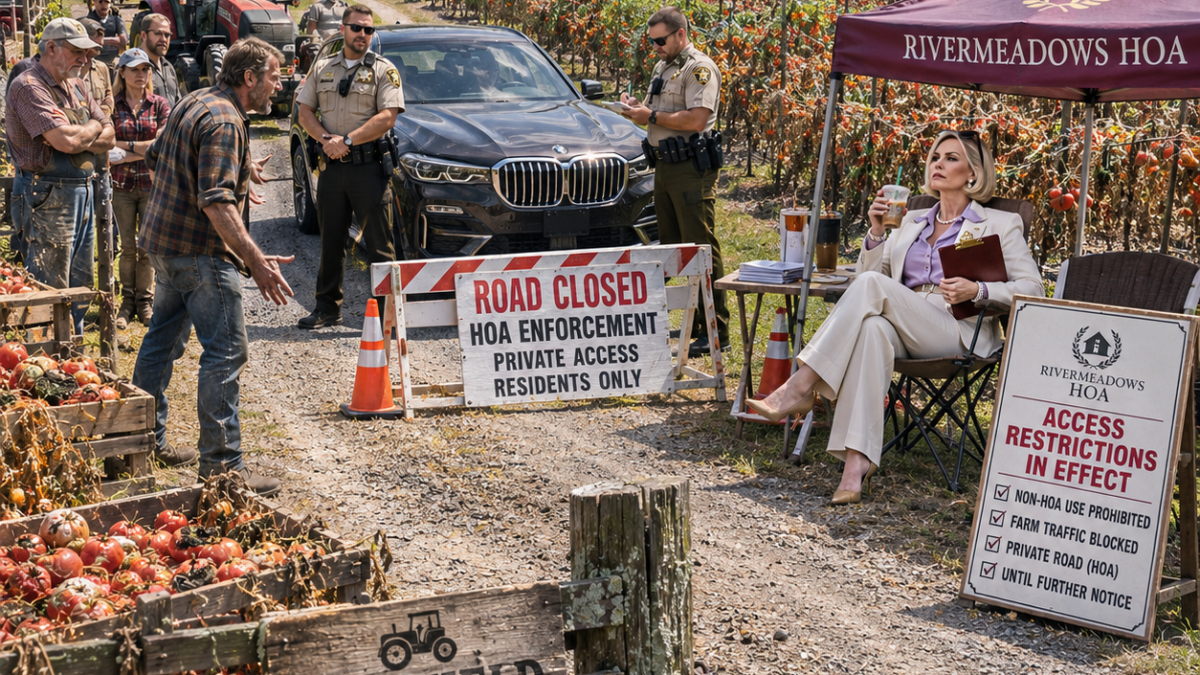
PART 2
The next morning, I went looking for proof.
Not revenge.
Not yet.
Proof.
Sarah had taught me that.
During the last year of her illness, we had fought insurance companies almost as often as we fought cancer.
Forms disappeared.
Approvals changed.
Phone representatives contradicted each other.
Every time I became angry, Sarah would reach across the kitchen table and say, “Edward, anger doesn’t leave a paper trail.”
She kept everything.
Names.
Dates.
Call numbers.
Letters.
Receipts.
Doctor notes.
She could build a case out of a napkin.
After she died, I hated seeing her handwriting.
Now I found myself imitating her.
I created a folder.
**THORNFIELD ACCESS INTERFERENCE.**
Every time Brenda blocked the road, I photographed the BMW.
Date.
Time.
Location.
Duration.
Witnesses.
Every time she spoke to me, I wrote down what she said.
Within two weeks, I had more evidence than I ever wanted.
And Brenda was getting worse.
The folding chair became a canopy.
The canopy became a small storage box.
Then came the camera.
I found it on a Monday morning.
A professional surveillance camera mounted on a telescoping pole, aimed directly toward my equipment barn.
The sign beneath it nearly made me laugh.
**MAGNOLIA ESTATES
COMMUNITY AGRICULTURAL MONITORING INITIATIVE**
I read it twice.
Then I walked straight to Brenda’s house.
She answered wearing a silk robe and holding a coffee cup.
Behind her, several monitors displayed live camera feeds.
My driveway.
My equipment barn.
My road.
Part of a neighboring property.
I stared at the screens.
“You’re filming my farm?”
“Documenting.”
“Without permission.”
“We’re establishing usage patterns.”
“Usage patterns for what?”
“Our easement claim.”
There it was.
Finally.
The truth.
“You’re trying to claim my road.”
“I’m trying to establish equitable community access.”
“That means yes.”
She smiled.
“Edward, Magnolia Estates is growing. Infrastructure has to evolve.”
“My farm isn’t your infrastructure.”
“Your road creates valuable connectivity.”
“For my tractors.”
“Currently.”
That word stayed with me.
Currently.
I realized then that Brenda’s BMW wasn’t only an inconvenience.
It was evidence.
She wanted repeated use.
Repeated presence.
Repeated claims.
Enough noise and paperwork that eventually somebody might treat her invented access right as if it were real.
She wasn’t trying to borrow the road.
She was trying to create the appearance that Magnolia Estates had always had a claim to it.
I drove to the county courthouse that afternoon.
The records office had barely changed since Dad used to bring me there as a kid.
Same fluorescent lights.
Same beige walls.
Same smell of paper slowly turning yellow.
Dolores Martinez was still behind the counter.
She had worked there longer than I had been farming.
When she saw me, she smiled.
“Edward Dunfield.”
“Dolores.”
“You look like your father when somebody annoyed him.”
“That bad?”
“Worse.”
I slid Grandpa’s old survey across the counter.
“I need everything connected to this road.”
She adjusted her glasses.
“Everything?”
“Everything.”
That was how I spent the next four hours discovering that my grandfather had been far more careful than anyone had ever given him credit for.
Back in 1962, a brutal drought had threatened farms across the region.
Various government relief programs had created protected agricultural access arrangements for properties involved in emergency food production and distribution.
Grandpa had enrolled.
Not just the fields.
The access route.
The same road Brenda kept blocking.
Dolores pointed at a faded notation.
“Your grandfather registered this as protected agricultural access.”
“What does that mean now?”
“It means you should talk to somebody who handles agricultural law before your HOA friend keeps getting creative.”
I smiled.
“Can I get certified copies?”
“You can get enough copies to wallpaper her clubhouse.”
I ordered six.
The first real blow against Brenda didn’t come from me.
It came from her own arrogance.
She installed more cameras.
Then she hired security.
One morning, a white pickup appeared beside my road.
**SENTINEL SECURITY SERVICES.**
A man stepped out wearing a uniform half a size too small.
“Mr. Dunfield?”
“Depends.”
“I’m Wade Patterson.”
He offered his hand.
I looked at it.
Then him.
“What are you doing on my property?”
“I’ve been retained by Magnolia Estates to monitor community safety.”
“From my farm?”
“We are documenting potentially aggressive agricultural activity.”
I waited.
He did not laugh.
That worried me.
“What exactly is aggressive agricultural activity?”
“Equipment movement. Confrontational machinery use. Noise events.”
“You mean tractors.”
He glanced at his clipboard.
“I’m not here to debate terminology.”
“Good. Because you’d lose.”
Wade set up a folding table.
Then another camera.
Apparently Brenda believed the solution to illegal surveillance was hiring someone else to perform additional illegal surveillance.
I checked Sentinel Security Services.
The company registration had lapsed more than a year earlier.
Wade’s professional credentials were equally questionable.
I added everything to the folder.
Then Brenda’s cousin Jerry began sending letters.
**CEASE AGRICULTURAL INTIMIDATION.**
That was my favorite heading.
Another accused me of creating an “industrial nuisance environment.”
I was farming.
On a farm.
A farm that existed before Magnolia Estates.
The irony apparently never reached Jerry.
He demanded that I stop operating tractors during “community quiet hours.”
The problem was that agricultural operations in our area were specifically treated differently from ordinary residential noise.
Jerry either didn’t know that or didn’t care.
Then he filed an actual lawsuit.
Fifty thousand dollars.
Emotional distress.
Property devaluation.
Harassment.
Agricultural intimidation.
He filed it in the wrong county.
I was sitting in my kitchen reading the papers when I started laughing.
Not chuckling.
Laughing.
The kind of laughter that comes when something has become so absurd your body no longer knows what else to do.
Margaret Kowalski happened to be there.
She lived nearby and had appointed herself commander of the anti-Brenda information network.
Margaret was sixty-eight, five-foot-two, and more dangerous with neighborhood gossip than most intelligence agencies.
“What?” she asked.
“He filed in Fulton County.”
“So?”
“My farm isn’t in Fulton County.”
She stared.
“Is Jerry stupid?”
“I’m beginning to think Jerry is a public service.”
“How?”
“He keeps documenting their mistakes.”
Margaret considered that.
“Maybe send him a Christmas card.”
I folded the lawsuit.
“Maybe after this is over.”
Margaret was the reason I learned Brenda wasn’t only targeting me.
She had complained about Margaret’s grandson riding his bicycle.
She had filed noise complaints over Dell Kowalski’s woodworking.
She complained about Ethel Parker’s rooster.
She objected to smells from the feed store.
She sent a letter regarding the veterinary clinic’s “persistent animal odor.”
The woman had moved next to farmland and launched a campaign against the existence of farms.
That changed things.
My fight had been private until then.
Now neighbors began gathering in Margaret’s living room.
Farmers.
Shop owners.
Retirees.
People from Magnolia Estates who were embarrassed by what their HOA had become.
Dell Kowalski usually sat quietly through those meetings.
Dell had been an engineer for most of his life.
He was the type of man who could stare at a broken hinge for five seconds and tell you exactly why it failed.
One evening, after everybody left, he followed me to my workshop.
Margaret had apparently told him about Brenda’s latest threat to have my equipment impounded.
Dell ran his hand across my workbench.
“You know what your problem is?”
“I’m surrounded by lunatics?”
“Besides that.”
“I’m listening.”
“You’re treating this like a property dispute.”
“It is a property dispute.”
“No.”
He looked toward the road.
“It’s theater.”
I frowned.
“She needs an audience. The cameras. The letters. The security guard. The complaints.”
“Okay.”
“So stop giving her the show she expects.”
“What do you suggest?”
He smiled.
That should have frightened me.
“Give her a better show.”
A few weeks earlier, Dell had helped his grandson build a small medieval-style catapult for a school physics project.
They had launched pumpkins.
The boy loved it.
Dell, apparently, loved it more.
He started talking about medieval siege engineering.
Leverage.
Counterweights.
Historical demonstrations.
Mechanical energy.
I raised one hand.
“Dell.”
“Yes?”
“Why are you telling me this?”
His smile widened.
“No reason.”
“Dell.”
“Purely educational.”
I stared at him.
Then toward Brenda’s BMW.
Then back at him.
“No.”
“I didn’t say anything.”
“You’re thinking loudly.”
He laughed.
“At least hear the idea.”
The idea was ridiculous.
Completely ridiculous.
It was also the first thing that had made me genuinely smile since Sarah died.
Not because I intended to destroy Brenda’s car.
At least that was what I told myself.
Dell wanted to build a large historical trebuchet as part of a farm heritage and physics demonstration.
A real educational exhibit.
Professionally reviewed.
Properly permitted.
Safely operated.
No improvised backyard weapon.
No secret construction.
A legitimate historical engineering project.
We would invite schools.
Historians.
Agricultural groups.
Maybe turn the conflict surrounding the farm into something useful.
“That’s your revenge?” I asked.
“My revenge?”
“You know exactly what you’re doing.”
“I am promoting science education.”
“With a medieval siege engine.”
“Children love medieval siege engines.”
I couldn’t argue with that.
The next breakthrough came accidentally.
I was cleaning the old storage room when I kicked Grandpa’s tackle box.
It hit the concrete.
The rusted latch opened.
Paper spilled everywhere.
Old fishing permits.
Receipts.
Letters.
A photograph of Dad at seventeen holding a catfish so large I suspected the perspective was dishonest.
Then I saw an envelope.
Government letterhead.
1962.
I sat on the floor.
Inside were additional documents relating to the agricultural protection program Dolores had found.
Grandpa had kept the originals.
I called Claude Brewster.
Claude had spent decades in civil engineering and rural infrastructure.
He arrived that afternoon.
We spread everything across my workbench.
He read slowly.
Once.
Twice.
Then he looked at me.
“Your grandfather knew exactly what he was doing.”
“What?”
“He protected access to the agricultural operation.”
“For how long?”
Claude tapped the document.
“Long enough that Brenda’s attorney should have researched this before claiming your road.”
That answer was less dramatic than what I wanted.
But it was real.
And real was useful.
We brought the documents to an agricultural attorney.
Then another specialist.
The conclusion was consistent.
Brenda’s claim was extremely weak.
Her interference with agricultural access potentially exposed her and the HOA to serious liability.
Especially after repeated written warnings.
Especially after crop losses.
Especially after installing equipment on my property.
Especially after hiring an unlicensed security operation.
Especially after Jerry’s questionable filings.
That night, I walked alone through the tomato field.
Most of that section had already been harvested or lost.
The air was cool.
The stars were clear.
For months, I had imagined revenge as a moment.
Brenda humiliated.
Brenda frightened.
Brenda losing.
Standing there, I realized what I actually wanted.
I wanted my life back.
I wanted sunrise to mean farming instead of wondering whether a white BMW was waiting at the road.
I wanted to walk into my kitchen without seeing Sarah’s empty chair and a stack of legal threats beside it.
I wanted to be a farmer again.
I sat at the edge of the field.
Sarah had loved this place.
Not farming.
She tolerated farming.
There is a difference.
She loved the evenings.
The porch.
Summer storms.
Fresh tomatoes sliced with salt.
She once told me she married me despite the farm, not because of it.
I could hear her voice.
“You’re enjoying this too much, Edward.”
“Probably.”
“You’re going to do something stupid.”
“Possibly.”
“Don’t.”
I smiled at the darkness.
“I miss you.”
The field didn’t answer.
But something in me settled.
The next morning, I made three decisions.
First, every legal issue would go through attorneys and proper authorities.
Second, Dell could proceed with his educational trebuchet project only if professionals approved every aspect and the county authorized the event.
Third, I would not touch Brenda’s BMW.
If that car ever moved, someone with legal authority would have to approve its removal.
That last rule would matter later.
Construction on the historical exhibit drew attention almost immediately.
Dell was delighted.
Claude supervised.
The county reviewed the plans.
Insurance was obtained.
The historical society became involved.
Professors wanted to observe.
Margaret turned what should have been a small community demonstration into Heritage Farm Days.
Within a week, she had food vendors.
School groups.
Traditional craft demonstrations.
Antique tractors.
Seed preservation workshops.
I stared at her planning board.
“You realize this started because Dell wanted to throw pumpkins?”
“Everything important begins somewhere.”
“We have parking for five hundred people now.”
“Six hundred.”
“Margaret.”
“We added overflow.”
“You scare me.”
“Good.”
Brenda hated it.
Of course she did.
Her cameras recorded every delivery.
Every piece of timber.
Every engineer visiting my property.
Then she went on television.
Channel 7 arrived for what Brenda apparently believed would be an exposé about rural terrorism.
I watched from a distance while reporter Rebecca Martinez stood beside her.
Brenda wore a cream-colored blazer.
Her BMW was parked across my road.
Naturally.
“This structure,” Brenda announced dramatically, pointing toward the historical exhibit, “is clearly intended to intimidate the peaceful residents of Magnolia Estates.”
Rebecca looked toward the farm.
“The county issued permits?”
Brenda hesitated.
“That doesn’t make it appropriate.”
“And the historical society is sponsoring the event?”
“That doesn’t address the psychological impact.”
“Of a physics demonstration?”
“Of a siege weapon.”
“Have organizers threatened your home?”
Brenda paused.
“No explicit threat is necessary when the message is obvious.”
Rebecca looked directly past her.
At the BMW.
“Why is your vehicle currently parked on Mr. Dunfield’s private access road?”
The pause was magnificent.
Brenda recovered.
“We dispute his characterization of ownership.”
“Has a court ruled that Magnolia Estates has an easement?”
“Our attorney has filed comprehensive documents.”
“Which court?”
Brenda looked toward the camera.
“Our legal team is handling that.”
“What is the case number?”
No answer.
“And is your attorney licensed to practice in Georgia?”
Brenda’s face changed.
I almost felt bad for her.
Almost.
The interview aired that evening.
Rebecca had spoken with actual property attorneys.
Agricultural specialists.
County officials.
The report questioned Brenda’s claims, Jerry’s filings, the surveillance, and the repeated obstruction.
Within twenty-four hours, people from Magnolia Estates began calling me.
Not to complain.
To apologize.
One man named Thomas came to my porch.
“I didn’t know she was doing this.”
“You saw her car.”
“I thought there was a legal dispute.”
“There was.”
“So why didn’t you tow it?”
I looked toward the road.
“Because every time I considered it, Brenda was standing there with a camera hoping I’d lose my temper.”
Thomas nodded slowly.
“She wanted you to react.”
“Yes.”
That was the entire strategy.
Make me angry.
Film me angry.
Call me dangerous.
Turn the farmer into the villain.
But the more documentation Brenda created, the more she revealed.
Then Wade made things worse.
He confronted Deputy Ray Kowalski.
Ray was Dell and Margaret’s son.
Good deputy.
Patient man.
Possibly too patient.
He arrived to deliver formal notice that Brenda could no longer obstruct the disputed route while authorities reviewed the agricultural access issue.
Wade stepped between him and Brenda.
“You don’t have jurisdiction here.”
Ray stared at him.
“Excuse me?”
“Sentinel Security has been contracted to protect Magnolia Estates.”
“This is a legal notice.”
“You need authorization from community security.”
Ray looked at Wade’s uniform.
Then his badge.
Then his truck.
“Mr. Patterson, move.”
“I’m placing you under citizen detention pending review.”
I was standing thirty yards away.
Even I whispered, “Oh, Wade.”
He reached toward Ray.
Ray stepped back.
“Do not touch me.”
Wade tried anyway.
The situation ended exactly how any reasonable person would expect.
With Wade sitting in the back of a patrol car staring through the window like a man who had just discovered television police procedures did not count as legal training.
Brenda screamed.
Ray ignored her.
Jerry stopped returning calls.
By Friday, rumors spread that his licensing problems had caught up with him.
That left Brenda.
Alone.
Angry.
Still convinced she could win if she simply refused to acknowledge reality.
Her BMW remained her favorite weapon.
Every morning.
Same spot.
Across my road.
Even after written warnings.
Even after attorneys became involved.
Even after investigators photographed it.
Even after the news story.
The night before Heritage Farm Days, Ray came to my porch.
He carried paperwork.
“What is it?”
“Vehicle notice.”
I read it.
Brenda had parked the BMW and left it there far longer than usual.
She had apparently decided the road itself would become her final protest.
The vehicle had been formally documented as an obstruction.
Authorities had notified her.
She refused to move it.
“What happens now?” I asked.
“You can have it removed through the authorized process.”
“Tow truck?”
“That would be the sensible option.”
I looked toward the farm.
Dell was standing near the historical exhibit.
He looked at me.
Then at the BMW.
Then at Ray.
Ray followed my eyes.
“No.”
“I didn’t say anything.”
“I know that look.”
“What look?”
“The Dunfield look.”
“My father had a look?”
“Your entire family has a look.”
Dell walked over.
“Problem?”
Ray pointed at him.
“No.”
Dell raised both hands.
“I’m just an educator.”
“You’re a retired engineer with too much free time.”
“Also true.”
I held up the document.
“Hypothetically, what qualifies as removal?”
Ray narrowed his eyes.
“Edward.”
“Hypothetically.”
“Reasonable, lawful removal.”
Dell smiled.
Ray pointed at him again.
“Stop smiling.”
“I’m happy about tomorrow’s educational program.”
Ray rubbed his forehead.
“I hate all of you.”
In the end, nobody made an impulsive decision.
That mattered.
Our attorney reviewed the situation.
The event supervisors were consulted.
The vehicle had already been formally designated for removal.
The historical demonstration had a controlled safety zone.
And someone—Dell would forever refuse to admit whose idea it actually was—suggested that instead of using the usual demonstration load, the abandoned obstruction could become part of a supervised removal demonstration.
Even then, I expected somebody to say no.
Several people did.
Then several more conversations happened.
Insurance representatives nearly had heart attacks.
Engineers discussed safety.
Authorities argued about what was and was not permissible.
The final approval was narrow, controlled, documented, and surrounded by more paperwork than Sarah’s cancer treatment.
And yes.
I saved every page.
Sunday morning arrived cold and bright.
Heritage Farm Days opened at nine.
I had expected maybe two hundred people.
Margaret had apparently invited Georgia.
Families arrived in trucks.
Children climbed on antique tractors.
Steam rose from apple cider.
Kettle corn popped.
A bluegrass group played beside the equipment barn.
For the first time in a year, the farm felt joyful.
That almost broke me.
I stood near the barn watching a boy show his sister how an old seed sorter worked.
Sarah should have seen this.
She would have complained about the crowds.
Then spent six hours talking to strangers.
I reached into my pocket and touched the wedding ring I still carried there.
“Wish you were here,” I whispered.
At ten-thirty, people began gathering near the trebuchet demonstration area.
The machine towered over the field.
I’m not going to pretend it didn’t look insane.
It did.
A huge wooden reconstruction of medieval engineering standing on a Georgia tomato farm while television cameras pointed at it.
Dell was happier than I had seen him in years.
Dr. Hartwell from the university brought students.
Claude reviewed the safety procedures.
County representatives inspected the barriers one final time.
And Brenda’s BMW remained across the road.
Mud pit beyond the designated landing area.
Car in removal zone.
Crowd far behind the safety barriers.
Cameras rolling.
Brenda was nowhere outside.
But I could see movement behind the upstairs window of her house.
At eleven, I stepped toward the microphone.
I looked at the crowd.
Then at the farm.
Then at the road.
“For my grandfather,” I said quietly.
Nobody heard that part.
Then I raised my voice.
“Good morning.”
The crowd answered.
“Today’s demonstration started as a history project.”
Dell coughed loudly.
I glanced at him.
“Mostly.”
People laughed.
“But for me, this farm has never been a museum.”
I paused.
“My grandfather built this place because he believed land mattered when people cared for it. My father continued it. My wife Sarah helped me understand that protecting something doesn’t mean refusing to let it change. It means making sure what changes still matters.”
The crowd became quiet.
“Over the last several months, a road my family has used for generations became the center of a fight that cost this farm money, time, crops, sleep, and probably several years of my blood pressure.”
More laughter.
“But something good came out of it.”
I pointed toward the families.
“This.”
Children.
Farmers.
Teachers.
Neighbors from Magnolia Estates.
People who six months earlier barely spoke to one another.
“This farm is still working because people decided it was worth protecting.”
I looked toward the BMW.
“And sometimes protecting access means removing an obstruction.”
The crowd reacted immediately.
A low wave of laughter.
Gasps.
Then cheers.
I raised a hand.
“Before anybody gets creative at home, everything happening here has been reviewed, supervised, documented, and approved for this controlled demonstration.”
Dell whispered, “Killjoy.”
“I heard that.”
More laughter.
The preparation crew moved into place.
The BMW had already been secured according to the event plan.
The crowd realized what was about to happen.
Phones rose everywhere.
Then Brenda appeared.
She came running from Magnolia Estates.
Still wearing slippers.
“What are you doing?”
I stepped away from the microphone.
Ray intercepted her before she reached the safety barrier.
“That is my car!”
“Yes, ma’am.”
“You can’t touch my property!”
“You received the removal notice.”
“I rejected it!”
“That isn’t how notices work.”
She stared past him.
At me.
“Edward!”
I looked at her.
For months, I had imagined this moment.
I thought I would be furious.
I wasn’t.
She looked small.
Not physically.
Her certainty had disappeared.
All that authority she had invented around herself had finally met a boundary she couldn’t talk through.
“You wanted the road,” I said.
“This is criminal!”
“No, Brenda. What’s happening today is documented.”
Her face twisted.
“You think this makes you better than me?”
That question surprised me.
“No.”
“Then stop it!”
I looked toward the car.
Then back at her.
“You had six months to stop.”
She said nothing.
“You watched my crops rot.”
Silence.
“You filed complaints accusing me of being dangerous because I operated farm equipment.”
Her eyes moved toward the cameras.
“You hired Wade.”
“That was for security.”
“He tried to detain a deputy.”
“I didn’t tell him to do that.”
“You used Jerry’s filings to threaten me.”
“He’s an attorney.”
“Not here, apparently.”
A few people laughed.
Brenda looked around.
Her own neighbors were in the crowd.
That hurt her more than anything.
Thomas from Magnolia Estates stood beside his wife.
Mrs. Henderson—the Magnolia resident who had challenged Brenda at the clubhouse—stood near the historical society tent with her grandson.
Nobody defended Brenda.
She pointed at the trebuchet.
“This is revenge.”
I looked at her.
“Yes.”
The crowd went silent.
Ray stared at me.
I continued.
“But not the way you think.”
I pointed toward the festival.
“You wanted this farm quiet because you thought tractors and animals lowered your property values.”
I pointed toward the children.
“Now schools are coming here.”
Toward the reporters.
“People across the state know this farm exists.”
Toward Magnolia Estates.
“And your own residents finally know they don’t have to let one HOA president speak for all of them.”
Then I looked at the BMW.
“The car?”
I shrugged.
“That’s just the visual aid.”
Dell laughed so hard he had to turn away.
The final safety signal came.
I stepped back.
The release mechanism was activated by the trained demonstration team.
For half a second, nothing happened.
Then the counterweight dropped.
The ground seemed to thump.
The great wooden arm swung.
People shouted.
Brenda screamed.
And her BMW left the ground.
There are moments your brain refuses to process normally.
Your first kiss.
The birth of a child.
A doctor telling you your wife’s cancer has returned.
Your father’s funeral.
And apparently watching a luxury SUV sail through a Georgia morning because a retired engineer helped build a medieval siege-engine exhibit.
The BMW rose.
Higher than any automobile had a moral right to rise.
Sunlight flashed off the windshield.
For one absurd second, it looked graceful.
Then gravity remembered its job.
The SUV dropped nose-first into the mud pit.
**WHUMP.**
Mud exploded upward.
A wall of brown water rose into the air.
The crowd screamed.
Then erupted.
People laughed.
Cheered.
Children jumped.
Dell looked as if he had just discovered fire.
Margaret screamed, “BEST FESTIVAL EVER!”
I stood completely still.
The BMW sank until mud covered the lower doors.
One windshield wiper somehow activated.
It swept slowly back and forth.
Once.
Twice.
That nearly killed me.
I bent over laughing.
Not cruel laughter.
Not even victorious laughter.
Months of anger left my body all at once.
I laughed until I couldn’t breathe.
When I finally stood upright, Brenda was staring at me.
Her face was red.
Tears filled her eyes.
For one second, I saw beyond the HOA president.
Beyond the expensive clothes.
Beyond the woman who treated farmers like scenery.
I saw someone who had built her entire identity around control.
Now the whole county had watched control disappear.
She whispered, “You ruined me.”
I shook my head.
“No.”
She looked at me.
“You did that yourself.”
Federal and state investigators met with her afterward regarding the broader interference claims.
The BMW became almost irrelevant compared with everything else she had created.
Her own surveillance records documented months of obstruction.
Her correspondence documented intent.
Jerry’s filings created a paper trail.
Wade’s activities expanded the investigation.
The HOA’s internal emails exposed discussions about pressuring me to surrender road access.
Brenda had documented herself into a corner.
Within weeks, Magnolia Estates residents voted her out.
It wasn’t close.
Several board members resigned.
Jerry’s legal troubles worsened.
Wade faced consequences for his own conduct.
The dispute over my road ended with formal recognition of the farm’s access rights.
Brenda’s claim collapsed.
The financial side took longer.
Lawyers always do.
But crop-loss claims, legal costs, property interference, and associated damages eventually produced a settlement substantial enough to cover what the fight had cost me.
The first check arrived almost a year after Brenda first parked on the road.
I set it on the kitchen table.
Sarah’s old chair sat across from me.
For months, I had imagined how satisfying that moment would be.
Instead, I cried.
Because I wanted to show her.
“Look,” I said to the empty chair.
“We won.”
The word sounded wrong.
Won.
Sarah was still gone.
Dad was still gone.
Grandpa was still a photograph beside the old farm ledgers.
A settlement could replace rotten crops.
It could pay lawyers.
It could repair fencing.
But there are losses money cannot touch.
I sat there until sunset.
Then I called Dell.
“I know what we’re doing with part of the money.”
“What?”
“Scholarship.”
There was a pause.
“For what?”
“Agricultural engineering.”
Another pause.
Then his voice softened.
“Sarah?”
“Sarah.”
That became the Sarah Dunfield Memorial Scholarship.
Students studying agricultural engineering, sustainable farming, rural infrastructure, and agricultural education could apply.
The first year, we funded three students.
The next year, seven.
Then twelve.
One of the first recipients was a girl named Maya who had attended Heritage Farm Days with her father.
She told me the trebuchet made her realize engineering wasn’t just something people did in laboratories.
It could solve real problems.
I nearly told her that launching a BMW into mud should not become her standard engineering methodology.
Instead I said, “Your professors will explain the details.”
Dell later accused me of crushing innovation.
Heritage Farm Days became permanent.
That surprised everyone.
Especially me.
The trebuchet remained.
But after Brenda’s BMW, it never launched another vehicle.
Pumpkins.
Watermelons.
Demonstration weights.
Safe educational loads.
Kids learned trajectory principles.
Teachers explained mechanical advantage.
Historians talked about medieval engineering.
Farmers talked about modern machinery.
The contrast worked beautifully.
The old and new.
Levers and GPS tractors.
Medieval mechanics and precision agriculture.
Grandpa would have loved it.
Magnolia Estates changed too.
The new board removed most of Brenda’s ridiculous restrictions.
Eventually residents dissolved the aggressive HOA structure and replaced it with a voluntary neighborhood association.
Their first president was Thomas.
His first official act was to visit my farm.
He brought beer.
“Peace offering?”
I asked.
“Absolutely.”
“What does the neighborhood want now?”
“Vegetables.”
“That all?”
“And maybe discounted tickets to Heritage Farm Days.”
“Extortion.”
“We learned from the best.”
I laughed.
We drank on the porch.
Somewhere around sunset, he said, “You hated us, didn’t you?”
“Not you.”
“The subdivision.”
I thought about it.
“At first.”
“Why?”
“Because you replaced farmland.”
He nodded.
“That’s fair.”
“But Sarah would’ve told me people need places to live too.”
“Your wife sounds smarter than you.”
“She was.”
We sat quietly.
Then he looked toward the road.
“You ever regret the car?”
I smiled.
“Ask me when the lawyers aren’t listening.”
He laughed.
Brenda’s final chapter wasn’t what people expected.
For months, rumors spread that she would go to prison forever, lose everything, disappear overseas, or join a monastery.
Small towns are creative.
Reality was less cinematic.
She faced legal and financial consequences.
The lawsuits consumed her.
The HOA presidency was gone.
Her public credibility collapsed.
Eventually she sold the Magnolia Estates house.
The morning the moving truck arrived, I saw her standing beside the driveway.
No BMW.
That vehicle had been written off.
She had a smaller rental car.
I considered staying inside.
Instead, I walked over.
She saw me coming.
Her shoulders tightened.
“What do you want?”
“Nothing.”
“Then why are you here?”
I looked toward the farm road.
“You’re leaving.”
“Obviously.”
There was bitterness in every syllable.
“Where are you going?”
“Florida.”
I nodded.
She folded her arms.
“Come to celebrate?”
“No.”
“You humiliated me in front of the entire state.”
“I didn’t park your car on my property for six months.”
“You didn’t have to destroy it.”
“That part was dramatic.”
Her eyes narrowed.
“At least you admit it.”
“Never denied it.”
For a moment we stood quietly.
Then she looked at me.
“Do you know why I hated that farm?”
I hadn’t expected the question.
“No.”
“My father farmed.”
That stopped me.
She laughed without humor.
“Small operation outside Macon. Never made money. Always dirty. Always exhausted. My mother hated it. We lost the property when I was sixteen.”
I said nothing.
“I spent my entire adult life getting away from places like this.”
She looked across my fields.
“Then I bought the nicest house I could afford and ended up staring at tractors every morning.”
“Brenda…”
“Don’t.”
Her eyes were wet.
“I know what I did.”
There it was.
Not an apology.
But closer than anything I had expected.
“You could have told me.”
“And said what? That your farm reminded me of being poor?”
“Would’ve been more honest than claiming my tractor was terrorism.”
She almost smiled.
Almost.
“I really hated that tractor.”
“It hated you too.”
That time she did smile.
Barely.
Then it disappeared.
“I’m sorry about your wife,” she said.
I stiffened.
She had never mentioned Sarah before.
“Thank you.”
“I read about the scholarship.”
I looked at her.
“News travels.”
“You turned the whole thing into something.”
“Trying.”
She glanced toward the road.
“I suppose that’s what bothers me most.”
“What?”
“You got something good out of it.”
I thought about that.
“No.”
She looked confused.
“The good part wasn’t what you did.”
I gestured toward the farm.
“The good part was what everyone did afterward.”
She nodded slowly.
Then the moving truck driver called her.
Brenda walked away.
At the rental car, she stopped.
“Edward?”
“Yes?”
“I still think the trebuchet was insane.”
“It absolutely was.”
She got into the car.
That was the last time I saw Brenda Thornfield.
Years have passed.
The farm looks different now.
Not completely.
Grandpa’s farmhouse still stands.
The porch still leans slightly because Dad never fixed it correctly.
The gravel road remains gravel.
Heritage tomatoes still grow in the back forty.
But now there’s an education building near the workshop.
School buses arrive twice a week during spring and fall.
The Heritage Farm Educational Center hosts students from across the state.
Dell has his own workshop classroom.
That was a terrible decision.
He keeps teaching twelve-year-olds how to build things.
Margaret manages volunteers.
She is still terrifying.
Thomas handles neighborhood coordination.
Magnolia Estates residents sponsor part of the scholarship fund.
The relationship between the subdivision and local farmers has become something nobody expected.
Cooperative.
That word used to sound impossible.
The trebuchet stands near the edge of the demonstration field.
We reinforced it over the years.
Students ask constantly whether the BMW story is true.
I tell them the educationally appropriate version.
Then Dell tells them the real version when I’m not looking.
There’s a framed photograph in the visitor center.
The BMW is frozen at the highest point of its flight.
Below it is a small plaque:
**PHYSICS DOESN’T TAKE SIDES.
BUT GRAVITY ALWAYS COLLECTS.**
Dell wrote that.
Obviously.
I tried removing it.
Margaret put it back.
Some battles are unwinnable.
The scholarship grew.
So did the festivals.
The farm recovered financially.
Better than recovered.
Heritage tourism created another source of income that helped protect us from bad harvest years.
I started hiring more people.
Young farmers.
Mechanics.
Educators.
One of Maya’s first jobs after finishing her engineering degree was designing a more efficient irrigation system for our back fields.
The same fields Brenda once prevented me from reaching.
The day we activated it, Maya stood beside me.
“You know,” she said, “I became an engineer because of your trebuchet.”
“That is exactly the sentence I hoped never to hear.”
She laughed.
“I’m serious.”
“So am I.”
She pointed toward the irrigation controls.
“Would you rather I had become a lawyer?”
“Engineering is perfect.”
That evening I walked the road alone.
The sun was low.
Dust floated above the gravel.
The fields smelled warm and green.
There are places where grief settles into the land.
Sarah was everywhere on that farm.
The garden she planted beside the porch.
The dent in the kitchen cabinet she made when she threw a skillet during an argument about my mother.
The maple tree we planted on our twentieth anniversary.
For a long time, those things hurt.
Now they comfort me.
I stopped near the place Brenda used to park.
Nothing marked it.
No plaque.
No monument.
Just gravel.
I liked that.
She didn’t deserve a monument.
The lesson did.
Grandpa once told me that farming teaches humility because eventually weather, machinery, animals, markets, or your own stupidity will remind you that control is temporary.
Brenda had never learned that.
Maybe neither had I.
I thought I could protect the farm by holding tighter.
She thought she could control a community with paperwork.
Both of us eventually learned that land survives us.
What matters is what we leave behind.
Grandpa left a protected road.
Dad left a stronger farm.
Sarah left me a reason to turn anger into something useful.
What would I leave?
For years, I thought the answer was tomatoes.
Maybe it still is.
But now there are scholarships.
Students.
Families.
A community that understands farms are not decorative scenery.
And a giant medieval machine that once launched a BMW into a mud pit.
Life is strange.
One October morning, I received a package with no return address.
Inside was a small toy BMW.
White.
The same model as Brenda’s.
I stared at it.
There was a note.
Two words.
**Still insane.**
No signature.
I laughed.
I knew exactly who sent it.
I put the toy on my office shelf.
Dell saw it later.
“Where’d that come from?”
“Florida.”
He looked at me.
“No.”
“Yes.”
“Brenda?”
“I assume.”
He picked it up.
“We could build a miniature trebuchet.”
“No.”
“For educational purposes.”
“No.”
“Scale modeling.”
“Dell.”
“Fine.”
He left.
Ten minutes later, I heard him telling Margaret his idea.
Some things never change.
Every year on the anniversary of Sarah’s death, I close the education center early.
No festivals.
No school groups.
No visitors.
I spend the evening on the porch.
Sometimes Margaret brings food and leaves without saying anything.
Sometimes Dell sits with me.
Usually I prefer being alone.
One year, I walked to Sarah’s tree after sunset.
I told her about the latest scholarship students.
About Maya.
About the farm.
About Magnolia Estates.
About Brenda’s toy BMW.
“I think you’d like what happened here,” I said.
Wind moved through the maple leaves.
“I think you’d tell me I went too far.”
I smiled.
“You’d definitely say that.”
Then I became quiet.
“I was angry after you died.”
That was harder to say.
“At everything.”
Cancer.
Doctors.
God.
Myself.
People who still had their wives.
People complaining about meaningless things.
Brenda.
Maybe that was why she got under my skin so deeply.
She arrived when I had no patience left.
She tried to control the one place where grief had allowed me to breathe.
For months, I told myself the fight was entirely about property rights.
It wasn’t.
Part of me was fighting because I couldn’t fight cancer anymore.
I couldn’t save Sarah.
But I could save a road.
I could save a field.
I could defeat Brenda.
That realization took years.
Revenge feels clean when you’re angry.
It isn’t.
It carries everything else inside it.
Grief.
Pride.
Fear.
Shame.
Love.
I looked toward the dark fields.
“We made something good anyway.”
That mattered.
A few weeks later, Heritage Farm Days opened for another year.
Nearly two thousand people came across the weekend.
Children launched pumpkins.
Families toured fields.
College students demonstrated robotics used in modern agriculture.
The Magnolia Estates volunteer group served food.
Thomas, now gray-haired, still negotiated for resident discounts.
Margaret ran everything.
Dell stood beside the trebuchet explaining medieval mechanics with the excitement of a child.
At noon, I walked onto the demonstration platform.
People recognized me now.
I never became comfortable with that.
I lifted the microphone.
“Welcome to Dunfield Heritage Farm.”
Applause.
“Some of you came because you care about agriculture.”
More applause.
“Some came for history.”
Applause.
“And some of you are here because you heard a rumor about a BMW.”
The loudest reaction.
I shook my head.
“Shameful.”
Dell shouted from behind the barrier.
“GIVE THE PEOPLE WHAT THEY WANT!”
Everyone laughed.
I waited.
Then my voice became more serious.
“This farm has been in my family for generations. But the lesson we learned here belongs to everybody.”
The crowd settled.
“Community isn’t a gate.”
I looked toward Magnolia Estates.
“It isn’t an HOA title.”
Toward the farmers.
“It isn’t owning more acres than your neighbor.”
Toward the children.
“It’s understanding that the place you live only works when people respect what others need to live there too.”
I paused.
“Farmers need roads.”
A few cheers.
“Families need homes.”
More.
“Children need places to learn.”
I turned toward the trebuchet.
“And retired engineers apparently need adult supervision.”
Dell bowed.
The crowd laughed.
I smiled.
“Most conflicts don’t need catapults.”
Margaret shouted, “TREBUCHET!”
“Thank you, Margaret.”
More laughter.
“Most conflicts don’t need trebuchets either.”
I looked around.
“They need documents. Patience. Good neighbors. Good lawyers. And sometimes the courage to tell someone with a title that a title doesn’t make them right.”
That was the real ending.
Not the BMW flying.
People always think that was the ending.
It wasn’t.
That was merely the loudest part.
The ending happened slowly.
It happened when the first school bus arrived.
When Mrs. Henderson’s grandson learned physics where Brenda once held emergency HOA meetings.
When Magnolia Estates residents brought food to farmers during harvest.
When Maya returned with an engineering degree.
When Sarah’s scholarship gave a kid from a farm family a chance at college.
When I stopped waking up angry.
That last one took the longest.
One morning, years after Brenda left, I started the tractor before dawn.
The diesel engine settled into its familiar rumble.
I drove toward the back forty.
No BMW blocked the road.
No security camera tracked me.
No folding chair.
No canopy.
No Brenda.
Just gravel crunching beneath heavy tires.
The eastern sky slowly became orange.
I passed the spot where everything had started.
For years, I had always glanced toward it.
That morning, I didn’t.
I drove straight through.
Heritage tomatoes waited in the field.
Work needed doing.
Life had moved forward.
And that was when I finally understood what revenge was supposed to feel like.
Not hatred.
Freedom.
Brenda had spent months trying to make my road hers.
In the end, she lost control of the HOA, lost her legal argument, lost a ridiculous amount of money, lost her BMW, and left Georgia.
I kept the road.
But more importantly, I kept my life.
The farm survived.
The crops returned.
The community changed.
Sarah’s name became attached to opportunities instead of hospital paperwork.
Grandpa’s forgotten documents protected something sixty years after he signed them.
And every once in a while, when a new student asks whether the story about the flying BMW is exaggerated, I take them into the visitor center.
I point toward the photograph.
White SUV.
Blue sky.
Georgia farmland beneath it.
The impossible frozen moment between arrogance and gravity.
Then I tell them the same thing.
“The picture is real.”
Their eyes widen.
“What happened next?”
I smile.
“It landed.”
“Where?”
“In the mud.”
“Was the owner mad?”
“Extremely.”
“Did you get in trouble?”
“That’s a much longer lesson.”
They laugh.
Then we walk outside.
Usually toward the fields.
Because despite everything, that’s where the story truly belongs.
Not with Brenda.
Not with the lawsuit.
Not even with the trebuchet.
With the farm.
With soil my grandfather worked.
With crops my father taught me to grow.
With a place Sarah loved even when she complained about the dirt on my boots.
With people who learned that living beside a farm means respecting the farm was alive long before decorative gates appeared beside it.
The BMW became famous.
The road became protected.
The trebuchet became an attraction.
But the most important thing remained ordinary.
Every morning, I could reach my fields.
Sometimes ordinary victories are the ones worth fighting hardest for.
Last fall, I found myself standing on that road after rain.
The gravel was wet.
Red Georgia mud clung to my boots.
The smell of earth rose from the fields.
A school bus passed near the entrance.
Children waved through the windows.
I waved back.
Then I heard Dell behind me.
“Edward.”
I turned.
He was holding rolled blueprints.
“No.”
“You haven’t even heard the idea.”
“No.”
“It’s historically significant.”
“Absolutely not.”
“You might change your mind.”
“I won’t.”
He unfolded the first page.
I stared.
“What is that?”
“Medieval drawbridge.”
“Why?”
He smiled.
“Educational infrastructure.”
I closed my eyes.
Somewhere, Sarah was laughing.
I could feel it.
“Dell.”
“Yes?”
“Put the blueprints down.”
“Just look at page two.”
“No.”
“It’s brilliant.”
“No.”
“Margaret already approved the festival theme.”
I opened my eyes.
“Margaret approved this?”
“Unanimously.”
“She is one person.”
“Still unanimous.”
I stared at him.
Then at the blueprints.
Then toward the education center filled with children.
And despite every instinct telling me to run, I started laughing.
Because that was my life now.
Not fighting Brenda.
Not defending myself.
Building things.
Teaching people.
Remembering Sarah without falling apart.
Watching the farm become something bigger than inheritance.
A place where history and science met.
Where neighbors who once stood on opposite sides of a property dispute worked together.
Where a terrible conflict had produced friendships I would never have found otherwise.
Maybe Grandpa had been right.
Maybe fine print really could save your bacon.
But Sarah had been right too.
Paperwork alone wasn’t enough.
You had to decide what happened after the fight.
You could spend the rest of your life reliving what somebody did to you.
Or you could build something they never intended to give you.
I chose to build.
A school program.
A scholarship.
A stronger farm.
A better relationship with the people next door.
And yes.
One enormous trebuchet.
The BMW was just a bonus.
People still ask what I felt during those few seconds when Brenda’s SUV crossed the sky.
I used to tell them satisfaction.
Then I said justice.
For a while, I called it revenge.
None of those answers feels completely right anymore.
What I remember most is what happened immediately afterward.
Not the cheering.
Not Brenda screaming.
Not mud raining down.
I remember turning toward the crowd and seeing families from Magnolia Estates standing beside farming families.
People who had spent months treating one another like enemies were laughing together.
Children were pointing toward the sky.
Dell was crying from happiness.
Margaret was screaming like Georgia had won the national championship.
And for the first time since Sarah died, I felt completely present.
Not trapped in a hospital room from the past.
Not afraid of another HOA letter tomorrow.
Not replaying arguments.
Just there.
Alive.
Maybe that was what Sarah had been trying to teach me all along.
The opposite of grief isn’t happiness.
It’s presence.
The willingness to remain part of the world even after the person who made the world meaningful is gone.
Brenda came into my life at exactly the wrong time.
Or maybe the right one.
I would never thank her for what she did.
She caused real damage.
She cost me crops.
Money.
Sleep.
She weaponized authority and made accusations she had no right to make.
But fighting her forced me back into my own life.
It brought people onto the farm.
It opened old boxes.
It reminded me of Grandpa.
It made me use lessons Sarah had taught me when neither of us knew I would someday need them for anything except insurance appeals.
Document everything.
Stay calm.
Don’t let someone else’s certainty become your reality.
And when you finally win, do something useful with it.
The sun climbed over the fields.
Dell remained beside me holding the drawbridge plans.
“Well?”
I sighed.
“Show me page two.”
His face lit up.
I pointed at him.
“This does not mean yes.”
“Of course not.”
“And nothing flies.”
“Absolutely.”
“Nothing explodes.”
“Wouldn’t dream of it.”
“No vehicles.”
He paused.
“Dell.”
“No vehicles.”
I took the blueprint.
Across the road, heritage tomatoes stretched toward the tree line.
The same fields Brenda once kept me from reaching.
The same soil Grandpa worked.
The same place where Sarah once stood barefoot in summer and yelled at me for bringing muddy boots inside.
Home.
That was what I had really been defending.
Not property.
Not acreage.
Home.
And nobody had the right to take that from me simply because they carried a clipboard and knew how to sound important.
Brenda thought authority meant people had to obey her.
Grandpa understood something different.
Authority came from responsibility.
Dad understood it too.
So did Sarah.
It took me longer.
That farm wasn’t mine because my name was on a deed.
It was mine because generations had cared for it.
And someday, it would belong to someone else.
My job was to leave it stronger than I found it.
The road was open.
The fields were alive.
Children were learning there.
Sarah’s name was helping students build futures.
And Brenda’s white BMW?
A small piece of its mud-stained license plate hangs inside Dell’s workshop.
I told him that was inappropriate.
He called it a historical artifact.
Margaret agreed.
Again, I lost the vote.
Sometimes when I pass it, I smile.
Not because Brenda lost.
Because we didn’t.
That distinction took me years to understand.
And it was worth far more than revenge.
The morning Brenda parked on my farm road for the first time, she believed she was claiming territory.
She had no idea she was starting a chain of events that would bring farmers, engineers, teachers, reporters, lawyers, neighbors, and hundreds of children onto land she wanted to control.
She thought she could bury me under HOA paperwork until I surrendered.
Instead, her paperwork helped prove my case.
She installed cameras to document my behavior.
They documented hers.
She hired security to intimidate me.
That security operation became another problem for her.
She hired her cousin to outmaneuver me legally.
His filings made investigators look closer.
She blocked my road because she wanted control of the farm’s future.
Instead, the fight helped secure that future more firmly than it had been in decades.
And when she left her BMW sitting there one time too many, convinced no one would ever dare move it, she finally learned the lesson Grandpa had written into his life without ever saying it aloud.
Never confuse patience with weakness.
Farmers are patient because everything we do requires waiting.
We wait for rain.
Wait for seeds.
Wait for calves.
Wait for markets.
Wait for seasons.
But waiting doesn’t mean we aren’t preparing.
Sometimes a seed is underground long before anything breaks through the surface.
Sometimes a case is being built long before somebody realizes they’re losing.
And sometimes an old farmer spends sixty years protecting a road because he somehow knows his grandson is eventually going to need every piece of paper.
Grandpa played the long game.
I finally learned how.
Brenda spent six months parking in my way.
I spent those same six months documenting.
Learning.
Building relationships.
Finding records.
Letting her believe she controlled the situation.
Then one Sunday morning, with half the county watching, her confidence finally met gravity.
The car landed in mud.
The farm kept growing.
And that, in the end, was the only scoreboard I ever needed.








