PART 2: HOA Karen Blocked My Driveway Until I Towed Her SUV — Then She Attacked the Police and Needed $375,000 Bail
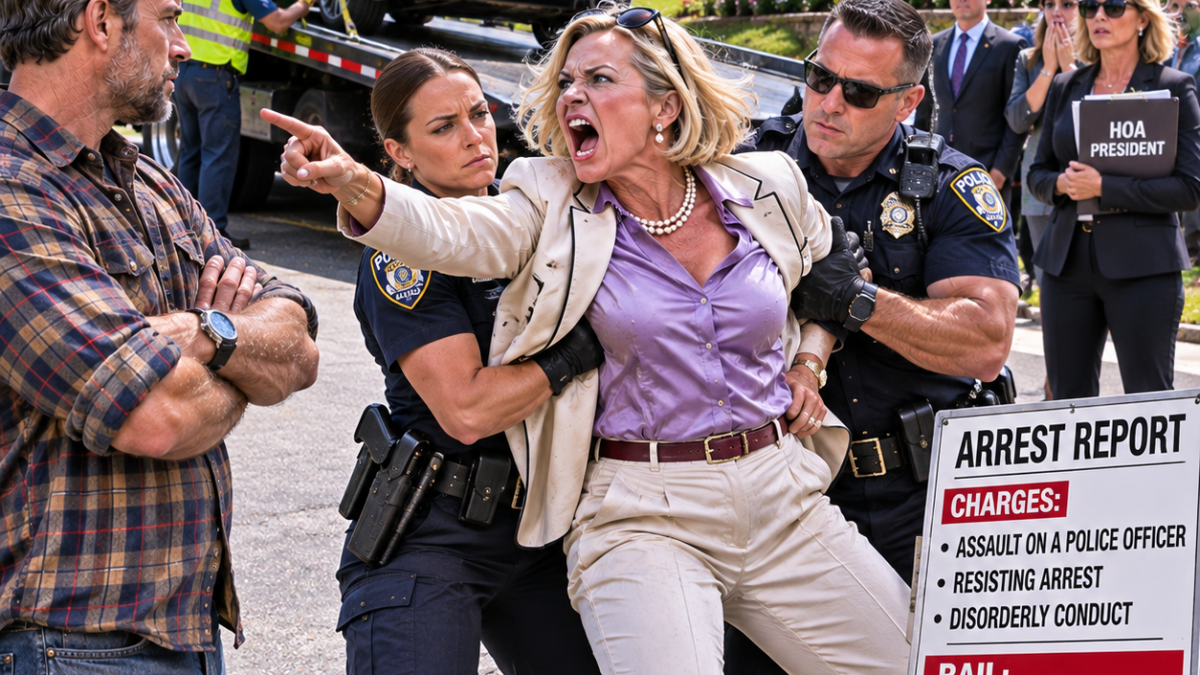
The woman had blocked my driveway for weeks, cost me the biggest job opportunity I’d had in years, and laughed when I warned her that the next time she parked there, I would have her SUV towed.
Forty-five minutes after the tow truck carried her white luxury SUV away, she was standing on my lawn screaming that she owned the neighborhood—and seconds later, she put her hands on a police officer.
What happened after that began with one parking dispute, but before it was over, I would discover that my driveway was only one small piece of something she had been building for years.
My name is Nicholas Parker.
When this happened, I had recently moved back into my grandmother Ruth’s old house in Maple Ridge, Colorado.
I hadn’t planned to return.
For most of my adult life, that little two-story house had existed in my mind as a collection of summer memories.
Grandma Ruth making pancakes before sunrise.
The creek behind the property.
The pine trees dripping rainwater after afternoon storms.
A cracked wooden bench beside the garage where my grandfather used to clean trout.
And the narrow concrete driveway where Grandma taught me how to back up her old Buick when I was sixteen.
She died in January.
By April, the house was mine.
I arrived carrying more debt than furniture, a stack of unanswered job applications, and the vague hope that maybe returning somewhere familiar would help me figure out what came next.
Maple Ridge had changed.
When I was young, Grandma’s road had been mostly independent homes.
Over the years, the Maple Ridge Homeowners Association expanded until nearly every house around hers belonged to it.
Grandma hated that.
She used to joke that if the HOA ever figured out how to regulate clouds, they would start issuing citations for improper shade.
After her funeral, I found a folder in her desk containing years of HOA letters.
Fence complaints.
Grass-height warnings.
Mailbox-color disputes.
One letter actually questioned whether her bird feeder created an “inconsistent visual environment.”
Grandma had written three words across it in red ink.
Come take it.
I laughed when I found that.
I didn’t laugh much after meeting Deborah Callahan.
She arrived three days after I moved in.
Mid-fifties.
Perfect hair.
Pearl earrings.
Cream-colored slacks.
Sunglasses too expensive for someone standing in my cracked driveway.
She held a clipboard against her chest like a judge carrying a sentencing order.
“Mr. Parker?”
“That’s me.”
She smiled.
“Deborah Callahan. President of the Maple Ridge Homeowners Association.”
“I figured someone would eventually come introduce themselves.”
Her smile widened.
Unfortunately, that was not why she had come.
She pointed toward the concrete beneath my feet.
“We’re going to need you to address those fractures.”
I looked down.
“My driveway?”
“Visible cracking affects community presentation.”
I honestly thought she was joking.
She wasn’t.
“I’ve been here three days.”
“I understand. That’s why we allow thirty days for compliance.”
“No ‘welcome to the neighborhood’?”
She blinked.
“I’m sorry?”
“Nothing.”
She continued explaining color guidelines, landscaping expectations, trash schedules, and exterior maintenance requirements.
I barely listened.
Then she said something that made me pay attention.
“We try very hard to preserve order here.”
There was something in the way she said order.
Not pride.
Ownership.
I smiled politely and ended the conversation.
At first, I convinced myself Deborah was simply overinvolved.
Then her white SUV started appearing in my driveway.
The first time, she claimed she was conducting an inspection.
The second time, she said the HOA needed temporary access to evaluate street visibility.
By the fourth time, she wasn’t even pretending.
She parked across the driveway whenever she felt like it.
Sometimes ten minutes.
Sometimes two hours.
Once she left a handwritten note beneath my windshield wiper.
DRIVEWAYS ARE SHARED VISUAL ZONES. KEEP CLEAR FOR HOA INSPECTIONS.
That phrase bothered me enough that I checked my deed.
The driveway belonged to my property.
No shared-access easement.
No HOA parking right.
Nothing.
I emailed Deborah.
She responded with one sentence.
I am the HOA. You do not make the rules here.
I saved the email.
At the time, I thought it was simply the most arrogant sentence I had ever read.
I had no idea it would eventually become evidence.
Then came the morning that changed everything.
I had a job interview downtown.
Not just another interview.
The interview.
A senior operations position with a salary large enough to eliminate most of the debt I had accumulated while caring for my mother during her final illness.
I woke before sunrise.
Ironed my suit.
Reviewed my notes.
Checked the time twice.
Then I opened the front door.
Deborah’s SUV was blocking me in.
Again.
I called.
No answer.
I texted.
Nothing.
Five minutes passed.
Then ten.
Then fifteen.
By the time I ordered a rideshare, I was already late.
I arrived at the office twenty minutes behind schedule.
The receptionist gave me one sympathetic look.
That was enough.
They had moved on.
By the time I came home, embarrassment had become anger.
But underneath the anger was something worse.
I could hear Grandma’s voice.
Don’t let people make you feel like a guest on your own property.
That afternoon, I stopped arguing with Deborah.
I started reading the law.
And by the following morning, a brand-new steel sign stood beside my driveway:
PRIVATE DRIVEWAY. NO PARKING. UNAUTHORIZED VEHICLES WILL BE TOWED AT OWNER’S EXPENSE.
Two days later, Deborah parked there anyway.
This time she left a cardboard sign on her dashboard.
YOU DON’T OWN THE STREET, NICHOLAS. I’LL PARK WHERE I WANT.
I stared at it.
Then I took out my phone.
And called the tow company.
PART 2
Caleb Brooks arrived twenty-three minutes later.
He was a broad-shouldered man in his forties who looked like he had spent his entire adult life moving things other people wished he wouldn’t move.
He parked his tow truck beside the curb, climbed out, and studied the situation.
“You Nicholas?”
“Yes.”
“That the vehicle?”
I pointed toward Deborah’s white SUV.
“Unfortunately.”
Caleb looked at the sign beside the driveway.
Then at the SUV.
Then at me.
“She know she can’t park here?”
“I emailed her. She replied.”
I showed him the message.
He read it.
His eyebrows lifted.
“She really wrote, ‘I am the HOA’?”
“Word for word.”
He gave me my phone back.
“That’s impressive.”
“In what sense?”
“In the sense that I’ve been towing cars twenty years and I’ve never heard anyone claim a homeowners association outranks property law.”
I showed him my deed and the parcel map I had downloaded from the county website.
Caleb nodded.
“Looks clear.”
He photographed everything before touching the SUV.
The sign.
The vehicle’s position.
The driveway.
The license plate.
Then he completed the required notice paperwork.
I did the same.
I recorded the tow from my porch.
I wasn’t going to give Deborah any opportunity to claim her car had been taken from a public road.
Ten minutes later, the SUV’s front wheels were off the ground.
Five minutes after that, it disappeared behind the tow truck.
For the first time in weeks, my driveway was empty.
I stood there with my coffee.
The house looked exactly the same.
Nothing dramatic happened.
No music.
No applause.
Just sunlight on concrete.
But I felt strangely emotional.
That driveway had belonged to my grandmother for forty-two years.
She had paid taxes on it.
Maintained it.
Shoveled snow from it.
Taught me to drive on it.
And Deborah Callahan had somehow convinced herself that a title printed on an HOA letterhead gave her more rights to it than my family had.
I went inside.
For about forty-five minutes, everything was peaceful.
Then I heard screaming.
Not talking.
Not arguing.
Screaming.
“NICHOLAS PARKER!”
I closed my eyes.
Of course.
When I stepped onto the porch, Deborah was marching across my lawn.
No SUV.
No clipboard.
No polished smile.
Her hair was slightly out of place and her sunglasses were pushed onto the top of her head.
“What did you do?”
“Good afternoon, Deborah.”
“Where is my vehicle?”
“Towed.”
Her face changed.
“You stole HOA property.”
“No.”
“You had no authority!”
I held up the tow receipt.
“Actually, I had the property rights and complied with the towing requirements.”
She snatched the paper from my hand.
Read half of it.
Crumpled it.
Then threw it at my feet.
“You think this is funny?”
“No.”
“Do you have any idea what you’ve done?”
“Yes.”
“You’ve interfered with official HOA operations.”
“You were blocking my driveway.”
“I was conducting community business.”
“Then conduct it somewhere you’re allowed to park.”
Her face flushed.
“I can have your property cited every day for the next year.”
I stared at her.
“Is that a threat?”
“It’s reality.”
“You already cost me a job interview.”
“That isn’t my responsibility.”
That answer hit harder than I expected.
“You blocked my only vehicle.”
“You should have planned better.”
I actually laughed.
Not because it was funny.
Because the alternative was saying something I would regret.
Deborah pointed toward my house.
“You inherited this property five minutes ago and suddenly you think you can challenge people who have spent years protecting this community?”
“This was my grandmother’s home long before you became president.”
“Your grandmother was constantly noncompliant.”
That did it.
I stepped down from the porch.
Not aggressively.
But enough that Deborah stopped speaking.
“Do not use my grandmother to justify your behavior.”
She lifted her chin.
“I’m stating facts.”
“No. You’re using rules as an excuse to control people.”
“I run this association.”
“You don’t run me.”
Her eyes narrowed.
“We’ll see.”
Then she pulled out her phone.
I assumed she was calling the tow yard.
I was wrong.
“911,” she snapped when someone answered. “I need officers immediately. A resident has stolen an HOA vehicle.”
I stared at her.
She pointed at me as though I were holding the SUV behind my back.
“Yes. Grand theft. He is becoming aggressive.”
I almost interrupted.
Instead, I turned toward my doorbell camera.
The small blue light was on.
Recording.
Good.
Two patrol cars arrived within minutes.
Officer James Ramirez stepped out of the first.
Officer Megan Chen exited the second.
Ramirez looked from Deborah to me.
Then at the driveway.
“Afternoon. Who called?”
“I did,” Deborah said immediately.
She walked toward him.
“This man illegally seized HOA property.”
Ramirez looked toward me.
“Sir?”
“Nicholas Parker. I own the residence. Mrs. Callahan repeatedly parked across my private driveway after written notice. I posted the required tow warning and had the vehicle removed.”
“Do you have documentation?”
“Yes.”
I retrieved everything.
The deed.
Parcel map.
Copy of my email.
Deborah’s reply.
Photographs.
Tow receipt.
Video.
Ramirez reviewed the papers.
Chen watched the footage on my phone.
After perhaps thirty seconds, she turned to Ramirez.
“Vehicle is fully inside the driveway.”
He nodded.
Then faced Deborah.
“Ma’am, based on what we’ve been shown, this appears to be a lawful private-property tow.”
Deborah stared at him.
“No.”
“Excuse me?”
“No.”
Her voice rose.
“This is HOA property.”
“The vehicle may belong to the HOA,” Ramirez said, “but the driveway doesn’t.”
“You don’t understand our charter.”
Chen remained calm.
“An HOA charter doesn’t override private-property law.”
Deborah laughed sharply.
“Oh, please. I have been president of Maple Ridge for nine years.”
“That doesn’t change the situation.”
“You people always do this.”
Ramirez frowned.
“Do what?”
“Show up without understanding how this community operates.”
“Ma’am, we understand where the vehicle was parked.”
“I am telling you I had authorization.”
“From the property owner?”
“I don’t need authorization from him.”
Chen said, “Then you did not have authorization.”
Deborah’s face turned red.
I had seen angry people before.
I had not seen anger physically transform someone so quickly.
Her neck flushed.
Her hands started shaking.
“You’re taking his side?”
Ramirez answered, “We’re explaining the law.”
“This man has been harassing me for weeks!”
I couldn’t help myself.
“By asking you to stop parking in my driveway?”
“Shut up!”
Chen stepped slightly closer.
“Ma’am, lower your voice.”
Deborah turned on her.
“Don’t tell me what to do.”
“Mrs. Callahan—”
“I said don’t!”
Then everything happened at once.
Deborah moved forward.
Her hand hit Officer Chen in the shoulder.
Hard.
Chen stumbled half a step.
Ramirez reacted immediately.
“Ma’am, back up.”
Deborah swung her large handbag toward him.
It struck his forearm.
He grabbed her wrist.
“Stop resisting.”
She screamed.
“You can’t touch me!”
Chen recovered and moved in.
“Mrs. Callahan, put your hands behind your back.”
“I AM THE PRESIDENT OF THE HOA!”
Those were the words.
Not “I didn’t do anything.”
Not “This is a misunderstanding.”
Not even “Call my attorney.”
I am the president of the HOA.
As though that were diplomatic immunity.
As though she had honestly reached a point where she believed being elected to enforce landscaping rules made her untouchable.
The handcuffs clicked around her wrists.
Suddenly the entire street was silent.
Curtains moved.
Doors opened.
Neighbors appeared on porches.
Gary Thompson, who lived directly across from me, stood near his mailbox holding his phone.
He had apparently recorded the whole thing.
Deborah continued yelling as officers guided her toward the cruiser.
“You’ll both lose your jobs!”
Nobody answered.
“You hear me?”
Chen opened the rear door.
“This is corruption!”
Ramirez gave her the standard instruction to watch her head.
Deborah twisted toward me.
“This is your fault!”
I stayed on my porch.
“No, Deborah.”
She glared.
“You did this to yourself.”
The door closed.
For the first time since I had met her, Deborah Callahan stopped talking.
At least until the patrol car drove away.
Gary crossed the street afterward.
He looked stunned.
“Nick.”
“Yeah?”
“Did she just hit two cops because you towed her car?”
“Pretty much.”
He looked at his phone.
“I got all of it.”
“Keep the original file.”
“You think they’ll need it?”
“I think everybody is going to need it.”
I had no idea how right I was.
By the next morning, the video was everywhere in Maple Ridge.
Gary hadn’t uploaded it publicly.
Someone else had filmed from another angle and did.
The clip spread through neighborhood groups and local social media.
The title was predictable.
HOA PRESIDENT ATTACKS POLICE OVER TOWED SUV.
I watched about twelve seconds before closing it.
I didn’t enjoy seeing it.
That surprised me.
For weeks, I had imagined Deborah being forced to acknowledge she was wrong.
I had imagined the satisfaction of watching her SUV disappear.
But watching someone’s life implode in public was different.
Whatever else Deborah was, she was still human.
And somewhere behind the pearls and threats was probably a family having a terrible morning.
My phone rang constantly.
Some neighbors congratulated me.
Others wanted details.
A few asked whether Deborah had threatened me before.
Then Paul Bennett arrived.
Paul was the HOA treasurer.
Late fifties.
Polo shirt.
Khaki pants.
Permanent expression of mild discomfort.
He stood at the bottom of my porch.
“Nicholas?”
“That depends.”
He almost smiled.
“Can we talk?”
“Sure.”
He glanced toward the driveway.
“I heard about yesterday.”
“That narrows it down.”
“The board is holding an emergency meeting.”
“About Deborah?”
“Among other things.”
“Is she still president?”
Paul shifted his weight.
“Technically.”
I stared at him.
“She assaulted two police officers.”
“I’m aware.”
“So technically she’s president?”
“Our bylaws require a vote.”
I shook my head.
“Of course they do.”
Paul looked embarrassed.
“Hazel wants to suspend her immediately.”
“Hazel?”
“Hazel Nelson. Vice president.”
I vaguely remembered seeing the name on HOA letters.
“She’s been trying to rein Deborah in for years.”
“That hasn’t gone well.”
“No.”
Paul looked toward the house.
“Mr. Parker, there are people in Maple Ridge who have been waiting a long time for something like this to happen.”
“That sounds terrible.”
“I don’t mean the assault.”
“I know.”
He lowered his voice.
“Deborah has controlled the board for years.”
“How?”
“Favors.”
He looked uncomfortable.
“Pressure.”
“What kind of pressure?”
“She knows everyone’s violations. Everyone’s unpaid balances. Everyone’s renovation requests.”
“That sounds like normal HOA information.”
“It is.”
“The way you said it didn’t sound normal.”
Paul said nothing.
That evening I attended the emergency meeting.
The community room was packed.
I stood near the back.
At the front table, Deborah’s chair was empty.
Her brass nameplate still sat there.
DEBORAH CALLAHAN — PRESIDENT
Hazel Nelson called the meeting to order.
She was in her early sixties, silver hair tied back, reading glasses resting low on her nose.
She looked exhausted.
“Most of you are aware of yesterday’s incident.”
A man shouted, “We saw the video!”
Someone else yelled, “She attacked the police!”
Hazel raised her hand.
“I know.”
Another voice called, “She should be removed!”
Applause erupted.
Hazel waited.
“We have consulted counsel. Effective immediately, Deborah Callahan is suspended from all presidential duties pending further board action and resolution of her criminal case.”
Half the room applauded.
The other half started shouting questions.
“What about the fines she issued?”
“What about the legal threats?”
“Is she still accessing the bank account?”
Hazel’s expression tightened.
“We have restricted account access.”
That caught my attention.
A woman near the front stood.
“What does that mean?”
“It means we are reviewing financial controls.”
“Why?”
Hazel hesitated.
Paul stared down at the table.
And I felt a small shift in the room.
The driveway incident was no longer the only story.
After the meeting, Hazel approached me.
“Mr. Parker.”
“Nicholas is fine.”
“Nicholas.”
She held out her hand.
“Thank you for remaining calm yesterday.”
“I didn’t have many better options.”
“You’d be surprised.”
She glanced toward the parking lot.
“I’m sorry about your interview.”
That surprised me.
“How do you know about that?”
“Deborah mentioned it.”
“When?”
“At a board meeting.”
I stared at her.
“She talked about blocking my driveway?”
“She described it as an enforcement inconvenience.”
I laughed once.
“Of course she did.”
Hazel’s face hardened.
“She also said you needed to learn that Maple Ridge wasn’t going to bend around you.”
I felt my stomach tighten.
“She knew exactly what she was doing.”
“Yes.”
Hazel handed me a card.
“If Deborah contacts you after release, document everything.”
“After release?”
“She has attorneys.”
“What are the charges?”
“Assaulting officers, resisting, possibly other counts.”
I slipped the card into my pocket.
“Thanks.”
Hazel started walking away.
Then she stopped.
“Nicholas?”
“Yeah?”
“Your grandmother hated Deborah.”
I smiled.
“The feeling was probably mutual.”
“Ruth was one of the only residents who never seemed afraid of her.”
“That sounds like Grandma.”
Hazel’s expression softened.
“She used to tell Deborah, ‘You’re president of the board, not president of my life.’”
I laughed.
“That definitely sounds like Grandma.”
Hazel smiled.
Then she left.
For the first time since moving home, I wished I could call Ruth and tell her what had happened.
She would have pretended to disapprove.
Then asked whether the tow truck scratched Deborah’s SUV.
Two days later, Officer Ramirez returned.
I expected follow-up questions.
Instead, he asked me to step outside.
“We need to talk.”
Something about his expression worried me.
“What happened?”
“Mrs. Callahan posted bond.”
I stared at him.
“She’s out?”
“Yes.”
“How much?”
“Three hundred seventy-five thousand.”
The number sounded surreal.
“That high?”
“Judge considered the alleged assault, resisting, and information from her prior record.”
I hadn’t known there was a prior record.
“What record?”
“I can’t discuss details outside what’s public.”
“But she’s back in Maple Ridge?”
“As far as I know.”
I looked down the street.
Suddenly every parked vehicle looked suspicious.
Ramirez noticed.
“Has anyone contacted you?”
“No.”
“Threatened you?”
“Not directly.”
“Good.”
He started toward his car.
“Keep it that way.”
That night, I slept badly.
Every creak sounded louder.
Every passing headlight painted the bedroom wall.
I checked my doorbell camera at 12:40.
Again at 2:15.
Again at 4:03.
At 7:12, my phone vibrated.
Motion detected.
I opened the feed.
Deborah stood at the edge of my driveway.
Same white-blonde hair.
Dark pants.
Long coat.
No pearls.
No smile.
She faced the camera without moving.
For twenty seconds, she simply stared.
Then she pointed toward the steel NO PARKING sign.
Slowly.
Deliberately.
Then she walked away.
I called Ramirez.
He watched the footage later that morning.
“She doesn’t enter far enough onto the property for me to make much of this alone.”
“She knows that.”
“Probably.”
“She’s sending a message.”
“I agree.”
“What do I do?”
“What you’re already doing.”
“Document.”
“Yes.”
I hated that answer because it was correct.
The harassment started three days later.
First an anonymous note.
YOU DON’T BELONG HERE.
Then another.
YOU EMBARRASSED THE WRONG PERSON.
My trash bins were knocked over.
The mailbox flag was bent.
One morning I discovered a long dead strip across my lawn where someone had poured a chemical detergent mixture into the grass.
I photographed everything.
Hazel contacted me after Deborah began sending letters on HOA letterhead.
The first one demanded two hundred dollars for “harassment of association leadership.”
The second cited me for an “unauthorized tow-related display,” apparently referring to my private-property sign.
Hazel called furious.
“Those aren’t legitimate.”
“I assumed.”
“She’s suspended.”
“She apparently missed the memo.”
“She’s using old templates.”
“Can she do that?”
“No.”
“Will someone tell her?”
“Our attorney already has.”
Two nights later, I woke at 2:07 a.m.
Metal scraped inside the garage.
I sat upright.
Listened.
Another sound.
A dull clang.
I grabbed my phone.
The driveway camera showed nothing.
I moved slowly through the hallway.
The door connecting the house to the garage was locked.
I opened it.
Darkness.
I flipped the light switch.
Nothing.
The bulb had been unscrewed.
My pulse accelerated.
I used my phone flashlight.
Across the inside of the garage door was a red spray-painted symbol.
The Maple Ridge HOA seal.
Beneath it:
GET OUT, LAW BREAKER.
I stood there staring.
Someone had entered the garage without triggering the front camera.
That meant they either knew another route or had been inside before.
Officer Chen photographed the scene the next morning.
Ramirez found part of a broken spray-can nozzle near the side fence.
“This is escalating.”
“You think Deborah did it?”
“Maybe.”
“Or someone helping her.”
“Maybe.”
I looked at the red paint.
“This isn’t about a car anymore.”
“No.”
“What is it about?”
Ramirez looked toward the house.
“Control.”
That afternoon another envelope appeared beneath my front door.
Heavy paper.
Official-looking HOA seal.
One page.
YOU MADE ME LOSE EVERYTHING.
Below that:
MY TITLE. MY HOME. MY NAME.
Then:
BUT MAPLE RIDGE STILL BELONGS TO ME.
No signature.
No need.
The paper smelled faintly of gardenia perfume.
Deborah’s perfume.
I drove directly to Hazel’s office.
She read the letter.
Then read it again.
“Jesus.”
“That was roughly my response.”
“She’s obsessed with you.”
“She’s obsessed with not losing.”
Hazel rubbed her temples.
“The board votes tomorrow.”
“On what?”
“Permanent removal.”
“Can she stop it?”
“No.”
“Does she think she can?”
“That’s the problem.”
I sat across from her.
“How much authority did she really have?”
Hazel looked at the closed office door.
Then back at me.
“More than she should have.”
“Why?”
“Because people let her.”
She leaned back.
“She started as a competent president. That’s the part nobody likes admitting.”
“What happened?”
“She solved problems.”
“Then?”
“People stopped questioning how.”
Hazel looked tired.
“She negotiated landscaping contracts. Threatened delinquent owners. Pushed through improvements. Property values went up.”
“And she got used to winning.”
“Yes.”
“Then winning became ownership.”
Hazel nodded.
“Exactly.”
The permanent removal vote passed unanimously.
Deborah responded by filing what looked like a civil complaint against me using outdated HOA letterhead.
It claimed my towing sign violated “community cohesion standards.”
She also began circulating emails under the subject line:
RECLAIM THE RIDGE.
Then the men appeared on my lawn.
Three of them.
Blue polos.
One carried a mallet.
Another held a sign.
I opened the front door.
“What are you doing?”
The largest man continued hammering.
“Property review.”
“By who?”
“President Callahan.”
I walked closer.
The sign read:
PROPERTY UNDER HOA REVIEW — UNAUTHORIZED STRUCTURE
The unauthorized structure was apparently my house.
“Take it down.”
The man looked up.
“Call the board.”
“I’m calling the sheriff.”
That got his attention.
I called Hazel too.
She arrived before law enforcement.
Hazel marched across the grass holding her official board identification.
“Who hired you?”
The man looked confused.
“President Callahan.”
“She is not the president.”
“We were told she was reinstated.”
“By whom?”
He looked toward his coworkers.
Hazel pointed toward the sign.
“Remove it.”
“We were paid.”
“Then request a refund.”
When they hesitated, she took out her phone.
“I’m reporting criminal trespass.”
They removed the sign.
After they left, Hazel stood beside me.
“She’s recruiting people.”
“Or lying to contractors.”
“Both.”
I looked toward the road.
“Who still supports her?”
Hazel hesitated.
“Paul Bennett.”
“The treasurer?”
“He defended her longer than anyone.”
“I thought he supported the suspension.”
“He supported surviving the meeting.”
That answer stayed with me.
That night, I created a digital folder.
Videos.
Emails.
Letters.
Photographs.
HOA notices.
Names.
Dates.
Timestamps.
I labeled it:
CALLAHAN EVIDENCE
I considered something more dramatic.
Then decided evidence should sound boring.
Boring things survive court.
I sent everything to Assistant District Attorney Thomas Grady, who was handling Deborah’s assault case.
The next morning he replied.
Received. Possible witness harassment and bail-condition violations. Do not engage.
By afternoon, Ramirez called.
“We have a warrant.”
“For Deborah?”
“Yes.”
“When?”
“Tonight.”
I sat on the porch as darkness settled over Maple Ridge.
Around eight, patrol cars moved slowly toward Deborah’s house at the far end of the neighborhood.
Their lights flashed through the trees.
I didn’t follow.
I didn’t need to.
Twenty minutes later, I saw officers lead her outside.
She wore a long dark coat.
Her hands were cuffed behind her.
She was still arguing.
Then she looked down the street.
Toward my house.
And smiled.
That smile frightened me more than her screaming had.
The following morning, Hazel called.
“Bond revoked.”
“Good.”
“She’ll remain in custody pending the next hearing.”
I exhaled.
For the first time in weeks, my shoulders relaxed.
Then Hazel said, “There’s something else.”
“Of course there is.”
“When investigators searched her house, they found a folder labeled with your name.”
I sat down.
“What was inside?”
“Photos.”
“Of what?”
“Your house. Your truck. Your mailbox. Your driveway.”
“How many?”
“Dozens.”
I stopped breathing normally for a moment.
“Anything else?”
“Property records.”
“What kind?”
“I don’t know yet.”
That changed everything.
Deborah hadn’t simply been angry after the tow.
She had been studying my property.
Possibly before it.
One week later, an anonymous newsletter appeared in every mailbox.
No logo.
No signature.
One sentence.
THE HOA IS FOREVER. AND SO AM I.
Maple Ridge collectively lost its mind.
Residents started locking gates.
People called the sheriff.
Hazel scheduled an emergency meeting.
Standing at the front of the packed community room, she held the flyer.
“This did not come from the current board.”
Someone shouted, “She’s in jail!”
Another yelled, “Then who sent it?”
Hazel raised her voice.
“We don’t know.”
That was not comforting.
“The mailing list appears to have come from an older resident database that Deborah retained access to.”
“Why did she have our addresses at home?”
“We’re investigating that.”
The room erupted again.
I sat in the back watching Paul Bennett.
He did not look surprised.
He looked nervous.
Three nights later, my doorbell camera captured a dark blue sedan stopping near my mailbox.
A person wearing gloves placed something inside.
Then left.
The next morning, I found a USB drive wrapped in gray tape.
I did not connect it to my everyday computer.
I used an old laptop with networking disabled.
The drive contained folders.
Scanned HOA records.
Meeting minutes.
Emails.
Financial spreadsheets.
Property maps.
Then I saw:
PARKER CASE
I opened it.
Photos of my house.
My deed.
Emails I had sent the board.
A map of my parcel.
And a draft letter addressed to the county assessor.
The letter requested reconsideration of parcel boundaries for “community oversight purposes.”
It bore Deborah’s name.
The date?
Four months before she ever blocked me on the morning of my job interview.
I stared at the screen.
The parking wasn’t random.
She had wanted control of the property.
Maybe not ownership in the traditional sense.
But jurisdiction.
Authority.
The legal ability to regulate.
I called Hazel.
She arrived twenty-five minutes later.
When she read the draft request, her face went pale.
“She never showed this to the board.”
“She tried to expand HOA jurisdiction?”
“Without a vote.”
“Could she?”
“No.”
“Then why draft it?”
Hazel kept reading.
“She was building a record.”
“What kind?”
“If she could make the county believe Maple Ridge had historically regulated your parcel, she could argue administrative continuity.”
“That sounds insane.”
“It probably wouldn’t succeed.”
“That’s not the point.”
Hazel looked at me.
“No.”
“The point was she tried.”
We found other files.
Properties along the western boundary.
Homes not originally within Maple Ridge.
Several were labeled:
EXPANSION CANDIDATE.
Another folder listed “compliance leverage.”
Outstanding repairs.
Old debts.
Zoning disputes.
Everything Deborah could potentially use to pressure owners.
Hazel whispered, “She was building an annexation strategy.”
“Using violations?”
“Using anything.”
We gave the drive to investigators.
Detective Ryan Colby joined the case.
He spent two hours reviewing printed material.
Finally he said, “This is larger than harassment.”
“How large?”
“Depends what we can authenticate.”
“If it’s real?”
“Fraud. Potential conspiracy. Mail-related offenses. Forged filings. Maybe more.”
Hazel folded her arms.
“What about Paul?”
Colby looked up.
“What about him?”
“He visited Deborah shortly before the newsletters were mailed.”
“How do you know?”
“Visitor log.”
Colby wrote that down.
Two days later, Paul Bennett disappeared.
His house remained dark.
His car vanished.
His wife claimed he had taken an unexpected business trip.
Nobody believed her.
Then Hazel’s office was burglarized.
Whoever entered ignored computers.
Ignored cash.
Ignored furniture.
They took one backup drive.
The one containing records from Deborah’s presidency.
A week later, Ramirez called.
“We found Bennett’s car.”
“Where?”
“Near the county line.”
“Paul?”
“No.”
“What was in the car?”
“HOA records.”
“And?”
“Letters addressed to Deborah.”
I closed my eyes.
“He was the courier.”
“That’s our working theory.”
The investigation accelerated.
Subpoenas.
Bank records.
Phone records.
Document examinations.
The county assessor’s office confirmed receiving informal inquiries from Deborah about changing the treatment of boundary properties.
Nothing had been legally approved.
But the attempt existed.
Paul eventually surrendered through an attorney.
He negotiated cooperation.
What he revealed stunned even Hazel.
Deborah had been quietly creating a network of loyal vendors, board allies, and residents.
Waived fines in exchange for support.
Preferential approvals.
Special access to contracts.
Not a criminal organization in some cinematic sense.
Something more ordinary.
More believable.
A small ecosystem built around favors.
Deborah had convinced herself that because she maintained order, whatever methods she used were justified.
Paul helped mail letters.
Helped preserve databases.
Helped create draft filings.
He insisted he never intended physical harm.
Maybe that was true.
But he had enabled a woman whose obsession had grown far beyond an HOA presidency.
Additional charges followed.
Fraudulent misrepresentation.
Forgery-related counts.
Obstruction.
Conspiracy.
Witness harassment.
Deborah’s case became much more serious.
At the first major hearing after the expansion of charges, I testified again.
The courtroom was crowded.
Deborah entered wearing county-issued clothing.
Her immaculate appearance was gone.
Gray roots showed beneath her blonde hair.
She looked older.
But when she saw me, she smiled.
Same smile.
Smaller throne.
Same queen.
Prosecutor Grady presented the driveway evidence first.
Then the assault.
Then the harassment.
Then the forged documents.
Then the property-expansion files.
Deborah’s attorney repeatedly objected.
Some objections were sustained.
Others weren’t.
Eventually, the judge asked Deborah whether she understood the seriousness of the allegations.
She stood.
“Yes.”
“Do you understand why the court considers you a risk of continued interference with witnesses?”
Deborah looked at me.
“I understand that Mr. Parker has manipulated this entire situation.”
Her attorney touched her arm.
She pulled away.
The judge’s expression hardened.
“Mrs. Callahan.”
“I built Maple Ridge.”
“Sit down.”
She continued.
“I protected property values while people like him arrived and acted as though history meant nothing.”
The judge repeated, “Sit down.”
Her lawyer whispered urgently.
Deborah finally complied.
Bail remained revoked.
The earlier $375,000 amount became one of the details reporters loved repeating.
Former HOA president.
$375,000 bail.
Police assault.
Fraud investigation.
Neighborhood feud.
It sounded like satire.
Living inside it did not.
Months passed.
I missed work because of hearings.
Slept badly.
Installed additional cameras.
Started checking mirrors whenever I drove.
My grandmother’s peaceful home had become a crime scene, document archive, and symbol in a fight I never asked for.
One evening, Hazel visited carrying takeout.
We sat on my porch.
“I’m sorry,” she said.
“For what?”
“For Maple Ridge.”
“You didn’t create Deborah.”
“I helped tolerate her.”
I looked at her.
“So did everyone else.”
“That isn’t comforting.”
“It isn’t supposed to be.”
She opened the food container.
“Your grandmother used to hate our meetings.”
“I know.”
“She once brought popcorn.”
I laughed.
“What?”
“Deborah was arguing about decorative shutters. Ruth sat in the back eating popcorn.”
“That sounds like her.”
“Deborah told her food wasn’t permitted.”
“What did Grandma say?”
Hazel smiled.
“She asked whether breathing required board approval.”
I laughed harder than I had in months.
Then something hurt behind the laughter.
“I miss her.”
Hazel nodded.
“She’d be proud of you.”
“I lost a job because of this.”
“You also stopped something.”
“I know.”
“But?”
I looked toward the driveway.
“I wanted to come here and start over.”
“You still can.”
“It doesn’t feel like it.”
Hazel was quiet.
Then she said, “Maybe starting over isn’t returning to peace.”
“What is it?”
“Maybe it’s rebuilding after someone proves the peace was fake.”
I looked at her.
“That’s annoyingly wise.”
“I’m old.”
“So was Deborah.”
Hazel threw a napkin at me.
The federal and state investigations eventually separated into their appropriate jurisdictions.
Some dramatic claims faded once examined.
Other charges strengthened.
Paul’s cooperation led investigators to more records.
Several filings had been falsified.
Money had been improperly routed.
HOA databases had been copied without authorization.
Deborah had attempted to create expansion plans and pressure mechanisms far beyond what her office permitted.
When sentencing finally came, the courtroom was full.
Hazel sat beside me.
Gary sat two rows behind.
Several former board members attended.
Paul did not.
Deborah stood before the judge.
She wore a plain dark suit.
Her hands trembled slightly.
The judge gave her a chance to speak.
She did.
Of course she did.
“I created stability,” she said.
Her attorney stared straight ahead.
“I spent nine years making Maple Ridge one of the best neighborhoods in the county.”
Nobody interrupted.
“People complained constantly. About dues. Rules. Paint. Parking. They wanted benefits without responsibility.”
The judge listened.
Deborah looked toward the residents.
“I did what leaders do.”
Then she pointed at me.
“People like Mr. Parker think property rights mean they owe nothing to the community.”
I remained seated.
“He humiliated me over a parking space.”
The judge finally spoke.
“No, Ms. Callahan.”
Deborah stopped.
“You were not prosecuted because someone disagreed with you about parking.”
The courtroom was silent.
“You assaulted law-enforcement officers.”
Deborah’s jaw tightened.
“You continued contacting and intimidating a witness.”
She looked down.
“You participated in falsifying documents.”
Silence.
“You used an association designed for common governance as a vehicle for personal control.”
The judge leaned forward.
“That is not leadership.”
Deborah’s shoulders dropped.
The final sentence was substantial.
Not a Hollywood number thrown out for dramatic effect.
A real combination of incarceration, supervised release, restitution, and restrictions related to association records and involved parties.
The exact structure mattered less to me than what happened immediately afterward.
Deborah looked at Hazel.
Then at the residents.
Then at me.
For the first time, she seemed tired.
Not angry.
Not defiant.
Just tired.
“I only wanted order,” she whispered.
The judge answered quietly.
“Order without limits becomes oppression.”
Deborah closed her eyes.
When she was led away, I expected satisfaction.
Instead, I felt empty.
Hazel touched my shoulder.
“It’s over.”
I looked at her.
“I hope so.”
It wasn’t.
Not exactly.
The strange letters continued.
The first appeared in my mailbox three days after sentencing.
No stamp.
No address.
Two words.
STILL HERE.
The handwriting looked like Deborah’s.
I called Ramirez.
He examined it.
“She can’t have delivered this.”
“I know.”
“Could be Paul.”
“He’s cooperating.”
“Could be someone else.”
“Or something she arranged earlier.”
“That too.”
The next week, my doorbell camera went offline.
I stepped outside.
Someone had taped a newspaper photograph of Deborah directly over the lens.
On the back:
STILL HERE.
Hazel received a similar note.
Then several residents received fake violation letters.
Improper lawn watering.
Noise.
Mailbox appearance.
All signed:
D. CALLAHAN, PRESIDENT
Deborah was incarcerated.
So either someone was imitating her—or she had built something before her arrest that was continuing without her.
We eventually discovered two explanations.
The first was human.
A small number of loyalists, including vendors and former supporters, still possessed old templates and mailing lists.
Some thought Deborah had been persecuted.
Others simply enjoyed frightening people.
The second explanation was technological.
Before her removal, Deborah had invested heavily in an HOA compliance platform.
Automated dues reminders.
Violation templates.
Resident databases.
Smart-camera integrations at common areas.
The board had rejected much of the project.
Deborah implemented pieces anyway.
Inside archived systems, technicians found scheduled emails, automated voice messages, and prewritten notices capable of triggering long after her access should have ended.
Hazel called it “Deborah’s ghost.”
The name stuck.
Not because anything supernatural was happening.
Because even after the woman was gone, the systems she built continued behaving as though she still ruled.
That realization unsettled me more than the letters.
A person could be arrested.
A system could continue.
One evening, my phone rang.
Caller ID:
MAPLE RIDGE HOA
I answered.
A recorded voice spoke.
Deborah’s voice.
“Nicholas, community order requires participation.”
I froze.
Then the recording continued.
“Failure to maintain compliance weakens everyone.”
I hung up.
Hazel called five minutes later.
“You got one?”
“Yes.”
“Me too.”
“Recorded?”
“Has to be.”
“Can we shut it down?”
“We’re trying.”
The HOA’s contracted IT company discovered old administrator accounts.
Automated rules.
Scheduled campaigns.
Backups.
Some had been created years earlier.
Deborah apparently planned communications weeks or months in advance.
One automated package contained a file labeled:
CONTINUITY PROTOCOL
The title sounded grandiose.
The contents were mostly bureaucracy.
Prewritten notices.
Templates.
Resident lists.
Scripts.
Instructions for restoring “standards” after leadership disruption.
But in one section, Deborah had named successor administrators.
Paul Bennett.
Two former committee members.
And, bizarrely, me.
Nicholas Parker.
I stared at my name.
“Why me?”
Hazel shook her head.
“She wanted to make you responsible for the system.”
“What does that mean?”
“She listed you as an emergency compliance administrator.”
“I never agreed.”
“I know.”
“How?”
“Forged approval.”
Of course.
Deborah had found one final way to weaponize bureaucracy.
If the system activated under my name, residents could receive notices appearing to come from me.
And they did.
The next morning, six neighbors called.
“Nick, why are you fining us?”
“I’m not.”
“I got an email with your name.”
“Delete it.”
“It says President Nicholas Parker.”
“I would rather move to Antarctica.”
Gary crossed the street holding a printed notice.
“President Parker?”
“Say that again and I’m towing your car.”
He laughed.
For the first time, so did I.
We reported everything.
Technicians isolated the old system.
Accounts were disabled.
Servers were imaged for evidence.
Automations were shut down.
But Deborah’s so-called ghost was stubborn.
Not supernatural.
Just badly designed, badly secured, and spread across too many old accounts.
One night, multiple streetlights in common HOA areas came on simultaneously after a scheduled maintenance program triggered.
Someone joked that Deborah had returned.
Nobody laughed very hard.
Another archived system broadcast an old prerecorded announcement through community-center speakers.
“Meeting adjourned.”
Hazel stared at the speaker.
“I hate that woman.”
“You’re allowed.”
The county eventually forced Maple Ridge to conduct a full governance and technology audit.
Residents voted on whether the HOA should continue.
The debate became emotional.
Some wanted dissolution.
Others argued common roads, landscaping, and shared facilities still required an association.
I attended one meeting only because Hazel asked me.
The room was full.
She stood at the front.
“No more ghosts.”
People laughed.
She held up a stack of documents.
“We’re rebuilding everything.”
New bylaws.
Transparent finances.
Independent audits.
External legal review.
Strict limits on data collection.
No automated violation notices without human approval.
No property-boundary action without full board vote and counsel.
No president able to spend above a modest threshold without another signature.
And perhaps my favorite:
No vehicle belonging to the HOA could be parked on private property without the owner’s permission.
The room burst into laughter.
Hazel looked at me.
“That one’s named after you.”
“I’m honored.”
“We considered calling it the Callahan Rule.”
“Don’t.”
“Why?”
“She’d enjoy it.”
Hazel smiled.
“Good point.”
The residents ultimately voted to preserve a much smaller, more limited HOA.
For the first time, people seemed to understand that an association was supposed to be a tool.
Not a government.
Not a kingdom.
Not a substitute for private-property law.
A tool.
Tools needed limits.
One year after Deborah first blocked my driveway, I stood beside the same steel tow sign.
It was scratched.
Sun-faded.
Still standing.
Gary walked over.
“You keeping that forever?”
“Probably.”
“Sentimental value?”
“Something like that.”
He looked at my driveway.
“Hard to believe all this started with one car.”
“It didn’t.”
He frowned.
“What do you mean?”
“It started years before I got here.”
“With Deborah?”
“With people letting her believe no one would tell her no.”
Gary nodded.
“Fair.”
I looked at Grandma’s house.
The cracks Deborah once demanded I repaint were still visible.
I had repaired some sections.
Not because the HOA ordered me to.
Because I wanted to.
The grass was healthier.
The garage door had been repainted after the vandalism.
My cameras had been upgraded.
The dead strip on the lawn had grown back.
The house looked lived in again.
Mine again.
That mattered.
I eventually found another job.
Not the one Deborah caused me to miss.
A different company.
Better people.
Slightly better salary.
The interviewer asked why there had been a gap in my employment.
I said, “Long story.”
He smiled.
“Try me.”
I told him part of it.
Not everything.
Definitely not the automated HOA ghost.
He laughed so hard he hired me a week later.
Life became normal.
Or as normal as Maple Ridge could be.
Then one afternoon, Hazel knocked on my door.
She held an envelope.
“No.”
She looked confused.
“I haven’t said anything.”
“If that’s another fake violation, burn it.”
“It isn’t.”
“What is it?”
She handed it to me.
“From Deborah.”
I stared at the envelope.
The return address was a correctional facility.
Real postage.
Official inspection markings.
I almost handed it back.
Then I opened it.
Nicholas,
You will probably assume this is another attempt at manipulation.
I understand why.
For most of the first year, I blamed you.
I blamed the officers.
The judge.
Hazel.
Paul.
My board.
My neighbors.
Anyone except myself.
Then one day there was no one left to blame.
I kept thinking about the driveway.
Not because the driveway mattered.
Because I still remember how certain I was.
You told me it was yours.
I knew the deed said it was yours.
I knew you had warned me.
And I still believed my position gave me the right to ignore you.
That was the moment I should have understood what I had become.
Instead, I called the police.
I thought authority would rescue me.
When they disagreed, I attacked authority too.
I spent years believing rules mattered.
The truth is I only respected rules that supported me.
That is not order.
It is arrogance.
I cannot undo what I did.
I cannot give you back the interview.
I cannot repair the fear I caused.
I cannot apologize enough for involving your grandmother’s home in my obsession.
But I am sorry.
I have heard Maple Ridge changed its bylaws.
I hope it stays better than the place I left behind.
Deborah Callahan
I read the letter twice.
Hazel watched me.
“Well?”
“I don’t know.”
“You believe her?”
“I believe she had time to think.”
“That wasn’t my question.”
I smiled.
“You’re getting annoying.”
“I learned from Ruth.”
I looked down at the letter.
“Maybe she means it.”
“Would you forgive her?”
That question sat there.
The old version of me would have said no immediately.
The man who had watched Deborah scream as officers cuffed her.
The man who had woken at two in the morning and found red paint across his garage.
The man who had lost a job interview because she thought his driveway belonged to her.
That man wanted revenge.
But time had changed something.
“I don’t know if forgiveness is one decision.”
Hazel nodded.
“What is it?”
“Maybe it’s deciding she doesn’t get to occupy my mind anymore.”
Hazel smiled.
“That sounds like forgiveness.”
“It sounds like eviction.”
She laughed.
I folded the letter.
Then put it into the desk where I kept Grandma’s old HOA files.
On top of the stack was the bird-feeder violation.
Grandma’s handwriting still glowed in red.
COME TAKE IT.
I laughed.
“Still winning, Grandma.”
Later that summer, Maple Ridge held a neighborhood picnic.
A real one.
No mandatory attendance.
No compliance inspections.
No matching tablecloth requirement.
No president standing beside a sign-in sheet.
Kids ran through sprinklers.
Someone grilled burgers badly.
Gary played music too loud.
Hazel pretended not to notice.
I sat beneath a pine tree drinking lemonade.
A woman named Sophie Reynolds joined me.
She had served as HOA secretary under Deborah.
“You know what’s strange?”
“What?”
“We still have rules.”
“Congratulations.”
She laughed.
“I’m serious.”
“So am I.”
“Deborah always told us without her, everything would fall apart.”
I looked around.
Nothing was falling apart.
One house had a blue mailbox.
Another had wind chimes.
Someone’s lawn was maybe half an inch too tall.
The world continued rotating.
Sophie followed my gaze.
“Turns out people can live without being threatened every Tuesday.”
“Radical concept.”
Hazel walked past.
“I heard that.”
“You were supposed to.”
She pointed at me.
“Your mailbox paint is fading.”
I stared.
She smiled.
“Kidding.”
“Never joke about that.”
She laughed and walked away.
As evening approached, I wandered home.
The picnic noise faded behind me.
I reached my driveway.
Stopped.
Looked down.
Same concrete.
Same cracks.
Same place Deborah had parked.
Same spot where officers had cuffed her.
Same steel sign.
But the driveway no longer felt like a battleground.
It was simply a driveway again.
That may sound insignificant.
It wasn’t.
When someone spends enough time trying to control your home, ordinary things stop feeling ordinary.
Your mailbox becomes evidence.
Your lawn becomes a target.
Your driveway becomes a line you have to defend.
Getting those things back is its own kind of victory.
I sat on Grandma’s porch.
The sun disappeared behind the pines.
For the first time since returning to Maple Ridge, I understood why she never left.
The HOA letters had annoyed her.
Deborah had angered her.
Rules had changed around her.
But the house contained something no board could measure.
Memory.
Belonging.
The certainty that she had earned the right to sit on her porch without asking permission.
I had inherited that house.
But during the fight with Deborah, I had also inherited that lesson.
Power was never the problem by itself.
Every community needed someone to organize meetings.
Collect dues.
Maintain common roads.
Handle shared expenses.
The problem began when a person confused responsibility with ownership.
Deborah had believed she was Maple Ridge.
That sentence explained almost everything.
She didn’t believe she served the neighborhood.
She believed the neighborhood existed through her.
So my private driveway wasn’t private if she needed it.
My house wasn’t mine if she wanted jurisdiction.
The police weren’t legitimate if they disagreed.
The board wasn’t legitimate if it removed her.
The court wasn’t fair if it restrained her.
Every boundary became an injustice simply because it limited Deborah.
That was what entitlement really looked like.
Not wanting nice things.
Not being demanding.
Believing that every rule should bend when it reaches you.
I thought about the first officer she shoved.
Officer Chen.
She had been doing her job.
Calmly explaining the law.
Deborah had hit her because reality had finally contradicted the story Deborah told herself.
The irony was that the arrest became the beginning of the very accountability she had spent years avoiding.
If she had simply paid the tow fee, collected her SUV, and stopped parking in my driveway, almost none of what followed would have happened.
Her financial manipulation might have remained hidden longer.
The expansion documents might never have been found.
Paul might have continued helping her.
Residents might still be paying fines because they were afraid to question them.
One parking space opened a door.
Deborah kicked it open herself.
People sometimes called what happened revenge.
I didn’t.
Revenge would have been damaging her SUV.
Threatening her home.
Harassing her family.
Doing to her what she did to me.
I didn’t need that.
I needed her to stop.
The law did the rest.
That distinction mattered.
I had spent months angry.
Sometimes frightened.
Sometimes obsessed.
But in the end, the most satisfying moment was not watching Deborah get arrested.
It wasn’t hearing the $375,000 bail amount.
It wasn’t seeing her lose the presidency.
It wasn’t even watching the court finally reject her excuses.
The most satisfying moment came nearly two years after I returned to Maple Ridge.
I had just come home from work.
I turned onto my street.
No white SUV blocked my driveway.
No HOA inspector stood on my lawn.
No threatening envelope waited on the door.
Gary waved from across the street.
Hazel was walking her dog.
Some teenager had parked slightly crooked near the curb.
Nobody cared.
I pulled into my driveway.
Turned off the engine.
Sat there.
For several seconds, I did nothing.
Then I realized I was smiling.
The driveway was open.
My house was quiet.
And for the first time in years, Maple Ridge finally understood something my grandmother had understood all along.
Community did not mean surrendering ownership.
Rules did not mean surrendering judgment.
Leadership did not mean surrendering your voice.
And a title—whether president, director, chairperson, or anything else—never gave someone the right to treat other people like subjects.
I walked inside.
Grandma’s old photograph sat on the hallway table.
She was standing in front of the house twenty years earlier.
Arms crossed.
That familiar stubborn smile on her face.
I picked up the frame.
“You would’ve loved the tow truck.”
I could practically hear her.
Should’ve charged her storage.
I laughed.
Then I set the picture down.
Outside, a car drove past.
I glanced instinctively toward the window.
Old habit.
It wasn’t Deborah.
Just a neighbor.
I let the curtain fall.
That was when I knew the story was truly finished.
Not when Deborah went to court.
Not when the HOA reformed.
Not when the automated systems were shut down.
When I finally stopped expecting her to return.
The fear was gone.
The anger was mostly gone.
Even the need to prove I had won was gone.
I had my grandmother’s house.
I had my driveway.
I had my peace.
Deborah had spent years building a kingdom out of rules.
One tow truck exposed how fragile that kingdom really was.
And the strangest part?
The SUV she insisted proved her authority was ultimately nothing more than a vehicle sitting where it had no right to be.
Just like her power.
For years, Deborah Callahan occupied spaces that were never truly hers.
Other people’s money.
Other people’s decisions.
Other people’s property.
Other people’s fear.
Then somebody finally told her to move.
She refused.
So consequences moved her instead.
The lesson cost her far more than a towing fee.
It cost her the title she worshipped.
The influence she abused.
The reputation she protected.
And eventually, the freedom she believed no one could take from her.
But Maple Ridge gained something in return.
People started asking questions.
Boards started showing receipts.
Neighbors stopped whispering.
Rules became rules again instead of weapons.
And my grandmother’s old house became what she always wanted it to remain.
A home.
Mine.
Not Deborah’s.
Not the HOA’s.
Not anybody else’s.
Mine.
And every time I pulled into that driveway without seeing a white SUV blocking the entrance, I remembered the day Deborah screamed that I didn’t make the rules.
She had been right about one thing.
I didn’t.
Neither did she.
That was the lesson she never understood until it was far too late.
THE END








