PART 2: HOA Karen Blocked My Driveway Every Day—So I Built Four 4-Ton Planters and Ended Her Reign for Good
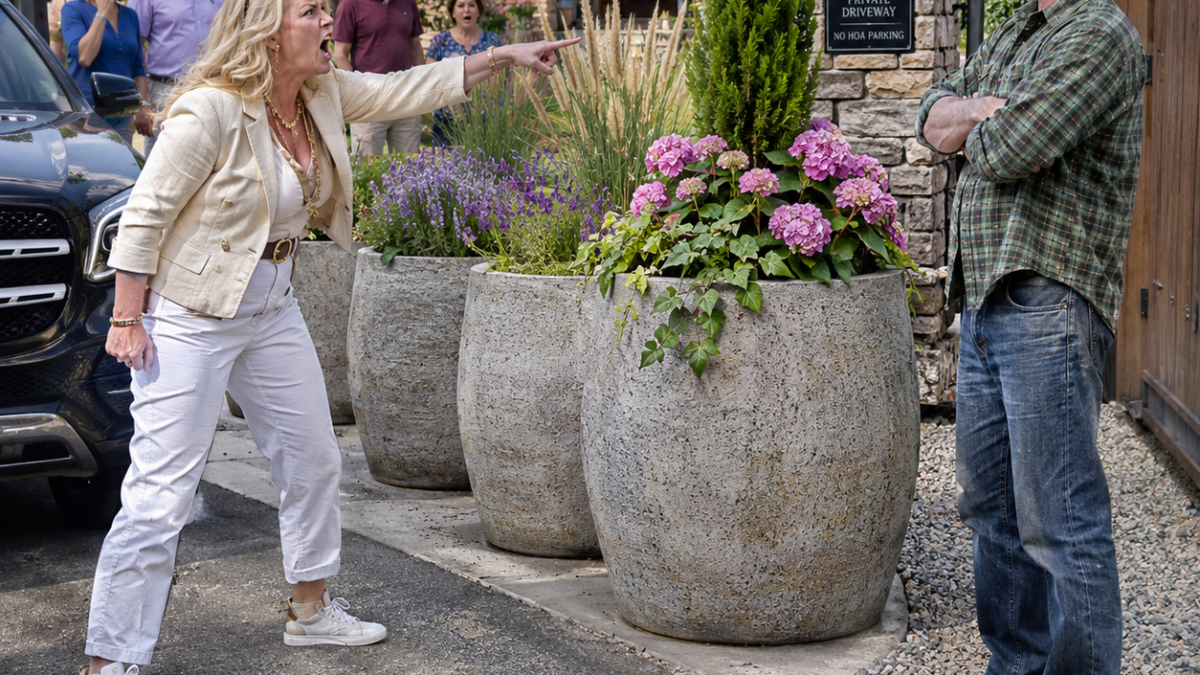
By the third time I found my own driveway barricaded before sunrise, I stopped asking why my HOA president hated me and started asking how much concrete it would take to make her stop.
Delilah Thornberry thought I was an exhausted, freshly divorced veteran she could fine, tow, and humiliate until I either surrendered or moved.
She had no idea that the quiet corner lot she had chosen for her next little victory was about to become the place where her entire neighborhood finally stopped being afraid.
My name is Marcus Rivera. I was fifty-two when I moved into Willow Brook Estates, a tidy suburban development outside Denver where every lawn seemed trimmed to the same height and every mailbox looked like it had been inspected by a committee. After twenty years in the Army moving tanks, artillery, fuel, and equipment through places where a bad decision could get people killed, I had wanted something simple.
Peace.
My divorce had already taken enough from me. Half my savings disappeared in lawyers, paperwork, and the slow collapse of a marriage I once thought would last forever. I wasn’t looking for a fight. I was looking for a place where I could rebuild my life, run my small IT consulting business, drink coffee on my porch, and sleep without wondering what disaster waited for me the next morning.
The house on the corner seemed perfect.
What sold me was the circular driveway. It gave me enough room for my pickup and the occasional client who stopped by with a laptop, a router, or a server that needed emergency attention. Nobody had to block the street. Nobody had to park on a neighbor’s lawn. Before I signed anything, I did what the Army had trained me to do: I read every page.
HOA covenants. Deed restrictions. County rules. Parking regulations. Home-business provisions.
Nothing prohibited the kind of consulting I did.
For the first few weeks, I honestly believed I had made a good decision.
Then Delilah Thornberry walked into my driveway.
It was a Tuesday morning in October. I was loading networking equipment into the back of my three-year-old Ford F-150 when I heard the sharp click of heels behind me. I turned and saw a woman in a cream-colored coat holding a clipboard against her chest. Her blond hair was flawless. Her smile was even more polished.
“You need to move that commercial truck immediately,” she said.
No hello. No introduction.
I looked at my truck, then back at her.
“This is my personal vehicle.”
She clicked a gold pen.
“You use it for business.”
“I also use it to buy groceries.”
Her smile tightened.
“I’m Delilah Thornberry, president of the Willow Brook Estates Homeowners Association. We’ve received concerns about traffic to your residence.”
“We?”
“The community.”
I leaned against the tailgate. “Which part of the covenants am I violating?”
Her eyes narrowed slightly, as if she wasn’t used to people asking for the actual rule.
“You should familiarize yourself with our standards.”
“I did. Before I bought the house.”
For half a second, the smile disappeared.
Then it came back colder.
“Some people,” she said, “discover after moving in that they aren’t a good fit for Willow Brook.”
She turned and walked away, leaving behind the smell of expensive perfume and the strange sensation that I had just failed an interview I never agreed to take.
Three days later, an official violation notice arrived.
Unauthorized commercial vehicle storage: $150.
Cease all business activities within seven days or face escalating fines of up to $500 per day.
I read the letter twice at my kitchen table, feeling the old pressure behind my eyes that used to come before a mission went bad.
I spent the entire weekend buried in HOA documents. Page after page, paragraph after paragraph. The rules allowed home-based professional services as long as they didn’t create a nuisance. Commercial vehicles were defined by weight, and my pickup was nowhere near the limit.
Delilah was stretching vague language until it said whatever she wanted it to say.
I requested an appeal.
The earliest hearing, I was told, was six weeks away.
The fines would continue in the meantime.
That was the moment I understood what kind of system she had built.
It wasn’t about rules.
It was about exhaustion.
Make people pay before they could challenge her. Make the process so expensive and humiliating that surrender felt cheaper than resistance.
I paid the first fine because I needed time.
Then I installed four security cameras.
And as I tightened the final mount above my garage, I made myself a promise I hadn’t made since leaving the Army:
I would not start this war.
But I would be ready when it came.
PART 2
The cameras paid for themselves eleven days later.
At 5:43 on a Wednesday morning, I came downstairs, started the coffee maker, and opened the security app on my phone out of habit.
There she was.
Delilah.
The timestamp read 11:47 p.m.
She had parked her white Mercedes three houses away and walked back toward my property carrying a measuring tape and the same clipboard she always carried like some suburban field marshal.
I watched the recording twice.
Then a third time.
She measured the width of my driveway.
The distance between the curb and the garage.
The space where clients usually parked.
She crouched near the edge of my property, took photographs, wrote something down, then measured again.
At one point she stepped several feet onto my driveway.
I sat at my kitchen table with my coffee untouched.
Something cold settled inside me.
It wasn’t fear.
It was recognition.
I had met people like Delilah before.
Not exactly like her, of course. The Army had given me tyrants wearing rank, not designer scarves. But the psychology was familiar.
People like that didn’t want compliance.
Compliance was only the beginning.
They wanted submission.
They wanted you to lower your head when they entered the room.
They wanted you to wonder whether you were allowed to do things you had every legal right to do.
They wanted you to become afraid of paperwork.
And once you were afraid, they owned you.
At 8:05 that morning, I heard heels on my driveway again.
I was putting a tool case into my truck when Delilah approached.
“Marcus,” she said. “We need to discuss your ongoing driveway situation.”
I shut the tailgate.
“Funny you should mention my driveway.”
Her smile paused.
“I was reviewing some interesting security footage this morning.”
Nothing changed in her expression, but something changed in her eyes.
“What footage?”
“Midnight surveying.”
Her jaw tightened.
I pulled out my phone.
The still image was beautiful.
There she was, caught in infrared, crouching beside my driveway with her tape stretched across the pavement.
For the first time since I had met her, Delilah Thornberry had nothing to say.
It lasted maybe two seconds.
Then the armor came back.
“I was conducting a community assessment.”
“At midnight?”
“We have received numerous complaints.”
“From whom?”
“Board matters are confidential.”
“Of course they are.”
I turned my phone toward her again.
“Is trespassing confidential too?”
Her face hardened.
“You’re being deliberately difficult.”
“No, Delilah. I’m being deliberately precise.”
She folded her arms.
“You moved into a community with standards.”
“And I agreed to follow the standards that actually exist.”
“You’re running a commercial operation.”
“I’m running an IT consulting business from a home where home businesses are permitted.”
“That is your interpretation.”
“No. That’s what the document says.”
Her smile returned, but this time there was no warmth left in it.
“Emergency board meeting. Thursday. Seven o’clock.”
“Will everyone receive proper notice?”
The question caught her.
Only for a moment.
“You should worry about yourself, Marcus.”
Then she walked away.
I watched her until the white Mercedes disappeared around the corner.
My phone was still in my hand.
The camera still recording.
“Already doing that,” I whispered.
### The Kangaroo Court
Thursday night taught me just how much power Delilah had accumulated.
Five board members sat behind folding tables inside the Willow Brook community center. Delilah was in the middle, naturally, positioned beneath the HOA logo as if she had been elected governor of a small country.
About fifteen residents attended.
What struck me immediately was who wasn’t there.
None of my nearest neighbors.
None of the people supposedly complaining about me.
Delilah started exactly at seven.
“Tonight,” she announced, “we are addressing a serious deterioration of residential standards.”
The lights dimmed.
A PowerPoint presentation appeared on the wall.
I almost laughed.
She had aerial photographs of my house.
Pictures of my truck.
Pictures of two clients arriving on the same afternoon.
One photograph had been taken from such a low angle that my ordinary F-150 looked like a commercial freight vehicle.
Another image showed three cars in my driveway during an emergency server repair.
The caption beneath it read:
**ONGOING COMMERCIAL TRAFFIC.**
Delilah clicked to the next slide.
“Residents have a reasonable expectation that their homes will not be surrounded by business operations.”
I waited.
She talked for almost twenty minutes.
Property values.
Neighborhood tranquility.
Traffic patterns.
Community character.
Words that sounded serious until you noticed there wasn’t much evidence underneath them.
When she finished, she smiled at me.
“Mr. Rivera, you may respond.”
I stood.
“Thank you.”
I carried a folder to the front table.
“I made copies.”
That bothered her.
I could tell.
Bullies love rooms where only they have documents.
I gave each board member three pages.
“Page twelve of our covenants explicitly permits home-based professional services provided they do not create a documented nuisance.”
I heard paper moving.
“Page fifteen defines a restricted commercial vehicle by weight. My truck is well below that weight.”
One of the board members, a man named Robert, looked at Delilah.
She stared straight ahead.
I continued.
“I also logged every client visit during the last three months.”
I put another sheet on the table.
“Average: 2.3 vehicles per week. Average visit: forty-seven minutes.”
A woman in the audience whispered, “That’s it?”
Delilah’s mouth tightened.
“And there’s one more problem.”
I looked around the room.
“Our bylaws require proper written notice before a meeting like this.”
Delilah grabbed her gavel.
“This meeting was properly called.”
“No, it wasn’t.”
A voice came from the back.
Everyone turned.
An elderly man with silver hair stood slowly.
I knew him by sight but not personally.
Frank Kowalski.
He lived four houses away.
“I spent thirty-eight years practicing law,” he said calmly. “Mr. Rivera is correct. The notice procedure used for this meeting is defective.”
Delilah’s face changed.
“Frank, this is an internal board matter.”
“Then the board should probably follow its own internal rules.”
A few people laughed.
Not loudly.
But loud enough.
That tiny laugh mattered.
Because I saw something happen in Delilah’s face.
People were no longer afraid to react.
She banged the gavel.
“This meeting will continue.”
Frank didn’t raise his voice.
“I strongly recommend that it not.”
One board member leaned toward another.
Whispers began.
Delilah tried to regain control.
But control, once visibly cracked, is hard to put back together.
The meeting was postponed twelve minutes later.
As residents gathered their coats, Frank walked over to me.
“You’ve annoyed a dangerous woman,” he said.
“I noticed.”
He looked toward Delilah.
She was stuffing papers into her briefcase so hard I thought she might tear them.
“She’s not dangerous because she’s powerful,” Frank said. “She’s dangerous because she believes she is.”
I glanced at him.
“That sounds worse.”
“It usually is.”
He handed me a card.
“Call me if this escalates.”
I looked across the room.
Delilah looked back.
Her expression answered the question before I asked it.
It would escalate.
### The Tow Truck
One week later, at 6:17 in the morning, I opened my garage and saw an empty driveway.
For one confused second, I thought I had parked somewhere else.
Then I saw the orange sticker on the garage door.
**VEHICLE REMOVED FOR HOA PARKING VIOLATION. FINAL NOTICE.**
My stomach dropped.
I read it twice.
My truck had been parked in my own driveway.
Not on the street.
Not on common property.
My driveway.
I called the towing company.
The dispatcher sounded bored.
“Vehicle identification?”
I gave it to him.
“Yeah. We have it.”
“Why?”
“HOA removal.”
“From my private driveway?”
“Sir, I just handle releases.”
“What violation?”
“You’ll need to speak with your association.”
“How much?”
“Three-fifty for release. Twenty-five a day storage.”
I closed my eyes.
“Three hundred and fifty dollars?”
“Cash or certified funds.”
That money was supposed to cover groceries and utilities.
My consulting business was doing okay, but divorce has a way of making a man who once felt financially secure count every hundred-dollar bill twice.
“I want the authorization record.”
“Take it up with the HOA.”
He hung up.
I stood alone in my garage.
For twenty years, I had followed orders.
Real orders.
Orders signed by people who were accountable for giving them.
Orders that involved equipment worth millions of dollars and soldiers whose lives depended on us getting things right.
And now a woman with a clipboard had ordered my truck removed from my property.
My hands started shaking.
That embarrassed me more than the towing.
I hated that she had gotten inside me.
I hated that opening a garage door had become something I dreaded.
I hated that part of me wondered whether buying this house had been a mistake.
Twenty minutes later, Frank knocked.
He was holding two coffees.
“I heard.”
“How?”
“Eleanor Patterson saw the tow truck.”
He handed me a cup.
“Come on. I’ll drive.”
On the way to the impound lot, I told him everything.
“No warning?”
“None.”
“No posted notice?”
“No.”
“No hearing?”
“Nothing.”
He made notes in a leather notebook.
“That was reckless.”
“Can she do it?”
“Not the way she did.”
His voice was quiet.
That made me feel better than shouting would have.
Frank was the kind of man who became calmer as problems got worse.
At the impound yard, my truck sat behind chain-link fencing.
Seeing it there hit me harder than I expected.
It wasn’t about the truck.
It was about helplessness.
I paid the $350.
Frank photographed the receipt.
Then the gate.
Then the signs.
Then my truck.
Then me.
“You documenting my humiliation?”
“I’m documenting damages.”
I looked at him.
He smiled slightly.
“There’s a difference.”
On the drive home, I said, “I want to destroy her.”
Frank kept his eyes on the road.
“No.”
“No?”
“You want to stop her.”
“At the moment, I’m comfortable with both.”
“That’s exactly when you don’t make decisions.”
I leaned my head against the seat.
He continued.
“People like Delilah depend on two reactions. Fear and anger. Fear makes you surrender. Anger makes you reckless.”
“So what am I supposed to feel?”
“Whatever you want.”
He glanced at me.
“Just don’t let her decide what you do.”
That sentence stayed with me.
### Eleanor’s Casserole
That evening, my doorbell rang.
Eleanor Patterson stood outside holding a casserole dish covered in aluminum foil.
She was seventy-six, barely five feet tall, and looked like someone’s grandmother because she was someone’s grandmother.
But her eyes were angry.
“I heard what happened.”
“News travels fast.”
“In this neighborhood, bad news moves faster than Wi-Fi.”
Despite myself, I laughed.
She pushed the dish into my hands.
“Chicken and rice.”
“You didn’t have to do this.”
“Yes, I did.”
She looked toward the street.
Then lowered her voice.
“Because you need to understand something.”
“What?”
“You’re not the first.”
I invited her inside.
We sat at my kitchen table.
And Eleanor told me the history of Willow Brook that no realtor had included in the brochure.
The Kelly family had built a wooden swing set for their six-year-old daughter.
Delilah ordered them to remove it because it supposedly disrupted “aesthetic harmony.”
There was no rule against it.
Danny Kelly had challenged her.
Fines appeared.
Notices arrived.
Threats followed.
Danny worked two jobs.
His wife worked part-time while raising their daughter.
They didn’t have the money or energy for lawyers.
They took the swing set down.
“The little girl cried,” Eleanor said.
Her voice cracked.
“Sarah sat on the back steps and watched her father dismantle it board by board.”
I stared at the table.
“The Garcias had a vegetable garden.”
“What was wrong with that?”
“Apparently tomatoes are dangerous to property values.”
I looked up.
Eleanor smiled without humor.
“The Johnsons had a dog run. She called it an unsightly structure. The Henderson boy had a basketball hoop. Noise violation.”
“How many people?”
“Enough.”
“Then why has nobody stopped her?”
Eleanor was quiet.
Finally, she said, “Because she never attacks everybody at the same time.”
I frowned.
“She isolates people. Makes each family think they’re the difficult ones. Makes you embarrassed. Makes you think the rest of us agree with her.”
That was when I understood.
The fines weren’t Delilah’s greatest weapon.
Isolation was.
I lifted a forkful of casserole but couldn’t eat.
Eleanor reached across the table and touched my wrist.
“Marcus, don’t let her make you think you’re alone.”
Something in my chest tightened.
My marriage had ended slowly, painfully, with two people becoming strangers while sharing the same rooms.
Since then, I had trained myself not to need anyone.
I had told myself it was independence.
Maybe some of it was loneliness with better branding.
“I’m not going anywhere,” I said.
Eleanor smiled.
“Good.”
After she left, I sat alone in my kitchen for another hour.
Then I created a folder on my computer.
**THORNBERRY — DOCUMENTATION**
Inside it, I made subfolders.
Fines.
Towing.
Security footage.
Correspondence.
Board procedures.
Potential witnesses.
I stared at the screen.
The soldier in me had finally stopped trying to ignore the situation.
If Delilah wanted paperwork, she was going to get paperwork.
A lot of it.
### The Smear Campaign
Two days later, every mailbox on my street received a glossy flyer.
Mine was waiting for me at seven in the morning.
Across the top:
**PROTECT OUR COMMUNITY**
Below that:
**THE TRUTH ABOUT COMMERCIAL OPERATIONS IN RESIDENTIAL WILLOW BROOK**
There was a photograph of my house.
A picture of my truck.
Several supposedly anonymous quotations.
“Concerned about traffic.”
“Worried about property values.”
“Commercial activity changing neighborhood character.”
I read the entire thing standing beside my mailbox.
The cold barely registered.
Frank walked toward me carrying his copy.
“Well,” he said, “she has officially lost perspective.”
“She made my house look like a meth lab.”
“Very professional meth lab.”
I almost smiled.
Then Mrs. Chan came outside.
She saw me.
Stopped.
And crossed the street.
That hurt.
More than the tow.
More than the fines.
Delilah had taken something invisible from me.
Belonging.
The next two days were worse.
People who used to wave looked away.
Conversations stopped when I approached.
I began wondering whether some of the flyer’s quotes were real.
Maybe people did hate having clients come to my house.
Maybe I had misjudged everything.
That is the part nobody tells you about harassment.
The paperwork is irritating.
The money hurts.
But the worst part is what happens in your own head.
You start conducting the bully’s trial for them.
You provide the prosecution and the defense.
You question your memory.
Your motives.
Your right to be angry.
Then, Thursday evening, someone knocked.
Danny and Sarah Kelly stood outside with their little girl.
Danny wore a delivery uniform. His hands were rough and stained from work.
Sarah held her daughter’s hand.
“We read the flyer,” Danny said.
I nodded.
“We don’t believe it.”
Something loosened inside me.
Sarah stepped forward.
“Neither do a lot of people.”
Their daughter looked up at me.
“Are you the computer man?”
I smiled.
“I guess I am.”
“My daddy says the mean lady doesn’t like your truck.”
Sarah closed her eyes.
“Sweetheart—”
“It’s okay.”
I crouched.
“I like my truck.”
The girl considered that.
“Me too.”
Danny glanced toward the street.
“She made us take down Sarah’s swing set.”
I looked at the child.
Her name was Sarah too—Sarah Kelly Jr., though everyone called her Sadie to avoid confusion.
“She cried for three days,” he said.
His voice was tight.
“I let Delilah do that because I was tired. Because I had a second shift starting at six the next morning. Because I couldn’t afford a lawyer.”
He looked me in the eye.
“I’ve regretted it every day since.”
“Danny—”
“No.”
His jaw hardened.
“She counted on me being tired.”
Those words landed hard.
Because that was exactly it.
Not law.
Not rules.
Fatigue.
Sarah squeezed her husband’s arm.
“There’s another board meeting next week.”
Danny nodded.
“We’ll be there.”
The next night, the Garcias came over.
Then the Johnsons.
Then Maria and Tom Henderson.
Suddenly my kitchen was full of folders, photographs, notices and stories.
The Garcias had been fined over tomatoes.
The Johnsons over their dog run.
The Hendersons over a basketball hoop.
Maria Henderson slapped one of Delilah’s letters onto my table.
“My son is seventeen,” she said. “Honor-roll student. He plays basketball for forty minutes after school. She called him a chronic noise nuisance.”
Frank read the letter.
“She cited a provision that doesn’t exist.”
Maria’s eyes flashed.
“I know.”
A strange silence filled the kitchen.
Then Frank leaned back.
“She made a mistake.”
Danny Kelly laughed bitterly.
“Only one?”
“The important one.”
Frank looked around the table.
“She made too many enemies.”
### Two in the Morning
The discovery that eventually destroyed Delilah happened because I couldn’t sleep.
It was 2:17 a.m.
I was sitting in the kitchen scrolling through public property records after Frank suggested we examine liens, assessments and HOA filings.
I wasn’t looking for anything dramatic.
Mostly I wanted to understand how Willow Brook’s finances worked.
Then I found Delilah’s account.
At first, I thought I was reading it wrong.
I refreshed the page.
Checked the property address.
Checked the owner name.
Delilah Thornberry.
Unpaid special assessments.
$8,400.
I sat back.
“No way.”
I searched again.
Same result.
She had fallen behind on community assessments while aggressively demanding payment from everyone else.
I called Frank.
He answered after six rings.
“Someone better be dead.”
“She owes the HOA eighty-four hundred dollars.”
Silence.
“Marcus.”
“I’m looking at the records.”
“What records?”
I told him.
I heard movement on his end.
Bedsheets.
A lamp switching on.
“Send me everything.”
I did.
Twenty minutes later he called back.
His voice had changed.
“You understand what this could mean?”
“She’s a hypocrite?”
“Much more than that.”
He explained that Willow Brook’s governing documents required board members to remain in good standing, including assessments.
A delinquency at that level could make her ineligible to continue serving.
I looked at the screen.
“So all those fines…”
“Slow down.”
“But—”
“Slow down.”
Frank’s lawyer voice.
I hated the lawyer voice.
“We verify first.”
“Frank—”
“Everything.”
He paused.
“If you fire a cannon, Marcus, make sure it isn’t loaded with blanks.”
So we verified.
For the next week, Frank reviewed records.
Then bylaws.
Then meeting minutes.
Then account notices.
The deeper he went, the worse it looked for Delilah.
Her delinquency wasn’t recent.
It stretched back months.
Long enough that her authority could be challenged during much of the period when she had targeted me and several other families.
When Frank finally sat at my kitchen table and closed his folder, I knew from his face.
“Well?”
“She has a serious problem.”
I exhaled.
“Can we expose it?”
“Yes.”
“When?”
“Not yet.”
I stared at him.
“She had my truck towed.”
“I know.”
“She humiliated the Kellys.”
“I know.”
“She’s still issuing notices.”
“I know.”
“Then why are we waiting?”
Frank leaned forward.
“Because revenge feels best immediately.”
He tapped the folder.
“Justice works best when it’s complete.”
I didn’t like waiting.
But I understood strategy.
So I waited.
And Delilah kept digging.
### The Third Blockade
The third time my driveway was blocked happened on a Monday morning.
December.
Six o’clock.
Still dark.
I had a client emergency across town and needed to leave before traffic got bad.
I opened the garage.
Three concrete traffic barriers sat across the entrance to my circular driveway.
Not decorative.
Not temporary cones.
Concrete barriers.
Big enough that I could not safely move them myself.
For several seconds, I simply stood there in my bathrobe.
Steam rose from the coffee mug in my hand.
The air smelled like frost, diesel and new concrete.
I put the coffee down.
Then I laughed.
I couldn’t help it.
Months of fines.
The towing.
The flyer.
The surveillance.
And now this.
She had finally made the mistake I needed.
My phone came out.
Photos first.
Video.
Timestamp.
Property line.
Street view.
Then I called a number I hadn’t used in months.
A sleepy voice answered.
“Who died?”
“Morning, Danny.”
This wasn’t Danny Kelly.
This was Daniel Restrepo.
Army buddy.
Logistics specialist.
Concrete contractor.
One of the few men I knew who considered moving thirty tons of material before lunch a normal Tuesday.
“Rivera?”
“Yeah.”
“What time is it?”
“Six.”
“You’d better have coffee.”
“I need something permanently immovable.”
There was a pause.
Then he laughed.
“Now you’re speaking my language.”
### Danny Restrepo
Danny arrived that afternoon in a work truck dusted white with concrete powder.
At fifty-one, he still looked like he could carry half a building under one arm.
He hugged me hard enough to rearrange my spine.
“Still skinny.”
“Still ugly.”
“Good to see you too.”
Frank arrived twenty minutes later.
Eleanor brought cookies.
Danny Kelly and Maria Henderson showed up because by then my kitchen had become unofficial resistance headquarters.
I showed Restrepo the documentation.
The fines.
The tow.
The surveillance.
The barriers.
When I finished, he whistled.
“So you want bollards?”
“No.”
“Wall?”
“No.”
“Tank trap?”
Frank looked alarmed.
“No tank traps.”
Danny grinned.
“I’m brainstorming.”
I said, “I want my driveway protected. Legally.”
That changed his expression.
He pulled graph paper from his bag.
“Show me the survey.”
We worked for three hours.
The solution was almost embarrassingly simple.
Planters.
Four of them.
Massive reinforced-concrete landscaping planters positioned entirely inside my property boundary.
Decorative.
Professionally engineered.
Beautiful.
And when filled with soil, plants and reinforced cores, each would weigh roughly 8,000 pounds.
Four tons.
Each.
Danny drew rectangles along the vulnerable edges of my circular driveway.
“They prevent anybody from dropping barriers here.”
He pointed.
“Or parking across this approach.”
Another point.
“Or driving onto your property from this side.”
I looked at Frank.
“Legal?”
He adjusted his glasses.
“Potentially.”
“Potentially?”
“I’m a lawyer. We don’t say yes until we’re sure.”
For three days we checked everything.
Property survey.
Setbacks.
Drainage.
Height limits.
Sight lines.
HOA landscaping provisions.
Municipal rules.
The planters were designed just below the threshold that would create additional permitting complications.
Nothing in Willow Brook’s covenants prohibited them.
They would remain fully on my land.
Danny even selected decorative aggregate that matched stone used elsewhere in the subdivision.
Frank reviewed the final drawings.
“I hate how much I like this.”
Danny smiled.
“You’re welcome.”
I studied the plans.
“How much?”
“Twelve thousand.”
The smile left my face.
“Danny.”
“Materials, crew, equipment, reinforcement, soil, drainage, plants.”
“Could I buy a small used car instead?”
“Absolutely.”
“Could we park four used cars around the driveway?”
Frank shook his head.
“No.”
Danny tapped the drawing.
“These will still be here after the cars are scrap metal.”
Twelve thousand dollars was serious money.
Especially after a divorce.
Especially after months of legal nonsense.
I went outside alone.
The evening was cold.
I stood in the driveway Delilah had turned into a battlefield.
And I thought about why I had bought the house.
I hadn’t bought it to defeat anyone.
I had bought it because I wanted a place that belonged to me.
A place where nobody else’s anger controlled the atmosphere.
A place where I could begin again.
Delilah had taken that feeling from me one petty attack at a time.
Maybe twelve thousand dollars wasn’t buying concrete.
Maybe it was buying back peace.
I returned to the kitchen.
“Build them.”
Danny smiled.
“Now we’re having fun.”
### Operation Concrete Justice
We called it Operation Concrete Justice.
Mostly because Danny insisted every good project needed a ridiculous military name.
The timing was perfect.
Delilah was leaving Friday for a three-day real estate conference.
By Saturday morning, concrete trucks were rolling into Willow Brook.
I stood outside with coffee as Danny’s crew worked.
Neighbors came out to watch.
Eleanor arrived wearing a winter coat and carrying a thermos.
Sadie Kelly pressed her face between the rails of her front porch.
“Are those swimming pools?”
“No,” her father said.
“What are they?”
“Flower boxes.”
She stared at the forms.
“Those are giant flower boxes.”
Danny yelled from across the driveway.
“Premium giant flower boxes!”
By midday the first reinforced cores were taking shape.
Steel rebar disappeared beneath concrete.
Drainage lines were installed.
Every measurement was checked twice.
Frank wandered around with the property survey like a nervous inspector.
“Three inches farther inward,” he said at one point.
Danny stared at him.
“It’s already inside the boundary.”
“I want six inches.”
“You planning to defend this in the Supreme Court?”
“I’m planning to sleep.”
Danny moved it.
By Sunday afternoon, the planters were finished.
Four massive structures stood along the driveway, clean-lined and elegant, filled with dark soil and winter-hardy evergreens.
Landscape lighting sat beneath the plants.
The decorative finish made them look expensive rather than defensive.
Frank walked around them.
“I expected uglier.”
Danny looked offended.
“I’m an artist.”
Eleanor touched the stone surface.
“How heavy?”
“About eight thousand pounds each once everything settles.”
Her eyes widened.
“Each?”
“Each.”
She smiled.
“That should do.”
At sunset the lights came on.
Soft illumination washed across the aggregate.
The driveway looked better than it had before.
I stood across the street with the others.
For months, everything Delilah did had made my home feel smaller.
Now it felt like mine again.
Danny clapped my shoulder.
“Worth twelve grand?”
I looked at the four concrete sentinels.
“We’ll know tomorrow.”
### Delilah Comes Home
She returned Monday at 7:23 a.m.
I know the exact time because my cameras caught everything.
Her Mercedes turned onto the street.
Then braked.
Hard.
The car stopped in front of my house.
For nearly three full minutes, she sat behind the wheel.
Motionless.
I watched from my kitchen.
Coffee in hand.
She finally got out.
Even from inside, I could see the disbelief on her face.
She walked toward the first planter.
Looked behind it.
Walked around the second.
Measured something.
Photographed the third.
Then she saw me in the window.
I raised my coffee cup.
She stormed toward the house.
I stepped outside before she could ring the bell.
“What have you done?”
“Good morning, Delilah.”
“What are those?”
“Planters.”
“Don’t insult me.”
I looked toward them.
“They’re holding plants.”
“These are unauthorized structures.”
“Decorative landscaping.”
“They will be removed.”
“No.”
Her face flushed.
“You do not have permission.”
“I don’t need permission.”
“I am ordering you—”
“No.”
That word stopped her.
I had always explained myself before.
This time I didn’t.
Delilah pointed toward the planters.
“You cannot construct fortifications in a residential neighborhood!”
“Fortifications?”
“You know exactly what you did.”
“I improved my landscaping.”
“You deliberately designed them to obstruct HOA access.”
“Why would the HOA need to drive across my property?”
She opened her mouth.
Closed it.
Then pointed at me.
“You’ll regret this.”
“Put it in writing.”
She did.
Within an hour, a city building inspector arrived.
Delilah marched him around the property like a prosecutor presenting a murder scene.
I stayed back.
The inspector measured.
Checked.
Looked at the drawings.
Checked the survey.
Measured again.
Finally he approached me.
“Your contractor did this?”
“Yes.”
“Good work.”
“Thank you.”
Delilah followed.
“Well?”
The inspector looked at her.
“I don’t see a code issue.”
Her mouth fell open.
“They’re enormous!”
“They’re landscaping features.”
“They’re concrete!”
“So are retaining walls.”
“They’re dangerous.”
“They’re properly engineered.”
“They’re illegal.”
He shook his head.
“No, ma’am.”
I will never forget the sound she made.
It was somewhere between a gasp and a strangled scream.
By that afternoon, I had a certified letter from an expensive law firm demanding removal of the planters within thirty days.
Frank read it at my kitchen table.
He smiled.
“What?”
“This is panic dressed as stationery.”
“Can they force me?”
“Based on what I’m reading? No.”
He turned the page.
“They’re calling them spite structures.”
“Are they?”
“What are they for?”
“Flowers.”
Frank looked at me.
I looked at him.
He laughed so hard he had to remove his glasses.
### The Lawyers Walk Away
The next morning, Frank called.
“Sit down.”
“That sounds bad.”
“It isn’t.”
I sat.
“Delilah’s law firm withdrew.”
“What?”
“They did a deeper review.”
“And?”
“They discovered the same board-eligibility problem we did.”
I leaned back.
“They dropped her?”
“Apparently they were unwilling to pursue an enforcement action in her name while her authority to act as president was under serious question.”
For a long moment I said nothing.
Then I looked through the window.
Delilah’s Mercedes was creeping past my house.
Again.
She slowed beside the planters.
Then continued.
I smiled.
For the first time, I didn’t feel anger when I saw her.
I felt something much more dangerous to a bully.
I felt unimpressed.
### The Neighborhood Changes Sides
The planters became a neighborhood attraction.
People stopped during evening walks.
“Who built these?”
“Daniel Restrepo.”
“Do they need permits?”
“Not these.”
“How heavy are they?”
“Four tons.”
That answer always got a reaction.
Sadie Kelly loved them most.
She sat on the low edge one afternoon while her father talked to me.
“You know,” Danny Kelly said, “she asked me something last night.”
“What?”
He looked toward his daughter.
“She asked if the flower boxes meant Delilah couldn’t be mean anymore.”
My smile faded.
“What did you tell her?”
“I told her flower boxes don’t stop mean people.”
He paused.
“But people standing together can.”
I looked at Sadie.
She had picked up a fallen evergreen branch and was pretending it was a magic wand.
Danny swallowed.
“I should’ve fought harder for her swing set.”
“You were surviving.”
“Still feels like I failed her.”
“No.”
He looked at me.
“You taught her something better.”
“What?”
“That adults can make mistakes and fix them.”
His eyes became wet.
He looked away.
That was when I realized this had stopped being my fight weeks ago.
The concrete was just the visible part.
The real change was happening in people.
The Garcias replanted tomatoes.
Tom Henderson rolled his son’s basketball hoop back to the driveway.
The Johnsons repaired their dog run.
Small things.
Ordinary things.
But when people have spent years being afraid, ordinary freedom feels enormous.
### Delilah Unravels
Delilah did not accept defeat gracefully.
She created a petition demanding emergency removal of my “hazardous concrete installations.”
Three people signed it.
One was her.
Another was a board member who later claimed he hadn’t realized what he was signing.
The third was a woman who lived two streets away and apparently thought the petition concerned traffic safety.
Delilah went door to door.
The Hendersons asked her to leave.
The Garcias did not answer.
Eleanor opened her door, listened politely, then said, “No, dear,” and closed it.
Her social media campaign went worse.
She posted photographs of my planters at night.
Called them industrial monstrosities.
Claimed neighborhood character was under attack.
People responded with photographs of their own experiences.
The Kellys posted the empty patch of grass where Sadie’s swing set had once stood.
Maria Henderson posted Delilah’s basketball-hoop notices.
The Garcias posted copies of vegetable-garden fines.
Comments piled up.
Not insults.
That would have been easier for Delilah.
Facts.
Dates.
Letters.
Photographs.
Receipts.
The truth is much harder to fight.
Frank told everyone the same thing.
“No threats. No personal attacks. No exaggeration. Document. Document. Document.”
Delilah responded by driving past my house constantly.
One Saturday my cameras counted seventeen passes.
Seventeen.
By the tenth, even I was concerned.
By the seventeenth, Frank was making notes.
Then came the barbecue.
### The Barbecue
Danny Restrepo wanted to celebrate finishing the project.
So on Sunday afternoon we put grills in my driveway.
Somebody brought folding tables.
Eleanor brought potato salad.
The Garcias brought carne asada.
The Kellys brought cookies.
Children ran between yards.
For the first time since moving to Willow Brook, I saw what the neighborhood could have been all along.
People laughing.
Trading stories.
Arguing about football.
Borrowing chairs.
Kids drawing with sidewalk chalk.
Sadie stood beside one of my planters telling another child, with tremendous authority, “This one weighs more than an elephant.”
I didn’t correct her.
Then everything went quiet.
Delilah was walking across my lawn.
Her hair, usually perfect, looked hurried.
Her blazer was wrinkled.
Papers filled both hands.
“What is this?”
Nobody answered immediately.
Danny Restrepo stepped away from the grill.
“A barbecue.”
“This gathering was not approved.”
I almost laughed.
“Private property, Delilah.”
She shook the papers.
“These structures create a danger to children.”
Sadie looked at the planter she had been sitting beside for an hour.
Then at Delilah.
“No they don’t.”
A few adults choked back laughter.
Delilah’s face reddened.
“This is exactly the kind of disrespect that is destroying this community.”
Maria Henderson stepped forward.
“No.”
Delilah turned.
Maria rarely spoke loudly.
That day she did.
“You destroying our children’s happiness over your personal preferences damaged this community.”
“My enforcement actions were lawful.”
“You tried to take my son’s basketball hoop.”
“Noise complaints—”
“You were the complaint.”
Danny Kelly walked over.
“And my daughter’s swing set?”
“Aesthetic standards.”
“Show me the rule.”
Delilah looked around.
The crowd was closing in—not physically, but morally.
For years she had faced families one at a time.
Now they were standing together.
Her voice rose.
“I am president of this association. I have authority over every property in Willow Brook!”
Frank had been sitting near the garage.
He stood.
Slowly.
Calmly.
The entire crowd seemed to sense what was coming.
“Actually,” he said, “that’s something we should discuss.”
Delilah froze.
Frank walked closer.
“You have been delinquent on association assessments for an extended period.”
The color drained from her face.
Nobody moved.
“You don’t know what you’re talking about.”
“I do.”
“This is private financial information.”
“The relevant records and association documents establish a serious eligibility problem.”
Her eyes darted toward me.
“You.”
I said nothing.
“You did this.”
“No,” Frank said. “You did.”
She pointed at him.
“I’ll sue you.”
“For reading your bylaws?”
“I’ll sue all of you.”
Sadie moved behind her father.
That bothered me.
I stepped forward.
“Delilah.”
She looked at me.
Her breathing was fast.
“Leave.”
“This is an HOA matter.”
“This is my property.”
“I have a right—”
“No.”
I pointed toward the sidewalk.
“You’ve spent months telling everyone else what they’re allowed to do on property they own.”
My voice stayed quiet.
“Now I’m telling you one thing about mine.”
I held her gaze.
“Leave.”
Something changed then.
Not in her.
In everyone else.
Nobody looked away.
Nobody tried to disappear.
Nobody lowered their eyes.
Delilah looked around and realized she had lost the one thing her authority actually depended on.
Our fear.
She turned.
Her heels dug into the winter lawn as she walked back toward the street.
Nobody cheered.
I’m glad they didn’t.
Watching a person lose control of a crowd she once intimidated was enough.
Frank came beside me.
“That was the preview.”
“Preview?”
“Thursday is the meeting.”
### Thursday Night
The Willow Brook Community Center had never seen anything like it.
Cars lined both sides of Maple Street.
Every chair inside was occupied by 6:30.
People stood against walls.
More filled the hallway.
I counted over eighty residents.
Then I saw a television camera.
“Why is Channel 7 here?”
Maria Henderson smiled.
“I may have made a phone call.”
Frank sighed.
“Of course you did.”
“You said transparency.”
“I meant financial records.”
“Television is transparent.”
At exactly seven, Delilah entered.
I almost admired the effort.
Hair perfect again.
Dark business suit.
Pearls.
High heels.
Thick briefcase.
If you hadn’t watched the previous months unfold, you would have thought she was the calmest person in the building.
She took her place at the board table.
Tapped the microphone.
“Good evening.”
The room became quiet.
“We are here to address an unprecedented campaign of hostility, unsafe modifications, commercial encroachment and organized harassment that threatens the character of Willow Brook Estates.”
I glanced at Frank.
He whispered, “She’s going all in.”
The lights dimmed.
PowerPoint.
Again.
Photographs of my house.
Again.
My truck.
Again.
The planters.
Many photographs of the planters.
She called them “aggressive landscaping installations.”
I had to bite the inside of my cheek.
Then she showed photographs of residents attending my barbecue.
The caption read:
**ORGANIZED ANTI-HOA ACTIVITY.**
That was the moment the audience turned.
You could feel it.
People began whispering.
Someone laughed.
Delilah kept going.
“Certain residents appear determined to undermine established governance through intimidation and public pressure.”
Eleanor raised her hand.
Delilah ignored her.
“Furthermore, the commercial activity at Mr. Rivera’s residence—”
“Two clients a week!” somebody shouted.
Delilah slammed the gavel.
“This is not an open forum.”
A voice near the back replied, “Then why are we here?”
Laughter.
More gavel.
Finally she finished.
“Mr. Rivera may respond.”
I stood.
Months earlier, the idea of addressing that room would have made my stomach tighten.
Not anymore.
I carried a binder to the front.
Then I looked at the residents.
Not Delilah.
Them.
“My name is Marcus Rivera.”
A few people smiled.
“I moved here because I wanted peace.”
The room settled.
“I had just gone through a divorce. I had spent twenty years in the Army. I was tired of conflict.”
I glanced toward my neighbors.
“I chose the corner house because I liked the driveway.”
A little laughter.
“I thought this would be the least complicated chapter of my life.”
More laughter.
Then I looked toward Delilah.
“I was wrong.”
I began with the documents.
Actual covenant language permitting home-based professional work.
Vehicle definitions.
My client log.
Dates.
Times.
Then the towing receipt.
“Three hundred and fifty dollars to recover a truck removed from my own driveway without the proper process.”
Murmurs.
Then the security footage.
The screen showed Delilah measuring my driveway at 11:47 p.m.
The room erupted.
She grabbed the microphone.
“That was official inspection activity!”
I waited until the noise settled.
Then the flyer appeared.
Photographs.
Anonymous quotations.
My house portrayed as a commercial threat.
“After this was distributed,” I said, “neighbors who had spoken to me every morning stopped looking at me.”
My voice caught unexpectedly.
I paused.
“I can laugh about concrete planters.”
Nobody laughed now.
“I can fight fines.”
I looked down.
“I can recover money.”
Then I looked back at the room.
“But making somebody feel unwelcome in the home they worked years to afford—that stays with you.”
Eleanor’s eyes filled.
I continued.
“And I learned I wasn’t the only one.”
Danny Kelly stood.
He held a photograph of Sadie’s old swing set.
Maria Henderson held her son’s violation letter.
Mr. Garcia held vegetable-garden notices.
Mrs. Johnson carried photographs of their dog run.
One by one, people stood.
Not everyone.
They didn’t need to.
Enough.
A neighborhood’s worth of evidence.
Delilah’s expression became rigid.
“These are unrelated enforcement matters.”
“No,” I said.
“They’re a pattern.”
I looked at Frank.
He stood.
The room became silent.
### Frank Opens the Folder
Frank walked to the microphone carrying a thin folder.
Not a dramatic binder.
Not a stack of papers.
Just one folder.
That made it more frightening.
“I would like to address a threshold issue.”
Delilah immediately said, “You are not recognized.”
Frank looked at the remaining board members.
One of them, Robert, cleared his throat.
“I recognize him.”
Delilah turned.
“Robert.”
He didn’t look at her.
“Proceed, Frank.”
Frank opened the folder.
“Willow Brook’s governing documents require directors to remain members in good standing.”
He lifted the first page.
“Records indicate that President Thornberry has been delinquent on association assessments for approximately eighteen months.”
The room went completely silent.
Delilah didn’t move.
Frank continued.
“The outstanding amount reflected in the records we obtained is approximately eight thousand four hundred dollars.”
Someone whispered, “What?”
Another person said, louder, “Eight thousand?”
Frank kept going.
“This creates a serious issue regarding Ms. Thornberry’s eligibility to serve and the validity of actions taken while she was not in good standing.”
Delilah slammed both hands onto the table.
“That is false.”
Frank looked at her.
“Then provide current payment records.”
“This is a confidential financial matter.”
“You made everybody else’s finances an HOA matter when you imposed fines.”
Applause exploded.
The gavel struck repeatedly.
“Order! Order!”
Nobody listened.
The Channel 7 camera moved closer.
A reporter raised her microphone.
“Ms. Thornberry, are you disputing that you owe the association $8,400?”
Delilah stood.
“This is a coordinated attack.”
“Are the records inaccurate?”
“I have been the victim of harassment for months.”
The reporter tried again.
“Do you owe the assessments?”
Delilah pointed toward me.
“That man moved into this community and immediately began operating a business in violation of our standards.”
I stepped toward the microphone.
“No.”
My voice carried.
“I moved into this community and asked you to show me the rule.”
The room became quiet again.
“You never could.”
I looked at her.
“So you fined me.”
Silence.
“You towed my truck.”
Someone muttered, “Unbelievable.”
“You watched my home at night.”
Delilah’s face was red now.
“You sent propaganda to my neighbors.”
I pointed toward the residents standing behind me.
“And while you were demanding that every one of us obey your rules, you weren’t following the rules required to hold the office you were using against us.”
She shook her head.
“You don’t understand what it takes to preserve a community.”
Eleanor stood.
That tiny seventy-six-year-old woman somehow silenced eighty people without a microphone.
“No, Delilah.”
Her voice was soft.
“You don’t.”
Delilah stared at her.
Eleanor continued.
“A community is Danny working two jobs and still finding time to rebuild his daughter’s swing set.”
Danny looked down.
“It’s Maria’s boy practicing basketball after school.”
Maria wiped her eyes.
“It’s the Garcias sharing tomatoes with everyone on this street.”
Mr. Garcia smiled.
“It’s Marcus having people at his house when they’re frightened and tired.”
My throat tightened.
Eleanor looked directly at Delilah.
“A community is people.”
Then she said the sentence that ended Delilah more completely than any legal document ever could.
“You spent years protecting property values and forgot to value the people living on the property.”
Nobody applauded immediately.
The room was too quiet.
Too emotional.
Then Sadie Kelly started clapping.
One pair of little hands.
Danny joined her.
Then Sarah.
Then Maria.
Then everyone.
The applause rose until it filled the building.
Delilah stood behind the board table looking smaller than I had ever seen her.
For the first time, I almost felt sorry for her.
Almost.
### The Vote
Robert, the board member who had recognized Frank, spoke into the microphone.
“I move that Delilah Thornberry be immediately suspended from all board duties pending formal review of her eligibility and association accounts.”
Another board member raised her hand.
“Second.”
Delilah stared at them.
“You can’t do this.”
Robert finally looked at her.
“We should have done it months ago.”
The vote was unanimous.
Delilah’s lips parted.
No words came out.
The reporter stepped toward her.
“Ms. Thornberry—”
Delilah grabbed her briefcase.
Then she left.
No speech.
No threat.
No final declaration.
Just the sharp sound of heels crossing the community-center floor.
The door closed behind her.
For several seconds, nobody moved.
Then Frank exhaled.
“That,” he said quietly, “was complete.”
I looked at him.
“Justice?”
He nodded.
“Much better than revenge.”
I wasn’t entirely convinced.
The planters still felt pretty good.
### The Morning After
Delilah resigned by email the following afternoon.
One paragraph.
Formal.
Cold.
No apology.
No acknowledgment of anyone she had hurt.
Frank read it and shrugged.
“Some people apologize when they understand what they did.”
“And the others?”
“They resign.”
Her house went on the market that weekend.
**MOTIVATED SELLER.**
The sign appeared so quickly that Eleanor called me just to laugh.
Three weeks later, moving trucks arrived.
I watched from my kitchen window.
For months I had imagined what I would do if Delilah finally left.
Wave?
Smile?
Stand beside the planters with a cup of coffee like a victorious general?
When the moment came, I did none of those things.
I just watched.
Boxes went into the truck.
Furniture.
Lamps.
Her giant dining table.
The decorative fountain equipment from the backyard.
Then Delilah came outside.
She looked toward my house.
For a second, our eyes met through the window.
I expected anger.
I expected hatred.
What I saw instead was exhaustion.
She looked tired.
Older.
Human.
And strangely, that took some of the satisfaction out of it.
Because monsters are easy to hate.
Human beings are more complicated.
I wondered what had made control so important to her.
Fear?
Debt?
Pride?
Some old wound nobody knew about?
I would probably never know.
But understanding why someone becomes cruel does not require you to keep allowing the cruelty.
Delilah got into her Mercedes.
The moving truck pulled away.
She followed.
Her white car passed my planters for the last time.
Then disappeared around the corner.
I waited for triumph.
What came instead was relief.
Deep, quiet relief.
I hadn’t realized how tense I had been for months until the source of that tension was gone.
I opened my back door.
Cold air rushed inside.
Somewhere down the street, a basketball bounced.
Thump.
Thump.
Thump.
A child laughed.
And for the first time since buying the house, Willow Brook sounded like home.
### President Patterson
The association held elections the following month.
Eleanor Patterson tried desperately not to become president.
That was precisely why everyone wanted her.
“I’m seventy-six.”
“So?”
“I make cookies for meetings.”
“Excellent qualification.”
“I don’t want power.”
Frank smiled.
“Best qualification yet.”
She won almost unanimously.
Her first meeting lasted forty-two minutes.
There was no PowerPoint.
No gavel.
She put coffee on one table, cookies on another, and financial statements in printed packets by the door.
Her first policy was simple.
Every homeowner could see the association’s financial records.
Every fine required written citation to an actual rule.
Every homeowner had a reasonable appeal process.
No anonymous complaints would be treated as evidence without verification.
Board members had to disclose conflicts of interest.
And every director’s eligibility status would be checked regularly.
At the end of the meeting, Eleanor looked around the room.
“Any other business?”
Danny Kelly raised his hand.
“Yes?”
“My daughter wants to know whether a swing set requires presidential approval.”
The room laughed.
Eleanor pretended to think.
“How many swings?”
“Two.”
“Dangerous.”
Sadie gasped dramatically.
Eleanor smiled.
“Build three.”
### The Swing Set
Two Saturdays later, half the neighborhood gathered in the Kellys’ backyard.
Danny Restrepo brought tools.
I brought lumber.
Frank claimed he was too old for construction, then spent four hours measuring everything.
The Garcias brought food.
Maria Henderson brought lemonade.
We built Sadie a new swing set.
Not the same one.
Better.
Two swings.
A slide.
A small climbing wall.
And a little wooden fort at the top.
When we finished, Sadie stared at it.
“Mine?”
Danny Kelly crouched beside his daughter.
“Yours.”
“Forever?”
He looked at me.
Then at Frank.
Then at Eleanor.
“As long as you want it.”
She threw her arms around his neck.
Danny closed his eyes.
I looked away because something had gotten into mine.
That night, after everyone left, I sat beside one of my concrete planters.
The landscape lights glowed beneath the evergreens.
Across the street, I could hear Sadie’s swing chains creaking.
Back and forth.
Back and forth.
The sound was so ordinary.
That was what made it beautiful.
### My Money Came Back
The association’s review took months.
Several fines issued under Delilah’s leadership were refunded or voided.
Mine were among them.
The towing matter was resolved too.
I recovered my costs.
Other homeowners had penalties removed.
Some received refunds.
The new board established a process to review older enforcement actions.
Frank warned us not to expect every wrong to be magically repaired.
“Justice isn’t a time machine,” he said.
He was right.
Nobody could give Sadie back the days she had watched an empty patch of grass where her swing set once stood.
Nobody could erase the nights Danny Kelly worried about fines instead of sleeping.
Nobody could make Maria’s son forget being treated like a nuisance for shooting basketballs after school.
Nobody could erase the humiliation I felt walking into that impound lot to retrieve a truck that never should have been there.
But repairing what could be repaired mattered.
And admitting that harm had happened mattered too.
For people who had spent years being told they were the problem, hearing someone finally say, “You were treated unfairly,” was powerful.
Sometimes vindication isn’t loud.
Sometimes it’s a refund check.
Sometimes it’s a rescinded violation.
Sometimes it’s a swing set standing where fear used to be.
### The Planters Become Famous
I expected the planters to fade into neighborhood background.
They didn’t.
Someone from the local news ran a follow-up segment.
The phrase “four-ton flowerpots” was apparently too good for television producers to resist.
Then photos appeared online.
Then Danny Restrepo started receiving calls.
Lots of calls.
“People want defensive landscaping,” he told me one morning.
“That’s a real category?”
“It is now.”
His company began offering reinforced decorative planters to homeowners who needed barriers for privacy, traffic control or property protection.
Nothing illegal.
Nothing hostile.
Just beautiful landscaping that happened to be very difficult to move.
His business nearly tripled.
He called one design the Rivera.
I told him I wanted royalties.
He told me my royalty was free mulch for life.
Frank began hosting homeowner-rights workshops once a month at the community center.
He taught people how to read covenants.
How to request records.
How to document disputes.
How to distinguish an actual rule from somebody’s interpretation.
His sessions became so popular Eleanor had to buy more folding chairs.
The Garcias expanded their garden.
By summer, six neighboring families were growing vegetables.
They set up a small table on weekends where people left extra tomatoes, peppers, herbs and zucchini.
Nobody charged anything.
Take what you need.
Leave what you can.
The Henderson boy graduated and went to college.
The basketball hoop stayed.
The Johnsons adopted another dog.
Their dog run stayed too.
And my business?
It grew.
Ironically, the publicity Delilah created by trying to destroy it brought me new clients.
People liked hiring the computer guy who defeated his HOA with giant flowerpots.
I had to correct them.
“I didn’t defeat the HOA.”
“What do you mean?”
“The HOA is us.”
That was another lesson Delilah accidentally taught me.
An association isn’t a building.
It isn’t a logo.
It isn’t a president.
It isn’t a clipboard.
It’s the people who live there.
When good people stop paying attention, authority gets concentrated in whoever wants it most.
When they start paying attention again, things change quickly.
### Sarah Mitchell
Six months later, Eleanor held a neighborhood barbecue to celebrate one year of the new board.
That was where I met Sarah Mitchell.
She had recently bought the Hendersons’ old house after they downsized.
She was forty-six, recently divorced, an elementary-school teacher, and raising an eight-year-old daughter named Emma.
Emma discovered my planters before Sarah and I had finished introducing ourselves.
“Can I sit on this?”
Sarah called, “Emma, ask first!”
Emma looked at me.
“Can I?”
“Sure.”
She climbed onto the edge.
“Why are these so big?”
I looked at Sarah.
Sarah smiled.
“Oh, I know this story.”
“You do?”
“Everyone knows this story.”
I groaned.
Emma looked fascinated.
“What happened?”
Sarah said, “Mr. Rivera used flowers to defeat a villain.”
“That is not what happened.”
Emma’s eyes widened.
“There was a villain?”
“No.”
Sarah laughed.
“You should stop while you’re behind.”
Emma patted the concrete.
“How heavy?”
“Four tons.”
She jumped off immediately.
I laughed.
“It’s not going anywhere.”
Sarah looked at me.
“I hear that was the point.”
Something in the way she said it made me smile.
We talked for the rest of the evening.
Not about Delilah.
About teaching.
Army life.
Divorce.
Starting over.
The strange embarrassment adults feel when a life they carefully built falls apart.
At one point Sarah said, “I used to think starting over meant I failed.”
I looked toward Emma playing with Sadie near the swing set.
“What changed?”
“I realized staying miserable just to prove I hadn’t failed would have been the real failure.”
That hit close.
“Wish somebody had told me that two years ago.”
“Would you have listened?”
I thought about it.
“No.”
“Me neither.”
We laughed.
And somewhere between the potato salad and sunset, I realized I had gone an entire hour without thinking about Delilah.
That might have been the biggest victory of all.
### Three Years Later
Three years have passed.
The planters are still there.
Of course they are.
They weigh thirty-two thousand pounds combined.
The evergreens have grown taller.
Roots have pushed deep into the soil.
In spring, Emma and Sadie plant flowers along the edges.
In winter, somebody inevitably wraps the planters in Christmas lights.
Danny Restrepo still claims the foundations could survive a direct artillery strike.
Frank still insists that is not a legally relevant selling point.
Eleanor is no longer HOA president.
She served two terms and refused a third.
Her final speech lasted less than a minute.
“Power should be borrowed,” she said, “not owned.”
Then she handed the meeting to the new board and walked straight to the cookie table.
The neighborhood scholarship fund started almost by accident.
A few veterans living nearby wanted to help children from military families.
We held the first fundraiser in my circular driveway.
The same driveway Delilah had tried to control.
Tables stood between the planters.
Children ran around with lemonade.
Danny grilled burgers.
Frank gave a speech nobody asked for.
We raised $6,800 that first year.
The scholarship went to a young woman whose father had served overseas and later started a landscaping company.
During the little ceremony, her father touched one of the planters and laughed.
“Concrete paid for my daughter’s future too.”
I understood what he meant.
That evening, after everyone had gone home, I stayed outside.
Warm summer air.
Soft landscape lights.
Children laughing somewhere down the street.
A basketball bouncing.
A dog barking.
Wind moving through trees.
Nothing extraordinary.
Everything extraordinary.
I thought about the man who had stood in this same driveway three years earlier in a bathrobe at six in the morning, staring at concrete barriers and feeling completely powerless.
I barely recognized him.
Not because I had become tougher.
I had already spent twenty years proving I could be tough.
What changed was that I stopped confusing independence with isolation.
I used to believe strength meant handling problems alone.
The Army should have taught me better.
Nobody wins a real battle alone.
Frank had brought knowledge.
Eleanor brought courage disguised as casserole.
Danny Restrepo brought thirty-two thousand pounds of concrete.
The Kellys brought the willingness to speak after years of silence.
The Garcias, Hendersons and Johnsons brought evidence.
Even little Sadie brought something.
She reminded all of us what these fights were supposed to protect.
Not property values.
Not uniform paint colors.
Not perfect lawns.
People.
Families.
Home.
I sometimes wonder what happened to Delilah.
I heard she moved somewhere south of Denver.
I never investigated.
Once, I would have.
I would have searched public records, looked for her name, wondered whether another neighborhood was dealing with her.
Eventually I decided I didn’t want to carry her around anymore.
That surprised me.
For months, revenge had fueled me.
I wanted to see her embarrassed.
Defeated.
Exposed.
And when those things finally happened, they felt satisfying.
I won’t pretend otherwise.
Watching her authority collapse after everything she had done felt good.
Watching my neighbors stand up felt even better.
But revenge was not the part that lasted.
The swing set lasted.
The garden lasted.
The basketball hoop lasted.
The friendships lasted.
The scholarship lasted.
The planters definitely lasted.
And I finally understood something Frank had tried to tell me from the beginning.
The strongest revenge is not ruining the person who tried to ruin you.
It is building a life their cruelty can no longer touch.
One evening, Emma—older now, taller, suddenly too sophisticated to climb the planters—sat beside me while I watered the flowers.
“Marcus?”
“Yeah?”
“Mom says the lady who lived here before was mean to everyone.”
“She didn’t live here.”
“You know what I mean.”
“I do.”
“Do you hate her?”
I stopped watering.
Children ask questions adults spend years avoiding.
I considered lying.
Then I decided she deserved better.
“I did.”
“Do you still?”
I looked down the street.
At the Kelly house.
At the swing set.
At Mr. Garcia carrying a basket of vegetables to Eleanor.
At a teenager shooting basketballs outside the Hendersons’ old home.
At Sarah talking to a neighbor beside our mailbox.
“No,” I said.
Emma seemed surprised.
“Why?”
“Because hating someone keeps giving them space in your life.”
She thought about that.
“So you forgave her?”
Kids never let you escape with an easy answer.
“I don’t know if forgiveness is the right word.”
“What is?”
I set the hose down.
“I stopped letting her matter.”
Emma nodded solemnly, like she had just received classified information.
Then she pointed to the planter.
“But you kept the giant concrete thing.”
I laughed.
“Oh, absolutely.”
“Why?”
“Because forgiveness and stupidity are different things.”
She laughed so hard Sarah yelled from across the yard to ask what I had said.
“Nothing!” Emma shouted.
I leaned back against the planter.
The concrete was warm from the evening sun.
Four tons.
Immovable.
Once, I thought that was why I loved them.
Because Delilah couldn’t move them.
Now I understood differently.
Concrete is strong because of what happens inside it.
Cement alone isn’t enough.
Aggregate alone isn’t enough.
Steel alone isn’t enough.
But combine them correctly, give them time to cure, and the result can carry enormous weight.
Communities work the same way.
For years, Willow Brook had been a collection of frightened individuals.
Delilah had kept us separated.
Then pressure brought us together.
Eleanor.
Frank.
Danny.
Sarah.
Maria.
The Garcias.
The Johnsons.
All of us.
Once connected, we became much harder to move.
That was the real thing Delilah never understood.
She thought power came from making people afraid of her.
Real power came when those people stopped being afraid of one another.
I turned off the hose.
The landscape lights clicked on automatically.
Soft yellow light spread across the four planters.
Sarah walked toward me carrying two glasses of iced tea.
She handed me one.
“You giving Emma life advice again?”
“She asked.”
“That child is going to become unbearable.”
“She already knows the difference between forgiveness and stupidity.”
Sarah closed her eyes.
“Oh, Marcus.”
“She seemed receptive.”
“I’m raising a future school principal because of you.”
We sat together.
Across the street, Sadie—no longer six years old—was helping a younger child onto one of the swings her father had built.
I watched her push him gently.
The chain creaked.
The boy laughed.
Sarah leaned against my shoulder.
“You know what I like about this neighborhood?”
“What?”
“It feels lived in.”
I understood exactly what she meant.
Not perfect.
Lived in.
Gardens.
Dogs.
Basketball hoops.
Children’s bicycles lying on lawns.
Neighbors disagreeing about stupid things and solving them over coffee instead of threats.
Homes that looked like people actually lived inside them.
The opposite of Delilah’s vision.
Maybe that was the irony.
She had tried so hard to preserve Willow Brook that she nearly squeezed all the life out of it.
We saved it by allowing people to be people again.
I looked toward the driveway.
The same circular driveway that had started everything.
The place where Delilah first confronted me.
The place where my truck disappeared.
The place where concrete barriers once trapped me.
The place where neighbors eventually gathered to raise money for a young woman’s education.
Same pavement.
Different meaning.
That is another thing I learned.
Places remember what we make them mean.
For a while, my driveway meant humiliation.
Then resistance.
Then victory.
Now it means Saturday barbecues.
Fundraisers.
Kids learning to ride bikes.
Neighbors stopping to talk.
Sarah parking crooked even though she insists she doesn’t.
“I heard that.”
I turned.
“What?”
“You were thinking about my parking.”
“I didn’t say anything.”
“You get a face.”
“I do not have a parking face.”
“You absolutely have a parking face.”
Twenty years of military logistics and apparently I had married—well, not married yet, though Sarah liked to tease me about the possibility—a woman incapable of parking parallel to anything.
I smiled.
She smiled back.
And I realized something.
When I moved into Willow Brook, I thought peace meant nothing happening.
No arguments.
No conflict.
No complications.
An empty calendar.
A quiet house.
I had been wrong.
Peace isn’t the absence of problems.
It’s knowing the problems don’t own you.
It’s having people beside you when they come.
It’s sleeping at night because your home feels safe.
It’s opening your garage in the morning without wondering what somebody moved onto your property while you were asleep.
It’s hearing laughter outside and knowing nobody is going to write a violation notice because children are having too much fun.
It’s a swing set creaking after sunset.
It’s tomatoes growing beside a fence.
It’s a teenager bouncing a basketball.
It’s four absurdly heavy concrete planters glowing beneath landscape lights.
And every once in a while, when someone new moves into Willow Brook and hears the story, they walk over and ask me the same question.
“Did you really spend twelve thousand dollars just to stop one HOA president from blocking your driveway?”
I always give them the same answer.
“No.”
They look confused.
Then I point around the neighborhood.
At the gardens.
The swing set.
The basketball hoop.
The families talking in driveways.
Eleanor walking her tiny dog without carrying a folder of violation notices.
Frank arguing with Danny over whether a planter can technically be considered a defensive installation.
All of it.
“I spent twelve thousand dollars on four planters.”
Then I smile.
“Everything else happened because people finally decided they’d had enough.”
The concrete only gave us something to stand beside.
We did the rest.
And if Delilah taught me anything, it was this:
A bully can move a person who thinks he is standing alone.
A bully can frighten a family who believes nobody else will speak for them.
A bully can even turn rules, money and bureaucracy into weapons when decent people are too exhausted to push back.
But when those people finally look around and realize they are surrounded by neighbors who have suffered the same thing, fear changes shape.
It becomes anger.
Then courage.
Then action.
And eventually, if you build carefully enough, it becomes something stronger.
Something grounded.
Something permanent.
Something no one can move just because they decided it shouldn’t be there.
Three years later, the four planters still stand beside my driveway.
Thirty-two thousand pounds of reinforced concrete, soil, roots and flowers.
But whenever I look at them, I don’t see revenge anymore.
I see the morning I stopped surrendering.
I see the night eighty neighbors stood together.
I see a little girl getting her playground back.
I see a seventy-six-year-old woman reminding an entire room that a community is made of people.
I see a divorced veteran who moved into a strange neighborhood looking for peace and discovered something better.
A home.
Delilah wanted to make me understand that I didn’t belong in Willow Brook.
In the end, she accomplished exactly the opposite.
Because after she was gone, the people she had tried so hard to separate became my friends, my neighbors, and eventually something close to family.
And those four massive planters?
They never moved an inch.
Neither did we.








