PART 2: HOA Karen Blocked My Corn Harvest With Her BMW—Then She Made One Expensive Mistake
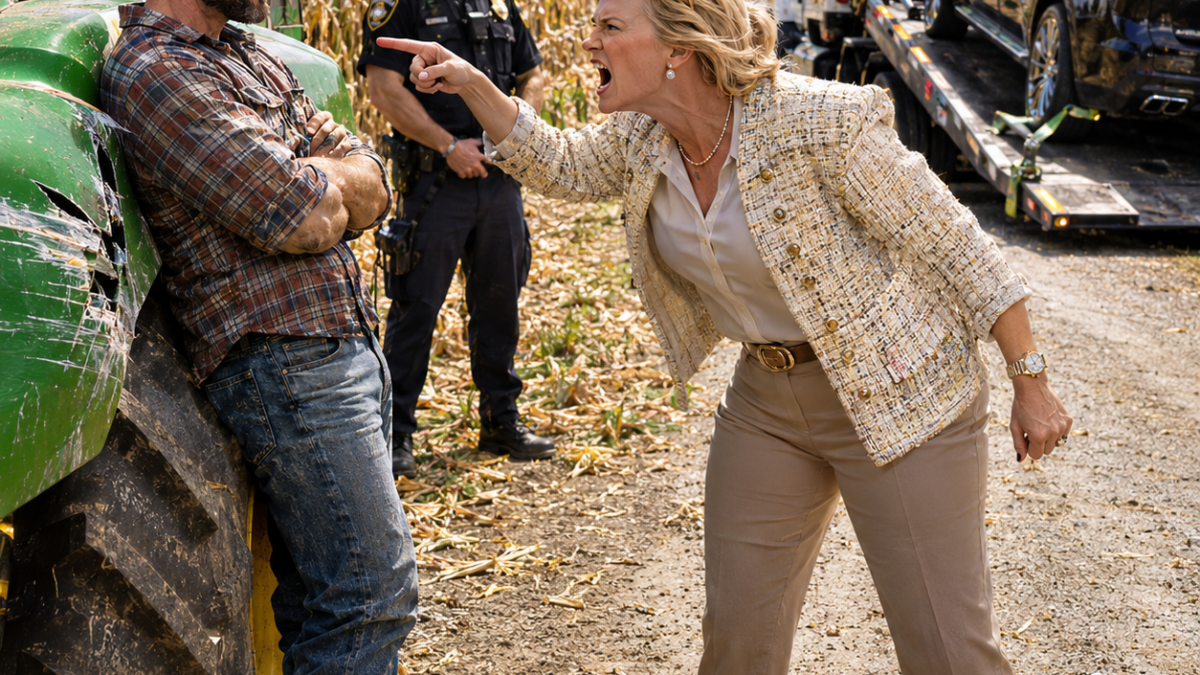
PART 2
“What are those?” she finally asked.
I leaned against the tractor tire.
“Survey markers.”
“I can see that.”
“Then we’re making progress.”
Her eyes followed the orange stakes through the decorative landscaping bordering Meadowbrook’s entrance.
One ran less than two feet from her folding chair.
Another stood directly inside the rose bed the HOA newsletter had featured the previous spring.
Brenda pointed.
“That flower bed belongs to Meadowbrook.”
“The land may belong to Meadowbrook. The thirty-foot recorded right-of-way belongs to my farm for access purposes.”
“You cannot destroy our landscaping.”
“I haven’t touched anything.”
“You had those stakes put there.”
“The county surveyor did.”
Her face reddened.
“I’m calling an emergency board meeting.”
“Good.”
“This is intimidation.”
“No.”
I picked up my work gloves.
“This is measuring.”
That afternoon, Jim Carver, whose farm bordered mine on the west side, texted me.
**Saw Brenda with a measuring tape. Thought you’d appreciate that.**
I did.
Sarah laughed when I showed her.
“Don’t get cocky.”
“I’m not cocky.”
“You’re smiling at your phone.”
“That’s different.”
She pointed a wooden spoon at me.
“You promised documentation, not revenge.”
That mattered.
Because I was angry enough to want revenge.
I had spent twenty years keeping the farm alive through fuel increases, drought, equipment failures, interest rates, and years when corn prices barely covered what it cost to grow the crop.
Now a woman who moved beside the farm three years earlier was acting like my work was an inconvenience the HOA could vote out of existence.
But Sarah was right.
Anger makes people sloppy.
And Brenda was already doing enough sloppiness for both of us.
The emergency HOA meeting happened Thursday.
Sarah and I weren’t members, so we stayed home.
That did not stop the neighborhood from reporting every detail.
By nine that night, Jim had called.
Then Mrs. Patterson.
Then a Meadowbrook homeowner named Eleanor Walsh, whom I had never met.
All three told roughly the same story.
Brenda tried to convince the board my survey was retaliation.
Three directors asked to see the easement.
She didn’t have a legal answer.
One board member remembered my grandfather driving equipment over that route long before Meadowbrook existed.
Another had apparently bought his home after being told agricultural access remained across part of the common area.
The board refused to challenge the survey immediately.
Friday morning, Brenda’s checkpoint disappeared.
For the first time in weeks, I drove to the back fields without seeing her folding chair.
She was still there.
Just inside her BMW.
Parked beside the easement.
Watching.
Sarah had been right.
This wasn’t finished.
Monday morning proved it.
At six, somebody knocked on the farmhouse door.
County noise inspector.
“Mr. Hartwell?”
“That depends how expensive this conversation is.”
He almost smiled.
“We received multiple complaints regarding industrial machinery before residential quiet hours.”
“Industrial machinery?”
“Tractors, combines, grain equipment.”
“So farming.”
He checked his form.
“Essentially.”
Sarah stood behind me with a coffee mug.
I could feel her trying not to laugh.
The inspector spent nearly an hour taking readings.
My equipment operated within applicable agricultural standards.
He left.
Before lunch, Brenda posted photos online.
Dust behind my tractor.
A combine parked beside corn.
A fertilizer spreader.
Her caption:
**HOW MUCH LONGER MUST MEADOWBROOK FAMILIES LIVE BESIDE UNREGULATED INDUSTRIAL OPERATIONS?**
I showed Sarah.
She read it twice.
“She knows farms are regulated, right?”
“She doesn’t care.”
“Then don’t argue with her.”
“I want to.”
“I know.”
She took the phone away from me.
“That’s why I’m saying don’t.”
By Tuesday, Brenda’s new Facebook group had twelve members.
**Concerned Citizens of Millbrook County.**
She posted about “toxic agricultural dust.”
Dangerous machinery.
Uncontrolled chemical exposure.
Her language became more dramatic every day.
Some of the newer Meadowbrook families believed her.
Older residents did not.
Mrs. Patterson, who had lived in the area forty years, replied publicly:
**Brenda, that’s corn dust. It was here before your house.**
I saved the screenshot.
Then I started documenting everything else.
Security cameras at the easement entrance.
Trail cameras near equipment storage.
Time logs.
Weather reports.
Photographs.
Maintenance records.
Chemical-storage records.
Agricultural permits.
My county extension agent had preached documentation for years.
I had always thought farmers kept records because government offices loved paper.
Now I understood the second reason.
Paper survives arguments.
Wednesday morning, three orange cones appeared across the road.
Beside them:
**ROAD CLOSED — SAFETY INSPECTION — HOA BOARD ORDER**
I stopped the tractor.
Put my phone on record.
Then moved the cones.
Brenda appeared almost immediately.
“You cannot remove official safety equipment.”
I held up one cone.
“This came from a hardware store.”
“The board authorized the closure.”
“The board doesn’t control my easement.”
“It controls Meadowbrook property.”
“Subject to my recorded agricultural access.”
“Not during dangerous operations.”
“What dangerous operation?”
“Harvest preparation.”
I looked at the tractor behind me.
“You mean farming.”
“You’re deliberately twisting my words.”
“No.”
I set the cone beside her.
“I’m asking you not to obstruct a recorded farm access route again.”
“Or what?”
I looked at the camera mounted on the gatepost.
“Or I document it.”
She laughed.
“You think your little cameras scare me?”
“No.”
I climbed into the tractor.
“They just save me from arguing later.”
That afternoon Deputy Martinez called.
“Jake Hartwell?”
“Yes.”
“This is Deputy Martinez with the county sheriff’s department. We received a complaint regarding obstruction of agricultural access.”
My stomach tightened.
“Complaint against me?”
Pause.
“Are you the farmer?”
“Yes.”
“Then probably not.”
I sat down.
“Who filed it?”
“Another resident reported someone repeatedly blocking your easement and filing complaints against your operation.”
That surprised me.
I had assumed nobody inside Meadowbrook wanted to get involved.
Martinez continued.
“I need your statement.”
“I have video.”
“That helps.”
“Lots of video.”
“That helps more.”
The next morning, I carried a folder and a flash drive into the sheriff’s office.
Martinez was younger than I expected.
Mid-thirties.
Quiet.
He listened more than he talked.
I showed him the deed.
Survey.
Video of Brenda’s checkpoint.
Cones.
HOA signs.
Complaint timeline.
He flipped through the folder.
“You keep good records.”
“My wife made me.”
“Smart wife.”
“I know.”
He watched the roadblock video again.
“Has she physically threatened you?”
“No.”
“Damaged equipment?”
“Not yet.”
“Entered your farm?”
“Not beyond the easement disputes.”
He nodded.
“Then we stay precise.”
“What happens now?”
“We document the pattern and determine whether any conduct crosses into criminal interference or another offense. Don’t provoke her.”
“I haven’t.”
He looked at me.
“You smiled while moving her cones.”
“That isn’t illegal.”
“No.”
He almost smiled too.
“Still don’t provoke her.”
Driving home, I felt something I had not felt in weeks.
Relief.
Not victory.
Just relief that somebody outside our family had looked at the evidence and said the situation was real.
Brenda saw the sheriff’s cruiser at my house later that afternoon.
She stayed in her BMW for nearly an hour making calls.
Then Friday brought Channel 8.
I was eating breakfast when Sarah looked out the window.
“There’s a news van.”
“No.”
“Yes.”
“Why?”
We both knew.
Brenda stood beside the entrance sign speaking to a reporter.
I could hear pieces from the porch.
“Agricultural terrorism…”
“Children…”
“Toxic dust…”
Sarah closed her eyes.
“She actually said terrorism.”
“Apparently corn has declared war.”
The reporter, Jessica Torres, asked:
“How long has the farm operated here?”
Brenda answered:
“That is irrelevant.”
I looked at Sarah.
She looked at me.
We both started laughing.
Jessica continued:
“Does the farm predate Meadowbrook Estates?”
Brenda snapped:
“Are you taking his side?”
The interview lasted less than ten minutes.
The news crew left without interviewing me.
At first I was offended.
Then the segment aired that evening.
They did not need me.
They used county records.
Historical aerial photographs.
Agricultural zoning.
The reporter calmly explained that Hartwell Farm had existed decades before Meadowbrook.
Then they aired Brenda calling ordinary corn harvest “agricultural terrorism.”
Sarah stared at the television.
“Oh no.”
“What?”
“That was worse for her than anything you could have said.”
Exactly.
Brenda’s humiliation should have slowed her down.
Instead it pushed her harder.
Saturday morning, professional-looking sawhorses appeared across the easement.
Yellow caution tape.
Printed signs.
**ROAD CLOSED BY ORDER OF MILLBROOK COUNTY HOA.**
There was no Millbrook County HOA.
Meadowbrook Estates had an HOA.
The county did not.
My cameras showed Brenda and three others installing the barricade shortly after midnight.
Reflective vests.
Flashlights.
The whole production.
I called Martinez.
Then an agricultural attorney named Martha Hendricks.
Jim recommended her.
Her office occupied an old brick building downtown.
She watched the footage.
Read the deed.
Read the complaint log.
Then looked at me.
“Your documentation is unusually good.”
“Everyone keeps saying that.”
“Most people show up with anger and screenshots missing dates.”
“I have anger too.”
“I can tell.”
“What can we do?”
“We document, report, and seek appropriate relief. There are state protections for established agricultural operations and strong legal remedies when someone unlawfully interferes with farming.”
“Criminal?”
“Potentially, depending on conduct and intent.”
“How much trouble is Brenda in?”
Martha folded her hands.
“That depends on how much more she does.”
I laughed once.
“That’s the problem.”
“What?”
“She always does more.”
Martha did not laugh.
“Then make sure you don’t.”
That Sunday night Brenda entered my property at three in the morning.
One of the hidden trail cameras caught her.
Dark jacket.
Gloves.
A quart of motor oil.
She poured it near my equipment staging area.
Then left.
Two hours later, somebody reported an agricultural petroleum spill to county environmental services.
Inspector Dave Richardson arrived before eight.
I met him beside the oil stain.
He crouched.
Looked at the shape.
Then at the equipment.
“This come from that tractor?”
“No.”
“Why not?”
“Tractor hasn’t moved.”
“Leak?”
“Doesn’t appear to have one.”
I showed him the camera video.
Dave watched Brenda walk into frame and pour the oil.
He looked at me.
Then watched again.
“Send me a copy.”
“Already backed up.”
“You people really are documenting everything.”
“Apparently that’s my personality now.”
He photographed the site.
Collected what he needed.
Then said:
“This is no longer a normal nuisance complaint.”
I believed him.
Brenda continued posting online as though none of it mattered.
Photos of the oil.
Captions about environmental contamination.
Claims that my farm was poisoning Meadowbrook.
Her supporters grew to around sixty.
But the more extreme she became, the more farmers around the county pushed back.
Jim started posting old aerial photographs.
Mrs. Patterson shared pictures of harvest seasons going back thirty years.
The county extension office posted general information about agricultural dust and right-to-farm protections.
Not about Brenda.
Just facts.
Facts were becoming her worst enemy.
Then state environmental officials arrived.
Serious people.
Official vehicles.
Sampling kits.
They inspected chemical storage.
Fuel tanks.
Soil.
Water.
Equipment.
Air conditions.
Four hours.
I hated every minute.
Even when you know you’re compliant, watching officials test your livelihood produces a very specific kind of fear.
Sarah found me in the barn afterward.
“You okay?”
“No.”
“What’s wrong?”
“What if they find something?”
“Have you done something wrong?”
“No.”
“Then breathe.”
“That’s not how inspections work.”
She touched my arm.
“Jake.”
I looked at her.
“We’ve spent months letting Brenda decide when we’re afraid.”
That stopped me.
The inspectors finished.
One of them, Williams, met us near the house.
“Mr. Hartwell, based on what we’ve reviewed today, your operation appears to comply with the standards we inspected.”
I exhaled.
He continued.
“However, the apparent staged petroleum contamination has been referred for further review.”
Sarah squeezed my hand.
Brenda had tried to create evidence.
Instead she created evidence against herself.
Then Eleanor Walsh knocked on our door.
Seventy-three.
Retired accountant.
Meadowbrook homeowner.
She carried two binders.
“Jake, Sarah, I think we have a bigger problem.”
We sat at the kitchen table.
She opened the first binder.
HOA financial records.
“Legal consultation services,” she said.
Six months:
$15,000.
Vendor:
Ashworth Property Solutions LLC.
“Brenda?”
I asked.
“Her husband Richard.”
Another invoice.
Agricultural nuisance consultation.
$2,500.
Environmental compliance research.
$3,000.
Legal strategy development.
$4,200.
All connected to the campaign against me.
Sarah stared.
“She used HOA money?”
“Yes.”
Eleanor opened another file.
“The BMW too.”
I frowned.
“What about it?”
“Lease reimbursements buried inside management expenses.”
“Her personal car?”
“Looks like approximately twelve thousand dollars in association funds went toward vehicle-related costs and reimbursements.”
Sarah sat back.
“She’s making homeowners pay for the car she uses to stalk Jake?”
“Essentially.”
Eleanor kept going.
Landscaping contract.
Eight thousand dollars.
Vendor linked to Brenda’s nephew.
No competitive bidding.
Consulting fees.
Another four thousand.
Little by little the total reached roughly thirty-five thousand dollars in questionable or self-interested spending.
Not every dollar was necessarily criminal.
Martha made sure we understood that.
But enough was documented to justify a serious independent investigation.
Then Eleanor showed me Brenda’s BMW lease documents.
“How did you get this?”
She smiled.
“Retired accountants know people.”
“I don’t want to know.”
“Correct.”
The lease restricted certain business use.
Insurance coverage could also become complicated if the vehicle was deliberately used in unlawful conduct or a staged incident.
I looked at Sarah.
Sarah looked at me.
“No,” she said.
“I didn’t say anything.”
“You were thinking something.”
“I was thinking Brenda really loves that car.”
“Jake.”
“I know.”
No revenge.
Documentation.
Let her make her own mistakes.
Martha joined us Friday afternoon.
Eleanor brought financial records.
Bill Morrison from the county extension office brought agricultural compliance material.
My seventeen-year-old son, Mike, had been quietly saving Brenda’s public social-media posts.
“Dad.”
He opened his laptop.
“I made a timeline.”
I watched.
Month one:
Road complaints.
Month two:
Dust.
Month three:
Toxic agriculture.
Then terrorism.
Then chemical warfare.
Then calls for authorities to shut down the farm.
“Where did you learn to organize this?”
“Mom.”
Sarah looked pleased.
“Of course.”
Mike said:
“I also downloaded every live stream.”
Martha leaned toward the screen.
“Every one?”
“Public ones.”
She looked at me.
“Your family is terrifying.”
“Thank you.”
Our plan was simple.
Not glamorous.
Monday, evidence packages would go to appropriate investigators and regulators.
Thursday, Meadowbrook’s annual budget meeting would force a financial conversation.
Eleanor would present the accounting issues.
Bill would explain normal agricultural practices.
Martha would address the legal picture.
I would show the harassment record only if necessary.
Harvest was scheduled Friday.
The meeting Saturday.
Martha said:
“If Brenda follows her pattern, harvest may trigger her.”
Sarah looked worried.
“She’s already staged contamination.”
“I know.”
“What if she does something dangerous?”
“We call law enforcement.”
Martha looked at me.
“No confrontation.”
“I know.”
“Say it.”
“No confrontation.”
“Good.”
Monday morning, my primary camera feeds went dark.
Not all at once.
One by one.
I walked outside before dawn.
Spray paint coated three camera housings.
A ladder lay near the barn wall.
Brenda had spent nearly two hours moving around the property.
She thought she had blinded me.
She had not found the backup trail cameras.
They recorded everything.
The next morning, another oil trail appeared.
This one ran from my tractor toward a storm drain near Meadowbrook.
Dead fish had been placed beside it.
The scene looked almost theatrical.
Because it was.
The hidden cameras showed Brenda pouring oil in a straight line.
Then taking dead fish from a plastic grocery bag.
Mike paused the video.
“Dad.”
“What?”
“Zoom.”
The bag came from a local supermarket.
Sarah covered her face.
“She bought dead fish.”
“To prove farm pollution.”
Mike looked at me.
“This is insane.”
“Yes.”
Brenda posted the photos before breakfast.
**AGRICULTURAL POLLUTION KILLING WILDLIFE.**
By lunch, county environmental officers had my footage.
Tuesday she targeted Sarah.
Anonymous letters arrived at the school board accusing her of teaching children while married to an “environmental criminal.”
Principal Rodriguez called.
Sarah put the phone on speaker.
“Sarah, I have a letter here claiming your husband is conducting agricultural terrorism.”
“I’m aware.”
“Is he?”
I shouted from across the kitchen:
“Not before lunch.”
Sarah glared at me.
The principal laughed.
Then became serious.
“Your job is not in danger. But save everything.”
When the call ended, Sarah sat at the table.
I saw her hands shaking.
That changed my anger.
Until then, Brenda had mostly attacked the farm.
Me.
My work.
Now she had gone after Sarah.
“I’m sorry.”
She looked up.
“For what?”
“This is because of me.”
“No.”
“Sarah—”
“No.”
She stood.
“This is because Brenda cannot tolerate being told no.”
I looked at the letters.
“I could settle the road issue.”
“And then what?”
She pointed toward Meadowbrook.
“She learns harassment works?”
I said nothing.
“You’ve done nothing wrong by farming your land.”
“I know.”
“Then act like you know.”
Wednesday, fake health-warning signs appeared around Meadowbrook.
**TOXIC AGRICULTURAL OPERATIONS — LIMIT OUTDOOR EXPOSURE**
Residents were told to report symptoms to the HOA.
Mrs. Patterson ripped one down.
Brenda threatened legal action.
Jim called me.
“She’s telling people corn dust is toxic.”
“I know.”
“Three families asked if they should evacuate.”
I rubbed my forehead.
The online group reached around eighty members.
Some were not even local.
The language grew more extreme.
Chemical attack.
Agricultural weapons.
Terrorism.
By Thursday, Deputy Martinez called.
“Jake.”
“That tone means trouble.”
“There are multiple agencies reviewing her reports now.”
“Good?”
“Complicated.”
“How?”
“When someone repeatedly reports chemical threats or intentional agricultural contamination, agencies have to determine whether there is a real public-safety issue.”
“Even when it’s nonsense.”
“Especially until they establish it’s nonsense.”
“So Brenda’s lies are wasting federal resources.”
“Yes.”
“What happens to her?”
“Investigators decide that.”
“Are they coming tomorrow?”
“I’m not answering that.”
Which meant yes or maybe.
Friday was final harvest.
I woke before five.
The air was cold enough that I could see my breath.
Corn stood dry and gold beneath a pale morning sky.
I had waited all season for this day.
Harvest is the closest thing farmers get to judgment.
Months of work reduced to whether kernels fill the grain tank.
I checked the combine.
Fuel.
Hydraulics.
Corn head.
Lights.
Cameras.
Then Mike came running from the driveway.
“Dad.”
I looked up.
“Brenda.”
Her BMW sat sideways across the access road.
Engine running.
Completely blocking the route.
I stared at it.
“No.”
Mike already had his phone out.
“She’s live streaming.”
Of course.
I walked toward the BMW.
Security cameras recorded from three angles.
I stopped well back from the car.
“Brenda.”
She cracked the window.
“This road is closed.”
“No.”
“Federal safety investigation.”
“You don’t have authority to close my easement.”
“I’m protecting residents.”
“I need to harvest.”
“Then use another route.”
“The combine cannot safely use the highway route you keep recommending.”
“Not my problem.”
“That’s exactly why this easement exists.”
She held up her phone.
“Everyone can see how aggressive you’re being.”
I looked directly at the phone.
“Brenda, I am asking you calmly to move your vehicle from my recorded agricultural access.”
“No.”
“I’m calling the sheriff.”
“Go ahead.”
I did.
Martinez answered.
“She’s blocking it?”
“Yes.”
“Don’t engage.”
“I’m thirty feet away.”
“Stay there.”
Within minutes, two patrol cars arrived.
Then a supervisor.
Martinez approached the BMW.
“Mrs. Ashworth.”
Brenda opened her door.
“Finally. Arrest him.”
“For what?”
“Agricultural terrorism.”
Martinez looked toward my combine.
It was parked.
Engine off.
“Ma’am, you need to move your vehicle.”
“No.”
“You are obstructing an agricultural access route during active harvest.”
“I’m exercising HOA authority.”
“The HOA does not authorize you to physically block this easement.”
“You don’t understand the danger.”
“I understand you need to move your car.”
She looked toward her phone.
Her live stream was still running.
Comments flew past.
Even her supporters were asking her to leave.
Martinez repeated:
“Move the BMW.”
Something happened in Brenda’s face.
I had watched anger there.
Smugness.
Contempt.
Now I saw panic.
She had spent months telling people she was protecting them.
If she moved now, on camera, after a deputy ordered her to stop, the performance ended.
She got back inside.
For one second I thought she would reverse.
Instead the engine revved.
Mike shouted:
“Dad!”
I stepped farther back.
The BMW jerked forward.
Not toward the open road.
Toward the combine parked beside the equipment staging area.
The sound was awful.
Plastic.
Metal.
Glass.
Then the deep, unmoving clang of the BMW striking the corn head.
The combine barely moved.
The BMW’s front end folded.
Steam rose from beneath the hood.
Silence.
Even Brenda seemed shocked.
Then she threw open the door.
“He hit me!”
Martinez stared.
“Ma’am.”
“He attacked my car!”
“Your vehicle moved.”
“That machine was in my path!”
“It was stationary.”
“He positioned it there!”
“My combine had been parked there overnight,” I said.
Brenda pointed at me.
“Shut up!”
Martinez said:
“Mr. Hartwell, don’t engage.”
I raised my hands.
Fine.
Brenda looked around at the cameras.
Then her phone.
Her own live stream.
Her face changed again.
She realized eighty people had watched the collision.
Martinez asked her to step away from the BMW.
She refused.
A second deputy moved closer.
“Mrs. Ashworth.”
“This is private property!”
“Yes,” I said before I could stop myself.
Martinez gave me a look.
I closed my mouth.
Brenda continued shouting.
Insurance.
Assault.
Hazardous equipment.
The tow truck arrived.
She almost lost control when the driver began hooking her BMW.
“You cannot tow my vehicle!”
The deputy answered:
“It’s disabled and blocking the easement.”
“I have roadside assistance!”
“You’re also being detained while we investigate the collision and the ongoing interference complaint.”
Her face went white.
I stood beside Mike while the BMW was winched onto the flatbed.
The front bumper hung crooked.
One headlight was shattered.
Coolant stained the gravel.
The tow truck pulled away.
Brenda watched it go from beside a patrol car.
For months she had used that BMW like part of her authority.
Parked it beside my easement.
Sat inside watching me.
Drove it during her inspections.
Used it as a mobile office for harassment.
Now police had watched it disappear on a tow truck because she drove it into stationary farm equipment while live streaming.
I did not cheer.
I wanted to.
Instead I walked back to my combine.
Martinez stopped me.
“Jake.”
“Yes?”
“We need copies of every angle.”
“Three backups already.”
He nodded.
“You really do document everything.”
“Sarah says it’s my only good habit.”
Mike said:
“Mom says that’s not true.”
I looked at him.
“What else?”
“She says you’re good at fixing things.”
That hit me unexpectedly.
Because for months this conflict had made me feel like I was failing at the one job I had always understood.
Protect the farm.
Protect the family.
Fix what breaks.
Brenda had turned every normal day into a defensive position.
Now, finally, she had made a mistake I did not have to interpret.
I climbed into the combine.
Started the engine.
Diesel filled the morning.
The corn head lowered.
And while deputies photographed the damaged gravel near the access road, I drove into the field.
Harvest did not care about Brenda.
That was one of the most peaceful thoughts I had all year.
By sunset, the last field was nearly finished.
Corn poured into the grain cart.
Mike rode with me for the final pass.
“You think she’s done?”
“No.”
“Even after today?”
“Especially after today.”
He looked toward Meadowbrook.
“That’s terrifying.”
“Yes.”
Saturday evening proved me right.
Meadowbrook’s community center usually drew thirty people for annual budget meetings.
That night, every household showed up.
More than a hundred people.
Local reporter Tom Onyx stood in the back.
Eleanor had prepared the financial presentation.
Martha carried legal files.
Bill Morrison brought agricultural compliance records.
Sarah sat beside me.
Brenda arrived by rideshare.
No BMW.
She had been released pending further proceedings after the previous day’s incident.
She looked exhausted.
Her hair was no longer perfect.
Her voice still tried to be.
She walked to the front.
“Ladies and gentlemen, before we begin, we must address the agricultural terrorism threatening our families.”
The room erupted.
“Where’s the money?”
“What happened to our dues?”
“Why did your husband get contracts?”
“What happened to your car?”
Brenda banged the gavel.
“Order!”
Eleanor stood.
“No.”
That one word silenced almost everyone.
Brenda stared.
Eleanor continued.
“Before we approve another dollar, homeowners deserve an explanation for thirty-five thousand dollars in questionable payments and reimbursements.”
“These are confidential management matters.”
“They’re our assessments.”
Eleanor connected her laptop.
First slide.
Ashworth Property Solutions.
Fifteen thousand dollars.
Brenda’s husband.
Second.
Landscaping contracts.
Eight thousand.
Relative-linked vendor.
No competitive bidding.
Third.
Management and vehicle expenses.
BMW-related reimbursements.
Fourth.
Consulting.
Agricultural disputes.
My farm.
Homeowners began shouting again.
One man stood.
“You used my dues to pay someone to harass Jake?”
Brenda snapped:
“No.”
Eleanor clicked.
Invoice descriptions.
Dates.
Amounts.
Each one aligned with a new phase of her campaign.
Noise complaints.
Environmental consultants.
Legal strategy.
Agricultural nuisance.
Sarah whispered:
“She really billed them for it.”
“Yes.”
Martha stood next.
“An independent investigation will determine which expenditures were improper and whether criminal conduct occurred. But homeowners have enough documented information tonight to demand an audit and protect association funds.”
Brenda pointed at her.
“You’re Jake’s lawyer.”
“Yes.”
“So you’re biased.”
“Which is why I’m asking for an independent audit.”
No answer.
Bill Morrison explained agricultural practices.
Established farm.
Normal harvest activity.
Compliance inspections.
County findings.
Environmental findings.
Right-to-farm protections.
He did not insult Brenda.
That made his presentation stronger.
Then it was my turn.
I did not want to speak.
Sarah touched my hand.
“Just tell the truth.”
I stood.
My first slide was the 1943 easement.
Then the survey.
Thirty feet.
Then Brenda’s monitoring station.
Then cones.
Sawhorses.
Oil.
Fake spill.
Dead fish.
Spray-painted cameras.
HOA warning signs.
School-board letter attacking Sarah.
Her social-media posts.
Each dated.
Each preserved.
Nobody laughed.
Then came Friday.
Video angle one.
BMW blocking road.
Deputy instructing her to move.
Video angle two.
Combine stationary.
Video angle three.
BMW accelerating.
Impact.
The room flinched when metal hit steel.
Then her live-stream audio:
“He attacked me!”
The video froze on the combine.
Unmoved.
The BMW crumpled against it.
I closed the laptop.
For several seconds, no one spoke.
Finally a homeowner named Janet Peterson stood.
“Brenda.”
Brenda looked at her.
“You drove into a parked combine.”
“I was trying to document a safety hazard.”
“You drove into it.”
“He positioned it to intimidate me.”
“It wasn’t moving.”
“You don’t understand agricultural machinery.”
Janet laughed.
That broke something.
Not in me.
In the room.
People started laughing.
Not cruelly at first.
Nervously.
Then louder.
Brenda slammed the gavel.
“This is not funny!”
A man in the back called:
“You hit a tractor and blamed the tractor.”
“It was a combine!” somebody else shouted.
Even I laughed.
Brenda’s face changed.
She had survived anger.
Fear.
Complaints.
But ridicule destroyed the last piece of authority she had.
Eleanor moved to the formal motion.
Remove Brenda from the board pending investigation.
Vote.
The result was overwhelming.
A second motion authorized an independent forensic audit.
Passed.
A third affirmed that the HOA would recognize my recorded agricultural easement and negotiate any maintenance concerns lawfully rather than obstructing access.
Unanimous.
Brenda remained seated.
For the first time since I met her, she had no power in the room.
Then Deputy Martinez entered.
The laughter stopped.
He carried paperwork.
Another investigator accompanied him.
“Mrs. Ashworth.”
Brenda stood slowly.
“What now?”
“We need you to come with us regarding additional matters connected to the interference and financial investigations.”
Her attorney moved forward.
Martinez addressed him.
“You can accompany your client as permitted.”
Then another set of papers was served.
Civil claims related to the BMW lease and insurance issues.
Exact liability would be sorted out later.
But the car problem was real.
So was the audit.
So was the evidence.
Brenda looked directly at me.
“This is what you wanted.”
I shook my head.
“No.”
“You wanted to humiliate me.”
“I wanted you off my access road.”
“You destroyed my life over a dirt path.”
“No.”
I looked at Eleanor’s financial records.
Then at the screen where her BMW was frozen against my combine.
“You did all that after I asked you to stop.”
Her mouth opened.
Nothing came out.
The deputies escorted her from the room.
Richard did not follow immediately.
He sat with his head down.
Then stood and left through the side door.
The room remained silent for several seconds.
Finally Eleanor said:
“We still have a budget.”
Everybody laughed again.
That was how Meadowbrook began repairing itself.
Not with a dramatic speech.
With an old accountant reminding everyone bills still had to be paid.
The criminal and civil cases took months.
Much longer than the neighborhood expected.
Social media had trained everyone to believe consequences happen by Tuesday.
Courts do not work like social media.
Investigators reviewed the staged pollution reports.
Access interference.
Financial records.
Insurance issues.
False complaints.
The BMW collision.
Brenda eventually accepted plea agreements resolving several criminal matters, including fraud-related conduct and financial wrongdoing connected to the HOA.
She received incarceration followed by supervision and restitution obligations.
The exact structure was less cinematic than the rumors that had circulated through Meadowbrook, but the outcome was serious.
Richard’s company collapsed under scrutiny and lost the benefit of the HOA-related work that had helped support it.
He faced separate financial consequences.
Their house was eventually sold.
The BMW became almost a joke around town.
People called the intersection near my easement “BMW Bend.”
I hated that.
Mike loved it.
He made a sign once.
Sarah made him take it down.
The final HOA audit confirmed tens of thousands of dollars in improper or unsupported expenditures.
The new board recovered money through insurance, restitution, settlements, and terminated vendor relationships.
Dues dropped by roughly twenty percent after questionable contracts disappeared.
Eleanor became treasurer.
Nobody wanted the job.
That made her perfect for it.
She required receipts for everything.
Competitive bids.
Written conflicts disclosures.
Monthly reports.
One board member complained:
“This is excessive.”
Eleanor answered:
“So was embezzlement.”
Nobody complained again.
The new board repaired the easement road.
Proper gravel.
Drainage.
Shoulders.
The work was funded partly from recovered association money because Meadowbrook residents used that section and had an interest in maintaining it.
The first morning after the repairs, I drove a tractor through.
No cones.
No chair.
No BMW.
Just gravel crunching under the tires.
I stopped near the entrance.
Jim was waiting with coffee.
“Looks good.”
“Expensive.”
“Not your money.”
“Still expensive.”
He laughed.
Mrs. Patterson walked by.
“Try not to terrorize anyone with corn today.”
“No promises.”
That was the beginning of something I never expected.
Meadowbrook started embracing the farm.
Not all at once.
Some families still hated early equipment noise.
Some complained about dust.
But instead of Brenda turning every irritation into warfare, the new board called me.
“Jake, we have three families asking about Saturday harvest hours.”
“Fine. I can shift the grain trucks away from their entrance until eight.”
That was it.
Conversation.
No threats.
No fake safety signs.
No environmental panic.
Sarah suggested we invite residents to the farm.
I thought she was joking.
“You want more suburbanites here?”
“I want them to know what they live beside.”
“Same thing.”
She ignored me.
The first farm day drew forty people.
Kids climbed into a parked tractor.
Bill Morrison explained harvest safety.
I showed parents why dust happens.
Jim brought an old corn sheller.
Mrs. Patterson told children the whole area used to be farmland.
One little boy stared up at the combine.
“Is this the machine the lady crashed into?”
Sarah covered her face.
I said:
“Yes.”
“Did it win?”
“Machines don’t win.”
He pointed.
“But her car broke.”
“That is accurate.”
The boy nodded seriously.
“Then it won.”
I could not argue with that logic.
The event became an annual agricultural heritage festival.
The next year, Meadowbrook helped organize it.
Families brought food.
Local farmers displayed equipment.
Sarah created classroom lessons about where food comes from.
Corn maze.
Farm safety.
Soil.
Water.
Weather.
My kids helped.
Mike handled cameras.
Not surveillance cameras anymore.
Event videos.
That mattered.
For months, every camera on our farm had represented defense.
Proof.
Suspicion.
Now Mike used them to film kids laughing from a hay wagon.
I liked that better.
One evening after the festival, Sarah and I sat on the porch.
Fields stretched dark beyond the barn.
She leaned against me.
“You know what I hated most?”
“Brenda?”
“No.”
“That was my guess.”
“I hated watching you become afraid of every vehicle.”
I looked at her.
“What do you mean?”
“Any car stopped near the easement, you checked cameras.”
“I still do.”
“I know.”
Silence.
Then she said:
“You stopped enjoying the farm.”
That landed harder than I expected.
“I was protecting it.”
“I know.”
“But?”
“But sometimes protecting something can become the only way you relate to it.”
I thought about harvest.
How relieved I had felt after Brenda’s BMW disappeared.
How the combine engine sounded like victory.
That bothered me now.
The machine had not been built to win arguments.
It had been built to harvest corn.
“I’m working on it.”
Sarah smiled.
“You’re terrible at emotional conversations.”
“I grow corn.”
“Same excuse for twenty years.”
“It has served me well.”
Three years later, the changes were bigger.
Several Meadowbrook homeowners placed conservation restrictions or supported farmland-preservation initiatives around the area.
Not everyone.
But enough.
New buyers received agricultural-use disclosures explaining that farms operated nearby.
Early mornings.
Equipment.
Dust.
Odors.
Harvest traffic.
Reality.
The county extension office used parts of my documentation process in a conflict-prevention workshop.
Nothing fancy.
Record dates.
Save correspondence.
Know your deeds.
Install lawful security cameras if needed.
Keep inspection records.
Do not threaten.
Do not retaliate.
Let evidence speak.
Martha started taking more farmer-development disputes.
She occasionally called.
“Jake.”
“No.”
“You don’t know what I’m asking.”
“Still no.”
“Farmer outside Lafayette. New subdivision blocking his equipment access.”
I sighed.
“Does he have documentation?”
“Not enough.”
“Tell him to start.”
“He wants to speak to you.”
“I am not a lawyer.”
“I know.”
“What am I supposed to say?”
“Exactly what you just said.”
So I talked to farmers.
Not as an expert.
As the guy who learned the expensive way that paperwork matters before the conflict starts.
One farmer from Oregon visited.
He brought a binder modeled after mine.
“Your story made us realize we needed to prepare.”
I looked at the binder.
“Hopefully you never use it.”
“That’s the goal.”
Exactly.
The strangest outcome came from the HOA itself.
Eleanor called one spring.
“We have surplus money.”
“Give it back.”
“Not that simple.”
“Nothing with HOAs is.”
She ignored that.
“We want to fund something community-based.”
“Road maintenance.”
“Already covered.”
“Drainage.”
“Covered.”
“Emergency reserves.”
“Healthy.”
I waited.
She said:
“Scholarship.”
“For what?”
“Agriculture.”
I laughed.
“You’re serious.”
“Three students per year. Agriculture, mechanics, environmental science, or trades supporting rural infrastructure.”
“Why are you asking me?”
“Because we want to name it Hartwell.”
“No.”
“Sarah already said yes.”
I turned toward the kitchen.
Sarah was pretending not to listen.
“Traitor.”
She smiled.
The final name became the Meadowbrook Rural Skills Scholarship because I refused to have my name on it.
The first recipient wanted to become a diesel technician.
That made me suspicious.
“Did Sarah choose him?”
“No.”
“Eleanor?”
“No.”
“Mike?”
“No.”
He was simply a kid who loved machines.
I let him work at the farm that summer.
Not because of the scholarship.
Because good help is hard to find.
He eventually rebuilt an old tractor carburetor I had been procrastinating on for four years.
Worth every tuition dollar.
Brenda’s name slowly disappeared from conversation.
That surprised me.
For months she had occupied every breakfast.
Every legal meeting.
Every county inspection.
Every phone notification.
Then one day nobody mentioned her.
A week.
Then another.
Her old house sold.
A family moved in.
They had two daughters.
The first thing the father did was walk over.
“I’m Kevin.”
“Jake.”
“I’ve been told there’s an agricultural easement.”
“There is.”
“I’ve seen the survey.”
I waited for the argument.
Instead he said:
“Anything we need to know?”
“Don’t block it.”
“Got it.”
“Harvest gets noisy.”
“We bought beside a farm.”
I almost hugged him.
Didn’t.
That would have been weird.
His daughters came to the heritage festival.
The younger one became obsessed with combines.
A year later, she told Sarah she wanted to study agricultural engineering.
That might be the closest thing to poetic justice I ever saw.
Not Brenda suffering.
A child who moved into Brenda’s old house learning to love the machine Brenda once called dangerous.
One harvest afternoon, that girl stood beside me while I checked the corn head.
“Is this where the BMW hit?”
“Right there.”
She touched a small scrape in the paint.
“You never fixed it.”
“I fixed what needed fixing.”
“Why leave the scratch?”
I looked at it.
I had never consciously decided.
The combine had plenty of scars.
Branches.
Tools.
Field debris.
Twenty years of work.
But I knew exactly which mark came from Brenda.
“I guess it didn’t matter.”
She nodded.
Then ran back toward her father.
That answer stayed with me.
For months, Brenda had made herself feel enormous.
Powerful enough to threaten the farm.
Sarah’s job.
My access.
My reputation.
She called normal dust terrorism.
She tried to manufacture environmental violations.
She used HOA money to support her campaign.
She blocked harvest.
She drove a luxury car into a stationary harvester and blamed the machine.
At the time, every incident felt huge.
Years later, the only physical mark she left was one scrape among dozens on a machine built to work.
That might have been the most satisfying ending possible.
Not that she disappeared.
That life became larger than her.
The farm stayed.
The corn came up every spring.
Harvest returned every fall.
Sarah kept teaching.
Mike went to college and came back whenever equipment needed cameras or software I refused to understand.
Our younger daughter handled livestock better than all of us and reminded everyone constantly.
Jim kept insulting my repair methods.
Mrs. Patterson kept telling new homeowners they had moved into farm country and should behave accordingly.
Eleanor kept receipts.
Martha kept calling.
The annual farm dinner grew so large we had to move half the tables into the machine shed.
One October evening, after nearly everyone had left, I walked toward the field.
The air smelled like dry corn stalks and cooling diesel.
The combine sat near the barn.
I climbed the steps.
Sat in the cab.
The place where I had recorded Brenda screaming beside her damaged BMW years earlier.
My phone was in my pocket.
No recording.
No notifications.
No live stream.
Just quiet.
Sarah climbed up behind me.
“You hiding?”
“Yes.”
“From who?”
“People.”
“There are six people left.”
“Exactly.”
She sat beside me.
For a while we watched the last light disappear over the fields.
Then she pointed toward the corn head.
“You know the scrape is still there.”
“I know.”
“You want me to ask?”
“No.”
“I’m asking anyway.”
“Of course.”
“Why haven’t you painted it?”
I shrugged.
“Never needed to.”
She looked at me.
“That’s very philosophical for a farmer.”
“Don’t tell anybody.”
She smiled.
Then rested her head against my shoulder.
The scratch caught the last orange light of sunset.
Small.
Barely visible.
I thought about that Friday morning when Brenda drove toward the combine believing one more act of intimidation might finally make me surrender.
She lost the BMW.
Then the board position.
Then the money she had hidden behind.
But the moment that stayed with me wasn’t watching the tow truck carry her car away.
It was what happened afterward.
I climbed into the combine.
Lowered the corn head.
And went back to work.
That had been the answer all along.
Brenda could create noise.
She could create paperwork.
She could create fear.
She could even create a collision.
But she could never make the farm stop being a farm unless I let the fight become more important than the work.
Outside the cab, the fields were almost dark.
Sarah squeezed my hand.
“Ready?”
“For what?”
“Dinner cleanup.”
I groaned.
“Thought this was an emotional moment.”
“It was.”
“Can we stay another five minutes?”
“No.”
I started climbing down.
The old scrape flashed once under the barn light.
Then disappeared into the rest of the machine.
Exactly where it belonged.
The following harvest season was the first one in years when I woke before dawn and did not immediately check the security cameras.
That sounds small unless you have lived through months of waiting for somebody to cross a line.
For almost a year, every motion alert had tightened something inside me. A truck slowing near the easement made me look out the window. A strange car sitting near Meadowbrook made me wonder whether Brenda had sent another inspector, another reporter, another person with a clipboard and a story already written about me.
Even after she was gone, my body had not gotten the message.
Sarah noticed before I did.
One morning, I came into the kitchen around five with my boots on and my thermos in hand. She was already awake, leaning against the counter in one of my old sweatshirts.
“You didn’t check your phone.”
I stopped.
“What?”
“The cameras.”
I looked at the phone in my hand.
She was right.
For the first time since Brenda had started her campaign against us, I had gotten dressed for work without checking whether somebody was standing at the road.
“I guess I forgot.”
Sarah smiled.
“No.”
“What?”
“You didn’t forget.”
She walked over and kissed my cheek.
“You finally expected the morning to be normal.”
I did not say anything.
I just stood there with coffee warming my hand and realized how much of our life Brenda had occupied without ever being invited into it.
That was the damage nobody put into court records.
Legal bills could be calculated.
Equipment damage could be photographed.
The BMW collision had repair estimates.
HOA money could be audited.
But nobody sent an invoice for the nights Sarah woke because a car door slammed outside.
Nobody calculated the hours Mike spent saving videos because he thought his dad might need evidence.
Nobody measured what it did to our younger daughter when she asked whether the police were going to make us leave the farm.
Brenda had lost her position, her reputation, and eventually her freedom for a period of time.
But our family still had to learn how to stop living like we were waiting for her next move.
That took longer than I expected.
The harvest itself went well.
Not perfectly.
Farming never gives you perfectly.
A bearing went out on the grain cart in the second week. A storm rolled through before we finished the north field and flattened maybe five acres badly enough that harvesting them became slow, ugly work. Corn prices dipped just when I wanted to sell.
Normal problems.
Beautiful problems.
Problems that did not involve an HOA president calling the EPA because she saw dust behind a tractor.
One Saturday, Kevin—the man who had bought Brenda’s old house—walked over while I was replacing a hydraulic hose.
He stood at the edge of the shop.
“Need a hand?”
I looked at his clean jeans.
“You know anything about hydraulic lines?”
“No.”
“Then absolutely.”
He laughed and came inside.
I showed him how to hold the fitting while I broke the old connection loose.
For the first few minutes, we talked about nothing.
Football.
Weather.
His daughters.
Then he said:
“Can I ask you something weird?”
“Usually means you’re going to anyway.”
He nodded toward Meadowbrook.
“Do people hate us because we bought their house?”
That surprised me.
“No.”
“My wife worries about it.”
“Why?”
“First month we moved in, three different people told us stories about Brenda.”
“People like stories.”
“Yeah.”
He hesitated.
“One woman actually said, ‘Don’t worry, you seem normal.’”
I laughed.
Kevin did not.
“I don’t want my daughters growing up thinking everybody’s waiting for us to act like the family before us.”
I set down the wrench.
“Nobody sane thinks that.”
“That’s reassuring.”
“I didn’t say everybody.”
That got him smiling.
Then I added:
“You’re not responsible for what Brenda did.”
He looked toward the easement.
“Still feels strange living in the house where all that started.”
“It didn’t start in the house.”
“No?”
“It started when she decided somebody else’s property mattered less than what she wanted.”
Kevin nodded slowly.
Then he looked at the hose.
“So what do I do?”
“About the hose?”
“About the neighborhood.”
“Same answer.”
“What?”
“Don’t force anything.”
He laughed.
But I meant it.
A few months later, Meadowbrook held its first open budget meeting under the new bylaws.
Eleanor had organized everything so carefully that the packet handed to homeowners looked like something from a publicly traded company.
Revenue.
Expenses.
Reserve balance.
Vendor bids.
Insurance.
Road maintenance.
Every check above the disclosure threshold.
Every related-party relationship.
I sat near the back.
I had no vote.
I was not part of the HOA and had no desire to become part of one.
But the easement agreement tied us together financially, so Eleanor invited me whenever road expenses came up.
Halfway through the meeting, a man named Phillip stood.
He had defended Brenda longer than most people.
Not because he liked her personally, as far as I knew.
He simply believed rules were rules and leadership needed respect.
He looked uncomfortable standing there.
“I have a question about the road fund.”
Eleanor nodded.
“Go ahead.”
“Why are we paying for maintenance on property we don’t own?”
A few people glanced toward me.
Old instinct tightened my shoulders.
Eleanor answered before I could.
“Because we have a permanent access agreement that requires proportional maintenance contributions.”
Phillip looked at me.
“So we’re basically paying Jake forever.”
I stayed seated.
Eleanor said:
“We are paying for maintenance of an access route forty-seven households use.”
“He owns it.”
“Yes.”
“Then why doesn’t he maintain it?”
That was when I stood.
Not angry.
At least not yet.
“Fair question.”
Phillip looked surprised.
I continued.
“If I used the road alone, I’d maintain it alone.”
“But it’s your land.”
“Correct.”
“And we pay.”
“Because forty-seven households drive over it.”
He folded his arms.
“So this is rent.”
“Part of the agreement compensates for access and insurance. Part funds maintenance.”
“You make money.”
“Yes.”
That answer changed the room.
People expected defensiveness.
I had learned not to give it.
Phillip said:
“So after everything that happened, you profit.”
“Some.”
“How much?”
Eleanor started to object.
I stopped her.
“After insurance, legal administration, taxes related to the arrangement, and maintenance reserves, not enough to retire.”
A few people laughed.
Phillip did not.
I said:
“If the association wants to build another road on land it owns, the agreement includes a process for ending the arrangement.”
That quieted him.
“You’d let us?”
“It’s not prison.”
He looked at the financial packet.
Then sat down.
After the meeting, he found me by my truck.
“I wasn’t trying to attack you.”
“I know.”
“I just don’t want another person controlling the neighborhood.”
Neither did I.
“That’s why the agreement has an exit.”
He nodded.
“Brenda never gave exits.”
“No.”
He held out his hand.
I shook it.
That conversation mattered more than I realized at the time.
Power had become a sensitive subject in Meadowbrook.
Residents had spent years living under somebody who turned authority into ownership.
Now they questioned everything.
Sometimes annoyingly.
Good.
An annoying question asked publicly is cheaper than a secret discovered five years later.
Eleanor understood that better than anyone.
She posted monthly statements online.
If somebody asked why a landscaper cost $2,400, she produced the bid.
If somebody asked why insurance increased, she invited the agent to explain it.
When a board member suggested hiring his cousin for snow removal, Eleanor made him leave the room during the vote.
He was offended.
She did not care.
One evening she came to the farm carrying a folder.
“I need a favor.”
“No.”
“You don’t know what it is.”
“Still no.”
She handed me the folder.
“Three bids for easement resurfacing.”
“I thought we weren’t doing that until spring.”
“We moved it up.”
“Why?”
“The drainage on the subdivision side is pushing water toward your shoulder.”
That interested me.
I opened the folder.
Three contractors.
Three prices.
Three scopes.
“Which do you like?”
“The middle one.”
“Why?”
“Best drainage plan.”
“That’s what I thought.”
She smiled.
“I hate when you’re useful.”
“Everyone does.”
The project started two weeks later.
Miguel Santos handled part of it.
He had become friendly with half of Meadowbrook after the old HOA finally paid what it owed him.
I watched his crew reshape the drainage ditch near the easement.
For years, that strip of dirt had represented conflict.
Orange stakes.
Cones.
Barricades.
Police cars.
Brenda’s BMW.
Now three workers in reflective vests were laying proper culvert pipe while residents complained about where to park for six hours.
Normal.
Again, beautiful.
Miguel climbed out of a skid steer.
“Remember when your road looked like hell?”
“Which time?”
He laughed.
“Fair.”
He pointed toward the subdivision.
“They’re different.”
“People?”
“Yeah.”
“Some are.”
“Most.”
I watched Kevin walking his daughters toward the school bus.
“They’re less scared.”
Miguel nodded.
“That woman had people believing every neighbor was an enemy.”
I knew exactly what he meant.
When somebody leads by fear long enough, people forget disagreement is not betrayal.
Meadowbrook had to relearn that.
So did I.
The biggest test came the next summer.
A family named the Rollinses moved into a house near the eastern edge of Meadowbrook.
Within two weeks, Mr. Rollins filed a written complaint about early tractor noise.
Eleanor called me personally.
I laughed when she told me.
“You’re kidding.”
“No.”
“Did Brenda come back wearing a mustache?”
“Jake.”
“What time?”
“Five forty-three.”
“That was planting.”
“I know.”
“Legal.”
“I know.”
“So?”
“So he has a right to complain.”
That irritated me more than it should have.
“I have a right to farm.”
“Yes.”
“Right-to-farm protections.”
“Yes.”
“Then tell him.”
“I did.”
“Good.”
“And I told him you would meet with him.”
“No.”
“Tomorrow. Seven.”
“No.”
She hung up.
I stared at my phone.
Sarah, sitting across the table, said:
“You’re going.”
“I hate everybody.”
“You hate mornings.”
“I’m a farmer.”
“You can be both.”
The next evening, Mr. Rollins came to the porch.
He was maybe thirty-five.
Software engineer.
New baby.
Dark circles under his eyes.
That changed things immediately.
He sat down.
“Look, I know I’m the new guy.”
I waited.
“And everybody has already warned me not to become Brenda.”
I almost smiled.
He continued:
“I don’t want to stop you farming.”
“Good.”
“My daughter was born three months ago.”
I looked toward the baby monitor clipped to his belt.
“She doesn’t sleep.”
“Neither did mine.”
“The tractor wakes her.”
There it was.
Not tyranny.
Exhaustion.
I asked:
“What room?”
“Back bedroom.”
“Closest to the field?”
“Yes.”
“Planting lasts another week.”
“I know.”
“I can start the east section after six-thirty instead of five-thirty for a few days.”
His face changed.
“You can?”
“Costs me some time.”
“I can pay—”
“No.”
“I don’t want special treatment.”
“It’s not special treatment.”
“Then what is it?”
“Neighbor treatment.”
He looked embarrassed.
“I came in ready for a fight.”
“So did I.”
That admission surprised both of us.
Sarah brought out lemonade.
Mr. Rollins laughed.
“Eleanor said you’d be difficult.”
“She’s dead to me.”
Sarah said:
“She says that because she likes you.”
“Worse.”
The tractor started later near the east field for the rest of that week.
Nothing collapsed.
The crop still got planted.
The baby slept.
Mr. Rollins later helped Mike build the online registration system for the heritage festival.
That was the moment I understood how close I had come to letting Brenda change me permanently.
Before her, I knew the difference between a neighbor with a problem and a person trying to control my life.
During the conflict, everybody started looking like the second kind.
I had become suspicious before people even finished speaking.
Brenda had not only tried to make Meadowbrook afraid of me.
She had nearly made me afraid of Meadowbrook.
Sarah saw it.
She always saw things before I did.
On our anniversary that year, we walked through the north field after dinner.
The corn was waist-high.
Fireflies flickered near the tree line.
She held my hand.
“You’re different.”
“Older.”
“That too.”
“Better looking.”
“Debatable.”
“What do you mean?”
“You listen faster.”
“That sounds insulting.”
“It’s a compliment.”
“From a teacher?”
“High praise.”
I kicked at a clump of soil.
“I almost became an asshole.”
“You were already an asshole.”
“Supportive wife.”
“You almost became a permanent asshole.”
“Ah.”
She squeezed my hand.
“You were so angry that being right started feeling more important than being peaceful.”
I did not like hearing that.
Because it was true.
“Brenda was wrong.”
“Yes.”
“She was hurting us.”
“Yes.”
“I had to fight.”
“I know.”
“Then what was I supposed to do?”
Sarah stopped walking.
“Fight.”
She turned toward me.
“But come home afterward.”
That sentence stayed with me.
For months, even when I was home, Brenda had still been in the room.
In the cameras.
In the evidence binders.
In every conversation.
In my head.
Winning meant nothing if I kept carrying her after she was gone.
So I started throwing things away.
Not evidence required for ongoing legal matters.
Copies.
Duplicates.
Old screenshots.
Printed Facebook posts.
Stacks of complaint letters after the cases closed.
Mike helped.
We fed pages into the shredder.
Noise complaint.
Shred.
Fake safety notice.
Shred.
Printed photo of Brenda’s monitoring chair.
Shred.
Then Mike found a still frame from the BMW collision.
Brenda’s car frozen against the corn head.
He held it up.
“Keep this one?”
I looked at it.
For a long second, I wanted to.
Not as evidence.
As a trophy.
Then I shook my head.
“No.”
“You sure?”
“Yeah.”
He fed it into the shredder.
The blades pulled the image down.
White BMW.
Steel combine.
Gone.
The actual video remained where it legally needed to remain.
But I did not need a photograph on my wall.
That felt like another kind of victory.
The next October, the heritage festival drew more people than expected.
Not five thousand.
That number would have been ridiculous for our little operation.
But hundreds came through over the weekend.
Enough to fill the parking field.
Enough that Sarah made me paint directional signs.
Enough that I complained constantly while secretly enjoying it.
Kids climbed into stationary equipment with supervision.
Bill Morrison gave a soil-health demonstration.
Miguel sponsored lunch.
Eleanor ran the ticket table even though admission was free because, according to her, “people need to be counted.”
Kevin’s youngest daughter, Emily, spent almost an hour beside the combine.
She had grown since the year before.
Now she asked questions about the corn head.
“What happens here?”
“The stalk goes in.”
“And the corn?”
“Gets separated farther inside.”
“Does the whole plant go through?”
“Most of it gets processed through different systems.”
She climbed down.
Then pointed at the old scrape.
“Still there.”
“Yep.”
“You’re really never fixing it?”
“Probably not.”
“Because it’s from the BMW?”
“No.”
She looked skeptical.
“Then why?”
I rubbed the paint with my thumb.
“Because machines don’t need to be pretty to work.”
She considered that.
“My dad says that about his truck.”
“Your dad is wise.”
“My mom says his truck is ugly.”
“Your mom is wiser.”
Emily laughed.
Then asked:
“Was Brenda really scary?”
That question caught me off guard.
“To you?”
“No. I wasn’t here.”
“To people?”
“Sometimes.”
“Why?”
I thought carefully.
Because children deserve honest answers without inheriting adult grudges.
“She got used to believing being in charge meant everyone had to agree with her.”
“That’s dumb.”
“Adults are capable of impressive things.”
“Did she hate farming?”
“I don’t know.”
“But she said it was dangerous.”
“She said a lot of things when she was angry.”
Emily looked toward the field.
“I like it.”
“Good.”
“I want to design tractors.”
“Better.”
“Could I make one that doesn’t get hurt by BMWs?”
I laughed so hard Sarah turned around from twenty yards away.
“What?”
“Nothing.”
Emily grinned.
That evening, after the last visitors left, I walked through the equipment shed collecting trash.
A paper cup.
Two napkins.
Somebody’s tiny plastic tractor.
I picked it up.
Cheap green toy.
One wheel missing.
I put it on the workbench.
Later Sarah found it.
“Whose?”
“No idea.”
“Throw it away.”
“Wheel can be fixed.”
She stared at me.
“Of course that’s your answer.”
I found a small screw the next morning and repaired it.
The next festival, the toy sat on the registration table.
A kid took it home.
I never learned who.
That felt right too.
Not everything needs documentation.
By then, Brenda’s legal cases had mostly faded from our daily lives.
Restitution payments continued through formal channels.
The association recovered what it could.
There were no magical piles of money.
No grand courtroom speech where every dollar returned at once.
Some losses stayed losses.
That was one of the hardest lessons.
Justice does not always restore.
Sometimes it only stops the damage from continuing.
Eleanor once apologized to the neighborhood during a meeting because the HOA would never recover every cent.
An older homeowner stood and said:
“You recovered the truth.”
Eleanor almost cried.
Then denied it.
I saw her wipe her eyes.
The road fund remained healthy.
The drainage held through two heavy storms.
The easement arrangement caused occasional arguments.
That was fine.
Agreements that never produce arguments usually mean nobody is reading them.
One winter, the HOA asked whether snow removal could begin earlier on the shared access.
I said yes.
Another year, I requested that landscaping stay farther from the turning radius needed for grain trucks.
They adjusted it.
No screaming.
No threats.
No BMW parked sideways.
Just emails.
Boring emails.
I grew to love boring emails.
Five years after the collision, Mike graduated college.
He had studied agricultural systems technology.
I pretended not to be emotional.
Failed.
At his graduation dinner, he handed me a small wrapped box.
“What is this?”
“Open it.”
Inside was a metal plate.
Laser engraved.
DOCUMENT EVERYTHING
I stared at him.
Sarah laughed.
“You encouraged this.”
I turned the plate over.
On the back:
BUT LIVE SOMETIMES TOO.
I looked at Mike.
He shrugged.
“Mom’s part.”
Of course.
I mounted it in the farm office.
Not the barn.
Not the combine.
The office.
Where paperwork belonged.
The last time I thought seriously about Brenda was during another final harvest pass.
Same field.
Different year.
The combine was newer.
I had finally traded the old one after the transmission started showing signs of expensive trouble.
Before the dealer hauled it away, I stood beside the corn head and found that scrape one last time.
The mark Brenda made was still there.
Faded.
Partly covered by newer scratches.
The salesman noticed me looking.
“Want us to touch that up before resale?”
“No.”
“Doesn’t matter either way.”
Exactly.
It did not matter.
That machine had cut thousands of acres after Brenda hit it.
Thousands.
One collision that once felt like the center of my life had become barely visible beneath years of honest work.
I signed the trade papers.
The dealer loaded the combine.
As the truck pulled away, Sarah came outside.
“You okay?”
“Yeah.”
“You look weird.”
“Thanks.”
“You know what I mean.”
I watched the old combine disappear down the county road.
“That scrape is gone.”
“No, it’s not.”
“Well, technically it’s headed to Ohio.”
Sarah slipped her arm through mine.
“What did you expect? To keep that machine forever because Brenda hit it?”
“No.”
“You kept it longer than you needed.”
“Maybe.”
“Why?”
I thought about it.
“Proof.”
“Of what?”
“That we won.”
Sarah looked toward the truck until it disappeared.
Then she said:
“You don’t need proof anymore.”
Behind us, the new combine waited beside the barn.
Clean paint.
No scars yet.
That would change.
Machines that work collect marks.
So do people.
The point is not staying untouched.
The point is making sure the damage does not become the only thing anybody sees.
I climbed into the new cab the next morning.
Mike rode beside me.
Sarah stood near the porch with coffee.
Kevin drove through the easement and waved.
Mr. Rollins followed a few minutes later.
No one blocked the road.
No one filmed me.
No one shouted about toxic dust.
I lowered the corn head.
The first rows disappeared beneath the machine.
Golden grain filled the tank.
Somewhere behind me, Meadowbrook children were getting ready for school.
Somewhere ahead, Sarah had already started planning another farm dinner I would pretend to hate.
I looked over at Mike.
“You checking the cameras?”
“Nope.”
“Why?”
He smiled.
“Nothing happening.”
For years, that answer would have made me nervous.
That morning, it made me smile.
I pushed the combine forward.
Corn moved beneath us in steady rows.
No revenge.
No confrontation.
No audience.
Just work.
And after everything Brenda Ashworth had tried to turn my farm into—a crime scene, a political argument, an environmental threat, a battleground—it had finally become what it had always been before she arrived.
Home.
[END OF STORY]








