PART 2: HOA KAREN Blamed My Wall After Her Son Crashed Through It — Then Her $45,000 Lawsuit Exposed Something Much Bigger
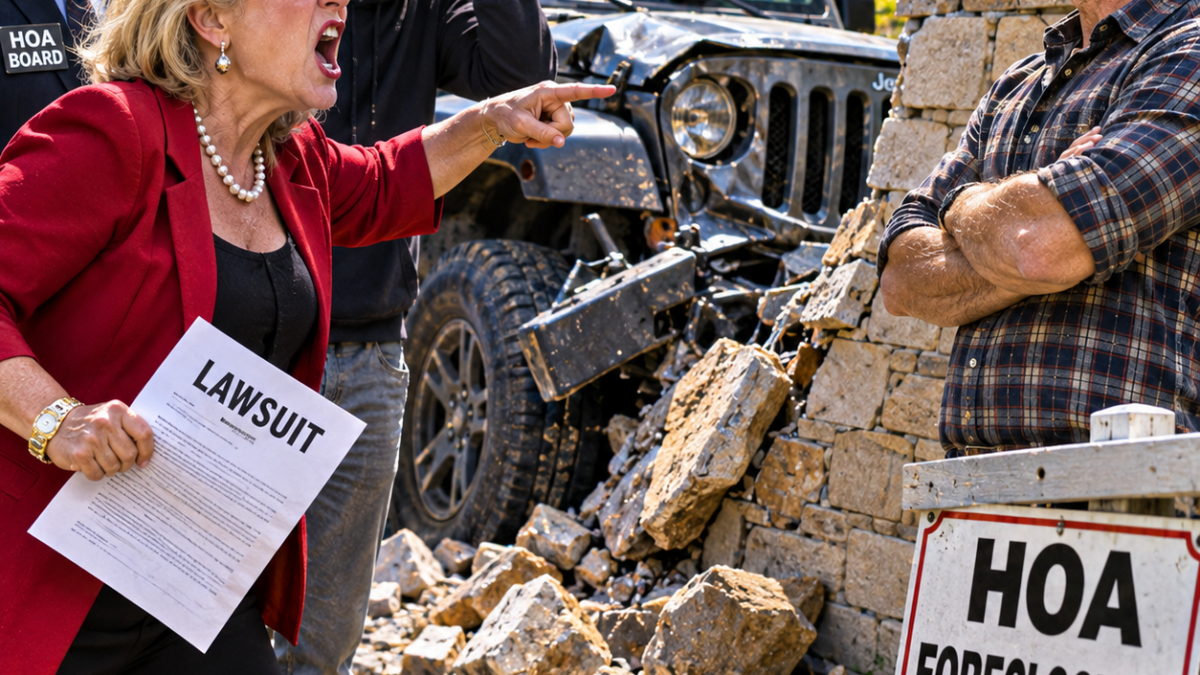
PART 2
The stakes were still there that afternoon.
Three orange flags placed along the eastern line when I had the property professionally surveyed years earlier.
One stood near the road.
One near the wall.
One farther back beside a maple.
I walked the line twice with the lawsuit folded in my hand.
Preston’s attorney was arguing that my wall violated county setback requirements and extended dangerously close to the roadway.
That wasn’t true.
The wall sat about six feet inside my property.
I knew that.
Theo knew that.
The county permit showed it.
The survey showed it.
But the complaint had been written carefully.
Not “the wall definitely crossed the line.”
Instead:
“The retaining structure was positioned in a manner that created an unreasonable roadside hazard and may have encroached upon required setback areas.”
May have.
Two words designed to create expensive uncertainty.
I called Beverly Okafor.
Beverly had represented me during earlier HOA disputes, including the lean-to mess with Dolores.
She was the kind of attorney who could make silence feel like cross-examination.
I sat across from her the next morning while she read Preston’s complaint.
She reached the damages section.
“Forty-five thousand.”
“Apparently.”
She kept reading.
“Bruised knee.”
“Apparently.”
“Anxiety.”
“Apparently.”
She lowered the pages.
“And the Jeep damage?”
“His mother’s insurance already handled my property claim. I assume they’re trying to recover his side separately.”
“The wall was permitted?”
I slid the permit toward her.
“Survey?”
Next document.
“Code enforcement report after the accident?”
Next.
“Photographs?”
I put a flash drive on the desk.
Beverly leaned back.
“Garrett.”
“Yes?”
“This is not a strong lawsuit.”
“Good.”
“That doesn’t mean it’s harmless.”
I waited.
She tapped the complaint.
“Some lawsuits aren’t designed to reach a jury. They’re designed to make defending yourself painful enough that writing a settlement check feels cheaper.”
“How much?”
“If I had to guess what they want? Eight, maybe ten thousand.”
“And if I don’t pay?”
“We fight.”
“How much does that cost?”
She gave me the look lawyers give when they know you won’t enjoy the answer.
“Potentially enough that their strategy makes financial sense.”
I looked through the office window.
Traffic moved below.
I thought of Dolores standing beside the wrecked wall telling me not to make it “a situation.”
“I’m not paying them.”
Beverly nodded once.
“That was my assumption.”
She filed our response.
County permit.
Certified survey.
Code enforcement report.
Accident photographs.
Contractor estimates.
Then she brought in an independent structural engineer.
He inspected the rebuilt wall and the original plans.
His conclusion was simple.
The wall complied with applicable requirements.
It was located inside my property.
Its placement did not force Preston’s Jeep off the road.
The collision was consistent with a driver losing control at excessive speed.
The skid marks supported that.
For the first time since receiving the lawsuit, I slept well.
For two nights.
Then Dolores used the HOA.
A community-wide notice appeared in every mailbox.
**PROPERTY COMPLIANCE REVIEW — MILBROOK LANE**
It did not identify me by name.
It didn’t need to.
The notice warned homeowners that “ongoing code concerns involving a corner property” could potentially affect neighborhood safety and property values.
Theo knocked on my door that evening holding the letter.
“She’s poisoning the well.”
“That’s dramatic.”
“I’m retired. I’m allowed.”
I read it again.
There was no actual violation listed.
No county citation.
No ruling.
Just implication.
“She wants the neighbors to think I’m the problem.”
Theo shrugged.
“People who know you won’t.”
“And people who don’t?”
“They’ll learn.”
I wasn’t as confident.
I had lived in Cedarbrook fifteen years, but neighborhoods are strange places.
You can wave to somebody twice a day for ten years and still know almost nothing about them.
A vague official-looking letter can do more damage than an argument because people fill the empty spaces themselves.
Then the county tax assessor called.
Someone had reported my workshop lean-to as an unpermitted improvement that should be reassessed.
I emailed the permit.
Case closed.
Two hours wasted.
Then an HOA statement arrived showing unpaid fines.
Old fines.
The ones Dolores had withdrawn almost eighteen months earlier.
I stared at the ledger.
$150.
$200.
Late fees.
Administrative charges.
A new $500 penalty.
I called Beverly.
“She put the old fines back.”
“Send it.”
“I have the rescission letter.”
“I know.”
“How?”
“Because you send me everything.”
“That sounded like criticism.”
“It is praise. I’m just bad at praise.”
I emailed the records.
Beverly’s paralegal spent several hours reconstructing the fine history.
Two days later Beverly called.
“Interesting.”
That word coming from an attorney is almost never relaxing.
“What?”
“Three of these fines have no documented board vote.”
“So?”
“Under the governing documents, Dolores could issue a notice, but the board had to approve larger assessments and enforcement escalations.”
“They didn’t?”
“No minutes.”
“Maybe missing?”
“Could be.”
She paused.
“But the ledger entries all use Dolores’s authorization.”
I sat up.
“What does that mean?”
“It means I want the HOA’s financial records.”
That was the first moment the fight changed direction.
Until then, everything had centered on me.
My wall.
My lean-to.
My fines.
My property.
Now Beverly sent a letter to all five HOA board members requesting financial and enforcement records related to the disputed assessments.
Not just Dolores.
Everyone.
Dolores called me two days later.
First direct call in years.
“Garrett.”
“Dolores.”
“I think this has gone far enough.”
“Which part?”
“You know exactly what I mean.”
“The part where your son crashed into my wall?”
Silence.
“The lawsuit?”
“Garrett—”
“The fines you withdrew and then quietly put back?”
Her voice tightened.
“There are administrative inconsistencies.”
“Then an audit should clear those up.”
“This does not require an audit.”
“I didn’t say it did.”
“You had your lawyer contact the entire board.”
“Yes.”
“That was unnecessary.”
“I disagree.”
“We can resolve your account privately.”
“No.”
That single word sat between us.
I could almost hear how much she hated it.
“You’re making this personal.”
“Your son sued me.”
“That is separate.”
“You reinstated fines after his lawsuit.”
“Also separate.”
“You reported my permitted workshop.”
“I have no idea who contacted the assessor.”
“Maybe.”
Her breathing changed slightly.
Then she said:
“I’m trying to help you before this gets expensive.”
I smiled even though she couldn’t see me.
“Too late.”
She hung up.
Forty-eight hours later, the disputed fines disappeared again.
But Beverly’s records request remained.
That bothered Dolores far more than the money.
I didn’t understand why yet.
Six weeks later, Theo knocked on my door at seven in the morning.
Coffee thermos.
Old jacket.
Serious face.
“Come outside.”
“What happened?”
“Your stakes.”
I followed him.
The eastern survey line looked wrong immediately.
Three orange flags were gone.
Not knocked down.
Gone.
I walked to the first location.
Small hole.
Fresh dark soil.
Second.
Same.
Third.
Same.
Theo crouched.
“These were pulled.”
“You sure?”
“I’ve walked past them every morning for three years.”
“Could landscapers—”
“Your landscapers?”
“I don’t have landscapers.”
“Exactly.”
I felt my stomach tighten.
The lawsuit.
The setback argument.
The survey stakes.
Someone had removed the easiest physical markers showing where my property ended.
Theo stood.
“Call Beverly.”
I did.
Then I called the police.
The responding officer looked at the three little holes with understandable skepticism.
“This is what was removed?”
“Licensed survey markers.”
He took photographs.
Asked when I last saw them.
Asked who knew they mattered.
That question stopped me.
“Anyone who read the lawsuit.”
He looked up.
“Meaning?”
“The people suing me claim my wall is too close to the road.”
He wrote that down.
“Any cameras?”
“Not on this side.”
“Neighbors?”
“Theo.”
Theo raised his coffee.
“I’m hard to miss.”
The officer took the report.
I didn’t accuse Dolores.
I didn’t accuse Preston.
We had no proof.
But the report existed.
That mattered.
I hired the same surveyor immediately.
Her name was Claire Benson.
She came out the following week.
We didn’t merely replace the flags.
Claire prepared a new certified survey showing exact measurements from established monuments.
Photographs.
Coordinates.
Sworn documentation.
The wall was where it had always been.
Six feet inside my line.
When Beverly saw the new packet, she smiled.
“They tried to create ambiguity.”
“You think they pulled the stakes?”
“I think somebody did.”
“Can we prove who?”
“No.”
“So what good did it do?”
“For us?”
She tapped Claire’s affidavit.
“It gave me evidence stronger than the stakes.”
That became a pattern.
Every time Dolores tried to make something less clear, the response created a cleaner record.
Then two board members contacted me.
Randolph Cass called first.
Former bank manager.
Quiet.
Careful.
“I’d rather this conversation remain between us for now.”
“Fine.”
“I heard your attorney requested financial records.”
“Yes.”
“Why?”
I told him about the reinstated fines.
Long silence.
Then:
“I’ve been asking Dolores about the reserve account.”
“The what?”
“Our reserve fund.”
Cedarbrook collected part of our dues for major maintenance.
Entrance roads.
Common-area repairs.
Stormwater infrastructure.
Clubhouse work.
The balance should have been roughly $180,000 based on budgets.
Randolph had asked for a current statement two months earlier.
Dolores told him the fund was “under review.”
No bank statement.
No detailed ledger.
Nothing.
“That normal?” I asked.
“No.”
“Then why didn’t the board push?”
Another silence.
“Because Dolores runs meetings in a way that makes disagreement exhausting.”
I understood that better than he knew.
The second board member, Patricia Engel, told me almost the same thing.
She had requested vendor documentation.
Delayed.
Asked about reserve balances.
Tabled.
Asked why several invoices had been summarized rather than attached.
Dolores told her details were being reconciled.
I called Beverly.
“What would it take to force an audit?”
“Board action is easiest.”
“Randolph and Patricia are willing.”
“Then have them submit a written request.”
They did.
Dolores called an emergency board meeting.
I attended.
Homeowners were allowed.
The room was hot.
Dolores kept the agenda in front of her like a shield.
Randolph made the motion.
“Independent audit of reserve accounts covering the previous three fiscal years.”
Patricia seconded.
Dolores didn’t call the vote.
Instead:
“This request is procedurally premature.”
Randolph frowned.
“How?”
“Financial reconciliation is ongoing.”
“For how long?”
“We’re not discussing internal administrative matters in front of general membership.”
I spoke from the back.
“Isn’t that our money?”
Every head turned.
Dolores looked at me.
“This is a board discussion.”
Randolph said:
“He’s right.”
Dolores ignored him.
“I’m tabling the motion pending legal review.”
“You can’t just table everything you dislike,” Patricia said.
“I am chair.”
“And we are directors.”
For the first time, Dolores looked uncertain.
Only for a second.
Then she struck the gavel.
“Meeting adjourned.”
Randolph remained seated.
Patricia too.
I watched Dolores gather her papers quickly.
That bothered me.
Not the argument.
The speed.
People move fast when they want to leave before another question arrives.
Three months after the Jeep crash, Preston’s lawsuit was still alive.
My wall stood rebuilt.
The fines had vanished.
The audit had been blocked.
Someone had pulled survey stakes.
I still didn’t know what connected all of it.
The answer arrived through a plumber named Dusty Webb.
Dusty had done common-area maintenance for Cedarbrook for years.
Leak repairs.
Irrigation lines.
Clubhouse plumbing.
Pump work.
He called Randolph because the HOA owed him money.
Eleven thousand two hundred dollars.
Four invoices.
Months overdue.
Randolph called me that evening.
“Come over.”
“What happened?”
“Bring Beverly if she’s available.”
She wasn’t.
So I brought Theo.
Dusty had spread invoices across Randolph’s kitchen table.
Dates.
Work orders.
Materials.
Signatures.
Each invoice had been submitted.
None paid.
Randolph pulled out the financial summary Dolores had given the board.
Theo leaned over his shoulder.
“Where are the liabilities?”
“Exactly.”
According to Dolores’s summary, operating expenses were current.
No mention of $11,200 owed to Dusty.
Dusty scratched his beard.
“I don’t care about your board drama. I fixed your pipes. I want paid.”
“Fair,” Randolph said.
I asked:
“Did Dolores approve the work?”
Dusty pointed at the invoices.
Her initials were on every one.
That gave Beverly a reason to push harder.
Court discovery connected to the expanding dispute allowed us to seek actual banking documentation tied to the fines and reserve fund.
What came back made her call me at seven forty-five one evening.
“Are you sitting?”
“I hate when lawyers say that.”
“Sit.”
I sat at the kitchen table.
Bonita looked over from the stove.
“What?”
I held up a finger.
Beverly spoke slowly.
“The reserve account does not contain one hundred eighty thousand dollars.”
“How much?”
“Approximately twenty-three thousand.”
I said nothing.
Bonita stopped stirring the pot.
“How much is missing?”
“About one hundred fifty-seven thousand appears to have been transferred over roughly twenty-two months.”
My mouth went dry.
“Transferred where?”
“A company called Cedarbrook Property Services LLC.”
“Management company?”
“No.”
“What do you mean no?”
“I mean I searched the registration.”
Silence.
“Beverly.”
“Single-member LLC.”
I already knew.
“Whose?”
“Dolores Hartwell.”
The kitchen went completely still.
Even the burner seemed loud.
“She paid herself?”
“Apparently.”
“How?”
“Transfers labeled management and administrative fees.”
“Was the board told?”
“Randolph says no.”
“Patricia?”
“No.”
“What about invoices?”
“We’re looking.”
I stared through the window toward the dark street.
All the little fights suddenly rearranged themselves.
The lean-to.
The fines.
The vague letters.
The audit being blocked.
The lawsuit.
My wall.
It no longer looked like Dolores merely enjoyed control.
Control protected something.
“Beverly.”
“Yes?”
“The lawsuit.”
“I know.”
“She needed me busy.”
“I am not prepared to state motive yet.”
“But you thought it.”
Another pause.
“Yes.”
The next morning, Beverly hired a forensic accountant.
Dr. Sylvia Grant.
She had spent years working financial-misconduct cases involving nonprofits and community organizations.
She followed every transfer.
Reserve account to Cedarbrook Property Services.
Cedarbrook Property Services to personal accounts and vendors.
Then she found more.
$14,800 in reimbursements categorized as “community enhancement materials.”
The dates matched a major renovation at Dolores’s house.
Neighbors remembered contractors.
Cabinet deliveries.
A new luxury range.
Stone countertops.
When Beverly told Randolph, he put both hands over his face.
“She renovated her kitchen with our reserve fund.”
The evidence wasn’t yet a conviction.
But it was enough to trigger formal reports.
Beverly sent the forensic material to the appropriate state consumer-protection authorities and local investigators.
We were told one thing clearly.
Do not warn Dolores.
Do not post accusations.
Do not give her a chance to destroy or move records.
For three weeks, we became quiet.
That was harder than fighting.
I would see Dolores drive past.
She still looked composed.
Still chaired meetings.
Still sent neighborhood emails.
And I knew investigators were following the money behind the scenes.
Theo hated silence.
“This is unnatural.”
“What?”
“Knowing something and not telling everybody.”
“You’re retired. Find a hobby.”
“This is my hobby.”
Meanwhile, Beverly amended our response to Preston’s lawsuit.
She added a counterclaim arguing that the case had been pursued in bad faith and used to harass me.
The timing mattered.
Preston sued three weeks after the crash had already been handled through insurance.
Then Dolores intensified HOA pressure.
Then audit questions emerged.
Then survey stakes disappeared.
Then she tried to reinstate old fines.
None of that alone proved motive.
Together, it told a story.
Preston’s attorney started sounding less confident.
They requested extensions.
Asked about settlement.
Beverly rejected confidentiality.
Then Dolores sent a four-page letter to all forty-seven Cedarbrook homeowners.
The title:
**NOTICE REGARDING DISRUPTIVE CONDUCT AND ASSOCIATION STABILITY**
Theo brought his copy over.
I read the first paragraph.
Then the second.
Then looked up.
“She sounds scared.”
“Exactly.”
The letter described me as chronically adversarial.
It rewrote the lean-to incident as though I had built illegally and bullied the HOA into retreating.
It called the wall location “disputed.”
It described the audit demand as an attempt to destabilize the association.
Then came the best part.
A $500 fine for “harassment of board officers.”
I handed it to Beverly.
She searched the covenants.
Again.
Then:
“This violation does not exist.”
“No?”
“No.”
“So what is it?”
“Creative writing.”
The letter backfired.
Neighbors began calling me.
People I barely knew.
“What’s actually happening?”
“Why is Dolores sending this?”
“Is the HOA broke?”
I told them I couldn’t discuss an active financial investigation.
That answer frightened them more than any accusation would have.
Then my mailbox was hit.
Bent post.
Dented box.
Could have been accidental.
I replaced it.
Installed a camera.
A week later, at 2:14 in the morning, a dark BMW rolled slowly past.
The video showed the vehicle mount the edge of the grass.
My mailbox went down.
The rear plate appeared partially covered.
I gave the footage to the investigator.
He didn’t tell me whose car it was.
I didn’t ask him to.
I knew what Dolores drove.
But suspicion is not evidence.
That distinction mattered more every day.
Her next move was almost clever.
At an emergency board meeting, she proposed changing the HOA’s financial rules to give the president authority to approve expenditures up to $25,000 without full board authorization.
Randolph stared at her.
“Why?”
“Operational efficiency.”
Patricia laughed once.
“You’ve been president three years and this became urgent now?”
Dolores ignored her.
“This association cannot function if every routine contract requires procedural delay.”
Randolph said:
“Twenty-five thousand dollars is not routine.”
“It is for major maintenance.”
“Then the board should vote.”
Dolores’s smile disappeared.
The amendment failed three to two.
She wrote meeting minutes accusing Randolph and Patricia of procedural obstruction.
Randolph submitted a correction the same day.
Another record.
Another brick in the wall she was building around herself.
The investigators interviewed Dusty.
Former board members.
A landscaper who also had unpaid invoices.
Vendors.
Bank employees.
Dr. Grant’s financial report mapped the transfers.
The number grew.
$157,000 in management payments.
$14,800 in suspicious reimbursements.
Total potential restitution exposure:
$171,800.
Beverly called that number “the one Dolores could no longer explain as bookkeeping.”
I asked:
“What happens to her house?”
“Why?”
“The HOA charter.”
“What about it?”
I had been reading old documents.
Thirty-seven pages of governing rules.
Then archived charter provisions from when Cedarbrook was formed.
One section addressed financial misconduct by officers.
If an officer caused a verified financial loss through misappropriation or fraud, the association could seek recovery secured against that officer’s property within the community.
Dolores owned one of Cedarbrook’s largest homes.
I sent the provision to Beverly.
She called five minutes later.
“Where did you find this?”
“Page eighty-three of the formation packet.”
“You read eighty-three pages?”
“I’m an electrician. We read manuals nobody else wants to read.”
“You understand what this means?”
“If the fraud is proven, the HOA can go after her house.”
“Potentially, yes.”
I sat quietly.
That was the first time I saw the ending that eventually happened.
Not because I wanted it.
Not yet.
But because Dolores had spent years using HOA rules to threaten everybody else’s homes.
Now the oldest rules in the association could reach hers.
Beverly recommended recording a notice tied to the pending claims and potential recovery rights.
It was not a lien.
It did not transfer ownership.
It simply placed the dispute into the public property record.
Any buyer.
Any lender.
Any title company.
Would see it.
Months later, I learned Dolores tried to list her house almost immediately.
The title issue stopped her.
She had apparently been preparing an exit.
Sell.
Take equity.
Leave before the financial case matured.
Now she couldn’t move cleanly.
The wall had started the fight.
The house was beginning to trap her inside it.
Then came the settlement offer.
Preston would dismiss the $45,000 lawsuit.
Dolores would “resolve” all HOA fines against me.
In return, I would withdraw my counterclaim, stop supporting the audit effort, and sign a confidentiality agreement.
Beverly read the offer to me.
When she finished, neither of us spoke.
Finally:
“Well?”
“No.”
“I assumed.”
“No confidentiality.”
“Agreed.”
“No withdrawing the audit.”
“Agreed.”
“No pretending the fines were legitimate.”
“Agreed.”
I leaned back.
“What kind of person offers to drop a weak lawsuit if you stop looking at community finances?”
“The kind who is worried about community finances.”
That week, Randolph and Patricia finalized a homeowner forum.
Not a formal board meeting.
A community meeting.
All forty-seven properties invited.
Financial documents available.
Beverly insisted we present only what could be supported.
No rumors.
No dramatic accusations.
Numbers.
Bank records.
LLC registrations.
Invoices.
Board minutes.
The meeting was scheduled for Saturday.
Four days before Preston’s court hearing.
Friday evening, I walked outside with coffee.
The new wall stood clean and straight.
The mortar had started weathering to match the older blocks.
Behind it, the hillside was stable.
Tulips I had replanted after the crash were blooming.
Red.
Yellow.
Small things.
Theo came walking down the sidewalk.
He stopped.
“Looks good.”
“The wall?”
“The tulips.”
“You helped engineer the wall.”
“I’m secure enough to appreciate flowers.”
I laughed.
Then he touched one block.
“Good wall.”
“It better be.”
“You nervous about tomorrow?”
“Yes.”
“Good.”
“Why does everyone say that?”
“Means you understand it matters.”
We stood there as evening settled over Cedarbrook.
Three months earlier, Preston’s Jeep had exploded through this exact spot.
I had thought the worst thing that morning was broken block.
I had been wrong.
The crash had opened something else.
A question.
Why did Dolores fight so hard over everything?
Why couldn’t she let one dispute die?
Why did every challenge to her authority create another retaliation?
Now I knew.
Because petty authority had become camouflage for financial control.
Saturday morning, forty-one homeowners showed up.
The community center hadn’t seen that crowd in years.
Margaret Hooper sat in the first row.
Margaret had been the HOA president before Dolores.
Retired schoolteacher.
Soft voice.
Yellow cardigan.
Dolores had pushed her off the board after months of conflict that had allegedly started over a wind chime.
When I saw Margaret, I understood how long people had been waiting.
Dolores arrived seven minutes late.
Preston was beside her.
He looked thinner than I remembered.
Less arrogant.
Mostly uncomfortable.
A young attorney followed them.
Dolores took a seat near the front.
No hello.
No smile.
Randolph opened the forum.
Patricia recorded minutes even though it wasn’t required.
Theo operated the projector.
Then I stood.
My hands were shaking.
Not much.
Enough that I noticed.
Bonita sat in the second row.
She caught my eye.
Slow down.
That was what her expression said.
I did.
First slide.
**CEDARBROOK RESERVE FUND**
Budgeted expected balance:
Approximately $180,000.
Documented balance discovered:
Approximately $23,000.
A murmur moved through the room.
Second slide.
Transfer total:
$157,000.
Recipient:
Cedarbrook Property Services LLC.
Third slide.
North Carolina registration.
Single member:
Dolores Hartwell.
Nobody spoke.
I placed two signatures on the screen.
One from the LLC filing.
One from the HOA bank authorization.
Same signature.
Same person.
The room went silent in a way I will never forget.
Not surprise exactly.
Recognition.
Forty-one people realizing all at once that the person who fined them over mailbox colors had been signing checks from their reserve account to her own company.
Dolores stood.
Her attorney grabbed her arm lightly.
She pulled away.
“These documents are being misrepresented.”
Randolph spoke.
“The bank statements are from the association’s account.”
“The payments were legitimate management expenses.”
“Authorized by whom?”
“I had executive authority.”
“Show me the vote.”
“You know very well that not every operational expense requires—”
“Show me the authorization.”
She looked around.
No one came to help her.
Her attorney whispered:
“Sit down.”
She sat.
I continued.
Dr. Grant’s analysis.
Additional reimbursements.
$14,800.
Timing consistent with personal renovation expenses.
Still under investigation.
I used those exact words.
Under investigation.
No claim beyond the documents.
Then Preston’s lawsuit.
I showed the complaint.
$45,000.
The wall alleged to be unsafe.
Then the county permit.
Survey.
Structural engineer certification.
Skid analysis.
Then the settlement proposal.
Drop the lawsuit if I abandoned audit efforts and signed confidentiality.
Margaret made a quiet sound.
Almost a laugh.
Almost disbelief.
Dolores stood again.
“This is private litigation!”
I looked at her.
“You sent a letter about it to every homeowner.”
Her mouth opened.
Closed.
Then the door at the back of the room opened.
Two deputies entered.
No rush.
No handcuffs.
No dramatic announcement.
One asked for Dolores.
Her attorney stood immediately.
The deputy handed him documents.
A criminal complaint related to alleged financial misconduct had been filed and become public record that morning.
The attorney read.
His face changed.
He leaned toward Dolores.
Whispered something.
For once, she listened.
She stood.
Looked around the room.
Margaret.
Randolph.
Patricia.
Theo.
Me.
Dozens of homeowners she had fined, lectured, dismissed, or ignored.
Then Preston.
Her son stared at the floor.
Dolores gathered her purse.
And walked out.
No speech.
No final threat.
The door closed.
Silence.
Then Margaret started clapping.
Slowly.
One clap.
Another.
The man beside her joined.
Then Patricia.
Then people in the back.
It spread through the room.
Not cheering.
Not cruelty.
Relief.
That was what it sounded like.
Relief.
I sat down.
Theo put a hand on my shoulder.
“Good wall.”
I laughed despite myself.
Four days later, Preston’s attorney voluntarily dismissed the $45,000 lawsuit.
Beverly immediately pushed to ensure it could not simply be refiled later.
The court agreed.
The case was over.
My wall had not injured Preston.
My wall had not violated the setback.
My wall had not caused the crash.
That should have been enough.
It wasn’t.
Beverly continued the bad-faith litigation claim.
Two months later, after Preston and Dolores failed to properly defend against the separate action, the court entered judgment in my favor.
$23,400.
Legal fees and damages.
I remember Beverly telling me.
“You won.”
I stared at my kitchen table.
The same table where I had first read the lawsuit.
“Doesn’t feel like winning.”
“That’s common.”
“Why?”
“Because getting money back does not return the months.”
That was exactly it.
Nobody reimbursed the nights I woke at three wondering whether my home was at risk.
Nobody repaid the time Bonita spent telling me to stop pacing.
Nobody restored the way I used to hear a car outside and assume it was simply a neighbor.
Still, the judgment mattered.
So did what happened next.
Dolores reached a plea agreement in the financial case.
Restitution:
$171,800.
Probation.
Restrictions preventing her from serving in positions where she controlled other people’s money.
The HOA recorded its recovery claim against her Cedarbrook home.
She could not sell cleanly without satisfying it.
Couldn’t refinance around it.
Couldn’t pretend the money had never disappeared.
For months, the house sat there.
The same big colonial where she had hosted board meetings designed to keep ordinary homeowners uncomfortable.
The three-car garage.
The perfect lawn.
The front steps she had once walked down carrying violation notices.
Then one winter morning, Theo called me.
“Walk.”
“Coffee first.”
“Bring it.”
We went down Milbrook.
Cold air.
Bare trees.
The neighborhood unusually quiet.
When we reached Dolores’s cul-de-sac, Theo slowed.
A notice was attached near her front door.
Foreclosure.
I stood at the curb.
I had imagined that moment before.
I’m not proud of it.
During the worst months, when Dolores was threatening liens on me, poisoning the neighborhood, and helping push a lawsuit that could have cost me tens of thousands, I had imagined seeing her lose everything.
In those fantasies, I felt triumphant.
Reality was quieter.
Curtains closed.
Driveway empty.
A dead plant beside the front steps.
No victory music.
Just paper on a door.
Theo stood beside me.
“Feel good?”
I considered lying.
“Partly.”
He nodded.
“Fair.”
“She did this to herself.”
“Yes.”
“That doesn’t make it less ugly.”
“No.”
We walked home.
That afternoon, I told Bonita what I had seen.
She listened.
Then said:
“Maybe that’s enough now.”
“It is.”
And it was.
Cedarbrook held new elections six weeks after the homeowner forum.
Randolph ran for president.
He won thirty-eight of forty-one votes.
Patricia became treasurer.
Theo refused every official position.
Then accepted “community liaison,” which was apparently a title created specifically so he could continue walking around the neighborhood commenting on drainage while pretending he wasn’t on the board.
Margaret came to the first meeting.
Randolph stood.
“Before we start, I owe this community an apology.”
Everyone became quiet.
“We allowed one office to become too powerful because confronting it was inconvenient.”
He looked at Margaret.
“We especially owe apologies to people who raised concerns before the rest of us were ready to hear them.”
Margaret nodded.
No dramatic forgiveness.
Just acknowledgment.
Then the new board changed everything boring.
That was the best part.
Quarterly statements.
Professional management company.
Two signatures required for major transfers.
Vendor invoices attached to meeting records.
Open financial reviews.
Real minutes.
Homeowners could see where their dues went.
Dusty the plumber received every dollar the HOA owed him.
With interest.
He celebrated by charging us normally for the next repair.
The community center finally got painted.
Entrance roads were repaved.
Reserve funds were rebuilt.
Most importantly, people started coming to meetings.
Not because meetings became exciting.
They didn’t.
They became boring.
Financial tables.
Maintenance bids.
Landscaping schedules.
Budget forecasts.
Boring governance is underrated.
Nobody should feel adrenaline when opening an HOA letter.
I still had the $23,400 judgment.
After legal expenses, I came out ahead by about $19,200.
At first, I planned to use it on the house.
New panel upgrade.
Garage insulation.
Maybe replace my truck.
Then I saw Margaret at a board meeting.
Yellow cardigan again.
Sitting quietly in the back.
Afterward, I stopped her.
“You got a minute?”
“Of course.”
“What did you teach?”
“English. Thirty-two years.”
“You miss it?”
“Every day until I remember grading essays.”
I laughed.
Then I asked:
“What would you think about a scholarship?”
Her expression changed.
“For what?”
“Local student. Cedarbrook kid if possible. College or trade program.”
“Why are you asking me?”
“Because I want your name on it.”
Margaret stared.
“No.”
“Why?”
“I haven’t done anything.”
“You stood up before most of us.”
“I got pushed out over a wind chime.”
“You still stood up.”
She shook her head.
“Garrett.”
“The money came from the lawsuit.”
That made her quiet.
“I don’t want to buy something with it that reminds me of Dolores.”
Margaret looked down.
Then back at me.
“What would the scholarship be called?”
“The Margaret Elaine Hooper Community Scholarship.”
Her eyes filled immediately.
“Oh, absolutely not.”
“That sounded like yes.”
“It was not.”
Theo later claimed he didn’t cry at the scholarship announcement dinner.
This is false.
The first recipient was eighteen.
Heading to study civil engineering.
He wanted to design bridges.
When I introduced him to Theo, Theo tried to act normal for approximately eleven seconds.
Then asked:
“What kind of bridges?”
The kid started talking.
Steel.
Suspension systems.
Load paths.
Theo disappeared into engineering heaven.
Margaret sat beside Bonita wiping her eyes.
I watched them and realized that money can carry memory.
The $45,000 lawsuit had been meant to make me afraid of defending myself.
The money I eventually recovered from fighting it was now helping someone build a future.
That felt better than buying a truck.
Preston contacted me once.
Text message.
Unknown number at first.
**Mr. Winslow, this is Preston. I wanted to say I’m sorry about what happened with the wall.**
I stared at it for several minutes.
No apology for the lawsuit.
No mention of the survey stakes.
No explanation.
Just the wall.
I typed:
**I appreciate that. Please stay under the speed limit on residential streets.**
Then I added:
**I’m glad you weren’t hurt.**
He responded:
**Me too.**
That was it.
I never saw him again.
For a long time, I blamed Preston almost as much as Dolores.
He was an adult.
He signed the lawsuit.
He participated.
But with distance, I understood something uncomfortable.
He had grown up inside his mother’s version of reality.
Dolores believed every conflict could be solved by applying enough pressure until the other person stopped resisting.
Preston had learned the same lesson.
Crash the Jeep?
Find a reason the wall shouldn’t have been there.
Insurance pays?
Sue the property owner.
Neighbor resists?
Increase pressure.
It had probably worked before.
This time, the records were better than the story they tried to tell.
That was all.
Spring returned.
Tulips came back beside the retaining wall.
Red and yellow.
One morning, I carried coffee outside and sat on the edge of the driveway.
The wall looked ordinary.
That surprised me.
For months, it had been evidence.
Photographed.
Measured.
Inspected.
Discussed by attorneys.
Referenced in court filings.
Blamed for a crash.
Certified by engineers.
Now it was just a wall again.
Theo walked past.
Stopped.
“Morning.”
“Morning.”
He pointed.
“Good wall.”
“You’ve been saying that for a year.”
“Still true.”
He came closer.
Ran one hand along the cap.
“Rebar every other course?”
“Yes.”
“Drainage aggregate?”
“Yes.”
“Footing?”
“Deeper than your recommendation.”
“That was unnecessary.”
“You complained the first wall wasn’t overbuilt enough.”
“I did not.”
“You absolutely did.”
He smiled.
“You know what’s funny?”
“What?”
“The Jeep helped you build a better wall.”
“I’m not sending Preston a thank-you card.”
“Probably wise.”
We stood there.
Then Theo looked down Milbrook toward Dolores’s old house.
A new family had purchased it after foreclosure proceedings completed.
Young couple.
Two children.
They had repainted the front door blue.
Under Dolores, I suspect that would have generated a letter.
Randolph’s board approved it in one email.
The new owners planted tomatoes beside the garage.
Nobody measured them.
Their daughter drew sidewalk chalk stars across the driveway.
Nobody issued a notice.
That house stopped being Dolores’s house faster than I expected.
Maybe homes are like that.
They remember less than people do.
One summer evening, the new homeowner came over.
His name was Jason.
“Garrett?”
“Yeah?”
“Can I ask you something weird?”
“Depends.”
He looked embarrassed.
“The previous owner.”
“What about her?”
“People get strange when they hear our address.”
I laughed.
“That’ll pass.”
“Was she really that bad?”
I thought about the question.
Easy answer:
Yes.
But easy answers flatten people.
“She did some serious things.”
He waited.
“She also probably thought she was smarter than consequences.”
“That’s diplomatic.”
“I’m getting older.”
He glanced toward my wall.
“That the wall?”
“The wall.”
He whistled.
“Looks normal.”
“Best compliment I’ve heard.”
He laughed.
Then said:
“We found a bunch of HOA folders in the attic.”
I froze.
“What kind?”
“Old meeting stuff. Copies. Nothing financial, I don’t think.”
“Call Randolph.”
“Problem?”
“Probably not.”
“Probably?”
“Just don’t throw anything away until the board looks.”
He did.
Most documents were duplicates.
Old agendas.
Violation templates.
Landscaping guidelines.
Nothing criminal.
Nothing dramatic.
But one folder contained photographs of neighborhood houses.
Mailboxes.
Gardens.
Sheds.
Vehicles.
Notes written in Dolores’s handwriting.
Possible fine.
Watch.
Follow up.
Repeat offender.
My house had its own section.
I looked at the photographs.
My lean-to.
Mailbox.
Christmas lights.
The original wall.
There was a picture of me carrying lumber from my truck.
Something about that photograph bothered me more than the rest.
Not illegal.
Not even especially strange in context.
But it captured the way Dolores had seen the neighborhood.
Not as forty-seven homes.
As forty-seven files.
Forty-seven potential violations.
Forty-seven opportunities to exercise control.
Randolph asked:
“Want these?”
“No.”
“Sure?”
“Yes.”
He sent relevant HOA records for proper retention and destroyed the unnecessary personal surveillance copies according to counsel’s advice.
I watched my folder go into the shred bin.
That felt like another ending.
Years pass differently after something like that.
The details stop feeling immediate.
You forget dates.
Remember sounds.
The Jeep impact.
Blocks hitting pavement.
Dolores’s heels.
The quiet in the community center when her LLC registration appeared on the screen.
Margaret’s first clap.
Beverly’s voice saying:
“The reserve account has twenty-three thousand.”
The sound of Theo tapping the rebuilt wall.
Good wall.
Eventually, I recycled my two-inch folder labeled **DOLORES**.
Not all of it.
I kept important legal records.
Court judgment.
Surveys.
Permits.
Insurance documents.
But the duplicate letters?
Old notices?
Photographs I no longer needed?
Gone.
Bonita found me beside the recycling bin.
“You sure?”
“Yes.”
“You carried that thing around like a Bible for three years.”
“It got heavy.”
“Paper doesn’t weigh that much.”
“You know what I mean.”
She did.
I dropped the folder.
Then paused.
Pulled one document back out.
The original lawsuit cover page.
**PRESTON HARTWELL v. GARRETT WINSLOW**
Damages demanded:
$45,000.
Bonita raised an eyebrow.
“Thought you were letting go.”
“I am.”
“Then why keep that?”
I folded it.
“For the scholarship file.”
She smiled.
“That I approve.”
The second scholarship went to a young woman studying accounting.
Margaret loved that.
“Maybe she can audit an HOA someday.”
Randolph groaned.
“Please don’t encourage her.”
By the third year, local businesses were contributing.
The scholarship no longer depended on my judgment money.
It had become its own thing.
At the annual neighborhood dinner, Margaret sat near the front.
Theo still denied crying.
Patricia brought printed financial statements because apparently trauma had turned all of us into accounting enthusiasts.
Randolph gave a short speech.
Then stopped himself.
“Actually, nobody wants to hear the HOA president talk longer than necessary.”
The room applauded.
That may have been the healthiest sign of all.
After dinner, I walked home.
Milbrook Lane was quiet.
Porch lights.
Kids’ bikes.
Dog barking somewhere behind a fence.
I passed the house Dolores had once owned.
The blue front door was open.
Jason’s family was eating on the porch.
He waved.
I waved back.
No anger.
No satisfaction.
Just a neighbor.
Then I reached my wall.
I stopped.
The tulips were gone for the season.
Green leaves remained.
The blocks had weathered enough that the rebuilt section no longer looked obviously newer than the rest.
The scar was disappearing.
That felt appropriate.
People sometimes ask me whether I’m glad Preston crashed through the wall because of everything it eventually exposed.
No.
I’m not.
That crash could have hurt somebody.
It cost time.
Stress.
Money.
It damaged trust.
I would have preferred Preston back out normally, Dolores stay out of my life, and Cedarbrook discover its financial problems through a routine audit.
But that isn’t what happened.
What happened was messier.
A Jeep broke a wall.
A lawsuit tested whether I would pay to make trouble disappear.
A few reinstated fines made my attorney ask for records.
A plumber wanted his invoices paid.
Two board members finally compared notes.
A forensic accountant followed transfers.
Neighbors stopped believing that each problem was happening only to them.
And a woman who had used paperwork to frighten people discovered that paperwork works both ways.
I never took her house.
That matters to me.
I didn’t foreclose on Dolores.
I didn’t sabotage her mortgage.
I didn’t create her debt.
The HOA recovered money that belonged to homeowners.
Courts and investigators handled the legal consequences.
Her own financial decisions did the rest.
The house was simply the last asset left when the promises she had made on paper finally met the numbers in the bank.
That distinction is why I can sit beside the wall now without feeling ashamed of how the story ended.
I defended myself.
Then I documented.
Then I waited for evidence.
That was enough.
One October morning, nearly four years after the crash, I found a small crack in the wooden cap rail.
Nothing serious.
Weather.
I went to the garage for tools.
Theo happened to walk by.
“What happened?”
“Age.”
“To you?”
“The wall.”
He examined it.
“Easy fix.”
“I know.”
“You want help?”
“No.”
He stayed anyway.
We removed the damaged section.
Cut a replacement.
Sealed it.
Screwed it into place.
The whole repair took forty minutes.
When we finished, Theo stepped back.
“Good wall.”
I laughed.
“You ever going to stop saying that?”
“No.”
“Why?”
He looked at the blocks.
Then at me.
“Because it isn’t really about the wall anymore.”
I knew exactly what he meant.
The original wall had been something I built to hold back dirt.
The rebuilt wall had become something else.
Proof that things can take a hit without belonging forever to the moment that damaged them.
My house had taken a hit.
My finances.
My reputation.
My sleep.
The neighborhood had taken one too.
Even Preston, in his own way.
Then everybody rebuilt.
Not perfectly.
Stronger in places.
More careful.
More transparent.
Maybe uglier where the repairs showed.
But standing.
That evening, I sat outside with coffee even though it was too late for caffeine.
The air had turned cold.
The new family’s kids were drawing chalk on their driveway.
A blue bicycle lay on its side.
Somebody’s wind chime sounded down the block.
Margaret’s old wind-chime argument had once been enough for Dolores to turn an HOA presidency into a private kingdom.
Now nobody cared.
The chime moved in the breeze.
Soft.
Ordinary.
Exactly the kind of sound power shouldn’t be afraid of.
Bonita came outside.
“You coming in?”
“In a minute.”
She looked at the wall.
“Talking to it?”
“Theo does.”
“Theo is strange.”
“True.”
She went back inside.
I took one last sip.
Across the street, a car slowed at the corner.
Not thirty-four miles an hour.
Maybe fifteen.
I smiled.
The tulips would return in spring.
The scholarship would award another student in June.
Randolph would send another quarterly report nobody really wanted to read but everybody appreciated having.
Dusty would complain about invoice formatting.
Theo would walk his route.
And that wall would keep holding forty tons of North Carolina hillside exactly where it belonged.
Dolores once stood in my destroyed driveway and told me the wall shouldn’t have been there.
Years later, it was still there.
Her lawsuit wasn’t.
Her fines weren’t.
Her secret company wasn’t.
Her control over Cedarbrook wasn’t.
Even the house she once treated like the headquarters of her little kingdom belonged to somebody else.
I didn’t need a plaque commemorating any of that.
I didn’t need to tell the new family what had happened every time I passed.
I didn’t need revenge anymore.
The blocks said enough.
A scar ran through the center where the Jeep had broken the original structure.
You could still see it if you knew where to look.
But the wall was stronger there now.
And every morning when I step outside with coffee and the sun catches those weathered blocks, that is the part I notice first.
Not where it broke.
Where we rebuilt it.
[END OF STORY]








