PART 2: HOA Karen Barricaded My Ranch Road—She Had No Idea a U.S. Marshal Owned the Land
PART 2
For the first time in fourteen months, I stopped thinking like a ranch owner.
I had spent most of my adult life as a deputy United States Marshal.
By then I was supervisory.
That meant my work was often less dramatic than television imagined.
Warrants.
Fugitive operations.
Witness security coordination.
Prisoner movements.
Interagency planning.
Procedure.
Most of federal law enforcement is not kicking doors.
It is making sure the door you kick is the right one, the warrant is valid, the address is correct, the evidence is preserved, and everyone goes home alive.
Victoria Sterling had spent fourteen months teaching herself the opposite lesson.
She believed confidence created authority.
It doesn’t.
Paper does not become lawful because it carries a letterhead.
A private uniform does not become a badge because the shirt is black.
A security company does not become law enforcement because its SUVs have light bars.
And a homeowners association president cannot invent an “emergency community protection order” and use it to detain people on somebody else’s ranch.
Agent Brooks spoke into her radio.
“Primary ranch location escalating. Private armed security has physically detained civilians. Maintain warrant plan but advance response posture.”
Two vehicles ahead of us accelerated.
I reached for my vest.
Lena stopped me with one hand.
“Remember.”
“I know.”
“You are not running this.”
“I know.”
That mattered.
The investigation involving Victoria had been intentionally placed outside my operational control months earlier.
The ranch was mine.
The harassment had been directed at me.
If I personally controlled the case, every defense attorney would later argue that I had weaponized federal power to settle a private property dispute.
So I disclosed everything.
Recused from investigative decision-making.
Submitted my documentation as a complainant.
Stayed out of warrant applications.
Stayed out of charging recommendations.
Stayed out of grand-jury presentations.
Lena and the financial-crimes team built the case independently.
That morning, I was present because the ranch was the subject of one of the coordinated enforcement actions and because my workers were involved.
Nothing more.
That distinction had felt academic until I heard Ray being restrained.
Now it felt unbearable.
“You’re not running this,” Lena repeated.
“I heard you.”
“You’re making the face.”
“What face?”
“The one where experienced officers decide rules are suddenly optional because somebody touched their people.”
I looked at her.
“You’ve known me seven months.”
“Long enough.”
“I’m fine.”
“No, you’re not.”
She was right.
We turned off the county road.
Dust rose ahead.
Black SUVs.
Excavators.
The ranch gate was completely blocked.
Lena keyed her radio.
“Alternative entry.”
Our convoy did not stop.
The first armored federal vehicle dropped into the shallow drainage shoulder beside the gate, climbed the embankment, and entered through open ground.
The next followed.
Then ours.
My ranch appeared through a curtain of limestone dust.
Workers lined against the fence.
Hands restrained behind them.
Luis Ortega was on his knees.
Ben Harris had blood along one wrist where a plastic tie cut his skin.
Ray stood slightly apart with two security men beside him.
At least a dozen armed private guards were spread across the yard.
They wore dark tactical clothing.
No state insignia.
No agency markings.
No lawful authority.
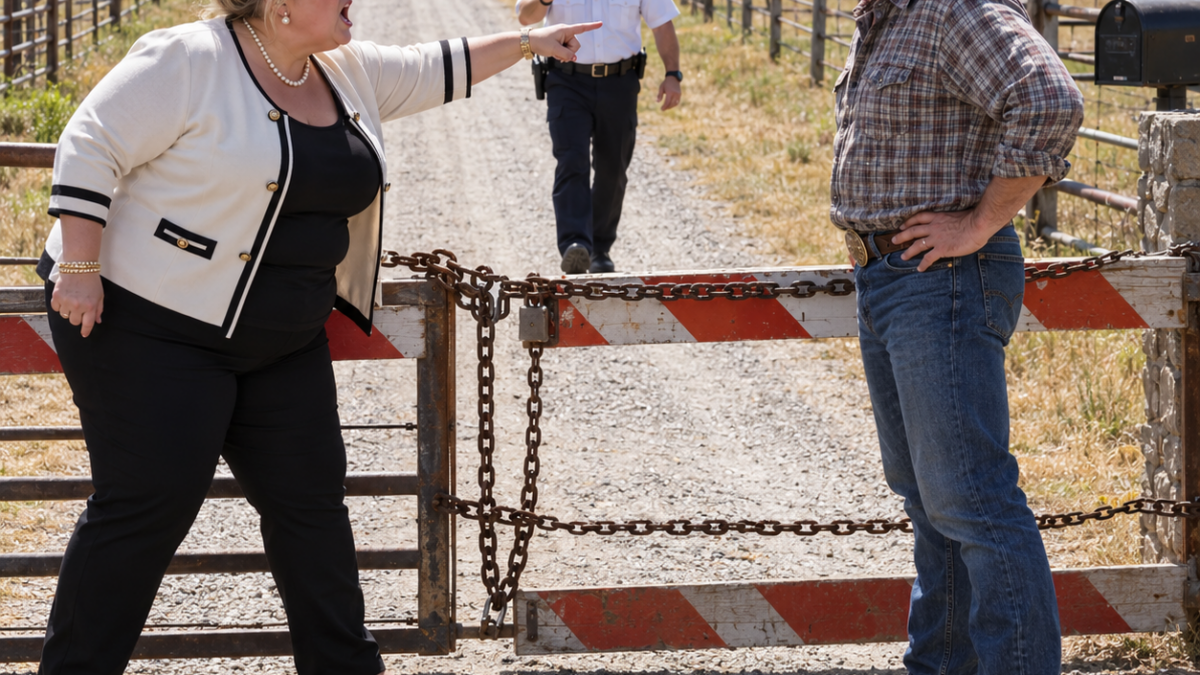
And beside the office stood Victoria Sterling.
White blouse.
Tailored khaki jacket.
Designer boots already dusty.
Thick leather folder tucked beneath her arm.
She looked annoyed.
Then the first federal doors opened.
Everything changed.
Agents deployed.
“Federal law enforcement!”
“Hands where we can see them!”
“Do not reach!”
“Step away from your weapons!”
The private security guards froze.
One guard looked toward the security chief.
The chief looked toward Victoria.
Victoria looked toward the convoy.
Then she saw me.
Confusion first.
She had seen me only twice in person during fourteen months of conflict.
Once when she attempted to negotiate a purchase.
Once when she appeared unexpectedly at the edge of the ranch during a survey dispute.
Both times I wore jeans.
Work boots.
No badge.
No vest.
No government vehicle.
She believed I was exactly what she wanted me to be.
A rural landowner with enough money to be inconvenient but not enough influence to be dangerous.
Now I stepped out wearing a U.S. Marshals Service tactical vest.
Her face changed.
Not fear.
Not yet.
Disbelief.
I did not look at her.
I went to Ray.
Federal agents secured the private guards.
“Hands up!”
“Weapons down!”
The security chief shouted:
“Everybody comply!”
That was the smartest thing he did all morning.
Holstered weapons were removed.
Men were separated.
Nobody fired.
Nobody needed to.
I reached Ray.
“You hurt?”
“Pride.”
“Hands?”
“Tight.”
I cut the plastic restraint.
He rubbed his wrists.
“About time.”
“You told Victoria her paper was toilet paper?”
“I said decorative stationery.”
“Very professional.”
“Thank you.”
I moved to Luis.
He was twenty-six.
Two daughters.
Worked irrigation and heavy equipment.
His face was pale.
“You okay?”
“They took my phone.”
“We’ll get it.”
“They said we were under arrest.”
“You weren’t.”
He looked at the federal vehicles.
“Are they under arrest?”
“Some of them probably are.”
He nodded.
That seemed to help.
A medic began checking wrists.
Ray walked beside me.
“You didn’t tell me the cavalry was coming today.”
“Operational information.”
“You are deeply annoying.”
“So I’ve been told.”
Then he pointed.
“She’s moving.”
Victoria was not trying to run.
That would have been smarter.
Instead she was walking toward my office.
Fast.
One hand remained on the leather folder.
The other reached for the door.
Lena saw it.
“Watch Sterling.”
Two agents moved.
But the ranch office was only a few steps away.
Victoria got inside first.
Lena looked at me.
“What is she doing?”
“Looking for something.”
“What?”
“Evidence.”
We did not immediately charge inside.
The office had cameras.
Three.
One above the file cabinets.
One in the corner.
One facing the door.
Victoria did not know.
Months earlier, after survey stakes began moving at night, we had upgraded ranch security.
Every common area.
Every entrance.
Every office surface.
Nothing hidden in private spaces.
Plenty of angles in work areas.
On the live feed, Victoria opened one drawer.
Then another.
Papers hit the floor.
She moved to Ray’s filing cabinet.
Locked.
She yanked.
Nothing.
Then she saw the red folder on the desk.
Her name was printed across the tab.
VICTORIA STERLING / SILVER RIDGE.
She froze.
Ray looked at me.
“You left that there?”
“I didn’t.”
Lena answered.
“We did.”
I looked at her.
She gave me nothing.
The folder was controlled evidentiary bait.
Not fabricated evidence.
Copies.
Material the federal team already possessed independently.
Placed in an office Victoria had no legal right to enter.
Nobody forced her inside.
Nobody told her to search.
Nobody told her to take anything.
Victoria picked up the folder.
Did not open it.
Shoved it into her designer bag.
Then walked out.
Ray whispered:
“Oh, that’s beautiful.”
“Don’t.”
“It is.”
Federal agents intercepted her.
“Ms. Sterling, stop.”
She stopped.
“What is the meaning of this?”
Lena approached.
“Keep your hands visible.”
“You have no authority here.”
Ray made a noise.
I turned.
“Not one word.”
He mimed zipping his mouth.
Victoria pointed toward the ranch entrance.
“This property is under emergency association control pursuant to a duly executed protective order.”
Lena said:
“Who issued it?”
“The association.”
“A homeowners association?”
“We have statutory emergency rights.”
“What statute?”
Victoria’s face tightened.
“Our counsel can explain.”
“Your counsel is currently speaking with agents at the Silver Ridge administration building.”
That got through.
Victoria blinked.
“What?”
Lena continued.
“A federal search warrant is being executed there.”
Victoria went pale.
“This is outrageous.”
“Your residence is also being searched pursuant to warrant.”
She stepped backward.
“No.”
“Do not move.”
“You cannot search my home.”
“A federal judge disagreed.”
Victoria finally looked at me.
“You.”
I did not answer.
“You did this.”
“No.”
“You’ve been pretending.”
“Pretending what?”
“To be some farmer.”
“I own a ranch.”
“You never told me—”
“You never asked.”
“That is entrapment.”
I almost laughed.
Being unaware of someone’s job is not entrapment.
Lena spoke.
“Ms. Sterling, are you carrying any weapons?”
“No.”
“Do you have any items taken from the ranch office?”
Victoria’s eyes moved toward her bag.
“No.”
Ray looked at me.
I looked at him.
He stayed silent.
Lena nodded to a female agent.
“Secure the bag.”
Victoria clutched it.
“You cannot take my personal property.”
“You are currently being detained during execution of federal warrants.”
“This is theft!”
The irony almost hurt.
The agent took the bag.
Placed it on the hood of a federal SUV.
Opened it.
Wallet.
Phone.
Keys.
Leather folder.
Then the red file.
Lena held it up.
“What is this?”
Victoria recovered instantly.
“Association records.”
Ray coughed.
I stared at him.
He looked innocent.
Lena asked:
“You brought this with you?”
“Yes.”
“From your association office?”
“Yes.”
“It belongs to you?”
“To the association.”
“And these are official records?”
“Yes.”
Lena looked at me.
Then at Victoria.
“You’re certain?”
“Of course.”
That statement was being recorded on multiple body cameras.
Lena opened the folder.
Victoria’s confidence lasted about three seconds.
First page:
An internal email between Victoria and the vice president of acquisitions for Stonebridge Development Group.
SUBJECT: ACCESS CORRIDOR.
The message described incentive payments contingent upon acquisition of my ranch road.
Second:
An altered ledger tracing association money into two consulting companies tied to Victoria.
Third:
Draft property documents.
Not final.
Draft.
With comments.
CHANGE NOTARY DATE.
USE SEAL FROM PRIOR FILING.
REMOVE REFERENCE TO CONSENT.
Fourth:
A scanned image of a forged notary stamp.
Fifth:
Victoria’s own handwritten annotation on a printed draft.
MAKE THIS LOOK COUNTY-ISSUED.
The federal investigation had obtained copies from the association’s internal counsel months earlier.
Now Victoria had voluntarily taken those copies from a private office and falsely claimed they were her official records.
The source story likewise describes the red folder containing kickback emails, altered ledgers, and draft forged notary paperwork with handwritten alteration instructions—material Victoria then effectively authenticated by stealing and claiming as her own.
Victoria stopped breathing normally.
“That isn’t mine.”
Lena said:
“You just said it was.”
“I meant the folder.”
“You said the records were official association records.”
“I didn’t look.”
“You said you brought them.”
“I—”
She looked toward the office.
Then saw the camera above the door.
Everything collapsed in her face.
Lena followed her eyes.
“Yes.”
Victoria swallowed.
“You recorded me?”
“This is private property.”
“You set me up.”
“No one instructed you to enter that office.”
“That folder was planted.”
“A folder was placed on a desk.”
“You knew I would take it.”
“I didn’t.”
I believed that.
Lena was too careful to guarantee another person’s stupidity.
She had simply given Victoria an opportunity to make a choice.
Victoria had.
The security chief watched from twenty feet away.
His name was Mason Pike.
Former police officer.
Left municipal service under circumstances I later learned involved repeated disciplinary complaints.
He now ran Sentinel Protective Services.
Silver Ridge paid him almost four hundred thousand dollars per year.
Mason raised his voice.
“Agent!”
Lena ignored him.
“Agent!”
One marshal approached.
“What?”
“I need to cooperate.”
Victoria spun.
“Mason, shut your mouth.”
He looked at her.
“You said it was a court order.”
“It is.”
“There is no court number.”
“You knew that.”
“No, I didn’t.”
“You were paid to enforce association directives.”
“You told us a judge had signed off.”
“I never said judge.”
Mason looked at his own men.
Then back at her.
“You said legal order.”
“It is legal.”
Lena said:
“Mr. Pike, stop discussing facts publicly. You’ll have an opportunity to speak with counsel.”
“I don’t need a lawyer.”
Every experienced law-enforcement officer within earshot silently disagreed.
Victoria said:
“Don’t say anything.”
Mason laughed.
“You’re not my president anymore.”
The loyalty purchased with association money evaporated in seconds.
Lena stepped closer to Victoria.
“Victoria Sterling, turn around and place your hands behind your back.”
Victoria stared at her.
“No.”
“Turn around.”
“What are the charges?”
“You will receive them.”
“I demand to call my attorney.”
“You will have that opportunity.”
“This is private association property!”
“No.”
That came from me.
Everyone looked at me.
I pointed toward the ground beneath her boots.
“This is my ranch.”
For fourteen months she had blurred that distinction whenever convenient.
Her association ended at the surveyed boundary.
My ranch began.
No covenant crossed that line.
No board vote crossed it.
No invented emergency order crossed it.
Victoria looked toward me.
“You could have sold.”
There it was.
Not innocence.
Not confusion.
Resentment.
“You could have taken the offer.”
“I said no.”
“You destroyed a billion-dollar project over one dirt road.”
“No.”
I stepped closer, but stopped outside Lena’s working space.
“You built a billion-dollar project around land you didn’t own.”
Victoria’s mouth opened.
Nothing came.
Handcuffs closed around her wrists.
Quiet metallic clicks.
She looked suddenly smaller.
Not physically.
Authority changes perception.
When people obeyed Victoria, she appeared enormous.
When nobody did, she was simply one defendant standing in ranch dust.
Federal agents loaded her into a vehicle.
Mason Pike followed in another.
Several members of the security team were detained.
Others were interviewed and released pending further investigation.
Their weapons were seized as evidence where appropriate.
My workers were freed.
Phones collected from the canvas bag.
Photographed.
Returned after documentation.
Luis sat on the tailgate of a ranch truck while a medic cleaned his wrists.
I joined him.
“You want the day off?”
He looked offended.
“They broke the gate.”
“Yes.”
“Somebody’s gotta fix it.”
“You were zip-tied twenty minutes ago.”
“Still know how to weld.”
I smiled.
“Go home.”
“My wife’ll ask why.”
“You think she won’t notice your wrists?”
He considered.
“Fair.”
I put a hand on his shoulder.
“You did exactly right.”
“I didn’t do anything.”
“Exactly.”
No heroics.
No resistance.
No escalation.
That was why everyone went home.
Ray came over carrying the fake emergency order.
“Souvenir?”
“Evidence.”
“I made a copy.”
“Of course you did.”
He handed it to me.
SILVER RIDGE ESTATES
EMERGENCY COMMUNITY PROTECTION ORDER.
There was a circular seal.
Not county.
Not court.
A compromised notary stamp.
The document accused us of:
Excessive dust.
Environmental harm.
Boundary encroachment.
Interference with community emergency access.
That last one was remarkable considering Victoria had personally ordered construction of the brick blockade obstructing the emergency lane.
“Frame it,” Ray said.
“No.”
“Why not?”
“Because somebody will think we believed it.”
“Put TOILET PAPER under it.”
I laughed for the first time that morning.
Then Lena approached.
“We’re moving to the association office.”
“I stay?”
“Yes.”
“Why?”
“Because you have workers who need statements, a damaged gate, and property to secure.”
She was right.
Again.
I hated competent people.
“What about the main warrants?”
“Proceeding.”
“Residence?”
“Proceeding.”
“Stonebridge?”
She paused.
“Proceeding.”
That surprised me.
The developer had become a full target.
I knew federal investigators were examining money.
I did not know how far the warrants extended.
Lena saw the question.
“You are still recused.”
“I didn’t ask.”
“Your face did.”
She left.
I turned toward Ray.
“What?”
“You have a very expressive federal face.”
“Go fix something.”
“With pleasure.”
The next several hours changed everything.
At the Silver Ridge administration building, federal agents seized servers, finance records, phones, and physical files.
Inside Victoria’s private office they found a wall safe.
Inside:
Notary stamps.
Multiple.
Some legitimate-looking.
Some altered.
Blank association letterhead.
Property records for parcels Silver Ridge did not own.
Cash envelopes.
Two ledgers.
One official.
One not.
Deleted files recovered from a workstation documented negotiations with Stonebridge Development.
The arrangement was not subtle once investigators had everything.
Stonebridge needed my road.
Victoria promised influence.
She would pressure me into sale.
In return, payments would flow through “community consulting” contracts once expansion approvals were secured.
The association itself had also been victimized.
Resident dues funded lawyers.
Security.
Survey activity.
Political influence.
Land-acquisition harassment.
Silver Ridge homeowners believed they were paying for neighborhood operations.
Part of that money was financing Victoria’s private deal.
The internal counsel who exposed it all was named Daniel Reese.
I met him months later.
At the time, I only knew there was an insider.
Daniel had spent seven years representing the association.
Mostly boring work.
Contracts.
Insurance.
Covenant questions.
Collections.
Then Victoria began asking for things no lawyer should be asked to sanitize.
“How do we characterize emergency authority?”
“Can association documents supersede a recorded county easement?”
“How much exposure exists if boundary markers are relocated before survey resolution?”
“Can residents’ dues fund strategic land acquisition?”
At first Daniel believed Victoria was simply aggressive.
Then he saw invoices.
Shell companies.
Forged minutes.
Altered notary seals.
He understood one fact lawyers understand faster than almost anyone.
The paper trail was becoming dangerous to anyone near it.
He began making lawful copies of materials he was entitled to access.
Then he reported to federal investigators.
That decision probably saved several people from being wrongly implicated.
Including himself.
Stonebridge’s offices were raided simultaneously.
Its chief acquisition officer, Peter Lang, lasted thirty-six hours before requesting a cooperation meeting.
That’s what money schemes often look like once secrecy disappears.
Loyalty becomes negotiable.
Peter had emails.
Draft agreements.
Payment schedules.
Internal projections.
One spreadsheet listed my ranch corridor as:
ACQUISITION — HIGH RESISTANCE / PRESIDENT S. ASSIGNED.
Another:
INCENTIVE PACKAGE ON CLOSURE.
Another:
CONTINGENCY IF OWNER REFUSES — REGULATORY PRESSURE.
That phrase mattered.
Regulatory pressure.
Except Victoria had no regulatory authority.
So she manufactured it.
County complaints.
Association fines.
Fake orders.
Moved boundary stakes.
Private-security intimidation.
Brick blockade.
Then the ranch raid.
The case widened from fraud into conspiracy.
The next morning county officials arrived at my property.
Not federal.
Local code enforcement.
Fire division.
Public works.
The brick blockade Victoria ordered across the emergency lane had been irritating for months.
We had filed complaints.
Silver Ridge argued it sat within disputed common property.
Survey evidence said otherwise.
Now the federal evidence removed ambiguity.
The county fire marshal stood in front of the brick wall with hands on hips.
Chief Samuel Ortega.
No relation to Luis.
Sixty-one.
Gray mustache.
Thirty-four years in fire service.
He stared at the obstruction.
“Who built this?”
“Silver Ridge contractor.”
“Permit?”
“No.”
“Engineering?”
“Unknown.”
“Emergency-lane approval?”
“No.”
He looked at me.
“You’re telling me this has been here four months?”
“We reported it.”
His expression tightened.
“I know.”
That was interesting.
“You know?”
“I received the complaints.”
“And?”
“Somebody above my office kept kicking jurisdiction questions back.”
Political pressure.
Exactly what Daniel had suspected.
The fire marshal ran one hand across the brick.
Then looked down the emergency road toward the rear entrance of Silver Ridge.
“This lane is on the county emergency-access map.”
“Yes.”
“And they deliberately obstructed it.”
“Yes.”
“For leverage?”
“Looks that way.”
He removed a red notice pad.
“Well.”
He smiled without humor.
“Then we can stop debating.”
By noon, the blockade carried a bright red violation order.
UNLAWFUL OBSTRUCTION — EMERGENCY ACCESS.
Removal required.
Daily penalties began.
Inspection costs billed.
Engineering review ordered.
Silver Ridge’s new temporary management counsel did not fight it.
The wall came down.
The cost was eventually charged as part of the civil recovery against Victoria and associated actors.
That was the fire marshal’s first involvement.
Not because he lived at the other end of the road.
Because Victoria had illegally obstructed an actual emergency lane.
Truth was better than the rumor version.
Later, the same fire marshal became part of the most absurd subplot of Victoria’s downfall.
After her federal arrest, she was released pending trial under severe restrictions.
Electronic monitoring.
Travel limits.
Financial disclosures.
No contact with certain witnesses.
No association authority.
She returned to her mansion.
For three days.
Then Fire Marshal Ortega received another tip.
Unpermitted renovations.
Electrical bypasses.
Converted wine cellar.
Modified egress.
The source account similarly describes local officials later red-tagging Victoria’s illegal emergency-lane blockade and the fire marshal finding code violations in her mansion serious enough to make it temporarily uninhabitable.
His team inspected.
The mansion was a code disaster.
Altered circuits behind finished walls.
Unpermitted structural changes.
Blocked secondary egress.
Improper electrical work in a theater room.
A gas appliance installed without approved venting.
Ortega did not care that she had once been president.
He cared whether people could safely sleep inside.
Answer:
Not until repairs.
Victoria spent the first months of her federal case in a standard business hotel.
Ray found this hilarious.
“Which hotel?”
“Don’t.”
“I want to send her a brick.”
“No.”
“Decorative.”
“Ray.”
“Approved community color.”
“You need hobbies.”
“I have this.”
Silver Ridge itself entered chaos.
Residents had no idea their association had been financing Victoria’s war against the ranch.
Some defended her initially.
They called the federal case political.
Overreach.
Misunderstanding.
One homeowner came to my gate three days after the arrest.
Richard Voss.
Retired surgeon.
Beautiful car.
Expensive loafers.
He stood beside the new temporary gate.
“You destroyed our community.”
I looked at him.
“No.”
“Federal agents tore apart the office.”
“They had warrants.”
“Because of you.”
“Because of evidence.”
“You could have sold the road.”
That again.
“Why is my refusal the problem instead of Victoria committing fraud?”
His mouth tightened.
“People invested in that expansion.”
“Then they invested before securing required access.”
“You knew what was at stake.”
“Yes.”
“And you still refused.”
“Yes.”
“Why?”
I looked past him toward the pasture.
Because my father built that road.
Because my mother taught me to drive on it.
Because my wife and I buried a dog beneath cottonwoods near the south fence.
Because I knew exactly what four lanes of construction traffic would do to the ranch.
Because land is not merely its resale price.
I gave him the shorter answer.
“Because it wasn’t for sale.”
Richard shook his head.
“Everything has a price.”
“No.”
He stared.
That was the same mistake Victoria made.
He left.
Two weeks later, Richard came back.
Different car?
No.
Different posture.
He carried papers.
“What are these?”
“HOA statements.”
I opened the folder.
Special assessments.
Security charges.
Legal expenses.
Consulting fees.
“Victoria told us this was all necessary because you were threatening neighborhood safety.”
“I know.”
“She said the brick wall was required by fire code.”
I almost laughed.
“It violated fire code.”
“I know that now.”
He looked embarrassed.
“My wife thinks I owe you an apology.”
“Do you?”
He considered.
“Yes.”
That mattered more.
“Then accepted.”
He looked toward the ranch.
“I still wish you’d sell the road.”
I smiled.
“That apology was almost good.”
He laughed.
That was the first crack between the ranch and Silver Ridge.
Not friendship.
Reality.
Other residents followed.
A woman named Marjorie Bell brought association newsletters.
They portrayed us as environmental violators.
Noise polluters.
Threats to community infrastructure.
One newsletter said my cattle had “compromised watershed quality.”
County testing had repeatedly found nothing.
Marjorie looked furious.
“We believed this.”
“You were given official-looking information.”
“We should have asked.”
“Yes.”
Not comforting.
True.
People need to be told when they surrendered judgment.
Not abused for it.
Just reminded.
Silver Ridge called an emergency membership meeting.
Temporary outside counsel attended.
So did a court-appointed financial monitor.
The entire board resigned.
Some had genuinely known nothing.
Some had known enough to be ashamed.
One board member, Diane Porter, cried through her statement.
“I trusted Victoria because she did the work nobody else wanted to do.”
That sentence explained half of community corruption.
People surrender responsibility to the person willing to carry it.
Then stop checking what they’re carrying.
An interim board was elected.
Financial audit ordered.
Contracts frozen.
Private security terminated.
Mason Pike’s company lost the Silver Ridge agreement immediately.
Residents demanded access to records.
The same people who once ignored budgets now read every line.
Good.
Fear and apathy had been Victoria’s two strongest allies.
Both were gone.
At the ranch, we repaired the gate.
Luis welded one hinge.
Ray criticized his work.
Luis told him to do it himself.
Ray said management meant delegation.
Normal arguments.
Beautiful normal arguments.
Ben’s wrists healed.
But he began having trouble sleeping.
He was fifty-two.
Had worked ranch jobs since he was sixteen.
Tougher than most people I knew.
One afternoon, I found him sitting in the equipment shed.
“You okay?”
“Yep.”
“That answer is bad.”
He looked at his hands.
“Keep hearing the zip ties.”
I sat beside him.
No speeches.
He continued.
“They pushed me against the fence.”
“I know.”
“I’ve never been arrested.”
“You weren’t.”
“Body doesn’t know that.”
That sentence stayed with me.
We covered counseling for every worker.
No questions.
No payroll deduction.
No paperwork burden beyond what insurers required.
Ben resisted.
Ray forced him.
“Go talk to somebody.”
“I don’t need—”
“You’re waking your wife at night.”
Ben glared.
“How do you know?”
“She called mine.”
“You two gossip?”
“Professionally.”
Ben eventually went.
Luis too.
A younger worker named Mateo resigned.
He could not come through the gate without shaking.
That angered me in a different way.
Federal indictments are measurable.
Trauma isn’t.
Victoria’s paperwork had always reduced people to obstacles.
Worker.
Owner.
Resident.
Vendor.
Security.
She never calculated what fear cost after the invoice closed.
Federal prosecutors did what prosecutors do.
They built.
Grand jury.
Superseding indictment.
Fifty counts eventually.
Wire fraud.
Mail fraud.
Conspiracy.
Extortion-related charges.
Forged documents.
Financial offenses.
The exact statutory language mattered in court.
To everyone else, the story was simple.
Victoria had turned a homeowners association into a private power structure.
Then used it to enrich herself and pressure people who stood in her way.
Mason Pike cooperated.
His testimony was ugly.
Victoria ordered surveillance on the ranch.
Night photography.
Vehicle tracking from public roads.
Repeated “presence patrols” designed to intimidate.
She told him county officials had approved escalation.
They had not.
She told him the emergency order had legal backing.
It did not.
She told him I was close to selling.
I was not.
Most damning:
She instructed his team to create physical control of the ranch road long enough for Stonebridge survey crews to establish “operational possession.”
That phrase came from a developer memo.
Operational possession.
There is no magic moment where trespass becomes ownership because somebody parks enough SUVs.
But Stonebridge executives believed forcing a dispute into court might change leverage.
If my road became tied up in emergency litigation, maybe financing pressure would push me to settle.
That was their theory.
Their problem was the illegal part.
And the evidence.
Stonebridge executive Peter Lang testified.
He described consulting promises to Victoria.
Projected payments.
Private agreements.
Pressure deadlines.
He said Victoria became increasingly erratic as the expansion schedule slipped.
“She said the owner would break.”
The prosecutor asked:
“Did he?”
Peter looked toward me.
“No.”
“Why not?”
“I don’t know.”
I knew.
I had spent my career seeing powerful people bluff.
The first rule of bluffing is don’t reward it.
When the first fake fine arrived, I could have called Victoria.
Threatened.
Shown my badge.
Ended some of it quickly.
Maybe.
Instead, I documented.
Because something about her behavior felt larger than an HOA dispute.
I did not know about the federal financial case then.
I only knew escalation produces evidence.
Victoria produced a mountain.
The defense tried attacking me.
Predictable.
Supervisory deputy marshal.
Property owner.
Federal arrest.
Conflict.
They argued I had engineered a personal prosecution.
The independent structure defeated that.
I had recused.
I had no authority over Lena’s team.
No warrant applications from me.
No charging decisions.
No grand-jury role.
No evidence planting under my control.
Body cameras documented the ranch raid.
Office cameras documented Victoria’s burglary.
Her own statements authenticated the red folder.
The defense called the folder a trap.
The prosecutor answered:
“A trap requires inducement. No federal agent instructed Ms. Sterling to trespass into a private office, search its files, steal a folder, conceal it in her bag, or falsely claim the contents belonged to her.”
That was hard to rebut.
Victoria took the stand against advice.
I was stunned.
Lena whispered:
“Bad idea.”
She was right.
Victoria was intelligent.
But intelligence is not the same as self-awareness.
She still believed she could explain her way back into control.
Her attorney asked about Silver Ridge.
She described years of service.
Property values.
Volunteer labor.
Safety.
Then my ranch.
“Mr. Mercer was obstructionist.”
There.
She said my name.
Thomas Mercer.
First time in court.
“He refused reasonable negotiation.”
Her attorney asked:
“Did you believe the association had emergency rights regarding the access road?”
“Yes.”
“Why?”
“Our residents’ safety.”
“And the document?”
“I relied on legal advice.”
The prosecutor stood on cross.
“Which lawyer told you your Emergency Community Protection Order authorized detention?”
Victoria hesitated.
“I don’t recall.”
“Was it Daniel Reese?”
“No.”
“Did Mr. Reese ever approve the document?”
“I don’t know.”
The prosecutor displayed an email.
Daniel:
I DO NOT APPROVE THIS DOCUMENT. THE ASSOCIATION HAS NO AUTHORITY TO DETAIN PERSONS OR SEIZE ADJACENT LAND.
Victoria had replied:
NOTED.
The courtroom went silent.
“Did you receive this?”
“I receive hundreds of emails.”
“Your reply says ‘Noted.’”
“I may not have read closely.”
“Yet you relied on legal advice?”
“Other advice.”
“From whom?”
No answer.
Then the notary seals.
“Did you instruct an assistant to modify expiration dates?”
“No.”
Draft displayed.
Handwriting expert.
Email.
Her note.
CHANGE DATE.
USE PRIOR SEAL.
Victoria claimed it referred to formatting.
Then the red folder.
“Did you enter Mr. Mercer’s ranch office?”
“I believed I had authority.”
“Did you break the lock?”
“I didn’t personally.”
“Did security under your command break it?”
Silence.
“Yes.”
“Did you search the office?”
“I inspected records.”
“Did you put the red folder in your bag?”
“I believed it belonged to the association.”
“Without opening it?”
“I recognized it.”
“From what?”
Silence.
“Did you tell agents you had brought those records to the property?”
“I was confused.”
“Did you tell agents they were official association records?”
“Under stress.”
“Were you under stress before or after you learned the folder contained your kickback emails?”
Objection.
Sustained.
But the jury had heard enough.
Victoria did not explode.
She unraveled quietly.
Answers shortened.
Confidence faded.
By the end, she looked toward her attorney more than the prosecutor.
The jury convicted on most major counts.
Sentencing came months later.
Restitution.
Asset forfeiture.
Prison.
Civil exposure remained.
Stonebridge paid enormous settlements.
Silver Ridge recovered some losses.
Our ranch received compensation for property damage, business interruption, and civil violations.
My workers had individual claims.
I insisted their settlements not disappear into ranch recovery.
What happened to them happened to them.
Not to my corporate balance sheet.
Luis used part of his settlement to buy a welding rig.
Ben paid off his house.
Mateo moved north and took a county maintenance job.
He never returned to ranch work.
I sent him Christmas cards anyway.
No replies for two years.
Then one arrived.
Photograph of him with his wife and baby.
Back:
Doing better. Tell Ray his gate welds still look terrible.
I framed that.
Ray demanded equal representation.
We placed it beside the time clock.
Silver Ridge changed.
Not perfectly.
Nothing does.
The new board abolished private tactical security.
Ordinary gate attendants remained.
Vendor contracts required disclosure.
Financials online.
Related-party transactions prohibited without full member notice and independent approval.
Emergency access routes mapped and inspected with county officials.
The brick blockade never returned.
Fire Marshal Ortega became unexpectedly popular.
Residents invited him to a safety meeting.
He walked through evacuation routes.
Hydrant access.
Wildfire plans.
Electrical safety.
At the end, someone asked:
“Chief, what is the number one problem you see in HOAs?”
He answered:
“People thinking a gate changes physics.”
Everyone laughed.
Then he added:
“Fire doesn’t care about your covenants.”
That quote ended up in every emergency plan.
The expansion project died.
Without my road, Stonebridge could not satisfy access requirements economically.
They eventually sold the valley parcel.
A conservation-minded ranch family bought much of it.
Some housing was built on another portion using a lawful route farther east.
I had no objection.
Development was never the enemy.
Taking what was not yours was.
Richard Voss became president of Silver Ridge two years later.
The same man who once told me everything had a price.
He visited the ranch.
“Coffee?”
“Depends.”
“On?”
“Are you buying the road?”
He laughed.
“No.”
“Then yes.”
We sat on the porch.
He looked toward the emergency lane.
“You know, residents still blame you sometimes.”
“For what?”
“Lost expansion value.”
“That’s their right.”
“Doesn’t bother you?”
“No.”
“I thought you’d be angry.”
“I’ve been angry.”
“Past tense?”
“Mostly.”
He looked surprised.
“What changed?”
I pointed toward Luis driving a tractor.
“Normal life came back.”
Richard nodded slowly.
“Victoria really hated you.”
“She didn’t know me.”
“She hated that you wouldn’t negotiate.”
“Same thing to her.”
“That’s probably true.”
He drank coffee.
“I used to think you were stubborn.”
“I am.”
“But not about the road.”
“No.”
“You just meant no.”
“Yes.”
He smiled.
“Remarkably complicated word in Silver Ridge.”
“Two letters.”
“Still.”
The ranch itself changed subtly.
We installed a new steel gate.
Not ornamental.
Heavy.
Functional.
Ray designed it.
Which meant overbuilt by at least forty percent.
At the inside post, Luis welded a small plate:
PRIVATE PROPERTY
NO MEANS NO
I saw it.
“Absolutely not.”
Ray crossed his arms.
“Why?”
“Looks childish.”
“Accurate.”
“Remove it.”
He did.
Next morning another plate appeared:
PLEASE OBTAIN ACTUAL COURT ORDER BEFORE RAIDING
I stared at Ray.
He looked innocent.
“It was Luis.”
Luis denied everything.
I left it.
For six months.
Then took it down before some reporter photographed it.
Years passed.
I eventually retired from the Marshals Service.
Actual retirement.
Ray said:
“You’ll last six weeks.”
“I own a ranch.”
“Exactly.”
He was right.
I lasted three days before trying to reorganize equipment storage.
The crew threatened mutiny.
I learned to drink coffee and interfere selectively.
Retirement gave me time to think about the fourteen months before the raid.
People assumed I had known exactly how it would end.
I didn’t.
I knew Victoria was escalating.
I knew her paperwork was fraudulent.
I knew someone inside Silver Ridge had gone to authorities once the federal team briefed me.
I knew warrants were approaching.
I did not know she would choose the exact morning of execution to bring a private army onto my property.
Nobody could have written timing that absurd.
Ray still talked about it.
“Best Wednesday of my life.”
“You were zip-tied.”
“Temporarily.”
“Your phone got thrown in a bag.”
“Got it back.”
“You were threatened.”
“Coffee tasted amazing afterward.”
Trauma does not always look like trauma.
Ray turned fear into jokes.
Ben didn’t.
Mateo left.
Luis worked harder.
I became quieter for a while.
One evening, my daughter Emily visited.
She was thirty-four then.
Teacher.
Two kids.
She walked with me to the rebuilt gate.
“Dad?”
“Yeah?”
“Mom says you aren’t sleeping.”
I looked at her.
“Your mother talks too much.”
“She says the same thing about you.”
“I’m fine.”
“That’s the federal answer.”
“What do you want?”
“The dad answer.”
I looked toward the fence where workers had been restrained.
“I should’ve stopped it earlier.”
She waited.
“I knew Victoria was escalating.”
“You didn’t know she’d do that.”
“I knew enough.”
“To what? Arrest her yourself?”
“No.”
“Threaten her with your badge?”
“No.”
“Sell?”
“No.”
“Then what?”
I had no answer.
Emily put her arm through mine.
“You did what you always told us to do.”
“What?”
“You used the system.”
I looked at her.
“And it worked.”
“Yes.”
“People still got hurt.”
“That doesn’t mean the wrong choice would’ve helped.”
I hated when my children sounded reasonable.
“Whose side are you on?”
She laughed.
“Mom’s.”
“Of course.”
The federal system did work.
Not perfectly.
Not quickly.
But law is not a machine that prevents every wrong act.
It creates a way to prove wrong acts after people commit them.
That distinction matters.
Victoria believed patience was weakness.
In reality, patience gave investigators evidence.
She believed paperwork was power.
In reality, paperwork became a map of her crimes.
She believed hired security created legitimacy.
In reality, those men became witnesses.
She believed the red folder would save her.
Instead, it helped bury her case.
And the fire code she ignored?
That became the final humiliation.
Years later, Fire Marshal Ortega retired.
Silver Ridge held a community dinner for him.
Richard invited me.
I went reluctantly.
At the microphone, Ortega said:
“I inspected one wall and one mansion and somehow became part of HOA folklore.”
People laughed.
Then he looked at me.
“Tom, stand up.”
“No.”
“Federal people always hate fun.”
“I’m retired.”
“Then stand.”
I did.
Ortega raised his glass.
“To private roads that remain private.”
Applause.
Then:
“And emergency lanes that remain open.”
Louder applause.
Then Ray shouted from our table:
“And hotels with good fire exits!”
The room exploded.
Even I laughed.
Ortega pointed at him.
“You’re why retirement parties require security.”
The interesting thing was who else laughed.
Silver Ridge residents.
People who once saw us as enemies.
Time had changed the story.
Victoria’s name slowly became less important.
Good.
Communities should not organize identity around the person who hurt them.
They should organize around what they learned.
Silver Ridge learned transparency.
The ranch learned vigilance.
County agencies learned to take “private HOA wall blocking emergency road” complaints more seriously.
Stonebridge’s failure became a planning case study.
Everyone moved forward.
Except Victoria.
Prison time does not stop time.
It simply changes where you spend it.
I received one letter from her.
Six years after the raid.
No return name outside the required institutional markings.
I recognized the handwriting.
I almost threw it away.
Then read it.
Tom Mercer,
I expect you will enjoy receiving this.
Wrong already.
She continued.
She did not apologize immediately.
She explained.
The development pressure.
Board expectations.
Stonebridge.
The belief that expansion would increase property values.
Then:
You became the symbol of everything standing in my way.
That was honest.
She wrote:
I told myself you were unreasonable because accepting that you had the right to refuse would have forced me to admit the entire plan depended on property I did not control.
I read that twice.
There it was.
The entire case.
No meant no.
She simply needed no to mean something else.
She wrote about the ranch raid.
I genuinely believed you would surrender once we physically occupied the road. I believed possession would create leverage. I did not know what you did for a living.
I almost laughed.
Still missing the point.
So I wrote back.
One page.
Victoria,
My profession was never the reason your actions were unlawful.
If I had been only a farmer, you still would not have had the right to trespass, fabricate legal authority, detain workers, forge documents, or steal association money.
You did not lose because you chose the wrong victim.
You lost because you chose the wrong actions.
I hope you understand the difference.
Thomas Mercer
I mailed it.
No second letter came.
That was fine.
A year later, Ray and I sat on the porch before sunrise.
Coffee.
Same place as the source story’s final scene.
The emergency lane stretched clear toward the ridge.
No brick wall.
No black SUVs.
No excavators.
Cattle moved slowly through morning fog.
Ray said:
“You know the funniest part?”
“I’ve heard all your parts.”
“No.”
“What?”
“She thought the folder was hers.”
I smiled.
“She said official association records.”
“On camera.”
“Yes.”
“While standing on your ranch.”
“Yes.”
“After stealing it.”
“Yes.”
He shook his head.
“You couldn’t write that.”
“Apparently someone did.”
He laughed.
Then became quiet.
“Ben retiring next month.”
“I know.”
“Luis wants foreman.”
“I know.”
“Mateo sent another picture.”
“I know.”
“You’re terrible at conversation.”
“I know.”
He looked toward the road.
“Still glad you didn’t sell?”
“Yes.”
“Even after everything?”
“Yes.”
No hesitation.
That surprised him.
“Why?”
I thought about Richard’s old question.
Why keep land when selling would have ended the conflict?
Because peace purchased by surrender is not always peace.
Because property rights mean very little if they exist only until someone richer wants the property.
Because roads have histories.
Because ranches are not interchangeable.
Because workers depend on the land.
Because my family did.
But I gave Ray a simpler answer.
“It was mine.”
He nodded.
“Fair.”
The sun came over the ridge.
Light hit the steel gate.
The small plate Ray and Luis eventually settled on was still there.
No jokes.
No insults.
Just:
PRIVATE PROPERTY.
BOUNDARIES MATTER.
That one I kept.
People ask what happened to Victoria’s mansion.
Eventually repaired.
Sold.
The new owners tore out much of the illegal renovation.
They installed compliant electrical systems.
Reopened proper exits.
Removed a wall near the rear terrace.
Fire Marshal Ortega signed off on the final inspection before retiring.
Silver Ridge’s clubhouse kept a copy of the approval.
Not because anyone worshipped bureaucracy.
Because rules work best when they apply to everyone.
The old board.
The new board.
Rich homeowners.
Ranchers.
Developers.
Federal officers.
Everyone.
That was the entire lesson.
Victoria believed rules were weapons powerful people pointed outward.
My career taught me something else.
A real rule is a boundary powerful people must obey too.
The morning she came to my ranch, Victoria had money.
Private security.
Excavators.
Lawyers.
Developers.
A fake order.
A leather folder.
Nine SUVs.
I had a blocked gate and workers against a fence.
For several minutes, it probably looked as if she had won.
Then legitimate authority arrived.
Not because I was special.
Not because a badge makes its owner more deserving of property rights.
Because evidence existed.
Warrants existed.
Judges had reviewed probable cause.
Investigators had followed procedure.
Her money could buy uniforms.
It could not buy jurisdiction.
Her letterhead could imitate an order.
It could not create one.
Her security guards could restrain wrists.
They could not make the detention lawful.
Her wall could block a road.
It could not erase the fire code.
Her forged stamps could imitate government.
They could not survive verification.
Her title said president.
It never meant sovereign.
I retired believing that morning was one of the strangest operations of my career.
Years later, I understood it differently.
It was not really a story about federal marshals arriving just in time.
That was timing.
Not the lesson.
It was a story about boundaries.
Property boundaries.
Legal boundaries.
Ethical boundaries.
The boundary between private power and public authority.
Victoria crossed every one because people had stopped forcing her to see them.
My ranch became the place where she finally crossed one too many.
She had barricaded my road to prove she controlled it.
Instead, county crews eventually tore her blockade down.
She had detained my workers to demonstrate her authority.
Instead, they became witnesses against her.
She had searched my office to destroy evidence.
Instead, she stole the evidence that helped destroy her defense.
She had built her mansion as proof that rules did not reach her.
Then the fire marshal red-tagged it.
And she had spent fourteen months trying to make me leave my land.
Years later, I was still sitting on the same porch.
Same ranch.
Same road.
Same sunrise.
Ray lifted his coffee.
“To quiet Wednesdays.”
I touched my mug to his.
“Those are underrated.”
The ranch woke behind us.
A truck started.
Cattle shifted near the pasture.
Luis shouted at somebody about a welder.
Ordinary sounds.
The kind of sounds you only appreciate after hearing men scream commands while innocent workers are zip-tied against your fence.
Ray looked down the clear emergency lane.
“You think anyone will ever barricade that thing again?”
“No.”
“How confident?”
I smiled.
“Very.”
“Federal confidence?”
“No.”
“Fire marshal confidence?”
I laughed.
“Better.”
He nodded approvingly.
And as the sun climbed over Silver Ridge, lighting the road Victoria once believed money had given her the right to seize, the truth looked almost embarrassingly simple.
The road had always belonged to the ranch.
The emergency lane had always needed to remain open.
My workers had never been hers to detain.
And no matter how many papers she printed, guards she hired, or walls she built, she had never possessed the authority she pretended to have.
By sunset after the federal raid, Victoria Sterling controlled almost nothing she once considered hers.
Not the association.
Not the developer deal.
Not the ranch road.
Not her security force.
Not even her mansion for long.
The only property still carrying her name was sealed inside an evidence bag.








