PART 2: HOA Ignored a Level-5 Fire Ban Beside My Wheat Field — Then the Wind Shifted Against Them
PART 2
Monica’s voice came through my phone with the flat confidence of someone reading from prepared language.
“Mr. Morris, Cedar Ridge acknowledges your concerns. The association is conducting authorized vegetation management on HOA-maintained land for community fire prevention. Any alleged damages should be submitted through the proper claims process.”
I stopped the recording.
Played it again.
Then wrote the time beside her name.
7:16 p.m.
Admission of burn activity.
Not necessarily an admission of an illegal burn.
Not yet.
But close enough to matter.
Lily stood across the kitchen table watching me.
“You look happy.”
“I’m not.”
“You look like you just found something.”
“I did.”
“What?”
“Paper.”
“That voicemail is not paper.”
“It will be in five minutes.”
I forwarded the audio to myself, backed it up, typed a transcript, printed two copies, and slid one into the folder.
Lily shook her head.
“You firefighters are weird.”
“Retired firefighter.”
“Still weird.”
I looked at her.
She was seventeen and had inherited her mother’s ability to expose nonsense with very little effort.
Her mother and I had been divorced for eleven years.
No great scandal.
No betrayal.
Just two people who eventually admitted that my career had taken more out of our marriage than either of us knew how to replace.
Lily lived with me most of the time now because her mother worked out of state.
The farm had become the one project Lily and I built together.
Not legally.
The deed was mine.
Emotionally, though, every irrigation trench and every painted barn board had her fingerprints on it.
That was why the wheat mattered.
Ten months earlier, she had helped me seed the first section.
She had complained the entire morning.
“My back hurts.”
“You’re seventeen.”
“I’m fragile.”
“You carried three shopping bags through the mall last weekend.”
“Different muscles.”
Then, when the first green appeared, she photographed it.
When it reached her knees, she took another picture.
When the heads began to fill, she told me:
“It actually looks like something now.”
“That’s usually how crops work.”
She threw a work glove at me.
Now those same stalks stood dry enough to catch from a drifting ember.
I closed the folder.
“Go to bed.”
“Are you?”
“Eventually.”
She looked toward the old turnout gear near the door.
“You’re expecting them to try again.”
“I’m expecting Savannah to believe she was right the first time.”
“That’s the same thing.”
Unfortunately, it was.
Tuesday night passed without another flame.
At least none I saw.
Wednesday morning arrived pale and hot.
Humidity was already below fifteen percent before breakfast.
By ten, it dropped further.
The weather station near the county line issued an extreme fire-weather advisory.
Wind from the south.
Gusts increasing after sunset.
Every warning I had learned to respect in twenty years of wildfire work lined up like a row of red flags.
I drove the perimeter.
My wheat was irrigated but nearly harvest-ready.
Dry heads.
Stems with enough moisture to keep them from being dead fuel, but not enough to save them if sustained flame entered the field.
Along Cedar Ridge’s common strip, fresh gravel had been spread over the scorched patch.
White marker flags appeared every few feet.
RESTORATION ZONE.
I laughed when I read the first one.
Someone had burned illegally.
Then covered the evidence with gravel and renamed it restoration.
That was exactly Savannah.
I photographed everything anyway.
At eleven, my neighbor Pete Hanlon pulled into the driveway.
Pete lived three parcels west.
Retired mechanic.
Quiet man.
He usually spoke only when he had something worth saying.
Which made me listen when he said:
“They’re back.”
“Who?”
“Landscaping crew.”
“Where?”
“Behind the tennis courts.”
My stomach tightened.
“Burn equipment?”
“Saw barrels.”
“Flame?”
“Couldn’t tell.”
“Anyone from the board?”
“Red SUV.”
Savannah.
Of course.
Pete leaned an elbow through his truck window.
“My cousin works county maintenance.”
“Yeah?”
“He checked permits.”
I waited.
“Nothing.”
“No burn permit?”
“Nothing for Cedar Ridge.”
I nodded.
“Thank you.”
“You want me to call somebody?”
“I already have.”
Pete looked toward my field.
“Wind’s ugly.”
“Going to get worse.”
His expression changed.
“You think this could really go?”
I looked at the dry brush along Cedar Ridge’s maintenance slope.
Then the houses beyond it.
Synthetic fencing.
Decorative junipers.
Wood pergolas.
Propane grills.
Mulch beds.
Every modern subdivision has a thousand little things that look harmless until flame arrives.
“Pete.”
“Yeah?”
“If you smell smoke, don’t come over here.”
He frowned.
“Why?”
“Get your wife and dogs and go north.”
“You expecting evacuation?”
“I’m expecting nothing.”
I paused.
“And preparing for everything.”
Pete nodded.
That was enough.
At 4:37 p.m., I saw flame.
Tiny.
Bright orange.
Against sun-baked weeds.
I was standing near the equipment shed when something flickered beyond the eastern fence.
I raised binoculars.
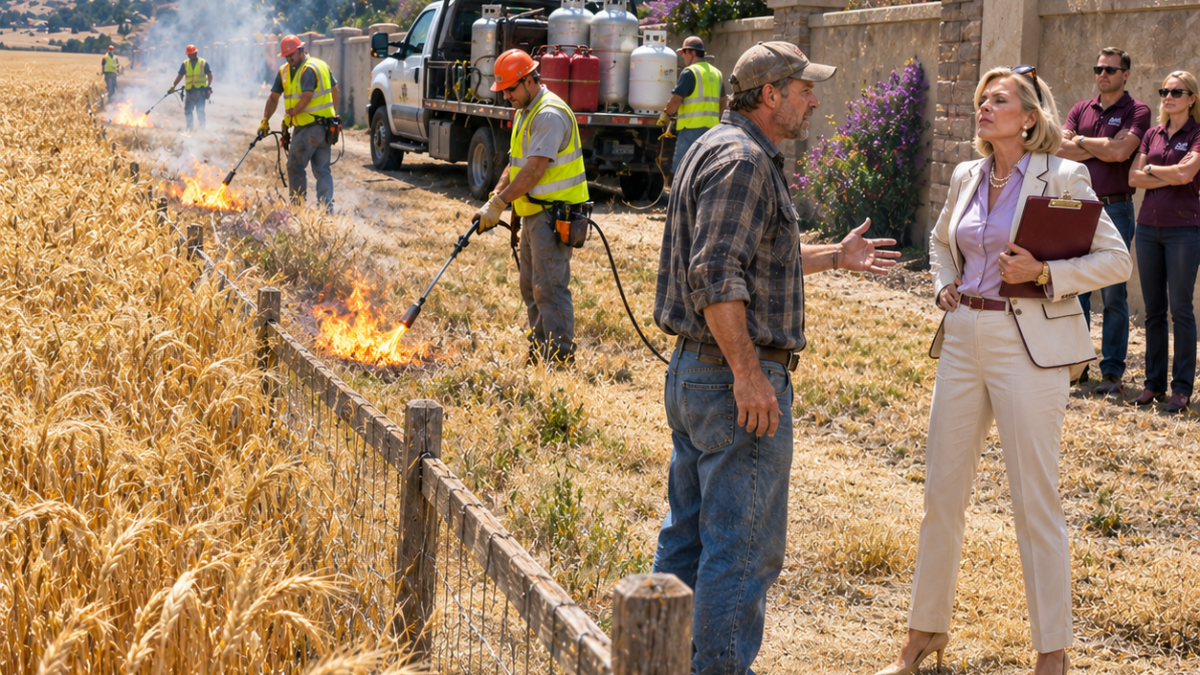
Three contractors.
Same yellow vests.
One held a propane torch angled toward the ground.
My body went cold despite the heat.
I reached for my phone and started recording.
“August seventeenth. Sixteen thirty-seven hours.”
Old habit.
Fire-service language returned whenever adrenaline did.
“Cedar Ridge landscaping contractor actively using open flame under Level Five county restriction approximately twenty feet from private agricultural property.”
The torch flared again.
A line of weeds darkened.
Smoke rose.
One worker looked up.
Saw me.
His head snapped toward the others.
The torch shut off.
They started kicking dirt across the smoldering edge.
Too late.
I had the video.
I sent it directly to the fire marshal.
Then the sheriff.
Then my lawyer, Lacey Turner.
Lacey called within six minutes.
“Tell me you’re not exaggerating.”
“I sent video.”
“I’m watching.”
Silence.
Then:
“Oh, hell.”
“Exactly.”
“Have you called emergency dispatch?”
“They’ve extinguished what I can see.”
“That isn’t what I asked.”
“Yes. I reported it.”
“Good.”
“I’m walking the perimeter.”
“No.”
“Lacey.”
“No. Let county personnel do their jobs.”
“They’re ten miles away.”
“And you’re retired.”
That word still irritated me.
Retired.
As though experience dissolved when a pension started.
“I’m checking my side.”
“Fine. Your side.”
“I know.”
“And Scott?”
“Yeah?”
“Do not cross that fence.”
I looked toward Cedar Ridge.
“Wasn’t planning to.”
“Your voice says otherwise.”
“You don’t know my voice that well.”
“I’ve represented you for six years.”
“Exactly.”
She hung up.
The fire department sent an engine.
By the time it arrived, the visible burn was out.
The crew had disappeared.
Savannah’s SUV was gone.
The captain on scene was a man named Rob Delgado.
He had been a rookie when I was still working.
Now there was gray in his beard.
“Scott.”
“Rob.”
He looked past me.
“You attract trouble after retirement?”
“Apparently.”
I showed him the footage.
His jaw tightened.
“You sent this to Grant?”
“Yes.”
Mark Grant ran the county fire marshal’s investigation unit.
“He’ll love that.”
“Not sure love is the word.”
Rob looked toward the field.
“You ready?”
“For?”
“If this goes bad.”
I gestured toward the pump.
“Holding tank full.”
“Hoses laid.”
“Yes.”
“House defensible?”
“As much as I can make it.”
“Lily?”
“She knows the evacuation route.”
Rob nodded.
Then lowered his voice.
“Wind advisory upgraded.”
“I saw.”
“Thirty-five-mile gusts after midnight.”
“I saw that too.”
He stared at Cedar Ridge.
“Those idiots are going to kill somebody.”
I didn’t answer.
Because saying it aloud would not make it more true.
It would only make it harder to pretend we still had time.
Rob’s crew documented the burn location and left.
At 5:20, I received a Cedar Ridge HOA violation notice.
I stared at the email.
Then opened it.
PROPERTY CODE 4.12.
OVERGROWN AND COMBUSTIBLE VEGETATION.
My wheat field.
My harvest-ready wheat field.
The same HOA conducting illegal burns was now accusing me of creating a fire hazard.
I laughed.
Not because it was funny.
Because sometimes absurdity is the only thing separating anger from rage.
Lily came into the kitchen.
“What?”
I turned the laptop.
She read the notice.
Then looked at me.
“No way.”
“Yes.”
“They’re blaming your wheat?”
“Apparently.”
“After lighting fires beside it?”
“Yes.”
She sat down.
“That’s psychotic.”
“Careful.”
“What?”
“You’re not qualified to diagnose.”
She stared at me.
“Dad.”
“Sorry.”
“Are you answering?”
I typed.
Dear Savannah,
Thank you for documenting your position.
For clarity, my agricultural crop is lawfully maintained private property and is currently under active irrigation.
I have forwarded your notice to the county fire marshal along with today’s video of Cedar Ridge contractors using open flame during a Level Five burn restriction.
Please preserve all board communications, contractor instructions, invoices, permits, safety plans, and correspondence relating to vegetation burning along the eastern boundary.
Scott Morris.
Lily read over my shoulder.
“That’s it?”
“What did you expect?”
“Something meaner.”
“Never insult somebody in writing when you can make them nervous with nouns.”
She laughed.
I sent it.
At dinner, neither of us ate much.
The wind rattled the windows harder as darkness settled.
Around nine, I walked the property again.
The air felt wrong.
People who have never spent time around wildfire imagine danger announces itself dramatically.
Flames.
Sirens.
Smoke columns.
Sometimes it begins as texture.
The way air scrapes your throat.
The way gusts arrive unevenly.
The smell of dry vegetation.
The static tension before a weather shift.
I checked the pump.
Pressure lower than I wanted.
County conservation rules had throttled the shared line.
I switched to holding-tank supply.
Better.
Not enough for a major fire.
Enough to save structures if flame remained manageable.
At 11:52, Lily came outside.
“You sleeping?”
“No.”
“Me neither.”
She looked east.
“Do you smell that?”
Smoke.
Faint.
Mixed with something chemical.
Propane residue.
Hot weeds.
I grabbed binoculars.
Nothing obvious.
Then a tiny orange glow appeared beyond Cedar Ridge’s maintenance wall.
Low.
Moving.
“Inside.”
“Dad—”
“Inside.”
She didn’t argue.
That scared me more than if she had.
I walked to the fence.
The glow disappeared.
Reappeared.
Then another.
Someone was burning.
At midnight.
Under extreme fire conditions.
I recorded from my side.
Shadowed figures.
Low flames.
Generator noise.
An HOA maintenance truck.
I called the county hotline again.
Then emergency dispatch.
“Any active uncontrolled flame?” the dispatcher asked.
“Not yet.”
“Not yet?”
“I’m a retired firefighter. They’re conducting open burning in thirty-mile-an-hour forecast gusts under a Level Five ban.”
A pause.
“Units are being notified.”
“Hurry.”
I hung up.
The wind hit at 3:07 a.m.
I know the time because my weather station alarm sounded.
A hard southern gust slammed the side of the farmhouse.
Thirty-one miles an hour.
Then thirty-eight.
Then forty-two.
I stepped outside.
My wheat bent almost flat.
Dust crossed the yard in sheets.
The sky flashed in the distance with dry lightning.
Then I smelled something stronger.
Smoke.
Not faint.
Active fire.
I saw the glow before I saw the flame.
Low red beyond Cedar Ridge’s maintenance slope.
Then orange rose behind it.
“Lily!”
She was already at the door.
Fully dressed.
Phone in hand.
“You called?”
“911 now.”
“I already did.”
Good girl.
I ran for the truck.
Turnout coat.
Helmet.
Gloves.
Not because I planned to become a firefighter again.
Because instincts are stubborn.
I drove the eastern perimeter.
The first flame crossed into view near the previous scorch site.
Small brush fire.
Fifteen feet wide.
Then a gust hit.
Thirty feet.
A stream of embers lifted into the air.
I started the pump.
Pulled hose.
Opened the nozzle.
Weak stream.
“Come on.”
Pressure climbed.
Not enough.
I soaked the nearest fence line.
Flame reached the dry strip.
The wind drove it sideways.
This was no longer a maintenance burn.
It was a running fire.
I knew within thirty seconds that my wheat was in danger.
Within sixty, I knew I could not stop it alone.
Within ninety, I knew I had to decide what I was willing to lose.
The first ember landed inside my field.
Then another.
A tiny flame caught at the base of a wheat row.
I hit it with water.
Dead.
Another ignited twenty yards away.
Then three more.
Spotting.
The nightmare scenario.
Wind-driven embers skipping ahead of the main flame front.
I ran.
Sprayed.
Ran again.
My boots sank into dry soil.
Smoke thickened.
Lily shouted from the porch.
“Dad!”
“Stay by the truck!”
“The dispatcher says engines are coming!”
“How long?”
“Ten minutes!”
Ten minutes.
In wildfire time, ten minutes can be a county.
Flame spread into the first wheat row.
The sound changed.
A dry roar.
Thousands of stalks catching in sequence.
My crop.
Ten months.
Ten months became fuel in seconds.
I stood with the hose open until heat pushed me back.
“Damn it!”
The wind shoved flame west.
Toward my house.
I moved to structure protection.
Soaked siding.
Porch.
Grass.
Roof edge.
Anything combustible.
My phone vibrated.
Cedar Ridge HOA Office.
I almost ignored it.
Then answered.
“Scott Morris.”
Savannah’s voice came through over shouting.
“Mr. Morris, there’s a fire spreading from your field!”
I stopped moving.
For one second, rage erased everything else.
“My field?”
“Yes! It’s coming toward Cedar Ridge. You need to—”
“You mean the burn your contractors lit.”
“We were conducting approved—”
“There is no approval!”
“We had it contained!”
“Fire does not care what you had!”
She began talking over me.
I cut her off.
“Savannah, get people out.”
“What?”
“Evacuate.”
“The wind is pushing it toward—”
“I know exactly where the wind is pushing it.”
“We need you to stop it!”
I looked at my burning wheat.
Ten months of work collapsing in orange waves.
“You should have thought of that before you lit it.”
I hung up.
Then the wind shifted.
Not dramatically.
Maybe twenty degrees.
Enough.
The flame front that had been moving toward my farmhouse bent northwest.
Toward Cedar Ridge.
I stopped.
Lily came beside me.
“Dad.”
“I see it.”
The subdivision sat slightly downslope.
Decorative wood fencing ran between backyards.
Dry landscaping lined the common strip.
The wind found all of it.
Embers crossed the boundary.
One fence caught.
Then another.
A patio cover ignited.
Someone screamed from the Cedar Ridge side.
I grabbed Lily’s shoulder.
“Truck.”
“I’m not leaving you.”
“Truck. Now.”
“Dad—”
“Lily!”
The tone did it.
She ran.
I backed toward the house.
The field was lost.
No amount of bravery changes fuel physics.
My farmhouse might survive.
The barn might survive.
But staying too long would only create two more people firefighters had to rescue.
I looked once toward the wheat.
Then ran.
The engine started.
Thank God.
Lily climbed in.
I drove north toward the county road.
In the mirror, orange filled half the sky.
Then explosions cracked through the wind.
Pop.
Pop.
A larger boom.
Propane.
I looked toward Cedar Ridge.
One of the maintenance trucks was burning.
Flames climbed from the truck bed where cylinders had been stored.
Another cylinder ruptured.
Fire shot sideways.
Lily grabbed the dashboard.
“Oh my God.”
“Don’t look.”
“You’re looking.”
“I’m driving.”
We reached the old irrigation reservoir on higher ground.
Other residents had begun evacuating toward the same area.
Families.
Dogs.
Children in pajamas.
Cars packed with boxes.
I parked.
The view below us made my stomach turn.
Cedar Ridge burned.
Not all of it.
Not at once.
But enough.
The fire moved yard to yard.
Fence to deck.
Deck to shrub.
Shrub to roof edge.
People ran with hoses that looked ridiculous against wind-driven flame.
Savannah appeared briefly near Sycamore Lane.
Red blazer.
Hair loose.
Waving both arms.
Trying to direct traffic.
Trying to command chaos.
Then smoke swallowed her.
Lily gripped my hand.
“Is she okay?”
“I don’t know.”
“Should we go help?”
Every part of the firefighter I had been screamed yes.
Every part of the father I was said no.
Engines were arriving.
Professionals with equipment.
Command structure.
Protective gear.
My job was to stay out of their way.
“We stay here.”
Lily nodded.
Below, firefighters deployed lines.
Water turned to steam.
One crew defended homes still untouched.
Another attacked the maintenance area.
A third evacuated residents.
The clubhouse roof caught.
Flames ran along the edge.
Then the center collapsed.
Sparks exploded upward.
People around the reservoir gasped.
No cheering.
No satisfaction.
This was not revenge.
Those houses belonged to families.
Children.
People who had never voted for Savannah.
Some probably hated the HOA as much as I did.
I watched a man pull an elderly woman toward a car.
A teenager carried two cats in a laundry basket.
A woman stood in the road clutching a photo album.
Nobody deserved this.
Not even Savannah.
By dawn, the fire slowed.
The wind dropped.
Crews gained ground.
Then, almost insultingly, rain began.
Tiny drops.
Too late.
Lily stood beside me.
Her face was gray with ash.
“Can we go home?”
“I don’t know if we have one.”
She looked at me.
“Dad.”
“I know.”
We waited until officials reopened our access road.
The farmhouse still stood.
So did the barn.
The western edge of the yard was scorched.
The wheat field was gone.
Black.
Smoldering.
The first thing I did was walk into it.
Lily followed.
“Careful.”
I stopped where golden wheat had stood twenty-four hours earlier.
Nothing.
Ash.
Twisted irrigation tube.
Heat rising from soil.
My knees almost gave out.
Lily touched my arm.
“It’s just a crop.”
“No.”
I looked at her.
“It’s not.”
She understood immediately.
This field had been my father’s dream before it was mine.
He had never farmed this exact land.
But every lesson I used here came from him.
Plant straight.
Fix before replacing.
Never trust clouds.
Respect fire.
He died three years before I bought the property.
I had imagined showing him the first harvest.
Now there would be no harvest.
I crouched.
Picked up a charred wheat head.
It collapsed in my fingers.
Lily sat beside me in the ash.
Neither of us spoke.
At eight, county vehicles arrived.
Fire investigators.
Sheriff.
Public works.
Media.
I stood at the fence.
Same place I had warned Savannah.
Only now the land beyond it looked like war.
Logan Pierce drove up in a white pickup.
Logan had spent thirty years investigating fires before retirement.
He was the kind of man who could read a burn pattern the way other people read traffic signs.
He got out.
Looked at my field.
“Jesus.”
“Yeah.”
He walked the boundary.
Crouched.
Touched ash.
Photographed directional patterns.
Then he stood.
“Origin’s over there.”
Cedar Ridge side.
“You sure?”
“Very.”
He pointed.
“See the depth of char?”
I nodded.
“Wind pushed it through this strip. Your side burned fast after ignition, but the longer heat was theirs.”
I exhaled.
“I warned them.”
“I know.”
He handed me a witness form.
“Write everything.”
“I have everything.”
“I assumed.”
We almost smiled.
Then Savannah’s SUV came down the road.
Fast.
She got out before it fully settled.
Soot covered her red blazer.
Her hair was tangled.
Her face looked exhausted.
But the anger was alive.
She pointed at me.
“I hope you’re proud.”
Logan turned.
I didn’t.
“Excuse me?”
“Your field spread the fire into our community.”
I stared at her.
“You lit the fire.”
“We conducted vegetation management.”
“Under a Level Five ban.”
“We had authorization.”
“No, you didn’t.”
“Our contractor—”
“No.”
I stepped closer to the fence but did not cross it.
“I warned you Monday.”
She opened her mouth.
“Tuesday.”
She stopped.
“Wednesday.”
Her expression shifted.
“I sent emails.”
Silence.
“Certified letters.”
Logan watched.
“Video.”
Savannah found her voice.
“If you had maintained a proper firebreak—”
“Scott.”
A new voice.
Mark Grant from the county fire marshal’s office.
He walked toward us.
Tan uniform.
Badge.
No patience.
“Savannah Clark?”
She straightened.
“I’m president of Cedar Ridge.”
“Were you supervising vegetation work along this boundary?”
“We retained professionals.”
“That wasn’t my question.”
She hesitated.
“Our board approved necessary maintenance.”
“Did you obtain a county burn permit?”
“We were told—”
“Yes or no.”
Savannah looked toward her burned subdivision.
Then at me.
“No.”
Mark nodded.
“Thank you.”
She rushed to recover.
“But this man’s wheat—”
“Was an agricultural crop.”
“It was combustible.”
“So was everything here.”
Mark pointed toward Cedar Ridge.
“County investigators are currently documenting suspected ignition points on HOA-maintained property.”
Savannah went pale.
“Our contractor told us the burn was extinguished.”
“That contractor will be interviewed.”
“You can’t blame us for weather.”
Mark’s expression hardened.
“You don’t get to create ignition under a fire ban and then blame wind for being wind.”
Savannah looked at me.
“This is his fault.”
I laughed once.
Sharp.
Exhausted.
“Say it again.”
“What?”
“Say my field started it.”
“It did.”
I raised my phone.
Recording.
“Good.”
Her face changed.
Mark stepped between us.
“That’s enough.”
Savannah turned on him.
“I have residents who lost homes.”
“So do I.”
He pointed toward the burned neighborhood.
“My job is finding out why.”
For once, Savannah had nothing useful to say.
She walked away.
That afternoon, investigators found melted propane hardware.
Burn barrels.
Fuel residue.
One partially intact torch assembly.
They photographed everything.
Then someone found the diesel.
A line of accelerant residue.
Not gasoline poured like an arsonist.
Fuel used to help stubborn vegetation burn faster.
Under a Level Five restriction.
In extreme wind.
The stupidity was almost harder to process than malice would have been.
Mark came to my porch before leaving.
“Preliminary origin is HOA side.”
I nodded.
“You’ll get the written report.”
“Good.”
“Keep everything.”
“I will.”
“Emails.”
“Yes.”
“Voicemails.”
“Yes.”
“Video.”
“Yes.”
“Certified receipts.”
I held up the manila folder.
He smiled.
“You still document like the firehouse.”
“Old habits.”
His expression softened.
“Scott.”
“Yeah?”
“You did what you were supposed to do.”
I looked toward the black field.
“Didn’t save it.”
“That isn’t what I said.”
He left.
By evening, local news vans lined the highway.
I ignored most reporters.
One shouted:
“Mr. Morris, did the HOA burn your crop deliberately?”
“I don’t know.”
“Did you warn them?”
“Yes.”
“How many times?”
“Enough.”
“Do you blame Savannah Clark?”
I looked toward Cedar Ridge.
Families were walking through rubble.
A little girl held a melted bicycle helmet.
“This is not about one person tonight.”
Then I went inside.
Lily followed.
“That was good.”
“I hate cameras.”
“You used to give briefings.”
“I hated those too.”
She put two cups of coffee on the table.
“Do you think Savannah knew?”
“Knew what?”
“That it could burn like this.”
“She knew I said it could.”
“That’s not what I asked.”
I understood.
Did Savannah truly understand fire?
Probably not.
There is a difference between being warned about danger and respecting it.
People who live around fire without fighting it often think flame is a controllable object.
A tool.
A line on the ground.
A number in an insurance plan.
Firefighters learn something else.
Fire is behavior.
Fuel plus heat plus oxygen.
Change one variable and everything changes.
Wind is the cruelest variable of all.
Savannah thought she was managing landscaping.
Fire did not care what she called it.
The preliminary report came the next morning.
Primary ignition:
Open flame use on Cedar Ridge HOA-maintained property.
Contributing factors:
Violation of county burn restriction.
Use of fuel accelerants.
Extreme wind.
Inadequate extinguishment.
Failure to maintain suppression resources.
My wheat:
Secondary fuel exposure.
Not origin.
I read that sentence three times.
Secondary fuel exposure.
Lily stood beside me.
“So they can’t blame you.”
“They’ll try.”
“Why?”
“Because liability is expensive.”
The HOA’s first legal notice arrived that afternoon.
It alleged my field had contributed to the spread because I failed to maintain adequate defensible space.
Lacey called before I could.
“Do not answer.”
“I wasn’t going to.”
“Good.”
“They’re blaming my wheat.”
“I know.”
“It was a crop.”
“I know.”
“It was irrigated.”
“I know.”
“I have moisture records.”
“I know.”
“You sound annoying.”
“I bill by the hour.”
She paused.
“Scott, this is going to get ugly.”
“It already burned.”
“I mean legally.”
“What do you need?”
“Everything.”
I looked at the folder.
“Come over.”
Lacey arrived with two associates.
For six hours, we created a timeline.
The first HOA warning.
Savannah’s maintenance-burn announcement.
County restriction.
Certified letter.
Contractor photographs.
Test scorch area.
Monica voicemail.
Pete’s witness statement.
Torch video.
Midnight burn footage.
Emergency calls.
Savannah’s phone call during the fire.
Fire marshal findings.
Lacey stared at the wall where we had taped copies chronologically.
“This is absurd.”
“What?”
“You warned them more than some agencies warn repeat industrial violators.”
“I was hoping embarrassment would work.”
“It didn’t.”
“No.”
She pointed toward Monica’s voicemail.
“This matters.”
“Because she admitted the burn?”
“Because the HOA is now claiming no open-burning program existed.”
I looked at her.
“They’re saying what?”
“Counsel says any flame use was unauthorized contractor activity.”
I laughed.
“Savannah announced it to my face.”
“Witness?”
“Monica.”
“Board member.”
“Two contractors.”
“Good.”
“Email.”
“Better.”
“The voicemail.”
“Best.”
We both looked at it.
Authorized vegetation management.
Words have consequences.
The county investigation escalated into an arson-task-force case.
Not arson in the cartoon sense of somebody sneaking around with gasoline and matches.
Potential negligent or reckless burning.
Emergency-order violations.
False permit claims.
Property destruction.
The sheriff wanted a full statement.
Detective James O’Donnell interviewed me.
He was stocky, calm, and impossible to impress.
“Mr. Morris, what is your background?”
“Twenty years fire service.”
“Wildland?”
“Structural and wildland.”
“Command?”
“Suppression teams, later captain.”
“So you understood the fire conditions?”
“Yes.”
“Did you exaggerate risk to the HOA?”
“No.”
“How do you know?”
“Because reality exceeded my warnings.”
He looked up.
Fair answer.
I gave him everything.
Then he asked:
“You’re not going to like this.”
“I’ve had a bad week.”
“The HOA says your conflict with them may have influenced your interpretation.”
“How?”
“They allege ongoing hostility.”
“Because they tried to regulate my farm.”
“Anything else?”
“They fined me for soil color once.”
O’Donnell stopped writing.
“Say that again.”
“Non-compliant soil color.”
“You’re serious?”
“I framed it.”
He rubbed his face.
“Okay.”
He asked about the field.
Moisture.
Irrigation.
Harvest schedule.
Firebreak.
Wind.
I explained each.
“Could your wheat burn?”
“Yes.”
He looked surprised.
“Absolutely.”
“You’re not denying that.”
“Why would I?”
“Some people would.”
“It was harvest-ready wheat. Of course it could burn.”
“Then their defensible-space argument?”
“My field did not create ignition.”
“Could it accelerate spread?”
“Yes.”
“Did it?”
“Yes.”
He leaned back.
“Does that concern you?”
“Truth concerns me.”
That seemed to satisfy him.
“Their lawyers may try using that.”
“They should.”
He studied me.
“What?”
“If their entire defense is that they started an illegal fire beside something flammable and the flammable thing burned, I’m comfortable.”
O’Donnell smiled for the first time.
“Fair enough.”
Two days later, Mark Grant’s official press statement went public.
The fire had burned approximately twelve hundred acres, including agricultural land, common space, and residential property.
Several homes destroyed.
Others damaged.
No fatalities.
That mattered most.
A few minor injuries.
Smoke inhalation.
One firefighter treated for heat exhaustion.
No deaths.
I read that part repeatedly.
No deaths.
We had been lucky beyond reason.
Then came Grant’s quote.
“This incident was entirely preventable. Multiple documented warnings were ignored. The fire did not begin by chance; it began through a prohibited ignition activity.”
That sentence ended Cedar Ridge’s first public defense.
Then drone footage surfaced.
The HOA’s own drone.
The same one I had seen hovering earlier in the week.
Someone had recorded their “safety initiative.”
The footage showed contractors lighting brush.
Burn barrels.
Propane equipment.
Workers laughing.
Savannah’s red SUV parked nearby.
No suppression engine.
No water truck.
No permit official.
No controlled-burn infrastructure.
Just confidence.
The internet turned Savannah into a joke within hours.
Burn Ban Karen.
HOA Inferno.
Flaming Bylaws.
Lily showed me one meme.
Savannah photoshopped holding the Statue of Liberty torch over a subdivision map.
“Don’t show me these.”
“You smiled.”
“No.”
“You absolutely smiled.”
“Go do homework.”
“I graduated.”
“Then find new homework.”
She laughed.
I turned serious.
“People lost houses.”
Her smile disappeared.
“I know.”
“That part isn’t funny.”
“I know.”
We never looked at the memes together again.
Then Detective O’Donnell came back.
He arrived alone.
“Got a minute?”
“Sure.”
We walked the fence.
New grass already pushed through some ash.
Nature has terrible bedside manners.
It heals before people are ready.
O’Donnell stopped.
“We found internal communications.”
My stomach tightened.
“What kind?”
“Board email.”
“Okay.”
“Text messages.”
“Okay.”
“Contractor instructions.”
I waited.
“Something else.”
He took out his phone.
“Voice memo recovered from one contractor.”
“Why was he recording?”
“Apparently he recorded job instructions because he was worried about liability.”
Smartest person in the entire disaster.
O’Donnell played it.
Savannah’s voice.
Clear.
Calm.
“We’ll light it tonight while the wind’s calm. Keep it contained near the fence. If it gets close to Morris’s property, we’ll say his overgrowth contributed. He’s always filming anyway.”
My hands tightened.
Not accidental denial after the fact.
Not panic.
A plan.
Blame me if it spreads.
I looked toward my black field.
“She planned the excuse.”
“Yes.”
“She knew it could cross.”
“She anticipated the possibility.”
I felt something sharper than anger.
Betrayal sounds strange because Savannah had never been my friend.
But this was a different category of wrongdoing.
She had not merely ignored my warnings.
She had built me into her defense before the match was lit.
O’Donnell stopped the recording.
“The district attorney is reviewing potential charges against Savannah, Darren Lowe, and Marcy Hill.”
“Who are they?”
“Vice president and treasurer.”
“I know Marcy.”
“Board records show both voted to proceed.”
“Did they know about the burn ban?”
“Emails suggest yes.”
I sat on a fence post.
For once, I had nothing to say.
O’Donnell looked at me.
“You okay?”
“No.”
“Fair.”
“They knew.”
“Yes.”
“People lost homes.”
“Yes.”
“They knew.”
He did not try to soften it.
That helped.
By evening, news of criminal review leaked.
Savannah held a press conference.
Black dress.
No red blazer.
No smile.
“Our hearts go out to everyone affected by this unforeseeable tragedy.”
I turned off the television.
Lily looked at me.
“You made it twelve seconds.”
“Personal record.”
“She said unforeseeable.”
“I heard.”
“You literally forecast it.”
“I know.”
“Multiple times.”
“I know.”
“She’s insane.”
“Unqualified diagnosis.”
Lily threw a cushion at me.
The district attorney filed charges three days later.
Reckless endangerment.
Unlawful burning.
Property destruction.
Conspiracy relating to false safety documentation.
Additional allegations remained under review.
Bail was set.
The HOA’s insurance carrier opened a separate investigation.
Homeowners filed civil claims.
The county filed enforcement action.
Cedar Ridge’s board collapsed.
Three members resigned.
The remaining members voted Savannah out pending the criminal case.
The HOA hired independent counsel.
Their new lawyer sent me a letter.
Dear Mr. Morris,
The interim board acknowledges your prior safety warnings and regrets the association’s failure to respond appropriately.
Lacey read it.
“Careful.”
“With an apology?”
“It is not an apology.”
“It says regrets.”
“It regrets failure to respond appropriately.”
“Difference?”
“It does not admit legal liability.”
I smiled.
“Lawyers are magical.”
“We try.”
That week, I received the first threatening letter.
Plain white envelope.
No return address.
YOU’RE DESTROYING THIS COMMUNITY.
YOU’VE MADE ENOUGH ENEMIES.
LET IT GO BEFORE SOMETHING ELSE BURNS.
Lily read it over my shoulder.
Her face went pale.
“Police.”
“Already calling.”
“You think Savannah sent it?”
“No idea.”
“Who else?”
“Somebody who lost a home and thinks I’m responsible.”
“Or one of her people.”
“Maybe.”
“You’re not staying here alone.”
“I’m not alone.”
She gave me a look.
“Dad.”
“I have you.”
“That is the opposite of reassuring.”
O’Donnell collected the letter.
No useful prints.
No immediate suspect.
He told me to call if anything else arrived.
For the first time since the fire, I locked the gate at night.
Not because I feared Savannah specifically.
Because disasters create blame.
Blame needs targets.
I was public.
That made me convenient.
Three nights later, headlights stopped at my mailbox.
I stepped onto the porch.
A dark SUV.
Driver’s door opened.
Savannah got out.
No lawyer.
No board.
No red blazer.
Jeans.
Gray sweater.
She stood beside the mailbox.
“I shouldn’t be here.”
“You shouldn’t.”
“I wanted to talk.”
“Your attorney know?”
“No.”
“Mine would hate this.”
She almost smiled.
Then looked toward the burned field.
“It wasn’t supposed to happen.”
I leaned against the porch railing.
“What part?”
“All of it.”
“That’s vague.”
“The fire.”
“You lit fire during a ban.”
“We hired a contractor.”
“You ordered it.”
Her face tightened.
“People keep saying that recording makes it sound like I wanted houses to burn.”
“No one serious is saying that.”
“I didn’t.”
“I know.”
She looked surprised.
“You believe me?”
“I believe you wanted to burn weeds.”
She exhaled.
“And teach me something.”
Her eyes moved away.
There.
“I wanted you to cooperate.”
“With what?”
“The boundary.”
“My farm?”
“You were always fighting us.”
“I wasn’t in your HOA.”
“That’s what you kept saying.”
“Because it’s true.”
Savannah wrapped her arms around herself.
“You made everything difficult.”
“No.”
“I couldn’t get the common strip cleaned because you objected to every plan.”
“I objected to fire.”
“You objected to our authority.”
“You had none over me.”
Her old anger flashed.
Then faded.
“I know that now.”
Silence.
Crickets.
A far-off generator.
She stared at the field.
“People lost everything.”
“Yes.”
“My house too.”
I didn’t know.
“You didn’t hear?”
“No.”
“Sycamore Lane.”
I remembered the fire moving through there.
“I’m sorry.”
Her eyes snapped toward me.
“You are?”
“Yes.”
“After everything?”
“Losing your home isn’t a punishment I wanted.”
Savannah swallowed.
“They’re going to put me in prison.”
“I don’t control that.”
“You’re the main witness.”
“I’m one witness.”
“You could say I didn’t understand.”
“I can’t.”
“You could say the winds were unpredictable.”
“They weren’t.”
“You could—”
“No.”
Her eyes filled.
I felt sorry for her.
Then angry at myself for feeling sorry.
“You came here for forgiveness?”
“I don’t know.”
“Then figure that out before asking for it.”
She looked toward the house.
“Your daughter hates me.”
“Lily barely knows you.”
“She looked at me during the evacuation like I was a monster.”
“She was scared.”
“I am not a monster.”
“I didn’t say you were.”
Savannah’s voice dropped.
“What am I?”
I looked toward the field.
“A woman who thought authority made her judgment safer than everyone else’s.”
She flinched.
I continued.
“And then you lit something you couldn’t control.”
Her mouth trembled.
“They’re going to destroy me.”
“No, Savannah.”
I shook my head.
“You need to stop saying that.”
“What?”
“That everyone else is doing this to you.”
She stared.
I went inside.
Conversation over.
The preliminary hearing happened two weeks later.
Courtroom packed.
Reporters.
Residents.
Attorneys.
Savannah sat with Darren Lowe and Marcy Hill.
The prosecutor played the voice recording.
Savannah’s own voice filled the room.
If it gets close to Morris’s property, we’ll blame his overgrowth.
No one moved.
Even her lawyer lowered his eyes.
Then Monica Hale testified.
I had not expected that.
Monica had been the treasurer who stood beside Savannah at my fence.
The woman who signed for one warning.
The woman whose voicemail admitted “authorized vegetation management.”
Now she sat under oath.
The prosecutor asked:
“Did Mr. Morris warn the board about the fire ban?”
“Yes.”
“How many times?”
“Several.”
“Did President Clark receive those warnings?”
“Yes.”
“Did the board discuss them?”
Monica hesitated.
“Yes.”
“What was the response?”
Savannah’s lawyer stood.
“Objection.”
Overruled.
Monica looked toward Savannah.
Then down.
“Savannah said Scott was exaggerating because of his firefighter background.”
A murmur.
“She said he saw worst-case scenarios everywhere.”
The prosecutor continued.
“Did anyone advise against burning?”
“I did.”
That surprised me.
Savannah stared at her.
“When?”
“Monday afternoon.”
“What happened?”
“She said we would lose thousands if we delayed brush treatment.”
“Did the board have alternatives?”
“Yes.”
“What alternatives?”
“Mechanical mowing. Hauling. Chipping.”
“Why weren’t those used?”
“Cost.”
There it was.
Not necessity.
Not safety.
Money.
Approximately ten thousand dollars in projected monthly landscaping savings.
That was the price they had put on the risk.
The criminal case moved toward trial.
Civil cases multiplied.
Insurance attorneys descended like migrating birds.
Everyone wanted documents.
Every email I had sent became evidence.
Every photograph.
Every time stamp.
My obsessive folder stopped looking ridiculous.
Lacey held it up during preparation.
“This is why boring people win lawsuits.”
“Thank you?”
“It’s a compliment.”
The defense strategy became clear.
They could not deny the burn.
Could not deny the ban.
Could not deny the warnings.
So they attacked causation.
My wheat was flammable.
My boundary lacked enough bare-soil firebreak.
My irrigation pressure was insufficient.
The wind was extraordinary.
I had supposedly created “agricultural fuel loading.”
Lacey explained it.
“They’re not trying to prove you started it.”
“What are they trying to prove?”
“That their negligence wasn’t the only cause.”
“For damages.”
“Yes.”
“Can it work?”
“Potentially.”
I hated that answer.
Then Mark Grant produced satellite moisture data and fire modeling.
My wheat had been irrigated.
The initial heat signatures and burn patterns began on Cedar Ridge property.
Embers entered my field after the HOA burn reignited.
My crop accelerated spread after ignition, but did not create ignition.
Fire investigators are precise for a reason.
Blame is emotional.
Cause is technical.
The trial began six weeks later.
Judge Claire Winslow presided.
The courthouse felt older than the county itself.
Stone walls.
Wood benches.
Air-conditioning that hummed too loudly.
Savannah wore gray.
Darren wore navy.
Marcy looked as though she hadn’t slept in months.
The prosecutor, Rebecca Lane, stood before the jury.
“This fire did not begin in a wheat field.”
She paused.
“It began in a boardroom.”
That sentence silenced everyone.
She explained the cost-cutting decision.
The warnings.
The burn ban.
The contractors.
The false expectation that a small fire could remain small simply because a board called it controlled.
Drone footage played.
Savannah’s SUV visible.
Workers igniting vegetation.
The voice memo followed.
Then Monica’s voicemail.
Authorized vegetation management.
Then my email.
No open flame.
Level Five restriction.
Then Savannah’s response.
Document his refusal to cooperate.
One after another.
Not one dramatic piece.
A chain.
Each link made the next harder to excuse.
When I took the stand, I expected anger.
What I felt was exhaustion.
Rebecca asked about my career.
Then the farm.
Then Lily.
Then the wheat.
“Why did the crop matter to you?”
“It was income.”
“Only income?”
“No.”
I looked toward the jury.
“I left firefighting because I was tired of seeing things destroyed.”
The courtroom went quiet.
“I wanted to grow something.”
Rebecca let that sit.
“What did you do when the HOA announced the burn?”
“I warned them.”
“How?”
I listed everything.
Email.
Certified mail.
Video.
Phone calls.
County notice.
Direct conversation.
“Did you believe the danger was immediate?”
“Yes.”
“Why?”
“Fuel, heat, humidity, wind.”
“Could the wheat burn?”
“Yes.”
Savannah’s lawyer looked up quickly.
Rebecca nodded.
“So your wheat was combustible?”
“Of course.”
“Then why wasn’t that the cause?”
“Because combustible is not the same as ignition source.”
She smiled slightly.
“No further questions.”
Michael Trent, Savannah’s attorney, stood.
He was good.
That mattered.
Villains should not be defeated by incompetent counsel.
“Mr. Morris, you agree your wheat contributed to the size of the fire.”
“Yes.”
“And you knew wheat could burn.”
“Yes.”
“Yet you did not harvest it early.”
“It was not ready.”
“You didn’t create a one-hundred-foot bare-earth buffer.”
“No.”
“You didn’t remove your crop despite extreme conditions.”
“No.”
“So you left combustible vegetation beside a residential community.”
“I left a legal agricultural crop on my farm.”
He paced.
“Because profit mattered.”
“Harvest timing matters.”
“Money.”
“Food production usually involves money.”
A few jurors smiled.
Trent continued.
“You considered yourself more knowledgeable about fire than the HOA contractor.”
“Yes.”
“More knowledgeable than Savannah Clark.”
“Yes.”
“More knowledgeable than the board.”
“Yes.”
His eyebrows rose.
“That sounds arrogant.”
“No.”
I looked directly at him.
“I was a firefighter for twenty years.”
The courtroom stayed quiet.
“That makes me experienced.”
He changed direction.
“You watched the contractors.”
“Yes.”
“Recorded them.”
“Yes.”
“Repeatedly.”
“Yes.”
“Did you want them caught?”
“I wanted them stopped.”
“Did you dislike the HOA?”
“I disliked them trying to regulate property they did not own.”
“Did you feel vindicated when Cedar Ridge burned?”
The question hit hard.
I looked toward residents sitting behind him.
Some had lost homes.
A young father I recognized from the ruins sat with his wife.
“No.”
Trent waited.
“I felt sick.”
“Yet you told Savannah the fire would teach her about control.”
“Later.”
“So you did view it as a lesson.”
“I viewed her behavior as a lesson.”
He smiled.
“No further questions.”
Lacey leaned toward me when I returned.
“You did fine.”
“I admitted everything.”
“That’s why.”
The most damaging testimony came from Mark Grant.
Chemical analysis.
Burn mapping.
Wind data.
Accelerant traces.
Suppression deficiencies.
He explained that the HOA ignition area remained incompletely extinguished and later reignited under changing wind conditions.
Then Rebecca asked:
“Could Scott Morris’s wheat field have ignited without an ignition source?”
“Not spontaneously under the conditions documented.”
“Did his field start this fire?”
“No.”
“Did it contribute fuel after ignition?”
“Yes.”
“Would the fire have entered his field without the Cedar Ridge ignition?”
“Not from this incident.”
Simple.
Technical.
Devastating.
Then the voice recording played again.
Savannah’s face changed.
For the first time, she looked at me.
Not angry.
Hollow.
Darren’s defense collapsed next.
Email showed he had approved the cost-saving plan.
Marcy’s signature appeared on contractor payments despite missing permits.
Monica received immunity for cooperation and testified that she had warned them privately.
The jury deliberated less than four hours.
Guilty.
Savannah closed her eyes.
Marcy cried.
Darren stared forward.
No applause.
Nobody celebrated.
The judge later imposed custodial sentences, probation terms after release, and restitution subject to civil determinations.
The legal details mattered.
But all I remember is the sound of Savannah’s chair scraping backward when the bailiff approached.
That tiny sound.
Metal against courtroom floor.
The sound of a person discovering that titles had finally stopped working.
Outside, reporters surrounded me.
“Mr. Morris, do you feel vindicated?”
“No.”
“Do you forgive Savannah?”
“I don’t know.”
“Do you feel like you won?”
That one stopped me.
I looked toward the courthouse.
Then the residents.
Then Lily standing beside Lacey.
“No.”
Cameras leaned closer.
“We all just stopped losing.”
That quote went everywhere.
I hated that.
Lily loved it.
“You’re internet famous.”
“Terrible.”
“Someone printed it on a shirt.”
“Worse.”
“I ordered one.”
“You’re disowned.”
She laughed.
The criminal verdict did not restore the farm.
That was the part cameras never show.
Justice arrives.
Then somebody still has to shovel ash.
Insurance covered part of my crop loss.
Restitution would cover more eventually.
County disaster relief helped with infrastructure.
None of it paid for memory.
I replaced irrigation lines.
Rebuilt fencing.
Cleared scorched debris.
Tested soil.
Lily spent weekends helping.
One morning, she stood in the field holding a seed bag.
“Same wheat?”
“Different variety.”
“Why?”
“Better heat tolerance.”
“Fire tolerance?”
I looked at her.
“No wheat is fireproof.”
“Feels rude.”
“Nature rarely checks feelings.”
She opened the bag.
We planted.
Not all eighty acres.
Only the burned section first.
I wanted to see what the soil would do.
Within weeks, green appeared.
Tiny.
Fragile.
Almost offensive against the black ground.
Lily crouched.
“Look.”
“I see.”
“You smiling?”
“No.”
“You are.”
“Wind.”
“There is no wind.”
I walked away.
Cedar Ridge struggled with whether to rebuild.
Some homeowners sold their lots.
Others stayed.
The old HOA dissolved under lawsuits and insolvency.
A temporary community association formed only to coordinate utilities, insurance, and rebuilding.
No architectural fines.
No mailbox committees.
No color charts.
At least not initially.
County officials required new firebreaks.
Shared water storage.
Emergency access.
Fuel-management plans reviewed by actual fire professionals.
Imagine that.
Then they held a community forum.
On the burned clubhouse site.
A white tent.
Folding chairs.
People who had once waved HOA violation letters now carrying water bottles and insurance folders.
Mark Grant invited me.
I resisted.
Lily insisted.
“Why?”
“Because they need to see you.”
“They’ve seen enough.”
“They need to hear you.”
“I’m not giving a speech.”
“You used to brief fire crews.”
“Different.”
“How?”
“They had to listen.”
She smiled.
“Exactly.”
I went.
Residents packed the tent.
Some faces I knew.
Others I recognized from evacuation night.
One woman had burns on her forearm.
A man sat with a cane.
Several families wore matching disaster-relief shirts.
Mark spoke first.
“What happened here was preventable.”
No sugarcoating.
He outlined reforms.
Fire restrictions.
Board accountability.
Emergency planning.
Then someone asked:
“Are we creating another HOA?”
Nervous laughter.
Mark said:
“That’s your decision.”
A man in the back shouted:
“Let the farmer decide!”
I wanted the ground to open.
Lily clapped.
Traitor.
Mark handed me the microphone.
I stood.
Looked at the crowd.
“I’m not deciding anything for you.”
Silence.
“That’s the first rule.”
A few people laughed.
“I spent twenty years fighting fires.”
I looked toward the blackened lots.
“And most of this mess was not really about fire.”
Faces tightened.
“It was about people deciding authority was a substitute for judgment.”
I paused.
“Rules can be useful. Leadership can be useful. HOAs can probably be useful.”
That earned louder laughter.
“But nobody gets smarter because a title appears after their name.”
I saw people nodding.
“I warned Cedar Ridge because I understood fire.”
“Savannah ignored me because she believed disagreement was disrespect.”
“Those are different things.”
The tent quieted.
“If you rebuild, build something where people can disagree without becoming enemies.”
I thought about the little girl with the melted bicycle.
“Because when the fire came, nobody asked who voted for Savannah.”
“The flames didn’t check HOA dues.”
“They didn’t care which house had the right paint color.”
“They burned whatever they could reach.”
I handed the microphone back.
“That’s all.”
Someone clapped.
Then another.
Then most of the tent.
I hated every second.
Lily looked delighted.
Afterward, a young father approached.
I recognized him.
The melted bicycle.
His name was Aaron Bell.
“My daughter’s bike was in the garage.”
“I remember.”
“You saw us?”
“Yes.”
He looked toward the rebuild site.
“I voted for Savannah twice.”
I didn’t know what to say.
“She was good at first.”
That mattered.
People always want villains to have always been villains.
Life is rarely that convenient.
Aaron continued.
“She fixed the pool contract.”
“Got reserve funds under control.”
“Made developers repair drainage.”
“She did good things.”
“I believe you.”
“Then everybody stopped questioning her.”
There it was.
Aaron rubbed his face.
“I stopped questioning her.”
“You lost a house.”
“That doesn’t erase it.”
“No.”
He looked at me.
“I’m sorry.”
“For what?”
“For thinking you were the problem.”
I nodded.
“Thank you.”
That was enough.
Months later, a letter arrived from the correctional facility.
Savannah.
I left it unopened for three days.
Lily noticed.
“You scared of paper?”
“No.”
“You keep moving it.”
“I’m busy.”
“You organized your socket drawer yesterday.”
“It needed it.”
“Open the letter.”
I did.
Scott,
I don’t expect forgiveness.
Good start.
I have had a lot of time to replay the recording they played in court.
The worst sentence is not the one everyone quotes.
It’s the part where I said we would blame your field.
I remember saying it.
I remember why.
I wanted a defense ready before I had even admitted to myself there was something to defend.
That sentence made me stop.
Savannah continued.
I told myself I was protecting homeowners from expensive maintenance.
Then I told myself you were obstructing safety.
Then I told myself your warnings were personal attacks.
Every time reality contradicted me, I changed the explanation instead of changing my mind.
That is what I am most ashamed of.
Not the red blazer.
Not the memes.
Not even prison.
Changing the explanation instead of changing my mind.
That was more honest than anything she had said before the fire.
She wrote about Cedar Ridge.
About residents.
About seeing photographs of the rebuilding.
Then:
I heard your wheat was replanted.
If that is true, I am glad.
I know I have no right to ask this, but if there is ever one row you do not mind thinking of as mine, not because I own it, but because I should remember what arrogance burned, I would be grateful.
Savannah Clark.
Lily read it after I finished.
“With permission.”
“Thank you.”
“She’s getting better.”
“Maybe.”
“You forgive her?”
“Not yet.”
“Why?”
I looked outside.
Green wheat moved under a light wind.
“Because understanding what you did and repairing it are different things.”
Lily nodded.
“That sounds fair.”
I folded the letter.
Put it in the IF WHEN folder.
The folder no longer needed that name.
But I kept it.
By autumn, the field looked like a field again.
Not a scar.
Not evidence.
A crop.
The first harvest after the fire was smaller.
Expected.
Soil compaction.
Infrastructure damage.
Replant timing.
But the combine still ran.
The wheat still poured into the hopper.
That sound hit me harder than I expected.
Grain against steel.
A steady rushing sound.
I stopped the machine.
Lily, riding beside me, looked over.
“What?”
“Nothing.”
“You stopped.”
“I know.”
“You crying?”
“Dust.”
“Cab is closed.”
“Advanced dust.”
She laughed.
Then she reached over and squeezed my shoulder.
We sat quietly.
The field outside rolled ahead of us.
Golden again.
Not identical.
Nothing rebuilt ever is.
That evening, neighbors from both sides of the old Cedar Ridge boundary gathered near the barn.
No mandatory community event.
No newsletter.
No committee.
People simply came.
Someone brought pies.
Pete brought barbecue.
Aaron brought lemonade.
Mark Grant came off duty.
Logan Pierce showed up with coffee and complained that my combine sounded like a washing machine full of bolts.
Lily organized kids around a hay wagon.
She had started a small youth program after the fire.
Ashes to Acres.
Fire safety.
Gardening.
Basic land stewardship.
The name was too sentimental.
I told her so.
She ignored me.
As usual.
At sunset, she climbed onto the hay wagon.
“Everybody shut up.”
The crowd laughed.
She raised a plastic cup.
“To what fire tried to take.”
People lifted drinks.
“And what we grew back anyway.”
The cheer carried across the field.
I stood at the edge.
Not comfortable being celebrated.
Never had been.
Logan joined me.
“You okay?”
“Yeah.”
“Field looks good.”
“It is.”
“You ever think you’d see this?”
“No.”
He nodded toward the crowd.
“What about that?”
“Definitely not.”
He smiled.
“Your dad would’ve liked it.”
That caught me.
“You barely knew him.”
“Long enough.”
I looked across the wheat.
Dad taught me fire before the academy did.
Not firefighting.
Fire.
Campfire.
Brush burning.
Welding sparks.
Engine heat.
He used to say:
“Fire isn’t evil. It’s impatient.”
As a kid, I thought it was one of his strange sayings.
As an adult, I understood.
Fire is always waiting for conditions.
Fuel.
Heat.
Air.
Opportunity.
So is arrogance.
The next morning, I drove alone to the middle of the field.
I parked.
Walked into the wheat.
The stalks brushed my jeans.
I found one row near the old eastern boundary.
No marker.
No sign.
Nothing special about it.
I remembered Savannah’s letter.
One row you do not mind thinking of as mine.
I didn’t believe land needed memorials for every person who harmed it.
But memory can prevent repetition.
So I stood there for a moment.
“This one.”
No ceremony.
No forgiveness speech.
No declaration.
Just one row.
Not hers to own.
Hers to remind me.
Months later, Cedar Ridge officially voted not to recreate its old HOA structure.
Instead, residents formed a voluntary neighborhood cooperative for shared infrastructure.
Membership agreements.
Open books.
Public meetings.
Term limits.
Fire-management decisions required county review.
No one person controlled money and enforcement.
Patricia Grant, a retired accountant unrelated to Mark, chaired finance.
Aaron managed emergency preparedness.
He called me often.
Too often.
“Scott, defensible-space review Friday?”
“I am not your employee.”
“So Saturday?”
“Goodbye.”
“Ten?”
Click.
Lily loved it.
“You created a monster.”
“I created nothing.”
“You gave a speech.”
“I was forced.”
“History will disagree.”
One spring afternoon, a family moved onto one of the rebuilt lots nearest my boundary.
The mother, Elena, came over with her young son.
He held something behind his back.
“Mr. Morris?”
“Scott.”
“We wanted to ask permission.”
That word.
Permission.
I smiled.
“For?”
Her son produced a small sapling.
Cedar.
A real one.
“Cedar Ridge should have a cedar,” he said.
I laughed.
For years, I had mocked the subdivision name because there had never been a cedar anywhere near it.
“Where do you want to plant it?”
Elena pointed.
“Near the community side of the fence.”
“Your land?”
“Yes.”
“Then you don’t need my permission.”
Her son looked disappointed.
I understood.
“But I’ll help.”
We dug the hole.
Planted the tree.
Watered it.
The boy pressed soil around the trunk with both hands.
“Will it burn?”
The question stopped me.
Kids raised after disaster ask different questions.
“Anything can burn under the wrong conditions.”
His face fell.
“So why plant it?”
I looked at the small green branches.
“Because the answer isn’t never planting anything.”
I handed him the hose.
“It’s taking care of what you plant.”
He nodded.
That evening I sat on the porch.
The young cedar stood near the fence.
Tiny.
Almost ridiculous.
But real.
Lily came outside.
“You planted a cedar.”
“Apparently.”
“After years making fun of Cedar Ridge.”
“I’ve matured.”
“No.”
She sat beside me.
“Savannah wrote again.”
I looked at her.
“How do you know?”
She handed me an envelope.
Same correctional return address.
Shorter letter this time.
Scott,
I saw a newspaper photograph of the new community and the cedar tree near your fence.
I laughed when I saw it.
You were right about one thing I never admitted: there really was no cedar in Cedar Ridge.
Maybe now the name means something.
My restitution payments have begun.
I know that will take years.
I am helping with fire-safety education here.
Irony is apparently permanent.
I hope Lily is well.
Savannah.
I folded it.
Lily waited.
“Well?”
“What?”
“Are you writing back?”
“Maybe.”
“You should.”
“Why?”
“Because she asked about me.”
“That is your standard?”
“Yes.”
I wrote three paragraphs.
Savannah,
The cedar belongs to a boy named Mateo.
He asked whether it could burn.
I told him anything can burn if people stop caring for it.
The wheat is healthy.
Lily is doing well.
Keep making restitution.
Scott.
That became the shape of our contact.
Occasional letters.
No friendship.
No rewriting history.
No pretending her remorse erased houses.
But no endless hatred either.
Years in the fire service had taught me something important.
You do not carry burned material forever.
After investigation, you clear what has to be cleared.
You rebuild.
Otherwise the fire keeps occupying the land long after it is out.
Two years after the disaster, Savannah was released under supervision.
She did not return to Cedar Ridge.
She moved several counties away.
Worked administrative jobs.
Continued restitution.
I heard through Aaron that she declined an invitation to attend a rebuilding anniversary.
“Why?”
“She said it shouldn’t be about her.”
That might have been the clearest sign she had changed.
The anniversary happened anyway.
Not a celebration of the fire.
A preparedness day.
Kids learned evacuation routes.
Residents practiced hose hookups.
County firefighters demonstrated ember-resistant vents.
Mark Grant gave a painfully long talk about burn restrictions.
I heckled him from the back.
“Wrap it up!”
He pointed.
“You’re the reason this lecture exists.”
Fair.
Mateo’s cedar had grown almost six feet.
He stood beside it proudly.
“You said it might burn.”
“It might.”
“It didn’t.”
“Good maintenance.”
He nodded seriously.
Then ran away.
That afternoon, Lily found me walking the eastern edge.
“You always come out here alone.”
“I like quiet.”
“You used to say quiet made you nervous.”
“People change.”
She looked toward Cedar Ridge.
New houses.
Different designs.
More spacing.
Less decorative fuel.
Real firebreaks.
The old perfectly matching development was gone.
What replaced it looked messier.
Different roof colors.
Different fences.
Vegetable gardens.
Fruit trees.
A few empty lots left as open buffer.
Better.
“Dad.”
“Yeah?”
“I got into Colorado State.”
I stopped walking.
She had applied for environmental science.
Fire ecology.
Of course.
“That’s far.”
“I know.”
“No.”
She laughed.
“What?”
“No.”
“That isn’t how college admissions work.”
“I’m your father.”
“That isn’t how geography works either.”
I stared at the field.
“When?”
“August.”
“That’s soon.”
“Six months.”
“Soon.”
She slipped her arm through mine.
“I learned from you.”
“That should concern you.”
“Fire stuff.”
“Oh.”
“And land.”
“Good.”
“And stubbornness.”
“Your mother.”
“Definitely you.”
We walked.
The thought of her leaving hurt more than I expected.
For years, rebuilding had given us something shared every day.
I had forgotten rebuilding ends.
Children grow.
Fields harvest.
Projects finish.
That is the point.
August came anyway.
We loaded Lily’s car.
Boxes.
Bedding.
Books.
A ridiculous number of plants for a dorm room.
She hugged me by the porch.
“You’ll call?”
“No.”
She punched my arm.
“Daily?”
“No.”
“Every other?”
“Maybe.”
“Dad.”
“I’ll call.”
She looked toward the field.
“Don’t let Aaron turn you into HOA president.”
“I would rather burn the—”
I stopped.
She raised an eyebrow.
“Maybe choose another metaphor.”
“Fair.”
She hugged me again.
Then drove away.
The farm became too quiet.
For the first month, I worked longer hours than necessary.
Anything not to walk into an empty kitchen.
Then one evening, I found the old IF WHEN folder.
I opened it.
Photographs.
Letters.
Monica’s voicemail transcript.
Burn-ban notice.
Drone images.
Savannah’s first legal threats.
Fire marshal report.
Trial notes.
Her later letters.
Two years compressed between cardboard covers.
I carried it onto the porch.
The wheat moved under evening wind.
Beyond the fence, Mateo’s cedar stood dark green.
I thought about burning the folder.
That would have been cinematic.
Also stupid.
Evidence retention rules.
I laughed alone.
Instead, I removed one thing.
The first HOA violation notice about my “overgrown combustible vegetation.”
I read it.
Then turned it over.
On the blank side, I wrote the date of the first harvest after the fire.
Underneath:
Field restored.
Then I put it back.
A truck approached on Cedar Ridge’s road.
Not mine.
The driver stayed on his side.
Normal.
I realized I had not checked the boundary camera in weeks.
That night, I turned off two alerts.
Not the cameras.
I’m not that evolved.
Just the alerts.
Spring came again.
Then summer.
The wheat ripened.
The cedar grew.
Cedar Ridge’s volunteer cooperative had its first election.
Nobody ran unopposed.
That alone impressed me.
Aaron lost the chair position to Elena.
He came over afterward.
“Democracy is terrible.”
“You lost?”
“By three votes.”
“Beautiful.”
“I want a recount.”
“Get off my farm.”
He laughed.
Then became serious.
“Thank you.”
“For enjoying your defeat?”
“For not letting the old board get away with it.”
I looked toward the community.
“People always say that like I did something heroic.”
“You documented.”
“Boring.”
“You warned.”
“Obvious.”
“You stayed.”
I thought about that.
Staying had been hardest.
After the fire, I considered selling.
Never told Lily.
The black field felt haunted.
Every wind gust sounded like flame.
Every smell of barbecue from Cedar Ridge tightened my chest.
I almost listed the property.
Then the first green shoots came through.
That stopped me.
“I stayed because leaving felt worse.”
“Still counts.”
Maybe.
That year’s harvest was the best I had ever had.
Not because fire improved soil.
That’s a romantic simplification.
Some nutrients returned.
Other damage required expensive correction.
The yield improved because I rebuilt irrigation better, changed seed, managed wind exposure, and learned.
Growth after disaster is rarely magic.
Mostly it is labor.
At sunset after harvest, I sat on the tailgate with coffee.
No cameras.
No reporters.
No lawyers.
No Savannah.
Just grain stored safely.
The phone rang.
Lily.
“Guess what.”
“You failed a class.”
“Dad.”
“You’re joining an HOA.”
“Worse.”
“What?”
“I got an internship.”
“Where?”
“County wildfire resilience program.”
I laughed.
“Of course.”
“You’re proud.”
“Moderately.”
“I’ll take it.”
We talked for half an hour.
Afterward, I walked to the eastern fence.
The young cedar moved gently.
Wheat stubble covered my side.
Homes glowed beyond it.
Different houses.
Different people.
Same wind.
That was the part nobody could change.
The wind had never been our enemy.
It had simply exposed every bad assumption we made about control.
Savannah thought she could command fire.
I thought enough documentation could prevent disaster.
Residents thought a board would protect them.
Contractors thought instructions transferred responsibility.
Everyone had been wrong about something.
The difference was what we did after being proven wrong.
I rested both hands on the fence.
No decorative HOA signs remained.
Just one county-required marker near the shared emergency break:
FIRE LANE — KEEP CLEAR.
Simple.
Useful.
True.
I thought of the night my field burned.
Savannah calling.
“There’s a fire spreading from your field.”
Even then, with flame around her, she needed the story to belong to somebody else.
Years later, that was the part I understood best.
Blame is often the last refuge of people terrified to admit they lost control long before the disaster became visible.
A breeze moved across the stubble.
No smoke.
No ash.
No heat.
Just evening.
I looked toward the cedar.
Real cedar in Cedar Ridge.
Dad would have enjoyed that joke.
“Yeah,” I said aloud.
“We finally got one.”
A bird lifted from the fence and crossed toward the community.
Nobody owned the sky it flew through.
That felt right.
I walked back to the house.
Before going inside, I turned once more toward the field.
A few volunteer wheat stalks had escaped the combine and stood near the edge.
Their heads moved slowly in the wind.
Breathing.
Just like before.
For years, I thought that sound meant harvest was coming.
After the fire, it meant something else.
Not revenge.
Not victory.
Not karma.
Life continuing after people finally learned they were never entitled to control it.
I stood there until the light faded.
Then I went inside and left the field to the wind.
[END OF STORY]








