PART 2: HOA Hijacked My Farm Gate for Their Christmas Gala—So Before Dinner, Every Truck They Needed Turned Around
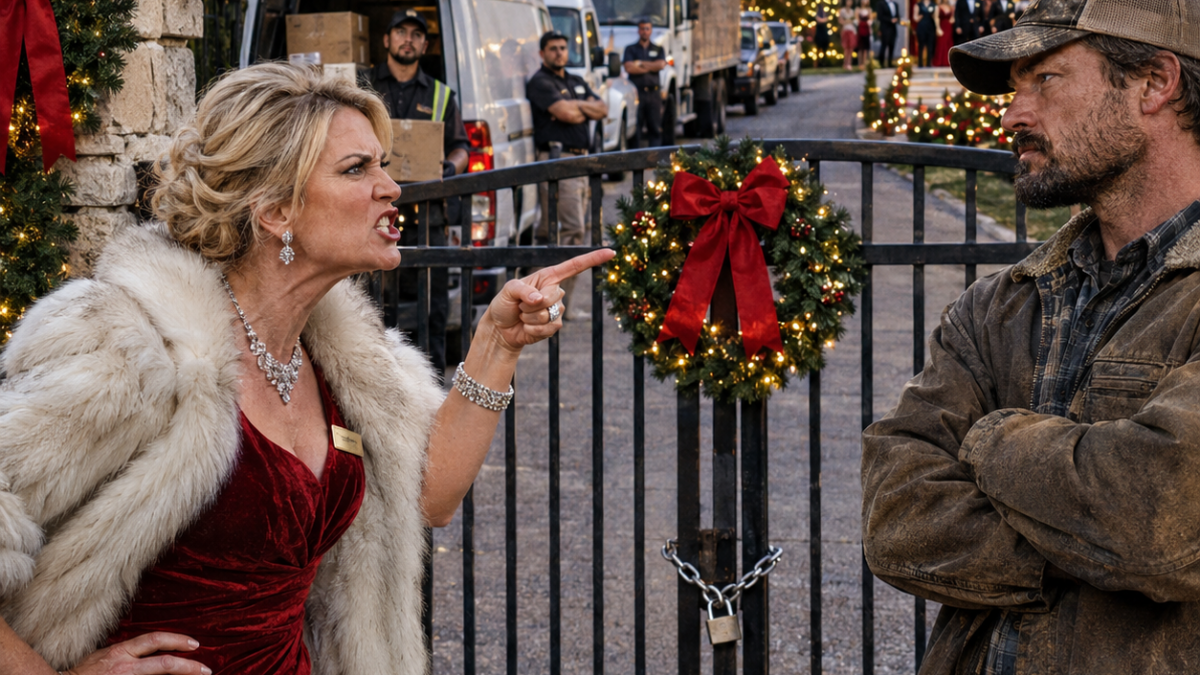
PART 2:
I didn’t call Elaine.
That was important.
People imagine revenge as something loud.
You slam doors.
You yell.
You threaten.
You make sure the other person knows you are angry.
That wasn’t how my father handled problems.
And it wasn’t how I had learned to run the farm after he died.
My father used to say:
“If you’re right, don’t ruin it by acting wrong.”
So I stayed in the truck.
West Farm Lane had existed long before Northgate Ridge.
It ran entirely across Donnelly Tree Farm.
Wide gravel.
Gradual curves.
Built for heavy farm equipment and tractor-trailers hauling trees.
When the subdivision developer constructed Northgate Ridge along our eastern boundary, they made their main entrance beautiful.
Stone arch.
Decorative bridge.
Landscaped median.
Tight curve.
It looked fantastic in real estate brochures.
It was almost useless for heavy service trucks.
The clubhouse sat at the rear of the subdivision, only a few hundred yards from my property.
The original board quickly discovered a problem.
Wedding caterers couldn’t get large refrigerated trucks through the front arch.
Lighting trucks had difficulty with the decorative bridge.
Rental companies hated the tight turns.
So the HOA approached my father and me about buying a permanent easement across West Farm Lane.
We said no.
After Dad died, they asked again.
I still said no.
Not because I hated the neighborhood.
I didn’t.
Most of the residents were fine.
But Dad had taught me to be careful about permanent rights across farmland.
A temporary convenience can become a permanent burden surprisingly quickly.
Eventually, we created a compromise.
A **revocable access license**.
Not an easement.
Not ownership.
Not a property interest.
Permission.
Northgate Ridge could route approved service vehicles down West Farm Lane during special events.
In return, they agreed to three conditions.
No guest parking.
No blocking the road.
And above everything else:
**Never obstruct my main farm gate.**
I had insisted that the agreement explicitly say the license created no permanent easement or property right.
Then I added Section Seven.
If the HOA obstructed my access, I could terminate their permission immediately.
At the time, one board member laughed.
“You expecting us to blockade your farm?”
“No.”
I had answered.
“I’m expecting people to forget what they promised.”
Six years later, Elaine Barlow proved me right.
I opened the gala vendor schedule.
The event planner, Megan Crowley, had emailed it three weeks earlier.
4:45 — catering.
4:58 — rentals.
5:05 — florals.
5:15 — audio/lighting supplemental load.
5:25 — beverage supplier.
5:35 — terrace heaters.
I called Clayton Fisk Catering first.
A dispatcher answered.
“Clayton Fisk Events.”
“My name is Bryce Donnelly.”
“How can I help you?”
“You have a refrigerated truck scheduled for Northgate Ridge tonight.”
“Yes.”
“It is scheduled to use West Farm Lane.”
Keyboard tapping.
“Yes, sir.”
“I own West Farm Lane.”
Another pause.
“Okay.”
“As of 4:12 p.m., Northgate Ridge’s license to use that road has been revoked.”
The dispatcher became more careful.
“Is there an access problem?”
“Yes.”
“Road closed?”
“No.”
“Then…”
“The HOA blocked my private gate and refused to remove the obstruction.”
I explained the agreement.
Then I emailed three documents.
My deed.
The signed license with Section Seven highlighted.
And a one-sentence written notice.
**Effective immediately, Northgate Ridge HOA and its agents, vendors, contractors, and invitees no longer have authorization to enter West Farm Lane.**
The dispatcher said she would contact management.
I made the second call.
Rental company.
Same facts.
Same documents.
Third.
Florist.
Fourth.
Beverage distributor.
Fifth.
Audio and lighting.
Sixth.
Temporary heating.
I did not tell one company to cancel.
I didn’t threaten anyone.
I didn’t say:
**Destroy Elaine’s gala.**
I said:
**You no longer have permission to drive on my land.**
What happened after that was their decision.
Private companies tend to become extremely conservative when the words **trespass**, **insurance**, and **written notice** appear in the same email.
Clayton Fisk called me personally ten minutes later.
His voice sounded tired.
“Mr. Donnelly.”
“Bryce.”
“I’ve been doing this twenty-two years.”
“I’m sorry to make your Christmas Eve interesting.”
He ignored the joke.
“Is there another commercial route?”
“The HOA has a front entrance.”
“My truck won’t clear it.”
“I know.”
“How do you know?”
“You surveyed it two years ago.”
Silence.
Then:
“I hate people who keep records.”
“I hear that.”
Clayton sighed.
“So if my driver enters your road…”
“He will be on private property without permission.”
“Even though the client says otherwise?”
“Ask them for the recorded easement.”
Another pause.
“You know they don’t have one.”
“Yes.”
He gave a low whistle.
“What happened?”
“They parked two SUVs across my farm gate.”
“That’s stupid.”
“Yes.”
“We’ll hold the truck on the public road until somebody sorts this out.”
“That’s your decision.”
“You’re not giving permission.”
“No.”
“Understood.”
At 4:18, I emailed Elaine.
Megan.
Every HOA board member.
Subject:
**REVOCATION OF WEST FARM LANE ACCESS LICENSE**
Elaine called before I finished closing the laptop.
“You cannot cancel our Christmas gala.”
“I’m not.”
“Every vendor is calling Megan.”
“That sounds like a coordination issue.”
“You contacted them.”
“Yes.”
“You told them not to come.”
“No.”
“I told them they do not have permission to cross my land.”
“That is the same thing.”
“It really isn’t.”
“We have an easement.”
“Give me the county recording number.”
Silence.
Music in the background.
People talking.
Then:
“We have authorization.”
“From whom?”
“You know exactly what I mean.”
“No.”
“Elaine, a license is not an easement.”
“You cannot retaliate because of a temporary parking inconvenience.”
“Temporary?”
“You can use the north entrance.”
I laughed once.
“The contract says obstruction of owner access terminates the license immediately.”
“That clause is not intended for this.”
“Then what is it intended for?”
“You are being petty.”
“You parked cars across my gate.”
“Because we needed the space.”
“And now I need my road.”
She lowered her voice.
“You are going to embarrass yourself.”
“No.”
I looked through the windshield at the giant wreath arch.
“I think one of us already has.”
She hung up.
I called the sheriff’s non-emergency line.
Not to arrest anyone.
Not even to tow the SUVs.
I wanted documentation.
An incident number.
A deputy arrived shortly after four-thirty.
Young guy.
Calm.
Professional.
His name was Deputy Nolan.
I showed him the deed.
License.
Email.
Video of Elaine saying the gate would remain closed.
He read everything carefully.
Then looked toward the gala entrance.
“So that road is entirely yours?”
“Yes.”
“And this document is permission.”
“Yes.”
“Revocable.”
“Yes.”
“And they blocked your gate.”
I played the video again.
He nodded slowly.
“This looks civil.”
“That’s fine.”
“You’re not asking us to physically stop vendor trucks?”
“No.”
“You’re not blocking the public road?”
“No.”
“You just revoked permission.”
“Yes.”
Deputy Nolan looked at the agreement.
“If this clause works the way it reads, I don’t see how we could force you to let commercial vehicles onto your land.”
He closed the laptop.
“Unless someone shows up with some other legal authority.”
Then he added:
“And if somebody tries to establish that authority using documents that aren’t legitimate, that becomes a different issue.”
I noticed Elaine.
She had walked close enough to hear him.
For less than a second, her face changed.
Then she turned and walked quickly back toward the clubhouse.
That tiny reaction bothered me.
Why?
At the time, I didn’t know.
At 4:43, the first catering truck appeared.
White.
Large.
Clayton Fisk logo along the side.
At almost the same moment, Elaine returned.
She was carrying several sheets of paper.
County seal in the corner.
She stepped into the lane.
Waved the driver forward.
The truck stopped.
The window lowered.
Elaine shouted:
“You’re authorized.”
The driver picked up his radio instead.
His dispatcher already knew the situation.
I stayed where I was.
No dramatic blockade.
No standing in front of the truck.
Nothing.
Elaine held up the papers.
“We have temporary county event authorization.”
That was new.
I walked closer.
“Can I see it?”
“No.”
“Why?”
“You’re not entitled to HOA documents.”
“It supposedly authorizes access to my property.”
“The county has already approved it.”
Deputy Nolan looked up.
“Ma’am.”
She ignored him.
Then the truck radio crackled.
Clayton Fisk’s voice came through.
“Bryce Donnelly there?”
The driver said yes.
“Has he provided written authorization allowing us onto West Farm Lane?”
“No.”
“Then do not enter.”
Elaine practically shouted into the open cab.
“I have the county authorization!”
Clayton responded through the radio.
“Send it to my office.”
“We don’t have time.”
“Then my truck doesn’t move.”
Elaine stared.
The driver looked almost apologetic.
Then shifted into reverse.
The truck backed out.
Turned slowly.
And disappeared.
The first domino had fallen.
At 4:58, the rental truck arrived.
Tables.
Chairs.
Linens.
Turned around.
5:06.
Florist.
Thousands of dollars in centerpieces.
Gone.
5:18.
Audio and lighting truck.
Stopped.
Called dispatch.
Left.
5:27.
Beverage shipment.
Refused entry.
5:36.
Terrace heaters.
Same result.
Elaine tried to route them through Northgate Ridge’s main entrance.
Every original design problem returned.
Stone arch too low or narrow.
Decorative bridge weight restrictions.
Turns too tight.
Elaine apparently told one driver:
“Just try.”
The man told her:
“My employer does not pay me enough to test your homeowners insurance.”
Megan Crowley arrived at 5:10 looking like she had aged five years since lunch.
Phone in one hand.
Clipboard in the other.
She walked straight toward Elaine.
“What happened?”
“Bryce is sabotaging the gala.”
Megan looked at me.
Then the cars blocking my gate.
Then back at Elaine.
“I told you to keep this gate clear.”
“You told me service access had to remain clear.”
“No.”
Megan pulled out her phone.
“I told you **his gate** had to remain clear.”
“I don’t remember that.”
Megan searched.
Then held up an email.
Elaine had written it three days earlier.
**We’re using his entire frontage for valet. He’ll complain, but he always backs down.**
Nobody spoke.
Deputy Nolan read it.
Then looked at me.
I said nothing.
There was nothing useful to add.
Elaine changed the subject.
“We have county authorization.”
Deputy Nolan held out his hand.
“Can I see that?”
Elaine hesitated.
For the first time, I felt something colder than anger.
She handed him the papers.
He flipped through.
County seal.
Event access language.
Parcel number.
Temporary commercial authorization.
Then I saw the bottom.
A typed line:
**PROPERTY OWNER CONSENT**
And beneath it:
**Bryce Donnelly**
My signature.
Except it wasn’t my signature.
I stepped closer.
“That’s fake.”
Elaine turned.
“What?”
“I did not sign that.”
“You signed access documents before.”
“Not this.”
Deputy Nolan looked between us.
“You’re certain?”
“I would remember signing away access to my own road.”
I pointed at the page.
“That is not my signature.”
The dispute changed instantly.
A minute earlier, we were arguing about contract interpretation.
Now someone had put my name on a document bearing a county seal.
Deputy Nolan called Sheriff Amos Ridley.
Elaine began talking faster.
“This was prepared through the event process.”
“By whom?” I asked.
“The county.”
Deputy Nolan looked at her.
“We’ll verify that.”
Elaine’s confidence weakened.
“This can be sorted out after Christmas.”
“No.”
Nolan folded the pages.
“This needs to be sorted out now.”
Sheriff Ridley arrived twenty minutes later.
Gray mustache.
Heavy coat.
Slow movements.
Sharp eyes.
He didn’t arrive performing for anyone.
He took the document.
Called the county planning office’s after-hours supervisor.
Read the permit number.
Then waited.
His expression hardened.
“No such permit?”
Elaine stopped moving.
Ridley described the form.
The supervisor said the county did not use that template.
The seal resembled an older county seal retired years earlier.
Sheriff Ridley ended the call.
Then turned toward Elaine.
“You told Deputy Nolan the county issued this.”
“I was told it was approved.”
“By whom?”
“Our event team.”
Megan immediately said:
“No.”
Elaine looked at her.
Megan stepped forward.
“I did not prepare that.”
Elaine corrected herself.
“A consultant.”
“What consultant?”
Sheriff Ridley asked.
Elaine opened her mouth.
Nothing came out.
I took another look at the fake authorization.
Then noticed the parcel number.
It was exact.
Every digit.
Somebody had gone into public records.
Pulled my parcel information.
Copied it.
Then forged my name.
This wasn’t a rushed mistake.
It required preparation.
That was the first moment I realized the Christmas gala might not be the real story.
Joanna Pritchard arrived shortly before six.
HOA treasurer.
Retired accountant.
Quiet.
One of those people who noticed numbers nobody else saw.
She walked toward the crowd.
Then saw the papers in Sheriff Ridley’s hand.
Her face went pale.
“I’ve seen that.”
Everyone turned.
Elaine stared at her.
Joanna continued.
“You circulated it to the board.”
Elaine said nothing.
“Two weeks ago.”
Joanna looked at me.
“You told us Bryce had approved full event access.”
“I did not.”
She seemed genuinely confused.
“You signed it.”
“No.”
I turned my laptop toward her.
“Read the actual agreement.”
She did.
Section Seven.
Immediate revocation for obstructing owner access.
Then:
**No permanent easement or property interest created.**
Joanna read that sentence twice.
Then looked toward Elaine.
“You told us this road was HOA-controlled.”
“It is functionally controlled.”
“No.”
Joanna’s voice was quiet.
“That is not what this says.”
Elaine’s eyes hardened.
“Tonight is not the time.”
Joanna looked toward the trucks disappearing down the county road.
“I think tonight became the time.”
Sheriff Ridley told Elaine not to delete anything.
Emails.
Files.
Messages.
Documents.
Nothing.
The lights around the clubhouse still glowed.
Guests had started arriving.
Men in tuxedos.
Women in gowns.
Valets opening doors.
A string quartet played Christmas music inside.
From the outside, Northgate Ridge looked magical.
Behind the scenes, it was collapsing.
At 5:50, Clayton Fisk called Megan.
“If we don’t unload in fifteen minutes, we cannot serve dinner.”
Megan stared at Elaine.
“What do I tell him?”
“Wait.”
I spoke.
“They can wait anywhere legal.”
Elaine glared at me.
“Not West Farm Lane.”
She walked away.
Then Joanna touched my arm.
“Bryce.”
“What?”
Her voice lowered.
“You think this is about the gala?”
“I’m beginning to think it isn’t.”
“You need to see something.”
Before she could explain, guests flooded the entrance.
The clubhouse itself was beautiful.
Most decorations had arrived the day before.
White lights.
Silver ornaments.
Garland.
Band musicians.
A massive Christmas tree.
Nobody entering at six knew dinner wasn’t coming.
Nobody knew the premium bar shipment was sitting miles away.
Nobody knew half the tables and linens were missing.
No floral centerpieces.
No terrace heaters.
No major sound system.
Elaine tried improvising.
Residents drove SUVs to collect whatever they could.
Gas station ice.
Folding tables from garages.
Bottled wine from local stores.
But you cannot move a refrigerated dinner service for two hundred people in a Lexus.
Clayton refused to release prepared food without approved equipment.
Elaine offered him ten thousand dollars extra.
He said:
“Money doesn’t make food safety disappear.”
At 6:15, guests noticed half the tables looked unfinished.
At 6:25, bar staff announced reduced service.
At 6:34, the band admitted their main audio equipment had never arrived.
Then Elaine started telling board members I was extorting the HOA.
That was when I walked inside.
Deputy Nolan accompanied me.
I handed Joanna my phone.
First:
My original email.
**Keep my main gate completely clear. December 24 is a working farm day.**
Second:
Revocation notice.
Third:
Video.
Elaine’s voice:
**Until the gala is over.**
Joanna looked around at the board.
“Where is the extortion?”
Nobody answered.
I said:
“I haven’t asked them for one dollar.”
Another board member took the phone.
I continued.
“I withdrew a permission I had the right to withdraw.”
At 6:42, Megan received the final email from Clayton Fisk.
Catering contract closed for the night.
Service failure due to inaccessible delivery location.
Crew released.
No dinner.
Elaine read the message.
“No.”
Megan looked exhausted.
“It’s done.”
“Call him back.”
“I’ve called him sixteen times.”
“Offer more.”
“He won’t do it.”
“Twenty thousand.”
“Elaine.”
Megan lowered her voice.
“The food is leaving.”
Through the ballroom window, we could see red tail lights moving away in the darkness.
One truck.
Then another.
Then the last.
I checked my watch.
Not yet seven.
Every delivery that mattered had turned around before dinner.
I had not moved a cone.
I had not touched a car.
I had not threatened one driver.
Elaine had shut down her own Christmas gala the moment she blocked my gate.
But Joanna wasn’t watching the trucks.
She was watching Elaine.
Then she handed me her phone.
“Read this.”
The title page said:
**NORTHGATE RIDGE 2027 EXPANSION ACCESS CERTIFICATION**
I swiped.
Clubhouse expansion.
Commercial kitchen.
New ballroom wing.
Fitness center.
Event venue operations.
Estimated investment:
**$3.8 million.**
Developer:
Warren Slade.
Then I saw the map.
West Farm Lane appeared in red.
Across my property.
A label sat beside it.
**PERMANENT HOA SERVICE CORRIDOR**
I felt my jaw tighten.
“What is this?”
Joanna looked sick.
“The project Elaine planned to announce after dinner.”
“On my road?”
“The engineering study says the main entrance can’t handle construction traffic.”
“And after construction?”
“Commercial deliveries.”
I kept reading.
Without West Farm Lane, the HOA would have to build an entirely new service route on its own property.
Expensive.
Complex.
Slower.
So Elaine had promised Warren Slade that Northgate Ridge controlled my lane.
The gala was supposed to prove it.
Two hundred guests.
Valet operations.
Vendor trucks.
HOA signs.
Security.
If Elaine could film West Farm Lane functioning like an HOA-owned event entrance, she could present the appearance of established control.
Then Joanna showed me an email.
Elaine to another board member:
**Once we establish full event use this Christmas, Donnelly will have a much harder time pretending the lane isn’t part of our access system.**
I read it twice.
Everything became clear.
The blocked gate was not an inconvenience.
It was evidence.
Elaine needed the gala to look like ownership.
She needed me pushed aside.
She needed cars parked on my frontage.
Security controlling my gate.
Vendors using my road.
And if I objected?
She had a fake county authorization with my forged signature.
That was her insurance policy.
“Warren is here?”
I asked.
Joanna nodded.
“At the bar.”
There was barely a bar.
We found him holding a club soda.
Warren Slade looked to be in his late fifties.
Tailored tuxedo.
Expensive watch.
The calm expression of a man who had spent decades deciding whether large numbers were profitable or dangerous.
Joanna handed him the real license.
He read.
Elaine appeared moments later.
“Warren.”
He raised one hand.
She stopped.
He looked at her.
“You told me the HOA owned permanent service access.”
“I said we controlled access.”
“No.”
He didn’t raise his voice.
“You said owned.”
Elaine smiled tightly.
“In practical terms, there is no meaningful difference.”
Warren stared.
“There is a four-million-dollar difference.”
Nearby conversations stopped.
Elaine lowered her voice.
“We can resolve this.”
Warren looked at me.
“Do you intend to grant a permanent easement?”
“No.”
“Sell one?”
“No.”
Elaine jumped in.
“He is negotiating.”
“No.”
I turned toward Warren.
“I have never negotiated permanent access.”
He looked toward Elaine again.
Megan appeared.
She had her phone.
Another email.
Elaine had written to her two weeks earlier after Megan asked whether she should reconfirm the gala access with me.
**Do not contact Donnelly again. We have authority to proceed.**
Warren read it.
Then Joanna showed him the expansion budget.
One line:
**WEST FARM LANE ACCESS IMPROVEMENTS — $420,000**
I stared.
“Improvements?”
Elaine said:
“Nothing had been approved.”
Joanna looked at her.
“The board approved the budget.”
“Conceptually.”
“You intended to spend four hundred twenty thousand dollars improving his road?”
“It would benefit everyone.”
“It isn’t ours.”
Elaine looked around.
“Will everybody stop saying that?”
Warren closed the folder.
“No.”
He tucked it under his arm.
“Until ownership and access are legally verified, the expansion deal is suspended.”
Elaine froze.
“This is unnecessary.”
“No.”
“It’s a misunderstanding.”
“No.”
“Warren—”
“I will not invest $3.8 million into a project whose commercial access depends on private property we do not control.”
He looked at me.
“Mr. Donnelly.”
“Bryce.”
“I apologize for the confusion.”
“You didn’t create it.”
Then he walked away.
The gala had just lost dinner.
Elaine had just lost the project she planned to unveil after dinner.
And the worst part of the evening had not even started.
At 6:50, Joanna called an emergency board meeting.
Elaine objected.
“You cannot hold a board meeting during the gala.”
Joanna looked at her.
“We are not in the middle of a gala.”
She held up the fake document.
“We are in the middle of a liability event.”
Five board members entered a conference room.
Sheriff Ridley stood near the door.
I was invited in.
Elaine protested.
“He isn’t a member.”
Joanna answered:
“This meeting is about his property and his forged signature.”
That ended that.
I did not give a speech.
I placed evidence on the table.
One.
Deed.
West Farm Lane entirely within Donnelly Tree Farm.
Two.
Revocable access license.
No easement.
No property interest.
Three.
My email requiring the gate remain clear.
Four.
Video of Elaine refusing to open it.
Five.
Forged county authorization.
Six.
Email instructing Megan not to contact me.
Seven.
Expansion map labeling my road a permanent HOA service corridor.
Eight.
Email about establishing full gala use to weaken my ability to contest HOA control later.
When I finished, I sat down.
Elaine looked at the documents.
Then at the board.
“This is being deliberately distorted.”
Joanna pointed to the forged signature.
“Which part?”
“Administrative staff prepared event paperwork.”
Sheriff Ridley finally spoke.
“What administrative process produces another man’s signature?”
Elaine stared at him.
“It may have been electronically applied.”
“By whom?”
“I don’t know.”
“It’s your authorization.”
“The event team—”
Megan stood in the doorway.
“No.”
Everyone looked at her.
“I never touched that document.”
Elaine’s face hardened.
Joanna turned to the board.
“I move that Elaine Barlow’s authority as HOA president be suspended immediately pending internal and law-enforcement investigation.”
A board member seconded.
Elaine stood.
“You cannot do this.”
Joanna looked almost sad.
“We can.”
Vote.
Unanimous.
Five to zero.
Elaine’s signing authority revoked.
HOA corporate card frozen.
Contract authority suspended.
Joanna appointed interim president.
Elaine sat motionless.
An hour earlier, she had arrived in emerald green expecting to stand under a chandelier and announce her vision for Northgate Ridge.
Now she couldn’t authorize an office-supply purchase.
Joanna’s first decision was simple.
End the gala.
At seven fifteen, she walked to the microphone.
The guests expected an announcement.
Maybe the expansion project.
Instead:
“Ladies and gentlemen, due to unforeseen operational issues, tonight’s gala will conclude early.”
Confused murmurs.
“We sincerely apologize.”
A few people laughed nervously.
Some already knew.
Rumors move faster than appetizers.
Joanna continued.
“Please drive safely, and from the board, Merry Christmas.”
Guests began leaving.
The string quartet stopped.
Valets ran for vehicles.
Security workers removed cones.
Someone unscrewed the **HOA EVENT ACCESS ONLY** sign.
Workers dismantled the wreath arch.
One strand of lights at a time.
Finally, the two SUVs blocking my gate moved.
I stood across the road.
Elaine came outside.
White fur wrapped tightly around her.
She watched the entrance she had built disappear.
I didn’t say anything.
There are moments when silence is crueler than victory speeches.
I walked to my truck.
Opened my gate.
Drove through.
Then closed it behind me.
Nothing dramatic.
But Elaine understood.
All night she had tried to prove she controlled that gate.
At the end, I opened it because I owned it.
The cancellation invoices arrived the next morning.
Christmas Day.
Northgate Ridge lost more than seventy thousand dollars.
Prepared catering food and cancellation:
roughly $18,600.
Rental logistics:
$7,400.
Florals:
$4,900.
Beverage service:
$6,300.
Audio and lighting:
$3,700.
Heaters:
$2,800.
Then valet.
Security.
Planner overtime.
Ticket refunds.
Sponsor reimbursement.
Elaine had attempted to save money by using a road she did not own.
Her decision cost the HOA far more than building proper logistics ever would have.
But money was secondary now.
On December twenty-sixth, Warren Slade formally suspended the $3.8 million expansion project.
The board hired independent real estate counsel.
Daniel Hargrove.
He reviewed my license.
The deed.
History.
Emails.
His written opinion was mercilessly simple.
Northgate Ridge did not own West Farm Lane.
Northgate Ridge did not possess a recorded easement.
Its repeated written acknowledgment that it crossed my land only by revocable permission made any argument for permanent rights extremely weak.
Elaine’s attempt to bury the old license had achieved the opposite.
That document became the strongest proof against her.
Then the county investigation began.
Slowly.
Professionally.
No Christmas Eve handcuffs.
No dramatic arrest beneath the lights.
Sheriff Ridley told me:
“Good investigations are boring until they aren’t.”
Digital files were collected.
Email metadata.
Shared drive logs.
Document creation dates.
User accounts.
The fake authorization had been uploaded through Elaine’s HOA account.
From the president’s office computer.
Late Sunday night.
Clubhouse closed.
Then investigators found the original editable file.
That made the “administrative mistake” explanation harder.
The board voted to permanently remove Elaine in early January.
They also voted that association funds would not be used to defend unauthorized personal conduct outside board authority.
That meant Elaine needed her own lawyer.
The woman who had planned to spend Christmas showing a developer how powerful she was now had to explain why a fake county authorization bearing a farmer’s signature had been created under her login.
I should have felt triumphant.
Part of me did.
But Christmas morning had been strange.
The farm was quiet.
Too quiet.
Dad had always been the center of Christmas morning.
He made coffee badly.
He burned bacon.
He insisted on playing the same old records.
After he died, I usually buried myself in work until Christmas Eve and treated Christmas Day like any other winter morning.
That year, I walked the rows alone.
Snow on the firs.
Branches bending under white weight.
The air smelled clean.
I stopped near the tree Dad had planted the year I was born.
It was enormous now.
Too large to sell.
We kept it because some things shouldn’t be cut simply because they have market value.
I rested one hand against the trunk.
“You would’ve enjoyed yesterday.”
I could almost hear him.
**Should’ve made her move the damn cars the first time.**
I smiled.
Then thought about something else he used to say.
“People tell you who they are when they think you need them.”
Elaine thought I needed her cooperation.
That was why she felt free to take my gate.
But the truth was reversed.
Northgate Ridge needed my permission.
Permission is invisible until somebody abuses it.
Then suddenly everybody learns who owns what.
A few days later, Joanna asked me to meet the new board.
I entered the clubhouse.
No music.
No gowns.
No glitter.
The ballroom looked enormous without two hundred people inside it.
Tables stacked.
Chandeliers dimmed.
Joanna sat with four other board members.
She did not start with excuses.
“We failed.”
That surprised me.
“What?”
“The board failed.”
She folded her hands.
“We trusted Elaine’s representations about your property without reading the agreement.”
Nobody argued.
“We approved gala contracts based on assumptions.”
She continued.
“We approved expansion planning based on claims we never verified.”
A board member beside her said:
“We owe you an apology.”
I waited.
Joanna looked directly at me.
“I’m sorry.”
Simple.
That was enough.
Then she asked:
“Would you consider restoring event access?”
“No.”
The room went still.
I continued.
“Not under the old license.”
Joanna nodded slowly.
“What would you require?”
I slid a draft across the table.
“If you want access again, there is no ambiguity.”
Every event required written advance notice.
Every commercial vendor required insurance.
No guest parking.
No valet operations.
No HOA signs on my property.
No use of my lane suggesting HOA ownership.
No construction traffic.
No paving.
No widening.
No permanent infrastructure.
No use of historical access as evidence supporting a future easement.
One serious violation terminated permission permanently.
No appeal.
No renegotiation.
A board member read.
“This is strict.”
“Yes.”
“Very strict.”
“Yes.”
Joanna said:
“After Christmas Eve, can you blame him?”
Nobody answered.
They approved it unanimously.
Months later, Warren Slade returned with a redesigned expansion.
This version included a completely new service road.
On HOA property.
It wound behind the houses to the clubhouse loading dock.
Expensive.
More than what Elaine planned to spend “improving” mine.
Some homeowners complained.
Joanna explained it at the annual meeting.
“If we require permanent infrastructure…”
She looked around the room.
“…we should own it.”
That sentence received applause.
The expansion eventually moved forward.
Smaller than Elaine’s dream.
More financially cautious.
And entirely independent of Donnelly Tree Farm.
I preferred it that way.
The investigation into the forged authorization took much longer.
I won’t pretend the legal details were dramatic.
Most consequences aren’t.
Interviews.
Subpoenas.
Records.
Lawyers.
More interviews.
Elaine eventually resigned from every committee and listed her house.
The final outcome involved criminal charges related to falsified documents and unauthorized use of another person’s signature.
Her attorney negotiated.
The county handled it.
I didn’t attend every hearing.
I didn’t need to.
The farm required work.
That mattered more.
One morning, Sheriff Ridley stopped by.
I was repairing fencing.
He leaned against his truck.
“She might have walked away from most of this if she’d just moved those two SUVs.”
I shook my head.
“No.”
He raised an eyebrow.
“Those cars were just how I found out.”
He thought about that.
Then nodded.
“You’re probably right.”
Because the real problem wasn’t the gate.
The gate exposed the plan.
Elaine wanted more than one night.
She wanted West Farm Lane permanently.
The Christmas gala was supposed to create a picture.
A story.
Two hundred guests entering through my property.
HOA signage.
HOA security.
HOA valet.
Commercial deliveries.
Videos.
Photographs.
A developer watching.
Then months later, when I objected to construction traffic, she could say:
“But this is how the road has always functioned.”
Except it hadn’t.
That was the part I couldn’t forgive easily.
Blocking my gate was arrogance.
Forging my signature was different.
That was an attempt to manufacture consent.
My father had spent his life building something he could hand down.
Elaine tried to turn part of it into an amenity for people who hadn’t planted one tree.
I eventually realized my revenge was not the gala failing.
It wasn’t the seventy-thousand-dollar loss.
It wasn’t Elaine losing her presidency.
Those were consequences.
The real revenge was simpler.
West Farm Lane remained exactly what Dad intended.
Ours.
The following December, Northgate Ridge held another Christmas party.
Smaller.
No gala.
No valet.
No developer announcement.
Just residents.
Joanna called me in November.
“I have a strange question.”
“What?”
“Would you sell us trees?”
I laughed.
“You live next door to a Christmas tree farm.”
“I know.”
“And this is the first year you’re asking?”
“We may have had leadership issues.”
“That’s fair.”
They ordered twenty-five trees.
One large one for the clubhouse.
Smaller ones for common areas.
I gave them the regular commercial price.
Joanna tried to negotiate a discount.
“No.”
“You’re cold.”
“I sell Christmas trees for a living.”
“I thought we were friends.”
“We’re becoming friendly.”
“Difference?”
“About fifteen percent.”
She laughed.
They picked up the trees through the new service road.
Not West Farm Lane.
I watched from across the fence.
For some reason, that made me smile.
A week later, Joanna invited me to their Christmas gathering.
I almost declined.
Then I remembered Dad.
He never stayed angry when there was pie.
So I went.
No emerald gowns.
No security.
No two-hundred-dollar tickets.
Kids ran through the clubhouse.
Someone burned cider.
The tree from our farm stood near the fireplace.
A little crooked.
Perfect.
One boy asked me:
“Did you grow that?”
“Yes.”
“How long?”
“About nine years.”
His eyes widened.
“That’s older than me.”
“Trees usually are.”
His mother laughed.
Later Joanna handed me a small ornament.
Wooden.
Hand-carved.
Shape of a Christmas tree.
On the back:
**DONNELLY TREE FARM — NORTHGATE RIDGE CHRISTMAS 2027**
I stared at it longer than expected.
Joanna noticed.
“You okay?”
“Yes.”
“You look emotional.”
“Cold air.”
“We’re indoors.”
“I have allergies.”
She smiled.
I put the ornament in my pocket.
That night, I hung it on the small tree in my farmhouse.
Dad’s old ornaments surrounded it.
For years I had thought protecting his legacy meant keeping people away from it.
Maybe I had been wrong about that part.
Protection doesn’t always mean isolation.
Sometimes it means controlling the terms under which something is shared.
That was what Elaine never understood.
She thought permission was weakness.
She thought if I had let the HOA use my road six years in a row, I had somehow surrendered it.
But generosity and surrender are not the same thing.
A neighbor can let you cross his land.
That doesn’t mean you own his land.
A man can choose peace.
That doesn’t mean he is afraid of conflict.
A quiet person can be patient.
That doesn’t mean he will always back down.
The following Christmas Eve, exactly one year after the gala disaster, I finished my deliveries early.
Around four, I drove toward the main gate.
For a second, memory hit me.
Valet cones.
SUVs.
Lights.
Elaine telling me:
**Tonight, this belongs to us.**
But there was nothing there.
No barricade.
No signs.
No guards.
West Farm Lane stretched quietly between the trees.
Snow began falling.
I stopped near the gate.
Got out.
Opened both panels.
Then stood there.
The rows of Fraser firs climbed the hill behind me.
Thousands of them.
Some would be harvested next year.
Some five years later.
Some would remain.
Growing trees teaches you patience.
You plant something knowing the payoff is years away.
You accept storms.
Disease.
Bad markets.
Dry summers.
You take care of what belongs to you.
Then, if you’re lucky, it becomes something meaningful to somebody else.
I thought about Dad.
I thought about Elaine.
Then I thought about the six phone calls.
People loved that part of the story.
Six calls.
Six vendors.
Every truck turning around.
It sounded like revenge.
Maybe it was.
But I never shut down the gala.
That distinction still mattered to me.
Elaine had every opportunity to hold her party.
She could have used smaller vehicles.
Planned around the front entrance.
Cleared my gate when I asked.
Called me three weeks earlier and negotiated.
She could have built the proper service road before promising Warren anything.
Instead, she built an entire evening on property she did not control.
Then she blocked the one person whose permission held everything together.
She shut down her own gala.
I just stopped saving it.
That winter, a young employee named Tyler asked me about the story.
He had been nineteen when the gala happened.
Now he helped manage our retail lot.
“Bryce?”
“Yeah?”
“If Elaine had apologized right away, would you have reopened the road?”
I thought about that.
“When?”
“When the first truck arrived.”
“If she moved the cars?”
“Yes.”
“Probably.”
Tyler looked surprised.
“You would have let the catering truck through?”
“If my gate was cleared and she respected the agreement.”
“Even after everything?”
“At that point, everything hadn’t happened yet.”
“The fake document?”
“I didn’t know about it.”
He nodded.
“So the gala could’ve survived.”
“Yes.”
“That’s crazy.”
“No.”
I looked toward the rows of trees.
“That’s choice.”
People like to imagine consequences as inevitable.
Usually there is a moment before them.
A small moment.
One decision.
Elaine had one.
Move two SUVs.
Apologize.
Respect the license.
Christmas Eve continues.
Dinner arrives.
Expansion announcement happens.
Maybe later we fight over permanent access.
Instead, she looked at my camera and said:
**Yes. The gate stays blocked until the gala is over.**
That sentence triggered everything.
Every vendor.
Sheriff.
Forged document.
Expansion deal.
Investigation.
Her presidency.
Sometimes a life doesn’t collapse because of one enormous mistake.
Sometimes it collapses because somebody refuses to correct a small one.
Northgate Ridge eventually finished its expansion.
The new ballroom was beautiful.
I attended the opening.
Yes.
Me.
Joanna invited me.
The service road entered from the opposite side.
Built entirely on HOA property.
Warren Slade had returned after title issues were resolved.
He recognized me.
“You’re the Christmas tree guy.”
“I prefer farmer.”
“Fair.”
He looked toward the new service entrance.
“That road cost them a fortune.”
“I heard.”
“You could’ve made money selling an easement.”
“I know.”
“Why didn’t you?”
I looked toward the dark fields beyond the clubhouse.
“Because some money costs too much.”
Warren considered that.
“I understand why you’re not a developer.”
“Thank you.”
“That was not necessarily a compliment.”
“I’m taking it as one.”
He laughed.
Then extended his hand.
We shook.
The new facility did well.
Weddings.
Community events.
Corporate gatherings.
All without one delivery truck using West Farm Lane.
Proof that inconvenience is not impossibility.
People simply prefer cheap solutions when somebody else pays the hidden cost.
Elaine’s solution had been cheap for the HOA.
Because the cost would have been mine.
Lost control.
Traffic.
Road wear.
Future disputes.
Construction equipment.
Maybe eventually a legal argument that years of use had created stronger rights.
The new road cost the homeowners money.
But they owned it.
They controlled it.
They maintained it.
That is what infrastructure costs.
Joanna once said:
“We should have built it from the beginning.”
“Yes.”
“Would’ve saved us seventy thousand dollars.”
“And one president.”
She smiled.
“Some costs had benefits.”
I laughed.
Years passed.
Donnelly Tree Farm continued.
My knees hurt more.
Christmas deliveries felt heavier.
I hired more people.
I learned to delegate badly, then slightly better.
One December morning, Tyler found me in the barn going through old paperwork.
“What’s that?”
“The original Northgate access license.”
“Still keeping it?”
“Yes.”
“Even though they have the new road?”
“Yes.”
“Why?”
I looked at him.
“Because memory is unreliable.”
I tapped the paper.
“Documents are patient.”
That was something Dad would have appreciated.
We had one remaining limited access arrangement with Northgate.
Emergency use only.
Fire.
Medical.
Road blockage.
No events.
No commercial operations.
It was almost never needed.
One winter storm changed that.
Ice dropped trees across Northgate’s main service road.
Then a resident had a medical emergency.
The ambulance couldn’t reach the back of the subdivision.
Joanna called me.
“Bryce.”
“What?”
“We need West Farm Lane.”
No hesitation.
“Open it.”
The ambulance crossed.
Fire crew followed.
Resident reached the hospital.
No argument.
No paperwork fight.
Nobody asked for money.
Later, Joanna called.
“Thank you.”
“That’s what emergency access is for.”
She went quiet.
“Elaine would have hated how easy that was.”
“I’m trying not to organize my life around what Elaine would hate.”
“Healthy.”
The incident reminded everyone again.
The road was private.
But private did not mean cruel.
Boundaries can exist without hostility.
That became the heart of our relationship with Northgate.
Respect the boundary.
Then generosity becomes possible.
Disrespect it, and generosity disappears.
Simple.
One afternoon, several years after the gala, a letter arrived.
No return address I recognized.
Inside was a Christmas card.
No long message.
Just:
**Mr. Donnelly,**
**I have had years to think about what happened. I was wrong to block your gate, wrong to treat permission as ownership, and wrong to sign off on actions involving your property without your consent.**
**I am sorry.**
**Elaine Barlow**
I sat at the kitchen table.
Read it again.
There was no request.
No excuse.
No explanation.
No demand for forgiveness.
Just apology.
I put it down.
Then walked outside.
Snow covered the farm.
The same kind of quiet snow that had fallen Christmas Eve years before.
I walked toward the main gate.
For a long time I stood there.
Did I forgive her?
Eventually, yes.
Not because what she did became acceptable.
Because carrying anger past its useful life is another way of letting somebody keep access to your property.
Except the property is your mind.
I had revoked that license too.
That Christmas, I placed Elaine’s card in the same fireproof cabinet as the old agreement.
Not as evidence.
As closure.
I never spoke to her again.
I didn’t need to.
When I tell the story now, people always laugh at the missing dinner.
They love the line:
“Six phone calls later, every delivery turned around.”
They love the image of two hundred wealthy gala guests standing in a decorated ballroom with no food.
They love the forged-paper twist.
The developer walking away.
Elaine losing her presidency.
Those are good story moments.
But they aren’t my favorite.
My favorite happened when the workers removed the SUVs.
I opened my gate.
Drove through.
Closed it behind me.
Because that was the entire fight reduced to one movement.
My gate.
My road.
My choice.
Dad understood that.
He spent his life building something so the next generation would have choices.
That is what ownership means when you inherit family land.
Not power.
Responsibility.
You don’t own the years before you.
You don’t own the years after you.
You just get your turn to protect what survived long enough to reach your hands.
Northgate wanted convenience.
Elaine wanted control.
I wanted continuity.
In the end, continuity won.
Every Christmas Eve, I still work.
Not as late now.
Usually by three, Tyler kicks me out.
“Go home.”
“I own the place.”
“Exactly. You have nowhere to get fired from. Leave.”
I pretend to complain.
Then drive the same route.
Past the clubhouse.
Past the fence.
Toward the main gate.
Northgate’s gala is now a modest annual party.
They buy trees from us.
The event planner uses their own service road.
Nobody parks on West Farm Lane.
Nobody hangs signs on my fence.
Sometimes Joanna sends cookies.
They’re not very good.
I eat them anyway.
One Christmas Eve, around sunset, I stopped the truck at the gate.
Light snow fell.
Rows of trees stretched into the dark.
A few still had red harvest tags.
Others were small enough that I wouldn’t cut them for years.
The farmhouse windows glowed in the distance.
I thought about the first Christmas after Dad died.
I had hated the silence.
Back then, I believed grief was something you defeated by working harder.
It isn’t.
Grief is more like winter.
You don’t defeat it.
You live through it.
Then eventually you begin noticing things growing underneath.
That farm had carried me through losing Dad.
Through bad markets.
Storm damage.
Lonely Christmas mornings.
And one spectacularly arrogant HOA president.
I rested my hand on the gate.
Dad had welded part of the hinge assembly himself.
Terrible weld.
Still holding.
“Not bad,” I said.
Nobody answered.
Then I noticed headlights.
A Northgate SUV approached.
Stopped on the public shoulder.
Window lowered.
A family I vaguely recognized.
Father.
Mother.
Two little kids.
A Christmas tree tied to the roof.
The father waved.
“Merry Christmas, Bryce!”
“Merry Christmas.”
The little girl shouted from the back:
“We got one of your trees!”
“I can see that.”
“It’s huge!”
Her mother laughed.
“We may have misjudged the ceiling.”
“Common mistake.”
They drove away.
I watched their tail lights disappear.
That was the ending I liked.
Not Elaine’s fall.
A family driving home with one of our trees.
A neighborhood that once tried to take part of my farm now buying something from it respectfully.
Connection without possession.
Neighborliness without entitlement.
Permission without surrender.
Christmas without war.
I opened the gate.
Drove through.
Closed it behind me.
West Farm Lane disappeared between the Fraser firs under a thin layer of new snow.
No valet cones.
No wreath arch.
No sign claiming **HOA EVENT ACCESS ONLY**.
Just a private farm road doing exactly what it was built to do.
Bringing me home.
Elaine had once blocked that gate because she believed Christmas Eve made her untouchable.
Six phone calls later, every truck she needed had turned around before dinner.
But the part people usually miss is this:
I never shut down her gala.
I never told the caterer not to serve.
I never told the florist to leave.
I never told the band to stop playing.
I never blocked a public road.
I never touched her decorations.
I never moved one guest’s car.
I simply stopped allowing people to use something that belonged to me after the person receiving that privilege decided my rights no longer mattered.
Everything that followed belonged to Elaine.
Her decision.
Her forged document.
Her secret expansion plan.
Her seventy-thousand-dollar disaster.
Her suspended presidency.
Her investigation.
Her consequences.
All I did was open the contract and read Section Seven.
That may not sound dramatic.
But sometimes the most satisfying revenge isn’t destroying someone else’s plan.
It is stepping aside and letting the weight of their own choices destroy it for them.
The farm survived.
The road stayed ours.
Northgate built its own access.
The neighbors became better neighbors.
And every December, thousands of families still carried pieces of Donnelly Tree Farm into their homes, covered them in lights, and gathered around them on Christmas morning.
Dad would have liked that.
And years after the night Elaine tried to turn my private gate into the entrance to her empire, I finally understood something he had been trying to teach me my entire life.
You can share what belongs to you.
You can be generous with it.
You can let neighbors use it.
You can help people when they need you.
But generosity only means something when you are still free to say no.
That freedom was what Elaine tried to take.
That was why I fought.
And that was why, when the snow settled over West Farm Lane that Christmas night and there was finally nothing outside my gate except quiet rows of Fraser firs, I didn’t feel victorious.
I felt something better.
I felt home.








