PART 2: HOA Guards Blocked My Legal Road—Then Their Own Bodycams Exposed the Shotgun Lie
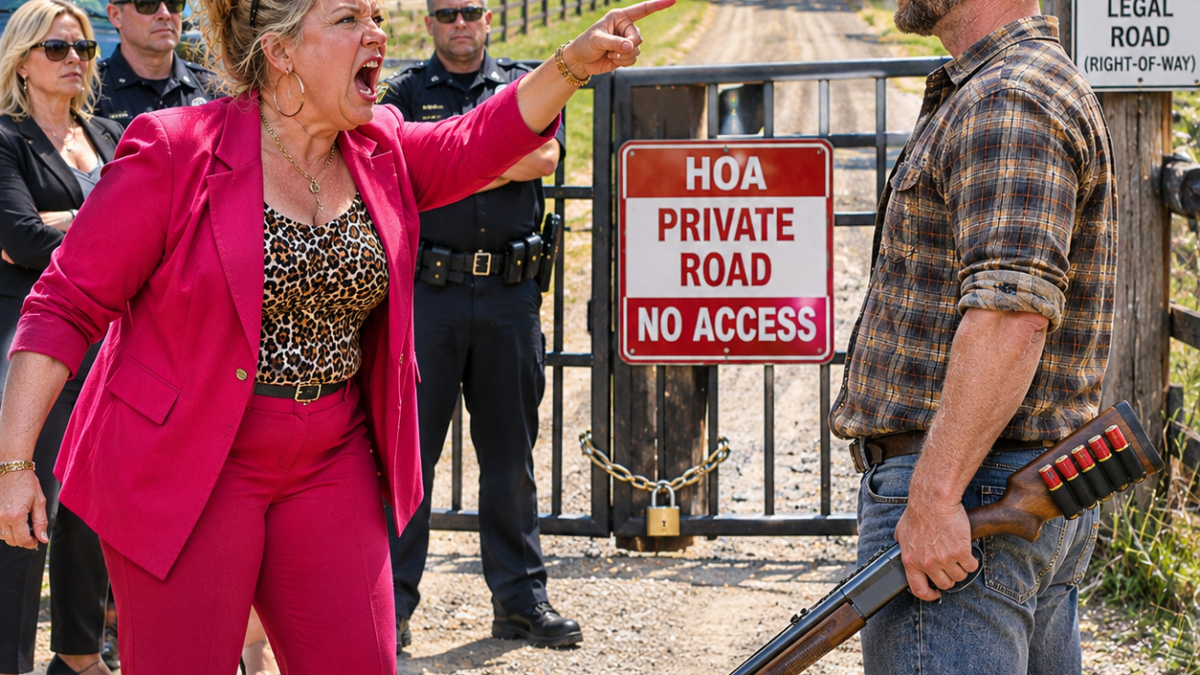
A black iron gate was standing across the road my family had used for thirty-seven years when I came home from visiting my daughter, and two men wearing “Community Security” patches stepped in front of my truck and told me I needed an HOA visitor pass to reach forty-five acres that had belonged to us since 1951. What those guards did not know was that I had spent twenty-eight years as a sheriff’s deputy in that county, that the permanent access easement beneath their brand-new concrete posts had been recorded in 1987, and that the shotgun locked in a case behind my seat had never been pointed at another human being in my life. I hoped the whole thing could be solved with one deed and one reasonable conversation, but the way those men watched me through the gate—and the way their security camera followed my truck when I finally backed away—told me somebody had already decided this road was worth lying about.
My name is Walter Hadley.
I was sixty-two when Whispering Meadows decided I needed permission to go home.
I had spent three days in Raleigh with my daughter and grandsons. My youngest grandson had just turned seven, and I had promised him I would not miss the cake, no matter how much farm work waited for me back home.
The drive back took nine miserable hours through steady rain.
By the time I reached Miller Creek Road, all I wanted was coffee, a shower, and my own bed.
Then I rounded the bend.
The gate had not been there four days earlier.
Neither had the concrete pillars.
A white sign bolted across the iron bars read:
PRIVATE PROPERTY
WHISPERING MEADOWS HOA RESIDENTS ONLY
I stopped my truck.
The taller guard approached.
“Sir, this is a private road. Do you have an access pass?”
“No.”
“Then I need you to turn around.”
“This road goes to my farm.”
He glanced at his partner.
“Whispering Meadows controls the roads inside the development.”
“Not this one.”
“Sir—”
“Do you know what an easement is?”
His expression changed slightly.
“I’m just doing my job.”
“I understand that.”
I pointed through the gate.
“My property is at the end of that road. My family has permanent recorded access.”
“You’ll need to contact management.”
I looked beyond him.
I knew every curve of that pavement.
The dip beside the old oak where water collected after storms.
The cracked section that buckled every winter.
The long bend where my grandfather once told me he proposed to my grandmother after walking her home from church.
This was not a neighborhood amenity to me.
It was the only reliable road into the land where I had grown up.
Then I noticed the camera.
Small black dome.
Red indicator light.
Watching everything.
I had been a Marine before becoming a deputy, and twenty-eight years in law enforcement had taught me one lesson that outlasted every badge I ever wore:
When somebody is recording you, give them nothing but the truth.
So I kept my hands visible.
Kept my voice level.
Did not mention the shotgun.
Did not argue.
I backed up and took the alternate route.
Twelve extra miles.
Most of it rough county road.
By the time I reached my house, anger had settled into something colder.
I went straight to the metal lockbox my grandfather used for important documents.
Under old surveys, tax records, and yellowed correspondence, I found the deed.
1987.
That was the year Grandpa sold the front parcel to a developer while keeping our forty-five acres behind it.
The sale contained a permanent access easement along the existing road.
The wording was precise.
Perpetual.
Recorded.
Running with the land.
No expiration.
No renewal requirement.
No right for later owners to revoke it.
I read it three times.
Then I found the original survey.
The access corridor ran exactly where the HOA had just poured its gate posts.
I sat at the kitchen table with the papers spread in front of me and remembered something Grandpa told me when I was fourteen.
“That road is the blood of this farm, Walter. Don’t ever let anybody take it.”
Back then, I thought he was being sentimental.
That night, I finally understood.
The next morning I emailed the HOA a scanned copy of the deed, highlighted the easement clause, and gave them forty-eight hours to open the road.
They did not answer.
Five days later, I sat across from HOA president Diane Mercer.
She barely glanced at my deed before sliding a proposal across the table.
Five hundred dollars a year.
For an HOA access pass.
To use my own legal easement.
I stared at her.
Then she smiled and said quietly, “Circumstances change, Mr. Hadley.”
That was the moment I realized this gate was not a mistake.
PART 2
I left the HOA office without raising my voice.
That mattered to me.
Diane Mercer wanted emotion.
Maybe not consciously, but people like her usually do. Anger makes a useful distraction when the facts are against them. If I shouted, she could describe me as hostile. If I threatened, she could call me dangerous. If I lost control, suddenly the argument would stop being about a thirty-seven-year-old easement and become a conversation about my behavior.
I had seen that tactic used hundreds of times when I wore a badge.
So I walked into the parking lot, crossed to my truck, and stopped before opening the door.
One of the two security guards from the gate was standing twenty feet away.
Phone raised.
He was photographing my license plate.
I looked at him.
He did not lower the phone.
“Get a good one?” I asked.
He said nothing.
I got into the truck and drove home.
That evening, I made two calls.
The first was to the county recorder’s office.
I gave the clerk the recording information from my deed and asked whether any subsequent instrument had modified, extinguished, relocated, or superseded the easement.
She searched.
“No, sir.”
“You’re certain?”
“Yes. The original instrument remains active in the chain.”
“Can I order certified copies?”
“Absolutely.”
I ordered everything.
The original deed.
The survey.
The 1987 developer acknowledgment.
Any amendment touching the parcel.
Then I called Ruth Claybourne.
Ruth was a property attorney in Milbrook, recommended by a retired circuit judge I had worked with during my deputy years.
She answered her own phone.
That alone surprised me.
“Claybourne.”
“Ms. Claybourne, my name is Walter Hadley.”
“Judge Patterson said you might call.”
“He did?”
“He said you don’t call lawyers unless somebody has done something unusually stupid.”
I smiled for the first time that day.
“Then he described this accurately.”
I gave her the short version.
Recorded easement.
New HOA.
Gate.
Access denied.
Offer to sell me a pass.
She interrupted only twice.
“Do you have the original instrument?”
“Yes.”
“Recorded?”
“Yes.”
“Continuous use?”
“Thirty-seven years.”
“Any abandonment agreement?”
“No.”
“Send me everything.”
I did.
Then I opened a fresh notebook.
Date.
Time.
Person.
Exact statement.
Document.
Witness.
I had written reports for twenty-eight years.
Good reports are not dramatic.
They are precise.
That night I wrote:
**Thursday, 4:17 p.m. — meeting with Diane Mercer, HOA president. Presented recorded 1987 easement. Mercer refused removal of obstruction pending HOA legal review. Offered annual $500 access pass. Stated surrounding land under development control. Mentioned developer interest in my property.**
Then I added the security guard photographing my license plate.
No adjectives.
No speculation.
Just facts.
Three days later, the HOA answered in writing.
I knew the letter was trouble before I opened it.
Heavy paper.
Official logo.
Certified mail.
The kind of thing designed to make a homeowner’s stomach tighten.
I sat at my kitchen table and read it twice.
The HOA had “reviewed” my documentation.
Their conclusion:
My easement lacked sufficient standing under current development agreements.
The gate would remain.
Any attempt to bypass, alter, damage, or interfere with HOA security equipment would be treated as trespassing and referred to law enforcement.
I laid the letter beside the 1987 deed.
Then I laughed once.
Not because it was funny.
Because they had done me a favor.
They now knew about the easement.
They had received the document.
They had consciously chosen to ignore it.
There is a difference between being wrong and being willfully wrong.
That letter helped establish the second.
The detour became my daily life.
Twelve extra miles each way.
Twenty-four miles every round trip.
Forty-five minutes added to an ordinary supply run.
More when rain turned the alternate road into mud.
At first, it was an inconvenience.
Then it became expensive.
My regular feed supplier refused to bring his truck over the alternate route.
“Insurance issue,” he told me.
“We can’t send loaded trucks over that grade in wet conditions.”
“I understand.”
“I hate it, Walter.”
“It isn’t your fault.”
I switched suppliers.
Delivery cost doubled.
My veterinarian had the same problem.
He had been driving to the farm for years.
One morning he called.
“Walter, I can still come if it’s an emergency, but routine livestock visits? I can’t justify that route.”
“How much longer is it for you?”
“Almost forty minutes.”
I looked toward the window.
The road the HOA blocked would have put him at my gate in twelve.
“All right.”
“I’m sorry.”
“So am I.”
The practical danger bothered me more than the money.
I lived alone.
Sixty-two is not ancient, but it is old enough to know that bodies fail without consulting schedules.
A fall from a ladder.
A heart attack.
A barn fire.
Every emergency vehicle coming from the nearest station now had to take the long way unless somebody at Whispering Meadows decided to open the gate.
That thought stayed with me.
Diane had turned an access dispute into a safety problem.
Whether she understood that or not, I intended to make sure a judge did.
Then the white security SUVs started appearing.
At first, one parked near the edge of my property line.
Engine running.
Tinted windows.
No one got out.
I walked toward it once.
The vehicle drove away before I reached the road.
Two days later, another sat there.
I photographed it.
License plate.
Time.
Location.
Added it to the notebook.
Then came the garbage.
Fast-food wrappers.
Plastic bottles.
A torn bag scattered across the pasture near the road.
Could have been wind.
So I took pictures and cleaned it.
Four days later it happened again.
Different garbage.
Same location.
That made coincidence less likely.
I still did not accuse anyone.
I documented.
One evening at a gas station, a woman named Helen Vasquez approached me.
I knew her by sight.
Retired schoolteacher.
Lived in Whispering Meadows.
She kept glancing toward the parking lot while we spoke.
“Mr. Hadley?”
“Yes.”
“I don’t know if I should be doing this.”
“Then don’t.”
She blinked.
“I mean it. If talking to me causes you trouble, you don’t owe me anything.”
That seemed to make her trust me more.
She lowered her voice.
“Diane has been talking about you at meetings.”
“What is she saying?”
“That you’re a security concern.”
“Why?”
“She doesn’t say exactly.”
Of course she did not.
Helen continued.
“She says you’ve been aggressive with staff.”
“I haven’t.”
“I didn’t think so.”
“What else?”
“She sent a safety notice.”
I looked at her.
“To residents?”
“Yes.”
“What did it say?”
“Concerns involving an adjacent landowner. Residents should report suspicious behavior. Avoid direct confrontation.”
“She named me?”
“No.”
“She didn’t need to.”
Helen rubbed her thumb along the edge of her purse.
“At my last community in Florida, we had a president like her.”
“What happened?”
“Three families left.”
“Why?”
“Because fighting became more exhausting than moving.”
That sentence landed hard.
Helen looked at me.
“Some people here don’t believe Diane.”
“How many?”
“I don’t know.”
“Enough to challenge her?”
She shook her head.
“No.”
“Why not?”
“Because nobody wants to become next.”
I understood that.
I had seen the same thing in law enforcement.
The threat of consequence often controls people more effectively than consequence itself.
I thanked Helen.
Then I drove home and ordered cameras.
Four of them.
Road frontage.
Driveway.
Fence line.
Front approach.
Motion activated.
Night capable.
Cloud backup.
Nothing hidden on someone else’s property.
Nothing pointed through windows.
Just my land.
My access point.
My fence.
I also hired a surveyor.
Martin Deacro arrived on a clear Monday morning carrying enough equipment to map a small country.
He spent hours measuring.
Referencing monuments.
Comparing plats.
Checking current aerial imagery.
By late afternoon, he sat at my kitchen table with a transparency overlay spread between us.
“Walter.”
“Yeah?”
“You were right.”
He traced the easement.
Then the gate.
“The road is completely inside the recorded corridor.”
“And the posts?”
“Inside it.”
“Both?”
“Every inch.”
I leaned back.
“Any ambiguity?”
“No.”
“None?”
“If I were testifying, I’d say the same thing.”
He tapped the old acknowledgment letter.
“The original developer accepted this expressly as a condition of purchase.”
“And that binds successors?”
“That’s how this instrument is written.”
I looked at the overlay.
The black iron gate cut directly across the easement line like somebody had drawn a bar through my grandfather’s signature.
Martin shook his head.
“The title company should have identified this.”
“Could they have missed it?”
“Maybe.”
“Ignored it?”
“Maybe.”
“Does either matter to my right?”
“No.”
That was all I needed.
Two days later, another certified letter arrived.
This one came from the HOA’s law firm.
**CEASE AND DESIST.**
They accused me of harassing HOA personnel.
Unauthorized surveillance.
Creating a hostile environment.
They demanded removal of my cameras.
I read the letter standing at the kitchen counter.
Then called Ruth.
“They want my cameras removed.”
“Where are they?”
“My property.”
“What do they capture?”
“My road frontage and boundary.”
“Any private interiors?”
“No.”
“Any audio where it’s legally restricted?”
“No.”
She paused.
“Keep the letter.”
“They’re threatening a restraining order.”
“Keep that too.”
I heard paper moving on her end.
“Walter?”
“Yeah?”
“They are starting to document their own bad faith.”
I smiled.
“That’s what I thought.”
“Do not get pleased with yourself.”
“I’m not.”
“You sound pleased.”
“I’m seventy percent tired, thirty percent pleased.”
“Stay tired. Tired clients listen better.”
I liked Ruth.
The following week, I drove to her office.
Second floor of an old Victorian house.
Wooden stairs.
Books everywhere.
Ruth herself was in her early fifties, sharp-eyed, direct, and impatient with unnecessary language.
She spread my file across her desk.
Recorded deed.
Survey.
HOA rejection letter.
Security photographs.
Cameras complaint.
Access-pass offer.
Delivery costs.
Veterinary issues.
When she finished, she stacked everything neatly.
“You have a very strong case.”
“How strong?”
“The easement is the cleanest part.”
“Meaning?”
“Recorded. Perpetual. Used continuously. Survey-confirmed.”
“And the harassment?”
“Useful for damages and bad faith.”
“Gate comes down?”
“If the court agrees with what I’m looking at, yes.”
I nodded.
“What do we file?”
“Complaint for declaratory and injunctive relief. Interference with easement rights. Damages.”
She tapped Diane’s rejection letter.
“This is important.”
“Because they knew?”
“Exactly.”
She looked at me.
“We give them one final formal opportunity to remove the obstruction.”
“How long?”
“Thirty days.”
“And if they don’t?”
“We proceed.”
“Proceed.”
Ruth studied me.
“You’re sure?”
“They’re blocking my home.”
“I know.”
“I’m sure.”
We filed.
Three days later, I drove to the gate to deliver formal notice.
Not because hand-delivery was magically more legal.
Because I wanted a documented receipt and I wanted no later argument that the paperwork had been lost.
It was Tuesday morning.
Cool.
Clear.
The shotgun was in my truck.
It had been there for years.
Locked behind the seat in its hard case.
I used it on the farm.
Predators.
Occasional hunting.
Nothing unusual in my part of the county.
I did not remove it.
I did not touch it.
I did not mention it.
The taller security guard stepped into the lane when he saw my truck.
I stopped.
Window down.
Hands visible.
“I have legal documents for the HOA.”
“You need to exit the vehicle.”
“No.”
His expression tightened.
“Sir, exit the vehicle.”
“I’m not required to.”
“You are on private property.”
“I’m on my recorded easement.”
“You’ve been told not to interfere with security operations.”
“I’m delivering an envelope.”
His partner stood near the guard shack talking on his phone.
I placed the envelope on the dashboard where both men could see it.
The tall guard moved closer.
“Step out of the truck.”
“No.”
His voice rose.
“Exit the vehicle now.”
Mine did not.
“I’m not threatening you. I’m not obstructing you. I’m delivering legal notice.”
His partner kept talking into the phone.
Eight minutes later, a sheriff’s cruiser arrived.
I recognized the deputy before he got out.
Tom Kendrick.
I had trained him during his first year.
He was fifteen years younger than me now, but for one second I saw the nervous twenty-two-year-old rookie who once forgot to put a cruiser in park during a traffic stop.
He saw me.
His eyebrows lifted.
“Walter?”
“Morning, Tom.”
The tall guard jumped in.
“This man threatened us with a firearm.”
Everything inside me went still.
Tom looked at me.
Not accusing.
Assessing.
“Walter, is there a firearm in your truck?”
“Yes.”
The guard pointed.
“See?”
I kept looking at Tom.
“Shotgun. Locked case behind the seat.”
“Have you handled it today?”
“No.”
“Threatened anyone with it?”
“No.”
Tom nodded.
“Mind if I verify the weapon is secured?”
“Go ahead.”
I unlocked the rear door for him.
Tom checked the case.
Still latched.
Still locked.
He did not open it.
He did not need to.
He closed the door.
“The firearm is secured.”
The tall guard flushed.
“He told us he’d use it if we didn’t let him pass.”
I looked at him.
“That’s a lie.”
Tom looked between us.
Then his eyes dropped to the guard’s chest.
“You wearing body cameras?”
The two men exchanged a glance.
There.
That was the moment.
I had seen guilty people make that glance for almost three decades.
One person silently asking the other:
*How much did the camera get?*
Tom saw it too.
The shorter guard said:
“Yeah.”
Tom nodded.
“Good.”
The taller man’s face changed.
Tom pointed toward both camera mounts.
“I’ll need those recordings preserved for the report.”
No one spoke.
Tom turned toward me.
“Walter, stay put a second.”
He walked the scene.
Spoke to each guard separately.
Checked my documents.
Then returned.
Quietly, he said:
“I don’t know what they’re trying to do.”
“Neither do I.”
“But what they reported to dispatch doesn’t match what I’m seeing.”
“Ask for the footage.”
“I will.”
“I want that in the report.”
“It will be.”
He looked at me for a moment.
“You okay?”
“I’m angry.”
“Good answer.”
“Why?”
“Because angry isn’t illegal.”
He almost smiled.
“Just don’t turn it into anything else.”
“I won’t.”
Tom stepped away.
I handed the legal envelope to the guard.
“Please acknowledge receipt.”
He stared at me.
Then signed.
For the first time since the gate had been installed, they opened it.
I drove through.
No celebration.
No raised fist.
No glance back.
The shotgun remained locked behind my seat.
That should have ended the gun story.
Diane made sure it did not.
That evening, Helen forwarded me a screenshot from the Whispering Meadows community page.
**SECURITY ALERT: ARMED INDIVIDUAL MAKES THREATENING STATEMENTS AT COMMUNITY GATE. LAW ENFORCEMENT CONTACTED. RESIDENTS ADVISED TO REMAIN VIGILANT.**
I read it three times.
Comments multiplied beneath it.
**Why wasn’t he arrested?**
**This is terrifying.**
**Is this the farm guy?**
**We need better security.**
**What kind of person brings a gun to threaten guards?**
I did not answer any of them.
I called Ruth.
“They posted that I threatened guards with a firearm.”
“Did you?”
“No.”
“Did the shotgun leave the case?”
“No.”
“Deputy?”
“Verified it was locked.”
“Bodycam?”
“Both guards recorded the entire interaction.”
Ruth went quiet.
Then:
“Excellent.”
I laughed.
“That’s an odd reaction.”
“No. It’s a lawyer’s reaction.”
“What now?”
“Screenshot everything.”
“Already did.”
“Save metadata if possible.”
“Done.”
“Get the incident report.”
“I will.”
“And Walter?”
“Yeah?”
“Do not respond online.”
“I wasn’t going to.”
“You will be tempted.”
“I’m not sixteen.”
“Adults are worse online.”
She was right.
The bodycam footage changed everything.
Tom’s report was finished two days later.
Ruth requested the recordings through discovery and preservation channels connected to the case.
When we finally watched them together, I felt something between anger and relief.
The footage was clearer than my memory.
I was visible in the truck.
Both hands on the wheel.
Envelope on the dashboard.
Voice calm.
The guard repeatedly ordering me out.
My repeated refusal.
No threat.
No mention of a firearm.
Then the shorter guard calling dispatch.
His own microphone captured him saying:
“Subject is armed and making threats.”
Before he had even asked whether I possessed a weapon.
Ruth stopped the video.
“Did you hear that?”
“Yes.”
“He made the firearm claim before anyone saw the case.”
“Yes.”
She resumed.
Then Tom arrived.
Checked the locked case.
Verified the weapon was secured.
The tall guard claimed I threatened to use it.
I denied it.
And then came the most damaging moment.
Tom asked:
“You do have body cameras, right?”
Both guards froze.
Ruth paused the video again.
“That.”
“What?”
“That reaction.”
“You noticed?”
“A jury will.”
The preliminary hearing came six weeks later.
I wore the dark gray suit I had last worn to my wife’s funeral.
That bothered me more than I expected.
Her name was Margaret.
She had died four years earlier.
Cancer.
Fast.
Ugly.
She had always hated that suit.
Said it made me look like a bank manager.
Standing in front of the courthouse mirror that morning, I could almost hear her.
*Walter, loosen the tie. You look like you’re attending your own sentencing.*
I did.
One notch.
Then walked into court.
Judge Patricia Hullbrook presided.
Sixties.
Efficient.
No interest in theatrics.
Ruth presented first.
Deed.
Easement.
Survey.
Developer acknowledgment.
Continuous use.
HOA correspondence.
The judge asked precise questions.
“Has the easement ever been released?”
“No.”
“Relocated by mutual agreement?”
“No.”
“Abandoned?”
“No.”
“Has Mr. Hadley used the route continuously?”
“Yes.”
Then the HOA attorney stood.
Silver hair.
Expensive suit.
Confident voice.
He argued the development agreement was newer.
That the old easement had not been integrated properly.
That nonuse or changed circumstances should affect enforceability.
Ruth stood.
“My client used the road continuously for thirty-seven years.”
The judge looked at opposing counsel.
“Do you have evidence of abandonment?”
“We are still reviewing title documentation.”
“You’ve had six weeks.”
Silence.
“Do you or do you not have an instrument extinguishing this easement?”
“No, Your Honor.”
Diane sat behind him.
Her face remained composed.
Barely.
Then Ruth said:
“There is an additional matter.”
I knew what came next.
The USB drive went to the clerk.
Bodycam footage appeared on the courtroom screen.
I watched myself again.
Truck.
Envelope.
Hands visible.
Guard ordering me out.
The false call.
Tom arriving.
Locked shotgun case.
No threat.
No weapon displayed.
The entire courtroom stayed quiet.
When the footage ended, Judge Hullbrook looked toward the HOA table.
“Counsel.”
The silver-haired attorney stood slowly.
“Yes, Your Honor.”
“Your client’s security personnel appear to have made materially false statements to law enforcement.”
“We were not aware of the complete context.”
“Your client publicly described this incident as an armed threat?”
He glanced at Diane.
“I believe a safety notice was issued.”
Ruth placed the post on the display.
The judge read it.
Then looked back at counsel.
“I am ordering preservation of all recordings, dispatch communications, security logs, and internal correspondence relating to this incident.”
The attorney nodded.
“Understood.”
“I am also directing that the relevant material be forwarded for prosecutorial review.”
Diane whispered sharply to him.
He leaned away.
Judge Hullbrook continued.
“As to access, the court finds sufficient basis for temporary injunctive relief.”
My chest tightened.
“The HOA is ordered to permit Mr. Hadley unobstructed access across the easement pending final disposition.”
Diane’s expression finally broke.
She grabbed her attorney’s sleeve.
He removed her hand.
The judge noticed.
Said nothing.
Outside, Ruth and I stood on the courthouse steps.
“You won the important part today.”
“The gate?”
“Open.”
“Temporary.”
“Temporary orders matter.”
I looked toward the parking lot.
Diane was climbing into a black SUV, already on the phone.
“What happens now?”
Ruth followed my gaze.
“She either gets smart.”
“Or?”
“Or gets desperate.”
I drove home on Miller Creek Road.
The gate was open.
Chained back.
No guard stepped out.
I slowed anyway.
The camera still blinked red.
The guard house was empty.
Then I passed through.
The road looked exactly the same.
That was almost insulting.
Months of conflict.
Thousands in expenses.
Rumors.
Threats.
Court.
And underneath all of it, the road remained an ordinary road.
The dip by the oak.
The cracked asphalt.
The curve toward the farm.
Nothing had changed except the people trying to control it.
I reached the long bend and remembered Grandpa again.
He had walked that road with Grandma before there were houses anywhere near it.
I was suddenly glad neither of them had lived to see a gate across it.
The county newspaper published a story two days later.
Nothing sensational.
Gate dispute.
Recorded easement.
Security footage.
Court injunction.
But residents began asking questions.
Then Diane sent another community email.
She described me as a landowner “weaponizing litigation” against neighborhood safety.
She promised stronger security.
Announced two extra guards.
Never mentioned the bodycam.
Never mentioned the judge.
Never mentioned why the prosecutor now had copies of the footage.
Ruth called me three days later.
“The guards have been charged.”
I sat down.
“Both?”
“False police report allegations.”
“Criminal?”
“Yes.”
“Diane?”
“Not yet.”
“Yet?”
“One guard is cooperating.”
“Which?”
“The shorter one.”
I remembered him looking uncomfortable almost from the beginning.
“What’s he saying?”
“That Diane told them to keep you off the road by any means necessary.”
I felt my jaw tighten.
“Anything written?”
“Emails.”
I said nothing.
Ruth continued.
“He claims she instructed them that if you became confrontational, they should characterize you as threatening and involve law enforcement.”
“And the gun?”
“Apparently somebody knew you were a retired deputy and assumed you might carry a firearm.”
I closed my eyes.
“So they built the story before I arrived.”
“That’s what his lawyer is suggesting.”
Ruth paused.
“If the emails support it, your civil case just became much stronger.”
“And Diane?”
“Potential criminal exposure.”
“What kind?”
“We let prosecutors answer that.”
Good lawyer.
Always precise.
I asked:
“What do we do?”
“Nothing new.”
“That’s all?”
“Walter, your biggest advantage is that your opponent keeps generating evidence without your help.”
I leaned back.
“So I stand still.”
“You document.”
The HOA began cracking internally.
Helen kept me informed, although I never asked her to spy.
She called after an emergency community meeting.
“It fell apart.”
“What did?”
“Everything.”
She described Diane standing at the front of the room talking about safety, litigation, hostile outsiders, collapsing property values.
Then Marcus Webb stood.
Retired accountant.
Maple Lane.
Quiet man.
The kind of homeowner Diane probably never worried about.
He asked one question.
“How much have we spent on this?”
Diane tried to move on.
Marcus repeated it.
Legal fees.
Security expansion.
Gate construction.
Consultants.
Nobody had numbers.
So Marcus brought his own.
He had been reviewing quarterly statements.
Large expenses were lumped into broad categories.
“Legal reserve.”
“Administrative costs.”
“Community protection.”
No itemization.
No board minutes authorizing some of the spending.
Helen told me Diane became angry.
“She said she had emergency authority.”
“Does she?”
“I don’t know.”
“Marcus?”
“He said no.”
Then somebody asked why the gate contractor had been selected without competitive bids.
Another resident asked whether the board had approved the legal budget.
A third asked why the HOA was still fighting after a judge ordered access.
Diane snapped.
Helen went quiet on the phone.
“What did she say?”
“She shouted.”
“What?”
“That she was the only person protecting everyone.”
I waited.
Helen continued.
“She said if you won, everything she built would be destroyed.”
“That’s an interesting choice of words.”
“Everyone heard it.”
“What happened?”
“People left.”
“Meeting ended?”
“No.”
Helen gave a tired laugh.
“Diane kept talking.”
That evening I watched the phone video.
Diane stood at the podium.
Face flushed.
Finger pointing toward homeowners.
“I am protecting all of you!”
People collected bags.
Chairs scraped.
One by one they walked out.
Diane kept talking.
When the video ended, half the seats were empty.
That was the beginning of the end.
A petition for an independent audit collected forty-three signatures.
More than half the development.
Another petition demanded a special leadership election.
Three families listed their homes.
A retired attorney named Donald Kemp demanded itemized legal expenditures.
Then something happened I did not expect.
The HOA’s law firm withdrew.
Ruth called me.
“They’re out.”
“Why?”
“Breakdown in attorney-client relationship.”
“What does that really mean?”
“Usually?”
“Yes.”
“The client won’t follow advice.”
I laughed.
“That sounds like Diane.”
“It also means her attorneys do not want their names attached to whatever comes next.”
Two board members resigned.
Ralph Martinez, treasurer, issued a statement saying major security and litigation decisions had been made without full board consensus.
The community started separating Diane from the HOA.
That distinction mattered.
I did not want to destroy Whispering Meadows.
Most residents had done nothing to me.
Some believed lies.
Some stayed quiet.
Some were afraid.
But Diane had been using “the community” as armor.
Now the people behind that phrase were stepping away.
That fall, the case went to trial.
Tuesday morning.
Late October.
Gray sky.
Cold wind.
I arrived early.
Ruth was already there.
Martin Deacro sat in the gallery.
Helen.
Marcus.
Several residents.
That surprised me.
Across the aisle, Diane sat beside a new attorney.
Young.
Nervous.
Her old firm was gone.
Diane looked polished, but the old confidence was missing.
The jury heard Ruth first.
She did not dramatize.
That was what made her effective.
Recorded easement.
Gate.
Notice.
Refusal.
Detour costs.
Lost services.
Harassment.
False report.
Bodycam.
Internal emails.
She showed them the case in a straight line.
The defense talked about security.
Community standards.
Modern development needs.
Collective property interests.
They barely touched the deed.
Martin testified.
Survey overlay projected.
“Where is the gate relative to the easement?”
“Inside it.”
“Partially?”
“No.”
“Completely?”
“Yes.”
“Any lawful extinguishment?”
“None located.”
Continuous access?
“Yes.”
The defense tried to suggest an old easement might become obsolete.
Martin answered:
“Not because somebody wishes it were.”
A few jurors wrote that down.
Then came the emails.
I had seen them by then.
They still made me angry.
Diane to security:
**Do not allow him through under any circumstances.**
Another:
**If he causes trouble, call law enforcement and report him as a threat.**
Another, after the gate incident:
**Why wasn’t he taken into custody? I need an explanation.**
The jurors looked at Diane.
She kept her eyes down.
Ruth called the cooperating guard.
His name was Caleb Morris.
He looked younger in court.
Without the uniform, he seemed almost ordinary.
Ruth asked:
“Who instructed you not to allow Mr. Hadley through?”
“Ms. Mercer.”
“Did you know he claimed a recorded easement?”
“Yes.”
“Did you review it?”
“No.”
“Were you instructed to treat him as a trespasser anyway?”
“Yes.”
“On the day of the firearm report, did Mr. Hadley threaten you with a shotgun?”
Caleb swallowed.
“No.”
The courtroom shifted.
I heard somebody behind me exhale.
“Did you see him touch the shotgun?”
“No.”
“Did you see the shotgun before Deputy Kendrick inspected the case?”
“No.”
“Then why did you tell dispatch he was armed and threatening?”
Caleb stared at his hands.
“We were told he was dangerous.”
“By whom?”
“Ms. Mercer.”
“Did she instruct you to report him as a threat if there was trouble?”
“Yes.”
The defense objected repeatedly.
Some sustained.
Some overruled.
The central fact remained.
I had not threatened them.
They knew I had not threatened them.
And their own cameras proved it.
Then Ruth called Diane.
I watched her walk to the witness stand.
For months she had spoken from podiums.
Conference tables.
HOA letters.
Positions where she controlled the subject.
A witness stand is different.
Somebody else asks the questions.
Ruth started gently.
“When did you become HOA president?”
Diane answered.
“When did Whispering Meadows install the gate?”
She answered.
“Did you review Mr. Hadley’s easement before construction?”
“Our development advisers reviewed title issues.”
“That wasn’t my question.”
Diane looked at the jury.
Then back at Ruth.
“No.”
“Did you personally review the easement before denying access?”
“Not initially.”
“When did you receive it?”
“He emailed something.”
“Did you read it?”
“Yes.”
“Did it state the easement was perpetual?”
“Yes.”
“Did you allow access after reading it?”
“No.”
“Why?”
“Our attorneys believed—”
“Which written opinion?”
Diane stopped.
Ruth approached the evidence table.
“Can you identify a written legal opinion issued before the gate was installed stating the easement was invalid?”
“No.”
“Before you denied Mr. Hadley access?”
“I don’t recall.”
“Before you offered to sell him a five-hundred-dollar annual pass?”
Diane’s face tightened.
“No.”
Ruth let that sit.
Then:
“Did you send this email?”
The message appeared.
**Do not allow him through under any circumstances.**
Diane looked at it.
“Yes.”
“Did you tell security to report him as a threat if he caused trouble?”
“I told them to protect the community.”
“That’s not my question.”
The judge said:
“Answer the question.”
Diane’s voice became quieter.
“Yes.”
“Did you know Mr. Hadley was a retired sheriff’s deputy?”
“Yes.”
“Did you know he legally possessed firearms?”
“I assumed.”
“Did you instruct your guards that he might be armed?”
“I warned them.”
“Before he arrived?”
“Yes.”
Ruth paused.
Then displayed the community alert.
“After the incident, you told residents an armed individual made threatening statements.”
“Yes.”
“Had you watched the bodycam?”
“No.”
“Had you spoken with Deputy Kendrick?”
“No.”
“Had anyone independently confirmed a threat?”
“My officers reported it.”
“Your officers who were acting under your instructions?”
The defense objected.
Sustained.
Ruth changed direction.
“After the bodycam showed no threat, did you correct the community alert?”
Diane stared at her.
“No.”
“Why?”
“I still believed Mr. Hadley represented a danger.”
“Based on what?”
“His behavior.”
“What behavior?”
“He was hostile.”
Ruth played the bodycam again.
My voice filled the courtroom.
Calm.
Almost boring.
The video stopped.
Ruth turned toward Diane.
“Where is the hostility?”
Diane snapped.
“You weren’t there.”
Ruth did not react.
“No. The camera was.”
A juror looked down quickly, hiding a smile.
Then Ruth moved to finances.
The unauthorized security expansion.
Legal expenses.
Emergency spending.
Diane claimed she had authority.
Ruth asked her to point to it.
She could not.
Finally Diane broke.
“I was the only person trying to protect that neighborhood.”
Her attorney lowered his head.
Diane continued.
“Everyone else was willing to let him dictate terms.”
Ruth said nothing.
Diane looked toward me.
“He owns forty-five acres behind us. He owns the road. He rejects every attempt at cooperation. He could have sold. He could have accepted the pass. He could have worked with us.”
There it was.
The real grievance.
Not safety.
Not security.
I had refused to surrender.
Ruth asked quietly:
“Ms. Mercer, was Mr. Hadley legally required to sell his farm?”
“No.”
“Legally required to buy an HOA access pass?”
“No.”
“Legally required to surrender a recorded easement?”
“No.”
“Then what, precisely, did you want from him?”
Diane’s mouth opened.
Nothing came out.
That silence did more than any answer could have.
The jury deliberated less than three hours.
I sat beside Ruth.
Did not speak much.
I thought about Grandpa.
Margaret.
My daughter.
The extra miles.
Feed trucks.
Veterinarian.
Garbage in the pasture.
White security SUVs.
The gate.
Then the jury returned.
Liable.
All civil counts submitted.
Actual damages:
$47,000.
Punitive damages:
$150,000.
Legal fees and costs:
$85,000.
Total:
$282,000.
Then Judge Hullbrook ordered permanent protection of the easement.
The gate had to be removed.
No future obstruction.
No replacement security device interfering with access.
The decision was read in formal language.
But I heard one sentence underneath all of it.
*You can go home.*
A reporter stopped me outside.
“Mr. Hadley, how do you feel?”
I looked at the microphone.
Then at the courthouse doors.
“I didn’t want a fight.”
She waited.
“I wanted to drive home.”
“What does the verdict mean to you?”
“My grandfather protected that road in 1987.”
I looked toward Ruth.
“Today the court confirmed he knew what he was doing.”
The reporter asked about the shotgun.
I shook my head.
“It never left its locked case.”
“Do you think the guards tried to use it against you?”
“The video answers that.”
I walked away.
I was tired of talking.
The criminal side continued without me pushing it.
Prosecutors pursued the false-report allegations.
Caleb Morris had cooperated.
The taller guard eventually did too.
Diane hired criminal counsel.
The final resolution came in December.
Reduced plea.
Conspiracy related to the false report.
Eighteen months supervised probation.
A substantial fine.
Community-service requirements.
Permanent resignation from HOA leadership as part of the broader settlements.
Separate professional consequences followed.
Her real-estate license became part of a state licensing matter and was surrendered.
The guards received probation and fines for their roles.
Caleb sent me a letter through Ruth.
Handwritten.
One page.
He said he knew the report was wrong.
He said Diane had convinced them I was dangerous.
He said he had been afraid of losing his job.
He did not excuse himself.
Did not ask me to forgive him.
He ended with:
**I’m sorry I helped turn you into something you weren’t.**
I read that line three times.
Then folded the letter.
I never replied.
I did not hate him.
But forgiveness did not require correspondence.
Whispering Meadows changed leadership three weeks after the trial.
Marcus Webb ran for president.
Won nearly three to one.
His first promise was simple:
Open the books.
They commissioned an independent audit.
That was when the community discovered how much worse the financial side had become.
More than $90,000 in legal expenses.
Security contracts not properly approved.
Vendor relationships connected to Diane’s relatives.
Payments that lacked adequate documentation.
The gate itself had cost far more than residents realized.
The thing that blocked my road had also drained their money.
The new board voted to pursue Diane for breach of fiduciary duty.
I stayed out of that fight.
It belonged to them.
One afternoon Helen called.
“It’s gone.”
“What?”
“The gate.”
I looked out my kitchen window.
“They removed it?”
“This morning.”
“Posts too?”
“Everything.”
I did not drive down to look.
That surprised me.
For months I had imagined watching those iron bars come down.
I thought I would need to see it.
Instead I poured coffee.
Sat on the porch.
And kept working.
Two hours later, I drove into town.
Miller Creek Road was open.
No gate.
No concrete pillars.
No guard booth controlling the lane.
Just pavement.
I slowed where the gate had stood.
There were pale scars in the ground where the posts had been removed.
That was all.
I drove through.
The road curved beside the oak.
My hands loosened on the steering wheel.
By the time I reached the farm, I was crying.
Not hard.
Just enough that I had to sit in the truck after shutting off the engine.
Margaret should have been there.
That thought came from nowhere.
She would have teased me for fighting an HOA at sixty-two.
Then she would have read every legal document and corrected my grammar.
She had always done that.
I sat there and said aloud:
“It’s open, Maggie.”
The empty truck did not answer.
I wiped my eyes and went inside.
The money arrived over time.
After fees, costs, offsets, and legal expenses were handled, what remained changed the farm in practical ways.
New fencing.
Better security.
Barn repairs.
Emergency reserve.
I did not buy a new truck.
Did not take a vacation.
Did not spend it proving I had won.
Winning, if that was what it was, had already cost too much.
I did one symbolic thing.
I installed a small sign near the road.
Plain white background.
Black letters.
**PRIVATE EASEMENT — ACCESS RIGHTS RECORDED WITH COUNTY**
Below it:
The instrument number.
Nothing about Diane.
Nothing about the lawsuit.
Nothing threatening.
Just the record.
My daughter visited for Thanksgiving.
She brought her husband and both boys.
The youngest had grown enough to believe he could split firewood.
He could not.
I spent most of the afternoon making sure he kept all ten fingers.
That night we ate too much.
Played cards.
Argued about football.
Ordinary family noise filled the house.
I had forgotten how much I missed it.
The next morning, my daughter found me on the porch.
Coffee.
Cold air.
Sun coming through the trees.
She sat beside me.
For a while, neither of us spoke.
Then she said:
“I was scared.”
I looked at her.
“Of what?”
“When you told me about the guards.”
“I was fine.”
“That’s what you always say.”
“I was.”
“You had a gun in the truck.”
“Locked.”
“I know.”
“And I never touched it.”
“I know.”
She wrapped both hands around her mug.
“But what if they had done something stupid?”
I had asked myself the same question.
“I don’t know.”
She looked at me.
“That’s what scared me.”
I nodded.
“I’m sorry.”
“You don’t have to apologize for defending the farm.”
“I’m apologizing for making you worry.”
She leaned her shoulder against mine.
Then said:
“Grandpa would be proud.”
“My grandfather?”
“Yeah.”
I smiled.
“He would’ve complained I hired a lawyer instead of handling it myself.”
She laughed.
“Then Grandma would’ve hit him with a newspaper.”
“Probably.”
A few minutes passed.
Then she said:
“I’m proud too.”
I did not know what to do with that.
So I nodded.
Some emotions get harder to speak as you age, not easier.
Spring arrived early.
Grass returned.
Creek filled.
The farm settled back into its rhythms.
Feed deliveries resumed on the normal route.
The veterinarian came back.
The road stopped feeling like a battlefield.
That was the strangest kind of healing.
At first, every time I approached the former gate location, I remembered guards.
Body cameras.
Diane.
Tom’s cruiser.
Then one day I drove through without thinking.
Did not slow.
Did not look.
Half a mile later, I realized what had happened.
The road had become a road again.
I pulled over.
Sat there smiling.
That mattered more to me than the verdict.
Conflict changes places.
It attaches memory to ordinary objects.
A driveway becomes an argument.
A mailbox becomes a threat.
A gate becomes humiliation.
Recovery is when those things become ordinary again.
One afternoon in April, I was repairing fence near the road when an unfamiliar pickup slowed.
Out-of-state plates.
Young couple in front.
They stopped.
The driver rolled down his window.
“Excuse me, sir?”
“Yeah?”
“Is this private?”
I looked at the road.
He continued.
“We’re looking at property nearby and GPS sent us this way. We saw the easement sign and didn’t want to trespass.”
I walked closer.
“You have legitimate business?”
“Yes, sir.”
“Then you’re fine.”
His wife smiled.
“You live around here?”
I pointed toward the hill.
“Forty-five acres past that tree line.”
“How long?”
“Family’s had it since 1951.”
Her expression softened.
“That’s wonderful.”
I looked behind them.
Miller Creek Road stretched back through Whispering Meadows.
Same road.
Different world.
“My grandfather cleared most of it.”
“You’re lucky.”
“Yes.”
I had spent months thinking about what had been taken from me.
Access.
Time.
Money.
Reputation.
Peace.
Standing there, I thought instead about what remained.
Land.
Family.
Road.
Memory.
The young man thanked me.
They drove on.
Dust rose behind the truck.
I leaned against the fence and watched until they disappeared around the bend.
Then I went back to work.
A year after the verdict, Tom Kendrick stopped by.
He was off duty.
Pickup instead of cruiser.
He brought coffee.
“You look older.”
“So do you.”
“I’m working.”
“I’m farming.”
“Same thing?”
“No. Farming produces something.”
He laughed.
We sat on the porch.
After a while, Tom said:
“You know that gate call bothered me.”
“Why?”
“I knew you.”
“That helped.”
“Maybe too much.”
I looked at him.
He continued.
“When dispatch said armed threat, I came in expecting something bad.”
“I remember.”
“Then I saw you.”
“Old man in a truck?”
“Old man with both hands visible.”
I nodded.
Tom looked toward the road.
“If I hadn’t known you, I still would’ve checked the same things.”
“I know.”
“But I kept thinking afterward about how quickly somebody can turn a legal gun into a story.”
I did not answer.
He looked at me.
“You did everything right that morning.”
“That’s why I kept it locked.”
“Exactly.”
We drank coffee.
Then Tom smiled.
“You know those guards almost ruined themselves with their own cameras.”
“I know.”
“You noticed their faces when I asked?”
“I noticed.”
“You were smiling.”
“I was not.”
“You absolutely were.”
“Maybe internally.”
He laughed.
That conversation stayed with me.
The shotgun had never been the source of power in the story.
It was never the thing that saved my road.
If anything, it was the thing Diane tried to use to make me look dangerous.
The real protection was boring.
A deed.
A survey.
A camera.
A recorded conversation.
A lawyer.
A judge.
A witness who finally decided to tell the truth.
People like Diane understand visible power.
Uniforms.
Gates.
Titles.
Security vehicles.
Threatening letters.
They assume those symbols determine reality.
But paperwork can be stronger than iron.
A recorded right can outlast a development.
A camera can defeat a lie.
A quiet witness can undo years of intimidation.
And sometimes the most powerful thing a person can do is keep both hands on the steering wheel while somebody else makes the mistake.
Two years after the trial, Whispering Meadows invited me to a community meeting.
I almost did not go.
Marcus called personally.
“We’re updating access maps.”
“Sounds thrilling.”
“Walter.”
“I’m listening.”
“We want you there.”
“Why?”
“Because nobody wants to repeat what happened.”
I attended.
The room looked different without Diane.
Less polished.
More folding tables.
More paper.
Marcus displayed updated easement maps.
My corridor was marked clearly.
Permanent access.
No HOA gate authority.
Emergency services access protected.
One resident asked:
“Does this lower our security?”
Marcus answered:
“No.”
Another:
“Couldn’t someone use that road to enter?”
I raised my hand.
Marcus nodded.
I said:
“A road being accessible to the person who owns legal rights to it is not a security failure.”
Nobody argued.
A man near the back said:
“Fair.”
That was it.
No confrontation.
No yelling.
The issue was recorded in minutes.
The map was approved.
I went home.
Sometimes justice is dramatic.
Sometimes it is a room full of people correcting a line on a map.
Helen became a friend too.
She and her husband came to the farm one summer evening.
We grilled.
She apologized again.
“I should’ve challenged Diane sooner.”
“You warned me.”
“Quietly.”
“That mattered.”
“I was afraid.”
“I know.”
She looked toward Whispering Meadows.
“You weren’t?”
I laughed.
“Of course I was.”
“You never looked afraid.”
“That’s different.”
“What were you afraid of?”
I thought.
“Losing access.”
“My daughter getting a call because somebody lied about me.”
“A judge deciding I had misunderstood the deed.”
“Being right and still losing because I couldn’t afford the fight.”
Helen nodded.
“That last one.”
“What?”
“That’s why most people don’t fight.”
I knew.
Legal rights cost money to enforce.
That reality bothered me more after the case than before it.
If I had been younger.
Poorer.
Without a retired judge who knew Ruth.
Without decades of law-enforcement experience.
Would Diane have succeeded?
Maybe.
That thought kept me humble.
I had not won because justice automatically appears when somebody is wrong.
I won because I had documentation, support, patience, and enough resources to stay in the fight.
Susan Miller—another Whispering Meadows resident who had challenged Diane years earlier over arbitrary fines—once told me:
“You had advantages we didn’t.”
She was right.
I never forgot it.
That is why, when the new HOA created a grievance committee, I offered one thing.
Not leadership.
I wanted no title.
I agreed to review the process as an outside easement holder and former deputy.
No voting authority.
Just feedback.
The rule I pushed hardest was simple:
Every violation must cite the exact covenant provision.
No vague “community standards.”
No invented rules.
No punishment first, explanation later.
Marcus adopted it.
Another rule required written board authorization for security directives involving specific residents.
No president acting alone.
A third required bodycam preservation whenever security contacted law enforcement.
I smiled when I read that one.
Sometimes systems learn.
Slowly.
Usually after somebody pays dearly for the lesson.
The farm changed too.
I replaced old fence lines.
Repaired the barn.
Added cameras.
Upgraded exterior lighting.
But I never put up another gate across Miller Creek Road.
People asked why.
“After everything, don’t you want one?”
No.
The road was not the problem.
The wrong people believing they owned it was the problem.
Grandpa understood that.
He secured access instead of blocking it.
There was wisdom in that.
One evening, years after the fight, I opened the old metal lockbox.
The 1987 deed was still inside.
I had newer certified copies.
Digital scans.
Attorney copies.
Court exhibits.
But I kept the original.
Grandpa’s handwriting appeared in the margin beside one legal description.
A small note:
**Keep access. Always.**
Two words underlined.
I had never noticed it before.
Maybe I had seen it as a boy and forgotten.
Maybe age had taught me to look differently.
I ran my finger across the ink.
The man had been dead a long time.
Yet one decision he made in 1987 had protected me decades later.
That humbled me.
We like to think property is about ownership.
Sometimes it is about stewardship.
You receive something because somebody before you protected it.
Then your job is to leave it protected for whoever comes after.
My daughter will probably inherit the farm.
Maybe one of the boys will want it.
Maybe neither.
That is their decision.
But if they ever open that lockbox, the road will still be there.
The easement will still be recorded.
And nobody will be able to say I gave it away because fighting was inconvenient.
On my sixty-sixth birthday, my daughter brought the family again.
My oldest grandson was learning to drive.
He begged to drive the truck down Miller Creek Road.
I sat beside him.
“Slow down before the curve.”
“I know.”
“You don’t know.”
“Grandpa.”
“Brake.”
He braked too hard.
I grabbed the dashboard.
He laughed.
We reached the section where the gate once stood.
He slowed.
“Was it here?”
“What?”
“The HOA gate.”
“Yeah.”
He looked around.
“There’s nothing.”
“That’s the point.”
He drove on.
Then asked:
“Were you scared when the police came?”
I looked at him.
“Who told you that?”
“Mom.”
“Your mother talks too much.”
“She said they told police you threatened them with your shotgun.”
I sighed.
“I never touched the shotgun.”
“I know.”
“Never bring a firearm into an argument.”
He glanced at me.
“Okay.”
“I mean it.”
“I know.”
“Locked means locked.”
“Grandpa.”
“What?”
“I understand.”
I sat back.
Then he asked:
“So what did you use?”
“To do what?”
“To beat them.”
I looked out the window.
Oak trees.
Fence.
Pasture beyond.
“The deed.”
“That’s boring.”
“The camera.”
“A little better.”
“The lawyer.”
“Expensive.”
“Very.”
He laughed.
Then I added:
“Patience.”
He groaned.
“That’s the most grandpa answer possible.”
“Good.”
We drove the rest of the road without talking.
When we reached the farm, he parked crooked.
I made him fix it.
Some things matter.
That evening, everyone sat around the fire pit.
My daughter asked whether I ever regretted fighting.
I answered immediately.
“No.”
Then thought about it.
“Actually.”
She waited.
“I regret how much it cost everybody.”
“Diane caused that.”
“I know.”
“But?”
“But winning doesn’t refund the months.”
She nodded.
Time is the one damage award nobody receives.
Court can calculate miles.
Business costs.
Legal fees.
Property damage.
It cannot return sleep.
Or undo the moment your daughter hears someone called her father an armed threat.
Or erase neighbors looking at you like you are dangerous.
That is why I never celebrated Diane’s collapse.
Her career ended.
She lost authority.
Paid fines.
Faced lawsuits.
Moved on with her life somewhere else.
That was consequence.
Enough.
If I had turned her suffering into entertainment, I would have let the conflict own more of me than it deserved.
The best revenge was not watching her lose.
It was eventually forgetting to think about her.
That happened slowly.
One month I realized I had not said her name.
Then another.
Then a year passed.
The road stayed open.
That was the ending I wanted.
Not a courtroom.
Not a check.
Not a criminal plea.
An open road.
A normal day.
A truck driving home without stopping.
One spring morning, I took my coffee to the porch.
The pasture was bright green.
Creek full.
Birds noisy.
A feed truck came down Miller Creek Road.
No guard stopped it.
No gate opened.
Because there was no gate.
The driver waved.
I waved back.
Then I heard Grandpa’s voice in memory.
*That road is the blood of this farm.*
At fourteen, I thought he meant nostalgia.
At sixty-two, I learned he meant survival.
Landlocked property is not truly usable property.
A farm without reliable access becomes vulnerable.
He knew that.
So he put the right on paper.
Recorded it.
Protected it.
Then trusted whoever came after him not to surrender it.
I finished my coffee.
Walked down to the road.
The little easement sign stood near the shoulder.
Recording number visible.
Plain.
Boring.
Permanent.
A young couple in an unfamiliar pickup slowed.
The driver rolled down his window.
“Sir?”
“Yes?”
“We’re looking at a house in Whispering Meadows. GPS says this road connects through.”
“It does.”
“Are we allowed?”
“If you’ve got legitimate business, you’re fine.”
He smiled.
“Thank you.”
His wife looked beyond me toward the farm.
“You live here?”
“Past that hill.”
“How long?”
“Family since 1951.”
“That’s amazing.”
I nodded.
“It’s been work.”
They drove on.
I stayed there for a moment.
A few years earlier, two uniformed men had stood on that same spot and told me I was not allowed to pass.
One of them lied about a gun.
An HOA president thought an iron gate could erase a deed.
Residents believed a story because it sounded official.
Lawyers argued.
Judges ruled.
People lost jobs.
Money changed hands.
And after all of it, the road itself looked exactly as it had before.
Open.
I turned toward home.
Forty-five acres waited beyond the hill.
Fences needed checking.
A tractor needed service.
The barn roof would probably find another place to leak.
Real problems.
Honest problems.
The kind I could solve with my own hands.
Behind me, Miller Creek Road remained open.
Ahead of me, the farm was still ours.
And the shotgun that had supposedly made me dangerous was exactly where it had always belonged—
Locked away.
Unused.
Irrelevant.
Because in the end, I never needed a weapon to defend that road.
My grandfather had already given me the strongest thing I could carry into that fight.
A recorded right.
And I had been patient enough to let the truth prove who had really crossed the line.
[END OF STORY]








