PART 2: HOA Gated My Ranch Bridge at Christmas—They Forgot Who Actually Owned It
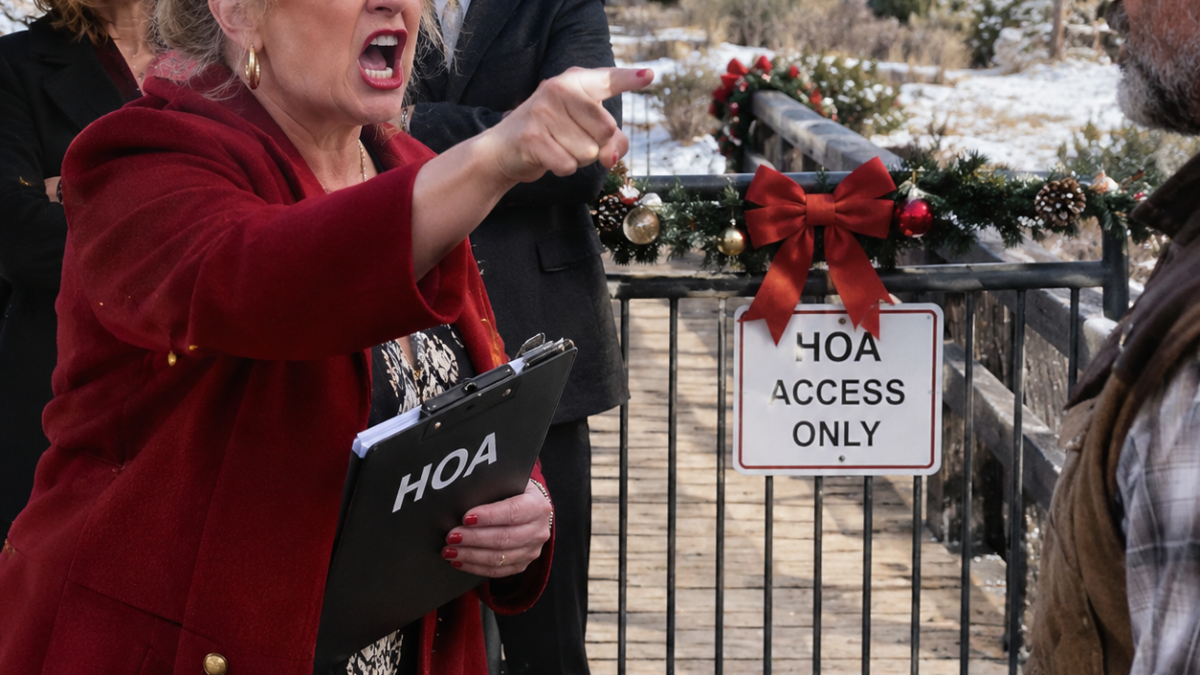
PART 2
The sentence was buried in Exhibit D, four pages from the end of the original Silver Pines declaration.
Elias read it aloud.
“‘The association shall have no authority to regulate, restrict, or control any privately owned improvement located outside the designated common areas.’”
I read it again myself.
Then a third time.
Elias pulled the county plat from the stack and spread it beside the declaration.
Silver Pines common areas were shaded green.
The neighborhood streets were green.
The clubhouse parcel was green.
The landscaped strips around the entrance were green.
My bridge wasn’t.
Neither was the southern approach.
Neither was the forty feet of gravel where Maribel’s contractor had poured concrete for her gate.
Elias tapped the map.
“Your father knew exactly what he was doing.”
I leaned against the edge of his desk.
“He hated HOAs.”
Elias smiled.
“Apparently he hated future lawsuits even more.”
For the first time since seeing those steel bars across my driveway, some of the pressure in my chest eased.
Then Elias raised a finger.
“Don’t get comfortable.”
I looked at him.
He pulled another folder from my box.
“These are the old board minutes you asked the county for?”
“Yeah.”
He started turning pages.
Three years earlier, the Silver Pines board had held a closed planning session. The minutes were brief, but one item jumped off the page.
Proposed acquisition of Cutbank Creek Bridge and ranch access corridor.
I straightened.
“What?”
Elias kept reading.
The board had authorized a realtor to contact the owner of the Callahan Ranch regarding the possible purchase of the bridge and a right-of-way connecting Silver Pines to the county highway beyond my property.
I remembered the call immediately.
A young realtor had contacted me out of nowhere and asked whether I would consider selling “a small transportation easement” across part of my ranch.
He refused to identify his client.
I told him no.
The conversation lasted maybe four minutes.
By dinner, I had forgotten about it.
Elias had not forgotten the sentence in the minutes beneath it.
He rotated the page toward me.
“Read the purpose.”
I did.
My jaw tightened.
The HOA wanted a second entrance.
Silver Pines had one paved road connecting the subdivision to the state route. A second road across my ranch would cut nearly twenty minutes off the commute for homeowners on the western side.
But there was more.
The minutes mentioned future development potential.
“What development?”
Elias pulled out the county map again.
Silver Pines ended just east of my boundary.
Beyond its northern edge sat several hundred acres of undeveloped land.
If the association could establish reliable access across my bridge and ranch lane, those lots suddenly became far more attractive.
I looked at Elias.
“So this isn’t about security.”
“I seriously doubt it.”
“She tried to buy access. I said no. Three years later she puts up a gate.”
“And gives you a regulation to sign acknowledging her authority.”
I looked back at the document.
The whole thing seemed different now.
Yesterday, I had thought Maribel was trying to inconvenience me.
Now I understood she was trying to create a record.
A gate.
A keypad.
A registration system.
Fees.
Permission forms.
My signature.
Elias leaned back.
“She couldn’t get ownership, Wade. So she’s trying to establish control.”
“By making me use her gate.”
“Exactly.”
“And if I go along with it?”
“Today, you use a code. Next year, everyone remembers that Silver Pines has always controlled the bridge. A few years from now, somebody starts arguing about implied rights, historical practice, permission, access, reliance. Property disputes get ugly when facts are allowed to blur.”
I rubbed both hands over my face.
“What if I just tear the gate down?”
“Don’t.”
His answer came so quickly that I stopped.
“Why?”
“Because that gate is the one thing they unquestionably paid for.”
“It’s on my property.”
“And that matters. But Maribel wants this dispute reframed. Right now, she installed something on your land without permission. If you hook a chain to it and drag it across the subdivision road, tomorrow she has photographs of an angry rancher destroying association property.”
“I don’t care what the pictures look like.”
“A judge might.”
That shut me up.
Elias pointed to the letter I’d received from the HOA’s attorney that morning.
Bradley Pike of Randle and Pike.
The letter threatened $100-a-day fines if I interfered with the gate. It demanded that I preserve all “association security equipment.” It warned of damages, attorney fees, and suspension of bridge privileges.
Bridge privileges.
On my bridge.
I pushed the letter away.
“So what do I do?”
Elias was quiet.
Outside his second-floor office window, Christmas lights swung above Main Street. Snow moved sideways in the wind.
Finally he said, “You’re still thinking the fight is about the gate.”
“What else would it be about?”
“The bridge.”
I frowned.
He took off his glasses.
“You own the bridge, correct?”
“Yes.”
“Entirely?”
“Yes.”
“No easements?”
“None that I know of.”
“No recorded right of access in favor of Silver Pines?”
“No.”
“Your taxes?”
“I pay them.”
“Insurance?”
“Mine.”
“Maintenance?”
“Mine.”
“Then let me ask you something.”
He folded his glasses and placed them on the desk.
“What happens if there isn’t a bridge anymore?”
I stared at him.
He didn’t smile.
For several seconds, all I heard was the old radiator clicking against the wall.
“You’re telling me to destroy my own bridge?”
“No. I’m asking whether you’re legally allowed to remove your own structure.”
“That bridge is the only practical way into the ranch.”
“You have the forest route.”
“Forty minutes out of the way.”
“I didn’t say it would be convenient.”
I walked to the window.
Below us, people moved along the snowy sidewalk carrying shopping bags and wrapped boxes.
Christmas Eve was the next day.
My father’s bridge had stood over Cutbank Creek for almost thirty years.
I could still see him building it.
I had been fourteen, skinny and impatient, convinced every task he gave me was designed specifically to ruin my summer.
“Bring me the nine-sixteenths.”
I’d hand him the wrong wrench.
“That’s half-inch.”
“They look the same.”
“No, they don’t.”
“They’re both metal.”
He would stare at me until I laughed.
Then he’d shake his head and tell me I was going to starve if I ever had to make a living with tools.
That bridge had outlasted him by nine years.
After he died, I replaced boards when they split. I repainted the railings. I had the steel inspected. Every autumn, I cleared brush from the approaches because he had done the same thing.
Removing it felt wrong.
Elias seemed to read my face.
“I’m not telling you what decision to make.”
“It feels like letting her win.”
“Why?”
“Because she shows up with a gate, and I lose my father’s bridge.”
“You don’t have to lose it.”
I turned.
“What?”
“Disassemble it.”
I stared at him again.
“For maintenance. Inspection. Replacement if necessary. Preserve the components. Leave the abutments. You don’t need to blow the thing into the creek, Wade.”
Despite myself, I almost laughed.
Elias continued.
“If an engineer says the structure is due for work, that gives you a legitimate reason independent of this dispute. But before you touch one bolt, we confirm title. We confirm permitting. We confirm environmental requirements. We confirm there are no easements. And we notify everybody.”
“You think Maribel will believe I’d actually do it?”
“No.”
That was the first time Elias smiled.
“And that may be useful.”
I drove home after dark.
The HOA gate stood exactly where it had the night before, black against the snow, green keypad glowing.
The camera followed my headlights.
I stopped short of it.
For a minute, I sat with the truck idling.
Then I rolled down the window and looked through the bars.
I could see the first twenty feet of the bridge deck beyond them.
My father’s bridge.
My property.
Maribel’s gate.
I finally understood the mistake she had made.
She had chosen the one piece of my land she believed I couldn’t afford to stop using.
And she was betting everything on that belief.
The next morning—Christmas Eve—Elias began a second title search.
I called Nora Whitaker.
Nora was a structural engineer from Livingston who had inspected county bridges for fifteen years before opening her own practice. I’d hired her twice before to look at ranch structures, and she had the useful habit of answering questions with facts instead of opinions.
She arrived before ten wearing insulated coveralls under a heavy coat.
I met her on the ranch side.
She stared across the creek at the steel gate.
“That new?”
“Very.”
“Yours?”
“No.”
She looked at me.
“That sounds interesting.”
“It’s becoming interesting.”
For almost two hours, Nora inspected the bridge.
She tested timber.
Photographed connections.
Measured deck wear.
Checked rust around bolts.
Crawled beneath the approach with a flashlight.
When she climbed back up, she wiped her gloves on her pants.
“The steel is serviceable.”
“That’s good.”
“The decking is not.”
“How bad?”
“Not emergency bad. But your father used good timber, and good timber still gets old. You’ve got surface deterioration, several boards approaching replacement, and enough hidden moisture that I wouldn’t argue with a full redeck.”
“Could the bridge reasonably be disassembled for inspection?”
She looked at me for a long second.
“You’re planning something.”
“I’m asking an engineering question.”
She glanced toward the gate again.
Then she smiled.
“Yes. It can be disassembled. Carefully.”
By noon, she had sketched a removal sequence.
The abutments would remain untouched.
No machinery would enter the creek.
Deck boards would be lifted toward the ranch.
Steel spans could be craned onto timber cribbing in my pasture.
Every major component would be labeled, photographed, and preserved.
“This isn’t demolition,” Nora said. “If you follow this plan, it’s controlled disassembly.”
Exactly the phrase I needed.
Elias called at 12:17.
“Title is clean.”
“No easement?”
“None.”
“No bridge rights?”
“None.”
“Nothing?”
“Nothing, Wade. Silver Pines has exactly as much ownership interest in your bridge as I do.”
I looked across the creek.
The red light on Maribel’s camera blinked.
“All right.”
“You sure?”
“No.”
That surprised him.
I could hear it in the silence.
Then I said, “But I’m doing it.”
By two that afternoon, I had hired Hank Brewer and four men from a heavy-equipment crew I trusted.
Hank listened to the plan with his arms folded.
“You want this whole thing apart starting at midnight?”
“Yes.”
“On Christmas?”
“Yes.”
“In the snow?”
“If conditions are safe.”
He looked at Nora.
She nodded.
Hank scratched his beard.
“Your family Christmases always this cheerful?”
“I live alone.”
“Well. Mine doesn’t start until nine.”
He held out his hand.
“We’ll be here.”
The practical problems came next.
I needed feed.
Without the bridge, my normal hay deliveries would be impossible until I restored access.
So I called my supplier and had a month’s worth hauled in that afternoon.
I topped off diesel.
Moved equipment.
Checked the forest route.
Placed barricades at my side of the bridge.
Mounted two cameras of my own.
Then Elias prepared the notice.
It was deliberately boring.
No accusations.
No mention of Maribel.
No threats.
It stated that the privately owned Cutbank Creek Bridge would be closed beginning at midnight on December 25 for maintenance, disassembly, inspection, and repair.
The closure would continue until further notice.
Elias emailed it to the HOA.
He emailed Bradley Pike.
He sent certified copies.
Then, because he knew Maribel would later claim she hadn’t seen it, he drove to the clubhouse and handed her one personally.
He called me afterward.
“She laughed.”
“What did she say?”
“That you won’t do it.”
I looked out my kitchen window toward the barn.
“Anything else?”
“She said you’re bluffing.”
“That all?”
“No. She has an emergency HOA meeting tonight.”
I glanced at the clock.
“About me?”
“I imagine you’ll be the entertainment.”
“You going?”
“No.”
“Neither am I.”
At six that evening, while the residents of Silver Pines gathered beneath the clubhouse Christmas tree, I was standing beside Cutbank Creek.
I learned later what Maribel told them.
People gave me copies of the meeting notes. Two residents described the speech almost word for word.
She called the gate a holiday security improvement.
She said Silver Pines faced “unregulated commercial traffic.”
That meant my feed trucks.
She said I had benefited from community roads without showing “community cooperation.”
That meant I paid my assessment and otherwise minded my own business.
Then she held up Elias’s maintenance notice.
According to three people in the room, she smiled.
“Mr. Callahan is attempting to intimidate this board by pretending he will remove a bridge he depends on every day.”
Several people laughed.
Gary Pruitt, who lived in the stone house nearest the creek, apparently said, “Let him try.”
I didn’t hear any of that until later.
At the time, I was standing alone on the bridge with snow beginning to fall.
I rested one hand on the railing.
The timber was cold beneath my glove.
For a moment, I could see my father exactly where he had stood in the summer of 1996.
Sunburned neck.
Sweat-darkened shirt.
A wrench hanging from his right hand.
We had stopped for lunch one afternoon and sat on the tailgate eating sandwiches.
The steel beams were new then, shining in the sun.
I had complained about having to spend another Saturday working.
He nodded toward the bridge.
“One day this’ll be yours.”
“I don’t want a bridge.”
“You will when you need to cross the creek.”
“I’ll buy a helicopter.”
“With what money?”
“I’ll be rich.”
He laughed.
Then he said something I had almost forgotten.
“Never ask somebody else for permission to use what’s yours.”
At fourteen, I thought he was talking about tools.
Standing there twenty-eight years later, I knew better.
At 11:45 that night, Hank’s crew arrived from the upper barn.
The crane came first.
Then the excavator.
Then two flatbeds.
Portable floodlights turned the snow bright white.
Nora checked wind speed and temperature.
Hank walked the site.
I checked the cameras.
At 11:58, my phone rang.
Maribel.
I stared at her name.
Hank looked at me.
“You answering?”
“Yeah.”
I put it on speaker.
“Wade.”
“Maribel.”
“What exactly are you doing?”
I looked toward the camera she had installed.
“I sent notice.”
“This is association infrastructure.”
“No, it isn’t.”
“If you damage that gate—”
“I’m not touching your gate.”
She stopped.
That silence told me more than any argument could have.
Finally she said, “You cannot remove access to this community.”
“I’m not removing community access.”
“You know exactly what I mean.”
“I know exactly what I own.”
Her voice hardened.
“You are going to regret turning this into a war.”
I looked at the clock on my phone.
11:59.
“No, Maribel.”
The minute changed.
12:00.
“I’m ending one.”
I hung up.
Hank raised his eyebrows.
“Christmas.”
“Christmas.”
He turned toward his crew.
“Let’s work.”
The first thing they removed was the timber railing.
No smashing.
No ripping.
Every bolt came out deliberately.
Each section was tagged and loaded onto the ranch-side flatbed.
Then came the deck boards.
Some protested with long creaks as pry bars lifted them from the steel.
Others came free cleanly.
I carried the first one myself.
It weighed more than I remembered.
Hank saw me struggling.
“You own a crane.”
“Shut up.”
He laughed.
By one-thirty, half the deck was gone.
The creek moved beneath us, black and fast between snow-covered banks.
That was when headlights appeared on the subdivision road.
A vehicle stopped behind the HOA gate.
White SUV.
Maribel.
She stepped out wearing boots and a long coat.
Her camera had clearly alerted her.
She came to the bars.
“What are you doing?”
No one stopped working.
I walked toward her across the remaining deck.
We were separated by the gate.
“You know what I’m doing.”
“You cannot do this.”
“I am doing it.”
“This bridge serves Silver Pines.”
“It serves my ranch.”
“We have a legitimate interest.”
“Then show Elias the easement.”
“This is reckless.”
“Then you’ll be relieved to know I hired an engineer.”
Nora raised one gloved hand from the far side.
Maribel stared at her.
Then at the crew.
Then at the labeled timber.
This was the moment she finally understood it wasn’t theater.
Her face changed.
“You planned this.”
“Yes.”
“You’re cutting off your own ranch to make a point.”
“I have another route.”
“That forest road is forty minutes away.”
“I know. I drove it because of you.”
She gripped one of the bars.
“I can get an injunction.”
“Then call your lawyer.”
“I will.”
“Good.”
I turned away.
“Wade.”
I stopped.
“If you take that bridge down, I will make sure you pay to put it back.”
I looked at her through the gate.
“You keep talking like it’s yours.”
She said nothing.
“That’s the problem.”
I walked back toward the crew.
Maribel stayed another twenty minutes.
She called someone.
Probably Bradley Pike.
Whatever he told her didn’t stop us.
She eventually got back into her SUV and left.
At two in the morning, the deck was gone.
Only the steel remained.
Nora inspected the rigging twice.
Hank inspected it a third time.
The crane took the weight of the first main span.
“Clear.”
Chains tightened.
Steel groaned against its bearings.
For nearly three decades, that beam had rested in the same place.
Then it moved.
Slowly.
An inch.
Three inches.
A foot.
It rose into the floodlights with snow collecting on its upper edge.
I felt something unexpectedly painful in my chest.
Not regret.
Not exactly.
It was the realization that an object could hold thirty years of your life without you noticing until you watched it leave the ground.
The crane swung the beam toward the ranch.
Hank’s crew guided it onto timber cribbing in the pasture.
The second span came out forty minutes later.
The third just before four.
Nothing entered the creek.
Nothing touched Maribel’s gate.
Nothing damaged the abutments.
At 4:07 on Christmas morning, the Cutbank Creek Bridge was gone.
I stood at the northern concrete abutment with my hands in my coat pockets.
Sixty feet of empty air separated me from the opposite bank.
And directly across that empty space stood Maribel’s beautiful new ten-foot security gate.
Keypad glowing.
Camera blinking.
Protecting absolutely nothing.
Hank came beside me.
“Well.”
I looked at him.
“That’s one hell of a gate.”
I laughed for the first time in three days.
By seven, the crew was gone.
The steel was stacked in my pasture.
The good timber was tarped.
Nora’s documentation filled a binder.
I went inside, showered, and made coffee.
While I was standing at the kitchen counter, Elias drove into Silver Pines.
He later told me exactly what he did.
He entered the clubhouse using a key he still had from an old easement matter and placed a thick envelope on the boardroom table in front of the president’s chair.
Inside were certified copies of my deed.
The county plat.
My father’s original building permit.
Property tax records.
Insurance records.
Exhibit D.
And a formal legal demand.
The association had ten days to remove its gate and both cameras from my private property.
Any future HOA employee, contractor, officer, or agent entering my ranch without written permission would be treated as a trespasser.
Any attempt to assert control over my bridge, approach, or ranch lane would be challenged in district court.
Elias left before anyone arrived.
Gary Pruitt discovered the missing bridge first.
His kitchen window faced the creek.
At 8:13 Christmas morning, my phone started receiving messages.
The first came from a neighbor named Carl Jennings.
Wade, is the bridge actually gone?
I wrote back.
Maintenance.
Thirty seconds later:
You actually took it down?
Inspection too.
He responded with three dots.
Then:
Merry Christmas, I guess.
By 8:30, I could see people gathering on the far bank.
Parents.
Kids.
Neighbors in bathrobes under winter coats.
Gary was there.
So was Dale Hutchins, the HOA treasurer.
At 8:40, Maribel’s white SUV arrived.
I watched from my side through binoculars.
She pushed through the small crowd and stopped at her gate.
The expression on her face was worth every hour I had spent on the forest road.
She walked right up to the bars.
Looked through them.
Looked down.
Looked across at me.
I raised my coffee mug.
She did not wave.
At noon, she found Elias’s envelope.
At 12:43, according to the timestamp, she emailed me.
SUBJECT: IMMEDIATE RESTORATION DEMAND.
The message accused me of unlawfully destroying “critical community infrastructure.”
It demanded that the bridge be rebuilt within thirty days at my expense under HOA supervision.
It announced that fines were accruing.
It warned that Silver Pines would seek damages.
I forwarded it to Elias.
His answer came five minutes later.
Merry Christmas.
That afternoon, he drafted a formal response.
It was less than half a page.
He asked the association to identify, by document, page, paragraph, and recording information, the legal instrument granting Silver Pines ownership or control of the Cutbank Creek Bridge.
That was it.
No insult.
No threat.
One question.
They never answered it.
Instead, Maribel began fighting somewhere else.
Public opinion.
For the next several days, I heard versions of myself I barely recognized.
I was reckless.
Hostile.
Antisocial.
Vindictive.
Dangerous.
I had supposedly endangered children by “destroying a transportation route.”
What transportation route?
No Silver Pines resident had a legal right to drive across my bridge.
But facts were slower than gossip.
Gary cornered me at the mailbox on December 27.
“You happy now?”
I shut my mailbox.
“About what?”
“You’ve made the whole place look ridiculous.”
“I didn’t install the gate.”
“You didn’t have to remove the bridge.”
“I didn’t have to keep it either.”
He stepped closer.
“This is what I’m talking about. You don’t care about anyone except yourself.”
I felt the old temptation rise.
Tell him about the county road washout five years earlier when I let half the subdivision cross my ranch for eleven days.
Tell him about the wildfire evacuation when I left my back gate open for every family who needed another route.
Tell him about the snowstorm when I used my tractor to pull three Silver Pines vehicles from ditches and never charged anyone.
Instead I asked, “Gary, how much did you pay to build that bridge?”
His mouth tightened.
“How much did the HOA pay?”
He looked past me.
“How much did you spend maintaining it?”
“That isn’t the point.”
“It became the point when your president put a gate on it.”
He shook his head.
“You’re going to lose in court.”
“Maybe.”
That threw him.
“You don’t sound very worried.”
“I hired a lawyer so he could worry for me.”
I got in my truck.
That night, Elias called.
“We need to change the temperature.”
“What does that mean?”
“Maribel has had four days to tell everyone her version.”
“Let her.”
“No. Because your dispute isn’t with 112 homeowners. It’s with one board that acted beyond its authority.”
“So?”
“So we show them the documents.”
Two days later, every household in Silver Pines received a four-page letter.
Elias wrote it in language anyone could understand.
He explained the property boundary.
He attached the plat.
He explained that my father built the bridge.
He attached the permit and receipts.
He explained that my family had paid its taxes, insurance, maintenance, and repairs for almost three decades.
He attached records.
Then he quoted Exhibit D.
The association shall have no authority to regulate, restrict, or control any privately owned improvement located outside the designated common areas.
Finally, he included the board minutes from three years earlier.
The ones proving Maribel had tried to buy the bridge.
People began calling me.
Not many.
Three the first day.
Seven the next.
One was Carl Jennings.
“I owe you an apology.”
“You don’t owe me anything.”
“I voted to support the gate.”
“That was your vote.”
“I believed it belonged to the HOA.”
“So did a lot of people.”
“Maribel never told us they tried to buy it.”
“No.”
“Why would you try to buy something you already owned?”
That was the question.
Once people started asking it, Maribel’s story weakened fast.
At an informal gathering in the clubhouse on December 30, Dale Hutchins asked her about the old purchase attempt in front of a dozen residents.
I wasn’t there.
Carl called me afterward.
“What did she say?”
“That it was exploratory.”
“What does that mean?”
“No idea.”
“Did she explain why she never disclosed it?”
“No.”
“Did she explain the gate?”
“She said the board had broad authority to protect community interests.”
“That isn’t an answer.”
“I know.”
He paused.
“People are getting angry.”
I sat at my kitchen table.
For several days, I had wanted exactly that.
Then, unexpectedly, I didn’t.
“Carl.”
“Yeah?”
“Don’t turn this into a mob.”
He was quiet.
“She deserves consequences.”
“Maybe. But facts are enough.”
That surprised me too.
Maybe because the bridge was already gone.
Maybe because once I had stopped asking Maribel for permission, I no longer needed her humiliation either.
New Year’s Eve arrived cold and clear.
At four in the afternoon, I was closing the barn when I saw an unfamiliar sedan parked outside my back gate.
An older woman sat behind the wheel.
I walked down.
She rolled her window open.
“Mr. Callahan?”
“That’s me.”
“My name is Ruth Delaney.”
I recognized it.
Former Silver Pines secretary.
She had stepped down the previous spring.
“I know who you are.”
She nodded.
“I thought you might.”
She held out a folded sheet of paper.
“What’s this?”
“Something I should have given you sooner.”
I didn’t take it immediately.
Ruth looked tired.
Not frightened.
Just tired.
“You should read it.”
I accepted the page.
It was a printed email.
From Maribel.
Four years earlier.
To the Silver Pines board.
The subject line read:
CUTBANK ACCESS STRATEGY.
I read the first paragraph.
Then the second.
My hand tightened around the paper.
The email outlined a sequence.
First, approach the owner quietly regarding purchase of the bridge and right-of-way.
If he refused, wait.
Then establish a “security rationale.”
Install controlled access.
Provide the owner with a code.
Require registration.
Normalize HOA administration of the crossing.
The final sentence was short.
Once he gets used to asking, the bridge is ours in practice.
I looked at Ruth.
“You had this for four years?”
“Yes.”
“Why?”
“I printed board emails for the meeting packets. I saw that sentence and kept a copy.”
“Why didn’t you say anything?”
Her eyes dropped.
“Because Maribel was good at making every objection sound unreasonable.”
“That isn’t an answer.”
“No.”
She looked back at me.
“The answer is I was a coward.”
I didn’t know what to say to that.
Snow crunched beneath my boots as I shifted my weight.
Ruth continued.
“She never said, ‘Let’s steal Wade Callahan’s bridge.’ She talked about planning. Safety. Future access. Community benefit. Every step sounded small when you heard it by itself.”
“Until there was a gate.”
“Yes.”
She swallowed.
“When I saw the bridge gone Christmas morning, I knew exactly why you had done it.”
I folded the paper.
“Does anyone else have this?”
“I don’t know.”
“Would you be willing to say where it came from?”
“Yes.”
“In writing?”
She hesitated.
Then nodded.
“Yes.”
That changed everything.
Elias nearly shouted when I read him the email over the phone.
“Do not lose that page.”
“I’m standing in my driveway.”
“Go inside.”
“It’s paper, Elias.”
“Go inside, Wade.”
I laughed.
“All right.”
“And scan it.”
“I will.”
“And photograph it.”
“Yes.”
“And put the original somewhere safe.”
“Yes, Mom.”
“I’m serious.”
“So am I.”
His voice lowered.
“That sentence proves intent.”
“I know.”
“No. It does more than that. It answers the question they’ve avoided since Christmas. They knew the bridge wasn’t theirs. They weren’t mistaken. They were trying to create practical control after failing to buy it.”
I looked at the folded email on my table.
For the first time, Maribel’s behavior made complete sense.
The gate had never been the destination.
It was a first step.
On January 2, more than half of Silver Pines homeowners signed a petition demanding a special meeting.
The bylaws required the board to honor it.
The meeting was scheduled for January 8.
During the days before it, Maribel became quieter.
The HOA’s attorney became much quieter.
Bradley Pike called Elias on January 3.
I happened to be in Elias’s office when it happened.
Elias put the call on speaker.
“Brad.”
“Elias.”
“Happy New Year.”
A pause.
“Likewise.”
Bradley sounded nothing like the man who had written me a letter threatening $100-a-day fines.
“I understand your client has acquired additional correspondence.”
“I understand your client wrote it.”
Another pause.
“We should discuss resolution.”
I looked at Elias.
He looked at me.
“What kind of resolution?” he asked.
“Restoration of bridge access, withdrawal of certain disputed assessments, mutual releases.”
Elias leaned back.
“Which disputed assessments?”
“The fines.”
“The fines your client lacks authority to impose?”
“I’m not going to debate wording.”
“That seems unfortunate for a lawyer.”
Bradley sighed.
“Elias.”
“Yes?”
“Your client took down a bridge on Christmas.”
“My client removed his privately owned bridge for documented maintenance after written notice.”
“You and I both know why.”
“And you and I both know why your client installed a gate on land she didn’t own.”
Silence.
Bradley changed direction.
“What does Callahan want?”
Elias looked at me.
I answered before he could.
“My property back.”
Bradley heard me.
“Wade?”
“I’m here.”
“What does that mean?”
“Gate gone. Cameras gone. Concrete removed. Gravel repaired. Every fine withdrawn. Written acknowledgment that the HOA has no ownership, easement, or authority over my bridge or approach.”
“And the bridge?”
“That’s mine.”
“Will you rebuild it?”
“That’s my decision.”
Bradley exhaled.
“There are community interests here.”
“Community interest isn’t ownership.”
He didn’t answer.
I added, “And I want my legal fees.”
“That may be difficult.”
“So was driving forty minutes around a mountain because your client blocked my driveway.”
Elias covered his mouth to hide a smile.
Bradley said he would speak to the board.
We heard nothing for three days.
Then came January 8.
The clubhouse parking lot was full twenty minutes before the meeting.
I had avoided every HOA meeting for years.
Now I was walking into one carrying a brown accordion folder under my arm.
Elias came with me but stopped at the door.
“This part is yours.”
“You’re not coming in?”
“I’ll sit in the back.”
“Why?”
“Because they need to hear from their neighbor before they hear from his lawyer.”
I nodded.
Inside, almost every chair was occupied.
People stood along the walls.
Maribel sat at the head table.
Beside her was Frank Oakley, vice president of the association and a retired highway engineer.
Dale Hutchins sat on the other side.
Gary Pruitt stood near the back.
When I entered, conversations stopped one by one.
Maribel watched me walk down the aisle.
Her face gave nothing away.
I took a seat in the front row.
At seven, she called the meeting to order.
She started with the language I had come to recognize.
Community safety.
Shared responsibility.
Difficult decisions.
Protecting property values.
Then she said, “Everything this board has done was undertaken in good faith for the benefit of Silver Pines.”
A man behind me whispered, “Here we go.”
Maribel continued.
“The dispute concerning the Cutbank Creek crossing has unfortunately been sensationalized.”
I raised my hand.
She saw it.
Ignored it.
Frank Oakley leaned toward her.
“Maribel.”
“I’ll take comments after the board statement.”
“This is a member-called meeting.”
Her jaw tightened.
Frank turned toward me.
“Mr. Callahan?”
I stood.
“I’m not a Silver Pines voting member.”
A few people laughed softly.
I walked to the front and placed my folder on the table.
“I won’t take long.”
Maribel spoke without looking at me.
“This is highly irregular.”
“So was pouring concrete in my driveway.”
The room went silent.
I opened the folder.
The first document I laid down was the county plat.
“This is the recorded property map.”
I pointed to the boundary.
“The bridge is here.”
Then the original permit.
“My father’s building permit. 1996.”
Then invoices.
“Steel. Concrete. Timber.”
Then tax records.
“Twenty-eight years.”
Insurance.
“Same.”
Maintenance.
“Same.”
I looked around the room.
“Not one of these documents contains the words Silver Pines Homeowners Association.”
No one interrupted.
I placed Exhibit D on top.
“Your own declaration says the association has no authority to control privately owned improvements outside common areas.”
Maribel finally spoke.
“Documents are subject to interpretation.”
Elias shifted in the back row but stayed silent.
I nodded.
“Then interpret this.”
I placed Ruth’s email down.
Maribel saw it.
For the first time that evening, her expression broke.
Only slightly.
But I saw it.
So did Frank.
He reached for the page.
“Where did this come from?”
“Former secretary Ruth Delaney.”
Maribel’s hand moved.
“Frank—”
He held up one finger.
He read.
Slowly.
Dale leaned over his shoulder.
Then Frank reached the last sentence.
His eyes stopped.
He read it again.
“What does it say?” someone called.
Frank looked toward Maribel.
She stared straight ahead.
“Read it,” another homeowner said.
Frank did.
“‘Once he gets used to asking, the bridge is ours in practice.’”
The room changed.
Not loudly.
That was the strange part.
No one shouted.
No one gasped dramatically.
The air simply seemed to leave the place.
Maribel sat completely still.
I turned toward the residents.
“I didn’t take the bridge down because I hate any of you.”
I glanced at Gary.
“Most of you have crossed my land at one time or another. When the county road flooded, I let people through. During the wildfire evacuation, my back gate stayed open. I never asked for money.”
Then I faced Maribel.
“But you put a gate on my property. You put a camera facing my home. Then you handed me a document asking me to acknowledge that you controlled what my father built.”
“You inconvenienced an entire community,” she said.
Her voice remained steady, but one hand had tightened around her pen.
“Families. Children. During Christmas.”
“Inconvenience doesn’t create ownership.”
The words came out quieter than I expected.
But everyone heard them.
Carl Jennings stood from the third row.
“I have one question.”
Maribel looked relieved to have someone else speaking.
“Did you know the bridge belonged to Wade when you authorized the gate?”
Silence.
Carl repeated it.
“Did you know?”
Maribel folded her hands.
“There were competing interpretations regarding access responsibilities and longstanding community—”
“Yes or no?”
She looked at Frank.
Then Dale.
Neither helped her.
“I believed the association had a legitimate interest.”
“That’s not what I asked.”
Someone behind Carl said, “Answer him.”
Maribel’s composure began to crack.
“You are reducing a complex matter to—”
“Did you know?”
Frank Oakley picked up the old email.
His voice was calm.
“Maribel.”
She looked at him.
“You tried to buy the bridge four years ago.”
“That was exploratory.”
“Then you wrote this after Wade refused.”
“I wrote a planning discussion.”
“You specifically describe establishing control.”
“I described securing access.”
“Over something we did not own.”
Her chair scraped back.
“Frank, if you intend to turn this into an ambush—”
“I intend to understand what the board did.”
“I was protecting the future of this community.”
Frank looked down at the email.
Then at the plat.
Then at me.
Finally he faced the room.
“Under Section Nine of the bylaws, I move that the president’s authority over all matters related to the Cutbank Creek property dispute be suspended immediately pending full board and independent legal review.”
Maribel stared at him.
“You cannot be serious.”
“I am.”
Dale seconded the motion.
The vote happened by show of hands.
Eighty-one households in favor.
Nine opposed.
The rest abstained.
Frank counted twice.
Then announced the result.
Maribel sat with both hands flat on the table.
No applause followed.
I was glad.
I hadn’t come for applause.
Something larger than embarrassment had happened.
A board that had spent years automatically following one person had finally told her no.
After the meeting, Gary caught me near the door.
I expected another argument.
Instead, he shoved both hands into his coat pockets.
“I was wrong.”
I waited.
He looked embarrassed.
“I thought you were just being difficult.”
“I was being difficult.”
He almost smiled.
“You know what I mean.”
“I do.”
He glanced toward the front, where homeowners surrounded Frank and Dale.
“She told us the gate was temporary security.”
“I know.”
“I should’ve asked more questions.”
I looked at him.
“So should a lot of people.”
He nodded.
Then he walked away.
Elias joined me outside.
Snow had begun falling lightly.
“You did well.”
“I almost punched Gary three weeks ago.”
“But you didn’t.”
“Growth.”
He laughed.
Then his expression turned serious.
“Don’t assume this is over.”
“I don’t.”
“Good.”
The next several weeks were quieter but more complicated.
The board appointed a review committee.
Bradley Pike stopped threatening me.
Instead, he began sending phrases like proposed resolution framework and mutual settlement position.
The association’s insurer became involved.
So did an independent attorney.
Records were reviewed.
Invoices were reviewed.
The gate contract was reviewed.
That created another problem for Silver Pines.
Maribel had authorized installation before obtaining a complete boundary confirmation.
The contractor had apparently relied on an old subdivision sketch that did not show my survey pins clearly.
That didn’t excuse the HOA.
But it explained why two workmen had confidently poured concrete on land that wasn’t theirs.
The contractor removed the second camera first.
I watched from my kitchen window as they unbolted the pole that had been aimed toward my house.
Two days later, the big gate came down.
I drove around through the forest just to see it.
The crane lifted the black steel panel from its posts.
For a moment, it hung in the air above the driveway.
Then it was lowered onto a trailer.
The keypad followed.
The camera followed.
Finally, the concrete footings were broken out.
Fresh gravel went down.
When the crew finished, the approach looked almost the way it had before Christmas.
Almost.
By the end of January, we had a settlement.
Silver Pines withdrew every fine.
It retracted its public statements describing me as a safety threat.
A written correction went to all 112 households.
The association agreed to pay a substantial portion of my legal expenses.
Most importantly, it signed a recorded acknowledgment with the county.
The bridge.
The approaches.
The ranch lane.
All private Callahan Ranch property.
No HOA ownership.
No easement.
No control rights.
No implied authority.
Nothing.
Frank insisted on one additional policy.
From then on, any HOA action affecting private land had to be reviewed by an independent attorney and approved by a membership vote before work began.
I liked that more than any apology.
Rules were easy to bend when only one person got to interpret them.
Procedures forced people to slow down.
Maribel resigned as president at the end of January.
She cited personal reasons.
No one publicly celebrated.
At least not around me.
She stayed in Silver Pines and remained an ordinary board member for a while.
The day the settlement documents were signed, I saw her at Elias’s office.
She arrived alone.
No cream blazer.
No HOA folder.
No silver pine seal.
Just a winter coat and a leather purse.
Bradley Pike handed her the acknowledgment requiring her signature because she had been president when the gate was authorized.
She read every page.
Then signed.
When she finished, she put down the pen.
Everyone else began gathering documents.
She didn’t move.
Finally she looked at me.
“I did what I thought was right.”
Elias glanced toward me but said nothing.
Maribel continued.
“For the neighborhood.”
I believed that she believed it.
That was what made the whole thing more troubling.
She hadn’t woken up one morning thinking, I’m going to steal Wade’s bridge.
She had convinced herself that the HOA’s needs justified one more small step.
Then another.
Then another.
Until my property line became an obstacle rather than a boundary.
I answered carefully.
“Maybe you did think it was right.”
Her eyes stayed on mine.
“But good intentions don’t turn somebody else’s property into yours.”
She looked down.
For once, she had no answer.
After she left, Elias leaned back in his chair.
“That might be the first time I’ve ever heard you sound diplomatic.”
“Don’t spread it around.”
February brought a different problem.
Silver Pines still wanted a second route to the highway.
Now that everyone understood my bridge wasn’t available, the new board dusted off an old subdivision plan.
Along the eastern boundary was a strip of common land originally reserved for a future emergency access road.
It had been sitting unused for decades.
Frank called me.
“We’re surveying the eastern corridor.”
“Good.”
“We need temporary access to one corner of your ranch to set county control points.”
I paused.
A few months earlier, I would have said yes immediately.
Instead I asked, “How many people?”
“Two surveyors.”
“Which days?”
“We’re flexible.”
“Names?”
He laughed softly.
“You learned your lesson.”
“I learned it before Christmas. Christmas just made it expensive.”
Frank gave me the names.
Elias drafted a temporary license.
Two named surveyors.
Four specific dates.
Specific hours.
Specific route.
No vehicles outside the marked area.
No continuing easement.
No implied permission.
Automatic expiration.
Frank signed it.
I signed it.
Everything clear.
Everything on paper.
Everything done with permission.
That felt better than a handshake.
On the final survey day, I was repairing a fence when a white SUV stopped outside my back gate.
Maribel stepped out.
I set down my pliers.
She stayed on the county side.
Didn’t touch the gate.
Didn’t call my name until I was halfway down the lane.
“I won’t keep you.”
She held up a plain white envelope.
My name was handwritten across the front.
No HOA letterhead.
No seal.
I opened the gate but didn’t invite her through.
She didn’t seem to expect me to.
“This is for you.”
I took it.
“What is it?”
“Something I should have said before.”
I looked at the envelope.
“You could say it now.”
She shook her head.
“I’ll say it badly.”
For some reason, that made me smile.
“Fair enough.”
She started toward her SUV.
“Maribel.”
She turned.
“Thank you.”
Her face tightened for just a second.
Then she nodded and drove away.
I read the letter that night beside the wood stove.
It was short.
She wrote that for eight years she had convinced herself that order was kindness.
That control was responsibility.
That every disagreement represented a problem she needed to solve for everyone else.
She admitted that somewhere along the way she had stopped seeing the people affected by HOA decisions as neighbors and had started seeing them as obstacles.
Then she wrote about Christmas morning.
She said she had stood at the gate looking across sixty feet of empty air and felt something she had not expected.
Not anger.
Embarrassment.
She had finally seen the absurdity of what she had done.
She had built a gate to control something that was never hers, and I had made that gate meaningless without touching it once.
The last line said:
I’m sorry about your father’s bridge.
I sat there for a long time.
That sentence hit harder than the others.
The bridge had become evidence in a dispute.
A bargaining chip.
A symbol.
An HOA issue.
But before any of that, it had been my father’s work.
I folded the letter.
Put it on the mantel.
And left it there.
Spring came late.
Cutbank Creek swelled with snowmelt in April, dark water pushing hard against the banks.
By May, the level dropped enough for work.
For months people had asked whether I planned to rebuild.
I never answered.
Not because I was trying to make a point.
I genuinely didn’t know.
The old bridge could have been reassembled.
Much of the steel remained usable.
Some timber could be replaced.
But every time I looked at the dismantled pieces in the pasture, I realized I didn’t want to restore the bridge exactly as it had been.
My father hadn’t built it because he worshiped old things.
He built it because he needed a good bridge.
So I sat at the same kitchen table where he had drawn his plans in 1996 and began sketching.
I am not an engineer.
My first drawing proved that.
When Nora saw it, she stared at the page.
“What?”
“Nothing.”
“What?”
“Are you planning for trucks to drive over this or under it after it collapses?”
I took the pencil away from her.
“Fine.”
She laughed.
Then we started over.
Galvanized steel beams.
Composite decking.
Reinforced old abutments.
Improved drainage.
Higher load capacity.
And one detail I refused to change.
The railings.
We sorted through the timber removed on Christmas.
A surprising amount remained sound.
The best pieces were milled.
Sanded.
Sealed.
Reused as the railings on the new bridge.
When I ran my hand across the finished wood months later, I could still find an old gouge near the center.
I remembered making it.
Fourteen years old.
Dropped wrench.
My father yelling from underneath.
“Did you just throw that at me?”
“No.”
“It landed six inches from my head.”
“Wind.”
“There is no wind.”
“Gravity?”
He laughed so hard he had to climb out.
I never repaired the gouge.
Some marks deserved to stay.
A licensed surveyor reset the property pins before construction finished.
Bright caps marked the boundary clearly.
Elias recorded the updated survey.
The new bridge maintenance agreement was almost comically precise.
Ownership: Callahan Ranch.
Maintenance: Callahan Ranch.
Insurance: Callahan Ranch.
Authority: Callahan Ranch.
No one else appeared anywhere.
The bridge was completed in September.
The first time I drove my pickup across it, I stopped halfway.
Cutbank Creek moved beneath the deck.
The rails caught the afternoon sun.
The truck idled softly.
For nearly nine months, entering the ranch from that side had required the long forest route.
Now the road was open again.
I expected triumph.
Instead, I felt relief.
There is a difference.
Triumph needs someone else to lose.
Relief only needs something wrong to be over.
By the time Christmas returned, the new bridge had already taken snow, rain, feed trucks, a veterinarian’s trailer, and one neighbor whose battery died on the far road.
I never installed a keypad.
I never charged a fee.
I never required forty-eight hours’ notice from friends.
But I did hang one gate at the ranch end.
A simple wooden farm gate.
Cedar posts.
Painted green.
Most days, it stood open.
On the top rail, I attached a small hand-lettered sign.
WELCOME WITH PERMISSION.
Elias saw it and laughed for almost a full minute.
“Subtle.”
“I tried subtle last year.”
On Christmas morning, exactly one year after the old bridge came down, fresh snow covered the ranch.
I carried coffee down to the creek.
The air was so cold that steam rolled from the cup.
The new bridge stretched clean and straight between the old concrete abutments my father had poured.
A vehicle approached from the back road.
Elias climbed out carrying a metal tin.
“My wife sent cookies.”
“Are they actually for me?”
“No. She assumes I’ll eat half before leaving.”
“Honest woman.”
He joined me at the railing.
For several minutes, neither of us talked.
Then he looked toward the water.
“You ever regret it?”
I knew what he meant.
“Taking the old bridge down?”
“Yeah.”
I thought about the question.
The old timber stacked in my pasture.
The midnight crane.
Maribel standing behind her gate.
My father teaching a skinny fourteen-year-old which wrench was which.
“No.”
Elias nodded slowly.
“I thought you might.”
“It cost me money.”
“A lot.”
“Time.”
“A lot.”
“Made half the neighborhood hate me for two weeks.”
“Gary might have lasted three.”
I smiled.
“But no.”
“Why?”
I rested both hands around the coffee cup.
“Because if I had cut her gate down, we would’ve fought about the gate.”
Elias waited.
“If I had signed the regulation, we would’ve fought later about whether I’d agreed.”
He nodded.
“If I’d kept arguing with Maribel about who had authority, she would’ve kept acting like the question was undecided.”
The creek rushed below us.
“So I stopped arguing over her rules.”
Elias looked across the bridge.
“That’s one way to put it.”
Movement caught my eye.
Someone was walking down the Silver Pines road on the opposite side.
Long gray coat.
Maribel.
She stopped near the new boundary marker.
Exactly at it.
Not one step beyond.
For a moment, the three of us simply stood there.
Then she raised her hand.
I raised mine.
She looked at the bridge.
“The new one is beautiful.”
Her voice carried across the water.
“Thank you.”
She nodded.
No argument.
No document.
No warning.
No demand.
Then she turned and walked back toward the houses.
Elias picked up the cookie tin.
“Coffee?”
“Kitchen.”
He headed toward the house.
I stayed.
Morning light came over the ridge and touched the bridge railings.
The salvaged timber turned gold against the snow.
I walked out onto the deck.
My boots made a hollow sound beneath me.
At the center, I stopped beside the old gouge in the railing.
For years, I had thought my father’s lesson was about stubbornness.
Never let another man tell you how to use what you built.
But standing there, I understood it differently.
He hadn’t taught me to fight over everything.
He had taught me to know where the line was.
Where my responsibility started.
Where somebody else’s authority ended.
And when permission mattered.
The people of Silver Pines had never really wanted a bridge.
They wanted control of a line they had no right to move.
Once the line was made clear again—in surveys, signatures, county records, and finally in the way Maribel stopped at the boundary that morning—there was nothing left to fight about.
Snow began falling.
Small flakes settled on the deck and the old timber rails.
Cutbank Creek kept moving beneath me, dark and cold and completely indifferent to property arguments, HOA meetings, lawyers, gates, or deeds.
Behind me, my wooden gate stood open.
The little sign moved slightly in the wind.
WELCOME WITH PERMISSION.
I took another drink of coffee and looked across the bridge my father had started, the bridge I had been forced to rethink, and the bridge that finally belonged to me without anyone pretending otherwise.
Then I walked home.
[END OF STORY]








