PART 2: HOA Forced Me to Tear Down the Wall Holding Up Their Parking Lot—Then One Rainstorm Exposed Everything
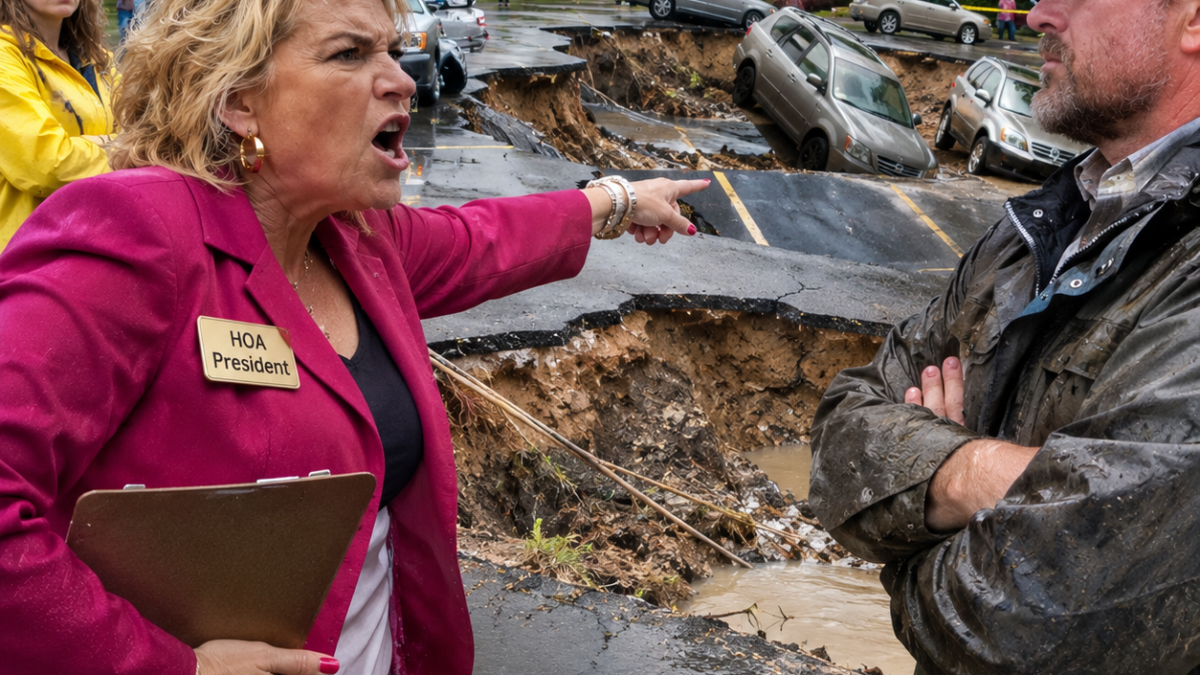
At 7:12 on a cold North Carolina morning, I stood in my own driveway while the president of our HOA pointed at the forty-two-foot limestone retaining wall I had built stone by stone eleven years earlier and calmly told me I had thirty days to tear it down, or the association would send a crew onto my property, remove it for me, and bill me for every minute of the work.
She smiled when she said it, as if she were ordering weeds pulled instead of demanding the removal of the only structure keeping a steep, rain-soaked hillside from pressing downhill toward the HOA’s parking lot, and when I reminded her that the wall had survived storms, inspections, and nearly a decade of board meetings without a single complaint, she simply tapped the violation letter and said, “Section 7.4B, Garrett—rules are rules.”
What Renata Osgood did not understand was that I had spent most of my life fixing electrical systems by tracing the failure backward to the point where somebody had ignored a warning, and before I touched a single stone in that wall, I intended to make sure there was a written record of exactly who had been warned, what they had been told, and who still chose to proceed.
My name is Garrett Callaway.
I’m a third-generation electrician from Hendersonville, North Carolina.
My grandfather wired houses in Henderson County before contractors carried tablets and laser measures. My father kept the business alive through two recessions, and I took over in 2009, which was about the worst possible year to inherit a small construction company unless you enjoy learning cash-flow management while everyone around you is going broke.
By 2012, Delia and I finally had enough stability to buy a home.
We weren’t looking for luxury.
Delia wanted a garden.
I wanted a porch big enough for two chairs and enough room to store tools without turning the garage into a maze.
We found both in Sycamore Hollow Estates.
Forty-seven homes climbed along a wooded hillside outside Hendersonville. Nothing about the place was fancy, but it was quiet, affordable, and close to town.
The HOA was almost invisible then.
Forty-eight dollars a month.
It maintained the entrance sign, two decorative lamp posts, the small clubhouse, and a common parking area at the bottom of the hill.
That was about it.
Our quarter-acre lot had one problem.
The backyard sloped hard toward the rear property line.
Beyond that line, several feet lower, sat the HOA parking lot.
The previous owners had done nothing about erosion. Every heavy rain carried red clay and topsoil downhill, leaving little channels behind and dumping sediment along the bottom edge of our yard.
I knew enough to recognize that ignoring it would eventually become expensive.
So one summer, I built a retaining wall.
Forty-two linear feet.
Dry-stacked limestone.
Three courses high.
Gravel drainage behind the face.
Compacted backfill.
Nothing decorative. Nothing oversized. Nothing remotely close to the property line.
I built it because the hill needed support.
The work took two weekends. I still remember limestone dust sticking to my arms, the smell of cut grass, and Delia bringing iced tea while asking why every project I called “a Saturday job” somehow consumed half a month.
Our neighbor Bert Aldridge leaned over the fence while I was setting the final course.
Bert was a retired civil engineer.
He looked at the drainage layer, kicked lightly at the compacted soil, then nodded.
“That wall will outlive both of us.”
“Cheerful thought.”
“I mean it as a compliment.”
For nine years, nobody complained.
Not one letter.
Not one warning.
Not one mention during any HOA meeting.
Then Renata Osgood became board president.
She had moved into Sycamore Hollow in 2019 and, within eighteen months, had turned a sleepy volunteer board into something that seemed to exist mainly to discover what homeowners were doing wrong.
Paint colors, basketball hoops, driveway cracks, trash cans left out too long—she called it “consistent enforcement.”
Delia called it something less polite.
My first letter from Renata was about a crack in my driveway apron.
I repaired it.
Then came the letter about the wall.
Three pages.
Thirty-day deadline.
Fifty dollars per day if I refused.
And one final sentence promising the HOA could exercise “self-help remediation” at my expense.
I read that sentence twice.
Then I looked through the kitchen window at the limestone holding back the hillside.
Delia came up beside me.
“What?”
I handed her the letter.
She read it.
Then looked at me.
“You’re going to fight this.”
“I’m going to read first.”
“That sounded worse.”
I folded the letter.
“Only for them.”
PART 2
The first thing I did was call Piedmont Property Solutions.
They were the management company the HOA paid to handle dues, notices, meeting schedules, and whatever other tasks the volunteer board didn’t want to touch.
A man named Terence answered.
I gave him my address.
There was a pause.
Then another pause.
That was never a good sign.
“I see the notice.”
“Did the board actually vote on this?”
“Yes, sir.”
“Unanimously?”
“No.”
“Who voted against it?”
Another pause.
“I probably shouldn’t—”
“Terence.”
He sighed.
“Walt Fincher.”
That made sense.
Walt was sixty-three, retired from commercial construction, and one of only two board members I knew personally.
“What did Walt say?”
“He raised concerns about the wall’s drainage function.”
“So the board knew it wasn’t decorative.”
“I can’t characterize the discussion.”
“Did anyone inspect the wall?”
“I don’t see an inspection report.”
“Engineer?”
“No.”
“Contractor?”
“Not that I have.”
“County?”
“No.”
“So three people looked at a photograph and decided a retaining wall needed to be demolished.”
“I wouldn’t phrase it that way.”
“How would you phrase it?”
Another silence.
“I’d file the appeal.”
“When is the next hearing?”
“Six weeks.”
“The removal deadline is thirty days.”
“I know.”
I laughed once.
Not because anything was funny.
“That’s convenient.”
“I don’t set the dates.”
“I know.”
I submitted the appeal the next morning.
Certified mail.
Return receipt.
I learned that habit from my father.
Dad didn’t trust important documents unless somebody had signed for them.
He used to say, “Memory gets creative when money is involved.”
I explained three points.
First, the wall had existed for nine years without complaint.
Second, it wasn’t cosmetic.
It controlled erosion and stabilized the slope.
Third, the covenant Renata cited dealt primarily with architectural and landscape alterations visible from common areas.
If the board wanted to classify a functional retaining structure as decorative landscaping, I wanted them to say so clearly.
I included a photograph taken from the HOA parking lot.
The wall was visible.
Barely.
A strip of limestone at the bottom of our slope.
I marked it with an arrow.
Delia watched me print the photograph.
“You’re giving them proof they can see it.”
“That’s the point.”
“How?”
“If they acknowledge the view, they acknowledge what’s between our hill and their parking lot.”
She smiled.
“Paperwork revenge.”
“Not revenge.”
“What is it?”
“Preparation.”
“That’s less fun.”
Eleven days later, my appeal was denied.
Not at a meeting.
Not by the full board in front of homeowners.
A letter.
HOA stationery.
Purple signature.
Renata Osgood.
The Architectural Review Committee had allegedly determined the wall did not qualify for retroactive approval.
I pulled the covenants.
Section 7.4B.
Then subsection 2.
The language was irritatingly clear.
Structures installed by current owners without prior architectural approval could not automatically claim grandfathered status merely because the HOA had failed to enforce the rule earlier.
Technically, they had an argument.
That didn’t make removing the wall sensible.
It just meant I couldn’t rely on “nobody complained for nine years.”
I walked outside.
Late October.
Leaves crackled under my boots.
The wall was exactly where it had been since 2012.
No bowing.
No displaced stones.
No visible washout.
I knelt and pulled a handful of gravel from behind one end.
Clean.
Free draining.
The system was working.
I ran my hand over the top course.
Cold limestone.
Eleven years ago, I had placed that exact stone while Delia sat on an overturned bucket eating watermelon.
I remembered because she’d complained that it looked crooked.
It still wasn’t crooked.
I called Walt.
He answered on the third ring.
“Tell me you didn’t call to ask whether Renata is reasonable.”
“I know better.”
“Good.”
“You voted against the removal.”
“Yes.”
“Why?”
“Because I’m not an idiot.”
“Technical answer?”
He laughed.
“Your backyard is a cut slope over common property.”
“I know.”
“That wall is interrupting soil movement and giving surface water somewhere to drain.”
“I know.”
“If they remove it, the slope becomes less stable.”
“How much less?”
“Can’t tell you from eyeballing.”
“How soon would it move?”
“Depends.”
“On?”
“Rain.”
I looked at the sky.
Clouds over the ridge.
“Could be years?”
“Yes.”
“Weeks?”
“Yes.”
“One storm?”
“If conditions are right.”
I wrote down his exact words.
Walt heard the pen.
“You documenting me?”
“Yes.”
“Good.”
“What would you do?”
“Hire somebody whose opinion has a stamp.”
That cost me nine hundred dollars.
Dr. Priscilla Vane arrived from Asheville on Tuesday morning in a white Ford pickup.
She was a geotechnical engineer.
Small woman.
Gray-streaked hair.
No patience for speculation.
I liked her immediately.
She walked the slope.
Measured grade.
Checked moisture.
Took soil samples.
Examined the wall drainage.
Asked when it had been built.
Asked what the hill looked like before.
Asked whether the HOA parking lot had ever shown settlement.
“Patch near the northwest corner,” I said.
“When?”
“2019, I think.”
She walked down to the common area.
Photographed the asphalt.
Then came back.
“Who built the wall?”
“I did.”
“You follow a design?”
“Basic dry-stack principles. Gravel drainage. Compacted lifts.”
She nodded.
“Better than some contractors.”
“I’ll put that on my website.”
“Don’t.”
Her report arrived five days later.
Twelve pages.
Charts.
Soil descriptions.
Photographs.
Slope diagram.
The important part was simple.
Under saturated conditions, the slope already had a limited margin of safety.
My retaining wall increased that margin.
Remove the wall and prolonged rainfall could result in shallow slope movement toward the HOA parking area.
She estimated the risk of failure under heavy saturation at roughly fifty-five to seventy percent over the following years, depending on rainfall and maintenance.
The most likely direction?
Downhill.
Toward the common parking lot.
Delia read the report.
“So now they stop.”
“Maybe.”
“You don’t believe that.”
“I believe rational people stop.”
“And Renata?”
I looked at her.
“Certified mail.”
I mailed copies to every board member.
Individually.
Piedmont Property Solutions.
Renata.
Walt.
The other directors.
Then the HOA’s liability insurance carrier.
That last one got Delia’s attention.
“You’re sending it to their insurance?”
“Yes.”
“Why?”
“Because if the board ignores an engineering warning and something fails, the insurer will care when they knew.”
“That is deeply unattractive.”
“What?”
“The way your face lights up when you say things like that.”
“I’ve been married to you twenty-eight years.”
“Exactly.”
Every envelope had tracking.
Every delivery had a signature.
Renata responded one week later.
One paragraph.
The board had reviewed the engineering submission.
Its prior decision remained unchanged.
Compliance required.
Deadline remained.
No discussion of slope risk.
No alternative drainage plan.
No proposal for an engineered replacement.
Just:
Take it down.
Walt called that evening.
“She called me.”
“I assumed.”
“Told me I need to support board determinations publicly.”
“What did you say?”
“I asked whether she wanted me to lie.”
I smiled.
“How’d that go?”
“She said my attitude was undermining board cohesion.”
“That sounds serious.”
“Garrett.”
His voice changed.
“She isn’t backing down.”
I looked through the kitchen window.
The wall sat beneath a dogwood.
Leaves moving in the wind.
Rain smell in the air.
“I know.”
“So what are you doing?”
I had spent two days thinking about that.
A lawsuit could cost thousands before anything happened.
Ignoring the deadline meant accumulating fines.
Letting them send a crew onto my property created a worse problem.
Then I realized Renata had already given me the cleanest path.
Compliance.
Exact compliance.
Documented compliance.
“I’ll remove it.”
Walt didn’t speak.
“Did you hear me?”
“I heard.”
“Every stone.”
“Garrett, that’s not—”
“You said the slope could move.”
“Yes.”
“Dr. Vane said the slope could move.”
“Yes.”
“The board received the report.”
“Yes.”
“The insurer received the report.”
Long silence.
Then Walt said:
“You’re going to let them own their decision.”
“I am going to comply with a written order after documenting the engineering objection.”
“That is the most electrician thing I’ve ever heard.”
“Thank you.”
“It wasn’t a compliment.”
The next call was to the county.
That mattered to me.
I didn’t want a dangerous condition appearing and somebody later claiming I had secretly created it.
I filed written notice with Henderson County explaining that the HOA had ordered removal of a retaining structure adjacent to common property despite a geotechnical warning.
The county logged it.
An inspector came.
Photographed everything.
Recorded that removal had been directed by the association.
I gave him Dr. Vane’s report.
He read the summary.
“Your HOA still wants this removed?”
“Yes.”
He looked down at the parking lot.
Then at me.
“Why?”
“Aesthetics.”
He stared.
“That wall?”
“Yes.”
“People need hobbies.”
“I think this is hers.”
He made a note.
Then I hired Roy Beaumont.
Roy was a civil and structural engineer I’d worked with on commercial jobs.
He visited Sunday morning.
Walked the slope.
Reviewed Vane’s report.
Looked at the parking lot patch.
“You really taking it down?”
“Board order.”
“You appealing?”
“Denied.”
“Lawyer?”
“Not yet.”
He shook his head.
“If you remove it, use temporary erosion controls.”
“That will stop a slide?”
“No.”
“It’ll reduce loose surface erosion and keep runoff from cutting random channels.”
“Do it.”
He helped me lay out the safest temporary measures we could reasonably install without replacing the wall itself.
Fiber rolls.
Surface protection.
Drainage monitoring.
Nothing designed to damage anything.
Nothing designed to redirect water onto a particular location.
The goal was the opposite.
Reduce unnecessary erosion while preserving the exact condition created by the HOA’s removal order.
Then I called three neighbors.
Bert.
Cecilia Pruitt.
And Nora Bennett, who lived two houses uphill.
I showed them everything.
Renata’s notice.
Appeal.
Denial.
Vane’s report.
Certified receipts.
County report.
Cecilia was sixty-one and had retired after thirty years as a paralegal.
She read documents the way surgeons look at scans.
Silently.
Carefully.
When she finished, she stacked everything.
“How many certified receipts?”
“Twenty-three.”
“Keep all twenty-three.”
“I was planning to.”
“Make copies.”
“Already did.”
She smiled.
“You and I are going to get along.”
The wall came down Saturday.
Delia set up a camera.
Wide shot.
Timestamp.
The entire slope and parking area visible.
I started at the top course.
Lift.
Carry.
Stack.
The same process as eleven years earlier, except backwards.
There is something unsettling about dismantling your own good work.
You remember each decision.
Why that large stone went at the corner.
Why you chose flatter pieces for the second course.
Where you added gravel.
Where the clay had been soft.
By noon, Bert appeared over the fence eating a sandwich.
“You sure?”
“No.”
“Good.”
“Good?”
“Means you’re still sane.”
He finished his sandwich.
Then came around to help stack stone.
We numbered the courses in chalk.
One.
Two.
Three.
I intended to put them back.
At four in the afternoon, the wall was gone.
Forty-two feet of limestone sat in my driveway.
The hillside looked naked.
That’s the only word for it.
Bare soil where stone had been.
A line where years of pressure had met resistance.
Delia stood beside the tripod.
“I hate it.”
“So do I.”
“Put it back.”
“Not yet.”
Clouds had gathered.
Pewter gray.
November coming.
I photographed everything.
Then called the county again.
Removal complete.
Condition documented.
Temporary erosion controls installed.
Concern remains.
Another entry in the file.
Then we waited.
Not for disaster.
For the next step.
Two weeks later, Cecilia knocked on my door at eight in the evening.
She was holding a thick folder.
“You need to come over.”
“What happened?”
“I found something.”
Her dining table was covered with Sycamore Hollow’s founding documents.
Not the shortened handbook Renata mailed to homeowners.
The original recorded covenants from 1994.
Cecilia had obtained them from the county.
“Section eleven point two.”
She slid the document toward me.
Common Area Maintenance and Drainage Easements.
The language was dense.
Developer language.
Long sentences.
Definitions nested inside definitions.
Cecilia had translated it on a yellow pad.
The HOA accepted maintenance responsibility for drainage structures serving common areas where runoff or slope conditions from adjoining lots could damage association property.
I read it again.
Then looked at her.
“My wall.”
“Maybe.”
“Not maybe.”
“The board will argue.”
“But the wall protects their parking lot.”
“Yes.”
“And they ordered it removed.”
“Yes.”
“So they’re enforcing Section 7.4B against something Section 11.2 requires them to protect.”
Cecilia leaned back.
“That would be my argument.”
I laughed.
“What?”
“I spent nine hundred dollars on an engineer.”
“Good decision.”
“And the answer was sitting in the covenants.”
“Different answers.”
She tapped Vane’s report.
“This proves what the wall does.”
Then Section 11.2.
“This proves why that function matters contractually.”
She hadn’t finished.
The HOA had a line of credit.
One hundred eighty thousand dollars.
Secured partly against common-area assets.
Including the clubhouse and parking facilities.
Standard collateral provision.
Material damage could trigger lender intervention.
I stared at the document.
Cecilia said:
“Your face is doing the thing.”
“What thing?”
“The quiet thing.”
“Delia says that too.”
“She’s smart.”
“We aren’t trying to hurt the HOA financially.”
“No.”
“Forty-seven families pay for it.”
“Correct.”
“But the bank needs to know if collateral is deteriorating.”
“If it does.”
I nodded.
“Exactly.”
By then, the conflict had stopped being about my wall.
Renata had sent compliance letters to nine households in her first year.
Then more.
Cecilia had been cited for a vegetable garden.
Nora for a porch stain.
Bert for parking his camper in his driveway for forty-eight hours before a trip.
Another neighbor for a basketball hoop.
Another for an American flag bracket mounted six inches outside an approved location.
Individually, everybody had grumbled and paid.
Together, a pattern looked different.
Cecilia drafted a petition.
Eleven homeowners signed.
The original covenants allowed a group of ten or more owners to demand a special meeting.
We asked for one.
Agenda:
Board enforcement practices.
Section 11.2.
Retaining-wall directive.
Financial authority.
Compliance procedures.
We sent the petition to every board member.
Certified.
Walt began talking to neighbors.
Not campaigning.
Not insulting Renata.
Showing documents.
That difference mattered.
By the third week of November, twenty-nine of forty-seven households had committed to attending.
Renata heard.
Her response was immediate.
She tried to change the meeting rules.
The board voted three to one to require a much higher threshold for homeowner-called meetings.
Walt voted no.
Cecilia read the amendment.
“They can’t do this with a simple board vote.”
“You sure?”
“The original declaration controls.”
“Another letter?”
“Another letter.”
Then four petition signers received new compliance notices.
Porch railing.
Fence color.
Satellite dish.
Landscaping.
All within days.
One called me laughing.
“She’s citing my mailbox.”
“What about it?”
“Apparently gray isn’t gray enough.”
The other homeowners weren’t laughing.
Retaliation is funny until a fine starts accumulating.
The notices made them more determined.
Then Renata hired an HOA consulting firm.
Board money.
No recorded authorization that Walt could find.
Then a Charlotte law firm.
Another retainer.
Again, questions about approval.
Every attempt to strengthen her position created another record about how she was using association funds.
Delia watched me sorting documents one night.
Our dining room looked like a paper warehouse.
“You miss wiring houses?”
“Every day.”
“Simple compared to this?”
“Electricity tells the truth immediately.”
She sat across from me.
“You okay?”
“Yeah.”
“No.”
I looked at her.
She nodded toward the backyard.
“You’ve been staring at that hill like it’s sick.”
“It is.”
“That’s not what I mean.”
I sat back.
The wall being gone bothered me more than I expected.
Not financially.
Not even aesthetically.
I had built it during one of the happiest summers of our marriage.
The business was finally stable.
Our daughter had just graduated college.
My father was still alive.
He had visited halfway through construction.
Walked along the first course.
Criticized three stones.
Moved two himself.
Dad had been gone five years now.
One of the stones he moved sat in my driveway with a chalk number on it.
“You think I should’ve fought harder before taking it down?” I asked.
Delia shook her head.
“You are fighting.”
“I mean stopped them.”
“Then we’d still be arguing about whether the wall was permitted.”
She looked toward the dark window.
“Now we’re going to find out why it was there.”
That wasn’t comforting.
But it was true.
The rain began Sunday.
Slow.
Steady.
Cold.
A soaking mountain rain.
No thunder.
No drama.
Just water.
Hour after hour.
Roy came by Sunday afternoon.
We walked the slope under umbrellas.
The temporary erosion controls were intact.
Surface flow was being slowed.
But the soil behind where the wall had stood was saturated.
He crouched.
Pressed a gloved hand into the clay.
“How bad?”
“Not great.”
“Failure?”
“Could move.”
“When?”
He stood.
“Could be tonight. Could be next month.”
“Useful.”
“Geotechnics isn’t fortune-telling.”
“I know.”
He looked down at the parking lot.
“Keep people away from the downslope edge if you can.”
I called Piedmont.
Terence answered.
“Rain issue?”
“Yes.”
I recommended closing several parking spaces closest to the slope until conditions were checked.
He didn’t argue.
Orange cones went out.
That mattered later.
No vehicles were placed in the immediate risk area.
No one was hurt.
Sunday night, the rain continued.
Delia and I stood on the porch.
Coffee.
Rain against the roof.
“You think it’ll move before Tuesday?” she asked.
“Roy doesn’t know.”
“Do you?”
“No.”
She nodded.
“Camera charged?”
“Yes.”
“Backup battery?”
“Yes.”
“Good.”
I looked at her.
“You’re enjoying this too much.”
“I want proof.”
“I married myself.”
“Worse. You married somebody who remembers where you put the receipts.”
Monday at dawn, I inspected the slope.
The topsoil was swollen.
Small cracks had appeared.
Nothing catastrophic.
But movement.
I called Roy.
Sent photographs.
He arrived before ten.
“It’s creeping.”
“How much?”
“Enough that I don’t like it.”
“Parking lot?”
“Keep the closure.”
County inspector Marcus Webb came at eleven.
Not related to anything else.
Just a county employee who had followed the drainage report.
He photographed the cracks.
Measured.
Added notes.
“What happens if the lot moves?”
“County can restrict use.”
“Would you?”
“If there’s active settlement.”
At noon, Renata called Terence demanding the special meeting be postponed.
I learned that later.
Her attorney needed more time.
Petition validity disputed.
Board amendment supposedly changed the threshold.
Terence refused to cancel without clearer authority.
At ten that morning, the consultants Renata hired delivered their governance report.
They acknowledged Section 11.2 existed.
Then suggested it might have been superseded by later practices.
Cecilia read it.
“What later amendment?”
“None cited.”
“Then this is four pages of perfume sprayed over a dead argument.”
That was Cecilia’s legal opinion.
Not technically.
But emotionally.
She wrote a formal rebuttal.
Sent it to homeowners.
Around noon, my doorbell rang.
Renata.
White Lexus behind her.
No clipboard this time.
Rain falling.
Hair covered by a hood.
I opened the door.
“Garrett.”
“Renata.”
“Can we speak?”
“We are.”
She looked annoyed.
“Privately.”
“Delia’s inside.”
“That’s fine.”
I stepped onto the porch and closed the door behind me.
“What do you want?”
“A resolution.”
That surprised me.
“I’m listening.”
“The board is prepared to grant retroactive approval for your wall.”
I didn’t speak.
“All associated fines would be waived.”
“There haven’t been fines yet.”
“They would remain waived.”
“Okay.”
“And the recent compliance notices involving petition signers would be reviewed.”
“Withdrawn?”
“Reviewed.”
“That’s different.”
She exhaled.
“Garrett, I’m trying to compromise.”
“Continue.”
“In exchange, you withdraw the special meeting petition and agree not to pursue claims against the association.”
Six weeks earlier, I would’ve taken it.
Maybe.
Now?
I looked over her shoulder.
Rain crossed the driveway.
Water moved along the curb.
“There is an active slope problem behind my house.”
“We’ll authorize reconstruction.”
“The wall isn’t the only issue now.”
“What else do you want?”
“Independent financial review.”
Her expression changed.
“Absolutely not.”
“Then we’re done.”
“Garrett.”
“Section 11.2.”
She went still.
“I know you’ve seen it.”
“It’s outdated.”
“Then amend it properly.”
“The board has interpretive authority.”
“Not enough to erase recorded obligations.”
Her jaw tightened.
“You are not an attorney.”
“No.”
“Then stop pretending you understand these documents.”
I nodded.
“Cecilia does.”
That landed.
“Who?”
“Pruitt.”
“Your neighbor?”
“Thirty years as a paralegal.”
Renata looked away.
I continued.
“The county knows about the slope.”
She looked back.
“The insurer has the engineering report.”
Silence.
“The bank?”
Her eyes narrowed.
I hadn’t contacted them about damage yet.
Only requested loan information.
Interesting reaction.
“There is also a lender with collateral rights.”
“What are you trying to do?”
“Nothing.”
“You want this HOA to fail.”
“No.”
“You want me humiliated.”
I thought about that.
A month earlier?
Maybe.
But standing there watching rain collect on the pavement, I realized I mostly wanted the whole thing over.
“I want the meeting.”
Her face hardened again.
“And I want the homeowners to see the documents.”
“You think one wall gives you the right to destabilize this community?”
“No.”
I pointed toward the backyard.
“The wall stabilized something.”
She left.
No dramatic final line.
Just turned.
Walked through the rain.
Got into the Lexus.
Drove away.
At 2:47 that afternoon, the parking lot moved.
The camera captured the first visible crack.
Not a sinkhole.
No cars vanishing.
No cinematic collapse.
A curved fracture spread across the patched northwest section.
Then the asphalt settled.
Slowly.
Maybe an inch.
Then another.
By the time I walked down with Marcus Webb, an eight-foot-wide depression had formed.
Four inches at the center.
Standing water gathered.
Red-brown.
Cloudy with clay.
Marcus crouched beside the crack.
“Everybody clear?”
“Yes.”
“Spaces are already closed.”
“Good.”
He measured.
Photographed.
Then looked uphill.
“Your wall used to be there?”
“Yes.”
He had seen the earlier photographs.
“Board ordered removal?”
“Yes.”
“Engineer warned them?”
“Yes.”
He stood.
“I’ll issue an unsafe-use notice for this section.”
I didn’t feel triumphant.
That surprised me.
For weeks, I had imagined the moment Renata’s decision would become visible.
I expected satisfaction.
Instead, looking at cracked asphalt, all I could think was:
Forty-three families are going to pay for this.
Including me.
Consequences don’t always land neatly on the person who caused them.
Sometimes they spill.
That’s why leadership matters.
Delia joined me.
“It’s happening.”
“Yeah.”
“You okay?”
“No.”
She took my hand.
“Good.”
I looked at her.
“Why good?”
“Because if you were enjoying this, I’d worry about you.”
Tuesday evening, the clubhouse filled.
Forty-seven folding chairs had been set out.
Sixty-three people arrived.
Homeowners.
Spouses.
A local reporter.
Marcus Webb from county code enforcement.
Cecilia.
Roy.
Walt.
Renata.
The depression in the parking lot was visible through the glass doors.
Temporary floodlights illuminated the cracked section.
We had permission to set them up.
No theatrics needed.
The evidence sat outside.
Dark asphalt.
Brown water.
Rain still falling.
Renata opened the meeting at seven.
Composed.
Navy jacket.
Hair perfect.
Voice steady.
Minutes.
Treasurer’s report.
Routine agenda.
Walt raised his hand.
“I move to suspend regular business and proceed to the homeowner petition.”
Seven people seconded at once.
A few nervous laughs.
The motion passed.
Cecilia stood.
She wasn’t representing me as an attorney.
She made that clear.
She was a homeowner presenting records.
The original compliance notice appeared on the projector.
Then my appeal.
Then the denial.
Then Vane’s report.
The section describing saturated slope risk.
Certified mail receipts.
Each board member’s delivery.
Section 11.2.
The original recorded covenant.
Temporary board amendment.
Her analysis of why the homeowners, not merely the board, would have needed to approve a significant change.
Then unauthorized consultant expenses.
Legal retainer questions.
Targeted compliance notices.
Finally, she stopped.
No speech.
No insult.
“Those are the documents.”
She sat.
Walt spoke next.
“I voted against the removal order.”
Renata folded her hands.
“I believed then, and believe now, that the wall served a drainage function.”
Keith Delacour, another board member, looked down.
Walt continued.
“We were given a professional report.”
He glanced toward Renata.
“I asked that enforcement pause.”
Renata interrupted.
“The report was advisory.”
“It was an engineering report.”
“All professional opinions can be disputed.”
“Did we commission another engineer?”
She didn’t answer.
“Did we obtain a second opinion?”
“No.”
“Did we design alternative stabilization?”
“No.”
“Then what exactly were we disputing?”
The room became very quiet.
I stood.
No notes.
No speech.
One question.
“In September, I sent the board a licensed geotechnical report warning that removing my wall increased the risk of slope movement toward HOA property.”
Renata looked at me.
“All board members received it.”
“Yes.”
“I have delivery receipts.”
“I am aware.”
“The board still ordered removal.”
“The board determined compliance with the covenants was required.”
“Was the board aware of the drainage risk?”
She glanced toward the attorney.
He whispered something.
She answered carefully.
“The board was aware that your consultant had expressed an opinion.”
“Fifty-five to seventy percent failure probability under saturated conditions.”
“Over a broad time period.”
“Yes.”
I pointed through the glass.
“It’s raining.”
Nobody moved.
“The parking lot is settling.”
More silence.
“So I’ll ask again.”
I kept my voice level.
“Did the board know removing the wall increased the risk?”
Keith spoke before Renata could.
“Yes.”
Everyone turned.
He rubbed his forehead.
“We knew.”
Renata stared at him.
“Keith.”
“We should have listened to Walt.”
“You don’t speak for—”
“I voted yes.”
His voice sounded exhausted.
“I was wrong.”
That was the turning point.
Not the parking lot.
Not my documents.
One board member saying:
I was wrong.
People underestimate how powerful that is.
Because once one person admits the obvious, everybody else no longer has to pretend.
A woman in the second row spoke.
“Why weren’t we told about the engineering report?”
Another:
“Why did you spend HOA money fighting this?”
Another:
“Why were petition signers suddenly cited?”
Renata tried to restore order.
The questions continued.
Then Marcus Webb raised his hand.
The room quieted because the county uniform changed the temperature.
“I need to note something for the record.”
He stood.
“The county received written notice from Mr. Callaway after the retaining wall was removed.”
He held a folder.
“We documented the exposed slope on multiple dates.”
Renata looked at him.
“The parking lot now shows active drainage-related settlement.”
He pointed outside.
“I am restricting use of the affected section pending engineering assessment.”
He walked toward the door.
Orange notice.
Tape.
The sound of tape tearing off the roll was strangely loud.
He posted the notice.
Returned.
Sat.
Renata’s face had gone pale.
Walt moved for a no-confidence vote.
Her attorney stood.
“Before any vote occurs, I need to raise procedural concerns—”
Cecilia lifted the original covenants.
“The amendment you’re relying on was never approved by the homeowners.”
The attorney looked at the document.
Then at Renata.
Then sat down.
The vote happened.
Thirty-one in favor of removing Renata from the presidency.
Five against.
Others abstained or were ineligible to vote.
It wasn’t close.
Walt became interim president.
Not because he wanted the job.
Because no one trusted anyone eager to have it.
The reporter wrote the entire time.
Renata stayed until the end.
I’ll give her credit.
She didn’t storm out.
Didn’t scream.
Didn’t insult me.
She sat at the front while homeowners voted to remove her.
When the meeting adjourned, I was packing documents when she approached.
“Are you happy?”
I looked at her.
“No.”
She laughed bitterly.
“Please.”
“I wanted my wall left alone.”
“You wanted this.”
“I wanted you to listen.”
She looked toward the parking lot.
“You made sure everybody saw it.”
“I made sure nobody could claim they hadn’t.”
“You could have rebuilt the wall before the rain.”
I felt anger rise.
Slow.
Controlled.
“I asked you not to make me remove it.”
“You could have refused.”
“And paid fifty dollars a day?”
“You could’ve gone to court.”
“At my expense.”
“You had options.”
“So did you.”
She stared.
I continued.
“You had Vane’s report.”
No answer.
“You had Walt.”
Nothing.
“You had the insurer receiving the same warning.”
Her eyes shifted.
“You could’ve paused enforcement for thirty days and hired your own engineer.”
She looked away.
“This never needed to happen.”
That was the truth.
And it hurt more than winning felt good.
The parking lot repair estimate came in at forty-three thousand dollars.
That number traveled around Sycamore Hollow faster than any gossip I’d ever heard.
The liability carrier paid thirty-one thousand.
Why?
Because the association had coverage.
But the insurer also specifically noted the documented engineering warning and the board’s prior knowledge.
The remaining cost created a fight about responsibility.
The new board did something I respected.
They didn’t immediately dump twelve thousand dollars onto homeowners through a special assessment.
They reviewed whether unauthorized decisions by former leadership had contributed.
Lawyers handled it.
A civil claim followed.
Renata ultimately settled.
I never asked the amount.
Didn’t want to know.
That surprised Delia.
“You don’t want to know what she paid?”
“No.”
“Not even a little?”
“Maybe a little.”
She laughed.
“But?”
“If I know, I’ll turn it into a scoreboard.”
“And?”
“I don’t want one.”
That was another lesson.
Winning can become an addiction if you need to measure how badly the other person lost.
February brought cold blue skies.
We rebuilt the wall.
This time, officially.
Permit.
Engineering review.
HOA acknowledgement.
County acknowledgement.
Every document a person could possibly want.
Roy signed off.
Bert helped.
Delia filmed some of it, but mostly because she liked comparing the reconstruction to footage from 2012.
I used many of the original stones.
Chalk marks still visible.
Course one.
Course two.
Course three.
Then I found the stone my father had repositioned years earlier.
Large limestone slab.
Slight notch along one edge.
I sat on the ground holding it.
Bert noticed.
“You all right?”
“Yeah.”
“You sure?”
“My dad moved this one.”
He waited.
“He told me I had it backwards.”
“Did you?”
“No.”
Bert smiled.
“Of course not.”
“He moved it anyway.”
“Sounds like a dad.”
I laughed.
Then placed it where he had.
Delia came outside carrying coffee.
She saw the stone.
Her expression softened.
“That’s his.”
“Yeah.”
She crouched beside me.
For a moment, the HOA didn’t exist.
Renata didn’t exist.
Parking lot didn’t exist.
Just me.
My wife.
My father’s stone.
That’s the thing people miss about property disputes.
A wall isn’t always a wall.
A tree isn’t always a tree.
A shed isn’t always a shed.
Sometimes ordinary objects accumulate pieces of your life until somebody treating them like violations feels like they’re putting a red stamp on your memories.
That doesn’t mean rules never apply.
It means decent leadership should understand the difference between enforcement and thoughtlessness.
By late February, the wall stood again.
Stronger.
Better drained.
Documented.
The county sent a formal acknowledgement of compliance.
I framed it.
Hung it in the garage.
Delia laughed for five full minutes.
“You framed a compliance letter?”
“Yes.”
“You are officially old.”
“I earned this.”
“It’s a piece of government paper.”
“Exactly.”
The parking lot was repaired too.
Excavation.
Subbase.
Compaction.
Drainage improvements.
Asphalt.
Striping.
The weak area underneath was corrected instead of patched again.
That was another ironic outcome.
Renata’s decision exposed a problem the HOA should have addressed years earlier.
The lot ended up better.
The hill ended up better.
Our wall ended up better.
Everything improved.
After an absurd amount of money and stress that could have been avoided by one competent conversation.
Walt’s interim board began changing procedures.
No single board officer could initiate significant enforcement without review.
Compliance letters required more than one person.
Financial statements became easier to access.
Major expenditures required documented votes.
Homeowners were given meaningful appeal timelines before penalties began.
The management contract with Piedmont was renegotiated.
Terence sounded happier.
“You realize I’m not supposed to have favorites,” he told me one day.
“I’m your favorite?”
“No.”
“Renata?”
“Absolutely not.”
“That narrows it down.”
The board created a homeowner liaison group.
Cecilia joined.
Of course she did.
Nobody was going to sneak questionable covenant language past a retired paralegal again.
She became famous for one sentence.
“Show me the recorded version.”
People would complain.
“Board says—”
“Show me the recorded version.”
“Newsletter says—”
“Show me the recorded version.”
“Renata used to—”
“Then definitely show me the recorded version.”
Walt had another idea.
The reserve fund contained two thousand dollars budgeted for a vague “community enhancement” category that had rolled over for years.
He proposed an annual scholarship.
Civil engineering.
Environmental science.
Water resources.
Homeowners approved it.
The Sycamore Hollow Community Excellence Award.
I thought the name sounded like something printed on a plaque in a dentist’s office.
Walt told me to stop complaining.
The first recipient was a high school senior named Freya Moss.
She wanted to study watershed hydrology.
At the June cookout, I handed her the check.
Two thousand dollars.
Kids ran through sprinklers.
Smoke from grills hung over the clubhouse lawn.
The repaired parking lot was full.
My limestone wall stood uphill.
Nobody noticed it.
Perfect.
Good infrastructure is boring.
That’s how you know it’s working.
Freya shook my hand.
Then immediately found Roy.
“Mr. Beaumont?”
He looked terrified.
“Yes?”
She asked about soil saturation.
His face changed.
Forty-five minutes later, they were drawing drainage diagrams on the back of a paper plate.
Delia stood beside me.
“You created this.”
“No.”
“The scholarship?”
“Walt did.”
“The whole chain of events.”
“Renata created it.”
She gave me a look.
“You know what I mean.”
I watched Freya arguing with Roy about permeability.
“I tore down a wall.”
“After being ordered to.”
“Then it rained.”
“Garrett.”
I smiled.
“Fine.”
But I didn’t want to become the hero of the story.
Heroes flatten complicated things.
I made good decisions.
I also made decisions because I was angry.
There were moments I wanted Renata humiliated.
I wanted the parking lot crack visible from space.
I’m not proud of that.
The important part was what I did with the feeling.
Nothing unsafe.
Nothing secret.
Nothing that put cars or people in a known danger zone.
I involved the county.
Engineers.
Insurance.
Neighbors.
Documentation.
The rain didn’t take instructions from me.
It simply exposed what the engineering report already said.
That distinction mattered.
A lot.
Months after everything settled, I ran into Renata at a grocery store.
Frozen-food aisle.
Why do difficult conversations always happen beside frozen peas?
She saw me.
I saw her.
Both of us considered pretending we hadn’t.
Then she pushed her cart closer.
“Garrett.”
“Renata.”
She looked tired.
Not defeated.
Just smaller somehow without the board-president role surrounding her.
“How’s the wall?”
“Still there.”
“I’ve seen it.”
“Good.”
Silence.
Then:
“I heard the scholarship was successful.”
“Freya starts college next month.”
“That’s good.”
“Yeah.”
She reached for a bag of vegetables.
Put it back.
“I’ve thought about what happened.”
I waited.
“I still believe homeowners should follow architectural rules.”
“So do I.”
That surprised her.
“You do?”
“Yes.”
“Then why—”
“Because enforcement should solve problems, not create bigger ones.”
She looked at me.
“I thought you were trying to embarrass me.”
“Eventually I was angry enough that part of me wanted to.”
Her eyes tightened.
“But?”
“But that wasn’t the objective.”
“What was?”
“To keep the hill where it belonged.”
For the first time, she smiled.
Barely.
“I suppose I made that difficult.”
“You did.”
“I was under pressure.”
“From who?”
She hesitated.
“Myself, mostly.”
That was more honesty than I expected.
She continued.
“When I became president, people complained constantly.”
“That’s HOA leadership.”
“I thought consistency was the answer.”
“It can be.”
“I didn’t want people saying I played favorites.”
“So you enforced everything.”
“Yes.”
“Even when it didn’t make sense.”
She nodded.
“The wall wasn’t approved.”
“No.”
“And once I made the decision, changing it felt like admitting I couldn’t enforce anything.”
There it was.
The real failure.
Not cruelty.
Pride.
“I should have hired an engineer,” she said.
“Yes.”
“I should’ve listened to Walt.”
“Yes.”
“You don’t need to agree so quickly.”
I smiled.
“You came to the wrong aisle for comfort.”
She laughed.
A real laugh.
Then her expression changed.
“I’m sorry.”
I didn’t answer immediately.
“For the wall?”
“For the way I handled it.”
That mattered more.
“Thank you.”
“You forgive me?”
I thought.
“I don’t wake up angry anymore.”
“That’s not what I asked.”
“It’s the answer I have.”
She nodded.
Fair enough.
We went separate directions.
I told Delia later.
“She apologized?”
“Yes.”
“What did you do?”
“Accepted it.”
“You didn’t lecture her?”
“No.”
“You feeling okay?”
“Very funny.”
Delia smiled.
“Maybe you’re growing.”
“At my age?”
“Miracles happen.”
Another year passed.
Then another.
The wall became ordinary.
The parking lot became ordinary.
Walt tried resigning as president twice.
Nobody volunteered to replace him.
That is the best qualification for HOA president, in my opinion.
Someone who would rather not be president.
He instituted term limits anyway.
Two years maximum as chair.
No exceptions.
“If I become Renata,” he told me, “throw me down the hill.”
“I’ll file the proper request first.”
“Appreciated.”
Cecilia became board secretary for one term.
Meeting minutes improved dramatically.
They also became twenty pages long.
Nobody complained.
Bert continued inspecting my wall every time he came over.
“Still there.”
“Thanks, Bert.”
“Just checking.”
“You do this monthly.”
“Professional curiosity.”
“You’ve been retired twelve years.”
“Engineering is a disease.”
Roy agreed.
The scholarship grew.
Local contractors donated.
Piedmont contributed.
My electrical company matched some years.
One recipient became a civil engineer.
Another went into environmental science.
Freya came back during college breaks.
Her senior project involved stormwater management in hillside subdivisions.
She used Sycamore Hollow as one of several case studies.
Not names.
Just design principles.
When she graduated, she handed me a bound copy.
First page:
**To communities that learn before the next storm.**
I stared at it.
“That’s a little dramatic.”
She smiled.
“You’re the guy who framed a compliance letter.”
Fair.
My business changed too.
Not because of the HOA.
Because I got older.
Climbing ladders feels different at sixty than it does at thirty.
My nephew began taking over field operations.
I spent more time estimating jobs.
Training apprentices.
Explaining why “good enough” electrical work is usually expensive work delayed.
One apprentice asked why I kept a photograph of a limestone wall in the office.
“Long story.”
He looked at it.
“Looks like a wall.”
“Exactly.”
“What happened?”
“Somebody thought it was unnecessary.”
“Was it?”
“No.”
“What’d you do?”
“Took it down.”
He stared.
“Why?”
“They ordered me to.”
“That seems dumb.”
“It was.”
“Then?”
“It rained.”
He waited.
“And?”
“Parking lot sank.”
His eyes widened.
“No way.”
I smiled.
“Read your specifications before you remove things you don’t understand.”
He thought I was teaching construction.
I was teaching life.
Systems accumulate hidden dependencies.
That old breaker somebody wants removed because it “doesn’t do anything”?
Trace it.
The drain nobody remembers installing?
Trace it.
The retaining wall somebody calls decorative?
Ask what it’s retaining.
The employee everybody thinks is replaceable?
Ask what happens when she’s gone.
The quiet neighbor everybody assumes will comply?
Maybe ask why he’s asking questions.
That’s what this whole thing became for me.
A lesson in invisible function.
Renata saw limestone.
She didn’t see drainage.
The board saw an architectural violation.
They didn’t see slope stability.
They saw my appeal as resistance.
They didn’t see an engineering warning.
They saw authority as the ability to make me comply.
They didn’t understand authority also meant responsibility for the consequences.
That distinction is easy to forget.
Especially when power is small.
Big power gets scrutiny.
Presidents.
Governors.
CEOs.
Judges.
Everybody watches.
Small power often operates unnoticed.
HOA boards.
Volunteer committees.
Local offices.
People deciding whether your porch rail is acceptable.
That’s where ego can become absurdly expensive.
Not because the person is uniquely evil.
Because nobody reminds them that the title is temporary.
The responsibility isn’t.
One autumn morning, years after the dispute, a heavy storm moved through Hendersonville.
Three inches overnight.
The kind of rain that would’ve made me sleep badly during the Renata years.
I woke before sunrise.
Delia was already awake.
“You’re thinking about it.”
“What?”
“The wall.”
“No.”
“Liar.”
We put on jackets.
Walked outside.
Rainwater moved through the gravel drainage exactly as designed.
No soil movement.
No sediment spilling toward the parking lot.
The common-area drains handled the flow.
Everything worked.
Delia put her hand on the top course.
“Bert was right.”
“About?”
“Outliving us.”
“We’re still alive.”
“Details.”
We stood there in the rain.
I remembered the October afternoon when the wall was gone.
Bare clay.
Camera running.
Uncertainty.
I remembered asking myself whether I was being stubborn.
Whether I should just rebuild quietly and let Renata win the paperwork argument.
There are fights not worth having.
Most fights, probably.
But this one mattered because the board wasn’t simply wrong about stone.
It was wrong about listening.
If I had quietly rebuilt before anyone looked at the records, Renata’s system would’ve remained intact.
Next homeowner.
Next arbitrary letter.
Next deadline.
Next person deciding legal fees cost more than principle.
Sometimes the immediate problem isn’t the only problem.
That’s why the special meeting mattered more than the parking lot.
The rain created evidence.
The homeowners created change.
Another memory came back.
My father.
I was sixteen.
Working summer jobs with him.
We had been called to a house where a breaker kept tripping.
Homeowner had replaced it twice with a larger breaker.
Dad looked at the panel.
Then at me.
“What do you think?”
“Breaker is too small.”
“No.”
“Why?”
“Breakers don’t create problems.”
He tapped it.
“They report problems.”
We traced the circuit.
Damaged wire inside a wall.
Heat marks.
Near fire.
On the drive home, Dad said:
“Never punish the warning because you don’t like what it’s telling you.”
I hadn’t thought about that sentence in decades.
Then Renata came along.
My wall was the breaker.
The geotechnical report was the breaker.
Walt was the breaker.
The county notice was the breaker.
Every warning tripped.
And she kept trying to reset the system without fixing what caused it.
Eventually something heated up.
That’s what failures do.
A few months after that storm, Walt invited me to speak at the HOA annual meeting.
“About what?”
“Drainage.”
“No.”
“Why?”
“I’m not becoming the neighborhood wall prophet.”
“Ten minutes.”
“No.”
“Five.”
“No.”
“Free barbecue.”
“What time?”
Delia laughed for an hour.
I gave a short presentation.
Not about Renata.
Not about revenge.
Drainage.
Slope maintenance.
When to call an engineer.
Why runoff needs somewhere safe to go.
How property owners uphill and downhill affect each other.
I ended with one photograph.
The parking lot depression.
Then one photograph of the repaired wall and rebuilt lot.
“What changed?” I asked.
Nobody answered.
“Same hill.”
“Same rain.”
“Same neighborhood.”
“The difference was whether we respected how the system worked.”
That was all.
Afterward, a young homeowner approached.
He’d bought one of the homes after Renata left the board.
“I heard the story.”
“I’m sorry.”
He smiled.
“My wife says you intentionally let the lot collapse to teach the HOA a lesson.”
“No.”
“She’ll be disappointed.”
“I complied with the removal order, documented the hazard, used temporary erosion controls, kept the affected parking spaces closed, and notified the county.”
“So less dramatic.”
“Much.”
“Did you know it would fail?”
“I knew engineers had warned it might.”
“And you waited?”
“I waited for the board to reverse itself.”
“They didn’t.”
“No.”
He considered that.
“Would you do it the same way?”
That question stayed with me.
Would I?
I thought about forty-three thousand dollars.
Months of stress.
Neighbors angry.
Delia watching me lose sleep.
The answer wasn’t easy.
“I’d hire the engineer earlier.”
He laughed.
“That’s it?”
“I’d also get the original covenants earlier.”
“But would you take the wall down?”
“If I had the same written order, the same legal advice, the same safety measures and a documented path?”
I hesitated.
“Yes.”
“Why?”
“Because sometimes people need to own the decision they insist on making.”
He nodded.
Then I added:
“But I’d never create the failure myself.”
That distinction was important enough that I wanted him to hear it clearly.
“Why?”
“Because then I’m not proving they’re wrong.”
I looked at the repaired lot.
“I’m just becoming wrong too.”
There were easier revenge fantasies.
I could have imagined redirecting runoff.
Blocking drains.
Doing something clever in the middle of the night.
That makes good fiction.
It makes terrible neighbors.
Real accountability is less flashy.
You hand people the warning.
You create the record.
You protect against foreseeable harm.
You comply when required.
Then consequences arrive from the decision itself.
You don’t manufacture them.
If the decision was truly harmless, nothing happens.
If it wasn’t—
the truth becomes visible.
That’s what the rain did.
It made an argument physical.
A crack in asphalt was easier for people to understand than twelve pages of geotechnical language.
That’s not because homeowners were stupid.
It’s human.
We ignore percentages.
We understand a hole.
The wall stood for years after that.
Delia planted lavender near the upper edge.
I complained roots could complicate maintenance.
She ignored me.
Marriage also has limits on enforcement power.
Bert added a bench near his fence.
From there, he could see the wall.
Every time I caught him looking at it, he’d say:
“Inspection.”
“No one hired you.”
“Pro bono.”
One spring, he became ill.
Cancer.
Fast.
Six months from diagnosis to funeral.
That loss hit harder than I expected.
Bert had been there when I built the original wall.
There when I removed it.
There when I rebuilt.
At his memorial, his daughter handed me a small cardboard box.
“He wanted you to have this.”
Inside was his old brass level.
Heavy.
Scratched.
Initials etched into the side.
B.A.
There was a note.
**For the man who finally learned walls are supposed to stay up.**
I laughed while crying.
Very Bert.
I keep that level in the garage beneath the framed compliance letter.
Two ridiculous trophies.
One government document.
One worn tool.
The tool matters more.
Years passed.
Sycamore Hollow changed.
Children grew up.
Homes sold.
New families arrived who had never met Renata.
That was healthy.
Communities shouldn’t revolve forever around old conflicts.
At some point, a story needs to become history instead of identity.
Walt finally escaped the presidency.
A younger woman named Marissa Lee took over.
Before accepting, she made the board adopt a written conflict-of-interest policy.
Cecilia nearly applauded.
Marissa’s first email to residents said:
**Our job is to maintain shared property and solve shared problems, not manage private taste.**
I printed that too.
Delia refused to let me frame it.
“Garage is full.”
“There’s space.”
“No.”
“Authoritarian.”
“Appeal denied.”
Some scars fade into jokes.
That’s how you know healing happened.
One evening, Renata appeared at our door.
Years after the grocery-store conversation.
No Lexus.
She drove a small crossover now.
She held an envelope.
I opened the door.
“Everything okay?”
“Yes.”
She looked nervous.
“I wanted you to have something.”
Inside was a check.
Not huge.
Five hundred dollars.
Payable to the Sycamore Hollow scholarship fund.
I looked at her.
“You don’t have to do this.”
“I know.”
“Why?”
She looked toward the backyard.
“I saw Freya’s graduation announcement.”
“She did well.”
“I know.”
Renata took a breath.
“I spent a long time thinking everybody here hated me.”
“Nobody spends that much time thinking about anybody else.”
She smiled weakly.
“I eventually figured that out.”
She looked at the envelope.
“I can’t undo what happened.”
“No.”
“But maybe this can do something useful.”
I handed it back.
Her face fell.
Then I said:
“Write it directly to the community foundation.”
She looked confused.
“Why?”
“So you get the tax receipt.”
She laughed.
The tension disappeared.
“Still paperwork.”
“Always.”
She came inside for coffee.
Delia looked surprised when she saw her.
To Renata’s credit, she didn’t pretend friendship existed where it didn’t.
She apologized to Delia.
Not just me.
“For bringing all that stress into your home.”
Delia studied her.
Then said:
“Thank you.”
Nothing more.
Enough.
We drank coffee.
Talked about ordinary things.
Renata had started volunteering at a food pantry.
Her mother had moved closer.
Her husband was dealing with heart problems.
Life had continued happening.
It always does.
When she left, Delia stood beside me at the door.
“That was strange.”
“Very.”
“Do you trust her?”
“About what?”
“Anything.”
I shrugged.
“I don’t need to.”
Delia smiled.
“That’s healthier than forgiveness speeches.”
“I specialize in boring endings.”
“No.”
She looked toward the wall.
“You specialize in structural endings.”
Bad joke.
I married her anyway.
The scholarship eventually reached five thousand dollars a year.
Local engineering firms contributed.
So did contractors.
Freya returned after graduate school and joined a regional water-resources firm.
At one cookout, she found me near the wall.
“I’ve got something.”
“What?”
She handed me a business card.
**FREYA MOSS, P.E.**
I stared.
“You passed?”
“First try.”
“Show-off.”
She smiled.
“Remember when you gave me that scholarship check?”
“Yes.”
“You told me good infrastructure should be boring.”
“I did.”
“I use that line.”
“You owe me royalties.”
“No.”
She looked at the wall.
“Can I tell you something?”
“Sure.”
“This story is one reason I picked geotechnical and stormwater work.”
“That seems like a poor career decision.”
“Garrett.”
“I know.”
She ran a hand over the limestone.
“Most people never see what keeps the ground underneath them stable.”
“No.”
“Until it isn’t.”
“Exactly.”
She smiled.
“I like working on the things nobody notices.”
For some reason, that hit me harder than any settlement check.
The wall had started as a weekend project.
Then violation.
Then evidence.
Then conflict.
Now it had helped push one kid toward engineering.
Life is strange.
My father would have called that “getting too sentimental about rocks.”
He would have been right.
One November afternoon, almost exactly eleven years after the dispute began, heavy rain came again.
I was older.
Semi-retired.
Hair grayer.
Knees less cooperative.
I sat on the porch instead of walking the hill every hour.
Delia brought two coffees.
“Not checking?”
“Freya inspected it last month.”
“You trust her?”
“Professional engineer.”
“So?”
“Good enough.”
She smiled.
We listened to rain.
Then Delia said:
“Remember Renata standing in the driveway?”
“Yes.”
“You were furious.”
“I was calm.”
“You were terrifyingly calm.”
“Different.”
“What were you thinking?”
I considered lying.
Didn’t.
“I wanted to tell her exactly where she could put Section 7.4B.”
Delia laughed.
“I knew it.”
“But I didn’t.”
“No.”
“Good thing.”
“Why?”
“Because then the story would’ve been about you losing your temper.”
She was right.
People will forgive bad decisions if they can shift attention to your reaction.
That’s why bullies provoke.
That’s why documentation beats outrage.
The moment you explode, suddenly the argument becomes about tone.
Behavior.
Threats.
Respect.
Anything except the original wrongdoing.
Renata expected resistance.
Maybe even wanted it.
A shouting match would’ve made me easier to dismiss.
Instead I asked for the section number.
Got the report.
Sent certified mail.
Filed with the county.
Pulled original covenants.
That was how a wall defeated a board president.
Not because limestone is magical.
Because every time she moved, I made sure the movement left a record.
Rain fell harder.
I looked toward the wall.
Still there.
Delia rested her head against my shoulder.
“You happy?”
“Yeah.”
“With the wall?”
“With this.”
“What?”
I gestured.
House.
Rain.
Her.
Quiet neighborhood.
Ordinary evening.
“That was all we wanted when we bought the place.”
She nodded.
“A garden and two chairs.”
“Exactly.”
We got more than we asked for.
Some of it useful.
Some exhausting.
But the end was simple.
We still lived there.
Our hill stayed put.
The parking lot worked.
The HOA functioned like an HOA instead of a personal enforcement agency.
The scholarship helped young people.
Renata learned something.
So did I.
That’s enough.
People sometimes ask whether the parking lot “sank.”
Technically?
Part of it settled.
About eight feet across.
Several inches deep initially.
Enough to crack asphalt and require substantial subbase repair.
No car disappeared.
No building collapsed.
No one was injured.
Good.
I don’t need the disaster to be bigger for the lesson to matter.
The real collapse happened before the rain.
It happened when a board received professional advice and decided pride was more important.
The asphalt merely made that failure visible.
That’s why I tell the story carefully now.
It wasn’t:
**I outsmarted the HOA and destroyed their parking lot.**
I didn’t destroy anything.
It was:
**The HOA ordered removal of a protective structure after being warned of the risk, and one prolonged storm proved the warning correct.**
Maybe that sounds less cinematic.
It is also more satisfying.
Because I didn’t have to become destructive to win.
I didn’t need sabotage.
Didn’t need secret tricks.
Didn’t need revenge that hurt neighbors.
All I had to do was make sure responsibility stayed attached to the people making the decisions.
That’s harder than it sounds.
Organizations are good at separating decisions from consequences.
One person sends the letter.
Another approves the budget.
Another enforces the fine.
Another manages the insurance.
Then when something goes wrong, everyone says:
Not my decision.
Paperwork reconnects those pieces.
Renata signed the denial.
Board members received the report.
Piedmont logged the correspondence.
The county documented the slope.
The insurer documented notice.
The original covenants documented the HOA’s drainage responsibility.
Each document was a stone.
No single one carried the entire case.
Together they formed a wall.
That’s the comparison I like best.
Not because I’m poetic.
I’m really not.
Because that’s how structures work.
Load transfers.
One piece supports another.
Weakness occurs when gaps line up.
Strength occurs when they don’t.
Renata saw paperwork as bureaucracy.
I saw reinforcement.
She had authority.
I had a record.
Authority without a record can sound powerful for a while.
A record lasts longer.
One morning, I found Bert’s old level slightly rusted.
Humidity in the garage.
I cleaned it.
Oiled the metal.
Set it on top of the wall.
Bubble centered.
Perfect.
I laughed.
“Still there, Bert.”
Wind moved through the dogwood.
No answer.
Didn’t need one.
I carried the level back inside.
As I walked, I passed the framed county letter.
Then Freya’s scholarship photograph.
Then a picture from the first cookout after the repair.
Walt holding a plate.
Cecilia pointing at something off camera.
Delia laughing.
Renata wasn’t in the photograph.
That felt appropriate.
The story stopped being about her.
That’s probably the best ending any conflict can have.
Not your enemy suffering forever.
Your life becoming too full to keep them at the center of it.
The wall Renata wanted removed?
Still there.
Most days I don’t think about it.
That’s victory.
The parking lot she accidentally put at risk?
Full every community meeting.
That’s victory too.
The HOA?
Boring.
Financial reports.
Maintenance schedules.
Occasional disagreements about landscaping.
Perfectly, gloriously boring.
And every time heavy rain comes over the Blue Ridge, water still runs downhill because gravity never joined the HOA.
It enters the gravel behind forty-two feet of limestone.
Pressure dissipates.
Soil stays where it belongs.
The parking lot remains level.
Nobody posts about it.
Nobody sends a letter.
Nobody calls a meeting.
The system simply works.
One summer evening, Delia and I sat on the porch with iced tea.
Same two chairs we’d wanted when we bought the place.
Sun lowering through the trees.
She looked toward the backyard.
“You know what the funniest part is?”
“What?”
“Renata said the wall violated visual uniformity.”
“Yeah.”
“You can’t even see it from here.”
I looked.
She was right.
Shrubs had grown.
Lavender.
Dogwood.
Only a few feet of limestone showed through.
Eleven years of conflict, engineering, lawyers, insurance, meetings, votes and forty-three thousand dollars in parking-lot repairs—
over something most people barely noticed.
I shook my head.
“People are strange.”
Delia took a sip.
“You’re people.”
“Debatable.”
Then she smiled.
“Would you build it again?”
“The wall?”
“Everything.”
I looked downhill.
“Yeah.”
“Same way?”
“Maybe I’d get approval first.”
She laughed so hard she nearly spilled her tea.
That’s marriage.
No matter how satisfying your story gets, somebody remembers the part where you skipped the form.
Fair enough.
If I could go back to 2012, maybe I would file the architectural application.
Maybe the whole conflict never happens.
But I can’t regret building the wall.
It did exactly what I built it to do.
And I can’t entirely regret the fight either.
It forced Sycamore Hollow to read documents nobody had read in decades.
It changed how enforcement worked.
It repaired the parking lot properly.
It put checks around HOA spending.
It created a scholarship.
It taught me that being right isn’t enough.
You have to be able to prove what you knew, when you knew it, and what you did with that knowledge.
Most importantly, it taught me the difference between revenge and accountability.
Revenge would have been enjoying the parking lot failure.
Accountability was making sure nobody could blame the rain for a decision people had knowingly made.
Revenge would have been making every homeowner pay because their president angered me.
Accountability was helping the new board push responsibility where it belonged.
Revenge would’ve been humiliating Renata forever.
Accountability was removing her from authority until the system was repaired.
Then letting life continue.
That’s why, when people tell the story now and say:
“Garrett tore down his wall and waited for the HOA parking lot to collapse.”
I correct them.
“No.”
I tell them:
“I warned them.”
“I hired an engineer.”
“I appealed.”
“I notified the insurer.”
“I notified the county.”
“I installed temporary erosion protection.”
“I kept the risky parking spaces empty.”
“And when the board still demanded removal, I complied.”
Then nature answered the engineering question.
That’s a very different story.
It’s the one I’m comfortable living with.
The last time Freya visited, she brought a group of engineering students.
They were doing a field tour.
I pointed out the wall.
The repaired subbase.
Drainage path.
Slope.
One student asked:
“Mr. Callaway, what was the biggest failure?”
I expected him to mean physical failure.
I looked at the parking lot.
Then at the wall.
“The meeting.”
He frowned.
“What meeting?”
“The board meeting where they received the warning and decided not to change course.”
He looked confused.
“Not the soil?”
“No.”
“Not drainage?”
“No.”
I tapped the wall.
“Physical systems fail for reasons.”
Then pointed toward the clubhouse.
“Organizations do too.”
Freya smiled because she knew where I was going.
“The soil did what saturated soil does.”
“The rain did what rain does.”
“The wall, when it existed, did what retaining walls do.”
“The preventable failure was human.”
I looked around at them.
“Somebody was given new information and treated changing their mind like weakness.”
Nobody spoke.
“That gets expensive.”
One student wrote it down.
I hope he remembers.
Not my name.
Not Renata’s.
That sentence.
Changing your mind when the evidence changes isn’t weakness.
It’s maintenance.
People understand maintenance when we’re talking about machines.
Oil changes.
Tires.
Roof shingles.
Circuit breakers.
Retaining walls.
But leadership needs maintenance too.
Rules need review.
Assumptions need inspection.
Authority needs limits.
Otherwise small cracks become expensive ones.
I learned that from electricity.
Then from limestone.
And finally from rain.
The wall Renata ordered me to remove is still behind my house.
The parking lot that started settling during that storm is level again.
The cracked asphalt is gone.
The repaired section drains properly.
The HOA no longer issues one-person compliance crusades.
Walt finally retired from board service.
Cecilia still reads every document anyone foolishly sends her.
Freya is a professional engineer.
Renata contributed to the scholarship more than once after that first check.
Delia still reminds me that none of this would have happened if I’d filed an ARC application in 2012.
And me?
I still sit in those two porch chairs.
Sometimes rain starts.
I listen.
Not anxiously anymore.
Just listen.
Water on the roof.
Water in gutters.
Water moving downhill.
The sound of a system doing what it has always done.
Gravity doesn’t care who won the election.
Clay doesn’t care who signed a violation notice.
Rain doesn’t care how polished your letterhead looks.
The ground responds to load, saturation and support.
Always has.
Always will.
That is what Renata forgot.
She ordered me to tear down the support because she thought authority could override function.
One rainstorm later, the parking lot gave her an answer no committee could vote away.
But the ending wasn’t the cracked asphalt.
It was what came afterward.
We rebuilt.
The wall.
The lot.
The board.
The rules.
Even, in a small way, the trust between neighbors.
Because the best revenge isn’t watching someone else’s system fail.
It’s making sure the system that replaces it is strong enough that nobody can make the same mistake again.
I built my first wall out of limestone.
The second one was made of reports, signatures, photographs, covenants, engineers and neighbors willing to finally ask questions.
Renata managed to knock down the first one.
She never got through the second.
And when the rain finally came, the truth held exactly where the wall no longer could.








