PART 2: HOA Fined My Firewood as an Eyesore—Then a 15-Day Blackout Sent the Whole Neighborhood to My Door
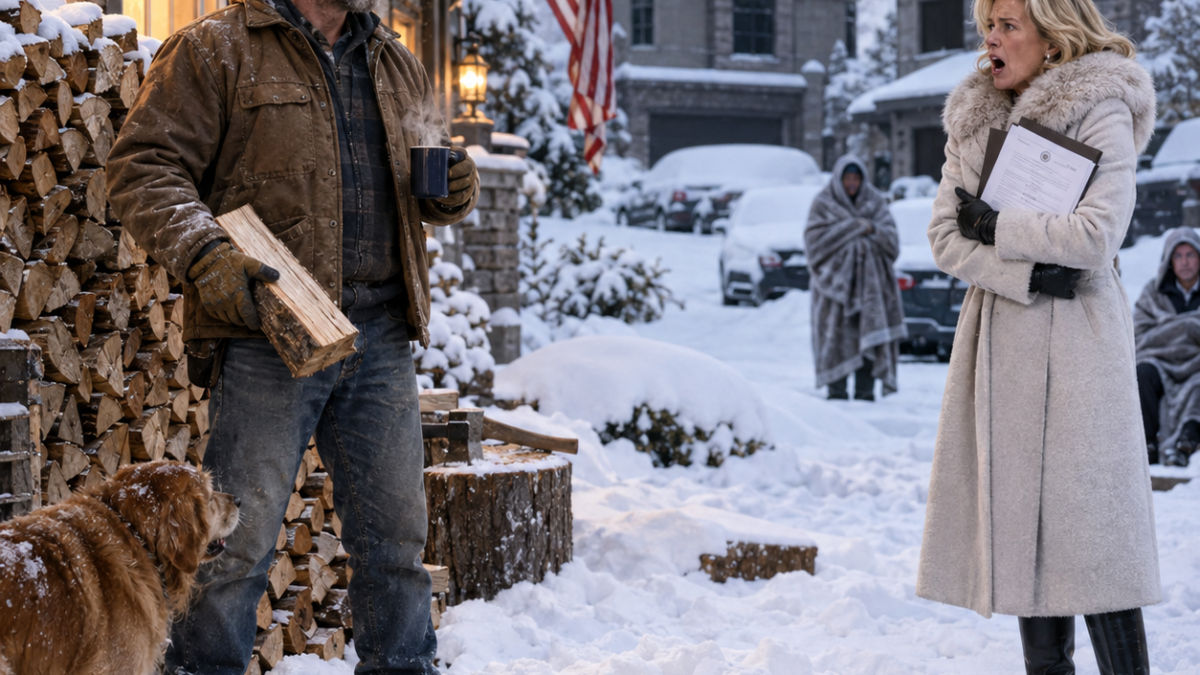
The HOA president stood beside six cords of firewood I had split with my own hands and told me I had thirty days to make every piece disappear.
She called it an “aesthetic blight,” threatened me with escalating fines, and smiled like she had already won.
What she didn’t know was that winter was about to settle an argument neither one of us could see coming.
“My decision is final, Major McPherson.”
Karen Miller hugged her clipboard against her floral blouse and nodded toward the wood stacked at the far edge of my ten-acre property.
Six cords of oak, maple, and cherry.
Straight rows. Covered. Seasoned. Nearly two hundred yards from the road.
I had spent most mornings since August cutting fallen timber from my own land, splitting it, hauling it, and stacking it carefully beneath the woodshed I had built myself.
To me, it wasn’t junk.
It was heat.
Insurance.
A promise that my wife, Sarah, and I would never have to depend entirely on a power line staying upright during a Pennsylvania winter.
Karen saw none of that.
“This is Whispering Pines Estates,” she said. “Not a logging camp.”
I stared at her for a second.
Then at the tires of her HOA golf cart sitting on the edge of my newly seeded lawn.
“Which rule am I violating?”
Her smile tightened.
“Section Seven. Storage of landscape materials.”
“I’d like that in writing.”
That seemed to annoy her more than arguing would have.
“You’ll receive it.”
Then she climbed into her golf cart and drove away, leaving two muddy tracks across my grass.
I photographed those before I did anything else.
Twenty-five years in the Army Corps of Engineers had taught me one lesson I never forgot: when somebody starts making threats, document everything.
Sarah was waiting in the kitchen.
“What happened?”
“She wants the wood gone.”
“All of it?”
I nodded.
Her face changed.
Our house used an electric heat pump. It worked beautifully—when electricity existed.
But the old stone fireplace in our great room had been fitted with a serious wood-burning insert capable of heating most of the downstairs.
Sarah looked toward the windows.
“That wood is our backup.”
“Exactly.”
“So what are you going to do?”
I pulled the HOA binder off the bookshelf.
“Read.”
That evening I went through 158 pages of covenants line by line.
Paint colors.
Fence heights.
Mailbox dimensions.
Driveway regulations.
Then I found Karen’s rule.
Section 7.C.4 prohibited leaving *temporary landscape materials* such as mulch, soil, or construction debris for more than fourteen days.
Nothing about firewood.
Nothing about fuel.
Nothing about a permanent supply for an installed heating system.
I read it three times.
Then I smiled.
The following morning I found Arthur Henderson working in his flower bed three streets over.
Arthur was pushing eighty and had practiced law most of his life.
When I told him what Karen had done, he laughed.
“Section 7.C.4?”
“You know it?”
“I helped draft it thirty years ago.”
That got my attention.
Arthur leaned on his garden trowel.
“That clause was written because people were dumping mulch in their front yards and leaving it there all summer. It was never intended to regulate firewood.”
“So I’m reading it correctly.”
“You are.”
He studied me.
“You planning to fight her?”
“I’m planning to follow the rules better than she does.”
Arthur grinned.
“Then you might be the first person around here who scares her.”
I submitted a formal appeal.
Photographs.
Property maps.
The exact covenant language.
Even pictures of the tracks her golf cart had left on my lawn.
A week later, the answer arrived.
**Appeal denied.**
Not only did Karen uphold the $500 fine, the board added a $250 “administrative fee.”
Then came the threat that made Sarah go silent.
Failure to pay could result in a lien against our home.
But Karen still wasn’t finished.
Two days later, I walked into the clubhouse and saw a redacted copy of my denial letter pinned to the public bulletin board.
My name was removed.
Everything else made my identity obvious.
People looked away when I entered.
Karen hadn’t merely fined me.
She wanted the neighborhood to watch me surrender.
I photographed the notice and walked home without saying a word.
That evening, while Sarah made coffee, the television meteorologist interrupted the regular broadcast.
A massive winter system was moving toward Pennsylvania.
Two feet of snow was possible.
Maybe three.
Then he said the sentence that made me glance through the kitchen window toward the very woodpile Karen wanted removed.
“Residents should prepare for prolonged power outages.”
I slowly set my coffee down.
Karen had given me thirty days to remove my firewood.
The storm was arriving in six.
PART 2
Arthur answered on the second ring.
“You saw the forecast?” I asked.
“I saw it.”
“How serious?”
“Serious enough that my wife has already made me hunt for every flashlight in the house.”
I looked through the window at the woodpile.
“Arthur, before the storm gets here, I want to move forward with something else.”
“The financial records?”
“Exactly.”
There was a short silence.
Then he said, “You’re not letting this go.”
“No.”
“Good.”
Arthur had lived in Whispering Pines for twenty years. Karen had been HOA president for twelve of them and, somehow, treasurer for most of that time too.
According to Arthur, residents complained constantly but rarely challenged her formally.
Meetings were held on weekday mornings.
Records were difficult to obtain.
Committees were stacked with people loyal to Karen.
Most homeowners had jobs, children, mortgages, and lives. They would complain privately, then pay whatever fine arrived because fighting cost more time than surrendering.
Karen had built her authority out of exhaustion.
“The bylaws give every homeowner the right to inspect the association’s financial records,” Arthur told me. “Thirty days written notice.”
“Then draft the request.”
“You realize she’ll hate you.”
“She already threatened my house over firewood.”
Arthur chuckled.
“Fair point.”
We filed the request the next morning.
Then I turned my attention to the storm.
By Wednesday every grocery store within twenty miles looked as if somebody had announced the end of civilization.
Bread disappeared.
Milk disappeared.
Batteries disappeared.
Propane cylinders vanished.
People lined up for gasoline.
The hardware store ran out of snow shovels before lunch.
Whispering Pines buzzed with nervous activity.
And then Karen sent an HOA-wide email.
I expected emergency contacts.
Instructions for checking elderly neighbors.
Maybe information about warming centers.
Instead, the email reminded residents that trash containers must be hidden, portable basketball hoops removed from driveways, patio furniture secured, and cars moved off the street.
Violations, she warned, would still be subject to fines.
I read the message twice.
Sarah leaned over my shoulder.
“You’re kidding.”
“Nope.”
“People are trying to keep their pipes from freezing.”
“And Karen’s worried about lawn furniture.”
Sarah shook her head and walked away.
I printed the email.
Into the HOA folder it went.
Outside, the sky was already changing.
A bruised gray ceiling had formed over the mountains.
The air was strangely still.
I spent the next day checking everything.
The property had come with an old twenty-kilowatt generator connected to a thousand-gallon underground propane tank. I had it serviced soon after we bought the place because leaving machinery untested until the day you needed it offended every instinct I had.
I started it.
The engine settled into a deep mechanical rumble.
Perfect.
Next came the well.
Then the storm windows.
Weatherstripping.
Gutters.
Fuel.
Food.
Medical supplies.
Sarah had been a nurse for more than thirty years, which meant our medicine cabinet looked halfway prepared for a field hospital.
My final job was the wood.
I brought a week’s supply onto the covered porch.
Oak for long burns.
Maple for quicker heat.
Cherry because it caught nicely and smelled good enough to make a bad night feel less bad.
Then I secured the rest beneath heavy tarps.
While I worked, Karen drove past in her golf cart.
She had enclosed it in clear plastic.
Of course she had.
She slowed when she saw the wood stacked on my porch.
I gave her a polite wave.
She stared straight ahead and kept driving.
That night, the first snowflakes appeared while Sarah and I were eating dinner.
The television carried a red banner:
**STATE OF EMERGENCY DECLARED.**
The governor urged everyone to stay home.
Forecasters were now predicting thirty inches of snow, possibly more in isolated areas, followed by dangerous cold.
Sarah looked at me.
“Are you nervous?”
I reached across the table.
“A little.”
She raised an eyebrow.
That surprised her.
I smiled.
“Being prepared doesn’t mean assuming nothing can go wrong. It means respecting what can.”
She squeezed my hand.
Outside, the snow thickened.
By nine o’clock we could no longer see the road.
By ten, the wind was throwing snow sideways.
At 10:17, every light in the house went out.
The silence after a power failure is always strange.
You don’t realize how many machines are speaking around you until they all stop.
The refrigerator.
Heat pump.
Television.
Clocks.
Pumps.
All gone.
Sarah and I stood in complete darkness.
Then, from beneath us, came a heavy mechanical cough.
The generator started.
Seconds later, selected lights returned.
The refrigerator came back.
The well pump had power.
I looked at Sarah.
“Plan B.”
She smiled.
“Plan C, actually.”
She pointed toward the fireplace.
I laughed.
“Fair enough.”
I loaded the wood insert and touched a match to the kindling.
Dry maple caught almost immediately.
Orange flames began licking upward.
Twenty minutes later, heat rolled through the great room.
Not warm air.
Heat.
The kind you could stand beside and feel sinking into your shoulders.
Sarah stretched her hands toward it.
“I’m officially withdrawing every complaint I ever made about you spending half the fall splitting logs.”
“You complained?”
“I complained internally.”
“That doesn’t count.”
She leaned against me.
“Thank you, Mac.”
“For what?”
“For being impossible.”
I looked at the fire.
“I prefer prepared.”
The radio told us the rest.
Trees were down everywhere.
Transmission lines had failed.
Transformers were burning out.
Emergency crews couldn’t move.
Thousands of homes were without power.
By midnight, estimates for restoration had shifted from hours to days.
By the following afternoon, officials were saying some rural areas could be without electricity for weeks.
Weeks.
That changed the calculation.
A generator was useful, but propane was finite.
So I rationed electricity.
A few hours in the morning.
A few more in the evening.
Enough to run the well pump, refrigerate food, charge devices, and handle necessities.
The fireplace carried the heating load.
For two full days the blizzard refused to stop.
Snow rose past the bottom of our windows.
Drifts formed against garages.
Trees vanished behind white curtains.
The world beyond our house simply disappeared.
Inside, Sarah and I settled into a strange little routine.
Coffee.
Breakfast.
Firewood.
Generator.
Cards.
Books.
Radio updates.
More firewood.
Our living room remained around seventy degrees.
The bedrooms stayed cooler, but comfortable under thick blankets.
We had running water.
Hot meals.
Light.
Most importantly, we had no fear of freezing.
On the third morning, sunlight finally broke through.
I opened the door and stared.
Whispering Pines was gone.
In its place lay something that looked like northern Alaska.
Cars were buried.
Mailboxes had disappeared.
Four-foot drifts blocked sections of road.
Some places had six feet.
The thermometer outside read five below zero.
Without wind chill.
I stood on the porch listening.
No snowblowers.
No cars.
No furnaces.
No distant traffic.
Nothing.
Then I looked toward the neighboring houses.
Every one of them was dark.
Something uncomfortable settled in my stomach.
Being prepared feels good until you realize everyone around you isn’t.
At first I told myself they were probably fine.
Blankets.
Winter clothes.
Maybe generators.
Maybe gas fireplaces.
But I knew the houses.
Most were newer construction.
Electric heat pumps.
Decorative fireplaces.
Some had natural gas furnaces, but the blowers still needed electricity.
The longer the outage lasted, the less theoretical the danger became.
That afternoon I saw a man moving down the road.
At first he looked like a dark speck against the snow.
He stumbled.
Got up.
Continued.
As he drew closer, I recognized him.
Tom Reynolds.
Three houses down.
Young guy.
Worked in IT.
His wife Jenny had given birth a few months earlier.
I stepped outside.
“Tom?”
He lifted one gloved hand.
“Mac.”
Something in his voice told me this wasn’t a social call.
He fought through the final drift and reached my cleared path.
His face was pale.
His lips looked almost gray.
“Come inside.”
“I need—”
“Inside first.”
The moment he crossed into the great room, he stopped.
The fire was roaring.
Warm air wrapped around him.
His expression changed.
It was the look of a man entering another world.
Sarah took one look at him and moved.
“Sit.”
“I’m okay.”
“You’re shaking.”
“I’m just cold.”
“Which is why you’re sitting.”
Thirty years of nursing had given her a tone even colonels would have obeyed.
Tom sat.
She put hot coffee in his hands.
It took him almost a minute before he could speak clearly.
“Our house is forty degrees.”
I crouched beside him.
“What about Jenny?”
“She’s trying to keep Emily warm.”
Emily.
The baby.
“How old?”
“Four months.”
Sarah froze.
Tom stared into the coffee.
“We put every blanket we have in the bedroom. We blocked the door with towels. Pipes burst this morning. I don’t know what to do anymore.”
He looked up.
“I saw your chimney.”
There it was.
The woodpile Karen had called ugly had become a signal flare.
“Go get them,” I said.
Tom blinked.
“What?”
“You’re staying here.”
“Mac, we can’t—”
“You have a four-month-old baby in a forty-degree house.”
“We don’t want to impose.”
“This isn’t a dinner invitation. It’s an emergency.”
Sarah was already stripping sheets from the guest bed.
“Bring diapers,” she called. “Formula if you’re using it. Medication. Warm clothes. Don’t waste time on anything else.”
Tom’s eyes filled.
He looked embarrassed by it.
Men sometimes are.
I put a hand on his shoulder.
“Go.”
I went with him.
Moving through waist-deep snow was exhausting.
We found Jenny sitting on a mattress they had dragged into their smallest bedroom.
She wore a winter coat indoors.
Emily was bundled tightly against her chest.
When Jenny saw us, her lower lip started trembling.
“I’m sorry,” she whispered.
That word bothered me.
Sorry.
As if needing help were a moral failure.
“You’re not apologizing for anything.”
I picked up two bags.
Tom gathered the rest.
“We’re going to our house.”
Jenny looked toward their living room.
“I can’t feel my feet anymore.”
Sarah examined her the moment we returned.
Nothing severe.
Just frightened, exhausted, and very cold.
Within an hour Jenny was sitting beside the fire holding Emily, tears quietly rolling down her face while the baby slept.
That should have been the end of my involvement.
It wasn’t.
Smoke was visible.
People noticed.
At noon Arthur Henderson appeared at the end of my driveway.
He wore a parka inside another coat and was carrying what looked like the world’s smallest bundle of manufactured fireplace logs.
I laughed despite myself.
“Planning a bonfire?”
“This is all I have.”
“Your furnace?”
“Dead.”
“Fireplace works?”
“Yes.”
I loaded the wheelbarrow.
Arthur watched.
He looked at the oak, then toward my woodshed.
“You know, Mac…”
“What?”
He smiled.
“I believe I owe your aesthetic blight an apology.”
We pushed the load to his house.
His wife Margaret was waiting inside beneath two blankets.
Their thermostat read thirty-eight.
I built the first fire myself.
Oak beneath.
Maple above.
Once the draft was established, the flames climbed.
Margaret sat close enough to the hearth that Arthur finally had to pull her chair backward.
Before I left, Arthur caught my arm.
“When this is over, Karen and I are going to have a conversation.”
“When this is over,” I said, “we can have all the conversations we want.”
I pointed at the fire.
“Right now we keep people alive.”
By late afternoon, another neighbor came.
Then another.
One family had two elementary-school-age children.
Another had an elderly mother with arthritis who could barely get out of bed.
One house contained a man dependent on an oxygen concentrator. We ran an extension from a portable generator long enough to stabilize his equipment, then moved him to a warmer home.
Every person who arrived brought information.
That became important.
Tom found a notebook.
“We need to know who’s out there.”
So we made a list.
House number.
Names.
Number of occupants.
Heating source.
Generator.
Medical needs.
Children.
Elderly residents.
By sunset, we knew which houses were safest and which were in trouble.
My home became the command post.
Not because I asked for it.
Because it was warm.
Jenny organized food.
Sarah handled medical concerns.
Tom tracked households.
Arthur coordinated communication with the few residents who still had working landlines.
I hauled wood.
Again and again.
Wheelbarrow through snow.
Load.
Deliver.
Return.
Load.
Deliver.
Return.
My shoulders burned.
My back ached.
Sweat froze around the collar of my coat.
But each time I entered another freezing home and watched flames begin to rise in a fireplace, the exhaustion stopped mattering.
By the fourth night seven houses had fires burning with wood from my property.
Families without fireplaces consolidated into homes that had them.
People pooled food.
Someone produced a propane camp stove.
Someone else had three unopened cases of bottled water.
A retired electrician helped residents disconnect damaged circuits.
A plumber taught us how to shut off and drain lines before they burst.
The HOA hadn’t organized any of it.
Neighbors had.
That night I finally sat beside my own fireplace.
Tom’s baby was asleep upstairs.
Someone had brought over two chickens that were thawing in a freezer without power, so Sarah roasted them before they spoiled.
Six adults sat around our dining table eating together by lamplight.
Outside, the temperature dropped below zero again.
Inside, people laughed.
Not because things were funny.
Because laughter was proof that fear hadn’t won.
Then Arthur asked the question everyone had avoided.
“What about Karen?”
The room became quiet.
Karen’s home was only several houses away.
No smoke.
No lights.
No movement.
Tom looked at me.
“She hasn’t asked for anything.”
“No.”
Jenny glanced toward the window.
“Maybe she has a generator.”
“She does,” Arthur said. “A little portable one.”
“That won’t heat that house.”
No one disagreed.
Karen’s house was enormous.
Cathedral ceilings.
Huge windows.
Electric everything.
A beautiful house built on the assumption that infrastructure never failed.
I stared into the fire.
Part of me felt something I wasn’t proud of.
Satisfaction.
Karen had called my woodpile an eyesore.
She had threatened fines.
A lien.
Public humiliation.
Now she was sitting in the dark while that same wood kept her neighbors alive.
There was poetic justice in that.
But there was another truth too.
I didn’t want anyone freezing to death just so I could win an argument.
So the following morning I asked Tom to check the Miller house from the road.
He returned twenty minutes later.
“No answer.”
“Tracks?”
“Some near the garage.”
“At least somebody’s moving.”
We left it there.
On day six, Karen sent an email.
Tom’s phone received it while we were sitting beside the fire.
He stared at the screen.
Then started laughing.
“What?”
He handed me the phone.
Karen wrote that she had become aware of the “unauthorized distribution of resources” within Whispering Pines.
Residents, she said, were prohibited from removing landscape materials from another property.
Bartering and unapproved exchanges could constitute a nuisance.
Everyone should remain inside their own homes and wait for official emergency assistance.
Tom finished reading it aloud.
Silence lasted about two seconds.
Arthur burst out laughing first.
Then Sarah.
Then Jenny.
Soon the whole room was laughing.
I wasn’t.
I printed the email.
Arthur watched me place it inside the folder.
“You really do save everything.”
“Especially stupid things.”
His smile disappeared.
“That email is going to matter.”
“I know.”
The next two days were brutal.
Emergency crews remained unable to reach several side roads.
Fuel became scarce.
We reduced generator time again.
My wood supply, however, remained strong.
Six cords was a lot of wood.
Karen’s small generator apparently ran dry.
We learned that from Dave Miller.
He appeared on my porch on the eighth afternoon.
Karen’s husband was normally a quiet man.
I had seen him mowing, washing their car, occasionally following Karen at neighborhood events like someone permanently assigned to carry things.
Now he looked ten years older.
Thin jacket.
Wet sneakers.
Hands trembling.
“Dave.”
His jaw shook so badly I could hear his teeth.
“Come inside.”
He shook his head.
“I just need…”
He looked over my shoulder at the fire.
His pride lasted another five seconds.
Then he whispered, “We need wood.”
There it was.
The moment I had imagined since Karen first stood in my yard with that clipboard.
I could have enjoyed it.
I could have quoted Section 7.C.4.
I could have told him my wood constituted an aesthetic violation and therefore couldn’t be distributed.
For one ugly second, I wanted to.
Then I looked at Dave.
He hadn’t fined me.
He hadn’t posted the letter.
He hadn’t threatened my house.
He was simply cold.
“Does your fireplace work?”
“We have one in the family room.”
“Real fireplace?”
He nodded.
“We never use it.”
“Chimney inspected?”
“Last year.”
“Good.”
I loaded a canvas carrier with dry wood.
Dave’s eyes followed every log.
When I handed it over, he whispered, “Thank you.”
“Dave.”
He stopped.
“This will get you through tonight. Come back tomorrow if you need more.”
His expression changed.
He had expected conditions.
Maybe humiliation.
Instead I said, “And tell Karen something for me.”
His shoulders tightened.
Of course.
There were conditions after all.
“Tell her I want the violation rescinded.”
He nodded slowly.
“All fines and administrative fees.”
Another nod.
“My record cleared.”
He swallowed.
“And she apologizes publicly on the same bulletin board where she posted that denial.”
Dave closed his eyes.
“Mac…”
“She tried to shame my family publicly. The correction needs to be public too.”
“You know how she is.”
“Yes.”
“That’s going to be…”
“Difficult?”
He gave a miserable laugh.
“That’s one word.”
I stepped closer.
“Dave, the wood is yours regardless. I’m not letting you freeze because of what she did.”
He looked surprised.
“But the argument isn’t going away because there’s a blizzard. When this emergency ends, I intend to finish it.”
He stared at me.
Then slowly nodded.
“That’s fair.”
I watched him trudge home carrying the firewood Karen had tried to outlaw.
I expected nothing.
The next afternoon Dave returned.
He held a sheet of paper.
Karen had handwritten four words.
**The fine is rescinded.**
Nothing else.
I read it.
“Is this supposed to be the apology?”
Dave rubbed his forehead.
“It took me three hours to get that.”
“I believe you.”
“She says she did nothing wrong.”
“Then she can explain that at the next meeting.”
Dave looked exhausted.
“Mac, she hasn’t slept properly in days.”
“Neither have I.”
“I know.”
He looked toward the woodpile.
“I’ve lived with her for thirty-one years.”
There was something in the way he said it that made me soften.
“I’m not asking you to fight your wife for me.”
He laughed without humor.
“I think everybody eventually fights Karen. Some people just take longer.”
He folded the paper.
“What do I tell her?”
“Tell her the fine being rescinded is step one.”
“And step two?”
“The public correction.”
He nodded.
Before leaving, he hesitated.
“Could I still have some wood?”
“Of course.”
That mattered to me.
I wanted Karen held accountable.
I didn’t want revenge to turn me into her.
There is a difference between consequences and cruelty.
Karen had never understood it.
I intended to.
On day ten we heard diesel engines.
National Guard equipment had reached the main road.
For the first time since the storm began, heavy machinery appeared beyond the entrance to Whispering Pines.
People stood in driveways cheering as plows attacked walls of snow.
Civilization was returning.
Which meant the emergency phase was ending.
And the accountability phase was beginning.
That afternoon Carol Bennett, one of Karen’s allies on the architectural committee, arrived at my house.
She carried an HOA envelope as if it contained anthrax.
“Karen asked me to deliver this.”
I opened it.
Official letterhead.
Violation 734 rescinded.
All fines voided.
Record cleared.
Then, at the bottom:
*I apologize for the misunderstanding concerning interpretation of the association’s storage covenant.*
Signed:
**Karen Miller, President.**
I read it twice.
Technically, it satisfied most of what I had requested.
Barely.
“Will she post it?”
Carol stared at me.
“What?”
“The bulletin board.”
“She apologized.”
“She humiliated me publicly.”
“This is ridiculous.”
“No. What was ridiculous was threatening a lien over neatly stacked heating fuel.”
Carol’s cheeks flushed.
“You’ve turned everyone against her.”
I looked past her.
Across the street, smoke rose from Arthur’s chimney.
Farther down, another fireplace was burning.
Then another.
“No, Carol.”
I pointed.
“The storm did that.”
She followed my gaze.
For a moment she had nothing to say.
Then she snapped, “You think you’re some kind of hero because you happened to have firewood.”
“No.”
I stepped closer.
“I think preparedness matters. I think neighbors matter. And I think leadership should help people when they’re frightened instead of threatening to fine them.”
She looked away.
I continued.
“Your president sent an email telling families to stop sharing heat during an emergency.”
“That’s not what she meant.”
“I have the email.”
“Everything with you is documents and photographs.”
“That’s because documents don’t forget what people wish they hadn’t done.”
Carol went still.
I saw the moment she realized the problem was much larger than a woodpile.
“Tell Karen the apology goes on the board.”
Then I closed the door.
Two days later it did.
Karen’s letter appeared exactly where my denial had been posted.
Someone drew a small fireplace beside it in pencil.
I never found out who.
By then Arthur and I were already working on the next step.
The financial request Karen had hoped the storm would bury was still valid.
The HOA finally produced boxes of records.
Not organized records.
Boxes.
Loose invoices.
Bank statements.
Photocopies.
Missing months.
Duplicate payments.
Checks without clear descriptions.
Arthur stared at the mess spread across my dining room.
“She thinks making this difficult will make us quit.”
I handed him coffee.
“She still doesn’t know me very well.”
Tom volunteered to help digitize everything.
We created spreadsheets.
Vendor.
Date.
Amount.
Approval.
Contract.
Invoice.
Check number.
Again and again.
Patterns emerged.
Our annual dues had risen nearly forty percent in a decade.
Road maintenance had declined.
The pool was constantly closed for repairs.
Community landscaping looked worse each year.
Yet spending kept increasing.
Then Arthur found Evergreen Solutions.
He slid three invoices across the table.
“Look at these.”
Landscape maintenance.
Mulching.
Tree trimming.
Seasonal planting.
The totals were extraordinary.
“Are these normal prices?”
“Not even close.”
Tom searched public business records once internet service returned.
He stared at his laptop.
“Oh, you’re going to like this.”
Arthur looked over.
“What?”
“Evergreen Solutions is registered to Michael Reeves.”
The name meant nothing to me.
Arthur’s expression hardened.
“That’s Karen’s brother-in-law.”
Nobody spoke for several seconds.
We dug deeper.
No competitive bids.
No documentation showing why Evergreen had been selected.
Payments exceeding contract schedules.
Consulting fees.
Emergency service charges.
Equipment rentals nobody remembered seeing.
Arthur removed his glasses.
“This isn’t just bad governance.”
“What is it?”
“At minimum, undisclosed self-dealing.”
“And maximum?”
He looked at me.
“We let an auditor answer that.”
That night I sat beside the fireplace after everyone else had gone home.
The woodpile outside was noticeably smaller.
Probably a third of it had been distributed through the neighborhood.
Sarah sat beside me.
“You got very quiet.”
“I’m thinking.”
“That’s dangerous.”
I smiled.
She rested her head against my shoulder.
“You know you already won the firewood argument.”
“I know.”
“So what is this now?”
I watched the flames.
“This is about whether Karen gets to keep doing it to someone else.”
Sarah was quiet.
Finally she said, “Then don’t make it about revenge.”
I looked at her.
“She embarrassed you,” she continued. “She threatened our home. I know that hurt you more than you admitted.”
“It made me angry.”
“I know.”
“But?”
“But if you make this about destroying her, she still controls you.”
That landed.
Sarah had always possessed a talent for saying in twelve words what took me three pages of analysis to understand.
“So what do I make it about?”
“Fixing what she broke.”
The next morning, my strategy changed.
We wouldn’t circulate rumors.
We wouldn’t insult Karen.
We wouldn’t speculate.
Everything would be documented.
Everything would be verifiable.
Arthur drafted a petition for a special membership meeting under the exact requirements of the bylaws.
Twenty-five percent of homeowners were required.
We prepared a packet.
Karen’s original violation.
My appeal.
The denial.
The extra fee.
The lien threat.
The public posting.
Her emergency email.
Her rescission.
Her apology.
Statements from residents describing the outage and how neighbors had helped one another.
Then we included a simple request:
A special meeting to review board conduct, association finances, and a vote concerning Karen’s continued service as president.
No name-calling.
No accusations we couldn’t prove.
Facts.
Tom looked at the packet.
“This is devastating.”
“It’s paper.”
“That’s why it’s devastating.”
We began collecting signatures on a Saturday morning.
Arthur set up a folding table beside my driveway.
Ironically, it stood only twenty feet from the woodpile.
The first signature came from Margaret Henderson.
The second from Tom.
Third from Jenny.
Then the family across the street.
Then another.
And another.
Soon people I barely knew were waiting in line.
That was when I realized my dispute had never really been about me.
A woman named Linda told me Karen had once fined her for wind chimes because their sound allegedly disturbed neighborhood harmony.
An elderly widower said he had been ordered to remove a rose bush his late wife had planted because the variety wasn’t on the approved landscaping list.
Another homeowner produced photographs showing stains on the community pool deck he had reported repeatedly while HOA dues continued increasing.
A young couple said their request for a small wheelchair ramp for an aging parent had been delayed for months over aesthetic concerns before somebody finally threatened legal action.
The stories kept coming.
Every person seemed to have one.
Some petty.
Some painful.
All carrying the same theme.
People had stopped believing the HOA belonged to them.
Karen had convinced them it belonged to her.
We needed sixty signatures.
By sunset we had 123.
Arthur counted them twice.
Then he sat back and laughed.
“Well, Major.”
“What?”
“I believe you’ve assembled your army.”
I looked at the neighbors still standing around talking.
“No.”
I shook my head.
“They assembled themselves.”
Ten days later the clubhouse was packed.
Not crowded.
Packed.
Every chair.
Every wall.
Hallway.
Doorway.
People I had never seen at an HOA meeting before were there.
Tom and Jenny sat near the front.
Arthur stood beside me.
Sarah squeezed my hand once.
“You know what I said.”
“Fix what she broke.”
“Exactly.”
Then Karen arrived.
The room changed.
She wore a dark navy pantsuit and carried the same leather binder I had seen during our first confrontation.
Carol followed her.
So did the third architectural committee member, Robert, a man who looked as though he regretted every decision that had brought him there.
Karen marched to the podium.
She picked up the gavel.
“This meeting will come to order.”
Conversation continued.
Her face tightened.
She struck the gavel harder.
“Order!”
Arthur stood.
“Karen.”
She glared.
“This is a special membership meeting called by petition.”
“I am the president.”
“And under Article Eleven, Section Four, the petitioners appoint the temporary chair until the stated business has concluded.”
Murmurs spread through the room.
Karen opened her binder.
Arthur already had the page marked.
He walked forward and handed her a copy.
She read.
Her jaw tightened.
Then Arthur said calmly, “Please take a seat.”
For twelve years Karen had controlled that podium.
For twelve years people had allowed her to define the room.
Now, in front of nearly the entire community, she had to step away from it.
No one cheered.
That made the moment stronger.
She walked to the first row.
Sat.
Folded her arms.
Arthur took the podium.
“This meeting will be conducted respectfully. Everyone will have an opportunity to respond. We will discuss documents, not rumors. Facts, not personal attacks.”
I looked at Sarah.
She nodded.
Arthur introduced me.
I walked to the front.
Behind me, the projector displayed a photograph.
Six cords of beautifully stacked firewood in autumn sunlight.
A few people laughed softly.
I waited.
“My name is John McPherson.”
The room quieted.
“Most of you know how this started.”
I glanced toward the photograph.
“A woodpile.”
More laughter.
“But tonight isn’t actually about wood.”
I clicked.
Karen’s violation notice appeared.
“It’s about authority.”
Next.
My appeal.
“It’s about procedure.”
Next.
The denial and extra fee.
“It’s about whether rules exist to serve a community—or whether a community exists to serve whoever controls the rules.”
Karen shifted in her chair.
I kept going.
The public bulletin board.
The weather warning.
The emergency email.
Then photographs from the outage.
Arthur’s fireplace.
Tom and Jenny beside ours.
Neighbors carrying wood.
Wheelbarrow tracks through deep snow.
Nothing dramatic.
Nothing staged.
Just people helping people.
“The power was gone for fifteen days in our section.”
I looked around the room.
“During that time, the HOA did not organize a warming center.”
Karen started to speak.
Arthur raised his hand.
“You’ll have your response.”
She stopped.
I continued.
“The HOA did not create a list of vulnerable residents. It did not organize fuel sharing. It did not coordinate medical needs.”
I clicked.
Karen’s email filled the screen.
“What it did do was send this.”
People had seen it before.
Reading it together was different.
I watched faces harden.
“Residents helping one another were warned about unauthorized resource distribution and potential nuisance violations.”
From the back, somebody muttered, “Unbelievable.”
I didn’t respond.
Instead I put up the final photograph from the storm.
My woodpile.
Smaller now.
Snow around it.
Paths leading outward.
“That wood was called an aesthetic blight.”
I looked at Karen.
“During the outage, it heated seven homes directly and helped consolidate residents from several others into warm houses.”
My voice nearly broke when I remembered Jenny holding Emily.
I paused.
“An infant slept safely because of that wood.”
Tom lowered his head.
Jenny wiped her eyes.
“So did elderly residents. So did people with medical needs. So did neighbors who simply hadn’t imagined the grid could disappear for two weeks.”
I turned back toward the room.
“I’m not telling you I was smarter than anybody.”
That mattered.
“I was lucky to have land, timber, equipment, and experience. Other people contributed food, medical knowledge, electrical skills, plumbing knowledge, generators, fuel, batteries, transportation, and labor.”
I looked toward Sarah.
“The blizzard didn’t prove that I could save Whispering Pines.”
Then at everyone else.
“It proved we could save each other.”
Silence.
“And that is what leadership should protect.”
I stepped away.
Arthur took over.
His presentation was colder.
Numbers usually are.
HOA dues.
Maintenance expenditures.
Road conditions.
Pool costs.
Vendor payments.
Then Evergreen Solutions.
Arthur displayed the corporate registration.
Owner:
Michael Reeves.
Relationship:
Karen Miller’s brother-in-law.
Whispers exploded.
Karen shot to her feet.
“This is outrageous!”
Arthur remained calm.
“Is Michael Reeves your brother-in-law?”
“That has nothing to do with—”
“Is he?”
Karen looked around.
“Yes.”
“Was that relationship disclosed to homeowners before Evergreen Solutions received HOA contracts?”
“The board knew.”
Robert, sitting beside Carol, suddenly spoke.
“I didn’t.”
Every head turned.
Karen stared at him.
Robert’s face went pale, but he continued.
“I was never told he was your brother-in-law.”
Carol looked down.
Arthur asked, “Were competitive bids obtained?”
Karen snapped, “Evergreen provided reliable service.”
“That was not my question.”
“You’re trying to make routine business sound criminal.”
“No.”
Arthur’s voice remained steady.
“I’m making routine business visible.”
That line silenced the room.
He displayed invoice comparisons.
Evergreen’s charges were dramatically higher than comparable estimates Arthur had obtained from three local companies.
Then came consulting fees.
Equipment charges.
Payments with incomplete descriptions.
Nobody declared them crimes.
We didn’t need to.
The questions themselves were enough.
Karen looked smaller with every page.
When Arthur finished, he addressed her directly.
“You may respond.”
Karen stood.
For a moment I almost felt sorry for her.
Almost.
She walked to the podium.
“You people have no idea what it takes to manage this neighborhood.”
Her voice shook.
“I spent twelve years keeping property values up while most of you complained about every rule.”
No one interrupted.
“I answered calls at night. I handled contractors. I dealt with disputes. I spent thousands of hours doing work none of you wanted to do.”
That part was probably true.
And truth matters even when it belongs to somebody you dislike.
Karen continued.
“Were mistakes made? Yes. But this entire campaign began because one man refused to follow community standards.”
She pointed at me.
“This man has turned a simple violation into a personal vendetta.”
All eyes moved toward me.
I stayed seated.
Karen looked almost relieved.
She thought she had finally found solid ground.
“He undermined the board during an emergency. He encouraged unauthorized distribution. He demanded an apology in exchange for resources.”
Dave stood.
Karen froze.
Her husband had been sitting near the back.
His voice was quiet.
“He gave me wood before you apologized.”
Karen stared at him.
“Dave.”
“He never refused me.”
The room became perfectly silent.
Dave looked at me, then back at his wife.
“He told me I could come back whether you apologized or not.”
Karen’s face drained.
Dave continued.
“He wanted the fine removed. He wanted you to correct what you posted. But he never told me we had to freeze.”
I hadn’t asked Dave to speak.
Maybe that was why his words mattered.
Karen whispered, “Sit down.”
For the first time, he didn’t.
“No.”
One word.
Soft.
But it landed harder than the gavel ever had.
Karen looked around the room.
Everything she had relied on—position, intimidation, procedure, embarrassment—was failing at once.
Arthur returned to the podium.
“The motion before the membership is a vote of no confidence and removal of Karen Miller as association president pursuant to the recall provisions in the bylaws.”
Ballots were distributed.
I didn’t watch Karen.
I watched Sarah.
She reached for my hand.
“You okay?”
“Yes.”
“You sure?”
I thought about the first morning.
The clipboard.
The golf cart.
The threat.
The public letter.
Then Jenny and Emily.
Arthur’s freezing house.
Dave standing at my door.
The wheelbarrow tracks.
The fires.
“I am now.”
Voting took twelve minutes.
Counting took twenty.
Nobody spoke much.
Finally Arthur received the paper from the volunteers.
He read it silently.
Then again.
Karen stared straight ahead.
Arthur stepped to the microphone.
“Total valid ballots cast: 186.”
The room held its breath.
“Votes supporting removal: 161.”
A sound moved through the clubhouse.
Not exactly cheering.
Relief.
“Votes opposing removal: 21.”
He paused.
“Four abstentions.”
Karen closed her eyes.
Arthur continued.
“The motion carries.”
That was it.
Twelve years ended in one sentence.
Karen picked up her purse.
Carol tried to say something to her.
Karen brushed past.
When she reached the door, she stopped.
For one second I thought she might turn around.
She didn’t.
She walked out.
No applause followed her.
No jeering.
No humiliation.
Just silence.
Sarah leaned toward me.
“That was better.”
“Better than what?”
“Revenge.”
I understood.
Karen had humiliated herself.
We hadn’t needed to.
Arthur was elected interim president until regular elections could be held.
His first official motion was to remove my firewood violation permanently from the association records.
Unanimous.
His second was to commission an independent financial audit.
Unanimous.
His third required competitive bidding and conflict-of-interest disclosure for major HOA contracts.
Unanimous.
Tom was asked to build an online records portal so every homeowner could access budgets, contracts, meeting minutes, and board votes.
He accepted.
Then Margaret Henderson raised her hand.
“I have another motion.”
Arthur smiled.
“Go ahead.”
“I move that firewood stored neatly for legitimate residential heating purposes be expressly permitted.”
Laughter spread through the room.
Arthur looked toward me.
“Any objections?”
One hand rose.
Everyone stared.
It belonged to me.
“I suggest reasonable safety requirements.”
That brought louder laughter.
“Of course you do,” Tom called.
The revised rule passed.
After the meeting, people surrounded Sarah and me.
Thank-yous.
Handshakes.
Stories.
Hugs I wasn’t prepared for.
Jenny approached carrying Emily.
The baby was asleep against her shoulder.
“You know what I remember most?” she asked.
“What?”
“The first night at your house.”
I expected her to say the fire.
She didn’t.
“I remember Sarah telling me to stop apologizing.”
Sarah’s eyes filled.
Jenny continued.
“I spent three days thinking I had failed because I couldn’t keep my baby warm.”
“You didn’t fail,” Sarah said.
“I know that now.”
She looked around the clubhouse.
“We all thought being good neighbors meant not bothering each other.”
That sentence stayed with me.
Maybe that had been Whispering Pines’ real problem.
We had mistaken isolation for peace.
The audit took months.
What it found was worse than I expected.
Evergreen Solutions had received years of unusually favorable contracts.
Some invoices were unsupported.
Certain consulting payments couldn’t be matched to clear deliverables.
Association funds had paid expenses the auditors questioned as lacking proper HOA purposes.
The new board turned the findings over to counsel and then to the appropriate authorities.
I stayed out of that part.
That was important.
My job had never been to determine whether Karen committed a crime.
There were professionals for that.
Investigators.
Auditors.
Attorneys.
If charges were appropriate, they would decide.
What mattered to me was that no single person would ever again have unchecked access to the board, committees, treasury, and information flow.
Controls were adopted.
Two signatures for major payments.
Independent yearly review.
Competitive bids.
Recorded votes.
Financial statements posted online.
Term limits.
Even meeting times changed.
Evenings and weekends.
Times when actual residents could attend.
Whispering Pines slowly became boring again.
And boring governance, I discovered, is beautiful.
Then something else happened.
Neighbors kept helping each other.
Not because of an emergency.
Because they had learned how.
Tom started a tool-sharing shed.
Someone donated a pressure washer.
I added a log splitter.
Arthur contributed every gardening tool known to mankind.
Residents created a contact list for elderly neighbors and people with medical equipment.
A retired paramedic taught a basic emergency-preparedness class.
Sarah organized a first-aid workshop.
A few families bought generators.
Others installed wood stoves or gas backups after checking permits and chimney requirements.
We created a winter plan.
Not a paranoid plan.
A practical one.
Who had heat.
Who had fuel.
Who had four-wheel drive.
Who had medical training.
Who needed assistance.
Never again would smoke from one chimney have to serve as the neighborhood’s emergency broadcast system.
By spring, the last dirty snow disappeared.
My lawn recovered from Karen’s golf cart tracks.
I could barely see where they had been.
One afternoon I stood there staring at the grass when Arthur walked up.
“You know,” he said, “you never filed that trespass complaint.”
“No.”
“Why not?”
“I got busy.”
He smiled.
“Softhearted.”
“Efficient.”
“Same thing at your age.”
I ignored that.
Arthur looked toward the woodshed.
“Running low.”
“Shared a lot.”
“How much?”
“About two cords.”
He whistled.
“That’s expensive heat.”
“No.”
I shook my head.
“Cheap, considering.”
That summer, Whispering Pines held a block party.
Apparently no one could remember the last one.
Tables filled the street.
Kids ran between yards.
Someone brought a smoker.
Someone else organized cornhole.
Tom handled music.
Arthur appointed himself unofficial quality inspector for every dessert.
Dave came alone.
I hadn’t seen much of him since the meeting.
He approached while I was standing near the grill.
“Mac.”
“Dave.”
We shook hands.
“How are you?”
He looked toward the crowd before answering.
“Better.”
I didn’t ask for details.
He gave them anyway.
“Karen and I separated.”
“I’m sorry.”
He shrugged.
“Maybe you shouldn’t be.”
“That’s between you two.”
“I know.”
He smiled faintly.
“She still says you ruined her life.”
I looked around.
Neighbors laughing.
Sarah talking with Jenny.
Arthur arguing over barbecue sauce.
Children running between houses that once felt like isolated islands.
“I didn’t.”
“No.”
Dave nodded.
“I told her that.”
He took a long breath.
“You didn’t create anything that wasn’t already there.”
Then he looked toward my property.
“You just refused to pretend you couldn’t see it.”
We talked another few minutes.
Before leaving, Dave held out his hand again.
“Thank you for the wood.”
I shook it.
“You’re welcome.”
“I mean it.”
“I know.”
Autumn returned faster than expected.
One Saturday morning I walked outside with my chainsaw.
Tom was already standing by the fallen trees.
“What are you doing?”
“Helping.”
“You own a chainsaw?”
“I bought one.”
“That concerns me.”
He laughed.
Arthur arrived twenty minutes later carrying coffee.
Then another neighbor appeared.
Then two more.
By noon, nine people were working.
Cutting.
Splitting.
Hauling.
Stacking.
What had taken me months alone went ridiculously fast with a crew.
Sarah and Jenny brought sandwiches.
Margaret Henderson sat beneath a tree issuing unwanted supervisory advice.
At some point I stopped working and simply watched.
The new stack was taking shape beside the woodshed.
Oak.
Maple.
Cherry.
Neater than before.
Bigger too.
Tom wiped sweat from his forehead.
“How many cords?”
“Eight if we finish everything.”
He stared at it.
“Karen would’ve had a stroke.”
Arthur shouted from behind him, “Nine cords!”
I laughed.
That was when Arthur told me the board had voted on something without my knowledge.
“I hate surprises.”
“You’ll survive.”
Two weeks later he dragged Sarah and me into the clubhouse.
Mounted beside the entrance was a simple brass plaque attached to polished oak.
I stared at it.
Arthur folded his arms proudly.
The plaque honored the residents who had shared heat, food, medical care, labor, and shelter during the Great Blizzard.
At the bottom was one line:
**Sometimes community begins with the thing we were told didn’t belong.**
I looked at Arthur.
“You changed the wording.”
“We decided giving an award specifically to a woodpile sounded stupid.”
“It did.”
“I fought for it.”
“Of course you did.”
Sarah laughed.
I ran my fingers over the polished oak.
For some reason, that simple piece of wood hit me harder than the meeting had.
Maybe because the fight had never really been about winning.
Not in the end.
Karen thought authority meant being the person who could tell everyone else what they weren’t allowed to do.
The blizzard taught us something different.
Authority is fragile.
Electricity fails.
Roads close.
Titles disappear.
Gavels become useless.
A rulebook cannot warm a baby.
A fine cannot repair a burst pipe.
A committee cannot replace the moment someone opens a door and says, “Come inside.”
Real strength was Arthur sharing legal knowledge.
Sarah caring for frightened families.
Tom mapping vulnerable households.
Jenny organizing food while recovering from three sleepless nights.
Neighbors carrying logs through waist-deep snow.
Dave finally saying no.
People who had barely known one another turning seven fireplaces into a neighborhood heating system.
And yes, some of that strength had been sitting behind my house all along.
Split.
Seasoned.
Stacked.
Waiting.
The next winter brought plenty of snow, but nothing like the Great Blizzard.
Still, on the first truly cold night, I walked outside before bed.
The sky was clear enough to see thousands of stars.
Smoke rose from several chimneys throughout Whispering Pines.
Not just mine anymore.
Tom had installed a proper wood stove.
Arthur had stocked nearly a cord.
Two other families had upgraded their fireplaces.
Everyone kept emergency supplies.
Nobody panicked when temperatures dropped.
I walked around the woodshed and placed my hand on the end of one oak log.
Sarah opened the back door.
“You coming inside?”
“In a minute.”
“You admiring your wood again?”
“Yes.”
“That’s weird.”
“I’ve earned the right.”
She laughed and closed the door.
I remained there another moment.
Years earlier, I had spent my career planning supply lines because lives sometimes depended on boring things arriving before anyone realized they were needed.
Fuel.
Water.
Parts.
Food.
Shelter.
Preparedness rarely looks heroic beforehand.
Usually it looks excessive.
Paranoid.
Inconvenient.
Sometimes even ugly.
Then something goes wrong.
And suddenly the thing everyone questioned becomes the thing everyone needs.
I never wanted Karen’s house.
I never wanted her position.
I never wanted to humiliate her.
All I wanted was the right to keep my family safe on my own property.
But when she tried to turn that preparation into a violation, she accidentally forced the entire neighborhood to answer a larger question.
What is a community actually for?
Perfect lawns?
Matching mailboxes?
Approved shades of beige?
Or people?
I know my answer.
Because I watched seven fireplaces burning in a frozen neighborhood.
I watched frightened parents finally sleep after carrying their baby into a warm house.
I watched an eighty-year-old lawyer sit beside a fire he might not have had.
I watched strangers become neighbors.
And I watched six cords of “unsightly” firewood do more for Whispering Pines in fifteen powerless days than twelve years of Karen’s fines ever had.
The following morning, I returned to splitting.
The axe rose.
Fell.
The oak opened with a sharp crack.
Tom carried the pieces toward the stack.
Arthur sat nearby drinking coffee and pretending age had earned him exemption from physical labor.
Sarah watched from the porch.
And behind us stood the biggest woodpile Whispering Pines had ever seen.
Nobody complained.
Nobody issued a violation.
Nobody threatened a fine.
In fact, several neighbors had already reserved Saturdays to help add to it.
Because the pile was no longer mine alone in the way it had been before.
It represented something all of us understood now.
Warmth before appearance.
Preparation before pride.
Neighbors before power.
I picked up another round of oak and set it on the splitting block.
Then I glanced across the neighborhood, where smoke rose steadily into a bright winter sky.
Karen once gave me thirty days to make my firewood disappear.
Instead, the blizzard gave us fifteen days to discover exactly why it needed to stay.
And after everything that happened, nobody in Whispering Pines ever called that woodpile an eyesore again.
The storm arrived six days after Karen Miller threatened to fine me for the firewood.
By then, every grocery store within twenty miles had been stripped nearly bare. Bread disappeared first, then milk, batteries, propane cylinders, rock salt, bottled water, and anything that could reasonably be called emergency food.
Karen responded with an HOA email.
Not emergency contacts.
Not information about elderly residents.
Not a neighborhood warming plan.
She reminded everyone to secure patio furniture, hide trash cans, remove portable basketball hoops, and keep vehicles off the street.
“Failure to comply may result in fines.”
Sarah read the message over my shoulder.
“You have got to be kidding me.”
I printed it.
“What are you doing?”
“Saving it.”
She sighed. “Of course you are.”
Twenty-five years as an Army engineer had taught me that when people abuse authority, memories become surprisingly unreliable later.
Paper doesn’t.
That afternoon I checked the generator one last time, inspected the thousand-gallon propane tank, tested the well pump, and carried enough split oak and maple onto the covered porch to last at least a week.
At dusk, the sky turned the color of bruised steel.
By nine that night, we could no longer see the road.
At 10:17, the lights flickered twice.
Then everything went black.
For one long second the house became perfectly silent.
Then the generator started.
A deep mechanical rumble rose from the basement.
Several lights returned. The refrigerator hummed. The well pump came back online.
But I didn’t use the generator for heat.
Propane was finite.
Firewood was not.
I opened the cast-iron insert inside our old stone fireplace, stacked dry maple over kindling, and struck a match.
Twenty minutes later, heat rolled through the great room.
Sarah stood beside the fire with her hands stretched toward the flames.
“Thank you for being stubborn,” she said.
“I prefer strategically prepared.”
She smiled.
Outside, the storm became monstrous.
The wind screamed around the corners of the house. Snow flew horizontally, erasing fences, roads, mailboxes, and eventually entire cars beneath enormous drifts.
By morning, officials were reporting catastrophic damage to the electrical grid.
Restoration estimates changed from hours to days.
Then from days to weeks.
For two full days, the blizzard refused to stop.
We were comfortable.
Not luxurious.
Comfortable.
I ran the generator only several hours each day to protect the refrigerator, operate the well pump, and charge necessary devices.
The wood stove kept the main floor near seventy degrees.
We cooked.
We had water.
We had blankets.
We were safe.
Then the storm stopped.
The temperature plunged to five below zero.
That was when I realized how serious things had become.
Whispering Pines was silent.
Every neighboring house was dark.
No furnaces.
No cars.
No snowblowers.
Nothing.
That afternoon, I spotted someone struggling down the center of the buried road.
It was Tom Reynolds from three houses away.
He stumbled through waist-deep snow until he reached my cleared path.
“Mac!”
His face was pale.
His lips trembled.
I opened the door.
“Inside.”
“Our house is forty degrees.”
“How’s Jenny?”
“She’s trying to keep Emily warm.”
Emily was their four-month-old daughter.
“My pipes burst this morning,” Tom continued. “We’ve got every blanket in one bedroom. Jenny hasn’t slept. I don’t know what else to do.”
He looked past me at the roaring fire.
“We saw your chimney.”
Those four words changed everything.
I grabbed my coat.
“Take me to them.”
Jenny was sitting on a mattress in their smallest bedroom wearing a winter coat.
She held Emily beneath layers of blankets.
When she saw me, she started crying.
“I’m sorry.”
“You don’t apologize for needing help.”
Tom gathered diapers, formula, medicine, and clothing.
I carried the bags.
Within an hour, they were inside our house.
Sarah took over immediately.
She checked Emily, warmed Jenny slowly, found dry socks for Tom, and converted our guest room into emergency sleeping quarters.
I thought that would be the only rescue.
I was wrong.
Smoke from our chimney had become a signal.
The next person to appear was Arthur Henderson.
The retired lawyer stood in my driveway wearing two coats and carrying three manufactured fireplace logs.
I stared at them.
“That’s your fuel supply?”
Arthur looked embarrassed.
“I may have underestimated the situation.”
“Your fireplace works?”
“Yes.”
“Then we’re in business.”
I filled the wheelbarrow with oak.
When Arthur saw it, he laughed.
“I suppose this is the aesthetic blight.”
“The very same.”
His smile disappeared.
“Mac, this isn’t funny anymore.”
“No.”
His house was thirty-eight degrees.
His wife, Margaret, sat beneath two blankets near the cold fireplace.
I built their first fire.
Within minutes the room began warming.
Arthur stood beside me watching the flames.
“You realize your woodpile may save half this neighborhood.”
“Then we’d better start figuring out who needs it.”
That became our mission.
Tom created a list of every house.
Children.
Elderly residents.
Medical needs.
Available fireplaces.
Generators.
Fuel.
People with working heat.
People without it.
Jenny organized food supplies.
Sarah handled medical problems.
Arthur coordinated calls.
I delivered wood.
Again.
And again.
And again.
Seven homes had functioning wood-burning fireplaces.
Families without fireplaces moved temporarily into homes that did.
One woman’s husband depended on an oxygen concentrator, so we used generator power strategically to support his equipment.
Another elderly resident had been trying to sleep wearing three sweaters and a winter coat.
By the fourth night, seven chimneys sent smoke into the frozen sky.
My woodpile had become the neighborhood heating system.
Then Karen sent another email.
Tom read it aloud beside my fireplace.
Karen warned residents that “unauthorized distribution of resources” could violate HOA rules.
She specifically mentioned firewood.
She warned against unapproved exchanges that created “public nuisances.”
For several seconds nobody spoke.
Then Arthur started laughing.
Soon everyone was laughing.
I wasn’t.
I printed the email and placed it beside the violation notice Karen had issued me.
On the eighth day, Dave Miller arrived.
Karen’s husband.
He stood on my porch wearing wet sneakers and a thin jacket.
His teeth were chattering.
“We ran out of gasoline for the generator.”
“How cold is the house?”
He looked at the floor.
“Twenty-nine degrees downstairs.”
I stared at him.
“We need wood,” he whispered.
For one dangerous second, anger spoke louder than compassion.
I remembered Karen standing in my yard.
The clipboard.
The fine.
The threat of a lien.
The humiliation notice she had posted at the clubhouse.
I could have turned Dave away.
Instead, I filled a canvas carrier with dry firewood.
Dave looked at it like I had handed him gold.
“Thank you.”
“Dave.”
He stopped.
“Tell Karen the violation disappears.”
He nodded.
“All fines disappear.”
Another nod.
“My record is cleared, and she posts an apology on the same board where she tried to embarrass me.”
Dave closed his eyes.
“You know how she is.”
“Yes.”
I handed him the wood.
“But understand something. I’m giving you this whether she apologizes or not. I’m not letting somebody freeze because I’m angry.”
Dave stared at me.
That distinction mattered.
Karen had used power to punish people.
I wasn’t going to become her just because the balance had shifted.
Two days later, Dave returned carrying a note.
The fine is rescinded.
That was all.
I folded it.
“This isn’t the apology.”
“It took me three hours to get that much.”
“I believe you.”
Eventually, Karen produced an official letter.
The violation was voided.
Every fee was canceled.
My record was cleared.
At the bottom she wrote:
“I apologize for any misunderstanding regarding the interpretation of the bylaws.”
Weak.
Forced.
But signed.
And after pressure from the community, it went onto the same clubhouse bulletin board where she had posted my denial.
By then, however, the firewood fight had exposed something larger.
Before the storm, Arthur and I had formally requested ten years of HOA financial records.
When roads reopened, the documents finally arrived.
They were a mess.
Missing invoices.
Duplicate payments.
Unexplained expenses.
Then Arthur found something.
A landscaping company called Evergreen Solutions had received years of no-bid contracts.
The prices were dramatically above normal market rates.
Tom searched the business registration.
He turned his laptop toward us.
“Owner: Michael Reeves.”
Arthur’s expression hardened.
“That’s Karen’s brother-in-law.”
We kept digging.
Consulting payments.
Equipment fees.
Unexplained charges.
For years, HOA dues had risen while roads cracked, the pool deteriorated, and services declined.
The woodpile wasn’t the real problem anymore.
The money was.
Arthur drafted a petition for a special homeowners meeting.
We needed sixty signatures.
We received 123 in one day.
People came with stories.
Fines over wind chimes.
Flowers.
Paint colors.
Mailboxes.
Garden decorations.
Requests denied for arbitrary reasons.
Years of frustration poured out.
Karen had mistaken silence for loyalty.
It had only been exhaustion.
Ten days later, the clubhouse was overflowing.
Karen marched to the podium and slammed her gavel.
“This meeting will come to order.”
Arthur stood.
“Not yours to chair.”
Her face tightened.
He opened the bylaws.
“As a special meeting called by member petition, the petitioners appoint the temporary chair.”
Karen had spent twelve years controlling that podium.
That afternoon, she had to step away from it.
I connected my laptop to the projector.
The first photograph appeared.
My woodpile.
Six cords stacked beneath the autumn sun.
Several people laughed.
“My name is John McPherson,” I began. “And this started with firewood.”
I showed Karen’s violation notice.
My appeal.
The denial.
The additional fee.
The lien threat.
Her public humiliation notice.
Then her emergency email telling people to stop sharing resources.
Finally, I showed photographs from the storm.
Neighbors carrying logs.
Families sitting beside fireplaces.
Arthur’s house.
Tom and Jenny.
Wheelbarrow tracks through snow.
“That firewood was called an aesthetic blight,” I said.
I looked around the room.
“During fifteen days without power, it heated seven homes directly and helped several other families consolidate into warm houses.”
Jenny held Emily against her chest.
“An infant stayed warm because of that wood.”
My voice tightened.
“So did elderly residents. So did people with medical needs.”
Then Arthur presented the financial records.
Evergreen Solutions.
Inflated costs.
No competitive bids.
The connection to Karen’s brother-in-law.
Karen jumped up.
“This is a personal attack!”
Arthur remained calm.
“Was the owner’s relationship to you disclosed?”
“The board knew.”
Robert, one of her own committee members, suddenly spoke.
“I didn’t.”
Karen turned.
Robert swallowed.
“No one told me.”
That was the moment her control broke.
The room changed.
Arthur called for the vote.
One hundred eighty-six valid ballots were cast.
One hundred sixty-one supported Karen’s removal.
Twenty-one opposed it.
Four abstained.
Arthur read the result.
“The motion carries.”
Karen sat motionless.
Then she grabbed her purse and walked out.
Nobody mocked her.
Nobody shouted.
Silence followed her through the door.
That felt better than revenge.
We didn’t destroy Karen.
We simply stopped protecting her from the consequences of her own choices.
Arthur became interim president.
The new board immediately ordered an independent financial audit.
Evergreen’s contract was terminated.
Competitive bidding became mandatory.
Major payments required multiple approvals.
Budgets and meeting records went online.
The audit later uncovered enough questionable transactions that the findings were referred to attorneys and appropriate authorities.
I stayed out of that process.
Whether Karen had committed crimes wasn’t mine to decide.
My fight had always been simpler.
No one person should ever again control the rules, the money, the committees, and the information.
Whispering Pines changed after that winter.
Tom built an online neighborhood emergency list.
Sarah organized first-aid training.
Residents created a tool-sharing shed.
Families bought backup heaters and generators.
People started checking on elderly neighbors before storms.
And when autumn returned, I went outside one Saturday morning to start rebuilding my wood supply.
Tom arrived carrying a chainsaw.
Arthur showed up with coffee.
Then came four more neighbors.
By noon, nine people were cutting, splitting, hauling, and stacking.
What had once been my private preparation became a neighborhood tradition.
We built an even larger stack than the original.
Nobody complained.
Nobody issued a fine.
The clubhouse eventually received a small brass plaque honoring everyone who shared food, shelter, fuel, labor, and warmth during the blizzard.
One sentence was engraved at the bottom:
Sometimes community begins with the thing we were told didn’t belong.
The next winter, I stood outside one cold evening looking across Whispering Pines.
Smoke rose from several chimneys.
Tom had installed a wood stove.
Arthur kept a full cord stacked behind his garage.
Other homes had backup systems.
Everyone knew who might need help.
Nobody assumed the grid would save us.
Sarah opened the door behind me.
“You coming inside?”
“In a minute.”
She looked at the enormous stack beside the woodshed.
“You’re admiring your firewood again, aren’t you?”
“Yes.”
“That’s still weird.”
I laughed.
Then I ran my hand across one split piece of oak.
Karen had looked at that wood and seen disorder.
I had seen preparation.
During the blizzard, our neighbors saw something else.
They saw warmth.
Safety.
A reason to knock on someone’s door.
The entire fight had taught me something I hadn’t understood when it began.
A community isn’t defined by matching mailboxes.
It isn’t defined by approved paint colors or perfectly trimmed lawns.
It isn’t even defined by rules.
A community is defined by what happens when the lights go out.
Who opens their door.
Who shares what they have.
Who carries wood through the snow.
Who says, “Come inside. You’re safe here.”
I picked up another oak round the next morning and placed it on the splitting block.
The axe came down.
Crack.
Tom carried the pieces toward the stack.
Arthur sat nearby drinking coffee and pretending being nearly eighty exempted him from helping.
Sarah watched from the porch.
Behind us stood the biggest woodpile Whispering Pines had ever seen.
Karen once gave me thirty days to make every piece disappear.
Instead, fifteen days without power taught the entire neighborhood exactly why it needed to stay.
And nobody ever called my firewood an eyesore again.








