PART 2: HOA Fined Me for Flying the Flag from My Fallen Son’s Memorial—Then Federal Law Turned Their Threat Against Them
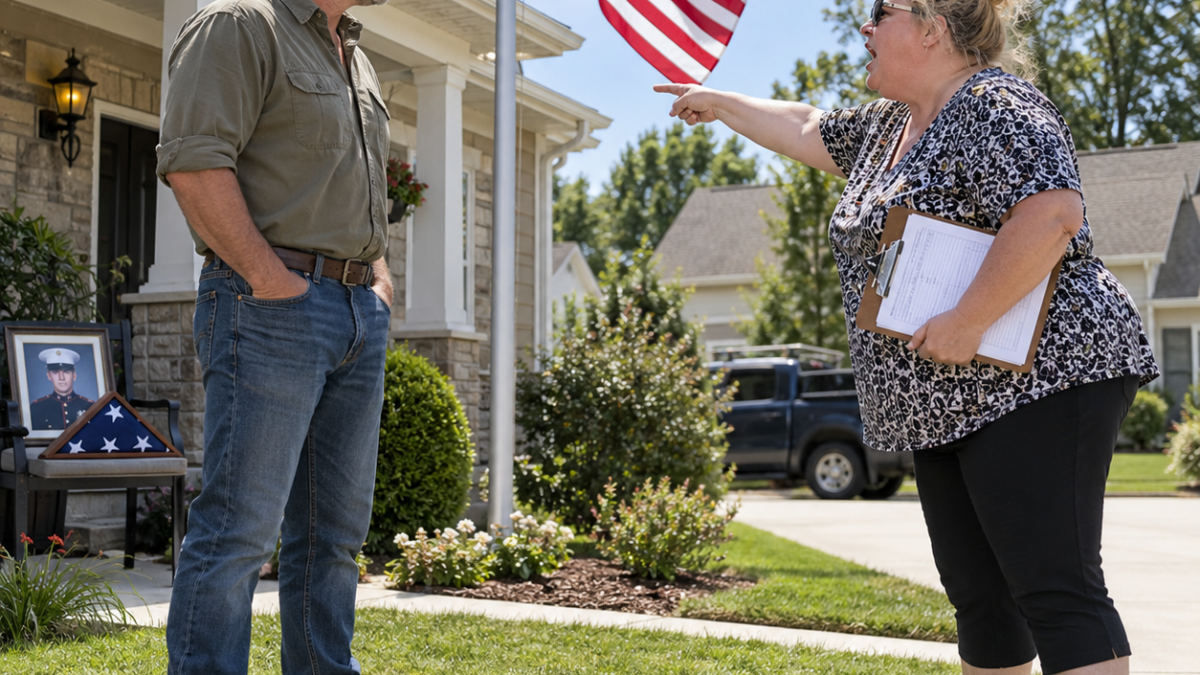
PART 2
I did not tell Sarah what I found immediately.
She had gone to bed before ten, though I knew from the thin line of light beneath our bedroom door that she wasn’t sleeping.
Neither was I.
I sat in my study with Karen’s section of the HOA covenants open on one side of my desk and my laptop on the other.
Twenty-four years in the Army had taught me something that civilians sometimes misunderstand about soldiers.
The movies make people think we spend our careers charging forward.
Most of military life is the opposite.
Planning.
Checking.
Reading.
Waiting.
Making absolutely sure you understand the terrain before anyone moves.
Karen had terrain.
Eighty-two pages of covenants, conditions, restrictions, architectural standards, hearing procedures, enforcement schedules, and enough vague language to frighten anybody who saw legal formatting and assumed it must mean authority.
So I read every page.
Karen’s citation was real.
The covenants did restrict freestanding poles and required architectural approval for certain front-yard structures.
The bench could become a legitimate procedural dispute.
I understood that.
What Karen had done wrong was broader.
Her letters and verbal order weren’t limited to pole dimensions, placement, or some clearly defined safety concern.
She was demanding removal of the display itself unless her committee later decided some lesser version looked acceptable.
That distinction sent me searching.
I found the Freedom to Display the American Flag Act of 2005.
I read it once.
Then again.
The principle was straightforward.
Residential associations covered by the law could not adopt or enforce policies that prevented a member from displaying the flag of the United States on property where the member had the required ownership or use rights.
Associations could impose certain reasonable time, place, or manner restrictions tied to substantial interests.
That mattered.
It meant I did not have a magical right to install any structure I wanted anywhere I wanted simply because a flag hung from it.
But Karen did not appear to be balancing anything.
She had ordered the display removed.
Her written rules gave her committee enormous discretion.
And she had specifically called our memorial incompatible with neighborhood aesthetics.
I printed the statute.
Then I did something I had learned long before battlefields and command briefings.
I started a binder.
On the cover I wrote one word.
DAVID.
Page one was a photograph of my son.
Not in uniform.
Not heroic.
David at seventeen, sitting on the hood of my old pickup with a fishing pole across his knees and the stupidest grin I had ever seen.
That was how I wanted to remember why I was fighting.
Page two was Karen’s violation notice.
It arrived the next morning exactly as promised.
Certified mail.
Two separate violations.
Unauthorized freestanding pole.
Unauthorized landscape alteration.
At the bottom, handwritten in Karen’s looping script:
Failure to remove both items within forty-eight hours will result in continuing fines and potential lien action.
Current amount assessed: $400.
She had charged us retroactively.
I almost admired the audacity.
Sarah stood beside me at the kitchen counter while I read it.
“How is it already four hundred?”
“She backdated it.”
“Can she do that?”
“I don’t know yet.”
Sarah folded her arms tightly across herself.
“What if we just move the flag?”
I looked at her.
She immediately looked away.
“I’m not saying take David’s memorial down.”
“Yes, you are.”
Her face crumpled.
“No.”
I softened.
“Sarah.”
“I’m scared, John.”
That stopped me.
Not because I wasn’t.
Because Sarah rarely admitted fear anymore.
After David died, she learned to carry pain almost invisibly.
People would say, “You’re so strong.”
I hated that phrase.
Strength had not been offered to her as a choice.
She had survived because mornings kept arriving.
Now she was staring at a piece of HOA stationery as if it were another official notice arriving at our door.
“I can’t lose this house,” she whispered.
“You won’t.”
“You don’t know that.”
“No.”
I took her hands.
“But I know we don’t start by surrendering.”
Her eyes filled.
“The flag is the first thing I see when I open the curtains.”
“I know.”
“Some mornings that’s the reason I open them.”
That sentence settled the matter.
Not legally.
Personally.
I kissed her forehead.
“I’m not taking it down.”
Sarah nodded.
Then she looked at the violation letter.
“What do we do?”
“We make them follow every rule they expect us to follow.”
That afternoon I contacted a veterans legal-aid organization.
I described the situation carefully.
I did not tell them Karen was violating federal law as though I had already decided the case.
I told them what the HOA had written, what it had demanded, and what I had found.
A staff attorney named Rachel Kim returned my call.
Her first question surprised me.
“Mr. Miller, is the association forbidding the flag itself, or regulating the pole?”
“Both, effectively.”
“Tell me exactly what they said.”
I read the notices.
Then I described Karen’s words.
Rachel was quiet for several seconds.
“The distinction matters.”
“I figured.”
“The federal statute protects flag display, but associations can still impose reasonable restrictions related to time, place, manner, substantial interests, safety, things like that. The statute doesn’t necessarily give someone an unlimited right to install any flagpole anywhere.”
“I understand.”
“But what you’re describing worries me.”
“Why?”
“Because their written enforcement seems aimed at making the display contingent on discretionary aesthetic approval. And threatening a lien while refusing any meaningful review could make their position worse.”
“What should I do?”
“Nothing emotional.”
I smiled.
“My wife will be pleased to hear that.”
“Document everything.”
“I already started.”
“Good. Request a formal hearing.”
“The rules say I’m entitled to one.”
“Excellent.”
“Should I cite the federal law?”
Rachel paused.
“Not yet.”
That surprised me.
“Why?”
“Because I want to see how they articulate their position when given a chance to correct themselves.”
She wasn’t setting a trap.
Not exactly.
She was doing what competent lawyers do.
Creating a record.
Give the other side notice.
Give them an opportunity to explain.
If they correct the mistake, the dispute can end.
If they don’t, their own words become important.
I drafted the letter that evening.
Calm.
Respectful.
No accusations.
I acknowledged receipt.
I explained that the flag and memorial honored our fallen son.
I asked for a temporary suspension of fines pending review.
I requested a hearing before the full board.
I requested the architectural standards relied upon.
I asked what alternative displays were permitted and what objective criteria would be applied.
I did not mention the federal statute.
Certified mail.
Return receipt.
Karen signed for it herself.
Three days later, the response arrived.
REQUEST DENIED.
A box marked “violations clear and unambiguous” had been checked.
Beneath it Karen had written:
The Board is not obligated to conduct repetitive hearings regarding obvious noncompliance. Remove the pole and memorial bench immediately. Fines continue. Failure to remit may result in lien proceedings.
Sarah read it over my shoulder.
“She called David’s bench noncompliance.”
“Don’t.”
“What?”
“Don’t let her wording into your head.”
Sarah touched the bronze wedding ring on her finger.
“Too late.”
I added the denial to the binder.
Rachel asked me to scan everything.
Twenty minutes after receiving the documents, she called back.
“That’s not good for them.”
“Legally?”
“Procedurally, definitely. On the flag question, we need more.”
“I can get more.”
“Do not provoke anyone.”
“I didn’t say provoke.”
“You sounded like a colonel for a second.”
“Lieutenant colonel.”
“That explains it.”
I had retired at lieutenant colonel after twenty-four years.
David used to call me Colonel Dad whenever he wanted money.
I still heard it sometimes.
Not in some supernatural way.
Memory is enough.
Colonel Dad, the truck needs gas.
Colonel Dad, Mom said ask you.
Colonel Dad, you know you love me.
The last voice mail he ever left was ordinary.
That was what hurt most.
“Hey, Dad. Just checking in. Tell Mom I’m fine. Love you both. Talk soon.”
No prophecy.
No cinematic final words.
Talk soon.
We never did.
Two evenings after the hearing denial, I saw Karen walking her normal inspection route.
Clipboard.
Walking shoes.
Reading glasses hanging on a cord.
I had placed a small recorder in my shirt pocket after confirming with Rachel that recording a conversation I participated in was lawful where we lived.
I hated doing it.
It felt sneaky.
Then I remembered Karen threatening our home beside my son’s plaque.
I walked toward her.
“Karen.”
She looked up.
“Mr. Miller.”
“I’m asking one more time.”
Her shoulders sagged theatrically.
“John, this matter has been settled.”
“No hearing?”
“No.”
“Even though your bylaws provide one?”
“Our committee has discretion.”
“Can we discuss the flag separately from the bench?”
“They are both violations.”
“The flag is a United States flag displayed on my property.”
“On unauthorized hardware.”
“If I removed the pole but displayed the same flag another way?”
“You would need prior architectural approval.”
“Could the committee deny it?”
“Of course.”
“For what reason?”
“Aesthetics. Placement. Size. Community harmony.”
“What size would be approved?”
“We evaluate requests individually.”
“So there is no published standard?”
Karen’s eyes narrowed.
“You’ve been doing research.”
“I’m trying to understand.”
“Then understand this.”
She stepped closer.
“Our covenants are a binding contract.”
“I know.”
“You agreed to them.”
“Yes.”
“They govern your property.”
“Subject to applicable law.”
She laughed.
Not a nervous laugh.
A genuinely amused one.
“Oh, please.”
“There are federal protections concerning display of the American flag.”
“I know what you’re referring to.”
That surprised me.
“You do?”
“Yes.”
“And?”
“It doesn’t matter.”
“Why?”
“Because you agreed to our restrictions when you bought here.”
I kept my voice level.
“Are you saying the HOA covenants override federal law?”
“I’m saying you don’t get to wave something you found online at me and ignore a contract.”
“It’s not something online. It’s federal legislation.”
Karen gave me a tired smile.
“Then hire a lawyer.”
“I may.”
“Good. In the meantime, your fines are now sixteen hundred dollars.”
She turned.
Then stopped.
“And John?”
“Yes?”
“If you force this to lien proceedings, do not blame me when your wife discovers how expensive your pride becomes.”
She walked away.
For several seconds I couldn’t move.
Not because of the threat.
Because she had brought Sarah into it.
That night, I played the recording for Rachel.
She was silent when it ended.
“Still there?”
“Yes.”
“What are you thinking?”
“I’m thinking President Whitmore should stop speaking without counsel.”
“That bad?”
“She acknowledged knowledge of the federal issue and doubled down. More importantly, the association still hasn’t identified an objective, reasonable standard. I want another attorney to look at this.”
“Who?”
“I know someone.”
His name was Marcus Davis.
Colonel Marcus Davis, retired.
My former brigade commander.
My friend.
The man who stood beside me at David’s funeral wearing a black suit and a Combat Infantryman Badge pin because he knew David had always admired it.
After leaving the Army, Marcus returned to law.
By the time Rachel called him, he was a partner at one of the larger civil-litigation firms in the city.
My phone rang at 7:10 the following morning.
“John.”
I recognized the voice immediately.
“Marcus.”
“I just spent an hour getting angry before breakfast.”
“That can’t be good for your blood pressure.”
“Your HOA president called David’s memorial a violation?”
I looked through the window.
The flag moved lazily in the morning breeze.
“Yes.”
“And she threatened Sarah?”
“Indirectly.”
“Don’t defend her.”
“I’m trying to be accurate.”
“Of course you are.”
That was something Marcus used to say whenever he thought I was being annoyingly precise.
He continued.
“Rachel sent me the documents.”
“What do you think?”
“I think we slow down.”
Not what I expected.
“You too?”
“Yes.”
“Everybody keeps telling the infantryman not to advance.”
“You were artillery.”
“Details.”
“Exactly. Listen to me.”
I did.
“The federal flag statute gives us something important, but I don’t want to make an argument broader than the law supports. They can regulate reasonable time, place, and manner under certain conditions. So we don’t walk in screaming that every flagpole regulation in America is illegal.”
“Agreed.”
“What helps us is their behavior.”
“Explain.”
“They aren’t identifying a safety problem. They aren’t offering a clear neutral standard. They are using discretionary aesthetic approval to force removal. They are denying hearings. They’re retroactively fining you. They’re threatening a lien. And Karen is on tape saying the covenants control despite your legal objection.”
“That sounds bad.”
“It sounds litigable.”
I laughed despite myself.
Marcus did not.
“John, I also want to know whether she treats everyone like this.”
That question changed everything.
Until then, I had been looking at Karen entirely through my own grief.
Our memorial.
Our flag.
Our son.
Marcus forced me to widen the lens.
That evening, Mr. Garcia caught me at the mailbox.
His first name was Miguel.
He was sixty-three, broad-shouldered, and had spent thirty-eight years repairing trucks.
“John.”
“What’s up?”
He nodded toward the flag.
“I heard about Karen.”
“News travels.”
“In this neighborhood? Faster than disease.”
He looked uncomfortable.
“You know she got me too.”
“For what?”
“My pickup.”
I glanced at the F-150 in his driveway.
“What’s wrong with it?”
“Apparently parking it at my own house for more than seventy-two hours makes it commercial storage.”
“Do you use it commercially?”
“I’m retired.”
I laughed.
“So no.”
“She fined me seven hundred dollars before I gave in and parked it at my brother’s house.”
“Why did you pay?”
Miguel looked toward his front window.
“My wife had just started dialysis.”
The humor disappeared.
“I didn’t have energy for a war.”
There it was again.
Karen’s real weapon.
Not rules.
Exhaustion.
Across the street lived Amy and Daniel Clark with two little boys.
Their story came two days later.
Amy stopped Sarah while they were both bringing trash cans in.
That evening, she knocked on our door holding a photograph.
A beautiful wooden playset.
Red roof.
Blue sides.
Yellow climbing wall.
“Karen made us remove it.”
Sarah stared.
“Why?”
“Not harmonious with natural landscaping.”
“When?”
“Last year.”
Amy’s voice shook.
“My oldest cried for a week.”
Daniel added, “We appealed.”
“What happened?”
“Denied.”
“Any hearing?”
“No.”
“How much did they fine you?”
“Five hundred before we took it down.”
More stories followed.
Holiday lights.
A garden hose.
A satellite dish.
Flower colors.
Driveway parking.
A mailbox post.
Cream-colored trim that Karen allegedly considered too warm compared with the approved beige.
At first it was almost funny.
Then I started collecting amounts.
$300.
$650.
$1,100.
$425.
$900.
These were not life-ending sums for everyone.
But that was the point.
Each was expensive enough to hurt and small enough that hiring counsel made little economic sense.
It was a pressure system.
Make resistance more expensive than obedience.
Sarah understood before I did.
“This isn’t just happening to us.”
We were sitting at the kitchen table.
“No.”
“And everybody thinks they’re alone.”
“Yes.”
Sarah looked toward the memorial.
“Then bring them together.”
“How?”
“A barbecue.”
I blinked.
“A barbecue?”
“You soldiers make everything sound like an invasion.”
“I was thinking meeting.”
“Exactly.”
She almost smiled.
“Feed them.”
That Saturday, eight families came.
We kept it small.
Miguel and Rosa Garcia.
Amy and Daniel Clark.
The Hendersons.
The Watsons.
Two younger families I barely knew.
Children ran across the backyard.
Smoke rose from the grill.
Sarah made potato salad because she believed no political revolution should begin without too much mayonnaise.
For the first hour, nobody discussed the HOA.
Then Mr. Henderson mentioned the color of his trim.
Miguel laughed.
Amy didn’t.
Within fifteen minutes everyone was talking.
Stories poured out.
“I thought it was just us.”
“She told you that too?”
“We paid because we were afraid of collections.”
“She refused our hearing.”
“She told me everybody else had complied.”
“She said neighbors complained.”
“Nobody complained.”
The isolation dissolved in real time.
I watched shoulders relax.
Voices strengthen.
People stopped whispering.
After dinner, I brought out a folder.
Not the DAVID binder.
That was personal.
This folder contained statutes, HOA bylaws, hearing procedures, correspondence, and a one-page timeline.
“I want to make something clear,” I said.
Everyone listened.
“This isn’t a mob.”
Miguel smiled.
“Disappointing.”
“Marcus Davis, the attorney advising me, would prefer none of us behave like one.”
“That sounds expensive.”
“He is.”
A few people laughed.
I held up the federal statute.
“This is one part of my dispute. It does not mean every rule involving a flag or flagpole is automatically invalid. But it does protect a homeowner’s right to display the American flag against outright prohibition by covered residential associations, subject to reasonable restrictions.”
Amy leaned forward.
“So Karen is wrong?”
“On what she’s doing to me, our attorneys believe she has a serious problem.”
“Good.”
“But that doesn’t automatically fix your playset.”
Her face fell.
“Different issues require different arguments.”
Daniel nodded slowly.
“What can we do?”
“Read.”
Everyone looked at me.
“Seriously?”
“Yes.”
I pushed copies of the bylaws across the table.
“Karen wins because everybody assumes she knows the rules better.”
Miguel picked up a copy.
“Eighty pages?”
“You wanted freedom.”
“Not this much freedom.”
Another laugh.
Then Sarah spoke.
“Keep every letter.”
The table went quiet.
She looked at Amy.
“Every envelope.”
At Miguel.
“Every email.”
At Mrs. Henderson.
“Every payment.”
Then at everyone.
“When someone speaks to you, write down when and where.”
I stared at my wife.
She looked back.
There was steel in her I had not seen since before David died.
“She made us feel ashamed for loving our son,” Sarah said.
Her voice trembled.
“I won’t give her another inch.”
Nobody joked after that.
By Monday we had a secure shared folder.
Families uploaded violations.
Emails.
Photographs.
Appeal requests.
Invoices.
Within a week, Marcus’s firm had enough material to identify patterns.
Some violations appeared legitimate.
We did not pretend otherwise.
A homeowner who left a broken-down car leaking oil in the street had been properly cited.
Another family had built a large structure without approval.
But mixed among those were dozens of discretionary aesthetic fines.
More troubling was process.
Hearings denied.
Standards changed without clear notice.
Similar violations treated differently.
Karen’s friends appeared to receive warnings while others received fines.
The more Marcus reviewed, the less amused he became.
“This isn’t just bad leadership.”
“What is it?”
“Potential selective enforcement, procedural irregularity, maybe fiduciary issues depending on the financial records.”
“How do we get those?”
“Homeowners request them through the process.”
We did.
Karen refused.
Not directly.
The association office claimed records were temporarily unavailable because of “administrative restructuring.”
Marcus smiled when he read that.
“What?”
“I love vague phrases.”
“Why?”
“They usually mean somebody doesn’t want you looking.”
He sent a formal records request.
That got attention.
Three days later, Karen appeared at my door.
I opened it but stayed behind the storm door.
“What are you doing?”
“No hello?”
“You contacted an attorney.”
“Yes.”
“You are trying to intimidate volunteers.”
“You threatened a lien against my home.”
“We’re enforcing rules.”
“I requested records.”
“You’re stirring up neighbors.”
“They’re adults.”
“You held a meeting.”
“We had ribs.”
Her face reddened.
“You think this is funny?”
“No.”
I looked past her toward the memorial.
“Not remotely.”
Karen followed my eyes.
For a moment, something shifted.
Then she hardened again.
“If you proceed with this, the board will take the lien vote.”
“When?”
“Next regular meeting.”
“Put that in writing.”
Her eyes narrowed.
“You keep saying that.”
“Yes.”
“Why?”
“Because spoken threats disappear.”
She stared at me.
Then said the worst thing she could have said.
“Your son’s service does not entitle you to special treatment.”
I felt my hand tighten on the doorframe.
“No.”
My voice came out quieter than I expected.
“It entitles him to nothing now.”
Karen flinched.
“He’s dead.”
I opened the storm door.
Not toward her.
Just enough that she heard every word.
“I am not asking you to give my dead son anything.”
Sarah had come into the hallway behind me.
I could feel her presence.
“I’m asking you not to use his memorial as leverage against his mother.”
Karen’s mouth opened.
Nothing came.
I continued.
“You want to debate pole placement? Fine.”
I pointed toward the binder visible on the entry table.
“You want to discuss objective safety standards? Fine.”
Then I looked her directly in the eyes.
“But if you threaten this home because my wife looks at that flag every morning and remembers the boy she buried, you had better be certain every signature, hearing denial, fine, and lien action can survive daylight.”
Karen stepped backward.
“Is that a threat?”
“No.”
“It sounded like one.”
“It was advice.”
She left.
Sarah waited until Karen reached the sidewalk.
Then she closed the door.
Her face was wet.
“I hate her.”
I put my arms around her.
“I know.”
“I haven’t hated anybody since David died.”
“That’s not true.”
She looked at me.
“You hated the casualty officer for about ten minutes.”
A laugh escaped her through the tears.
“He was so kind.”
“I know.”
“I felt terrible.”
“I know.”
She pressed her face into my chest.
“I don’t want this fight to turn me into someone else.”
That sentence stayed with me longer than anything Karen had said.
Because revenge feels righteous when you are wounded.
It feels clean.
Necessary.
But Sarah understood the danger.
We could fight Karen without becoming Karen.
That became the rule.
No threats.
No harassment.
No contacting her employer.
No bothering her family.
No publishing her address.
No cruelty.
Documents.
Procedure.
Votes.
Law.
Nothing more.
The board meeting was scheduled for the fifteenth.
A week before it, Marcus told me to make one final written attempt at resolution.
“Why?”
“Because I want a judge to see that your first goal was compliance, not punishment.”
“They have rejected me twice.”
“Then make it three.”
I drafted a letter.
I offered to discuss relocating the pole slightly if the board identified a legitimate safety concern.
I offered to submit measurements.
I offered to provide photographs.
I asked again for clear written standards.
I asked again for a hearing.
I asked that fines stop while the dispute was reviewed.
I said the bench could be discussed separately.
I did everything a reasonable homeowner should do.
The board’s response arrived ten days later.
Signed by all five members.
No hearing.
No suspension.
No compromise.
And one paragraph that made Marcus go silent when I read it.
The board would vote on the fifteenth to authorize lien proceedings for unpaid fines and legal costs if the memorial and flag display remained unchanged.
Marcus finally spoke.
“Send me a scan.”
I did.
Ten minutes later, he called.
“John.”
“Yes?”
“They just made this much more serious.”
The meeting on the fifteenth drew almost sixty homeowners.
Normally twelve showed up.
Karen noticed.
She entered carrying two binders and a gavel.
I almost admired the symbolism.
Marcus sat beside me.
Sarah sat on my other side.
Miguel and Rosa were behind us.
Amy Clark had brought the photograph of her children’s playset.
Mr. Henderson carried his paint invoices.
The board sat at a long folding table.
Karen began with routine business as if nothing unusual were happening.
Pool filter.
Landscaping contract.
Streetlight repair.
Then she reached our item.
“Violation enforcement concerning 124 Chestnut Lane.”
My home.
Sarah’s fingers tightened around mine.
Karen read from prepared remarks.
She said the board respected military service.
That phrase immediately told me what was coming.
Whenever someone begins with “we respect,” prepare for the word “but.”
“But no resident can place personal preference above community standards.”
She described the memorial as unauthorized improvements.
She called our refusal willful.
Then she said the outstanding balance.
$5,400.
Sarah inhaled sharply.
Five thousand four hundred dollars.
For leaving our son’s memorial untouched while requesting a hearing.
Karen called for discussion.
One board member, Richard Collins, looked uneasy.
“Have we gotten a legal opinion?”
Karen answered before the association attorney could.
“Yes.”
Marcus leaned toward me.
“Interesting.”
Another member asked whether the federal flag issue had been considered.
Karen’s voice sharpened.
“This is not about patriotism.”
Richard looked at her.
“I didn’t say patriotism. I said federal law.”
Karen shuffled papers.
“Our counsel has advised that reasonable architectural restrictions remain permissible.”
That statement was at least partly true.
Then she made the leap.
“Therefore our enforcement is valid.”
Marcus wrote something.
I looked.
NOT WHAT COUNSEL SAID.
He had noticed the lawyer’s expression.
The HOA attorney, a local practitioner named Paul Hendricks, looked deeply uncomfortable.
Richard turned to him.
“Is that your opinion?”
Hendricks cleared his throat.
“My advice was that federal law does not eliminate all reasonable association restrictions concerning manner of display.”
Karen nodded triumphantly.
“Exactly.”
Hendricks continued.
“I also advised the board to suspend enforcement and negotiate a written accommodation while evaluating whether our current policy satisfies the statute.”
Silence.
Karen stared at him.
“You said our rules were valid.”
“I said reasonable restrictions may be valid.”
“Same thing.”
“No.”
One word.
But it changed the room.
Hendricks looked around the table.
“I did not recommend lien action at this stage.”
Marcus whispered, “There it is.”
Karen’s face flushed.
“We are the elected board. Counsel advises. We decide.”
That was also true.
And disastrous.
Richard lowered his eyes.
The other members shifted.
Karen called the vote.
“Motion to authorize lien proceedings if the outstanding balance remains unpaid.”
Richard hesitated.
Karen looked at him.
He raised his hand.
Yes.
Brenda Hayes.
Yes.
Steven Porter.
Yes.
Linda Marks.
Yes.
Karen.
Yes.
Unanimous.
Sarah’s hand trembled in mine.
I turned toward her.
“You okay?”
“No.”
“Want to leave?”
“No.”
Her answer was immediate.
“I want to watch.”
Karen looked directly at us.
“The motion carries.”
Marcus closed his notebook.
I knew that gesture.
I had seen it years earlier when he commanded troops.
Decision made.
Operation begins.
Outside the clubhouse, he stopped under the parking-lot light.
“Tomorrow morning we file.”
Sarah looked at him.
“File what?”
“A federal complaint challenging the association’s enforcement against the protected flag display and related conduct, along with appropriate state-law claims your local counsel has developed.”
Sarah looked frightened.
“Will we lose our house?”
“No.”
Marcus spoke gently now.
“And if they attempt to perfect a lien while the dispute is being litigated, we seek immediate relief.”
Sarah nodded.
I looked at him.
“What about everybody else?”
“Separate track.”
Miguel stepped closer.
“What track?”
Marcus faced the neighbors gathering around us.
“Your complaints require individual review. Some may be contractual. Some may involve selective enforcement or process. We are not going to promise claims we cannot prove.”
Miguel nodded.
“But?”
“But you have enough homeowners to use your bylaws.”
“For what?”
Marcus looked at Karen leaving through the clubhouse door.
“A recall.”
The petition required thirty percent of voting households to demand a special membership meeting.
By midnight we had thirty-eight percent.
By noon the next day, fifty-six.
People I had never met knocked on our door.
Not because of federal law.
Because the unanimous lien vote frightened them.
If the board could threaten a Gold Star family’s home while its own attorney advised negotiation, what would happen to everyone else?
The lawsuit was filed two days later.
No trumpets.
No cameras.
Electronic docket.
Case number.
Complaint.
Motion for preliminary relief.
Affidavits.
Exhibits.
The real world of law is less cinematic than television.
But a stamped federal complaint carries its own gravity.
Karen was served at home.
So were the board members in their official capacities where appropriate.
The association received service.
Insurance carriers were notified.
Lawyers appeared.
Then somebody called the media.
Not me.
Not Marcus.
Not Sarah.
Amy Clark later admitted she emailed a local investigative reporter after seeing the filing become public.
Her name was Sharon Price.
She called me on a Monday.
“Mr. Miller?”
“Yes.”
“I’m with Channel Seven Investigates.”
My stomach dropped.
“How did you get my number?”
“Public directory.”
“What do you want?”
“I’ve read the complaint involving Oakwood Creek.”
I closed my eyes.
“I’m not discussing active litigation without counsel.”
“Understood. May I ask one question off the record?”
“No.”
She laughed.
“Your lawyer trained you well.”
“The Army trained me first.”
“Can I call him?”
“You can call anybody you want.”
Marcus called fifteen minutes later.
“You charming television reporters now?”
“I told her nothing.”
“She wants an interview.”
“Absolutely not.”
“Why?”
“Because this is David.”
That ended his joking.
“I know.”
“I will not turn him into a headline.”
Marcus was quiet.
“Then don’t.”
The next day Sharon emailed.
No pressure.
Just one paragraph.
She had interviewed other homeowners.
Amy.
Miguel.
The Hendersons.
She had copies of public court filings.
She planned to run the story whether I participated or not.
Sarah read the email.
“Talk to her.”
I stared at my wife.
“You sure?”
“No.”
She sat on David’s bench.
“But if they’re going to tell his story, I want them to know who he was.”
That changed my answer.
Sharon came Thursday.
One camera operator.
No giant production.
No dramatic music while we spoke.
She stood beside the memorial and asked about David.
For a few seconds, I couldn’t answer.
Then I began where fathers always begin.
“He was funny.”
Not brave.
Not decorated.
Funny.
“He could imitate every officer I ever worked for.”
Sarah smiled.
“Especially John.”
“He had me perfect.”
Sharon asked what David loved.
Sarah answered.
“Bad coffee.”
I laughed.
“He thought gas-station coffee was gourmet.”
“Baseball.”
“Dogs.”
“Fishing, though he was terrible.”
“His mother.”
Sarah looked down.
“And this country.”
Sharon did not ask how he died immediately.
I appreciated that.
Eventually she did.
Afghanistan.
Vehicle attack.
Three killed.
David was twenty-nine.
She asked about the flag.
I touched the pole.
“The flag used on certain days is the one connected to his funeral. We rotate it carefully to preserve it. But every day there is an American flag here because that mattered to him.”
“Why not simply use a house-mounted bracket if the HOA allows one?”
It was a fair question.
“Because we built this memorial around the place Sarah comes to sit.”
I pointed to the bench.
“This isn’t about winning permission to wave fabric. It is about whether the association can use discretionary aesthetics to effectively force this display out after refusing any meaningful process.”
Sharon asked about the federal law.
I repeated what Marcus had instructed.
“The law protects flag display, but it also permits reasonable restrictions in certain circumstances. Our position is that what Oakwood Creek did here went beyond reasonable regulation.”
No grandstanding.
No claim that every HOA restriction was automatically illegal.
Then Sarah asked to speak.
I had not expected that.
She stood beside the plaque.
Sharon lowered the microphone.
“My son isn’t a legal argument.”
Her voice shook.
“He isn’t a political argument either.”
She placed her hand on the stone.
“He was my child.”
Sharon said nothing.
“I changed his diapers.”
Sarah laughed through tears.
“I yelled at him for leaving cereal bowls in his room.”
Her voice broke.
“I sat beside his hospital bed when he broke his arm at thirteen.”
She wiped her cheek.
“And then somebody handed me a folded flag because he was never coming home.”
Even the camera operator looked away.
“I don’t need this HOA to honor him.”
Sarah drew herself upright.
“I need them to stop punishing me for remembering him.”
That line aired exactly as she said it.
The report ran at six.
I did not watch live.
I couldn’t.
Miguel called at 6:14.
“John.”
“What?”
“You might want to turn off your phone.”
“Why?”
“This is going everywhere.”
By seven, veterans organizations had shared the clip.
By eight, regional news outlets picked it up.
The headline reduced months of nuance to one sentence:
GOLD STAR FAMILY FINED OVER AMERICAN FLAG MEMORIAL
I hated how much I liked its effect.
That frightened me.
Because outrage is intoxicating when it favors you.
Our neighborhood Facebook page exploded.
Most residents defended us.
Some defended the board.
A few correctly pointed out that the legal issue was more complicated than “HOA bans American flag.”
They were right.
But then Karen gave an interview.
Nobody on her legal team approved it.
I learned that later.
She apparently contacted another station because she believed Sharon’s report was unfair.
Karen sat in her living room surrounded by framed family photographs.
The reporter asked whether she regretted how the issue had been handled.
Karen should have said:
We respect the Millers.
The board is reviewing the matter with counsel.
We hope to reach a compassionate resolution consistent with law.
Instead, she said:
“Rules lose their meaning if personal tragedy becomes an excuse for noncompliance.”
I watched the clip once.
Only once.
Sarah was beside me.
When Karen said personal tragedy, my wife went completely still.
Then Karen continued.
“Mr. Miller has chosen to exploit his son’s military death to gain special treatment.”
Sarah stood.
Walked out.
I heard the bedroom door close.
I did not follow immediately.
I remained in my chair.
My hands shook.
For the first time since this began, I wanted to hurt Karen.
Not physically.
I wanted humiliation.
I wanted cameras on her when she lost.
I wanted every neighbor to turn away from her.
I wanted her to feel powerless.
Then I heard my son’s voice in memory.
Colonel Dad, calm down.
He used to say it whenever I got angry about small things.
The television kept playing.
I shut it off.
Then I went upstairs.
Sarah sat on the edge of the bed holding David’s framed academy photograph.
“I’m sorry.”
“For what?”
“For telling you to talk to the reporter.”
“This isn’t your fault.”
“She called him—”
“I know.”
Sarah covered her mouth.
“How can somebody say that?”
I sat beside her.
“Because she’s scared.”
“That doesn’t make it okay.”
“No.”
She looked at me.
“Destroy her.”
The words shocked both of us.
Sarah closed her eyes.
“I don’t mean—”
“I know.”
“No.”
She turned toward me.
“I want her gone.”
I took her hand.
“That we can work toward.”
“I want everyone to know what she is.”
“They’re learning.”
“I want her to feel what she made us feel.”
There it was.
The edge.
I squeezed her fingers.
“David wouldn’t want that part.”
Sarah’s face collapsed.
“I know.”
We sat together until after midnight.
The next morning, Karen’s interview had produced exactly the backlash you would expect.
But I imposed rules on myself.
I would not read comment sections.
I would not share humiliating clips.
I would not celebrate threats sent to the board.
When strangers posted Karen’s personal phone number online, Marcus’s firm publicly asked people to stop.
When someone photographed her husband at a grocery store, I condemned it.
He had not fined us.
He had not voted.
He had not called David manipulative.
Justice needed boundaries.
The association’s insurance attorney understood the danger faster than Karen did.
Within forty-eight hours, the HOA offered to suspend the fines and lien process pending litigation.
Marcus accepted the suspension.
Not a settlement.
A pause.
The recall petition continued.
Karen sent an email to the whole community accusing “outside agitators” of attacking Oakwood Creek.
That phrase did not help.
Most of the agitators lived there.
Then the board cracked.
Richard Collins called Marcus.
Not me.
Smart.
He wanted separate counsel.
Within a day, two other directors did the same.
Karen had assumed unanimity meant loyalty.
It had meant fear.
When the consequences became personal, fear changed direction.
The emergency HOA meeting was called for Thursday.
Normally the clubhouse seated eighty.
More than two hundred people arrived.
Residents.
Local veterans.
A few reporters.
Not a mob.
Marcus had made that clear.
“We are not staging theater.”
Miguel looked around the packed room.
“Feels theatrical.”
“Behave.”
“You’re no fun.”
Sarah and I sat in the front row.
I had not worn my old uniform.
I considered it for about thirty seconds.
Then decided against it.
David’s memory did not need costume.
I wore jeans and a navy shirt.
Sarah wore the blue dress she had worn to David’s final promotion ceremony.
I didn’t realize until we were in the car.
When I asked, she simply said, “I wanted him here.”
The meeting began badly.
Karen struck the gavel three times.
“Order.”
Someone shouted, “Apologize!”
Marcus turned around.
“No.”
His voice cut through the room.
“Let the meeting proceed.”
Strangely, they listened.
Karen read a statement prepared by counsel.
Respect for veterans.
Pending litigation.
Board commitment.
No comments on active case.
It was legally sensible and emotionally dead.
Then the resident-comment period began.
Amy Clark went first.
She brought the photograph of the playset.
“My son was five.”
She held it up.
“He thought he did something wrong because adults made us take this down.”
Her voice trembled.
“I told him the neighborhood had rules.”
She looked at Karen.
“I should have told him one woman liked control.”
Applause.
Miguel followed.
He spoke about moving his truck during his wife’s dialysis treatments because he could not handle another fight.
Mrs. Watson described receiving three violation letters while caring for her dying sister.
A young father talked about being fined because his work van was visible overnight even though he needed it for his job.
The Hendersons spoke about paying twice to repaint trim.
Story after story.
No federal statutes.
No legal jargon.
Just consequences.
Karen shrank a little with each one.
Then Sarah stood.
I reached for her hand.
She squeezed it once and let go.
She walked to the microphone.
Nobody spoke.
“My name is Sarah Miller.”
Her voice was quiet.
Everybody leaned forward.
“I am David’s mother.”
She paused.
“I have listened to people call me a Gold Star mother for years.”
Her hands trembled.
“I appreciate what they mean.”
She swallowed.
“But I would trade every medal, every folded flag, every ceremony, every kind word anybody has ever given me for one ordinary Tuesday with my son.”
The room became completely still.
“I don’t want special treatment.”
She looked directly at Karen.
“I want my boy.”
Karen looked down.
“But I cannot have him.”
Sarah’s voice cracked.
“So I have a bench.”
She pointed toward our street, toward a memorial nobody inside could see.
“I have his name in bronze.”
She wiped tears away.
“And I have a flag.”
Several veterans in the back lowered their heads.
“I sit under that flag when I miss him so badly I cannot breathe.”
She looked at Karen again.
“You called that manipulation.”
Karen’s face changed.
For the first time, I saw shame.
Not annoyance.
Not fear.
Shame.
Sarah continued.
“I don’t need you punished because you hurt me.”
I had not known she would say that.
“I need you removed because you hurt too many people and believed your title made every hurt acceptable.”
Applause began.
Sarah lifted one hand.
It stopped.
She wasn’t finished.
“My son wore a uniform.”
Her voice strengthened.
“He believed authority should mean responsibility.”
She stepped away from the microphone.
“So should we.”
No roar.
No dramatic cheer.
People stood.
Slowly.
One after another.
The entire room.
I stayed seated for a second because my legs had stopped working.
Then I stood too.
Karen stared at Sarah.
Her eyes were wet.
That complicated everything.
Because villains are easier when they never look human.
Marcus waited until everyone sat.
Then he approached the microphone.
“My name is Marcus Davis. I represent John and Sarah Miller.”
Karen’s new attorney shifted in his chair.
Marcus kept his tone measured.
“I will not try this case in a clubhouse.”
A few people laughed.
“But several facts are appropriate to clarify.”
He explained the federal law carefully.
It protected display of the American flag by members of covered residential associations on property where they held the relevant ownership or use rights.
It did not erase every reasonable time, place, or manner restriction.
Our claim, he explained, challenged Oakwood Creek’s actual enforcement: an order effectively prohibiting the Millers’ chosen display under discretionary aesthetic rules, escalating fines, refusal of hearings, and threatened lien action despite notice of federal protection.
That was less dramatic than saying “federal law makes every flagpole fine illegal.”
It was also honest.
Marcus continued.
“The HOA’s own prior attorney advised negotiation before lien action.”
Karen looked toward the board.
Richard stared straight ahead.
“That advice was not followed.”
Then Marcus did something unexpected.
He closed his folder.
“The lawsuit can be resolved.”
People murmured.
Karen looked up.
Marcus turned toward the board.
“My clients are not asking to bankrupt Oakwood Creek.”
I looked at him.
We had discussed this.
Still, hearing it publicly changed the atmosphere.
“They are asking for the fines to be withdrawn, lien action abandoned, reasonable written standards adopted consistent with applicable law, hearing rights honored, and the association’s enforcement practices independently reviewed.”
Karen’s attorney whispered to her.
Marcus added:
“And they are asking the leadership responsible for this escalation to answer to the membership.”
That was the recall.
Richard Collins stood.
Karen’s face tightened.
“Richard?”
He looked terrified.
“I need to say something.”
“Talk to counsel.”
“I have.”
He faced the room.
“I voted for the lien action.”
Boos started.
Marcus turned around.
“Let him speak.”
Richard continued.
“I believed Karen when she told us counsel had approved everything.”
Karen shot up.
“That is not what happened.”
Richard looked at her.
“You told me Paul said we were safe.”
“We were!”
“No.”
He shook his head.
“I called him.”
The room stirred.
“He told us to negotiate.”
Karen gripped the table.
Richard’s voice broke.
“I should have asked before I voted.”
Another board member, Linda Marks, began crying.
“I should have too.”
Karen stared at them.
“You’re cowards.”
Maybe they were.
But the word landed differently coming from her.
Linda wiped her face.
“I was scared of you.”
That silenced Karen.
“You’re supposed to be scared of consequences, Linda.”
“No.”
Linda stood.
“That’s the problem.”
She looked around.
“We all became scared of Karen instead of accountable to you.”
She pointed toward the homeowners.
“I’m resigning.”
Gasps.
Richard nodded.
“So am I.”
A third member raised his hand.
“Me too.”
Karen’s entire majority disappeared in under two minutes.
She began pounding the gavel.
“You cannot disrupt governance because of media pressure!”
Miguel shouted from behind me.
“This isn’t media pressure!”
Karen pointed at him.
“You are out of order.”
He stood.
“No, Karen.”
Rosa grabbed his sleeve.
He softened his voice.
“This is our neighborhood.”
The petition organizers had followed the bylaws precisely.
Enough signatures had been certified.
A formal recall election had already been scheduled for the following week.
The emergency meeting could not lawfully remove Karen by shouted vote that night.
And I was glad.
Because mob justice, even when the mob agrees with you, is still dangerous.
So the meeting ended with procedure.
Exactly what Karen had weaponized.
Exactly what would now judge her.
The following Tuesday, ballots were counted by an independent election service retained after homeowners demanded outside oversight.
Eligible votes cast: 186.
Votes to retain Karen Whitmore: 2.
Votes to remove: 184.
When Miguel called me with the number, I thought I had misheard.
“One hundred eighty-four?”
“One eighty-four.”
“And two against removal?”
“Yep.”
“Who were they?”
He laughed.
“I’m pretty sure one was Karen.”
“The other?”
“Her husband loves her.”
I couldn’t help it.
I laughed.
Not cruelly.
Maybe a little.
Karen was removed.
The new board elected Miguel president.
He objected immediately.
“I fix engines.”
“That qualifies you better than most politicians,” I said.
“Not helping.”
His first motion was simple.
All fines against the Miller property connected with the disputed memorial enforcement were suspended permanently pending counsel’s formal dismissal.
Second motion:
Withdraw any lien authorization.
Passed unanimously.
Third:
Issue a written apology.
Miguel read it aloud at the next meeting.
Sarah cried.
So did he.
Fourth:
Commission an independent audit of five years of enforcement fines.
That was where the revenge became bigger than us.
The audit found more than $68,000 in fines and administrative fees that required review.
Not all were improper.
Some were legitimate.
But thousands had been assessed under inconsistent standards or flawed procedures.
The board created a claims process.
Families received refunds.
Amy and Daniel Clark received theirs first.
Five hundred dollars.
They did something better with it.
They rebuilt the playset.
The weekend it went up, half the street came to help.
Red roof.
Blue panels.
Yellow climbing wall.
Amy asked Leo—now six—to choose one additional color.
He chose neon green.
“Karen would have fainted,” Miguel said.
“Behave,” Rosa told him.
The Hendersons received reimbursement for one of their unnecessary repainting expenses.
Mr. Garcia got back several truck-related fines.
The Watsons received fees tied to violations issued during a period when the association’s own hearing process had not been followed.
The community changed.
Not because rules disappeared.
That would have been another mistake.
People still had to maintain dangerous structures.
They still could not block sidewalks.
They still had parking restrictions.
Noise rules remained.
Pool rules remained.
But subjective aesthetic enforcement was narrowed.
Hearings became meaningful.
Board decisions were published.
Fine schedules were capped.
Records were accessible.
And a new flag policy was adopted after counsel reviewed federal requirements.
It explicitly recognized residents’ right to display the American flag while establishing neutral safety and placement standards.
Nobody mentioned David in the rule.
I liked that.
The law should protect everyone.
Not just families with sympathetic stories.
The lawsuit remained.
The HOA’s insurer wanted settlement.
Marcus did not ask for millions.
Despite what angry strangers online suggested, we were not trying to own Oakwood Creek.
Our demand focused on legal fees, emotional harm, reform, and assurance that the association would not resume the challenged conduct.
Karen became the difficult piece.
Her own counsel wanted resolution.
She did not.
For weeks, she refused to admit anything.
Then discovery began.
Emails surfaced.
One from Karen to another board member read:
If Miller gets away with that memorial, everyone will want exceptions and we’ll lose control of visual standards.
Another:
His military story is making people sentimental. Stay focused on enforcement.
Then one that made Sarah put down the page and leave the room:
The wife will pressure him to comply once she understands the lien risk.
I stared at that sentence for a long time.
Karen had seen Sarah.
Not as a grieving mother.
As leverage.
Marcus watched me.
“John.”
“I’m fine.”
“No, you’re not.”
“She used my wife.”
“Yes.”
“I want her to pay.”
Marcus leaned back.
“What does that mean?”
I hated lawyers when they asked questions I didn’t want to answer.
“You know.”
“No.”
He waited.
“What do you actually want?”
I looked at the email.
“I want her embarrassed.”
“Already happened.”
“I want her to lose money.”
“Possible.”
“I want her to understand.”
Marcus’s expression changed.
“That one I can’t guarantee.”
Neither could a court.
Eventually, mediation was scheduled.
We sat in separate rooms.
Karen arrived with her attorney and her husband, Peter.
I had seen Peter around the neighborhood.
Quiet man.
Retired pharmacist.
Never involved with HOA meetings.
At noon, the mediator brought an offer.
All fines withdrawn.
No lien.
Legal fees paid through insurance subject to agreement.
Financial payment to Sarah and me.
Policy reforms locked in.
Karen would contribute personally toward a portion not covered by insurance.
Confidentiality limited because we refused any deal that prevented discussing general facts already public.
Marcus looked at me.
“This is strong.”
“How much personally?”
He told me.
Enough to hurt.
Not enough to ruin her.
Sarah sat beside me.
“What do you think?”
She looked exhausted.
“I want to go home.”
That decided it for me.
Not vengeance.
Home.
We accepted after final language changes.
When it became public that a settlement had been reached, reporters wanted an exact amount.
We declined to disclose details restricted by the agreement.
But the overall payment to us was substantial enough to matter.
Sarah surprised me.
“I don’t want it.”
“We can save it.”
“No.”
She shook her head.
“It feels wrong.”
“What do you want to do?”
She looked toward David’s photograph on the mantel.
“Give it away.”
We donated our net recovery after expenses to organizations assisting families of fallen service members and veterans in crisis.
Not as a publicity stunt.
At first we planned to do it quietly.
Then Marcus pointed out something.
“If you announce it, other people may donate too.”
Sarah agreed.
So we held one press availability beside the memorial.
No dramatic speech.
I said:
“This case was never about turning David’s death into money.”
Then Sarah spoke.
“It was about protecting the place where we remember him.”
She looked at the reporters.
“If anything good came from something so ugly, we want that good to reach families who know what an empty chair feels like.”
That line produced more donations than ours.
People sent twenty dollars.
Five.
One hundred.
Veterans groups organized fundraisers.
A local business matched donations for a week.
The final total went far beyond the settlement.
For once, publicity felt clean.
Karen’s house went up for sale one month later.
A FOR SALE sign appeared near her mailbox.
Miguel saw it first.
He texted me a photograph.
THE FINAL VIOLATION.
I called him.
“Take that down.”
“What?”
“The joke.”
“Why?”
“We’re done.”
He was quiet.
“You’re right.”
That was another lesson.
Winning can become addictive.
If you keep punishing after the danger ends, victory turns into cruelty.
Karen avoided us during her final weeks.
Then one afternoon, while I was trimming Sarah’s roses, a shadow crossed the lawn.
I looked up.
Karen stood on the sidewalk.
No clipboard.
No folders.
Simple gray sweater.
She seemed smaller.
“John.”
“Karen.”
She looked toward the flag.
Then toward the bench.
“May I come closer?”
That question alone told me how much had changed.
“Yes.”
She walked onto the lawn.
Slowly.
When she reached the memorial, she read David’s plaque.
Actually read it.
Her lips moved slightly.
“He was twenty-nine?”
“Yes.”
“My daughter is twenty-nine.”
I said nothing.
Karen sat on the edge of the granite bench.
I almost told her not to.
Then stopped myself.
A bench exists for people to sit.
She looked up at the flag.
“I was wrong.”
Simple words.
I had imagined them many times.
They felt smaller in reality.
“Yes.”
She winced.
“You could make this easier.”
“I could.”
“Will you?”
“No.”
She nodded.
Fair.
“I don’t know what happened to me.”
I leaned against the flagpole.
“You became president.”
A tiny smile.
“Maybe.”
Then she shook her head.
“No. That’s too easy.”
I waited.
“My mother lived with us at the end of her life.”
I had never known that.
“She had dementia.”
Karen looked at the plaque rather than me.
“Everything in our house became chaos.”
She breathed slowly.
“She would leave burners on. Wander outside. Hide things. Accuse me of stealing.”
Her eyes filled.
“I spent four years unable to control anything.”
I understood where the story was going.
“When she died, I thought I’d feel grief.”
Karen laughed softly.
“I felt relief.”
Then shame crossed her face.
“I hated myself for that.”
She pressed her hands together.
“The HOA gave me something I could fix.”
“Lawns.”
“Mailboxes.”
“Playsets.”
“Order.”
She looked at me.
“Every rule had an answer. Every violation could be corrected.”
“And people?”
Her face collapsed slightly.
“People became violations too.”
There it was.
Not an excuse.
An explanation.
I had spent enough years leading soldiers to understand the difference.
Trauma does not absolve harm.
Grief does not grant authority.
Pain can explain the road without excusing where you drove.
“Why did you call Sarah manipulative?”
Karen closed her eyes.
“I was angry.”
“That email about using the lien to pressure her?”
She opened her eyes.
“I was cruel.”
“Yes.”
No softening.
No rescue.
“Yes, you were.”
She began crying.
Quietly.
“I watched the interview afterward.”
“The one you gave?”
“Yes.”
“My husband asked me who I had become.”
I looked toward her house.
“Peter seems decent.”
“He is.”
“Did he know?”
“Not most of it.”
She laughed bitterly.
“He thought HOA president meant organizing landscaping bids.”
That sounded like Peter.
Karen ran her hand along the stone bench.
“I don’t expect forgiveness.”
“Good.”
Her eyes met mine.
Again, surprise.
“I’m not trying to punish you.”
“What’s the difference?”
“Forgiveness is not something you request because consequences became uncomfortable.”
She looked down.
“Fair.”
We sat in silence.
Then the front door opened.
Sarah stepped outside.
She saw Karen.
Stopped.
I stood.
Karen did too.
For several seconds, neither woman moved.
Then Sarah walked toward us.
Karen looked terrified.
More terrified than she ever had facing lawyers or cameras.
“Mrs. Miller.”
“Sarah.”
Karen swallowed.
“Sarah.”
My wife stood beside the plaque.
Karen tried to speak.
Nothing came.
Finally:
“I am sorry.”
Sarah’s expression did not change.
“For which part?”
Karen inhaled.
“For calling David an excuse.”
Sarah’s eyes filled immediately.
“For calling your grief manipulative.”
Karen’s voice broke.
“For threatening your home because I thought fear would make you pressure your husband.”
Sarah looked at her.
“That one hurt the most.”
“I know.”
“No.”
Sarah shook her head.
“You know now.”
Karen nodded.
“Yes.”
Sarah touched David’s name.
“I spent months after he died wondering if I had done something wrong.”
Karen looked confused.
“Mothers do that.”
Sarah’s voice became distant.
“What if I had talked him out of joining? What if I had made him afraid? What if I had called that morning? What if I had prayed harder? What if—”
I touched her shoulder.
She continued.
“Grief is a machine that manufactures guilt.”
Karen started crying again.
“So when you said I was using him…”
Sarah pressed a fist to her chest.
“You gave that machine new material.”
Karen covered her mouth.
“I’m sorry.”
Sarah stared at her for a long time.
Then she said something I will remember forever.
“I believe you are sorry.”
Karen lowered her hands.
“That is not the same as saying what you did is okay.”
“I understand.”
“And I am not ready to forgive you.”
“I understand.”
Sarah nodded.
“But I hope wherever you move, you learn to see the person before the rule.”
Karen’s face crumpled.
“I’ll try.”
Sarah turned toward the house.
Then stopped.
“Karen?”
“Yes?”
“The bench isn’t a shrine.”
Karen looked at it.
“What is it?”
“A place to sit.”
Sarah went inside.
Karen stood there another minute.
Then she left.
That was the final confrontation.
No screaming.
No police.
No crowd.
No gavel thrown across a room.
Just three people standing beneath an American flag, finally speaking like human beings.
Karen moved the following Saturday.
Peter waved from the moving truck.
Karen did not.
But as their car reached the end of the street, she looked back once.
Toward our house.
Toward the flag.
Then they turned the corner.
Oakwood Creek changed afterward.
Miguel hated being HOA president.
This was an excellent sign.
“Why did I agree to this?”
He asked me at least twice a month.
“Power.”
“Shut up.”
“You enjoy it.”
“I spent forty minutes yesterday discussing hedge height.”
“Absolute authority.”
“I’m resigning.”
Rosa would laugh.
He served two years.
During those two years, HOA meetings became painfully boring.
Another excellent sign.
Financial reports.
Roof approvals.
Pool maintenance.
Real drainage problems.
Actual parking disputes.
The occasional argument over fences.
Nobody patrolled with clipboards.
Nobody invented violations of the month.
The architectural committee still existed.
It had to.
Communities need procedures.
But now five residents served staggered terms.
Decisions required written reasons.
Appeals went before people who had not issued the original decision.
Enforcement statistics were published annually.
Fines no longer became punishment machines.
And every board member received training from independent HOA counsel.
The first slide in the annual training included one sentence Marcus insisted on adding:
YOUR AUTHORITY HAS LIMITS.
Miguel sent me a photograph.
“You famous now.”
“That was your idea?”
“Maybe.”
“Take my name off anything.”
“Your name isn’t there.”
“Good.”
Sarah slowly returned to herself.
Not the woman she had been before David.
Neither of us would ever become those people again.
But she laughed more.
She restarted her garden club.
She invited Amy and the boys over.
She sat on the memorial bench without checking the mailbox first.
That mattered.
For months, every envelope had become a threat.
Grief does strange things to physical objects.
A folded uniform.
A voicemail.
A coffee mug.
A front door.
An envelope.
Our minds attach fear to whatever was nearby when pain arrived.
Karen had attached fear to our mailbox.
Time detached it.
One morning, I found Sarah outside before sunrise.
She sat beneath the flag wearing David’s old Army sweatshirt.
I brought coffee.
She handed me one earbud.
“What?”
“Listen.”
I put it in.
David’s voice.
His last voicemail.
Hey, Dad. Just checking in. Tell Mom I’m fine. Love you both. Talk soon.
I had not listened in almost two years.
Sarah played it again.
Then again.
I started crying on the second time.
“I forgot his voice.”
“You didn’t.”
“I did.”
“No.”
She took my hand.
“You forgot details.”
She was right.
Memory protects itself.
Edges soften.
Voices blur.
Faces in dreams change.
I stared at the flag.
“I keep thinking about that last sentence.”
“Talk soon?”
“Yes.”
Sarah leaned against me.
“Maybe soon means something different when someone is gone.”
I looked at her.
“You getting philosophical?”
“I married a lieutenant colonel. Somebody had to think.”
We sat until sunlight touched the houses.
A school bus stopped at the corner.
Sprinklers clicked.
A dog barked.
Ordinary life.
That was what David had protected in my mind.
Not grand speeches.
Not politics.
Not ceremony.
Ordinary mornings people are allowed to live without fear.
The memorial became part of the neighborhood.
Children walking to school sometimes stopped to read the plaque.
Veterans left small flags on Memorial Day.
One year, somebody placed a baseball there.
No note.
Just a baseball.
David had pitched in high school.
Sarah cried for an hour.
The next Veterans Day, the elementary school asked whether I would speak.
I almost declined.
Then their teacher told me the topic.
“What does service mean after the uniform comes off?”
I thought about Oakwood Creek.
I said yes.
I did not tell children a story about destroying Karen.
I told them something else.
“Service means understanding that rules exist for people, not people for rules.”
The teacher watched me carefully.
I continued.
“It means speaking up when something is wrong, but also knowing when anger starts making you wrong too.”
One little boy raised his hand.
“Were you ever angry?”
The adults laughed.
“Very.”
“At who?”
“Lots of people.”
“Did you fight them?”
“Sometimes.”
His eyes widened.
“With guns?”
“No.”
Disappointed.
“With paper.”
More laughter.
“But paper is boring.”
“Exactly.”
I liked that kid.
Years passed.
The playset across the street eventually came down.
Not because of the HOA.
The Clark boys outgrew it.
When Daniel dismantled it, he brought me one painted board.
Red.
“Souvenir.”
“Of what?”
“The rebellion.”
I hung it in my workshop.
Miguel’s pickup remained in his driveway until the engine finally died.
We gave it a funeral.
He objected.
I made him stand beside it while Sarah played taps from her phone.
“You people are terrible.”
“You love us.”
“I tolerate you.”
The Hendersons eventually sold their house and moved closer to their grandchildren.
At their farewell barbecue, Mr. Henderson handed the new homeowners a binder.
I recognized the idea.
“What’s that?”
“HOA records.”
I laughed.
He looked proud.
“Documentation.”
“You’ve learned.”
“From the master.”
I shook his hand.
“You also included paint samples, didn’t you?”
“Every approved beige known to man.”
Some habits survive revolution.
Marcus eventually stepped away from active practice.
At his retirement dinner, I told the story about him ordering a lieutenant colonel not to engage an HOA president without legal supervision.
He denied it.
Rachel Kim became a director at the veterans legal-aid organization.
We donated to them every year.
Not enormous amounts.
Enough.
They helped families who could not afford the kind of representation Marcus had given us.
That mattered because I knew something uncomfortable.
Our outcome depended partly on resources.
I had military experience.
Education.
Friends.
Time.
A paid-off house.
People listened when I spoke.
Many homeowners Karen targeted had none of those advantages.
The law means less if people cannot reach it.
That realization stayed with me.
So Sarah and I helped fund a small legal-assistance program for veterans and Gold Star families facing housing disputes.
Not just flag disputes.
Foreclosures.
Landlord problems.
Benefits-related housing issues.
Predatory contracts.
Ordinary things that become emergencies when grief, age, or money leaves somebody vulnerable.
We named nothing after David.
That surprised people.
“Why not?”
Sarah answered best.
“David already has his name where we need it.”
She meant the bronze plaque.
Our program belonged to everybody.
Ten years after David died, Oakwood Creek held a Memorial Day gathering.
Not HOA-sponsored originally.
Residents organized it.
Then the board helped with chairs and permits








