PART 2: HOA Fined Me $50,000 for My 153-Year-Old Dam—So I Removed It Legally and Let the Next Storm Expose Everything
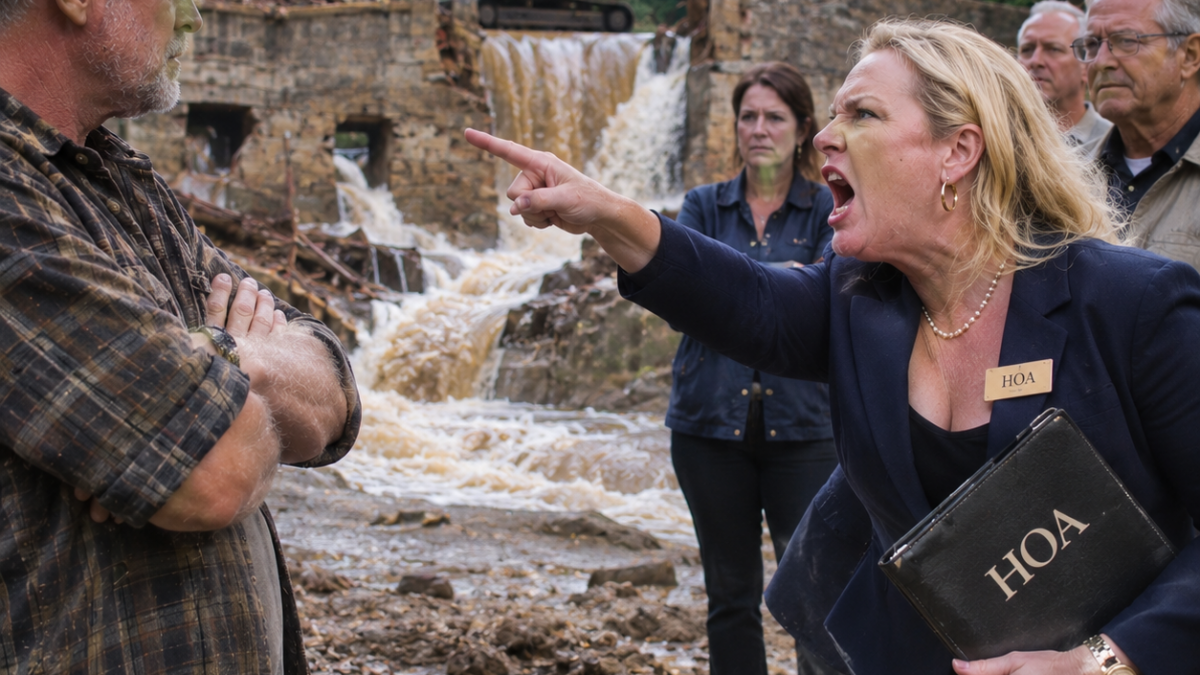
PART 2
Her first letter arrived in the summer of 2020.
Cream paper.
Maple Brook Reserve crest.
Formal language.
She introduced herself as Lucinda Marbury, HOA president, then suggested that we “coordinate watershed management between our adjoining communities.”
We did not have adjoining communities.
She had a subdivision.
I had a mill.
But I wrote back politely.
I explained that the Whittington dam had managed the stream since 1872, that it was inspected through the appropriate Vermont agencies, and that no HOA coordination was required.
Niamh watched me seal the envelope.
“You’re being too nice.”
“She wrote politely.”
“She wants something.”
“She may genuinely be confused.”
Niamh gave me the look she reserves for people who insist March weather will probably stay warm.
“You restore nineteenth-century machinery for fun, Beckett. You are not qualified to recognize modern predators.”
I laughed.
She did not.
The next letter came in October 2021.
NOTICE OF ADJACENT WATERSHED MANAGEMENT CONCERN.
According to Lucinda, my mill pond’s water level fluctuated in a way “inconsistent with downstream community aesthetic expectations.”
I read the sentence three times.
Then handed it to Niamh.
She put on her reading glasses.
Read.
Removed them.
“What does that mean?”
“It means the water goes up and down.”
“It’s a pond.”
“Yes.”
“Fed by a stream.”
“Yes.”
“And operated by a mill.”
“Yes.”
She placed the letter on the table.
“Send her a picture of rain.”
Instead, I wrote another explanation.
Mill ponds fluctuate.
The sluice releases controlled flow when the mill operates.
Summer evaporation changes elevation.
Rain changes elevation.
Snowmelt changes elevation.
The pond typically varied between eight and fourteen inches depending on the season.
That was normal.
Functional.
Historic.
Hydrologically unsurprising.
Lucinda never replied.
The following March, she demanded I lower the pond thirty inches to improve downstream “view corridors.”
She also complained about “visual stagnation” along the upper edge of Maple Brook Reserve.
The HOA had no jurisdiction over the dam.
No easement.
No contract.
No deed restriction.
No statutory authority.
Nothing.
It was theater printed on expensive paper.
I declined.
That summer, Maple Brook Reserve’s newsletter published an article titled:
ADJACENT WATERSHED TENSIONS: A NOTE FROM YOUR BOARD.
They didn’t name me.
They didn’t have to.
It described an adjacent landowner refusing to cooperate with “community water-management priorities” and threatening the “visual integrity” of the Lower Meadow Corridor.
I was beginning to understand Lucinda.
She liked language that sounded official while saying very little.
The complaints themselves were annoying.
The pattern interested me more.
Residents started paddling upstream.
They would launch from Maple Brook Reserve’s kayak dock and work their way toward my spillway.
Photograph the dam.
Photograph the mill.
Photograph the pond.
Then leave.
No questions.
No introductions.
Just cameras.
One Saturday, Tarquin came into the mill while I was cleaning the stone floor.
“Three more.”
“Boats?”
“Yes.”
“What did they do?”
“Photographed everything.”
“Did you talk to them?”
“I waved.”
“And?”
“They paddled away faster.”
He leaned against the door.
“What do they want?”
“I don’t know yet.”
Tarquin picked up one of the old gear teeth from my workbench.
“You always say you can tell what a machine is for by seeing what load it carries.”
“That’s generally true.”
“So look at the load.”
He had May’s habit of saying simple things that made me feel like I had unnecessarily complicated the problem.
In April 2023, the first fine came.
Five thousand dollars.
Unauthorized obstruction of community waterway access.
Lucinda cited Vermont law.
A real statute.
Completely unrelated to what she was claiming.
That part impressed me.
Not because it was clever.
Because it showed intent.
She wanted homeowners—or me—to see a statute number and assume she knew what she was doing.
I drove to my attorney.
Cormac Twombly had practiced Vermont property and water law for forty-three years.
He was sixty-eight then.
His office in Morrisville smelled like old paper, radiator heat, and coffee.
I handed him the fine.
He read it.
Then laughed.
Not a chuckle.
Not a polite breath through the nose.
Nine full seconds.
I timed it because I had never heard Cormac laugh that long.
Finally:
“Beckett.”
“Yes?”
“They’re trying to frighten you.”
“I suspected.”
“This statute has nothing to do with your dam.”
“I know.”
“Don’t pay.”
“I wasn’t going to.”
“Don’t respond.”
“That seems impolite.”
“Excellent.”
He slid the letter back.
“If they try to enforce it, then we answer.”
November brought a second fine.
Ten thousand dollars.
Watershed nuisance creation.
Same fake authority.
February 2024:
Fifteen thousand.
“Obstinate refusal to coordinate community standards.”
Niamh read that one beside the wood stove.
“Obstinate?”
“Apparently.”
“That may be the first accurate thing she’s written.”
I smiled.
Then, in April, Lucinda herself drove up Whittington Mill Road.
Pearl white Range Rover.
She stopped at the foot of our drive.
Didn’t approach.
Sat there thirty-five minutes.
Phone pointed toward the pond.
The dam.
The mill.
Niamh watched from the kitchen.
Coffee in hand.
She added one piece of yellow birch to the stove.
Then said:
“That woman wants something she has no right to.”
“I know.”
“What?”
“I’m trying to figure it out.”
Three weeks later, I got the fifty-thousand-dollar letter.
Consolidated administrative penalty.
Threat of a property lien if unpaid within thirty days.
I stood in the kitchen.
Back door open.
Spillway running outside.
The sound I had known my entire life.
Water moving over stone.
I called Cormac.
“They’re filing a lien.”
He was silent for a moment.
Then:
“Now we stop laughing.”
He came to the house the next morning.
Thermos.
Yellow legal pad.
Old leather portfolio.
Niamh set out coffee.
I read all four fines in chronological order.
Five thousand.
Ten.
Fifteen.
Fifty.
Cormac didn’t interrupt.
When I finished, he took off his glasses.
“You’re not the target.”
“What?”
“The dam is.”
Niamh folded her arms.
“Told you.”
Cormac continued.
“They don’t care if you pay.”
“Then why fine me?”
“To make keeping it expensive.”
“Why?”
“That’s what we’re going to find out.”
We spent four hours in the county records room.
Cormac knew exactly what to request.
Maple Brook Reserve’s 2018 development application.
Planning records.
ANR files.
Flood studies.
Subdivision documents.
Phase-one approvals.
The development sat inside a regulatory floodplain.
That meant the original permit required hydrology analysis.
We found it.
Exhibit B.
Northeast Floodplain Consulting.
Storm models.
Return intervals.
Peak flow.
Channel capacity.
It was dry technical reading, which is exactly where developers sometimes hide the most important truths because they assume nobody outside an agency will ever read them.
Cormac found the sentence first.
He pushed the document toward me.
“Read.”
The Maple Brook Reserve development site, according to its own engineer, was protected from severe flood inundation by permanent upstream impoundment structures providing approximately eleven hours of peak-flow attenuation.
I read the next line.
There it was.
Whittington Mill Pond Dam.
1872.
Inventory number.
My dam.
I sat back.
Cormac stared at me.
“They needed it.”
“Yes.”
“To get their development approved.”
“Yes.”
Niamh’s voice from my memory:
That woman wants something.
But the question had changed.
Why would they now want removed something their own permit relied on?
Cormac stood.
“Phase two.”
“What?”
“Developers don’t stop at eighty homes if there’s another piece of land on the map.”
He went back to the clerk.
Requested later planning filings.
September 2023.
Preliminary phase-two plan.
Thirty additional luxury residences.
Lakefront estates.
Sixty-acre tract identified as:
UPPER MEADOW.
I looked at the site map.
The proposed homes sat across what was currently underwater.
My mill pond bed.
The plan assumed the pond would not exist by 2026.
I stared at Cormac.
“They’re planning houses on my pond.”
“On the bed beneath it.”
“They don’t own that.”
“Correct.”
“They can’t build there.”
“Not now.”
The words hung there.
Not now.
If the dam disappeared, the pond would drain.
A large area would become dry ground.
And suddenly their plan would look less impossible to investors, lenders, and whoever else they hoped to convince.
Cormac tapped Lucinda’s fine.
“This is pressure.”
“They want me to remove the dam for them.”
“Yes.”
“What if I did?”
He looked at me.
“Properly?”
“With ANR.”
“Documented?”
“Yes.”
“Then your liability for lawful removal would be very different from somebody breaching it negligently.”
“That’s not what I asked.”
Cormac knew.
He leaned back.
“Without that upstream attenuation, Maple Brook Reserve becomes far more vulnerable during a major storm.”
“How vulnerable?”
“We need hydrology.”
I thought about the fifty-thousand-dollar notice.
The threats.
Years of letters.
Then said:
“What if we give them exactly what they want?”
Cormac didn’t smile.
That mattered.
“Beckett.”
“Yes?”
“This cannot be revenge.”
“I know.”
“You cannot remove a dam intending to injure downstream homeowners.”
“I know.”
“If the state says no, we stop.”
“Yes.”
“If the state requires mitigation, we do it.”
“Yes.”
“If the state determines removal is unsafe, it stays.”
“Yes.”
Cormac studied me.
“And if the state approves lawful removal?”
I looked at the fine.
“Then I remove my dam.”
That night, I told Niamh.
We sat at the kitchen table.
I explained the 2018 study.
The eleven hours.
The phase-two plan.
The pond bed.
She listened without interrupting.
When I finished:
“They knew.”
“The original developers definitely knew the dam mattered.”
“Quentin signed the application?”
“Yes.”
“And now his wife is fining you to remove it.”
“Yes.”
Niamh drank coffee.
“Call Thora.”
Thora Westbrook had run Vermont’s dam-safety program for nineteen years.
We had worked together on historic mill sites across the state.
She knew my dam.
Its condition.
Its spillway.
Its classification.
When I told her I wanted a stream-alteration permit to remove it, she was silent.
Nine seconds.
Almost as long as Cormac had laughed.
“Beckett.”
“Yes?”
“You’ve spent thirty years saving dams.”
“I know.”
“And now you want to remove yours.”
“Yes.”
“Why?”
“I’ll send you the paperwork.”
“No.”
Her voice hardened.
“Tell me.”
So I did.
The fines.
The hydrology report.
The phase-two plan.
Thora became quieter.
Finally:
“If you proceed, the review will be real.”
“I expect that.”
“You don’t get favors.”
“I don’t want favors.”
“If the engineering says removal creates unacceptable immediate risk—”
“We stop.”
“If mitigation is required—”
“We do it.”
She exhaled.
“I’ll send the packet.”
Then I asked:
“What happens downstream under a major storm without the dam?”
Thora paused.
“Depends on the event.”
“Fifty-year?”
“Some of the low Maple Brook Reserve lots would likely flood.”
“How many?”
“Could be twenty to thirty, depending on antecedent soil moisture and rainfall distribution.”
I closed my eyes.
“Thank you.”
“Beckett?”
“Yes?”
“Make sure you understand what you’re doing.”
“I do.”
After the call, I sat with Niamh.
“If I remove it, homes may flood during a fifty-year storm.”
She didn’t answer immediately.
Then:
“They built in a flood corridor.”
“Yes.”
“They relied on your dam.”
“Yes.”
“They are now demanding the dam disappear.”
“Yes.”
She stared toward the dark window.
“Are you responsible for permanently operating your property as unpaid flood infrastructure for their subdivision?”
I said nothing.
She continued.
“That’s the real question.”
“I don’t want families hurt.”
“Neither do I.”
She reached across the table.
“But those families deserve the truth about where they live.”
The permit process took weeks.
No shortcuts.
ANR engineer Tamsin Holyoke inspected the site.
Core samples.
Embankment measurements.
Spillway analysis.
Pond bathymetry.
Sediment.
Channel profile.
Historic structure.
Fish habitat.
Downstream conditions.
The state approved removal on June 14.
Recommended a controlled late-summer schedule.
I held the permit in my hands for a long time.
The old dam had stood through:
World wars.
The Depression.
Floods.
Droughts.
Generations.
Hosea built it before electric power reached most of Vermont.
Now I had legal permission to take it apart.
I walked down there alone.
Put one hand on the grassed embankment.
“Sorry, old man.”
I wasn’t sure whether I meant Hosea or myself.
By late June, Quentin Marbury knew.
He came in a black Lexus.
Stopped at the mailbox.
Didn’t enter.
That surprised me.
Maybe he finally understood property lines.
“Beckett!”
I walked down.
“We need to talk.”
“What about?”
“The permit.”
“What permit?”
“Don’t do that.”
I waited.
He lowered his voice.
“I know you filed to remove the dam.”
“I did.”
His face tightened.
“That dam protects Maple Brook Reserve.”
“I know.”
That landed.
His eyes changed.
“You know?”
“I read your 2018 hydrology study.”
The color left his face.
For the first time in four years, someone connected to Maple Brook Reserve looked genuinely afraid of the dam being gone.
“Beckett.”
“Yes?”
“I’ll cancel the fines.”
“They’re not yours.”
“I’ll make Lucinda withdraw them.”
“She can.”
“I’ll cancel the lien filing.”
“Good.”
He stepped closer.
“Don’t remove it.”
I looked toward the pond.
“You built eighty houses relying on my dam.”
“Yes.”
“And your HOA has spent years demanding it come out.”
“That was Lucinda.”
“Your wife.”
“She didn’t understand the engineering.”
“Then perhaps she shouldn’t have been issuing watershed fines.”
He swallowed.
“What do you want?”
“A written retraction.”
“Fine.”
“All four fines.”
“Yes.”
“Signed.”
“Yes.”
“Notarized.”
He hesitated.
“Close of business Friday.”
“And if she does?”
“I’ll reconsider.”
“If she doesn’t?”
“The removal proceeds on schedule.”
Quentin nodded.
Drove away.
Lucinda sent nothing.
No retraction.
No apology.
No withdrawal.
Then Hobart Twining called.
Former HOA board member.
Retired insurance executive.
He arrived with a banker’s box and homemade bean dip.
Vermont is like that.
Potential federal fraud can still arrive beside bean dip.
We sat at the kitchen table.
Niamh poured coffee.
Hobart spoke carefully.
“The board has been discussing you for over a year.”
“Discussing?”
“Lucinda called it the Whittington question.”
Niamh looked at me.
I looked at Hobart.
He continued.
“Private meetings.”
“Legal?”
“Not the way they were being handled.”
“What was the goal?”
“Remove the dam.”
“The fines?”
“Pressure.”
“Did the board know it lacked jurisdiction?”
Hobart looked down.
“Yes.”
“How many voted?”
“Four to two.”
“You?”
“Against.”
“And phase two?”
“Real.”
He opened the first folder.
Architectural renderings.
Thirty homes.
Glass.
Stone.
Water views.
Prices between $1.8 million and $2.3 million.
The maps assumed the pond gone.
Then Hobart opened another folder.
Insurance.
That was where the story became something else.
Quentin’s commercial liability policy from 2018 included a specific exclusion for flood damage caused by removal, breach, or modification of the Whittington dam.
He knew.
His insurer knew.
The risk was explicit enough to write into a policy.
Then Hobart produced a later policy.
2021.
Marbury Holdings Risk Limited.
Bermuda captive insurer.
Coverage tied to future phase-two development.
And flood events involving upstream dam removal.
Cormac came over that afternoon.
Read everything.
His face changed as he moved from one document to the next.
“This is sophisticated.”
“What?”
“Insurance planning.”
Hobart explained what he believed the structure was designed to do.
If a major flood followed removal, certain policies could produce enormous payouts.
Flooded homeowners could become distressed sellers.
Phase-one property could be consolidated.
Phase two could expand.
Niamh sat very still.
“They were planning to profit from their own neighbors flooding.”
Hobart nodded.
“That’s what the documents suggest.”
I felt sick.
For weeks I had been worried removing the dam might hurt people who had done nothing except buy homes in the wrong development.
Now I was looking at evidence that the people running that development may have considered those homeowners expendable.
Cormac took the documents straight to the Vermont Attorney General’s Consumer Protection Division.
Deputy Attorney General Lachlan Quigley met us.
Fifteen years in fraud work.
He read for three hours.
Asked very few questions.
Then closed the file.
“We need all of it.”
Hobart nodded.
“Everything you have.”
“Yes.”
“Originals preserved.”
“Yes.”
“Sworn affidavit.”
“I’ll give one.”
Lachlan looked at me.
“Mr. Whittington, the dam removal needs to proceed under the existing state process.”
I frowned.
“You’re asking me to continue?”
“Yes.”
“Knowing homes may flood during a future major storm?”
“The state permit already evaluated lawful removal.”
“Yes.”
“What we cannot have is anyone manipulating that process now that the financial scheme is under investigation.”
Cormac asked:
“You want evidentiary documentation?”
“Complete.”
The dam removal became evidence.
That was not why I had filed the permit.
But it changed how carefully everything would be recorded.
ANR deployed engineers.
Tamsin led.
Indigo Cassidy documented compliance.
Four high-resolution cameras.
Drone.
Time stamps.
Field logs.
Watershed Conservancy participation.
Fish and Wildlife coordination.
Nothing hidden.
Nothing rushed.
Nothing done at night.
Then came Sigrid Walcott.
Investigative reporter.
Burlington Free Press.
She read the fines.
The hydrology study.
Phase-two map.
Insurance documents.
Hobart’s statement.
She looked at me.
“You understand what this story says?”
“Yes.”
“The same developers who relied on your dam for approval later pressured you to remove it.”
“Yes.”
“And there is insurance tied specifically to the consequences of removal.”
“Yes.”
She sat back.
“This is front page.”
The article ran July 20.
The headline made the flood plan public before there was any flood.
That distinction mattered enormously.
The story detailed the fines.
The hydrology study.
Phase two.
Bermuda insurance.
By Sunday afternoon, the Attorney General sought to freeze Maple Brook Reserve LLC assets.
Monday:
Lender froze credit.
Tuesday:
Federal subpoenas.
Wednesday:
HOA board resignations.
Lucinda did not resign.
Of course she didn’t.
If there was one thing I had learned about Lucinda, it was that she considered surrender a character defect other people suffered from.
Then she went to court.
Emergency restraining order.
She argued that I was weaponizing environmental regulation to inflict mass property damage.
Cormac read the complaint in my kitchen.
Niamh listened.
Then laughed.
“What?”
“She fined you for not removing it.”
“Yes.”
“Now she wants a judge to stop you from removing it.”
“Yes.”
“Does she know paper keeps copies of itself?”
The judge knew.
The TRO was denied.
The court cited my permit.
My landowner rights.
And the HOA’s own years of demands.
Sanctions followed for bad-faith litigation.
Lucinda responded by organizing a protest.
Fourteen residents.
Matching navy shirts.
Signs:
SAVE OUR HOMES.
STOP THE DAM REMOVAL.
BECKETT, DON’T.
I watched from the porch.
Some of those people looked terrified.
That bothered me.
They were not Quentin.
They were not Lucinda.
They were homeowners who had just learned their neighborhood’s flood safety was tied to a dam they didn’t own.
Niamh put on her wool coat.
“Where are you going?”
“Down there.”
“What are you going to say?”
“The truth.”
She walked to the front of the protest.
Stopped six feet from Lucinda.
Local television camera rolling.
“Mrs. Marbury.”
Lucinda lifted her chin.
Niamh continued.
“You have spent four years sending letters demanding my husband remove this dam.”
Silence.
“He is doing what you demanded.”
Niamh turned.
“Go home.”
She walked back.
Protest ended soon afterward.
The next day, Quentin tried to leave the country.
Burlington International.
One-way ticket to Bermuda.
Carry-on.
Briefcase.
Federal investigators waiting.
He was arrested before boarding.
The briefcase contained cash and insurance documentation.
By Friday evening, a broader indictment became public.
Lucinda.
Quentin.
Consultants.
Others connected to the financial scheme.
Then Sunday night, Lucinda came to the dam.
9:15.
Range Rover.
She sat inside forty minutes.
I watched from the porch through binoculars.
Eventually she got out.
Walked to the spillway.
Picked up a rock.
Threw it into the pond.
Another.
Then another toward the gate.
Missed.
She started crying.
I almost stayed where I was.
Then I put on my jacket.
Walked down.
Stopped twenty feet away.
Lucinda heard my boots.
Turned.
Her face looked smaller without the HOA board behind it.
“Beckett.”
“Mrs. Marbury.”
“You can stop this.”
“I gave you a chance.”
“I didn’t understand.”
“Quentin did.”
She looked toward the water.
“You’ll destroy those people’s homes.”
“I’m removing a structure on my property under state permit after your HOA demanded it for four years.”
“You know what will happen.”
“I know what could happen during a major storm.”
“And you’ll do it anyway.”
I looked at her.
“This is the first time you’ve cared about that risk enough to admit it exists.”
She began crying harder.
I felt no pleasure.
None.
Only exhaustion.
“The dam comes out in nine hours.”
She stared.
“Go home.”
Lucinda walked back to the Range Rover.
Drove away.
I stood beside the spillway.
Frogs called.
Water slipped over stone.
I put one hand on the old gate.
“Hosea.”
The name felt strange out loud.
“Thank you.”
Then I went home.
Niamh was waiting with coffee.
“Tomorrow?”
“Tomorrow.”
We sat until the moon rose above the ridge.
I barely slept.
At four, I gave up trying.
Niamh made oatmeal.
Maple syrup.
Tarquin had already been at the forge since two-thirty.
He was finishing a plaque.
I walked to the pond before sunrise.
Mist hung over the water.
Everything looked ordinary.
That hurt.
Places rarely look historic while history is happening.
They look like the same thing they were yesterday.
Tamsin arrived at 5:45.
Indigo after her.
Attorney General’s staff.
Watershed Conservancy.
Contractor.
Two excavators.
Seven-person crew.
Rowan Cleary led the removal.
Forty dam projects behind her.
She walked the embankment with me.
“You ready?”
“No.”
She waited.
Then I said:
“But yes.”
At 7:07, they opened the spillway fully.
The pond began lowering.
Slow.
Controlled.
Four inches an hour.
No dramatic wall of water.
No catastrophic breach.
That mattered.
People later described the story as though I blew up a dam and waited for the neighborhood to drown.
Nothing could be further from what happened.
The removal took days.
Engineered drawdown.
Monitoring.
Sediment control.
Fish management.
Channel restoration.
Documentation.
On Tuesday, the old pond bed began emerging.
Mud.
Stones.
The original channel.
For the first time in generations, Beaver Branch’s pre-1872 shape became visible.
Tarquin stood beside me.
“That was under there the whole time.”
“Yes.”
“Feels wrong.”
“Yes.”
“Feels right too.”
I looked at him.
“Exactly.”
Ardith Beaumont’s watershed crew began restoring habitat.
Brook trout fingerlings.
Native strain.
Absent from that stretch for more than a century.
Children from a local school watched some of the release.
One boy asked:
“Did your great-great-grandfather kill the fish when he built the dam?”
I smiled.
Kids don’t soften history.
“He changed the river.”
“Was that bad?”
“For the fish?”
“Yes.”
“Probably.”
“Then why are you sad to remove it?”
I looked at the mill.
“Because something can matter to your family and still have consequences for something else.”
The boy considered that.
Then nodded.
That was more understanding than I got from most adults.
By Wednesday morning, the pond was empty.
The excavators started structural removal.
Layer by layer.
Tamsin and Indigo documented the earth embankment.
Original stones.
Keyway.
Historic construction.
Soil samples.
Photographs.
Every piece treated like archaeology and engineering at the same time.
I watched the machine take down earth Hosea had placed 153 years earlier.
There was grief in it.
Real grief.
Niamh stood beside me.
“You okay?”
“No.”
“Good.”
I looked at her.
She squeezed my hand.
“Means it mattered.”
Thursday evening, the dam was gone.
Friday:
Natural stream channel.
Bank shaping.
Native vegetation.
Beaver Branch ran free.
For the first time since 1872.
The mill wheel was still.
That silence was almost unbearable.
I had rebuilt that mill to hear water move through it.
Now nothing.
Tarquin installed the commemorative plaque.
WHITTINGTON MILL DAM
BUILT 1872 BY HOSEA WHITTINGTON
REMOVED 2025 BY HIS GREAT-GREAT-GRANDSON BECKETT
RETURNED TO BEAVER BRANCH
I ran my fingers across Hosea’s name.
Then mine.
“Think he’d be angry?”
Tarquin asked.
“Probably.”
“Why?”
“Whittington men don’t like people changing our work.”
Tarquin smiled.
“Sounds healthy.”
That Saturday afternoon, the National Weather Service issued a flash-flood watch.
Slow-moving system.
Four to seven inches possible.
Saturated soils.
I stared at the forecast.
Niamh stood behind me.
“So soon.”
“Yes.”
“You knew it would rain eventually.”
“Eventually.”
“But not the next day.”
“No.”
She sat.
Neither of us said what we were both thinking.
The dam had been gone less than forty-eight hours.
By Sunday evening, rain started.
Steady at first.
Then heavy.
At eight:
One inch.
Ten:
Flash-flood warning.
Midnight:
Two inches.
I sat on the porch with a weather radio.
Niamh beside me.
No celebration.
No revenge.
Only numbers.
Rainfall.
Gauge heights.
Warnings.
At 1:47 a.m., the lower tributary crossed its bank near Maple Brook Reserve.
Niamh looked at me.
I said nothing.
2:09.
First emergency call.
Basement water.
3:00.
Seven homes.
Then more.
Emergency crews deployed.
National Guard.
Evacuations.
No injuries.
No deaths.
That mattered more than anything.
Forty-one residents taken to shelter.
At dawn, the water was several feet above flood stage.
Twenty-three homes flooded.
I drove nowhere.
There was no reason to.
The roads near Maple Brook Reserve were dangerous.
I stayed home.
Listened.
At 6:15, Sigrid arrived with a photographer.
Later, television crews.
The story was too simple for spin.
Maple Brook Reserve had been approved using a hydrology study that relied on an upstream dam.
The HOA spent years demanding that dam be removed.
The owner removed it under state permit.
Then a major storm arrived.
Twenty-three homes flooded.
Sigrid interviewed me at 10:05.
She held the microphone.
“Mr. Whittington, twenty-three Maple Brook Reserve homes flooded overnight. What would you say to Lucinda Marbury?”
I had thought about that question for years without knowing it.
Now I had no clever answer.
I went inside.
Returned with two documents.
The fifty-thousand-dollar fine.
The state removal permit.
Held them up.
“Mrs. Marbury fined me fifty thousand dollars for keeping what she called an unsightly impoundment structure.”
I raised the second paper.
“The State of Vermont later permitted me to do what her HOA demanded.”
I looked toward the camera.
“The dam was removed on a published schedule, under state oversight, with the HOA notified.”
Sigrid waited.
I continued.
“I’m sorry families lost property.”
That was true.
“I’m not sorry I followed the law.”
Also true.
Then:
“The flood was not created by a surprise demolition. It exposed a risk that existed before those houses were sold.”
That was the sentence I wanted people to hear.
The dam had masked risk.
It had not erased it.
By noon, Lucinda turned herself in.
Quentin remained in federal custody.
Phase-two permits were revoked.
FEMA disaster declaration followed.
Insurance regulators moved against the Bermuda arrangement.
The old Maple Brook board collapsed.
Then came the prosecutions.
Quentin pleaded guilty months later.
Wire fraud.
Insurance fraud.
Conspiracy.
False hydrology representations.
Obstruction.
He received federal prison time.
Lucinda eventually pleaded guilty to charges tied to the scheme and fraudulent HOA enforcement.
The woman who had spent years sending me invented fines finally sat in a courtroom where the paperwork was real.
I did not attend every proceeding.
Niamh asked why.
“You waited years for this.”
“No.”
“For what then?”
“For the truth to be public.”
“It is.”
“Then I have work.”
“What work?”
I looked toward the stream.
“Figuring out how to run a mill without a pond.”
That became my next obsession.
I did not want the Whittington Mill to become a dead museum.
Hosea built it to work.
I rebuilt it to work.
So I worked with engineers from the University of Vermont.
We explored low-head hydro.
Instream kinetic systems.
Seasonal flow.
Eventually, we installed a small turbine downstream in a natural rapid.
No impoundment.
Roughly seven kilowatts continuous under normal conditions.
Enough to operate the demonstration mill with modern transmission assistance while preserving the free-flowing stream.
The first Saturday we reopened, I stood near the mill door.
Visitors gathered.
Tarquin beside the forge.
Niamh at a table with maple syrup.
I engaged the system.
The millstones started turning.
Not exactly as they had under Hosea.
Different energy path.
Same purpose.
Grain went in.
Meal came out.
An older man in the crowd started crying.
I knew him.
His grandfather had used the mill.
“You all right?”
He nodded.
“Thought it was done.”
“So did I.”
He looked toward the stream.
“Better this way?”
I considered.
“For the river.”
“And the mill?”
“Different.”
He nodded.
“Different isn’t dead.”
That became another sentence I carried.
Maple Brook Reserve changed too.
The twenty-three flooded families received restitution through the court-supervised recovery of the insurance money Quentin intended to control.
Many elevated their homes above the new flood elevation.
Two sold into a floodplain buyout program.
Those lots became conservation land.
No replacements.
No bigger luxury houses.
No “Upper Meadow Estate Collection.”
The proposed phase-two land became open space.
Watershed restoration.
The business plan died.
The meadow remained.
Hobart Twining became president of the reconstituted HOA.
He visited one autumn afternoon.
No banker’s box this time.
Just coffee.
“We capped dues.”
“How much?”
“Fifty-five a month.”
“That seems more Vermont.”
He smiled.
“Independent audit every year.”
“Better.”
“Meeting minutes public.”
“Dangerous.”
“I know.”
He looked toward the stream.
“I owe you an apology.”
“No.”
“I was on that board.”
“You voted against the fines.”
“I stayed too long.”
I understood.
“People stay inside bad systems because they think they can moderate them.”
He nodded.
“Sometimes that works.”
“And sometimes?”
“You become proof the system had reasonable people while the unreasonable ones keep control.”
We sat quietly.
Then Hobart said:
“You know the strangest thing?”
“What?”
“Lucinda always said she was protecting property values.”
I looked toward the restored floodplain.
“She nearly destroyed the whole development.”
“Exactly.”
That was the irony.
People like Lucinda often speak about value as though it is only a number on a listing.
But value can be resilience.
Truthful engineering.
Safe siting.
A river allowed enough room to flood without destroying a living room.
The most expensive house in Vermont is still vulnerable if it was built where water needs to go.
The flood changed public opinion about the old dam too.
Some people called me reckless.
Others called me brilliant.
Both descriptions missed the point.
I had followed a legal process.
That was less exciting than revenge.
More important.
The flood was nature.
The fraud belonged to Quentin and Lucinda.
The removal belonged to me, the state, and a long list of professionals who did it correctly.
I refused interviews that framed it as:
MAN TAKES REVENGE BY FLOODING HOA.
That wasn’t what happened.
One television producer called.
“We’d love to recreate the moment you decided to remove the dam.”
“There was no dramatic moment.”
“Surely you were angry.”
“Yes.”
“So you decided—”
“No.”
I interrupted.
“I applied for a permit.”
He paused.
“That’s not very visual.”
“No.”
“Could you maybe stand by the excavator and—”
“No.”
I hung up.
Niamh laughed for ten minutes.
“You ruined his movie.”
“Good.”
The real story was harder.
A century-old structure had hidden a flood risk.
A developer knew.
An HOA weaponized false authority.
A financial scheme tried to profit from catastrophe.
Then catastrophe came.
No villain needed to control the weather.
Nature handled that part.
The May Whittington Memorial Stream Restoration Trust came later.
Niamh’s idea.
We named it for my first wife.
That surprised people.
They assumed Niamh would want her own name somewhere.
She said:
“May helped raise Tarquin.”
“Yes.”
“She lived in this house.”
“Yes.”
“She is part of the river’s story.”
So May’s name stayed.
The trust funds small dam removals and stream restoration around Vermont.
Not every dam should come out.
I’m a millwright.
I would never say that.
Some dams still serve critical purposes.
Some historic structures can be modified.
Some should remain.
Some should be removed.
The lesson is not:
Dams bad.
The lesson is:
Understand what a structure does before demanding it disappear.
The first project we funded was an abandoned 1908 dam on Standard Brook.
No active mill.
No flood-control function.
No meaningful modern purpose.
Blocked habitat.
We removed it properly.
Native brook trout returned.
Tarquin forged a plaque.
Then another project.
Then another.
Eleven plaques.
Eighteen sites identified.
Each one different.
Each one studied.
That mattered to me.
Because Lucinda’s central failure was assuming every complex thing could be reduced to aesthetics.
Ugly dam.
Bad view.
Remove.
No.
Old systems deserve questions.
What does it do?
Who depends on it?
What changes if it goes?
What risks appear?
Who benefits?
Who pays?
Those questions should have been asked before Maple Brook Reserve broke ground.
Instead, they were asked after twenty-three homes flooded.
Quentin’s conviction didn’t restore those basements.
Lucinda’s sentence didn’t replace family photographs.
Restitution helped.
Elevating homes helped.
Better hydrology maps helped.
But consequences always arrive after damage.
That is why prevention matters.
One Maple Brook family visited us after their home was elevated.
The husband, Neil, stood on the porch.
His wife, Tara, beside him.
They had two children.
Their basement had taken nearly four feet of water.
Neil said:
“I hated you.”
I nodded.
“Fair.”
“For months.”
“Okay.”
“I thought you did it to us.”
“I understand.”
Tara looked toward the stream.
“Then we read the 2018 report.”
I waited.
“The developer knew.”
“Yes.”
“And the board knew about phase two.”
“Yes.”
Neil looked at me.
“Why didn’t you warn us before removing it?”
That question hurt because there was no answer that made everything clean.
“The permit was public.”
“That’s not what I asked.”
“I know.”
Niamh stayed inside.
Let us talk.
I said:
“I gave the records to the Attorney General and the newspaper before removal.”
Neil nodded.
“I read the article.”
“I could have gone door to door.”
“Yes.”
“I didn’t.”
“Why?”
I looked at him.
“Because by then there was an active fraud investigation, a public permit process, media reporting, and an HOA telling residents I was trying to destroy them. I believed the public record was enough.”
Neil’s face stayed hard.
“Was it?”
“No.”
Silence.
That was important too.
Being legally right does not mean every decision was morally perfect.
I could admit that without accepting responsibility for Quentin’s scheme.
Tara finally said:
“We came because our son wants to see the mill.”
I smiled.
“Then let’s show him.”
Their son spent forty minutes watching the gears.
Asked twenty questions.
Children keep adults from staying dramatic forever.
Before they left, Neil held out his hand.
I shook it.
“Still angry?”
“Less.”
“Fair.”
Years later, we became friendly.
Not close.
But enough.
That was more honest than turning every homeowner into a grateful supporter after the truth came out.
Some people forgave.
Some didn’t.
Some moved.
Some stayed.
That’s what real communities do after disaster.
They remain complicated.
Lucinda’s old letters stayed in a file drawer.
Eventually, I put the fifty-thousand-dollar one in a frame.
Not because I was proud of beating her.
Because the trust uses it when we teach community groups.
At public talks, I hold it up.
“Read the phrase.”
UNSIGHTLY IMPOUNDMENT STRUCTURE.
Then I show the 2018 hydrology study.
PERMANENT UPSTREAM IMPOUNDMENT STRUCTURES PROVIDING PEAK-FLOW ATTENUATION.
Same dam.
Two descriptions.
One political.
One engineering.
Words matter.
The HOA described what it looked like.
The engineer described what it did.
If you remember nothing else, remember that difference.
Niamh often joins those talks.
She waits until I get too technical.
Then interrupts.
“Beckett.”
“Yes?”
“Tell them the simple version.”
I sigh.
“The simple version is that the developer built houses downstream of a dam.”
She shakes her head.
“Simpler.”
“They needed the dam.”
“And?”
“Then they tried to make me remove it.”
“And?”
“It flooded.”
She smiles.
“See? People understand you when you stop talking like a turbine manual.”
Tarquin married years later.
A sugar maker’s daughter from Hardwick.
Good woman.
Strong opinions about syrup grades.
Their daughter arrived the following March.
They named her Hosea.
I told them Hosea was traditionally a boy’s name.
Tarquin said:
“Your point?”
Niamh laughed so hard she had to sit down.
Baby Hosea has May’s eyes.
Or maybe I just see May everywhere I want to.
Grandparents are allowed.
When she was old enough to walk, I took her to the restored stream.
Held her hand.
Showed her the plaque.
She touched Hosea Whittington’s name.
“Me.”
“Sort of.”
Then mine.
“Papa.”
“Yes.”
She pointed at the water.
“River.”
“Yes.”
That was enough history for one afternoon.
I sometimes wonder what my great-great-grandfather would think.
He built the dam to power an economy.
Grain.
Food.
Work.
It changed the stream.
It served generations.
Then the world changed.
The mill no longer depended on the pond.
The development downstream relied on the dam without owning it.
People tried to weaponize that reliance.
Then I removed it.
Hosea might have been furious.
He might have understood.
I’ll never know.
But I do know this:
He was a builder.
Builders should understand that what we create belongs partly to the future.
Not legally.
Morally.
Every structure outlives some intention.
The question becomes whether later generations preserve it, modify it, or let it go.
That is stewardship.
Not worship.
I learned that late.
The floodplain below Maple Brook Reserve looks different now.
Some houses elevated high.
Open land where two used to stand.
Restoration corridor.
Wet meadow.
A place for water.
That is what floodplains need.
Room.
The old development brochures showed neat grass to the stream edge.
Now the banks look messier.
Alder.
Willow.
Sedge.
Flood-tolerant vegetation.
Nature doesn’t care much for luxury landscaping.
Good.
The kayak dock washed away in the flood.
They replaced it higher.
Better anchored.
One homeowner joked:
“Maybe this one won’t visit New Hampshire.”
I laughed.
Trauma can become humor when enough time passes.
Not always.
But sometimes.
The Burlington Free Press kept following the case.
Sigrid won another award.
She sent me a clipping.
I didn’t frame it.
Niamh did.
Then put it in the downstairs bathroom.
“Why there?”
“Guests need reading.”
“That article is about federal insurance fraud.”
“People stay in there a while.”
Marriage keeps ego under control.
Cormac finally retired.
Again.
He had already claimed to be semi-retired when the fifty-thousand-dollar fine appeared.
After the case, he announced:
“This time I mean it.”
I asked:
“How many clients?”
“Four.”
“That’s not retirement.”
“It is in Vermont.”
We still have coffee.
He claims the Marbury matter was his last major case.
Then tells stories about three newer cases.
Lawyers and millwrights apparently retire the same way.
Thora retired too.
At her farewell dinner, she told the room:
“Beckett spent most of his career preserving historic dams and then gave me one of the most complicated removal permits of mine.”
I raised a glass.
She added:
“And he called it a favor.”
Everyone laughed.
After dinner, she pulled me aside.
“You okay with how it ended?”
“The case?”
“The dam.”
I thought.
“Yes.”
“Always?”
“No.”
She nodded.
“Good answer.”
“I miss the pond.”
“I know.”
“I don’t miss what it was hiding.”
“That’s the point.”
Sometimes I dream about the old mill pond.
Same surface.
Frogs.
Mist.
Hosea’s dam intact.
May sitting on the bank.
Tarquin eight years old.
Then I wake to the sound of free water moving past the house.
At first that felt like loss.
Now it feels like both.
Memory and present occupying the same place.
That’s what old properties teach you.
Nothing stays exactly the same.
Not people.
Not rivers.
Not mills.
Not families.
The trick is changing without pretending the past meant nothing.
The mill still opens Saturdays.
Visitors still come.
The kinetic turbine is less romantic than a waterwheel fed by a pond.
But the stones turn.
Cornmeal falls.
Children stare.
The smell of grain fills the room.
I tell them about Hosea.
About 1872.
About the pond.
Sometimes someone asks:
“Why did you remove the dam?”
If there are children in the group, I say:
“Because rivers change and people make complicated decisions.”
If they are adults:
“Because an HOA fined me fifty thousand dollars to remove it.”
They laugh.
Then I say:
“No, really.”
The laugh stops.
I explain.
But I always end with the same warning.
“The flood was not the joke.”
Twenty-three families lost property.
Forty-one people needed evacuation.
No one died.
That still feels miraculous.
If the storm had come at a different hour—
If road access failed—
If one child had been trapped—
I’m not sure how I would carry the story.
Legal compliance would not make grief lighter.
That reality keeps me humble when people call the outcome poetic justice.
Poetic justice looks cleaner from outside.
Floodwater is mud.
Sewage.
Ruined drywall.
Furniture.
Photographs.
Insurance calls.
Children sleeping in school gyms.
Nothing poetic.
The justice came later.
In the fraud convictions.
The restitution.
The canceled phase two.
The corrected maps.
The restored floodplain.
The new HOA.
The open books.
The audits.
The truth.
The water was consequence.
Not justice.
There is a difference.
Lucinda eventually left prison.
I heard through someone.
Didn’t ask where she went.
Didn’t care.
For years, people wanted me to react to updates.
She appealed.
She lost.
She was transferred.
She had parole.
None of it interested me much.
Niamh said:
“That’s progress.”
“What?”
“You used to read every article.”
“Research.”
“Obsession.”
“Documentation.”
She raised an eyebrow.
“Fine.”
Eventually, Lucinda became irrelevant.
That was healthier.
Quentin’s development company disappeared.
The Marbury name came off project signs.
New management took over some surviving assets.
The subdivision stayed.
Children grew up there.
Homeowners planted gardens.
People who had nothing to do with the fraud built lives.
I’m glad.
A place should not remain guilty forever because the person who developed it was corrupt.
The new HOA invited me to a meeting once.
I almost refused.
Hobart insisted.
They had one question:
Should they contribute money to maintain the new stream-restoration corridor?
“Yes.”
I answered immediately.
A homeowner frowned.
“Even though it’s outside some of our parcel boundaries?”
“Yes.”
“Why?”
“Because water doesn’t care about your parcel boundary.”
That got a laugh.
I continued.
“Your old leadership treated the watershed like a collection of private views. It isn’t. What happens upstream affects downstream. What happens on the bank affects the channel. If your community wants resilience, invest in the system, not just the landscaping.”
Someone asked:
“Is that what the dam did?”
“For a long time.”
“Then why not rebuild it?”
Good question.
“Because now we understand the risks differently, the habitat differently, the mill can operate without impoundment, and the floodplain can be managed openly instead of depending on somebody else’s private structure.”
Hobart smiled.
“That should be in the minutes.”
“Please make it shorter.”
They funded restoration.
Niamh joined the trust board.
Eventually became chair.
She is better at meetings than I am because she can stop people from using twelve words when four will do.
Ardith became vice chair.
Tarquin continues forging plaques.
Every restored stream site gets one.
Not because every old dam was bad.
Because every removal deserves memory.
I like that.
We shouldn’t erase the structure from history just because we remove it physically.
One plaque reads:
BUILT FOR WORK.
REMOVED FOR THE RIVER.
BOTH MATTERED.
That may be the best one.
Tarquin pretends he wrote it.
Niamh did.
The May Whittington Memorial Stream Restoration Trust eventually funded projects where removal was not the answer too.
Fish passage.
Gate repair.
Sediment management.
Historic stabilization.
That was important to me.
I didn’t want our story turned into an ideology.
The lesson was never:
Remove every dam.
The lesson was:
Do the homework.
Lucinda didn’t.
Quentin did, which was worse, because he knew and lied.
That difference matters too.
Ignorance can be corrected.
Knowledge used dishonestly is something else.
One winter evening, I found the original fifty-thousand-dollar fine while looking for tax documents.
I took it to the wood stove.
Niamh said:
“Don’t.”
I looked at her.
“Why?”
“Archive.”
“It’s nonsense.”
“It’s history.”
“You sound like me.”
“Terrifying.”
So I kept it.
The paper is yellowing slightly now.
Lucinda’s signature still sharp.
Sometimes I look at it and think about the chain of events contained inside one arrogant letter.
She wanted the dam gone.
She chose a fake fine.
That pushed me toward records.
Records revealed the hydrology study.
The hydrology study revealed their dependence.
Phase-two files revealed motive.
Insurance records revealed the broader scheme.
The permit created a lawful removal.
The removal exposed the flood risk.
The storm exposed what engineering had already predicted.
The fraud investigation redistributed money meant for profit back to victims.
One letter.
Not the cause of everything.
But the match thrown into a room already full of fumes.
People ask what I would have done if Lucinda retracted the fines when Quentin asked.
I don’t know.
That’s the truth.
I told him I would reconsider.
I meant it.
Would I have kept the dam?
Maybe.
Would ANR have required future flood-management arrangements?
Possibly.
Would Maple Brook Reserve have had to pay for maintenance or alternative attenuation?
Maybe.
There were many paths.
Lucinda chose the one with no retreat.
That was her pattern.
She considered compromise humiliation.
So she kept going.
Fifty thousand.
TRO.
Protest.
Public accusation.
Even after the documents surfaced.
That is what arrogance does.
It converts solvable problems into irreversible ones.
One afternoon, I ran into Neil—the homeowner who once told me he hated me—at a hardware store.
He was buying flood-resistant insulation.
“Still improving?”
“Basement.”
“I thought you raised everything.”
“Did.”
He smiled.
“Now I’m paranoid.”
“Understandable.”
He looked at my cart.
“What are you buying?”
“Bearings.”
“For mill?”
“Yes.”
He nodded.
Then said:
“You know, my son wants to volunteer at the stream trust.”
“How old?”
“Sixteen.”
“Send him.”
“He still blames Quentin.”
“So do many people.”
“I told him blame is fine for a while.”
“And after?”
Neil shrugged.
“Then build something.”
I smiled.
“That sounds familiar.”
His son volunteered that summer.
Cleared invasive plants.
Installed willow stakes.
Learned water-quality sampling.
Maybe that is what recovery looks like.
Not forgiveness.
Work.
The Whittington property has been in our family more than two centuries.
That sounds impressive until you realize ownership is just a long chain of temporary caretakers.
Hosea was temporary.
I am temporary.
Tarquin will be.
Hosea’s daughter, someday.
Land outlives our arguments.
So do rivers.
One morning, I walked the old pond bed after frost.
The restored stream curved through grasses.
A beaver had started working near an alder stand.
I laughed.
Niamh asked why.
“Nature is building another dam.”
She looked.
Small sticks.
Mud.
“Are you going to fine it?”
“Fifty thousand.”
“Unsightly impoundment structure?”
“Exactly.”
She laughed.
The beaver stayed.
Its little dam lasted one season before spring runoff rearranged it.
No HOA meeting required.
That humor helped.
Because for a long time, every mention of “dam” led back to conflict.
Now sometimes it just means beavers.
Good.
Years passed.
The story became less about Lucinda.
More about water.
Engineering.
Responsibility.
My grandchildren.
The trust.
The mill.
That is how I prefer it.
One July Saturday, a group of college engineering students toured the site.
Their professor asked me to explain peak-flow attenuation.
I started.
Niamh was nearby.
“Simple version,” she called.
The students laughed.
I pointed upstream.
“Imagine a storm sends a huge volume of water downstream quickly.”
They nodded.
“The old pond temporarily stored part of that water and released it more slowly.”
One student said:
“So it flattened the hydrograph.”
I smiled.
“You’re allowed to say hydrograph.”
Niamh groaned.
I continued.
“When the dam disappeared, that storage disappeared too. That doesn’t mean the dam caused or prevented all flooding. It means the timing and magnitude downstream changed.”
Another asked:
“Did the developer’s original modeling account for removal?”
“The permit we found relied on the dam staying.”
“And phase two?”
“Assumed it gone.”
The student frowned.
“That’s inconsistent.”
“Yes.”
“That seems obvious.”
“Yes.”
“Why didn’t regulators catch it?”
“Different filings. Different years. Different assumptions. Government systems are made of people. People miss things.”
The professor looked toward Maple Brook Reserve.
“So the real failure was coordination.”
“One of them.”
“Others?”
“Fraud.”
That shortened the lecture.
The students later helped install monitoring equipment on the restoration corridor.
I like engineers when they get mud on their boots.
Niamh says that is prejudice.
She may be right.
On the tenth anniversary of the trust, we held a small gathering at the mill.
Not fancy.
Soup.
Bread.
Maple desserts.
Tarquin displayed all eleven plaque designs.
Hobart came.
Sigrid.
Cormac.
Thora.
Ardith.
Neil and Tara.
People whose lives had collided because of one dam.
We raised money for another restoration project.
At the end, Niamh surprised me.
She had printed a photograph from 1994.
May and me standing beside the old mill before restoration.
Roof sagging.
Boards gray.
Young Tarquin between us.
I stared.
“Where did you get this?”
“Tarquin.”
I looked at him.
“Traitor.”
He smiled.
Niamh said:
“You rebuilt the mill once.”
“Yes.”
“Then rebuilt it again after the dam.”
“Yes.”
“You keep acting surprised that things survive change.”
I looked at May in the photograph.
Then at Niamh.
“You’re very wise.”
“I know.”
That photograph hangs beside the turbine controls now.
Not beside the Marbury documents.
That’s deliberate.
The mill’s story is not their story.
They were a chapter.
Not the title.
When I’m asked what I feel about the twenty-three flooded homes now, the answer is complicated.
Regret that families suffered.
Relief nobody died.
Anger that developers knowingly put them at risk.
Confidence the dam removal was legal and properly supervised.
Discomfort that I knew flooding was possible.
Gratitude that the fraud investigation was already public before the storm.
Pride that the floodplain was eventually corrected.
All of those things can exist at once.
People want stories with one emotion.
Life rarely cooperates.
The simplest part is Lucinda’s fine.
That was wrong.
Everything after that became harder.
Maybe that’s why people still tell the story.
Not because a man “got revenge on an HOA.”
Because sometimes complying with a foolish demand reveals why the demand was foolish.
But I would caution anyone who hears this story and thinks:
I should just remove the thing they complain about and let disaster happen.
No.
That misses everything.
I had professional engineering review.
State permits.
Agency oversight.
Attorneys.
Public records.
Fraud investigators.
Environmental restoration.
A controlled process.
The storm was not scheduled.
Not caused.
Not manipulated.
It was weather.
You never play games with water.
I spent my career around mills.
Water always wins eventually.
Respect that.
The real revenge, if you insist on calling it revenge, was documentation.
Lucinda expected me to either pay or become angry.
I did neither.
I read.
Cormac read.
Hobart kept records.
Sigrid published.
Lachlan investigated.
ANR documented.
The courts read.
The documents killed the scheme before the floodwater ever reached the subdivision.
The storm only made the engineering impossible to deny.
That distinction matters to me.
One September evening, Niamh and I drove to Hyde Park.
Village House diner.
Grilled cheese.
Tomato bisque.
The ceiling fan looked older than both of us.
Patty Griffin on the jukebox.
Tarquin joined us after closing the forge.
We ate at the counter.
Nobody talked about the case.
Good.
Driving home, windows down, the air smelled like hay and rain on hemlock.
A barred owl crossed the headlights.
For a few seconds, everything felt ancient.
The road.
The woods.
The family land.
The stream.
The same landscape Hosea might have recognized.
Except the pond.
That was gone.
I used to think losing it meant breaking the family chain.
Now I think the opposite.
Hosea used the tools and knowledge of 1872 to make the land serve his family.
I used the tools and knowledge of my time to change it again.
That isn’t betrayal.
That is continuity.
The plaque on the stream bank says the dam was “returned to Beaver Branch.”
Technically, the dam wasn’t returned anywhere.
The river was.
Words.
But good words.
The stream is alive.
The mill is alive.
The family is alive.
That’s enough.
Hosea, my granddaughter, is old enough now to ask why she has a man’s name.
Tarquin told her:
“Because your ancestor built something important.”
She asked me:
“Did he build the river?”
“No.”
“The mill?”
“Yes.”
“The dam?”
“Yes.”
“Did you break it?”
I laughed.
“Sort of.”
“Why?”
“Long story.”
She sat beside me.
“I have time.”
So I told her a child’s version.
Great-great-great-grandfather built a dam.
Many years later, people built houses downstream.
They forgot what the dam did.
Some people wanted it gone.
We removed it carefully.
A big storm came.
Everyone learned why understanding water matters.
She listened.
Then asked:
“Who won?”
Children.
Always the correct inconvenient question.
I thought.
“The river.”
She seemed satisfied.
Maybe that’s the answer.
Not me.
Not Lucinda.
Not Quentin.
Not the HOA.
The river got room.
The homeowners got the truth.
The mill got a second life.
Victims got restitution.
Fraudsters got consequences.
My family got a new purpose.
That is more balanced than revenge usually is.
Every Saturday, when the mill runs, I stand near the old floorboards and feel the vibration beneath my boots.
Not the same as the original waterwheel.
But close enough to connect past and present.
Visitors watch the stones.
Outside, Beaver Branch moves freely.
Sometimes brook trout flash in the shallows.
Sometimes the water runs high.
Sometimes low.
No HOA letter tells it where the “visual level” should be.
I like that.
Niamh says I’m becoming sentimental.
She is correct.
If Lucinda’s fifty-thousand-dollar fine is still somewhere in my records when I die, Tarquin has instructions.
Not to burn it.
He wants to put it in the mill archive.
Beside the permit.
The hydrology study.
Photographs of the dam removal.
The flood maps.
The first trust plaque.
One story.
Many documents.
That’s how history should be stored.
Not as:
Beckett beat Lucinda.
But as:
This is what happened when people ignored how a watershed worked.
That lesson is worth more than the drama.
Still, I understand why people remember the dramatic version.
HOA fines historic dam.
Owner removes it.
Luxury homes flood.
It has shape.
Irony.
Consequences.
But the part I remember most is quieter.
The night before removal.
Lucinda standing at the spillway.
Throwing rocks.
Crying.
For years she had treated the dam as an obstacle.
That night she finally understood it was infrastructure.
Too late.
That is what arrogance costs most often.
Time.
You can correct a mistake before consequences.
Afterward, all you can do is pay.
Quentin paid with prison.
Lucinda with prison, reputation, control.
Maple Brook homeowners paid with ruined property and fear.
The state paid with emergency response.
My family paid with the loss of a historic pond.
Everyone paid.
That is why I reject the idea that revenge was free.
Nothing about it was free.
The only clean part was the paperwork.
One final thing.
The old dam used to make a low sound in high water.
A deep vibration.
Not loud.
You could feel it through your boots when standing on the embankment during spring runoff.
I miss that.
Sometimes during heavy rain, I wake expecting it.
Then remember.
No dam.
No pond.
Just Beaver Branch rushing over stones.
At first, the silence felt wrong.
Now the new sound has become familiar.
Change does that.
The flood taught Maple Brook Reserve that safety cannot depend on infrastructure someone else owns but is under no obligation to preserve forever.
The fraud case taught them that boards need oversight.
The new hydrology taught planners to model the watershed as it actually exists.
The trust taught me that preservation sometimes means letting go.
And Lucinda’s fine taught me something I should have known already after thirty years around old machinery.
Never remove a piece from a system until you understand what that piece is carrying.
She saw a dam.
I saw family history.
Quentin saw land beneath a pond.
His engineer saw eleven hours of attenuation.
The insurer saw flood exposure.
The river saw an obstruction.
All were true.
The disaster came because the people making the biggest decisions chose the one truth that made them money and ignored the rest.
So yes.
The HOA fined me fifty thousand dollars over my dam.
Yes.
I removed it.
Legally.
Carefully.
Under state supervision.
And yes, the next major storm flooded twenty-three homes downstream.
But I did not celebrate that.
I celebrated what came after.
The fraud exposed.
The families compensated.
The bad development plan canceled.
The floodplain restored.
The river reopened.
The mill running again without the pond.
And May’s name attached to restoration work that will continue long after I am gone.
That is the ending Lucinda never imagined when she put that fine in my mailbox.
She thought she was forcing an old millwright to surrender.
Instead, she forced everyone to finally ask the question nobody at Maple Brook Reserve had bothered to ask before they sold the first house:
What, exactly, was that old dam doing for us?
By the time nature answered, the paperwork had already told the truth.
Nobody had wanted to read it.
And sometimes that is the most expensive mistake people ever make.








