PART 2: HOA Fined Me $500 for Fishing at My Own Cabin — They Never Checked Who Controlled the Lake
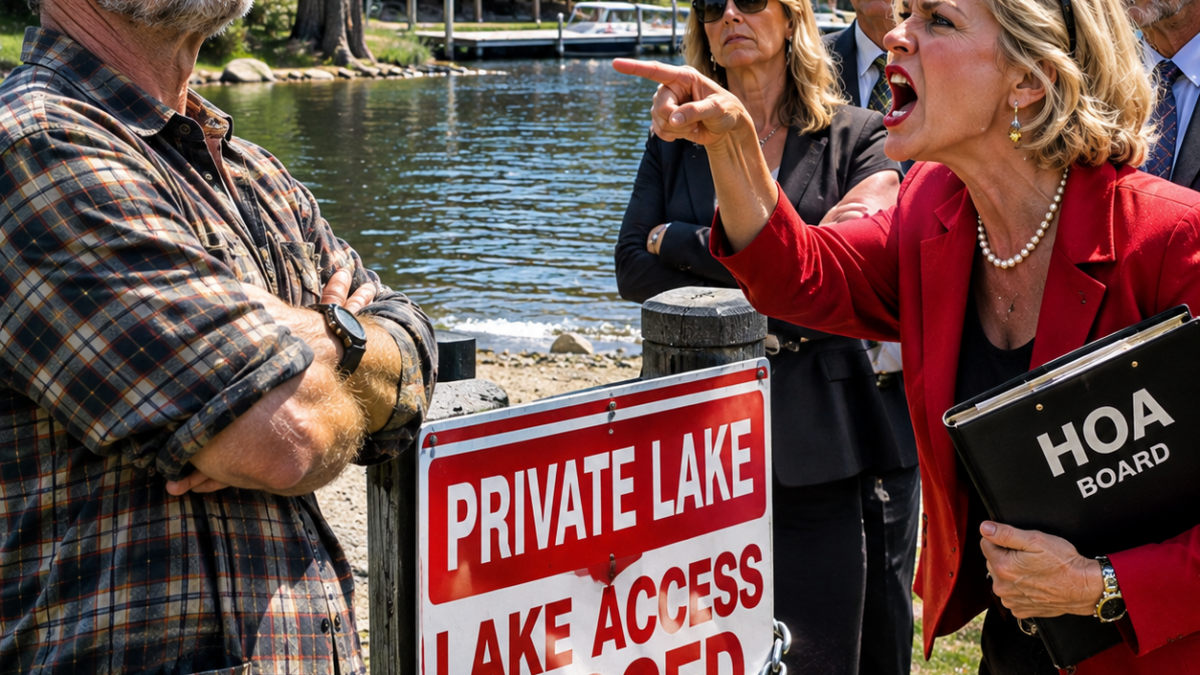
PART 2
I stared at the sentence until the words stopped looking like English.
“Me?”
Beth nodded.
“That’s what this says.”
“No.”
“Garrett.”
“I own a cabin.”
“And apparently a great deal more than the cabin.”
She pulled another sheet from the pile.
My original survey.
Yellowed edges.
Faded county stamp.
The shoreline boundary ran differently from the modern parcel map I had always assumed was controlling.
My lot extended along the old creek bed where the reservoir’s original water-control infrastructure had been built.
Beth traced it with one fingernail.
“You see this?”
“Creek channel.”
“Keep going.”
I followed the line.
It crossed beneath the water.
Reached the dam.
Then incorporated a narrow utility strip wrapping around the western gate structure.
I sat back.
“That can’t be right.”
“Why?”
“Because nobody owns a dam because they bought a fishing cabin.”
“People own strange things because of old property law.”
“I was an electrician, Beth. If somebody told me I bought a transformer easement in 1994, I might believe them. A lake?”
She leaned back.
“You need somebody who understands water law.”
I thought immediately of Buck Morrison.
Buck had retired from the Army Corps of Engineers years earlier.
He was seventy-two, built like an old fence post, and had spent half his career around dams, channels, culverts, and flood-control projects.
I called him.
“Buck.”
“Mills.”
“You busy?”
“I’m retired. That means everybody assumes I’m never busy.”
“I need you to look at some lake documents.”
Long pause.
“What’d you break?”
“Nothing.”
“That answer makes me nervous.”
“Just come over.”
He arrived before dinner carrying reading glasses and a notebook.
Beth stayed.
We spread everything across my kitchen table.
Dorothy’s old salt shaker sat between two surveys because there wasn’t room for anything else.
Buck read the covenant first.
Then the deed.
Then the original 1961 Cascade Lumber reservoir survey.
His expression changed.
“What?” I asked.
“Who gave you these?”
“County recorder.”
“All of them?”
“Yes.”
He put on his glasses again.
“Garrett, when Cascade Lumber built Willow Brook, this wasn’t designed as a recreational subdivision lake.”
“I know. Log pond.”
“Partly.”
He tapped the old map.
“They impounded the creek for timber operations, fire protection, and water storage. When the company broke up, shoreline parcels were sold under different classes of rights.”
“And mine?”
“Your parcel retained the control structure.”
I stared at him.
“The dam?”
“Looks that way.”
Beth said quietly:
“That’s what I thought.”
Buck continued.
“The later community covenant preserves recreational access for the original parcels, but senior operational control stayed attached to this lot.”
“Why?”
“Probably because somebody needed legal responsibility for the gate system.”
“So I can drain the lake whenever I want?”
Both of them answered at once.
“No.”
I held up my hands.
“I’m asking.”
Buck frowned.
“You do not get to play God with a reservoir because your HOA president annoyed you.”
“She fined me for fishing.”
“I heard.”
“She wants thirty-four hundred dollars a year in dock insurance.”
“Still not a reason to drain a lake.”
Beth smiled.
“However…”
I looked at her.
“I hate when lawyers say however.”
“I’m not a lawyer.”
“You worked with them long enough.”
She tapped the covenant.
“The HOA also can’t regulate away rights that predate it.”
That was what mattered first.
My property predated the HOA by seven years.
My fishing rights were explicitly grandfathered.
The HOA’s later recreational restrictions could not simply erase rights recorded with the property.
At least that was Beth’s reading.
We needed a real attorney.
So the next morning I called Laura Pennington, a property lawyer in Riverside County.
She took three days to review the documents.
Then she called.
“Mr. Mills?”
“Yes.”
“Your HOA president has a problem.”
That was the first enjoyable sentence I’d heard all month.
“How big?”
“Let’s not get excited.”
“Too late.”
“Your recorded rights appear strong. The HOA can regulate certain common conduct, but they likely cannot prohibit your historically protected recreational access.”
“What about the fine?”
“I’m disputing it.”
“The dock insurance?”
“Also questionable, especially if adopted without proper notice.”
I leaned against the kitchen counter.
“And the dam?”
Silence.
“You found that.”
“Buck found it.”
“Yes. Your parcel appears to carry operational rights and responsibilities tied to the original control structure.”
“So I own it.”
“In practical terms, part of it, yes.”
“Can I shut the lake?”
“Garrett.”
“I’m asking for information.”
“You can perform lawful maintenance when necessary. You cannot manipulate water levels to retaliate against neighbors.”
“Understood.”
I meant it.
Mostly.
The problem was Meredith wasn’t waiting for me to understand anything.
The emergency HOA meeting happened Tuesday afternoon at two.
Exactly when most working residents couldn’t attend.
No notice reached me.
None reached Harold.
Rosa didn’t get one.
Frank didn’t either.
But Beth got a forwarded agenda from a friend.
**Emergency Resolution 2024-07.**
Minimum one-million-dollar liability insurance for all private docks.
Effective immediately.
Estimated annual premiums for older structures would run into the thousands.
Beth read it at my kitchen table.
“They’re pricing people out.”
“I know.”
“No, Garrett. I mean literally.”
She pulled out a legal pad.
“Harold lives on Social Security and a military pension. Rosa’s mortgage is nearly paid off, but she’s helping her daughter. Frank’s retired.”
“And me.”
“You’re not rich either.”
“No.”
My retirement was stable.
Not luxurious.
Dorothy’s medical bills had eaten through savings before she died.
I could survive.
A lot of others couldn’t.
That was when the pattern stopped looking like aggressive HOA management.
It looked economic.
The older residents had one thing the new development wanted.
Land.
I spent the afternoon looking at property sales.
Then Beth called.
“I found Raymond.”
“Who?”
“Meredith’s husband.”
“What about him?”
“He runs AquaVest Properties.”
I had heard the name.
Developer.
Luxury lake communities.
High-end second homes.
Beth continued.
“They’ve bought distressed waterfront property in three counties.”
“So?”
“Guess who owns four of the houses around us now.”
I knew immediately.
“AquaVest.”
“Shell companies tied to them.”
That made me sit down.
She kept talking.
“Two were old owners who got hit with big compliance assessments before selling.”
“You sure?”
“I pulled transfer records.”
Then she said:
“There’s more.”
I hated that phrase now.
“Preliminary county planning documents show something called Willow Brook Lakes Phase Two.”
“What is that?”
“Expansion.”
“Where?”
“Your side of the lake.”
My kitchen went quiet.
Dorothy’s photograph sat on the shelf above the stove.
Her smiling beside a trout she had insisted I caught only because the fish was “emotionally compromised.”
Beth said:
“Your parcel is labeled future clubhouse and marina.”
I looked at her.
“My house?”
“Gone.”
“They planned this before the fishing fine?”
“Looks like it.”
“How long?”
“Preliminary drawing is dated fourteen months ago.”
That was four months before Meredith became HOA president.
Something inside me settled.
Not calmed.
Settled.
There’s a difference.
Anger spreads.
Purpose narrows.
I picked up the phone.
“Who are you calling?”
“Laura.”
The legal fight started the next day.
Formal challenge to the fines.
Demand for meeting notices.
Request for HOA financial records.
Notice that my recorded riparian rights predated association restrictions.
Laura also sent a letter warning Meredith and the board against entering my property without permission.
Meredith ignored it.
She came to my dock at seven-thirty the next morning.
I was sitting with coffee and my rod.
She walked straight past the **PRIVATE PROPERTY** sign.
Her heels hit the planks.
Click.
Click.
Click.
“Mr. Mills.”
“Morning.”
“I need photographs for the compliance file.”
“You need to leave.”
“This is official association business.”
“You’ve been notified not to enter.”
She lifted her tablet.
“We have inspection authority.”
“Laura Pennington disagrees.”
That stopped her.
“You retained counsel?”
“Why? Thought I was just a senile fisherman?”
Her eyes narrowed.
“I never said that.”
“Not yet.”
She began photographing.
The security camera Buck and I had installed watched from under the eave.
I pointed.
“You’re on video.”
For the first time, she looked uncertain.
Only for a second.
Then the old confidence returned.
“You’re making this much harder than necessary.”
“So are you.”
“I am trying to preserve the community.”
“By forcing out the people who built it?”
Her face hardened.
“This neighborhood is changing.”
“I noticed.”
“Standards protect value.”
“Whose value?”
She stopped.
That was the question.
Then she walked away without answering.
Two days later, three inspectors arrived.
County zoning.
Fish and Wildlife.
State environmental office.
Every one responding to complaints.
My dock.
Fish-cleaning station.
Boat motor.
Shoreline vegetation.
Fuel storage.
Septic runoff.
They measured everything.
Photographed everything.
Asked questions.
Most were polite.
One wildlife officer looked embarrassed.
“Someone reported fish waste being dumped directly into the lake.”
I pointed at my covered disposal bin.
“I compost offsite.”
He inspected it.
“Looks fine.”
County zoning found one actual issue.
A handrail section on the rear steps was below current code after a repair I had done years earlier.
I fixed it.
The environmental inspector found nothing.
But just defending myself cost money.
Consultation fees.
Document copies.
Inspection responses.
Attorney time.
By Thursday I had spent nearly twenty-four hundred dollars.
That night I sat alone on the dock.
Dorothy’s photograph beside me.
Sunset turned the water orange.
Her favorite color.
I held the photo.
“I’m tired, Dot.”
The lake answered with small waves under the boards.
“I know what you’d say.”
She would have told me to stop being stubborn.
Then five minutes later she would have become more stubborn than I was.
My phone rang.
Jennifer.
My daughter lived in Phoenix.
“Dad?”
“Hey, sweetheart.”
“Are you okay?”
“Fine.”
“That wasn’t my question.”
I smiled despite myself.
“I’m dealing with it.”
“I saw the article.”
“What article?”
Silence.
That was bad.
She texted the link.
**LOCAL HOA RAISES SAFETY CONCERNS OVER AGING WATERFRONT PROPERTY**
My cabin.
My dock.
A quote from Meredith.
No direct accusation.
Just concern.
Children.
Safety.
Environmental responsibility.
Words arranged carefully enough to create fear without stating anything she might have to prove.
Jennifer said:
“You look like they’re calling you dangerous.”
“I know.”
“Dad, maybe you should sell.”
The words hurt worse than Meredith’s fines.
“Sell?”
“I’m not saying forever. Maybe move closer to us.”
“Your mother is here.”
The silence afterward was long.
Jennifer said softly:
“Mom is not there.”
I looked at Dorothy’s photograph.
“I know.”
“Do you?”
I closed my eyes.
She wasn’t trying to hurt me.
That made it worse.
“Dad, I’m scared this fight is becoming all you have.”
“It isn’t.”
“You call me only when something happens with the HOA.”
“That’s not true.”
“When was the last time you asked about Tommy’s baseball?”
I had no answer.
My grandson had started Little League.
I knew that.
Couldn’t remember his position.
Jennifer sighed.
“I’m not telling you to surrender.”
“It sounds like it.”
“I’m telling you not to become so obsessed with keeping the cabin that you lose everything else Mom wanted you to keep.”
That stayed with me.
After the call, I sat outside until dark.
The next morning, someone sabotaged my boat.
The motor fired.
Ran thirty seconds.
Coughed.
Stopped.
I smelled something wrong in the fuel.
Sweet.
Contaminated.
The camera caught a figure near the dock at two in the morning.
Dark clothes.
Cap.
No usable face.
The repair shop later found contamination in the fuel system.
Cost:
Eighteen hundred dollars.
I wanted Meredith blamed.
Wanted it badly.
Laura stopped me.
“You have no identification.”
“She did it.”
“You think she did.”
“She benefits.”
“That isn’t evidence.”
I hated lawyers again.
Then came the emergency HOA meeting.
This one I attended.
Not because Meredith invited me.
Laura notified the board that excluding me while considering fines tied to my property would become part of our challenge.
The community center was packed.
Meredith stood at the front.
Raymond sat near the side wall.
I had never met him.
Tall.
Expensive watch.
Quiet.
The kind of man who looked comfortable letting other people talk.
Meredith began with my picture on a screen.
My cabin photographed in bad light.
Dock boards enlarged.
A rust spot on my boat trailer.
Then audio clips.
My voice saying:
“You don’t have authority here.”
Another:
“Keep pushing and you’re going to regret it.”
I remembered that one.
I had said it after she trespassed.
The rest of the sentence was:
“because your own records are going to expose what you’re doing.”
That part was gone.
Meredith looked toward the audience.
“This escalation has created concern among residents and board members.”
I stood.
“That recording is edited.”
“You will have an opportunity during comments.”
“You cut off the sentence.”
“Garrett.”
“Play the full audio.”
“Sit down.”
Raymond smiled.
That made me angrier than Meredith.
Then Sarah Mitchell stood.
Teacher.
Five years on the lake.
Newer resident.
Not one of our old group.
“Can I ask a question?”
Meredith’s smile returned.
“Of course.”
“Who verified the inspection reports?”
Silence.
Sarah continued.
“My family has received three violations this year for playground equipment. One report says the swing set is fourteen feet from our property boundary.”
She lifted photographs.
“It’s twenty-six.”
People turned.
Meredith said:
“That’s unrelated.”
“Is it?”
Then Tom Bradley stood.
Iraq veteran.
American flag pin on his jacket.
“I got fined because my flag bracket was twelve inches too high.”
A few people laughed.
Tom didn’t.
“Anyone else getting weird violations?”
Hands went up.
Not many.
Enough.
Then Frank Lucy’s daughter stood.
She had HOA budget printouts.
“Why have legal expenses increased from fourteen thousand dollars to eighty-nine thousand?”
The room changed.
Meredith said:
“That includes compliance work.”
“For which firms?”
“Various counsel.”
“Does Raymond Blackstone have business relationships with any of them?”
Raymond stopped smiling.
Meredith’s face went tight.
“That accusation is inappropriate.”
“It was a question.”
Then Harold Epstein stood.
Slowly.
One hand on his cane.
Harold had a Purple Heart from Vietnam, not Normandy despite the version of the story that later circulated.
He was seventy-eight, stubborn as old oak, and had spent weeks studying covenants after his hummingbird fine.
“You folks keep saying rules are rules.”
Meredith replied:
“They are.”
Harold nodded.
“Good.”
Then he held up a folder.
“Because some of us have rules older than yours.”
The room went quiet.
He looked toward me.
“Garrett?”
I hadn’t expected it.
But I understood.
I stood.
Meredith said:
“Mr. Mills, this isn’t your comment period.”
Harold answered:
“Maybe let the man you’re trying to fine five thousand dollars speak.”
That number hit me.
Five thousand?
Meredith had bundled everything.
Fishing.
Dock.
Boat.
Insurance.
“Noncompliance.”
A lien threat followed if I did not correct violations within thirty days.
I looked at Raymond.
He met my eyes.
For the first time, I understood how the plan might work.
Fine.
Pressure.
Legal costs.
Lien.
Distress.
Then AquaVest arrives with an offer.
I walked to the microphone.
“I have one question.”
Meredith crossed her arms.
“What?”
“Why is my property labeled ‘future clubhouse’ in AquaVest’s Phase Two planning file?”
Raymond stood.
The room erupted.
That was the moment the fight stopped being mine.
Neighbors shouted questions.
Meredith demanded order.
Sarah wanted documents.
Frank’s daughter asked about legal fees.
Harold wanted the fishing restrictions rescinded.
Tom wanted every fine reviewed.
Raymond left through the side door.
Meredith tried to adjourn.
Nobody listened.
For the first time, she had lost control of the room.
That should have been our turning point.
Instead, it made her more dangerous.
The newspaper story appeared two days later.
**PROPERTY OWNER ACCUSED OF THREATENING HOA LEADERSHIP**
My name.
My photograph.
The edited audio.
Social media followed.
Fake accounts appeared in the Willow Brook group.
Comments called me unstable.
Dangerous.
Anti-community.
Frank’s grandson, Eli, worked in network security.
He analyzed what he could legally access.
Several accounts had been created within days of each other.
Same writing style.
Same posting windows.
Enough to raise suspicion.
Not enough to prove Meredith personally ran them.
Then the physical intimidation started.
Trash on my lawn.
Red paint across one dock rail.
**TERRORIST**
Anonymous calls.
One said:
“Old men have accidents around water.”
I reported everything.
Sheriff Carlos Martinez—not the same deputy from another county, just a coincidence—took it seriously.
He installed extra patrols near my property.
“Garrett.”
“Yeah?”
“No hero stuff.”
“I’m sixty-seven.”
“Old guys do stupid hero stuff too.”
“I’m sixty-six.”
“Even worse.”
He pointed at me.
“You see anyone around the dam, call us.”
That sentence caught me.
“The dam?”
“Buck said you’re inspecting it.”
“Tomorrow.”
“Good. Call us if anything looks wrong.”
Buck and I met Saturday morning.
He carried a toolbox and old Corps manuals.
The dam sat behind trees at the western end.
Concrete face.
Steel gate wheel.
Old mechanical system.
Still functional.
He inspected corrosion.
Greased fittings.
Opened records.
Then frowned.
“What?”
“When was this last properly inspected?”
“HOA says annual.”
“Show me.”
I pulled board records Beth had obtained.
No full structural inspection since 2019.
Buck swore.
“That’s bad.”
“How bad?”
“Maybe nothing.”
“Helpful.”
“The gate works. Concrete looks okay above water. But we’ve got sediment, corrosion, and no recent underwater inspection.”
He turned the wheel a fraction.
Metal groaned.
Water increased through the release channel.
“After decades, you need periodic drawdowns.”
“How far?”
“For full inspection? Six feet, maybe eight.”
I stared at him.
“That would strand every dock.”
“Probably.”
“Destroy lake access.”
“Temporarily.”
“How long to refill?”
“Depends on rain and inflow. Months.”
I felt a dangerous idea forming.
Buck saw my face.
“No.”
“What?”
“Whatever you’re thinking.”
“I’m thinking maintenance.”
“You’re thinking revenge.”
“Can’t it be both?”
“No.”
He wiped his hands.
“You do this only if engineers and regulators say it’s necessary.”
I nodded.
Then a camera alert hit my phone.
Motion.
Dam access road.
Two men.
Meredith.
Eleven in the evening on Saturday.
Except it was still afternoon.
The camera timestamp showed footage from the previous night that had failed to push because of weak signal.
I opened it.
Meredith with two men in work clothes.
Flashlights.
Tools.
One carried a steel rod.
Another bagged material.
They approached the gate housing.
Worked for twelve minutes.
Left.
Buck watched beside me.
“What the hell were they doing?”
“I don’t know.”
We walked to the mechanism.
Fresh scratches.
Concrete residue.
A metal pin partly inserted into a locking assembly.
Buck crouched.
“They were trying to jam the gate.”
My hands went cold.
“Could it fail?”
“Not like this. But if they filled the housing and locked the stem…”
He stopped.
“Call the sheriff.”
Martinez arrived.
Photographs.
Evidence bags.
Measurements.
Camera footage.
The Riley Construction logo on one man’s jacket gave investigators a starting point.
By Sunday morning, both workers had been identified.
One cooperated quickly.
Meredith had hired them.
She wanted the control mechanism disabled.
According to his statement, she told them the gate was “unlawfully controlled by an unstable resident” and needed to be secured before an upcoming county action.
Then investigators found messages.
Not the massive criminal conspiracy legend that spread later.
Enough.
AquaVest had been planning Phase Two.
My parcel was a target.
Meredith had been pushing enforcement pressure.
Raymond had discussed “accelerated acquisition opportunities.”
A county condemnation proposal involving my parcel had been circulating.
Not yet approved.
Not secret final seizure.
But real enough.
The possible public-safety justification?
The dam.
My dock.
Water-control liability.
Everything they had spent months building into a record.
Laura called Sunday afternoon.
“Garrett.”
“I know.”
“No, you don’t.”
“What?”
“The county commission agenda for Tuesday includes a resolution authorizing further study of acquiring your control parcel.”
“Eminent domain?”
“Not a final condemnation vote. The source you heard exaggerated it. But it could start that process.”
I sat down.
“How fast?”
“Not thirty days. Eminent domain doesn’t happen like that. But if the county embraces the public-safety theory, your fight gets much harder.”
“Because they created the safety problem.”
“Yes.”
I looked out at the lake.
“They tried to disable the dam.”
“Yes.”
“Does that change maintenance?”
“It may.”
Buck spoke with state dam-safety officials.
They reviewed photographs.
They wanted a full inspection.
Because of evidence of attempted tampering and years of missed inspections, regulators approved a controlled drawdown.
Documented.
Scheduled.
Not because I wanted to punish the HOA.
Because the mechanism needed inspection.
Six feet.
Possibly more if required.
I sat with Buck beside the gate Monday evening.
He looked at me.
“You understand what happens tomorrow?”
“Lake goes down.”
“That’s the easy part.”
“Docks strand.”
“Property owners panic.”
“I know.”
“Realtors panic.”
“I know.”
“People blame you.”
“I know.”
“You ready?”
I looked toward my cabin.
Dorothy’s lights used to glow there every evening.
“I don’t know.”
That was the truth.
Jennifer called.
“Dad.”
“Hey.”
“Laura told me.”
“She shouldn’t have.”
“I called her.”
“Of course you did.”
“Are you draining the lake?”
“Lowering it for safety inspection.”
“You know what I mean.”
“Yes.”
“What if people hate you?”
“They already do.”
“I don’t.”
That stopped me.
She continued.
“Tommy plays second base.”
I closed my eyes.
“I’m sorry.”
“He has a game Saturday.”
“I’ll try to watch the stream.”
“Promise?”
“Yes.”
“Then go do what you need to do.”
Tuesday morning, five-thirty.
Buck and I stood at the gate.
State notification filed.
County emergency management notified.
Environmental controls ready.
Sheriff’s deputy present because of the sabotage attempt.
Cameras recording.
No theatrics.
No grin.
Buck said:
“Quarter turn.”
I put both hands on the wheel.
Cold steel.
Started turning.
The mechanism groaned.
Then water increased through the spillway.
Not a torrent.
A controlled release.
The lake did not suddenly vanish.
It began to fall.
Slowly.
By eight, some floating docks sat lower against their guides.
By ten, calls started.
Mike Torres.
“Garrett, people are losing their minds.”
“Inspection.”
“I know. I’m enjoying it.”
“Don’t.”
“Why?”
“Because some of these people didn’t do anything.”
That mattered.
Not every million-dollar-home owner was Meredith.
Some were families.
Some had believed her.
Some had stayed silent.
Silence wasn’t the same as conspiracy.
At nine-fifteen, Meredith arrived.
White Tesla.
Fast.
She stopped hard.
Walked toward me.
“You senile old fool!”
Buck looked at me.
“Still want revenge?”
I almost laughed.
Meredith pointed toward the lake.
“You’re destroying millions in value.”
I held up the state dam-safety authorization.
“Emergency inspection.”
“This is retaliation.”
“Your contractors tried to jam the gate.”
“They were securing it.”
Sheriff Martinez stepped from beside the service truck.
“No, ma’am.”
Meredith froze.
He walked over.
“We need to speak with you.”
Her face changed.
“What is this?”
“Investigation.”
“I have an attorney.”
“You can call them.”
“I’m not answering questions.”
“That is your right.”
She glared at me.
“You think this saves your cabin?”
I said nothing.
“The county meeting happens this afternoon.”
Martinez watched her carefully.
She continued:
“You will lose that property.”
“Meredith.”
Laura’s voice came from behind me.
She had driven out early.
“Stop talking.”
Meredith turned.
Laura smiled without warmth.
“I’m his attorney.”
That ended the conversation.
Martinez did not theatrically handcuff Meredith in front of the entire community.
He served her with a formal notice related to the investigation and later investigators interviewed her through counsel.
The two Riley workers were charged first.
Evidence from their phones tied the sabotage effort back to her.
The county postponed its acquisition study.
Commissioners wanted no part of condemning a property at the center of a developing corruption investigation.
The lake kept falling.
One foot.
Two.
Three.
Boat lifts became useless.
Marina slips shallowed.
Realtors called.
Homeowners called.
Some screamed.
Some pleaded.
One woman, Janet Richardson, had a buyer flying from California.
“Mr. Mills, can you pause the drawdown for the weekend?”
“No.”
“It’s costing us a sale.”
“I’m sorry.”
“You don’t sound sorry.”
“I am.”
“Then stop.”
“I can’t.”
“You control the gate.”
“State inspectors control the maintenance plan.”
That distinction saved me from myself.
If I could have stopped it casually, this would have become revenge.
Instead, the process had rules.
Buck enforced them.
Every six hours.
Measurements.
Sediment.
Gate function.
Spillway inspection.
Fish relocation where needed.
Environmental staff monitored exposed habitat.
The lake looked terrible.
Mud.
Old tires.
Lost anchors.
Beer cans from twenty years ago.
One sunken paddleboat.
People stood on dry dock ends staring.
The community finally saw what was beneath the surface.
Literally and otherwise.
Then the financial records surfaced.
Frank’s daughter, Alicia, worked in accounting.
She spent nights reviewing HOA statements obtained through member requests.
Eighty-nine thousand in legal fees.
Payments to firms connected to Raymond’s business partners.
Consulting charges.
“Community-development studies.”
AquaVest-related vendors.
Not all illegal.
Enough undisclosed relationships to matter.
Tom found records of targeted enforcement.
Harold had documents proving older homeowners missed notices sent correctly to newer residents.
Sarah collected similar cases.
Rosa.
Frank.
Beth.
Me.
A pattern.
Then one document changed everything.
An AquaVest acquisition spreadsheet.
Forty-seven parcels.
Target values.
Projected “distress discount.”
Original owners highlighted.
Mine listed:
**MILLS — PRIORITY / CLUBHOUSE SITE**
Projected acquisition:
Sixty percent of market.
That document spread through the neighborhood faster than any Facebook rumor.
People who had defended Meredith stopped answering her calls.
People who had called me dangerous appeared at my cabin.
One man, Douglas Lane, stood awkwardly in my driveway.
“I owe you an apology.”
“For?”
“I voted for the lien.”
I remembered him.
Third row.
Hand up.
“Okay.”
“That’s it?”
“What do you want me to say?”
“I thought you were the problem.”
“So did a lot of people.”
“My property is on their list.”
That was the part.
He hadn’t changed because he suddenly loved me.
He changed because the machine had turned toward him.
I could have resented that.
Instead I said:
“Come to the meeting.”
“What meeting?”
“The one where everyone stops hiding.”
The emergency community meeting happened Thursday evening in the high-school gym.
Around three hundred people.
News crews.
County officials.
HOA counsel.
AquaVest representatives did not appear.
Meredith’s chair at the front remained empty.
Raymond was represented by an attorney.
Outside, the lake sat several feet low.
Through tall gym windows, dock pilings looked absurdly high above the water.
County Commissioner Janet Walsh opened.
“We are here to discuss the current lake-level emergency, infrastructure inspection, and related community concerns.”
She wanted to talk about restoring the lake.
Tom Bradley stood.
“Before we restore anything, we need to know why we got here.”
Applause.
Not thunder.
But strong.
Commissioner Walsh said:
“Mr. Bradley, you’ll have public comment.”
“I’ve got financial records.”
The room shifted.
Alicia presented the numbers.
Legal spending.
Related vendors.
Acquisition consulting.
Raymond’s network.
Then Sarah Mitchell.
She held the AquaVest spreadsheet.
“This document identifies forty-seven lake properties for acquisition.”
People murmured.
She continued.
“Twenty-one belong to long-term residents who have received significant HOA enforcement action over the last two years.”
That was the line.
Twenty-one.
Not every old homeowner.
Not every fine.
A pattern.
She read mine.
**Priority. Clubhouse site.**
People shouted.
Commissioner Walsh banged the gavel.
Then Rosa stood.
She held a photograph of her garden.
“My grandmother planted tomatoes there in 1978.”
She looked around.
“Meredith called it nonconforming.”
She held up the AquaVest list.
“My house is number eleven.”
Silence.
Frank went next.
His old pickup had earned a three-hundred-dollar aesthetic violation.
His parcel was number fifteen.
Harold stood with his cane.
He did not deliver some speech about Normandy.
He simply held up the hummingbird fine.
“Four hundred dollars.”
Then the acquisition sheet.
“Number six.”
He looked at the room.
“I used to think this was about bird feeders.”
That was more powerful than any big speech.
Then Commissioner Walsh called my name.
I walked to the microphone.
My hands were shaking.
Not from fear.
Exhaustion.
I looked at everyone.
“Four months ago, I wanted to be left alone.”
No one moved.
“I wanted coffee. Fishing. My cabin.”
I glanced toward Jennifer’s face on my phone screen.
She was watching remotely.
“I didn’t drain the lake to punish you.”
I pointed toward Buck.
“The state ordered a safety inspection after somebody tried to interfere with the dam mechanism.”
Then I looked toward the empty HOA table.
“But I won’t pretend I didn’t know what lowering the water would do.”
There it was.
The truth.
“I knew people would panic.”
Nobody spoke.
“I knew property sales would pause.”
Still quiet.
“I knew AquaVest would hurt.”
I swallowed.
“And part of me wanted that.”
Laura shifted slightly.
I continued.
“I was angry.”
My voice cracked.
“Dorothy and I built our life there. Then somebody decided my grief, my age, my dock, my fishing, and my retirement account were just obstacles between them and a development plan.”
I looked at the old residents.
“I wanted them hurt.”
Then at the newer residents.
“But some of you weren’t part of that.”
That mattered too.
“You bought homes. You trusted the HOA. Some of you believed what you were told about me.”
I looked toward Douglas.
He lowered his eyes.
“So here’s where I stand.”
I held up the dam inspection report.
“The lake stays down until engineers finish the work.”
No cheering.
“The gate gets repaired.”
“The sediment problem gets addressed.”
“The safety system gets documented.”
“Then the water comes back.”
A few people exhaled.
“But the community can’t go back to what it was.”
That was the real condition.
Not ransom.
Not stolen property returned before water.
That part of the legend exaggerated me into somebody I never was.
I didn’t have the right to hold the lake hostage until people met political demands.
I had the right—and obligation—to operate the dam safely.
The rest had to be handled legally.
Harold spoke from his chair.
“Then we fix both.”
Exactly.
The lake.
And the HOA.
The county launched an investigation into the acquisition scheme and disclosure failures.
Members petitioned for a recall election.
Meredith was removed.
Not by handcuffs.
Votes.
Raymond resigned from every advisory role he held.
The county suspended review of AquaVest Phase Two.
Lenders froze portions of the development financing pending investigation.
The deal began collapsing under its own leverage.
Then the Riley Construction worker’s testimony connected Meredith directly to the attempted gate interference.
Text messages showed Raymond knew about the pressure campaign.
One message from him to Meredith read:
**If Mills won’t sell voluntarily, keep the violations moving. We need that parcel before Phase Two closes.**
That became important.
Another:
**Tucker can keep inspection pressure up.**
Tucker Blackstone.
The inspector.
Her brother-in-law.
His county certification review began.
Meredith’s criminal case ultimately involved conspiracy, attempted interference with critical private infrastructure, and fraud-related conduct.
Raymond faced separate charges tied to undisclosed financial arrangements and the property-acquisition scheme.
Marcus Finley, the HOA attorney, became an ethics problem when investigators found billing tied to AquaVest while he was advising the HOA.
His license was suspended during the investigation.
Some charges were dismissed.
Others were negotiated.
The final sentences were not the dramatic six and four years that neighborhood gossip turned them into.
Meredith served time.
Raymond served less but paid significant restitution and civil judgments.
Marcus lost his ability to practice for a period and later surrendered his license rather than complete reinstatement proceedings.
AquaVest didn’t disappear overnight.
But Willow Brook Phase Two died.
Lenders pulled back.
Partners sued each other.
Several targeted purchase contracts were rescinded.
Former owners who had already sold below market did not magically get their houses returned.
Real life doesn’t reverse deeds that easily.
But a few pending sales were canceled.
Others were renegotiated.
Residents received restitution through civil settlements.
Illegal fines were refunded.
My five-thousand-dollar lien threat vanished.
My fishing fine was rescinded.
So was the dock fine.
The seventy-five-dollar processing fee attached to one of them took another six weeks.
Beth called that “the most realistic part of the story.”
The lake remained low for three months.
Not six.
Snowmelt came early.
The inspection found corrosion in the gate assembly.
Sediment accumulation.
A partially blocked spillway.
Nothing catastrophic.
But enough to justify the drawdown.
We repaired the gate.
Replaced hardware.
Removed debris.
Improved monitoring.
Environmental crews used the low water to remove invasive vegetation and trash.
Buck supervised like a man thirty years younger.
I teased him.
“You enjoying retirement?”
“This isn’t retirement.”
“What is it?”
“Preventing you from doing something stupid.”
Fair.
The first rainstorm after repairs filled the creek.
Then spring snowmelt arrived.
Water climbed.
Slowly.
Six inches.
One foot.
Two.
Docks touched water again.
Boats floated.
Mud disappeared.
The lake looked scarred for a while.
Then green returned along the edge.
By March, Willow Brook looked like itself.
Almost.
I sat on my dock the morning the water finally reached the old stain line.
Dorothy’s photograph beside me.
Jennifer was visiting with Tommy.
My grandson was nine.
He carried a small rod.
“Grandpa?”
“Yeah?”
“Mom says you drained the whole lake because somebody fined you.”
Jennifer groaned.
“Tommy.”
“What?”
I laughed.
“That is not exactly what happened.”
“Did you drain it?”
“Lowered.”
“Same thing.”
“No.”
“Did the lady fine you?”
“Yes.”
“So I’m right.”
Jennifer sat beside me.
“He gets this from you.”
“I know.”
Tommy cast.
Badly.
His lure landed eight feet from the dock.
“Good?”
“Terrible.”
He grinned.
Dorothy would have loved him.
That hurt.
But differently now.
Less like an open wound.
More like weather.
Something present.
Something survivable.
Sarah Mitchell became HOA president.
Not because she was part of some heroic revolution.
Because after the recall, nobody else wanted the job.
Her platform consisted of three promises.
Publish the finances.
Send notices properly.
Stop inventing emergencies.
She won overwhelmingly.
Harold became marina committee chair.
Not “harbormaster,” though everyone called him that anyway.
He put up fourteen hummingbird feeders around his property after the new board repealed the wildlife-attraction rule.
Kids started walking past just to count them.
Rosa expanded her vegetable garden.
The board later asked whether she would organize a community produce stand.
She stared at Sarah.
“You fined me six hundred dollars for tomatoes.”
Sarah said:
“Old board.”
“I know.”
“You going to make us suffer forever?”
Rosa thought about it.
“Maybe.”
Then agreed.
Her Saturday stand became one of the best things about summer.
Frank still drove the same truck.
Nobody cared.
Mike Torres, the software engineer, helped rebuild the HOA website so every meeting notice, budget, vendor contract, and vote was available to residents.
I told him:
“You made the HOA too efficient.”
He said:
“Boring systems are good systems.”
Daniel from Willowbrook Estates would have liked him.
The new board hired independent counsel to review every covenant change from the prior three years.
Several rules were invalid because notice procedures hadn’t been followed.
Others were legal but stupid.
Those were repealed by vote.
A few stayed.
Noise rules.
Waste disposal.
Boat-speed limits.
Basic things people actually needed.
The lesson wasn’t that all HOA rules were tyranny.
The lesson was that process mattered.
Authority mattered.
Disclosure mattered.
The fishing restriction disappeared.
My first morning officially “legal” again, I woke before sunrise.
Coffee.
Rod.
Dock.
I cast.
No one came.
No clipboard.
No Tesla.
No fine.
I almost felt disappointed.
Then I remembered that peace is supposed to be boring.
Jennifer visited more after that.
Not every month like the exaggerated story people told.
A few times a year.
That was enough.
One summer she found me in the cabin looking through Dorothy’s recipe cards.
“Dad.”
“Yeah?”
“You missed Tommy’s game stream.”
I froze.
I had promised.
The lake fight was over.
I no longer had an excuse.
“I forgot.”
“He noticed.”
That hurt.
I called him.
He had gone two for three.
Double.
RBI.
Second base.
I listened.
Asked questions.
Then I drove to Phoenix two weeks later.
First time I had left the cabin for more than three nights since Dorothy died.
Jennifer cried when I showed up.
I pretended not to notice.
That trip mattered.
Because she had been right.
Keeping Dorothy’s place did not mean I had to keep myself trapped inside it.
The lake could be home without becoming my whole world.
The property lawsuit settled the following year.
AquaVest paid damages connected to interference and targeted acquisition practices.
The HOA’s insurer covered some claims.
My attorney fees were reimbursed.
I received more money than I expected.
Not enough to become rich.
Enough to ask what Dorothy would have done.
I knew.
Education.
She had been a school secretary for twenty-two years.
Loved kids who thought college wasn’t for them.
Loved kids who worked with their hands.
So Jennifer and I created the Dorothy Mills Conservation & Trades Scholarship.
Not forty-five thousand dollars a year.
We weren’t that rich.
Two scholarships.
Five thousand each.
Students studying environmental technology, water management, electrical work, civil infrastructure, or related trades.
The first recipient was a kid named Mateo Garcia.
His father worked at the marina.
Mateo wanted to study electrical systems for water-treatment plants.
At the ceremony, he said:
“I heard you were an electrician.”
“Forty-one years.”
“Any advice?”
“Yes.”
He waited.
“Shut the breaker off first.”
Everyone laughed.
Then I added:
“And read the plans before you touch anything.”
That one wasn’t a joke.
The annual lake cleanup grew out of the drawdown.
When the water was low, we found decades of garbage.
Old batteries.
Rusted lawn chairs.
Fishing line.
Two outboard motors.
A lawn mower.
Nobody knew how a lawn mower got twelve feet underwater.
Harold insisted it was probably government work.
The next spring, we organized a cleanup day.
Then another.
Eventually it became tradition.
Not a festival with national media.
Just neighbors.
Trash bags.
Work gloves.
Barbecue afterward.
The first year, newer residents worked beside people they had spent months avoiding.
Douglas Lane carried buckets with Rosa’s grandson.
Sarah’s kids helped Harold clean fishing line from cattails.
Mike repaired the marina Wi-Fi because apparently that qualifies as environmental stewardship if you ask a software engineer.
At lunch, I sat with Beth.
She looked around.
“You know what’s funny?”
“What?”
“Meredith ran on community improvement.”
I laughed.
“Technically she improved it.”
Beth raised her lemonade.
“To unintended consequences.”
We drank.
I saw Meredith again only once.
Years later.
County courthouse.
I was there filing an easement update.
She was coming out of a hearing.
No Tesla.
No perfect suit.
Older.
Tired.
We nearly passed without speaking.
Then she stopped.
“Garrett.”
“Meredith.”
She looked at me for a long moment.
“How’s the lake?”
“Full.”
“I heard.”
Silence.
Then she said:
“I was wrong.”
Simple.
I almost didn’t know what to do with it.
“About what?”
She gave a tired laugh.
“Pick something.”
I didn’t laugh.
She continued.
“I thought Raymond knew what he was doing.”
“That doesn’t explain the fines.”
“No.”
“The dock.”
“No.”
“The sabotage.”
Her eyes dropped.
“No.”
“Then why?”
She looked toward the courthouse steps.
“I liked being needed.”
I hadn’t expected that.
“When the neighborhood changed, everybody came to me with problems. Contractors. Rules. Complaints. I could fix things.”
“By controlling them.”
“Yes.”
She swallowed.
“Then Raymond started talking about Phase Two. He said the old properties were holding everything back.”
I felt anger.
Old anger.
Less powerful now.
“He said if we standardized the shoreline, values would rise.”
“And you believed him.”
“At first.”
“When did you stop?”
She looked at me.
“Too late.”
That was honest.
I nodded.
She asked:
“Do you hate me?”
I thought about Dorothy.
The dock.
The fines.
The night camera footage.
The gate.
The dry lake bed.
Jennifer.
Tommy.
Scholarship.
Rosa’s tomatoes.
Harold’s hummingbirds.
“No.”
She seemed surprised.
“I hated you.”
“Fair.”
“But hate is expensive.”
She looked away.
“I know.”
That was the last conversation we ever had.
I didn’t forgive everything.
Forgiveness isn’t a switch.
But I stopped carrying her around inside my head.
That mattered more.
Buck died two years later.
Heart.
He was seventy-five.
At his memorial, his daughter gave me his old Army Corps field notebook.
Inside were sketches from the dam inspection.
Measurements.
Gate torque.
Sediment.
And one note.
**Mills wants revenge. Make him follow procedure.**
I laughed so hard I cried.
Then below it:
**Good man. Terrible poker face.**
That was Buck.
I keep the notebook in the cabin.
Next to Dorothy’s recipes.
Beth still lives three houses down.
Harold turned eighty-two.
His hummingbird count reached seventeen one summer.
Sarah finally threatened to fine him.
He looked delighted.
“Do it.”
“For what?”
“Excessive smugness.”
She wrote him a fake violation notice.
He framed it.
Willow Brook became a normal place again.
Normal means arguments.
A homeowner once complained about Rosa’s Saturday produce stand creating traffic.
Rosa called him an idiot.
Sarah made them sit down together.
They worked it out.
A boat owner wanted midnight wakeboarding.
Denied.
A family wanted solar panels.
Approved.
Some people hated the decisions.
Nobody lost their house over them.
That’s probably the highest compliment an HOA can receive.
The dam still technically sits partly within my parcel.
But after everything, I negotiated a permanent recorded agreement.
Shared maintenance.
Clear responsibilities.
Independent inspections.
Emergency authority defined.
No single homeowner—including me—could casually change lake levels.
That was important.
I had learned something uncomfortable.
I had hated Meredith for using authority without checks.
Then circumstances handed me enormous authority over the lake.
For a few days, I enjoyed it too much.
That scared me.
Power feels righteous when you think you’re the good guy.
That’s exactly when you need rules.
So we created them.
Buck would have approved.
Laura definitely did.
“Congratulations,” she said after recording the agreement.
“For?”
“You gave away unilateral power voluntarily.”
“I didn’t want it.”
“That’s why you were probably safe to have it.”
I stared at her.
“Is that a lawyer compliment?”
“Don’t get used to it.”
The AquaVest clubhouse plan disappeared.
My cabin stayed.
I repaired the dock.
Not replaced.
The same boards Dorothy and I had installed weren’t all original anymore.
Wood doesn’t last forever.
People don’t either.
I finally accepted that maintaining something doesn’t mean freezing it in time.
You replace damaged boards.
Repaint.
Strengthen supports.
Keep the shape.
That’s what grief became too.
Not holding Dorothy unchanged in every room.
Keeping what mattered while making space for life around it.
I put a small brass plate beneath one dock bench.
**DOROTHY MILLS
1949–2021
SHE ALWAYS CAUGHT THE BIGGER FISH**
Jennifer laughed when she saw it.
“She did?”
“No.”
“Dad.”
“She would have liked it.”
“That part is true.”
Tommy, now twelve, asked:
“Was Grandma good at fishing?”
“She hated touching worms.”
“That’s not what I asked.”
“She was better than me.”
“Seriously?”
“No.”
Jennifer shoved my shoulder.
We laughed.
The following morning Tommy woke before me.
I found him on the dock.
Rod out.
Coffee replaced by hot chocolate.
“You’re not supposed to fish alone.”
“I’m twelve.”
“Exactly.”
“Mom said okay.”
“Your mother is reckless.”
He pointed.
“My line moved.”
“Probably weeds.”
Then the rod bent.
Fish.
Bass.
Good one.
I helped him land it.
He held it up.
Huge grin.
“Picture!”
I took one.
Then he asked:
“Keep it?”
I looked at the fish.
Dorothy used to fry bass with cornmeal.
For a second I could smell her kitchen.
Then I said:
“Your choice.”
Tommy thought.
“Let it go.”
He lowered the fish.
It disappeared.
The circle of ripples widened.
Then vanished.
Years earlier, Meredith had tried to fine me for that exact act.
Fishing.
On my dock.
At my cabin.
The irony wasn’t lost on me.
But the victory wasn’t that I could fish without permission.
It was that the permission had never been hers to give.
There’s a difference.
One summer, a new family bought one of the renovated houses.
Young couple from Seattle.
Software jobs.
Exactly the kind of people some old residents once blamed for everything.
They knocked on my door.
The husband introduced himself.
“We heard you’re Garrett.”
“That sounds ominous.”
His wife laughed.
“We heard you know the lake rules.”
“I know some.”
“We want to put in a small dock.”
“Talk to Sarah.”
“She said we should review the recorded agreement with you.”
So we did.
They were respectful.
Asked questions.
Built a modest dock.
Joined the cleanup day.
Their daughter bought tomatoes from Rosa every Saturday.
Nobody called them invaders.
That mattered.
The problem had never been newcomers.
It was people who believed money gave them the right to erase everyone who arrived before them.
Once the community understood that, change stopped feeling like replacement.
We could have both.
New houses.
Old cabins.
Fancy boats.
Old pickups.
Vegetable gardens.
Solar panels.
Hummingbird feeders.
My wooden dock.
There was room.
The lake didn’t care what anybody’s house cost.
Every spring, Buck’s old inspection checklist comes out.
Now a licensed dam engineer performs the real inspection.
I still walk beside them.
Gate.
Spillway.
Concrete.
Debris.
The first year after Buck died, the engineer was a woman named Claire Nguyen.
Thirty-one.
Sharp.
She looked at my notes.
“You know these systems pretty well.”
“I know enough to call someone younger.”
“Smart.”
“Buck taught me.”
She saw his notebook.
“Army Corps?”
“Yeah.”
She read the margin note about me wanting revenge.
Then laughed.
“He knew you.”
“Unfortunately.”
Claire finished the inspection.
Everything good.
Water level normal.
Gate functional.
No sabotage.
Boring.
Perfect.
Afterward I sat alone on the dock.
Mist.
Coffee.
Fishing rod.
The exact morning I had wanted before all of this began.
I thought it would feel like returning to the past.
It didn’t.
Too much had happened.
Dorothy gone.
Buck gone.
Tommy growing.
Jennifer worrying less.
Old neighbors older.
New ones arriving.
The lake itself healthier.
You cannot return to before.
That was another thing I had spent years resisting.
You can only carry what matters forward.
I cast.
Waited.
Nothing.
Five minutes.
Ten.
No bite.
I could almost hear Dorothy:
You’re not very good at this, Garrett.
I smiled.
“Still better than you.”
A loon called.
The sun rose.
Then a vehicle came slowly down my driveway.
White.
For one ridiculous second my chest tightened.
Meredith.
But it was Sarah’s Subaru.
She stepped out holding a folder.
“You awake?”
“No.”
“You’re fishing.”
“Sleep fishing.”
She walked onto the dock.
“No heels?”
“Not since Meredith.”
“Smart.”
She handed me the folder.
“What is this?”
“Annual financial report.”
I stared at her.
“You brought HOA paperwork to my dock?”
“Yes.”
“Get off my property.”
She laughed.
“Page nine.”
I opened it.
A line item.
**Dock compliance fines: $0**
I looked at her.
“Very funny.”
“Thought you’d enjoy it.”
I did.
She sat beside me.
We watched the lake.
After a while she asked:
“Do you regret draining it?”
That question had followed me for years.
I answered differently depending on the day.
That morning I said:
“I regret enjoying it.”
She waited.
“I don’t regret the inspection.”
“That’s probably fair.”
“I liked watching Meredith panic.”
“You were angry.”
“Still.”
“Sometimes.”
I nodded.
“If Buck hadn’t been there, if Laura hadn’t forced me to follow the rules…”
“You might have gone too far.”
“Yes.”
Sarah looked across the water.
“But you didn’t.”
That was important.
I didn’t need to pretend my motives were pure.
They weren’t.
I wanted justice.
I wanted revenge.
I wanted people who had made me feel powerless to experience powerlessness.
But rules, good people, and documentation kept my anger from becoming the same abuse I was fighting.
Maybe that’s the part I’m most grateful for.
Not that I won.
That I won without becoming Meredith.
The sun climbed.
A bass jumped near the reeds.
Sarah pointed.
“There.”
“I saw it.”
“You missed.”
“I wasn’t casting.”
“Excuses.”
I cast toward the ripple.
Nothing.
Sarah grinned.
“You’re terrible.”
“Everybody says that.”
She stood.
“I have a meeting.”
“Go be boring.”
“That’s the plan.”
Before leaving she turned.
“Oh, Harold wants twenty hummingbird feeders.”
“No.”
“He says seventeen is arbitrary.”
“Tell him the birds filed a complaint.”
She laughed all the way up the path.
I looked at Dorothy’s brass plate.
Then the water.
The story people tell about Willow Brook became larger every year.
They say I drained an entire lake overnight because an HOA fined me five hundred dollars.
Not true.
They say Meredith was arrested at the dam while trying to sabotage it in broad daylight.
Not exactly.
They say AquaVest lost millions in forty-eight hours.
Maybe on paper.
They say the county begged me to refill the lake.
Nobody begged.
They asked.
They say I held the water hostage until every old homeowner got their property back.
I didn’t.
Couldn’t.
Wouldn’t.
The real story is less clean.
And better.
An HOA president abused power.
A developer saw people’s homes as acquisition targets.
Old residents were pressured.
New residents were manipulated.
I found rights in paperwork I had ignored for thirty years.
Criminal stupidity created a legitimate dam-safety emergency.
That emergency exposed how dependent the entire community was on infrastructure nobody had bothered to understand.
Then people who distrusted one another finally compared notes.
That’s what broke the system.
Not the gate wheel.
Information.
The lake drawdown made everything visible.
Mud.
Garbage.
Broken systems.
Financially and physically.
Then we repaired both.
That is the part worth remembering.
This morning I am sitting in the same place where Meredith first handed me the five-hundred-dollar fine.
Same dock.
Some new boards.
Same coffee mug.
Different rod.
My hands hurt more now.
Arthritis.
Getting old is rude.
Tommy is inside asleep on the couch because he says sunrise is “unreasonable.”
Jennifer will make pancakes when she wakes.
Rosa’s tomatoes are already growing.
Harold’s feeders are probably attracting every hummingbird in the county.
The dam gate is inspected.
HOA finances are public.
My fishing license is current even though half the lake rights debate once made that question absurd.
The water is calm.
I cast.
The line arcs through morning light.
Lands softly.
No one comes to fine me.
No one tells me tradition is obsolete.
No one tells me I’m standing in the way of progress.
There is just the smell of cedar warming in the sun.
Dorothy’s favorite smell.
And for a moment I feel her beside me.
Not because the cabin trapped her memory here.
Because I finally stopped asking the place to bring her back.
I let the lake be a lake.
The cabin be a cabin.
The memories be memories.
And the future arrive without treating it like an enemy.
My line pulls.
Fish.
I lift the rod.
Laugh.
“About time.”
The bass fights hard.
I bring it close.
Healthy.
Bright.
Alive.
I remove the hook and hold it in the water.
For a second, it rests in my hands.
Then kicks free.
Ripples move outward across Willow Brook.
Past my dock.
Past Rosa’s shoreline.
Past Harold’s feeders.
Past glass houses and old cabins.
Past people who were here before Meredith and people who arrived afterward.
The lake belongs to a complicated web of deeds, easements, rights, responsibilities, and regulations.
But in that moment none of those papers matter.
The fish disappears.
The water closes.
And everything is exactly where it should be.
[END OF STORY]








