PART 2: HOA Fined Me $4,800 for Using My Own Creek Crossing—That Night, 120 Homes Lost the Shortcut They Thought They Owned
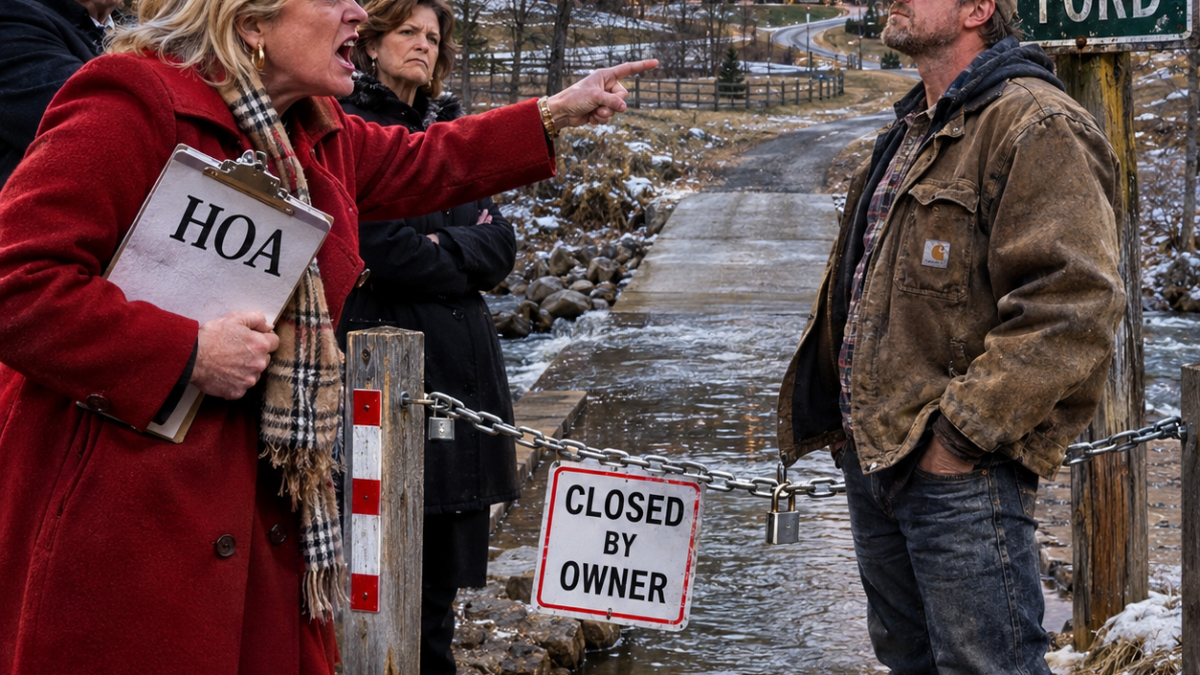
PART 2
I stared at Russell’s message until the screen dimmed in my hand.
Then I tapped it awake and read the line again.
**PREMIUM CREEK ACCESS — $18,500.**
I called him.
He answered almost immediately.
“Ms. Reed?”
“Marlow is fine. Where did you get this?”
“My closing packet.”
“When did you buy?”
“2016.”
“And you actually paid this?”
“It was rolled into the purchase price.”
“Were you told what it was for?”
There was a pause.
“Access.”
“To what?”
“The creek route. At least that’s what the sales agent said.”
I sat down at my kitchen table.
My mother’s 2011 letter was lying beside me.
“Russell, did anybody ever tell you that crossing was private?”
“No.”
“That Sterling Pines didn’t own it?”
“No.”
“That use was based on permission from my mother?”
Another pause.
“No.”
I heard papers moving on his end.
“I’ve lived here eight years,” he said. “I thought the HOA maintained it.”
“They don’t.”
“Then why do we pay for it?”
My fingers tightened around the phone.
“What do you mean?”
“There’s a crossing maintenance line in our annual budget.”
I went completely still.
“How much?”
“I’d have to pull the reports.”
“Would you?”
“Yes.”
Then he added, more quietly, “I used to get annoyed when I saw your truck parked by the ford.”
I almost laughed.
“Good to know.”
“I thought you were blocking our road.”
“That seems to be a popular belief.”
“I’m beginning to think somebody worked hard to create it.”
That was the first time I considered that Preston’s arrogance might be covering something bigger than a property dispute.
I didn’t sleep much.
At 7:12 the next morning, an email arrived from Sterling Pines.
**EMERGENCY ASSOCIATION MEETING — MANDATORY ACCESS REVIEW.**
I wasn’t a member, so nothing about it was mandatory for me.
Still, the message specifically summoned me to appear at five that afternoon.
I forwarded it to Hadley.
She called ten minutes later.
“Go.”
“I thought you told me not to acknowledge their authority.”
“You won’t. You attend as a guest.”
“What do I say?”
“Very little.”
“That’s disappointing.”
“Marlow.”
“I’m listening.”
“You state clearly that you own land outside the HOA. You do not call yourself a member. You do not agree that their rules bind you. You do not sign anything. And if they hand you a document, you bring it to me.”
“What if Preston starts performing for the room?”
“He will.”
“What if I want to perform back?”
“Don’t.”
I leaned against the kitchen counter.
“You take all the fun out of this.”
“My job is to keep your fun from becoming Exhibit A.”
Before the meeting, I drove to the county records office.
For three hours I worked through deeds, subdivision plats, recorded easements, road dedications, and survey references.
The final Sterling Pines plat showed every internal street.
It showed the northern public road.
It showed drainage easements.
Utility corridors.
Common areas.
But no residential access easement crossed Reed Crossing Ranch.
No blue line over my ford.
No dedication.
No permanent right-of-way.
Then I found a glossy promotional brochure filed with older development materials.
On that map, everything changed.
A bright blue route ran straight from Sterling Pines, across my mother’s ford, and toward town.
Next to it was a label:
**PREMIUM CREEK ACCESS — DIRECT ROUTE TO BRYER GLEN.**
I stared at the Wellington Development logo in the lower corner.
A clerk walked past and I stopped her.
“Can you tell me why this route is on the marketing map but not the recorded plat?”
She looked at both.
“This office can only tell you what was recorded.”
“So this wasn’t?”
“Not as an easement on that plat.”
“Who prepared the marketing map?”
She pointed to the logo.
“That would be a question for the developer.”
I photographed both documents side by side.
On the drive home, I tried to keep myself from jumping ahead.
Maybe somebody had made a mistake.
Maybe Wellington Development believed an easement existed.
Maybe another document was hidden in a different record set.
I refused to turn suspicion into fact just because Preston had made me angry.
That was something my mother drilled into me when I first started survey work.
A boundary line did not move because you hated the person standing on the other side.
Facts first.
Feelings later.
At 4:50, I entered the Sterling Pines clubhouse.
The place looked exactly like the kind of room designed to make people feel important.
Stone fireplace.
Leather chairs.
Dark beams.
Framed photographs of snowy mountains.
A twenty-foot wall of windows overlooking landscaped grounds.
I walked in wearing my brown work jacket because it was the warmest coat I owned.
Conversations stopped.
Then somebody whispered something.
A few people laughed.
Preston stood near a projector screen.
Behind him was a photograph of my Ford.
Mud along the wheel wells.
Scratches on the bed.
A dent in the rear bumper from a cattle gate five winters earlier.
Then the slide changed.
My work boots.
I actually looked down at them.
Mud.
Creek water.
Nothing worth photographing unless your goal was humiliation.
Preston smiled.
“Ms. Reed. Thank you for joining us.”
“Wouldn’t miss it.”
Hadley would have disliked that answer.
I sat in the back.
Forty minutes passed before Preston finally invited me forward.
During that time, I listened to people complain about the crossing.
It sprayed water onto luxury SUVs.
The stone surface was rough.
My signs looked “industrial.”
A woman near the front said prospective buyers expected a more “refined entrance experience.”
I wondered if Coldwater Creek had received the memo.
Then Preston pointed toward my truck on the screen.
“We cannot allow one unprofessional individual to dictate the quality of life for 120 families.”
There were murmurs of agreement.
He turned toward me.
“Ms. Reed, you have two minutes.”
I stood.
“Thank you.”
I placed my mother’s permission letter on the table.
Then the recorded plat.
“I have one question.”
Graham Blackwood leaned back in his chair.
“Go ahead.”
“What document gives this association ownership or a recorded residential easement over the crossing?”
Graham answered first.
“The community has acquired extensive rights through longstanding continuous use.”
“That wasn’t my question.”
“The law recognizes more than just recorded documents.”
“I know. I’m asking what recorded document you rely on.”
Preston sighed.
“Ms. Reed, don’t turn this into legal theater.”
“I didn’t issue a $4,800 fine.”
A few faces changed.
Preston tapped the table.
“You were fined for unauthorized use of HOA-controlled infrastructure.”
“How do I use my own property without authorization?”
“The route serves our residents.”
“Service doesn’t equal ownership.”
I slid my mother’s letter toward him.
“This is the permission Wellington Development received in 2011.”
Preston barely glanced at it.
He pushed it back with two fingers.
“Old paperwork does not outweigh the needs of an entire community.”
That sentence told me everything I needed to know about the conversation.
He didn’t care what the document said.
He had already decided that need created ownership.
Then he read the board’s resolution.
The $4,800 fine would stand.
I was ordered to resurface the ford using materials approved by the HOA.
I was required to provide Sterling Pines with a key to my gate.
And I was forbidden from closing the crossing for any reason without board authorization.
I looked at Graham.
“This is official?”
“Yes.”
“You’re voting on this?”
“The board already has.”
“I want that reflected in the minutes.”
Preston laughed.
“Oh, I’m sure your lawyer will enjoy reading them.”
“I want it reflected that I presented a written ownership document and asked you to review it.”
His smile faded.
“And?”
“And you refused.”
“I didn’t refuse anything.”
“You just pushed it back without reading it.”
The room went quiet.
Graham spoke carefully.
“The association disputes your interpretation.”
“Fine. Put that in the minutes too.”
Preston leaned toward his microphone.
“Your lawyer’s fees will cost more than that ranch if you keep this up.”
I closed my folder.
Maybe he expected anger.
Instead, I said, “Then I guess we’ll find out what the truth costs.”
I walked out.
The humiliation hit me only after the clubhouse door closed.
Not because they had mocked my truck.
I loved that truck.
It had belonged to my mother.
I had learned to drive stick in it.
The dent in the bumper came from the day we spent six hours trying to move a stubborn heifer before a blizzard.
What hurt was the laughter.
A room full of adults had watched a wealthy man ridicule someone who had spent years quietly maintaining the shortcut they used every day.
And most of them had never once asked who paid for it.
I reached my pickup.
My phone rang.
Hadley.
“I have the search results.”
I leaned against the door.
“Tell me.”
“No recorded residential easement across the crossing parcel.”
I closed my eyes.
“You’re sure?”
“I’m sure that I haven’t found one, and neither has the title search.”
“So I can close it.”
“Slow down.”
I groaned.
“Hadley.”
“Longstanding use can create legal arguments. We do this carefully.”
My dashboard lit up.
A second alert appeared.
Water sensor.
Coldwater Creek had risen seventeen inches since afternoon.
I opened the monitoring app.
The graph was climbing sharply.
“Marlow?”
“I’m here.”
“What happened?”
“The creek.”
“What about it?”
“Sensor’s above caution level.”
She became quiet.
“Same safety threshold your mother used?”
“Yes.”
“If it keeps climbing?”
“I close the ford.”
“When?”
I checked the forecast.
Upstream rainfall had been heavier than expected.
“Tonight.”
“Then forget Preston.”
“I’d love to.”
“I mean legally. This becomes a safety decision. Document everything.”
I drove fast but carefully.
By the time I reached the ranch, sleet was striking the windshield.
I changed into waterproof gear, grabbed my headlamp, and walked down to the creek.
Coldwater was brown and angry.
Branches spun through the current.
Water pushed hard over the stone bed.
I checked the electronic gauge.
Then the manual post.
Same reading.
I used a long probe to test the downstream edge.
At the third section, the pole dropped farther than it should have.
Undercut.
Maybe small.
Maybe worse.
I remembered a winter when I was nineteen.
My mother and I had checked the ford after three days of rain.
From above, the surface looked perfect.
Then Mom shoved a steel rod down between two stones and almost lost it into the hollow beneath.
Water had eaten away the base.
If a truck had crossed at the wrong angle, half the bed could have collapsed.
That night she closed the ford for two days.
Nobody complained.
Sterling Pines barely existed then.
Now I stood in the same creek and knew exactly what I had to do.
But I also knew how Preston would describe it.
Retaliation.
So I created a record.
6:58 p.m. — water reading photographed.
7:04 — manual gauge photographed.
7:12 — video of debris movement.
7:19 — call to county road department.
The county confirmed the ford was not a public road maintained by them.
7:31 — sheriff’s non-emergency line.
I reported that a private crossing might close for high water.
7:46 — fire district.
I confirmed the northern public road into Sterling Pines remained accessible.
8:03 — emergency dispatch.
Same confirmation.
No homes would be isolated.
The public route added roughly fourteen miles.
Inconvenient.
Not inaccessible.
At 8:18, I emailed Sterling Pines.
**NOTICE OF TEMPORARY SAFETY CLOSURE**
Due to rising water, debris movement, and possible erosion beneath the private Reed Crossing ford, vehicle use will be suspended beginning at 9:17 p.m. pending inspection.
The northern public road remains available.
I attached photographs.
Gauge readings.
Detour map.
Then I walked down with reflective signs.
I closed the gate on the ranch side.
Drove around the public route.
Closed the opposite gate.
Placed legal detour markers only on my own land.
At 9:16, I stood beside the ranch gate with the padlock in my hand.
For one second, I thought about Preston laughing.
I thought about his $4,800 fine.
His expensive watch.
His order that I surrender my key.
Then I pushed all of it out of my mind.
This was not revenge.
The creek was unsafe.
At exactly 9:17, the lock clicked shut.
My phone vibrated before I reached the porch.
One email.
Then three.
Then eleven.
YOU CAN’T DO THIS.
THIS IS OUR ROAD.
MY WIFE HAS WORK TOMORROW.
YOU’LL BE SUED.
YOU ARE HOLDING 120 FAMILIES HOSTAGE.
Then Preston.
Subject line:
**IMMEDIATE ORDER TO REOPEN COMMUNITY ACCESS**
I read the first sentence.
*You are hereby directed by Sterling Pines Estates HOA to immediately restore access—*
I stopped.
Forwarded my safety documentation.
No argument.
No insult.
Just facts.
At 10:05, headlights swept across my fence.
Two black SUVs.
I put on my coat.
Preston was already shouting when I reached the gate.
“MARLOW!”
“I’m right here.”
“Open this gate.”
“No.”
“You have ten seconds.”
“That’s dramatic.”
He came closer.
“You’ve taken 120 homes hostage.”
“Nobody is a hostage.”
“You shut their road.”
“I shut my crossing.”
“There is no difference.”
“There’s a fourteen-mile difference.”
Graham stepped out of the second SUV.
He had a phone in his hand.
“You were explicitly ordered not to interfere with association access.”
“By an association I don’t belong to.”
Preston pointed through the fence.
“Who authorized you to lock this?”
I raised my flashlight.
The beam landed on the wooden sign beside the creek.
**REED PROPERTY.**
“The person whose name is on the deed.”
His face reddened.
“You smug little—”
“Careful.”
“What?”
“My camera records audio.”
His mouth closed.
That was satisfying.
Then he pulled out his phone.
“I’m calling the sheriff.”
“Please do.”
He stared at me.
He had expected fear.
I think that bothered him more than resistance.
The deputy arrived twenty-three minutes later.
Young guy.
Nameplate said **S. MARTIN**.
Preston reached him first.
“This woman has unlawfully barricaded the only access to a residential community.”
Deputy Martin looked toward me.
“Only access?”
“No,” I said. “There’s a public northern road.”
Preston snapped, “It adds fourteen miles.”
The deputy looked back at him.
“So not the only access.”
“That isn’t the point.”
“It’s relevant.”
I showed Martin my deed map on the county portal.
The safety notice.
Photos.
Gauge readings.
Call records.
Then we walked toward the creek.
Water roared in the dark.
A branch struck the stone bed and rolled downstream.
Martin shined his flashlight.
“You letting anybody through this tonight?”
“No.”
“Emergency vehicles?”
“If dispatch determines this is necessary despite the condition, we coordinate. But the alternate public route is open.”
He nodded.
Then he went back to Preston.
“I’m not deciding your easement dispute out here.”
Preston crossed his arms.
“Then order her to open the gate.”
“I’m not doing that.”
“You don’t understand who my family—”
Martin held up one hand.
“I understand there’s a high-water condition on a crossing that appears to be private property. I’m documenting what I see. If you believe you have a legal access right, take that up through the appropriate process.”
Preston stared at him.
“What exactly are you saying?”
“I’m saying I’m not forcing this gate open tonight.”
The silence afterward was almost beautiful.
The SUVs left shortly after eleven.
I remained by the creek.
The water moved stones beneath the surface.
For years I had confused avoiding conflict with being kind.
My mother was generous.
She helped people.
She lent equipment.
She left gates open.
I had always believed honoring her meant doing the same.
But standing there in the sleet, I realized generosity without boundaries eventually becomes an expectation.
At 11:46, Russell called.
“Marlow?”
“What now?”
“I found the budgets.”
I could hear papers moving.
“How bad?”
“Last year?”
“Yes.”
“More than seventy-two thousand dollars.”
“For what?”
“Crossing-related maintenance categories.”
I stopped walking.
“What?”
“Creek crossing maintenance. Seasonal access improvement. Emergency ford protection. Road surface reserve.”
“Seventy-two thousand?”
“Last year.”
“What about previous years?”
“I’m still adding.”
I looked toward the creek.
“I paid for every repair last year.”
“I was afraid you’d say that.”
“Russell, don’t accuse anyone of stealing.”
“I’m an auditor. I don’t accuse before I have records.”
“Good.”
“But somebody owes us an explanation.”
The next morning, we met at a diner six miles outside Sterling Pines.
Russell arrived with three binders.
He was fifty-eight, tall, gray at the temples, and so precise that he lined up the salt shaker with the edge of his placemat before opening his documents.
“I spent thirty-two years auditing municipal contractors,” he said.
“That sounds fun.”
“It was not.”
“Good. I was worried.”
He almost smiled.
Then he showed me the numbers.
Five years of budgets.
Crossing maintenance appeared under slightly different names.
$41,600.
$56,200.
$63,900.
$68,400.
$72,350.
My appetite disappeared.
“Do you have invoices?”
“No.”
“Work orders?”
“No.”
“Contracts?”
“Not yet.”
I pulled out my own maintenance records.
Receipts from the quarry.
Equipment rental.
Fuel.
Reflective posts.
Concrete.
Bank reinforcement.
I had photographs of almost every major repair because survey work teaches you to document before and after.
Russell went page by page.
“You paid all this?”
“Yes.”
“Your mother before you?”
“Yes.”
“Did the association ever reimburse either of you?”
“No.”
He leaned back.
Our waitress came with coffee.
Neither of us touched it.
“I need to request the underlying books,” he said.
“As a member?”
“Yes. Our bylaws give homeowners inspection rights for certain financial records.”
“Do it properly.”
He nodded.
“I intend to.”
That afternoon Preston sent an email to all 120 homes.
Russell forwarded it to me.
The first line read:
**Ms. Marlow Reed is attempting to extort Sterling Pines by withholding critical community infrastructure.**
I laughed out loud.
Not because it was funny.
Because the alternative was throwing my laptop.
The email described me as greedy.
Vindictive.
Hostile to progress.
It claimed I had created a dangerous emergency by “unilaterally blocking longstanding access.”
There was no mention of rising water.
No mention of the alternate road.
No mention of the sheriff’s report.
No mention of the $4,800 fine.
The next day somebody pinned my photograph to the clubhouse bulletin board.
Underneath:
**THE WOMAN WHO SHUT DOWN STERLING PINES.**
A resident I didn’t know sent me a picture.
That night I sat at my kitchen table with the gate key in my palm.
I was tired.
Not physically.
Deep tired.
The kind that makes giving up feel reasonable.
I thought about reopening the crossing.
Just unlock it.
Let everybody drive through.
Let Preston declare victory.
Let the emails stop.
I actually stood.
Then I saw the inspection photographs on my counter.
One showed the downstream edge of the stone bed.
A dark hollow opened beneath two reinforced sections.
Water had eaten away several inches of base material.
I sat back down.
This wasn’t about Preston anymore.
If I opened the gate and somebody rolled a three-ton SUV across compromised stone because I wanted people to stop being mean to me, that would be cowardice disguised as peace.
I called Hadley.
“I’m having it inspected.”
“Good.”
“Independent engineer.”
“Better.”
“And after that?”
“After that we separate the issues.”
“Meaning?”
“Safety is one question. Legal access is another. Financial representations are a third.”
She paused.
“Do not mix them because Preston wants them mixed.”
“Why?”
“Because if everything becomes ‘Marlow is angry,’ he never has to answer specific questions.”
The engineer came two days later.
Her name was Jenna Morales.
She spent four hours measuring scour depth, probing the base, photographing the banks, and checking the approach.
When she finished, she wiped mud from her gloves.
“You were right to close it.”
“How bad?”
“Several areas are undermined. Not catastrophic yet, but I would not recommend vehicle traffic until reinforcement is completed.”
“Can you put that in writing?”
“I intend to.”
That report became my shield.
But while Jenna handled safety, Hadley kept digging into ownership.
A letter arrived from Graham Blackwood.
Heavy cream paper.
Expensive envelope.
He asserted that Sterling Pines possessed permanent access rights through “open, continuous, notorious, and longstanding use.”
I called Hadley.
“Can he do that?”
“He can make an argument.”
“My mother gave written permission.”
“That helps.”
“Helps?”
“Marlow, property law is not a magic-word contest.”
I hated when she was sensible.
She continued.
“Your mother’s permission strongly supports your position that use was permissive rather than hostile. The alternate public road matters. The recorded plat matters. But if they want a court to decide prescriptive rights, a court decides.”
“So we prepare.”
“Yes.”
That weekend I went through another box from my mother’s office.
Survey notes.
Old drainage studies.
Faded photographs.
Receipts.
At the bottom was a folded map dated 2013.
The ford was outlined in red.
Beside it:
**TEMPORARY PERMISSIVE CROSSING — EXCLUDED FROM RESIDENTIAL ACCESS DEDICATION.**
In the review block was a signature.
Owen Caldwell.
I knew the name.
Retired county land-record specialist.
I found his number through an old surveying colleague.
He answered after six rings.
“Caldwell.”
“Mr. Caldwell, my name is Marlow Reed.”
Silence.
Then:
“Elaine’s daughter?”
“Yes.”
“I’m sorry about your mother.”
“Thank you.”
“I liked her.”
“She liked you too.”
That was a lie.
Mom had called him “a pain in the rear with excellent handwriting.”
But affection took strange forms in surveying.
I told him about the map.
Read the notation.
For several seconds, I heard nothing.
Then Owen exhaled.
“I remember it.”
“Do you remember why it says that?”
“Yes.”
“Can I come see you?”
Another pause.
“Bring coffee.”
Owen lived in a cabin above the river.
His dog was so old it raised one eyebrow when I entered and decided that was sufficient security.
Owen kept work notes in labeled binders.
Of course he did.
Retired records people don’t trust memory.
He pulled one from 2013.
“Wellington Development wanted the ford shown as official access.”
“Why wasn’t it?”
“Because they didn’t have what they needed.”
“Which was?”
“A permanent agreement with your mother.”
He handed me a photocopy.
I recognized her handwriting.
*Wellington Development may not represent the Reed Crossing as dedicated residential infrastructure. Permission remains temporary and revocable. I will not grant a permanent right-of-way.*
My throat tightened.
“She knew.”
Owen nodded.
“She knew exactly what they wanted.”
“Did they keep trying?”
“Yes.”
He flipped through his notes.
“A later drawing came in showing the road connection in a way I wasn’t comfortable approving.”
“Why?”
“Because it visually implied continuous secured access beyond the subdivision boundary.”
“Did you reject it?”
“I declined to sign the review block.”
“Was it fraudulent?”
Owen raised one finger.
“I did not say that.”
“I know.”
“I’m serious.”
“So am I.”
“I can tell you what I saw. I can tell you what I signed. I can tell you what documents were missing.”
He closed the binder.
“I don’t tell people what conclusions to draw.”
That was why I trusted him.
Hadley and I spent the next week obtaining certified records.
Final plat.
Marketing brochure.
Buyer disclosure materials.
My mother’s refusal.
Owen’s technical notes.
We spread them across her conference table.
The difference was impossible to miss.
The official ownership record showed no permanent access.
The marketing materials sold the ford like an amenity.
“Now I understand the panic,” I said.
Hadley looked at me.
“Explain.”
“If homeowners paid premiums because Wellington promised this crossing, Preston can’t admit it wasn’t secured.”
“Maybe.”
“Maybe?”
“You don’t know what Preston personally approved.”
I frowned.
“The company has his name.”
“That doesn’t prove he personally knew what happened in 2013.”
I hated that too.
“Fine.”
“Let documents prove what documents prove.”
Preston did not slow down.
Sterling Pines mailed me an invoice for “community losses” caused by the closure.
Then another.
Lost property value.
Additional fuel expense.
Administrative costs.
Security monitoring.
I gave them all to Hadley.
One afternoon a white work truck stopped at my gate.
A man climbed out carrying bolt cutters and a replacement lock.
I walked down with my phone recording.
“Can I help you?”
“Sterling Pines contractor.”
“For what?”
“Restoring access.”
“No.”
He pointed toward the gate.
“I’ve been authorized to replace the lock.”
“Not by me.”
“HOA says this road is theirs.”
“This land isn’t.”
He stepped around the sign.
“You’re trespassing now.”
He stopped.
“I’m just doing my job.”
“And I’m asking you to leave.”
He took another step.
I kept recording.
“I’m asking a second time. Leave my property.”
He looked at the camera.
Then back at me.
Something in his face changed.
He returned to his truck.
No confrontation.
No screaming.
No weapons.
I sent the video and a written report to the sheriff’s office.
That night I sat at the kitchen table with Preston’s original fine.
I had looked at it so many times that I knew the wording by heart.
Then the signature caught my attention.
**Graham Blackwood.**
The capital G had a distinctive loop.
I searched the 2013 records.
There.
A Wellington Development legal acknowledgment accepting receipt of my mother’s refusal.
Signed:
**Graham Blackwood.**
Same loop.
Same hand.
I placed the two documents side by side.
In 2013, Graham acknowledged that Reed Crossing remained private and had not been dedicated as permanent residential access.
Years later, he signed a fine accusing me of unauthorized use of “HOA-controlled access.”
I took a photograph.
Then another.
I called Hadley at 7:06 the next morning.
“You’re awake?”
“I am now.”
“I found something.”
“That phrase terrifies me.”
I explained.
She told me to come in.
For five minutes, she studied the signatures.
Then she leaned back.
“This matters.”
“He knew.”
“It shows he received the notice.”
“He signed it.”
“Yes.”
“And later signed the fine.”
“Yes.”
“So he knew.”
“Marlow.”
I held up both hands.
“Fine. It strongly suggests he knew.”
“Good.”
“What happens now?”
“We demand records relating to the crossing.”
“And if they refuse?”
“We ask a judge.”
Russell was making progress too.
His document request produced partial financial reports.
Not enough.
But enough to make Sterling Pines residents uncomfortable.
The engineering report circulated.
One question spread through the neighborhood faster than any accusation I could have made.
**If we’ve paid crossing-maintenance fees for years, why is the crossing undermined—and why did Marlow Reed pay for the repairs?**
A group of homeowners petitioned for a special meeting.
They invited me.
I walked into the same clubhouse in the same faded jacket.
Nobody laughed.
Preston stood at the podium.
His tone had changed.
No mockery.
Now he sounded wounded.
“Ms. Reed is using ownership claims as financial leverage against innocent families.”
I waited until he finished.
Then I stood.
“I haven’t asked a single homeowner for money in exchange for opening an unsafe crossing.”
He frowned.
“You’ve imposed costs.”
“So has the fourteen-mile public road.”
“You know what I mean.”
“I do.”
I pointed toward the screen.
“I want you to explain one thing.”
Hadley had prepared verified copies.
First image.
County parcel map.
“This black boundary is Reed Crossing Ranch.”
Next.
Recorded subdivision plat.
“This is Sterling Pines.”
Next.
Marketing brochure.
A bright blue route ran through my ford.
“This is what Wellington Development advertised.”
Next.
My mother’s letter.
“This is what Wellington received before homes continued selling.”
The room went silent.
Preston stepped forward.
“Money builds communities, Ms. Reed.”
I nodded.
“Then you should’ve spent some of yours buying the right to cross my land.”
A few people murmured.
Graham stood.
“That statement is inflammatory and legally unsupported.”
I looked at him.
“Fair enough.”
He seemed surprised.
“Final liability belongs in a legal process.”
Hadley gave me a tiny nod from the side wall.
Then I said, “But I have one question for you personally.”
Graham’s face tightened.
“If Sterling Pines possesses the permanent right you claim, where is the document that created it?”
“We have legal theories—”
“Where is the document?”
“Longstanding use—”
“Where is it?”
Preston hit the gavel.
“That’s enough.”
Russell stood.
“No, it isn’t.”
Every head turned.
He carried a binder.
“I have a financial question.”
Preston sighed.
“Russell, this meeting is about access.”
“It’s about a crossing we’ve paid to maintain.”
The room changed.
Russell read figures.
Year by year.
Maintenance reserve.
Seasonal improvement.
Emergency ford protection.
More than seventy-two thousand dollars in the most recent year.
A woman in the third row raised her hand.
“Who was the contractor?”
Russell looked at Preston.
“That’s what I requested.”
Another man stood.
“Where are the invoices?”
Preston’s voice hardened.
“Those records are being gathered.”
Russell turned a page.
“Some payments were made to Blackwood Infrastructure Services.”
I looked at Graham.
He froze.
Russell continued carefully.
“I am not alleging fraud.”
Graham’s shoulders loosened slightly.
“But publicly available business records indicate ownership ties between that company and members of Mr. Blackwood’s family.”
The room erupted.
Graham stood so fast his chair struck the wall.
“That is a gross distortion.”
Russell held up one hand.
“I said it raises questions.”
“You are implying criminal behavior.”
“No. I’m asking whether the relationship was disclosed.”
“Sit down.”
Russell didn’t.
“Was it disclosed?”
Preston hammered the gavel.
“Meeting adjourned.”
Nobody moved.
“Meeting adjourned!”
A woman near the front shouted, “Show us the invoices!”
Another voice:
“Why were we paying for Marlow’s property?”
Another:
“Did you know there was no easement?”
Preston kept hitting the gavel.
I looked around.
Weeks earlier, the room had laughed at my boots.
Now nobody was looking at me.
Every eye was on him.
Preston shouted over the noise.
“This community is being destroyed by reckless accusations!”
I picked up my folder.
“A community isn’t destroyed by questions.”
He looked at me.
“It’s damaged when the people in charge refuse to answer them.”
I left.
Hadley called before I reached the highway.
“They filed.”
“What?”
“Emergency motion.”
“For?”
“Court order forcing you to reopen the crossing.”
I pulled onto the shoulder.
Snow drifted through my headlights.
“When?”
“Hearing next week.”
I stared at the steering wheel.
Until then, Preston had owned every room where we fought.
His clubhouse.
His board.
His audience.
His rules.
Now we were going somewhere else.
Hadley seemed to know what I was thinking.
“Remember something.”
“What?”
“This hearing won’t decide everything.”
“I know.”
“No. Really hear me. It’s not a trial on the finances. It’s not a final ruling on every possible access theory. The question is whether they can force immediate reopening.”
“Understood.”
“We win by being precise.”
I looked toward the snowy road.
“Precise sounds good.”
For the next five days, we built binders.
Deed.
Plat.
2011 permission letter.
Mother’s refusal.
Water records.
Engineering report.
Sheriff call log.
Emergency-service confirmations.
Meeting minutes.
Fine.
Marketing materials.
Photographs.
Owen’s notes.
Graham’s old acknowledgment.
I slept badly.
Not because I thought Preston was right.
Because courts are not magic truth machines.
People lose cases they believe they should win.
Documents can be interpreted differently.
Rules matter.
Evidence gets excluded.
Arguments have limits.
The morning of the hearing, I sat in my truck outside the courthouse for almost ten minutes.
My mother used to say fear was useful if you made it work.
So I let myself be afraid.
Then I went inside.
Preston sat in the front row wearing a charcoal suit.
Graham beside him.
When Preston saw me, he turned.
“Do you know who I am?”
The question was so absurd that I answered before Hadley could stop me.
“Yes.”
I took off my coat.
“But I’m still waiting for you to prove who owns the road.”
Hadley touched my elbow.
“Save it.”
“I’m done.”
“You’d better be.”
The association’s attorney argued first.
He did a good job.
That mattered.
He talked about reliance.
Twenty years of daily use.
Families who bought homes expecting access.
Hardship.
School schedules.
Fuel costs.
Emergency considerations.
He never once mocked my truck.
He didn’t need to.
He made 120 families sound like victims of one unreasonable landowner.
I understood why people paid lawyers.
Then Hadley stood.
She did not call Preston a liar.
She did not accuse anyone of theft.
She laid out facts.
Alternate public access existed.
The ford lay on private land.
No recorded residential easement had been produced.
The original landowner granted written permission with explicit limits.
The current closure followed measurable high-water conditions.
An independent engineer confirmed erosion and recommended no traffic until repairs.
Emergency services had been notified.
Nobody was trapped.
Then the judge asked Sterling Pines’s attorney:
“What document created the right-of-way you are asking me to enforce today?”
I watched Preston whisper to Graham.
Their lawyer cited long-standing use and possible prescriptive rights.
The judge listened.
She asked questions.
Hadley answered.
Their attorney answered.
Nobody shouted.
Nobody laughed.
Finally the judge folded her hands.
She made it clear that the court was not making a final determination of every property-right issue.
Long-term use might require further litigation.
The parties could pursue declaratory relief.
But on the emergency request before her, Sterling Pines had not shown sufficient grounds to compel a private landowner to reopen a crossing that an independent engineer considered unsafe while an alternate public route remained available.
Motion denied.
That was it.
No dramatic gavel.
No cheering.
Just words.
But Preston’s face changed.
For the first time, somebody with authority had looked at his certainty and asked him for evidence.
Outside, a local reporter waited.
“Ms. Reed, are you punishing Sterling Pines because they’re wealthy?”
I stopped on the courthouse steps.
Cold air filled my lungs.
“No.”
“Then why keep the crossing closed?”
“Because an engineer says it needs repair, and because legal access has to be determined lawfully.”
“Would you reopen it if they paid you?”
“This isn’t a ransom.”
“What is it?”
I thought about my mother.
“It’s private land someone else made promises about.”
Preston walked behind me.
“This is bigger than you,” he muttered.
I didn’t turn.
“That’s what you thought when you wrote the fine.”
Hadley groaned quietly.
“Was that necessary?”
“No.”
“Accurate?”
“Yes.”
She almost smiled.
The legal process continued.
But the social battle changed overnight.
Residents stopped sending me threats.
Not all of them.
Enough.
Some apologized.
Others asked for copies of the maps.
Russell’s group pushed for a financial audit.
Preston resisted at first.
Then too many homeowners signed the request.
The board hired an independent accounting firm.
I stayed out of it.
I wasn’t a Sterling Pines member.
I had no vote.
No right to turn their internal fight into my revenge campaign.
Whenever auditors requested my maintenance records through Hadley, I supplied them.
Receipts.
Bank statements.
Photographs.
Nothing else.
Meanwhile, Jenna supervised repairs to the ford.
The erosion was worse than it looked.
Two areas of the reinforced bed had lost significant support.
We removed loose stone.
Rebuilt the base.
Installed heavier material.
Armored the downstream edge.
Improved drainage on the approach.
I paid for it.
Again.
One afternoon Russell stood beside the fence watching an excavator place rock.
“You know,” he said, “our budget claims we paid for this kind of work last spring.”
“I did it last spring too.”
He looked sick.
“Do you have receipts?”
“In my truck.”
He laughed without humor.
“Of course you do.”
“Survey technician.”
“You people are terrifying.”
“Only to people who hate paper.”
A week later, the first audit summary reached the Sterling Pines board.
Russell called me.
“You sitting down?”
“I am now.”
“The auditors found problems.”
“What kind?”
“Incomplete documentation. Payments without matching completion records. Some expenses described in ways that suggested work was performed on the crossing.”
“Was it?”
“They haven’t established that.”
“Then don’t say it wasn’t.”
He sighed.
“You and Hadley spend too much time together.”
“What about Blackwood’s company?”
“Transactions exist.”
“Fraud?”
“Not proven.”
“Conflict?”
“Questions about disclosure.”
“Good.”
Russell paused.
“You sound disappointed.”
“No.”
I looked out toward the creek.
“I want truth. Not a story that feels better than truth.”
That sentence sounded like my mother.
It startled me.
The homeowners called another special meeting.
I did not attend.
That one belonged to them.
Later, Russell told me what happened.
He sent minutes too, so I didn’t have to rely on gossip.
The audit committee presented its preliminary findings.
Several residents demanded Preston’s removal as president.
A formal vote followed the bylaws.
He lost.
Not narrowly.
By enough that there was no argument about what the neighborhood wanted.
Graham resigned as the HOA’s legal adviser while the financial transactions and disclosure issues were reviewed.
A complaint regarding the marketing representations and unresolved payments went to the proper state authorities.
Nobody was led away in handcuffs.
No dramatic arrest.
No judge declared Preston Wellington a criminal.
The evidence didn’t support that, and I had no interest in inventing it.
But what happened to him was, in some ways, harder.
He lost the thing he valued most.
Authority.
The neighbors who once laughed when he mocked me stopped treating his words as facts.
Russell told me Preston came to the mailbox one Saturday and waved at three residents.
Nobody waved back.
I surprised myself by feeling no pleasure.
Maybe I had spent my anger.
Maybe seeing a man diminished is less satisfying when you finally understand how small his power always was.
The access dispute entered formal settlement talks.
By then, Sterling Pines had stopped claiming the HOA could regulate my ranch.
But Preston still owned a seat at the table through Wellington Development’s interests.
He tried one final approach.
Hadley and I sat across from him in a borrowed conference room.
Graham was there too, now representing only development-related matters with another attorney present.
Preston looked tired.
Not poor.
Not broken.
Just tired.
“We’ll pay for access,” he said.
Hadley glanced at me.
“How much?” she asked.
Preston slid a proposal across the table.
It offered a substantial annual payment.
In exchange, I would grant Sterling Pines permanent unrestricted access to the ford and surrender operational control to the association.
I read three pages.
Then closed it.
“No.”
His jaw tightened.
“You didn’t even finish.”
“I finished the part that matters.”
“What do you want?”
“Recognition.”
His eyes narrowed.
“Money?”
“No.”
“Then what?”
I pushed my original $4,800 fine across the table.
He stared at it.
“I want this withdrawn.”
“That’s easy.”
“I want written acknowledgment that Sterling Pines had no authority to issue it against my ranch.”
His expression changed.
“Language can be negotiated.”
“No.”
Hadley remained silent.
I continued.
“I want the association to correct the notice telling residents I obstructed HOA property.”
“We can say the matter was disputed.”
“It wasn’t HOA property.”
Preston leaned back.
“You want an apology.”
“I want the record corrected.”
“Same thing.”
“No. An apology is emotional. A correction is factual.”
Graham looked down at the table.
I turned to him.
“And I want future crossing use based on a written agreement that respects ownership, safety closures, and maintenance obligations.”
Preston rubbed one hand across his mouth.
“You realize Sterling Pines has relied on that route for years.”
“My mother allowed it for years.”
“They built expectations around that.”
“Your company built expectations around that.”
Silence.
He looked toward the window.
My Ford sat in the parking lot between two polished sedans.
“All this,” he said.
His voice had lost its edge.
“All this started because of one stupid fine.”
I zipped my jacket.
“No.”
He looked at me.
“It started when you decided you could take something from somebody because she didn’t look rich enough to fight you.”
His face tightened.
“I never said that.”
“You didn’t have to.”
I stood.
“You said ‘people like you.’”
He remembered.
I could see it.
“You looked at my truck, my boots, my ranch, and decided none of it mattered because you had 120 homeowners and a company name.”
Nobody spoke.
I picked up the fine.
“You were wrong about one thing.”
“What?”
“I didn’t need more money than you.”
I put the paper into my folder.
“I just needed better records.”
The settlement took another two weeks.
Sterling Pines formally withdrew the $4,800 fine.
It issued a written correction stating that its governing documents did not authorize it to regulate Reed Crossing Ranch.
The association agreed that future use of the ford would depend on legal rights or a new written agreement with me.
No HOA employee or contractor could enter my property to alter gates, locks, signs, or infrastructure without permission.
Safety closures supported by documented conditions or professional inspection would be respected.
No marketing material could represent the ford as HOA-owned infrastructure.
I kept my gate key.
I kept my land.
I did not give Sterling Pines unrestricted access.
Some people expected me to reopen the crossing immediately after repairs.
I didn’t.
That decision was harder than shutting it.
The ford was safe again by then.
I stood beside it one cold afternoon, key in my hand.
For twelve years, residents had driven through because my mother had said yes.
Part of me felt that keeping it closed dishonored her generosity.
Then I went home to file the settlement.
I opened the old cardboard box where I stored her papers.
At the bottom was an envelope I had never noticed.
Yellowed.
My name across the front.
**For Marlow, when you finally have to say no.**
I sat down before opening it.
For several seconds, I simply held the envelope.
My mother had been gone four years.
Cancer.
Fast at the end.
She spent her last months worrying about whether I knew where the ranch insurance policies were, whether I would remember to drain the north irrigation line, whether the barn roof leaked over the tack room.
Practical until her final breath.
I slid my finger beneath the flap.
The letter was three pages.
Her handwriting wandered more than usual.
She wrote about the ford.
About Sterling Pines.
About helping neighbors.
She said she never regretted letting families cross.
Then I reached the sentence that stopped me.
**When people begin treating your kindness as their right, you have to remind them that help is a choice.**
I covered my mouth with one hand.
For weeks I had been fighting Preston.
Fighting Graham.
Fighting paperwork.
Fighting assumptions.
And suddenly I was nineteen again, standing knee-deep beside my mother while she repositioned rocks with a pry bar.
I could hear her voice.
*Don’t just look where the water is, Marlow. Look where it wants to go.*
That was how she saw people too.
Not suspiciously.
Clearly.
She understood that generosity worked only when both sides remembered it was generosity.
The next paragraph was even harder.
**If you ever close the crossing, don’t do it because you hate them. Do it because you know why the boundary matters. And if someday you choose to open it again, make sure the choice is yours.**
I cried then.
Not dramatically.
No sobbing.
Just tears falling onto the paper while the house stayed quiet around me.
All winter, I had been trying to defend my mother’s land.
In that letter, I realized she had already defended my right to decide what happened to it.
The next morning I drove down to Coldwater Creek.
The water was clear.
Low.
The repaired stone bed looked solid beneath the surface.
Across the creek, Sterling Pines roofs rose against the hillside.
I unlocked the gate.
Then stopped.
I did not swing it open.
Not yet.
Instead, I called Hadley.
“I know what I want.”
“Good.”
“I’ll consider limited use.”
“Under what terms?”
“Ownership stays explicit.”
“Yes.”
“Maintenance costs transparent.”
“Yes.”
“Safety control stays with the property owner and engineer.”
“Yes.”
“No HOA rules on my ranch.”
“Obviously.”
“No advertising it as an amenity they own.”
“Good.”
“And no perpetual free access unless the consideration actually reflects what they’re asking for.”
Hadley paused.
“Marlow.”
“What?”
“You understand you can also say no.”
“I know.”
That was the difference.
I knew.
The new Sterling Pines board did not pressure me.
That helped.
Russell wasn’t president.
He refused.
“Too much paperwork,” he said, which was the funniest thing I had ever heard him say.
A woman named Denise Harper took the position.
She was a pediatric nurse with no development-company ties and very little patience for speeches.
The first time we met, she arrived at my gate alone.
No SUVs.
No attorney.
No photographers.
She stood on the public side.
“Can I come in?”
That question nearly made me smile.
“Yes.”
We sat at my kitchen table.
She brought the HOA budget.
Every page.
“Our board has two problems,” she said.
“Only two?”
“Give us time.”
I laughed.
She pointed to a map.
“First, we need a reliable long-term route.”
“You have one.”
“The public road.”
“Yes.”
“It’s inconvenient.”
“So is property law.”
She smiled.
“I walked into that.”
“You did.”
“We’re pricing improvements.”
“Good.”
“Widening. Winter maintenance. Better drainage.”
“That would help everybody.”
“Second problem.”
“The ford.”
She nodded.
“Some residents still want access.”
“I’m willing to discuss limited use.”
“What does that mean?”
“Exactly what it sounds like.”
I gave her the framework.
Permission in writing.
No claim of ownership.
Cost sharing.
Safety rules.
No commercial development traffic without separate agreement.
Emergency provisions.
Clear termination language.
Denise listened.
Then said something Preston never had.
“That sounds fair.”
It took months to negotiate.
Some residents decided the public road was enough.
Others wanted the shortcut badly.
The final arrangement was narrower than the access Sterling Pines had once assumed it owned.
Residents could use the ford during designated safe conditions under a revocable recorded license that preserved ownership and spelled out responsibilities.
The association contributed to actual maintenance.
Invoices were published to members.
Safety closures could occur without board approval.
No one could fine me for my own truck.
That clause was unnecessary legally.
I asked Hadley to include it anyway.
She stared at me.
“You’re petty.”
“Very.”
She laughed and wrote a more professional version.
The new board also improved the northern public route.
They added winter plowing.
Drainage work.
Better signage.
Over time, Sterling Pines stopped depending on my creek crossing as though it were oxygen.
That was healthier for everyone.
The audit continued in the background.
Some payment questions were resolved with supporting documents.
Others required reimbursement or internal corrective action.
The service-company relationships triggered new conflict-of-interest rules.
Graham did not return as HOA counsel.
Preston never regained the presidency.
Wellington Development faced scrutiny over how the crossing had been described in old sales materials, and the company had to deal with buyers through attorneys and regulators.
I stayed out of whatever I didn’t personally know.
That mattered to me.
Rumors are easy.
Evidence is harder.
I had won by refusing to confuse the two.
Spring arrived.
Then summer.
Coldwater Creek dropped until I could walk across the ford in rubber boots without water reaching my knees.
For the first time, residents who crossed waved.
Not all.
Enough.
Some stopped to talk.
One afternoon an older woman pulled over near the ranch gate.
I recognized her from the first HOA meeting.
She had been the person complaining that creek water stained her SUV.
She got out holding an envelope.
“I owe you an apology.”
“You don’t have to.”
“I do.”
She handed me the envelope.
Inside was a handwritten note.
She told me her husband had died the previous year.
She had been angry at everything since.
The extra fourteen-mile drive during the closure felt like one more thing being taken from her.
So when Preston told residents I was doing it out of spite, she believed him because anger was easier than questions.
At the bottom she wrote:
*I laughed at your boots. I’m ashamed of that.*
I folded the letter.
“You lost your husband?”
She nodded.
“Forty-three years.”
“I’m sorry.”
She looked toward the creek.
“I used that crossing to get him to treatments.”
Something inside me softened.
“My mother had cancer too.”
She looked at me.
For several minutes we stood beside the same road that had made enemies out of strangers.
Then she said, “Your mother did us a kindness.”
“Yes.”
“We forgot.”
“Some people did.”
She nodded.
“I won’t again.”
That conversation stayed with me longer than the court hearing.
Maybe because revenge feels satisfying for a moment.
Understanding lasts longer.
Russell became a friend.
Not the kind who calls every day.
The kind who shows up with coffee and a binder when you need either.
One gray afternoon, he drove to the ranch.
We stood beside the fence watching Coldwater Creek run over the repaired stone.
“I used to think you were making life hard for us,” he said.
“I remember.”
“I was one of the people who honked at you once.”
“I remember that too.”
“You remember everything?”
“Only grievances.”
He smiled.
Then became serious.
“You know what I think now?”
“What?”
“We got comfortable letting somebody else pay for something we used.”
I looked toward Sterling Pines.
“And comfortable believing somebody else when he told us we had a right to it.”
“That too.”
“Preston didn’t invent every assumption.”
“No.”
“He just benefited from them.”
Russell nodded.
The wind moved through the cottonwoods.
After a minute he said, “You could’ve made us all pay.”
“I did make you pay.”
“For actual maintenance.”
“That’s what I mean.”
“No. You could’ve punished everyone.”
I rested my arms on the fence.
“My mother wouldn’t have liked that.”
“What would she have liked?”
“Clear paperwork.”
Russell laughed.
“I think I would’ve liked your mother.”
“You would’ve terrified each other.”
By autumn, Sterling Pines published financial reports online.
Board votes were summarized.
Contractor relationships were disclosed.
Residents had access to invoices.
Not because I demanded it.
Because once people learn how expensive assumptions can become, transparency starts looking attractive.
Preston still lived in the community.
I saw him occasionally.
At the grocery store.
Gas station.
County offices.
He never approached me.
I never approached him.
Then one afternoon in November, almost a year after he put the fine on my truck, I stopped at the feed store.
When I came out, he was standing beside my Ford.
For a second, the sight made me feel like I had stepped backward in time.
Same truck.
Same man.
Different season.
He looked at the hood.
“Still driving this thing?”
“Runs.”
He nodded.
The old arrogance was gone.
Or maybe just quieter.
“I heard the northern road improvements are finished.”
“They are.”
“Good.”
Silence.
I loaded a bag into the truck bed.
He said, “Sterling Pines isn’t the same.”
“Probably not.”
“They blame me for everything.”
I stopped.
“Do they?”
“Some.”
“Is everything your fault?”
He looked surprised.
“No.”
“Then don’t claim it.”
His jaw tightened.
“I thought you’d enjoy this.”
“Enjoy what?”
“Seeing me lose.”
I closed the tailgate.
“I enjoyed seeing the fine withdrawn.”
“That isn’t the same thing.”
“No.”
He looked toward the store.
“Wellington Development may have to settle with some buyers.”
“I heard.”
“You caused that.”
I shook my head.
“The documents caused it.”
“You found them.”
“They already existed.”
He studied me.
“You really believe there’s a difference?”
“Yes.”
For a moment he looked almost angry again.
Then it passed.
“I spent my whole life watching my father solve problems by being the biggest person in the room.”
I didn’t say anything.
“He bought land. Bought companies. Bought people out. If someone pushed back, he pushed harder.”
Preston looked at my truck.
“I thought that was how things worked.”
“Maybe it worked often enough.”
He gave a short laugh.
“Until you.”
“No.”
I shook my head.
“Until the paperwork.”
That made him laugh for real.
Only once.
Then he nodded.
“I was wrong about you.”
“You were wrong about the crossing.”
“That too.”
He started toward his car.
“Preston.”
He turned.
“You were wrong about something else.”
“What?”
“People like me.”
He looked at me for a long second.
Then nodded once.
No apology.
I didn’t need one.
December returned.
The first real snow came overnight.
I woke before dawn.
For a few moments, lying in bed, I thought I heard my mother moving downstairs.
That still happened sometimes.
A floorboard.
Pipes cooling.
Wind against the siding.
Your mind takes ordinary sounds and gives you back someone you miss.
I dressed.
Made coffee.
Then drove the F-250 down to the creek.
Snow covered the hood.
I left it there.
At the ford, water moved dark between white banks.
The crossing was open that morning.
Safe.
Low flow.
The gate rested against the fence.
A Sterling Pines SUV approached from the far side.
It slowed.
The driver waved.
I waved back.
No drama.
No confrontation.
Just a neighbor crossing private land under an agreement that told both of us exactly what that meant.
I walked toward the wooden sign.
**REED PROPERTY — PRIVATE CROSSING.**
It wasn’t fancy.
The paint had begun to fade.
One corner was cracked.
Preston would have hated it.
I rested my gloved hand on the post.
I remembered the morning he had slapped the fine onto my truck and told me my land didn’t matter because 120 homes needed what was on it.
At the time, I thought the fight was about a ford.
It wasn’t.
It was about what happens when generosity lasts so long that people forget somebody is choosing to give it.
It was about money charged for promises nobody had secured.
It was about people trusting a polished presentation more than a muddy woman standing beside a creek.
And underneath all of it was my mother.
Elaine Reed.
The woman who hauled stone herself because hiring a contractor cost too much.
The woman who let construction trucks cross because she didn’t want workers driving fourteen extra miles.
The woman who said yes because helping people mattered to her.
And the woman wise enough to put that yes in writing so one day her daughter could still say no.
I took her letter from my coat pocket.
Not the original.
I would never bring that near water.
A copy.
I unfolded it.
**When people begin treating your kindness as their right, you have to remind them that help is a choice.**
The words blurred for a moment.
I folded the page again.
Across the creek, Christmas lights glowed along Sterling Pines.
I no longer saw 120 enemies.
Most of them had been people who believed what they were told.
Some had behaved badly.
Some apologized.
Some didn’t.
That was life.
The new board had done something the old one never had.
They painted a small sign at the Sterling Pines approach.
No crest.
No claim.
No words about ownership.
Just:
**PRIVATE REED CROSSING — USE SUBJECT TO POSTED SAFETY CONDITIONS**
Denise sent me the wording before they installed it.
Imagine that.
Permission.
My phone vibrated.
Russell.
I answered.
“You awake?”
“I’m standing in snow.”
“So yes.”
“What do you want?”
“Coffee.”
“You know where the house is.”
“I’m bringing cinnamon rolls.”
“Then why are you asking?”
“Politeness.”
“You’re getting soft.”
Twenty minutes later his truck came down the public road.
He parked beside my Ford.
Got out holding two coffees and a paper bag.
He looked at the creek.
“Low water.”
“Yep.”
“Good crossing day.”
“You auditing the weather now?”
“Somebody has to.”
We stood beside the gate eating cinnamon rolls while snow collected on our shoulders.
A school bus appeared on the Sterling Pines side.
Under the new agreement, buses were permitted when conditions were posted safe.
The driver slowed before the water.
Crossed carefully.
Waved.
Children looked through the windows.
One little boy pressed his face to the glass and waved both hands.
I waved back.
Russell watched the bus disappear toward town.
“Think your mom would’ve reopened it?”
I took a drink of coffee.
“Yes.”
“No hesitation?”
“Oh, she would’ve made them sign six pages first.”
He laughed.
Then I looked at the repaired ford.
“She believed in neighbors.”
“So do you?”
I thought about Preston.
Graham.
The woman who apologized for laughing at my boots.
Denise asking permission before entering the ranch.
The homeowners who voted for new rules.
The people who still probably disliked me.
“Yes.”
I surprised myself with the answer.
“But neighbors need boundaries too.”
Russell nodded.
Snow fell harder.
I walked over to my old Ford.
The hood still had a faint scratch where Preston’s fine had slid across the paint that morning.
For months I considered polishing it out.
I never did.
I liked it there.
Not because I wanted to remember Preston.
Because I wanted to remember the woman I had been when he handed me that paper.
Angry.
Embarrassed.
Unsure whether I was allowed to defend something I already owned.
I wasn’t that woman anymore.
I climbed into the truck.
Russell stood by his door.
“Where you going?”
“Town.”
“Public road or crossing?”
I looked toward Coldwater Creek.
Then at the open gate.
“Crossing.”
He smiled.
I started the engine.
The old Ford rattled to life.
I drove slowly toward the water.
At the edge, I stopped.
Not because I needed permission.
Because my mother taught me to check the current.
The water was clear.
The stones were solid.
The gauge was low.
Safe.
I eased forward.
Coldwater climbed around the tires, then fell away behind me.
Halfway across, sunlight broke through the clouds and flashed across the moving water.
For just a second, I could see my mother beside me.
One elbow on the window.
Old denim jacket.
Hair pulled back.
Telling me not to rush.
I reached the far bank.
In the mirror, the little Reed Property sign stood against the snow.
Sterling Pines rose beyond it.
One hundred and twenty homes.
Not trapped.
Not defeated.
Just finally connected to my land in the way they always should have been.
With permission.
With responsibility.
With the truth written down.
The $4,800 fine had disappeared months earlier.
Preston’s authority disappeared with it.
But that was never the ending that mattered most.
The real ending was simpler.
My mother’s kindness survived.
So did her boundary.
And this time, everyone knew the difference.
[END OF STORY]








