PART 2: HOA Fined Me $17,450 Over a Bird Feeder—Then the Entire Street Showed Up to My Hearing
PART 2
The hearing notice arrived exactly thirty-one days before Karen planned to put a continuing lien on my home.
I remember the wording because I read it so many times I could practically recite it from memory.
**SPECIAL ENFORCEMENT HEARING**
**Homeowner: 112 Arbor Lane**
**Purpose: Presentation of evidence regarding continuing covenant violations, delinquent fines totaling $17,450, and consideration of permanent lien remedies.**
Permanent lien remedies.
That was Karen’s phrase.
Not the law firm’s.
Not the HOA management company’s.
Hers.
I knew because by that point I recognized her writing style immediately.
She liked language that sounded heavier than it was.
“Remedies.”
“Enforcement action.”
“Compliance obligation.”
“Architectural integrity.”
Everything had to sound like she was presiding over a federal tribunal instead of a suburban neighborhood where the most dangerous structure in dispute was a bird feeder.
I placed the notice in the binder.
By then, the binder had a name.
The Karen File.
It had started as a joke.
It stopped being funny after Mr. Henderson.
Howard Henderson had lived in Oakwood Preserve for thirty-two years.
Longer than Karen.
Longer than me.
Longer than half the current HOA board.
His wife, Mary, had died three years earlier from complications after a stroke.
I didn’t know Mary well.
I had only met her a few times before she passed.
But I knew the garden.
Everybody did.
Mary’s flowers had been the kind that made people slow down while walking past.
Coneflowers.
Irises.
Roses.
Lavender.
And scattered between them were those ridiculous ceramic gnomes.
Some carried lanterns.
One held a fishing pole.
Another had a wheelbarrow.
One was missing half a nose.
Mary had apparently bought that one at a yard sale twenty years ago and refused to repair it because, according to Howard, “he had character.”
After she died, Howard kept every one.
So when Karen decided those gnomes violated her newly rewritten “exterior decorative uniformity” rule, she wasn’t asking an old man to remove lawn ornaments.
She was asking him to box up pieces of his wife.
That mattered to me.
More than my bird feeder.
Howard had spent the first week after receiving the notice thinking he had no choice.
Karen knew his finances were tight.
Everybody did.
He lived on a pension and Social Security.
She threatened two hundred dollars immediately, then daily fines if he failed to comply.
“I was going to put them in the garage,” he told me.
We were standing beside the flower bed.
His hand rested on the chipped red hat of one gnome.
“I figured I could still see them sometimes.”
“That’s not the point.”
“I know.”
He looked ashamed.
That bothered me.
People should not feel ashamed because somebody else bullied them.
“How long have these been here?”
“Some of them fifteen years.”
“Any complaints before Karen?”
“Never.”
“Any written rule prohibiting them when they were installed?”
“Not that I know of.”
I took out my phone.
“Can I photograph the notice?”
He hesitated.
“Am I going to get in trouble?”
That question.
An eighty-year-old man asking whether letting me photograph an HOA fine would get him in trouble.
That was Oakwood under Karen.
Not a community.
A classroom waiting for the teacher to return.
“You’re already being threatened,” I said gently. “Documenting it doesn’t make anything worse.”
He nodded.
I photographed the notice.
Then the gnomes.
Then the date.
I told him to write down everything he remembered about any conversation with Karen.
Exact words if possible.
Time.
Place.
Witnesses.
“You military boys love paperwork,” he said.
“Paperwork keeps people honest.”
He smiled faintly.
“Then we may need a truckload.”
He wasn’t wrong.
The next case came from the Garcias.
Maria and Luis Garcia had moved into Oakwood three years earlier.
Young couple.
Both worked full-time.
Their daughter Sophia was five.
Sophia drew on everything.
Paper.
Cardboard.
Restaurant placemats.
Her own arms once, according to Maria.
And the sidewalk outside their house.
Not permanent paint.
Sidewalk chalk.
Rainbows.
Flowers.
Stick figures.
One afternoon I found Maria on her knees with a scrub brush and a bucket.
It was ninety degrees outside.
She was crying.
I almost kept walking because I didn’t know her well enough to interfere.
Then I saw the yellow notice beside the bucket.
“What happened?”
Maria looked up quickly and wiped her face.
“Nothing.”
I pointed.
“That looks like something.”
She laughed bitterly.
Then handed me the notice.
**DEFACEMENT OF COMMON-VIEW HARDSCAPE.**
$500.
I read it twice.
“Five hundred?”
“She says if Sophia does it again, it doubles.”
I looked at the sidewalk.
Most of the chalk had already been scrubbed away.
I could still see part of a yellow sun and one blue line from a rainbow.
“She called this defacement?”
“She said it lowers community appearance standards.”
“Did she tell you the sidewalk belongs to the HOA?”
“No. It’s ours.”
I looked at Maria.
“Then why are you washing it off?”
Her expression said the answer before she did.
“Because I can’t afford another five hundred dollars.”
I understood.
That was how Karen operated.
She didn’t need to win every legal argument.
She only needed to make resistance more expensive than surrender.
For people raising kids, paying mortgages, working overtime, caring for elderly parents, going to school, or simply trying to survive ordinary life, that was usually enough.
Fight a $500 fine?
Hire a lawyer?
Take a day off work for a hearing?
Risk a lien?
Most people paid.
Karen counted on it.
“I’m fighting her too,” I told Maria.
She stopped scrubbing.
“You?”
“Bird feeder.”
Her mouth opened.
“You’re the bird-feeder guy?”
I had apparently achieved neighborhood fame.
“Yes.”
“She’s really putting a lien on your house?”
“She’s trying.”
Maria stood.
“Luis told me you must have done something else.”
“No.”
“Just the feeder?”
“And apparently a dangerous garden hose.”
She laughed despite herself.
Then I showed her a photograph of the gnome notice.
Her smile disappeared.
“She did this to Mr. Henderson?”
“Yes.”
“Oh my God.”
“Do you have any of Karen’s previous letters?”
Maria nodded.
“Keep them.”
“For what?”
“Because I think we need to start comparing.”
That evening, Maria posted a deliberately vague message in a private neighborhood Facebook group Karen wasn’t part of.
**Has anyone else received unusually aggressive HOA violation notices recently? Looking for experiences before deciding whether to appeal something. Please message privately.**
By bedtime she had fourteen messages.
By the following afternoon, twenty-seven.
That was when I understood the scale.
A woman named Cheryl had been fined because her welcome mat said **HELLO SUNSHINE** instead of being a plain approved color.
A family on Birch Court received a warning because their twelve-year-old son left a basketball near the garage door overnight.
Not a hoop.
A basketball.
Another resident had wind chimes Karen called a “repetitive auditory nuisance.”
An elderly woman had been fined fifty dollars per day because her Christmas wreath remained on the door until January fifth while she was visiting her hospitalized sister.
A man named Kevin received a thousand-dollar invoice after his teenage son’s band practiced in the garage one Saturday afternoon.
Karen categorized it as unauthorized commercial entertainment activity.
They were fifteen.
They played badly.
Nobody paid them.
Another couple had been forced to replace outdoor light fixtures that had been installed before Karen even moved into Oakwood.
A single mother received a warning because her son parked a bicycle beside the porch instead of in the garage.
Every story sounded silly.
Together they stopped being silly.
They became a method.
Karen targeted people least likely to challenge her.
Older residents.
New residents.
Busy families.
People living paycheck to paycheck.
People who wanted peace.
People like me at the beginning.
We scheduled our first meeting in my garage.
Seven people came.
I pulled my pickup onto the street and arranged folding chairs between a lawn mower and a workbench.
Howard arrived carrying his violation notice in a manila folder.
Maria and Luis brought Sophia, who sat on the floor with crayons.
Three other families came separately so it wouldn’t look like a gathering if Karen happened to drive by.
That sounds ridiculous now.
At the time, nobody laughed.
We closed the garage door.
I put the Karen File on the workbench.
“First thing,” I said, “this is not about revenge.”
Luis crossed his arms.
“She deserves some.”
“Maybe.”
“Then—”
“But revenge makes people sloppy.”
That got his attention.
“I spent twelve years around explosives. The quickest way to hurt yourself is to become more interested in the blast than the procedure.”
Howard smiled.
“I’m going to pretend I understood that.”
“It means we use facts.”
I opened the binder.
“We document everything.”
Dates.
Letters.
Photographs.
Payments.
Appeal requests.
Board responses.
Selective enforcement.
Meeting notices.
No exaggeration.
No social-media attacks.
No threats.
No vandalism.
Nothing Karen could use to make us look irrational.
Maria said, “She’ll just ignore us.”
“At first.”
“And then?”
“We follow her rules better than she does.”
That became the strategy.
Every resident disputing a fine sent a certified letter.
Specific rule requested.
Evidence requested.
Formal hearing requested where applicable.
Meeting minutes requested.
Appeal rights invoked.
One person could be ignored.
Twenty certified letters were harder.
The flow of fine payments slowed.
Karen noticed.
The next monthly meeting became tense.
She stood at the front of the clubhouse and lectured residents about what she called “a troubling decline in civic responsibility.”
I sat three rows back.
Howard beside me.
Maria and Luis behind us.
Karen said:
“Certain homeowners seem to believe rules are optional when personally inconvenient.”
Howard whispered:
“She means us.”
“I know.”
Karen continued.
“This association will not be intimidated by coordinated harassment.”
Maria leaned forward.
“Coordinated harassment?”
I looked back.
“Do not take the bait.”
Karen loved bait.
Her greatest weapon was making people angry enough to behave badly.
Then she could point at the bad behavior and ignore the original issue.
So we stayed quiet.
We took notes.
That infuriated her.
The letters became harsher.
My fine crossed ten thousand dollars.
Then fifteen.
Then seventeen thousand four hundred fifty.
The lien notice followed.
Karen believed that would break me.
Instead, it gave me the exact legal problem I needed.
I called Arthur Vance.
I found his name through a veterans legal-assistance network.
Semi-retired.
HOA and property lawyer.
Seventy-one years old.
Office above an insurance agency.
Books everywhere.
He looked like the kind of man who had spent forty years enjoying arguments other people hated.
I carried the Karen File into his office.
He stared at it.
“That all for one bird feeder?”
“Not anymore.”
I spent nearly two hours explaining everything.
He rarely interrupted.
Once in a while he made a note.
When I finished, he removed his glasses.
“May I say something unprofessional?”
“Please.”
“This woman is magnificent.”
I stared.
He smiled.
“Not morally.”
“Good.”
“From a legal perspective.”
“How?”
“She appears to have documented virtually every procedural mistake for us.”
He pulled Karen’s fine ledger closer.
“Daily fines without individualized cure procedures.”
Next.
“Rule amendments with questionable notice.”
Next.
“Selective enforcement.”
Photos of Janice’s flamingo and Carol’s satellite dish.
Arthur chuckled.
“Oh, that flamingo may become my favorite witness.”
“It doesn’t talk.”
“It doesn’t need to.”
He read the hearing notice.
Then leaned back.
“She made one serious mistake.”
“The lien?”
“No.”
“What?”
“She gave you a hearing.”
“I thought she had to.”
“She did.”
“So?”
“She also gave you the right to present evidence and witnesses.”
I understood immediately.
“She thinks the hearing is about the feeder.”
“Correct.”
“But the debt comes from the fines.”
“Correct.”
“And if the fines were created improperly—”
“Then the legitimacy of the debt becomes the issue.”
I smiled.
Arthur pointed at me.
“Do not smile like that in the hearing.”
“Why?”
“You look guilty.”
“I haven’t done anything.”
“Exactly.”
His plan was simple.
Let Karen present everything.
Do not interrupt.
Do not argue.
When our turn came, concede the obvious.
Yes, feeder.
Yes, notices.
Yes, nonpayment.
Then challenge the enforceability of the underlying fines.
Selective enforcement.
Procedural defects.
Failure to follow state-required processes.
Arbitrary rule interpretation.
Retaliatory conduct.
And witnesses.
Lots of witnesses.
Our garage meeting grew.
Seven people became twelve.
Then twenty.
Then thirty-one.
One former board member joined.
His name was George Warner.
He had served under Karen for three months before resigning.
At first, he refused to speak publicly.
Then he saw Howard’s gnome notice.
George called me.
“I’m done protecting her.”
He came to my house carrying a flash drive.
It contained board emails.
Not stolen.
His own copies from when he served.
Karen pushing amendments without proper discussion.
Karen telling directors not to worry about meeting-notice requirements because “nobody reads them anyway.”
Karen describing one resident as “easy to pressure.”
Karen instructing the secretary to delay an appeal hearing because the homeowner would probably “give up first.”
Arthur read them.
His expression became very still.
“This is useful.”
“That’s lawyer excitement?”
“Yes.”
“What does normal excitement look like?”
“You cannot afford it.”
We laughed.
Then Arthur grew serious.
“Your objective is not to destroy Karen.”
“I know.”
“Your objective is to stop unlawful enforcement.”
“Yes.”
“To protect the residents.”
“Yes.”
“To remove the lien.”
“Yes.”
“Good.”
He looked at me.
“Because somewhere in the middle of this hearing, she is probably going to collapse emotionally.”
That surprised me.
“Why?”
“Because people who derive identity from unchecked authority often experience accountability as persecution.”
He closed the folder.
“If that happens, do not humiliate her.”
I remembered those words later.
The night before the hearing, I sat in the backyard alone.
The bird feeder still hung from the oak.
A finch landed.
Pecked twice.
Flew away.
Seventeen thousand four hundred fifty dollars.
For that.
I almost laughed.
My phone buzzed.
Maria.
**Everyone’s ready. Scared, but ready.**
I replied:
**Facts. Calm. Together.**
Then Howard texted.
**Mary would have enjoyed this. She loved a good argument.**
I smiled.
For the first time in months, I slept well.
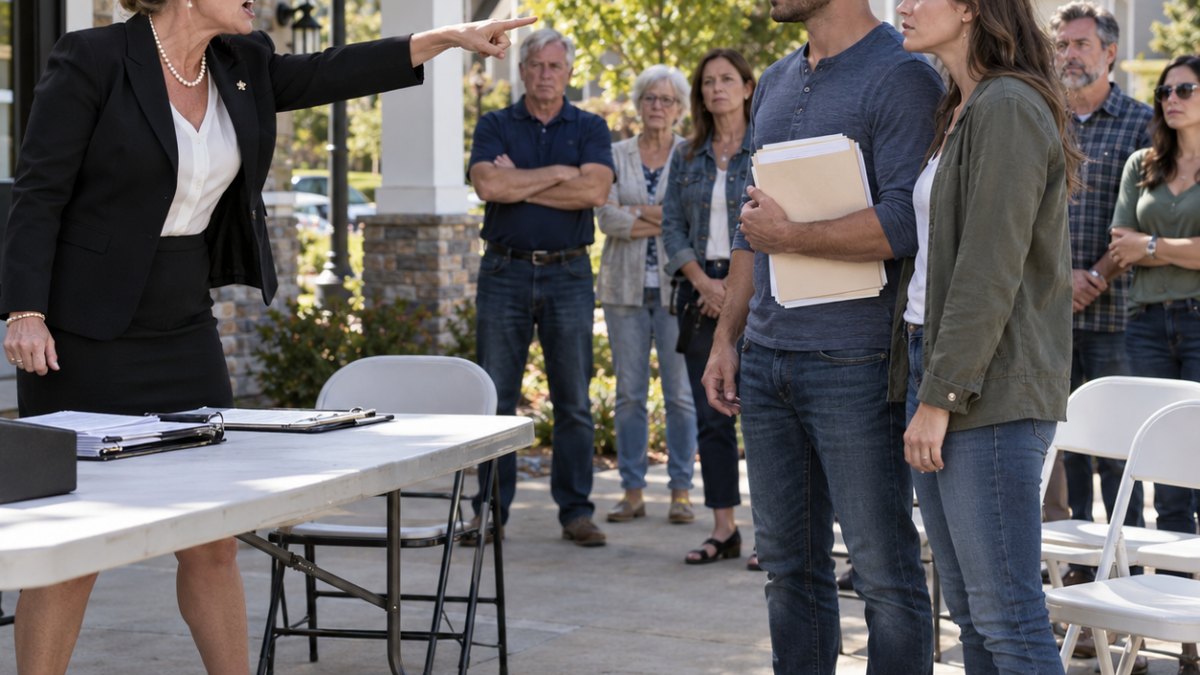
The clubhouse filled before the hearing started.
Karen had expected a crowd.
She just misunderstood why they were there.
Every chair was taken.
People stood along the walls.
More stood in the hallway.
I saw neighbors I had never spoken with.
Some had come because they supported us.
Some were curious.
A few probably supported Karen.
That was fine.
Truth should survive hostile audiences.
Karen sat in the middle of the board table wearing purple.
Janice sat to her right.
Carol to her left.
The pink flamingo and satellite dish women.
Both looked nervous.
Karen looked delighted.
The gavel came down.
“This special enforcement hearing of the Oakwood Preserve Homeowners Association is now called to order.”
Silence.
“The sole purpose of tonight’s hearing is to address the continuing and egregious violations committed by the homeowner at 112 Arbor Lane.”
Me.
She never said my name.
That was deliberate.
Turning a person into an address makes punishment easier.
She continued.
“Accumulated fines now total seventeen thousand four hundred fifty dollars.”
A murmur went through the room.
Karen seemed to enjoy it.
“The board will consider continuation of lien remedies.”
She looked at me.
“Mr. Cole, you will have an opportunity to respond after the board presents its evidence.”
My name is Daniel Cole.
I stood.
“Understood.”
Then sat.
Karen’s presentation lasted eighteen minutes.
She had a slideshow.
Photograph of the feeder.
Photograph of the hose.
Copies of notices.
Spreadsheet of fines.
Timeline.
She repeatedly used the phrase “willful defiance.”
According to Karen, I had become a threat to the orderly functioning of civilization.
At one point she said:
“If one homeowner is allowed to simply decide which rules apply to him, then what is the purpose of having standards at all?”
That was almost a fair question.
Almost.
The problem was that Karen had never applied the same standards to herself.
She finished.
“The board rests its case.”
She smiled.
Then Arthur stood.
Old suit.
Silver hair.
Leather briefcase.
No theatrics.
“Thank you, Madam President.”
Karen nodded as though granting him permission to exist.
Arthur began:
“We do not dispute that Mr. Cole placed a bird feeder in his yard.”
Karen’s smile widened.
“We do not dispute that the HOA sent violation notices.”
Janice visibly relaxed.
“We do not dispute that Mr. Cole declined to pay the resulting fines.”
Karen leaned back.
Victory.
Then Arthur said:
“What we dispute is whether those fines were lawfully and consistently imposed in the first place.”
Karen’s smile disappeared.
Arthur continued.
“A debt cannot become legitimate merely because someone prints it repeatedly on increasingly expensive paper.”
A few people laughed.
Karen banged the gavel.
“No disruptions.”
Arthur didn’t react.
“Our position is that this board has repeatedly failed to comply with mandatory procedures, has selectively enforced provisions against disfavored homeowners while ignoring identical or clearer violations by board members, and has used escalating fines as retaliation rather than reasonable compliance tools.”
Karen interrupted.
“This hearing is about his bird feeder.”
Arthur opened the bylaws.
“This hearing is about seventeen thousand four hundred fifty dollars allegedly owed because of your enforcement actions.”
He looked at her.
“That makes your enforcement conduct central.”
“No.”
“Yes.”
“This is my hearing.”
Arthur paused.
Then said:
“No, Madam President.”
The entire room seemed to tighten.
“This is the association’s hearing.”
Karen’s face darkened.
Arthur continued:
“Article Nine, Section Four grants the homeowner the right to present evidence and call witnesses relevant to the alleged debt.”
“There are no witnesses.”
“There are approximately thirty.”
Karen actually laughed.
Then Arthur said:
“Our first witness is Howard Henderson, 214 Blossom Court.”
The room went silent.
Howard stood.
He looked terrified.
I felt guilty immediately.
He was doing this because I asked.
Then he looked at me.
I nodded.
He walked forward.
Slowly.
Folder against his chest.
When he reached the front, Arthur asked his name.
“Howard Henderson.”
“How long have you lived in Oakwood Preserve?”
“Thirty-two years.”
“Did you receive a violation notice from this board?”
“Yes.”
“What for?”
Howard opened the folder.
He pulled out a photograph.
Mary’s garden.
Flowers.
Gnomes.
He turned toward the room.
“My wife collected these.”
His voice shook.
“She died three years ago.”
No one moved.
“I kept her garden the way she liked it.”
He placed Karen’s violation notice beside the photograph.
“Two months ago, I was fined two hundred dollars and told I had seven days to remove the gnomes or daily fines would begin.”
Arthur asked:
“Were those gnomes new?”
“No.”
“How long had they been displayed?”
“Some fifteen years.”
“Had the association fined you before?”
“No.”
Howard looked at Karen.
For the first time.
She stared back.
Then Howard said:
“It felt cruel.”
Not illegal.
Not tyrannical.
Cruel.
That word did more damage than any statute could have.
He returned to his seat.
People touched his shoulder as he passed.
Karen started to speak.
Arthur didn’t let her redirect.
“Our next witness is Maria Garcia.”
Maria walked up holding Sophia’s hand.
I had suggested Sophia stay home.
Maria disagreed.
“It happened to her.”
I didn’t argue.
At the front, Maria introduced herself.
“My daughter likes drawing with sidewalk chalk.”
Sophia held a piece of paper.
Maria displayed the violation notice.
“Five hundred dollars.”
Murmurs.
Karen said:
“The sidewalk markings were visible from the street.”
Maria turned.
“Yes.”
“It was chalk.”
“Appearance standards still apply.”
“She is five.”
“That doesn’t change the covenant.”
Maria inhaled.
Arthur stepped in.
“What did the board characterize the chalk as?”
Maria read.
“Defacement of common-view hardscape.”
Arthur asked:
“Was the sidewalk permanently altered?”
“No.”
“Did it wash away?”
“Yes.”
“What was Sophia drawing?”
Maria looked down.
Sophia held up her paper.
Rainbow.
Sun.
Stick-figure family.
No sophisticated legal argument could compete with that image.
People in the room began whispering.
Karen banged the gavel.
“This is emotionally manipulative.”
Maria looked at her.
“No.”
Her voice was steady.
“This is what you fined us for.”
Applause exploded.
Karen struck the gavel repeatedly.
“Order!”
Arthur raised one hand.
The room quieted faster for him than for her.
That had to hurt.
Then came Kevin.
Teenage band.
$1,000.
Then Ruth.
Christmas wreath.
$150.
Then the Parkers.
Cedar playset.
Then Cheryl.
Welcome mat.
Then a family with a flag displayed one day beyond an approved holiday window.
Then someone fined because a delivery box remained on the porch overnight.
Then another because their trash can lid did not fully close.
Every person brought paper.
Every person had dates.
Every person spoke calmly.
That was the key.
Karen wanted angry rebels.
She got accountants of their own pain.
Thirty stories.
Thirty addresses.
Thirty versions of the same pattern.
The room changed.
At the beginning, people had watched me.
By the middle, nobody cared about my bird feeder anymore.
They were watching each other.
Recognizing things.
Connecting dots.
This was no longer my hearing.
That was the title Karen had put on the notice.
But the entire street had taken it away from her.
Arthur waited until the witnesses finished.
Then:
“Now we address consistency.”
He connected a laptop to the projector.
First image.
Janice’s yard.
Pink flamingo.
Large.
Bright.
Impossible to miss.
People laughed.
Janice went white.
Second slide.
The architectural rule Karen had used against another resident’s decorative lawn object.
Third slide.
No violation history for Janice.
Arthur said:
“Mrs. Crest, has this flamingo received architectural approval?”
Janice looked at Karen.
Then down.
“I don’t know.”
Arthur:
“You own the property.”
“I don’t remember.”
Karen interrupted.
“This is harassment.”
Arthur changed slides.
Carol’s front-facing satellite dish.
Relevant rule.
Prohibited location.
No violation record.
Carol’s mouth opened.
Closed.
Arthur looked toward the room.
“Selective enforcement does not require complicated explanation.”
Next slide.
Two homes.
Same conduct.
Different consequences.
Board member.
No fine.
Ordinary resident.
Fine.
Again.
Again.
Again.
The pattern was visible.
Karen stood.
“This proves nothing!”
Arthur looked at her.
“It proves that you did not enforce your own standards uniformly.”
“We use discretion.”
“Precisely.”
“What is that supposed to mean?”
“It means discretion became favoritism.”
Karen’s face reddened.
“You come into my community—”
Arthur interrupted softly.
“Your community?”
Silence.
Something about the question broke through.
Karen looked around.
Then made the worst possible statement.
“Yes.”
Gasps.
She heard herself.
Tried to correct.
“I mean the community I was elected to protect.”
But the first version was the honest one.
My community.
Her identity had fused with authority so completely that she no longer distinguished stewardship from ownership.
Arthur closed his laptop.
“Our final exhibit concerns procedure.”
Meeting notices.
Amendments.
No posted minutes.
Missing cure periods.
Repeated daily fines without required steps.
Karen objected.
Arthur cited provisions.
Karen objected again.
Arthur handed copies to Janice and Carol.
They began reading.
Janice whispered something to Karen.
Karen snapped:
“Not now.”
Janice pulled away.
Another crack.
Arthur concluded:
“The question before you tonight is not whether a cedar bird feeder hung from Mr. Cole’s oak tree.”
He turned toward the residents.
“The question is whether seventeen thousand four hundred fifty dollars of debt created through inconsistent, procedurally defective, and retaliatory enforcement should be allowed to threaten a homeowner’s title.”
He paused.
“Our answer is no.”
People applauded.
Karen slammed the gavel.
“This board will deliberate.”
Arthur nodded.
“Of course.”
Karen leaned toward Janice.
Janice shook her head.
Carol said something.
Karen’s voice rose.
“You approved these!”
Carol replied:
“You told us it was legal.”
The microphone picked it up.
The room heard.
Karen froze.
Janice said:
“You never showed us those meeting requirements.”
“You voted!”
“Because you told us—”
Karen grabbed the microphone.
“Executive discussion.”
Arthur said:
“This is not an executive session.”
Karen exploded.
“You are not running this meeting!”
“No.”
Arthur’s voice remained level.
“You are.”
That was devastating because everyone could see how badly she was doing it.
Luis stood.
“Motion.”
Karen glared.
“You are not recognized.”
Luis continued.
“I move for a vote of no confidence in the current board and a special recall election.”
Karen shouted:
“That is out of order!”
A dozen people yelled:
“Second!”
“Second!”
“Second!”
Arthur opened the bylaws.
A member petition mechanism existed.
The room contained far more than the threshold.
Karen knew it.
She looked trapped.
Then she did something I will never forget.
She pointed toward us.
All of us.
“You people are ungrateful.”
Nobody spoke.
“I have spent hundreds of hours protecting this neighborhood.”
Her voice cracked.
“I’ve answered emails at midnight. I’ve dealt with contractors. I’ve inspected yards. I’ve kept standards from collapsing.”
Maria said:
“You fined my daughter’s chalk.”
Karen ignored her.
“You have no idea what this job requires!”
Howard spoke.
Quietly.
“Then maybe you shouldn’t have made it your whole life.”
Karen turned.
His words landed.
She looked suddenly older.
Not softer.
Just smaller.
She banged the gavel again.
“I will fine every homeowner participating in this unauthorized disruption.”
That was the end.
Any remaining sympathy disappeared.
Someone laughed.
Then another.
Not cruel laughter.
Disbelief.
The threat had lost its power because everyone heard it together.
That was the central difference.
Alone, a fine frightens you.
Together, absurdity becomes obvious.
Arthur looked at Karen.
“I recommend you refrain from further threats until counsel has reviewed your authority.”
“I don’t need your recommendation.”
“You may.”
Luis repeated his motion.
Arthur verified the bylaw process.
Residents stood.
Not one by one.
Almost all at once.
Everywhere I looked.
People rising.
Howard.
Maria.
Luis.
Cheryl.
Kevin.
Ruth.
Neighbors who hadn’t joined our garage meetings.
People who had stayed silent for months.
People I didn’t even know.
Nearly everyone.
Only Karen, Janice, Carol, and a handful of loyalists remained seated.
The silence was heavier than shouting.
Karen looked around.
This was the moment she finally understood.
Power had never been in the gavel.
It had been in everyone else believing the gavel mattered.
Her shoulders dropped.
The meeting continued under procedural supervision.
The recall process was formally initiated.
The lien action against me was suspended pending review.
Janice resigned the following morning.
Carol resigned that afternoon.
Karen released a statement insisting she would remain and “defend the integrity of Oakwood Preserve.”
She lasted four more days.
Then her attorney sent notice of resignation.
The recall election still proceeded to clean up the governance formally.
Karen was removed overwhelmingly.
Howard Henderson became interim president.
The same man who had asked me whether photographing his violation would get him in trouble.
His first meeting was packed.
He sat at the front looking miserable.
“I did not ask for this.”
Everyone laughed.
He held up a sheet of paper.
“First item.”
Silence.
“Review of all fines issued during the previous six months.”
Applause.
He frowned.
“Please don’t clap after every sentence. We’ll be here all night.”
More laughter.
The new board froze disputed fines.
Then reviewed them.
Bird feeder.
Dismissed.
Garden gnomes.
Dismissed.
Sidewalk chalk.
Dismissed.
Welcome mat.
Dismissed.
Wind chimes.
Dismissed after reasonable noise standards were established.
Christmas wreath.
Dismissed.
Teen band.
Dismissed.
Playset.
Dismissed.
Basketball.
Dismissed.
The $17,450 debt vanished.
Arthur made sure the lien proceeding was formally terminated.
Recorded documents confirmed no claim remained against my property.
The day that paperwork arrived, I sat at my kitchen island.
Same place the final notice had sat months earlier.
This document looked much less impressive.
Cheap paper.
Plain formatting.
But I liked it better.
**ACCOUNT BALANCE: $0.00**
I stared at that zero for a long time.
Then I went outside.
Filled the bird feeder.
Sat beneath the oak.
A chickadee arrived within minutes.
Seventeen thousand four hundred fifty dollars.
Zero.
The bird had no idea it had survived a legal crisis.
That seemed appropriate.
The new board spent months repairing the rules.
Arthur helped.
Public notices.
Meeting minutes.
Appeal procedures.
Fine caps.
Cure periods.
Clear definitions.
Selective-enforcement safeguards.
No daily fines without documented process.
No lien action without independent legal review and recorded board authorization.
No architectural decision by an improperly constituted committee.
Howard hated legalese.
“Arthur.”
“Yes?”
“Can normal humans understand this?”
“That is not traditionally considered necessary.”
“Rewrite it.”
Arthur smiled.
“Yes, Mr. President.”
Karen’s amendments disappeared one by one.
The neighborhood changed.
Slowly.
Fear leaves slower than rules.
For months people still looked over their shoulders before putting something in a yard.
Maria once called me because Sophia had drawn another rainbow.
“Is this stupid?”
“What?”
“I’m nervous.”
I understood immediately.
“You’re allowed.”
“I know.”
“But?”
“I keep expecting the yellow notice.”
That was Karen’s real legacy.
Not fines.
Anticipation.
Residents had learned to expect punishment.
It took time to unlearn.
Sophia helped.
One Saturday, children covered half the Garcia driveway in chalk.
Rainbows.
Planets.
Dogs.
Flowers.
One giant purple dinosaur.
Nobody complained.
Howard walked past.
Sophia froze.
Former HOA president approaching.
Then Howard crouched.
“Needs something.”
Sophia looked worried.
“What?”
He took a piece of yellow chalk.
Added a sun.
Maria sent me the photograph.
I printed it.
It went in the final section of the Karen File.
Rebuilding.
The gnomes stayed in Howard’s garden.
Actually, they multiplied.
Residents began giving him new ones as jokes.
By Christmas, he had twenty-three.
“Mary would hate half of these,” he told me.
“Then why keep them?”
“Spite.”
I laughed.
He smiled.
“Healthy spite.”
We held a backyard gathering at my house after the first clean annual meeting.
Nothing formal.
Garcias brought food.
Howard brought Mary’s potato salad recipe.
Kevin brought his son’s band.
I made one condition.
“They play quietly.”
Kevin laughed.
“No HOA fine?”
“Depends how bad they are.”
They were terrible.
Everybody applauded anyway.
Sophia drew birds in chalk near the patio.
Someone hung a tiny ceramic gnome from the oak branch beneath the bird feeder.
I never discovered who.
Arthur attended.
He sat holding lemonade and watching people.
“You happy?” I asked.
“I’m a lawyer.”
“Meaning?”
“We prefer dissatisfied clients. Better retention.”
I laughed.
Then he looked toward Howard.
“You know what you did correctly?”
“What?”
“You stopped being the main character.”
I frowned.
“That sounds insulting.”
“It’s praise.”
He pointed around.
“At first, Karen versus you.”
“Yes.”
“If it stayed that way, half the neighborhood would have treated it as a personality conflict.”
He nodded toward Maria.
“Then it became Karen versus her.”
Howard.
“Karen versus him.”
Kevin.
“The family with the wreath.”
“The welcome mat.”
“The playset.”
“Eventually the common factor was obvious.”
“Karen.”
“Correct.”
Arthur sipped his drink.
“You didn’t defeat her.”
“She defeated herself.”
“Yes.”
“But somebody had to make people compare notes.”
“That was your contribution.”
I thought about that.
The military had trained me to imagine resistance as something organized.
Mission.
Chain of command.
Objective.
But Oakwood wasn’t saved by one leader.
It was saved by neighbors discovering the person next door was scared of the same thing.
That changed how I thought about community.
Karen moved away three months later.
A FOR SALE sign appeared without warning.
Howard called me.
“You seen it?”
“Yes.”
“Any feelings?”
“Several.”
“Celebratory?”
“Not really.”
“That disappoints me.”
I laughed.
Her house sold quickly.
I saw moving trucks one Friday morning.
Karen stood in the driveway directing workers.
No clipboard.
At least not one I could see.
At one point she looked toward my cul-de-sac.
We were too far apart for me to know whether she saw me.
I didn’t wave.
Didn’t smile.
Didn’t salute.
Nothing.
She got into her SUV.
Drove away.
That was the last time I saw her.
Rumor said she moved into a condo complex without an HOA.
Nobody knew whether that was true.
It sounded poetic enough that people repeated it anyway.
I stopped caring.
That was another sign we had won.
Not when Karen left.
When Karen stopped being interesting.
The Facebook group returned to normal.
Lost dog.
Plumber recommendation.
Garage sale.
Strange noise near the woods.
Someone looking for a babysitter.
Nobody posted screenshots of violation notices anymore.
Meetings got boring.
I attended one where residents argued for thirty-five minutes about mulch.
I loved it.
Howard called the meeting to order.
Someone disagreed.
Nobody was fined.
A vote failed.
Nobody was threatened.
Another motion passed.
People went home.
Democracy is often incredibly dull when it is working.
That was beautiful.
I kept the Karen File.
Couldn’t bring myself to throw it out.
Six inches thick.
Eventually I added one final tab.
**LESSONS.**
Not rules.
Lessons.
First:
Paying an unfair demand for the sake of peace may purchase only a short cease-fire.
I learned that with my first trash-can fine.
Second:
Bullies depend on isolation.
Karen’s system worked because Howard thought his gnomes were only his problem.
Maria thought the chalk was only hers.
I thought the bird feeder was mine.
Third:
Documentation changes memory into evidence.
Letters matter.
Dates matter.
Photographs matter.
Minutes matter.
Certified mail matters.
Fourth:
Read the rules being used against you.
Most people never do.
Power loves unread documents.
Fifth:
Do not become what you are fighting.
That one was Arthur’s.
No threats.
No harassment.
No vandalism.
No humiliating Karen for sport.
Stay factual.
Stay calm.
Let conduct speak.
The final lesson was hardest.
Community is not the same as quiet.
When I moved to Oakwood, I believed peace meant nobody bothering me.
I wanted silence.
Distance.
Privacy.
After twelve years as a combat engineer, I thought that was enough.
Then Karen came along.
And the people I barely knew showed up to my hearing.
Howard.
Maria.
Luis.
Sophia.
Kevin.
Cheryl.
Ruth.
Thirty families from garage meetings.
Dozens more who had never spoken to me.
They filled every chair.
Stood against every wall.
And when the moment came, they stood together.
That changed me.
I had spent years wanting to be left alone.
I discovered there was something better than being left alone.
Being known well enough that when somebody comes for you unfairly, people notice.
A year after the hearing, Sophia turned seven.
The Garcias hosted a birthday party.
Sidewalk chalk covered nearly every piece of concrete in sight.
Howard arrived carrying a wrapped box.
Sophia opened it.
A ceramic garden gnome holding a piece of chalk.
Everybody laughed.
Maria cried.
Howard did too.
“I think Mary would approve,” he said.
The gnome went beside their porch.
No application.
No architectural review.
No fine.
Just neighbors.
A few months later, Howard stepped down as interim president.
He refused to run permanently.
“Too old.”
“You’re doing fine.”
“I’m eighty-one.”
“So?”
“I have gnomes to supervise.”
A woman named Priya Shah became president.
Accountant.
Calm.
Terrifyingly organized.
Her first act was creating a public digital archive for budgets, minutes, contracts, and rules.
Arthur called it revolutionary.
Priya called it Google Drive.
Transparency became boring.
That was the goal.
Years passed.
Oakwood matured.
Trees got larger.
Children grew.
Sophia eventually stopped drawing on sidewalks because teenagers apparently consider joy embarrassing.
Howard got slower.
I started helping with his garden.
Not because he asked.
Because eventually bending over became hard for him.
One afternoon we were pruning roses.
He looked toward the gnomes.
“You know what scared me most?”
“What?”
“The fine?”
He shook his head.
“Losing Mary again.”
I stopped.
“When Karen told me to remove those.”
He pointed.
“It felt like somebody saying her memories were clutter.”
I understood.
“My bird feeder came from my sister.”
He nodded.
“Small objects carry heavy things.”
That was exactly it.
HOA rules often described property as appearance.
Structures.
Colors.
Dimensions.
Materials.
But homes contain invisible weight.
The Christmas wreath your mother made.
The bench your husband built.
The tree planted when your daughter was born.
The gnomes your wife collected.
The chalk your child draws before she becomes too old to draw on sidewalks.
A bird feeder from your sister when you come home from war and don’t quite know what home means yet.
Karen never saw that.
She saw violations.
Howard saw Mary.
Maria saw Sophia.
I saw quiet.
No covenant can measure those things.
Good governance at least knows enough not to crush them casually.
Howard died seven years after the hearing.
Peacefully.
In his house.
His daughter called me.
The funeral was small.
At the reception, she approached.
“Dad left you something.”
She handed me a box.
Inside was the chipped gnome.
Half a nose.
The one Mary refused to repair.
There was a note.
**Daniel—
He has character. Don’t fix him.
Howard**
I cried.
No shame.
That little ceramic idiot sits beneath my oak tree now.
Right below the bird feeder.
Sophia, grown by then, visited one summer.
She was studying graphic design.
She saw the gnome.
“Is that one of Mr. Henderson’s?”
“Yes.”
“He gave it to you?”
“In his will.”
She laughed.
“That’s amazing.”
Then she looked up at the feeder.
“This is the famous one?”
“The criminal structure.”
She took a photograph.
Later she sent me a digital illustration.
The oak.
The feeder.
The gnome.
Birds.
At the bottom she had written:
**THE THINGS WORTH PROTECTING AREN’T ALWAYS BIG.**
I framed it.
That line became more meaningful as I grew older.
Karen had believed power came from escalation.
Bigger fines.
Bigger letters.
Bigger threats.
Lien.
Foreclosure.
Public hearing.
She was wrong.
The things that ultimately defeated her were small.
A photograph.
A certified letter.
A child’s chalk drawing.
A widower’s gnome.
A pink flamingo.
One neighbor speaking.
Then another.
Then another.
People often wait for some enormous piece of evidence before resisting something wrong.
Sometimes you don’t get one.
Sometimes you get thirty small truths.
Together they weigh more.
The bird feeder lasted fourteen years before the cedar finally split.
One winter morning I found the roof crooked.
The wood soft.
The chain rusted.
I took it down.
For a second I felt ridiculous emotion.
After everything, the thing itself was finally finished.
Not by Karen.
By rain.
Sun.
Time.
The natural authority no HOA can appeal.
I brought it into the garage.
Considered repairing it.
Then remembered Howard’s note.
He has character.
Don’t fix him.
So I didn’t.
I bought another cedar feeder.
Hung it from the same branch.
No approval request.
By then there was no rule pretending one was necessary.
I kept the old one on a shelf beside the Karen File.
Somebody once asked why.
“Evidence?”
“No.”
“Souvenir?”
“Maybe.”
“Symbol?”
I hated that word.
“Memory.”
That was enough.
Oakwood eventually established an annual neighborhood day.
No mandatory decorations.
No competition.
No formal theme.
People just came outside.
Cookouts.
Yard games.
Children drawing.
Howard’s daughter donated several gnomes for a community garden.
That would have killed Karen.
I never said that aloud.
One year, residents installed a small free library near the clubhouse.
During the planning meeting, somebody asked whether it required architectural approval.
Everyone stared at Priya.
She sighed.
“Yes.”
Laughter.
Then:
“But the committee meets next Tuesday, and we actually follow the process now.”
More laughter.
Approved unanimously.
That was progress.
Rules still existed.
That mattered.
I was never anti-HOA.
That surprises people.
Communities need mechanisms.
Roads.
Shared property.
Pools.
Drainage.
Insurance.
Maintenance.
Reasonable standards.
The problem was never the existence of rules.
The problem was Karen believing rules became righteous merely because she enforced them.
Authority needs restraint.
Procedure.
Consistency.
Appeal.
Humility.
Especially humility.
Karen had none.
Years later, I wondered what happened to her.
Not often.
One afternoon Arthur and I had lunch.
He was eighty-three.
Still practicing a little.
Still insulting everyone affectionately.
“Do you regret not suing her personally?” he asked.
“No.”
“You could have.”
“I know.”
“Could have recovered money.”
“Maybe.”
“You’re annoyingly well-adjusted.”
“Age.”
“No. Bad personality.”
I laughed.
Then asked:
“Did we go easy?”
Arthur considered.
“No.”
“She lost the board.”
“Yes.”
“Moved.”
“Yes.”
“But no lawsuit.”
Arthur leaned back.
“Punishment is not the only form of consequence.”
“What do you mean?”
“Karen wanted control.”
He pointed at me with his fork.
“She lost control.”
“Wanted respect.”
“Lost respect.”
“Wanted to define the community.”
“The community redefined itself against her model.”
He smiled.
“That is consequence.”
I thought about the clubhouse.
Everyone standing.
He was right.
The most painful defeat for Karen had not been financial.
It was discovering she had mistaken fear for respect.
They look similar from a throne.
They feel very different when the room stands up.
Arthur died two years later.
At his memorial, his daughter told me he kept a photograph from our hearing in his office.
I had never seen it.
She showed me.
Someone at the back had taken it.
Arthur stood near the board table.
Karen seated behind the gavel.
And in the background, almost every homeowner was standing.
Arthur had written on the back:
**This is what law is supposed to protect.**
I kept a copy.
It hangs in my office now.
Not because I am in the photograph.
You can barely see me.
That is why I like it.
The image is not one man defeating a bully.
It is a room deciding together that fear is over.
That is the story worth remembering.
I am older now.
Oakwood Preserve is quieter than it was during Karen’s reign.
But not silent.
Children laugh.
Dogs bark.
Wind chimes ring.
Basketballs bounce.
Sometimes teenagers play terrible music.
Chalk appears on sidewalks after school.
Christmas wreaths occasionally survive until January fifth.
And somewhere on Blossom Court, Howard’s daughter still keeps a few of Mary’s gnomes.
My original reason for moving here was silence.
I thought silence was peace.
I was wrong.
Silence can also be fear.
Karen’s Oakwood was very quiet.
People whispered.
Paid fines.
Closed doors.
Removed things they loved.
Nobody wanted attention.
That was not peace.
Peace is Sophia drawing without her mother crying.
Peace is Howard leaving his gnomes in the flowers.
Peace is disagreement at a board meeting without retaliation the following morning.
Peace is a resident asking for financial records and receiving them.
Peace is knowing your neighbor may not agree with you but will still stand beside you when someone treats you unfairly.
That is the peace I finally found.
Every morning, I still make coffee and stand at the kitchen window.
The new bird feeder hangs from the same oak.
Cardinals visit.
Finches.
Chickadees.
Occasional blue jay.
Still no rats.
Karen would be disappointed.
Howard’s chipped gnome sits below.
When birds scatter seed onto his hat, I clean it off.
Sometimes I catch myself talking to him.
The gnome, not Howard.
Maybe both.
On certain mornings, when sunlight comes through the trees exactly right, I remember that white letter on my kitchen island.
$17,450.
A number intended to make me feel alone.
That was Karen’s real mistake.
She assumed pressure would isolate me.
Instead, it forced me to look outward.
To Howard.
To Maria.
To Luis.
To Sophia.
To every person receiving yellow notices and believing nobody else would understand.
She fined families into silence.
Then she created a hearing where all that silence could finally speak at once.
That was the part she never planned for.
When I entered the clubhouse that night, she saw one homeowner.
One account.
One delinquent balance.
One target.
But behind me came a street.
Then another street.
Then almost an entire neighborhood.
Not because I was special.
Because every one of them had reached the same conclusion independently:
Enough.
There is tremendous power in that word when people say it together.
Karen learned that beneath fluorescent lights in a beige clubhouse.
I learned something too.
You can survive alone.
I had done that.
In places much harder than Oakwood Preserve.
But surviving together is different.
Better.
People notice when you’re tired.
Carry part of the file.
Save a chair.
Show up.
Stand when you need them to stand.
That was what happened at my hearing.
Karen tried to turn a bird feeder into proof that she owned my choices.
Instead, the feeder became the reason we started talking to one another.
And once neighbors talk honestly, little kingdoms built on fear become very fragile.
The first bird landed this morning at 6:43.
A cardinal.
Bright red.
He sat on the edge of the feeder, looked toward the window, and began eating as though nothing dramatic had ever happened there.
That made me smile.
Maybe that is the best ending.
The bird feeder became ordinary again.
The gnomes became ordinary.
Sidewalk chalk became ordinary.
Board meetings became ordinary.
Questions became ordinary.
Freedom inside your own home should feel ordinary.
It should not require heroism.
It should not require a six-inch binder.
It should not require thirty witnesses.
But when someone turns ordinary life into a battlefield, ordinary people sometimes have to remind them who the community actually belongs to.
Karen thought the answer was her.
The night of my hearing, an entire room stood up and gave her a different answer.
All of us.








