PART 2: HOA Fined Me $12,000 for Smoking Brisket—They Didn’t Know It Was Feeding the Fire Department’s Fundraiser
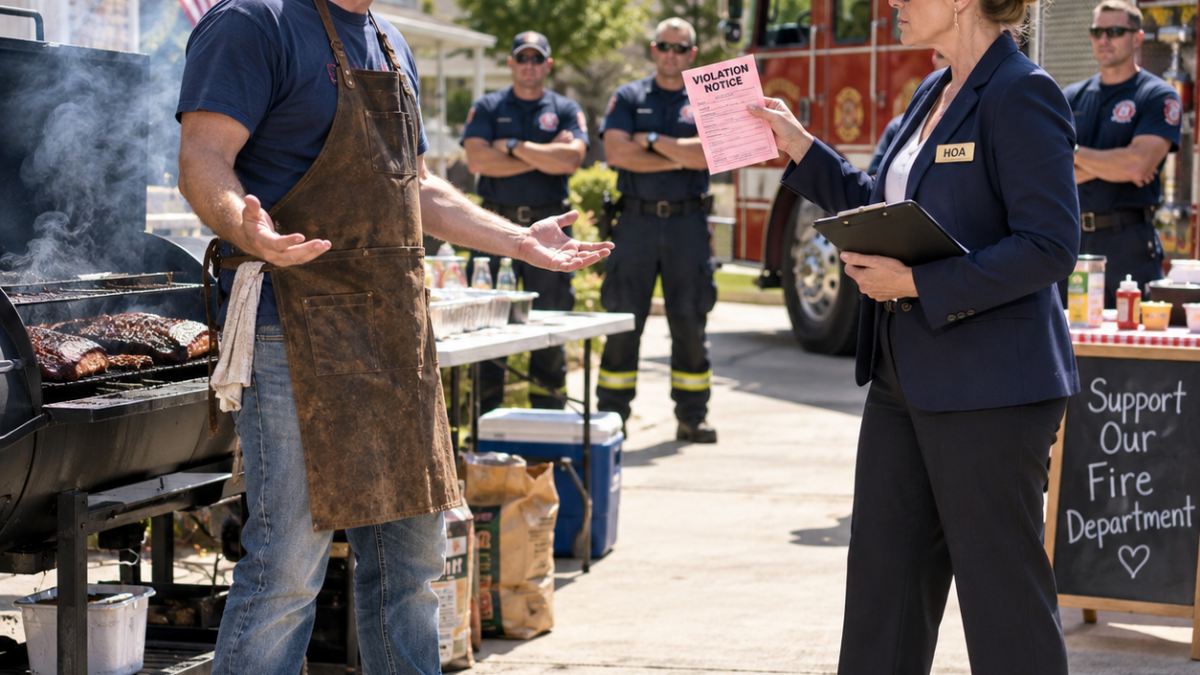
The woman from my HOA stood at the edge of my driveway and threatened to put a lien on my home because smoke was coming from a steel smoker I had fired before sunrise.
What she didn’t know was that the two hundred pounds of brisket inside weren’t for me—they were for the firefighters who had spent the year answering calls none of us wanted to imagine.
And before that brisket was served, one piece of paper on her clipboard was going to expose a fight that had been waiting years to happen.
“Five hundred dollars,” Karen Miller snapped, holding the violation notice out like a citation from a judge. “And another five hundred for every hour that thing stays out here.”
I looked past her at my smoker, a ten-foot offset rig my old Marine buddy had built for me when I retired. I called it the General. Hickory and applewood smoke curled from the stack while fat hissed softly over the heat.
It had been running for ten hours.
Inside were the briskets for the Blackwood County Fire Department’s annual fundraiser.
For three years, I had cooked for that event for free.
My name is Jack Thorne. I spent twenty years in the Marine Corps, and when I came home, I wanted something painfully ordinary. A garage. A yard to mow. Coffee with Sarah on the porch. Neighbors who waved.
Sarah and I had saved for years to buy our place in Oak Haven Estates. I knew there was an HOA. I read the covenants before we closed. Fence heights, mailbox colors, lawn maintenance—annoying but manageable.
What I hadn’t understood was that rules could become weapons when the wrong person controlled them.
Karen pointed at the General.
“Covenant 7B-4. Unapproved exterior appliance. Commercial equipment in a residential area.”
“This isn’t a business,” I said. “I’m donating the food. The fire department fundraiser is tomorrow. The smoker will be back in my garage after the cook.”
She gave me a thin smile.
“The fines are non-negotiable, Mr. Thorne. Pay within forty-eight hours or the association can begin lien proceedings.”
For a second, I heard only the fire inside the smoker.
I had spent years learning the difference between anger and action. Anger makes you loud. Action makes you careful.
So I wiped my hands on the rag tucked into my jeans and took the notice.
“Did the board vote on this?”
“I’m the president.”
“That wasn’t my question.”
Her smile disappeared.
She stepped closer. “The clock is ticking, Sergeant Thorne.”
That did something to me.
Not because she used my old rank like an insult.
Because suddenly this wasn’t about barbecue.
The fundraiser helped pay for equipment the county budget didn’t always cover. Chief Miller had once shown me a thermal imaging camera bought partly with fundraiser money. Firefighters had used it months later while searching a smoke-filled house.
That was why I cooked.
Not for praise.
Not for money.
Because serving had been part of my life for so long that retirement hadn’t switched it off.
And Karen was standing in my driveway threatening my home because she didn’t like how that service looked.
I kept my voice even.
“Karen, I’m asking you one more time. Withdraw the notice. Let the fundraiser happen.”
She tore the yellow copy from her clipboard and pressed it against my chest.
“We have standards here.”
Then she turned and walked away.
I watched her cross the street, climb into her spotless SUV, and drive toward the clubhouse.
Sarah came out a minute later.
“What happened?”
I handed her the notice.
She read the number twice.
Then she looked at me. “Can they really put a lien on the house over this?”
That question hit harder than Karen’s threat.
This house wasn’t an investment to us. It was the place Sarah and I had planned to grow old. Every mortgage payment represented deployments, overtime, missed holidays, and careful saving.
I took the notice back and read the covenant number again.
7B-4.
Temporary structures and unapproved exterior appliances.
Vague language.
Wide discretion.
Exactly the kind of rule a bully loves.
I went inside, pulled the three-ring HOA binder from a cabinet, and set it on the kitchen table.
Sarah knew that look.
“You’re not going to fight with her in the street, are you?”
“No.”
I opened the binder.
“I’m going to find out whether she followed her own rules.”
An hour later, I had a legal pad full of notes.
Two hours later, I found the section describing written appeals.
By noon, I had drafted mine.
And just before I sealed the envelope, I noticed something buried in the bylaws that made me stop, read the paragraph again, and reach for a second sheet of paper.
PART 2
The paragraph didn’t give me some magical loophole that made Karen’s fine disappear.
It gave me something better.
A process.
According to the bylaws, any homeowner accused of a violation had the right to written notice, a reasonable opportunity to cure the alleged violation, and a hearing before the board if the homeowner disputed the charge.
Karen had given me none of those things.
She had walked onto my property, announced a fine, threatened another five hundred dollars every hour, and acted as if the matter had already been decided.
I read the section three times.
Then I called Sarah into the kitchen.
“Read this.”
She leaned over my shoulder.
When she finished, she looked at me.
“She can’t just fine us?”
“Not the way she did.”
“That means we’re okay?”
I wanted to say yes.
But twenty years in the Marines had taught me not to confuse finding an opening with winning a fight.
“It means she made a mistake.”
Sarah folded her arms.
“And you’re going to make sure she knows it.”
“No.”
I put the covenant binder beside the violation notice.
“I’m going to make sure everyone knows it.”
That afternoon, I finished my appeal.
No insults.
No threats.
No references to dictators, petty tyrants, or the fact that Karen’s voice made my left eye twitch.
Just facts.
I explained that the General was temporarily outside my garage for the sole purpose of preparing food for the Blackwood County Fire Department’s annual fundraiser. I stated that I received no compensation. I attached the fundraiser announcement and a letter from Fire Chief Daniel Miller confirming that I had volunteered to cook the brisket.
Chief Miller was no relation to Karen, a fact he always mentioned with unusual enthusiasm.
His letter was short.
Jack Thorne had provided barbecue for the department fundraiser for three consecutive years. His contribution was donated. Proceeds from the fundraiser supported equipment and community fire-safety programs.
That was it.
Professional.
Clear.
I cited the hearing provision and requested that all fines be suspended pending review.
Then I sent the package by certified mail to the HOA’s official address.
The General stayed where it was.
I had meat to finish.
At four the next morning, I opened the smoker and checked the bark.
Perfect.
Dark mahogany crust. Rendered fat. The briskets bent over my gloved hand exactly the way I wanted.
Sarah came outside carrying two coffees.
“You sleep at all?”
“Twenty minutes.”
“That doesn’t count.”
“It does after fifty.”
She handed me a mug.
The neighborhood was silent except for the faint crackle from the firebox.
For a few minutes, we just stood there.
The smoke drifted above the rooftops.
No shouting.
No clipboards.
No HOA notices.
Sarah rested her head against my shoulder.
“I hate that she got inside my head.”
“What do you mean?”
“I spent half the night wondering if we could lose the house.”
I put my coffee down.
“Sarah.”
“I know. I know. You’re handling it. But that’s the point. One person shouldn’t be able to make somebody afraid of losing their home because she doesn’t like a smoker.”
She looked toward the street.
“How many other people has she done this to?”
That question stayed with me.
Until then, I had thought I was fighting my fine.
Sarah made me realize I might be looking at something much larger.
The fundraiser began at noon.
By eleven-thirty, the fire station parking lot was packed.
Families were lining up before we even started serving. Firefighters had pulled one engine onto the grass for the kids. Folding tables ran the length of the apparatus bay. There were silent-auction baskets, a raffle, homemade pies, donated tools, gift certificates, and enough potato salad to feed a battalion.
I carved brisket until my forearms cramped.
Chief Miller stood beside me calling out orders.
“Two lean! One fatty!”
A firefighter named Cody leaned over the serving table.
“Jack, I swear this brisket could settle international conflicts.”
“Then Congress owes me a catering contract.”
Sarah laughed from the register table.
By midafternoon, we had run out of brisket.
Two hundred pounds.
Gone.
Chief Miller climbed onto a folding chair holding the preliminary total.
“Thirty thousand, four hundred and eighty-two dollars!”
The room erupted.
I looked around at the firefighters.
Some were laughing.
One of the younger guys just stared at the number.
Thirty thousand dollars meant equipment.
Training.
Protective gear.
Things most people never thought about until they needed someone to come through their front door wearing an air tank.
Chief Miller raised his hand.
“I also want to recognize Jack Thorne. Third year running, he donated the meat, the wood, the equipment, and enough hours to make the rest of us feel lazy.”
People applauded.
I shook my head and waved him off.
Then I saw Karen.
She was standing near the dessert table.
Perfectly dressed.
Perfectly still.
Watching me.
Our eyes met.
She smiled.
Not warmly.
It was the smile of someone who knew something I didn’t.
I found out an hour later.
When Sarah and I got home, there was another notice taped to our front door.
FAILURE TO COMPLY.
The original fine had been doubled.
Behind it was my certified envelope.
Unopened.
Across the front, somebody had written REFUSED.
Sarah stood beside me.
“She didn’t even read it.”
“No.”
“Can she do that?”
“She just did.”
I looked at the handwriting.
I had seen it enough times on neighborhood notices.
Karen’s.
Sarah let out a slow breath.
“Jack.”
“Yeah?”
“Now I’m angry.”
That almost made me smile.
Sarah wasn’t an angry person.
She taught fourth grade for twenty-three years. I had seen her convince a room full of sugar-fueled nine-year-olds to sit quietly through a tornado drill using nothing but a raised eyebrow.
If Karen had managed to make Sarah angry, she was accomplishing something extraordinary.
I scanned every page that night.
The first violation.
The second violation.
The refused certified envelope.
Chief Miller’s letter.
The fundraiser documents.
Then I created a folder on my computer.
Sarah looked over my shoulder.
“You named it Operation Brisket Freedom?”
“It needed a name.”
“You are such a dork.”
“You married me voluntarily.”
“I was young.”
For the first time all day, we both laughed.
It mattered more than I expected.
Bullies like Karen make their victims feel isolated.
That is part of the method.
Everything becomes heavy when you think you’re carrying it alone.
A fine becomes a threat.
A threat becomes fear.
Fear becomes silence.
I wasn’t silent.
But I needed to know who else had been.
The next morning, I took a walk.
Not because I needed exercise.
I wanted to look at Oak Haven through Karen’s eyes.
Our neighborhood had two hundred and six homes arranged around three looping streets, a clubhouse, a pool, a playground, and a small park.
When Sarah and I first bought there, I had thought it looked almost unreal.
Trimmed hedges.
Fresh paint.
Identical black mailboxes.
No junk cars.
No broken fences.
Orderly.
Peaceful.
Now I started noticing something else.
Uniformity.
I pulled the covenant binder up on my phone and compared what I saw to the actual rules.
Section 4A allowed one modest seasonal lawn decoration.
Karen had nine ceramic gnomes in her front flower bed.
Section 9C required standard black mailboxes.
Hers was shaped like a largemouth bass.
Fence height was capped at six feet.
The privacy fence behind her house stood several inches higher.
I took photographs.
Not because I cared about gnomes.
I would have defended her right to build an entire gnome army if that made her happy.
But Karen had fined families over smaller things.
If she was enforcing the rules selectively, that mattered.
My first conversation was with Mrs. Gable.
She lived two streets over in a small ranch house with rose bushes that looked like they belonged in a botanical garden.
Her husband, George, had died four years earlier.
I knew that much from neighborhood conversation.
What I didn’t know was why there wasn’t a bird feeder anywhere in her yard.
I found her clipping dead blooms.
“Morning, Mrs. Gable.”
She looked up.
“Jack. I heard about your barbecue.”
“That rumor moves fast.”
“It smelled wonderful.”
“Thank you.”
I leaned against her fence.
“I’m having a disagreement with the HOA.”
Her expression changed instantly.
The warmth disappeared.
Her shoulders tightened.
“Best not to fight Mrs. Miller.”
There it was.
Not disagreement.
Fear.
“Why?”
“She can make things difficult.”
“I’m learning that.”
Mrs. Gable looked toward the street before speaking again.
I lowered my voice.
“I noticed something. You keep one of the nicest yards in Oak Haven, but you don’t have a bird feeder.”
She stopped cutting.
For several seconds, she said nothing.
Then she pointed toward a shepherd’s hook near her kitchen window.
Empty.
“George hung one there the week we moved in.”
Her voice softened.
“He loved cardinals. Said the red looked beautiful against snow.”
She smiled at the memory.
“After he died, I used to sit at the breakfast table every morning and watch them. Some mornings, that was the only reason I got out of bed.”
I didn’t interrupt.
“One day Karen came by and said bird feeders attracted pests. Called them ‘rodents of the sky.’ She said the nuisance clause applied.”
Mrs. Gable swallowed.
“Two hundred dollar fine.”
“For a bird feeder?”
“I tried to explain.”
“What happened?”
“She said if I didn’t remove it, the fine would increase.”
Mrs. Gable looked at the empty hook.
“I live on George’s pension and Social Security. I couldn’t afford a lawyer over birds.”
Something inside me shifted.
Until that moment, my fight with Karen had still carried an element of absurdity.
A giant smoker.
A furious HOA president.
A barbecue fundraiser.
It was almost funny.
Mrs. Gable’s empty shepherd’s hook wasn’t funny.
It was cruel.
I thanked her.
As I turned away, she called after me.
“Jack?”
“Yes, ma’am?”
“If you’re going to fight her…”
She looked down at her roses.
“…don’t do it halfway.”
I walked home thinking about that sentence.
The Henderson house was next.
Mark Henderson was in his garage changing the oil in a lawn mower.
His two boys were inside playing video games.
I had noticed before that there was a rectangle of discoloration near the edge of his driveway, like something heavy had sat there for years.
I introduced the subject carefully.
“The HOA ever give you trouble?”
He laughed once.
No humor in it.
“What did Karen get you for?”
“Smoker.”
His wrench stopped.
“The big one?”
“Yep.”
“The one you use for the fire department?”
“Yep.”
He stared at me.
“You’re kidding.”
I showed him the notice.
He read it.
Then looked toward his house.
“You know why my boys don’t have a basketball hoop anymore?”
I nodded toward the faded rectangle.
“That where it was?”
“She cited us every week.”
“For what?”
“Aesthetic impact.”
He shook his head.
“It was one of those portable hoops. We rolled it out when the boys played and moved it back. She said it was visible from the street and lowered property values.”
“What happened?”
“I got tired of fighting.”
He wiped his hands.
“Sold it.”
“What did you tell the kids?”
“That it broke.”
The shame in his voice surprised me.
He wasn’t ashamed of giving in.
He was ashamed he had lied to his sons because telling them the truth—that a woman with a clipboard had taken away something they loved—felt worse.
That afternoon, I talked to six more people.
A young couple had been ordered to remove vegetable beds from behind their privacy fence.
A retired teacher had received notices about discoloration on his driveway.
A family had been fined because a small swing set could be seen over the fence.
One man showed me eleven notices from a single year.
Most were technically connected to some clause.
That was what made Karen effective.
She rarely invented authority from nothing.
She found vague language and stretched it until it gave her whatever power she wanted.
Rules became elastic in one direction.
Toward everybody else.
Never toward her.
A week after the fundraiser, the letter from the HOA’s law firm arrived.
Sarah brought it inside.
“Certified.”
I signed for it.
The envelope was heavy.
That is never a good sign.
Inside was a formal notice of intent to pursue collection remedies against our property.
The balance listed was $12,350.
I read it twice.
Sarah read it once.
Then she sat down.
“Twelve thousand dollars.”
“They kept adding hourly penalties.”
“Even after the smoker was back inside?”
“Apparently.”
She looked around our kitchen.
For the first time, I saw genuine fear on her face.
That was the moment Karen made her biggest mistake.
She made my wife afraid in her own home.
I walked over and knelt beside Sarah.
“We are not losing this house.”
“How do you know?”
“Because from now on, we stop treating this like a neighborhood argument.”
I took the letter.
“We treat it like what it is.”
“And what is it?”
“A legal and financial problem.”
The first person I called was Dave Martinez.
Dave had been my platoon sergeant years earlier.
After leaving the Corps, he went back to school and became a forensic accountant.
He had the strange ability to look at spreadsheets the way I looked at maps.
Numbers told him where people had been.
What they had touched.
What they were hiding.
He answered on the third ring.
“Thorne.”
“Martinez.”
“You in jail?”
“Not yet.”
“Need bail?”
“Need accounting.”
“That’s more expensive.”
I told him the story.
By the time I reached the $12,350 balance, he had stopped joking.
“You have their budgets?”
“Some.”
“Meeting minutes?”
“Public ones.”
“Annual financials?”
“I can request them.”
“Send everything.”
“What are you looking for?”
“The same thing I always look for.”
“What’s that?”
“People who think nobody reads footnotes.”
While Dave started digging, I called an attorney.
Her name was Eva Rostova.
Eva and I had crossed paths during a joint task force years earlier when she was still a military lawyer.
She had since opened a civilian practice.
Property disputes.
Association governance.
Civil litigation.
Exactly the sort of law I suddenly needed.
She listened without interrupting.
When I finished, she said, “You kept the returned appeal?”
“Yes.”
“Envelope too?”
“Yes.”
“Photographs?”
“Yes.”
“Proof the smoker was moved back inside?”
“Garage camera.”
There was a pause.
“Jack?”
“Yeah?”
“Please tell me you didn’t threaten her.”
“I told her I wanted a hearing.”
“Beautiful.”
“That good?”
“That means I don’t have to spend the first hour explaining why my client called the HOA president a fascist on video.”
“I considered it.”
“I know you.”
The next day, Eva sat across from Sarah and me in her office.
She read the covenant.
Then the notices.
Then my certified appeal.
Then the attorney letter.
She tapped the refused envelope.
“This is useful.”
“How useful?”
“It shows you attempted to use the association’s own dispute process.”
“Can they still lien the house?”
“They can try to pursue whatever remedies state law and the governing documents actually permit. That doesn’t mean they automatically win, and it certainly doesn’t mean Karen can invent procedure.”
Sarah leaned forward.
“So we’re not helpless.”
Eva looked at her.
“No.”
That one word changed Sarah’s face.
Eva continued.
“But Jack, I want you to understand something. Litigation can become expensive even when you’re right. Karen may be counting on that.”
“What do we do?”
“We make this bigger than Jack versus Karen.”
I smiled slightly.
“I was hoping you’d say that.”
“Why?”
I slid a folder toward her.
Inside were photographs of Karen’s fence, mailbox, and lawn ornaments.
Then my notes from the neighbors.
Eva looked up.
“You’ve been busy.”
“I walk a lot.”
“Of course you do.”
She flipped through Mrs. Gable’s story.
Then the Hendersons’.
Then the vegetable garden.
Her expression hardened.
“If this is accurate, we may have a selective-enforcement pattern.”
“I think there’s more.”
My phone buzzed.
Dave.
His message contained one word.
Bingo.
I opened the email.
Then I stopped smiling.
Dave had reviewed three years of financial disclosures and vendor payments.
One landscaping contractor appeared over and over.
Prestige Lawn Care.
Invoices consistently higher than comparable work.
No competitive bid documentation that Dave could find.
The registered owner?
Harold Miller.
Karen’s brother-in-law.
Then there were consulting payments.
Repeated.
Vaguely described.
One company’s registration traced back to an address associated with Karen’s maiden name.
I slid the phone toward Eva.
She read silently.
Sarah came around the desk.
“What does that mean?”
Eva chose her words carefully.
“It means there are questions the board needs to answer.”
“Is it stealing?”
“Not based on this alone. We don’t jump ahead of evidence.”
That was one of the reasons I trusted her.
She didn’t need exaggeration.
Facts were enough.
“But,” she continued, “transactions involving relatives can raise serious conflict-of-interest and fiduciary-duty issues depending on how they were approved and disclosed.”
I looked at the numbers.
The smoker had been the spark.
The real fire had been burning for years.
Eva pulled my HOA binder toward her.
“How many homeowners?”
“Two hundred and six.”
“Find the section on special meetings.”
I already knew where it was.
Article 12.
Section 4.
A special meeting could be demanded by petition from twenty-five percent of the membership.
Removal of a director for cause required a vote under the procedures laid out in the bylaws.
Eva read the language.
Then she looked at me.
“Can you get fifty-two signatures?”
I thought about Mrs. Gable’s empty bird feeder.
Mark’s sons.
The vegetable garden.
“Yeah.”
“Good.”
She closed the binder.
“Then stop fighting for your smoker.”
“What am I fighting for?”
“Give them their HOA back.”
That became the plan.
Eva responded formally to the legal demand and disputed the entire balance.
She requested the records supporting the fines.
Board minutes.
Voting records.
Notice procedures.
The authority Karen claimed for the hourly penalties.
Any hearing documentation.
Any inspection records.
Meanwhile, Dave prepared a one-page summary of the financial questions.
He was very careful.
No accusations of theft.
No dramatic language.
Just numbers.
Vendor.
Amount.
Relationship.
Missing bid record.
Unexplained consulting payment.
Question.
Question.
Question.
That mattered.
We weren’t spreading rumors.
We were asking homeowners to demand answers about their own money.
Mark Henderson volunteered to go door-to-door with me.
Our first stop was Mrs. Gable.
She invited us into the living room.
George’s photograph sat on the mantel in a Navy uniform.
I showed her the petition.
She read every line.
Then she looked at Dave’s financial summary.
Her hands trembled slightly.
“Is this true?”
“These are figures from the HOA disclosures. We’re asking for an independent review.”
She looked toward George’s photograph.
Then toward the empty hook outside the window.
“Where do I sign?”
Her name became the first one on the petition.
The second belonged to Mark.
The third came from the young couple with the vegetable garden.
The fourth from the retired teacher.
Then five.
Eight.
Twelve.
Some people opened their doors and practically grabbed the pen.
Others barely opened the door.
“I don’t want trouble.”
“I understand.”
“What if Karen finds out?”
“She probably will.”
“I’m sorry.”
“No need.”
I meant it.
Fear doesn’t disappear because somebody tells you to be brave.
People needed to decide for themselves when they were ready.
By the third evening, twenty-nine homeowners had signed.
Then Karen found out.
Mark called me at seven the next morning.
“You’re gonna love this.”
“What?”
“Violation notice.”
“For what?”
“My grass.”
“What about it?”
“Quarter inch too high, allegedly.”
I closed my eyes.
“Take pictures before you mow.”
“Already did.”
Mrs. Gable received one that afternoon.
Unapproved mulch.
The young couple got a notice about garden edging.
A family that had signed our petition was cited for leaving a trash container visible twenty minutes after the permitted time.
Karen wasn’t hiding what she was doing.
She was demonstrating our case for us.
That evening, I walked back to Mrs. Gable’s house.
She opened the door holding her violation notice.
I expected her to be frightened.
Instead, she was furious.
“Unapproved mulch.”
“Yes, ma’am.”
“I have used the same mulch for eleven years.”
“Yes, ma’am.”
“She approved it herself in 2018.”
Mrs. Gable disappeared into the house.
She returned holding an old letter.
I read it.
Karen’s signature was at the bottom.
Approved.
Mrs. Gable straightened her shoulders.
“Make a copy.”
That was signature number thirty.
Word spread.
The retaliation had the opposite effect Karen intended.
People who had been reluctant started calling me.
“Is it true she fined Edith Gable?”
“Yes.”
“For mulch she already approved?”
“Yes.”
“Bring the petition.”
Within a week, we had eighty-four signatures.
More than forty percent of Oak Haven.
I hand-delivered the petition to the management office with Eva beside me.
Karen was there.
She looked at the stack of signatures.
Then at me.
“This is harassment.”
Eva answered.
“No. This is a procedure in your bylaws.”
Karen’s eyes narrowed.
“You are encouraging insubordination.”
I actually had to bite the inside of my cheek.
“Insubordination?” I asked.
“You know what I mean.”
“I’m not sure I do.”
“This community has rules.”
“So does the board.”
She looked at Eva.
“You people think you can come in here and destroy everything I’ve built?”
Eva’s voice stayed quiet.
“Nobody is asking you to destroy anything, Mrs. Miller. The homeowners are asking for a meeting.”
Karen grabbed the petition.
“You’ll get your meeting.”
We did.
Thursday.
7:30 p.m.
Community center.
The notice appeared two days later.
Then Karen made another mistake.
On the same bulletin board, she announced a mandatory “Community Standards and Beautification Summit” for the same evening.
The program promised presentations on exterior aesthetics, lawn maintenance, architectural consistency, and neighborhood values.
I stared at it for a while.
Mark walked up beside me.
“She’s serious?”
“Apparently.”
“She thinks people are going to sit through a lecture about lawn edges before voting on whether to remove her?”
“I think she wants to control the room.”
He looked at me.
“Can we smoke brisket?”
I turned toward him.
“What?”
“Before the meeting.”
That was the moment the idea took shape.
The fire department’s next fundraiser-planning barbecue had already been scheduled for that afternoon.
Nothing formal.
Just firefighters, volunteers, and residents getting together to plan the following year’s event.
So I called Chief Miller.
“What if we make it bigger?”
“How much bigger?”
“Whole neighborhood.”
Silence.
Then he started laughing.
“You’re weaponizing brisket.”
“I prefer community outreach.”
“You absolutely do not.”
With the chief’s blessing, we turned the planning barbecue into an Oak Haven community fundraiser event supporting the department.
No political speeches.
No anti-Karen signs.
No ugly slogans.
That was important.
I didn’t want a mob.
I wanted neighbors.
Eva submitted a formal request to use the HOA park.
The bylaws explicitly encouraged community events.
Karen approved it.
Barely.
Her approval came with three pages of conditions.
Noise levels.
Trash disposal.
Parking.
Food placement.
Equipment location.
Pre-event inspection.
Post-event inspection.
Mark read them and whistled.
“She forgot to regulate how many times we’re allowed to chew.”
“Don’t give her ideas.”
Eva also found the city’s temporary charitable-food event requirements.
I filled out the paperwork.
Paid the fee.
Got the permit.
Then I taped a copy inside my garage window.
Thursday morning, at 4:00 a.m., the General came out again.
Same driveway.
Same steel.
Same hickory.
Same applewood.
Different situation.
This time I was waiting for Karen.
She drove past at 6:12.
Slowed.
Stopped.
Her window came down.
I raised my coffee.
“Morning.”
She stared at the smoker.
Then at me.
I pointed toward the permit.
She saw it.
Her jaw tightened.
The SUV accelerated away.
Sarah came outside laughing.
“Was that childish?”
“Probably.”
“Did it feel good?”
“A little.”
At five that afternoon, the park was full.
Not crowded with protesters.
Families.
Kids.
Firefighters.
Retirees.
Teachers.
People I had lived beside for years without really knowing.
The Henderson boys were throwing a football.
Mrs. Gable had brought potato salad.
The young couple with the forbidden garden brought tomatoes, peppers, and cucumbers from the same backyard Karen had once told them was aesthetically unacceptable.
The irony tasted almost as good as the brisket.
A local band played classic rock at a reasonable volume.
The fire department parked an engine near the curb.
Kids took turns sitting behind the wheel.
Chief Miller stood at my serving table wearing an apron over his uniform.
It said KISS THE COOK.
He hated it.
Which was why I had bought it.
“You put a picture of me in this thing anywhere online,” he warned, “I will personally inspect your smoke detectors every week for the rest of your life.”
“Public safety first, Chief.”
At 6:30, Karen arrived.
I knew immediately we had reached the moment she wanted.
She didn’t come alone.
Two board members walked beside her.
Clipboard.
Folder.
Rigid posture.
People noticed.
The band kept playing for another thirty seconds before slowly fading out.
Karen marched straight toward me.
“Mr. Thorne.”
“Karen.”
“This event is out of compliance.”
“With what?”
“Noise.”
I gestured toward the sound meter we had rented.
“Within the limit.”
“Commercial activity on HOA common property.”
“Nothing is being sold.”
“You are distributing food.”
“For free.”
“Using a commercial appliance.”
“Permitted temporary charitable food equipment.”
I pointed toward the displayed permit.
Her eyes flashed.
“You think this is funny?”
“No.”
That was true.
A month earlier, it had felt ridiculous.
Now I knew about Mrs. Gable.
The Henderson boys.
The financial records.
Nothing about it was funny anymore.
“This is about a fire department,” I said. “It should never have become a fight.”
“You made it a fight.”
“No. You fined me five hundred dollars for helping them.”
Her voice rose.
“I am shutting this event down.”
The park went silent.
Chief Miller stepped out from behind the serving table.
He removed the ridiculous apron.
“Mrs. Miller.”
She turned.
“This event is being held with the department’s involvement and under the permits obtained for it. Nobody here is selling food. Nobody is interfering with emergency access. If you have a legitimate safety issue, tell me.”
“This is HOA property.”
“Yes, ma’am.”
“You have no authority over our community.”
“I didn’t say I did.”
He glanced around.
“I said if you have a safety problem, tell me what it is.”
Karen opened her mouth.
Closed it.
Eva walked over holding a paper plate with brisket on it.
Sarah later said that was her favorite part of the entire ordeal.
Our attorney confronting Karen while still carrying barbecue sauce on a plastic fork.
Eva spoke calmly.
“The association approved use of the park in writing.”
Karen glared at her.
“Under false pretenses.”
“The request says exactly what this event is.”
“This is political.”
“No campaign materials are being distributed here.”
“You’re collecting signatures.”
“The petition was submitted days ago.”
Karen’s two board allies shifted uncomfortably.
More neighbors were moving closer.
Nobody shouted.
Nobody insulted her.
That seemed to bother Karen more than anger would have.
She wanted a confrontation she could condemn.
Instead, she had a hundred witnesses watching her argue against a permitted community barbecue supporting firefighters.
Then a local news van pulled up.
I hadn’t called them.
Mark hadn’t either.
Later we learned one of the residents had tipped off a reporter after Karen started issuing retaliatory fines.
The station had seen the petition numbers and the fire department angle and decided there might be a story.
A reporter named Maria Flores stepped out with a cameraman.
Karen saw them.
Everything about her changed.
Shoulders.
Expression.
Voice.
For the first time since I met her, she looked uncertain.
Maria approached Chief Miller first.
“Chief, can we ask what’s happening?”
He looked at me.
I shrugged.
He answered.
“We’re participating in a neighborhood event supporting our annual fundraiser. There appears to be a disagreement between some residents and their homeowners association regarding the event.”
Maria turned toward Karen.
“Are you the HOA president?”
“Yes.”
“Can you explain the dispute?”
Karen looked directly into the camera.
“We are simply protecting the standards and property values of Oak Haven Estates. Rules exist for a reason.”
Maria nodded.
“What rule is being violated today?”
Karen hesitated.
“Several.”
“Such as?”
“Noise. Commercial activity. Unapproved equipment.”
Maria looked toward the smoker.
“Is that the smoker used for the fire department fundraiser?”
Nobody spoke for a second.
Karen’s face tightened.
“Yes.”
“Was the homeowner fined for using it?”
Karen’s eyes found me.
I could see the calculation happening.
Then Maria turned.
“Mr. Thorne?”
I stepped forward.
She raised the microphone.
“How much were you fined?”
“Originally five hundred dollars.”
“And now?”
“The association’s attorney sent a demand showing more than twelve thousand dollars.”
People behind the camera murmured.
Maria’s eyebrows rose.
“For operating this smoker?”
“For having it outside while I prepared food for the fire department fundraiser, yes.”
“Did you appeal?”
“I tried.”
“What happened?”
I held up a copy of the certified envelope.
“It was returned unopened.”
Maria looked at Karen.
Karen’s face went pale.
“That is not an accurate characterization.”
I handed Maria the envelope.
No speech.
No accusation.
Just paper.
The camera zoomed in on REFUSED.
Then Mrs. Gable stepped forward.
I hadn’t asked her to.
She stood barely five feet tall, wearing a pale blue blouse and holding a foil-covered bowl.
Maria lowered the microphone toward her.
“Ma’am?”
“My name is Edith Gable.”
Karen said sharply, “Edith, this is not the place.”
Mrs. Gable turned.
“I think it is.”
I will remember that moment for the rest of my life.
Not because Mrs. Gable yelled.
She didn’t.
She simply stopped being afraid.
“My husband served in the Navy,” she told Maria. “After he died, I kept a bird feeder outside my kitchen window because he loved cardinals. The association fined me until I removed it.”
Karen interrupted.
“That feeder violated—”
Mrs. Gable raised one hand.
“Please don’t talk over me.”
Karen actually stopped.
Mrs. Gable continued.
“I removed something that gave me comfort because I was afraid of losing money I could not afford to lose.”
She looked toward the neighbors.
“I should not have been afraid in my own home.”
Mark stepped beside her.
“My boys lost their basketball hoop for the same reason.”
Another woman called out.
“My garden.”
Someone else said, “Our swing set.”
Then another.
And another.
Maria turned toward the growing group.
“What is happening here?”
Mark held up the petition.
“Eighty-four homeowners demanded a special meeting tonight to consider removing Mrs. Miller from the board.”
The reporter stared at him.
“Eighty-four?”
“More than forty percent of the neighborhood.”
The camera swung toward Karen.
Maria asked the obvious question.
“How do you respond?”
Karen looked at the people around her.
At Chief Miller.
At Eva.
At Mrs. Gable.
At me.
The confidence was gone.
“This is a coordinated campaign of harassment.”
Nobody answered.
Sometimes silence is stronger than argument.
Karen turned and walked away.
Her board allies followed.
No triumphant music played.
Nobody chased her.
The band started again a minute later.
People went back to eating.
But something had changed.
For years, Karen had controlled Oak Haven because each homeowner thought his problem was his alone.
That afternoon, everyone finally saw the pattern.
At 7:20, we cleaned the park.
Every cup.
Every plate.
Every scrap.
I personally walked the grounds twice.
Karen had demanded cleanup within an hour.
We did it in twenty minutes.
Then we crossed the street to the community center.
The room held maybe eighty people comfortably.
Nearly twice that many showed up.
Chairs filled.
Walls filled.
The hallway filled.
Some people stood outside the open doors.
Karen sat behind the board table.
She looked composed again.
Almost.
When the clock reached 7:30, she struck the gavel.
“This special meeting will come to order.”
People settled.
Karen began reading a prepared statement.
“For more than eleven years, I have sacrificed my personal time to protect the character and financial stability of this neighborhood—”
Eva raised her hand.
“Point of order.”
Karen froze.
“I have the floor.”
“The bylaws specify the purpose of a petition-called special meeting. The petition lists removal for cause and financial review. The homeowners are entitled to proceed to those matters.”
Karen stared at her.
“I will finish my statement.”
A man in the back called out, “We’ve heard enough statements.”
Murmurs spread.
Eva didn’t raise her voice.
“Let her finish.”
I looked at her.
She whispered, “Due process goes both ways.”
That sentence mattered.
If we became what we hated, we had learned nothing.
So Karen finished.
She talked about falling property values.
Standards.
Sacrifice.
People who wanted to turn Oak Haven into chaos.
She never mentioned the $12,350 fine.
She never mentioned the returned appeal.
She never mentioned Mrs. Gable’s bird feeder.
When she was done, Eva stood.
“The petitioners have asked Mr. Thorne to speak.”
I walked to the front.
In my hands was a single sheet of paper.
I had written a speech.
Then I folded it.
And put it in my pocket.
“I was going to talk about my smoker.”
A few people laughed softly.
“But I don’t think this is about my smoker anymore.”
I looked at Mrs. Gable.
“This is about a bird feeder.”
Then Mark.
“A basketball hoop.”
The couple near the wall.
“A vegetable garden.”
I pointed toward the room.
“It’s about what happens when reasonable rules stop being guardrails and become weapons.”
Karen shifted in her chair.
“A community needs rules,” I continued. “I believe that. I spent twenty years living under rules stricter than anything in this binder.”
I held up the covenants.
“But rules without fairness are just power.”
The room went quiet.
“I don’t want revenge against anybody. I don’t want Oak Haven to become a place where everyone does whatever they want. I want the same rule applied to the same situation the same way, no matter who you are.”
Karen’s expression changed slightly.
Maybe because she had expected anger.
I continued.
“And I want homeowners to know where their money goes.”
That was Dave’s cue.
He walked to the projector.
Karen immediately stood.
“This is not on the agenda.”
Eva answered.
“Financial review is item two on the petition.”
Dave connected his laptop.
The first slide appeared.
OAK HAVEN ESTATES — VENDOR PAYMENT REVIEW.
No dramatic graphics.
No red arrows.
No accusations.
Just numbers.
Dave introduced himself.
Then he explained what a forensic accountant actually did.
“I’m not here to tell you a crime occurred. I’m here to show you transactions that merit independent review.”
That distinction immediately gave him credibility.
He showed three years of landscaping payments.
Prestige Lawn Care.
Amount paid.
Comparable market estimates.
No competitive bid records found in the materials we had received.
Then the ownership information.
Harold Miller.
Karen’s brother-in-law.
The room changed.
People stopped shifting in their chairs.
Dave advanced the slide.
Consulting expenses.
A company few residents recognized.
Repeated payments.
Minimal descriptions.
Business registration linked to an address associated with Karen’s maiden family name.
Karen jumped up.
“This is defamatory.”
Dave looked at her.
“These are figures reported in the association’s own records.”
“You’re implying criminal conduct.”
“No.”
He clicked to the next slide.
“I’m recommending an independent audit.”
Karen looked toward the other board members.
One wouldn’t meet her eyes.
The other had gone gray.
Dave showed legal expenses.
The association had spent thousands responding to disputes involving individual homeowners.
Then he put up a timeline.
Violation notices.
Attorney costs.
Collection costs.
Some of them were connected to disputes over things so minor that the room occasionally broke into disbelieving laughter.
Driveway discoloration.
Mulch.
Basketball equipment.
A fence stain.
One homeowner stood.
“You used our dues to hire lawyers against us?”
Karen grabbed the microphone.
“The association has an obligation to enforce standards.”
Another homeowner shouted from the back.
“Twelve thousand dollars over brisket?”
The room grew louder.
Eva stepped forward.
“Please.”
People quieted.
She looked at Karen.
“Mrs. Miller should be allowed to respond.”
Karen seemed surprised.
So was I.
But Eva understood something I was still learning.
Justice feels satisfying because it has rules.
Revenge without rules is just another form of abuse.
Karen stood.
She denied wrongdoing.
She said vendors had been chosen for reliability.
She said relationships had been disclosed where required.
She blamed bookkeeping irregularities on prior management companies.
She called the fines legitimate enforcement.
Then she made the worst possible argument.
“Most of you have no idea what it takes to maintain a community like this.”
The room went still.
“You think property values maintain themselves? You think people naturally follow standards? They don’t. Someone has to make difficult decisions.”
Mrs. Gable slowly stood.
“And who decided you were the only one allowed to make them?”
Karen stared at her.
Mrs. Gable’s voice shook.
But she kept speaking.
“You took down the one thing that reminded me of my husband every morning.”
“I enforced a nuisance rule.”
“It was a bird feeder.”
“It attracted animals.”
“They were cardinals.”
A few people laughed.
Mrs. Gable didn’t.
“I was afraid of you.”
That ended the laughter.
She looked around the room.
“I am seventy-six years old. I buried my husband. I have lived through more difficult things than an HOA fine. And somehow you made me afraid to hang a bird feeder outside a house I own.”
Karen looked away.
Mrs. Gable sat down.
Eva moved to the vote.
Paper ballots.
Not raised hands.
Secret ballots meant nobody had to fear retaliation.
The bylaws required a simple majority of those voting under the meeting procedure.
Ballot after ballot dropped into a clear box.
Karen sat rigidly at the front.
I didn’t feel triumphant.
I felt tired.
Sarah squeezed my hand.
“What if we lose?”
“Then we keep fighting the fine.”
The counting took twelve minutes.
It felt like an hour.
Finally, the temporary meeting chair stood.
“Votes to remove Karen Miller from the board presidency and directorship: one hundred twenty-seven.”
A murmur passed through the room.
“Votes against: nineteen.”
Karen closed her eyes.
Nobody cheered at first.
Then someone in the hallway applauded.
Another person joined.
Soon the room filled with clapping.
Karen stood.
She shoved her papers into a folder.
“You will regret this.”
Mark started to respond.
I caught his arm.
“Don’t.”
Karen walked toward the exit.
When she passed Mrs. Gable, the older woman didn’t look away.
The second motion called for an independent forensic audit and preservation of association financial records.
That passed overwhelmingly.
A temporary board was elected.
To my absolute horror, somebody nominated me.
I turned toward Sarah.
She smiled.
“Oh, no.”
I whispered, “You’re supposed to stop this.”
“I think it’s funny.”
“I don’t.”
“You named a computer folder Operation Brisket Freedom. This is karma.”
I ended up on the interim board with Mark and, after considerable persuasion, Mrs. Gable.
Her first response had been, “Absolutely not.”
Then Mark asked, “Who’s going to keep Jack from getting carried away?”
She considered that.
“All right.”
The $12,350 fine was suspended that night pending review.
Two weeks later, it was rescinded entirely.
I framed the cancellation letter.
Sarah refused to let me hang it in the living room.
It went in the garage beside the General.
But Karen wasn’t finished.
Three days after the meeting, Eva received a twelve-page letter accusing us of defamation, conspiracy, harassment, interference with contractual relationships, emotional distress, and something involving malicious use of barbecue smoke.
I am not making that last part up.
Eva read it.
Then she sent a six-line response requesting that any future legal claim be communicated through counsel and reminding Karen to preserve relevant documents.
Karen sent another letter.
Eva responded with four lines.
Another arrived.
Three lines.
I asked Eva whether she was trying to see how short she could make them.
“Absolutely.”
Then the independent auditors arrived.
That changed everything.
Unlike Dave, who had worked from the records available to homeowners, the auditors obtained the full accounting files.
Invoices.
Bank statements.
Checks.
Vendor agreements.
Electronic transfers.
Meeting authorizations.
Expense reimbursements.
Reserve-fund activity.
The first preliminary report landed on my kitchen table six weeks later.
Sarah sat beside me.
I read the first page.
Then the second.
Then I stopped.
“What?”
I slid it toward her.
The numbers were worse than we expected.
Far worse.
Prestige Lawn Care had received repeated contracts without documented competitive bidding.
Several invoices were significantly above what the audit considered reasonable market ranges.
Other vendors were connected through relatives, friends, or overlapping addresses.
Some consulting services had poor documentation.
There were questionable reserve transfers.
Reimbursements with missing receipts.
Payments that required explanations nobody could provide.
The auditors did not call it theft.
That wasn’t their role.
They called them exceptions.
Irregularities.
Unsupported expenditures.
Related-party transactions.
Failures of governance.
But when those numbers were totaled, we were talking about well into six figures over multiple years.
I sat back.
“Sarah.”
“I know.”
“This entire thing started because she didn’t like my smoker.”
Sarah shook her head.
“No.”
I looked at her.
“It started because she thought nobody would ever push back.”
That was the truth.
Karen hadn’t been undone by brisket.
She had been undone by certainty.
She believed every homeowner would make the same calculation Mrs. Gable once had.
It’s cheaper to surrender.
Easier to stay quiet.
Safer not to be noticed.
That system worked until enough people realized they were all making the same calculation separately.
Then fear stopped being private.
It became evidence.
Eva delivered the audit materials to the county authorities.
After that, our role changed.
We stopped investigating.
We handed over records and answered questions.
That was important.
I wasn’t interested in inventing charges or turning the neighborhood into a rumor mill.
If crimes had occurred, professionals could determine that.
Our job was rebuilding Oak Haven.
The first thing we did was declare a ninety-day pause on ordinary aesthetic violation notices.
Emergency safety issues were different.
A collapsing fence.
Blocked fire access.
Dangerous structures.
Those still mattered.
But nobody was getting a warning because a flowerpot was the wrong shade of brown.
Then we formed a covenant-review committee.
I expected maybe six volunteers.
Twenty-seven people showed up.
We spent evenings in the community center going line by line.
It was miserable.
And wonderful.
People argued about fences.
Parking.
Trash cans.
Gardens.
Holiday decorations.
Noise.
I discovered that democracy often looks like twelve adults debating whether inflatable reindeer should be permitted before December 1.
Mrs. Gable was ruthless.
“If the reindeer are quiet, leave them alone.”
That became an unofficial principle.
The vegetable-garden restriction disappeared.
The blanket restrictions on children’s play equipment were rewritten.
The exterior-appliance clause that Karen had used against the General was narrowed so ordinary grills and smokers were clearly permitted when safely operated.
Enforcement procedures were rewritten.
Written notice.
Evidence.
Time to correct.
Appeal.
Hearing.
Conflict-of-interest disclosures.
Recorded board votes for major penalties.
No single board officer could invent an escalating fine schedule.
Mark proposed one more provision.
“Any fine over five hundred bucks requires board approval in an open meeting.”
Everyone supported it.
Mrs. Gable raised her hand.
“And no fines for bird feeders.”
People laughed.
She didn’t.
“I am serious.”
So we wrote a reasonable bird-feeding rule focused on sanitation instead of prohibition.
Then Mark and I went shopping.
His boys came home from school one Friday and found a brand-new basketball hoop in the driveway.
Not a cheap one.
A heavy, adjustable system with a glass backboard.
The neighborhood chipped in.
Mark stood with his arms folded while his sons ran toward it.
The younger one stopped.
“Dad?”
“Yeah?”
“I thought we couldn’t have one.”
Mark looked at me.
Then at the new HOA rules.
“We can now.”
His older son touched the pole.
“You said the old one broke.”
Mark swallowed.
“I know.”
The boys looked at him.
“I should’ve told you the truth.”
“What truth?”
Mark crouched.
“Somebody told us we couldn’t keep it, and I got tired of fighting.”
His younger son frowned.
“Why?”
Mark looked around at the neighbors gathering in the street.
“Because sometimes grown-ups get scared too.”
His son considered that.
“Are you scared now?”
Mark smiled.
“No.”
The first shot bounced off the rim.
Mrs. Gable yelled, “You’ve got to use the backboard!”
Everyone turned.
She shrugged.
“George liked basketball too.”
A week later, I went to Mrs. Gable’s house carrying a wooden box.
She opened the door.
“What did you do?”
“Why do you assume I did something?”
“Because you’re smiling like an idiot.”
I opened the box.
Inside was a bird feeder.
A friend of mine had built it from cedar.
It looked like a miniature version of Mrs. Gable’s house.
Same roofline.
Same porch.
Same little white trim.
She didn’t speak.
I worried I had overstepped.
Then she touched the roof.
“George would have loved this.”
Her voice cracked.
I looked away to give her a moment.
She didn’t let me.
She grabbed my arm.
“You’re hanging it.”
“Yes, ma’am.”
“Where the old one was.”
“Yes, ma’am.”
We carried it into the backyard.
The old shepherd’s hook was rusty but solid.
I hung the feeder.
Mrs. Gable poured in sunflower seeds.
Then we waited.
Nothing happened.
Five minutes.
Ten.
I checked my watch.
She glared at me.
“Do Marines not understand patience?”
“Not when birds are involved.”
Fifteen minutes later, a cardinal landed on the fence.
Neither of us moved.
It hopped closer.
Then onto the feeder.
Mrs. Gable put one hand over her mouth.
I had seen people cry for a lot of reasons.
Grief.
Pain.
Fear.
Relief.
I had never seen someone cry because a red bird ate a sunflower seed.
Until then.
“George always said they come back if you make room for them.”
She wiped her cheek.
I didn’t have anything clever to say.
So I stood beside her and watched.
That afternoon changed something in me.
I had been telling myself the fight was about fairness.
And it was.
But fairness is abstract until you see what unfairness costs.
Sometimes it costs twelve thousand dollars.
Sometimes it costs a basketball hoop.
Sometimes it costs a widow fifteen quiet minutes every morning with the memory of her husband.
The criminal investigation continued for months.
We heard almost nothing officially.
Karen’s house stayed dark most evenings.
Her bass-shaped mailbox remained at the curb, which amused me more than it should have.
Nobody cited her for it.
That was the point.
We weren’t replacing selective enforcement with revenge.
One Tuesday morning, I was trimming a hedge when two unmarked county vehicles entered Oak Haven.
They stopped at Karen’s house.
I put the trimmer down.
Two investigators walked to the door.
One carried a document folder.
Another county vehicle arrived ten minutes later.
Neighbors noticed.
Curtains moved.
Garage doors opened.
I stayed in my yard.
Sarah came outside.
“Is this it?”
“I don’t know.”
Half an hour later, Karen walked out with investigators.
Her brother-in-law Harold arrived separately and was also detained as part of the case.
There was no cheering.
No barbecue.
No news camera.
Just consequences.
As Karen reached the vehicle, she looked down the street.
At me.
For a second, we were back on that first morning.
Smoke in the air.
Clipboard in her hand.
Five hundred dollars.
The difference was that I didn’t feel angry anymore.
I felt tired.
And strangely sad.
Not for what happened to her.
For what she had wasted.
She had been given a position that could have done enormous good.
Imagine spending eleven years helping elderly residents, organizing neighborhood events, improving playgrounds, resolving problems fairly, welcoming new families.
People might have loved her.
Instead, she had chosen fear.
Power is a strange thing.
Some people use it to lift.
Some use it to press down just because they can.
The investigation eventually produced charges tied to financial misconduct.
The legal case did not end with some Hollywood courtroom scene.
No screaming confession.
No dramatic judge slamming a gavel.
Real cases move slower.
Documents.
Lawyers.
Negotiations.
Audits.
Statements.
Months passed.
Eventually, Karen and Harold accepted plea agreements resolving the criminal case.
Restitution was ordered.
Restrictions were imposed that prevented them from returning to positions of financial authority in organizations covered by the orders.
Karen sold her house.
The moving truck came on a gray morning.
I saw it from my garage.
The General was behind me.
I was cleaning the grates for the upcoming fire department fundraiser.
Karen walked across the street.
Alone.
I stood.
She stopped at the edge of my driveway.
Almost exactly where she had stood the first time.
For several seconds, neither of us spoke.
Then she looked at the smoker.
“All this over that thing.”
I shook my head.
“No.”
Her lips tightened.
“You could have paid the fine.”
“And you could have read the appeal.”
“That wouldn’t have changed anything.”
“I know.”
That was the tragedy.
She looked toward Mrs. Gable’s house.
The bird feeder was visible through the yard.
Then toward the Henderson driveway.
A basketball bounced.
“You turned everyone against me.”
“No, Karen.”
I kept my voice quiet.
“You did that yourself.”
She looked angry.
Then exhausted.
“You think they appreciate you? Give it time. Somebody will hate every decision you make.”
“Probably.”
“You’ll see how difficult it is.”
“I already have.”
I stepped closer.
“The difference is, they’re allowed to disagree with me.”
She laughed bitterly.
“You think that makes you better?”
“No.”
I looked toward the community center.
“It makes the system better.”
For the first time, Karen had no answer.
She turned.
Walked back across the street.
By evening, the moving truck was gone.
So was the bass mailbox.
Oak Haven did not become perfect after Karen left.
I wish I could tell you it did.
We still argued.
One homeowner wanted six-foot Halloween skeletons in August.
Another believed leaf blowers were an assault on civilization.
A guy on Willow Lane parked his boat where he wasn’t supposed to and insisted the trailer “was basically landscaping.”
Mrs. Gable became the fiercest defender of meeting procedure I had ever seen.
“Jack, you skipped item four.”
“We can come back.”
“No. The agenda exists for a reason.”
Sometimes I would look at her and say, “You’re becoming Karen.”
She would threaten to hit me with the agenda packet.
But disagreements stopped feeling dangerous.
That was the difference.
Homeowners came to meetings because they knew they could speak.
Minutes were posted.
Contracts over a certain amount required multiple bids.
Related-party transactions required disclosure and recusal.
Financial statements were understandable.
Violation letters explained exactly what rule applied and how to appeal.
Most disputes were resolved with conversations before fines ever entered the picture.
We also created a hardship process.
I insisted on that one.
A fine that is an inconvenience to one family can be catastrophic to another.
Rules should correct problems, not create new ones.
The recovered money went back into Oak Haven.
Not all at once.
Restitution took time.
Insurance and legal recovery added pieces.
But slowly, the reserve fund stabilized.
We repaved the cracked tennis courts.
Repaired the playground.
Added better lighting near the community center.
Replaced aging pool equipment.
Then Mrs. Gable proposed a scholarship fund.
“For what?”
“Community service.”
Mark smiled.
“Firefighter kids?”
“Any graduating student from Oak Haven who demonstrates service.”
The board voted unanimously.
The first scholarship was modest.
But it meant something.
Money that had once disappeared into questionable contracts was helping send a kid to college.
That felt like the kind of revenge I could live with.
Not destruction.
Restoration.
One year after Karen first walked onto my driveway, I woke at 3:45 a.m.
No alarm.
My body knew.
Fundraiser day.
I pulled on jeans and an old Marine sweatshirt.
Sarah opened one eye.
“You’re insane.”
“Tradition.”
“It is not normal to be happy at four in the morning.”
“Brisket is not governed by normal time.”
“Go away.”
I kissed her forehead.
Outside, the neighborhood was dark.
The General waited in the garage.
I rolled it onto the driveway.
For a moment, I stopped.
The same spot.
I could almost see Karen standing there.
Clipboard.
Muumuu.
Outrage.
I lit the fire.
Hickory first.
Then applewood.
By sunrise, smoke curled over Oak Haven.
Nobody complained.
At seven, Mark rolled a smaller smoker out of his garage.
“Wings.”
“Too early.”
“You don’t own smoke.”
At eight, another neighbor set up a grill.
Then another.
By nine, the street smelled like a barbecue competition.
The city had issued a permit to close the block for the afternoon.
Chief Miller co-signed the event paperwork with a smile.
The annual fire department fundraiser had grown.
A lot.
Not because of what happened with Karen.
At least, not entirely.
People finally knew each other.
They wanted to participate.
The Henderson boys helped hang signs.
The garden couple brought crates of vegetables.
The retired teacher ran the raffle.
Mrs. Gable supervised everything while pretending she wasn’t supervising anything.
At noon, she marched up to my smoker.
“You’re behind.”
“I’m exactly on schedule.”
“You said food at twelve.”
“I said serving begins at twelve-thirty.”
“People are hungry.”
“People are always hungry around brisket.”
She pointed a wooden spoon at me.
“Do not get smart with a board member.”
“You’re not a board member anymore.”
“Then do not get smart with an elderly widow.”
“That argument is stronger.”
She smiled.
Behind her, children ran through the street.
Somebody had brought chalk.
The pavement filled with drawings.
Fire trucks.
Dogs.
Flowers.
A truly terrible picture of the General with flames shooting thirty feet into the air.
I found the artist.
A six-year-old girl.
“Is that supposed to be my smoker?”
She nodded proudly.
“It exploded.”
“Why?”
“Because explosions are cool.”
“Fair.”
Chief Miller arrived with an engine.
The firefighters were greeted like family.
Because by then, they were.
Some had responded to emergencies inside Oak Haven during the year.
A kitchen fire.
A cardiac arrest.
A car accident near the entrance.
One firefighter recognized a homeowner whose husband they had helped save.
They hugged near my serving table.
That was the part Karen had never understood.
A community isn’t architecture.
It isn’t synchronized mailbox posts.
It isn’t identical grass height.
Those things can matter.
Appearance affects neighborhoods.
Maintenance matters.
Safety matters.
But none of those things are the heart.
People are.
At two, the serving line stretched halfway down the block.
I sliced brisket.
Mark served wings.
Sarah handled tickets.
Mrs. Gable’s potato salad disappeared so quickly she became insufferable.
“I told you people prefer my cooking.”
“You made one side dish.”
“A side dish they finished before your brisket.”
“There are two hundred pounds of brisket.”
“Excuses.”
A young firefighter named Cody approached the table.
Same kid who had joked about my barbecue settling international disputes the year before.
Except he looked different now.
More confident.
A little older.
He held out his hand.
“Mr. Thorne.”
“Cody.”
“I wanted to show you something.”
He pulled out his phone.
On the screen was a thermal imaging camera.
“New model.”
“Nice.”
“Fundraiser money helped buy it.”
I stared at the picture.
He swiped.
The next image showed firefighters training inside a smoke-filled structure.
“Used it on a call two months ago too.”
He hesitated.
“Found a kid in an upstairs bedroom.”
Everything around me seemed to go quiet.
“How old?”
“Seven.”
I looked at the equipment on his screen.
“Kid okay?”
“Yeah.”
He smiled.
“Because we found him fast.”
I had to look away.
People love to talk about winning.
Beating the HOA.
Exposing Karen.
Getting the fine erased.
Watching the investigation unfold.
But standing there with grease on my gloves while a firefighter told me a piece of equipment bought partly through community fundraising helped locate a child in smoke—that was the only victory that mattered.
I cleared my throat.
“That’s good equipment.”
Cody nodded.
“That’s why we keep asking you to cook.”
“Here I thought it was my personality.”
“No, sir.”
I laughed.
Then I shook his hand again.
Harder.
Sarah had heard the conversation.
When Cody left, she stepped beside me.
“You okay?”
“Yep.”
“You’re crying.”
“Smoke.”
“You’re twenty feet from the smoker.”
“Strong smoke.”
She leaned against me.
That afternoon, the fundraiser broke another record.
When Chief Miller announced the total, the whole street erupted.
Children cheered without knowing exactly why.
Adults hugged.
Firefighters applauded.
Mrs. Gable cried openly and blamed allergies.
As the sun dropped, the band started playing.
Neighbors danced in the street.
Nothing elegant.
Nothing coordinated.
Just people having fun.
I sat on the edge of my porch with a paper plate balanced on my knee.
For the first time all day, I ate.
Sarah sat beside me.
“You realize,” she said, “that none of this happens without Karen.”
I groaned.
“Please don’t ruin brisket for me.”
“I’m serious.”
“So am I.”
She looked down the street.
The Henderson boys were shooting baskets with two firefighters.
Mrs. Gable was explaining potato salad technique to three women who hadn’t asked.
Children were drawing chalk pictures around the tires of the parked engine.
“You wanted quiet when we moved here,” Sarah said.
“I remember.”
“You got this instead.”
The band hit a loud chord.
Someone shouted because Chief Miller had fallen into the dunk tank.
I watched water splash everywhere.
“Yeah.”
“You disappointed?”
I thought about it.
“No.”
The quiet I had wanted after the Marines had been an absence.
No explosions.
No alarms.
No orders.
No responsibility.
I thought peace meant nobody needing anything from me.
I had been wrong.
Real peace was not isolation.
It was belonging somewhere safe enough that people could need each other without fear.
Mrs. Gable walked toward the porch carrying a plate.
She sat on the step below us.
“You two hiding?”
“Recovering.”
She pointed her fork at me.
“Your brisket is better this year.”
I looked at Sarah.
“Write down the date.”
Mrs. Gable ignored me.
“I saw two cardinals this morning.”
Her voice changed.
Softer.
“Male and female.”
“George checking on you?”
She smiled.
“Maybe.”
For a while, the three of us watched the block party.
Then a little boy ran past holding a red plastic firefighter helmet.
A dog chased him.
His father followed carrying two plates of barbecue.
Normal life.
Beautifully messy.
Mrs. Gable looked at me.
“Do you regret it?”
“What?”
“Not paying the first fine.”
I laughed.
“Ask Sarah.”
Sarah answered immediately.
“Yes.”
I stared at her.
She smiled.
“For approximately the first six weeks.”
“That’s fair.”
Then she took my hand.
“After that? No.”
Mrs. Gable nodded.
“Good.”
She stood.
“Because next month we’re discussing the Christmas decoration rule.”
I groaned.
She smiled sweetly.
“Democracy, Jack.”
Then she walked away.
I looked toward the General.
It sat at the far end of the driveway, fire dying slowly.
A year earlier, Karen had called it a monstrosity.
Maybe she wasn’t entirely wrong.
It was huge.
Ugly.
Heavy enough to require four men and language unfit for church whenever we moved it.
But now kids knew it by name.
Firefighters took pictures beside it.
Neighbors borrowed my thermometers.
People stopped when they saw smoke and asked what I was cooking.
The General had become part of Oak Haven.
Not because the HOA approved it.
Because the community did.
Near sunset, Chief Miller came up the driveway.
He had changed out of his wet uniform shirt after the dunk tank disaster.
He handed me a small metal plaque.
“What’s this?”
“Open it.”
It read:
THE GENERAL
OAK HAVEN ESTATES
IN RECOGNITION OF SERVICE TO THE BLACKWOOD COUNTY FIRE DEPARTMENT
AND THE BRISKET THAT STARTED A REVOLUTION.
I stared at him.
“You put ‘revolution’ on an official plaque?”
“Department vote.”
“You people have terrible judgment.”
“Look who cooks for us.”
Sarah read it and laughed.
Mrs. Gable demanded we mount it immediately.
So before the party ended, I screwed the plaque onto the wooden stand beside the smoker.
People gathered around.
Someone took a picture.
For once, I didn’t mind.
When darkness finally settled over the neighborhood, the crowd thinned.
The fire engine left.
Chairs folded.
Tables disappeared.
Trash bags were tied.
The street reopened.
By ten, Oak Haven was quiet again.
The good kind of quiet.
Sarah and I stood at the end of the driveway.
I touched the General’s steel lid.
Still warm.
“You ready to put him away?” she asked.
“In a minute.”
She went inside.
I stayed outside alone.
A cardinal couldn’t be heard at that hour.
No basketballs bounced.
No music played.
But I could see the changes.
The Henderson hoop stood at the edge of their driveway.
A garden trellis rose behind another fence.
Mrs. Gable’s bird feeder hung beneath a small yard light.
Little freedoms.
None of them dramatic.
All of them worth protecting.
I thought about Karen’s first words to me.
A blight on the community.
For months, I believed she had been talking about the General.
Eventually I understood she had described the wrong thing.
The blight had never been smoke.
It had been fear.
Fear that a neighbor could not question authority.
Fear that a widow could not afford to defend a bird feeder.
Fear that parents could lose something their children loved because challenging a fine cost more than surrendering.
Fear that mandatory dues could disappear behind closed doors while homeowners were told to mind their lawns.
We didn’t save Oak Haven by getting rid of rules.
We saved it by making the rules belong to everyone again.
That was the difference.
The revenge people expected from me would have been easy.
I could have celebrated Karen’s humiliation.
I could have filed complaints over her fence.
Her mailbox.
Her gnomes.
I could have made her final months in Oak Haven miserable.
I didn’t.
Because the best revenge wasn’t making Karen live under the same fear she had created.
It was proving Oak Haven never needed fear at all.
Her fines were gone.
The questionable money was being recovered.
Her contracts were canceled.
The legal threats stopped.
Her name disappeared from the boardroom wall.
But Mrs. Gable’s cardinals came back.
The Henderson boys played basketball until their father called them inside.
Families planted tomatoes again.
Kids used the playground we repaired.
A student went to college with the first community-service scholarship.
And firefighters carried equipment purchased with money raised beneath the same hickory smoke Karen once tried to punish.
That was enough.
More than enough.
I opened the garage.
Then I wrapped both hands around the General’s steel handle and started rolling it inside.
Halfway there, Sarah opened the kitchen door.
“Jack?”
“Yeah?”
“You left one brisket in the warmer.”
I stopped.
“Seriously?”
“Seriously.”
I looked down the street.
Most houses were dark.
Then I smiled.
“What are you doing?” she asked.
I pulled out my phone.
“Calling the fire station.”
“At ten-thirty?”
“They work nights.”
Sarah shook her head.
“You’re impossible.”
Maybe.
But twenty minutes later, a fire department pickup rolled quietly into Oak Haven.
Cody climbed out.
He saw the wrapped brisket in my hands and grinned.
“I knew there was a reason we kept you around.”
“Take it before my wife changes her mind.”
Sarah called from the porch.
“I can hear you.”
Cody took the brisket.
Then he looked at the plaque beside the General.
“Brisket that started a revolution.”
“Chief’s wording.”
“Accurate.”
“No revolution.”
He looked around the neighborhood.
Basketball hoop.
Bird feeder.
New playground visible beyond the park.
Then he looked back at me.
“Sure looks different.”
I couldn’t argue with that.
He climbed into the truck.
Before leaving, he lowered the window.
“Same time next year?”
I smiled.
“Tell the chief to buy more tables.”
The truck disappeared around the corner.
I rolled the General into the garage.
For once, there was no violation notice waiting on my door.
No fine.
No threat.
Just Sarah in the kitchen, two coffee mugs beside the sink, and the house we had worked our whole lives to make home.
I closed the garage.
Outside, the last trace of hickory smoke drifted through Oak Haven and disappeared into the night.
A year earlier, that smoke had cost me twelve thousand dollars on paper.
In the end, it gave our neighborhood something worth far more.
It gave people a reason to stop being afraid of one another.
It gave a widow her cardinals back.
It gave two boys their basketball hoop.
It gave firefighters equipment that helped them do their jobs.
And it reminded me of something I should have remembered from the beginning.
A real community isn’t built by the person holding the clipboard.
It’s built by the people willing to pull up a chair, share the table, protect one another, and stay when the smoke gets thick.
The General had started that morning as a smoker.
By the time the fight was over, it had become a big, ugly, beautiful steel monument to the truth Karen never understood:
Sometimes keeping the peace means refusing to stay quiet when someone mistakes fear for respect.
And sometimes justice smells a whole lot like hickory, applewood, and two hundred pounds of brisket.








