PART 2: HOA Fined Me $1,200 for Mud—Then I Found Out Who Had Secretly Turned the Creek Against My Home
PART 2
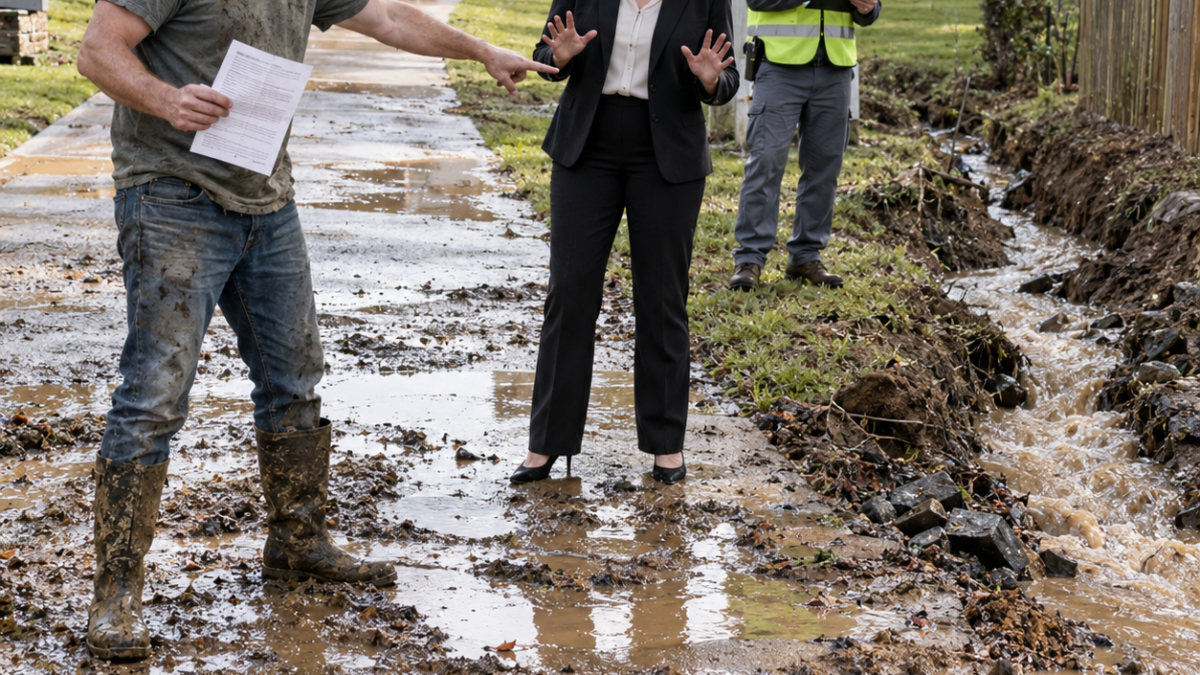
I stood ankle-deep in wet grass, staring at the new channel.
There are moments when professional training overrides emotion.
That was one of them.
The homeowner in me wanted to curse.
The engineer in me wanted measurements.
So I started documenting.
Wide photographs first.
The original creek bend.
The berm.
The new ditch.
The freshly sodded field behind it.
Then closer images.
Excavator tread marks.
Raw clay.
Freshly cut roots.
Erosion scars.
I activated the GPS on my phone and recorded the location.
Then I switched to video.
“This is Mark Henderson,” I said calmly into the camera. “Date and time recorded automatically. I am standing approximately two hundred yards upstream of my eastern property line on Oak Ridge Meadows common land.”
I turned slowly so the video captured everything.
“The natural channel has been partially obstructed by an earthen berm. A new artificial channel has been excavated to redirect storm flow away from the common recreational field.”
I pointed the camera downstream.
“And toward my property.”
Saying it aloud somehow made it worse.
It wasn’t an accident.
Nobody accidentally moves a creek with an excavator.
Behind the berm stretched what the HOA newsletters had been proudly calling Patriots Perch.
It was Karen’s newest community project.
A picnic lawn.
Benches.
Two grills.
A small playground.
Fresh sod.
Decorative landscaping.
For months, she had promoted it as proof that Oak Ridge Meadows was “investing in quality of life.”
Apparently, the field had one problem.
It was wet.
Which wasn’t surprising.
It sat beside a seasonal creek.
Someone had solved that problem by pushing the water somewhere else.
My land.
I walked farther.
The design was so crude it made me angry in a way Karen’s fine never could.
Natural streams curve for reasons.
Those bends dissipate energy.
Vegetation slows flow.
Floodplains spread water.
But somebody had cut a shortcut.
Straight channel.
Steeper effective gradient.
Less friction.
Higher velocity.
The new ditch was essentially a chute.
During eight inches of rain, it had become a hydraulic cannon.
And my driveway had been sitting at the end of the barrel.
I drove home slowly.
Sarah met me outside.
Her arms were folded.
“Well?”
“They moved the creek.”
For a moment she said nothing.
Then she gave a short laugh.
Not because it was funny.
Because the sentence sounded ridiculous.
“They what?”
I showed her the photographs.
The humor disappeared.
“Oh my God.”
“Exactly.”
“Who did this?”
“I have a theory.”
“Karen?”
“Not with a shovel personally.”
“You know what I mean.”
I did.
Karen had been talking about Patriots Perch for nearly a year.
She had pushed the board to spend money on it.
She had posted pictures of herself standing beside freshly planted shrubs.
It was her project.
Sarah flipped through the photos again.
“So they changed the creek, flooded us, then fined us because their water put mud on our driveway?”
“That appears to be the sequence.”
Her mouth tightened.
“Please tell me you are not going to the clubhouse right now.”
“I’m not.”
She visibly relaxed.
“I’m going to my office.”
“That is somehow more frightening.”
I spread everything across my desk.
The original property survey.
County topo maps.
Aerial images from two years earlier.
Current satellite imagery.
My GPS points.
The difference was unmistakable.
The old channel curved away from my property.
The new one cut a hard diagonal across the HOA common land, forcing overflow toward our boundary.
Then I placed Karen’s fine beside the maps.
That was when I understood what she had accidentally given me.
A causal timeline.
They altered the drainage.
The storm came.
My property received the redirected sediment.
Then the HOA officially documented the resulting mud and tried to punish me for it.
I scanned every page.
Saved copies to two drives.
Emailed backups to myself.
Then I printed enlargements.
Sarah watched the printer run.
“You’re enjoying this now.”
“No.”
“That is not your unhappy face.”
“I’m professionally offended.”
“That sounds worse.”
“It probably is.”
The next HOA meeting was four days away.
I waited.
There was no point confronting Karen privately.
If she was going to deny responsibility, I wanted witnesses.
Tuesday night, I put on a pressed shirt and slacks and carried a leather portfolio into the Oak Ridge Meadows clubhouse.
Karen saw me immediately.
Her mouth tightened.
Gary sat beside her.
He was the board treasurer, a nervous man with thinning hair and a permanent expression of somebody waiting for bad news.
Brenda sat on Karen’s other side.
Brenda rarely spoke.
She mostly nodded.
The three of them had become a familiar tableau.
Karen ruled.
Gary processed.
Brenda agreed.
About fifteen homeowners sat in folding chairs.
The meeting began with the normal theater.
Trash cans.
Holiday decorations.
Two lawns apparently one inch too high.
A front door painted a blue that had not received architectural approval.
I listened.
Then Karen reached the violation section.
“Mr. Henderson.”
Her voice changed.
Smug.
“Since you’ve decided to attend, perhaps you’d like to explain the condition of your driveway.”
A few people turned toward me.
I stood.
“Actually, Karen, I’d like to explain what caused it.”
She smiled.
“I’m sure we are all fascinated by the weather.”
“It wasn’t the weather.”
Her smile faded slightly.
I walked to the front.
Opened my portfolio.
The first photograph showed my driveway.
“This is the condition you fined me for?”
“Yes.”
“Twelve hundred dollars?”
“The fine reflects repeated failure to maintain aesthetic standards.”
“Repeated?”
“You were notified.”
“After the storm.”
“That doesn’t excuse neglect.”
I nodded.
Then I placed a satellite image on the table.
“This is Oak Ridge Meadows two years ago.”
Nobody spoke.
I traced the blue line marking the creek.
“This is the natural drainage path.”
Next photo.
Current conditions.
Red line.
Straightened channel.
“And this is today.”
Gary leaned forward.
Brenda stopped nodding.
Karen did not look at the map.
“What is your point?”
“My point is that somebody altered the creek on HOA common land.”
A murmur passed through the room.
Karen’s shoulders stiffened.
I showed the photographs of the berm.
The new ditch.
The equipment tracks.
The erosion.
“This modification redirected high-velocity stormwater directly toward my property.”
Karen waved one hand.
“That’s ridiculous.”
“No.”
My voice stayed calm.
“It’s hydrology.”
She glared at me.
“This was a landscaping improvement.”
There it was.
Admission.
Not full.
But enough.
“You’re acknowledging the HOA performed this work?”
Gary looked sharply at Karen.
She realized the mistake.
Too late.
“We maintained our common area.”
“Did you have a permit?”
Silence.
“Did a licensed engineer design it?”
Her face reddened.
“Mr. Henderson—”
“Was there a hydrological impact study?”
“We do not need your permission to landscape HOA property.”
“I didn’t ask whether you had my permission.”
I leaned slightly forward.
“I asked whether you had the county’s.”
Several homeowners started whispering.
Karen’s voice rose.
“You’re trying to distract everyone from your violation.”
“I’m establishing cause.”
“Your driveway was filthy.”
“Because your project sent a creek across my land.”
She slammed her palm on the table.
“Enough.”
Then came the line that changed everything.
“The board has every right to improve its own property however it sees fit.”
Gary looked down.
Brenda stared straight ahead.
I gave Karen one final opportunity.
“So your position is that the HOA authorized the drainage modification?”
“My position is that you owe $1,200.”
“And if I don’t pay?”
“We will begin lien proceedings.”
The room went still.
I closed my portfolio.
“Thank you.”
Karen blinked.
“For what?”
“For putting that on the record.”
Her face changed.
She understood, maybe for the first time, that I hadn’t come seeking mercy.
I had come collecting statements.
I turned to the residents.
“I’d pay attention to this.”
Karen grabbed her gavel.
“This meeting—”
“Today,” I continued, “the board changes a creek, my property floods, and I get fined for the damage.”
She banged the gavel.
“Mr. Henderson!”
“Tomorrow it could be your yard.”
The silence afterward was more powerful than shouting.
I walked out.
Sarah was awake when I got home.
“Well?”
“She admitted they did the work.”
“You recorded it?”
“Meeting minutes will.”
“You trust Karen’s minutes?”
“No.”
I held up my phone.
Sarah smiled.
“Of course.”
The following morning, I called David Miller.
Dave and I had served together years earlier.
He had left the military, gone to law school, and built a practice around environmental and property disputes.
He listened without interrupting.
When I finished, he was silent for three seconds.
Then he laughed.
“What?”
“Mark, do you have any idea how badly they have screwed this up?”
“I have an estimate.”
“Unpermitted diversion of a waterway. Direct property damage. Potential nuisance claim. Possible negligence. Potential fiduciary issues depending on how the board authorized the work.”
“And the fine.”
“The fine is my favorite part.”
“Why?”
“Because they documented the damage immediately after causing it.”
I leaned back.
“So what do we do?”
“Nothing emotional.”
“Good.”
“We build.”
That word fit.
Dave gave me a list.
County environmental office.
State natural-resource agency.
Public records.
Contract records.
Board minutes.
Invoices.
Vendor disclosures.
Any document mentioning the creek, Patriots Perch, drainage work or excavation.
“You’re looking for a permit?” Sarah asked later.
“A permit would be interesting.”
“And if there isn’t one?”
“More interesting.”
My first stop was the county Department of Environmental Protection.
The woman at the intake counter looked tired until she opened my folder.
Photos.
Maps.
Coordinates.
Engineering notes.
Her posture changed.
“You prepared this?”
“Yes.”
“You’re an engineer?”
“Retired Army Corps.”
She studied the before-and-after images.
“Did you see any erosion-control measures?”
“None.”
“Sediment fencing?”
“No.”
“Construction permit signage?”
“No.”
“Stormwater plan?”
“Nothing visible.”
She looked at the new channel photograph.
“This needs review.”
“I agree.”
She stamped the complaint.
An official case number appeared on my copy.
It was a small sound.
Ink hitting paper.
But it moved the entire dispute out of Karen’s little kingdom.
Next I requested county records relating to Patriots Perch.
Permits.
Applications.
Drainage plans.
Correspondence.
Contractor documents.
I requested everything I could legally obtain.
I also contacted the state natural-resource agency.
Then I waited.
Karen did not.
One week later, certified mail arrived.
The HOA’s attorney demanded $1,700.
The original fine.
Late charges.
Legal fees.
Payment due within ten business days.
Failure to pay could trigger lien proceedings.
I sent it to Dave.
His reply arrived within five minutes.
PERFECT.
I called him.
“You’re becoming disturbingly cheerful when people threaten my house.”
“They’re documenting malice.”
“They’re documenting stupidity.”
“Courts accept both.”
That evening our dining room table became a command center.
Maps.
Emails.
Statutes.
Photographs.
Violation notices.
Sarah brought coffee.
“You really are going after them.”
“No.”
She gave me a look.
“Fine. I’m going after what they did.”
“Better.”
“They damaged our land, threatened our house, and expect us to pay.”
“I know.”
“This stops here.”
Sarah put her hand over mine.
“Just remember something.”
“What?”
“Winning doesn’t mean becoming like Karen.”
I looked at her.
“I don’t want her power.”
“What do you want?”
“Our creek back.”
She nodded.
“Then keep that in front of you.”
The records arrived on a Tuesday.
Three boxes.
I carried them inside.
Dave came over that night.
Sarah ordered pizza.
We divided the work.
Dave took financial records.
Sarah took board minutes.
I handled correspondence and project documents.
For two hours, we found nothing except proof that human beings could spend astonishing amounts of time debating meaningless details.
Sarah held up one set of minutes.
“They spent fifty-two minutes discussing sunflower height.”
“Important matter of state.”
“Apparently.”
Near ten o’clock, Dave stopped turning pages.
“Oh.”
I looked up.
“What?”
He held a proposal.
“K&G Landscaping and Excavation.”
I moved beside him.
The project title read:
PATRIOTS PERCH ENHANCEMENT.
Line items included grading.
Sod.
Drainage work.
Then one sentence.
REROUTE PESKY CREEK TO IMPROVE DRAINAGE — $4,500.
Sarah leaned over my shoulder.
“You have got to be kidding.”
The proposal included a hand-drawn sketch.
A curved line labeled “old creek.”
An arrow.
A straight line labeled “new.”
No calculations.
No engineer.
No environmental plan.
Nothing remotely professional.
“This is the design?” I asked.
Dave smiled without humor.
“Calling it design is generous.”
I studied the company name.
“K&G.”
Sarah had already opened another document.
“Wait.”
She flipped pages.
“What?”
“Karen’s maiden name was Gable, right?”
“I think so.”
“And her brother-in-law is Kevin Gable.”
Dave stared at her.
Sarah held up a disclosure form.
“Emergency contact. Kevin Gable.”
I looked at the proposal.
K&G Landscaping.
Kevin Gable.
Karen Bishop.
The connection settled into the room.
Dave said it first.
“Conflict of interest.”
We kept searching.
Then it got worse.
A check from the HOA to K&G.
Signed by Karen.
Countersigned by Gary.
Minutes authorizing “common-area beautification.”
No contractor name.
No creek diversion mentioned.
No competitive bids.
An email from a homeowner asking why machinery had been digging behind his property.
Karen’s response:
FULLY APPROVED DRAINAGE IMPROVEMENT FOR THE BENEFIT OF THE COMMUNITY.
I read that sentence slowly.
“She knew.”
Dave nodded.
“And now we can prove she knew.”
At two in the morning, the dining room table looked like a crime board.
Project proposal.
Vendor payment.
Family connection.
Board approval.
Written admission.
Fine letter.
Lien threat.
Everything connected.
Sarah sat back.
“So what happens now?”
Dave looked at me.
“We sue.”
I looked at the documents.
For days I had imagined forcing Karen to withdraw the fine.
Repair the creek.
Pay for the damage.
But sitting there, I thought about every HOA meeting I had attended.
People lowering their eyes when Karen spoke.
Neighbors whispering complaints but never challenging her.
A board that operated through fear because fear isolated people.
“A lawsuit fixes us,” I said.
Dave nodded.
“It can.”
“It doesn’t fix the neighborhood.”
Sarah understood before Dave did.
“You’re going to talk to everyone.”
“Yes.”
Dave raised one eyebrow.
“Legally.”
“I assumed.”
“Good.”
The next morning, I visited the Millers.
Robert and Elaine Miller had lived in Oak Ridge Meadows for twenty years.
Karen had fined them because their white trim was supposedly the wrong white.
Not gray.
Not red.
White.
But not the right white.
“We repainted the whole front,” Elaine told me.
“How much?”
“Almost a thousand dollars.”
Robert shook his head.
“I was tired of fighting.”
I laid out the creek photographs.
Then the contractor proposal.
Then the check.
Robert’s expression changed.
“What does this have to do with us?”
“Your backyard has been wetter lately?”
Elaine looked at him.
“Yes.”
“How much wetter?”
“Our back corner never dries anymore.”
I showed them the drainage map.
“The rerouted water doesn’t only hit me.”
Elaine covered her mouth.
“I thought we had a broken irrigation line.”
Maybe they did.
Maybe not.
I was careful.
I did not tell people that every problem was caused by the creek.
I told them what I could prove.
The system had changed.
Properties downstream could be affected.
That was enough.
Next came the Young family.
Their crime had been a portable basketball hoop.
Then Maria.
A single mother whose daughter maintained a small vegetable garden.
Karen had declared it “agricultural use inconsistent with neighborhood aesthetics.”
Maria laughed when I told her about the creek.
Not because it was funny.
Because she was furious.
“She thinks my tomatoes are dangerous, but she can move a river?”
“Seasonal creek.”
“I don’t care if it’s a puddle. She moved it.”
Word spread.
Within two days, people were calling me.
A retired teacher fined for a bird feeder.
A couple threatened over a welcome mat.
A man warned for working on his own motorcycle in his driveway.
A widow cited because her trash container remained visible after pickup while she was at a medical appointment.
Each story alone was petty.
Together they told a different story.
Karen’s power depended on making every homeowner think his or her fight was private.
That nobody else would understand.
So we changed that.
I invited people to our house.
Thirty showed up.
Our living room couldn’t hold everyone.
Some stood in the hallway.
Others crowded the kitchen.
I connected my laptop to a screen.
Then I walked them through the case.
The fine.
The flow patterns.
The original creek.
The new ditch.
Patriots Perch.
K&G.
Kevin Gable.
The check.
Karen’s email.
Nobody interrupted.
When I finished, Robert Miller raised his hand.
“What can we do?”
I looked around.
“For starters, stop being afraid to talk to each other.”
Someone laughed softly.
I wasn’t joking.
“Karen can handle one resident at a time. One violation. One appeal. One complaint.”
I pointed at the room.
“She cannot pretend thirty people are thirty unrelated problems forever.”
Dave stepped forward.
He explained the legal exposure.
Environmental violations.
Property damage.
Potential fiduciary breaches.
The board’s duty to the association.
The importance of independent financial review.
He was careful not to promise criminal charges.
“This isn’t television,” he said. “We follow evidence.”
Maria crossed her arms.
“And if the evidence is as bad as it looks?”
“Then consequences follow.”
We created a concerned homeowners committee.
No dramatic name.
No secret handshake.
Just residents sharing information.
Every person signed.
I made one thing clear.
“No harassment.”
People listened.
“No threats. No trespassing. No screaming outside Karen’s house. No social-media mob.”
One man asked, “Why not? She deserves—”
“No.”
The room quieted.
“If we’re saying Karen abused power, we don’t answer by abusing ours.”
Sarah looked at me from the kitchen.
That was the sentence she had been waiting to hear.
“We use documents,” I continued. “Meetings. Votes. Regulators. Courts.”
Robert nodded.
“We do it clean.”
“Exactly.”
Dave drafted the demand letter.
Twelve pages.
Cold.
Precise.
It rejected the $1,200 fine.
Rejected late fees.
Rejected legal charges.
Documented the drainage project.
Disclosed the connection between Karen and K&G.
Referenced the county investigation.
Included an engineering estimate for restoring the creek and repairing my property.
The preliminary remediation estimate came to roughly $87,500.
Topsoil.
Bank stabilization.
Regrading.
Drainage restoration.
Vegetation.
Driveway reconstruction.
Dave also included compensation for professional time I had spent documenting and analyzing the damage.
I didn’t care much about that part.
He insisted.
“Your work has value.”
“My work is protecting my own house.”
“Which they forced you to do because of their conduct.”
The demands were simple.
Withdraw the fine.
Stop the lien threat.
Restore the creek.
Repair my property.
Commission an independent financial audit.
Address the conflict of interest.
Meet formally with the homeowners.
And remove Karen from authority pending review.
The board received fifteen business days.
Karen lasted twelve.
Then she called an emergency HOA meeting.
Her email went to every homeowner.
URGENT — PROTECTING OAK RIDGE MEADOWS FROM BASELESS LEGAL THREATS.
Sarah read it aloud.
“Our community is under attack by an individual making outrageous demands that could financially devastate every homeowner—”
She stopped.
“You’re the individual.”
“Apparently.”
“Nearly one hundred thousand dollars over a little mud.”
“That sounds much better than ‘illegal creek diversion.’”
“She called you a disgruntled resident.”
“I’ve been promoted from violator.”
Sarah scrolled.
“She wants everyone at the clubhouse Thursday.”
“Good.”
“Good?”
“She just invited the entire neighborhood to hear the evidence.”
The concerned homeowners responded with one message.
No insults.
No accusations.
Just:
We encourage everyone to attend and review the complete documentation before forming an opinion.
Then I made two calls.
The first went to Jessica Lane, a local reporter who had covered county zoning disputes.
She listened.
“Let me make sure I understand,” she said.
“HOA president approves drainage work performed by a relative?”
“Yes.”
“Work alters a creek?”
“Yes.”
“Your land floods?”
“Yes.”
“And then the HOA fines you for the mud?”
“Twelve hundred dollars.”
She paused.
“I’ll be there.”
My second call went to the county environmental investigator.
I informed her that the project under investigation would be discussed publicly.
I did not ask her to confront Karen.
I didn’t need to.
She said a representative might attend.
Thursday night, the clubhouse parking lot filled before the meeting started.
People stood along walls.
Jessica sat near the back.
A photographer beside her.
Dave sat with Sarah and me.
Our committee filled the front rows.
Karen entered last.
Gray suit.
Clipboard.
Gavel.
She looked around and seemed almost pleased by the crowd.
She thought they had come for her.
Then a county environmental investigator walked through the door.
Karen saw the logo on his shirt.
Her face changed.
Only for a second.
But I saw it.
She called the meeting to order.
“As you all know,” she began, “our community is facing an unprecedented threat.”
She pointed vaguely toward me.
“One homeowner is attempting to extort nearly one hundred thousand dollars from all of you.”
Murmurs.
Karen gained confidence.
“This is over mud.”
Nobody interrupted.
“Over mud after a historic storm.”
She smiled slightly.
“Our board has worked tirelessly to protect your homes and property values. We will not allow intimidation to bankrupt this community.”
A few people clapped.
Very few.
Then she looked at me.
“Mr. Henderson, since you created this crisis, I suppose you want to speak.”
I stood.
“Thank you.”
Dave whispered, “Slow.”
I nodded.
I walked to the front.
A projector had already been prepared.
“My name is Mark Henderson.”
I looked around.
“Karen is correct about one thing.”
That surprised her.
“This began with mud.”
The first photograph appeared.
My driveway.
Brown.
Destroyed.
“This is what I was fined twelve hundred dollars for.”
Then the next image.
Original aerial map.
“This is the creek before Patriots Perch.”
Next.
Current map.
“And this is after.”
The room shifted.
People leaned forward.
I showed the new ditch.
The berm.
The erosion.
The equipment tracks.
Then the proposal.
K&G LANDSCAPING & EXCAVATION.
I enlarged the line.
REROUTE PESKY CREEK — $4,500.
The room erupted.
Karen raised the gavel.
“Those documents are being misrepresented!”
I didn’t answer her.
Next slide.
The check.
Next.
Kevin Gable’s relationship to Karen.
Next.
The board disclosure form.
Next.
The email.
FULLY APPROVED AND NECESSARY DRAINAGE IMPROVEMENT.
People began talking all at once.
Karen banged the gavel.
“Order!”
I waited.
Then I displayed her fine.
Twelve hundred dollars.
Right beside a photograph of sediment that the redirected water had deposited.
“This isn’t about mud,” I said.
The room quieted.
“It is about a board using HOA money to change a natural drainage system without proper review, damaging private property, then punishing the homeowner for the damage.”
Karen stood.
“You are lying.”
I looked directly at her.
“Which document is false?”
Silence.
“Is the K&G proposal false?”
No answer.
“Is the check false?”
Her jaw clenched.
“Is your email false?”
“You are twisting—”
“Is the fine false?”
She slammed the gavel.
“This is my meeting!”
That sentence destroyed her more effectively than anything I had presented.
Not our meeting.
Not the homeowners’ meeting.
My meeting.
People heard it.
Maria stood.
“No, Karen.”
Karen looked at her.
“This is ours.”
The room erupted in applause.
Karen shouted for order.
Then Robert Miller stood.
He spoke about the trim fine.
The Youngs spoke about the basketball hoop.
Maria spoke about the vegetable garden.
One homeowner after another stood.
Not screaming.
Testifying.
That was what it felt like.
Years of frustration had finally found witnesses.
Then a voice came from the back.
“Ms. Bishop.”
Everyone turned.
The county investigator stepped forward.
He held a notebook.
“My name is Thomas Reeves. I’m with the County Department of Environmental Protection.”
Karen’s face went pale.
“We currently have an open investigation regarding the unpermitted alteration of the seasonal waterway on Oak Ridge Meadows common property.”
The room became so quiet I could hear the air-conditioning unit.
Reeves continued.
“I strongly recommend that the board preserve all relevant records and refrain from further work at the site until the county completes its review.”
Karen tried to speak.
“This was landscaping.”
Reeves did not raise his voice.
“Moving a watercourse is not ordinary landscaping.”
Gary looked like he might be sick.
Brenda stared at the table.
Karen’s hand shook.
The gavel remained in front of her.
For years, that little piece of wood had been enough.
Bang.
Fine.
Bang.
Warning.
Bang.
Denied.
Now she couldn’t bring herself to touch it.
The meeting dissolved.
Not violently.
People simply stopped treating Karen as the final authority.
Jessica approached the county investigator.
Residents crowded around Dave.
Gary left through a side door.
Brenda followed.
Karen sat alone behind the board table.
As Sarah and I walked out, I looked back once.
Karen was staring at the $1,200 fine projected behind her.
Her own signature was twenty feet tall.
The newspaper story ran two days later.
The headline wasn’t subtle.
LOCAL HOA PRESIDENT UNDER SCRUTINY AFTER UNPERMITTED CREEK DIVERSION.
The article detailed the contractor relationship.
The damage.
The county investigation.
The fine.
It spread quickly.
That part made me uncomfortable.
I had wanted accountability.
Not spectacle.
Sarah found me reading comments online.
“Stop.”
“What?”
“Reading strangers.”
“Some of them are funny.”
“Some of them want Karen drawn and quartered.”
“I noticed.”
She closed my laptop.
“You said this wouldn’t become a mob.”
“It won’t.”
“Then don’t feed yourself on the mob.”
Again, she was right.
I stopped reading.
The official county notice arrived the following week.
Oak Ridge Meadows had violated watershed regulations.
The HOA received a substantial civil penalty.
The restoration order required the creek to be returned to an approved alignment under professional engineering supervision.
The initial county fine was $50,000.
The state opened a separate review.
Gary resigned first.
His email went to every homeowner.
He claimed Karen had misrepresented the project.
I didn’t believe he was innocent.
His signature was on the check.
But I believed he was scared.
Brenda resigned eight days later.
Her letter contained six sentences.
No apology.
No explanation.
Just resignation.
Karen remained.
Alone.
The concerned homeowners began a recall petition.
The bylaws required signatures from twenty-five percent of owners to force the vote.
We reached that before lunch Saturday.
By Sunday evening, more than sixty percent had signed.
People came to my house voluntarily.
Some apologized for not speaking sooner.
One man shook my hand and said, “I thought you were trying to bankrupt us.”
“I don’t blame you.”
“I believed her.”
“You had one side of the story.”
He looked embarrassed.
“I should’ve asked questions.”
“Now you are.”
That mattered more.
The licensing board also opened a review of K&G Landscaping.
County records showed other questionable work.
Permit issues.
Complaints.
Shortcuts.
Kevin Gable’s contractor license was eventually suspended during the investigation.
Karen’s little drainage project had reached far beyond my driveway.
Then one evening, my doorbell rang.
Sarah looked through the window.
“Karen.”
I went to the door.
She stood on the porch without her clipboard.
No suit.
No makeup that I could see.
She looked smaller.
Not physically.
Just human.
“Mark.”
“Karen.”
“Can we talk?”
I stepped outside and closed the door behind me.
She looked toward the road.
“You have to stop this.”
“I don’t control it.”
“Yes, you do.”
“No.”
“The county listens to you.”
“They listen to evidence.”
“The newspaper.”
“I gave them documents.”
“The homeowners.”
“They signed their own names.”
Her eyes filled with anger.
“You started all of it.”
“You fined me for mud your project put on my driveway.”
“It wasn’t supposed to happen.”
For the first time, she admitted that much.
I waited.
“We just wanted the field dry.”
“There were legal ways to address drainage.”
“Those studies cost money.”
I stared at her.
“And this didn’t?”
Her face tightened.
“You don’t understand the pressure.”
“What pressure?”
“Everyone complains. Everyone wants lower dues and perfect common areas and better amenities. The picnic field kept flooding. People blamed me.”
“So you hired Kevin.”
“He could do it cheaply.”
“Because he was family.”
“Because I trusted him.”
“You didn’t disclose the relationship.”
She looked away.
“We weren’t stealing.”
“I didn’t accuse you of stealing.”
“You told everyone—”
“I showed them a check.”
That stopped her.
Evidence has a brutal simplicity.
Karen’s voice dropped.
“Call the county. Tell them we’ll fix it.”
“They already ordered you to fix it.”
“Ask them to reduce the fine.”
“I can’t.”
“You could try.”
“No.”
Her eyes hardened again.
There was the Karen I recognized.
“So this is revenge.”
“No.”
“Don’t pretend.”
I stepped closer, not threatening, just making sure she heard me.
“Revenge would’ve been humiliating you when you came to my house.”
She flinched.
“I don’t need revenge.”
“Then what do you want?”
I looked past her toward the woods.
“My land repaired.”
She said nothing.
“The creek restored.”
Nothing.
“The HOA to stop threatening people for problems it creates.”
Her mouth tightened.
“And?”
“That’s it.”
She laughed bitterly.
“You expect me to believe that?”
“Yes.”
“After what you’ve done to me?”
“What I did?”
I almost raised my voice.
Almost.
Then I remembered Sarah’s warning.
I lowered it instead.
“You approved the contractor.”
Karen looked away.
“You approved the payment.”
Silence.
“You defended the work at the meeting.”
Silence.
“You fined me.”
Silence.
“You threatened a lien.”
Her eyes returned to mine.
“I didn’t make those choices for you.”
She whispered, “I can lose my house.”
That hit differently.
Not enough to erase anything.
But enough to remind me there was a person standing there.
“I don’t want your house.”
“Then help me.”
“I can’t erase consequences.”
Her eyes filled with tears.
I don’t know whether they were for the damaged creek.
The homeowners.
The money.
Or herself.
Probably herself.
But misery is misery.
I didn’t enjoy it.
“Karen.”
She looked up.
“When this is finished, you still get to decide what kind of person comes out the other side.”
Her expression twisted.
“Spare me.”
“Fair enough.”
She turned.
Walked down the steps.
Then stopped.
“Was the driveway really that bad?”
I almost laughed.
“Yes.”
She nodded faintly.
Then walked away.
Sarah opened the door.
“You heard?”
“Most of it.”
“I thought I’d feel better.”
“About what?”
“Seeing her ask me for help.”
“Did you?”
“No.”
Sarah touched my arm.
“Good.”
I looked at her.
“Good?”
“If you enjoyed somebody being terrified about losing everything, I’d worry about you.”
The recall meeting happened two weeks later.
Karen attended.
That surprised me.
She could have resigned.
Instead, she sat alone at the front of the clubhouse while residents voted.
The result wasn’t close.
Her presidency ended before nine that evening.
Robert Miller was elected interim president.
The man who had once repainted his house trim rather than fight Karen now stood at the same table she had ruled.
His first act was not revenge.
That impressed me.
He didn’t void every rule.
Didn’t fire every contractor.
Didn’t declare victory.
He read a statement.
“The purpose of an HOA is to maintain common property and represent the interests of its homeowners. It is not to humiliate them.”
Then he looked at me.
“Mark, on behalf of Oak Ridge Meadows, I apologize.”
I felt oddly uncomfortable.
“You don’t owe me—”
“Yes, we do.”
Applause began.
I would have preferred silence.
But Sarah squeezed my hand.
So I accepted it.
The $1,200 fine was formally voided.
So were the legal fees.
The lien threat disappeared.
The new board accepted responsibility for restoring the creek and repairing our property.
An independent financial audit was approved.
All vendor relationships would be reviewed.
Competitive bidding became mandatory above a certain amount.
Conflicts of interest had to be disclosed in writing.
And until the governing documents were reviewed, discretionary aesthetic enforcement was suspended.
Maria raised her hand.
“So my tomatoes are safe?”
Robert smiled.
“Your tomatoes were never dangerous.”
People laughed.
Months of tension cracked.
For the first time, the clubhouse felt like a neighborhood meeting.
Not a courtroom.
The remediation started in early summer.
Real engineers came first.
Survey crew.
Environmental consultants.
Hydrologists.
They mapped the original channel.
Modeled storm events.
Calculated flow.
Identified erosion.
Designed bank stabilization.
The contrast with K&G’s hand-drawn arrow was almost painful.
Then machinery arrived.
This time with permits.
Plans.
Inspectors.
Erosion-control fencing.
Sediment barriers.
Everything that should have existed from the beginning.
The illegal berm was removed.
Slowly.
Carefully.
The artificial straight ditch was filled.
The original bend was reopened.
River stone stabilized vulnerable areas.
Native grasses and water-tolerant plants went in along the banks.
For weeks I watched from my back porch.
One morning, the project engineer walked over.
“Mr. Henderson?”
“Mark.”
“I’m Elena Torres.”
We shook hands.
“I’ve seen your original notes.”
“My amateur complaint?”
She smiled.
“Your ‘amateur complaint’ included better flow observations than some professional site reports.”
“Occupational disease.”
“We have a question about pre-project bank elevation near your southern boundary.”
I grabbed my old survey.
For an hour, we walked the creek together.
It felt good.
Not because I was winning anything.
Because I was talking about water with someone who respected it.
Elena pointed toward one section.
“We’re going to widen the riparian buffer here.”
“Good.”
“Slows sheet flow.”
“Exactly.”
“And if we get another eight-inch storm?”
“It’ll still be ugly.”
She smiled.
“Water always wins.”
“Eventually.”
We both knew that was the first law of hydrology nobody writes down.
My property was repaired too.
Topsoil replaced.
Eroded sections regraded.
Grass reseeded.
Drainage stabilized.
My driveway received fresh gravel.
They reshaped the shoulder so future runoff would spread safely rather than cut through one concentrated point.
The work cost more than Karen’s original $4,500 shortcut by an absurd margin.
That was the cruel arithmetic of bad engineering.
Saving money at the beginning often means spending ten times more repairing what the shortcut destroyed.
The HOA insurance covered part of it.
Not all.
Homeowners faced a special assessment.
I dreaded that.
I expected anger.
Some came.
Of course it did.
Families had budgets.
Retired couples had fixed incomes.
Nobody likes paying for someone else’s mistake.
At one meeting, a man stood and asked me directly.
“Why should I pay because Karen moved a creek?”
I understood.
“You shouldn’t have to.”
“Then why are we?”
“Because the HOA is a corporation owned collectively by the membership. The association incurred the liability.”
“So we get punished.”
Robert stepped in.
“We’re reviewing insurance recovery and claims against responsible parties.”
The man shook his head.
“But the money comes from us now.”
“Yes.”
There was no good answer.
That was important too.
Justice did not magically erase damage.
Sometimes innocent people still carried costs because leaders had failed them.
After the meeting, I found the man outside.
“I’m sorry.”
He shrugged.
“Not your fault.”
“I know, but I’m still sorry.”
He looked toward the clubhouse.
“I voted for Karen twice.”
“So did a lot of people.”
“She seemed organized.”
“She was.”
“You think I’m an idiot?”
“No.”
“Why?”
“Because bad leaders rarely advertise the bad part first.”
That made him smile.
“Fair.”
The independent financial audit took months.
It found sloppy controls.
Undisclosed relationships.
Improper process.
Some questionable spending.
But nothing as dramatic as rumors online had claimed.
That mattered.
We didn’t invent crimes because people wanted villains.
Facts remained facts.
The creek project was bad enough.
Karen had violated trust.
Used a family-connected contractor.
Hidden the conflict.
Approved reckless work.
Then tried to punish me for the result.
We did not need to exaggerate.
K&G faced licensing consequences.
The HOA pursued recovery where lawyers believed it was justified.
Karen disappeared from meetings.
Her house didn’t go up for sale immediately.
For months, I rarely saw her.
Once, while driving to town, I spotted her walking alone near the entrance.
No golf cart.
No clipboard.
She saw my truck.
I raised one hand.
After a hesitation, she did the same.
That was all.
Oak Ridge Meadows changed slowly.
Not overnight.
The new board removed some of Karen’s most subjective rules.
Not all standards.
Nobody wanted abandoned cars in front yards or common areas falling apart.
But enforcement shifted.
Warnings first.
Conversation.
Reasonable cure periods.
Appeals reviewed by people who were not personally involved.
The goal became compliance rather than punishment.
The Millers never had to discuss white paint again.
The Young kids left their basketball hoop outside sometimes.
The world continued turning.
Maria’s vegetable garden became so popular that the HOA created a shared garden near Patriots Perch.
That name didn’t survive.
At the first public meeting about rebuilding the recreational field, someone asked whether they should rename it.
Bill Young shouted from the back.
“Mud Meadow.”
Everyone laughed.
Maria suggested Creekside Commons.
That stuck.
Creekside Commons.
No patriotic branding.
No grand monument.
Just a small lawn beside a restored creek.
A few benches.
Shade trees.
Garden beds.
Children played there.
Parents talked.
The creek curved beside it the way it had before anybody decided nature needed to obey an HOA budget.
One autumn morning, an envelope arrived from the management company.
Inside was payment for the professional time documented in our settlement.
I stared at the check.
Sarah came downstairs.
“What?”
“They paid the consulting invoice.”
“Of course they did.”
“I wasn’t sure they would.”
“You documented every minute.”
“I may have overdone that.”
She laughed.
“Mark, you logged the time you spent logging your time.”
“Proper recordkeeping.”
There was also a handwritten note from Robert.
Mark,
The board approved this unanimously.
More important, the final county inspection closed the remediation order yesterday.
The creek passed.
Thank you for refusing to pay the most expensive $1,200 fine this neighborhood has ever issued.
—Robert
I read that final line twice.
Then I walked outside.
The driveway was clean.
Not artificially perfect.
There were leaves.
A little dust.
A tire mark from Sarah’s car.
Normal.
I followed it toward the back of the property.
The restored grass had come in thick.
New plantings lined the lower area.
Beyond the trees, I heard water.
The creek.
I had heard it thousands of times before.
But that morning I walked down to it.
The water moved around the rebuilt bend.
Slowly.
Naturally.
After everything, the sight was almost disappointingly ordinary.
That was its beauty.
A creek should not look like a battlefield.
It should simply be a creek.
I sat on a stone.
Sarah eventually found me.
“You planning to live down here?”
“Maybe.”
She sat beside me.
For a while, neither of us spoke.
Water moved over gravel.
Leaves rustled.
Somewhere near Creekside Commons, children were shouting.
Happy shouting.
Sarah leaned against my shoulder.
“Was it worth it?”
I thought about the question.
The legal fees.
The meetings.
The documents.
The anger.
The special assessment homeowners had to pay.
Karen standing on our porch.
Gary resigning.
K&G losing work.
Months of construction.
“Which part?”
“All of it.”
“I don’t know.”
She looked at me.
“That is not the answer I expected.”
“I’d rather none of it happened.”
“Obviously.”
“But once it did…”
I watched a leaf float around the bend.
“We couldn’t pretend it hadn’t.”
She nodded.
“That sounds more like you.”
A year after the storm, another major rain system moved through the county.
Not eight inches.
But enough.
I barely slept.
Old habits.
Around two in the morning, I pulled on boots.
Sarah sat up.
“Where are you going?”
“Creek.”
“Of course you are.”
Rain fell hard.
I walked through the yard with a flashlight.
The ground was saturated.
Water poured through the swales.
My stomach tightened as I approached the eastern boundary.
Then I saw it.
The restored creek was swollen.
Brown.
Loud.
Exactly as it should be.
Water entered the widened bend.
Spread briefly across the designed overflow area.
Slowed through vegetation.
Returned to the channel.
No hydraulic cannon.
No artificial chute.
No sheet flow racing toward the house.
I stood in the rain grinning like an idiot.
A flashlight appeared behind me.
Sarah.
“You couldn’t stay inside?”
“You married me.”
“That was before I knew hydrology involved standing outside at two in the morning.”
“Look.”
She looked.
At water.
I realized how ridiculous that sounded.
“Well?”
“It’s working.”
She smiled.
“Good.”
We walked back toward the house.
When morning came, I checked the driveway.
Mud?
A little.
Of course.
Storms are storms.
But no fan of red clay.
No deep sediment.
No scar crossing the property.
Just the normal dirt any reasonable human would expect after heavy rain.
Around nine, a golf cart came slowly down the street.
For half a second, my body reacted before my brain did.
Old memory.
Karen.
Clipboard.
Fine.
But the driver was Robert Miller.
He stopped near our driveway.
I walked out.
“Inspection?” I asked.
He looked at the mud.
“Absolutely.”
I folded my arms.
“How bad?”
Robert climbed out.
Walked dramatically around the driveway.
He crouched.
Picked up a small clump of dirt.
Rubbed it between his fingers.
Then pulled a folded piece of paper from his pocket.
My stomach tightened despite knowing better.
He handed it to me.
I unfolded it.
NOTICE OF EGREGIOUS MUD VIOLATION.
Fine:
$0.00.
Required action:
MAKE COFFEE.
I stared at him.
Robert burst out laughing.
Sarah laughed from the porch.
“You two planned this?”
Robert pointed at her.
“Her idea.”
I looked at my wife.
“Betrayal.”
She held up three coffee mugs.
“Come inside.”
We sat on the porch while rainwater dripped from the trees.
Robert told us the restored creek had handled the storm exactly as designed.
The county monitoring point showed no unusual downstream erosion.
Creekside Commons had some standing water.
“That’s what floodplains do,” I said.
“I know.”
He grinned.
“I’ve been educated.”
After coffee, he grew quiet.
“You know, I hated paying that assessment.”
“I know.”
“Everybody did.”
“I know.”
“But yesterday Maria’s daughter asked me why the creek wiggles.”
I smiled.
“What did you tell her?”
“That sometimes the longer way is the safer way.”
I looked toward the trees.
“Not bad for a paint guy.”
He laughed.
“I learned from an engineer.”
The following spring, the neighborhood held a small event at Creekside Commons.
Nothing elaborate.
No ribbon-cutting ceremony.
Nobody invited television cameras.
Families planted native wildflowers along the edge of the buffer.
Maria organized vegetables for the community garden.
The Young kids played basketball nearby.
Robert grilled hot dogs.
Someone brought folding tables.
Sarah handed me a shovel.
“What’s this?”
“You’re planting.”
“I’ve planted enough things in my life.”
“You’re planting.”
She pointed toward a young river birch.
A small brass marker had already been installed beside it.
I read it.
RESTORED AFTER THE GREAT STORM.
That was all.
No names.
No Mark Henderson.
No Karen Bishop.
No board.
No lawsuit.
Just restored.
I liked that.
Maria’s daughter ran over.
“Mr. Mark!”
She was carrying a muddy shovel.
“Yes?”
“My mom says you’re the creek man.”
“That’s unfortunate.”
“Did you save it?”
I looked at the water.
“No.”
She frowned.
“Then who did?”
“A lot of people fixed what was broken.”
“Like you?”
“Some.”
She thought.
“Was the creek mad?”
Children ask better questions than adults.
“Maybe.”
“Why?”
“Because we tried to make it go somewhere it didn’t belong.”
She nodded as if this were obvious.
“You shouldn’t do that.”
“No.”
“You should let it be a creek.”
I laughed.
“Exactly.”
She ran away.
Sarah stood beside me.
“There you go.”
“What?”
“Twenty-five years of engineering summarized by a seven-year-old.”
“Painfully accurately.”
Later that afternoon, I walked to the edge of Creekside Commons alone.
The picnic lawn was dry enough for families.
Wet enough near the lower edge to feed the plants.
The restored channel curved beyond it.
It had taken county orders, lawyers, engineers, inspectors, homeowners, money and months of work to return the land to something close to the way it had functioned before one reckless decision.
That was the lesson Karen never understood.
Systems are easy to damage.
Hard to rebuild.
That applies to creeks.
It applies to neighborhoods too.
She moved water because she thought the shortest solution was best.
She governed people the same way.
Push them.
Channel them.
Force them where you want.
Remove resistance.
For a while it worked.
Until pressure built.
Then everything overflowed.
I had spent years thinking my greatest advantage was that I understood hydrology better than Karen.
Eventually I realized the creek had understood her better than I did.
You can only force a system against its nature for so long.
Then the system finds another path.
People did too.
For years, Oak Ridge Meadows residents had absorbed Karen’s pressure separately.
Fifty dollars.
One hundred dollars.
Warning letter.
Threat.
Embarrassment.
They bent.
Then the creek controversy connected them.
Once neighbors discovered they were not alone, fear lost its grip.
That was what ended Karen’s reign.
Not me.
Not Dave.
Not the county.
All of those things mattered.
But evidence only becomes power when people are willing to look at it.
Months later, I saw Karen again.
This time at the grocery store.
We met at the end of an aisle.
No escape without making it obvious.
She looked healthier than she had on my porch.
Still tired.
But calmer.
“Mark.”
“Karen.”
We stood there with shopping carts between us.
Finally she said, “I heard the creek passed inspection.”
“It did.”
“Good.”
That surprised me.
“Thank you.”
She looked at the floor.
“Kevin doesn’t speak to me anymore.”
I didn’t know what to say.
“So there’s that.”
“I’m sorry.”
She looked at me sharply.
“You mean that?”
“Yes.”
“He blames me for losing his license.”
“Do you blame him?”
She considered.
“No.”
That was new.
“I should’ve hired an engineer.”
“Yes.”
A faint smile touched her face.
“You don’t have to enjoy saying that.”
“I’m trying very hard not to.”
She almost laughed.
Then she became serious.
“I thought if I admitted I was wrong, everyone would stop respecting me.”
I leaned on the shopping cart.
“And?”
“They stopped respecting me because I wouldn’t.”
There wasn’t much to add.
“That happens.”
“I hated you.”
“I noticed.”
“I thought you were trying to destroy me.”
“I wasn’t.”
“I know that now.”
People moved around us.
Shopping carts.
Children.
A store employee stocking canned vegetables.
An absurdly ordinary place for an ending.
Karen gripped her cart.
“I am sorry about your property.”
It was the first apology I had ever heard from her.
No qualifications.
No “but.”
No explanation.
I nodded.
“Thank you.”
“And the fine.”
I smiled slightly.
“The mud fine?”
Her eyes closed for half a second.
“Yes.”
“That was pretty bad.”
“It was extremely bad.”
We both laughed.
Small.
Awkward.
Human.
Then she said goodbye.
I watched her walk away.
I didn’t forgive everything in that aisle.
Forgiveness isn’t a switch.
Trust doesn’t magically grow back because somebody says the right sentence.
But I believed her apology.
That was enough for that day.
When I told Sarah, she put down her fork.
“She apologized?”
“Yes.”
“Karen Bishop?”
“The one and only.”
“For the creek?”
“And the fine.”
Sarah stared.
“What did you do?”
“Accepted it.”
“That’s all?”
“What was I supposed to do? Demand twelve hundred dollars?”
She laughed.
Then her expression softened.
“You feel better.”
I thought about it.
“Yes.”
“Why?”
“Because consequences worked.”
“What do you mean?”
“She lost power. Paid a price. Had to face what she did.”
I looked out our kitchen window toward the trees.
“But she didn’t have to stay the same person forever.”
Sarah reached across the table and took my hand.
“That sounds like peace.”
Maybe it was.
The original violation letter still exists.
I kept it.
Not framed.
I’m not that strange.
It’s in a file drawer with the maps, photographs and county correspondence.
Every once in a while, when I’m looking for some unrelated property document, I see it.
$1,200.
Persistent and egregious violation.
Mud and debris.
The letter that was supposed to force me into submission ended up exposing the very project that created the mud.
There is a kind of symmetry in that.
Karen thought paperwork was power because people were afraid of official-looking documents.
She learned paperwork cuts both ways.
Her violation notice became evidence.
Her meeting statement became evidence.
Her email became evidence.
The contractor invoice became evidence.
The check became evidence.
Facts don’t care who has the gavel.
They just sit there.
Waiting.
The driveway looks ordinary now.
Fresh gravel eventually faded into normal gravel.
Rain leaves puddles.
Tires leave marks.
Leaves blow across it.
Nobody measures its aesthetic harmony.
The creek behind our property is ordinary too.
That means we succeeded.
Restoration should disappear into the landscape.
If we did the engineering right, a stranger walking through would never know there had once been a berm and a crude ditch sending floodwater toward my home.
He would only see a stream bending between trees.
Native grasses.
Stone.
A low field that gets wet when it rains.
Exactly as it should.
People sometimes tell the story differently now.
Neighborhood stories become mythology.
According to Bill Young, I marched into the clubhouse carrying a hundred-page legal file and destroyed Karen with one sentence.
Not true.
According to Maria, the county investigator threatened to arrest the entire board.
Definitely not true.
According to Robert, Sarah discovered the family connection to K&G in thirty seconds.
That one is almost true.
Sarah encourages it.
My version is simpler.
The HOA fined me for mud.
I looked at the mud.
The mud told me where the water came from.
The water led me to the creek.
The creek led me to the ditch.
The ditch led me to the contractor.
The contractor led me to Karen.
And Karen’s paperwork led everyone else to the truth.
No miracle.
No secret trick.
Just attention.
Documentation.
Patience.
And people eventually willing to stand together.
If I learned anything from twenty-five years around water, it’s this:
Pressure always looks for a release.
Karen built pressure into Oak Ridge Meadows for years.
Every fine added a little.
Every threat.
Every humiliating meeting.
Every resident who swallowed anger because fighting seemed harder.
Then came one storm.
One muddy driveway.
One ridiculous $1,200 letter.
And suddenly the pressure found an outlet.
Not through violence.
Not through revenge.
Through truth.
The final time I thought about that fine was several years later.
Another storm had rolled through overnight.
I walked outside in the morning carrying coffee.
The driveway was wet.
A little muddy.
At the far end of the street, children were splashing in shallow puddles.
Creekside Commons was green.
The community garden stood behind it.
Tomatoes.
Peppers.
Herbs.
Exactly the kind of “agricultural activity” Karen once threatened Maria over.
I walked down toward the creek.
Water curved through the restored channel.
Steady.
Brown from the rain.
But contained.
The river birch we had planted was taller now.
Its roots held the bank.
The little brass marker beside it had weathered.
RESTORED AFTER THE GREAT STORM.
I touched the trunk.
Behind me, someone called my name.
Robert.
Older now.
Grayer.
Still president, despite insisting every year that he was resigning.
“What are you doing?”
“Inspection.”
He looked at the creek.
“Everything okay?”
“Perfect.”
He nodded.
Then looked toward my driveway.
“I saw mud.”
“Don’t start.”
He laughed.
“Fine’s going up.”
“How much?”
“Twelve hundred.”
“Cheap.”
“What?”
“The last one cost the neighborhood a lot more.”
Robert grimaced.
“Fair.”
We stood there together.
Two men who had once barely known each other.
One fined over paint.
One fined over mud.
Now friends.
That may have been Karen’s greatest unintended accomplishment.
She built a system designed to keep people compliant and isolated.
Then pushed too hard.
And in resisting her, we became a community.
Not because we agreed about everything.
We absolutely did not.
Robert still believed front-yard fences should be regulated more strictly than I did.
Maria thought my objections to the community garden irrigation system were obsessive.
They were not.
The Youngs’ basketball hoop still leaned slightly toward the street, which offended me professionally even though I never admitted it.
People argued.
That’s normal.
But nobody feared the argument.
Nobody worried disagreement would result in retaliation.
That was the difference.
Sarah came walking down the path carrying another mug of coffee.
“For me?” I asked.
“No.”
She handed it to Robert.
“Traitor.”
“You already have one.”
Robert smiled.
“Best HOA perk.”
“You don’t even live here?” I said.
Sarah looked at me.
“We live here.”
“Technically our property predates—”
She held up one finger.
“Do not start.”
Robert laughed so hard he nearly spilled the coffee.
I looked at the creek.
At Creekside Commons.
At the neighbors.
At the ordinary morning.
And I thought about how close Karen’s shortcut had come to causing something far worse.
Another storm.
A slightly different flow.
A clogged culvert.
Water could have reached the house.
Could have damaged foundations.
Could have injured someone.
That was why I never regretted pushing the issue.
Even when people accused me of overreacting.
Even when Karen begged me to stop.
Accountability mattered because the risk had been real.
But punishment had never been the goal.
Repair was.
Repair the land.
Repair the rules.
Repair trust.
Repair whatever could still be repaired.
Some things remained scars.
That’s true of landscapes and people.
But scars are not failures.
They are evidence that damage happened and healing followed.
I finished my coffee.
The creek moved past us.
No straight lines.
No crude shortcuts.
Just water finding the path it had followed long before Oak Ridge Meadows existed.
Long before Karen owned a gavel.
Long before anyone cared whether my driveway had mud on it.
Sarah slipped her hand into mine.
“You coming back?”
“In a minute.”
She and Robert walked toward the houses.
I stayed.
The morning sun broke through the clouds.
Light flashed on the water.
For years, I had taught younger engineers that good infrastructure was invisible when it worked.
Nobody thanks a drainage ditch that carries water safely.
Nobody applauds a culvert for staying open.
Nobody celebrates a creek for taking the rain exactly where it belongs.
People notice systems only when they fail.
Maybe communities are the same.
Oak Ridge Meadows had failed before the creek did.
The redirected water merely made the failure visible.
And somehow, from one absurd fine, the neighborhood finally learned what every engineer eventually learns:
You can manage a system.
You can guide it.
You can maintain it.
But the moment you begin believing you control everything inside it, you become dangerous.
Karen learned that lesson the expensive way.
I learned another.
Never ignore mud.
Especially when the person blaming you for it seems unusually desperate to make you clean it up before you ask where it came from.
I smiled.
Then turned toward home.
Behind me, the restored creek kept moving.
And this time, it was moving exactly where it belonged.








