PART 2: HOA Fined Me $100 a Day to Tear Down My Stone Wall—Then Historic Preservation Officials Identified What They Were Really Targeting
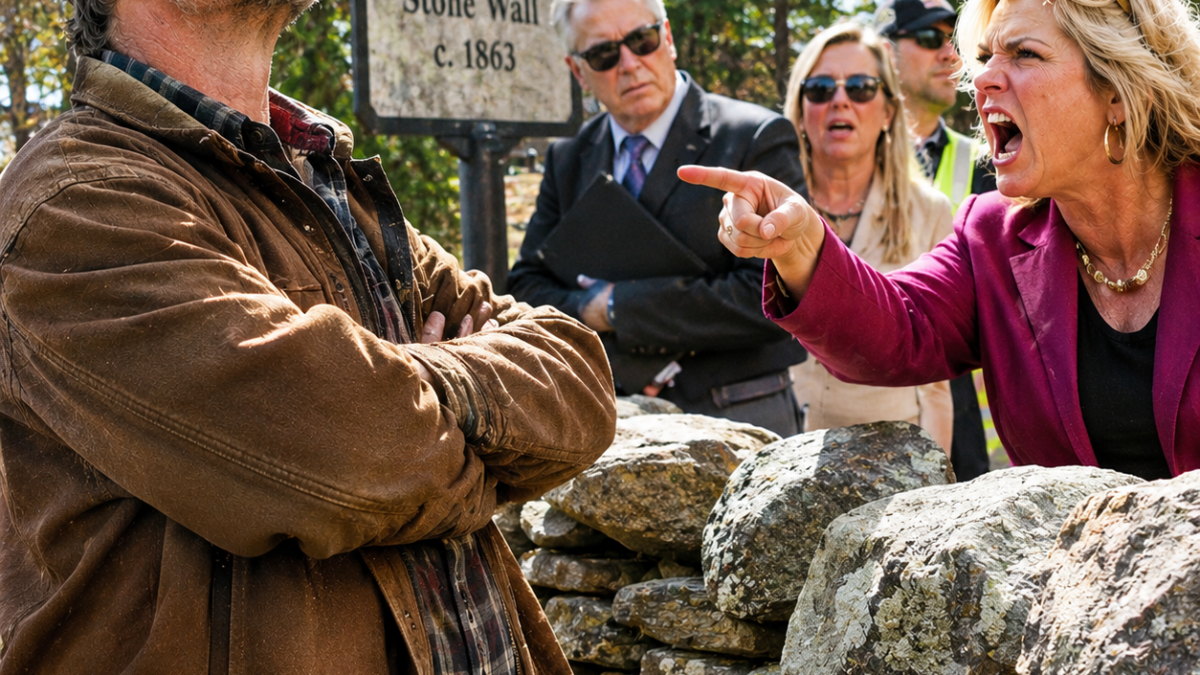
PART 2
The notation appeared on a survey Sarah and I had commissioned when we bought the property.
Our surveyor, Gus McAllister, was the kind of old professional who still carried a field notebook even though his crew used GPS equipment.
He had spent two days walking every line.
At the time, I thought he was just being thorough.
Now I studied the note he’d placed beside the wall.
**HISTORIC FIELDSTONE REVETMENT — CIRCA 19TH CENTURY — PRESERVE IN PLACE IF PRACTICABLE.**
Sarah leaned over my shoulder.
“I remember asking him about that.”
“What did he say?”
“That he thought it might be military.”
I looked at her.
“You never told me.”
“I did.”
“No.”
“You were arguing with the septic contractor.”
“That sounds possible.”
Sarah sat beside me.
For the next hour, we pulled everything we had.
Old photographs.
The Abernathy family papers given to us at closing.
A photocopied local history.
County maps.
Our title documents.
The property was the last remnant of the old Abernathy farm.
On one side of us lay Oak Ridge Estates.
New houses.
Sidewalks.
Cul-de-sacs.
On the other, land connected historically and geographically to the Kennesaw Mountain battlefield landscape.
That contrast had always been part of the property’s appeal.
Modern subdivision on one side.
History on the other.
The wall seemed to be the seam between them.
Sarah opened the county-history photocopy.
“There.”
A paragraph mentioned stone breastworks and improvised field fortifications constructed around farm lanes during troop movements associated with the Atlanta Campaign.
Not proof.
But enough to investigate.
I looked at the fine notice again.
One hundred dollars per day.
Something in me settled.
“First move?” Sarah asked.
“Reasonable.”
She laughed.
“You hate reasonable.”
“I am extremely reasonable.”
“You once returned a lawn mower because the owner’s manual had the wrong torque specification.”
“That was quality control.”
“That was Tuesday.”
I ignored her.
The next morning I drafted a letter.
No threats.
No insults.
I explained that the wall predated Oak Ridge Estates by more than a century.
I included:
The survey notation.
The county-history excerpt.
Property chronology.
Photographs.
I wrote:
**Given the documented age and potential historic significance of the structure, alteration should not occur until appropriate review has been completed.**
Then I gave Karen an exit.
I suggested the HOA treat the wall as a grandfathered feature rather than a violation.
It was polite.
Almost generous.
Certified mail.
Return receipt.
Then I waited.
For about ten days, nothing happened.
I allowed myself to believe somebody on the board had read my letter and told Karen to stop.
That was optimistic.
The response arrived two weeks later.
One page.
Template.
**APPEAL DENIED.**
Reason:
**Historical nature unverified and irrelevant to architectural compliance.**
Below that:
**Fine balance: $1,400.**
Sarah stared.
“Fourteen days.”
“Hundred a day.”
“They didn’t pause fines during review?”
“Apparently not.”
She read the line again.
“Unverified and irrelevant.”
I nodded.
“That’s what bothers you, isn’t it?”
“More than the money.”
She understood.
This wasn’t just a wall to us.
But even if it had been an ordinary wall, they had dismissed evidence without investigation.
No site visit.
No historian.
No request for documentation.
No hearing.
Just:
Irrelevant.
Sarah touched the paper.
“My students ask why history disappears.”
I looked at her.
“Usually because somebody thinks the old thing is inconvenient.”
That sentence stayed with me.
I moved the paperwork to my garage workbench.
War room.
I hated the phrase even as I used it.
Still, old habits.
I pinned Karen’s original notice to the corkboard.
Then the denial.
Fine.
Survey.
Map.
I created digital folders.
**CORRESPONDENCE**
**TITLE**
**HISTORICAL RESEARCH**
**HOA**
**LEGAL**
Every document scanned.
Every date logged.
I checked my state’s recording law before deciding how to handle future conversations.
I wouldn’t rely on memory if Karen decided later that she had never said something.
Then I started talking to neighbors.
Mrs. Gable lived east of us.
Eighty years old.
Widow.
Rose gardener.
Her home predated much of the surrounding development.
I found her clipping dead blooms.
“Mrs. Gable?”
She smiled.
“Jack.”
“Can I ask about the HOA?”
Her expression changed instantly.
“Oh dear.”
That told me enough.
“Karen?”
She lowered her voice.
“Is it Karen?”
“Yes.”
“She after the wall?”
“How did you know?”
“She has mentioned it.”
“Where?”
“Garden club. Mailbox. Everywhere.”
“What does she say?”
“That it makes Oak Ridge look rural.”
I stared.
“We are next to a national battlefield and old farmland.”
Mrs. Gable shrugged.
“Karen doesn’t like old.”
That was becoming clear.
Then Mrs. Gable told me her own stories.
Garden hose.
Birdbath.
Flower pots.
A warning because decorative garden edging didn’t match approved materials.
“Why stay?”
“My husband planted these roses.”
She looked at them.
“I won’t let her chase me out.”
A young military family had not been so fortunate.
Their son’s basketball hoop generated repeated notices.
Then fines.
Then threatened legal action.
Eventually they sold.
“Was the hoop permanent?”
“Portable.”
“Dangerous?”
“No.”
“Blocking traffic?”
“No.”
“Then why?”
She looked at me.
“Because Karen decided it didn’t belong.”
There was a pattern.
Not necessarily illegal.
Not every strict rule is harassment.
But selective obsession was different.
Mrs. Gable touched my arm before I left.
“Don’t let her win.”
“I don’t intend to.”
That evening, another envelope arrived.
New fines.
$1,600 more.
Then:
$500 failure-to-comply penalty.
$250 processing charge.
Total:
Over $3,700.
And a threat.
If I did not comply, the HOA would consider a lien and foreclosure remedies.
I read that twice.
Sarah stood in the kitchen doorway.
“What now?”
“They threatened the house.”
Her face went pale.
Not because we believed they could legally take it tomorrow.
Because once somebody starts throwing words like foreclosure into letters, the dispute enters a different emotional territory.
Our home was not abstract equity.
It was where Sarah had recovered after surgery two years earlier.
Where we had rebuilt a life after my retirement.
Where she had boxes of student letters.
Where my father’s tools sat in the garage.
Where we intended to stay.
Sarah sat down.
“I hate this woman.”
I nodded.
“I know.”
“You’re very calm.”
“I’m not.”
“Could’ve fooled me.”
I pushed the letter toward her.
“That’s why I’m documenting.”
The next morning, I called the county historical society.
Dr. Alister Finch answered.
Semi-retired professor.
Dry voice.
Very few wasted words.
Until I mentioned the wall.
“Where?”
I described the property.
He interrupted.
“The old Abernathy tract?”
“Yes.”
“Adjacent to Kennesaw battlefield holdings?”
“Yes.”
“What construction?”
“Dry-stacked fieldstone. About four feet high. Quarter mile.”
Silence.
Then:
“How intact?”
“Most of it.”
Another silence.
“Send photographs.”
His voice had changed.
I spent an hour photographing every section.
Full elevation.
Stone courses.
Corners.
Raised portions.
Tool marks.
Relationship to old road alignments.
Vegetation.
I sent the survey notation.
County-history excerpt.
Abernathy family story.
Finch called back before dinner.
“Mr. Callahan.”
“Jack.”
“This is interesting.”
“How interesting?”
“Potentially very.”
He had pulled wartime records.
Troop movement maps.
Engineering references.
A diary attributed to a Confederate engineering officer described fortifying farm lanes and stone lines in the area during operations in 1864.
Not every sentence could be matched precisely to my property.
But location.
Construction.
Orientation.
Age.
All aligned.
Finch said:
“This may be a surviving piece of field engineering.”
Sarah covered her mouth.
I had the phone on speaker.
“What does that mean legally?” I asked.
“It means don’t alter it.”
“I wasn’t planning to.”
“Good.”
“Karen is.”
“Who?”
“Long story.”
He sighed.
“I’d like to see it.”
He arrived two days later.
Khaki hat.
Old boots.
Camera.
Notepad.
Sarah walked with us.
Finch moved slowly along the wall.
He touched almost nothing.
Mostly looked.
Measured.
Photographed.
At several points, the stone line thickened.
He stopped at one.
“This isn’t random farm clearing.”
“Why?”
“Look at the geometry.”
I looked.
“This face is deliberately strengthened toward the road.”
He pointed toward a depression behind it.
“Possibly firing position.”
Sarah whispered:
“My God.”
Finch didn’t dramatize.
“Might be.”
He continued.
“Need archival confirmation.”
We walked another hundred yards.
He found tool marks.
Construction differences.
Sections integrated into natural grade.
Finally:
“I am comfortable saying this is historically significant.”
“How significant?”
“At minimum, a rare surviving nineteenth-century landscape feature associated with the Civil War-era use of this tract.”
“And at maximum?”
He looked toward the battlefield land.
“A military fieldwork connected to the Atlanta Campaign.”
That was enough.
He wrote an attestation for the county historical society.
Four pages.
Careful language.
No hype.
Evidence.
Location.
Physical characteristics.
Likely period.
Recommended preservation.
Sarah read it twice.
“She called it irrelevant.”
I looked at the wall.
“Not anymore.”
Next call:
Dave Riley.
We had served together.
Army Corps.
Iraq.
Two young officers who learned quickly that the difference between a bridge opening and a bridge becoming a disaster was usually paperwork nobody wanted to complete.
Dave later went to law school.
Atlanta practice.
Complex civil litigation.
Regulatory work.
I hadn’t spoken to him in years.
He answered:
“Jack Callahan.”
“Dave.”
“I assumed you were dead.”
“Good to hear you too.”
“What did you do?”
“HOA.”
Silence.
Then laughter.
“The man who negotiated construction access through a village under mortar threat is losing to suburban landscaping?”
“Stone wall.”
“Even better.”
I explained.
He stopped laughing.
“Send me everything.”
That evening he called.
Tone different.
Professional.
“First, stop talking to the HOA directly.”
“Already mostly stopped.”
“Good.”
“Second?”
“Don’t pay.”
“I wasn’t going to.”
“Third, do not touch that wall.”
“Obviously.”
“Fourth, we need to separate what we know from what we’re hoping.”
I appreciated that.
“What do we know?”
“It’s old.”
“Yes.”
“Your survey identifies it as historic.”
“Yes.”
“Historical society believes it is connected to Civil War military activity.”
“Yes.”
“HOA has received evidence and is continuing fines.”
“Yes.”
“What we do not yet know is the exact scope of state or federal protection.”
The source of my confidence shifted.
“That matters.”
“Very much.”
Dave continued.
“A National Register connection or preservation review isn’t magic that automatically turns every private dispute into a federal case.”
I nodded even though he couldn’t see me.
“So?”
“So we get the right agencies involved instead of bluffing.”
That was Dave.
No fantasy law.
No dramatic nonsense.
Process.
He drafted a formal cease-and-desist.
It identified the wall as a potentially significant cultural resource under active historical review.
Demanded suspension of fines.
Demanded no alteration.
Warned that any lien or enforcement action intended to compel destruction could expose the association to civil liability and potentially interfere with preservation processes if formal eligibility or other protections were established.
He copied every board member.
HOA counsel.
Management company.
Historical society.
Certified.
Sarah read it.
“This is less dramatic than what I wanted.”
“Law is usually less dramatic.”
“Could Dave add something about Karen being an idiot?”
“No.”
“Shame.”
Dr. Finch’s report went with it.
For seven days:
Silence.
Then Karen scheduled an emergency board meeting.
Subject:
**LEGAL ACTION REGARDING NON-COMPLIANT LOT 72**
My property.
Dave called.
“She didn’t.”
“She did.”
“I’m coming.”
Sarah asked:
“Can I?”
“Absolutely.”
The clubhouse was packed.
Thirty? Forty? Maybe more.
Karen sat center.
Four other directors.
One I recognized:
Mark Ellis.
Engineer.
Quiet.
He looked uncomfortable before the meeting started.
Karen opened with community standards.
Property values.
Dangerous precedent.
Rules must apply equally.
Interesting concept considering my property arguably wasn’t bound the same way.
She never mentioned Dr. Finch.
Never mentioned the certified notice.
Never mentioned potential historical significance.
Then she announced:
“The board is considering retaining litigation counsel and filing a lien against Lot 72.”
My pulse quickened.
Not fear exactly.
Recognition.
The moment Dave had predicted.
Karen looked toward me.
“Mr. Callahan, you requested to address the board.”
Actually, I hadn’t.
But I stood.
“My name is Jack Callahan.”
I held one folder.
“This wall was built approximately in the Civil War era.”
Murmurs.
Karen interrupted.
“Allegedly.”
I held up Finch’s letter.
“Dr. Alister Finch of the county historical society has examined the structure and documented its significance.”
I handed copies to the board.
Mark Ellis read immediately.
The others barely looked.
Karen said:
“This does not alter the wall-height covenant.”
I asked:
“Does the wall-height covenant apply to structures predating the HOA?”
“Our counsel—”
“Does it?”
She didn’t answer.
I continued.
“Ten days ago, your board received a formal legal notice advising you not to pursue alteration while historic review is ongoing.”
Karen snapped:
“We will not be intimidated by legal theatrics.”
I looked toward the homeowners.
“That’s exactly why I’m here.”
Then back to board.
“If you vote to spend association money pursuing a lien tonight, every homeowner deserves to know you are doing so after receiving expert evidence that the structure may be a historically significant battlefield resource.”
People shifted.
A man in the audience said:
“Wait. Battlefield?”
Karen banged her gavel.
“No audience interruptions.”
I said:
“The property borders Kennesaw Mountain battlefield land. Historical documentation links the old Abernathy tract to 1864 military operations.”
Another homeowner:
“You never told us that.”
Karen’s face reddened.
“This is irrelevant.”
Mark Ellis looked up.
“No, it isn’t.”
First crack.
Karen turned.
“Mark?”
He lifted Finch’s letter.
“We should have this independently reviewed before litigation.”
Karen stared.
“We already voted on enforcement policy.”
“Not on this evidence.”
The accountant beside Karen began reading.
The retired car salesman glanced toward the audience.
Karen sensed control slipping.
She pushed harder.
“This is a simple bylaw dispute.”
I said:
“Then why not pause thirty days?”
“Because rules become meaningless when people refuse compliance.”
I almost admired the purity of it.
No curiosity.
No caution.
No distinction between preserving order and protecting ego.
Karen called the vote.
Legal action.
Lien.
Continue fines.
Her hand went up.
Her closest ally followed.
The car salesman hesitated.
Then yes.
Accountant hesitated longer.
Yes.
Mark:
No.
Four to one.
Gavel.
“Motion passes.”
Dave was sitting beside Sarah.
He leaned toward me.
Very quietly:
“There it is.”
Outside, he looked almost cheerful.
“What?”
“They were warned.”
“I know.”
“They had evidence.”
“I know.”
“And they created a public vote.”
“Yes.”
Dave smiled without humor.
“Good.”
The next morning, we filed preservation inquiries and complaints with the appropriate state offices.
Dr. Finch added documentation.
Detailed photographs.
Survey.
Archival references.
Property location.
HOA correspondence.
We requested formal assessment of the wall’s historical significance and guidance on preservation.
Then Dave sent another letter to HOA counsel.
This one was shorter.
**Your client has now voted to pursue coercive action after formal notice of an active historical-resource review. Preserve all records.**
No insults.
No threat of federal agents kicking down doors.
Just facts.
A week passed.
Then another envelope arrived.
Law firm.
Lien notice.
Amount:
$5,850.
I stared.
Sarah saw my face.
“They did it?”
“Yes.”
She sat beside me.
For the first time since the fight began, my hands were shaking.
Not from fear of losing the house immediately.
Dave was already challenging the filing.
But because someone had placed a legal cloud over our property over an old wall they refused to understand.
Sarah took my hand.
“Jack.”
“I know.”
“No.”
She squeezed harder.
“Look at me.”
I did.
“Don’t make this destroy the reason we bought this place.”
That hurt because she was right.
For weeks, the wall had become conflict.
Documents.
Fines.
Karen.
Law.
I had stopped walking it because I enjoyed it.
I walked it to inspect evidence.
“I hate that she did that.”
Sarah nodded.
“So win without giving her the land in your head.”
I smiled faintly.
“You sound like Finch.”
“I teach teenagers.”
“More dangerous than litigation.”
“Exactly.”
I scanned the lien letter.
Sent it to Dave.
His response:
**Got it. Don’t panic.**
Then:
**Also, she’s making this much easier.**
The state preservation office called the next day.
Dr. Evelyn Reed.
Professional.
Measured.
“We’ve reviewed the initial materials.”
“And?”
“Compelling enough for field assessment.”
“When?”
“Tomorrow, if you’re available.”
“I’ll be here.”
Sarah stayed home from work.
Not because she needed to.
Because there was no chance a history teacher was missing this.
A government sedan arrived at nine.
Two people.
Michael Harris.
State preservation field specialist.
Dr. Claire Miles.
Archaeologist.
They started at the road.
No dramatic pronouncement.
No immediate declaration.
Real experts don’t behave that way.
Measurements.
Photographs.
GPS points.
Stone construction.
Orientation.
Tool marks.
Terrain.
Historic road alignment.
Dr. Miles spent almost fifteen minutes at a raised section.
“What do you see?” I asked.
She pointed.
“Intentional strengthening.”
“For what?”
“Could be defensive use.”
“Military?”
“Possibly.”
She looked toward the battlefield landscape.
“Location makes it very plausible.”
Sarah stood a few feet away.
Eyes shining.
Dr. Miles continued.
“Farm walls were frequently incorporated into field fortifications. Sometimes strengthened. Sometimes extended.”
She touched one stone lightly.
“If this survives from that period with this integrity, it’s remarkable.”
We walked almost the full quarter mile.
Then:
Golf cart.
I heard it before I saw Karen.
She stopped near the driveway.
“What is going on?”
Harris walked toward her.
“Good morning.”
“Who are you?”
He identified himself.
Karen looked at him.
Then at the equipment.
“This is private HOA business.”
Harris glanced at me.
“Is this your property, Mr. Callahan?”
“Yes.”
He looked back at Karen.
“Then this is a site assessment requested by the property owner and historical professionals.”
Karen pointed at the wall.
“That structure violates Oak Ridge covenants.”
Dr. Miles looked up.
Harris remained calm.
“Our office is assessing potential historical significance.”
“It’s four feet high.”
“Yes.”
“Allowed height is two.”
Harris paused.
“Ma’am, HOA dimensional standards are not the subject of our assessment.”
Karen’s face tightened.
“You’re saying they don’t matter?”
“I am saying we’re evaluating the resource.”
Then:
“We strongly recommend no alteration while that evaluation is pending.”
Karen crossed her arms.
“The board has already acted.”
“That is something your legal counsel should discuss with you.”
She looked toward me.
“This is ridiculous.”
I didn’t answer.
Harris did.
“Preservation review is not unusual.”
Karen pointed at the wall again.
“It’s rocks.”
Dr. Miles finally spoke.
“So is Fort Sumter.”
Sarah covered a smile.
Karen stared.
Dr. Miles continued, professionally:
“Material simplicity doesn’t determine historical value.”
Karen had no answer.
She got back into the cart.
Drove away.
For the first time, I saw fear.
Not because anyone threatened her.
Because the argument had entered a field she couldn’t control through volume.
One week later, preliminary findings arrived.
The wall had strong historical significance.
State preservation officials supported its eligibility for formal historic recognition.
They recommended preservation in place.
The HOA’s counsel received the same information.
More importantly, Dave’s title challenge attacked the lien.
The association’s basis was questionable.
The wall predated the subdivision.
My property status differed from ordinary Oak Ridge lots.
The board’s enforcement theory was shaky even before history entered the picture.
Then the HOA’s lawyer did something Karen didn’t expect.
He asked for an emergency executive session.
Mrs. Gable called me afterward.
“They’re fighting.”
“How do you know?”
“They came out of the clubhouse yelling.”
“Mrs. Gable.”
“I was watering roses.”
“At nine at night?”
“My roses have flexible schedules.”
I laughed.
She continued.
“The accountant looked terrified.”
“Anything else?”
“Karen threw papers into her golf cart.”
Reasonable sign of progress.
Then Mark Ellis called.
First board member to do so.
“Jack.”
“Mark.”
“I owe you an apology.”
“You voted no.”
“I was on the board before that.”
Fair.
“What happened?”
“Our attorney reviewed the title documents and preservation findings.”
“And?”
“He wants the lien withdrawn.”
My shoulders loosened.
“Karen?”
“Refuses.”
“What does the rest of the board say?”
“The salesman wants out. Accountant wants out. Karen’s ally still supports her.”
“What about you?”
“I want a special homeowners meeting.”
I leaned back.
“That’s your community.”
“I know.”
Then Mark said:
“People need the facts.”
He was right.
So we held an information session.
Not a coup.
Not a revenge rally.
Facts.
Sarah stood beside me.
Dave attended.
Dr. Finch provided a short written statement.
The clubhouse was standing-room only.
I presented everything chronologically.
First notice.
Photograph.
My response.
Denial.
$1,400.
$3,700.
Foreclosure threat.
Finch report.
Legal notice.
Emergency meeting audio.
Four-to-one board vote.
Lien.
Historic assessment.
Projected legal costs.
No insults.
I didn’t need them.
The documents were enough.
People listened to Karen’s voice from the recorded meeting.
“The historical claim is irrelevant.”
Then:
“All in favor?”
Hands.
Votes.
Gavel.
After the recording ended, silence.
A man near the back stood.
“So they knew?”
I answered.
“They knew there was a documented historical claim and pending review.”
“And still filed the lien?”
“Yes.”
Karen sat near the front.
She jumped up.
“This is character assassination!”
Mark Ellis stood.
“No, Karen.”
She turned.
He had copies of board minutes.
“This is the record.”
“You voted against me.”
“I voted against litigation.”
“You betrayed the board.”
“No.”
He looked around.
“I finally acted like a director.”
That line changed the room.
Another homeowner asked:
“How much could this cost us?”
Dave answered carefully.
“Depends what happens next.”
“Could homeowners get assessed?”
“If litigation grows and insurance or reserves don’t cover expenses, associations can face financial pressure.”
People stared at Karen.
She pointed toward me.
“He could end this by lowering the wall.”
Sarah stood.
For most of the conflict, she’d let me speak.
Not then.
“Lower it?”
Karen turned.
Sarah walked forward.
“My name is Sarah Callahan.”
Her voice was gentle.
Teacher voice.
Which meant nobody escaped.
“This wall stood before any of us were born.”
Silence.
“You have now been shown evidence that people who lived and died during the Civil War used this land.”
Karen opened her mouth.
Sarah continued.
“And your solution is still to destroy part of it because your binder says two feet?”
Karen snapped:
“Rules are rules.”
Sarah stared at her.
“No.”
The room became absolutely still.
“Rules are tools.”
She pointed toward the wall beyond the clubhouse.
“They are supposed to protect a community.”
Then toward the homeowners.
“They are not supposed to make a community stupid.”
I had married well.
People applauded.
Karen shouted over them.
“Unsanctioned meeting!”
Someone yelled:
“Recall her!”
Another:
“Resign!”
Mark raised his hand.
“Stop.”
The room settled.
“I have already drafted a recall petition under the bylaws.”
Karen went pale.
“We need signatures from fifty-one percent of owners.”
Hands started going up before he finished.
The petition moved quickly.
Seventy percent in forty-eight hours.
The association’s lawyer advised withdrawal.
Karen still resisted.
Dave sent final settlement terms.
Not obscene punitive demands.
Practical ones.
Remove lien.
Erase fines.
Written apology.
Association pays reasonable legal costs related to correcting the improper lien.
Board members involved in the enforcement step aside or face recall.
Historic-resource policy adopted after proper consultation.
No further interference with the wall.
Karen called it extortion.
Her own attorney reportedly called it “an opportunity to avoid expensive litigation.”
A special meeting happened one week later.
I sat in the audience.
Sarah beside me.
Karen at the table.
She looked tired.
Not defeated theatrically.
Just tired.
The accountant resigned first.
Then salesman.
Then Karen’s ally.
Karen remained.
Mark sat at the far end.
The management representative read recall status.
Enough signatures.
Vote inevitable.
Karen finally unfolded a letter.
She read:
“I hereby resign as president and director of the Oak Ridge Estates Homeowners Association, effective immediately.”
No speech.
No accusation.
No apology.
Just resignation.
She set the page down.
Walked out.
Nobody cheered.
A few people clapped.
Mostly there was exhalation.
Like a storm had passed.
Mark became interim president.
His first act was to read a formal apology.
“Mr. and Mrs. Callahan, on behalf of Oak Ridge Estates, the board acknowledges that the association’s handling of the stone-wall matter was improper, unnecessarily adversarial, and harmful.”
Sarah squeezed my hand.
“The association has authorized immediate release and removal of the lien and expungement of all associated fines and fees.”
Applause.
“The board further commits to working with qualified preservation professionals before taking action affecting documented historic resources.”
Then Mark looked at me.
Not reading anymore.
“I’m sorry, Jack.”
I nodded.
“Thank you.”
That was enough.
Dave leaned over.
“You know you could still sue.”
“I know.”
“Want to?”
I looked around.
Mrs. Gable.
Mark.
Families.
People who had finally shown up.
“No.”
Dave studied me.
“Sure?”
“Yes.”
“What about fees?”
“They cover our legal cost and title cleanup.”
“Anything else?”
“No.”
“Punitive damages?”
“No.”
He smiled.
“Age softened you.”
“Sarah did.”
“Same thing.”
The lien was formally released.
I drove to the county records office myself to verify.
I wanted to see the document.
**RELEASE OF LIEN.**
Recorded.
Stamped.
Done.
I stood outside the building for several minutes afterward.
For weeks, Karen’s letters had made our home feel vulnerable.
Now title was clean.
Wall untouched.
I called Sarah.
“It’s gone.”
“The lien?”
“Yes.”
She went quiet.
Then:
“Come home.”
I did.
We walked the wall.
Not inspecting.
Not photographing.
Just walking.
That was when I realized how much conflict had changed my relationship with it.
Before Karen, I’d seen beauty.
During Karen, evidence.
Now I wanted beauty back.
Sarah ran her fingers over the stones.
“Think about the hands that touched these.”
“Soldiers?”
“Farmers too.”
“Probably.”
“Children.”
“Probably.”
“People repairing it.”
“Yes.”
She looked at me.
“History isn’t pure, Jack.”
I knew what she meant.
The men associated with the Confederate Army fought for a cause inseparable from slavery and secession.
Preserving their fieldwork did not require celebrating their cause.
A battlefield artifact wasn’t a monument of approval.
It was evidence.
Something that survived.
A place to learn from.
Sarah said:
“If we’re going to preserve it, we tell the whole story.”
I nodded.
“Absolutely.”
That became important during the designation process.
Dr. Finch brought more research.
Union movements.
Confederate defensive withdrawals.
Civilian farms caught between armies.
The Abernathy family.
Enslavement records tied to the wider county.
Postwar farming.
Road development.
The wall wasn’t reduced to “Confederate wall.”
It became part of a larger landscape story.
Conflict.
Labor.
Civilian life.
Military engineering.
Memory.
A year of paperwork followed.
Forms.
Photographs.
Research.
Maps.
Historical-context statements.
Review.
Consultation.
I thought HOA paperwork was tedious.
Historic-preservation paperwork made Karen look like an amateur.
Sarah loved every minute.
She filled our dining table with books.
Sticky notes.
Maps.
“Dinner?”
“Move the 1864 campaign atlas.”
“You’re enjoying this.”
“Very much.”
The wall eventually received formal historic recognition.
The day the confirmation arrived, Sarah cried.
I didn’t.
Until later.
I found her in the study holding the letter.
“She tried to make you cut it in half.”
“Yep.”
“And now…”
She couldn’t finish.
I looked out the window.
The wall ran across the edge of the property in afternoon light.
Still four feet.
Still crooked.
Still moss-covered.
Exactly what Karen called ugly.
I finally understood Sarah’s tears.
The fight had transformed vulnerability into permanence.
Not literally forever.
Nothing is forever.
But legally.
Historically.
Socially.
The wall had become harder to erase.
Oak Ridge changed too.
Mark was elected president properly.
Not interim.
His campaign slogan should have been:
**PLEASE STOP YELLING.**
He didn’t have a slogan.
Good.
The new board reviewed enforcement policies.
Fines needed clear authority.
Appeals required genuine hearings.
Board members with conflicts recused themselves.
No more using legal threats as first contact.
Most importantly, they created a historic-resource policy.
At first they called it the Callahan Amendment.
I objected.
“Absolutely not.”
Mark laughed.
“Residents like it.”
“I don’t.”
“Democracy.”
“I’m not in your HOA.”
“Exactly why we’re naming it after you.”
Sarah loved this.
Traitor.
Eventually the board formally adopted a preservation-review provision.
If potentially historic structures or features were involved, the association had to investigate before ordering alteration.
No automatic exemption.
No magical blanket protection.
Just due diligence.
Reasonable.
Mrs. Gable said:
“Look at that. You taught them to read.”
“I didn’t.”
“Someone did.”
Her birdbath remained.
Nobody cared.
The old military family with the basketball hoop had already moved.
That bothered me.
You can fix policy.
You can’t undo every person who got exhausted before the fix arrived.
Mark tried to contact them.
Sent an apology.
Refunded some disputed charges where records supported it.
They replied politely.
Did not move back.
Consequences have residue.
That’s another thing revenge stories don’t show enough.
Removing a bully doesn’t reverse time.
The community had work to do.
They did.
Summer block party.
Open meetings.
Financial reports.
People attended.
Slowly, fear faded.
Karen and her husband listed their home.
Mrs. Gable reported that before the sign even went up.
Of course she did.
I saw Karen once before they left.
I was checking a loose stone near the road.
A sedan slowed.
Her husband driving.
Karen passenger.
Our eyes met.
For months I’d imagined that moment.
In my head, I always said something devastating.
Maybe:
“Still four feet.”
Maybe:
“How are the property values?”
Maybe nothing.
Reality chose nothing.
I stood.
She looked.
For the first time, she looked tired rather than angry.
No clipboard.
No golf cart.
No audience.
I nodded.
Small.
Final.
She looked away.
Car continued.
Sarah had watched from the porch.
“You didn’t say anything.”
“No.”
“I’m proud of you.”
“That’s insulting.”
She smiled.
“Would’ve been easy.”
“Yes.”
“What were you going to say?”
“Something immature.”
“Which means?”
“Classified.”
They moved.
A younger family bought the house.
Two children.
Dog.
The first summer, they put up a basketball hoop.
I noticed.
Sarah noticed me noticing.
“Don’t.”
“I didn’t say anything.”
“You were smiling.”
“Wasn’t.”
“You were.”
Maybe.
The formal plaque for the wall became another debate.
Dr. Finch wanted interpretation.
State preservation staff agreed.
I wanted nothing large.
No giant monument.
No tourist attraction in our front yard.
Sarah proposed a small bronze marker.
Simple.
Factual.
We worked on wording carefully.
No romantic mythology.
No Lost Cause nonsense.
No pretending the Civil War was just uniforms and tactics.
The plaque identified the wall as part of a Civil War-era military landscape associated with the Atlanta Campaign.
It noted that soldiers used and reinforced stone features as temporary defensive works.
It also directed visitors toward broader battlefield interpretation.
History.
Not celebration.
The dedication was held on a Saturday morning.
I expected thirty people.
Nearly the whole neighborhood came.
Mrs. Gable sat front row wearing a hat large enough to require its own zoning variance.
Mark spoke first.
“Last year, most of us saw this as somebody else’s wall.”
He looked at me.
“Some of us barely knew it existed.”
Then:
“Today we understand it as part of the landscape we share.”
Dr. Finch spoke about field engineering.
How armies used terrain.
How existing farm walls became tactical assets.
How quickly temporary wartime structures usually disappeared afterward.
Weather.
Agriculture.
Road building.
Development.
The fact that this one survived with such integrity was unusual.
Then Sarah spoke.
I hadn’t known she planned to.
She stood beside the plaque.
“As a teacher, I spend a lot of time telling students that history is not the same thing as nostalgia.”
The crowd quieted.
“History includes things we are proud of and things we are not.”
She looked toward the wall.
“This structure is associated with a Confederate army fighting during a war centered on slavery, secession, and the survival of the United States.”
Nobody shifted away.
Good.
“Preserving the wall does not mean celebrating that cause.”
She touched the plaque.
“It means preserving evidence.”
Then:
“So future generations can ask what happened here, who lived here, who fought here, what they believed, what the war cost, and what came afterward.”
I looked at Sarah.
Still falling in love after all these years.
When it was my turn, I had nothing better than what she had said.
So I kept it short.
“When Karen first told me the wall was an eyesore, I thought this fight would be about property rights.”
A few people smiled.
“It became about something bigger.”
I looked toward the neighbors.
“Not because the wall made us a community.”
Pause.
“Because learning to listen to one another did.”
I pointed toward the stones.
“This wall was built in a time of national division.”
Then:
“I’m glad its preservation became an excuse for people here to become less divided.”
That was enough.
Afterward, residents walked the edge.
Children touched stones.
Parents read the marker.
Questions.
Lots of questions.
One child asked Finch:
“Did the soldiers live here?”
“Temporarily.”
“Were they good guys?”
Every adult got quiet.
Finch smiled gently.
“History is usually more complicated than that.”
Sarah almost applauded.
The boy asked:
“Did they win?”
“Not the war.”
The child nodded.
Then ran toward the lemonade table.
Simple.
Human.
The wall became a teaching object.
Not a shrine.
That was exactly right.
Later, when the crowd thinned, Sarah and I walked the length.
Sun low.
Bronze plaque catching light.
She held my hand.
“You know what I hate admitting?”
“What?”
“Karen helped.”
I stopped.
“No.”
“In a terrible accidental way.”
“No.”
“If she hadn’t done all this, would you have called Finch?”
I stared.
“No.”
“Would we know what the wall actually was?”
“Probably not.”
“Would it have formal protection?”
“No.”
“Would Oak Ridge have changed its policies?”
“Maybe eventually.”
She smiled.
“Jack.”
“Fine.”
“Say it.”
“Absolutely not.”
She laughed.
“You owe Karen a thank-you card.”
“I would rather cut the wall to twenty-four inches.”
Sarah laughed so hard she had to stop walking.
That became a joke between us.
Whenever something good came from the ordeal:
“Thank Karen.”
“No.”
Years passed.
The wall settled in places.
Historic doesn’t mean maintenance-free.
Preservation specialists taught us what to do.
No cement smeared everywhere.
No modern reconstruction pretending to be old.
Document.
Stabilize.
Use compatible methods.
Respect original fabric.
I learned more about stone than I ever expected.
A preservation mason named Luis helped reset a collapsed section.
He worked slowly.
Studied each stone.
“You can’t force old walls.”
“Why?”
“They already know where they want to sit.”
I liked that.
He showed me how weight traveled through the irregular stones.
Friction.
Gravity.
Balance.
No mortar.
Every piece relying on others.
I thought about Oak Ridge.
Didn’t tell him.
Too sentimental.
Mrs. Gable died at eighty-seven.
Sarah and I attended the funeral.
Her niece found me afterward.
“Aunt Margaret wanted you to have this.”
A small garden ornament.
The infamous birdbath violation?
No.
Worse.
A stone gnome.
I laughed.
“Why?”
“She said it would irritate the old HOA president wherever she is.”
“That sounds like her.”
I placed the gnome near our garage, not the historic wall.
Even I had limits.
Mark remained president for four years.
Then stepped down voluntarily.
That alone proved progress.
His replacement was Daniel Hart.
Attorney.
Quiet.
He introduced term limits.
Budget transparency improved.
Enforcement complaints decreased.
Not because rules vanished.
Oak Ridge still had standards.
Fence heights.
Parking.
Common property.
Architectural review.
Some homeowners hated decisions.
Normal.
What changed was procedure.
No one person’s dislike automatically became a violation.
One afternoon Daniel called.
“We have a wall issue.”
My stomach tightened.
He laughed.
“Not yours.”
“Then why call?”
“A homeowner wants to build a replica stone wall.”
I groaned.
“Why?”
“Because yours looks good.”
“That is the funniest thing I’ve heard all month.”
“Architectural committee approved thirty inches.”
“Karen would haunt you.”
“We considered that.”
History had become property value.
Irony has a sense of humor.
Tourists occasionally stopped after the wall appeared on local heritage materials.
We limited access.
Private property.
View from designated area.
No climbing.
No collecting stones.
One man tried to remove a small rock as a souvenir.
I stopped him.
“But it’s just a loose stone.”
“So put it down.”
“There’s thousands.”
“Put it down.”
He did.
For once I understood Karen’s instinct to control something.
The trick was applying it to legitimate protection rather than ego.
Sarah retired from teaching.
Her first project?
A local history booklet about the Abernathy farm landscape.
Of course.
She interviewed older residents.
Studied land records.
Included postwar agriculture.
Reconstruction.
Changes in ownership.
Roads.
Black farming communities in the wider county.
Veterans.
Development.
The wall became one chapter.
Not the whole story.
When she finished the manuscript, she put it on my desk.
Title:
**STONES BETWEEN ERAS**
I stared.
“You wrote a book.”
“Booklet.”
“It’s eighty pages.”
“Teachers don’t retire. We expand.”
It became popular locally.
The historical society sold copies.
Sarah donated proceeds to battlefield education.
One evening, we sat on the porch.
She said:
“Remember when we thought the wall was built by Hood’s men?”
“I remember.”
“Research suggests the exact unit is less certain.”
“Finch said that.”
“I’m glad.”
I looked at her.
“Why?”
“Because certainty is tempting.”
That was one of the deepest lessons of the entire fight.
Karen had been certain.
Wall too tall.
Violation.
History irrelevant.
Authority absolute.
Then I became certain in the opposite direction.
Federal protection.
Confederate builders.
Massive consequences.
Dave forced me to slow down.
Experts refined the story.
The wall was real.
Significant.
Historically connected.
But the details needed evidence.
Good preservation wasn’t built on replacing Karen’s overconfidence with mine.
It was built on investigation.
Years later, a graduate student came to study the wall.
She used ground-penetrating radar nearby.
Historical maps.
Artifact distribution.
Her thesis suggested sections of the wall had been older farm boundaries later modified during military activity.
Sarah loved that.
“So both stories were true.”
“Which?”
“Farm wall and battlefield wall.”
I nodded.
“History layered.”
Exactly.
The wall was not created in a single dramatic afternoon by one unit.
Some stones may have been there before the armies.
Soldiers adapted it.
Farmers repaired it after.
Owners maintained it.
Road workers avoided it.
We preserved it.
Every generation added a chapter.
That made it more meaningful, not less.
One day, a new Oak Ridge resident stopped while I was near the plaque.
“Mr. Callahan?”
“Jack.”
“My realtor told me this wall made the neighborhood famous.”
I laughed.
“That sounds expensive.”
“She said it increases character.”
“Karen would’ve loved hearing that.”
“Who?”
I paused.
Then smiled.
“Nobody important.”
That was when I knew the fight was truly over.
Karen had become irrelevant even to the story she accidentally triggered.
The wall remained.
The community remained.
New residents didn’t know her.
Good.
No bully deserves permanent ownership of the place they harmed.
Sarah and I aged.
The wall didn’t seem to.
Of course it did.
Lichen grew.
Stones shifted.
Trees changed.
But compared with us, it looked permanent.
My knees complained on the quarter-mile walk.
Sarah started carrying a cane.
We still went.
At the halfway point, we added a small bench well back from the wall.
Not historic.
Very comfortable.
One autumn afternoon, Sarah sat there looking at the stones.
“You know what this is?”
“A wall.”
“Don’t be difficult.”
“It’s my strongest skill.”
She pointed.
“Memory with weight.”
I considered.
“Teacher phrase.”
“Yes.”
“Good one.”
“Thank you.”
Then she looked at me.
“What happens after us?”
Estate planning.
We’d discussed it.
No children.
Nieces and nephews.
Some interested in land.
Some not.
We didn’t want the property subdivided into lots with the wall as decorative landscaping.
So we worked with preservation and conservation groups.
Easements.
Restrictions.
Future stewardship.
Access provisions.
Maintenance obligations.
More paperwork.
Dave, now mostly retired, reviewed documents.
“I thought this stupid wall case was finished.”
“You missed me.”
“Deeply.”
We protected the historic corridor.
Not every acre.
The house remained usable.
Land retained value.
But the wall couldn’t simply be bulldozed by a future owner for convenience.
That mattered.
One afternoon Dave visited.
We walked.
He touched a stone.
“I still can’t believe you called me over an HOA.”
“I didn’t call you first.”
“That hurts.”
“You laughed.”
“Because it was funny.”
“Karen threatened foreclosure.”
“Eventually not funny.”
He looked toward Oak Ridge.
“Best case I never filed.”
“What?”
“We settled.”
“Exactly.”
“No courtroom.”
“No jury.”
“No big verdict.”
“No.”
He smiled.
“Still satisfying.”
“More.”
Why?
Because litigation wasn’t the point.
Keeping the wall was.
Cleaning title was.
Changing governance was.
Learning history was.
Getting revenge would’ve been temporary.
Preservation lasted.
Karen’s old house changed owners again.
The young family moved for work.
New owners arrived.
Retired couple.
They came to the wall dedication anniversary.
No idea who Karen was.
Again:
Perfect.
At the tenth anniversary of designation, the historical society held a small event.
Finch was much older.
Cane.
Still sharp.
Dr. Miles attended.
Mark.
Daniel.
Mrs. Gable gone.
Dave complained about the heat.
Sarah spoke briefly.
I refused.
Then a local high school student approached.
“Mr. Callahan?”
“Yes?”
“I’m doing a project on Civil War memory.”
Dangerous words.
“Okay.”
“Can I interview you?”
“About the wall?”
“And the HOA.”
I groaned.
Sarah volunteered me.
The student asked:
“Did you ever hate Karen?”
I thought.
“Yes.”
Sarah looked surprised by the honesty.
The student continued.
“Do you still?”
“No.”
“Why?”
“Too much work.”
She laughed.
I didn’t.
“Hating someone keeps them involved.”
I pointed toward the wall.
“She left years ago.”
Then:
“The wall didn’t.”
The student wrote that down.
I hoped she’d use the second sentence.
She asked:
“Do you think Karen was evil?”
“No.”
That surprised everyone.
“What was she?”
“Wrong.”
“Just wrong?”
“Wrong, arrogant, controlling, unwilling to admit uncertainty.”
I paused.
“That’s enough to hurt people without turning somebody into a cartoon villain.”
That answer came with age.
During the fight, Karen was the enemy.
Later, she became a warning.
Ordinary people can become dangerous when tiny authority meets deep insecurity.
She needed control.
The board gave it.
Neighbors avoided conflict.
Her behavior escalated.
No grand conspiracy required.
Just incentives.
Silence.
Fear.
That was a more useful lesson.
The student asked:
“What should the homeowners have done sooner?”
“Showed up.”
“To meetings?”
“Yes.”
“That’s it?”
“Mostly.”
I smiled.
“Democracy is often ruined by boring Tuesday nights.”
She laughed.
Oak Ridge started averaging thirty residents at annual meetings after Karen.
Then twenty.
Then fifteen.
Normal apathy returned gradually.
Mark warned them.
“Don’t make us learn this twice.”
The board eventually livestreamed meetings.
Published minutes.
Electronic voting where lawful.
Made participation easier.
That helped.
One year, a new president proposed tightening landscaping rules.
Residents debated.
Some approved.
Some opposed.
They voted.
Nobody called anyone a tyrant.
Amazing.
The wall remained outside most HOA business because title and jurisdiction were finally clear.
That clarity alone prevented future nonsense.
I framed the lien-release document.
Sarah asked why.
“Reminder.”
“Of Karen?”
“No.”
“Then?”
“To verify title.”
She rolled her eyes.
Army engineer romance.
Years later, Sarah got sick.
Not sudden.
Cancer.
Different from anything we’d fought before.
No enemy to outplan.
No binder that fixed it.
No board vote.
No cease-and-desist.
Treatment.
Appointments.
Good months.
Bad weeks.
The wall became part of our routine.
When she had strength, we walked.
When she didn’t, we sat near the beginning.
One afternoon she touched the plaque.
“I’m glad we didn’t make this about glory.”
“What?”
“The history.”
I understood.
“Me too.”
“Promise me it’ll stay educational.”
“It will.”
“No Confederate flags.”
“Absolutely not.”
“No people turning it into some romantic nonsense.”
“I promise.”
She smiled.
“Good.”
Months later, she became too weak to walk.
I brought a folding chair near the window where she could see part of the wall.
She died in our house on a quiet spring morning.
For a long time afterward, I avoided the wall.
Everyone expected the opposite.
They thought history would comfort me.
It didn’t.
It reminded me of her.
Her hand in mine at the dedication.
Her voice correcting plaque language.
Her laughing about thanking Karen.
Grief can turn even good places into pain.
One evening, almost six months later, I finally walked the whole length.
Alone.
Slow.
At the halfway bench, I sat.
Sunset.
Crickets.
Traffic in distance.
I could hear Sarah.
“Memory with weight.”
I put my hand on one stone.
Cold.
Rough.
Still there.
That phrase changed meaning.
The wall wasn’t just military history.
It was ours now too.
Not because we owned it.
Because we had become part of its stewardship.
I cried for the first time in months.
No shame.
Nobody there.
Eventually, I added a small line to my estate instructions.
Not plaque.
Not monument.
Just records:
**Sarah Callahan contributed substantially to the research, interpretation, and preservation of the Abernathy Farm stone line.**
She would’ve complained.
Too bad.
Historical record.
Years later, the high school student who interviewed us came back.
Now a graduate researcher.
She found me on the porch.
“Mr. Callahan.”
“Jack.”
“I wanted you to know I’m doing my thesis partly on community preservation conflicts.”
“That sounds like a terrible career.”
“She laughed.”
Then she handed me a copy of her undergraduate project.
Sarah was quoted.
**History is not the same thing as nostalgia.**
I stared.
“Where did you get this?”
“The dedication recording.”
I’d forgotten it existed.
I read the paragraph.
Sarah’s words.
Preserve evidence.
Tell whole story.
Ask difficult questions.
I couldn’t speak for a moment.
The student understood.
She left quietly.
That evening I walked to the wall.
Sun low.
Bronze marker.
New moss.
Same uneven stones.
I thought about the first day Karen stood there.
Powder-blue tracksuit.
Clipboard.
Thirty days.
One hundred dollars per day.
Such certainty.
She believed power meant making old things conform to new rules.
But some things deserve the opposite.
New rules need to learn how to make room for what matters.
Not everything old is valuable.
Not every old wall deserves preservation.
Not every historical claim is true.
That’s why investigation matters.
Experts.
Evidence.
Context.
But once we knew what we had, destroying it for aesthetic uniformity would’ve been absurd.
Karen never waited long enough to find that out.
That was her failure.
Not ignorance.
Everyone starts ignorant.
Her failure was treating ignorance like certainty.
I learned from that too.
Now whenever someone tells me something about the wall, I ask:
“How do we know?”
Sometimes the answer changes.
That’s history.
A living discipline studying a fixed past through changing evidence.
The stones do not speak.
Documents do.
Landscapes do.
Archaeology does.
Memory does, imperfectly.
Together, maybe we get closer.
Oak Ridge eventually created a small annual heritage walk.
Voluntary.
No costumes.
No fake battle reenactments on my lawn.
I drew that line.
Students came.
Historians spoke.
Part of the program discussed battlefield tactics.
Another part covered civilians and slavery.
Another discussed preservation ethics.
The wall became a starting point rather than a conclusion.
That would’ve made Sarah happy.
One year, a resident asked:
“Why include slavery if the wall is about soldiers?”
The presenter answered:
“Because the war wasn’t disconnected from why the armies were here.”
Good.
No sanitized history.
Another asked:
“Are we honoring Confederate soldiers?”
The presenter said:
“We are interpreting a historic resource.”
Exactly.
Preservation is not endorsement.
That distinction protected the wall from becoming something Sarah would’ve hated.
My military background made me fascinated by field engineering.
How soldiers adapted terrain.
How walls gave cover.
How roads shaped movement.
But tactics without context become entertainment.
History needed both.
I still occasionally received mail addressed to:
**Owner, Historic Wall Property**
I hated that.
I had a name.
The house had a name too, eventually.
Sarah’s idea:
**Stonefield**
Not original.
Good enough.
Near my eighty-second birthday, I decided I could no longer manage ten acres alone.
My niece Rebecca wanted the place.
Teacher.
Like Sarah.
That felt right.
She and her husband moved in gradually.
I kept a small apartment over the detached workshop.
She promised to maintain preservation agreements.
More importantly, she understood why.
The first morning she moved in, she found me at the wall.
“Uncle Jack.”
“Yeah?”
“There’s a crack in the plaque base.”
I smiled.
“You noticed.”
“Should I call someone?”
“Yes.”
“Who?”
I gave her Luis’ son’s number.
Preservation mason.
New generation.
She saved it.
“Anything else?”
“Don’t let anyone rebuild the wall to look prettier.”
“Why?”
“Old isn’t supposed to look new.”
She nodded.
Then:
“What if the HOA complains?”
I stared at her.
She grinned.
Sarah would’ve liked her.
The Oak Ridge board sent Rebecca a welcome packet.
Included:
Architectural standards.
Emergency information.
Contact numbers.
And one page:
**HISTORIC RESOURCES / NEIGHBORING PROPERTIES**
The wall was listed as protected historic property outside ordinary aesthetic enforcement.
I laughed for five minutes.
From violation to handbook.
Karen would’ve exploded.
Or maybe not.
Maybe time changed her.
I never learned.
I heard once that she moved several counties away.
Someone claimed she joined another neighborhood committee.
I hoped that was false.
Then I decided it wasn’t my concern.
That was freedom too.
One autumn morning, Rebecca’s daughter—my grandniece Lucy—walked beside me.
Ten years old.
She knew the wall story.
At least the family version.
“Is it true a mean lady tried to cut it?”
“Yes.”
“Why?”
“Rules.”
“She was dumb.”
“Careful.”
“She was.”
“She was wrong.”
“Same.”
“Not always.”
Lucy kicked a leaf.
“Did you beat her?”
Kids love simple verbs.
“No.”
“But she lost.”
“Her position.”
“And you won.”
“We kept the wall.”
“So you won.”
I considered.
“Okay.”
She smiled triumphantly.
Then:
“Did the Confederate soldiers win here?”
“Complicated.”
“Everything’s complicated with you.”
“Correct.”
We sat at the bench.
I explained.
The Atlanta Campaign.
Kennesaw.
Union army.
Confederate army.
Retreats.
Defensive lines.
Civilian farms.
Slavery.
War ending.
Reconstruction.
Lucy listened.
Then pointed.
“So the wall was on the wrong side?”
I smiled slightly.
“The wall didn’t pick a side.”
She thought.
“People did.”
“Yes.”
Good enough for ten.
As we walked home, she picked up a small loose stone from the grass.
“Can I keep this?”
“Was it part of the wall?”
“I don’t know.”
“Put it down.”
She groaned.
History preservation starts young.
That evening, I sat on the porch.
Rebecca cooking inside.
Lucy complaining about homework.
Life filling the house again.
The wall visible through trees.
I thought about Sarah.
Karen.
Finch.
Dave.
Mrs. Gable.
Mark.
Dr. Miles.
All the people who turned one ridiculous fine into something that outlived the fight.
The satisfying part was never Karen losing her title.
At the time, it felt satisfying.
I won’t lie.
Watching her authority collapse after months of threats felt good.
Seeing the lien removed felt better.
But those feelings faded.
What remained?
The wall.
Research.
Policy.
Community.
Sarah’s words.
Children asking questions.
The whole messy story.
That’s why I never call it revenge anymore.
Revenge points backward.
Preservation points forward.
Karen wanted compliance in thirty days.
The wall had already survived roughly sixteen decades.
Her timeline was absurd from the beginning.
She thought permanence belonged to paperwork.
It didn’t.
Her letters yellowed.
Her fines vanished.
Her lien was released.
Her presidency ended.
Her house sold.
The wall remained.
Not because stone always wins.
Stone falls too.
It remained because people finally decided it was worth understanding before changing.
That’s the lesson I wish we’d learned before any fight.
Not:
Old things are always right.
Not:
HOAs are always wrong.
Not:
Government should protect everything.
Simply:
Before you destroy something because it doesn’t fit your rulebook, understand what it is.
One day, Oak Ridge will change again.
Boards rotate.
Residents move.
Houses get renovated.
Maybe another person will think the wall is inconvenient.
That’s why we recorded the history.
Why we created preservation agreements.
Why the community changed policy.
Memory alone is fragile.
Institutions matter.
Documents matter.
Ironically, Karen taught me that.
She weaponized paperwork.
We answered with better paperwork.
Survey.
Historical attestation.
Title documents.
Preservation assessment.
Lien release.
Designation.
Easement.
Policy.
In the end, the same bureaucratic machinery she trusted became what protected the thing she wanted altered.
There is poetry in that.
Dave visited once more before age made travel difficult.
We sat on the halfway bench.
He looked at the wall.
“You know what I hate?”
“What?”
“This is actually impressive.”
“You doubted me?”
“I doubted your HOA story.”
“Why?”
“Because normal people would’ve backed off after the historian’s letter.”
“Karen wasn’t normal.”
“She was normal enough.”
I looked at him.
He continued.
“That’s what makes the story useful.”
“How?”
“She wasn’t a dictator.”
“No.”
“No army.”
“No.”
“No real government office.”
“No.”
“She had a volunteer title and a board that didn’t stop her.”
I understood.
Dave said:
“Systems don’t need monsters to fail.”
He pointed toward Oak Ridge.
“They need people who don’t pay attention.”
That was probably the wisest thing he said during the entire fight.
I told him.
He replied:
“Billable insight.”
Still Dave.
When he died a few years later, his daughter sent me his copy of our first cease-and-desist.
He had handwritten in the margin:
**CLIENT WILL NOT SETTLE FOR CUTTING WALL. STUBBORN. USEFUL.**
I framed that too.
Rebecca said my study looked like a museum of bureaucratic combat.
Fair.
Near the end of my life, I stopped walking the whole quarter mile.
I’d take the golf cart.
Yes.
A golf cart.
Sarah would’ve found that hilarious after Karen’s old suburban chariot.
Mine was dark green.
No HOA logo.
Lucy drove once.
Terrifying.
At the plaque, I still got out.
Touched the stone.
Read the text even though I knew every word.
The wording had been updated slightly after later research refined attribution.
Good.
Historic markers should change when evidence improves.
Truth mattered more than the first version.
One afternoon, Lucy—now in college—visited.
History major.
Of course.
Sarah wins again.
She sat beside me.
“I’m writing about contested memory.”
“That sounds exhausting.”
“It is.”
“Good.”
She asked:
“Do you think the wall would still be here if Karen hadn’t complained?”
I looked.
“Probably.”
“Would anyone understand it?”
“Probably not.”
“So was she necessary?”
“No.”
Lucy laughed.
“That sounded personal.”
“She was a catalyst.”
“Better.”
“I refuse to thank her.”
“You don’t have to.”
We watched light move across the stones.
Then Lucy said:
“Great-Aunt Sarah was right.”
“About what?”
“Fighting for it made people learn what it was.”
I nodded.
“Yes.”
“But that doesn’t mean the fight was good.”
Exactly.
People often romanticize adversity because of what grows afterward.
That’s dangerous.
We can value the growth without pretending the harm was necessary.
Karen’s behavior caused stress.
Money.
Fear.
A title problem.
Community division.
We recovered.
That doesn’t make the damage a gift.
It makes the recovery meaningful.
Sarah understood that too.
The wall became famous enough locally that people occasionally called it “Callahan’s Wall.”
I corrected them.
“Abernathy Farm Line.”
“Didn’t you save it?”
“Lots of people.”
“But it’s on your land.”
“For now.”
Ownership isn’t authorship.
Stewardship isn’t possession.
That lesson came slowly.
When I bought the property, I thought:
My wall.
After everything, I thought:
The wall I am responsible for while I’m here.
Much better.
On my eighty-fifth birthday, Oak Ridge held a small picnic.
I protested.
Nobody listened.
Mark, now older and walking with a cane, came.
Daniel.
Maria from two streets over.
Children who had been children during the Karen fight now arrived with their own kids.
One man brought a portable basketball hoop as a joke.
Mrs. Gable would’ve loved it.
Rebecca said a few words.
Then Lucy.
She read Sarah’s line:
**History is not the same thing as nostalgia.**
I cried.
Did not hide it.
After everyone left, I took the golf cart to the wall alone.
Sunset.
Same golden light as the dedication.
I thought about the day Karen pointed at it.
Thirty days.
One hundred dollars.
Cut it down.
Such a tiny human deadline.
The stones had survived:
War.
Reconstruction.
Economic collapse.
Roads.
Storms.
Trees.
Owners.
Development.
And one woman with a clipboard.
They would survive me too.
That thought no longer made me sad.
It comforted me.
We spend much of life trying to make our victories permanent.
They aren’t.
Our names fade.
Conflicts disappear.
Even plaques weather.
What matters is whether we leave something worth carrying forward.
Sarah left curiosity.
Mrs. Gable left courage.
Dave left discipline.
Mark left better governance.
Finch left research.
I hoped I left stewardship.
Karen?
Whether she meant to or not, she left a warning.
Authority without humility eventually turns ridiculous.
Sometimes dangerous.
Always temporary.
The wall was neither good nor evil.
It was evidence.
Stone arranged by people in one century.
Used by people in another circumstance.
Preserved by people later.
Interpreted again.
That is history.
Layer upon layer.
No single person gets the final word.
Not even Karen.
Especially not Karen.
As darkness settled, I rested my palm against the rough fieldstone.
Cold.
Solid.
Moss under my fingers.
A cricket somewhere in the grass.
Cars moving faintly beyond the trees.
Oak Ridge porch lights turning on one by one.
No shouting.
No gavel.
No certified mail.
No threat.
Just a neighborhood beside an old battlefield and a wall finally allowed to be what it had always been.
A survivor.
Karen once told me it was lowering property values.
Years later, residents brought visitors to see it.
Students studied it.
Historians documented it.
The HOA rewrote its policies because of it.
And my family helped guarantee that whoever owned this land after me would not casually erase it.
That was enough.
More than enough.
I looked toward the small bronze marker and remembered Sarah laughing on the day we installed it.
“Maybe we should thank Karen.”
I could almost hear her saying it again.
I smiled.
Then, because some arguments are worth maintaining even after the person you love is gone, I answered the empty evening exactly the way I always had.
“Absolutely not.”
The wind moved through the trees.
Somewhere beyond the wall, children laughed.
And the stones stayed exactly where they belonged.
[END OF STORY]








