PART 2: HOA Enforcers Tried to Seize My Father’s 1967 Mustang—They Had No Idea Who They Were Targeting
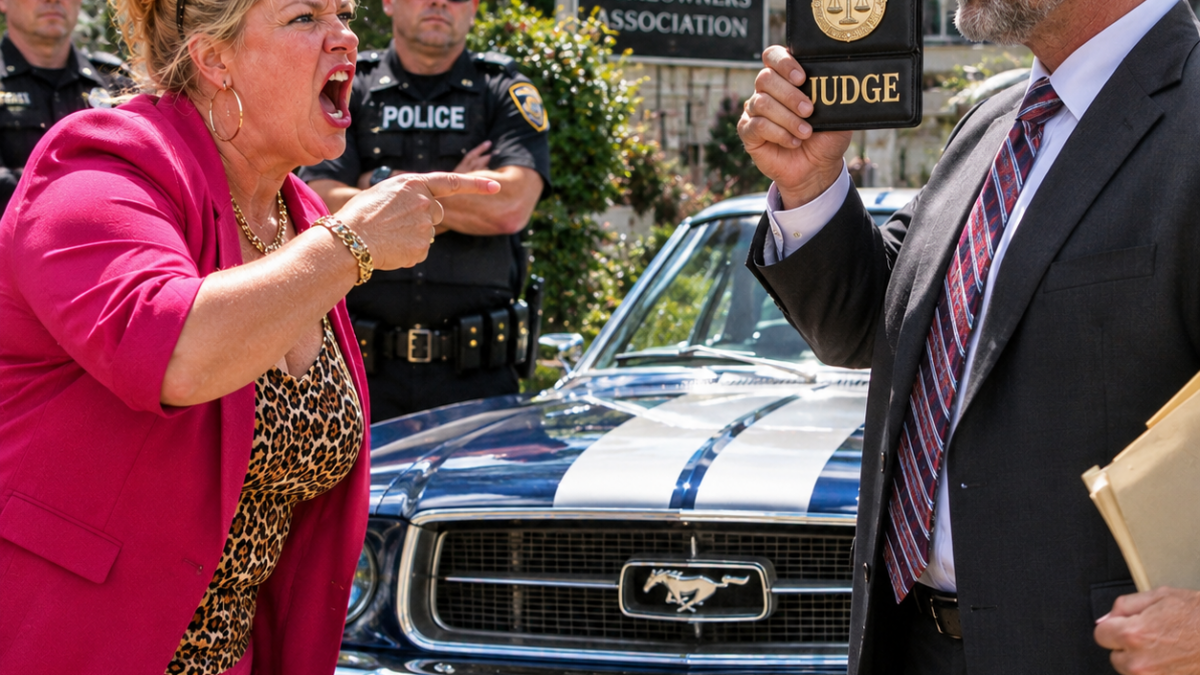
PART 2
One week later, the certified letter arrived.
The envelope was thick, white, and embossed with the Oakwood Estates logo in gold. It was the kind of stationery designed to make ordinary people believe something official had already happened before they even opened it.
I carried it into the kitchen and slit it carefully.
**OFFICIAL NOTICE OF VIOLATION.**
Community Standard 7.3.
Five-hundred-dollar fine.
Fourteen days to pay.
Failure to comply could allegedly result in vehicle removal, liens against my property, and legal proceedings.
At the bottom, in bold red letters:
**THIS NOTICE CONSTITUTES FORMAL LEGAL DOCUMENTATION AND MAY BE USED IN COURT PROCEEDINGS.**
I read that sentence twice.
Then I laughed.
Not because the situation was funny.
Because I had spent twenty-five years watching people misuse legal vocabulary as decoration.
The document looked intimidating.
That did not make it lawful.
There was no Community Standard 7.3 in my recorded covenants governing classic-car parking.
No recorded amendment created one.
No judicial order authorized anyone to take my car.
And an HOA could not manufacture police power by printing the word *enforcement* on a polo shirt.
But there was something else I had learned on the bench.
People running schemes rarely write documents for judges.
They write them for victims.
The goal is not to survive legal scrutiny.
The goal is to prevent legal scrutiny from ever happening.
You scare someone enough, they pay.
You threaten a lien, they pay.
You threaten towing, they pay.
You put a uniform at their door, they pay.
I placed the letter in a file.
Then I drove to the HOA office.
Gerald Ashworth met me five minutes later.
He was in his early sixties, silver-haired, deeply tanned, and wearing a golf shirt with the Oakwood Estates logo embroidered over his chest.
His office told me almost everything about him.
Photographs with local politicians.
Ribbon cuttings.
Charity events.
One framed newspaper clipping about rising property values.
He stood and extended his hand.
“Mrs. Vaughn.”
I shook it.
“Mr. Ashworth.”
“Please, sit.”
I placed the violation notice on his desk.
“I want to understand the legal basis for this.”
He barely glanced at it.
“Our community has standards.”
“I understand.”
“We adopted a supplemental enforcement code two years ago.”
“Recorded where?”
His smile shifted almost imperceptibly.
“It’s an internal governance document.”
“So it isn’t recorded.”
“The board has authority to implement reasonable compliance procedures.”
“May I have a copy?”
“It isn’t distributed generally.”
“Why?”
“Operational concerns.”
I leaned back.
“Mr. Ashworth, does your internal code authorize Vincent Drake to seize privately owned vehicles?”
He smiled again.
“We have arrangements with towing contractors when vehicles create safety or aesthetic concerns.”
“That wasn’t my question.”
The smile weakened.
“Vehicle removal is one available enforcement tool.”
“Authorized by whom?”
“The board.”
“Not a court?”
“The board.”
“Not law enforcement?”
“We don’t need law enforcement for internal community matters.”
There it was.
I had seen defendants give me the sentence that broke their own defense because they were too confident to recognize it.
I did not react.
Instead I asked:
“Who authorized Sentinel Compliance Services to exercise enforcement powers?”
“The contract is confidential.”
“Why?”
“Business reasons.”
I nodded.
“Thank you.”
His eyebrows lifted.
“That’s all?”
“For now.”
As I stood, Ashworth leaned back in his chair.
“One more thing, Mrs. Vaughn.”
I waited.
“Most residents find these disputes become expensive when they drag on.”
“Is that advice?”
“It’s experience.”
He folded his hands.
“Pay the five hundred. Put the car inside. Enjoy your retirement.”
I looked at him.
“You know I’m retired?”
“People talk.”
“Apparently.”
I walked toward the door.
His voice followed me.
“You seem like an intelligent woman.”
I turned.
“Then you should probably assume I read documents before paying them.”
For the first time, his smile disappeared.
I drove home and spent the afternoon doing the research I should have done before I bought the house.
Oakwood Estates had recorded CC&Rs.
Recorded amendments.
Board filings.
None of them contained Ashworth’s enforcement code.
None granted an HOA security contractor police powers.
None authorized private seizure of a vehicle from an owner’s driveway for an invented aesthetic violation.
Then I searched Sentinel Compliance Services.
The licensing information was even clearer.
Patrol.
Observation.
Reporting.
That was it.
Drake could observe a violation and report it to someone who actually had authority.
He could not create law.
He could not detain residents.
He could not seize property.
He could not transform a board’s internal policy into legal police authority.
That evening, Kenneth Nelson stopped by with a pair of pruning shears he had borrowed.
I asked him how long the enforcement patrols had existed.
“Three years, maybe.”
“Since Ashworth became president?”
“About then.”
“What was it like before?”
“Normal HOA nonsense.”
“Define normal.”
Kenneth smiled.
“Fence colors. Grass. People arguing about Christmas decorations.”
“And now?”
His smile vanished.
“People are scared.”
“Of Drake?”
“Of what happens if you fight.”
He sat at my kitchen table.
“At first, everyone liked the patrols. We thought they would keep package thieves out. Then the violations started.”
“What kind?”
“Everything.”
He counted on his fingers.
“Mailboxes. Trash cans. Vehicles. Basketball hoops. Landscaping. Flags.”
“People challenged them?”
“Some.”
“And?”
“More notices.”
He looked toward my driveway.
“One family was on vacation when their car disappeared.”
“Towed?”
“Yes.”
“How much?”
“More than three thousand by the time they returned.”
“Did they sue?”
“No.”
“They paid?”
“And moved.”
I let that sit.
Kenneth sighed.
“Eleanor, people have jobs. Families. Mortgages. They don’t want a war with their neighborhood.”
“I understand.”
“Do you?”
“Yes.”
I had seen that calculation thousands of times.
A guilty plea because trial was too expensive.
A settlement because litigation was exhausting.
A person surrendering a right not because the other side was correct, but because being correct cost more than they could afford.
After Kenneth left, I looked through the kitchen window at Dad’s Mustang.
The streetlight reflected across the cherry-red hood.
I could have ended my own problem easily.
Five hundred dollars.
Garage the car.
Pretend I had never met Frank Henderson.
Pretend Martha had never warned me.
Pretend Kenneth had never described frightened neighbors.
But I knew something now.
This was not about my Mustang.
My car was only the current target.
I opened the wooden box again.
My federal identification sat inside.
I touched the leather case.
Then closed it.
Still not yet.
I did not need authority.
I needed evidence.
Three days later, Vincent Drake came onto my property.
He brought another uniformed man.
His name tag read SIMMONS.
I was drinking coffee when their white SUV stopped in my driveway.
Neither man knocked.
They walked directly toward the Mustang.
Drake photographed it.
Simmons stretched a tape measure from the front bumper to the sidewalk.
I set down my coffee and stepped outside.
“Good morning.”
Drake straightened.
“Mrs. Vaughn.”
“You’re on private property.”
“Your compliance deadline has passed.”
“Does that authorize trespassing?”
His expression tightened.
“We have access rights for enforcement purposes.”
“Where?”
“In the enforcement code.”
“Which you still won’t show me.”
“You can make a formal records request.”
“I did.”
He looked at Simmons.
Then back at me.
“Your fine has escalated to one thousand dollars.”
“Based on what recorded covenant?”
“Mrs. Vaughn—”
“No. I’m asking a simple question.”
He lowered the clipboard.
“You seem determined to make this difficult.”
“I’m asking you to identify your authority.”
“We don’t have to debate every regulation with every homeowner.”
“Then tell me who told you that you can enter private residential property without consent.”
For the first time, he looked uncertain.
Only for a second.
“It’s all in the code.”
I almost told him what I knew.
That his license gave him no enforcement powers.
That the sheriff’s office had no agreement with the HOA.
That the recorded covenants did not contain the rule.
But judges learn patience.
You do not interrupt someone while they are building the case against themselves.
So I stepped aside.
“Finish whatever you’re documenting and leave.”
He blinked.
“You’re not going to interfere?”
“No.”
Suspicion moved across his face.
He had expected a confrontation.
Instead, he photographed the Mustang for another two minutes.
Simmons wrote measurements.
Across the street, Kenneth had stopped walking.
Martha stood on her porch.
Two more neighbors watched through windows.
Witnesses.
When Drake finally drove away, I went inside.
First call:
County sheriff’s administrative office.
I asked one question.
“Does Oakwood Estates HOA or Sentinel Compliance Services have any delegated law-enforcement authority from your department?”
The administrator checked.
“No.”
“Any authority to issue legal citations?”
“No.”
“Seize vehicles?”
“Absolutely not.”
“Can I get that in writing?”
“Yes.”
Second call:
State attorney general’s consumer protection division.
I described the pattern.
Fabricated violations.
Money demanded.
Property taken.
Uniformed security claiming powers they did not possess.
The intake specialist listened carefully.
“Do you have names?”
“Yes.”
“Documents?”
“A growing number.”
“Other victims?”
“I believe so.”
She assigned a case number.
I did not expect arrests.
I wanted a record.
I wanted it documented that before things escalated, I had gone through legitimate channels.
Then I installed cameras.
One above the garage.
One facing the driveway.
One covering the approach from the street.
Cloud backup.
Time stamps.
Nothing cinematic.
Nothing hidden for dramatic effect.
Just documentation.
Kenneth walked over while I was adjusting the last camera.
“You’re really fighting.”
“Yes.”
He looked at the phone in my hand.
“Frank Henderson might talk to you.”
“The man who lost the truck?”
“Yes.”
“Anyone else?”
“Margaret Cho.”
“What happened?”
“Fines.”
“How much?”
“Thousands.”
“Get me their numbers.”
Kenneth hesitated.
“What are you going to do with this?”
“The same thing I did for twenty-five years.”
“What?”
“Build the record before making the accusation.”
The sheriff’s email arrived that afternoon.
County letterhead.
Unambiguous language.
No HOA in the jurisdiction possessed law-enforcement powers.
Private security personnel could not issue government citations, seize private property, or represent themselves as peace officers.
I printed three copies.
Then Gerald Ashworth sent his neighborhood email.
The subject:
**PROTECTING OUR COMMUNITY STANDARDS.**
He never used my name.
He did not have to.
A “recent resident” was refusing “reasonable compliance.”
A “recent resident” was undermining neighborhood cohesion.
A “recent resident” was placing “personal convenience over collective values.”
I smiled sadly when I read it.
I had heard prosecutors call that language coded intimidation.
You do not accuse directly.
You create a social permission structure.
You tell people someone is dangerous.
Then let them choose the details.
I saved the email.
The next day, I met Frank Henderson.
Seventy-three.
Thin shoulders.
Careful movements.
His wife had limited mobility and regular medical appointments.
He showed me a receipt.
Two thousand dollars.
“What happened?”
“They took my truck.”
“From your driveway?”
“Yes.”
“Court order?”
Frank laughed without humor.
“I didn’t even know I owed anything.”
“What did Ashworth say?”
“That I had accumulated violations.”
“Which ones?”
“Parking. Maintenance. Something about my storage shed.”
“You received notices?”
“Maybe one.”
“Did you challenge it?”
“I tried.”
“What happened?”
“He told me if I wanted my truck, pay.”
Frank handed me a copy of the canceled check.
The payee line read:
**GERALD ASHWORTH.**
Not Oakwood Estates HOA.
Not Sentinel.
Gerald Ashworth personally.
I looked at Frank.
“Why did you write it to him?”
“He told me that was how expedited compliance payments were handled.”
“Did you think that was normal?”
“No.”
“Then why?”
His eyes filled with embarrassment.
“My wife had a cardiology appointment the next morning.”
That answered everything.
Margaret Cho showed me a similar pattern.
Fifty dollars became one hundred.
One hundred became three hundred.
Three hundred became fifteen hundred.
Every challenge produced another letter.
“It wasn’t about the money by the end,” she told me.
“What was it about?”
“Making them stop.”
David Ruiz’s case was worse.
His landscaping trailer had been taken.
Tools inside.
He paid three thousand dollars.
While he fought to recover his equipment, two customers canceled contracts.
“I almost lost my business.”
“Why didn’t you hire an attorney?”
“Ashworth told me I’d spend ten grand to recover three.”
He looked ashamed.
“I believed him.”
I photographed their documents.
Asked permission before recording notes.
Asked whether they would give sworn statements if necessary.
All three said yes.
When I returned home, a notice had been taped to my front door.
**FINAL WARNING — VEHICLE REMOVAL SCHEDULED WITHIN 24 HOURS.**
I stood there holding the paper.
Then I looked at the Mustang.
The car sat exactly where Dad used to leave it when he visited me years earlier.
I remembered him underneath it on a creeper, cursing at a stubborn bolt.
I remembered standing in his garage while he explained carburetors I did not understand.
I remembered the first time he let me drive it after restoration.
“Listen to the engine,” he had said.
“I am.”
“No, Ellie. Listen.”
He wanted me to hear when the machine was happy.
That was Dad.
Everything had a sound if you respected it enough.
The next morning, the Mustang made a different sound.
Metal chain against steel.
7:42 a.m.
The tow truck backed into my driveway.
Drake’s SUV behind it.
Another vehicle.
Drake stepped out with Simmons.
The tow operator began lowering equipment.
Nobody knocked.
Nobody asked.
Nobody produced a court order.
I activated recording on my phone before I opened the door.
Neighbors were already appearing.
Martha.
Kenneth.
Others.
Drake raised his hand when he saw me.
“Mrs. Vaughn, remain back.”
“This is my driveway.”
“This is an official enforcement action.”
“No.”
His eyebrows lifted.
“No?”
“You are trespassing on private property and attempting to remove a vehicle you do not own without judicial authorization.”
“Your violation notices provide sufficient authority.”
“They do not.”
“You’ve had multiple opportunities.”
“Stop the tow and leave.”
He shook his head.
“This is the consequence of noncompliance.”
The operator lowered chains.
One scraped along the Mustang.
The sound hit me harder than I expected.
For one second, I was not Judge Vaughn.
I was Dad’s daughter.
Watching strangers touch the car he had spent a decade restoring.
My instinct was to move toward them.
I stopped myself.
Evidence first.
I called 911.
“I need to report a theft in progress.”
The dispatcher asked for my address.
“Three men are attempting to remove my vehicle from my private driveway without permission or a court order.”
Drake heard me.
His face changed.
Only slightly.
The operator stopped moving.
Drake turned toward him.
“Continue.”
The man hesitated.
“She’s calling the cops.”
“The police know who we are.”
He looked at me.
“She’s bluffing.”
That statement went directly into my phone microphone.
Sirens arrived within minutes.
Drake heard them.
“Finish it,” he snapped.
The Mustang’s front wheels started rising.
That was the moment I stopped feeling angry.
I became very calm.
I had seen that calm before from the bench.
It comes when uncertainty ends.
Whatever argument Drake could have made before, he was now attempting to remove my property after being explicitly denied permission.
Two sheriff’s cruisers turned onto the street.
Deputies stepped out.
“Stop!”
The tow operator froze.
“Lower the vehicle.”
He obeyed immediately.
Drake walked toward the lead deputy.
“Officers, this is a routine HOA enforcement action.”
The sergeant looked at him.
“Stop talking for a second.”
Drake’s mouth closed.
“Lower the vehicle completely.”
The Mustang settled onto the driveway.
The sergeant turned to me.
“Is that your vehicle?”
“Yes.”
“Did you authorize the tow?”
“No.”
“Do they have a court order?”
“No.”
Then he looked at Drake.
“Show me your authority.”
Drake produced the yellow cards.
The notices.
The internal HOA documents.
The sergeant skimmed them.
“These are HOA papers.”
“They’re enforcement documents.”
“They’re not court orders.”
Drake straightened.
“Our enforcement code—”
The sergeant interrupted.
“Are you a peace officer?”
“No, but—”
“Do you have statutory authority to seize this car?”
“We’re contracted by the association.”
“That’s not what I asked.”
Drake’s confidence finally cracked.
The sergeant looked toward the tow driver.
“Unhook the chains.”
The man moved immediately.
Then the sergeant looked back at Drake.
“Until you can demonstrate legal authority, nobody is removing this vehicle.”
I continued recording.
My neighbors continued watching.
Drake stood in my driveway wearing a badge that suddenly looked like costume jewelry.
The sergeant’s name was Kevin Walsh.
He walked over to me.
“Mrs. Vaughn, can you tell me what led to this?”
I gave him the short version.
Fake vehicle rule.
Unrecorded enforcement code.
Escalating fines.
Trespass.
Threatened seizure.
Other residents’ vehicles taken.
Payments made to Gerald Ashworth personally.
Walsh’s expression changed.
“Other residents?”
“Yes.”
“How many?”
“I have three willing to make statements immediately.”
He looked at Drake.
“We’ve had complaints.”
“Formal?”
“Mostly calls.”
“Why no cases?”
“People paid.”
Exactly.
I said:
“I’m filing one.”
Walsh nodded.
“We’ll take it.”
Then he walked back to Drake.
“You are private security.”
Drake said nothing.
“You do not have police powers.”
Nothing.
“You are not to enter this property again or attempt to remove this vehicle absent lawful authorization.”
Drake’s jaw tightened.
“Do you understand?”
“Yes.”
Walsh looked toward the street.
“Leave.”
The convoy drove away.
No lights.
No dramatic music.
Just a tow truck leaving empty.
Kenneth crossed the street.
“I thought they were actually going to take it.”
“So did they.”
“What happens now?”
I looked at the Mustang.
A faint scrape marked the lower frame where the chain had touched.
I ran my fingers over it.
“Now the real investigation starts.”
Over the next three days, Frank, Margaret, and David gave formal statements.
They provided bank records.
That was when the financial pattern became impossible to ignore.
HOA dues went into HOA accounts.
Many “enforcement” payments did not.
They went to Ashworth.
Personally.
Frank’s two thousand.
Margaret’s fifteen hundred.
David’s three thousand.
Different dates.
Different violations.
Same recipient.
Kenneth obtained financial summaries through a records request.
The money was not reflected properly as HOA fine revenue.
I created a timeline.
Not because anyone had asked me to.
Because habits built over twenty-five years do not disappear when you retire.
Date.
Resident.
Alleged violation.
Amount demanded.
Amount paid.
Recipient.
Vehicle or property action.
Witnesses.
Supporting document.
The spreadsheet grew.
I met Detective Maria Santos after Walsh referred the case.
She sat at my dining-room table for two hours.
At first, she treated it like a complicated HOA dispute.
Then I showed her the bank records.
Her posture changed.
“Who collected this check?”
“Ashworth.”
“And this one?”
“Ashworth.”
“This?”
“Same.”
“How many?”
“Three confirmed victims so far.”
“Other allegations?”
“Yes.”
“Property seized?”
“Multiple.”
She looked at the tow footage.
Watched Drake instruct the operator to continue after I called police.
Then she replayed that section.
“He said the police know them?”
“Yes.”
Santos wrote something.
“This could be substantial.”
“I believe it is.”
“You understand investigations take time.”
“I do.”
“We need prosecutors before arrests.”
“I understand.”
I asked whether plainclothes deputies could attend the next HOA meeting.
Santos looked up.
“Why?”
“I’m going to present the evidence to residents.”
“That could become volatile.”
“I won’t confront anyone physically.”
“I know.”
“I want witnesses. I also think more victims may speak once they understand what happened.”
Santos considered it.
“I’ll see what I can arrange.”
The quarterly HOA meeting was five days away.
I registered for public comment.
Topic:
**Enforcement Procedures.**
That was all Ashworth would see.
Then I called Robert Callahan.
Robert and I had worked together for years before he moved to the circuit court.
He answered:
“Ellie.”
“Robert.”
“You sound like you’re about to ruin someone’s week.”
“I hope not.”
I explained.
He listened.
When I finished, he said:
“This is bigger than a parking dispute.”
“I know.”
“You’re considering showing credentials?”
“Yes.”
“Why?”
“Because they’ll try to characterize me as confused or vindictive.”
“They still might.”
“I know.”
“If you reveal who you are, your quiet retirement is over.”
“I know.”
“Press.”
“I know.”
“Calls.”
“I know, Robert.”
He went silent.
Then:
“You already decided.”
“Yes.”
“What changed?”
I looked through the window.
Frank Henderson was walking slowly toward Kenneth’s house.
Seventy-three years old.
Two thousand dollars lighter because he needed to take his wife to a cardiologist.
“I met the people they hurt.”
Robert sighed.
“Then do it carefully.”
“I always do.”
He laughed.
“Almost always.”
Friday evening, Detective Santos confirmed two plainclothes deputies would attend.
No promises of arrests.
No theatrical operation.
They would observe.
Document.
Act if legally necessary.
That was enough.
Saturday morning I dressed simply.
Dark slacks.
Blue jacket.
Comfortable shoes.
I placed my evidence folder in a bag.
Sheriff confirmation letter.
Licensing records.
Recorded covenants.
Victim statements.
Copies of checks.
Still images from the tow attempt.
The internal violation notices.
Then I picked up the leather credentials case.
I had carried it for decades.
In court, authority had never come from the badge itself.
It came from what the law entrusted me to do.
That distinction mattered.
I put it in my pocket.
The Mustang sat outside.
Dad’s car.
Still there.
I rested my hand on the roof.
“Patience,” I whispered.
That was his word.
Ten years restoring one automobile.
He understood patience better than anyone.
The community center was packed.
More than sixty residents.
Some stood against the walls.
Martha sat two rows behind me.
Kenneth near the back.
Frank.
Margaret.
David.
All present.
I spotted the plainclothes deputies near opposite exits.
Vincent Drake stood against a wall in uniform.
When he saw me, his face tightened.
Gerald Ashworth sat behind the board table.
He smiled.
That worried me less than if he had looked afraid.
A man who still smiles usually still believes he controls the room.
The meeting began at ten.
Budget.
Landscaping.
Painting.
A pool-maintenance issue.
Twenty minutes of ordinary business.
Then public comment.
Ashworth looked at his agenda.
“Mrs. Eleanor Vaughn.”
I stood.
“You have five minutes.”
I walked to the podium.
Placed my folder down.
Looked around the room.
“My name is Eleanor Vaughn.”
The room quieted.
“I moved here six months ago because I wanted a peaceful retirement.”
A few people glanced toward Ashworth.
“I did not find one.”
His smile remained.
I continued.
“I found a system that uses fabricated rules, uniforms, threats, and property seizures to collect money from residents who are afraid of fighting back.”
The first murmur moved through the room.
Ashworth leaned toward his microphone.
“Mrs. Vaughn, please remember—”
“I’ll stay within my time.”
He sat back.
I held up my original violation notice.
“This says my 1967 Mustang violated Community Standard 7.3.”
I looked toward residents.
“That standard does not exist in our recorded CC&Rs.”
Someone whispered:
“What?”
I placed copies of the recorded rules on the table.
“The so-called enforcement code cited by Mr. Drake was never recorded as an amendment.”
Ashworth spoke.
“It is an internal—”
I raised the sheriff’s letter.
“This comes from the county sheriff’s office.”
That stopped him.
“It confirms Oakwood Estates has no law-enforcement authority.”
The room changed.
Not dramatically.
But people sat differently.
Drake uncrossed his arms.
I continued.
“Sentinel Compliance Services is licensed for patrol and observation.”
I held up the licensing record.
“Not detention.”
“Not police enforcement.”
“Not private-property seizure.”
A man near the back called:
“Then how did they tow Frank’s truck?”
Frank looked down.
Ashworth raised his hand.
“Please.”
I said:
“That is an excellent question.”
I turned a page.
“Frank Henderson paid two thousand dollars to recover his vehicle.”
Frank stood.
Slowly.
He held up his receipt.
Ashworth’s smile disappeared.
I continued.
“Margaret Cho paid fifteen hundred dollars after escalating fines.”
Margaret stood.
“David Ruiz paid three thousand after his business trailer was seized.”
David stood.
Three residents.
Three receipts.
Three victims.
I looked directly at Ashworth.
“All three payments were made to Gerald Ashworth personally.”
Silence.
I had spent a career in courtrooms.
I knew silence had different forms.
Confusion has a sound.
Fear has a sound.
Recognition has a sound.
This was recognition.
A woman in front turned toward Ashworth.
“Gerald?”
He did not answer.
“Is that true?”
Another resident spoke.
“I paid a fine last year.”
Then another.
“So did I.”
A man stood.
“Mine was four hundred.”
Ashworth reached for the microphone.
“This is becoming disorderly.”
I said:
“No.”
Every eye returned to me.
“This is becoming documented.”
Drake stepped away from the wall.
“That’s enough.”
I looked at him.
“You attempted to seize my Mustang from my private driveway without a court order.”
“You were in violation.”
“You had no lawful authority.”
“This is an HOA matter.”
“Not anymore.”
His hand moved toward his utility belt.
Not a weapon.
Just instinct.
A gesture of authority.
Then Ashworth stood.
“This woman is defaming this board.”
His voice grew louder.
“These allegations are false.”
I waited until he finished.
Then reached into my jacket.
Removed the leather case.
Opened it.
“My name is Eleanor Vaughn.”
I held the identification where the room could see it.
“I served twenty-five years as a judge of the United States District Court.”
No one moved.
“I am retired with senior status.”
I lowered the credentials.
“I have presided over fraud cases.”
“Extortion cases.”
“Conspiracy cases.”
“Racketeering cases.”
Drake’s face changed first.
He looked toward the side exit.
Then at the plainclothes man beside it.
Understanding reached him one second too late.
He took a step.
The deputy moved.
“Sir.”
Drake stopped.
“I need you to remain inside.”
Ashworth stared at me.
“You’re retired.”
“Yes.”
“You have no authority over this HOA.”
“That is correct.”
His eyes flashed triumph for half a second.
Then I continued.
“And I never claimed I did.”
That wiped it away.
“I am here as a homeowner.”
“As a victim.”
“As a witness.”
“And as someone who knows the difference between actual authority and people dressing themselves to look like it.”
The room stayed silent.
“The sheriff’s office is investigating.”
I looked toward the residents.
“The attorney general’s consumer protection division has been notified.”
I placed the victim statements beside the checks.
“Law enforcement has copies of these records.”
Ashworth’s face drained.
Drake said:
“This is insane.”
One of the plainclothes deputies stepped forward.
“Mr. Drake.”
Everyone turned.
He identified himself.
Then the second deputy moved toward Ashworth.
The room erupted.
Not screaming.
Questions.
Chairs moving.
Residents standing.
Martha covered her mouth.
Kenneth simply watched.
The deputies did not stage some dramatic television arrest based solely on my speech.
They were there as part of an active investigation, and the evidence already collected had given them grounds for detention and further action.
That distinction mattered.
Reality is usually quieter than television.
But for Ashworth and Drake, the effect was the same.
The room they had controlled for three years no longer belonged to them.
Ashworth pointed at me.
“You planned this.”
“Yes.”
The honesty surprised him.
“You set us up.”
“No.”
I closed my folder.
“You set yourselves up.”
Drake started talking.
“I was following board policy.”
The deputy beside him said:
“Save it for your attorney.”
Ashworth looked around.
At Frank.
Margaret.
David.
Martha.
Kenneth.
Residents who had paid.
Residents who had stayed silent.
Residents who were silent no longer.
For the first time, nobody looked afraid of him.
The deputies escorted both men out.
Only after the doors closed did the room truly explode.
“How much money?”
“Who else paid?”
“What about my lien?”
“They towed my daughter’s car.”
“Is this why they wouldn’t show us the enforcement code?”
“Where are our records?”
I stepped away from the podium.
Martha reached me first.
“You’re a federal judge?”
“Was.”
“You never said.”
“I didn’t want it to matter.”
She stared at the door where Drake had disappeared.
“It mattered.”
“No.”
I shook my head.
“The documents mattered.”
“The witnesses mattered.”
“The bank records mattered.”
“My old job only made them finally listen before they could call me confused.”
Kenneth joined us.
“How long have you known?”
“That something was wrong?”
“Yes.”
“From the first time Drake said an internal code superseded recorded covenants.”
Kenneth laughed.
“I thought you were just stubborn.”
“I am that too.”
Forty-eight hours later, Detective Santos called.
The district attorney had elevated the investigation.
More importantly, neighbors started reporting.
The silence broke.
Three victims became eight.
Eight became fourteen.
By the end of the first week, twenty-three families had come forward.
Fines.
Threatened liens.
Towed cars.
Invented violations.
Personal checks.
Cash payments.
The total documented amount exceeded forty-seven thousand dollars.
And that was only what investigators could prove quickly.
Drake broke first.
His attorney contacted prosecutors.
He wanted cooperation credit.
His interview exposed the structure.
Gerald Ashworth had not simply hired overzealous security guards.
According to Drake and later-recovered records, Ashworth had designed the program.
Harold Sims and Patricia Vance, two board members, knew much more than residents realized.
They approved portions of the internal enforcement system.
Money moved through accounts residents had never been shown.
Some payments were divided.
Some were routed.
Emails discussed targets.
One message referred to Frank Henderson’s payment.
**Henderson situation resolved nicely.**
When Santos showed me that line, I felt physically sick.
Frank had paid because his wife needed medical care.
To them, his fear was a “situation” that had “resolved nicely.”
Another email discussed Margaret Cho.
She was called “persistent.”
The recommended response:
**Increase compliance pressure until nuisance objections stop.**
That was the entire strategy in six words.
Wear people down.
Then investigators found something even larger.
Ashworth had advised leaders in neighboring communities.
Templates.
Violation language.
Towing arrangements.
Collection strategies.
Drake described it as “consulting.”
Prosecutors described it differently.
The charges multiplied.
Ashworth faced fraud.
Extortion.
Theft by deception.
Conspiracy.
False lien allegations.
Drake faced impersonation-related and property crimes, though cooperation reduced his exposure.
Sims and Vance were pulled into the case through emails and financial records.
The state froze accounts connected to Ashworth.
More than sixty thousand dollars in deposits could not immediately be tied to legitimate income.
I testified during preliminary proceedings.
It felt strange being on the other side.
For twenty-five years, I had sat above everyone.
Now I sat in the witness chair.
My former title did not matter there.
My testimony did.
The defense tried to suggest I had engineered the whole situation.
One attorney asked:
“Judge Vaughn, you knew more about criminal law than the average homeowner, correct?”
“Yes.”
“You understood how to create evidence.”
“I understood how to preserve it.”
“You installed cameras anticipating a confrontation.”
“I installed cameras after private security trespassed on my property.”
“You allowed them to continue enforcement actions.”
“I told them repeatedly to stop.”
“You could have revealed your judicial status earlier.”
“Yes.”
“But chose not to.”
“Yes.”
“Why?”
“Because being a retired federal judge does not give me more property rights than Frank Henderson.”
The courtroom became very still.
I continued.
“If their conduct was illegal when directed at me, it was illegal when directed at him.”
The prosecutor did not need to rescue me.
The defense moved on.
Media coverage came next.
I hated it.
**RETIRED FEDERAL JUDGE EXPOSES HOA ENFORCEMENT SCHEME**
Cameras outside court.
Interview requests.
Television trucks.
I declined every invitation.
I did not want to become the story.
The story was Frank.
Margaret.
David.
Twenty other families.
People who had been right without possessing credentials that made strangers instantly take them seriously.
Still, publicity did something useful.
People in neighboring communities recognized the pattern.
They came forward.
Two additional investigations opened.
Ashworth’s “consulting” network began collapsing.
Back in Oakwood Estates, residents had to decide what remained after the men who claimed to protect the community were gone.
An emergency meeting was called.
This one felt different.
No uniforms at the doors.
No Ashworth at the podium.
No Drake standing against the wall.
Martha Reed was nominated interim president.
She looked horrified.
“No.”
Half the room laughed.
Kenneth said:
“That is the strongest qualification anyone has had in years.”
Martha glared at him.
Then accepted.
Her first statement lasted less than a minute.
“I don’t want power.”
She looked around.
“I want records.”
Applause.
Kenneth volunteered to review past assessments.
Every fine issued during Ashworth’s tenure.
Every lien.
Every towing action.
Every payment.
The committee found violations that made no sense.
Rules that had never existed.
Rules that had been changed without proper notice.
Violations issued selectively.
Fees applied inconsistently.
Some residents owed legitimate dues.
Those stayed.
Fraudulent assessments were reversed.
False liens were challenged and removed.
The community learned something painful:
Cleaning corruption is slower than discovering it.
You can expose a lie in five minutes.
Undoing three years of consequences takes months.
The criminal case moved toward trial.
Ashworth resisted plea negotiations longer than everyone else.
That did not surprise me.
Control had been his defining habit.
A plea requires accepting that someone else determines the outcome.
Drake agreed to cooperate.
His testimony connected financial records to the internal enforcement operation.
Sims and Vance faced their own charges and turned on Ashworth.
One by one, the people surrounding him chose self-preservation.
The organization he built around loyalty dissolved the moment loyalty became expensive.
Kenneth visited one evening.
I was waxing the Mustang.
He leaned against the garage.
“You know normal retired people play golf.”
“I dislike golf.”
“They travel.”
“I dislike airports.”
“They don’t dismantle criminal conspiracies before lunch.”
“That wasn’t before lunch.”
He smiled.
Then became serious.
“Why didn’t you pay?”
I looked at Dad’s car.
There was still a faint mark underneath where the tow chain had touched it.
I had decided not to repair that immediately.
Part of me wanted the reminder.
“I could have.”
“I know.”
“Five hundred dollars would have been cheaper.”
“Much.”
“I could have garaged the car.”
“Yes.”
I ran the cloth over the hood.
“But then Frank still paid two thousand.”
Kenneth nodded.
“Margaret still got threatened.”
“David still lost contracts.”
I stepped back.
“And the next person would have paid.”
Kenneth looked toward his own house.
“So you did it for them?”
“No.”
I thought about that.
“I started because of the Mustang.”
“That honest?”
“Yes.”
I smiled.
“I’m not a saint.”
“But?”
“But once I knew what was happening, walking away became a choice too.”
He nodded slowly.
“Bullies only stop when someone stops them.”
“That’s usually true.”
“And this time you were someone.”
“This time.”
The main case never reached the dramatic four-week jury trial journalists hoped for.
The evidence was too strong.
Ashworth eventually pleaded guilty to eight of twelve counts.
At sentencing, eleven families gave victim-impact statements.
Frank went first.
He walked slowly to the podium.
Ashworth sat at the defense table.
Frank unfolded a piece of paper.
Then folded it again.
“I wrote something.”
He looked toward the judge.
“But I don’t think I need it.”
He turned slightly toward Ashworth.
“My wife was sick.”
Ashworth stared at the table.
“You knew that.”
Frank’s voice shook.
“You knew I needed that truck to take her to appointments.”
Silence.
“And you still made me pay you two thousand dollars for something that was already mine.”
He paused.
“I thought I was weak for paying.”
His voice broke.
“My wife told me I wasn’t.”
Frank looked at the judge again.
“She said taking care of her mattered more than winning an argument.”
He wiped his eyes.
“She died before I got the money back.”
My throat tightened.
That detail had not been in any file.
Frank continued.
“So I don’t care about the two thousand anymore.”
He looked at Ashworth.
“I want you to understand that what you took from people wasn’t just money.”
No one in the courtroom moved.
Frank returned to his seat.
I reached over and squeezed his hand.
The judge sentenced Gerald Ashworth to eight years in state prison.
Full restitution from recoverable seized assets.
Permanent prohibition from serving in fiduciary positions covered by the judgment.
Ashworth stood motionless.
No final speech.
No polished explanation.
No smiling photograph with politicians behind him.
Just a man hearing the consequences of decisions he had spent years convincing himself were untouchable.
Vincent Drake received five years after cooperation reduced his sentence.
The uniform disappeared.
The fake authority disappeared.
He was left with the one thing he had spent years avoiding.
Real accountability.
Sims and Vance received suspended prison terms, probation, community service, and permanent public records tying their names to the fraud.
Restitution took longer.
Forensic accountants traced transactions one payment at a time.
Frank received his two thousand dollars.
He deposited it into the account he had once shared with his wife.
Margaret got fifteen hundred back.
David received three thousand and documents clearing the fraudulent lien connected to his property.
Other families received restitution based on proven losses.
No check restored the sleepless nights.
But the payments mattered.
They said:
You were not imagining it.
You did not deserve it.
What was taken from you counted.
Oakwood Estates held its first legitimate election in years that autumn.
Martha Reed ran for president.
She claimed I had talked her into it.
I denied everything.
She won with seventy-three percent of the vote.
Kenneth became treasurer.
The new bylaws were rewritten around transparency.
No enforcement without a documented covenant violation.
No fine without written notice and an opportunity to respond.
No property seizure based merely on an internal board rule.
Quarterly financial reports.
Annual independent audits.
Open records.
Clear appeal procedures.
And the “HOA enforcement code” was abolished.
Sentinel Compliance’s white SUV was sold.
The navy uniforms disappeared.
Kenneth later told me somebody donated a box of them to a community theater.
“What are they using them for?” I asked.
“A comedy.”
I laughed for almost a minute.
Sometimes justice does have a sense of humor.
I returned to retirement.
Mostly.
I grew tomatoes.
Read novels.
Learned how bad I was at watercolor painting.
Martha still brought flowers.
Kenneth still borrowed tools and returned them three days later than promised.
Frank occasionally came by for coffee.
And Dad’s Mustang remained in the driveway.
Nobody ever cited it again.
The first time I took it for a long drive after sentencing, I chose the country road Dad loved.
Windows down.
Cool air.
The V8 humming underneath me.
For several miles, I said nothing.
Then I started talking to him.
I had not done that since the funeral.
“You would’ve hated those chains.”
The engine answered in its own language.
“I know.”
I smiled.
“You would’ve told me to shoot somebody.”
Then I shook my head.
“No, you wouldn’t.”
Dad had owned guns.
He had also been the calmest man I knew.
He would have told me exactly what I told frightened witnesses in court for years.
Do it right.
Do not give the other side a reason to make your behavior the issue.
I drove until sunset.
When I returned, Martha was standing near my mailbox.
“You’re smiling.”
“Am I?”
“Yes.”
“That seems invasive.”
“You’ll survive.”
She looked at the Mustang.
“Your father restored that?”
“Ten years.”
“That long?”
“He rebuilt anything he didn’t like.”
“Perfectionist?”
“Impossible man.”
She smiled.
“You miss him.”
“Every day.”
Martha touched my arm.
Then went home.
A few weeks later, I received a letter from a state bar organization helping residents facing HOA disputes.
They were creating a pro bono advisory program.
Would I consult?
My first instinct was no.
I had retired for a reason.
Then I thought about Frank.
Not his money.
His face when he admitted his wife had died before restitution arrived.
I thought about Margaret saying they had paid simply to make the letters stop.
David believing he could not afford to fight.
People in neighboring communities seeing our case on television and realizing they were not alone.
I accepted.
Not as a judge.
Not even primarily as a lawyer.
As somebody who could sit across from frightened homeowners and say:
“Show me the document.”
That became my favorite question.
Not:
“Who has the bigger badge?”
Not:
“Who sounds more official?”
Not:
“Who sent the scariest letter?”
Show me the document.
Show me where the authority comes from.
Show me the recorded covenant.
Show me the vote.
Show me the invoice.
Show me the court order.
Show me where the money went.
Bad systems survive on assumptions.
Transparency is remarkably destructive to them.
Six months after Ashworth was sentenced, I saw him on television.
Prison transfer.
Handcuffs.
Corrections officers.
He looked older.
Smaller.
The reporter mentioned an unsuccessful request for early relief.
I turned the television off.
I did not feel triumphant.
That surprised me.
For months, I had imagined the moment these people finally understood they could not bully everyone forever.
But when it came, there was no victory rush.
Only quiet.
I went outside.
The Mustang sat in the driveway under the evening light.
I opened the driver’s door.
Sat behind the wheel.
Dad’s old steering wheel beneath my hands.
The same cracked leather on one small section.
The same faint smell of oil and vinyl that no restoration could remove.
I remembered the morning the tow truck came.
The chains.
Drake telling me it was an “official enforcement action.”
The confidence in his voice.
The assumption that nobody would stop him.
Then I remembered the sheriff telling him:
“These are internal HOA documents. They don’t authorize property seizure.”
That was the entire story in one sentence.
The difference between real authority and invented authority.
It is easy to confuse the two when invented authority has a uniform.
A badge.
Letterhead.
A board vote.
A title.
A white SUV with yellow lights.
But lawful power has a source.
Limits.
Procedure.
Accountability.
Ashworth forgot that.
Drake never learned it until the day actual deputies stood in my driveway.
I had spent twenty-five years wearing a different kind of authority.
People stood when I entered court.
They called me “Your Honor.”
Marshals guarded the room.
My signature could send a person to prison.
That kind of power teaches you something, if you let it.
The most important part of authority is not how much you have.
It is knowing where it ends.
Ashworth never understood that.
Neither did Drake.
They thought authority meant nobody could say no.
Real law is full of no.
No, you cannot seize property because you invented a policy.
No, you cannot threaten people with liens unsupported by governing documents.
No, you cannot impersonate powers your license does not grant.
No, you cannot take money personally and call it an HOA fine.
No, you cannot wear residents down until theft becomes easier than resistance.
The badge in my pocket did not defeat them.
Their own conduct did.
The badge merely made them understand, all at once, that the woman they expected to intimidate knew exactly what their conduct meant.
Months later, Frank came to my house.
He carried a small box.
“What’s this?”
“Open it.”
Inside was a model car.
A red 1967 Mustang.
White racing stripes.
I laughed.
“Frank.”
“Found it at a flea market.”
“You didn’t have to do this.”
“I know.”
I held the little car.
He looked toward the real Mustang.
“My wife liked red cars.”
I looked at him.
He smiled sadly.
“She would’ve loved yours.”
We sat on the porch.
He told me about her.
Forty-eight years married.
She hated hospitals.
Loved crossword puzzles.
Never let him fold laundry because he “did it like a man who had never seen a shirt before.”
He laughed.
Then went quiet.
“Those people made the last year harder than it needed to be.”
“I’m sorry.”
“You stopped them.”
“We stopped them.”
Frank looked skeptical.
“I paid them.”
“You testified.”
“After you did the hard part.”
“No.”
I shook my head.
“The hard part was standing up when you were already tired.”
He stared into his coffee.
“Maybe.”
Then he said:
“I wish she had seen the money come back.”
I had no answer.
Some losses do not fit into legal remedies.
That was another lesson my years on the bench had taught me.
Justice cannot reverse time.
It can only acknowledge what happened and stop it from continuing.
When Frank left, I put the model Mustang on my bookshelf.
It still sits there.
Not in my old chambers.
In my house.
A reminder that the case was never truly about a car.
One autumn morning, almost two years after I moved to Oakwood Estates, I walked outside with coffee.
Martha was watering flowers.
Kenneth was arguing with a sprinkler.
A delivery truck rolled slowly past.
Children waited for a school bus.
Nobody watched the street for a white SUV with yellow lights.
Nobody checked their mailbox expecting threats.
The quiet I had moved here seeking finally existed.
But it felt different than I once imagined.
I used to think peace meant the absence of conflict.
Now I understood that sometimes peace is what remains after people finally refuse to live under fear.
I finished my coffee and walked toward the Mustang.
The cherry-red paint caught the morning sun.
Dad would have found something wrong with it.
A fingerprint.
Dust near the wheel well.
A spot I had missed polishing.
I opened the door.
On the passenger seat sat my leather credentials case.
I had carried it to an advisory meeting the previous afternoon and forgotten to put it away.
I picked it up.
For a second, I remembered sixty people in the community center going silent when I opened it.
I remembered Drake freezing.
Ashworth’s face losing color.
People later called that the moment I defeated them.
They were wrong.
The case had been won before that.
When Frank kept his receipt.
When Margaret saved her letters.
When David preserved the lien documents.
When Kenneth connected us.
When Martha warned me.
When the sheriff’s office put its answer in writing.
When the cameras captured the tow truck.
When Santos opened an investigation.
When victims finally spoke to one another.
That is how operations like Ashworth’s collapse.
Not because one important person appears.
Because isolated people stop being isolated.
I carried the credentials inside.
Placed them back in the wooden box.
Closed the lid.
Then returned to the Mustang.
No badge.
No robe.
No courtroom.
Just Eleanor.
I started the engine.
The V8 settled into that deep rhythm Dad loved.
I sat there listening.
Really listening.
Then I smiled.
“All right, Dad.”
I backed out.
The car that men wearing fake authority once tried to take from me rolled freely down Oakwood Estates.
Martha waved.
Kenneth raised a hand.
Frank’s little model Mustang waited on my shelf.
Twenty-three families had received restitution.
The fraudulent enforcement system was gone.
The books were open.
The rules were public.
The white patrol SUV was history.
And people who once lowered their voices when discussing the HOA now asked questions openly at meetings.
I had come to Oakwood Estates because I wanted to disappear quietly into retirement.
Instead, I learned that sometimes the final responsibility of a career is recognizing when the skills you spent decades developing are needed one more time.
Dad used to say anything worth having was worth protecting.
For years, I thought he meant cars.
He did not.
He meant what they represent.
Work.
Memory.
Dignity.
The right to keep what is yours without being frightened into surrendering it.
I turned onto the country road and let the Mustang stretch its legs.
The morning opened ahead of me.
No tow truck.
No uniforms.
No threats.
Just the engine, the road, and a red car my father had loved enough to spend ten years putting back together.
For the first time since I arrived at Oakwood Estates, I was not driving away from a fight.
I was simply driving.
And that was exactly the kind of peace I had wanted all along.
[END OF STORY]








